


IEC TR 60825-9:1999
(Main)Safety of laser products - Part 9: Compilation of maximum permissible exposure to incoherent optical radiation
General Information
- Abstract
Provides guidance for the protection of persons from incoherent optical radiation in the wavelength range from 180nm to 1 mm by indicating safe levels of optical radiation which are believed to be safe for most individuals in the sense that exposure at or below these levels will create no adverse effects.
- Status
- Replaced
- Publication Date
- 28-Oct-1999
- Technical Committee
- TC 76 - Optical radiation safety and laser equipment
- Drafting Committee
- WG 9 - TC 76/WG 9
- Current Stage
- WPUB - Publication withdrawn
- Start Date
- 02-May-2014
- Completion Date
- 28-Aug-2026

Relations
- Effective Date
- 05-Sep-2023
- Replaced By
IEC 60825-1:2007 - Safety of laser products - Part 1: Equipment classification and requirements - Effective Date
- 05-Sep-2023
Frequently Asked Questions
IEC TR 60825-9:1999 is a technical report published by the International Electrotechnical Commission (IEC). Its full title is "Safety of laser products - Part 9: Compilation of maximum permissible exposure to incoherent optical radiation". This standard covers: Provides guidance for the protection of persons from incoherent optical radiation in the wavelength range from 180nm to 1 mm by indicating safe levels of optical radiation which are believed to be safe for most individuals in the sense that exposure at or below these levels will create no adverse effects.
Provides guidance for the protection of persons from incoherent optical radiation in the wavelength range from 180nm to 1 mm by indicating safe levels of optical radiation which are believed to be safe for most individuals in the sense that exposure at or below these levels will create no adverse effects.
IEC TR 60825-9:1999 is classified under the following ICS (International Classification for Standards) categories: 31.260 - Optoelectronics. Laser equipment. The ICS classification helps identify the subject area and facilitates finding related standards.
IEC TR 60825-9:1999 has the following relationships with other standards: It is inter standard links to IEC TR 60825-14:2004, IEC 60825-1:2007. Understanding these relationships helps ensure you are using the most current and applicable version of the standard.
IEC TR 60825-9:1999 is available in PDF format for immediate download after purchase. The document can be added to your cart and obtained through the secure checkout process. Digital delivery ensures instant access to the complete standard document.
Standards Content (Sample)
TECHNICAL IEC
REPORT
TR 60825-9
First edition
1999-10
Safety of laser products –
Part 9:
Compilation of maximum permissible exposure
to incoherent optical radiation
Sécurité des appareils à laser –
Partie 9:
Exposition maximale admissible au rayonnement
lumineux incohérent
Reference number
IEC/TR 60825-9:1999(E)
Numbering
As from 1 January 1997 all IEC publications are issued with a designation in the
60000 series.
Consolidated publications
Consolidated versions of some IEC publications including amendments are
available. For example, edition numbers 1.0, 1.1 and 1.2 refer, respectively, to the
base publication, the base publication incorporating amendment 1 and the base
publication incorporating amendments 1 and 2.
Validity of this publication
The technical content of IEC publications is kept under constant review by the IEC,
thus ensuring that the content reflects current technology.
Information relating to the date of the reconfirmation of the publication is available
in the IEC catalogue.
Information on the subjects under consideration and work in progress undertaken
by the technical committee which has prepared this publication, as well as the list
of publications issued, is to be found at the following IEC sources:
• IEC web site*
•
Catalogue of IEC publications
Published yearly with regular updates
(On-line catalogue)*
• IEC Bulletin
Available both at the IEC web site* and as a printed periodical
Terminology, graphical and letter symbols
For general terminology, readers are referred to IEC 60050: International
Electrotechnical Vocabulary (IEV).
For graphical symbols, and letter symbols and signs approved by the IEC for
general use, readers are referred to publications IEC 60027: Letter symbols to be
used in electrical technology, IEC 60417: Graphical symbols for use on equipment.
Index, survey and compilation of the single sheets and IEC 60617: Graphical symbols
for diagrams.
* See web site address on title page.
TECHNICAL IEC
REPORT
TR 60825-9
First edition
1999-10
Safety of laser products –
Part 9:
Compilation of maximum permissible exposure
to incoherent optical radiation
Sécurité des appareils à laser –
Partie 9:
Exposition maximale admissible au rayonnement
lumineux incohérent
IEC 1999 Copyright - all rights reserved
No part of this publication may be reproduced or utilized in any form or by any means, electronic or
mechanical, including photocopying and microfilm, without permission in writing from the publisher.
International Electrotechnical Commission 3, rue de Varembé Geneva, Switzerland
Telefax: +41 22 919 0300 e-mail: inmail@iec.ch IEC web site http://www.iec.ch
Commission Electrotechnique Internationale
PRICE CODE
X
International Electrotechnical Commission
For price, see current catalogue
– 2 – TR 60825-9 © IEC:1999(E)
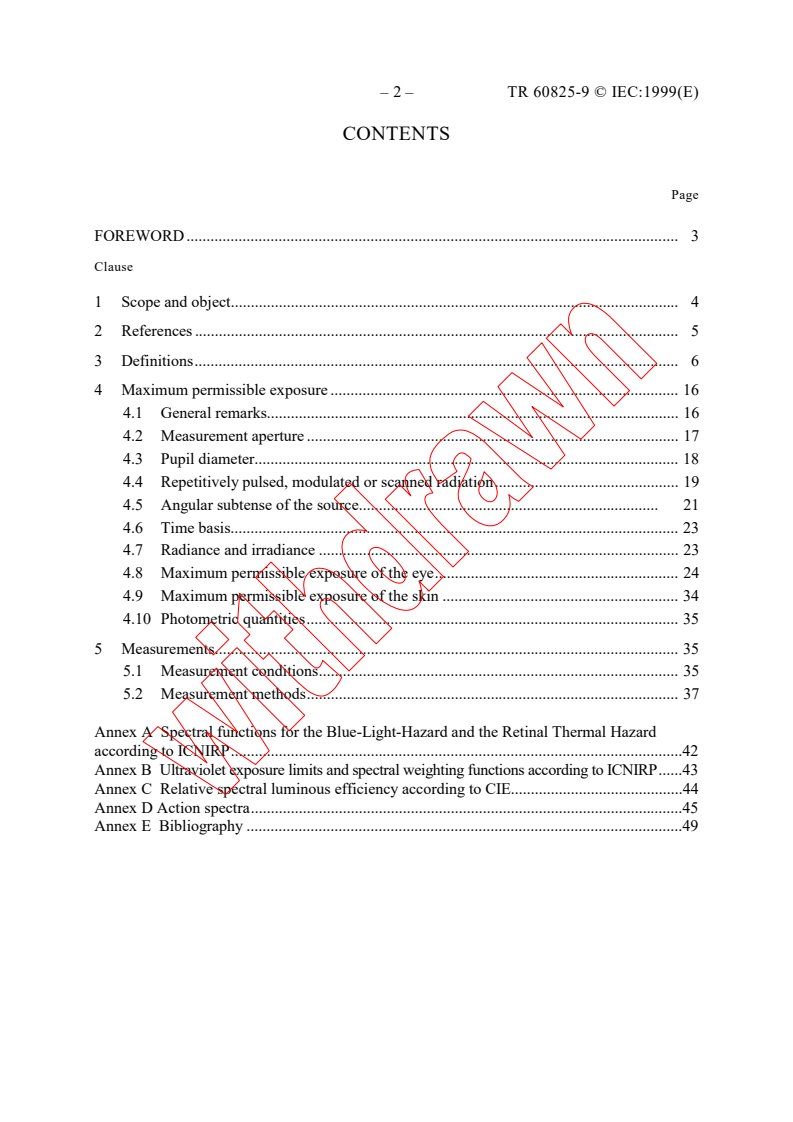
CONTENTS
Page
FOREWORD . 3
Clause
1 Scope and object. 4
2 References . 5
3 Definitions. 6
4 Maximum permissible exposure . 16
4.1 General remarks. 16
4.2 Measurement aperture . 17
4.3 Pupil diameter. 18
4.4 Repetitively pulsed, modulated or scanned radiation. 19
4.5 Angular subtense of the source. 21
4.6 Time basis. 23
4.7 Radiance and irradiance . 23
4.8 Maximum permissible exposure of the eye. 24
4.9 Maximum permissible exposure of the skin . 34
4.10 Photometric quantities. 35
5 Measurements. 35
5.1 Measurement conditions. 35
5.2 Measurement methods. 37
Annex A Spectral functions for the Blue-Light-Hazard and the Retinal Thermal Hazard
according to ICNIRP.42
Annex B Ultraviolet exposure limits and spectral weighting functions according to ICNIRP.43
Annex C Relative spectral luminous efficiency according to CIE.44
Annex D Action spectra.45
Annex E Bibliography .49
TR 60825-9 © IEC:1999(E) – 3 –
INTERNATIONAL ELECTROTECHNICAL COMMISSION
____________
SAFETY OF LASER PRODUCTS –
Part 9: Compilation of maximum permissible exposure
to incoherent optical radiation
FOREWORD
1) The IEC (International Electrotechnical Commission) is a worldwide organization for standardization comprising
all national electrotechnical committees (IEC National Committees). The object of the IEC is to promote
international co-operation on all questions concerning standardization in the electrical and electronic fields. To
this end and in addition to other activities, the IEC publishes International Standards. Their preparation is
entrusted to technical committees; any IEC National Committee interested in the subject dealt with may
participate in this preparatory work. International, governmental and non-governmental organizations liaising
with the IEC also participate in this preparation. The IEC collaborates closely with the International Organization
for Standardization (ISO) in accordance with conditions determined by agreement between the two organizations.
2) The formal decisions or agreements of the IEC on technical matters express, as nearly as possible, an
international consensus of opinion on the relevant subjects since each technical committee has representation
from all interested National Committees.
3) The documents produced have the form of recommendations for international use and are published in the
form of standards, technical specifications, technical reports or guides and they are accepted by the National
Committees in that sense.
4) In order to promote international unification, IEC National Committees undertake to apply IEC International
Standards transparently to the maximum extent possible in their national and regional standards. Any
divergence between the IEC Standard and the corresponding national or regional standard shall be clearly
indicated in the latter.
5) The IEC provides no marking procedure to indicate its approval and cannot be rendered responsible for any
equipment declared to be in conformity with one of its standards.
6) Attention is drawn to the possibility that some of the elements of this technical report may be the subject of
patent rights. The IEC shall not be held responsible for identifying any or all such patent rights.
The main task of IEC technical committees is to prepare International Standards.
However, a technical committee may propose the publication of a technical report when
it has collected data of a different kind from that which is normally published as an
International Standard, for example "state of the art".
Technical reports do not necessarily have to be reviewed until the data they provide are
considered to be no longer valid or useful by the maintenance team.
IEC 60825-9, which is a technical report, has been prepared by IEC technical
committee 76: Optical radiation safety and laser equipment.
The text of this technical report is based on the following documents:
Enquiry draft Report on voting
76/171/CDV 76/204/RVC
Full information on the voting for the approval of this technical report can be found in
the report on voting indicated in the above table.
This publication has been drafted in accordance with the ISO/IEC Directives, Part 3.
This document which is purely informative is not to be regarded as an International Standard.
– 4 – TR 60825-9 © IEC:1999(E)
SAFETY OF LASER PRODUCTS –
Part 9: Compilation of maximum permissible exposure
to incoherent optical radiation
1 Scope and Object
This Technical Report reconciles current Maximum Permissible Exposure
(MPE) values for the exposure of the human eye and skin to incoherent
optical radiation from artificial sources in the wavelength range from
180 nm to 3000 nm with the ultimate goal of harmonisation. Exposure
limits between 3000 nm and 1 mm wavelength are currently undefined.
These values are based on the best available information from experimental
studies and should be used only as guides in the control of exposure to
radiation from artificial sources and should not be regarded as a precise
line between safe and dangerous levels.
NOTE The values of this report are applicable to most individuals, however, some
individuals may be hypersusceptible or otherwise unusually responsive to optical radiation
because of genetic factors, age, personal habits (smoking, alcohol, or other drugs), medication,
or previous exposures. Such individuals may not be adequately protected from adverse health
effects from exposure to optical radiation at or below the maximum permissible exposure
values of this report. Medical advise should be sought to evaluate the extent to which
additional protection is needed.
These values were mainly developed for exposure to artificial sources.
They may also be used for the evaluation of exposure to sunlight.
The MPE values should not be applicable to exposure of patients to optical
radiation for the purpose of medical treatment.
Maximum permissible exposure values for the exposure to radiation from
laser sources are defined in IEC 60825-1.
NOTE 1 Basic documents of this report were IEC 60825-1 (addressing lasers) and the
IRPA/ICNIRP Guidelines (addressing incoherent sources). ACGIH limits are slightly different
in wavelength ranges and in limit values.
NOTE 2 In spite of the fact that LEDs emit mainly incoherent radiation they are currently
dealt with in IEC 60825-1.
TR 60825-9 © IEC:1999(E) – 5 –
NOTE 3 There are no damage mechanisms which are known to be different for coherent and
incoherent sources. However, in many cases the limit values in IEC 60825-1 are more
conservative than the values in this report. This is especially true in wavelength regions where
no lasers were available when IEC 60825-1 was originally developed.
NOTE 4 Exposures to levels at the MPE values given may be uncomfortable to view or feel
upon the skin.
NOTE 5 In the UV-B and UV-C spectral ranges the MPE values approach the radiant
exposures producing minimally detectable biological changes in the surface corneal cells.
Levels producing harmful effects are 2 to 3 times greater.
1.1 The object of this technical report is to provide guidance for the
protection of persons from incoherent optical radiation in the wavelength
range from 180 nm to 1 mm by indicating safe levels of optical radiation
which are believed to be safe for most individuals in the sense that
exposure at or below these levels will create no adverse effects. Because
only limited knowledge exists about the effects of a long-term exposure,
most MPEs are based on acute effects of the optical radiation exposure
during an eigth hours work day.
1.2
To provide procedures and methods how the level of optical radiation
should be measured and evaluated for the purpose of comparison with the
maximum permissible exposure.
2 Reference documents
IEC 60050(845):1987, International Electrotechnical Vocabulary –
Chapter 845: Lighting
Safety of laser products – Part 1: Equipment
IEC 60825-1:1993,
classification, requirements and user’s guide
*
Amendment 1:1997
ISO 1000:1992, SI units and recommendations for the use of their
multiples and of certain other units
ISO 11145:1994, Optics and optical instruments – Lasers and laser-
related equipment – Vocabulary and symbols
ISO/IEC Guide 51:1997, Safety aspects – Guidelines for their inclusion in
standards
__________
*
There is a consolidated edition 1.1 (1998) that includes IEC 60825-1 (1993) and its amendment 1 (1997).
– 6 – TR 60825-9 © IEC:1999(E)
3 Definitions
For the purposes of this report, the following definitions apply.
Basic definitions are given in ISO 1000:1992, ISO 11145:1994 and
IEC 60050(845):1987. Some of these definitions are repeated, as well as
some definitions from IEC 60825-1 and from ISO/IEC Guide 51.
Departures from the basic documents are intentional.
(In the following, → means “see”)
3.1
angular magnification M
→
angular magnification M of an optical instrument is the ratio of the
visual angle subtended by the object with the instrument (α )
instr
to the visual angle subtended at the eye by the object without the ins-
trument (α )
eye
α
instr
M =
α
eye
NOTE In technical optics the visual angle subtended without optical instruments is usually
based on a comfortable visual distance of 25 cm. In this report the minimum viewing distance
is considered to be not smaller than 10 cm.
3.2
angular subtense
visual angle α subtended by the
apparent source at the eye of an
observer (see figure 1) or at the
point of measurement (see also
IEC 1376/99
maximum angular subtense and
minimum angular subtense)
Figure 1 – The definition of the angular
subtense of the apparent source
α
Symbol: α
SI unit: radian
3.3
aperture, aperture stop
aperture stop is an opening serving to define the area over which radiation
is measured (see also measurement aperture)
TR 60825-9 © IEC:1999(E) – 7 –
3.4
apparent source
real or virtual object (source of optical radiation) that forms the smallest
possible retinal image
NOTE This definition is used to determine the location of the apparent origin of radiation in
the wavelength range of 380 nm to 1400 nm, with the assumption of the apparent source being
located in the eye's range of accommodation (usually ≥ 100 mm).
3.5
blue light hazard
potential for a photochemically induced retinal injury resulting from
radiation exposure at wavelengths principally between 380 nm and 500 nm
3.6
coherence
characteristic of an electromagnetic field where there is a constant phase
relationship between two points in space and time
3.7
coherence length
distance in beam propagation direction within which a constant phase
relationship is retained
3.8
diode emitter
any semiconductor p-n junction device which can be made to produce
electromagnetic radiation by radiative recombination in the semiconductor
in the wavelength range from 180 nm to 1 mm
3.9
exposure distance
shortest distance from a radiation source to the nearest place of human
exposure appropriate to the application
3.10
exposure duration
the duration of a pulse, or series, or train of pulses, or of continuous
emission of radiation incident upon the human body consistent with the
application
– 8 – TR 60825-9 © IEC:1999(E)
3.11
incoherent
radiation is considered incoherent if the coherence length is shorter
than 1 mm
3.12
infrared radiation
for practical purposes any electromagnetic radiation within the wave-
length range 780 nm to 1 mm. The infrared spectrum is divided into
three spectral bands for photobiological safety purposes: →infrared A,
→infrared B and →infrared C
3.13
infrared A (IR-A)
optical radiation for which the wavelengths fall in the spectral range
from 780 nm to 1400 nm
3.14
infrared B (IR-B)
optical radiation for which the wavelengths fall in the spectral range from
1400 nm to 3000 nm
3.15
infrared C (IR-C)
optical radiation for which the wavelengths fall in the spectral range from
3000 nm to 1 mm
3.16
intended use
the use of a product, process or service in accordance with specifications,
instructions and information provided by the supplier
3.17
intermediate source
basically, a source forming an image on the retina which is so large that
heat flow in radial direction (perpendicular to the optical axis) from the
centre of the image to the surrounding biological tissue is comparable to
heat flow in axial directions (parallel to the optical axis)
TR 60825-9 © IEC:1999(E) – 9 –
By extension, an intermediate source is a source forming an image on the
retina with a size larger than the size on which the maximum permissible
exposure values for →small sources are based, up to the size of a →large
source. This extension is needed because some eye movements are
included in the MPEs as listed in the tables of this report
NOTE In this report an intermediate source in its basic meaning is subtending at the retina
an angle between 1,5 mrad and 100 mrad, i.e. its image diameter on the retina lies between
25 μm and 1700 μm. These dimensions are applicable for exposure times less than 0,7 s.
In this report an intermediate source in its extended meaning is subtending at the retina an
angle between 11 mrad and 100 mrad, i.e. its image diameter on the retina lies between
187 μm and 1700 μm. These dimensions are valid for exposure times longer than 10 s.
For exposure times between 0,7 s and 10 s the angle subtended by an intermediate source
depends on the exposure time (see table 3).
3.18
irradiance
→ P
quotient of the radiant power d incident on an element of a surface
devided by the area dA of that element:
E = dP / dA
Symbol: E
SI Unit: W / m
3.19
large source
source forming an image on the retina which is so large that heat flow in
radial direction (perpendicular to the optical axis) from the centre of the
image to the surrounding biological tissue is small compared to heat flow
in axial directions (parallel to the optical axis)
NOTE In this report a large source is subtending an angle of more than 100 mrad at the
retina, i.e. the diameter of its image on the retina is larger than 1700 μm.
3.20
light
→visible radiation
3.21
light emitting diode (LED)
→diode emitter (The optical radiation of LEDs is produced primarily by
the process of spontaneous emission)
– 10 – TR 60825-9 © IEC:1999(E)
3.22
maximum angular subtense (α )
max
value of angular subtense of the apparent source above which the source is
considered to be a →large source (see also table 3)
3.23
maximum permissible exposure (MPE)
value of exposure to the eye or skin which, under normal circumstances, is
not expected to result in adverse biological effects. The MPE values are
related to the wavelength of the radiation, the exposure duration, the tissue
at risk and the dimensions of the exposure site. For visible and near
infrared radiation in the range 380 nm to 1 400 nm, the angular subtense of
the source defines the size of the retinal image
3.24
measurement aperture
circular area used for measurements of →irradiance, →radiant exposure, →
radiance and →time integrated radiance. This aperture defines the area
over which these quantities are averaged during measurements for
comparison with the MPE values
3.25
monochromatic radiation
radiation characterized by a single wavelength as a single emission line of
a low pressure gas discharge lamp. In practice, radiation of a very small
wavelength band can be described by stating a single wavelength if the
biological action spectrum does not vary significantly within this
wavelength band
3.26
optical radiation
electromagnetic radiation at wavelengths between 100 nm and 1 mm.
Ultraviolet radiation in the wavelength range below 180 nm (called
vacuum UV) is strongly absorbed by the oxygen in the air. For the purpose
of this report the wavelength band of optical radiation is limited therefore
to wavelengths greater than 180 nm
NOTE Considering the radiation safety, the spectral range between 380 nm and 1400 nm
needs special consideration since the eye transmits radiation in this spectral range to the
retina, where due to focusing, the irradiance may be increased by several orders of magnitude
compared to that at the cornea.
TR 60825-9 © IEC:1999(E) – 11 –
3.27
photometric quantities
all radiometric quantities have corresponding photometric quantities
relating to the visual perception of light. For monochromatic radiation of a
wavelength λ the photometric quantities can be calculated from the
radiometric quantities by multiplying with the relative spectral efficiency
V(λ) (see annex C) respectively V´(λ) and the maximum spectral efficacy
of radiation K respectively K´
m m
K = 683 lm / W for photopic vision and
m
K´ = 1700 lm / W for scotopic (night) vision
m
The names of the corresponding radiometric and photometric quantities can
be taken from table 1. The symbols are the same for both, if necessary they
may be discriminated by the subscript e (energetic) for radiometric and the
subscript v (visual) for photometric quantities.
Table 1 – Comparative list of radiometric and photometric quantities
Radiometric quantities Symbol Photometric quantities
Name Unit Name Unit
Radiant power W Luminous flux lm
P, Φ
.
Radiant energy J Q Quantity of light lm s
2 2
Irradiance W/m E Illuminance lm/m = lx
2 .
Radiant exposure J/m H Luminous exposure lx s
. 2 . 2 2
Radiance W/(sr m ) L Luminance lm/(sr m ) = cd/m
Radiant intensity W/sr I Luminous intensity lm/sr = cd
. 2 . . 2
L
Time integrated J/(sr m ) Time integrated lm s/(sr m )
i
radiance luminance
3.28
pulse duration
the maximum time increment measured between the half peak power points
at the leading and trailing edges of a pulse
– 12 – TR 60825-9 © IEC:1999(E)
3.29
radiance
the radiance L in a given direction at a given point is the quotient of the
→radiant power dP passing through that point and propagating within
the →solid angle dΩ in a direction ε divided by the product of the area
of a section of that beam on a plane perpendicular to this direction
.
(cos ε dA) containing the given point and the solid angle dΩ (see
figure 2):
dP
L = (1)
ddΩ⋅⋅A cosε
The same definition holds for the →time integrated radiance L if in (1) the
i
dP dQ
radiant power is replaced by the radiant energy :
dQ
L = (2)
i
ddΩ⋅⋅A ε
cos
NOTE 1 This definition is a simplified version of IEV 845-01-34, sufficient for the purpose
of this report. In cases of doubt, the IEV definition should be followed.
NOTE 2 Radiance and time integrated radiance cannot be changed by optical instruments.
However, if the radiance is measured in a
d
first material with index of refraction n and
the radiance is wanted in a second material L
with an index of refraction n , the radiance in
the first material L has to be multiplied by
L n
2 1
the factor (n /n ) : . In the case of
=
1 2
dA
L n
1 2
air (n = 1) and the eye (n = 1,336 for
1 2
aqueous and vitreous) this factor equals to
0,56. For the evaluation of the MPEs the
Vector norm al to the surface
radiance has to be used as measured in air
because this factor is already taken into
IEC 1377/99
account in the tables of this report.
Figure 2 – Definition of radiance
L
Symbol of radiance:
2 .
SI Unit of radiance: W / (m sr)
L
Symbol of time integrated radiance:
i
2 .
SI Unit of time integrated radiance: J / (m sr)
TR 60825-9 © IEC:1999(E) – 13 –
3.30
radiant energy
time integral of the →radiant power P over a given duration t
t
QP=⋅dt (3)
∫
Symbol: Q
SI Unit: Joule (J)
3.31
radiant exposure
the integral of the →irradiance over a given exposure time, i.e. the ratio of the
radiant energy dQ incident on an element of a surface by the area dA of that
element:
H = dQ / dA (4)
Symbol: H
SI Unit: Joule per square metre (J / m )
3.32
radiant power (flux)
power emitted, transferred, or received in the form of radiation
(IEV 845-01-24)
P, ( )
Symbol: Φ
SI Unit: Watt (W)
3.33
reflectance
ratio of the reflected radiant power to the incident radiant power in the
given conditions (IEV 845-04-58)
Symbol: ρ
SI Unit: 1
3.34
scanned radiation
radiation having a time-varying direction, origin or pattern of propagation
with respect to a stationary frame of reference
– 14 – TR 60825-9 © IEC:1999(E)
3.35
small source
basically, a source forming an image on the retina which is so small that
heat can easily flow in radial direction (perpendicular to the optical axis)
from the centre of the image to the surrounding biological tissue
By extension, a source with an image size on the retina smaller than the
size on which the maximum permissible exposure values are based. This
extension is needed because some eye movements are included in the
MPEs as listed in the tables of this report (see also 3.17 and 3.19)
NOTE In this report a small source in its basic meaning is subtending an angle of less
than 1,5 mrad at the retina, i.e. the diameter of its image on the retina is less than about
25 μm. This size is applicable for exposure times less than 0,7 s.
A small source in its extended meaning is subtending an angle of less than 11 mrad at the
retina, i.e. its diameter is less than about 187 μm. This size is applicable for exposure times
longer than 10 s.
For exposure times between 0,7 s and 10 s the limiting angle depends on the exposure time
(see table 3).
The term →"point source" cannot be used for small sources because it is prone to confusion:
"point sources" may be a lot larger than what is usually considered to be a "point". In this
report the term "small source" is therefore used in a similar sense.
3.36
A
solid angle
the solid angle with its vertex in the centre of
a sphere with the radius r, is the ratio of the
area A cut off by this angle of the surface of
the sphere divided by the square of the radius
r
(see figure 3):
Ω = A / r
Symbol: Ω
IEC 1378/99
SI Unit: steradian (sr)
Figure 3 – Definition of solid angle
π
A full solid angle has 4 sr.
TR 60825-9 © IEC:1999(E) – 15 –
3.37
spectral irradiance
the ratio of the →radiant power dP in a wavelength interval dλ incident on
an element of a surface by the area dA of that element and by the
wavelength interval dλ:
E = dP / (dA · dλ)
λ
Symbol: E
λ
3 2
SI Unit: W / m , usually expressed as W / (m · nm)
3.38
spectral radiance
the spectral radiance L for a wavelength interval dλ in a given direction at
λ
→ dP
a given point is the quotient of the radiant power passing through that
point and propagating within the →solid angle dΩ in a direction ε divided
λ
by the wavelength interval d and by the product of the area of a section of
.
that beam on a plane perpendicular to this direction (cosε dA) containing
the given point and the solid angle dΩ (see figure 2):
dP
L =
λ
ddΩ⋅⋅λεdA⋅ cos
Symbol: L
λ
3 . 2 . .
SI Unit: W / (m sr), usually expressed as W / (m sr nm)
3.39
time integrated radiance
the integral of the →radiance over a given exposure time expressed as
radiant energy per unit area of a radiating surface per unit solid angle of
emission
Symbol: L
i
2 .
SI Unit: J / (m sr)
3.40
ultraviolet radiation
for practical purposes, any radiation within the wavelength range from
100 nm to 400 nm. The ultraviolet spectrum is divided into three spectral
bands for photobiological safety purposes: →ultraviolet A, →ultraviolet B
and →ultraviolet C. Ultraviolet radiation at wavelengths less than 180 nm
is called vacuum ultraviolet radiation
NOTE In many standards the long wavelength limit of the ultraviolet spectral range is fixed
at 380 nm.
– 16 – TR 60825-9 © IEC:1999(E)
3.41
ultraviolet A (UV-A)
optical radiation for which the wavelengths fall in the spectral range
from 315 nm to 400 nm (see also note above)
3.42
ultraviolet B (UV-B)
optical radiation for which the wavelengths fall in the spectral range
from 280 nm to 315 nm
3.43
ultraviolet C (UV-C)
optical radiation for which the wavelengths fall in the spectral range
from 100 nm to 280 nm
NOTE Ultraviolet radiation in the wavelength range below 180 nm (called vacuum UV) is
strongly absorbed by the oxygen in the air. For the purposes of this report it is therefore
sufficient to limit the lower end of the wavelength range of UV-C to 180 nm.
3.44
visible radiation (light)
any optical radiation capable of causing a visual sensation directly
(IEV 845-01-03)
NOTE In this report, this is taken to mean electromagnetic radiation for which the
wavelength of the monochromatic components lies between 380 nm and 780 nm.
3.45
visual angle
the angle subtended (see 3.2) by an object or detail at the point of
observation. It usually is measured in radians, milliradians, degrees or
minutes of arc
4 Maximum permissible exposure
4.1 General remarks
Maximum permissible exposure (MPE) values are set below known hazard
levels, and are based on the best available information from experimental
studies. They apply to exposure within any 8-hour period. The MPE values
should be used as guides in the control of exposures and should not be
regarded as precisely defined dividing lines between safe and dangerous
levels. These limit values do not apply to photosensitive individuals or to
individuals concomitantly exposed to photosensitizing agents.
TR 60825-9 © IEC:1999(E) – 17 –
4.2 Measurement aperture
An appropriate aperture has to be used for all measurements and
calculations of exposure values. This is the measurement aperture and is
defined in terms of the diameter of a circular area over which the irradiance
or radiant exposure is to be averaged. Values for these apertures are shown
in table 2.
Larger measurement apertures than those given in the table may be used if
the irradiance is uniform over the diameter of the measurement aperture
and the sensitivity of the detector system makes it necessary. However,
with sources of optical radiation that do not produce a uniform optical
radiation pattern (i.e. contain hot spots), the apertures according to the
table should be used to assess the effect of hot spots.
When evaluating the MPEs of the skin it is recommended to use detectors
having a response proportional to the cosine of the angle of incidence of
the radiation.
The values of ocular exposures to radiation in the wavelength range from
380 nm to 1400 nm should be measured over a 7 mm diameter aperture
(eye pupil).
Table 2 – Minimum aperture diameter applicable to measuring irradiance,
radiant exposure, radiance and time integrated radiance
Diameter of the measure-
MPEsapplicable for the
MPEs
Exposure
See Exposur ment aperture in the case
spectral range
applicable for the
clause durduratationion of an exposure of the
spectral range
Eye Skin
mm mm
180 nm to 400 nm 4.8.1 t ≤ 3 s 11
180 nm to 400 nm 4.8.1 t > 3 s 7 7
>380 nm to 1400 nm 4.8.2.1, 4.8.2.2 any 7 3,5
>1400 nm to 3000 nm 4.8.2.3 11
t ≤ 3 s
>1400 nm to 3000 nm 4.8.2.3 t > 3 s 3,5 3,5
– 18 – TR 60825-9 © IEC:1999(E)
4.3 Pupil diameter
The MPE values applicable to the eye in the wavelength range from
380 nm to 1400 nm given in 4.8.2 are based on a standard pupil diameter d
s
of 7 mm for times <0,5 s and 3 mm for times >0,5 s. Depending on the
luminance of the visual field, the diameter of the eye pupil varies between
less than 2 mm and more than 7 mm. The pupil diameter varies also from
individual to individual, with the visual task, age, etc. The following
formula may be used for the calculation of the pupil diameter d (measured
p
in mm) from the mean luminance L (measured in cd/m ) of the object
looked at:
66, 2 mm
d=+
12, 9 mm (5)
p
03, 2
L
1 +
82, 4 cd / m
Figure 4 shows this dependence of the pupil diameter on the luminance.
The adjustment of the MPEs in the wavelength range from 380 nm to
1400 nm and for times < 0,5 s in relation to the standard pupil diameter d
s
(pupil diameter used for MPE specifications) has to be proportional to the
area of the pupil:
d
s
(6)
E (d )=E (d )⋅ or
p s
MPE MPE
d
p
d
s
(7)
Hd H d
(())=⋅ or
MPE p MPE s
d
p
d
s
(8)
Ld(())=⋅L d resp.
MPE p MPE s
d
p
TR 60825-9 © IEC:1999(E) – 19 –
Figure 4 – Dependence of
pupil diameter on the
luminance of the visual
field according to Reeves
-4 -3 -2 -1 0 1 2 3 4 5
10 10 10 10 10 10 10 10 10 10
Ambient luminance in cd/m
IEC 1379/99
NOTE In cases where radiation sources are used under very different illumination
conditions (e.g. during day, night, etc.), it will be most safe to evaluate the radiation safety for
a 7 mm pupil diameter.
4.4 Repetitively pulsed, modulated or scanned radiation
Since there are only limited data on multiple pulse exposure criteria,
caution must be used in the evaluation of exposure to repetitively pulsed
radiation. Most of the commonly used sources are emitting continuous
radiation. However, if the instantaneous value of the radiation output is
repetitively falling below 10 % of its time averaged value the following
methods should be applied.
For wavelengths <380 nm, the MPE is determined by using the most
restrictive of the following requirements a) and b).
The MPE for wavelengths >380 nm is determined by using the most
restrictive of requirements b) and c).
H L
a) The radiant exposure (respectively time integrated radiance )
sp sp
from any single pulse of a duration t within a pulse train should not
exceed the MPE H (L ) for a single pulse of the duration t:
MPE MPE
H ≤ H (t)(9)
sp MPE
respectively
__________
see e.g. P. Reeves, JOSA 4, 35-43 (1920)
Pupil diameter in mm
– 20 – TR 60825-9 © IEC:1999(E)
L ≤ L (t) (10)
sp MPE
b) The time averaged irradiance E (respectively radiance L ) for a pulse
m
m
train of duration T should not exceed the MPE E (respectively
MPE
L ) for a single pulse of duration T.
MPE
E ≤ E (T) (11)
m MPE
respectively
L ≤ L (T) (12)
m MPE
The average irradiance E (respectively radiance L ) for the exposure
m
m
duration T may be calculated by the following relations:
.
E = N H / T (13)
m sp
respectively
.
L = N L / T (14)
m sp
Where N is the total number of pulses during the exposure of
T.
duration
c) The radiant exposure H (respectively time integrated radiance L )
sp sp
from any single pulse of a duration t within a pulse train should not
exceed the MPE H (L ) for a single pulse of a duration t
MPE MPE
multiplied by the correction factor C . This correction factor C is only
5 5
applicable to pulse durations shorter than 0,25 s:
.
H ≤ H (t) C (15)
sp MPE 5
respectively
.
L ≤ L (t) C (16)
sp MPE 5
where
C -1/4
= N
N = total number of pulses expected in an exposure.
These two equations are equivalent to the following equations:
H H
sp sp
14/
=⋅ N≤ 1 (17)
Ht() ⋅C Ht( )
MPE 5 MPE
TR 60825-9 © IEC:1999(E) – 21 –
respectively
L L
sp sp
14/
=⋅ N≤ 1 (18)
Lt() ⋅C Lt()
5 MPE
MPE
t
Where a pulse train consists of pulses of different duration or
i
different single pulse radiant exposure H (respectively time
spi
integrated radiance L ), the following relations derived from (17) and
spi
(18) replace equations (15) and (16):
H
spi
N ⋅ ≤ 1 (19)
∑
i
Ht()
MPE i
respectively
L
spi
N ⋅ ≤ 1 (20)
∑
i
Lt()
MPE i
where
N = number of pulses of duration t
i i
N = N = total number of pulses expected in an exposure.
∑
i
H may fall below
In some cases the radiant exposure from a single pulse
sp
the MPE that would apply for continuous exposure at the same peak power
using the same total exposure time. Under these circumstances the MPE for
continuous exposure may be used.
4.5 Angular subtense of the source
The concept of a limiting →angular subtense of the →apparent source is
used in the wavelength range from 380 nm to 1400 nm where the radiation
can be focused by the refractive parts of the eye onto the retina.
Two limiting angular subtenses are used in this report: the angle
determining the limit between →small sources and →intermediate sources
(the minimum angular subtense α ) and the angle determining the limit
min
between intermediate sources and →large sources (the maximum angular
subtense α ).
max
– 22 – TR 60825-9 © IEC:1999(E)
Below the minimum angular subtense (α ) MPEs are independent of the
min
source size. The value of α depends on the exposure duration t (see
min
table 3).
NOTE The dependence of the minimum angular subtense on the exposure duration is due to
the time dependence of eye movements. For times >10 s the energy will be spread over a
larger area on the retina than for times <0,7 s. This angle α is equal to 11 mrad. For very
min
long exposures of 1000 s and more, when task determined eye movements dominate, the angle
is more than 100 mrad.
Table 3 – Limiting angular subtense for the eye
for t < 0,7 s
α = 1,5 mrad
min
. 3/4
α = 2 t mrad for 0,7 s ≤ t < 10 s
min
α = 11 mrad for t ≥ 10 s
min
α = 100 mrad = 0,1 rad
max
Above the maximum angular subtense (α ) MPEs are independent of
max
the source size. The value of α does not depend on the exposure time t
max
(see table 3) and is in all cases 100 mrad.
Between the minimum angular subtense (α ) and the maximum angular
min
subtense (α ) MPEs for retinal thermal hazard depend on the source size.
max
Values expressed as radiance or time integrated radiance are inversely
proportional to the source size. To describe this dependence of the MPEs
on the source size, a correction factor C is used:
α
C = α for α ≤ α
α
min min
C = α for α < α ≤ α
α
min max
C = α for α < α
α
max max
The values for the limiting angular subtense have to be used according to
the applicable exposure duration, i.e. α = 1,5 mrad for single pulses
min
shorter than 0,7 s, and α = 11 mrad for exposures durations longer
min
than 10 s.
TR 60825-9 © IEC:1999(E) – 23 –
The angular subtense of an oblong source is determined by the arithmetic
mean of the maximum and minimum angular dimensions of the source. Any
α
angular dimension that is greater than or less than 1,5 mrad should be
max
limited to α or 1,5 mrad respectively, prior to determining the mean.
max
The angular subtense of the source is determined at the distance of expected
exposure. The closest distance at which the human eye can sharply focus is about
100 mm. At shorter distances the image of a light source would be out of focus
and blurred. No shorter distance than 100 mm is used therefore in this report for
the determination of the angular subtense of a source.
4.6 Time basis
Any evaluation of compliance with the MPEs should be based on the
expected exposure duration. When looking into bright sources having a
4 2
luminance > 10 cd/m natural aversion response would limit the exposure
to 0,25 s. Where the MPEs expressed in J/m and exposures longer than 8
hours are expected, there is evidence that under normal extended exposure
conditions it is sufficient to integrate in the ultraviolet spectral range the
irradiance over 8 hours and to apply the 8-hour MPE.
4.7 Radiance and irradiance
In the following section some MPE values are expressed as radiance
(respectively time integrated radiance), some are expressed as irradiance
(respectively radiant exposure).
To calculate the irradiance E from the radiance L for an angle ε = 0
(see 3.29) one has to multiply by the solid angle Ω subtended by the
source at the eye:
EL=⋅ Ω (21)
This relation holds for small solid angles Ω . The more general expression is:
ddEL=⋅ Ω
(22)
For small circular sources, the following relation holds between the plane
angle α and the solid angle Ω :
απ⋅
Ω = (23)
– 24 – TR 60825-9 © IEC:1999(E)
This leads to the following relation between the irradiance and the radiance
for a given angular subtense α :
απ
⋅
EL=⋅ (24)
The equivalent relations hold between time integrated radiance and radiant
exposure.
NOTE 1 An instrument measuring radiance normally measures the radiant power through a
defined aperture and within a defined angle of acceptance. When applying these relations to
the MPEs expressed as radiance in this report, the solid angle Ω of measurement should be
calculated using α .
min
NOTE 2 When MPEs expressed as radiance are to be measured as irradiance using these
relations, the irradiance measurement should be performed with a solid angle Ω corresponding
to at least the source size a, but not larger than (α π)/4.
min
4.8 Maximum permissible exposure of the eye
4.8.1 Ultraviolet spectral range
4.8.1.1 Spectral range between 180 nm and 400 nm
In the spectral range between 180 nm and 400 nm the effective irradiance
E respectively radiant exposure H of a source has to be calculated
eff eff
using the following weighting formula:
400 nm
E = E ()λλ⋅⋅S( ) Δλ
∑
eff λ (25)
180 nm
respectively
400 nm
H = H ()λλ⋅⋅S( ) Δλ
eff ∑ λ
(26)
180 nm
where E ()λ is the spectral irradiance, H ()λ is the spectral radiant
λ
λ
exposure, S()λ is the relative spectral effectiveness (see annex B and
figure 5), and Δλ is the spectral bandwidth.
TR 60825-9 © IEC:1999(E) – 25 –
96-04e-G2.spw - 26.11.96
-1
-2
-3
-4
-5
200 250 300 350 400
Wavelength / nm
IEC 1380/99
Figure 5 – Relative spectral effectiveness S( λ )
Relative spectral effectiveness S( )
λ
Relative spectral effectiveness S(l)
– 26 – TR 60825-9 © IEC:1999(E)
Table 4 – Maximum Permissible
The maximum permissible
Exposure to UV radiation
H
effective radiant exposure is
eff
given by
Duration of Maximum permissible
H = 30 J / (27)
m
eff
exposure effective
per day irradiance E
eff
For a given effective irradiance
W/m
the permissible exposure time
8 h 0,001
t in seconds, for exposure to
max
4 h 0,002
ultraviolet radiation incident
2 h 0,004
1 h 0,008
upon the unprotected eye is
30 min 0,017
determined by:
15 min 0,033
10 min 0,05
30 J /
m
5 min 0,1 t = (28)
max
E
30 s 1 eff
10 s 3
The exposure time may also
1 s 30
be taken from table 4 which
0,5 s 60
0,1 s 300 provides maximum permissible
effective irradiance for a given
exposure duration per day.
4.8.1.2 Spectral range between 315 nm and 400 nm
The maximum permissible total radiant exposure within an 8-hour period
in the spectral range from 315 nm to 400 nm is
J
H = 10 (29)
UV
m
4 2
NOTE In the wavelength range from 315 nm to 400 nm ACGIH extends the 10 J/m
radiant exposure limit to 1000 s only and specifies for longer times a limit value of
10 W/m².
4.8.2 Visible and infrared spectral ranges
Retinal
The following three hazard functions should be evaluated: the
Thermal Hazard, the Retinal Blue-Light Photochemical Hazard and the
Infrared Radiation Hazard to the cornea and the lens. The most restrictive
one of these determines the risk caused by the source.
TR 60825-9 © IEC:1999(E) – 27 –
The maximum permissible exposure values of 4.8.2.1 and 4.8.2.2 are
averaged over the standard pupil diameter of 4.3.
4.8.2.1 Retinal Thermal Hazard (380 nm to 1400 nm)
To determine the effective radiance L of a so
...