

IEC GUIDE 117:2010
(Main)Electrotechnical equipment - Temperatures of touchable hot surfaces
General Information
- Abstract
IEC Guide 117:2010(E) provides guidance for assessing the risk, to any person, of a burn from contact with hot touchable surfaces of electrotechnical equipment. Establishes surface temperature limits, where such limits are required, and describes the maximum contact periods with a hot surface that any person may be subjected to without being exposed to a risk of burn. Curves of maximum temperatures versus contact times are described for different types of material with different types of surfaces. These temperature limit values shall be taken into consideration by technical committees in determining surface temperature limits in product standards.
- Status
- Published
- Publication Date
- 12-Oct-2010
- Technical Committee
- ACOS - ACOS
- Current Stage
- PPUB - Publication issued
- Start Date
- 13-Oct-2010
- Completion Date
- 15-Oct-2010
Overview
IEC GUIDE 117:2010 - Electrotechnical equipment - Temperatures of touchable hot surfaces is a non‑mandatory IEC guide that provides systematic guidance for assessing burn risks from contact with hot touchable surfaces of electrical and electronic equipment. The Guide establishes how to determine surface temperature limits, describes maximum contact periods, and presents curves of maximum temperature versus contact time for different materials and surface textures. It is intended to inform technical committees when they set product standard limits and to support manufacturers and safety engineers in product risk assessments.
Key Topics and Requirements
- Risk assessment procedure: Step‑by‑step approach covering identification of touchable parts, task analysis, measurement and comparison with burn thresholds.
- Identification of surfaces: Distinguishes between touchable surfaces, hot functional surfaces, adjacent surfaces, and handles/control knobs - each treated differently for temperature limits.
- Contact period and burn threshold: Describes how to select maximum likely contact durations and the corresponding burn thresholds (surface temperature that separates no‑burn from superficial burn for a given contact period).
- Material and surface effects: Provides temperature vs. contact‑time curves and discusses the influence of material thermal properties, texture and coatings on burn risk.
- Measurement and documentation: Guidance on measuring surface temperature under specified conditions and documenting results for standards or conformity assessment.
- Annexes: Include normative and informative material - burn threshold data (Annex A), scientific background (Annex B), thermal properties of selected materials (Annex C) and example protective measures (Annex D).
- Reference: Builds on ergonomics standards such as ISO 13732‑1 for assessment methods.
Practical Applications - Who Uses This Standard
- Standards committees / technical committees: Use the Guide to set consistent surface temperature limits in product standards.
- Manufacturers and product designers: Apply the guidance during design and risk assessment to ensure touchable surfaces meet safety expectations.
- Safety and compliance engineers: Use the curves, contact‑time methodology and measurement guidance for hazard analyses and technical files.
- Test laboratories and certification bodies: Use the Guide when evaluating surface temperatures and documenting conformity for consumer appliances, industrial equipment, heating devices, luminaires, office machines and hand‑held tools.
Related Standards
- ISO 13732‑1: Ergonomics of the thermal environment - methods for assessing human responses to contact with surfaces (referenced normative document).
- CENELEC Guide 29: Source of original work adapted in this IEC Guide.
IEC GUIDE 117 is a practical resource for anyone involved in limiting burn risk from hot surfaces - providing structured methods, material‑specific data and documentation practices to support safe electrotechnical product design and standardization.
Get Certified
Connect with accredited certification bodies for this standard

IMQ S.p.A. (Certification)
Italian electrical product certification.

SLG Prüf- und Zertifizierungs GmbH
German testing and certification body.

UL Solutions
Global safety science company with testing, inspection and certification.
Sponsored listings
Frequently Asked Questions
IEC GUIDE 117:2010 is a guide published by the International Electrotechnical Commission (IEC). Its full title is "Electrotechnical equipment - Temperatures of touchable hot surfaces". This standard covers: IEC Guide 117:2010(E) provides guidance for assessing the risk, to any person, of a burn from contact with hot touchable surfaces of electrotechnical equipment. Establishes surface temperature limits, where such limits are required, and describes the maximum contact periods with a hot surface that any person may be subjected to without being exposed to a risk of burn. Curves of maximum temperatures versus contact times are described for different types of material with different types of surfaces. These temperature limit values shall be taken into consideration by technical committees in determining surface temperature limits in product standards.
IEC Guide 117:2010(E) provides guidance for assessing the risk, to any person, of a burn from contact with hot touchable surfaces of electrotechnical equipment. Establishes surface temperature limits, where such limits are required, and describes the maximum contact periods with a hot surface that any person may be subjected to without being exposed to a risk of burn. Curves of maximum temperatures versus contact times are described for different types of material with different types of surfaces. These temperature limit values shall be taken into consideration by technical committees in determining surface temperature limits in product standards.
IEC GUIDE 117:2010 is classified under the following ICS (International Classification for Standards) categories: 29.020 - Electrical engineering in general. The ICS classification helps identify the subject area and facilitates finding related standards.
IEC GUIDE 117:2010 is available in PDF format for immediate download after purchase. The document can be added to your cart and obtained through the secure checkout process. Digital delivery ensures instant access to the complete standard document.
Standards Content (Sample)
IEC GUIDE 117 ®
Edition 1.0 2010-10
GUIDE
Electrotechnical equipment – Temperatures of touchable hot surfaces
All rights reserved. Unless otherwise specified, no part of this publication may be reproduced or utilized in any form
or by any means, electronic or mechanical, including photocopying and microfilm, without permission in writing from
either IEC or IEC's member National Committee in the country of the requester.
If you have any questions about IEC copyright or have an enquiry about obtaining additional rights to this publication,
please contact the address below or your local IEC member National Committee for further information.
IEC Central Office
3, rue de Varembé
CH-1211 Geneva 20
Switzerland
Email: inmail@iec.ch
Web: www.iec.ch
About the IEC
The International Electrotechnical Commission (IEC) is the leading global organization that prepares and publishes
International Standards for all electrical, electronic and related technologies.
About IEC publications
The technical content of IEC publications is kept under constant review by the IEC. Please make sure that you have the
latest edition, a corrigenda or an amendment might have been published.
ƒ Catalogue of IEC publications: www.iec.ch/searchpub
The IEC on-line Catalogue enables you to search by a variety of criteria (reference number, text, technical committee,…).
It also gives information on projects, withdrawn and replaced publications.
ƒ IEC Just Published: www.iec.ch/online_news/justpub
Stay up to date on all new IEC publications. Just Published details twice a month all new publications released. Available
on-line and also by email.
ƒ Electropedia: www.electropedia.org
The world's leading online dictionary of electronic and electrical terms containing more than 20 000 terms and definitions
in English and French, with equivalent terms in additional languages. Also known as the International Electrotechnical
Vocabulary online.
ƒ Customer Service Centre: www.iec.ch/webstore/custserv
If you wish to give us your feedback on this publication or need further assistance, please visit the Customer Service
Centre FAQ or contact us:
Email: csc@iec.ch
Tel.: +41 22 919 02 11
Fax: +41 22 919 03 00
IEC GUIDE 117 ®
Edition 1.0 2010-10
GUIDE
Electrotechnical equipment – Temperatures of touchable hot surfaces
INTERNATIONAL
ELECTROTECHNICAL
COMMISSION
PRICE CODE
U
ICS 29.020 ISBN 978-2-88912-219-6
– 2 – Guide 117 © IEC:2010(E)
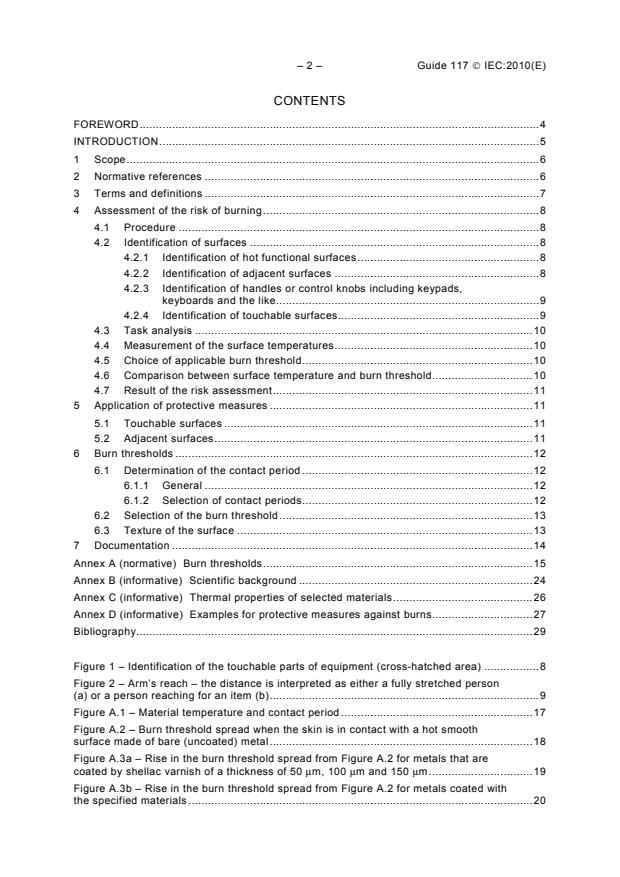
CONTENTS
FOREWORD.4
INTRODUCTION.5
1 Scope.6
2 Normative references .6
3 Terms and definitions .7
4 Assessment of the risk of burning.8
4.1 Procedure .8
4.2 Identification of surfaces .8
4.2.1 Identification of hot functional surfaces.8
4.2.2 Identification of adjacent surfaces .8
4.2.3 Identification of handles or control knobs including keypads,
keyboards and the like.9
4.2.4 Identification of touchable surfaces.9
4.3 Task analysis .10
4.4 Measurement of the surface temperatures.10
4.5 Choice of applicable burn threshold.10
4.6 Comparison between surface temperature and burn threshold.10
4.7 Result of the risk assessment.11
5 Application of protective measures .11
5.1 Touchable surfaces .11
5.2 Adjacent surfaces.11
6 Burn thresholds .12
6.1 Determination of the contact period .12
6.1.1 General .12
6.1.2 Selection of contact periods.12
6.2 Selection of the burn threshold.13
6.3 Texture of the surface .13
7 Documentation .14
Annex A (normative) Burn thresholds.15
Annex B (informative) Scientific background .24
Annex C (informative) Thermal properties of selected materials.26
Annex D (informative) Examples for protective measures against burns.27
Bibliography.29
Figure 1 – Identification of the touchable parts of equipment (cross-hatched area) .8
Figure 2 – Arm’s reach – the distance is interpreted as either a fully stretched person
(a) or a person reaching for an item (b).9
Figure A.1 – Material temperature and contact period .17
Figure A.2 – Burn threshold spread when the skin is in contact with a hot smooth
surface made of bare (uncoated) metal.18
Figure A.3a – Rise in the burn threshold spread from Figure A.2 for metals that are
coated by shellac varnish of a thickness of 50 μm, 100 μm and 150 μm.19
Figure A.3b – Rise in the burn threshold spread from Figure A.2 for metals coated with
the specified materials .20
Guide 117 © IEC:2010(E) – 3 –
Figure A.4 – Burn threshold spread when the skin is in contact with a hot smooth
surface made of ceramics, glass and stone materials .21
Figure A.5 – Burn threshold spread when the skin is in contact with a hot smooth
surface made of plastics .22
Figure A.6 – Burn threshold spread when the skin is in contact with a hot smooth
surface made of wood.23
Table 1 – Arm’s reach.9
Table 2 – Contact period.12
Table A.1 – Burn threshold for longer contact times.23
Table C.1 – Thermal properties of selected materials (taken from [2]).26
– 4 – Guide 117 © IEC:2010(E)
INTERNATIONAL ELECTROTECHNICAL COMMISSION
____________
ELECTROTECHNICAL EQUIPMENT –
TEMPERATURES OF TOUCHABLE HOT SURFACES
FOREWORD
1) The International Electrotechnical Commission (IEC) is a worldwide organization for standardization comprising
all national electrotechnical committees (IEC National Committees). The object of IEC is to promote
international co-operation on all questions concerning standardization in the electrical and electronic fields. To
this end and in addition to other activities, IEC publishes International Standards, Technical Specifications,
Technical Reports, Publicly Available Specifications (PAS) and Guides (hereafter referred to as “IEC
Publication(s)”). Their preparation is entrusted to technical committees; any IEC National Committee interested
in the subject dealt with may participate in this preparatory work. International, governmental and non-
governmental organizations liaising with the IEC also participate in this preparation. IEC collaborates closely
with the International Organization for Standardization (ISO) in accordance with conditions determined by
agreement between the two organizations.
2) The formal decisions or agreements of IEC on technical matters express, as nearly as possible, an international
consensus of opinion on the relevant subjects since each technical committee has representation from all
interested IEC National Committees.
3) IEC Publications have the form of recommendations for international use and are accepted by IEC National
Committees in that sense. While all reasonable efforts are made to ensure that the technical content of IEC
Publications is accurate, IEC cannot be held responsible for the way in which they are used or for any
misinterpretation by any end user.
4) In order to promote international uniformity, IEC National Committees undertake to apply IEC Publications
transparently to the maximum extent possible in their national and regional publications. Any divergence
between any IEC Publication and the corresponding national or regional publication shall be clearly indicated in
the latter.
5) IEC itself does not provide any attestation of conformity. Independent certification bodies provide conformity
assessment services and, in some areas, access to IEC marks of conformity. IEC is not responsible for any
services carried out by independent certification bodies.
6) All users should ensure that they have the latest edition of this publication.
7) No liability shall attach to IEC or its directors, employees, servants or agents including individual experts and
members of its technical committees and IEC National Committees for any personal injury, property damage or
other damage of any nature whatsoever, whether direct or indirect, or for costs (including legal fees) and
expenses arising out of the publication, use of, or reliance upon, this IEC Publication or any other IEC
Publications.
8) Attention is drawn to the Normative references cited in this publication. Use of the referenced publications is
indispensable for the correct application of this publication.
9) Attention is drawn to the possibility that some of the elements of this IEC Publication may be the subject of
patent rights. IEC shall not be held responsible for identifying any or all such patent rights.
This first edition of IEC Guide 117 has been prepared in accordance with ISO/IEC Directives,
Part 1, Annex A, by the IEC Advisory Committee on Safety (ACOS). This is a non-mandatory
guide in accordance with SMB Decision 136/8.
This Guide is based on CENELEC Guide 29.
The text of this IEC Guide is based on the following documents:
Four months’ vote Report on voting
C/1619/DV C/1636/RV
Full information on the voting for the approval of this Guide can be found in the report on
voting indicated in the above table.
This publication has been drafted in accordance with the ISO/IEC Directives, Part 2.
Guide 117 © IEC:2010(E) – 5 –
INTRODUCTION
This Guide was initially prepared by CENELEC BTTF 120-1, Surface temperatures, and was
approved by the CENELEC Technical Board as CENELEC Guide 29.
The CENELEC guide has been modified to take into account IEC document preparation
procedures and those comments received from National Committees and Technical
Committees.
– 6 – Guide 117 © IEC:2010(E)
ELECTROTECHNICAL EQUIPMENT –
TEMPERATURES OF TOUCHABLE HOT SURFACES
1 Scope
This IEC Guide provides guidance for assessing the risk, to any person, of a burn from
contact with hot touchable surfaces of electrotechnical equipment. This Guide establishes
surface temperature limits, where such limits are required, and describes the maximum
contact periods with a hot surface that any person may be subjected to without being exposed
to a risk of burn. Curves of maximum temperatures versus contact times are described for
different types of material with different types of surfaces.
These temperature limit values shall be taken into consideration by technical committees in
determining surface temperature limits in product standards. In making this determination,
consideration should be given to:
– the likelihood of contact with the heated part;
– the size and thermal capacity of the heated part;
– the expertise of the persons and their knowledge and experience relative to the
temperatures likely to be encountered in operating or servicing the product;
– the provision of adequate cautions or warnings; and
– other similar factors taking into account the task analysis specified in 4.3.
It is ultimately the responsibility of the technical committee to establish the acceptable
temperature limits (which may be higher) that may apply to touchable surfaces of products
under their scope. Manufacturers may also use these temperature limit values to assist in
their risk assessment if no relevant product standard exists.
It is not within the scope of this Guide to set temperature limits for the following zones or
surfaces:
– hot functional surfaces;
– adjacent surfaces;
– handles or control knobs, including keypads, keyboards and the like, that a user needs to
touch to operate or adjust the equipment;
– surfaces not likely to be touched.
It is outside of the scope of this Guide to specify protective measures. It is the task of
manufacturers and also of standardisation groups to decide upon protective measures
appropriate to the intended use of a product. Protective means, if needed, should be provided
together with the equipment.
NOTE Although not specified in this Guide, examples of protective measures that may be taken are given in
Clause 5 and Annex D. One example of several possible protective measures is the limitation of the surface
temperature below the burn threshold. To achieve this, surface temperature limit values may be established at or
below the burn threshold in the product standard. It is then the task of the manufacturer of the product to apply
technical solutions in order to comply with the established limit values.
2 Normative references
The following referenced documents are indispensable for the application of this document.
For dated references, only the edition cited applies. For undated references, the latest edition
of the referenced document (including any amendments) applies.
Guide 117 © IEC:2010(E) – 7 –
ISO 13732-1:2006, Ergonomics of the thermal environment – Methods for the assessment of
human responses to contact with surfaces – Part 1: Hot surfaces
3 Terms and definitions
For the purposes of this document, the following terms and definitions apply.
3.1
adjacent surface
surface adjacent to a hot functional surface
NOTE The adjacent surface and the hot functional surface normally consist of the same piece of material, or are
in direct thermal contact, and have similar thermal properties. The adjacent surface is not heated intentionally
during use of the product. However, as it is adjacent to the hot functional surface and may become hot through
conduction, its temperature will be in the range between the hot functional surface and a touchable surface.
3.2
arm’s reach
either the distance measured from the floor to the fingertips of a person fully extended in the
vertical direction or, for any other direction, one-third of that distance
3.3
burn threshold
surface temperature defining the boundary between no burn and a superficial partial thickness
burn caused by contact of the skin with a hot surface for a specified contact period
3.4
contact period
duration of contact with the surface
3.5
hot functional surface
surface that is intentionally heated by an internal heat source and that has to be hot to carry
out the function for which the equipment is intended to be used
NOTE 1 For example, curling tongs or the soleplate of an iron or the heater of a copy machine.
NOTE 2 Some equipment has hot surfaces as a consequence of how they generate their output, (for example,
lamps within a luminaire or the heater of a copy machine), and these surfaces are considered, in terms of their
treatment, as equivalent to a hot functional surface.
3.6
skin temperature
temperature at a depth of 80 μm below the surface of the skin, measured in degrees Celsius
3.7
surface temperature
temperature of a surface, measured in degrees Celsius, at an ambient temperature of
−5
25 °C.
+0
3.8
thermal inertia
product of the density, thermal conductivity and specific thermal capacity of material
3.9
touchable surfaces (in some standards, accessible surfaces or accessible parts)
surfaces defined as touchable (or accessible) in the end-product standard, taking into account
the intended installation of the equipment and surfaces within arm’s reach, other than:
– 8 – Guide 117 © IEC:2010(E)
– hot functional surfaces;
– adjacent surfaces; and
– handles or control knobs, including keypads, keyboards and the like, that a user needs to
touch to operate or adjust the equipment
NOTE 1 See Figure 1 for examples of the types of surfaces that may be encountered.
NOTE 2 The equipment has to be installed according to the manufacturer’s instructions. This means that an oven
intended for building-in should be installed according to the manufacturer’s instructions before identification of the
touchable surfaces.
Touchable surface: Surface that may be touched
Handles or
Adjacent surface
control
Hot functional
knobs,
including surface
keyboards
IEC 2365/10
Figure 1 – Identification of the touchable parts of equipment (cross-hatched area)
4 Assessment of the risk of burning
4.1 General
Normally it is sufficient to follow the product standard. The manufacturer only needs to carry
out a risk assessment if the product standard does not take account of the temperatures of
surfaces likely to be touched, or if no relevant product standard exists.
4.2 Procedure
The different types of surfaces or zones shall be identified according to 4. 3.
To assess the risk of a cutaneous burn from surfaces likely to be touched, the steps described
in 4. 4 to 4.8 shall be carried out for surfaces identified in 4.3 . 5.
4.3 Identification of surfaces
4.3.1 General
All surfaces of a product shall be classified according to 4. 3. 2 to 4 . 3. 5.
4.3.2 Identification of hot functional surfaces
Hot functional surfaces shall be identified when the equipment is installed as for normal use.
4.3.3 Identification of adjacent surfaces
Adjacent surfaces shall be identified.
Guide 117 © IEC:2010(E) – 9 –
4.3.4 Identification of handles or control knobs including keypads, keyboards and the
like
Handles or control knobs, including keypads, keyboards and the like that a user needs to
touch to operate or adjust the equipment shall be identified.
4.3.5 Identification of touchable surfaces
All necessary information concerning the touchable surfaces of the equipment, including the
following, shall be gathered:
– classification of surface temperatures as hot, moderate or cold;
– material and texture of the surfaces;
– all normal operating conditions of the equipment including the setting that results in
maximum temperatures of the touchable surfaces;
– the probability of contact, taking into account the arm’s reach of a person as shown in
Figure 2 and Table 1.
1/3
1/1
2/3
(a)
(b)
IEC 2366/10
The distance is interpreted as either a fully stretched person (a) or a person reaching for an item (b)
Figure 2 – Arm’s reach
The worst case of either (a) or (b) shall be used.
Table 1 gives guidance on arm’s reach for different age groups.
Table 1 – Arm’s reach
Age Arm’s reach in the vertical
direction (see (a) of Figure 2),
Years
measured from the floor
m
Children less than 2 years 1,00
Children from 2 years to less than 6 years 1,50
Children from 6 years to less than 14 years 1,80
Adult 2,30
NOTE The values in this table are average values and are based on the data
in CEN/TR 13387.
If the equipment is installed out of reach, it is not considered touchable.
– 10 – Guide 117 © IEC:2010(E)
4.4 Task analysis
All necessary information concerning the use of the product shall be collected. By means of
analysis or observation, the activities and tasks involved in using the product shall be
described. Attention shall be paid to the means of possible contact with hot touchable
surfaces and to which types of persons the contact may happen. From the task analysis, the
following information is obtained:
– the touchable surfaces that may be touched unintentionally,
– the users, or other persons, who will likely touch or may touch the surfaces
unintentionally,
– the range of operation of the product,
– the probability of touching a touchable surface,
– statistical data on relevant incidents, if available, and
– the normal operation setting of the temperature of the product.
4.5 Measurement of the surface temperatures
The surface temperatures shall be measured on touchable surfaces.
The measurement shall be carried out under normal operating conditions of the product that
will result in the maximum surface temperature of touchable surfaces. The chosen operating
conditions shall reflect the manufacturer’s intended use of the product while excluding
extreme usage patterns, deliberate misuse or unauthorised modifications of the product or its
operating parameters.
If a technical committee has a specified temperature measurement method, that method shall
be used. Otherwise the measurement of the surface temperature should be carried out by
means of an electrical thermometer with a contact sensor made of metal having insignificant
heat capacity. The accuracy of the instrument shall be at least ± 1 °C in the range up to 50 °C
and at least ± 2 °C in the range above 50 °C.
NOTE The data in Annex A is based on measurement methods described in ISO 13732-1:2006.
4.6 Choice of applicable burn threshold
4.3.5 and the task analysis in 4. 4, a nd
Based on the identification of the touchable surfaces in
by taking account of the surface material and texture, the applicable burn threshold may be
chosen using the data in Annex A, if available.
NOTE 1 Annex A provides data and curves for some types of materials under smooth surface conditions, and
including some coating treatments. Further study may be necessary to determine burn thresholds for materials or
textures not covered in A nne x A .
The contact period to be used for selecting the burn threshold shall be according to Clause 6,
and shall take into consideration the different groups of persons that are likely to come into
contact with the surface.
NOTE 2 It should be noted that the surface temperature limit values are based on temperatures taken of a large
mass at the point of contact, and with very high stored thermal energy. The document does not consider thin
materials or those having low stored thermal energy. For these materials, the stored energy and thermal
conductivity will need to be taken into account, not just the temperature as can be done for a large mass at the
point of contact.
4.7 Comparison between surface temperature and burn threshold
Compare the measured surface temperatures with the applicable burn thresholds:
– if the surface temperature is above the burn threshold, there is potential for cutaneous
injury after contact with the hot surface;
Guide 117 © IEC:2010(E) – 11 –
– if the temperature lies below the burn threshold, the skin will not normally suffer injury;
– if the measured surface temperature lies inside the burn threshold spreads of the figures
in Annex A, cutaneous injury may or may not occur. This corresponds to the remaining
uncertainty of the burn threshold specification.
NOTE The burn thresholds in ISO 13732-1:2006 relate to surface temperatures and not skin temperatures. The
relationship between surface temperatures and resultant skin temperatures is discussed in A.1. The occurrence of
a burn based on skin temperature is discussed in A nne x B .
4.8 Result of the risk assessment
Based on the analysis in 4.4, the probability of touching a part of the surface of the product
that has a temperature higher than the burn threshold shall be determined. As a result, the
risk of burning is determined in terms of
– exceeding or falling short of the burn threshold for all parts of the touchable surface of the
product, and
– probability of contact.
NOTE Hints for the risk assessment are given in subclause 6.3 of ISO 13732-1:2006.
5 Application of protective measures
5.1 General
Protective measures should be considered according to 5 . 2 a nd 5.3. Afterwards the process
of risk assessment should be repeated until the risk level is acceptable.
5.2 Touchable surfaces
If the risk assessment shows that there is a risk of a burn, it should be decided whether
protective measures are necessary and, if so, which protective measures are appropriate. In
making these decisions it is sufficient to follow the product standard.
In general, engineering, organisational or personal protective measures may be applied
(examples of such measures are given in Annex D). Whether it is necessary to apply
protective measures at all and which specific measures are appropriate will normally be
specified in the product standard.
Limitation of surface temperatures and establishment of limit values is applicable only for
those parts of a product that are not deliberately heated as hot functional surfaces.
5.3 Adjacent surfaces
As the temperature of an adjacent surface may be in excess of the limits of the touchable
surfaces, protective measures should be considered to minimize the risk of burning.
Examples of applicable protective measures in this case include limiting the dimensions to the
smallest possible area, use of alternative materials or surface structures to limit the likelihood
of touching of adjacent surfaces, reduction of the temperature flow by de-coupling or
insulation from the hot functional surface.
It is the responsibility of the technical committee or manufacturer to define the size, the
temperature limits and any other relevant aspects of this surface, where necessary.
– 12 – Guide 117 © IEC:2010(E)
6 Burn thresholds
6.1 Determination of the contact period
6.1.1 General
For the selection of appropriate contact periods, a minimum contact period of 0,5 s to 1 s
should be used. If extended reaction time is to be expected (for example, for persons who
need special precautions), a longer contact period of up to 15 s should be selected (see Table
2).
It is essential that, when selecting the contact periods, a distinction is made based upon the
group of persons who may come into contact with the hot surface (see Table 2 and 6. 1. 2) ,
such as,
– adults,
– children,
– elderly persons,
– people with phy
...