

IEC GUIDE 116:2018
(Main)Guidelines for safety related risk assessment and risk reduction for low voltage equipment
General Information
- Abstract
IEC Guide 116:2018(E) is non-mandatory and complements ISO/IEC Guide 51 and establishes guidelines useful for achieving safety in low voltage equipment. These guidelines include risk assessment, in which the knowledge and experience of the design, use, incidents, accidents and harm related to low voltage equipment are brought together in order to assess the risks during the relevant phases of the life of the equipment and to implement the basics for risk reduction measures. This IEC guide should be used by technical committees as far as appropriate and to the extent they decide to apply it. It gives additional guidance to ISO/IEC Guides 50, 51 and 71 on the information required to allow risk assessment to be carried out performed.
This second edition of IEC Guide 116 cancels and replaces its first edition published in 2010 and constitutes a technical revision; main changes with respect to the first edition are as follows:
- addition of a clause dealing with safety related security aspects, derived from the IEC 62443 series;
- reference to “domestic animals” rather than to “livestock”;
- alignment of definitions and Figure 2 with the latest edition of ISO/IEC Guide 51 (2014);
- Status
- Published
- Publication Date
- 06-Nov-2018
- Technical Committee
- ACOS - ACOS
- Current Stage
- PPUB - Publication issued
- Start Date
- 07-Nov-2018
- Completion Date
- 02-Oct-2018
Overview - IEC Guide 116:2018 (Guidelines for safety related risk assessment and risk reduction for low voltage equipment)
IEC Guide 116:2018 is a non‑mandatory guidance document published by the IEC to support safety in low voltage equipment. It complements ISO/IEC Guide 51 by specifying the information and approach needed to carry out risk assessment and risk reduction across the relevant life phases of low voltage products. This second edition (2018) replaces the 2010 edition and adds guidance on safety‑related security (aligned with the IEC 62443 series), updates references to “domestic animals,” and aligns definitions with ISO/IEC Guide 51 (2014).
Key topics and technical requirements
The Guide provides structured, practical guidance rather than mandatory rules. Key technical topics include:
- Principle of safety integration - embedding safety across design, production, use and maintenance.
- Scope and limits of equipment - defining intended use and foreseeable misuse for risk assessment.
- Hazard identification - systematic listing of hazards, hazardous situations and hazardous events applicable to low voltage equipment.
- Risk estimation and evaluation - assessing severity, probability and exposure to form a risk index; iterative evaluation of whether risk reduction is needed.
- Risk reduction measures - hierarchy of measures to eliminate or mitigate hazards, including design, protective measures and information for use.
- Functional safety and reliability - considerations for system faults, equipment design and safety‑related functions.
- Safety‑related security (new in 2018) - addressing security threats that could impact safety, drawing on IEC 62443 concepts.
- Documentation and traceability - templates and examples (Annex D, Table D.1) for recording risk assessment outputs and decisions.
- Informative annexes covering safety aspects, supporting standards and illustrative examples.
Practical applications and who uses it
IEC Guide 116 is intended primarily for:
- IEC technical committees and standards developers who draft or revise safety standards for low voltage equipment.
- Product designers and safety engineers performing design‑stage risk assessments and selecting mitigation measures.
- Regulatory bodies, conformity assessment bodies and testing laboratories seeking consistent interpretation of risk‑assessment inputs.
- Manufacturers and technical authors preparing instructions for use, warnings and maintenance guidance.
Typical applications:
- Performing life‑cycle risk assessments for household appliances, industrial low voltage devices and consumer electronics.
- Integrating security considerations that affect safety (e.g., remote access vulnerabilities).
- Preparing normative and informative content for product safety standards and declarations.
Related standards and keywords
Related guidance and standards include ISO/IEC Guide 51, ISO/IEC Guides 50 & 71, and the IEC 62443 series for security. Use keywords for SEO: IEC Guide 116:2018, low voltage equipment, risk assessment, risk reduction, safety integration, safety‑related security, IEC, ISO/IEC Guide 51, functional safety, documentation.
Relations
- Effective Date
- 05-Sep-2023
Get Certified
Connect with accredited certification bodies for this standard

IMQ S.p.A. (Certification)
Italian electrical product certification.

SLG Prüf- und Zertifizierungs GmbH
German testing and certification body.

UL Solutions
Global safety science company with testing, inspection and certification.
Sponsored listings
Frequently Asked Questions
IEC GUIDE 116:2018 is a guide published by the International Electrotechnical Commission (IEC). Its full title is "Guidelines for safety related risk assessment and risk reduction for low voltage equipment". This standard covers: IEC Guide 116:2018(E) is non-mandatory and complements ISO/IEC Guide 51 and establishes guidelines useful for achieving safety in low voltage equipment. These guidelines include risk assessment, in which the knowledge and experience of the design, use, incidents, accidents and harm related to low voltage equipment are brought together in order to assess the risks during the relevant phases of the life of the equipment and to implement the basics for risk reduction measures. This IEC guide should be used by technical committees as far as appropriate and to the extent they decide to apply it. It gives additional guidance to ISO/IEC Guides 50, 51 and 71 on the information required to allow risk assessment to be carried out performed. This second edition of IEC Guide 116 cancels and replaces its first edition published in 2010 and constitutes a technical revision; main changes with respect to the first edition are as follows: - addition of a clause dealing with safety related security aspects, derived from the IEC 62443 series; - reference to “domestic animals” rather than to “livestock”; - alignment of definitions and Figure 2 with the latest edition of ISO/IEC Guide 51 (2014);
IEC Guide 116:2018(E) is non-mandatory and complements ISO/IEC Guide 51 and establishes guidelines useful for achieving safety in low voltage equipment. These guidelines include risk assessment, in which the knowledge and experience of the design, use, incidents, accidents and harm related to low voltage equipment are brought together in order to assess the risks during the relevant phases of the life of the equipment and to implement the basics for risk reduction measures. This IEC guide should be used by technical committees as far as appropriate and to the extent they decide to apply it. It gives additional guidance to ISO/IEC Guides 50, 51 and 71 on the information required to allow risk assessment to be carried out performed. This second edition of IEC Guide 116 cancels and replaces its first edition published in 2010 and constitutes a technical revision; main changes with respect to the first edition are as follows: - addition of a clause dealing with safety related security aspects, derived from the IEC 62443 series; - reference to “domestic animals” rather than to “livestock”; - alignment of definitions and Figure 2 with the latest edition of ISO/IEC Guide 51 (2014);
IEC GUIDE 116:2018 is classified under the following ICS (International Classification for Standards) categories: 29.020 - Electrical engineering in general. The ICS classification helps identify the subject area and facilitates finding related standards.
IEC GUIDE 116:2018 has the following relationships with other standards: It is inter standard links to IEC GUIDE 116:2010. Understanding these relationships helps ensure you are using the most current and applicable version of the standard.
IEC GUIDE 116:2018 is available in PDF format for immediate download after purchase. The document can be added to your cart and obtained through the secure checkout process. Digital delivery ensures instant access to the complete standard document.
Standards Content (Sample)
IEC GUIDE 116 ®
Edition 2.0 2018-11
GUIDE
colour
inside
Guidelines for safety related risk assessment and risk reduction for low voltage
equipment
All rights reserved. Unless otherwise specified, no part of this publication may be reproduced or utilized in any form
or by any means, electronic or mechanical, including photocopying and microfilm, without permission in writing from
either IEC or IEC's member National Committee in the country of the requester. If you have any questions about IEC
copyright or have an enquiry about obtaining additional rights to this publication, please contact the address below or
your local IEC member National Committee for further information.
IEC Central Office Tel.: +41 22 919 02 11
3, rue de Varembé info@iec.ch
CH-1211 Geneva 20 www.iec.ch
Switzerland
About the IEC
The International Electrotechnical Commission (IEC) is the leading global organization that prepares and publishes
International Standards for all electrical, electronic and related technologies.
About IEC publications
The technical content of IEC publications is kept under constant review by the IEC. Please make sure that you have the
latest edition, a corrigenda or an amendment might have been published.
IEC Catalogue - webstore.iec.ch/catalogue Electropedia - www.electropedia.org
The stand-alone application for consulting the entire The world's leading online dictionary of electronic and
bibliographical information on IEC International Standards, electrical terms containing 21 000 terms and definitions in
Technical Specifications, Technical Reports and other English and French, with equivalent terms in 16 additional
documents. Available for PC, Mac OS, Android Tablets and languages. Also known as the International Electrotechnical
iPad. Vocabulary (IEV) online.
IEC publications search - webstore.iec.ch/advsearchform IEC Glossary - std.iec.ch/glossary
The advanced search enables to find IEC publications by a 67 000 electrotechnical terminology entries in English and
variety of criteria (reference number, text, technical French extracted from the Terms and Definitions clause of
committee,…). It also gives information on projects, replaced IEC publications issued since 2002. Some entries have been
and withdrawn publications. collected from earlier publications of IEC TC 37, 77, 86 and
CISPR.
IEC Just Published - webstore.iec.ch/justpublished
Stay up to date on all new IEC publications. Just Published IEC Customer Service Centre - webstore.iec.ch/csc
details all new publications released. Available online and If you wish to give us your feedback on this publication or
also once a month by email. need further assistance, please contact the Customer Service
Centre: sales@iec.ch.
IEC GUIDE 116 ®
Edition 2.0 2018-11
GUIDE
colour
inside
Guidelines for safety related risk assessment and risk reduction for low voltage
equipment
INTERNATIONAL
ELECTROTECHNICAL
COMMISSION
ICS 29.020 ISBN 978-2-8322-6097-5
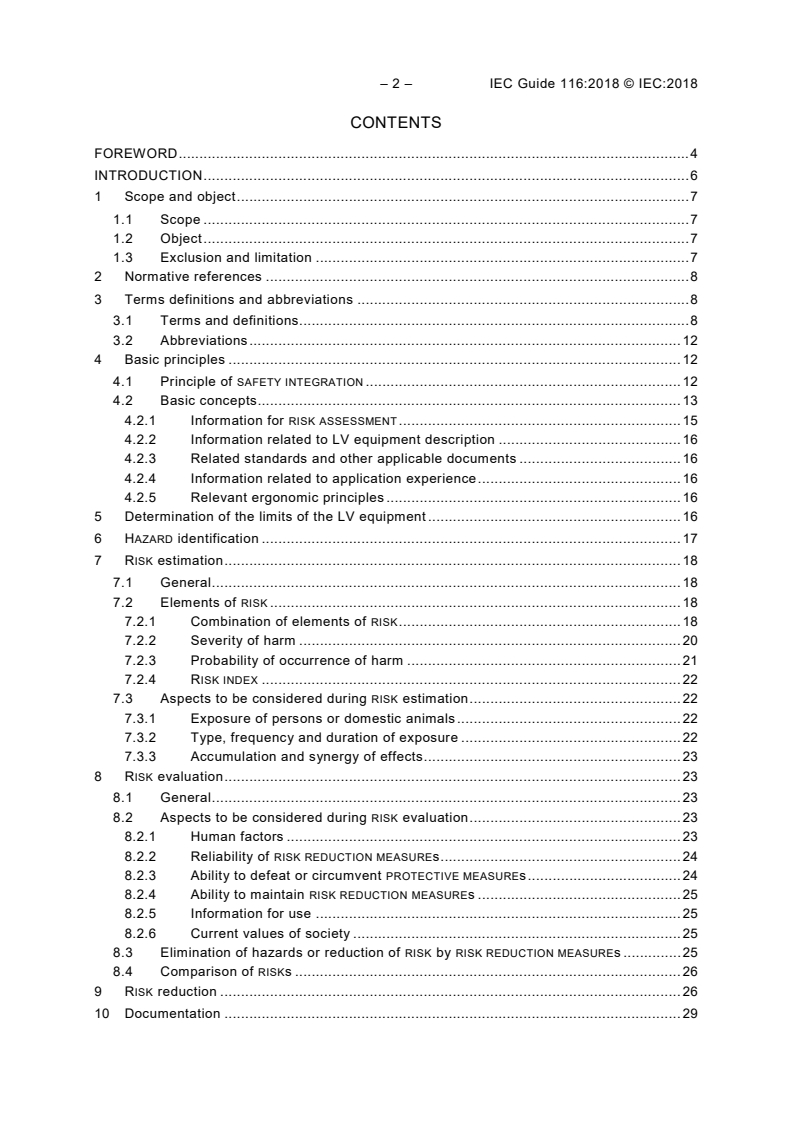
– 2 – IEC Guide 116:2018 © IEC:2018
CONTENTS
FOREWORD . 4
INTRODUCTION . 6
1 Scope and object . 7
1.1 Scope . 7
1.2 Object . 7
1.3 Exclusion and limitation . 7
2 Normative references . 8
3 Terms definitions and abbreviations . 8
3.1 Terms and definitions. 8
3.2 Abbreviations . 12
4 Basic principles . 12
4.1 Principle of SAFETY INTEGRATION . 12
4.2 Basic concepts. 13
4.2.1 Information for RISK ASSESSMENT . 15
4.2.2 Information related to LV equipment description . 16
4.2.3 Related standards and other applicable documents . 16
4.2.4 Information related to application experience . 16
4.2.5 Relevant ergonomic principles . 16
5 Determination of the limits of the LV equipment . 16
6 HAZARD identification . 17
7 RISK estimation . 18
7.1 General . 18
7.2 Elements of RISK . 18
7.2.1 Combination of elements of RISK . 18
7.2.2 Severity of harm . 20
7.2.3 Probability of occurrence of harm . 21
7.2.4 RISK INDEX . 22
7.3 Aspects to be considered during RISK estimation . 22
7.3.1 Exposure of persons or domestic animals . 22
7.3.2 Type, frequency and duration of exposure . 22
7.3.3 Accumulation and synergy of effects . 23
8 RISK evaluation . 23
8.1 General . 23
8.2 Aspects to be considered during RISK evaluation . 23
8.2.1 Human factors . 23
8.2.2 Reliability of RISK REDUCTION MEASUREs . 24
8.2.3 Ability to defeat or circumvent PROTECTIVE MEASUREs . 24
8.2.4 Ability to maintain RISK REDUCTION MEASUREs . 25
8.2.5 Information for use . 25
8.2.6 Current values of society . 25
8.3 Elimination of hazards or reduction of RISK by RISK REDUCTION MEASUREs . 25
8.4 Comparison of RISKs . 26
9 RISK reduction . 26
10 Documentation . 29
Annex A (normative) SAFETY aspects relating to LOW VOLTAGE EQUIPMENT . 30
A.1 General . 30
A.2 Preliminary observations . 30
A.3 SAFETY INTEGRATION . 30
A.4 Protection against electrical hazards . 31
A.5 Protection against mechanical hazards . 31
A.6 Protection against other hazards . 31
A.6.1 General . 31
A.6.2 Explosion . 31
A.6.3 Hazards arising from electric, magnetic, and electromagnetic fields,
other ionising and non-ionising radiation . 32
A.6.4 Electric, magnetic or electromagnetic disturbances . 32
A.6.5 Optical radiation . 32
A.6.6 Fire . 32
A.6.7 Temperature . 32
A.6.8 Acoustic noise . 32
A.6.9 Biological and chemical effects . 32
A.6.10 Emissions, production and/or use of hazardous substances (e.g. gases,
liquids, dusts, mists, vapour) . 33
A.6.11 Unattended operation . 33
A.6.12 Connection to and interruption from power supply . 33
A.6.13 Combination of equipment . 33
A.6.14 Implosion . 33
A.6.15 Hygiene conditions . 33
A.6.16 Ergonomics . 33
A.7 FUNCTIONAL SAFETY and reliability . 33
A.7.1 General . 33
A.7.2 Equipment design . 34
A.7.3 Equipment type related hazards . 34
A.7.4 System faults . 34
A.8 SAFETY-RELATED SECURITY RISK . 34
A.9 Information requirements . 35
Annex B (informative) Supporting standards . 36
B.1 Basic SAFETY standards . 36
B.2 Group SAFETY standards . 36
Annex C (informative) Table C.1 – Examples of hazards, hazardous situations and
HAZARDOUS EVENTs . 37
Annex D (informative) Tool for the application of this IEC Guide . 39
Bibliography . 41
Figure 1 – Principle of safety integration . 13
Figure 2 – Iterative process of RISK ASSESSMENT and RISK reduction . 15
Figure 3 – Elements of RISK for RISK estimation . 19
Figure 4 – Graph for RISK estimation . 20
Figure 5 – RISK reduction process . 28
Table D.1 – RISK ASSESSMENT documentation . 39
– 4 – IEC Guide 116:2018 © IEC:2018
INTERNATIONAL ELECTROTECHNICAL COMMISSION
____________
GUIDELINES FOR SAFETY RELATED RISK ASSESSMENT
AND RISK REDUCTION FOR LOW VOLTAGE EQUIPMENT
FOREWORD
1) The International Electrotechnical Commission (IEC) is a worldwide organization for standardization comprising
all national electrotechnical committees (IEC National Committees). The object of IEC is to promote
international co-operation on all questions concerning standardization in the electrical and electronic fields. To
this end and in addition to other activities, IEC publishes International Standards, Technical Specifications,
Technical Reports, Publicly Available Specifications (PAS) and Guides (hereafter referred to as “IEC
Publication(s)”). Their preparation is entrusted to technical committees; any IEC National Committee interested
in the subject dealt with may participate in this preparatory work. International, governmental and non-
governmental organizations liaising with the IEC also participate in this preparation. IEC collaborates closely
with the International Organization for Standardization (ISO) in accordance with conditions determined by
agreement between the two organizations.
2) The formal decisions or agreements of IEC on technical matters express, as nearly as possible, an international
consensus of opinion on the relevant subjects since each technical committee has representation from all
interested IEC National Committees.
3) IEC Publications have the form of recommendations for international use and are accepted by IEC National
Committees in that sense. While all reasonable efforts are made to ensure that the technical content of IEC
Publications is accurate, IEC cannot be held responsible for the way in which they are used or for any
misinterpretation by any end user.
4) In order to promote international uniformity, IEC National Committees undertake to apply IEC Publications
transparently to the maximum extent possible in their national and regional publications. Any divergence
between any IEC Publication and the corresponding national or regional publication shall be clearly indicated in
the latter.
5) IEC itself does not provide any attestation of conformity. Independent certification bodies provide conformity
assessment services and, in some areas, access to IEC marks of conformity. IEC is not responsible for any
services carried out by independent certification bodies.
6) All users should ensure that they have the latest edition of this publication.
7) No liability shall attach to IEC or its directors, employees, servants or agents including individual experts and
members of its technical committees and IEC National Committees for any personal injury, property damage or
other damage of any nature whatsoever, whether direct or indirect, or for costs (including legal fees) and
expenses arising out of the publication, use of, or reliance upon, this IEC Publication or any other IEC
Publications.
8) Attention is drawn to the Normative references cited in this publication. Use of the referenced publications is
indispensable for the correct application of this publication.
9) Attention is drawn to the possibility that some of the elements of this IEC Publication may be the subject of
patent rights. IEC shall not be held responsible for identifying any or all such patent rights.
This second edition of IEC Guide 116 has been prepared, in accordance with
ISO/IEC Directives, Part 1, Annex A, by the IEC Advisory Committee on Safety (ACOS). This
is a non-mandatory guide in accordance with SMB Decision 136/8.
This second edition of IEC Guide 116 cancels and replaces its first edition published in 2010
and constitutes a technical revision; main changes with respect to the first edition are as
follows:
• addition of a clause dealing with safety related security aspects, derived from the
IEC 62443 series (Clause A.8);
• reference to “domestic animals” rather than to “livestock”, throughout the text of the guide;
• alignment of definitions and Figure 2 with the latest edition of ISO/IEC Guide 51 (2014);
• editorial improvements throughout the text;
• updates of the links to the IEC website.
The text of this IEC Guide is based on the following documents:
FDIS Report on voting
ACOS/2084/DV ACOS/2108/RV
Full information on the voting for the approval of this International Standard can be found in
the report on voting indicated in the above table.
This document has been drafted in accordance with the ISO/IEC Directives, Part 2.
The committee has decided that the contents of this document will remain unchanged until the
stability date indicated on the IEC website under "http://webstore.iec.ch" in the data related to
the specific document. At this date, the document will be
• reconfirmed,
• withdrawn,
• replaced by a revised edition, or
• amended.
A bilingual version of this publication may be issued at a later date.
IMPORTANT – The 'colour inside' logo on the cover page of this publication indicates
that it contains colours which are considered to be useful for the correct
understanding of its contents. Users should therefore print this document using a
colour printer.
– 6 – IEC Guide 116:2018 © IEC:2018
INTRODUCTION
This non-mandatory IEC Guide is intended to be applied to RISK ASSESSMENT and risk
reduction for SAFETY of LOW VOLTAGE EQUIPMENT.
This Guide provides guidance to those developing and revising standards, specifications and
similar publications. However, the RISK ASSESSMENT method of this guide can be useful as
background information for, amongst others, designers, architects, manufacturers, service
providers, educators, communicators, auditors, SAFETY inspectors and policy makers.
This IEC Guide reflects ISO/IEC Guide 51 and gives additional guidance to ISO/IEC Guides
50, 51, and 71 on more detailed practical way of carrying out RISK ASSESSMENT and
implementing RISK reduction for RISKs commonly considered during all relevant phases of the
life of LOW VOLTAGE EQUIPMENT.
The user of this Guide is expected to take into account safety-related standards when
available (see also Annex B) and their use automatically reflects the state of the art as
defined in ISO/IEC Guide 2.
This Guide provides useful information in the absence of a specific standard.
GUIDELINES FOR SAFETY RELATED RISK ASSESSMENT
AND RISK REDUCTION FOR LOW VOLTAGE EQUIPMENT
1 Scope and object
1.1 Scope
This non-mandatory IEC Guide complements ISO/IEC Guide 51 and establishes guidelines
useful for achieving SAFETY in low voltage (LV) equipment. These guidelines include RISK
ASSESSMENT, in which the knowledge and experience of the design, use, incidents, accidents
and HARM related to LOW VOLTAGE EQUIPMENT are brought together in order to assess the RISKs
during the relevant phases of the life of the equipment, as specified in Clause 6, and to
implement the basic principles for RISK REDUCTION MEASUREs. This IEC guide should be used
by technical committees as far as appropriate and to the extent they decide to apply it.
This IEC Guide gives additional guidance to ISO/IEC Guides 50, 51 and 71 on the information
required to allow RISK ASSESSMENT to be performed. Procedures are described for identifying
hazards, estimating and evaluating RISK (including comparison of RISKs) and RISK reduction
where necessary. Harms considered in this document include possible damages to persons,
property, or domestic animals. It is not intended that the structure of this guide be adopted by
technical committees.
This IEC Guide also includes requirements for the equipment documentation to include
adequate information for the safe use of equipment.
1.2 Object
The purpose of this IEC Guide is to provide guidance for technical committees for decisions to
be made on the SAFETY of LOW VOLTAGE EQUIPMENT and the type of documentation required to
verify the RISK ASSESSMENT carried out.
This IEC Guide applies to all electrical equipment designed for use with a voltage range up to
1 000 V a.c. (1 500 V d.c.). Voltage ratings refer to the voltage of the electrical input or
output, not to voltages that may appear inside the equipment.
Annex A of this Guide identifies basic health and SAFETY requirements, typically for LOW
VOLTAGE EQUIPMENT.
Annex D can be used as a tool for documenting a self-assessment by a Technical Committee.
1.3 Exclusion and limitation
This guide does not apply to those basic components whose RISK ASSESSMENT depends to a
very large extent on how they are used and incorporated into a machine, electrical system or
installation. However, other electrical components that are intended to be incorporated into
other electrical equipment and for which a RISK ASSESSMENT can be undertaken are covered
by this IEC Guide, in general requiring a further assessment of the SAFETY aspects related to
the way in which such components are incorporated.
NOTE 1 The scope of the exclusion of basic components should not be misunderstood and extended to items like
lamps, starters, fuses, switches for household use, elements of electrical installations, etc.
These components, even if they are often used in conjunction with other electrical equipment and have to be
properly installed in order to deliver their useful function, are themselves to be considered electrical equipment in
the sense of this Guide.
– 8 – IEC Guide 116:2018 © IEC:2018
NOTE 2 RISK REDUCTION MEASUREs to be taken by the user of a product are subject to legal requirements in many
countries, especially in the occupational health and SAFETY framework.
This IEC Guide itself is not intended to be used for the purpose of certification. Product
committees are encouraged to include a clause in product SAFETY standards pertaining to RISK
ASSESSMENT, to be used when the requirements of these standards do not fully encompass all
possible hazards with equipment within the standard’s scope, especially for emerging
technologies, where new hazards may arise.
If the RISK ASSESSMENT identifies aspects not directly related to health and SAFETY such as
environment protection, energy consumption, climate change, etc., the RISK reduction for
health and SAFETY related RISKs in particular with respect to persons overrules the priority of
those other aspects. However such aspects can be defined by regulations.
2 Normative references
The following documents are referred to in the text in such a way that some or all of their
content constitutes requirements of this document. For dated references, only the edition
cited applies. For undated references, the latest edition of the referenced document (including
any amendments) applies.
IEC Guide 104:2010, The preparation of safety publications and the use of basic safety
publications and group safety publications
IEC Guide 117:2010, Electrotechnical equipment – Temperatures of touchable hot surfaces
ISO/IEC Guide 51:2014, Safety aspects – Guidelines for their inclusion in standards
3 Terms definitions and abbreviations
3.1 Terms and definitions
For the purposes of this document, the following terms and definitions apply.
ISO and IEC maintain terminological databases for use in standardization at the following
addresses:
IEC Electropedia: available at http://www.electropedia.org/
ISO Online browsing platform: available at http://www.iso.org/obp/
3.1.1
low voltage equipment
set of electrical devices or electrical apparatus necessary to perform a specific task such as
generation, transmission, distribution, utilisation of electric energy and with a supply or output
voltage not exceeding 1 000 V for alternating current and 1 500 V for direct current
EXAMPLES Equipment includes electric power generator, electrical switchgear and controlgear assemblies,
electrical wiring systems, air conditioning units, energy storage units, programmable and other electronic
equipment, etc.
3.1.2
harm
injury or damage to the health of people or damage to property or the environment
[SOURCE: ISO/IEC Guide 51:2014, definition 3.1]
3.1.3
hazard
potential source of HARM
[SOURCE: ISO/IEC Guide 51:2014, definition 3.2]
3.1.4
hazard zone
any space within and/or around a product, process or service in which persons, or domestic
animals can be exposed to a HAZARD
3.1.5
hazardous event
event that can cause HARM
[SOURCE: ISO/IEC Guide 51:2014, definition 3.3]
Note 1 to entry: A HAZARDOUS EVENT can occur over a short period of time or over an extended period of time.
3.1.6
hazardous situation
circumstance in which people, property or the environment is/are exposed to one or more
hazards
[SOURCE: ISO/IEC Guide 51:2014, definition 3.4]
3.1.7
arc
free burning short-circuit through air arising from a fault between live parts of different
potential and/or between live parts and other conductive parts within an assembly
[SOURCE: IEC 61641:2014, definition 3.5]
3.1.8
incident
past HAZARDOUS EVENT
Note 1 to entry: An INCIDENT that has resulted in HARM can be referred to as an accident. Whereas an INCIDENT
that has occurred and that did not result in HARM can be referred to as a near miss occurrence.
3.1.9
accident
INCIDENT that did result in HARM
3.1.10
malfunction
situation for which the electrical equipment does not perform the intended function due to a
variety of reasons, such as:
– variation of a property or of a dimension of the processed material or of the work piece;
– failure of one (or more) of its component parts or services;
– external disturbances (e.g. shocks, vibration, electromagnetic interference);
– design error or deficiency (e.g. software errors);
– disturbance of its power supply;
– surrounding conditions (e.g. condensation due to temperature change).
– 10 – IEC Guide 116:2018 © IEC:2018
3.1.11
risk index
combined score used to measure the likelihood of occurrence, magnitude and severity of RISK
[SOURCE: ISO 17666:2016, definition 3.1.3]
3.1.12
inherently safe design
measures taken to eliminate hazards and/or to reduce RISKs by changing the design or
operating characteristics of the product or system
[SOURCE: ISO/IEC Guide 51:2014, definition 3.5]
3.1.13
safeguarding
PROTECTIVE MEASURE using safeguards to protect persons and domestic animals from the
hazards which cannot reasonably be eliminated or RISKS which cannot be sufficiently reduced
by INHERENTLY SAFE DESIGN measures
[SOURCE: ISO 12100:2010, definition 3.21 modified with domestic animals]
3.1.14
complementary protective measure
RISK REDUCTION MEASURE involving a protective device (other than safeguard)
EXAMPLE of protective device: emergency stop equipment, interlocking device, enabling device, etc.
3.1.15
intended use
use in accordance with information provided with a product or system, or, in the absence of
such information, by generally understood patterns of usage
[SOURCE: ISO/IEC Guide 51:2014, definition 3.6]
3.1.16
reasonably foreseeable misuse
use of a product or system in a way not intended by the supplier, but which can result from
readily predictable human behaviour
Note 1 to entry: Readily predictable human behaviour includes the behaviour of all types of users, e.g. the
elderly, children and persons with disabilities. For more information, see ISO 10377.
Note 2 to entry: In the context of consumer SAFETY, the term “reasonably foreseeable use” is increasingly used as
a synonym for both “INTENDED USE” and “REASONABLY FORESEEABLE MISUSE.”
[SOURCE: ISO/IEC Guide 51:2014, definition 3.7]
3.1.17
residual risk
RISK remaining after RISK REDUCTION MEASUREs have been implemented
Note 1 to entry: This IEC Guide distinguishes:
– the RESIDUAL RISK after PROTECTIVE MEASUREs have been taken by the designer;
– the RESIDUAL RISK remaining after all PROTECTIVE MEASUREs have been implemented by the user.
[SOURCE: ISO/IEC Guide 51:2014, definition 3.8, modified]
3.1.18
risk
combination of the probability of occurrence of HARM and the severity of that HARM
Note 1 to entry: The probability of occurrence includes the exposure to a HAZARDOUS SITUATION, the occurrence of
a HAZARDOUS EVENT and the possibility to avoid or limit the HARM.
[SOURCE: ISO/IEC Guide 51:2014, definition 3.9]
3.1.19
risk assessment
overall process comprising a RISK analysis and a RISK evaluation
[SOURCE: ISO/IEC Guide 51:2014, definition 3.11]
3.1.20
risk reduction measure
protective measure
action or means to eliminate hazards or reduce RISKs
EXAMPLES INHERENTLY SAFE DESIGN; protective devices; personal protective equipment; information for use and
installation; organization of work; training; application of equipment; supervision.
[SOURCE: ISO/IEC Guide 51:2014, definition 3.13]
3.1.21
safety
freedom from RISK which is not tolerable
[SOURCE: ISO/IEC Guide 51:2014, definition 3.14]
3.1.22
tolerable risk
acceptable risk
level of RISK that is accepted in a given context based on the current values of society
[SOURCE: ISO/IEC Guide 51:, definition 3.15, modified with the synonymous term acceptable
risk]
3.1.23
safety integration
application of the “3-step-methodology” (see Figure 1) to reduce the RESIDUAL RISK of a LV
equipment below the level of TOLERABLE RISK
Note 1 to entry: See A.2 for further information.
3.1.24
functional safety
part of the overall SAFETY that depends on functional and physical units operating correctly in
response to their inputs
Note 1 to entry: See IEC/TR 61508-0, Functional safety of electrical/electronic/programmable electronic safety-
related systems – Part 0: Functional safety and and IEC 61508.
[SOURCE: IEC 60050-351:2013, 351-57-06]
3.1.25
adequate protection
protection which reduces RISK to a tolerable level
– 12 – IEC Guide 116:2018 © IEC:2018
3.1.26
single fault condition
condition in which there is a fault of a single protection (but not a reinforced protection) or of a
single component or a device
Note 1 to entry: If a SINGLE FAULT CONDITION results in one or more other fault conditions, all are considered as
one SINGLE FAULT CONDITION.
Note 2 to entry: Reinforced protection is defined IEV 903-02-08
[SOURCE: IEC Guide 104:2010, definition 3.8 modified]
3.1.27
safety-related security risk
RISK that a particular SECURITY THREAT exploits a particular SECURITY VULNERABILITY and leads
to HAZARDOUS SITUATION
[SOURCE: IEC/TS 62443-1-1:2009, derived from definition 3.2.87]
3.1.28
security threat
potential for violation of security, which exists when there is a circumstance, capability,
action, or event that could breach security and cause HARM
[SOURCE: Derived from IEC/TS 62443-1-1:2009, definition 3.2.125 modified]
3.1.29
security violation
act or event that disobeys or otherwise breaches security policy through an intrusion or the
actions of a well-meaning insider
[SOURCE: IEC/TS 62443-1-1:2009, definition 3.2.116 modified with a completed term]
3.1.30
security vulnerability
flaw or weakness in a system's design, implementation, or operation and management that
could be exploited to violate the system's integrity or security policy
[SOURCE: IEC/TS 62443-1-1:2009, definition 3.2.135 modified with a completed term]
3.2 Abbreviations
HMI Human machine interface
USB Universal Serial Bus
LAN Local area network
WLAN Wireless local area network
TCP Transmission control protocol
4 Basic principles
4.1 Principle of SAFETY INTEGRATION
Figure 1 shows the principle of SAFETY INTEGRATION. The minimum necessary RISK reduction is
the reduction in RISK that has to be achieved to meet the TOLERABLE RISK for a specific
situation. The concept of necessary RISK reduction is of fundamental importance in the
development of the SAFETY requirements for electrical equipment. The purpose of determining
the TOLERABLE RISK for a specific HAZARDOUS EVENT is to state what is deemed reasonable
with respect to both components of RISK (see 3.1.18, 7.2 and Figure 3).
The RISK will depend on many factors (for example, severity of injury, the damage to property,
the number of people exposed to HAZARD, the frequency at which a person or people are
exposed to HAZARD and the duration of the exposure).
If there are choices between different RISK REDUCTION MEASUREs in product standards, these
standards should clearly show the principles how the manufacturers have to implement RISK
including SAFETY INTEGRATIONs by their own thorough investigations of their
ASSESSMENT
equipment. In such cases manufacturers will take benefits of this approach by having more
flexibility and free innovation to determine the appropriate PROTECTIVE MEASUREs. This is
particularly important with more complex products when the manufacturers themselves have
the best knowledge of the specific characteristics and related contents of their own
equipment. In addition the following sources of information may also be considered:
– requirements from various origins, both general and those directly relevant to the specific
application;
– guidelines from various origins;
– discussions and agreements with the different parties involved in the application;
– international discussions and agreements; (the role of national and international standards
are becoming increasingly important in arriving at TOLERABLE RISK criteria for applications);
– industry standards and guidelines;
– independent industrial, expert and scientific advice from advisory bodies;
– current values defined by all involved stakeholders;
– user specifications.
HAZARDOUS
Safe situation
SITUATION
st
1 step:
inherently
safe design
nd
2 step:
SAFEGUARDING or
COMPLEMENTARY
PROTECTIVE
rd
3 step:
information
for use
RESIDUAL
RISK reduction needed
RISK
RISK
TOLERABLE RISK
NOTE Sometimes it is possible that TOLERABLE RISK is already achieved by applying step 1 or steps 1 and 2.
Figure 1 – Principle of safety integration
4.2 Basic concepts
Safety-related RISK ASSESSMENT is a series of logical steps which starts with the determination
of the limits of the LV equipment. The next step entails a systematic identification of the
– 14 – IEC Guide 116:2018 © IEC:2018
hazards associated with LV equipment. After a subsequent RISK estimation and RISK
evaluation and/or RISK comparison , RISK ASSESSMENT is followed, whenever necessary, by
RISK reduction. When this process is repeated, it gives the iterative process for eliminating
hazards as far as practicable and for implementing additional RISK REDUCTION MEASUREs
(PROTECTIVE MEASUREs).
ISK ASSESSMENT includes (see Figure 2):
R
a) RISK analysis,
1) determination of the limits of the LV equipment (see Clause 5);
2) HAZARD identification (see Clause 6);
3) RISK estimation (see Clause 7);
b) RISK evaluation / RISK comparison (see Clause 8).
RISK analysis provides the information required for the RISK evaluation which in turn allows
judgments to be made on the SAFETY of the LV equipment.
RISK ASSESSMENT relies on judgmental decisions. These decisions shall be supported by
qualitative methods complemented, as far as possible, by quantitative methods. Quantitative
methods can be appropriate when the potential severity and extent of HARM are high and
resources or data permit. Quantitative methods are useful assessing alternative RISK
REDUCTION MEASUREs and to determine what gives better protection.
NOTE 1 The application of quantitative methods is restricted by the amount of useful data which is available and
in many applications only qualitative RISK ASSESSMENT will be possible.
NOTE 2 The process of RISK ASSESSMENT on LV equipment can be implemented as follows:
– identify the appropriate scope and target users of the LV equipment (see Clause 5);
– identify the INTENDED USE and REASONABLY FORESEEABLE MISUSE of the LV equipment (see Clause 5);
– identify the hazards during each life cycle stage of the LV equipment, such as design, manufacture,
installation, maintenance, repair and disposal (see Clause 6);
– estimate the RISKs caused by each identified HAZARD (see Clause 7);
– evaluate the RISKs caused by identified hazards (see Clause 8);
– if the results of the RISK ASSESSMENT on the LV equipment show that the RESIDUAL RISK is at a tolerable level,
no further action is needed (see Clause 8);
– if the RESIDUAL RISK is not tolerable, RISK reduction has to be implemented (see Clause 9);
– the loop is repeated until the RESIDUAL RISK is reduced to a tolerable level.
The RISK ASSESSMENT shall be conducted in such a way that it is possible to document the
procedure that has been followed and the results that have been achieved (see Clause 10).
RISK ASSESSMENT determines whether RISK reduction is required. Guidance on how to do RISK
reduction is given in Clause 9.
Start
Determination of the limits of Risk Risk
assessment
the LV equipment analysis*
(see Clause 5)
Only relevant
assuming the
iterative
Hazard identification
process
(see Clause 6)
Risk estimation (see Clause 7)
Risk evaluation(see Clause 8)
* See Figure 3
Is the risk tolerable?
Yes
No
Risk reduction (see Clause 9)
Risk estimation (see Clause 7)
Risk evaluation (see Clause 8)
No
Residual risk
tolerable?
Yes
Validation and documentation (see Clause 10)
Complete
Figure 2 – Iterative process of RISK ASSESSMENT and RISK reduction
4.2.1 Information for RISK ASSESSMENT
The information needed for RISK ASSESSMENT and any qualitative and quantitative analysis
should include the following:
a) limits of the LV equipment (See Clause 5);
b) description of the various phases of the whole life cycle of the LV equipment (e.g.
transport, assembly and installation, commissioning and use);
c) design drawings or other means of establishing the nature of the LV equipment;
d) any accident, INCIDENT or MALFUNCTION history of the actual or similar LV equipment (when
available);
– 16 – IEC Guide 116:2018 © IEC:2018
e) information regarding possible RISKs resulting e.g. from emissions (noise, vibration, dust,
fumes etc.), chemicals used or materials processed by the LV equipment;
f) information for use supplied with the LV equipment, as available.
The information shall be updated as the design develops or when modifications are required.
Comparisons between similar HAZARDOUS SITUATIONs associated with different types of
equipment are often possible, provided that sufficient information about hazards and accident
circumstances in those situations is available.
The absence of an accident history, a small number of accidents or low severity of accidents
shall not be taken as an automatic presumption of a low RISK.
For quantitative analysis, data from databases, handbooks, laboratories and manufacturers'
specifications may be used provided that there is confidence in the suitability of the data.
Uncertainty associated with this data shall be indicated in the documentation (see Clause 10).
4.2.2 Information related to LV equipment description
Information related to the LV equipment description should include:
a) anticipated LV equipment specification, including:
– description of the various phases of the life cycle of the equipment (e.g. transport,
assembly and installation, commissioning, maintenance and use);
– design drawings or other means of establishing the nature of the equipment;
– required energy sources and how they are supplied;
b) information for use of the equipment, as available.
4.2.3 Related standards and other applicable documents
Related documents include:
a) relevant publications such as International Standards;
SAFETY data sheet and other relevant technical specifications.
b)
4.2.4 Information related to application experience
Information related to application experience of the equipment should include:
a) any historical record of the actual or similar equipment (remains the manufacturer’s
property if it refers to data collected by the manufacturer);
b) damage to health history.
4.2.5 Relevant ergonomic principles
Information shall be included as far as health aspects are related:
a) as the design develops, or
b) when modifications are required.
5 Determination of the limits of the LV equipment
RISK ASSESSMENT begins with the determination of the limits of the LV equipment. The limits of
the LV EQUIPMENT are listed herein by grouping them in four categories. They serve the
purpose to define the INTENDED USE and to consider REASONABLY FORESEEABLE MISUSE. The list
is not exhaustive and does not imply an order of importance or relevance.
a) Use limits, including the INTENDED USE and the REASONABLY FORESEEABLE MISUSE. Aspects
to be taken into account are, for example:
1) the different operating modes of the LV equipment and the different intervention
procedures for the users (including interventions required by foreseeable
MALFUNCTIONs of the use of the LV equipment);
2) the anticipated level of training, experience or ability of the users such as:
i) operators;
ii) maintenance personnel or technicians;
iii) trainees and apprentices;
iv) general public:
NOTE The use of the LV equipment (e.g. industrial, non-industrial and domestic) by persons identified by
sex, age, dominant hand usage, or limiting physical abilities (e.g. visual or hearing impairment, size,
strength) is to be taken into consideration when known.
3) the different accessories and connected equipment, to be used.
b) Space limits. Aspects to be taken into account are, for example:
1) range of movement;
2) space requirements for installation and maintenance of the LV equipment;
3) human interaction, e.g. "man-mac
...