

IEC 60664-3:2003
(Main)Insulation coordination for equipment within low-voltage systems - Part 3: Use of coating, potting or moulding for protection against pollution
General Information
- Abstract
Applies to assemblies protected against pollution by the use of coating, potting or moulding, thus allowing a reduction of clearance and creepage distances as described in Part 1 or Part 5. This standard describes the requirements and test procedures for two methods of protection: - type 1 protection improves the microenvironment of the parts under the protection; - type 2 protection is considered to be similar to solid insulation. This standard also applies to all kinds of protected printed boards, including the surface of inner layers of multi-layer boards, substrates and similarly protected assemblies. In the case of multi-layer printed boards, the distances through an inner layer are covered by the requirements for solid insulation in Part 1. This standard refers only to permanent protection. It does not cover assemblies that are subjected to mechanical adjustment or repair. The principles of this standard are applicable to functional, basic, supplementary and reinforced insulation. Has the status of a basic safety publication in accirdance with IEC Guide 104. The major changes made during the revision of IEC 60664-3 were the following: - Part 3 has been exactly aligned with Part 1 (including amendments 1 and 2). It has been made clear that Part 3 can only be used as a whole document together with Part 1 of IEC 60664. - The scope of Part 3 has been greatly extended including now also potting and moulding and similar procedures providing protection against pollution. The standard also applies to all kinds of coated printed boards including the surface of inner-layers of multi-layer boards, substrates and similar protected assemblies. The distances through an inner layer of multi-layer boards however are covered by the requirements for solid insulation in Part 1. - The difference between the two types of protection has been clarified. Type 1 (formerly type A) protection leads to a reduction of the pollution degree present beyond the protection to pollution degree 1. Type 2 (formerly type B) protection introduces protection systems which can be considered similar to solid insulation. Consequently the dimensioning and test requirements have been aligned more correctly. - The area of application has been extended including now functional, basic, supplementary and reinforced insulation. - Type 1 and type 2 protection now can both be used under the conditions of pollution degree 3 (formerly only type B). - Not only type 2 protection but also type 1 protection requires that between two conductive parts 100 % of the distance across the spacing shall be covered by the protection. - For type 2 protection minimum distances have been introduced. In any case the spacings shall not be lower than the minimum value of 10 µm. - Also the new Part 5 of IEC 60664 is referred to. - The tests follow much more closely the different requirements for type 1 and type 2 protection. The protected assembly shall withstand the electrical tests for solid insulation in 4.1.2 of IEC 60664-1. For type 1 protection, the partial discharge test is not applicable. For type 2 protection, the partial discharge test is required. The required partial discharge extinction voltage and the test method are specified in 4.1.2.4 of IEC 60664-1. - The requirements for the test specimen have been aligned with the extended scope. - The tests for the "adhesion of coating" and the "scratch resistance test" have been updated.
- Status
- Published
- Publication Date
- 22-Aug-2010
- Technical Committee
- TC 109 - Insulation co-ordination for low-voltage equipment
- Drafting Committee
- WG 2 - TC 109/WG 2
- Current Stage
- DELPUB - Deleted Publication
- Start Date
- 04-Nov-2016
- Completion Date
- 28-Aug-2026
Buy Documents
IEC 60664-3:2003 - Insulation coordination for equipment within low-voltage systems - Part 3: Use of coating, potting or moulding for protection against pollution Released:2/17/2003
IEC 60664-3:2003+AMD1:2010 CSV - Insulation coordination for equipment within low-voltage systems - Part 3: Use of coating, potting or moulding for protection against pollution Released:8/23/2010
Overview
IEC 60664-3:2003 (amended 2010) is an international standard published by the International Electrotechnical Commission (IEC) that focuses on insulation coordination for equipment within low-voltage systems. Specifically, Part 3 of this standard addresses the use of coating, potting, or moulding as protective measures against pollution impacting insulation performance.
This standard is essential for manufacturers, designers, and engineers involved in electrical and electronic equipment operating in low-voltage environments, aiming to reduce clearance and creepage distances safely by employing protective encapsulation methods. It extends and complements the requirements set out in IEC 60664-1 and IEC 60664-5, ensuring consistent compatibility and enhanced safety in insulation.
Key Topics
Scope and Application
IEC 60664-3 applies to permanent protective measures, such as coatings, potting compounds, or moulding materials, used on assemblies including printed circuit boards (PCBs), multi-layer boards, and other substrates. This enables reduction of electrical clearance and creepage distances necessary to withstand pollution effects.Types of Protection
- Type 1 Protection: Enhances the microenvironment under the protective layer, effectively lowering pollution degree to pollution degree 1 beyond the protection.
- Type 2 Protection: Provides performance comparable to solid insulation, meeting stricter dimensioning and electrical test requirements including minimum distance rules and partial discharge testing.
Design Requirements
The standard clarifies that 100% of the spacing between conductive parts must be covered with the protective material for both Type 1 and Type 2 protections. Additionally, it sets minimum spacing requirements, with a minimum thickness of 10 µm for Type 2 protection.Testing and Validation
IEC 60664-3 specifies comprehensive tests for confirming the reliability of coatings, potting, and moulding:- Mechanical tests like adhesion and scratch resistance.
- Electrical tests to withstand stress similar to solid insulation.
- Partial discharge tests mandatory for Type 2 protection to ensure insulation integrity.
Extended Application Fields
The standard applies to various forms of insulation-functional, basic, supplementary, and reinforced insulation-broadening its relevance across a wide range of low-voltage equipment.
Applications
Low-Voltage Electrical Equipment Manufacturing
Use of protective coatings, potting, or moulding materials ensures safe and reliable insulation coordination. This is critical in applications such as control panels, switchgear, power supplies, and electronic assemblies.Printed Circuit Board Protection
Coating and potting processes improve pollution resistance on PCBs, including multi-layer designs, where the standard complements solid insulation requirements for inner layers, enabling compact and durable electrical layouts.Pollution-Prone Environments
Agricultural, industrial, and outdoor electrical equipment benefit from reduced leakage currents and enhanced dielectric protection when IEC 60664-3 compliant coatings or encapsulation methods are employed.Equipment Design for Compactness
By allowing reduced clearance and creepage distances through validated protective methods, the standard facilitates designing smaller and more integrated devices without compromising safety.
Related Standards
IEC 60664-1: Principles, Requirements, and Tests
The foundational part of IEC 60664, providing the general rules on clearance, creepage distances, and insulation coordination principles. IEC 60664-3 is intended to be used in conjunction with Part 1.IEC 60664-5: Method for Determining Clearances and Creepage Distances ≤ 2 mm
Part 5 complements Part 3 by detailing measures where very small insulation distances are necessary and supports dimensioning when coatings or mouldings are employed.IEC Guide 104: Basic Safety Publications
This IEC guide emphasizes the safety role IEC 60664-3 plays as a fundamental publication, underscoring its importance in protecting users and equipment.Other Parts of IEC 60664 Series
Including Part 2 (application guide) and Part 4 (high-frequency voltage stress considerations), which complement the understanding and application of insulation coordination.
Summary
IEC 60664-3:2003+A1:2010 is a critical standard for ensuring the safety and reliability of insulation in low-voltage electrical systems through the use of coating, potting, or moulding to protect against pollution. It defines two types of protection methods, aligned testing procedures, and design rules to ensure permanent and effective insulation coordination. This facilitates reduced insulation distances, enabling compact and robust electrical equipment suitable for diverse industrial and environmental conditions while meeting stringent safety requirements.
Adopting IEC 60664-3 compliance supports manufacturers and engineers in delivering high-quality electrical products with enhanced durability against pollution, aiding global harmonization and improving operational safety across low-voltage systems worldwide.
Relations
- Effective Date
- 09-Feb-2026
- Effective Date
- 05-Sep-2023
- Effective Date
- 05-Sep-2023
Buy Documents
IEC 60664-3:2003 - Insulation coordination for equipment within low-voltage systems - Part 3: Use of coating, potting or moulding for protection against pollution Released:2/17/2003
IEC 60664-3:2003+AMD1:2010 CSV - Insulation coordination for equipment within low-voltage systems - Part 3: Use of coating, potting or moulding for protection against pollution Released:8/23/2010
Get Certified
Connect with accredited certification bodies for this standard

IMQ S.p.A. (Certification)
Italian electrical product certification.

SLG Prüf- und Zertifizierungs GmbH
German testing and certification body.

UL Solutions
Global safety science company with testing, inspection and certification.
Sponsored listings
Frequently Asked Questions
IEC 60664-3:2003 is a standard published by the International Electrotechnical Commission (IEC). Its full title is "Insulation coordination for equipment within low-voltage systems - Part 3: Use of coating, potting or moulding for protection against pollution". This standard covers: Applies to assemblies protected against pollution by the use of coating, potting or moulding, thus allowing a reduction of clearance and creepage distances as described in Part 1 or Part 5. This standard describes the requirements and test procedures for two methods of protection: - type 1 protection improves the microenvironment of the parts under the protection; - type 2 protection is considered to be similar to solid insulation. This standard also applies to all kinds of protected printed boards, including the surface of inner layers of multi-layer boards, substrates and similarly protected assemblies. In the case of multi-layer printed boards, the distances through an inner layer are covered by the requirements for solid insulation in Part 1. This standard refers only to permanent protection. It does not cover assemblies that are subjected to mechanical adjustment or repair. The principles of this standard are applicable to functional, basic, supplementary and reinforced insulation. Has the status of a basic safety publication in accirdance with IEC Guide 104. The major changes made during the revision of IEC 60664-3 were the following: - Part 3 has been exactly aligned with Part 1 (including amendments 1 and 2). It has been made clear that Part 3 can only be used as a whole document together with Part 1 of IEC 60664. - The scope of Part 3 has been greatly extended including now also potting and moulding and similar procedures providing protection against pollution. The standard also applies to all kinds of coated printed boards including the surface of inner-layers of multi-layer boards, substrates and similar protected assemblies. The distances through an inner layer of multi-layer boards however are covered by the requirements for solid insulation in Part 1. - The difference between the two types of protection has been clarified. Type 1 (formerly type A) protection leads to a reduction of the pollution degree present beyond the protection to pollution degree 1. Type 2 (formerly type B) protection introduces protection systems which can be considered similar to solid insulation. Consequently the dimensioning and test requirements have been aligned more correctly. - The area of application has been extended including now functional, basic, supplementary and reinforced insulation. - Type 1 and type 2 protection now can both be used under the conditions of pollution degree 3 (formerly only type B). - Not only type 2 protection but also type 1 protection requires that between two conductive parts 100 % of the distance across the spacing shall be covered by the protection. - For type 2 protection minimum distances have been introduced. In any case the spacings shall not be lower than the minimum value of 10 µm. - Also the new Part 5 of IEC 60664 is referred to. - The tests follow much more closely the different requirements for type 1 and type 2 protection. The protected assembly shall withstand the electrical tests for solid insulation in 4.1.2 of IEC 60664-1. For type 1 protection, the partial discharge test is not applicable. For type 2 protection, the partial discharge test is required. The required partial discharge extinction voltage and the test method are specified in 4.1.2.4 of IEC 60664-1. - The requirements for the test specimen have been aligned with the extended scope. - The tests for the "adhesion of coating" and the "scratch resistance test" have been updated.
Applies to assemblies protected against pollution by the use of coating, potting or moulding, thus allowing a reduction of clearance and creepage distances as described in Part 1 or Part 5. This standard describes the requirements and test procedures for two methods of protection: - type 1 protection improves the microenvironment of the parts under the protection; - type 2 protection is considered to be similar to solid insulation. This standard also applies to all kinds of protected printed boards, including the surface of inner layers of multi-layer boards, substrates and similarly protected assemblies. In the case of multi-layer printed boards, the distances through an inner layer are covered by the requirements for solid insulation in Part 1. This standard refers only to permanent protection. It does not cover assemblies that are subjected to mechanical adjustment or repair. The principles of this standard are applicable to functional, basic, supplementary and reinforced insulation. Has the status of a basic safety publication in accirdance with IEC Guide 104. The major changes made during the revision of IEC 60664-3 were the following: - Part 3 has been exactly aligned with Part 1 (including amendments 1 and 2). It has been made clear that Part 3 can only be used as a whole document together with Part 1 of IEC 60664. - The scope of Part 3 has been greatly extended including now also potting and moulding and similar procedures providing protection against pollution. The standard also applies to all kinds of coated printed boards including the surface of inner-layers of multi-layer boards, substrates and similar protected assemblies. The distances through an inner layer of multi-layer boards however are covered by the requirements for solid insulation in Part 1. - The difference between the two types of protection has been clarified. Type 1 (formerly type A) protection leads to a reduction of the pollution degree present beyond the protection to pollution degree 1. Type 2 (formerly type B) protection introduces protection systems which can be considered similar to solid insulation. Consequently the dimensioning and test requirements have been aligned more correctly. - The area of application has been extended including now functional, basic, supplementary and reinforced insulation. - Type 1 and type 2 protection now can both be used under the conditions of pollution degree 3 (formerly only type B). - Not only type 2 protection but also type 1 protection requires that between two conductive parts 100 % of the distance across the spacing shall be covered by the protection. - For type 2 protection minimum distances have been introduced. In any case the spacings shall not be lower than the minimum value of 10 µm. - Also the new Part 5 of IEC 60664 is referred to. - The tests follow much more closely the different requirements for type 1 and type 2 protection. The protected assembly shall withstand the electrical tests for solid insulation in 4.1.2 of IEC 60664-1. For type 1 protection, the partial discharge test is not applicable. For type 2 protection, the partial discharge test is required. The required partial discharge extinction voltage and the test method are specified in 4.1.2.4 of IEC 60664-1. - The requirements for the test specimen have been aligned with the extended scope. - The tests for the "adhesion of coating" and the "scratch resistance test" have been updated.
IEC 60664-3:2003 is classified under the following ICS (International Classification for Standards) categories: 29.080.30 - Insulation systems. The ICS classification helps identify the subject area and facilitates finding related standards.
IEC 60664-3:2003 has the following relationships with other standards: It is inter standard links to EN ISO 17409:2017, IEC 60664-3:2003/AMD1:2010, IEC 60664-3:2016. Understanding these relationships helps ensure you are using the most current and applicable version of the standard.
IEC 60664-3:2003 is available in PDF format for immediate download after purchase. The document can be added to your cart and obtained through the secure checkout process. Digital delivery ensures instant access to the complete standard document.
Standards Content (Sample)
NORME CEI
INTERNATIONALE IEC
60664-3
INTERNATIONAL
Deuxième édition
STANDARD
Second edition
2003-02
PUBLICATION FONDAMENTALE DE SÉCURITÉ
BASIC SAFETY PUBLICATION
Coordination de l'isolement des matériels
dans les systèmes (réseaux) à basse tension –
Partie 3:
Utilisation de revêtement, d'empotage ou de
moulage pour la protection contre la pollution
Insulation coordination for equipment
within low-voltage systems –
Part 3:
Use of coating, potting or moulding
for protection against pollution
Numéro de référence
Reference number
CEI/IEC 60664-3:2003
Numérotation des publications Publication numbering
Depuis le 1er janvier 1997, les publications de la CEI As from 1 January 1997 all IEC publications are
sont numérotées à partir de 60000. Ainsi, la CEI 34-1 issued with a designation in the 60000 series. For
devient la CEI 60034-1. example, IEC 34-1 is now referred to as IEC 60034-1.
Editions consolidées Consolidated editions
Les versions consolidées de certaines publications de la The IEC is now publishing consolidated versions of its
CEI incorporant les amendements sont disponibles. Par publications. For example, edition numbers 1.0, 1.1
exemple, les numéros d’édition 1.0, 1.1 et 1.2 indiquent and 1.2 refer, respectively, to the base publication,
respectivement la publication de base, la publication de the base publication incorporating amendment 1 and
base incorporant l’amendement 1, et la publication de the base publication incorporating amendments 1
base incorporant les amendements 1 et 2. and 2.
Informations supplémentaires Further information on IEC publications
sur les publications de la CEI
Le contenu technique des publications de la CEI est The technical content of IEC publications is kept
constamment revu par la CEI afin qu'il reflète l'état under constant review by the IEC, thus ensuring that
actuel de la technique. Des renseignements relatifs à the content reflects current technology. Information
cette publication, y compris sa validité, sont dispo- relating to this publication, including its validity, is
nibles dans le Catalogue des publications de la CEI available in the IEC Catalogue of publications
(voir ci-dessous) en plus des nouvelles éditions, (see below) in addition to new editions, amendments
amendements et corrigenda. Des informations sur les and corrigenda. Information on the subjects under
sujets à l’étude et l’avancement des travaux entrepris consideration and work in progress undertaken by the
par le comité d’études qui a élaboré cette publication, technical committee which has prepared this
ainsi que la liste des publications parues, sont publication, as well as the list of publications issued,
également disponibles par l’intermédiaire de: is also available from the following:
• Site web de la CEI (www.iec.ch) • IEC Web Site (www.iec.ch)
• Catalogue des publications de la CEI • Catalogue of IEC publications
Le catalogue en ligne sur le site web de la CEI The on-line catalogue on the IEC web site
(http://www.iec.ch/searchpub/cur_fut.htm) vous permet (http://www.iec.ch/searchpub/cur_fut.htm) enables
de faire des recherches en utilisant de nombreux you to search by a variety of criteria including text
critères, comprenant des recherches textuelles, par searches, technical committees and date of
comité d’études ou date de publication. Des publication. On-line information is also available
informations en ligne sont également disponibles sur on recently issued publications, withdrawn and
les nouvelles publications, les publications rempla- replaced publications, as well as corrigenda.
cées ou retirées, ainsi que sur les corrigenda.
• IEC Just Published • IEC Just Published
Ce résumé des dernières publications parues This summary of recently issued publications
(http://www.iec.ch/online_news/justpub/jp_entry.htm) (http://www.iec.ch/online_news/justpub/jp_entry.htm)
est aussi disponible par courrier électronique. is also available by email. Please contact the
Veuillez prendre contact avec le Service client Customer Service Centre (see below) for further
(voir ci-dessous) pour plus d’informations. information.
• Service clients • Customer Service Centre
Si vous avez des questions au sujet de cette If you have any questions regarding this
publication ou avez besoin de renseignements publication or need further assistance, please
supplémentaires, prenez contact avec le Service contact the Customer Service Centre:
clients:
Email: custserv@iec.ch Email: custserv@iec.ch
Tél: +41 22 919 02 11 Tel: +41 22 919 02 11
Fax: +41 22 919 03 00 Fax: +41 22 919 03 00
.
NORME CEI
INTERNATIONALE IEC
60664-3
INTERNATIONAL
Deuxième édition
STANDARD
Second edition
2003-02
PUBLICATION FONDAMENTALE DE SÉCURITÉ
BASIC SAFETY PUBLICATION
Coordination de l'isolement des matériels
dans les systèmes (réseaux) à basse tension –
Partie 3:
Utilisation de revêtement, d'empotage ou de
moulage pour la protection contre la pollution
Insulation coordination for equipment
within low-voltage systems –
Part 3:
Use of coating, potting or moulding
for protection against pollution
IEC 2003 Droits de reproduction réservés Copyright - all rights reserved
Aucune partie de cette publication ne peut être reproduite ni No part of this publication may be reproduced or utilized in any
utilisée sous quelque forme que ce soit et par aucun procédé, form or by any means, electronic or mechanical, including
électronique ou mécanique, y compris la photo-copie et les photocopying and microfilm, without permission in writing from
microfilms, sans l'accord écrit de l'éditeur. the publisher.
International Electrotechnical Commission, 3, rue de Varembé, PO Box 131, CH-1211 Geneva 20, Switzerland
Telephone: +41 22 919 02 11 Telefax: +41 22 919 03 00 E-mail: inmail@iec.ch Web: www.iec.ch
CODE PRIX
T
Commission Electrotechnique Internationale
PRICE CODE
International Electrotechnical Commission
Международная Электротехническая Комиссия
Pour prix, voir catalogue en vigueur
For price, see current catalogue
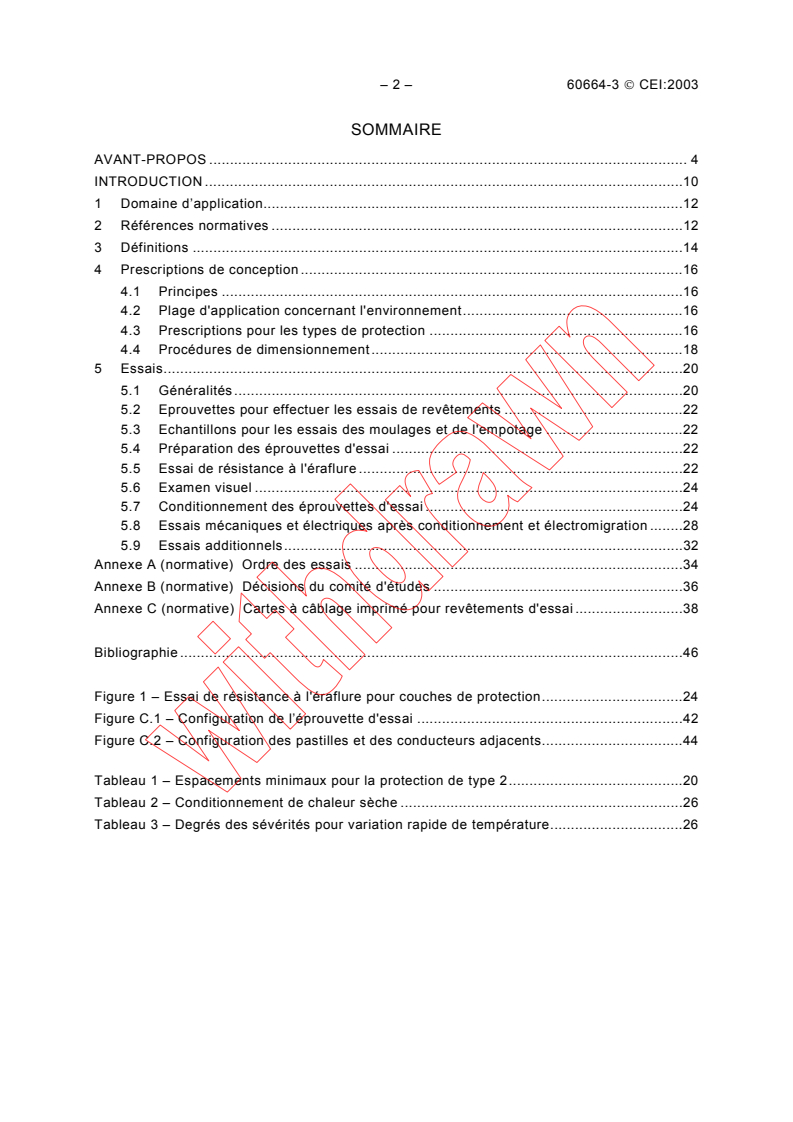
– 2 – 60664-3 CEI:2003
SOMMAIRE
AVANT-PROPOS . 4
INTRODUCTION .10
1 Domaine d’application.12
2 Références normatives .12
3 Définitions .14
4 Prescriptions de conception .16
4.1 Principes .16
4.2 Plage d'application concernant l'environnement.16
4.3 Prescriptions pour les types de protection .16
4.4 Procédures de dimensionnement.18
5 Essais.20
5.1 Généralités.20
5.2 Eprouvettes pour effectuer les essais de revêtements .22
5.3 Echantillons pour les essais des moulages et de l'empotage .22
5.4 Préparation des éprouvettes d'essai .22
5.5 Essai de résistance à l'éraflure .22
5.6 Examen visuel .24
5.7 Conditionnement des éprouvettes d'essai .24
5.8 Essais mécaniques et électriques après conditionnement et électromigration .28
5.9 Essais additionnels.32
Annexe A (normative) Ordre des essais .34
Annexe B (normative) Décisions du comité d'études .36
Annexe C (normative) Cartes à câblage imprimé pour revêtements d'essai .38
Bibliographie .46
Figure 1 – Essai de résistance à l'éraflure pour couches de protection.24
Figure C.1 – Configuration de l’éprouvette d'essai .42
Figure C.2 – Configuration des pastilles et des conducteurs adjacents.44
Tableau 1 – Espacements minimaux pour la protection de type 2.20
Tableau 2 – Conditionnement de chaleur sèche .26
Tableau 3 – Degrés des sévérités pour variation rapide de température.26
60664-3 IEC:2003 – 3 –
CONTENTS
FOREWORD . 5
INTRODUCTION .11
1 Scope .13
2 Normative references.13
3 Definitions .15
4 Design requirements.17
4.1 Principles .17
4.2 Application range regarding environment .17
4.3 Requirements for the types of protection.17
4.4 Dimensioning procedures .19
5 Tests .21
5.1 General .21
5.2 Specimens for testing coatings .23
5.3 Specimens for testing mouldings and potting .23
5.4 Preparation of test specimens.23
5.5 Scratch resistance test .23
5.6 Visual examination .25
5.7 Conditioning of the test specimens .25
5.8 Mechanical and electrical tests after conditioning and electromigration.29
5.9 Additional tests.33
Annex A (normative) Test sequence.35
Annex B (normative) Technical committees' decisions.37
Annex C (normative) Printed wiring board for testing coatings.39
Bibliography.47
Figure 1 – Scratch resistance test for protecting layers .25
Figure C.1 – Configuration of the test specimen .43
Figure C.2 – Configuration of lands and adjacent conductors .45
Table 1 − Minimum spacings for type 2 protection .21
Table 2 – Dry heat conditioning.27
Table 3 – Degrees of severities for rapid change of temperature.27
– 4 – 60664-3 CEI:2003
INTERNATIONAL ELECTROTECHNICAL COMMISSION
____________
COORDINATION DE L’ISOLEMENT DES MATÉRIELS
DANS LES SYSTÈMES (RÉSEAUX) À BASSE TENSION –
Partie 3: Utilisation de revêtement, d'empotage ou de moulage
pour la protection contre la pollution
AVANT-PROPOS
1) La CEI (Commission Electrotechnique Internationale) est une organisation mondiale de normalisation
composée de l'ensemble des comités électrotechniques nationaux (Comités nationaux de la CEI). La CEI a
pour objet de favoriser la coopération internationale pour toutes les questions de normalisation dans les
domaines de l'électricité et de l'électronique. A cet effet, la CEI, entre autres activités, publie des Normes
internationales. Leur élaboration est confiée à des comités d'études, aux travaux desquels tout Comité national
intéressé par le sujet traité peut participer. Les organisations internationales, gouvernementales et non
gouvernementales, en liaison avec la CEI, participent également aux travaux. La CEI collabore étroitement
avec l'Organisation Internationale de Normalisation (ISO), selon des conditions fixées par accord entre les
deux organisations.
2) Les décisions ou accords officiels de la CEI concernant les questions techniques représentent, dans la mesure
du possible, un accord international sur les sujets étudiés, étant donné que les Comités nationaux intéressés
sont représentés dans chaque comité d’études.
3) Les documents produits se présentent sous la forme de recommandations internationales. Ils sont publiés
comme normes, spécifications techniques, rapports techniques ou guides et agréés comme tels par les
Comités nationaux.
4) Dans le but d'encourager l'unification internationale, les Comités nationaux de la CEI s'engagent à appliquer de
façon transparente, dans toute la mesure possible, les normes internationales de la CEI dans leurs normes
nationales et régionales. Toute divergence entre la norme de la CEI et la norme nationale ou régionale
correspondante doit être indiquée en termes clairs dans cette dernière.
5) La CEI n’a fixé aucune procédure concernant le marquage comme indication d’approbation et sa responsabilité
n’est pas engagée quand un matériel est déclaré conforme à l’une de ses normes.
6) L’attention est attirée sur le fait que certains des éléments de la présente norme internationale peuvent faire
l’objet de droits de propriété intellectuelle ou de droits analogues. La CEI ne saurait être tenue pour
responsable de ne pas avoir identifié de tels droits de propriété et de ne pas avoir signalé leur existence.
La Norme internationale CEI 60664-3 a été établie par le comité d’études 109 de la CEI:
Coordination de l'isolement pour le matériel à basse tension.
Cette seconde édition annule et remplace la première édition parue en 1992, dont elle
constitue une révision technique.
Elle a le statut de publication fondamentale de sécurité, conformément au Guide CEI 104.
Le texte de la présente norme est issu des documents suivants:
FDIS Rapport de vote
109/24/FDIS 109/31/RVD
Le rapport de vote indiqué dans le tableau ci-dessus donne toute information sur le vote ayant
abouti à l'approbation de cette norme.
Cette publication a été rédigée selon les Directives ISO/CEI, Partie 2.
60664-3 IEC:2003 – 5 –
INTERNATIONAL ELECTROTECHNICAL COMMISSION
____________
INSULATION COORDINATION FOR EQUIPMENT
WITHIN LOW-VOLTAGE SYSTEMS –
Part 3: Use of coating, potting or moulding
for protection against pollution
FOREWORD
1) The IEC (International Electrotechnical Commission) is a worldwide organization for standardization comprising
all national electrotechnical committees (IEC National Committees). The object of the IEC is to promote
international co-operation on all questions concerning standardization in the electrical and electronic fields. To
this end and in addition to other activities, the IEC publishes International Standards. Their preparation is
entrusted to technical committees; any IEC National Committee interested in the subject dealt with may
participate in this preparatory work. International, governmental and non-governmental organizations liaising
with the IEC also participate in this preparation. The IEC collaborates closely with the International
Organization for Standardization (ISO) in accordance with conditions determined by agreement between the
two organizations.
2) The formal decisions or agreements of the IEC on technical matters express, as nearly as possible, an
international consensus of opinion on the relevant subjects since each technical committee has representation
from all interested National Committees.
3) The documents produced have the form of recommendations for international use and are published in the form
of standards, technical specifications, technical reports or guides and they are accepted by the National
Committees in that sense.
4) In order to promote international unification, IEC National Committees undertake to apply IEC International
Standards transparently to the maximum extent possible in their national and regional standards. Any
divergence between the IEC Standard and the corresponding national or regional standard shall be clearly
indicated in the latter.
5) The IEC provides no marking procedure to indicate its approval and cannot be rendered responsible for any
equipment declared to be in conformity with one of its standards.
6) Attention is drawn to the possibility that some of the elements of this International Standard may be the subject
of patent rights. The IEC shall not be held responsible for identifying any or all such patent rights.
International Standard IEC 60664-3 has been prepared by IEC technical committee 109:
Insulation coordination for low-voltage equipment.
This second edition cancels and replaces the first edition, published in 1992, and constitutes
a technical revision.
It has the status of a basic safety publication in accordance with IEC Guide 104.
The text of this standard is based on the following documents:
FDIS Report on voting
109/24/FDIS 109/31/RVD
Full information on the voting for the approval of this standard can be found in the report on
voting indicated in the above table.
This publication has been drafted in accordance with the ISO/IEC Directives, Part 2.
– 6 – 60664-3 CEI:2003
Les modifications majeures effectuées au cours de la révision de la CEI 60664-3 ont été les
suivantes:
• La Partie 3 a été alignée exactement à la Partie 1 (y compris les amendements 1 et 2).
Il a été précisé que la Partie 3 ne peut être utilisée que comme un document entier ainsi
que la Partie 1 de la CEI 60664.
• Le domaine d’application de la Partie 3 a été considérablement élargi, en incluant à
présent le moulage et l’empotage et les procédures similaires fournissant une protection
contre la pollution. La norme s'applique également à toutes sortes de cartes imprimées
enduites, y compris la surface de couches internes de cartes multicouches, de substrats
et d'ensembles protégés similaires. Les distances à travers une couche interne de cartes
multicouches sont cependant couvertes par les prescriptions pour l'isolation solide de la
Partie 1.
• La différence entre les deux types de protection a été clarifiée. La protection de type 1
(précédemment type A) aboutit à une réduction du degré de pollution présente au-delà de
la protection pour le degré 1 de pollution. La protection de type 2 (précédemment type B)
introduit des systèmes de protection qui peuvent être considérés comme similaires à
l’isolation solide. Par conséquent, les prescriptions de dimensionnement et d’essais ont
été alignées d’une meilleure façon.
• Le domaine d’application a été élargi, en incluant à présent l’isolation fonctionnelle,
principale, supplémentaire et renforcée.
• Les protections de type 1 et type 2 peuvent maintenant être utilisées dans des conditions
de degré 3 de pollution (précédemment type B).
• Non seulement la protection de type 2 mais également la protection de type 1 nécessitent
que, entre les deux parties conductrices, 100 % de la distance à travers l’espacement
soient couverts par la protection.
• Pour la protection de type 2, des distances minimales ont été introduites. Dans tous les
cas, les espacements ne doivent pas être inférieurs à la valeur minimale de 10 µm.
• Il est également fait référence à la nouvelle Partie 5 de la CEI 60664.
• Les essais suivent de beaucoup plus près les différentes prescriptions pour les
protections de type 1 et type 2. L’ensemble protégé doit résister aux essais électriques
concernant l’isolation solide de 4.1.2 de la CEI 60664-1. Pour la protection de type 1,
l’essai de décharge partielle n’est pas applicable. Pour la protection de type 2, l’essai de
décharge partielle est exigé. La tension d'extinction de décharge partielle prescrite et la
méthode d’essai sont spécifiées en 4.1.2.4 de la CEI 60664-1.
• Les prescriptions pour l’éprouvette d’essai ont été alignées en élargissant le domaine
d’application.
• Les essais concernant «l’adhérence du revêtement» et «l’essai de résistance aux
éraflures» ont été mis à jour.
La CEI 60664 comprend les parties suivantes, présentées sous le titre général Coordination
de l'isolement des matériels dans les systèmes (réseaux) à basse tension:
Partie 1: Principes, prescriptions et essais
Partie 2: Guide d’application
Partie 3: Utilisation de revêtement, d'empotage ou de moulage pour la protection contre la
pollution
Partie 4: Considérations sur les contraintes de tension à hautes fréquences
Partie 5: Méthode détaillée de détermination des distances d’isolement dans l’air et des
lignes de fuite inférieures ou égales à 2 mm
60664-3 IEC:2003 – 7 –
The major changes made during the revision of IEC 60664-3 were the following:
• Part 3 has been exactly aligned with Part 1 (including amendments 1 and 2). It has been
made clear that Part 3 can only be used as a whole document together with Part 1 of
IEC 60664.
• The scope of Part 3 has been greatly extended including now also potting and moulding
and similar procedures providing protection against pollution. The standard also applies to
all kinds of coated printed boards including the surface of inner-layers of multi-layer
boards, substrates and similar protected assemblies. The distances through an inner
layer of multi-layer boards however are covered by the requirements for solid insulation
in Part 1.
• The difference between the two types of protection has been clarified. Type 1 (formerly
type A) protection leads to a reduction of the pollution degree present beyond the
protection to pollution degree 1. Type 2 (formerly type B) protection introduces protection
systems which can be considered similar to solid insulation. Consequently the
dimensioning and test requirements have been aligned more correctly.
• The area of application has been extended including now functional, basic, supplementary
and reinforced insulation.
• Type 1 and type 2 protection now can both be used under the conditions of pollution
degree 3 (formerly only type B).
• Not only type 2 protection but also type 1 protection requires that between two conductive
parts 100 % of the distance across the spacing shall be covered by the protection.
• For type 2 protection minimum distances have been introduced. In any case the spacings
shall not be lower than the minimum value of 10 µm.
• Also the new Part 5 of IEC 60664 is referred to.
• The tests follow much more closely the different requirements for type 1 and type 2
protection. The protected assembly shall withstand the electrical tests for solid insulation
in 4.1.2 of IEC 60664-1. For type 1 protection, the partial discharge test is not applicable.
For type 2 protection, the partial discharge test is required. The required partial discharge
extinction voltage and the test method are specified in 4.1.2.4 of IEC 60664-1.
• The requirements for the test specimen have been aligned with the extended scope.
• The tests for the “adhesion of coating” and the “scratch resistance test” have been
updated.
IEC 60664 consists of the following parts under the general title Insulation coordination for
equipment within low-voltage systems:
Part 1: Principles, requirements and tests
Part 2: Application guide
Part 3: Use of coating, potting or moulding for protection against pollution
Part 4: Consideration of high-frequency voltage stress
Part 5: A comprehensive method for determining clearances and creepage distances equal
to or less than 2 mm
– 8 – 60664-3 CEI:2003
Le comité a décidé que le contenu de cette publication ne sera pas modifié avant 2008.
A cette date, la publication sera
• reconduite;
• supprimée;
• remplacée par une édition révisée, ou
• amendée.
60664-3 IEC:2003 – 9 –
The committee has decided that the contents of this publication will remain unchanged until 2008.
At this date, the publication will be
• reconfirmed;
• withdrawn;
• replaced by a revised edition, or
• amended.
– 10 – 60664-3 CEI:2003
INTRODUCTION
La présente partie de la CEI 60664 précise les conditions dans lesquelles la réduction des
distances d’isolement dans l’air et des lignes de fuite peuvent s'appliquer aux ensembles
rigides, tels que les cartes imprimées ou les bornes des composants. La protection contre la
pollution peut être obtenue par toutes sortes d'encapsulage, telles que le revêtement,
l'empotage ou le moulage. La protection peut être appliquée sur une face ou sur les deux
faces de l'ensemble. La présente norme spécifie les propriétés isolantes du matériau de
protection.
Entre deux parties conductrices quelconques non protégées, les prescriptions de distances
d'isolement et de lignes de fuite de la CEI 60664-1 ou de la CEI 60664-5 s'appliquent.
La présente norme fait uniquement référence à une protection permanente. Elle n'englobe
pas les ensembles après réparation.
Il est nécessaire que les comités d'études prennent en considération l'influence sur la
protection des conducteurs et composants surchauffés, en particulier dans des conditions de
défaut, et qu’ils décident si toute prescription additionnelle est nécessaire.
Une performance en toute sécurité des ensembles dépend d'un procédé de fabrication précis
et contrôlé pour l'application du système de protection. Il convient que les prescriptions pour
le contrôle de la qualité, par exemple par des essais par échantillonnage, soient prises en
considération par les comités d'études.
60664-3 IEC:2003 – 11 –
INTRODUCTION
This part of IEC 60664 details the conditions in which the reduction of clearance and
creepage distances can apply to rigid assemblies such as printed boards or terminals of
components. Protection against pollution can be achieved by any kind of encapsulation such
as coating, potting or moulding. The protection may be applied to one or both sides of the
assembly. This standard specifies the insulating properties of the protecting material.
Between any two unprotected conductive parts, the clearance and creepage distance
requirements of IEC 60664-1 or IEC 60664-5 apply.
This standard refers only to permanent protection. It does not cover assemblies after repair.
Technical committees need to consider the influence on the protection of overheated
conductors and components, especially under fault conditions, and to decide if any additional
requirements are necessary.
Safe performance of assemblies is dependent upon a precise and controlled manufacturing
process for the application of the protective system. Requirements for quality control, e.g. by
sampling tests, should be considered by technical committees.
– 12 – 60664-3 CEI:2003
COORDINATION DE L’ISOLEMENT DES MATÉRIELS
DANS LES SYSTÈMES (RÉSEAUX) À BASSE TENSION –
Partie 3: Utilisation de revêtement, d'empotage ou de moulage
pour la protection contre la pollution
1 Domaine d’application
La présente partie de la CEI 60664 est applicable aux ensembles protégés contre la pollution
au moyen de revêtement, d'empotage ou de moulage, permettant ainsi une réduction des
distances d'isolement et des lignes de fuite décrites dans la Partie 1 ou la Partie 5.
NOTE 1 Lorsqu’il est fait référence à la Partie 1 ou la Partie 5, on sous-entend la CEI 60664-1 ou la CEI 60664-5.
Cette norme décrit les prescriptions et procédures d'essai pour deux méthodes de protection:
– la protection de type 1 améliore le micro-environnement des parties sous protection;
– la protection de type 2 est considérée comme similaire à l'isolation solide.
La présente norme s'applique également à toutes sortes de cartes imprimées protégées,
y compris la surface de couches internes de cartes multicouches, de substrats et d'ensembles
protégés de manière similaire. Dans le cas de cartes imprimées multicouches, les distances
à travers une couche interne sont couvertes par les prescriptions pour l'isolation solide dans
la Partie 1.
NOTE 2 À titre d'exemples de substrats on peut citer les circuits intégrés hybrides et la technologie
à couches épaisses.
La présente norme fait uniquement référence à une protection permanente. Elle n'englobe
pas les ensembles soumis à une mise au point mécanique ou à des réparations.
Les principes de cette norme sont applicables à l'isolation fonctionnelle, principale, supplé-
mentaire et renforcée.
2 Références normatives
Les documents de référence suivants sont indispensables pour l'application du présent
document. Pour les références datées, seule l'édition citée s'applique. Pour les références
non datées, la dernière édition du document de référence s'applique (y compris les éventuels
amendements).
CEI 60068-2-1:1990, Essais d’environnement – Partie 2: Essais – Essais A: Froid
Amendement 1 (1993)
Amendement 2 (1994)
CEI 60068-2-2:1974, Essais fondamentaux climatiques et de robustesse mécanique –
Partie 2: Essais – Essais B: Chaleur sèche
Amendement 1 (1993)
Amendement 2 (1994)
CEI 60068-2-14:1984, Essais fondamentaux climatiques et de robustesse mécanique –
Partie 2: Essais – Essai N: Variation de température
Amendement 1 (1986)
CEI 60068-2-78:2001, Essais d’environnement – Partie 2-78: Essais – Essai Cab: Chaleur
humide, essai continu
60664-3 IEC:2003 – 13 –
INSULATION COORDINATION FOR EQUIPMENT
WITHIN LOW-VOLTAGE SYSTEMS –
Part 3: Use of coating, potting or moulding
for protection against pollution
1 Scope
This part of IEC 60664 applies to assemblies protected against pollution by the use of
coating, potting or moulding, thus allowing a reduction of clearance and creepage distances
as described in Part 1 or Part 5.
NOTE 1 When reference is made to Part 1 or Part 5, IEC 60664-1 or IEC 60664-5 are meant.
This standard describes the requirements and test procedures for two methods of protection:
– type 1 protection improves the microenvironment of the parts under the protection;
– type 2 protection is considered to be similar to solid insulation.
This standard also applies to all kinds of protected printed boards, including the surface of
inner layers of multi-layer boards, substrates and similarly protected assemblies. In the case
of multi-layer printed boards, the distances through an inner layer are covered by the
requirements for solid insulation in Part 1.
NOTE 2 Examples of substrates are hybrid integrated circuits and thick-film technology.
This standard refers only to permanent protection. It does not cover assemblies that are
subjected to mechanical adjustment or repair.
The principles of this standard are applicable to functional, basic, supplementary and
reinforced insulation.
2 Normative references
The following referenced documents are indispensable for the application of this document.
For dated references, only the edition cited applies. For undated references, the latest edition
of the referenced document (including any amendments) applies.
IEC 60068-2-1:1990, Environmental testing − Part 2: Tests − Tests A: Cold
Amendment 1 (1993)
Amendment 2 (1994)
IEC 60068-2-2:1974, Basic environmental testing procedures − Part 2: Tests − Tests B:
Dry heat
Amendment 1 (1993)
Amendment 2 (1994)
IEC 60068-2-14:1984, Basic environmental testing procedures − Part 2: Tests − Test N:
Change of temperature
Amendment 1 (1986)
IEC 60068-2-78:2001, Environmental testing − Part 2-78: Tests − Test Cab: Damp heat,
steady state
– 14 – 60664-3 CEI:2003
CEI 60249-1:1982, Matériaux de base pour circuits imprimés – Partie 1: Méthodes d'essai
Amendement 4 (1993)
CEI 60249-2 (toutes les parties), Matériaux de base pour circuits imprimés – Partie 2:
Spécifications
IEC 60326-2:1990, Cartes imprimées – Partie 2: Méthodes d'essai
Amendement 1 (1992)
IEC 60454-3-1:1998, Rubans adhésifs sensibles à la pression à usages électriques –
Partie 3: Spécifications pour matériaux particuliers – Feuille 1: Rubans en PVC avec un
adhésif sensible à la pression
CEI 60664-1:1992, Coordination de l'isolement des matériels dans les systèmes (réseaux) à
basse tension – Partie 1: Principes, prescriptions et essais
Amendement 1 (2000)
Amendement 2 (2002)
CEI 60664-5:, Coordination de l'isolement des matériels dans les systèmes (réseaux) à
basse tension – Partie 5: Méthode détaillée de détermination des distances d'isolement dans
1)
l'air et des lignes de fuite inférieures ou égales à 2 mm
Guide CEI 104:1997, Élaboration des publications de sécurité et utilisation des publications
fondamentales de sécurité et des publications groupées de sécurité
3 Définitions
Pour les besoins du présent document, les définitions de la CEI 60664-1 s’appliquent, ainsi
que les définitions suivantes.
3.1
matériau de base
matériau isolant sur lequel peut être réalisée une impression conductrice
NOTE Le matériau de base peut être rigide ou souple, ou encore les deux. Il peut s'agir d'un diélectrique ou d'une
feuille de métal isolée.
(CEI 60194, traduction de la définition 40.1334)
3.2
carte imprimée
terme général pour configurations de câblage imprimé et circuit imprimé entièrement traités
NOTE Cela comprend les cartes simple face, double face et multicouches à matériaux rigides, souples et
flexorigides.
(CEI 60194, traduction de la définition 60.1485)
3.3
conducteur
chemin conducteur simple d’une impression conductrice
(CEI 60194, traduction de la définition 22.0251)
3.4
protection
toute mesure qui réduit l’influence de l’environnement
———————
1)
A publier.
60664-3 IEC:2003 – 15 –
IEC 60249-1:1982, Base materials for printed circuits – Part 1: Test methods
Amendment 4 (1993)
IEC 60249-2 (all parts), Base materials for printed circuit – Part 2: Specifications
IEC 60326-2:1990, Printed boards – Part 2: Test methods
Amendment 1 (1992)
IEC 60454-3-1:1998, Pressure-sensitive adhesive tapes for electrical purposes – Part 3:
Specifications for individual materials – Sheet 1: PVC film tapes with pressure-sensitive
adhesive
IEC 60664-1:1992, Insulation coordination for equipment within low-voltage systems – Part 1:
Principles, requirements and tests
Amendment 1 (2000)
Amendment 2 (2002)
IEC 60664-5:, Insulation coordination for equipment within low-voltage systems – Part 5:
A comprehensive method for determining clearance and creepage distances equal to or less
1)
than 2 mm
IEC Guide 104:1997, The preparation of safety publications and the use of basic safety
publications and group safety publications
3 Definitions
For the purposes of this document, the definitions given in IEC 60664-1 as well as the
following definitions apply.
3.1
base material
insulating material upon which a conductive pattern may be formed
NOTE The base material may be rigid or flexible, or both. It may be a dielectric or an insulated metal sheet.
(IEC 60194, definition 40.1334)
3.2
printed board
general term for completely processed printed circuit and printed wiring configurations
NOTE This includes single-sided, double-sided and multilayer boards with rigid, flexible, and rigid-flex base
materials
(IEC 60194, definition 60.1485)
3.3
conductor
single conductive path in a conductive pattern
(IEC 60194, definition 22.0251)
3.4
protection
any kind of measure which reduces the influence of the environment
———————
1)
To be published.
– 16 – 60664-3 CEI:2003
3.5
revêtement
matériau isolant tel que vernis ou film sec posé sur la surface de l'ensemble
NOTE Le revêtement et le matériau de base d'une carte imprimée forment un système isolant qui peut avoir des
propriétés similaires à l'isolation solide.
3.6
isolation solide
matériau isolant solide placé entre deux parties conductrices
NOTE Dans le cas d’une carte imprimée à revêtement, l’isolation solide est constituée de la carte elle-même ainsi
que du revêtement. Dans les autres cas, l’isolation solide est constituée du matériau d’encapsulation.
3.7
espacement
toute combinaison de distances d'isolement, de lignes de fuite et des distances à travers
l'isolation
4 Prescriptions de conception
4.1 Principes
Le dimensionnement des espacements entre les conducteurs dépend du type de protection
utilisé.
Lorsque la protection de type 1 est utilisée, le dimensionnement des distances d'isolement et
des lignes de fuite doivent suivre les prescriptions de la Partie 1 ou de la Partie 5. Si les
prescriptions de cette norme sont satisfaites, le degré 1 de pollution s'applique sous la
protection.Lorsque la protection de type 2 est utilisée, les espacements entre les parties
conductrices doivent satisfaire aux prescriptions et aux essais pour l'isolation solide de la
Partie 1 et leurs dimensions ne doivent pas être inférieures aux distances d'isolement
minimales spécifiées dans la Partie 1 ou la Partie 5 pour des conditions de champ
homogènes.
4.2 Plage d'application concernant l'environnement
Les prescriptions de conception sont applicables dans tous les micro-environnements.
Les contraintes, telles que celles de température, chimiques, mécaniques, ou bien celles
énumérées en 3.3.2.3 de la Partie 1, doivent être prises en compte lorsque l'on sélectionne le
matériau de protection.
L'absorption d'humidité par le matériau de protection ne doit pas affecter les propriétés
d'isolation des parties protégées.
NOTE L'absorption d'humidité peut être vérifiée par une mesure de résistance d'isolement dans des conditions
humides.
4.3 Prescriptions pour les types de protection
La protection est obtenue des manières suivantes:
– la protection de type 1 améliore le micro-environnement des parties sous protection. Les
prescriptions de distance d'isolement et de lignes de fuite de la Partie 1 ou de la Partie 5
pour le degré 1 de pollution s'appliquent sous la protection. Entre deux parties conduc-
trices, il est prescrit qu'une partie conductrice ou les deux ainsi que tous les espacements
entre elles soient couverts par la protection;
60664-3 IEC:2003 – 17 –
3.5
coating
insulating material such as varnish or dry film laid on the surface of the assembly
NOTE Coating and base material of a printed board form an insulating system that may have properties similar to
solid insulation.
3.6
solid insulation
solid insulating material interposed between two conductive parts
NOTE In the case of a printed board with a coating, solid insulation consists of the board itself as well as the
coating. In other cases, solid insulation consists of the encapsulating material.
3.7
spacing
any combination of clearances, creepage distances and insulation distances through
insulation
4 Design requirements
4.1 Principles
Dimensioning of spacings between conductors depends on the type of protection used.
When type 1 protection is used, dimensioning of clearances and creepage distances shall
follow the requirements of Part 1 or Part 5. If the requirements of this standard are met,
pollution degree 1 applies under the protection.
When type 2 protection is used, spacings between conductive parts shall meet the
requirements and tests for solid insulation of Part 1 and their dimensions shall not be less
than the minimum clearances specified in Part 1 or Part 5 for homogeneous field conditions.
4.2 Application range regarding environment
The design requirements are applicable in all microenvironments.
Stresses such as temperature, chemical, mechanical or those listed in 3.3.2.3 of Part 1 shall
be taken into account when the protective material is selected.
Absorption of humidity by the protective material shall not impair the insulation properties of
the parts being protected.
NOTE Absorption of humidity can be checked by an insulation resistance measurement under humid conditions.
4.3 Requirements for the types of protection
Protection is achieved in the following ways:
– type 1 protection improves the microenvironment of the parts under the protection. The
clearance and creepage distance requirements of Part 1 or Part 5 for pollution degree 1
apply under the protection. Between two conductive parts, it is a requirement that one or
both conductive parts, together with all the spacings between them, are covered by the
protection;
– 18 – 60664-3 CEI:2003
– la protection de type 2 est considérée comme similaire à l'isolation solide. Sous protection,
les prescriptions pour isolation solide spécifiées dans la Partie 1 sont applicables et les
espacements ne doivent pas être inférieurs à ceux qui sont spécifiés dans le Tableau 1.
Les prescriptions pour distances d'isolement et lignes de fuite de la Partie 1 ou de la
Partie 5 ne s'appliquent pas. Entre deux parties conductrices, il est prescrit que les deux
parties conductrices ainsi que tous les espacements entre elles soient couverts par la
protection de sorte qu'il n'existe aucun entrefer entre le matériau de protection, les parties
conductrices et la carte imprimée.
Les prescriptions de distance d'isolement et de ligne de fuite conformément à la Partie 1 ou
de la Partie 5 s'appliquent à toutes les parties non protégées des matériels.
4.4 Procédures de dimensionnement
Pour la protection de type 1, les prescriptions de dimensionnement de 3.1 et 3.2 de la Par-
tie 1 ou de la Partie 5 s'appliquent.
Pour la protection de type 2, l'espacement entre les conducteurs avant d'appliquer la
protection ne doit pas être inférieur aux valeurs spécifiées dans le Tableau 1. Ces valeurs
s'appliquent à l'isolation principale, l’isolation supplémentaire, ainsi que l’isolation renforcée.
NOTE Dans le cas des cartes multicouches, l’espacement entre les conducteurs à la surface des couches
internes est dimensionné comme spécifié pour la protection de type 1 ou la protection de type 2 en fonction du
résultat des essais sur la protection.
60664-3 IEC:2003 – 19 –
– type 2 protection is considered to be similar to solid insulation. Under the protection, the
requirements for solid insulation specified in Part 1 are applicable and the spacings shall
be not less than those specified in Table 1. The requirements for clearances and creepage
distances in Part 1 or
...
IEC 60664-3 ®
Edition 2.1 2010-08
INTERNATIONAL
STANDARD
NORME
INTERNATIONALE
colour
inside
BASIC SAFETY PUBLICATION
PUBLICATION FONDAMENTALE DE SÉCURITÉ
Insulation coordination for equipment within low-voltage systems –
Part 3: Use of coating, potting or moulding for protection against pollution
Coordination de l'isolement des matériels dans les systèmes (réseaux) à basse
tension –
Partie 3: Utilisation de revêtement, d'empotage ou de moulage pour la protection
contre la pollution
All rights reserved. Unless otherwise specified, no part of this publication may be reproduced or utilized in any form or by
any means, electronic or mechanical, including photocopying and microfilm, without permission in writing from either IEC or
IEC's member National Committee in the country of the requester.
If you have any questions about IEC copyright or have an enquiry about obtaining additional rights to this publication,
please contact the address below or your local IEC member National Committee for further information.
Droits de reproduction réservés. Sauf indication contraire, aucune partie de cette publication ne peut être reproduite
ni utilisée sous quelque forme que ce soit et par aucun procédé, électronique ou mécanique, y compris la photocopie
et les microfilms, sans l'accord écrit de la CEI ou du Comité national de la CEI du pays du demandeur.
Si vous avez des questions sur le copyright de la CEI ou si vous désirez obtenir des droits supplémentaires sur cette
publication, utilisez les coordonnées ci-après ou contactez le Comité national de la CEI de votre pays de résidence.
IEC Central Office
3, rue de Varembé
CH-1211 Geneva 20
Switzerland
Email: inmail@iec.ch
Web: www.iec.ch
About the IEC
The International Electrotechnical Commission (IEC) is the leading global organization that prepares and publishes
International Standards for all electrical, electronic and related technologies.
About IEC publications
The technical content of IEC publications is kept under constant review by the IEC. Please make sure that you have the
latest edition, a corrigenda or an amendment might have been published.
ƒ Catalogue of IEC publications: www.iec.ch/searchpub
The IEC on-line Catalogue enables you to search by a variety of criteria (reference number, text, technical committee,…).
It also gives information on projects, withdrawn and replaced publications.
ƒ IEC Just Published: www.iec.ch/online_news/justpub
Stay up to date on all new IEC publications. Just Published details twice a month all new publications released. Available
on-line and also by email.
ƒ Electropedia: www.electropedia.org
The world's leading online dictionary of electronic and electrical terms containing more than 20 000 terms and definitions
in English and French, with equivalent terms in additional languages. Also known as the International Electrotechnical
Vocabulary online.
ƒ Customer Service Centre: www.iec.ch/webstore/custserv
If you wish to give us your feedback on this publication or need further assistance, please visit the Customer Service
Centre FAQ or contact us:
Email: csc@iec.ch
Tel.: +41 22 919 02 11
Fax: +41 22 919 03 00
A propos de la CEI
La Commission Electrotechnique Internationale (CEI) est la première organisation mondiale qui élabore et publie des
normes internationales pour tout ce qui a trait à l'électricité, à l'électronique et aux technologies apparentées.
A propos des publications CEI
Le contenu technique des publications de la CEI est constamment revu. Veuillez vous assurer que vous possédez
l’édition la plus récente, un corrigendum ou amendement peut avoir été publié.
ƒ Catalogue des publications de la CEI: www.iec.ch/searchpub/cur_fut-f.htm
Le Catalogue en-ligne de la CEI vous permet d’effectuer des recherches en utilisant différents critères (numéro de référence,
texte, comité d’études,…). Il donne aussi des informations sur les projets et les publications retirées ou remplacées.
ƒ Just Published CEI: www.iec.ch/online_news/justpub
Restez informé sur les nouvelles publications de la CEI. Just Published détaille deux fois par mois les nouvelles
publications parues. Disponible en-ligne et aussi par email.
ƒ Electropedia: www.electropedia.org
Le premier dictionnaire en ligne au monde de termes électroniques et électriques. Il contient plus de 20 000 termes et
définitions en anglais et en français, ainsi que les termes équivalents dans les langues additionnelles. Egalement appelé
Vocabulaire Electrotechnique International en ligne.
ƒ Service Clients: www.iec.ch/webstore/custserv/custserv_entry-f.htm
Si vous désirez nous donner des commentaires sur cette publication ou si vous avez des questions, visitez le FAQ du
Service clients ou contactez-nous:
Email: csc@iec.ch
Tél.: +41 22 919 02 11
Fax: +41 22 919 03 00
IEC 60664-3 ®
Edition 2.1 2010-08
INTERNATIONAL
STANDARD
NORME
INTERNATIONALE
colour
inside
BASIC SAFETY PUBLICATION
PUBLICATION FONDAMENTALE DE SÉCURITÉ
Insulation coordination for equipment within low-voltage systems –
Part 3: Use of coating, potting or moulding for protection against pollution
Coordination de l'isolement des matériels dans les systèmes (réseaux) à basse
tension –
Partie 3: Utilisation de revêtement, d'empotage ou de moulage pour la
protection contre la pollution
INTERNATIONAL
ELECTROTECHNICAL
COMMISSION
COMMISSION
ELECTROTECHNIQUE
PRICE CODE
INTERNATIONALE
CK
CODE PRIX
ICS 29.080.30 ISBN 978-2-88912-119-9
– 2 – 60664-3 © IEC:2003+A1:2010
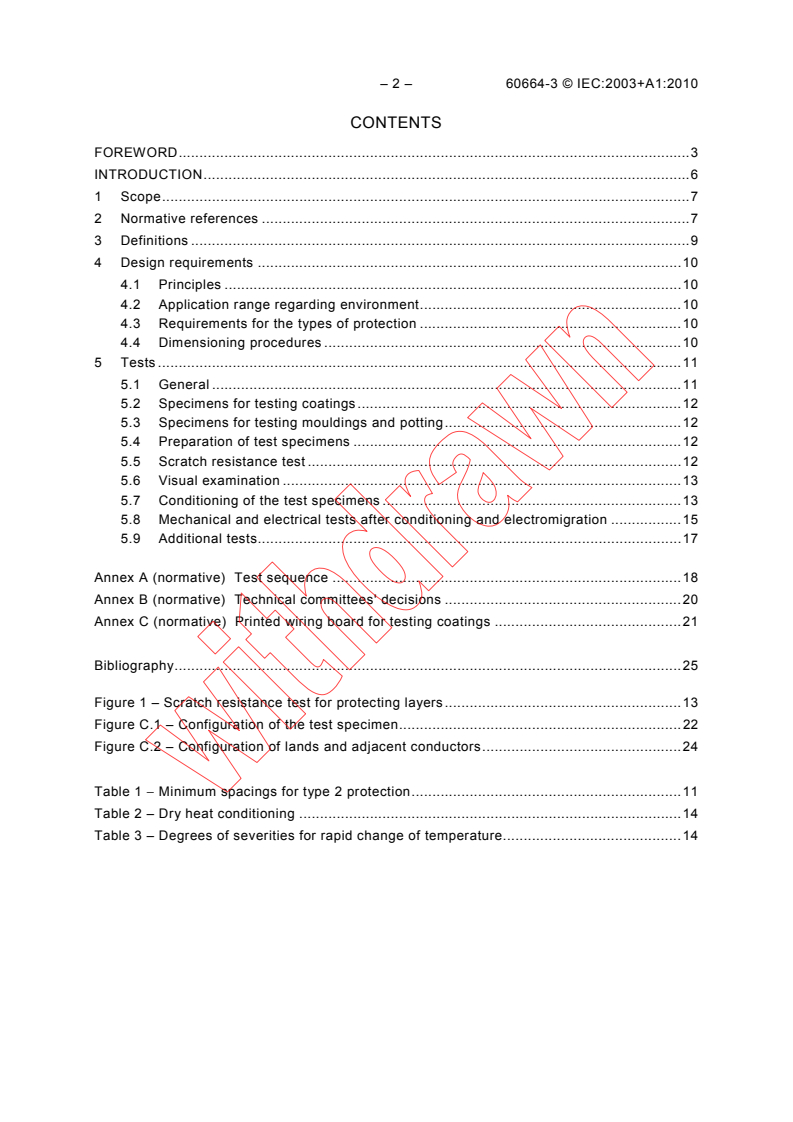
CONTENTS
FOREWORD.3
INTRODUCTION.6
1 Scope.7
2 Normative references.7
3 Definitions.9
4 Design requirements.10
4.1 Principles.10
4.2 Application range regarding environment.10
4.3 Requirements for the types of protection .10
4.4 Dimensioning procedures.10
5 Tests.11
5.1 General.11
5.2 Specimens for testing coatings.12
5.3 Specimens for testing mouldings and potting.12
5.4 Preparation of test specimens .12
5.5 Scratch resistance test .12
5.6 Visual examination.13
5.7 Conditioning of the test specimens .13
5.8 Mechanical and electrical tests after conditioning and electromigration .15
5.9 Additional tests.17
Annex A (normative) Test sequence .18
Annex B (normative) Technical committees' decisions .20
Annex C (normative) Printed wiring board for testing coatings .21
Bibliography.25
Figure 1 – Scratch resistance test for protecting layers.13
Figure C.1 – Configuration of the test specimen.22
Figure C.2 – Configuration of lands and adjacent conductors.24
Table 1 − Minimum spacings for type 2 protection.11
Table 2 – Dry heat conditioning .14
Table 3 – Degrees of severities for rapid change of temperature.14
60664-3 © IEC:2003+A1:2010 – 3 –
INTERNATIONAL ELECTROTECHNICAL COMMISSION
____________
INSULATION COORDINATION FOR EQUIPMENT
WITHIN LOW-VOLTAGE SYSTEMS –
Part 3: Use of coating, potting or moulding
for protection against pollution
FOREWORD
1) The International Electrotechnical Commission (IEC) is a worldwide organization for standardization comprising
all national electrotechnical committees (IEC National Committees). The object of IEC is to promote
international co-operation on all questions concerning standardization in the electrical and electronic fields. To
this end and in addition to other activities, IEC publishes International Standards, Technical Specifications,
Technical Reports, Publicly Available Specifications (PAS) and Guides (hereafter referred to as “IEC
Publication(s)”). Their preparation is entrusted to technical committees; any IEC National Committee interested
in the subject dealt with may participate in this preparatory work. International, governmental and non-
governmental organizations liaising with the IEC also participate in this preparation. IEC collaborates closely
with the International Organization for Standardization (ISO) in accordance with conditions determined by
agreement between the two organizations.
2) The formal decisions or agreements of IEC on technical matters express, as nearly as possible, an international
consensus of opinion on the relevant subjects since each technical committee has representation from all
interested IEC National Committees.
3) IEC Publications have the form of recommendations for international use and are accepted by IEC National
Committees in that sense. While all reasonable efforts are made to ensure that the technical content of IEC
Publications is accurate, IEC cannot be held responsible for the way in which they are used or for any
misinterpretation by any end user.
4) In order to promote international uniformity, IEC National Committees undertake to apply IEC Publications
transparently to the maximum extent possible in their national and regional publications. Any divergence
between any IEC Publication and the corresponding national or regional publication shall be clearly indicated in
the latter.
5) IEC itself does not provide any attestation of conformity. Independent certification bodies provide conformity
assessment services and, in some areas, access to IEC marks of conformity. IEC is not responsible for any
services carried out by independent certification bodies.
6) All users should ensure that they have the latest edition of this publication.
7) No liability shall attach to IEC or its directors, employees, servants or agents including individual experts and
members of its technical committees and IEC National Committees for any personal injury, property damage or
other damage of any nature whatsoever, whether direct or indirect, or for costs (including legal fees) and
expenses arising out of the publication, use of, or reliance upon, this IEC Publication or any other IEC
Publications.
8) Attention is drawn to the Normative references cited in this publication. Use of the referenced publications is
indispensable for the correct application of this publication.
9) Attention is drawn to the possibility that some of the elements of this IEC Publication may be the subject of
patent rights. IEC shall not be held responsible for identifying any or all such patent rights.
This consolidated version of IEC 60664-3 consists of the second edition (2003)
[documents 109/24/FDIS and 109/31/RVD], its amendment 1 (2010) [documents
109/79/FDIS and 109/81/RVD] and its corrigendum of November 2010. It bears the
edition number 2.1.
The technical content is therefore identical to the base edition and its amendment and
has been prepared for user convenience. A vertical line in the margin shows where the
base publication has been modified by amendment 1. Additions and deletions are
displayed in red, with deletions being struck through.
– 4 – 60664-3 © IEC:2003+A1:2010
International Standard IEC 60664-3 has been prepared by IEC technical committee 109:
Insulation coordination for low-voltage equipment.
It has the status of a basic safety publication in accordance with IEC Guide 104.
This publication has been drafted in accordance with the ISO/IEC Directives, Part 2.
The major changes made during the revision of IEC 60664-3 were the following:
• Part 3 has been exactly aligned with Part 1 (including amendments 1 and 2). It has been
made clear that Part 3 can only be used as a whole document together with Part 1 of
IEC 60664.
• The scope of Part 3 has been greatly extended including now also potting and moulding
and similar procedures providing protection against pollution. The standard also applies to
all kinds of coated printed boards including the surface of inner-layers of multi-layer
boards, substrates and similar protected assemblies. The distances through an inner
layer of multi-layer boards however are covered by the requirements for solid insulation
in Part 1.
• The difference between the two types of protection has been clarified. Type 1 (formerly
type A) protection leads to a reduction of the pollution degree present beyond the
protection to pollution degree 1. Type 2 (formerly type B) protection introduces protection
systems which can be considered similar to solid insulation. Consequently the
dimensioning and test requirements have been aligned more correctly.
• The area of application has been extended including now functional, basic, supplementary
and reinforced insulation.
• Type 1 and type 2 protection now can both be used under the conditions of pollution
degree 3 (formerly only type B).
• Not only type 2 protection but also type 1 protection requires that between two conductive
parts 100 % of the distance across the spacing shall be covered by the protection.
• For type 2 protection minimum distances have been introduced. In any case the spacings
shall not be lower than the minimum value of 10 µm.
• Also the new Part 5 of IEC 60664 is referred to.
• The tests follow much more closely the different requirements for type 1 and type 2
protection. The protected assembly shall withstand the electrical tests for solid insulation
in 4.1.2 of IEC 60664-1. For type 1 protection, the partial discharge test is not applicable.
For type 2 protection, the partial discharge test is required. The required partial discharge
extinction voltage and the test method are specified in 4.1.2.4 of IEC 60664-1.
• The requirements for the test specimen have been aligned with the extended scope.
• The tests for the “adhesion of coating” and the “scratch resistance test” have been
updated.
IEC 60664 consists of the following parts under the general title Insulation coordination for
equipment within low-voltage systems:
Part 1: Principles, requirements and tests
Part 2: Application guide
Part 3: Use of coating, potting or moulding for protection against pollution
Part 4: Consideration of high-frequency voltage stress
Part 5: A comprehensive method for determining clearances and creepage distances equal
to or less than 2 mm
60664-3 © IEC:2003+A1:2010 – 5 –
The committee has decided that the contents of the base publication and its amendments will
remain unchanged until the stability date indicated on the IEC web site under
"http://webstore.iec.ch" in the data related to the specific publication. At this date, the publication will
be
• reconfirmed,
• withdrawn,
• replaced by a revised edition, or
• amended.
IMPORTANT – The “colour inside” logo on the cover page of this publication indicates
that it contains colours which are considered to be useful for the correct understanding
of its contents. Users should therefore print this publication using a colour printer.
– 6 – 60664-3 © IEC:2003+A1:2010
INTRODUCTION
This part of IEC 60664 details the conditions in which the reduction of clearance and
creepage distances can apply to rigid assemblies such as printed boards or terminals of
components. Protection against pollution can be achieved by any kind of encapsulation such
as coating, potting or moulding. The protection may be applied to one or both sides of the
assembly. This standard specifies the insulating properties of the protecting material.
Between any two unprotected conductive parts, the clearance and creepage distance
requirements of IEC 60664-1 or IEC 60664-5 apply.
This standard refers only to permanent protection. It does not cover assemblies after repair.
Technical committees need to consider the influence on the protection of overheated
conductors and components, especially under fault conditions, and to decide if any additional
requirements are necessary.
Safe performance of assemblies is dependent upon a precise and controlled manufacturing
process for the application of the protective system. Requirements for quality control, e.g. by
sampling tests, should be considered by technical committees.
60664-3 © IEC:2003+A1:2010 – 7 –
INSULATION COORDINATION FOR EQUIPMENT
WITHIN LOW-VOLTAGE SYSTEMS –
Part 3: Use of coating, potting or moulding
for protection against pollution
1 Scope
This part of IEC 60664 applies to assemblies protected against pollution by the use of
coating, potting or moulding, thus allowing a reduction of clearance and creepage distances
as described in Part 1 or Part 5.
NOTE 1 When reference is made to Part 1 or Part 5, IEC 60664-1 or IEC 60664-5 are meant.
This standard describes the requirements and test procedures for two methods of protection:
– type 1 protection improves the microenvironment of the parts under the protection;
– type 2 protection is considered to be similar to solid insulation.
This standard also applies to all kinds of protected printed boards, including the surface of
inner layers of multi-layer boards, substrates and similarly protected assemblies. In the case
of multi-layer printed boards, the distances through an inner layer are covered by the
requirements for solid insulation in Part 1.
NOTE 2 Examples of substrates are hybrid integrated circuits and thick-film technology.
This standard refers only to permanent protection. It does not cover assemblies that are
subjected to mechanical adjustment or repair.
The principles of this standard are applicable to functional, basic, supplementary and
reinforced insulation.
2 Normative references
The following referenced documents are indispensable for the application of this document.
For dated references, only the edition cited applies. For undated references, the latest edition
of the referenced document (including any amendments) applies.
IEC 60068-2-1:1990, Environmental testing − Part 2: Tests − Tests A: Cold
Amendment 1 (1993)
Amendment 2 (1994)
IEC 60068-2-2:1974, Basic environmental testing procedures − Part 2: Tests − Tests B:
Dry heat
Amendment 1 (1993)
Amendment 2 (1994)
IEC 60068-2-14:1984, Basic environmental testing procedures − Part 2: Tests − Test N:
Change of temperature
Amendment 1 (1986)
IEC 60068-2-78:2001, Environmental testing − Part 2-78: Tests − Test Cab: Damp heat,
steady state
– 8 – 60664-3 © IEC:2003+A1:2010
IEC 60249-1:1982, Base materials for printed circuits – Part 1: Test methods
Amendment 4 (1993)
IEC 60249-2 (all parts), Base materials for printed circuit – Part 2: Specifications
IEC 60326-2:1990, Printed boards – Part 2: Test methods
Amendment 1 (1992)
IEC 60454-3-1:1998, Pressure-sensitive adhesive tapes for electrical purposes – Part 3:
Specifications for individual materials – Sheet 1: PVC film tapes with pressure-sensitive
adhesive
IEC 60664-1:1992, Insulation coordination for equipment within low-voltage systems – Part 1:
Principles, requirements and tests
Amendment 1 (2000)
Amendment 2 (2002)
IEC 60664-5:⎯, Insulation coordination for equipment within low-voltage systems – Part 5:
A comprehensive method for determining clearance and creepage distances equal to or less
than 2 mm
IEC Guide 104:1997, The preparation of safety publications and the use of basic safety
publications and group safety publications
IEC 60068-2-1:2007, Environmental testing – Part 2-1: Tests – Test A: Cold
IEC 60068-2-2:2007, Environmental testing – Part 2-2: Tests – Test B: Dry heat
IEC 60068-2-14:2009, Environmental testing – Part 2-14: Tests – Test N: Change of
temperature
IEC 60068-2-78:2001, Environmental testing – Part 2-78: Tests – Test Cab: Damp heat,
steady state
IEC 60326-2:1990, Printed boards – Part 2: Test methods
Amendment 1 (1992)
IEC 60454-3-1:1998, Pressure-sensitive adhesive tapes for electrical purposes –
Part 3: Specifications for individual materials – Sheet 1: PVC film tapes with pressure-
sensitive adhesive
Amendment 1 (2001)
IEC 60664-1:2007, Insulation coordination for equipment within low-voltage systems –
Part 1: Principles, requirements and tests
IEC 60664-5:2007, Insulation coordination for equipment within low-voltage systems –
Part 5: Comprehensive method for determining clearances and creepage distances equal to
or less than 2 mm
IEC 61189-2:2006, Test methods for electrical materials, printed boards and other
interconnection structures and assemblies – Part 2:Test methods for materials for
interconnection structures
IEC 61189-3:2007, Test methods for electrical materials, printed boards and other
interconnection structures and assemblies – Part 3: Test methods for interconnection
structures (printed boards)
IEC 61249-2 (all Parts 2) Materials for printed boards and other interconnecting structures –
Reinforced base materials, clad and unclad
60664-3 © IEC:2003+A1:2010 – 9 –
IEC Guide 104:2004, The preparation of safety publications and the use of basic safety
publications and group safety publications
3 Definitions
For the purposes of this document, the definitions given in IEC 60664-1 as well as the
following definitions apply.
3.1
base material
insulating material upon which a conductive pattern may be formed
NOTE The base material may be rigid or flexible, or both. It may be a dielectric or an insulated metal sheet.
(IEC 60194, definition 40.1334)
3.2
printed board
general term for completely processed printed circuit and printed wiring configurations
NOTE This includes single-sided, double-sided and multilayer boards with rigid, flexible, and rigid-flex base
materials
(IEC 60194, definition 60.1485)
3.3
conductor
single conductive path in a conductive pattern
(IEC 60194, definition 22.0251)
3.4
protection
any kind of measure which reduces the influence of the environment
3.5
coating
insulating material such as varnish or dry film laid on the surface of the assembly
NOTE Coating and base material of a printed board form an insulating system that may have properties similar to
solid insulation.
3.6
solid insulation
solid insulating material interposed between two conductive parts
NOTE In the case of a printed board with a coating, solid insulation consists of the board itself as well as the
coating. In other cases, solid insulation consists of the encapsulating material.
3.7
spacing
any combination of clearances, creepage distances and insulation distances through
insulation
– 10 – 60664-3 © IEC:2003+A1:2010
4 Design requirements
4.1 Principles
Dimensioning of spacings between conductors depends on the type of protection used.
When type 1 protection is used, dimensioning of clearances and creepage distances shall
follow the requirements of Part 1 or Part 5. If the requirements of this standard are met,
pollution degree 1 applies under the protection.
When type 2 protection is used, spacings between conductive parts shall meet the
requirements and tests for solid insulation of Part 1 and their dimensions shall not be less
than the minimum clearances specified in Part 1 or Part 5 for homogeneous field conditions.
4.2 Application range regarding environment
The design requirements are applicable in all microenvironments.
5.3.2.4 of
Stresses such as temperature, chemical, mechanical or those listed in 3.3.2.3
Part 1 shall be taken into account when the protective material is selected.
Absorption of humidity by the protective material shall not impair the insulation properties of
the parts being protected.
NOTE Absorption of humidity can be checked by an insulation resistance measurement under humid conditions.
4.3 Requirements for the types of protection
Protection is achieved in the following ways:
– type 1 protection improves the microenvironment of the parts under the protection. The
clearance and creepage distance requirements of Part 1 or Part 5 for pollution degree 1
apply under the protection. Between two conductive parts, it is a requirement that one or
both conductive parts, together with all the spacings between them, are covered by the
protection;
– type 2 protection is considered to be similar to solid insulation. Under the protection, the
requirements for solid insulation specified in Part 1 are applicable and the spacings shall
be not less than those specified in Table 1. The requirements for clearances and creepage
distances in Part 1 or Part 5 do not apply. Between two conductive parts, it is a
requirement that both conductive parts, together with all the spacings between them, are
covered by the protection so that no airgap exists between the protective material, the
conductive parts and the printed board.
Clearance and creepage distance requirements according to Part 1 or Part 5 apply to all
unprotected parts of the equipment.
4.4 Dimensioning procedures
For type 1 protection, the dimensioning requirements of 3.1 5.1 and 3.2 5.2 of Part 1 or Part 5
apply.
For type 2 protection, the spacing between the conductors before the protection is applied
shall not be less than the values as specified in Table 1. These values apply to basic
insulation, supplementary insulation as well as reinforced insulation. These values may also
be applied to functional insulation.
NOTE In case of multi-layer boards, the spacing between the conductors at the surface of inner layers is
dimensioned as specified for type 1 protection or type 2 protection depending on the result of the tests on the
protection.
60664-3 © IEC:2003+A1:2010 – 11 –
Table 1 − Minimum spacings for type 2 protection
Maximum peak value
Minimum spacings
a)
of any voltage
mm
kV
≤0,33 0,01
0,02
>0,33 and ≤0,4
>0,4 and ≤0,5 0,04
>0,5 and ≤0,6 0,06
>0,6 and ≤0,8 0,1
0,15
>0,8 and ≤1,0
>1,0 and ≤1,2 0,2
>1,2 and ≤1,5 0,3
0,45
>1,5 and ≤2,0
>2,0 and ≤2,5 0,6
>2,5 and ≤3,0 0,8
1,2
>3,0 and ≤4,0
>4,0 and ≤5,0 1,5
>5,0 and ≤6,0 2
>6,0 and ≤8,0
>8,0 and ≤10 3,5
>10 and ≤12 4,5
>12 and ≤15 5,5
>15 and ≤20
>20 and ≤25 10
>25 and ≤30 12,5
>30 and ≤40
>40 and ≤50 22
>50 and ≤60 27
>60 and ≤80
>80 and ≤100
a)
Transient overvoltages are disregarded since they are unlikely
to degrade the protected assembly.
Compliance is checked by measurement of the spacing before applying the protection.
5 Tests
5.1 General
The suitability of protection is evaluated by carrying out all the tests described in 5.8 after the
conditioning described in 5.7.
NOTE The suitability of protection is evaluated after the scratch resistance test described in 5.5, the visual
examination described in 5.6 and the subsequent conditioning described in 5.7.
Six specimens are used unless otherwise specified by technical committees. In addition,
technical committees may specify the additional tests of 5.9, each of which is carried out
on a separate new specimen.
– 12 – 60664-3 © IEC:2003+A1:2010
These tests are designed for type testing. Technical committees should consider if any of the
tests shall be specified for routine or sampling tests.
The sequence of tests is shown in Annex A.
No failure of any specimen under test is permitted.
Annex B lists the decisions required to be taken by technical committees when referring
to this standard.
5.2 Specimens for testing coatings
Test specimens may be
– test specimens according to Annex C, which specifically applies for printed wiring boards.
The specimen used for testing shall have the same minimum distances as those from
production;
– specimens from production;
– any printed board, as long as the test specimens are representative of those from
production.
5.3 Specimens for testing mouldings and potting
Production specimens shall be used, or they shall be representative of those from production.
5.4 Preparation of test specimens
Printed boards shall be cleaned and coated using the normal procedure of the manufacturer.
The soldering procedure is carried out but without components being in place. Moulded and
potted specimens shall be tested without further preparation.
5.5 Scratch resistance test
Scratches shall be made across five pairs of conducting parts and the intervening separations
at points where the separations will be subject to the maximum potential gradient during the
tests.
NOTE In some cases, scratch resistance test cannot be applied to assemblies protected against pollution by the
use of potting or moulding. In such cases, considerations for any alternatively or additional tests may be necessary
Scratches shall be made across five pairs of conducting parts and the intervening separations
at points where the insulation will be subject to the maximum electric field strength between
conductors.
Protective layers shall be scratched by means of a hardened steel pin, the end of which has
the form of a cone with an angle of 40°. Its tip shall be rounded and polished, with a radius of
0,25 mm ± 0,02 mm. The pin shall be loaded so that the force exerted along its axis is 10 N ±
0,5 N. The scratches shall be made by drawing the pin along the surface in a plane
perpendicular to the conductor edges of the protective layer at a speed of approximately
20 mm/s as shown in Figure 1. Five scratches shall be made at least 5 mm apart and at least
5 mm from the edges.
60664-3 © IEC:2003+A1:2010 – 13 –
BC
Direction of movement
of pin
Pin
80°-85°
D
A
Specimen
under test
IEC 571/03
NOTE The pin is in the plane ABCD which is perpendicular to the specimen under test.
Figure 1 – Scratch resistance test for protecting layers
5.6 Visual examination
The specimens shall be visually examined according to test 1b in 5.1.2 of IEC 60326-2. 3V02
in 6.2 of IEC 61189-3:2007.
The specimens shall show no
– blistering;
– swelling;
– separation from the base material;
– cracks;
– voids;
– areas with adjacent unprotected conductive parts, with the exception of lands;
– electromigration.
5.7 Conditioning of the test specimens
The conditioning methods are suitable for the majority of applications. For particular
applications, a modification of the parameters specified for the conditioning may be appro-
priate and should be considered by technical committees.
NOTE The climatic sequence from 5.7.1 to 5.7.4 is intended to simulate ageing.
5.7.1 Cold
The cold conditioning (simulation of storage and transportation) is carried out according to
test Ab of IEC 60068-2-1. The severities shall be specified by the technical committees and
selected from the following:
–10 °C
–25 °C
–40 °C
–65 °C
– 14 – 60664-3 © IEC:2003+A1:2010
The duration of the test is 96 h.
5.7.2 Dry heat
The dry heat conditioning is carried out according to test Bb of IEC 60068-2-2. However, the
conditioning time and conditioning temperature corresponds to the composition of the printed
board and the working surface temperature shown in Table 2.
Table 2 – Dry heat conditioning
Maximum working Conditioning
Conditioning time
Resin/base material
surface temperature temperature
h
°C °C
105 165 1000
Epoxide/cellulose paper
75 125 1000
140 175 1000
Epoxide/woven glass surfaces/cellulose
100 125 1000
paper core
75 95 1000
140 175 1000
Epoxide/woven glass surfaces/
100 125 1000
non-woven glass core
75 95 1000
140 175 1000
Epoxide/woven glass 100 125 1000
75 95 1000
160 200 1000
Polyester/glass mat 100 130 1000
75 100 1000
Phenolic/cellulose paper
110 155 1000
(with defined flammability –
a)
75 110 1000
vertical burning test)
125 170 1000
Phenolic/cellulose paper 100 140 1000
75 110 1000
a)
For defined flammability, refer to IEC 60249-1, subclause 4.3.4, and the relevant part of IEC 60249-2. 8.6 of
IEC 61189-2:2006 and the relevant part 2 of IEC 61249.
5.7.3 Rapid change of temperature
The rapid change of temperature conditioning is in accordance with test Na of
IEC 60068-2-14. The temperatures are in accordance with Table 3, where the degree
of severity shall be specified by the relevant technical committee.
Table 3 – Degrees of severities for rapid change of temperature
Minimum Maximum
Degree of
temperature temperature
severity
°C °C
1 −10 125
2 −25 125
3 125
−40
4 125
−65
60664-3 © IEC:2003+A1:2010 – 15 –
The conditioning is carried out as follows:
Duration of one cycle 1 h (30 min ± 2 min at each temperature)
Rate of change of temperature within 30 s
Number of cycles 5
When a protected assembly is likely to be subjected to many variations of temperature during
its service life, the technical committee may specify an increased number of cycles.
5.7.4 Damp heat, steady-state with polarizing voltage
5.7.4.1 General conditioning
The test specimens shall be placed in the humidity chamber for 96 h under conditions
according to test Cab of IEC 60068-2-78, as follows:
Temperature 40 °C ± 2 °C
+2%
Relative humidity 93%
− 3%
A d.c. voltage of 100 V is applied between conductors and adjacent lands. When a test
specimen according to Annex C is used, the positive pole of the supply shall be connected to
the “common”.
The test result is assessed according to 5.6, 5.8.3, 5.8.4 and 5.8.5.
5.7.4.2 Additional conditioning with respect to electromigration
When equipment can be expected to be subject to abnormally severe conditions of pollution
or humidity for significant periods during its service life, technical committees may specify a
longer d.c. voltage test under damp heat conditions.
In order to minimize the overall testing time, this test should be carried out on six new test
specimens which have been subjected to the soldering process (see 5.4), scratch resistance
test (see 5.5) and visual examination (see 5.6) only. The test is carried out according to
5.7.4.1. Preferred durations are 10 days, 21 days or 56 days.
5.8 Mechanical and electrical tests after conditioning and electromigration
5.8.1 General test conditions
The tests are carried out in a room having a temperature between 15 °C to 35 °C and
a relative humidity between 45 % and 75 %.
For the tests of 5.8.3, 5.8.4 and 5.8.5, the specimens are placed in a chamber having
+2%
a temperature of 40 °C ± 2 °C and a relative humidity of 93 % in accordance with
− 3%
IEC 60068-2-78 for 48 h.
5.8.2 Adhesion of coating
The tested area shall contain portions of metalization and base material.
The specimen shall be cleaned with suitable organic solvent and allowed to dry.
– 16 – 60664-3 © IEC:2003+A1:2010
Non-transferable transparent pressure sensitive tape, in accordance with IEC 60454-3-1, is used.
The tape shall have a minimum width of 13 mm. A suitable tape is IEC 60454-3-1-5/F-PVCP/90x.
A new piece of tape shall be used for each test.
A 50 mm length of the tape is applied to the test specimen. Air bubbles are excluded by using
means such as finger pressure, a hand roller or an eraser.
Within 10 s the tape is removed by a snap pull applied approximately perpendicular to the
surface of the test specimen.
NOTE A minimum achievable pull force may be specified by technical committees.
After the test the coating shall not have loosened and there shall be no material trans-
ferred to the tape that is visible to the naked eye. In order to assess whether there has
been any transfer of material, the tape may be placed on a sheet of white paper or card.
If a white or light-coloured coating is being tested, a suitably contrasting coloured paper
or card is used instead.
5.8.3 Insulation resistance between conductors
of IEC 60326-2 10.3 of IEC 61189-3:2007, the
The test shall be carried out according to 6.4.1
voltage specified for test 6a method 3E03 being as close to the working voltage as possible.
The minimum value for the insulation resistance between the conductors shall be 100 MΩ,
unless otherwise specified by technical committees.
5.8.4 AC withstand voltage test
The electrical tests on the protected specimen shall be carried out according to 4.1.2.3
6.1.3.4 of Part 1 with the exception that the test voltage is either as specified in 3.3.3.2.2
5.3.3.2.3 of Part 1 or 0,707 times the relevant rated impulse voltage according to Table F.1 of
Part 1, whichever is the higher value. If the assembly is subjected to pollution degree 3 or 4,
the withstand voltage test shall be carried out with a conductive layer on the surface of the
protection to simulate the pollution degree.
NOTE The conductive layer is not connected to the test generator or to one of the lands.
Reinforced insulation shall be tested with twice the test voltage required for basic insulation.
5.8.5 Partial discharge extinction voltage
The partial discharge test is only carried out for type 2 protection. The partial discharge
extinction voltage and the test method are specified in 4.1.2.4 6.1.3.5 of Part 1. The partial
discharge test voltage is 700 V peak or the peak value of the working voltage multiplied by the
relevant factors described in 4.1.2.4 6.1.3.5 of Part 1, whatever is higher. If the assembly is
subjected to pollution degree 3 or 4, the measurement of the partial discharge extinction
voltage shall be carried out with a conductive layer on the surface of the protection.
The partial discharge extinction voltage is reached when the magnitude of the discharge does
not exceed 5 pC.
60664-3 © IEC:2003+A1:2010 – 17 –
5.9 Additional tests
Technical committees may require one or more of these tests to be carried out.
5.9.1 Resistance to soldering heat
The test shall be carried out according to test 19c of 9.2.3 of IEC 60326-2. 3N02 of 11.2 of
IEC 61189-3:2007.
The floating time shall be 20 s. After the test, the test specimen shall be assessed according
to 5.6.
5.9.2 Flammability
The test shall be carried out according to test 16b of 8.4.2 of IEC 60326-2 3C02 of 8.2 of
IEC 61189-3:2007. The temperature shall be specified by the relevant technical committee.
The test shall be carried out on protected and unprotected assemblies. The results of the test
shall not be adversely affected by the protection.
5.9.3 Solvent resistance
This test shall be carried out according to test 17a of 8.5 of IEC 60326-2.
The solvent used is dichlor-methane (methylene chloride) unless otherwise specified by the
technical committee.
The test shall be made using such organic solvent as agreed between purchaser and supplier
and as appropriate to the application.
NOTE During the handling of the organic solvent, appropriate personal protective equipment should be used.
After the test, the solvent shall be removed and the test specimen shall be assessed
according to 5.6.
– 18 – 60664-3 © IEC:2003+A1:2010
Annex A
(normative)
Test sequence
The following flow-chart shows the order in which the tests of Clause 5 have to be carried out.
No failure of any specimen under test is permitted.
5.4
Soldering with the normal soldering procedure of the manufacturer,
e.g. with the steps cleaning, protecting, soldering
15 °C. 35 °C
5.5
Scratch resistance test
45 %. 75 % r.h.
5.6
Visual examination
Six specimens 5.7.4.2 Six specimens One specimen
for each test
5.7 5.9
Additional conditioning with respect Additional
Conditioning of the test specimens
to electromigration tests
5.7.1 −10 °C 96 h Cold 40°C/93% 10 or Damp heat,
r.h. 21 or steady
−25 °C
56 days state with
−40 °C
DC 100 V
polarizing
−65 °C
voltage
5.7.2 Temperature 1000 h Dry heat 5.9.1 Resistance to
from Table 2 soldering heat
5.7.3 5 Rapid change 9.2.3 of
−10°C/+125°C
cycles of IEC 60326-2
−25°C/+125°C
temperature t = 20 s
−40°C/+125°C
0,5h/30s/0,5h
−65°C/+125°C
5.7.4.1 40°C/93%r.h. 96 h Damp heat,
DC 100 V steady state
with polari-
5.9.2 Flammability
zing voltage
Test 16b
of 8.4.2 of
IEC 60326-2
5.8
Mechanical and electrical tests after
conditioning and electromigration
5.8.2 _ Adhesion of coating
15 °C. 35 °C (tape test)
45 %. 75 % r.h.
5.6 _ 5.9.3 Solvent
Visual examination
resistance
8.5 of IEC
48 h Humidity test
60326-2, with
dichlor-methane
5.8.3 40 °C/93 % r.h. _ Insulation resistance
≥ 100 MΩ
5.8.4 _
AC withstand voltage
5.8.5 _ Partial discharge
extinction voltage (type 2
protection only)
60664-3 © IEC:2003+A1:2010 – 19 –
5.4 Soldering with the normal soldering procedure of the manufacturer,
e.g. with the steps cleaning, protecting, soldering
15 °C. 35 °C
5.5 Scratch resistance test
45 %. 75 % r.h.
5.6 Visual examination
Six specimens 5.7.4.2 Six specimens One specimen
for each test
5.7 Conditioning of the test specimens Additional conditioning with respect 5.9 Additional
to electromigration tests
5.7.1 -10 °C 96 h Cold 40 °C/93 % 10 or Damp heat,
-25 °C r.h. 21 or steady
-40 °C DC 100 V 56 days state with
-65 °C polarizing
voltage
5.7.2 Temperature 1 000 h Dry heat 5.9.1 Resistance to
from Table 2 soldering heat
5.7.3 -10 °C/+125 °C 5 Rapid change 11.2 of
-25 °C/+125 °C cycles of tempera- IEC 61189-3:2007
-40 °C/+125 °C ture t = 20 s
-65 °C/+125 °C 0,5 h/30 s/
0,5 h
5.7.4.1 40 °C/93 % 96 h Damp heat,
r.h. steady state
DC 100 V with polari-
5.9.2 Flammability
zing voltage
Test 3C02 of 8.2
of
IEC 61189-3:2007
5.8 Mechanical and electrical tests after
conditioning and electromigration
5.8.2 ____ Adhesion of coating
(tape test)
15 °C. 35 °C
5.6 ____ 5.9.3 Solvent
Visual exam
...