

IEC 60664-1:2020
(Main)Insulation coordination for equipment within low-voltage supply systems - Part 1: Principles, requirements and tests
General Information
- Abstract
IEC 60664-1:2020 deals with insulation coordination for equipment having a rated voltage up to AC 1 000 V or DC 1 500 V connected to low-voltage supply systems. This document applies to frequencies up to 30 kHz. It applies to equipment for use up to 2 000 m above sea level and provides guidance for use at higher altitudes. It provides requirements for technical committees to determine clearances, creepage distances and criteria for solid insulation. It includes methods of electrical testing with respect to insulation coordination. The minimum clearances specified in this document do not apply where ionized gases are present. Special requirements for such situations can be specified at the discretion of the relevant technical committee. This document does not deal with distances:
– through liquid insulation;
– through gases other than air;
– through compressed air.
This edition includes the following significant technical changes with respect to the previous edition:
- update of the Scope, Clauses 2 and 3,
- addition of 1 500 V DC into tables,
- new structure for Clauses 4 and 5,
- addition of Annex G with a flowchart for clearances,
- addition of Annex H with a flowchart for creepage distances,
- update of distances altitude correction in a new Table F.10.
It has the status of a basic safety publication in accordance with IEC Guide 104. The contents of the corrigendum of October 2020 have been included in this copy.
- Status
- Published
- Publication Date
- 05-May-2025
- Technical Committee
- TC 109 - Insulation co-ordination for low-voltage equipment
- Drafting Committee
- MT 1 - TC 109/MT 1
- Current Stage
- PPUB - Publication issued
- Start Date
- 26-May-2020
- Completion Date
- 05-Jun-2020
Buy Documents
IEC 60664-1:2020+AMD1:2025 CSV - Insulation coordination for equipment within low-voltage supply systems - Part 1: Principles, requirements and tests Released:5/6/2025
IEC 60664-1:2020 - Insulation coordination for equipment within low-voltage supply systems - Part 1: Principles, requirements and tests Released:5/26/2020
Overview
IEC 60664-1:2020 - Insulation coordination for equipment within low-voltage supply systems - Part 1: Principles, requirements and tests - defines principles and requirements for insulation coordination of equipment rated up to AC 1 000 V or DC 1 500 V connected to low-voltage systems. It applies to frequencies up to 30 kHz, covers use up to 2 000 m altitude (with guidance for higher altitudes), and sets out requirements for clearances, creepage distances and solid insulation criteria. The standard also describes electrical test methods (impulse, AC, DC, partial discharge and high-frequency) used to verify insulation coordination.
Key topics and requirements
- Voltage and overvoltage categories: definitions for steady-state, recurring peak, temporary and transient overvoltages used to determine insulation levels and test voltages.
- Clearances and creepage distances: dimensioning criteria, environmental factors (pollution, humidity, altitude, temperature) and special considerations for functional, basic, supplementary and reinforced insulation.
- Solid insulation requirements: stress, material characteristics and withstand criteria, including partial discharge limits and conditioning.
- Electrical testing and measurements: test voltages, partial discharge methods (normative Annex C), impulse/AC/DC and high‑frequency tests, and measurement of attenuation of transient overvoltages.
- Environmental and installation factors: altitude correction (updated Table F.10), pollution degrees, and limitations (excludes liquid insulation, gases other than air, and compressed air).
- Practical guidance tools: new flowcharts in Annex G (clearances) and Annex H (creepage distances) to support design decisions.
- Exclusions & cautions: minimum clearances in the standard do not apply where ionized gases are present; special technical-committee requirements may be needed.
Applications
IEC 60664-1 is essential for professionals involved in the design, testing and certification of low-voltage electrical equipment. Typical users include:
- Design and product engineers specifying insulation coordination, clearances and creepage for PCBs, power supplies, controlgear and consumer/industrial devices.
- Test laboratories and compliance teams performing dielectric and partial discharge testing.
- Manufacturers and safety managers preparing technical documentation for conformity assessment.
- Technical committees developing product-specific standards that require clearances, creepage and insulation tests.
Related standards
- This edition has the status of a basic safety publication in accordance with IEC Guide 104.
- For complete compliance, IEC 60664-1 should be used alongside other IEC product and test standards relevant to the specific equipment family (e.g., product safety and dielectric test standards).
Keywords: IEC 60664-1, insulation coordination, low-voltage, clearances, creepage distances, solid insulation, partial discharge, dielectric tests, altitude correction.
Relations
- Effective Date
- 01-Jul-2026
- Effective Date
- 09-Feb-2026
- Effective Date
- 09-Feb-2026
- Effective Date
- 05-Sep-2023
- Effective Date
- 05-Sep-2023
- Effective Date
- 05-Sep-2023
Buy Documents
IEC 60664-1:2020+AMD1:2025 CSV - Insulation coordination for equipment within low-voltage supply systems - Part 1: Principles, requirements and tests Released:5/6/2025
IEC 60664-1:2020 - Insulation coordination for equipment within low-voltage supply systems - Part 1: Principles, requirements and tests Released:5/26/2020
Get Certified
Connect with accredited certification bodies for this standard

IMQ S.p.A. (Certification)
Italian electrical product certification.

SLG Prüf- und Zertifizierungs GmbH
German testing and certification body.

UL Solutions
Global safety science company with testing, inspection and certification.
Sponsored listings
Frequently Asked Questions
IEC 60664-1:2020 is a standard published by the International Electrotechnical Commission (IEC). Its full title is "Insulation coordination for equipment within low-voltage supply systems - Part 1: Principles, requirements and tests". This standard covers: IEC 60664-1:2020 deals with insulation coordination for equipment having a rated voltage up to AC 1 000 V or DC 1 500 V connected to low-voltage supply systems. This document applies to frequencies up to 30 kHz. It applies to equipment for use up to 2 000 m above sea level and provides guidance for use at higher altitudes. It provides requirements for technical committees to determine clearances, creepage distances and criteria for solid insulation. It includes methods of electrical testing with respect to insulation coordination. The minimum clearances specified in this document do not apply where ionized gases are present. Special requirements for such situations can be specified at the discretion of the relevant technical committee. This document does not deal with distances: – through liquid insulation; – through gases other than air; – through compressed air. This edition includes the following significant technical changes with respect to the previous edition: - update of the Scope, Clauses 2 and 3, - addition of 1 500 V DC into tables, - new structure for Clauses 4 and 5, - addition of Annex G with a flowchart for clearances, - addition of Annex H with a flowchart for creepage distances, - update of distances altitude correction in a new Table F.10. It has the status of a basic safety publication in accordance with IEC Guide 104. The contents of the corrigendum of October 2020 have been included in this copy.
IEC 60664-1:2020 deals with insulation coordination for equipment having a rated voltage up to AC 1 000 V or DC 1 500 V connected to low-voltage supply systems. This document applies to frequencies up to 30 kHz. It applies to equipment for use up to 2 000 m above sea level and provides guidance for use at higher altitudes. It provides requirements for technical committees to determine clearances, creepage distances and criteria for solid insulation. It includes methods of electrical testing with respect to insulation coordination. The minimum clearances specified in this document do not apply where ionized gases are present. Special requirements for such situations can be specified at the discretion of the relevant technical committee. This document does not deal with distances: – through liquid insulation; – through gases other than air; – through compressed air. This edition includes the following significant technical changes with respect to the previous edition: - update of the Scope, Clauses 2 and 3, - addition of 1 500 V DC into tables, - new structure for Clauses 4 and 5, - addition of Annex G with a flowchart for clearances, - addition of Annex H with a flowchart for creepage distances, - update of distances altitude correction in a new Table F.10. It has the status of a basic safety publication in accordance with IEC Guide 104. The contents of the corrigendum of October 2020 have been included in this copy.
IEC 60664-1:2020 is classified under the following ICS (International Classification for Standards) categories: 29.080.30 - Insulation systems. The ICS classification helps identify the subject area and facilitates finding related standards.
IEC 60664-1:2020 has the following relationships with other standards: It is inter standard links to EN ISO 8100-1:2026, EN ISO 18246:2023, EN ISO 19363:2021, IEC 60664-1:2020/AMD1:2025, IEC 60664-1:2020/COR1:2020, IEC 60664-1:2007. Understanding these relationships helps ensure you are using the most current and applicable version of the standard.
IEC 60664-1:2020 is available in PDF format for immediate download after purchase. The document can be added to your cart and obtained through the secure checkout process. Digital delivery ensures instant access to the complete standard document.
Standards Content (Sample)
IEC 60664-1 ®
Edition 3.1 2025-05
CONSOLIDATED VERSION
INTERNATIONAL
STANDARD
BASIC SAFETY PUBLICATION
HORIZONTAL PUBLICATION
Insulation coordination for equipment within low-voltage supply systems –
Part 1: Principles, requirements and tests
ICS 29.080.30 ISBN 978-2-8327-0423-3
All rights reserved. Unless otherwise specified, no part of this publication may be reproduced or utilized in any form or
by any means, electronic or mechanical, including photocopying and microfilm, without permission in writing from either
IEC or IEC's member National Committee in the country of the requester. If you have any questions about IEC copyright
or have an enquiry about obtaining additional rights to this publication, please contact the address below or your local
IEC member National Committee for further information.
IEC Secretariat Tel.: +41 22 919 02 11
3, rue de Varembé info@iec.ch
CH-1211 Geneva 20 www.iec.ch
Switzerland
About the IEC
The International Electrotechnical Commission (IEC) is the leading global organization that prepares and publishes
International Standards for all electrical, electronic and related technologies.
About IEC publications
The technical content of IEC publications is kept under constant review by the IEC. Please make sure that you have the
latest edition, a corrigendum or an amendment might have been published.
IEC publications search - IEC Products & Services Portal - products.iec.ch
webstore.iec.ch/advsearchform Discover our powerful search engine and read freely all the
The advanced search enables to find IEC publications by a publications previews, graphical symbols and the glossary.
variety of criteria (reference number, text, technical With a subscription you will always have access to up to date
committee, …). It also gives information on projects, content tailored to your needs.
replaced and withdrawn publications.
Electropedia - www.electropedia.org
The world's leading online dictionary on electrotechnology,
IEC Just Published - webstore.iec.ch/justpublished
Stay up to date on all new IEC publications. Just Published containing more than 22 500 terminological entries in English
details all new publications released. Available online and and French, with equivalent terms in 25 additional languages.
once a month by email. Also known as the International Electrotechnical Vocabulary
(IEV) online.
IEC Customer Service Centre - webstore.iec.ch/csc
If you wish to give us your feedback on this publication or
need further assistance, please contact the Customer
Service Centre: sales@iec.ch.
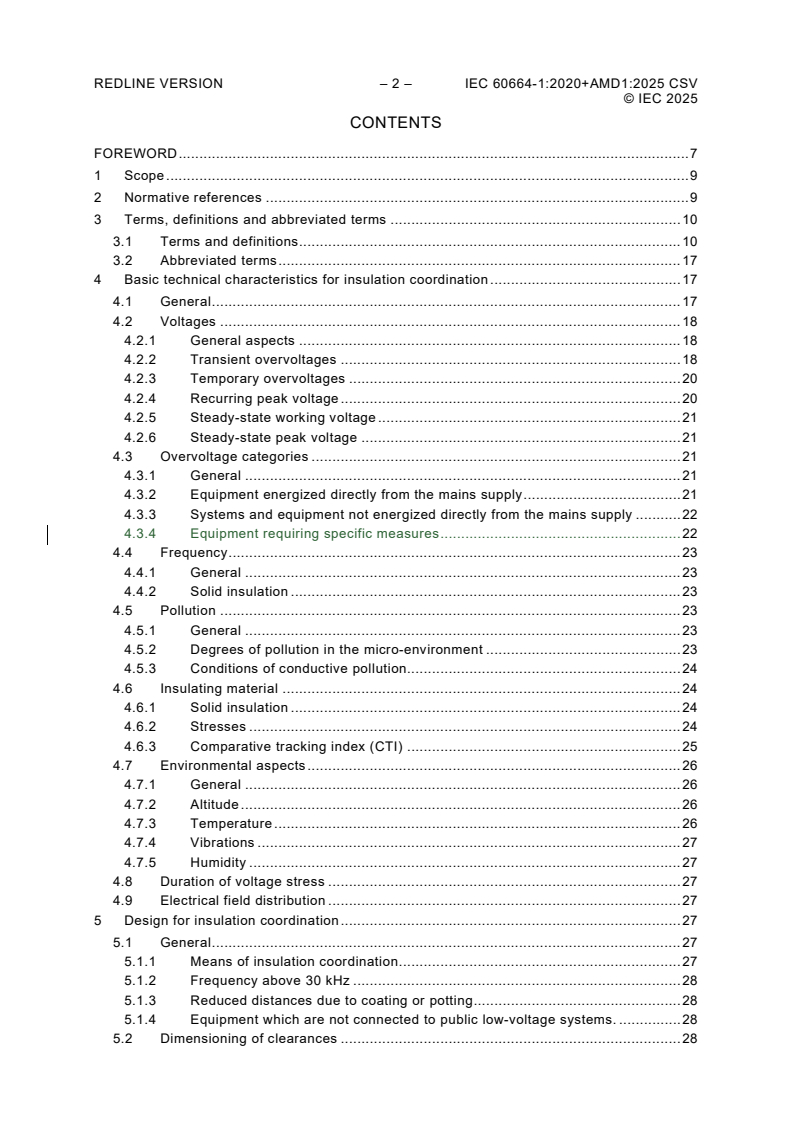
REDLINE VERSION – 2 – IEC 60664-1:2020+AMD1:2025 CSV
© IEC 2025
CONTENTS
FOREWORD . 7
1 Scope . 9
2 Normative references . 9
3 Terms, definitions and abbreviated terms . 10
3.1 Terms and definitions . 10
3.2 Abbreviated terms . 17
4 Basic technical characteristics for insulation coordination . 17
4.1 General . 17
4.2 Voltages . 18
4.2.1 General aspects . 18
4.2.2 Transient overvoltages . 18
4.2.3 Temporary overvoltages . 20
4.2.4 Recurring peak voltage . 20
4.2.5 Steady-state working voltage . 21
4.2.6 Steady-state peak voltage . 21
4.3 Overvoltage categories . 21
4.3.1 General . 21
4.3.2 Equipment energized directly from the mains supply . 21
4.3.3 Systems and equipment not energized directly from the mains supply . 22
4.3.4 Equipment requiring specific measures . 22
4.4 Frequency . 23
4.4.1 General . 23
4.4.2 Solid insulation . 23
4.5 Pollution . 23
4.5.1 General . 23
4.5.2 Degrees of pollution in the micro-environment . 23
4.5.3 Conditions of conductive pollution. 24
4.6 Insulating material . 24
4.6.1 Solid insulation . 24
4.6.2 Stresses . 24
4.6.3 Comparative tracking index (CTI) . 25
4.7 Environmental aspects . 26
4.7.1 General . 26
4.7.2 Altitude . 26
4.7.3 Temperature . 26
4.7.4 Vibrations . 27
4.7.5 Humidity . 27
4.8 Duration of voltage stress . 27
4.9 Electrical field distribution . 27
5 Design for insulation coordination . 27
5.1 General . 27
5.1.1 Means of insulation coordination . 27
5.1.2 Frequency above 30 kHz . 28
5.1.3 Reduced distances due to coating or potting . 28
5.1.4 Equipment which are not connected to public low-voltage systems. . 28
5.2 Dimensioning of clearances . 28
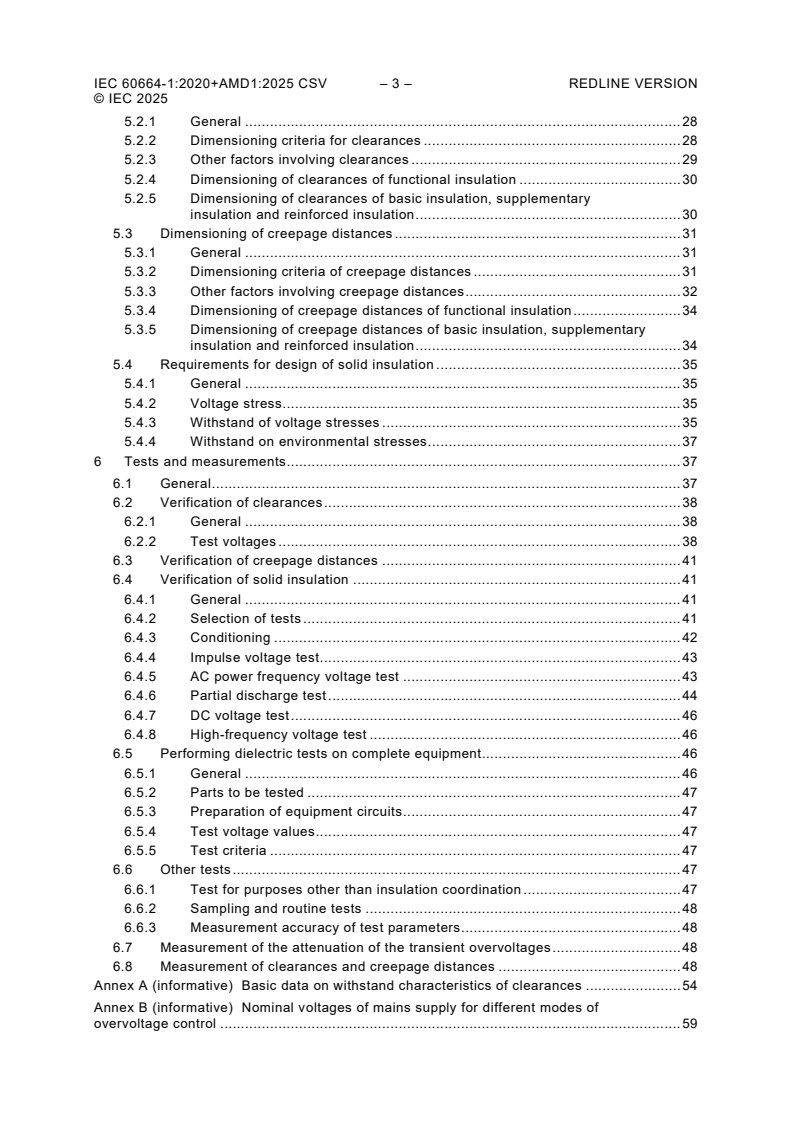
© IEC 2025
5.2.1 General . 28
5.2.2 Dimensioning criteria for clearances . 28
5.2.3 Other factors involving clearances . 29
5.2.4 Dimensioning of clearances of functional insulation . 30
5.2.5 Dimensioning of clearances of basic insulation, supplementary
insulation and reinforced insulation . 30
5.3 Dimensioning of creepage distances . 31
5.3.1 General . 31
5.3.2 Dimensioning criteria of creepage distances . 31
5.3.3 Other factors involving creepage distances . 32
5.3.4 Dimensioning of creepage distances of functional insulation . 34
5.3.5 Dimensioning of creepage distances of basic insulation, supplementary
insulation and reinforced insulation . 34
5.4 Requirements for design of solid insulation . 35
5.4.1 General . 35
5.4.2 Voltage stress. 35
5.4.3 Withstand of voltage stresses . 35
5.4.4 Withstand on environmental stresses . 37
6 Tests and measurements . 37
6.1 General . 37
6.2 Verification of clearances . 38
6.2.1 General . 38
6.2.2 Test voltages . 38
6.3 Verification of creepage distances . 41
6.4 Verification of solid insulation . 41
6.4.1 General . 41
6.4.2 Selection of tests . 41
6.4.3 Conditioning . 42
6.4.4 Impulse voltage test . 43
6.4.5 AC power frequency voltage test . 43
6.4.6 Partial discharge test . 44
6.4.7 DC voltage test . 46
6.4.8 High-frequency voltage test . 46
6.5 Performing dielectric tests on complete equipment. 46
6.5.1 General . 46
6.5.2 Parts to be tested . 47
6.5.3 Preparation of equipment circuits . 47
6.5.4 Test voltage values . 47
6.5.5 Test criteria . 47
6.6 Other tests . 47
6.6.1 Test for purposes other than insulation coordination . 47
6.6.2 Sampling and routine tests . 48
6.6.3 Measurement accuracy of test parameters . 48
6.7 Measurement of the attenuation of the transient overvoltages . 48
6.8 Measurement of clearances and creepage distances . 48
Annex A (informative) Basic data on withstand characteristics of clearances . 54
Annex B (informative) Nominal voltages of mains supply for different modes of
overvoltage control . 59
REDLINE VERSION – 4 – IEC 60664-1:2020+AMD1:2025 CSV
© IEC 2025
Annex C (normative) Partial discharge test methods . 61
C.1 Test circuits . 61
C.1.1 General . 61
C.1.2 Test circuit for earthed test specimen (Figure C.1) . 61
C.1.3 Test circuit for unearthed test specimen (Figure C.2) . 62
C.1.4 Selection criteria . 62
C.1.5 Measuring impedance . 62
C.1.6 Coupling capacitor C . 62
k
C.1.7 Filter . 62
C.2 Test parameters . 62
C.2.1 General . 62
C.2.2 Requirements for the test voltage . 63
C.2.3 Climatic conditions . 63
C.3 Requirements for measuring instruments . 63
C.3.1 General . 63
C.3.2 Classification of PD meters . 63
C.3.3 Bandwidth of the test circuit . 64
C.4 Calibration . 64
C.4.1 Calibration of discharge magnitude before the noise level measurement . 64
C.4.2 Verification of the noise level . 65
C.4.3 Calibration for the PD test . 66
C.4.4 Calibration pulse generator . 66
Annex D (informative) Additional information on partial discharge test methods . 67
D.1 Measurement of partial discharge (PD), PD inception and extinction voltage. 67
D.2 Description of PD test circuits (Figure D.1) . 67
D.3 Precautions for reduction of noise . 68
D.3.1 General . 68
D.3.2 Sources in the non-energized test circuit . 68
D.3.3 Sources in the energized test circuit . 68
D.3.4 Measures for reduction of noise . 68
D.4 Application of multiplying factors for test voltages . 68
D.4.1 General . 68
D.4.2 Example 1 (circuit connected to mains supply). 69
D.4.3 Example 2 (internal circuit with maximum recurring peak voltage U ) . 69
rp
Annex E (informative) Comparison of creepage distances specified in Table F.5 and
clearances in Table A.1 . 70
Annex F (normative) Tables . 71
Annex G (informative) Determination of clearance distances according to 5.2 . 80
Annex H (informative) Determination of creepage distances according to 5.3 . 82
Annex I (informative) Electrochemical migration of creepage distances in DC
applications . 84
I.1 The phenomenon of electrochemical migration . 84
I.2 Effect of electrochemical migration on creepage distances in DC applications . 84
Bibliography . 86
Figure 1 – Recurring peak voltage . 20
Figure 2 – Determination of the width (W) and height (H) of a rib . 34
Figure 3 – Test voltages . 45
© IEC 2025
Figure 4 – Across the groove . 49
Figure 5 – Contour of the groove . 50
Figure 6 – Contour of the groove with angle . 50
Figure 7 – Contour of rib . 50
Figure 8 – Uncemented joint with grooves less than X . 51
Figure 9 – Uncemented joint with grooves equal to or more than X . 51
Figure 10 – Uncemented joint with a groove on one side less than X . 52
Figure 11 – Creepage distance and clearance through an uncemented joint . 52
Figure 12 – Creepage distance and clearance to a head of screw more than X . 52
Figure 13 – Creepage distance and clearance to a head of screw less than X . 53
Figure 14 – Creepage distance and clearance with conductive floating part . 53
Figure A.1 – Withstand voltage at 2 000 m above sea level. 56
Figure A.2 – Experimental data measured at approximately sea level and their low
limits for inhomogeneous field . 57
Figure A.3 – Experimental data measured at approximately sea level and their low
limits for homogeneous field . 58
Figure C.1 – Earthed test specimen . 61
Figure C.2 – Unearthed test specimen . 62
Figure C.3 – Calibration for earthed test specimen. 65
Figure C.4 – Calibration for unearthed test specimen . 65
Figure D.1 – Partial discharge test circuits . 67
Figure E.1 – Comparison between creepage distances specified in Table F.5 and
clearances in Table A.1 . 70
Figure G.1 – Determination of clearance distances according to 5.2 (1 of 2) . 80
Figure H.1 – Determination of creepage distances according to 5.3 (1 of 2) . 82
Table 1 – Dimensioning of grooves . 49
Table A.1 – Withstand voltages for an altitude of 2 000 m above sea level (1 of 2) . 54
Table A.2 – Altitude correction factors for clearance correction . 55
Table B.1 – Inherent control or equivalent protective control . 59
Table B.2 – Cases where protective control is necessary and control is provided by
surge protective device having a ratio of voltage protection level to rated voltage not
smaller than that specified in IEC 61643 (all parts) . 60
Table F.1 – Rated impulse withstand voltage for equipment energized directly from the
mains supply . 71
Table F.2 – Clearances to withstand transient overvoltages . 72
Table F.3 – Single-phase three-wire or two-wire AC or DC systems . 73
Table F.4 – Three-phase four-wire or three-wire AC systems . 74
Table F.5 – Creepage distances to avoid failure due to tracking (1 of 2) . 75
Table F.6 – Test voltages for verifying clearances only at different altitudes . 77
Table F.7 – Severities for conditioning of solid insulation . 77
Table F.8 – Dimensioning of clearances to withstand steady-state peak voltages,
b
temporary overvoltages or recurring peak voltages . 78
Table F.9 – Additional information concerning the dimensioning of clearances to avoid
partial discharge . 78
REDLINE VERSION – 6 – IEC 60664-1:2020+AMD1:2025 CSV
© IEC 2025
Table F.10 – Altitude correction factors for clearance correction . 79
© IEC 2025
INTERNATIONAL ELECTROTECHNICAL COMMISSION
____________
INSULATION COORDINATION FOR EQUIPMENT
WITHIN LOW-VOLTAGE SUPPLY SYSTEMS –
Part 1: Principles, requirements and tests
FOREWORD
1) The International Electrotechnical Commission (IEC) is a worldwide organization for standardization comprising
all national electrotechnical committees (IEC National Committees). The object of IEC is to promote
international co-operation on all questions concerning standardization in the electrical and electronic fields. To
this end and in addition to other activities, IEC publishes International Standards, Technical Specifications,
Technical Reports, Publicly Available Specifications (PAS) and Guides (hereafter referred to as "IEC
Publication(s)"). Their preparation is entrusted to technical committees; any IEC National Committee interested
in the subject dealt with may participate in this preparatory work. International, governmental and non-
governmental organizations liaising with the IEC also participate in this preparation. IEC collaborates closely
with the International Organization for Standardization (ISO) in accordance with conditions determined by
agreement between the two organizations.
2) The formal decisions or agreements of IEC on technical matters express, as nearly as possible, an international
consensus of opinion on the relevant subjects since each technical committee has representation from all
interested IEC National Committees.
3) IEC Publications have the form of recommendations for international use and are accepted by IEC National
Committees in that sense. While all reasonable efforts are made to ensure that the technical content of IEC
Publications is accurate, IEC cannot be held responsible for the way in which they are used or for any
misinterpretation by any end user.
4) In order to promote international uniformity, IEC National Committees undertake to apply IEC Publications
transparently to the maximum extent possible in their national and regional publications. Any divergence
between any IEC Publication and the corresponding national or regional publication shall be clearly indicated in
the latter.
5) IEC itself does not provide any attestation of conformity. Independent certification bodies provide conformity
assessment services and, in some areas, access to IEC marks of conformity. IEC is not responsible for any
services carried out by independent certification bodies.
6) All users should ensure that they have the latest edition of this publication.
7) No liability shall attach to IEC or its directors, employees, servants or agents including individual experts and
members of its technical committees and IEC National Committees for any personal injury, property damage or
other damage of any nature whatsoever, whether direct or indirect, or for costs (including legal fees) and
expenses arising out of the publication, use of, or reliance upon, this IEC Publication or any other IEC
Publications.
8) Attention is drawn to the Normative references cited in this publication. Use of the referenced publications is
indispensable for the correct application of this publication.
9) IEC draws attention to the possibility that the implementation of this document may involve the use of (a)
patent(s). [IEC takes no position concerning the evidence, validity or applicability of any claimed patent rights in
respect thereof. As of the date of publication of this document, IEC had not received notice of (a) patent(s),
which may be required to implement this document. However, implementers are cautioned that this may not
represent the latest information, which may be obtained from the patent database available at
https://patents.iec.ch [and/or] www.iso.org/patents. IEC shall not be held responsible for identifying any or all
such patent rights.
This consolidated version of the official IEC Standard and its amendment has been
prepared for user convenience.
IEC 60664-1 edition 3.1 contains the third edition (2020-05) [documents 109/183/FDIS
and 109/186/RVD], its corrigendum 1 (2020-10) and its amendment 1 (2025-05)
[documents 109/235/FDIS and 109/240/RVD].
In this Redline version, a vertical line in the margin shows where the technical content
is modified by amendment 1. Additions are in green text, deletions are in strikethrough
red text. A separate Final version with all changes accepted is available in this
publication.
REDLINE VERSION – 8 – IEC 60664-1:2020+AMD1:2025 CSV
© IEC 2025
International Standard IEC 60664-1 has been prepared by IEC technical committee 109:
Insulation co-ordination for low-voltage equipment.
This third edition cancels and replaces the second edition published in 2007. This edition
constitutes a technical revision.
This edition includes the following significant technical changes with respect to the previous
edition:
a) update of the Scope, Clauses 2 and 3,
b) new structure for Clauses 4 and 5,
c) addition of 1 500 V DC into tables in Annex B and F,
d) update of distances altitude correction in a new Table F.10,
e) addition of Annex G with a flowchart for clearances,
f) addition of Annex H with a flowchart for creepage distances.
It has the status of a basic safety publication in accordance with IEC Guide 104.
The text of this International Standard is based on the following documents:
FDIS Report on voting
109/183/FDIS 109/186/RVD
Full information on the voting for the approval of this International Standard can be found in
the report on voting indicated in the above table.
This document has been drafted in accordance with the ISO/IEC Directives, Part 2.
A list of all parts in the IEC 60664 series, published under the general title Insulation
coordination for equipment within low-voltage supply systems, can be found on the IEC
website.
Future standards in this series will carry the new general title as cited above. Titles of existing
standards in this series will be updated at the time of the next edition.
In this document, the following print type is used:
– Terms defined in Clause 3: in bold type.
The committee has decided that the contents of this document and its amendment will remain
unchanged until the stability date indicated on the IEC website under webstore.iec.ch in the
data related to the specific document. At this date, the document will be
• reconfirmed,
• withdrawn, or
• revised.
© IEC 2025
INSULATION COORDINATION FOR EQUIPMENT
WITHIN LOW-VOLTAGE SUPPLY SYSTEMS –
Part 1: Principles, requirements and tests
1 Scope
This part of IEC 60664 deals with insulation coordination for electrical equipment having a
rated voltage up to AC 1 000 V or DC 1 500 V connected to low-voltage supply systems.
NOTE 1 Throughout this document, the term equipment is used with the meaning of electrical equipment.
This document applies to frequencies up to 30 kHz.
NOTE 12 Requirements for insulation coordination for equipment within low-voltage supply systems with
rated frequencies above 30 kHz are given in IEC 60664-4.
NOTE 23 Higher voltages can exist in internal circuits of the equipment.
It applies to equipment for use up to 2 000 m above sea level and provides guidance for use
at higher altitudes (See 5.2.3.4).
It provides requirements for technical committees to determine clearances, creepage
distances and criteria for solid insulation. It includes methods of electrical testing with
respect to insulation coordination.
The minimum clearances specified in this document do not apply where ionized gases are
present. Special requirements for such situations can be specified at the discretion of the
relevant technical committee.
This document does not deal with distances:
– through liquid insulation;
– through gases other than air;
– through compressed air.
This basic safety publication focusing on safety essential requirements is primarily intended
for use by technical committees in the preparation of standards in accordance with the
principles laid down in IEC Guide 104 and ISO/IEC Guide 51.
One of the responsibilities of a technical committee is, wherever applicable, to make use of
basic safety publications in the preparation of its publications.
However, in case of missing specified values for clearances, creepage distances and
requirements for solid insulation in the relevant product standards, or even missing
standards, this document applies.
NOTE 4 Further explanations and examples with regard to the use of this document are provided in
IEC TR 60664-2-1.
2 Normative references
The following documents are referred to in the text in such a way that some or all of their
content constitutes requirements of this document. For dated references, only the edition
REDLINE VERSION – 10 – IEC 60664-1:2020+AMD1:2025 CSV
© IEC 2025
cited applies. For undated references, the latest edition of the referenced document (including
any amendments) applies.
IEC 60068-2-2, Environmental testing – Part 2-2: Tests – Tests B: Dry heat
IEC 60068-2-14:2009, Environmental testing – Part 2-14: Tests – Test N: Change of
temperature
IEC 60068-2-78, Environmental testing – Part 2-78: Tests – Test Cab: Damp heat, steady
state
IEC 60270, High-voltage test techniques – Partial discharge measurements
IEC 61140:2016, Protection against electric shock – Common aspects for installation and
equipment
IEC 61180:2016, High-voltage test techniques for low-voltage equipment – Definitions, test
and procedure requirements, test equipment
3 Terms, definitions and abbreviated terms
For the purposes of this document, the following terms and definitions apply.
ISO and IEC maintain terminological databases for use in standardization at the following
addresses:
• IEC Electropedia: available at http://www.electropedia.org/
• ISO Online browsing platform: available at http://www.iso.org/obp
3.1 Terms and definitions
3.1.1
low-voltage supply system
all installations and plant provided for the purpose of generating, transmitting and distributing
electricity
[SOURCE: IEC 60050-601:1985, 601-01-01, modified – The term " electric power system" has
been replaced with “low-voltage supply system”.]
3.1.2
mains supply
AC or DC power distribution system (external to the equipment) that supplies operating power
to the equipment
Note 1 to entry: Mains supply includes public or private utilities and, unless otherwise specified in this document,
equivalent sources such as motor-driven generators and uninterruptible power supplies.
3.1.3
insulation coordination
mutual correlation of insulation characteristics of electrical equipment taking into account the
expected micro-environment and other influencing stresses
Note 1 to entry: Expected voltage stresses are characterized in terms of the characteristics defined in 3.1.7
to 3.1.16.
[SOURCE: IEC 60050-442:2014, 442-09-01, modified – “electrical” replaces “electric” and
Note 1 to entry has been added.]
© IEC 2025
3.1.4
clearance
shortest distance in air between two conductive parts
[SOURCE: IEC 60050-581:2008, 581-27-76]
3.1.5
creepage distance
shortest distance along the surface of a solid insulating material between two conductive
parts
[SOURCE: IEC 60050-151:2001, 151-15-50]
3.1.6
solid insulation
solid insulating material or a combination of solid insulating materials, placed between two
conductive parts or between a conductive part and a body part
[SOURCE: IEC 60050-903:2015, 903-04-14, modified – The example has been deleted.]
3.1.7
working voltage
highest RMS value of the AC or DC voltage across any particular insulation which can occur
when the equipment is supplied at rated voltage
Note 1 to entry: Transient overvoltages are disregarded.
Note 2 to entry: Both open-circuit conditions and normal operating conditions are taken into account.
[SOURCE: IEC 60050-851:2008, 851-12-31]
3.1.8
steady-state working voltage
working voltage after the transient overvoltage phenomena have subsided and not taking
into account short-term voltage variations
3.1.9
steady-state peak voltage
peak value of the steady-state working voltage
3.1.10
recurring peak voltage
U
rp
maximum peak value of periodic excursions of the voltage waveform resulting from distortions
of an AC voltage or from AC components superimposed on a DC voltage
Note 1 to entry: Random overvoltages, for example due to occasional switching, are not considered to be
recurring peak voltages.
[SOURCE: IEC 60050-442:2014, 442-09-15]
3.1.11
overvoltage
any voltage having a peak value exceeding the corresponding peak value
of maximum steady-state working voltage at normal operating conditions
3.1.12
temporary overvoltage
overvoltage at power frequency of relatively long duration
REDLINE VERSION – 12 – IEC 60664-1:2020+AMD1:2025 CSV
© IEC 2025
[SOURCE: IEC 60050-614:2016, 614-03-13, modified – “power frequency overvoltage” has
been replaced with “overvoltage at power frequency” and Note 1 to entry has been deleted.]
3.1.13
transient overvoltage
short duration overvoltage of a few milliseconds or less, oscillatory or non-oscillatory, usually
highly damped
[SOURCE: IEC 60050-614:2016, 614-03-14, modified – “overvoltage with a duration” has
been replaced with “short duration overvoltage” and the notes have been deleted.]
3.1.14
withstand voltage
voltage to be applied to a specimen under specified test conditions
which does not cause breakdown of insulation and/or flashover of a satisfactory specimen
3.1.15
impulse withstand voltage
highest peak value of impulse voltage of specified form and polarity which does not cause
breakdown of insulation under specified conditions
[SOURCE: IEC 60050-442:2014, 442-09-18, modified – "prescribed" has been replaced with
"specified".]
3.1.16
temporary withstand overvoltage
highest RMS value of a temporary overvoltage which does not cause breakdown of
insulation under specified conditions
[SOURCE: IEC 60050-442:2014, 442-09-19]
3.1.17
rated voltage
U
n
value of voltage assigned by the manufacturer, to a component, device or
equipment and to which operation and performance characteristics are referred
Note 1 to entry: Equipment may have more than one rated voltage value or may have a rated voltage range.
[SOURCE: IEC 60050-442:2014, 442-09-10, modified – “rated value of the voltage” has been
replaced with “value of voltage” and Note 2 to entry has been deleted.]
3.1.18
rated insulation voltage
U
i
value of the RMS withstand voltage assigned by the manufacturer to the equipment or to a
part of it, characterizing the specified (long-term) withstand capability of its insulation
Note 1 to entry: The rated insulation voltage is equal to or greater than the rated voltage of equipment which is
primarily related to functional performance.
[SOURCE: IEC 60050-312:2014, 312-06-02, modified – symbol has been added, in the
definition “rated value” has been replaced by “value” and in the note “not necessarily equal to”
has been replaced by “equal to or greater than”.]
© IEC 2025
3.1.19
rated impulse withstand voltage
U
imp
value of the impulse withstand voltage assigned by the manufacturer to the equipment or to
a part of it, characterizing the specified withstand capability of its insulation against transient
overvoltages
3.1.20
overvoltage category
numeral defining a transient overvoltage condition
Note 1 to entry: Overvoltage categories I, II, III and IV are used, see 4.3.2.
[SOURCE: IEC 60050-581:2008, 581-21-02, modified – Note 1 to entry has been added.]
3.1.21
environment
surrounding which can affect performance of a device or system
EXAMPLE Pressure, temperature, humidity, pollution, radiation and vibration.
3.1.22
macro-environment
environment of the room or other location in which the equipment is installed or used
[SOURCE: IEC 60050-442:2014, 442-01-55]
3.1.23
micro-environment
ambient conditions which immediately influences the dimensioning
of the clearance and creepage distances
3.1.24
pollution
any condition of foreign matter, solid, liquid or gaseous (ionized
gases), that can affect dielectric strength or surface resistivity
3.1.25
pollution degree
numeral characterizing the expected pollution of the micro-environment
[SOURCE: IEC 60050-581:2008, 581-21-07, modified – Note 1 to entry has been deleted.]
3.1.26
homogeneous field
electric field which has an essentially constant voltage gradient between electrodes
Note 1 to entry: The homogeneous field condition is referred to as case B in Table F.2 and Table F.8. See
also4.9.
3.1.27
inhomogeneous field
non-uniform field
electric field which does not have an essentially constant voltage gradient between electrodes
Note 1 to entry: See also 4.9.
REDLINE VERSION – 14 – IEC 60664-1:2020+AMD1:2025 CSV
© IEC 2025
[SOURCE: IEC 60050-442:2014, 442-09-03, modified – "inhomogeneous electric field" has
been replaced with "inhomogeneous field", Note 1 to entry has been replaced with a new
Note 1 and Note 2 to entry has been deleted.]
3.1.28
electric insulation
part of an electrotechnical product which separates the conducting parts at different electrical
potentials during operation or insulates such parts from the surroundings
[SOURCE: IEC 60050-212:2010, 212-11-07, modified –"electric" has been replaced with
"electrical".]
3.1.29
functional insulation
insulation between conductive parts which is necessary only for the proper functioning of the
equipment
[SOURCE: IEC 60050-195:1998, 195-02-41, modified – "necessary" has been replaced with
"which is necessary only".]
3.1.30
basic insulation
insulation of hazardous-live-parts which provides basic protection
Note 1 to entry: This concept does not apply to insulation used exclusively for functional purposes.
[SOURCE: IEC 60050-826:2004, 826-12-14]
3.1.31
supplementary insulation
independent insulation applied in addition to basic insulation for fault protection
[SOURCE: IEC 60050-826:2004, 826-12-15]
3.1.32
double insulation
insulation comprising both basic insulation and supplementary insulation
[SOURCE: IEC 60050-826:2004, 826-12-16]
3.1.33
reinforced insulation
insulation of hazardous-live-parts which provides a degree of protection against electric shock
equivalent to double insulation
Note 1 to entry: Reinforced insulation may comprise several layers which cannot be tested singly as basic
insulation or supplementary insulation.
[SOURCE: IEC 60050-826:2004, 826-12-17]
3.1.34
partial discharge
PD
electric discharge that partially bridges the insulation
Note 1 to entry: A partial discharge may occur inside the insulation or adjacent to a conductor.
© IEC 2025
Note 2 to entry: Scintillations of low energy on the surface of insulating materials are often described as partial
discharges but should rather be considered as disruptive discharges of low energy, since they are the result of
local dielectric breakdowns of high ionization density, or small arcs, according to the conventions of physics.
[SOURCE: IEC 60050-442:2014, 442-09-05, modified – Notes 1 and 2 to entry have been
added.]
3.1.35
apparent c
...
IEC 60664-1 ®
Edition 3.0 2020-05
INTERNATIONAL
STANDARD
NORME
INTERNATIONALE
colour
inside
BASIC SAFETY PUBLICATION
PUBLICATION FONDAMENTALE DE SÉCURITÉ
Insulation coordination for equipment within low-voltage supply systems –
Part 1: Principles, requirements and tests
Coordination de l’isolement des matériels dans les réseaux d’énergie électrique
à basse tension –
Partie 1: Principes, exigences et essais
All rights reserved. Unless otherwise specified, no part of this publication may be reproduced or utilized in any form
or by any means, electronic or mechanical, including photocopying and microfilm, without permission in writing from
either IEC or IEC's member National Committee in the country of the requester. If you have any questions about IEC
copyright or have an enquiry about obtaining additional rights to this publication, please contact the address below or
your local IEC member National Committee for further information.
Droits de reproduction réservés. Sauf indication contraire, aucune partie de cette publication ne peut être reproduite
ni utilisée sous quelque forme que ce soit et par aucun procédé, électronique ou mécanique, y compris la photocopie
et les microfilms, sans l'accord écrit de l'IEC ou du Comité national de l'IEC du pays du demandeur. Si vous avez des
questions sur le copyright de l'IEC ou si vous désirez obtenir des droits supplémentaires sur cette publication, utilisez
les coordonnées ci-après ou contactez le Comité national de l'IEC de votre pays de résidence.
IEC Central Office Tel.: +41 22 919 02 11
3, rue de Varembé info@iec.ch
CH-1211 Geneva 20 www.iec.ch
Switzerland
About the IEC
The International Electrotechnical Commission (IEC) is the leading global organization that prepares and publishes
International Standards for all electrical, electronic and related technologies.
About IEC publications
The technical content of IEC publications is kept under constant review by the IEC. Please make sure that you have the
latest edition, a corrigendum or an amendment might have been published.
IEC publications search - webstore.iec.ch/advsearchform Electropedia - www.electropedia.org
The advanced search enables to find IEC publications by a The world's leading online dictionary on electrotechnology,
variety of criteria (reference number, text, technical containing more than 22 000 terminological entries in English
committee,…). It also gives information on projects, replaced and French, with equivalent terms in 16 additional languages.
and withdrawn publications. Also known as the International Electrotechnical Vocabulary
(IEV) online.
IEC Just Published - webstore.iec.ch/justpublished
Stay up to date on all new IEC publications. Just Published IEC Glossary - std.iec.ch/glossary
details all new publications released. Available online and 67 000 electrotechnical terminology entries in English and
once a month by email. French extracted from the Terms and definitions clause of
IEC publications issued between 2002 and 2015. Some
IEC Customer Service Centre - webstore.iec.ch/csc entries have been collected from earlier publications of IEC
If you wish to give us your feedback on this publication or TC 37, 77, 86 and CISPR.
need further assistance, please contact the Customer Service
Centre: sales@iec.ch.
A propos de l'IEC
La Commission Electrotechnique Internationale (IEC) est la première organisation mondiale qui élabore et publie des
Normes internationales pour tout ce qui a trait à l'électricité, à l'électronique et aux technologies apparentées.
A propos des publications IEC
Le contenu technique des publications IEC est constamment revu. Veuillez vous assurer que vous possédez l’édition la
plus récente, un corrigendum ou amendement peut avoir été publié.
Recherche de publications IEC - Electropedia - www.electropedia.org
webstore.iec.ch/advsearchform Le premier dictionnaire d'électrotechnologie en ligne au
La recherche avancée permet de trouver des publications IEC monde, avec plus de 22 000 articles terminologiques en
en utilisant différents critères (numéro de référence, texte, anglais et en français, ainsi que les termes équivalents dans
comité d’études,…). Elle donne aussi des informations sur les 16 langues additionnelles. Egalement appelé Vocabulaire
projets et les publications remplacées ou retirées. Electrotechnique International (IEV) en ligne.
IEC Just Published - webstore.iec.ch/justpublished Glossaire IEC - std.iec.ch/glossary
Restez informé sur les nouvelles publications IEC. Just 67 000 entrées terminologiques électrotechniques, en anglais
Published détaille les nouvelles publications parues. et en français, extraites des articles Termes et définitions des
Disponible en ligne et une fois par mois par email. publications IEC parues entre 2002 et 2015. Plus certaines
entrées antérieures extraites des publications des CE 37, 77,
Service Clients - webstore.iec.ch/csc 86 et CISPR de l'IEC.
Si vous désirez nous donner des commentaires sur cette
publication ou si vous avez des questions contactez-nous:
sales@iec.ch.
IEC 60664-1 ®
Edition 3.0 2020-05
INTERNATIONAL
STANDARD
NORME
INTERNATIONALE
colour
inside
BASIC SAFETY PUBLICATION
PUBLICATION FONDAMENTALE DE SÉCURITÉ
Insulation coordination for equipment within low-voltage supply systems –
Part 1: Principles, requirements and tests
Coordination de l’isolement des matériels dans les réseaux d’énergie électrique
à basse tension –
Partie 1: Principes, exigences et essais
INTERNATIONAL
ELECTROTECHNICAL
COMMISSION
COMMISSION
ELECTROTECHNIQUE
INTERNATIONALE
ICS 29.080.30 ISBN 978-2-8322-8287-8
– 2 – IEC 60664-1:2020 © IEC 2020
CONTENTS
FOREWORD . 6
1 Scope . 8
2 Normative references . 8
3 Terms, definitions and abbreviated terms . 9
3.1 Terms and definitions . 9
3.2 Abbreviated terms . 15
4 Basic technical characteristics for insulation coordination . 15
4.1 General . 15
4.2 Voltages . 16
4.2.1 General aspects . 16
4.2.2 Transient overvoltages . 17
4.2.3 Temporary overvoltages . 18
4.2.4 Recurring peak voltage . 18
4.2.5 Steady-state working voltage . 19
4.2.6 Steady-state peak voltage . 19
4.3 Overvoltage categories . 19
4.3.1 General . 19
4.3.2 Equipment energized directly from the mains supply . 19
4.3.3 Systems and equipment not energized directly from the mains supply . 20
4.4 Frequency . 20
4.4.1 General . 20
4.4.2 Solid insulation . 20
4.5 Pollution . 20
4.5.1 General . 20
4.5.2 Degrees of pollution in the micro-environment . 21
4.5.3 Conditions of conductive pollution. 21
4.6 Insulating material . 21
4.6.1 Solid insulation . 21
4.6.2 Stresses . 22
4.6.3 Comparative tracking index (CTI) . 23
4.7 Environmental aspects . 24
4.7.1 General . 24
4.7.2 Altitude . 24
4.7.3 Temperature . 24
4.7.4 Vibrations . 24
4.7.5 Humidity . 24
4.8 Duration of voltage stress . 24
4.9 Electrical field distribution . 25
5 Design for insulation coordination . 25
5.1 General . 25
5.1.1 Means of insulation coordination . 25
5.1.2 Frequency above 30 kHz . 25
5.1.3 Reduced distances due to coating or potting . 25
5.1.4 Equipment which are not connected to public low-voltage systems. . 25
5.2 Dimensioning of clearances . 25
5.2.1 General . 25
5.2.2 Dimensioning criteria for clearances . 26
5.2.3 Other factors involving clearances . 26
5.2.4 Dimensioning of clearances of functional insulation . 27
5.2.5 Dimensioning of clearances of basic insulation, supplementary
insulation and reinforced insulation . 27
5.3 Dimensioning of creepage distances . 28
5.3.1 General . 28
5.3.2 Dimensioning criteria of creepage distances . 29
5.3.3 Other factors involving creepage distances . 30
5.3.4 Dimensioning of creepage distances of functional insulation . 31
5.3.5 Dimensioning of creepage distances of basic insulation, supplementary
insulation and reinforced insulation . 31
5.4 Requirements for design of solid insulation . 32
5.4.1 General . 32
5.4.2 Voltage stress. 32
5.4.3 Withstand of voltage stresses . 32
5.4.4 Withstand on environmental stresses . 34
6 Tests and measurements . 34
6.1 General . 34
6.2 Verification of clearances . 35
6.2.1 General . 35
6.2.2 Test voltages . 35
6.3 Verification of creepage distances . 37
6.4 Verification of solid insulation . 37
6.4.1 General . 37
6.4.2 Selection of tests . 38
6.4.3 Conditioning . 39
6.4.4 Impulse voltage test . 39
6.4.5 AC power frequency voltage test . 40
6.4.6 Partial discharge test . 40
6.4.7 DC voltage test . 42
6.4.8 High-frequency voltage test . 43
6.5 Performing dielectric tests on complete equipment. 43
6.5.1 General . 43
6.5.2 Parts to be tested . 43
6.5.3 Preparation of equipment circuits . 44
6.5.4 Test voltage values . 44
6.5.5 Test criteria . 44
6.6 Other tests . 44
6.6.1 Test for purposes other than insulation coordination . 44
6.6.2 Sampling and routine tests . 44
6.6.3 Measurement accuracy of test parameters . 44
6.7 Measurement of the attenuation of the transient overvoltages . 45
6.8 Measurement of clearances and creepage distances . 45
Annex A (informative) Basic data on withstand characteristics of clearances . 51
Annex B (informative) Nominal voltages of mains supply for different modes of
overvoltage control . 56
Annex C (normative) Partial discharge test methods . 58
C.1 Test circuits . 58
– 4 – IEC 60664-1:2020 © IEC 2020
C.1.1 General . 58
C.1.2 Test circuit for earthed test specimen (Figure C.1) . 58
C.1.3 Test circuit for unearthed test specimen (Figure C.2) . 59
C.1.4 Selection criteria . 59
C.1.5 Measuring impedance . 59
C.1.6 Coupling capacitor C . 59
k
C.1.7 Filter . 59
C.2 Test parameters . 59
C.2.1 General . 59
C.2.2 Requirements for the test voltage . 60
C.2.3 Climatic conditions . 60
C.3 Requirements for measuring instruments . 60
C.3.1 General . 60
C.3.2 Classification of PD meters . 60
C.3.3 Bandwidth of the test circuit . 61
C.4 Calibration . 61
C.4.1 Calibration of discharge magnitude before the noise level measurement . 61
C.4.2 Verification of the noise level . 62
C.4.3 Calibration for the PD test . 63
C.4.4 Calibration pulse generator . 63
Annex D (informative) Additional information on partial discharge test methods . 64
D.1 Measurement of partial discharge (PD), PD inception and extinction voltage. 64
D.2 Description of PD test circuits (Figure D.1) . 64
D.3 Precautions for reduction of noise . 65
D.3.1 General . 65
D.3.2 Sources in the non-energized test circuit . 65
D.3.3 Sources in the energized test circuit . 65
D.3.4 Measures for reduction of noise . 65
D.4 Application of multiplying factors for test voltages . 65
D.4.1 General . 65
D.4.2 Example 1 (circuit connected to mains supply). 66
D.4.3 Example 2 (internal circuit with maximum recurring peak voltage U ) . 66
rp
Annex E (informative) Comparison of creepage distances specified in Table F.5 and
clearances in Table A.1 . 67
Annex F (normative) Tables . 68
Annex G (informative) Determination of clearance distances according to 5.2 . 77
Annex H (informative) Determination of creepage distances according to 5.3 . 79
Bibliography . 81
Figure 1 – Recurring peak voltage . 19
Figure 2 – Determination of the width (W) and height (H) of a rib . 31
Figure 3 – Test voltages . 42
Figure 4 – Across the groove . 46
Figure 5 – Contour of the groove . 47
Figure 6 – Contour of the groove with angle . 47
Figure 7 – Contour of rib . 47
Figure 8 – Uncemented joint with grooves less than X . 48
Figure 9 – Uncemented joint with grooves equal to or more than X . 48
Figure 10 – Uncemented joint with a groove on one side less than X . 49
Figure 11 – Creepage distance and clearance through an uncemented joint . 49
Figure 12 – Creepage distance and clearance to a head of screw more than X . 49
Figure 13 – Creepage distance and clearance to a head of screw less than X . 50
Figure 14 – Creepage distance and clearance with conductive floating part . 50
Figure A.1 – Withstand voltage at 2 000 m above sea level. 53
Figure A.2 – Experimental data measured at approximately sea level and their low
limits for inhomogeneous field . 54
Figure A.3 – Experimental data measured at approximately sea level and their low
limits for homogeneous field . 55
Figure C.1 – Earthed test specimen . 58
Figure C.2 – Unearthed test specimen . 59
Figure C.3 – Calibration for earthed test specimen. 62
Figure C.4 – Calibration for unearthed test specimen . 62
Figure D.1 – Partial discharge test circuits . 64
Figure E.1 – Comparison between creepage distances specified in Table F.5 and
clearances in Table A.1 . 67
Figure G.1 – Determination of clearance distances according to 5.2 (1 of 2) . 77
Figure H.1 – Determination of creepage distances according to 5.3 (1 of 2) . 79
Table 1 – Dimensioning of grooves . 46
Table A.1 – Withstand voltages for an altitude of 2 000 m above sea level (1 of 2) . 51
Table A.2 – Altitude correction factors for clearance correction . 52
Table B.1 – Inherent control or equivalent protective control . 56
Table B.2 – Cases where protective control is necessary and control is provided by
surge protective device having a ratio of voltage protection level to rated voltage not
smaller than that specified in IEC 61643 (all parts) . 57
Table F.1 – Rated impulse withstand voltage for equipment energized directly from the
mains supply . 68
Table F.2 – Clearances to withstand transient overvoltages . 69
Table F.3 – Single-phase three-wire or two-wire AC or DC systems . 70
Table F.4 – Three-phase four-wire or three-wire AC systems . 71
Table F.5 – Creepage distances to avoid failure due to tracking (1 of 2) . 72
Table F.6 – Test voltages for verifying clearances only at different altitudes . 74
Table F.7 – Severities for conditioning of solid insulation . 74
Table F.8 – Dimensioning of clearances to withstand steady-state peak voltages,
b
temporary overvoltages or recurring peak voltages . 75
Table F.9 – Additional information concerning the dimensioning of clearances to avoid
partial discharge . 75
Table F.10 – Altitude correction factors for clearance correction . 76
– 6 – IEC 60664-1:2020 © IEC 2020
INTERNATIONAL ELECTROTECHNICAL COMMISSION
____________
INSULATION COORDINATION FOR EQUIPMENT
WITHIN LOW-VOLTAGE SUPPLY SYSTEMS –
Part 1: Principles, requirements and tests
FOREWORD
1) The International Electrotechnical Commission (IEC) is a worldwide organization for standardization comprising
all national electrotechnical committees (IEC National Committees). The object of IEC is to promote
international co-operation on all questions concerning standardization in the electrical and electronic fields. To
this end and in addition to other activities, IEC publishes International Standards, Technical Specifications,
Technical Reports, Publicly Available Specifications (PAS) and Guides (hereafter referred to as “IEC
Publication(s)”). Their preparation is entrusted to technical committees; any IEC National Committee interested
in the subject dealt with may participate in this preparatory work. International, governmental and non-
governmental organizations liaising with the IEC also participate in this preparation. IEC collaborates closely
with the International Organization for Standardization (ISO) in accordance with conditions determined by
agreement between the two organizations.
2) The formal decisions or agreements of IEC on technical matters express, as nearly as possible, an international
consensus of opinion on the relevant subjects since each technical committee has representation from all
interested IEC National Committees.
3) IEC Publications have the form of recommendations for international use and are accepted by IEC National
Committees in that sense. While all reasonable efforts are made to ensure that the technical content of IEC
Publications is accurate, IEC cannot be held responsible for the way in which they are used or for any
misinterpretation by any end user.
4) In order to promote international uniformity, IEC National Committees undertake to apply IEC Publications
transparently to the maximum extent possible in their national and regional publications. Any divergence
between any IEC Publication and the corresponding national or regional publication shall be clearly indicated in
the latter.
5) IEC itself does not provide any attestation of conformity. Independent certification bodies provide conformity
assessment services and, in some areas, access to IEC marks of conformity. IEC is not responsible for any
services carried out by independent certification bodies.
6) All users should ensure that they have the latest edition of this publication.
7) No liability shall attach to IEC or its directors, employees, servants or agents including individual experts and
members of its technical committees and IEC National Committees for any personal injury, property damage or
other damage of any nature whatsoever, whether direct or indirect, or for costs (including legal fees) and
expenses arising out of the publication, use of, or reliance upon, this IEC Publication or any other IEC
Publications.
8) Attention is drawn to the Normative references cited in this publication. Use of the referenced publications is
indispensable for the correct application of this publication.
9) Attention is drawn to the possibility that some of the elements of this IEC Publication may be the subject of
patent rights. IEC shall not be held responsible for identifying any or all such patent rights.
International Standard IEC 60664-1 has been prepared by IEC technical committee 109:
Insulation co-ordination for low-voltage equipment.
This third edition cancels and replaces the second edition published in 2007. This edition
constitutes a technical revision.
This edition includes the following significant technical changes with respect to the previous
edition:
a) update of the Scope, Clauses 2 and 3,
b) new structure for Clauses 4 and 5,
c) addition of 1 500 V DC into tables in Annex B and F,
d) update of distances altitude correction in a new Table F.10,
e) addition of Annex G with a flowchart for clearances,
f) addition of Annex H with a flowchart for creepage distances.
It has the status of a basic safety publication in accordance with IEC Guide 104.
The text of this International Standard is based on the following documents:
FDIS Report on voting
109/183/FDIS 109/186/RVD
Full information on the voting for the approval of this International Standard can be found in
the report on voting indicated in the above table.
This document has been drafted in accordance with the ISO/IEC Directives, Part 2.
A list of all parts in the IEC 60664 series, published under the general title Insulation
coordination for equipment within low-voltage supply systems, can be found on the IEC
website.
Future standards in this series will carry the new general title as cited above. Titles of existing
standards in this series will be updated at the time of the next edition.
In this document, the following print type is used:
– Terms defined in Clause 3: in bold type.
The committee has decided that the contents of this document will remain unchanged until the
stability date indicated on the IEC website under "http://webstore.iec.ch" in the data related to
the specific document. At this date, the document will be
• reconfirmed,
• withdrawn,
• replaced by a revised edition, or
• amended.
IMPORTANT – The 'colour inside' logo on the cover page of this publication indicates
that it contains colours which are considered to be useful for the correct
understanding of its contents. Users should therefore print this document using a
colour printer.
– 8 – IEC 60664-1:2020 © IEC 2020
INSULATION COORDINATION FOR EQUIPMENT
WITHIN LOW-VOLTAGE SUPPLY SYSTEMS –
Part 1: Principles, requirements and tests
1 Scope
This part of IEC 60664 deals with insulation coordination for equipment having a
rated voltage up to AC 1 000 V or DC 1 500 V connected to low-voltage supply systems.
This document applies to frequencies up to 30 kHz.
NOTE 1 Requirements for insulation coordination for equipment within low-voltage supply systems with rated
frequencies above 30 kHz are given in IEC 60664-4.
NOTE 2 Higher voltages can exist in internal circuits of the equipment.
It applies to equipment for use up to 2 000 m above sea level and provides guidance for use
at higher altitudes (See 5.2.3.4).
It provides requirements for technical committees to determine clearances, creepage
distances and criteria for solid insulation. It includes methods of electrical testing with
respect to insulation coordination.
The minimum clearances specified in this document do not apply where ionized gases are
present. Special requirements for such situations can be specified at the discretion of the
relevant technical committee.
This document does not deal with distances:
– through liquid insulation;
– through gases other than air;
– through compressed air.
This basic safety publication focusing on safety essential requirements is primarily intended
for use by technical committees in the preparation of standards in accordance with the
principles laid down in IEC Guide 104 and ISO/IEC Guide 51.
One of the responsibilities of a technical committee is, wherever applicable, to make use of
basic safety publications in the preparation of its publications.
However, in case of missing specified values for clearances, creepage distances and
requirements for solid insulation in the relevant product standards, or even missing
standards, this document applies.
2 Normative references
The following documents are referred to in the text in such a way that some or all of their
content constitutes requirements of this document. For dated references, only the edition
cited applies. For undated references, the latest edition of the referenced document (including
any amendments) applies.
IEC 60068-2-2, Environmental testing – Part 2-2: Tests – Tests B: Dry heat
IEC 60068-2-14:2009, Environmental testing – Part 2-14: Tests – Test N: Change of
temperature
IEC 60068-2-78, Environmental testing – Part 2-78: Tests – Test Cab: Damp heat, steady
state
IEC 60270, High-voltage test techniques – Partial discharge measurements
IEC 61140:2016, Protection against electric shock – Common aspects for installation and
equipment
IEC 61180:2016, High-voltage test techniques for low-voltage equipment – Definitions, test
and procedure requirements, test equipment
3 Terms, definitions and abbreviated terms
For the purposes of this document, the following terms and definitions apply.
ISO and IEC maintain terminological databases for use in standardization at the following
addresses:
• IEC Electropedia: available at http://www.electropedia.org/
• ISO Online browsing platform: available at http://www.iso.org/obp
3.1 Terms and definitions
3.1.1
low-voltage supply system
all installations and plant provided for the purpose of generating, transmitting and distributing
electricity
[SOURCE: IEC 60050-601:1985, 601-01-01, modified – The term " electric power system" has
been replaced with “low-voltage supply system”.]
3.1.2
mains supply
AC or DC power distribution system (external to the equipment) that supplies operating power
to the equipment
Note 1 to entry: Mains supply includes public or private utilities and, unless otherwise specified in this document,
equivalent sources such as motor-driven generators and uninterruptible power supplies.
3.1.3
insulation coordination
mutual correlation of insulation characteristics of electrical equipment taking into account the
expected micro-environment and other influencing stresses
Note 1 to entry: Expected voltage stresses are characterized in terms of the characteristics defined in 3.1.7
to 3.1.16.
[SOURCE: IEC 60050-442:2014, 442-09-01, modified – “electrical” replaces “electric” and
Note 1 to entry has been added.]
3.1.4
clearance
shortest distance in air between two conductive parts
[SOURCE: IEC 60050-581:2008, 581-27-76]
– 10 – IEC 60664-1:2020 © IEC 2020
3.1.5
creepage distance
shortest distance along the surface of a solid insulating material between two conductive
parts
[SOURCE: IEC 60050-151:2001, 151-15-50]
3.1.6
solid insulation
solid insulating material or a combination of solid insulating materials, placed between two
conductive parts or between a conductive part and a body part
[SOURCE: IEC 60050-903:2015, 903-04-14, modified – The example has been deleted.]
3.1.7
working voltage
highest RMS value of the AC or DC voltage across any particular insulation which can occur
when the equipment is supplied at rated voltage
Note 1 to entry: Transient overvoltages are disregarded.
Note 2 to entry: Both open-circuit conditions and normal operating conditions are taken into account.
[SOURCE: IEC 60050-851:2008, 851-12-31]
3.1.8
steady-state working voltage
working voltage after the transient overvoltage phenomena have subsided and not taking
into account short-term voltage variations
3.1.9
steady-state peak voltage
peak value of the steady-state working voltage
3.1.10
recurring peak voltage
U
rp
maximum peak value of periodic excursions of the voltage waveform resulting from distortions
of an AC voltage or from AC components superimposed on a DC voltage
Note 1 to entry: Random overvoltages, for example due to occasional switching, are not considered to be
recurring peak voltages.
[SOURCE: IEC 60050-442:2014, 442-09-15]
3.1.11
overvoltage
any voltage having a peak value exceeding the corresponding peak value
of maximum steady-state working voltage at normal operating conditions
3.1.12
temporary overvoltage
overvoltage at power frequency of relatively long duration
[SOURCE: IEC 60050-614:2016, 614-03-13, modified – “power frequency overvoltage” has
been replaced with “overvoltage at power frequency” and Note 1 to entry has been deleted.]
3.1.13
transient overvoltage
short duration overvoltage of a few milliseconds or less, oscillatory or non-oscillatory, usually
highly damped
[SOURCE: IEC 60050-614:2016, 614-03-14, modified – “overvoltage with a duration” has
been replaced with “short duration overvoltage” and the notes have been deleted.]
3.1.14
withstand voltage
voltage to be applied to a specimen under specified test conditions
which does not cause breakdown of insulation and/or flashover of a satisfactory specimen
3.1.15
impulse withstand voltage
highest peak value of impulse voltage of specified form and polarity which does not cause
breakdown of insulation under specified conditions
[SOURCE: IEC 60050-442:2014, 442-09-18, modified – "prescribed" has been replaced with
"specified".]
3.1.16
temporary withstand overvoltage
highest RMS value of a temporary overvoltage which does not cause breakdown of
insulation under specified conditions
[SOURCE: IEC 60050-442:2014, 442-09-19]
3.1.17
rated voltage
U
n
value of voltage assigned by the manufacturer, to a component, device or
equipment and to which operation and performance characteristics are referred
Note 1 to entry: Equipment may have more than one rated voltage value or may have a rated voltage range.
[SOURCE: IEC 60050-442:2014, 442-09-10, modified – “rated value of the voltage” has been
replaced with “value of voltage” and Note 2 to entry has been deleted.]
3.1.18
rated insulation voltage
U
i
value of the RMS withstand voltage assigned by the manufacturer to the equipment or to a
part of it, characterizing the specified (long-term) withstand capability of its insulation
Note 1 to entry: The rated insulation voltage is equal to or greater than the rated voltage of equipment which is
primarily related to functional performance.
[SOURCE: IEC 60050-312:2014, 312-06-02, modified – symbol has been added, in the
definition “rated value” has been replaced by “value” and in the note “not necessarily equal to”
has been replaced by “equal to or greater than”.]
3.1.19
rated impulse withstand voltage
U
imp
value of the impulse withstand voltage assigned by the manufacturer to the equipment or to
a part of it, characterizing the specified withstand capability of its insulation against transient
overvoltages
– 12 – IEC 60664-1:2020 © IEC 2020
3.1.20
overvoltage category
numeral defining a transient overvoltage condition
Note 1 to entry: Overvoltage categories I, II, III and IV are used, see 4.3.2.
[SOURCE: IEC 60050-581:2008, 581-21-02, modified – Note 1 to entry has been added.]
3.1.21
environment
surrounding which can affect performance of a device or system
EXAMPLE Pressure, temperature, humidity, pollution, radiation and vibration.
3.1.22
macro-environment
environment of the room or other location in which the equipment is installed or used
[SOURCE: IEC 60050-442:2014, 442-01-55]
3.1.23
micro-environment
ambient conditions which immediately influences the dimensioning
of the clearance and creepage distances
3.1.24
pollution
any condition of foreign matter, solid, liquid or gaseous (ionized
gases), that can affect dielectric strength or surface resistivity
3.1.25
pollution degree
numeral characterizing the expected pollution of the micro-environment
[SOURCE: IEC 60050-581:2008, 581-21-07, modified – Note 1 to entry has been deleted.]
3.1.26
homogeneous field
electric field which has an essentially constant voltage gradient between electrodes
Note 1 to entry: The homogeneous field condition is referred to as case B in Table F.2 and Table F.8. See
also4.9.
3.1.27
inhomogeneous field
non-uniform field
electric field which does not have an essentially constant voltage gradient between electrodes
Note 1 to entry: See also 4.9.
[SOURCE: IEC 60050-442:2014, 442-09-03, modified – "inhomogeneous electric field" has
been replaced with "inhomogeneous field", Note 1 to entry has been replaced with a new
Note 1 and Note 2 to entry has been deleted.]
3.1.28
electric insulation
part of an electrotechnical product which separates the conducting parts at different electrical
potentials during operation or insulates such parts from the surroundings
[SOURCE: IEC 60050-212:2010, 212-11-07, modified –"electric" has been replaced with
"electrical".]
3.1.29
functional insulation
insulation between conductive parts which is necessary only for the proper functioning of the
equipment
[SOURCE: IEC 60050-195:1998, 195-02-41, modified – "necessary" has been replaced with
"which is necessary only".]
3.1.30
basic insulation
insulation of hazardous-live-parts which provides basic protection
Note 1 to entry: This concept does not apply to insulation used exclusively for functional purposes.
...