

IEC 60981:2019
(Main)Extra heavy-duty electrical rigid steel conduits
General Information
- Abstract
IEC 60981:2019 specifies requirements for extra heavy-duty electrical rigid steel (EHDERS) conduits, couplings, nipples and elbows for electrical installations, including communications and fibre optics. This document also specifies threads for these components. It is not applicable to the conduits specified in IEC 60423. This third edition cancels and replaces the second edition published in 2004. This edition constitutes a technical revision. This edition includes the following significant technical changes with respect to the second edition:
- addition of provisions for alternative coatings to zinc;
- addition of elasticity test for organic coatings;
- new Annex B on tests for evaluating alternative exterior coatings applied on extra heavyduty electrical rigid steel (EHDERS) conduits.
- Status
- Published
- Publication Date
- 19-Aug-2019
- Technical Committee
- SC 23A - Cable management systems
- Drafting Committee
- MT 1 - TC 23/SC 23A/MT 1
- Current Stage
- PPUB - Publication issued
- Start Date
- 20-Aug-2019
- Completion Date
- 20-Sep-2019
Buy Documents
IEC 60981:2019 - Extra heavy-duty electrical rigid steel conduits Released:8/20/2019
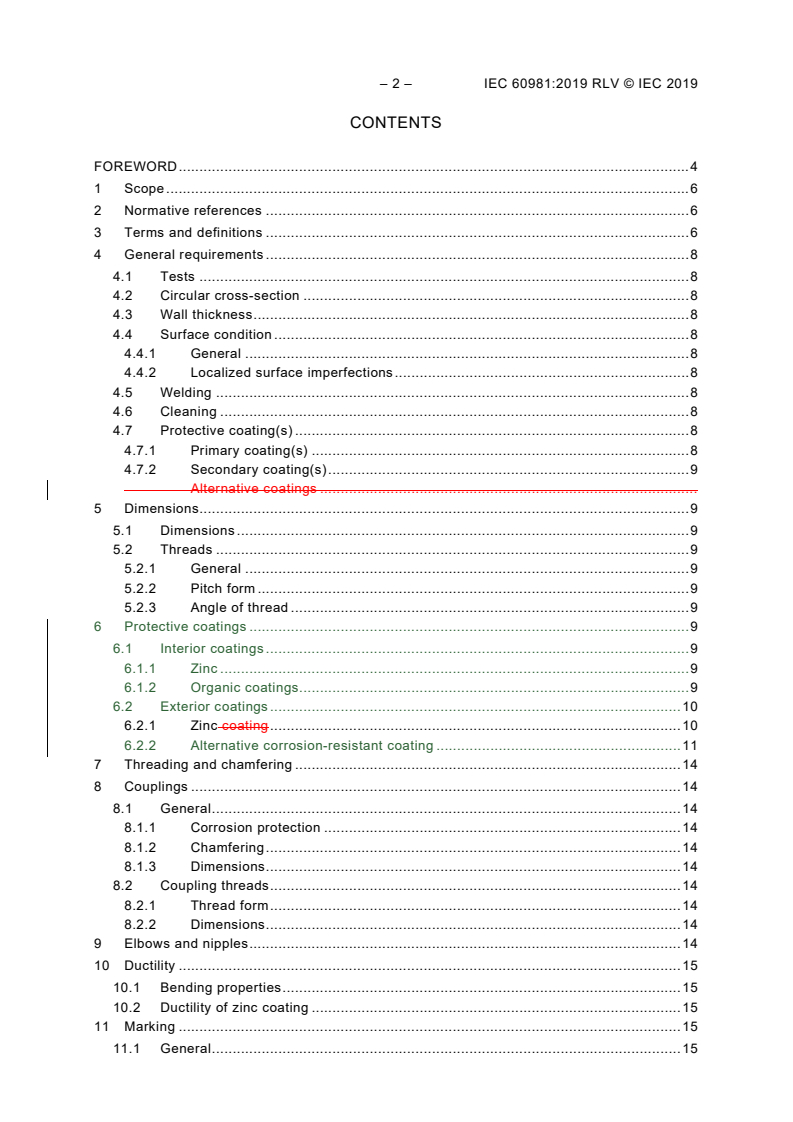
IEC 60981:2019 RLV - Extra heavy-duty electrical rigid steel conduits Released:8/20/2019
Overview
IEC 60981:2019 - Extra heavy-duty electrical rigid steel conduits (EHDERS) - is the third edition international standard that defines requirements for extra heavy‑duty electrical rigid steel conduits, couplings, nipples and elbows, including thread forms and protective coatings. It applies to conduits used in electrical installations - including communications and fibre‑optics - and replaces the 2004 edition. The standard is explicit that it does not apply to the conduits covered by IEC 60423.
Key topics and technical requirements
- Scope and components: Requirements for EHDERS conduits, couplings, nipples and 90° elbows; thread specifications for these parts.
- Dimensions & threads: Specified conduit wall thicknesses, diameters and thread forms to ensure interchangeability and mechanical integrity.
- Protective coatings: Detailed rules for zinc coatings and provisions for alternative exterior coatings (new in 2019). Annex B provides test methods for evaluating alternative corrosion‑resistant coatings.
- Coating tests: Inclusion of an elasticity test for organic coatings and other test programs (e.g., salt spray, UV, and oven conditioning referenced via ISO/IEC methods) to verify adhesion and durability.
- Mechanical and manufacturing requirements: Welding, cleaning, chamfering, coupling dimensions, ductility and bending performance, and marking requirements for traceability.
- Test methods & annexes: Normative Annex A covers zinc thickness testing; Annex B contains a new, systematic test program for alternative exterior coatings. Normative references include IEC 60695‑11‑3, IEC 61950, ISO 9227, ISO 4892‑2, among others.
Practical applications and users
Who uses IEC 60981:2019:
- Conduit and fittings manufacturers - to design and certify EHDERS products that meet international performance and interchangeability requirements.
- Electrical engineers and specifiers - to select compatible conduits and fittings for robust electrical and communications installations.
- Procurement and compliance teams - to set procurement criteria and verify supplier conformity.
- Certifiers and test laboratories - to perform the standardized coating, mechanical and thread tests required by the standard.
Typical applications:
- Heavy‑duty electrical installations in industrial and commercial buildings.
- Conduit runs that enclose power, communications and fibre‑optics cabling where enhanced mechanical protection and corrosion resistance are required.
Related standards
- IEC 60423 (different conduit types - not covered by IEC 60981)
- IEC 61950 (conduit fittings and accessories)
- IEC 60695‑11‑3, ISO 9227, ISO 4892‑2 (referenced test methods)
IEC 60981:2019 provides manufacturers, engineers and compliance teams with a clear, updated technical framework for specifying and testing extra heavy‑duty steel conduit systems, including modern options for corrosion protection and validated test procedures for alternative coatings.
Relations
- Effective Date
- 10-Feb-2026
- Effective Date
- 05-Sep-2023
Buy Documents
IEC 60981:2019 - Extra heavy-duty electrical rigid steel conduits Released:8/20/2019
IEC 60981:2019 RLV - Extra heavy-duty electrical rigid steel conduits Released:8/20/2019
Get Certified
Connect with accredited certification bodies for this standard

IMQ S.p.A. (Certification)
Italian electrical product certification.

SLG Prüf- und Zertifizierungs GmbH
German testing and certification body.

UL Solutions
Global safety science company with testing, inspection and certification.
Sponsored listings
Frequently Asked Questions
IEC 60981:2019 is a standard published by the International Electrotechnical Commission (IEC). Its full title is "Extra heavy-duty electrical rigid steel conduits". This standard covers: IEC 60981:2019 specifies requirements for extra heavy-duty electrical rigid steel (EHDERS) conduits, couplings, nipples and elbows for electrical installations, including communications and fibre optics. This document also specifies threads for these components. It is not applicable to the conduits specified in IEC 60423. This third edition cancels and replaces the second edition published in 2004. This edition constitutes a technical revision. This edition includes the following significant technical changes with respect to the second edition: - addition of provisions for alternative coatings to zinc; - addition of elasticity test for organic coatings; - new Annex B on tests for evaluating alternative exterior coatings applied on extra heavyduty electrical rigid steel (EHDERS) conduits.
IEC 60981:2019 specifies requirements for extra heavy-duty electrical rigid steel (EHDERS) conduits, couplings, nipples and elbows for electrical installations, including communications and fibre optics. This document also specifies threads for these components. It is not applicable to the conduits specified in IEC 60423. This third edition cancels and replaces the second edition published in 2004. This edition constitutes a technical revision. This edition includes the following significant technical changes with respect to the second edition: - addition of provisions for alternative coatings to zinc; - addition of elasticity test for organic coatings; - new Annex B on tests for evaluating alternative exterior coatings applied on extra heavyduty electrical rigid steel (EHDERS) conduits.
IEC 60981:2019 is classified under the following ICS (International Classification for Standards) categories: 29.120.10 - Conduits for electrical purposes. The ICS classification helps identify the subject area and facilitates finding related standards.
IEC 60981:2019 has the following relationships with other standards: It is inter standard links to EN IEC 60947-1:2021, IEC 60981:2004. Understanding these relationships helps ensure you are using the most current and applicable version of the standard.
IEC 60981:2019 is available in PDF format for immediate download after purchase. The document can be added to your cart and obtained through the secure checkout process. Digital delivery ensures instant access to the complete standard document.
Standards Content (Sample)
IEC 60981 ®
Edition 3.0 2019-08
INTERNATIONAL
STANDARD
colour
inside
Extra heavy-duty electrical rigid steel conduits
All rights reserved. Unless otherwise specified, no part of this publication may be reproduced or utilized in any form
or by any means, electronic or mechanical, including photocopying and microfilm, without permission in writing from
either IEC or IEC's member National Committee in the country of the requester. If you have any questions about IEC
copyright or have an enquiry about obtaining additional rights to this publication, please contact the address below or
your local IEC member National Committee for further information.
IEC Central Office Tel.: +41 22 919 02 11
3, rue de Varembé info@iec.ch
CH-1211 Geneva 20 www.iec.ch
Switzerland
About the IEC
The International Electrotechnical Commission (IEC) is the leading global organization that prepares and publishes
International Standards for all electrical, electronic and related technologies.
About IEC publications
The technical content of IEC publications is kept under constant review by the IEC. Please make sure that you have the
latest edition, a corrigendum or an amendment might have been published.
IEC publications search - webstore.iec.ch/advsearchform Electropedia - www.electropedia.org
The advanced search enables to find IEC publications by a The world's leading online dictionary on electrotechnology,
variety of criteria (reference number, text, technical containing more than 22 000 terminological entries in English
committee,…). It also gives information on projects, replaced and French, with equivalent terms in 16 additional languages.
and withdrawn publications. Also known as the International Electrotechnical Vocabulary
(IEV) online.
IEC Just Published - webstore.iec.ch/justpublished
Stay up to date on all new IEC publications. Just Published IEC Glossary - std.iec.ch/glossary
details all new publications released. Available online and 67 000 electrotechnical terminology entries in English and
once a month by email. French extracted from the Terms and Definitions clause of
IEC publications issued since 2002. Some entries have been
IEC Customer Service Centre - webstore.iec.ch/csc collected from earlier publications of IEC TC 37, 77, 86 and
If you wish to give us your feedback on this publication or CISPR.
need further assistance, please contact the Customer Service
Centre: sales@iec.ch.
IEC 60981 ®
Edition 3.0 2019-08
INTERNATIONAL
STANDARD
colour
inside
Extra heavy-duty electrical rigid steel conduits
INTERNATIONAL
ELECTROTECHNICAL
COMMISSION
ICS 29.120.10 ISBN 978-2-8322-7310-4
– 2 – IEC 60981:2019 © IEC 2019
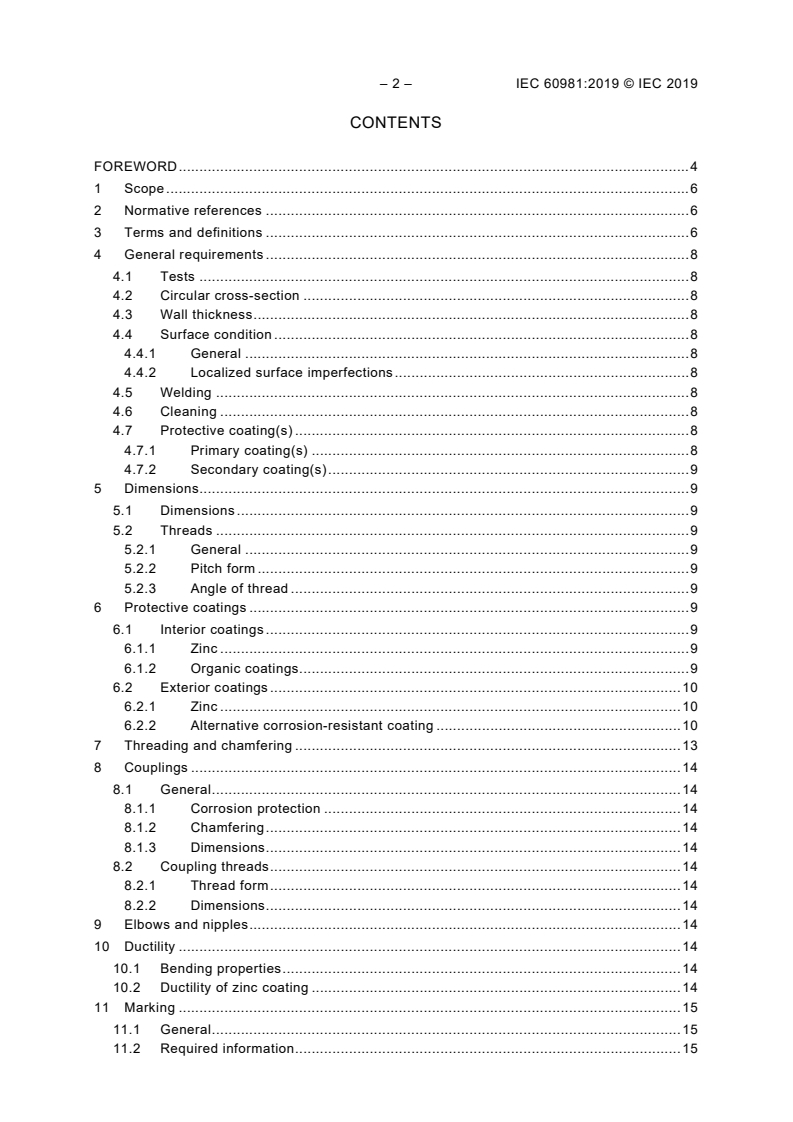
CONTENTS
FOREWORD . 4
1 Scope . 6
2 Normative references . 6
3 Terms and definitions . 6
4 General requirements . 8
4.1 Tests . 8
4.2 Circular cross-section . 8
4.3 Wall thickness . 8
4.4 Surface condition . 8
4.4.1 General . 8
4.4.2 Localized surface imperfections . 8
4.5 Welding . 8
4.6 Cleaning . 8
4.7 Protective coating(s) . 8
4.7.1 Primary coating(s) . 8
4.7.2 Secondary coating(s) . 9
5 Dimensions. 9
5.1 Dimensions . 9
5.2 Threads . 9
5.2.1 General . 9
5.2.2 Pitch form . 9
5.2.3 Angle of thread . 9
6 Protective coatings . 9
6.1 Interior coatings . 9
6.1.1 Zinc . 9
6.1.2 Organic coatings. 9
6.2 Exterior coatings . 10
6.2.1 Zinc . 10
6.2.2 Alternative corrosion-resistant coating . 10
7 Threading and chamfering . 13
8 Couplings . 14
8.1 General . 14
8.1.1 Corrosion protection . 14
8.1.2 Chamfering . 14
8.1.3 Dimensions . 14
8.2 Coupling threads . 14
8.2.1 Thread form . 14
8.2.2 Dimensions . 14
9 Elbows and nipples . 14
10 Ductility . 14
10.1 Bending properties . 14
10.2 Ductility of zinc coating . 14
11 Marking . 15
11.1 General . 15
11.2 Required information . 15
Annex A (normative) Test for thickness of zinc coating on extra heavy-duty electrical
rigid steel (EHDERS) conduits . 24
A.1 Requirement . 24
A.2 Solutions required . 24
A.3 Preparation of samples . 24
A.4 Specimen surface condition . 24
A.5 Test method . 24
A.6 Results . 25
Annex B (normative) Tests for evaluating alternative exterior coatings applied on extra
heavy-duty electrical rigid steel (EHDERS) conduits . 26
B.1 Alternative corrosion-resistant coatings . 26
B.2 Preparation of specimens . 26
B.3 Air oven conditioning exposure . 28
B.4 Resistance to ultraviolet light and water exposure . 29
B.5 Resistance to salt spray (fog) exposure . 29
B.6 Resistance to moist carbon dioxide-sulfur dioxide-air exposure . 29
Bibliography . 30
Figure 1 – Dimensions of threads for EHDERS conduits . 18
Figure 2 – Basic form of taper thread . 19
Figure 3 – Limits on crest and root truncation of external and internal threads . 20
Figure 4 – Dimensions of a ferrous metal coupling . 21
Figure 5 – Dimensions of wedge . 22
Figure 6 – Essential dimensions for flame test . 23
Figure B.1 – Alternative corrosion program flowchart with sample requirements . 27
Figure B.2 – Scribe pattern . 28
Table 1 – Dimensions and mass of EHDERS conduits . 16
Table 2 – Dimensions of couplings . 17
Table 3 – Dimensions of 90° elbows . 17
– 4 – IEC 60981:2019 © IEC 2019
INTERNATIONAL ELECTROTECHNICAL COMMISSION
____________
EXTRA HEAVY-DUTY ELECTRICAL RIGID STEEL CONDUITS
FOREWORD
1) The International Electrotechnical Commission (IEC) is a worldwide organization for standardization comprising
all national electrotechnical committees (IEC National Committees). The object of IEC is to promote
international co-operation on all questions concerning standardization in the electrical and electronic fields. To
this end and in addition to other activities, IEC publishes International Standards, Technical Specifications,
Technical Reports, Publicly Available Specifications (PAS) and Guides (hereafter referred to as "IEC
Publication(s)"). Their preparation is entrusted to technical committees; any IEC National Committee interested
in the subject dealt with may participate in this preparatory work. International, governmental and non-
governmental organizations liaising with the IEC also participate in this preparation. IEC collaborates closely
with the International Organization for Standardization (ISO) in accordance with conditions determined by
agreement between the two organizations.
2) The formal decisions or agreements of IEC on technical matters express, as nearly as possible, an international
consensus of opinion on the relevant subjects since each technical committee has representation from all
interested IEC National Committees.
3) IEC Publications have the form of recommendations for international use and are accepted by IEC National
Committees in that sense. While all reasonable efforts are made to ensure that the technical content of IEC
Publications is accurate, IEC cannot be held responsible for the way in which they are used or for any
misinterpretation by any end user.
4) In order to promote international uniformity, IEC National Committees undertake to apply IEC Publications
transparently to the maximum extent possible in their national and regional publications. Any divergence
between any IEC Publication and the corresponding national or regional publication shall be clearly indicated in
the latter.
5) IEC itself does not provide any attestation of conformity. Independent certification bodies provide conformity
assessment services and, in some areas, access to IEC marks of conformity. IEC is not responsible for any
services carried out by independent certification bodies.
6) All users should ensure that they have the latest edition of this publication.
7) No liability shall attach to IEC or its directors, employees, servants or agents including individual experts and
members of its technical committees and IEC National Committees for any personal injury, property damage or
other damage of any nature whatsoever, whether direct or indirect, or for costs (including legal fees) and
expenses arising out of the publication, use of, or reliance upon, this IEC Publication or any other IEC
Publications.
8) Attention is drawn to the Normative references cited in this publication. Use of the referenced publications is
indispensable for the correct application of this publication.
9) Attention is drawn to the possibility that some of the elements of this IEC Publication may be the subject of
patent rights. IEC shall not be held responsible for identifying any or all such patent rights.
International Standard IEC 60981 has been prepared by subcommittee 23A: Cable
management systems, of IEC technical committee 23: Electrical accessories.
This third edition cancels and replaces the second edition published in 2004. This edition
constitutes a technical revision.
This edition includes the following significant technical changes with respect to the second
edition:
a) addition of provisions for alternative coatings to zinc;
b) addition of elasticity test for organic coatings;
c) new Annex B on tests for evaluating alternative exterior coatings applied on extra
heavy-duty electrical rigid steel (EHDERS) conduits.
The text of this International Standard is based on the following documents:
FDIS Report on voting
23A/886/FDIS 23A/888/RVD
Full information on the voting for the approval of this International Standard can be found in
the report on voting indicated in the above table.
This document has been drafted in accordance with the ISO/IEC Directives, Part 2.
In this document, the following print types are used:
• requirements proper: in roman type;
• test specifications: in italic type;
• explanatory matter: in smaller roman type.
The committee has decided that the contents of this document will remain unchanged until the
stability date indicated on the IEC website under "http://webstore.iec.ch" in the data related to
the specific document. At this date, the document will be
• reconfirmed,
• withdrawn,
• replaced by a revised edition, or
• amended.
A bilingual version of this publication may be issued at a later date.
IMPORTANT – The 'colour inside' logo on the cover page of this publication indicates
that it contains colours which are considered to be useful for the correct
understanding of its contents. Users should therefore print this document using a
colour printer.
– 6 – IEC 60981:2019 © IEC 2019
EXTRA HEAVY-DUTY ELECTRICAL RIGID STEEL CONDUITS
1 Scope
This document specifies requirements for extra heavy-duty electrical rigid steel (EHDERS)
conduits, couplings, nipples and elbows for electrical installations, including communications
and fibre optics. This document also specifies threads for these components.
It is not applicable to the conduits specified in IEC 60423.
2 Normative references
The following documents are referred to in the text in such a way that some or all of their
content constitutes requirements of this document. For dated references, only the edition
cited applies. For undated references, the latest edition of the referenced document (including
any amendments) applies.
IEC 60695-11-3, Fire hazard testing – Part 11-3: Test flames – 500 W flames – Apparatus and
confirmational test methods
IEC 61950, Cable management systems – Specifications for conduit fittings and accessories
for cable installations for extra heavy duty electrical steel conduit
ISO 527 (all parts), Plastics – Determination of tensile properties
ISO 4892-2, Plastics – Methods of exposure to laboratory light sources – Part 2: Xenon-arc
lamps
ISO 9227, Corrosion tests in artificial atmospheres – Salt spray tests
ISO 13263, Thermoplastics piping systems for non-pressure underground drainage and
sewerage – Thermoplastics fittings – Test method for impact strength
ISO 19095-3, Plastics – Evaluation of the adhesion interface performance in plastic-metal
assemblies – Part 3: Test methods
3 Terms and definitions
For the purposes of this document, the following terms and definitions apply.
ISO and IEC maintain terminological databases for use in standardization at the following
addresses:
• IEC Electropedia: available at http://www.electropedia.org/
• ISO Online browsing platform: available at http://www.iso.org/obp
3.1
extra heavy-duty electrical rigid steel conduit
EHDERS conduit
part of a closed wiring system of circular cross-section made of welded steel construction
capable of providing extra heavy mechanical protection to conductors or cables in electrical
installations and used as an equipment earthing conductor when installed utilizing appropriate
fittings
3.2
straight conduit
straight length of EHDERS, greater than 0,6 m long and threaded at each end, without a
coupling
3.3
finished conduit
straight length of EHDERS with one coupling attached
3.4
threaded coupling
internally threaded steel cylinder for connecting two sections of an EHDERS conduit
3.5
elbow
factory-curved section of an EHDERS conduit threaded at each end
3.6
glowing combustion
combustion of a material in the solid phase without flame but with emission of light from the
combustion zone
3.7
nipple
straight section of an EHDERS conduit not more than 0,6 m long and threaded at each end
3.8
type test
test made on a specimen for the conformity of the design of a given product to the
requirements of the relevant document
3.9
alternative corrosion-resistant coating
exterior primary coating(s) other than one consisting solely of zinc
Note 1 to entry: The coating(s) may include zinc. See Annex B.
3.10
organic coating
coating(s) other than one consisting solely of zinc
Note 1 to entry: The coating(s) may include zinc.
3.11
zinc coating
interior or exterior primary coating consisting solely of zinc
– 8 – IEC 60981:2019 © IEC 2019
4 General requirements
4.1 Tests
Tests according to this document shall be type tests.
Unless otherwise specified, the tests shall be carried out at an ambient temperature of
(20 ± 5) °C.
Unless otherwise specified, each test shall be carried out on two new samples. If a sample
tested in accordance with this document fails, two additional samples shall be tested, both of
which shall comply with all the requirements of this document.
4.2 Circular cross-section
An EHDERS conduit shall have a circular cross-section sufficiently accurate to allow the
cutting of threads in accordance with Figure 1.
4.3 Wall thickness
The wall thickness shall comply with the dimensions given in Table 1.
4.4 Surface condition
4.4.1 General
Surfaces of a conduit shall be free from slivers, burrs, scale and other defects likely to cause
damage to conductors or cables.
Compliance shall be checked by visual inspection of the external and internal surfaces.
4.4.2 Localized surface imperfections
Localized surface imperfections shall not exceed a depth of 12,5 % of the nominal wall
thickness given in Table 1.
Compliance of localized surface imperfections shall be checked by measurement.
4.5 Welding
The welding of all seams shall be continuous and carried out in a professional manner.
Compliance is checked by visual inspection.
4.6 Cleaning
The conduit shall be adequately cleaned before the application of the protective coating. The
cleaning process shall leave the exterior and interior surfaces of the conduit in such a
condition that the protective coating will be firmly adherent and smooth, as defined in 4.4.
4.7 Protective coating(s)
4.7.1 Primary coating(s)
The exterior surface shall be thoroughly and evenly coated with either a metallic zinc or an
alternative corrosion protection coating applied directly to the surface of the steel so that
metal-to-metal contact and galvanic protection against corrosion are provided. Zinc coatings
or alternative corrosion protection coatings having a zinc component shall be in metal-to-
metal contact with the steel.
The interior surface shall be protected by a zinc or organic or other suitable corrosion-
resistant coating.
4.7.2 Secondary coating(s)
When (an) additional coating(s) is(are) applied to enhance the primary coating, the evaluation
for each additional coating's degree of corrosion protection shall be optional.
5 Dimensions
5.1 Dimensions
The dimensions and mass of the EHDERS conduit shall be in accordance with those given in
Table 1.
5.2 Threads
5.2.1 General
The pitch and the length of the threaded portion at each end of each length of conduit, nipple,
and elbow shall be as indicated in Figure 1 and shall be compatible with IEC 61950. The
complete thread shall be tapered for its entire length, and the taper shall have a ratio of
1 to 16.
5.2.2 Pitch form
The form of the thread profile, the dimensional relationships for the form of the thread and the
general notation are shown in Figure 2.
5.2.3 Angle of thread
The angle between the sides of the thread, measured in the axial plane, shall be 60°. The line
bisecting this angle is perpendicular to the axis.
6 Protective coatings
6.1 Interior coatings
6.1.1 Zinc
The presence of a zinc coating on the interior surface shall be verified.
Compliance shall be checked by the method described in Annex A for one test cycle only.
6.1.2 Organic coatings
6.1.2.1 Elasticity test
An organic coating used to protect the interior of the conduit shall not crack, flake off or be
otherwise damaged.
Compliance shall be checked by the following test:
The coating shall be applied to a sheet-steel test piece and baked in an oven for 5 h, and
shall withstand without damage ten successive bends of the test piece back and forth through
an angle of 180° against an edge having a radius of 1,6 mm.
– 10 – IEC 60981:2019 © IEC 2019
The apparatus shall consist of flat test pieces of sheet steel of a width of 75 mm by a length of
125 mm and a thickness of approximately 0,25 mm, an oven for baking the test pieces, and a
vice with jaws of a width of at least 75 mm for holding the test pieces during the bending test.
The 75-mm edge of each jaw shall be rounded to a radius of 1,6 mm.
Two test pieces shall be cleaned with a suitable organic solvent to remove any grease and
foreign material and shall then be dipped in the organic coating. After air drying for 30 min,
the test pieces shall be suspended by means of short wires in the oven. Samples shall be
baked for 5 h at the normal baking temperature for the organic coating in question but, if the
normal baking temperature is lower than 135 °C or the enamel is regularly air dried, the oven
temperature shall be maintained between 135 °C and 150 °C.
At the end of 5 h, the test pieces shall be removed from the oven and cooled in still air to
room temperature. Each flat test piece shall be secured in the vice, gripped at its free end,
and then bent for 90° against one of the 75-mm edges of the vice jaws. Each test piece shall
then be bent back past its original position through 180° so that it ends bent 90° against the
other 75-mm edge of the vice jaws. It shall then be bent for 90° in the opposite direction,
ending with the test piece in its original position. This cycle shall be repeated five times.
6.1.2.2 Warm humid air test
No corrosion of the metal shall be present after 1 440 h of exposure to humidity.
Compliance shall be checked by the following test:
The test apparatus shall be an insulated chamber with inside dimensions of approximately
119 cm × 71 cm × 71 cm. It shall contain a temperature-controlled water reservoir, pump,
spray chamber for humidifying the air, an air-circulating fan, provisions for heating the air,
specimen supports, and the necessary means of control.
The dry bulb temperature of the test chamber shall be maintained at (60 ± 1) °C for 1 440 h
and at (98 ± 2) % relative humidity throughout the test. The specimens shall be supported in
racks at an angle of 15° from the vertical.
6.2 Exterior coatings
6.2.1 Zinc
A zinc coating on the outside surface shall have a minimum thickness of 0,02 mm.
Compliance shall be checked by measurement. In case of a dispute, the minimum acceptable
thickness shall be determined using the method described in Annex A.
6.2.2 Alternative corrosion-resistant coating
6.2.2.1 General
An alternative corrosion-resistant coating on the outside surface shall provide an equal or
greater protection from corrosion as a zinc coating.
Compliance shall be checked by the requirements in Clauses B.2 to B.6, 6.2.2.2 to 6.2.2.5 (as
applicable) and the electrical continuity and mechanical strength test sequence for fittings for
unthreaded EHDERS conduits in accordance with IEC 61950. Separate sets of assembled
specimens of the conduit, elbow, or nipple to both set-screw and compression-type couplings
shall be subjected to the fault current test, electrical continuity test, a bend test, an electrical
continuity test (repeated), and a pull-out test as specified in IEC 61950.
6.2.2.2 Tensile strength
The tensile strength of a polyvinyl chloride (PVC) alternative corrosion-resistant coating for
EHDERS conduits shall have a minimum tensile strength of 13,79 MPa (2 000 psi).
Compliance shall be checked by the tests in ISO 527 (all parts). Other materials shall be
subject to special investigation.
6.2.2.3 Adhesion
The adhesion of an alternative corrosion-resistant coating shall be greater than the strength of
the alternative corrosion-resistant coating itself. The coating may tear rather than separate
from the substrate.
Compliance for coatings of a thickness of 0,51 mm to 1,27 mm shall be checked by the
following test:
Two parallel circumferential cuts 38 mm long shall be made 13 mm apart through the
alternative corrosion-resistant coating to the substrate. A third cut shall be made
perpendicular to, and crossing, the circumferential cuts. The edge of the alternative corrosion-
resistant coating shall be carefully lifted with a knife to form a tab. To determine compliance,
this tab shall be pulled perpendicularly to the conduit with a pair of pliers.
Compliance for coatings with a thickness of 0,127 mm or less shall be checked by the test in
ISO 19095-3.
6.2.2.4 Cold impact
The coating shall not separate from the metal nor be damaged to the extent that bare metal is
exposed on each individual specimen.
Compliance shall be checked by inspection without magnification after the following test:
Ten 152 mm to 203 mm specimens of finished conduit provided with a non-metallic alternative
corrosion-resistant coating shall be conditioned at a temperature of 0 °C for a period of
60 min. Conduits intended for use in temperatur
...
IEC 60981 ®
Edition 3.0 2019-08
REDLINE VERSION
INTERNATIONAL
STANDARD
colour
inside
Extra heavy-duty electrical rigid steel conduits
All rights reserved. Unless otherwise specified, no part of this publication may be reproduced or utilized in any form
or by any means, electronic or mechanical, including photocopying and microfilm, without permission in writing from
either IEC or IEC's member National Committee in the country of the requester. If you have any questions about IEC
copyright or have an enquiry about obtaining additional rights to this publication, please contact the address below or
your local IEC member National Committee for further information.
IEC Central Office Tel.: +41 22 919 02 11
3, rue de Varembé info@iec.ch
CH-1211 Geneva 20 www.iec.ch
Switzerland
About the IEC
The International Electrotechnical Commission (IEC) is the leading global organization that prepares and publishes
International Standards for all electrical, electronic and related technologies.
About IEC publications
The technical content of IEC publications is kept under constant review by the IEC. Please make sure that you have the
latest edition, a corrigendum or an amendment might have been published.
IEC publications search - webstore.iec.ch/advsearchform Electropedia - www.electropedia.org
The advanced search enables to find IEC publications by a The world's leading online dictionary on electrotechnology,
variety of criteria (reference number, text, technical containing more than 22 000 terminological entries in English
committee,…). It also gives information on projects, replaced and French, with equivalent terms in 16 additional languages.
and withdrawn publications. Also known as the International Electrotechnical Vocabulary
(IEV) online.
IEC Just Published - webstore.iec.ch/justpublished
Stay up to date on all new IEC publications. Just Published IEC Glossary - std.iec.ch/glossary
details all new publications released. Available online and 67 000 electrotechnical terminology entries in English and
once a month by email. French extracted from the Terms and Definitions clause of
IEC publications issued since 2002. Some entries have been
IEC Customer Service Centre - webstore.iec.ch/csc collected from earlier publications of IEC TC 37, 77, 86 and
If you wish to give us your feedback on this publication or CISPR.
need further assistance, please contact the Customer Service
Centre: sales@iec.ch.
IEC 60981 ®
Edition 3.0 2019-08
REDLINE VERSION
INTERNATIONAL
STANDARD
colour
inside
Extra heavy-duty electrical rigid steel conduits
INTERNATIONAL
ELECTROTECHNICAL
COMMISSION
ICS 29.120.10 ISBN 978-2-8322-7331-9
– 2 – IEC 60981:2019 RLV © IEC 2019
CONTENTS
FOREWORD . 4
1 Scope . 6
2 Normative references . 6
3 Terms and definitions . 6
4 General requirements . 8
4.1 Tests . 8
4.2 Circular cross-section . 8
4.3 Wall thickness . 8
4.4 Surface condition . 8
4.4.1 General . 8
4.4.2 Localized surface imperfections . 8
4.5 Welding . 8
4.6 Cleaning . 8
4.7 Protective coating(s) . 8
4.7.1 Primary coating(s) . 8
4.7.2 Secondary coating(s) . 9
Alternative coatings .
5 Dimensions. 9
5.1 Dimensions . 9
5.2 Threads . 9
5.2.1 General . 9
5.2.2 Pitch form . 9
5.2.3 Angle of thread . 9
6 Protective coatings . 9
6.1 Interior coatings . 9
6.1.1 Zinc . 9
6.1.2 Organic coatings. 9
6.2 Exterior coatings . 10
6.2.1 Zinc coating . 10
6.2.2 Alternative corrosion-resistant coating . 11
7 Threading and chamfering . 14
8 Couplings . 14
8.1 General . 14
8.1.1 Corrosion protection . 14
8.1.2 Chamfering . 14
8.1.3 Dimensions . 14
8.2 Coupling threads . 14
8.2.1 Thread form . 14
8.2.2 Dimensions . 14
9 Elbows and nipples . 14
10 Ductility . 15
10.1 Bending properties . 15
10.2 Ductility of zinc coating . 15
11 Marking . 15
11.1 General . 15
11.2 Required information . 15
Annex A (normative) Test for thickness of zinc coating on extra heavy-duty electrical
rigid steel (EHDERS) conduits . 24
A.1 Requirement . 24
A.2 Solutions required . 24
A.3 Preparation of samples . 24
A.4 Specimen surface condition . 24
A.5 Test method . 24
A.6 Results . 25
Annex B (normative) Tests for evaluating alternative exterior coatings applied on extra
heavy-duty electrical rigid steel (EHDERS) conduits . 26
B.1 Alternative corrosion-resistant coatings . 26
B.2 Preparation of specimens . 26
B.3 Air oven conditioning exposure . 28
B.4 Resistance to ultraviolet light and water exposure . 29
B.5 Resistance to salt spray (fog) exposure . 29
B.6 Resistance to moist carbon dioxide-sulfur dioxide-air exposure . 29
Bibliography . 30
Figure 1 – Dimensions of threads for EHDERS conduits . 18
Figure 2 – Basic form of taper thread . 19
Figure 3 – Limits on crest and root truncation of external and internal threads . 20
Figure 4 – Dimensions of a ferrous metal coupling . 21
Figure 5 – Dimensions of wedge . 22
Figure 6 – Essential dimensions for flame test . 23
Figure B.1 – Alternative corrosion program flowchart with sample requirements . 27
Figure B.2 – Scribe pattern . 28
Table 1 – Dimensions and mass of EHDERS conduits . 16
Table 2 – Dimensions of couplings . 17
Table 3 – Dimensions of 90° elbows . 17
– 4 – IEC 60981:2019 RLV © IEC 2019
INTERNATIONAL ELECTROTECHNICAL COMMISSION
____________
EXTRA HEAVY-DUTY ELECTRICAL RIGID STEEL CONDUITS
FOREWORD
1) The International Electrotechnical Commission (IEC) is a worldwide organization for standardization comprising
all national electrotechnical committees (IEC National Committees). The object of IEC is to promote
international co-operation on all questions concerning standardization in the electrical and electronic fields. To
this end and in addition to other activities, IEC publishes International Standards, Technical Specifications,
Technical Reports, Publicly Available Specifications (PAS) and Guides (hereafter referred to as "IEC
Publication(s)"). Their preparation is entrusted to technical committees; any IEC National Committee interested
in the subject dealt with may participate in this preparatory work. International, governmental and non-
governmental organizations liaising with the IEC also participate in this preparation. IEC collaborates closely
with the International Organization for Standardization (ISO) in accordance with conditions determined by
agreement between the two organizations.
2) The formal decisions or agreements of IEC on technical matters express, as nearly as possible, an international
consensus of opinion on the relevant subjects since each technical committee has representation from all
interested IEC National Committees.
3) IEC Publications have the form of recommendations for international use and are accepted by IEC National
Committees in that sense. While all reasonable efforts are made to ensure that the technical content of IEC
Publications is accurate, IEC cannot be held responsible for the way in which they are used or for any
misinterpretation by any end user.
4) In order to promote international uniformity, IEC National Committees undertake to apply IEC Publications
transparently to the maximum extent possible in their national and regional publications. Any divergence
between any IEC Publication and the corresponding national or regional publication shall be clearly indicated in
the latter.
5) IEC itself does not provide any attestation of conformity. Independent certification bodies provide conformity
assessment services and, in some areas, access to IEC marks of conformity. IEC is not responsible for any
services carried out by independent certification bodies.
6) All users should ensure that they have the latest edition of this publication.
7) No liability shall attach to IEC or its directors, employees, servants or agents including individual experts and
members of its technical committees and IEC National Committees for any personal injury, property damage or
other damage of any nature whatsoever, whether direct or indirect, or for costs (including legal fees) and
expenses arising out of the publication, use of, or reliance upon, this IEC Publication or any other IEC
Publications.
8) Attention is drawn to the Normative references cited in this publication. Use of the referenced publications is
indispensable for the correct application of this publication.
9) Attention is drawn to the possibility that some of the elements of this IEC Publication may be the subject of
patent rights. IEC shall not be held responsible for identifying any or all such patent rights.
This redline version of the official IEC Standard allows the user to identify the changes
made to the previous edition. A vertical bar appears in the margin wherever a change
has been made. Additions are in green text, deletions are in strikethrough red text.
International Standard IEC 60981 has been prepared by subcommittee 23A: Cable
management systems, of IEC technical committee 23: Electrical accessories.
This third edition cancels and replaces the second edition published in 2004. This edition
constitutes a technical revision.
This edition includes the following significant technical changes with respect to the second
edition:
a) addition of provisions for alternative coatings to zinc;
b) addition of elasticity test for organic coatings;
c) new Annex B on tests for evaluating alternative exterior coatings applied on extra
heavy-duty electrical rigid steel (EHDERS) conduits.
The text of this International Standard is based on the following documents:
FDIS Report on voting
23A/886/FDIS 23A/888/RVD
Full information on the voting for the approval of this International Standard can be found in
the report on voting indicated in the above table.
This document has been drafted in accordance with the ISO/IEC Directives, Part 2.
In this document, the following print types are used:
• requirements proper: in roman type;
• test specifications: in italic type;
• explanatory matter: in smaller roman type.
The committee has decided that the contents of this document will remain unchanged until the
stability date indicated on the IEC website under "http://webstore.iec.ch" in the data related to
the specific document. At this date, the document will be
• reconfirmed,
• withdrawn,
• replaced by a revised edition, or
• amended.
IMPORTANT – The 'colour inside' logo on the cover page of this publication indicates
that it contains colours which are considered to be useful for the correct
understanding of its contents. Users should therefore print this document using a
colour printer.
– 6 – IEC 60981:2019 RLV © IEC 2019
EXTRA HEAVY-DUTY ELECTRICAL RIGID STEEL CONDUITS
1 Scope
This document specifies requirements for extra heavy-duty electrical rigid steel (EHDERS)
conduits, couplings, nipples and elbows for electrical installations, including communications
and fibre optics. This document also specifies threads for these components.
1)
It is not applicable to the conduits specified in IEC 60423 .
2 Normative references
The following documents are referred to in the text in such a way that some or all of their
content constitutes requirements of this document. For dated references, only the edition
cited applies. For undated references, the latest edition of the referenced document (including
any amendments) applies.
IEC 60695-11-3, Fire hazard testing – Part 11-3: Test flames – 500 W flames – Apparatus and
confirmational test methods
IEC 61950, Cable management systems – Specifications for conduit fittings and accessories
for electrical cable installations for extra heavy duty metal electrical steel conduit
ISO 527 (all parts), Plastics – Determination of tensile properties
ISO 4892-2, Plastics – Methods of exposure to laboratory light sources – Part 2: Xenon-arc
lamps
ISO 9227, Corrosion tests in artificial atmospheres – Salt spray tests
ISO 13263, Thermoplastics piping systems for non-pressure underground drainage and
sewerage – Thermoplastics fittings – Test method for impact strength
ISO 19095-3, Plastics – Evaluation of the adhesion interface performance in plastic-metal
assemblies – Part 3: Test methods
3 Terms and definitions
For the purposes of this document, the following terms and definitions apply.
ISO and IEC maintain terminological databases for use in standardization at the following
addresses:
• IEC Electropedia: available at http://www.electropedia.org/
• ISO Online browsing platform: available at http://www.iso.org/obp
___________
1)
IEC 60423, Conduits for electrical purposes – Outside diameters of conduits for electrical installations and
threads for conduits and fittings
3.1
extra heavy-duty electrical rigid steel conduit
EHDERS conduit
part of a closed wiring system of circular cross-section made of welded steel construction
capable of providing extra heavy mechanical protection to conductors or cables in electrical
installations and used as an equipment earthing conductor when installed utilizing appropriate
fittings
3.2
straight conduit
straight length of EHDERS, greater than 0,6 m long and threaded at each end, without a
coupling
3.3
finished conduit
straight length of EHDERS with one coupling attached
3.4
threaded coupling
internally threaded steel cylinder for connecting two sections of an EHDERS conduit
3.5
elbow
factory-curved section of an EHDERS conduit threaded at each end
3.6
glowing combustion
combustion of a material in the solid phase without flame but with emission of light from the
combustion zone
3.7
nipple
straight section of an EHDERS conduit not more than 0,6 m long and threaded at each end
3.8
type test
test made on a specimen for the conformity of the design of a given product to the
requirements of the relevant document
3.9
alternative corrosion-resistant coating
exterior primary coating(s) other than one consisting solely of zinc
Note 1 to entry: The coating(s) may include zinc. See Annex B.
3.10
organic coating
coating(s) other than one consisting solely of zinc
Note 1 to entry: The coating(s) may include zinc.
3.11
zinc coating
interior or exterior primary coating consisting solely of zinc
– 8 – IEC 60981:2019 RLV © IEC 2019
4 General requirements
4.1 Tests
Tests according to this document shall be type tests.
Unless otherwise specified, the tests shall be carried out at an ambient temperature of
(20 ± 5) °C.
Unless otherwise specified, each test shall be carried out on two new samples. If a sample
tested in accordance with this document fails, two additional samples shall be tested, both of
which shall comply with all the requirements of this document.
4.2 Circular cross-section
An EHDERS conduit shall have a circular cross-section sufficiently accurate to permit allow
the cutting of threads in accordance with Figure 1.
4.3 Wall thickness
The wall thickness shall comply with the dimensions given in Table 1.
4.4 Surface condition
4.4.1 General
Surfaces of a conduit shall be free from slivers, burrs, scale and other defects likely to cause
damage to conductors or cables.
Compliance shall be checked by visual inspection of the external and internal surfaces.
4.4.2 Localized surface imperfections
Localized surface imperfections shall not exceed a depth of 12,5 % of the nominal wall
thickness given in Table 1.
Compliance of localized surface imperfections shall be checked by measurement.
4.5 Welding
The welding of all seams shall be continuous and carried out in a workmanlike professional
manner.
Compliance is checked by visual inspection.
4.6 Cleaning
The conduit shall be adequately cleaned before the application of the protective coating. The
cleaning process shall leave the exterior and interior surfaces of the conduit in such a
condition that the protective coating will be firmly adherent and smooth, as defined in 4.4.
4.7 Protective coating(s)
4.7.1 Primary coating(s)
The exterior surface shall be thoroughly and evenly coated with either a metallic zinc or an
alternative corrosion protection coating applied directly to the surface of the steel so that
metal-to-metal contact and galvanic protection against corrosion are provided. Zinc coatings
or alternative corrosion protection coatings having a zinc component shall be in metal-to-
metal contact with the steel.
The interior surface shall be protected by a zinc or organic or other suitable corrosion-
resistant coating.
4.7.2 Secondary coating(s)
When (an) additional coating(s) is(are) applied to enhance the primary coating, the evaluation
for its each additional coating's degree of corrosion protection shall be optional.
4.7.3 Alternative coating
When an alternative coating is applied to enhance or replace the primary coating, the
evaluation of the amount of corrosion protection provided shall be the subject of a separate
standard.
5 Dimensions
5.1 Dimensions
The dimensions and mass of the EHDERS conduit shall be in accordance with those given in
Table 1.
5.2 Threads
5.2.1 General
The pitch and the length of the threaded portion at each end of each length of conduit, nipple,
and elbow shall be as indicated in Figure 1 and shall be compatible with IEC 61950. The
complete thread shall be tapered for its entire length, and the taper shall have a ratio of
1 to 16.
5.2.2 Pitch form
The form of the thread profile, the dimensional relationships for the form of the thread and the
general notation are shown in Figure 2.
5.2.3 Angle of thread
The angle between the sides of the thread, measured in the axial plane, shall be 60°. The line
bisecting this angle is perpendicular to the axis.
6 Protective coatings
6.1 Interior coatings
6.1.1 Zinc
The presence of a zinc coating on the interior surface shall be verified.
Compliance shall be checked by the method described in Annex A for one test cycle only.
– 10 – IEC 60981:2019 RLV © IEC 2019
6.1.2 Organic coatings
6.1.2.1 Elasticity test
An organic coating used to protect the interior of the conduit shall not crack, flake off or be
otherwise damaged.
Compliance shall be checked by the following test:
The coating shall be applied to a sheet-steel test piece and baked in an oven for 5 h, and
shall withstand without damage ten successive bends of the test piece back and forth through
an angle of 180° against an edge having a radius of 1,6 mm.
The apparatus shall consist of flat test pieces of sheet steel of a width of 75 mm by a length of
125 mm and a thickness of approximately 0,25 mm, an oven for baking the test pieces, and a
vice with jaws of a width of at least 75 mm for holding the test pieces during the bending test.
The 75-mm edge of each jaw shall be rounded to a radius of 1,6 mm.
Two test pieces shall be cleaned with a suitable organic solvent to remove any grease and
foreign material and shall then be dipped in the organic coating. After air drying for 30 min,
the test pieces shall be suspended by means of short wires in the oven. Samples shall be
baked for 5 h at the normal baking temperature for the organic coating in question but, if the
normal baking temperature is lower than 135 °C or the enamel is regularly air dried, the oven
temperature shall be maintained between 135 °C and 150 °C.
At the end of 5 h, the test pieces shall be removed from the oven and cooled in still air to
room temperature. Each flat test piece shall be secured in the vice, gripped at its free end,
and then bent for 90° against one of the 75-mm edges of the vice jaws. Each test piece shall
then be bent back past its original position through 180° so that it ends bent 90° against the
other 75-mm edge of the vice jaws. It shall then be bent for 90° in the opposite direction,
ending with the test piece in its original position. This cycle shall be repeated five times.
6.1.2.2 Warm humid air test
No corrosion of the metal shall be present after 1 440 h of exposure to humidity.
Compliance shall be checked by the following test:
The test apparatus shall be an insulated chamber with inside dimensions of approximately
119 cm × 71 cm × 71 cm. It shall contain a temperature-controlled water reservoir, pump,
spray chamber for humidifying the air, an air-circulating fan, provisions for heating the air,
specimen supports, and the necessary means of control.
The dry bulb temperature of the test chamber shall be maintained at (60 ± 1) °C for 1 440 h
and at (98 ± 2) % relative humidity throughout the test. The specimens shall be supported in
racks at an angle of 15° from the vertical.
6.2 Exterior coatings
6.2.1 Zinc coating
A zinc coating on the outside surface shall have a minimum thickness of 0,02 mm.
Compliance shall be checked by measurement. In case of a dispute, the minimum acceptable
thickness shall be determined using the method described in Annex A.
6.2.2 Alternative corrosion-resistant coating
6.2.2.1 General
An alternative corrosion-resistant coating on the outside surface shall provide an equal or
greater protection from corrosion as a zinc coating.
Compliance shall be checked by the requirements in Clauses B.2 to B.6, 6.2.2.2 to 6.2.2.5 (as
applicable) and the electrical continuity and mechanical strength test sequence for fittings for
unthreaded EHDERS conduits in accordance with IEC 61950. Separate sets of assembled
specimens of the conduit, elbow, or nipple to both set-screw and compression-type couplings
shall be subjected to the fault current test, electrical continuity test, a bend test, an electrical
continuity test (repeated), and a pull-out test as specified in IEC 61950.
6.2.2.2 Tensile strength
The tensile strength of a polyvinyl chloride (PVC) alternative corrosion-resistant coating for
EHDERS conduits shall have a minimum tensile strength of 13,79 MPa (2 000 psi).
Compliance shall be checked by the tests in ISO 527 (all parts). Other materials shall be
subject to special investigation.
6.2.2.3 Adhesion
The adhesion of an alternative corrosion-resistant coating shall be greater than the strength of
the alternative corrosion-resistant coating itself. The coating may tear rather than separate
from the substrate.
Compliance for coatings of a thickness of 0,51 mm to 1,27 mm shall be checked by the
following test:
Two parallel circumferential cuts 38 mm long shall be made 13 mm apart through the
alternative corrosion-resistant coating to the substrate. A third cut shall be made
perpendicular to, and crossing, the circumferential cuts. The edge of the alternative corrosion-
resistant coating shall be carefully lifted with a knife to form a tab. To determine compliance,
this tab shall be pulled perpendicularly to the conduit with a pair of pliers.
Compliance for coatings with a thickness of 0,127 mm or less shall be checked by the test in
ISO 19095-3.
6.2.2.4 Cold impact
The coating shall not separate from the metal nor be damaged to the extent that bare metal is
exposed on each individual specimen.
Compliance shall be checked by inspection without magnification after the following test:
Ten 152 mm to 203 mm specimens of finished conduit provided with a non-metallic alternative
corrosion-resistant coating shall be conditioned at a temperature of 0 °C for a period of
60 min. Conduits intended for use in temperatures below 0 °C shall be conditioned at the
rated temperature, for which the rated temperature shall be any temperature below 0 °C in
5 °C increments. The specimens shall then be subjected to an impact force of 12,2 J. A
combination of any height and weight resulting in this impact force shall be considered
equivalent if the impact face remains unchanged.
The impact shall be performed according to the apparatus, falling mass and method specified
in ISO 13263. The test shall be conducted inside the cold chamber or within 15 s of removal
from the cold chamber.
– 12 – IEC 60981:2019 RLV © IEC 2019
6.2.2.5 Flammability
The finished conduit provided with a non-metallic alternative corrosion-resistant coating shall
be flame resistant.
The finished conduit shall not flame for longer than 5 s following any of three 60-s
applications of flame, the period between applications being 30 s. A specimen shall not:
• emit flaming or glowing particles or flaming drops at any time that ignite the cotton on the
burner, wedge, or floor of the enclosure (flameless charring of the cotton shall be ignored);
• continue to flame longer than 5 s after any application of the gas flame; or
• have the coating completely consumed during or after any application of the gas flame.
NOTE When an alternative corrosion protection system employs a thin exterior organic topcoat measuring less
than or equal to 0,125 mm in thickness, over a confirmed three-dips worth of zinc, a specimen can display a total
consumption of the top coat at the point of flame contact to the conduit without any measureable flame propagation
as long as it meets the requirements of 6.2.2.5, first and second bullet points. Confirmation of the presence of
three-dips worth of zinc coating is accomplished using the zinc coating test of Annex A as part of a separate test.
Compliance is checked by the following test:
Materials and reactants shall consist of the following:
a) Methane, at 98 % minimum purity, having a heat content of (37 ± 1) MJ/m at 25 °C and
101 kPa; or natural gas, with a heat content of (37 ± 1) MJ/m at 25 °C and 101 kPa;
Alternative gases, such as propane, at a 95 % minimum purity, having a heat content of
(94 ± 2) MJ/m at 25 °C and 101 kPa or butane, at 99 % minimum purity, having a heat
content of (120 ± 3) MJ/m at 25 °C and 101 kPa, may be used if a stable flame is
obtained and the heat evolution profile complies with IEC 60695-11-3.
WARNING Propane and butane gases are denser than air and can settle and become an
explosion hazard. Consult the gas supplier for special precautions to be taken.
b) Surgical cotton, dry and untreated.
The apparatus and a means for supporting the test specimen in a vertical position shall
consist of the following:
1) A three-sided metal enclosure in an exhaust hood or cabinet. The metal enclosure shall
be 305 mm wide, 355 mm deep, and 610 mm high, and the top and front shall be open. A
457-mm specimen of finished conduit shall be secured with its longitudinal axis vertical in
the centre of the enclosure. A flat, horizontal layer of untreated surgical cotton of a
thickness between 6 mm and 25 mm shall cover the floor of the enclosure. The upper
surface of the cotton shall be between 229 mm and 241 mm below point B, which is the
point at which the tip of the blue inner cone of the test flame touches the specimen. See
Figure 6.
2) An angle block, wedge, (see Figure 5) to which the base of the burner can be secured,
shall be provided for tilting the barrel 20° from the vertical while the longitudinal axis of
the barrel remains in a vertical plane. The burner shall be secured to the wedge and the
assembly shall be placed in an adjustable support jig. A layer of untreated surgical cotton
of a thickness between 6 mm and 25 mm shall be placed on the wedge and around the
base of the burner. The jig shall be adjusted toward one side or the other of the enclosure
to place the longitudinal axis of the barrel in the vertical plane that contains the
longitudinal axis of the specimen. The plane shall be parallel to the sides of the enclosure.
The jig shall also be adjusted toward the rear or front of the enclosure to position the
point A, which is the intersection of the longitudinal axis of the barrel with the plane of the
tip of the barrel, 38 mm from the point B at which the extended longitudinal axis of the
barrel meets the outer surface of the specimen. Point B is the point at which the tip of the
blue inner cone touches the centre of the front of the specimen. The specimen shall be
adjusted vertically to keep point B from being any closer than 76 mm to the lower clamp or
other support for the specimen.
3) A laboratory burner in conformance with IEC 60695-11-3, suitable for the calorific value of
the gas and having an inside diameter of (9,5 ± 0,3) mm and a length of (100 ± 10) mm
above the primary-air inlets. The burner shall be calibrated in accordance with
IEC 60695-11-3 each time a cylinder of gas, when used, is changed or refilled, or any of
the apparatus is changed.
The burner flame shall be calibrated at least every 30 days and each time that a cylinder
of gas is changed or if any of the apparatus is changed. If using gas different from the
grade of methane specified for referee purposes, the burner flame shall be calibrated
immediately before testing.
4) A length-measuring device accurate to within 5 % of char length requirements.
5) A flame height gauge capable of measuring the specified flame heights.
6) A timing device capable of measuring the specified times in seconds, having a resolution
of 1 s and an accuracy of ±0,5 s.
Three specimens having a minimum length of 457 mm taken from a sample of finished
conduit shall be conditioned at room temperature for a minimum of 6 h.
When conducting the test, the specimens, apparatus, and surrounding air shall be at room
temperature.
The specimens shall be mounted vertically in the supports in the chamber (see Figure 6).
A continuous horizontal layer of cotton between 6 mm and 25 mm shall be placed on the
floor of the test chamber, centred on the vertical axis of the test specimen, extending from
75 mm to 100 mm outward in all directions except in the direction of the burner, where it
shall extend to just contact the angle block. The upper surface of the cotton shall be
between 229 mm and 241 mm, (235 ± 6) mm below the point at which the tip of the blue
inner cone of the flame shall impinge on the specimen. There shall be no cotton on the
burner, or on or under the angle block.
With the burner in vertical position, the height of the test flame shall be adjusted to
(125 ± 10) mm, with an inner blue cone of a length of (40 ± 2) mm. The burner shall then
be positioned on the angle block, with its barrel at an angle of 20° to the vertical.
The alignment of the angle block shall be such that the axis of the burner barrel and the
longitudinal axis of the specimen are in the same plane.
The motion of the angle block, which allows smooth removal of the flame from the
specimen and smooth reapplication of the flame, shall not disturb the layer of cotton on
the floor of the enclosure.
The angle block shall be moved into position such that the tip of the inner blue cone of the
flame impinges on the outer surface of the specimen for 60 s, and is then moved away for
30 s. This cycle shall be repeated until three applications of the flame have been
completed. In all cases, the movement of the angle block shall be smooth and quick, with
minimum disturbance of the chamber air. On a flat specimen, the flame shall impinge on
the centre of the broad face of the specimen. If the specimen changes location due to
heating or burning, the position of the burner shall be adjusted so that the point of
impingement remains on the same location of the specimen.
When any specimen emits flaming or glowing particles or flaming drops that fall outside
the area of the testing surface covered by the cotton, or fall onto the wedge or burner, or
both, the test results shall be discarded and the test repeated. For the repeat test, the
area covered by the cotton may be increased, placed over the wedge, or both.
When flaming of the specimen persists for longer than 5 s after removal of the burner
flame, the burner flame shall not be re-applied until immediately after the flaming ceases.
If flaming ceases and only glowing combustion continues after 30 s, the burner flame shall
be re-applied.
After the test is completed, the exhaust system shall be activated to remove all smoke and
fumes from the chamber.
During and after the test, occurrence of the following shall be recorded:
– 14 – IEC 60981:2019 RLV © IEC 2019
– flaming or glowing particles or flaming drops at any time that ignite the cotton on the
burner, wedge, or floor of the enclosure (flameless charring of the cotton shall be ignored);
– non-metallic alternative corrosion-resistant coating flaming longer than 5 s following any of
three 60-s applications of gas flame; or
– complete consumption of the coating during or after any application of the gas flame.
7 Threading and chamfering
7.1 Each length of conduit, as well as each nipple and elbow shall be threaded at both ends.
Each end shall be chamfered or otherwise treated to remove burrs and sharp edges.
7.2 Threads shall comply with the requirements of 5.2. If threads are cut after the zinc
coating has been applied, the threads, before installation, shall be treated with a protective
coating to prevent corrosion. This treatment shall not impair electrical continuity through the
joint after installation.
8 Couplings
8.1 General
8.1.1 Corrosion protection
The exterior surface of couplings shall be protected by means of a zinc coating or alternative
corrosion protection coating, which shall comply with the requirements of Clause 6, and the
interior surface shall be treated to keep corrosion from taking place prior to installation onto
the conduit.
8.1.2 Chamfering
Both ends of couplings shall be chamfered between 11° and 15°, to prevent damage to the
start of the thread (see Figure 4).
8.1.3 Dimensions
The outside diameter and length of couplings shall be as indicated in Table 2. Each length of
conduit shall be supplied with one coupling attached.
8.2 Coupling threads
8.2.1 Thread form
Coupling threads in accordance with this document shall be straight (parallel) threads of the
same thread form as the taper thread specified in 5.2.1.
8.2.2 Dimensions
The dimensions and pitch diameter limits shall be as indicated in Table 2, and the truncation
shall be as indicated in Figure 3.
The major and minor diameters vary with the pitch diameter. The thread form shall be as
indicated in Figure 2.
9 Elbows and nipples
Conduit elbows and conduit nipples shall have the same dimensions and quality employed in
the straight lengths of the EHDERS conduit, and shall be treated, coated, threaded and
marked for identification according to the requirements of this document. The dimensions of
90° elbows shall be as indicated in Table 3.
10 Ductility
10.1 Bending properties
The specimen is deemed to have passed the test if after bending there is no cracking on the
surface, or opening of the weld, visible under normal or corrected-to-normal vision.
10.2 Ductility of zinc coating
The ductility of protective coatings used on the exterior or interior surfaces of an EHDERS
conduit shall be checked by the following test, which shall be carried out within one year of
manufacture.
A specimen of conduit shall be bent at ambient temperature around a mandrel to a radius
specified in Table 3.
Conduits designated as 12H and 16H are bent at 180°. Conduits of other designators are bent
at 90°.
The specimen is deemed to have passed the test if after bending there is no visible cracking
or flaking of the coating, visible under normal or corrected-to-normal vision.
11 Marking
11.1 General
Marking shall be durable and easily legible.
Test for compliance under consideration.
11.2 Required information
Each length of conduit, nipple and elbow shall be marked with the name of the manufacturer
or responsible vendor or trademark or other identifying symbols, as well as the words “Extra
Heavy-Duty Electrical Rigid Steel Conduit”, or “EHDERS Conduit”, or “EHDERS” being
marked with at least one of the following:
a) "extra heavy-duty electrical rigid steel conduit";
b) "EHDERS conduit";
c) "EHDERS";
d) "electrical rigid metal conduit"; or
e) "ERMC-S".
Nipples, where the unthreaded portion is less than 25 mm long, need not be marked.
Each finished length of conduit, elbow, or nipple shall be legibly and durably marked with
"Consult manufacturer for proper installation" or equivalent marking. Elbows and nipples of
trade sizes 53 or smaller may be marked on the smallest shipping container instead of the
product.
The conduits provided with a non-metallic alternative corrosion-resistant coating shall be
allowed to be marked with a maximum use temperature of "90°C". A conduit tested for use at
a maximum ambient temperature higher than 90 °C shall be marked "____°C" with the rated
– 16 – IEC 60981:2019 RLV © IEC 2019
temperat
...