


IEC 61162-420:2001
(Main)Maritime navigation and radiocommunication equipment and systems - Digital interfaces - Part 420: Multiple talkers and multiple listeners - Ship systems interconnection - Companion standard requirements and basic companion standards
General Information
- Abstract
Specifies the requirement for and basic components of the IEC 61162-4 series companion standards. These components are referred to as a) PCS (PISCES companion standards); b) PCSDL (PCS description language); c) function block description; d) PFS (PISCES foundation specifications).
- Status
- Replaced
- Publication Date
- 27-Nov-2001
- Technical Committee
- TC 80 - Maritime navigation and radiocommunication equipment and systems
- Drafting Committee
- WG 6 - TC 80/WG 6
- Current Stage
- WPUB - Publication withdrawn
- Start Date
- 24-Jun-2011
- Completion Date
- 28-Aug-2026
Buy Documents
IEC 61162-420:2001 - Maritime navigation and radiocommunication equipment and systems - Digital interfaces - Part 420: Multiple talkers and multiple listeners - Ship systems interconnection - Companion standard requirements and basic companion standards Released:11/28/2001
Relations
- Effective Date
- 05-Sep-2023
- Referred By
EN ISO 9875:2001 - Ships and marine technology - Marine echo-sounding equipment (ISO 9875:2000) - Effective Date
- 25-Aug-2026
Buy Documents
IEC 61162-420:2001 - Maritime navigation and radiocommunication equipment and systems - Digital interfaces - Part 420: Multiple talkers and multiple listeners - Ship systems interconnection - Companion standard requirements and basic companion standards Released:11/28/2001
Get Certified
Connect with accredited certification bodies for this standard

DNV
DNV is an independent assurance and risk management provider.

Lloyd's Register
Lloyd's Register is a global professional services organisation specialising in engineering and technology.

FSC International
Forest Stewardship Council certification.
Sponsored listings
Frequently Asked Questions
IEC 61162-420:2001 is a standard published by the International Electrotechnical Commission (IEC). Its full title is "Maritime navigation and radiocommunication equipment and systems - Digital interfaces - Part 420: Multiple talkers and multiple listeners - Ship systems interconnection - Companion standard requirements and basic companion standards". This standard covers: Specifies the requirement for and basic components of the IEC 61162-4 series companion standards. These components are referred to as a) PCS (PISCES companion standards); b) PCSDL (PCS description language); c) function block description; d) PFS (PISCES foundation specifications).
Specifies the requirement for and basic components of the IEC 61162-4 series companion standards. These components are referred to as a) PCS (PISCES companion standards); b) PCSDL (PCS description language); c) function block description; d) PFS (PISCES foundation specifications).
IEC 61162-420:2001 is classified under the following ICS (International Classification for Standards) categories: 47.020.70 - Navigation and control equipment. The ICS classification helps identify the subject area and facilitates finding related standards.
IEC 61162-420:2001 has the following relationships with other standards: It is inter standard links to IEC 61162-450:2011, EN ISO 9875:2001. Understanding these relationships helps ensure you are using the most current and applicable version of the standard.
IEC 61162-420:2001 is available in PDF format for immediate download after purchase. The document can be added to your cart and obtained through the secure checkout process. Digital delivery ensures instant access to the complete standard document.
Standards Content (Sample)
INTERNATIONAL IEC
STANDARD
61162-420
First edition
2001-11
Maritime navigation and radiocommunication
equipment and systems –
Digital interfaces –
Part 420:
Multiple talkers and multiple listeners –
Ship systems interconnection –
Companion standard requirements
and basic companion standards
Reference number
Publication numbering
As from 1 January 1997 all IEC publications are issued with a designation in the
60000 series. For example, IEC 34-1 is now referred to as IEC 60034-1.
Consolidated editions
The IEC is now publishing consolidated versions of its publications. For example,
edition numbers 1.0, 1.1 and 1.2 refer, respectively, to the base publication, the
base publication incorporating amendment 1 and the base publication incorporating
amendments 1 and 2.
Further information on IEC publications
The technical content of IEC publications is kept under constant review by the IEC,
thus ensuring that the content reflects current technology. Information relating to
this publication, including its validity, is available in the IEC Catalogue of
publications (see below) in addition to new editions, amendments and corrigenda.
Information on the subjects under consideration and work in progress undertaken
by the technical committee which has prepared this publication, as well as the list
of publications issued, is also available from the following:
• IEC Web Site (www.iec.ch)
• Catalogue of IEC publications
The on-line catalogue on the IEC web site (www.iec.ch/catlg-e.htm) enables
you to search by a variety of criteria including text searches, technical
committees and date of publication. On-line information is also available on
recently issued publications, withdrawn and replaced publications, as well as
corrigenda.
• IEC Just Published
This summary of recently issued publications (www.iec.ch/JP.htm) is also
available by email. Please contact the Customer Service Centre (see below) for
further information.
• Customer Service Centre
If you have any questions regarding this publication or need further assistance,
please contact the Customer Service Centre:
Email: custserv@iec.ch
Tel: +41 22 919 02 11
Fax: +41 22 919 03 00
INTERNATIONAL IEC
STANDARD
61162-420
First edition
2001-11
Maritime navigation and radiocommunication
equipment and systems –
Digital interfaces –
Part 420:
Multiple talkers and multiple listeners –
Ship systems interconnection –
Companion standard requirements
and basic companion standards
IEC 2001 Copyright - all rights reserved
No part of this publication may be reproduced or utilized in any form or by any means, electronic or
mechanical, including photocopying and microfilm, without permission in writing from the publisher.
International Electrotechnical Commission 3, rue de Varembé Geneva, Switzerland
Telefax: +41 22 919 0300 e-mail: inmail@iec.ch IEC web site http://www.iec.ch
Commission Electrotechnique Internationale
PRICE CODE
XD
International Electrotechnical Commission
For price, see current catalogue
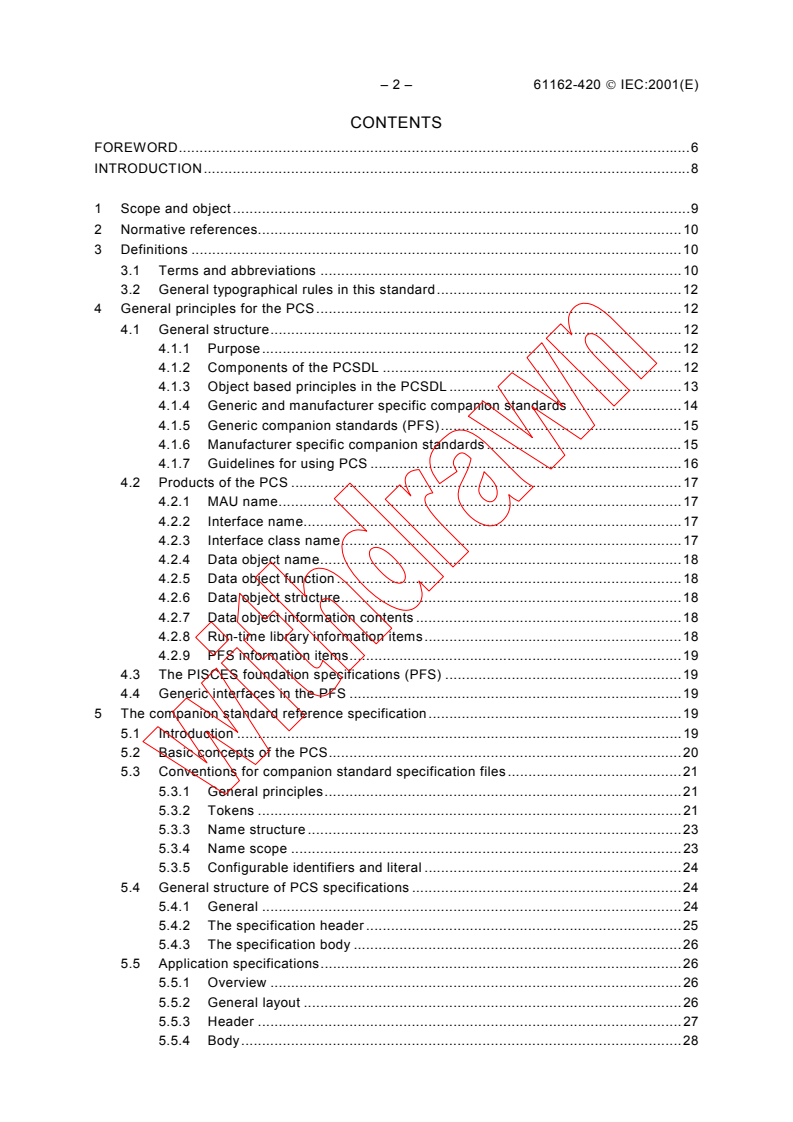
– 2 – 61162-420 IEC:2001(E)
CONTENTS
FOREWORD.6
INTRODUCTION.8
1 Scope and object .9
2 Normative references.10
3 Definitions .10
3.1 Terms and abbreviations .10
3.2 General typographical rules in this standard.12
4 General principles for the PCS.12
4.1 General structure.12
4.1.1 Purpose.12
4.1.2 Components of the PCSDL .12
4.1.3 Object based principles in the PCSDL .13
4.1.4 Generic and manufacturer specific companion standards .14
4.1.5 Generic companion standards (PFS).15
4.1.6 Manufacturer specific companion standards .15
4.1.7 Guidelines for using PCS .16
4.2 Products of the PCS .17
4.2.1 MAU name.17
4.2.2 Interface name.17
4.2.3 Interface class name.17
4.2.4 Data object name.18
4.2.5 Data object function .18
4.2.6 Data object structure.18
4.2.7 Data object information contents .18
4.2.8 Run-time library information items.18
4.2.9 PFS information items.19
4.3 The PISCES foundation specifications (PFS) .19
4.4 Generic interfaces in the PFS .19
5 The companion standard reference specification.19
5.1 Introduction .19
5.2 Basic concepts of the PCS.20
5.3 Conventions for companion standard specification files.21
5.3.1 General principles.21
5.3.2 Tokens .21
5.3.3 Name structure .23
5.3.4 Name scope .23
5.3.5 Configurable identifiers and literal .24
5.4 General structure of PCS specifications .24
5.4.1 General .24
5.4.2 The specification header .25
5.4.3 The specification body .26
5.5 Application specifications.26
5.5.1 Overview .26
5.5.2 General layout .26
5.5.3 Header .27
5.5.4 Body.28
61162-420 IEC:2001(E) – 3 –
5.6 Interface component specifications .30
5.6.1 Overview .30
5.6.2 General layout .31
5.6.3 Header specification .31
5.6.4 Body specification.32
5.7 Information specifications .33
5.7.1 Overview .33
5.7.2 General layout .33
5.7.3 Header .34
5.7.4 Body.34
5.8 Data types .35
5.8.1 Overview .35
5.8.2 General layout .35
5.8.3 Header .36
5.8.4 Body.36
6 PISCES foundation specification (PFS) .38
6.1 Introduction .38
6.2 Naming conventions .39
6.3 Application classes .39
6.3.1 Introduction .39
6.3.2 Application base class: PACApplication.40
6.3.3 LNA MAU application: PACLNA.40
6.3.4 Managed applications: PACFullApplication .40
6.3.5 IEC 61162-1 and IEC 61162-2 interface application: PACNMEARelay.40
6.3.6 Console application: PACConsole .40
6.3.7 General alarm and monitoring application: PACServerApp.40
7 Specification requirements for PCS compliant applications.41
7.1 Introduction and general documentation format.41
7.2 Function block .41
7.2.1 Function block graphical view.41
7.2.2 Physical effects.41
7.2.3 Input variables .41
7.2.4 Output variables .42
7.2.5 Events .42
7.2.6 Commands .42
7.2.7 Status.42
7.2.8 Parameters.42
7.2.9 Indication of accept or connect functionality .42
7.3 Functional description.42
7.4 Companion standard descriptions .43
– 4 – 61162-420 IEC:2001(E)
Annex A (normative) Defined keywords .44
Annex B (normative) Basic IEC 61162-4 data types .46
Annex C (normative) General application companion standards .47
C.1 Introduction and general principles.47
C.2 Functionality overview.47
C.2.1 General data definitions .47
C.2.2 Version codes.47
C.2.3 Manufacturer and model identification .47
C.2.4 Interface and MCP information.47
C.2.5 Authentication.47
C.2.6 File overview.48
C.2.7 Data types General .48
C.2.8 Application PACSimpleApplication.52
C.2.9 Application PACFullApplication .52
C.2.10 Interface PCCVersionCodes.53
C.2.11 Interface PCCApplicationInfo .54
C.2.12 Data types UserAuth .55
C.2.13 Interface PCCUserAuth.56
Annex D (normative) LNA-MAU companion standard .59
D.1 General principles.59
D.2 Companion standards.60
D.2.1 Data types LnaMau .60
D.2.2 Interface PCCLNAStats.62
Annex E (normative) General alarm and monitoring companion standards .64
E.1 Introduction and general principles.64
E.2 Alarm and monitoring system identifiers .64
E.3 Functionality overview.64
E.3.1 Companion standard for tag based monitoring and alarm system .64
E.3.2 Client-server architecture.65
E.3.3 Tag number .65
E.3.4 Tag sets .65
E.3.5 Tag information.65
E.3.6 Tag attributes .65
E.3.7 Tag data .65
E.3.8 Alarms.66
E.4 Application classes .66
E.5 Companion standard structure .67
E.6 File structure .67
E.7 Standard tag names .68
E.7.1 General .68
E.7.2 Structure of P tag name class .69
E.7.3 General structural rules.69
E.7.4 Main process codes .70
E.7.5 Process sub-codes .70
E.7.6 General sub-groups .70
61162-420 IEC:2001(E) – 5 –
E.7.7 Automation related sub-group .71
E.7.8 Navigation sub-groups .71
E.7.9 Data type indication group.71
E.7.10 Use of engineering units .72
E.7.11 Sequence number.72
E.8 Structure of standard tags (S class) .73
E.9 Structure of yard tags (Y class).73
E.10 Structure of internal tags (I class) .73
E.11 New tag name classes.73
E.12 General quality indicators .73
E.13 Certification .73
E.14 Time stamp .73
E.15 Validity flag.74
E.16 Authentication.74
E.17 Companion standard specifications.74
E.17.1 DATA TYPES TagData .74
E.17.2 Application PACReadableServer .80
E.17.3 Application PACWritableServer .80
E.17.4 Application PACAlarmSystem.81
E.17.5 Interface PCCTagDatabase .82
E.17.6 Interface PCCTagText .84
E.17.7 Interface PCCTagStream .85
E.17.8 Interface PCCTagNetsearch .86
E.17.9 Interface PCCTagAttributes .87
E.17.10 Interface PCCTagSubscribe.88
E.17.11 Interface PCCTagWrite.89
E.17.12 Interface PCCTagAlarm.90
E.17.13 Interface PCCTagSet.91
E.17.14 Interface PCCTagAttributeWrite.92
Annex F (normative) Navigational interfaces.94
F.1 IEC 61162-1 relay function.94
F.2 Interface PCCNMEAIn .94
F.2.1 READ NoOfPorts .94
F.2.2 FUNCTION GetPortDescription .94
F.2.3 FUNCTION NoOfSentences .94
F.2.4 FUNCTION GetListOfSentences .94
F.2.5 FUNCTION GetSentence .94
F.2.6 SUBSCRIBE Port_ .95
F.2.7 SUBSCRIBE Port__.95
F.3 Interface PCCNMEAOut.95
F.3.1 READ NoOfPorts .95
F.3.2 FUNCTION GetPortDescription .95
F.3.3 NONACKED-WRITE Port_ .95
F.4 The IEC 61162-1/2 related companion standard documents .96
F.4.1 The IEC 61162-1/2 data type description.96
F.4.2 Description of Interface PCCNMEAIn .97
F.4.3 Description of Interface PCCNMEAOut. 100
F.4.4 Application Description . 101
– 6 – 61162-420 IEC:2001(E)
INTERNATIONAL ELECTROTECHNICAL COMMISSION
____________
MARITIME NAVIGATION AND RADIOCOMMUNICATION
EQUIPMENT AND SYSTEMS –
DIGITAL INTERFACES –
Part 420: Multiple talkers and multiple listeners –
Ship systems interconnection – Companion standard requirements
and basic companion standards
FOREWORD
1) The IEC (International Electrotechnical Commission) is a worldwide organization for standardization comprising
all national electrotechnical committees (IEC National Committees). The object of the IEC is to promote
international co-operation on all questions concerning standardization in the electrical and electronic fields. To
this end and in addition to other activities, the IEC publishes International Standards. Their preparation is
entrusted to technical committees; any IEC National Committee interested in the subject dealt with may
participate in this preparatory work. International, governmental and non-governmental organizations liaising
with the IEC also participate in this preparation. The IEC collaborates closely with the International Organization
for Standardization (ISO) in accordance with conditions determined by agreement between the two
organizations.
2) The formal decisions or agreements of the IEC on technical matters express, as nearly as possible, an
international consensus of opinion on the relevant subjects since each technical committee has representation
from all interested National Committees.
3) The documents produced have the form of recommendations for international use and are published in the form
of standards, technical specifications, technical reports or guides and they are accepted by the National
Committees in that sense.
4) In order to promote international unification, IEC National Committees undertake to apply IEC International
Standards transparently to the maximum extent possible in their national and regional standards. Any
divergence between the IEC Standard and the corresponding national or regional standard shall be clearly
indicated in the latter.
5) The IEC provides no marking procedure to indicate its approval and cannot be rendered responsible for any
equipment declared to be in conformity with one of its standards.
6) Attention is drawn to the possibility that some of the elements of this International Standard may be the subject
of patent rights. The IEC shall not be held responsible for identifying any or all such patent rights.
International Standard IEC 61162-420 has been prepared by IEC technical committee 80:
Maritime navigation and radiocommunication equipment and systems.
The text of this standard is based on the following documents:
FDIS Report on voting
80/312/FDIS 80/327/RVD
Full information on the voting for the approval of this standard can be found in the report on
voting indicated in the above table.
This publication has been drafted in accordance with the ISO/IEC Directives, Part 3.
The special typographical conventions and nomenclature used in this standard are defined in
IEC 61162-400 annex A.
Annexes A, B, C, D, E and F form an integral part of this standard.
61162-420 IEC:2001(E) – 7 –
The committee has decided that the contents of this publication will remain unchanged until
June, 2005. At this date, the publication will be
• reconfirmed;
• withdrawn;
• replaced by a revised edition, or
• amended.
– 8 – 61162-420 IEC:2001(E)
INTRODUCTION
International Standard IEC 61162 is a four part standard which specifies four digital interfaces
for applications in marine navigation, radiocommunication and system integration.
The four parts are:
IEC 61162-1 Single talker and multiple listeners
IEC 61162-2 Single talker and multiple listeners, high speed transmission
IEC 61162-3 Multiple talkers and multiple listeners – Serial data instrument network
IEC 61162-4 Multiple talkers and multiple listeners – Ship systems interconnection. Part 4 of
this standard is sub-divided into a number of individual standards with part
numbers in the 400 series.
IEC 61162-420 contains the specification of a description language for IEC 61162-4 series
companion standards (user layer specifications), a framework for the organization of such
companion standard descriptions and also the descriptions of basic components that can be
used as a starting point to build IEC 61162-4 series components and networks.
Later standards in the companion standard series (IEC 61162-42x) are expected to address
more concrete interface requirements for specific navigational equipment.
Relationship with the other parts of the IEC 61162 series of standards is defined in annex B to
IEC 61162-400.
61162-420 IEC:2001(E) – 9 –
MARITIME NAVIGATION AND RADIOCOMMUNICATION
EQUIPMENT AND SYSTEMS –
DIGITAL INTERFACES –
Part 420: Multiple talkers and multiple listeners –
Ship systems interconnection – Companion standard requirements
and basic companion standards
1 Scope and object
International Standard IEC 61162-420 specifies the requirement for and basic components of
the IEC 61162-4 series companion standards. These components are referred to as follows:
a) PCS (PISCES companion standards) which contain the rules for creation of companion
standards. The general principles underlying the PCS are described in clause 4.
b) PCSDL (PCS description language). Part of the PCS is the definition of the syntax for the
various types of companion standard documents that make them readable by computer
tools. The PCSDL is described in clause 5.
c) function block description. The function block description is a high level and graphical
description of applications using the IEC 61162-4 series interface standard. The function
block syntax is specified in clause 7.
d) PFS (PISCES foundation specifications) which contain a framework for classification of
applications adhering to the IEC 61162-4 standard. The PFS will also provide a minimum
level of interoperability between different manufacturers’ applications using this framework.
The PFS is described in clause 6.
Clause 5 contains the complete reference to the PCS description language. Subclause 5.2
explains the basic concept of the PCS which is given by the distinction between four types of
specifications: applications, interfaces, information and data types. General conventions with
respect to the syntax of the PCS can be found in 5.3. All PCS documents are based on a
similar structure. This approach is intended to make it easier to become familiar with the
syntax and semantics of the PCS which is defined in 5.3.1. The four subclauses thereafter
explain in detail the syntax and semantics of the four different types of specifications generated
by the PCS.
Clause 6 describes the relationship between the different classes of IEC 61162-4 applications
and gives an overview of their functionality. The annexes contain the detailed PCS definitions
for the classes.
The objective of companion standards is to provide definitions of the information that is
transferred within an integrated ship control system and of how these information items can be
accessed or provided. Furthermore, the standard shall allow the definition of the actual network
interfaces which the applications use to connect to the system. The description format is
machine-readable, allowing an automatic compilation of the description into interface software.
A companion standard allows the reader to, at will, shift the focus between a technical
specification and a definition of interfaces and information items. The development team can
determine information attributes like unit, power, accuracy and the structure of the system
architecture and create a common interpretation basis for data before the system
implementation. The formalisms underlying the specification language will at the same time
provide an unambiguous and precise description of the equipment interfaces which allow the
use of computer tools to automatically generate interface program codes or to inspect and
manipulate interfaces on-line, for example for debugging and monitoring purposes.
– 10 – 61162-420 IEC:2001(E)
2 Normative references
The following normative documents contain provisions, which, through reference in this text,
constitute provisions of this part of IEC 61162. For dated references, subsequent amendments
to, or revisions of, any of these publications do not apply. However, parties to agreements
based on this part of IEC 61162 are encouraged to investigate the possibility of applying the
most recent editions of the normative documents indicated below. For undated references, the
latest edition of the normative document referred to applies. Members of IEC and ISO maintain
registers of currently valid International Standards.
IEC 61162-1:2000, Maritime navigation and radiocommunication equipment and systems –
Digital interfaces – Part 1: Single talker and multiple listeners
IEC 61162-2:1998, Maritime navigation and radiocommunication equipment and systems –
Digital interfaces – Part 2: Single talker and multiple listeners, high speed transmissiion
IEC 61162-3, Maritime navigation and radiocommunication equipment and systems – Digital
interfaces – Part 3: Multiple talkers and multiple listeners – Serial data instrument network
IEC 61162-400, Maritime navigation and radiocommunication equipment and systems – Digital
interfaces – Part 400: Multiple talkers and multiple listeners – Ship systems interconnection –
Introduction and general principles
IEC 61162-401, Maritime navigation and radiocommunication equipment and systems – Digital
interfaces – Part 401: Multiple talkers and multiple listeners – Ship systems interconnection –
Application profile
ISO/IEC 8859-1:1998, Information technology – 8-bit single-byte coded graphic character sets
– Part 1: Latin alphabet No. 1
3 Definitions
For the purpose of this part of IEC 61162, the following definitions apply.
3.1 Terms and abbreviations
3.1.1
abstract specification
PCS specifications that are part of the PFS (defined in this standard) are not intended for direct
implementation and are termed “abstract”
3.1.2
application interface
a collection of interface components instantiated in an application definition document as one
protocol level interface
___________
To be published.
61162-420 IEC:2001(E) – 11 –
3.1.3
CP – connection point
an application interface consists of a number of individual “functions” that can be called into or
out from
3.1.4
CS – companion standard
a protocol layer on top of the normal OSI application level (see definition of companion
standard in IEC 61162-400), representing the definition of how the application layer
functionality is used to implement a certain application’s interface functionality. Also called user
layer
3.1.5
function block
a high level, partly graphical representation of an application’s place in an integrated system
which presents all interfaces and relationships between these on an overview level
3.1.6
interface (component)
a collection of connection points (CP) in one INTERFACE definition document. It can be
aggregated with others into an actual interface as defined in the A-profile. The actual interface
(A-profile sense) is defined as the application interface in the APPLICATION document
3.1.7
NMEA
the National Marine Electronics Association (NMEA) maintains a protocol standard called
NMEA 0183 that is almost identical to IEC 61162-1 and IEC 61162-2. For historical reasons,
symbolic names in some of the PCS documents in this standard refers to NMEA instead of to
IEC 61162-1 (annex F). Although references to NMEA are made, the PCS documents define an
application that is intended for use together with the IEC 61162-1 and IEC 61162-2 standards.
It can also be useful for transmittal of NMEA 0183 messages, but this is outside the scope of
this standard.
3.1.8
PCS – PISCES companion standard
the complete concept, including description language (PCSDL), function blocks and the
foundation classes (PFS)
3.1.9
PCSDL – PISCES companion standard description language
the formal interface description language for PCS
3.1.10
PFS – PISCES foundation specifications
the interface base classes for all applications created in the framework of the PCS
3.1.11
tangible
a specification of an entity that shall be implemented (instantiated) at some time
– 12 – 61162-420 IEC:2001(E)
3.2 General typographical rules in this standard
The following typographical rules apply throughout this standard:
a) fragments and complete pieces of PCSDL source code is written in Courier;
b) tokens written in capitals, typeset in COURIER are reserved PCSDL keywords;
c) words in angle brackets (elbows), '<' and '>', define place-holders that have to be filled
with the appropriate token as described in the text;
d) tokens in square brackets, '[' and ']', define tokens that are optional, for example parts
of a statement that are only required under special circumstances;
e) ellipses, ., show that the preceding item can be repeated.
Subclause 5.3 defines other typographical and lexical conventions that apply to PCSDL
documents.
4 General principles for the PCS
4.1 General structure
4.1.1 Purpose
The main purpose of the PCS is to give an unambiguous way to interpret data transmitted via
the IEC 61162-401 A-profile protocol. In this sense, the companion standard adds meaning to
the data transmitted via the protocol, converts it to information and makes it usable for
application modules connected to the network. To serve this purpose, the PCS shall provide
the following:
a) establish a language to define information types, application interfaces and applications.
This language has to be human readable as well as interpretable by a computer. this
language is the PCSDL;
b) provide a standardized set of information types and interfaces which can be used as a
basis to create customized (i.e. vendor specific) application and interface descriptions. This
set of specifications is the PFS, see 4.4;
c) provide a general framework for a high level description of applications that use the
IEC 61162-4 standard for communication. This is the function block specification format.
4.1.2 Components of the PCSDL
The PCSDL supports the generation of four different types of specifications as outlined in the
following subclauses.
The three first document types can be used to generate protocol (A-profile) related entities, for
example data object names, MAU names and format strings. The information specification can
be used to add more application related meaning to the information entities. The information
specifications can also use an extended format string syntax to implement higher level
functionality based on the A-profile specification.
4.1.2.1 Application
Representation of application units within the PCS. An application is defined by application
interfaces specifying the respective inputs and/or outputs. The application specification can be
looked at as the specification of how one particular piece of equipment is connected to the
system. Applications will normally consist of a number of interfaces configured as either
providing data to or using data from the system.
61162-420 IEC:2001(E) – 13 –
4.1.2.2 Interface (component)
Specification of connection mechanisms used between applications. Each interface has one or
more connection points (CP). Each connection point specifies one or more information type
received or provided by the respective interface. The connection point specification consists of
the data structures transferred, the information the data structures carry and how the
information can be accessed (read, write, etc.).
4.1.2.3 Data type
Data type definition specifies the structure and to some degree the content of data transmitted
via the IEC 61162-4 network. This document can be optionally exchanged or complemented
with information specifications.
4.1.2.4 Information
An information specification represents and defines the content and interpretation of data
transmitted via the IEC 61162-4 network. The purpose of these specifications is to define the
format of exchanged data and specify the usage of the respective information. This type of
document extends and replaces the function of the data type definition by making it possible to
give more meaning to the data structures. Any information specification can be converted to a
data type definition, but at a loss of information meaning.
NOTE The information type specification is not currently used in the PFS. At this time, only the data type
specification is used to define structure and contents of transmitted data blocks. However, it is recommended that
the information type is considered for new specifications.
4.1.3 Object based principles in the PCSDL
4.1.3.1 General
The PCSDL supports a simplified object based view on companion standard specifications. To
create companion standards, the following object-based principles can be applied.
All specifications used within PCS are seen as encapsulated structures defining their own
scope and domain. Each specification can be used as a “building block” to create new
specifications following the rules given in clause 5. Two different mechanisms are available to
compose new specifications from existing ones: specialization and aggregation.
4.1.3.2 Specialization
The PCSDL gives the opportunity to derive new specifications from existing ones. The new
specification (i.e. application, interface or information) inherits all properties from the old
specification called the base specification). This mechanism forms a generalized-specialization
relation between these two specifications.
4.1.3.3 Aggregation
It is possible to compose new specifications by aggregating two or more existing specifications.
A complex information type can, for example be formed by including several information
specifications into a new specification. The same applies for composing complex application
interfaces from one or more interfaces (see 5.6).
Specifications for applications, interfaces and information are included in three separate
hierarchies, see figure 1. Each hierarchy stems from a base specification covering properties
common to each specification of the respective type (i.e. information, application or interface).
An overview of the PFS hierarchy for applications is given in annex E.
– 14 – 61162-420 IEC:2001(E)
4.1.3.4 Data types versus information
The current version of the PFS does not make use of interface specifications and neither the
object-oriented principles inherent in that. Instead, the less advanced data type definitions are
used. This is due to legacy companion standards from previous versions of this document (see
MiTS in part 400).
NOTE This part of the standard emphasizes the information type documents as it is believed that this will be the
description method of choice in the future. However, the reader may want to concentrate on data type documents
which are the most commonly used.
4.1.4 Generic and manufacturer specific companion standards
The general approach recommended by PCS is to divide the set of companion standards into
two different parts (figure 1): Generic CS and manufacturer specific CS. Generic CS will be
defined by the PFS. The PFS contains generic specifications for data types, information,
interfaces and applications. These specifications can be used by manufacturers as a starting
point to define own specifications to describe their respective equipment. This means that PFS
specifications can be used as templates to create equipment specific specifications. This
mechanism forms a generalized-specialization relation between the newly created specification
and the respective specification of the PFS. It has to be noted that specifications which are part
of the PFS are abstract in the sense that they cannot be used directly to specify equipment. A
tangible PCS specification of a component has always to be derived from a PFS specification.
Information Interface Application
PICInformation PCCInterface PACApplication
Generic CS
PICInfo1 PICInfo2 PCCInt1 PCCInt2 PACApp1 PACApp2
(PFS)
Manufacturer
specific CS
CInfo3 CInfo4 CInt3 CInt4 CApp3 CApp4
IEC 2408/01
Figure 1 – General structure of PCS hierarchy of specifications
To form specifications of information, interfaces or applications, direct inheritance mechanisms
can be used. The new specification inherits all properties from the specification from which it is
derived (the base specification). When deriving new specifications from existing ones,
attributes only may be added (see also 4.2.5). Thus, the following mechanisms are the only
ones permitted by the PCS description language:
a) generation of a new application specification: derivation of the new specification from an
existing one (abstract or tangible specification) and addition of new application interfaces
(see 5.5);
b) generation of a new interface specification: d
...