

IEC 62769-1:2021
(Main)Field Device Integration (FDI) - Part 1: Overview
General Information
- Abstract
IEC 62769-1:2021 describes the concepts and overview of the Field Device Integration (FDI) specifications. The detailed motivation for the creation of this technology is also described (see 4.1). Reading this document is helpful to understand the other parts of this multi-part standard.
- Status
- Published
- Publication Date
- 04-Feb-2021
- Technical Committee
- SC 65E - Devices and integration in enterprise systems
- Drafting Committee
- WG 7 - TC 65/SC 65E/WG 7
- Current Stage
- DELPUB - Deleted Publication
- Start Date
- 04-Apr-2023
- Completion Date
- 28-Jan-2022
Buy Documents
IEC 62769-1:2021 RLV - Field Device Integration (FDI) - Part 1: Overview Released:2/5/2021
IEC 62769-1:2021 - Field Device Integration (FDI) - Part 1: Overview Released:2/5/2021
Overview
IEC 62769-1:2021 is the Part 1 overview of the Field Device Integration (FDI) international standard. It describes the concepts, motivation and high-level architecture of the FDI specifications and explains the intent and structure of the multi-part IEC 62769 series. Reading this document helps stakeholders understand how FDI enables consistent field device integration, lifecycle management and interoperability across multiple device protocols and vendor tools.
Key topics
- FDI architecture and components: conceptual roles such as FDI Client, FDI Server, FDI Communication Server, and FDI Packages.
- FDI Packages: distribution mechanism for device-specific resources and tools.
- Information and technology mapping: references to the FDI Information Model and Technology Mapping parts that define how device data is modeled and exposed.
- Protocol extensibility: support for a generic protocol extension to accelerate adoption of new or different communication technologies.
- Security and integrity: digital signatures for FDI Packages and trusted timestamping to support long-term validation.
- Deployment and lifecycle: guidelines for deployment (engineering, operator and maintenance stations, handhelds), versioning, identification mechanisms, forward compatibility and lifecycle management.
- Terminology and references: alignment with OPC UA (IEC 62541 series), EDDL and FDT concepts and common definitions.
- Redundancy and security considerations for resilient and secure operation.
(These topics are described at a conceptual level in Part 1; technical details are in subsequent parts of IEC 62769.)
Applications and users
IEC 62769-1 is intended for professionals involved in industrial automation and device integration, including:
- Control system architects and system integrators planning device interoperability strategies.
- Device vendors packaging device integration assets (device packages, digital signatures).
- Automation software developers building FDI Clients, Servers or Communication Servers or integrating OPC UA clients.
- Maintenance and asset engineers implementing lifecycle and versioning strategies for field instrumentation.
- Certification bodies and IT/security teams assessing package integrity and trusted timestamping.
Practical use cases include multi-vendor device integration, centralized device management, secure deployment of device tools, and enabling protocol-agnostic device access.
Related standards
- IEC 62769 series (Parts 2–7, 100, 101–115, 150): Client, Server, Packages, Information Model, Technology Mapping, and protocol profiles (HART, PROFIBUS, PROFINET, Modbus, etc.).
- OPC Unified Architecture (IEC 62541 series) - used for information modeling and communication.
- EDDL and FDT technologies - historical device description approaches referenced for background and migration.
Keywords: IEC 62769-1, Field Device Integration, FDI, FDI Packages, OPC UA, device integration, digital signature, trusted timestamping, protocol extension, device lifecycle.
Relations
- Effective Date
- 05-Sep-2023
- Effective Date
- 05-Sep-2023
Buy Documents
IEC 62769-1:2021 RLV - Field Device Integration (FDI) - Part 1: Overview Released:2/5/2021
IEC 62769-1:2021 - Field Device Integration (FDI) - Part 1: Overview Released:2/5/2021
Get Certified
Connect with accredited certification bodies for this standard

BSI Group
BSI (British Standards Institution) is the business standards company that helps organizations make excellence a habit.

DVS-ZERT GmbH
German welding certification society.
CARES (UK Certification Authority for Reinforcing Steels)
UK certification for reinforcing steels and construction.
Sponsored listings
Frequently Asked Questions
IEC 62769-1:2021 is a standard published by the International Electrotechnical Commission (IEC). Its full title is "Field Device Integration (FDI) - Part 1: Overview". This standard covers: IEC 62769-1:2021 describes the concepts and overview of the Field Device Integration (FDI) specifications. The detailed motivation for the creation of this technology is also described (see 4.1). Reading this document is helpful to understand the other parts of this multi-part standard.
IEC 62769-1:2021 describes the concepts and overview of the Field Device Integration (FDI) specifications. The detailed motivation for the creation of this technology is also described (see 4.1). Reading this document is helpful to understand the other parts of this multi-part standard.
IEC 62769-1:2021 is classified under the following ICS (International Classification for Standards) categories: 25.040.40 - Industrial process measurement and control; 35.100.05 - Multilayer applications. The ICS classification helps identify the subject area and facilitates finding related standards.
IEC 62769-1:2021 has the following relationships with other standards: It is inter standard links to IEC 62769-1:2023, IEC 62769-1:2015. Understanding these relationships helps ensure you are using the most current and applicable version of the standard.
IEC 62769-1:2021 is available in PDF format for immediate download after purchase. The document can be added to your cart and obtained through the secure checkout process. Digital delivery ensures instant access to the complete standard document.
Standards Content (Sample)
IEC 62769-1 ®
Edition 2.0 2021-02
REDLINE VERSION
INTERNATIONAL
STANDARD
colour
inside
Field device integration (FDI) –
Part 1: Overview
All rights reserved. Unless otherwise specified, no part of this publication may be reproduced or utilized in any form
or by any means, electronic or mechanical, including photocopying and microfilm, without permission in writing from
either IEC or IEC's member National Committee in the country of the requester. If you have any questions about IEC
copyright or have an enquiry about obtaining additional rights to this publication, please contact the address below or
your local IEC member National Committee for further information.
IEC Central Office Tel.: +41 22 919 02 11
3, rue de Varembé info@iec.ch
CH-1211 Geneva 20 www.iec.ch
Switzerland
About the IEC
The International Electrotechnical Commission (IEC) is the leading global organization that prepares and publishes
International Standards for all electrical, electronic and related technologies.
About IEC publications
The technical content of IEC publications is kept under constant review by the IEC. Please make sure that you have the
latest edition, a corrigendum or an amendment might have been published.
IEC publications search - webstore.iec.ch/advsearchform IEC online collection - oc.iec.ch
The advanced search enables to find IEC publications by a Discover our powerful search engine and read freely all the
variety of criteria (reference number, text, technical publications previews. With a subscription you will always
committee, …). It also gives information on projects, replaced have access to up to date content tailored to your needs.
and withdrawn publications.
Electropedia - www.electropedia.org
IEC Just Published - webstore.iec.ch/justpublished
The world's leading online dictionary on electrotechnology,
Stay up to date on all new IEC publications. Just Published
containing more than 22 000 terminological entries in English
details all new publications released. Available online and
and French, with equivalent terms in 18 additional languages.
once a month by email.
Also known as the International Electrotechnical Vocabulary
(IEV) online.
IEC Customer Service Centre - webstore.iec.ch/csc
If you wish to give us your feedback on this publication or
need further assistance, please contact the Customer Service
Centre: sales@iec.ch.
IEC 62769-1 ®
Edition 2.0 2021-02
REDLINE VERSION
INTERNATIONAL
STANDARD
colour
inside
Field device integration (FDI) –
Part 1: Overview
INTERNATIONAL
ELECTROTECHNICAL
COMMISSION
ICS 25.040.40; 35.100.05 ISBN 978-2-8322-9385-0
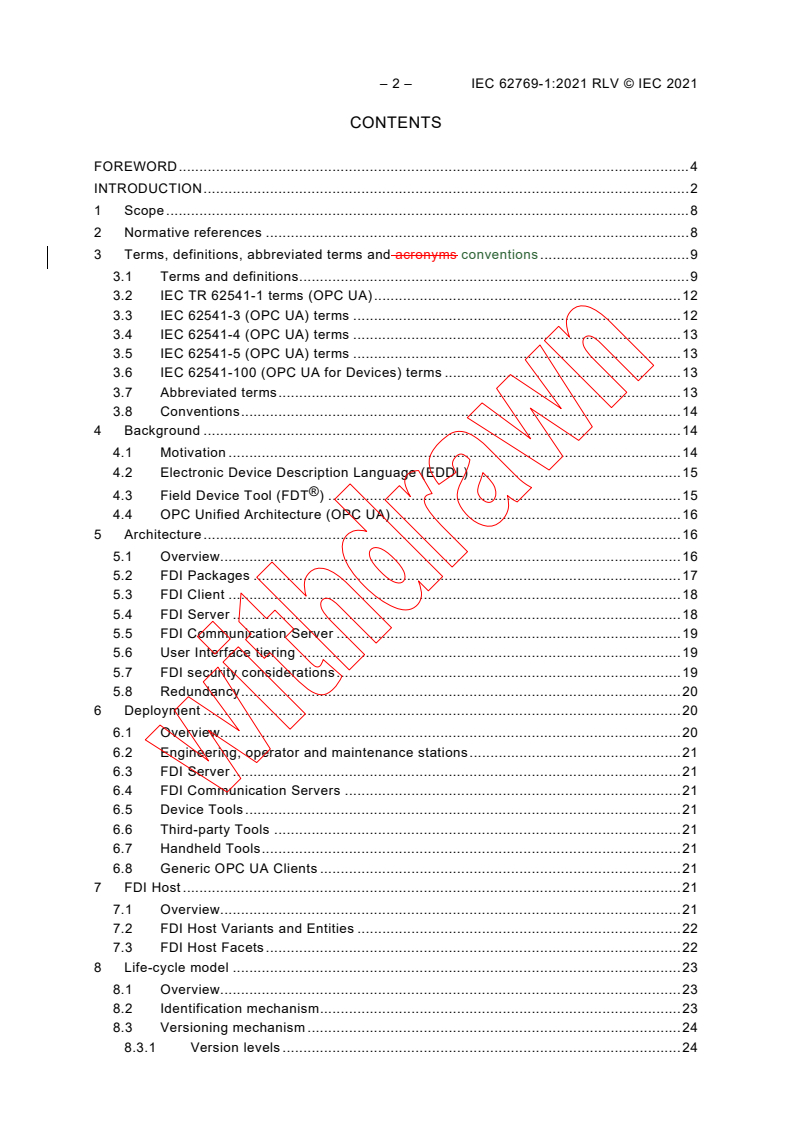
– 2 – IEC 62769-1:2021 RLV © IEC 2021
CONTENTS
FOREWORD . 4
INTRODUCTION . 2
1 Scope . 8
2 Normative references . 8
3 Terms, definitions, abbreviated terms and acronyms conventions . 9
3.1 Terms and definitions . 9
3.2 IEC TR 62541-1 terms (OPC UA) . 12
3.3 IEC 62541-3 (OPC UA) terms . 12
3.4 IEC 62541-4 (OPC UA) terms . 13
3.5 IEC 62541-5 (OPC UA) terms . 13
3.6 IEC 62541-100 (OPC UA for Devices) terms . 13
3.7 Abbreviated terms . 13
3.8 Conventions . 14
4 Background . 14
4.1 Motivation . 14
4.2 Electronic Device Description Language (EDDL) . 15 ®
4.3 Field Device Tool (FDT ) . 15
4.4 OPC Unified Architecture (OPC UA) . 16
5 Architecture . 16
5.1 Overview. 16
5.2 FDI Packages . 17
5.3 FDI Client . 18
5.4 FDI Server . 18
5.5 FDI Communication Server . 19
5.6 User Interface tiering . 19
5.7 FDI security considerations . 19
5.8 Redundancy . 20
6 Deployment . 20
6.1 Overview. 20
6.2 Engineering, operator and maintenance stations . 21
6.3 FDI Server . 21
6.4 FDI Communication Servers . 21
6.5 Device Tools . 21
6.6 Third-party Tools . 21
6.7 Handheld Tools . 21
6.8 Generic OPC UA Clients . 21
7 FDI Host . 21
7.1 Overview. 21
7.2 FDI Host Variants and Entities . 22
7.3 FDI Host Facets . 22
8 Life-cycle model . 23
8.1 Overview. 23
8.2 Identification mechanism . 23
8.3 Versioning mechanism . 24
8.3.1 Version levels . 24
8.3.2 FDI Technology Version . 24
8.3.3 Forward compatibility . 27
Annex A (informative) FDI life-cycle concept summary . 29
A.1 General . 29
A.2 Life-cycle relevant topics (references) . 29
Annex B (informative) Issue reporting . 30
Bibliography . 31
Figure 1 – FDI architecture diagram . 17
Figure 2 – Typical deployment scenario . 20
Figure 3 – FDI Technology Version dependencies . 25
Table 1 – FDI Host Variants and possible Facets . 22
Table 2 – FDI Host Facets and related FDI Entities . 23
Table 3 – Summary of influences on the FDI Technology Version . 27
Table 4 – Combinations of Minor Versions that require special handling . 27
Table A.1 – Life-cycle aspects as part of the FDI technology . 29
Table A.2 – Life-cycle aspects as part of products and services provided with the FDI
technology . 29
– 4 – IEC 62769-1:2021 RLV © IEC 2021
INTERNATIONAL ELECTROTECHNICAL COMMISSION
____________
FIELD DEVICE INTEGRATION (FDI) –
Part 1: Overview
FOREWORD
1) The International Electrotechnical Commission (IEC) is a worldwide organization for standardization comprising
all national electrotechnical committees (IEC National Committees). The object of IEC is to promote international
co-operation on all questions concerning standardization in the electrical and electronic fields. To this end and
in addition to other activities, IEC publishes International Standards, Technical Specifications, Technical Reports,
Publicly Available Specifications (PAS) and Guides (hereafter referred to as "IEC Publication(s)"). Their
preparation is entrusted to technical committees; any IEC National Committee interested in the subject dealt with
may participate in this preparatory work. International, governmental and non-governmental organizations liaising
with the IEC also participate in this preparation. IEC collaborates closely with the International Organization for
Standardization (ISO) in accordance with conditions determined by agreement between the two organizations.
2) The formal decisions or agreements of IEC on technical matters express, as nearly as possible, an international
consensus of opinion on the relevant subjects since each technical committee has representation from all
interested IEC National Committees.
3) IEC Publications have the form of recommendations for international use and are accepted by IEC National
Committees in that sense. While all reasonable efforts are made to ensure that the technical content of IEC
Publications is accurate, IEC cannot be held responsible for the way in which they are used or for any
misinterpretation by any end user.
4) In order to promote international uniformity, IEC National Committees undertake to apply IEC Publications
transparently to the maximum extent possible in their national and regional publications. Any divergence between
any IEC Publication and the corresponding national or regional publication shall be clearly indicated in the latter.
5) IEC itself does not provide any attestation of conformity. Independent certification bodies provide conformity
assessment services and, in some areas, access to IEC marks of conformity. IEC is not responsible for any
services carried out by independent certification bodies.
6) All users should ensure that they have the latest edition of this publication.
7) No liability shall attach to IEC or its directors, employees, servants or agents including individual experts and
members of its technical committees and IEC National Committees for any personal injury, property damage or
other damage of any nature whatsoever, whether direct or indirect, or for costs (including legal fees) and
expenses arising out of the publication, use of, or reliance upon, this IEC Publication or any other IEC
Publications.
8) Attention is drawn to the Normative references cited in this publication. Use of the referenced publications is
indispensable for the correct application of this publication.
9) Attention is drawn to the possibility that some of the elements of this IEC Publication may be the subject of patent
rights. IEC shall not be held responsible for identifying any or all such patent rights.
This redline version of the official IEC Standard allows the user to identify the changes
made to the previous edition IEC 62769-1:2015. A vertical bar appears in the margin
wherever a change has been made. Additions are in green text, deletions are in
strikethrough red text.
International Standard IEC 62769-1 has been prepared by subcommittee 65E: Devices and
integration in enterprise systems, of IEC technical committee 65: Industrial-process
measurement, control and automation.
This second edition cancels and replaces the first edition published in 2015. This edition
constitutes a technical revision.
This edition includes the following significant technical changes with respect to the previous
edition:
a) support for generic protocol extension for faster adoption of other technologies;
b) digital signature now include trusted timestamping for long term validation of FDI Package;
c) support of new protocols.
The text of this International Standard is based on the following documents:
FDIS Report on voting
65E/758/FDIS 65E/768/RVD
Full information on the voting for the approval of this International Standard can be found in the
report on voting indicated in the above table.
This document has been drafted in accordance with the ISO/IEC Directives, Part 2.
A list of all parts in the IEC 62769 series, published under the general title Field Device
Integration (FDI), can be found on the IEC website.
The committee has decided that the contents of this document will remain unchanged until the
stability date indicated on the IEC website under "http://webstore.iec.ch" in the data related to
the specific document. At this date, the document will be
• reconfirmed,
• withdrawn,
• replaced by a revised edition, or
• amended.
IMPORTANT – The 'colour inside' logo on the cover page of this publication indicates
that it contains colours which are considered to be useful for the correct understanding
of its contents. Users should therefore print this document using a colour printer.
– 6 – IEC 62769-1:2021 RLV © IEC 2021
INTRODUCTION
The IEC 62657 62769 series has the general title Field Device Integration (FDI) and the
following parts:
– Part 1: Overview
– Part 2: FDI Client
– Part 3: FDI Server
– Part 4: FDI Packages
– Part 5: FDI Information Model
– Part 6: FDI Technology Mapping
– Part 7: FDI Communication Devices
– Part 100: Profiles – Generic Protocol Extensions
– Part 101-1: Profiles – Foundation Fieldbus H1
– Part 101-2: Profiles – Foundation Fieldbus HSE
– Part 103-1: Profiles – PROFIBUS
– Part 103-4: Profiles – PROFINET
– Part 109-1: Profiles – HART and WirelessHART
– Part 115-2: Profiles – Protocol-specific Definitions for Modbus RTU
– Part 150-1: Profiles – ISA 100.11a
The International Electrotechnical Commission (IEC) draws attention to the fact that it is claimed
that compliance with this document may involve the use of patents concerning
a) method for the supplying and installation of device-specific functionalities, see Patent
Family DE10357276;
b) method and device for accessing a functional module of automation system, see Patent
Family EP2182418;
c) methods and apparatus to reduce memory requirements for process control system software
applications, see Patent Family US2013232186;
d) extensible device object model, see Patent Family US12/893,680.
IEC takes no position concerning the evidence, validity and scope of this patent right.
The holders of these patent rights have assured the IEC that he/she is willing to negotiate
licences either free of charge or under reasonable and non-discriminatory terms and conditions
with applicants throughout the world. In this respect, the statement of the holder of this patent
right is registered with IEC. Information may be obtained from:
a) ABB Research Ltd
Claes Rytoft
Affolterstrasse 4
Zurich, 8050
Switzerland
b) Phoenix Contact GmbH & Co KG
Intellectual Property, Licenses & Standards
Flachsmarktstrasse 8, 32825 Blomberg
Germany
c) Fisher Controls International LLC
John Dilger, Emerson Process Management LLLP
st
301 S. 1 Avenue, Marshaltown, Iowa 50158
USA
d) Rockwell Automation Technologies, Inc.
1 Allen-Bradley Drive
Mayfield Heights, Ohio 44124
USA
Attention is drawn to the possibility that some of the elements of this document may be the
subject of patent rights other than those identified above. IEC shall not be held responsible for
identifying any or all such patent rights.
ISO (www.iso.org/patents) and IEC (http://patents.iec.ch) maintain on-line data bases of
patents relevant to their standards. Users are encouraged to consult the data bases for the
most up to date information concerning patents.
– 8 – IEC 62769-1:2021 RLV © IEC 2021
FIELD DEVICE INTEGRATION (FDI) –
Part 1: Overview
1 Scope
This part of IEC 62769 describes the concepts and overview of the Field Device Integration
(FDI) specifications. The detailed motivation for the creation of this technology is also described
(see 4.1). Reading this document is helpful to understand the other parts of this multi-part
standard.
2 Normative references
The following documents are referred to in the text in such a way that some or all of their content
constitutes requirements of this document. For dated references, only the edition cited applies.
For undated references, the latest edition of the referenced document (including any
amendments) applies.
IEC 61804 (all parts), Function blocks (FB) for process control and Electronic Device
Description Language (EDDL) ®
IEC 62453 (all parts), Field device tool (FDT ) interface specification
IEC 62541 (all parts), OPC Unified Architecture
IEC TR 62541-1, OPC Unified Architecture – Part 1: Overview and concepts
IEC 62541-3, OPC Unified Architecture – Part 3: Address Space Model
IEC 62541-4, OPC Unified Architecture – Part 4: Services
IEC 62541-5, OPC Unified Architecture – Part 5: Information Model
IEC 62541-100, OPC Unified Architecture – Part 100: Device Interface
IEC 62769-2, Field Device Integration (FDI) – Part 2: FDI Client
NOTE IEC 62769-2 is technically identical to FDI-2022[4]
IEC 62769-3, Field Device Integration (FDI) – Part 3: FDI Server
NOTE IEC 62769-3 is technically identical to FDI-2023. [5]
IEC 62769-4:2015, Field Device Integration (FDI) – Part 4: FDI Packages
NOTE IEC 62769-4 is technically identical to FDI-2024. [6]
IEC 62769-5:2015, Field Device Integration (FDI) – Part 5: FDI Information Model
NOTE IEC 62769-5 is technically identical to FDI-2025. [7]
___________
Numbers in square brackets refer to the Bibliography.
IEC 62769-6:2015, Field Device Integration (FDI) – Part 6: FDI Technology Mapping
NOTE IEC 62769-6 is technically identical to FDI-2026. [8]
IEC 62769-7, Field Device Integration (FDI) – Part 7: FDI Communication Devices
NOTE IEC 62769-7 is technically identical to FDI-2027. [9]
ISO/IEC 11578, Information technology – Open Systems Interconnection – Remote Procedure
Call (RPC)
3 Terms, definitions, abbreviated terms and acronyms conventions
3.1 Terms and definitions
For the purposes of this document, the following terms and definitions given in IEC TR 62541-1,
IEC 62541-3, IEC 62541-4, IEC 62541-5, IEC 62541-100, as well as the following apply.
ISO and IEC maintain terminological databases for use in standardization at the following
addresses:
• IEC Electropedia: available at http://www.electropedia.org/
• ISO Online browsing platform: available at http://www.iso.org/obp
3.1.1
Field Device Integration
FDI
device integration and device management technology, combining base concepts and
technology aspects of the Electronic Device Description Language (EDDL) according to ®
IEC 61804 and Field Device Tool (FDT ) according to IEC 62453, as well as in IEC 62541-1
(OPC UA)
Note 1 to entry: The combination of those different proven technologies ensures a secure life cycle and the ability
to address all challenges of Device Integration and Device Management in a scalable manner.
Note 2 to entry: This note applies to the French language only.
Note 3 to entry: This note applies to the French language only.
Note 4 to entry: This note applies to the French language only.
3.1.2
Action
procedure that requires collaboration between an FDI Client and an FDI Server
3.1.3
Business Logic
descriptive element of an FDI Package that specifies the device-specific behavior and/or
mapping logic for a Nested Communication
3.1.4
Business Logic Interface
interface through which Business Logic is integrated with the Information Model
3.1.5
Communication Device
physical device that provides access to networks and devices
Note 1 to entry: Gateways and routers are examples of communication devices.
– 10 – IEC 62769-1:2021 RLV © IEC 2021
3.1.6
Connection Point
logical representation of a connection of a communication end point to a communication
network
3.1.7
Device Access Services
set of services through which a User Interface Plug-in accesses the Information Model of an
FDI Server
3.1.8
Device Definition
required element of an FDI Package that provides the core definition of a device
3.1.9
Device Instance
representation of a specific device in the Information Model of an FDI Server
3.1.10
Device Tool
standalone application that contains both an FDI Client and an FDI Server
3.1.11
Device Topology
arrangement of communication networks and devices that forms a network
3.1.12
Device Type
representation of a type of device in the Information Model of an FDI Server
3.1.13
FDI Client
software component that uses the Information Model, interprets user interface descriptions, and
hosts user interface plug-ins
3.1.14
FDI Communication Server
OPC UA server that is used by an FDI Server to access non-native networks
3.1.15
FDI Package
collection of components that provide all the information necessary to integrate a type of device
into a system
3.1.16
FDI Server
software component that implements the Information Model, executes Business Logic, and
communicates with device via Native Communication and/or Nested Communication
3.1.17
FDI Technology Version
version number that identifies to a specific revision of the overall FDI technology
3.1.18
Hosting Services
set of services through which a User Interface Plug-in interacts with an FDI Client
3.1.19
Information Model
set of objects, variables, and methods exposed by an FDI Server
3.1.20
Modular Device
device that is composed of one or more subdevices
3.1.21
Native Communication
communication with devices that are an integral part of the system
3.1.22
Nested Communication
communication with devices through a series of communication devices
3.1.23
Offline Data
device information maintained by an FDI Server that is stored in an FDI Server-specific
database
3.1.24
Online Data
device information maintained by an FDI Server that is retrieved from a physical device
3.1.25
User Interface Services
UI Services
set of services through which a User Interface Plug-in accesses the operating system
3.1.26
Platform User Interface Services
platform UI services
user interface services provided natively by the operating system
3.1.27
User Interface Description
UID
descriptive element of an FDI package that is used by an FDI Client to render user interface
3.1.28
User Interface Description Interpreter
UID interpreter
software component in an FDI Client that renders user interface descriptions and invokes
actions
3.1.29
User Interface Plug-In
UIP
executable element of an FDI package that is executed by an FDI Client
3.1.30
User Interface Plug-In UIP Services
UIP services
set of services through which an FDI Client interacts with a user interface plug-in
– 12 – IEC 62769-1:2021 RLV © IEC 2021
3.2 IEC TR 62541-1 terms (OPC UA)
For the purposes of this document, the following terms and definitions given in IEC TR 62541-1
apply.
AddressSpace
Attribute
Client
Method
Node
NodeClass
Notification
Object
ObjectType
Reference
ReferenceType
Server
Service Set
Session
Subscription
Variable
3.3 IEC 62541-3 (OPC UA) terms
For the purposes of this document, the following terms and definitions given in IEC 62541-3
(OPC UA) and the following apply.
Aggregates
ArrayDimensions
AuditEvent
AuditUpdateMethodEvent
BrowseName
ByteString
DataType
DataVariable
Folder
HasComponent
HasProperty
HasSubType
HasTypeDefinition
ModellingRule
NodeId
Property
UserAccessLevel
UserExecutable
Value
ValueRank
3.4 IEC 62541-4 (OPC UA) terms
For the purposes of this document, the following terms and definitions given in IEC 62541-4
(OPC UA) apply.
AddReferences
Browse
BrowseNext
Call
CreateSession
NodeManagement
Read
Request Header
Response Header
StatusCode
TranslateBrowsePathsToNodeIds
UserIdentityToken
Write
3.5 IEC 62541-5 (OPC UA) terms
For the purposes of this document, the following terms and definitions given in IEC 62541-5
apply.
BaseObjectType
PropertyType
3.6 IEC 62541-100 (OPC UA for Devices) terms
For the purposes of this document, the following terms and definitions given in IEC 62541-100
apply.
Block
Device
DeviceType
Parameter
3.7 Abbreviated terms and acronyms
DTM Device Type Manager
EDD Electronic Device Description
EDDL Electronic Device Description Language
FB Function blocks
FDI Field Device Integration ®
Field Device Tool (see IEC 62453)
FDT
GUI Graphical User Interface
n/a Not applicable
___________
FDT logo is a trade name of the non-profit organization FDT Group AISBL. This information is given for the
convenience of users of this part of IEC 62769 and does not constitute an endorsement by IEC of the trade names
holder or any of its products. Compliance does not require use of the registered trade name. Use of the trade
names requires permission of the trade name holder.
– 14 – IEC 62769-1:2021 RLV © IEC 2021
OPC Open packaging conventions
OPC UA OPC Unified Architecture (see IEC 62541)
PC Personal computer
PNO PROFIBUS Nutzerorganisation e. V. (is a regional organization of the
PROFIBUS and PROFINET International consortium)
RPC Remote Procedure Call
UI User Interface
UID User Interface Description
UIP User Interface Plug-in
UUID Universally unique identifier
XML Extensible markup language
ZVEI Zentralverband Elektrotechnik- und Elektronikindustrie e. V.
3.8 Conventions
Capitalization of the first letter of words beyond those defined in ISO/IEC Directives Part 2 is
used in the IEC 62769 series to emphasize an FDI-specific meaning. It is used for the following
cases:
• Defined terms
• Names of Services defined in IEC 62769-2
• Names of FDI Package elements defined in IEC 62769-4
• Names of Information Model elements defined in IEC 62769-5
EDD language elements are written with all letters in uppercase.
4 Background
4.1 Motivation
In today’s automation systems, field devices from many different suppliers have to be integrated
into the system, which results in additional effort for installation, version management and
operation of these devices. This challenge is best met with an open and standardized device
integration solution.
Two different device integration technologies exist: the Electronic Device Description Language
®
(EDDL) in accordance with IEC 61804 and the Field Device Tool (FDT ) in accordance with
IEC 62453. While these technologies take different approaches to solve the problem, there is a
lot of overlap between them. This has led to a situation where the technologies compete with
each other instead of complementing each other. As a result, system suppliers have taken their ®
positions, device suppliers have had to double their efforts in order to support EDDL and FDT ,
and the end users have become frustrated because they want the best of both technologies.
For all parties involved, the ideal solution looks different. System suppliers want to achieve
robustness while assuring a high level of technology and platform independence. Device
suppliers want to support only one technology instead of two in order to reduce cost and effort,
and they want to provide the optimal means for operating their devices. End users want to avoid
false investments and therefore demand only one future-proof solution that offers all the
advantages of the competing technologies.
4.2 Electronic Device Description Language (EDDL)
The Electronic Device Description Language (EDDL) is a language for describing the behavior
of field devices. It enables systems to configure, calibrate, troubleshoot, and operate a field
device without any prior knowledge of the device.
Device descriptions written in EDDL describe the capabilities of the field device; it is up to the
system to determine how to utilize these capabilities. These device descriptions enable systems
to access all the data and properties of all devices, which simplifies the maintenance, support,
and operation of the devices. It works well for small handheld applications and large integrated
automation systems. It works well for embedded systems and systems running on commercial
operating systems.
With EDDL, the device supplier can organize the device's data, properties, and procedures for
access by the end user. This provides the system guidance in dynamically creating a user
interface for the device. The capabilities of this user interface can vary significantly for different
classes of devices, and it can be as simple or complex as the device being described.
In the early 1990s, the first version of EDDL was created and was used to describe HART field
devices. In 1996, the EDDL was used to describe FOUNDATION Fieldbus devices. Then in 2000,
it was used to describe PROFIBUS devices. All three versions of EDDL can trace their lineage
back to the original HART version. Therefore, all three versions are largely the same, with some
differences due to differences in the underlying communication protocols. EDDL was
standardized first as part of IEC 61804-3 and IEC 61804-4 in March 2004. ®
4.3 Field Device Tool (FDT ) ®
FDT is an interface specification that standardizes the interface between the device software
and the systems. It provides independence from the communication protocol and establishes a
clear boundary between the software provided by the device supplier and the software provided
by the system supplier. ®
In FDT , field devices are delivered with a device-specific software component called a Device ®
Type Manager (DTM), which is only functional when used in conjunction with an FDT -specific
environment called a "frame application". A frame application interacts with a DTM through a ®
set of standard FDT interfaces.
A device supplier can develop a DTM for each of its devices, or it can develop a DTM for a
group of devices. A DTM can be used to access Device Parameters, configure and operate the
device, and diagnose problems. A DTM can range from a simple Graphical User Interface (GUI)
for setting Device Parameters to a highly sophisticated application for performing complex
calculations for diagnosis.
DTMs can be nested in order to support Modular Devices. The nesting of DTMs also allows
multi-level communication hierarchies to be supported. Devices routed through different bus
protocols can be connected through standard interfaces. A device DTM just has to support its
own communication protocol. Gateway DTMs that connect to the device DTM handle protocol
transformation. ®
The FDT specification supports a variety of bus protocols, for example: PROFIBUS, HART,
FOUNDATION Fieldbus, Interbus, AS-interface, IO-Link, DeviceNet, and PROFINET IO.
In 1998, the specification phase started in the context of the Zentralverband Elektrotechnik und
Elektronikindustrie e. V. (ZVEI). In 1999, completion of the technology was accelerated when
the specification was adopted by PROFIBUS Nutzerorganisation e. V. (PNO), which later ®
transferred the rights to the FDT Group AISBL. FDT was standardardized as IEC 62453-1 in
May 2009.
– 16 – IEC 62769-1:2021 RLV © IEC 2021
4.4 OPC Unified Architecture (OPC UA)
OPC Unified Architecture (OPC UA) is a platform-independent standard through which various
kinds of systems and devices can communicate by sending messages between clients and
servers over various types of networks. It supports robust, secure communication that assures
the identity of clients and servers and resists attacks.
OPC UA defines standard sets of services that servers can provide, and individual servers
specify to clients what service sets they support. The services act on an object model which is
managed by the server and discoverable by a client. Information is conveyed using standard
and vendor-defined data types, and servers define object models that clients can dynamically
discover. Servers can provide access to both current and historical data, as well as alarms and
events to notify clients of important changes.
OPC UA can be mapped onto a variety of communication protocols and data can be encoded
in various ways to trade off portability and efficiency. Transports and encodings for XML based
Web Services as well as a high-performance binary are defined for OPC UA. The abstraction
of the OPC UA standard from any particular technology provides future-proofing allowing OPC
UA to be mapped onto future technologies.
The integration of system components includes a "how" factor and a "what" factor. The
comprehensive set of services provided by OPC UA enables the "how" of system integration.
OPC UA also provides the basic building blocks of the "what" of system integration by defining
an extensible object model. Other standards bodies, vendors, and end users can extend this
object model to achieve a tight integration between system components.
OPC UA is standardized in IEC 62541.
5 Architecture
5.1 Overview
The FDI architecture consists of FDI Packages, FDI Clients, and FDI Servers as shown in
Figure 1.
User Interface
FDI Package
Description
FDI Package
User
Device Business User
Interface
Definition User Logic Interface User
Plug-in
FDI Client Device Business
Interface Interface
Definition Logic
Description Plug-in
UID
Interpreter
UID
FDI Server
UIP
Information Model Management
Services
Information Model Business Logic
User Interface Processor
OPC UA
Plug-in
Device Object
Business
Device Object
Logic
Device Object
User Interface Services
Platform UI Services
(Drawing, Input Devices)
System Services
OPC UA
Services
OPC UA Client OPC UA
Services
System
Communication
Communication
Hardware
Server
Data
Specified by this International Standard
Store
Not specified by this International Standard
IEC
Figure 1 – FDI architecture diagram
5.2 FDI Packages
FDI Packages are the means by which device vendors provide information about their devices
to system vendors. FDI Packages collect all of the device information required by a system
vendor in one place. FDI Packages are system independent, i.e. device vendors provide the
same FDI Package to all system vendors.
An FDI Package includes the following:
• Device Definition – Core definition of the device that is used by an FDI Server to create the
Information Model.
• Business Logic – Ensures the integrity of the Information Model.
• User Interface Description – Declarative user interface that is rendered by an FDI Client via
a UID Interpreter.
• User Interface Plug-in – Optional programmed user interface that is hosted by an FDI Client.
The Device Definition and Business Logic are used exclusively by an FDI Server. The User
Interface Description is processed by the FDI Server and transferred to the FDI Client. User
Interface Plug-ins are not processed by the FDI Server, beyond what is necessary to deliver
them to the FDI Client.
OPC UA
Hosting Services
Device Access
Services
OPC UA Services
Business Logic
Interface
– 18 – IEC 62769-1:2021 RLV © IEC 2021
The Device Definition, Business Logic, and User Interface Description are completely platform
independent. User Interface Plug-ins shall be targeted at a specific run-time environment.
Distinct User Interface Plug-ins can be developed for different run-time environments, but a
specific User Interface Plug-in will only run on a single run-time environment.
The content of an FDI Package is specified in IEC 62769-4.
5.3 FDI Client
FDI Clients interpret and render descriptive user interface contents (UID, Device Parameter
values and so on) that are delivered to an FDI Client via the Information Model of an FDI Server
in a specified format and through defined services. Interpretation of the EDD portion of an FDI
Package however is only done in the FDI Server. In addition, FDI Clients also host User
Interface Plug-ins.
The environment for hosting User Interface Plug-ins consists of four sets of services: the
Hosting Services, the UIP Services, the User Interface Services, and the Device Access
Services.
• The Hosting Services provide the means by which a User Interface Plug-in interacts with
the FDI Client.
• The UIP Services provide the means by which an FDI Client can activate, control, and
shutdown the User Interface Plug-in.
• The User Interface Services provide the means by which a User Interface Plug-in accesses
the operating system specific Platform UI Services, which provide access to the screen,
keyboard, mouse, and so on.
• The Device Access Services provide the means by which a User Interface Plug-in accesses
the Information Model in an FDI Server.
The behavior of an FDI Client is specified in IEC 62769-2.
5.4 FDI Server
FDI Servers provide FDI Clients access to information about Device Instances and Device
Types regardless of where the information is stored, for example, in the device itself or in a
data store. This information can be provided via OPC UA services.
The Information Model specifies the entities that can be accessed in an FDI Server, including
their properties, their relationships, and the operations that can be performed on them. The
Information Model is driven largely by the Device Definitions in FDI Packages. The Information
Model is based on the Information Model specified in the OPC UA Devices Specification.
The FDI Server invokes the Business Logic in FDI Packages as entities in the Information Model
are accessed. One of the main purposes of the Business Logic is to keep the Information Model
consistent.
The Business Logic Interface is the means by which Business Logic is integrated with the
Information Model. This interface consists of a set of well-defined Business Logic entry points,
which can be used by the Information Model to invoke Business Logic, and a set of well-defined
Information Model entry points, which can be used by the Business Logic to access the
Information Model.
An FDI Server shall support all elements of an FDI Package.
Some of the information managed by an FDI Server shall be stored persistently. The means by
which this data is stored is server-specific.
The behavior of an FDI Server is specified in IEC 62769-3, and the Information Model is
specified in IEC 62769-5.
5.5 FDI Communication Server
An FDI Server inherently knows how to communicate with devices via the communication
hardware it natively supports. In addition, an FDI Communication Server can be used to extend
the devices that the FDI Server can communicate with. An FDI Server communicates with an
FDI Communication Server via standard communication services that are specified in
IEC 62769-7.
5.6 User Interface tiering
There are three tiers of user interfaces that can be developed using FDI.
The lowest tier is a User Interface Description based user interface. This kind of user interface
is completely defined by a User Interface Description. It is the easiest user interface to create,
but it also has the most limitations. This kind of user interface is sufficient for relatively simple
devices.
The second tier is a User Interface Plug-in based user interface. This kind of user interface is
defined via the combination of a User Interface Description and one or more User Interface
Plug-ins. This is a more complicated user interface to build since it involves some software
development, but it also can produce a more sophisticated user interface. This kind of user
interface is required for some complex devices.
The third tier is an FDI Client. An FDI Client may access multiple devices, while User Interface
Descriptions and User Interface Plug-ins may only access a single device. This kind of user
interface is required when access to multiple devices is required.
5.7 FDI security considerations
F
...
IEC 62769-1 ®
Edition 2.0 2021-02
INTERNATIONAL
STANDARD
NORME
INTERNATIONALE
colour
inside
Field device integration (FDI) –
Part 1: Overview
Intégration des appareils de terrain (FDI) –
Partie 1: Vue d'ensemble
All rights reserved. Unless otherwise specified, no part of this publication may be reproduced or utilized in any form
or by any means, electronic or mechanical, including photocopying and microfilm, without permission in writing from
either IEC or IEC's member National Committee in the country of the requester. If you have any questions about IEC
copyright or have an enquiry about obtaining additional rights to this publication, please contact the address below or
your local IEC member National Committee for further information.
Droits de reproduction réservés. Sauf indication contraire, aucune partie de cette publication ne peut être reproduite
ni utilisée sous quelque forme que ce soit et par aucun procédé, électronique ou mécanique, y compris la photocopie
et les microfilms, sans l'accord écrit de l'IEC ou du Comité national de l'IEC du pays du demandeur. Si vous avez des
questions sur le copyright de l'IEC ou si vous désirez obtenir des droits supplémentaires sur cette publication, utilisez
les coordonnées ci-après ou contactez le Comité national de l'IEC de votre pays de résidence.
IEC Central Office Tel.: +41 22 919 02 11
3, rue de Varembé info@iec.ch
CH-1211 Geneva 20 www.iec.ch
Switzerland
About the IEC
The International Electrotechnical Commission (IEC) is the leading global organization that prepares and publishes
International Standards for all electrical, electronic and related technologies.
About IEC publications
The technical content of IEC publications is kept under constant review by the IEC. Please make sure that you have the
latest edition, a corrigendum or an amendment might have been published.
IEC publications search - webstore.iec.ch/advsearchform IEC online collection - oc.iec.ch
The advanced search enables to find IEC publications by a Discover our powerful search engine and read freely all the
variety of criteria (reference number, text, technical publications previews. With a subscription you will always
committee, …). It also gives information on projects, replaced have access to up to date content tailored to your needs.
and withdrawn publications.
Electropedia - www.electropedia.org
IEC Just Published - webstore.iec.ch/justpublished
The world's leading online dictionary on electrotechnology,
Stay up to date on all new IEC publications. Just Published
containing more than 22 000 terminological entries in English
details all new publications released. Available online and
and French, with equivalent terms in 18 additional languages.
once a month by email.
Also known as the International Electrotechnical Vocabulary
(IEV) online.
IEC Customer Service Centre - webstore.iec.ch/csc
If you wish to give us your feedback on this publication or
need further assistance, please contact the Customer Service
Centre: sales@iec.ch.
A propos de l'IEC
La Commission Electrotechnique Internationale (IEC) est la première organisation mondiale qui élabore et publie des
Normes internationales pour tout ce qui a trait à l'électricité, à l'électronique et aux technologies apparentées.
A propos des publications IEC
Le contenu technique des publications IEC est constamment revu. Veuillez vous assurer que vous possédez l’édition la
plus récente, un corrigendum ou amendement peut avoir été publié.
Recherche de publications IEC - IEC online collection - oc.iec.ch
webstore.iec.ch/advsearchform Découvrez notre puissant moteur de recherche et consultez
La recherche avancée permet de trouver des publications IEC gratuitement tous les aperçus des publications. Avec un
en utilisant différents critères (numéro de référence, texte, abonnement, vous aurez toujours accès à un contenu à jour
comité d’études, …). Elle donne aussi des informations sur adapté à vos besoins.
les projets et les publications remplacées ou retirées.
Electropedia - www.electropedia.org
IEC Just Published - webstore.iec.ch/justpublished
Le premier dictionnaire d'électrotechnologie en ligne au
Restez informé sur les nouvelles publications IEC. Just
monde, avec plus de 22 000 articles terminologiques en
Published détaille les nouvelles publications parues.
anglais et en français, ainsi que les termes équivalents dans
Disponible en ligne et une fois par mois par email.
16 langues additionnelles. Egalement appelé Vocabulaire
Electrotechnique International (IEV) en ligne.
Service Clients - webstore.iec.ch/csc
Si vous désirez nous donner des commentaires sur cette
publication ou si vous avez des questions contactez-nous:
sales@iec.ch.
IEC 62769-1 ®
Edition 2.0 2021-02
INTERNATIONAL
STANDARD
NORME
INTERNATIONALE
colour
inside
Field device integration (FDI) –
Part 1: Overview
Intégration des appareils de terrain (FDI) –
Partie 1: Vue d'ensemble
INTERNATIONAL
ELECTROTECHNICAL
COMMISSION
COMMISSION
ELECTROTECHNIQUE
INTERNATIONALE
ICS 25.040.40; 35.100.05 ISBN 978-2-8322-9307-2
– 2 – IEC 62769-1:2021 © IEC 2021
CONTENTS
FOREWORD . 4
INTRODUCTION . 6
1 Scope . 7
2 Normative references . 7
3 Terms, definitions, abbreviated terms and conventions . 7
3.1 Terms and definitions . 7
3.2 IEC TR 62541-1 terms (OPC UA) . 10
3.3 IEC 62541-3 (OPC UA) terms . 10
3.4 IEC 62541-4 (OPC UA) terms . 11
3.5 IEC 62541-5 (OPC UA) terms . 11
3.6 IEC 62541-100 (OPC UA for Devices) terms . 11
3.7 Abbreviated terms . 12
3.8 Conventions . 12
4 Background . 12
4.1 Motivation . 12
4.2 Electronic Device Description Language (EDDL) . 13 ®
4.3 Field Device Tool (FDT ) . 13
4.4 OPC Unified Architecture (OPC UA) . 14
5 Architecture . 14
5.1 Overview. 14
5.2 FDI Packages . 15
5.3 FDI Client . 16
5.4 FDI Server . 16
5.5 FDI Communication Server . 17
5.6 User Interface tiering . 17
5.7 FDI security considerations . 17
5.8 Redundancy . 18
6 Deployment . 18
6.1 Overview. 18
6.2 Engineering, operator and maintenance stations . 19
6.3 FDI Server . 19
6.4 FDI Communication Servers . 19
6.5 Device Tools . 19
6.6 Third-party Tools . 19
6.7 Handheld Tools . 19
6.8 Generic OPC UA Clients . 19
7 FDI Host . 19
7.1 Overview. 19
7.2 FDI Host Variants and Entities . 20
7.3 FDI Host Facets . 20
8 Life-cycle model . 21
8.1 Overview. 21
8.2 Identification mechanism . 21
8.3 Versioning mechanism . 22
8.3.1 Version levels . 22
8.3.2 FDI Technology Version . 22
8.3.3 Forward compatibility . 25
Annex A (informative) FDI life-cycle concept summary . 27
A.1 General . 27
A.2 Life-cycle relevant topics (references) . 27
Annex B (informative) Issue reporting . 28
Bibliography . 29
Figure 1 – FDI architecture diagram . 15
Figure 2 – Typical deployment scenario . 18
Figure 3 – FDI Technology Version dependencies . 23
Table 1 – FDI Host Variants and possible Facets . 20
Table 2 – FDI Host Facets and related FDI Entities . 21
Table 3 – Summary of influences on the FDI Technology Version . 25
Table 4 – Combinations of Minor Versions that require special handling . 25
Table A.1 – Life-cycle aspects as part of the FDI technology . 27
Table A.2 – Life-cycle aspects as part of products and services provided with the FDI
technology . 27
– 4 – IEC 62769-1:2021 © IEC 2021
INTERNATIONAL ELECTROTECHNICAL COMMISSION
____________
FIELD DEVICE INTEGRATION (FDI) –
Part 1: Overview
FOREWORD
1) The International Electrotechnical Commission (IEC) is a worldwide organization for standardization comprising
all national electrotechnical committees (IEC National Committees). The object of IEC is to promote international
co-operation on all questions concerning standardization in the electrical and electronic fields. To this end and
in addition to other activities, IEC publishes International Standards, Technical Specifications, Technical Reports,
Publicly Available Specifications (PAS) and Guides (hereafter referred to as "IEC Publication(s)"). Their
preparation is entrusted to technical committees; any IEC National Committee interested in the subject dealt with
may participate in this preparatory work. International, governmental and non-governmental organizations liaising
with the IEC also participate in this preparation. IEC collaborates closely with the International Organization for
Standardization (ISO) in accordance with conditions determined by agreement between the two organizations.
2) The formal decisions or agreements of IEC on technical matters express, as nearly as possible, an international
consensus of opinion on the relevant subjects since each technical committee has representation from all
interested IEC National Committees.
3) IEC Publications have the form of recommendations for international use and are accepted by IEC National
Committees in that sense. While all reasonable efforts are made to ensure that the technical content of IEC
Publications is accurate, IEC cannot be held responsible for the way in which they are used or for any
misinterpretation by any end user.
4) In order to promote international uniformity, IEC National Committees undertake to apply IEC Publications
transparently to the maximum extent possible in their national and regional publications. Any divergence between
any IEC Publication and the corresponding national or regional publication shall be clearly indicated in the latter.
5) IEC itself does not provide any attestation of conformity. Independent certification bodies provide conformity
assessment services and, in some areas, access to IEC marks of conformity. IEC is not responsible for any
services carried out by independent certification bodies.
6) All users should ensure that they have the latest edition of this publication.
7) No liability shall attach to IEC or its directors, employees, servants or agents including individual experts and
members of its technical committees and IEC National Committees for any personal injury, property damage or
other damage of any nature whatsoever, whether direct or indirect, or for costs (including legal fees) and
expenses arising out of the publication, use of, or reliance upon, this IEC Publication or any other IEC
Publications.
8) Attention is drawn to the Normative references cited in this publication. Use of the referenced publications is
indispensable for the correct application of this publication.
9) Attention is drawn to the possibility that some of the elements of this IEC Publication may be the subject of patent
rights. IEC shall not be held responsible for identifying any or all such patent rights.
International Standard IEC 62769-1 has been prepared by subcommittee 65E: Devices and
integration in enterprise systems, of IEC technical committee 65: Industrial-process
measurement, control and automation.
This second edition cancels and replaces the first edition published in 2015. This edition
constitutes a technical revision.
This edition includes the following significant technical changes with respect to the previous
edition:
a) support for generic protocol extension for faster adoption of other technologies;
b) digital signature now include trusted timestamping for long term validation of FDI Package;
c) support of new protocols.
The text of this International Standard is based on the following documents:
FDIS Report on voting
65E/758/FDIS 65E/768/RVD
Full information on the voting for the approval of this International Standard can be found in the
report on voting indicated in the above table.
This document has been drafted in accordance with the ISO/IEC Directives, Part 2.
A list of all parts in the IEC 62769 series, published under the general title Field Device
Integration (FDI), can be found on the IEC website.
The committee has decided that the contents of this document will remain unchanged until the
stability date indicated on the IEC website under "http://webstore.iec.ch" in the data related to
the specific document. At this date, the document will be
• reconfirmed,
• withdrawn,
• replaced by a revised edition, or
• amended.
IMPORTANT – The 'colour inside' logo on the cover page of this publication indicates
that it contains colours which are considered to be useful for the correct understanding
of its contents. Users should therefore print this document using a colour printer.
– 6 – IEC 62769-1:2021 © IEC 2021
INTRODUCTION
The IEC 62769 series has the general title Field Device Integration (FDI) and the following
parts:
– Part 1: Overview
– Part 2: FDI Client
– Part 3: FDI Server
– Part 4: FDI Packages
– Part 5: FDI Information Model
– Part 6: FDI Technology Mapping
– Part 7: FDI Communication Devices
– Part 100: Profiles – Generic Protocol Extensions
– Part 101-1: Profiles – Foundation Fieldbus H1
– Part 101-2: Profiles – Foundation Fieldbus HSE
– Part 103-1: Profiles – PROFIBUS
– Part 103-4: Profiles – PROFINET
– Part 109-1: Profiles – HART and WirelessHART
– Part 115-2: Profiles – Protocol-specific Definitions for Modbus RTU
– Part 150-1: Profiles – ISA 100.11a
FIELD DEVICE INTEGRATION (FDI) –
Part 1: Overview
1 Scope
This part of IEC 62769 describes the concepts and overview of the Field Device Integration
(FDI) specifications. The detailed motivation for the creation of this technology is also described
(see 4.1). Reading this document is helpful to understand the other parts of this multi-part
standard.
2 Normative references
The following documents are referred to in the text in such a way that some or all of their content
constitutes requirements of this document. For dated references, only the edition cited applies.
For undated references, the latest edition of the referenced document (including any
amendments) applies.
IEC TR 62541-1, OPC Unified Architecture – Part 1: Overview and concepts
IEC 62541-3, OPC Unified Architecture – Part 3: Address Space Model
IEC 62541-4, OPC Unified Architecture – Part 4: Services
IEC 62541-5, OPC Unified Architecture – Part 5: Information Model
IEC 62541-100, OPC Unified Architecture – Part 100: Device Interface
3 Terms, definitions, abbreviated terms and conventions
3.1 Terms and definitions
For the purposes of this document, the following terms and definitions given in IEC TR 62541-1,
IEC 62541-3, IEC 62541-4, IEC 62541-5, IEC 62541-100, as well as the following apply.
ISO and IEC maintain terminological databases for use in standardization at the following
addresses:
• IEC Electropedia: available at http://www.electropedia.org/
• ISO Online browsing platform: available at http://www.iso.org/obp
3.1.1
Field Device Integration
FDI
device integration and device management technology, combining base concepts and
technology aspects of the Electronic Device Description Language (EDDL) according to ®
IEC 61804 and Field Device Tool (FDT ) according to IEC 62453, as well as in IEC 62541-1
(OPC UA)
Note 1 to entry: The combination of those different proven technologies ensures a secure life cycle and the ability
to address all challenges of Device Integration and Device Management in a scalable manner.
– 8 – IEC 62769-1:2021 © IEC 2021
3.1.2
Action
procedure that requires collaboration between an FDI Client and an FDI Server
3.1.3
Business Logic
descriptive element of an FDI Package that specifies the device-specific behavior and/or
mapping logic for a Nested Communication
3.1.4
Business Logic Interface
interface through which Business Logic is integrated with the Information Model
3.1.5
Communication Device
physical device that provides access to networks and devices
Note 1 to entry: Gateways and routers are examples of communication devices.
3.1.6
Connection Point
logical representation of a connection of a communication end point to a communication
network
3.1.7
Device Access Services
set of services through which a User Interface Plug-in accesses the Information Model of an
FDI Server
3.1.8
Device Definition
required element of an FDI Package that provides the core definition of a device
3.1.9
Device Instance
representation of a specific device in the Information Model of an FDI Server
3.1.10
Device Tool
standalone application that contains both an FDI Client and an FDI Server
3.1.11
Device Topology
arrangement of communication networks and devices that forms a network
3.1.12
Device Type
representation of a type of device in the Information Model of an FDI Server
3.1.13
FDI Client
software component that uses the Information Model, interprets user interface descriptions, and
hosts user interface plug-ins
3.1.14
FDI Communication Server
OPC UA server that is used by an FDI Server to access non-native networks
3.1.15
FDI Package
collection of components that provide all the information necessary to integrate a type of device
into a system
3.1.16
FDI Server
software component that implements the Information Model, executes Business Logic, and
communicates with device via Native Communication and/or Nested Communication
3.1.17
FDI Technology Version
version number that identifies to a specific revision of the overall FDI technology
3.1.18
Hosting Services
set of services through which a User Interface Plug-in interacts with an FDI Client
3.1.19
Information Model
set of objects, variables, and methods exposed by an FDI Server
3.1.20
Modular Device
device that is composed of one or more subdevices
3.1.21
Native Communication
communication with devices that are an integral part of the system
3.1.22
Nested Communication
communication with devices through a series of communication devices
3.1.23
Offline Data
device information maintained by an FDI Server that is stored in an FDI Server-specific
database
3.1.24
Online Data
device information maintained by an FDI Server that is retrieved from a physical device
3.1.25
User Interface Services
UI Services
set of services through which a User Interface Plug-in accesses the operating system
3.1.26
Platform User Interface Services
platform UI services
user interface services provided natively by the operating system
3.1.27
User Interface Description
UID
descriptive element of an FDI package that is used by an FDI Client to render user interface
– 10 – IEC 62769-1:2021 © IEC 2021
3.1.28
User Interface Description Interpreter
UID interpreter
software component in an FDI Client that renders user interface descriptions and invokes
actions
3.1.29
User Interface Plug-In
UIP
executable element of an FDI package that is executed by an FDI Client
3.1.30
User Interface Plug-In Services
UIP services
set of services through which an FDI Client interacts with a user interface plug-in
3.2 IEC TR 62541-1 terms (OPC UA)
For the purposes of this document, the following terms and definitions given in IEC TR 62541-1
apply.
AddressSpace
Attribute
Client
Method
Node
NodeClass
Notification
Object
ObjectType
Reference
ReferenceType
Server
Service Set
Session
Subscription
Variable
3.3 IEC 62541-3 (OPC UA) terms
For the purposes of this document, the following terms and definitions given in IEC 62541-3
apply.
Aggregates
ArrayDimensions
AuditEvent
AuditUpdateMethodEvent
BrowseName
ByteString
DataType
DataVariable
Folder
HasComponent
HasProperty
HasSubType
HasTypeDefinition
ModellingRule
NodeId
Property
UserAccessLevel
UserExecutable
Value
ValueRank
3.4 IEC 62541-4 (OPC UA) terms
For the purposes of this document, the following terms and definitions given in IEC 62541-4
apply.
AddReferences
Browse
BrowseNext
Call
CreateSession
NodeManagement
Read
Request Header
Response Header
StatusCode
TranslateBrowsePathsToNodeIds
UserIdentityToken
Write
3.5 IEC 62541-5 (OPC UA) terms
For the purposes of this document, the following terms and definitions given in IEC 62541-5
apply.
BaseObjectType
PropertyType
3.6 IEC 62541-100 (OPC UA for Devices) terms
For the purposes of this document, the following terms and definitions given in IEC 62541-100
apply.
Block
Device
DeviceType
Parameter
– 12 – IEC 62769-1:2021 © IEC 2021
3.7 Abbreviated terms
DTM Device Type Manager
EDD Electronic Device Description
EDDL Electronic Device Description Language
FB Function blocks
FDI Field Device Integration ®
Field Device Tool (see IEC 62453)
FDT
GUI Graphical User Interface
n/a Not applicable
OPC Open packaging conventions
OPC UA OPC Unified Architecture (see IEC 62541)
PC Personal computer
PNO PROFIBUS Nutzerorganisation e. V. (is a regional organization of the
PROFIBUS and PROFINET International consortium)
RPC Remote Procedure Call
UI User Interface
UID User Interface Description
UIP User Interface Plug-in
UUID Universally unique identifier
XML Extensible markup language
ZVEI Zentralverband Elektrotechnik- und Elektronikindustrie e. V.
3.8 Conventions
Capitalization of the first letter of words beyond those defined in ISO/IEC Directives Part 2 is
used in the IEC 62769 series to emphasize an FDI-specific meaning. It is used for the following
cases:
• Defined terms
• Names of Services defined in IEC 62769-2
• Names of FDI Package elements defined in IEC 62769-4
• Names of Information Model elements defined in IEC 62769-5
EDD language elements are written with all letters in uppercase.
4 Background
4.1 Motivation
In today’s automation systems, field devices from many different suppliers have to be integrated
into the system, which results in additional effort for installation, version management and
operation of these devices. This challenge is best met with an open and standardized device
integration solution.
___________
FDT logo is a trade name of the non-profit organization FDT Group AISBL. This information is given for the
convenience of users of this part of IEC 62769 and does not constitute an endorsement by IEC of the trade names
holder or any of its products. Compliance does not require use of the registered trade name. Use of the trade
names requires permission of the trade name holder.
Two different device integration technologies exist: the Electronic Device Description Language ®
(EDDL) in accordance with IEC 61804 and the Field Device Tool (FDT ) in accordance with
IEC 62453. While these technologies take different approaches to solve the problem, there is a
lot of overlap between them. This has led to a situation where the technologies compete instead
of complementing each other. As a result, system suppliers have taken their positions, device ®
suppliers have had to double their efforts in order to support EDDL and FDT , and the end
users have become frustrated because they want the best of both technologies.
For all parties involved, the ideal solution looks different. System suppliers want to achieve
robustness while assuring a high level of technology and platform independence. Device
suppliers want to support only one technology instead of two in order to reduce cost and effort,
and they want to provide the optimal means for operating their devices. End users want to avoid
false investments and therefore demand only one future-proof solution that offers all the
advantages of the competing technologies.
4.2 Electronic Device Description Language (EDDL)
The Electronic Device Description Language (EDDL) is a language for describing the behavior
of field devices. It enables systems to configure, calibrate, troubleshoot, and operate a field
device without any prior knowledge of the device.
Device descriptions written in EDDL describe the capabilities of the field device; it is up to the
system to determine how to utilize these capabilities. These device descriptions enable systems
to access all the data and properties of all devices, which simplifies the maintenance, support,
and operation of the devices. It works well for small handheld applications and large integrated
automation systems. It works well for embedded systems and systems running on commercial
operating systems.
With EDDL, the device supplier can organize the device's data, properties, and procedures for
access by the end user. This provides the system guidance in dynamically creating a user
interface for the device. The capabilities of this user interface can vary significantly for different
classes of devices, and it can be as simple or complex as the device being described.
In the early 1990s, the first version of EDDL was created and was used to describe HART field
devices. In 1996, the EDDL was used to describe FOUNDATION Fieldbus devices. Then in 2000,
it was used to describe PROFIBUS devices. All three versions of EDDL can trace their lineage
back to the original HART version. Therefore, all three versions are largely the same, with some
differences due to differences in the underlying communication protocols. EDDL was
standardized first as part of IEC 61804-3 and IEC 61804-4 in March 2004. ®
4.3 Field Device Tool (FDT ) ®
FDT is an interface specification that standardizes the interface between the device software
and the systems. It provides independence from the communication protocol and establishes a
clear boundary between the software provided by the device supplier and the software provided
by the system supplier. ®
, field devices are delivered with a device-specific software component called a Device
In FDT ®
Type Manager (DTM), which is only functional when used in conjunction with an FDT -specific
environment called a "frame application". A frame application interacts with a DTM through a ®
set of standard FDT interfaces.
A device supplier can develop a DTM for each of its devices, or it can develop a DTM for a
group of devices. A DTM can be used to access Device Parameters, configure and operate the
device, and diagnose problems. A DTM can range from a simple Graphical User Interface (GUI)
for setting Device Parameters to a highly sophisticated application for performing complex
calculations for diagnosis.
– 14 – IEC 62769-1:2021 © IEC 2021
DTMs can be nested in order to support Modular Devices. The nesting of DTMs also allows
multi-level communication hierarchies to be supported. Devices routed through different bus
protocols can be connected through standard interfaces. A device DTM just has to support its
own communication protocol. Gateway DTMs that connect to the device DTM handle protocol
transformation. ®
The FDT specification supports a variety of bus protocols, for example: PROFIBUS, HART,
FOUNDATION Fieldbus, Interbus, AS-interface, IO-Link, DeviceNet, and PROFINET IO.
In 1998, the specification phase started in the context of the Zentralverband Elektrotechnik und
Elektronikindustrie e. V. (ZVEI). In 1999, completion of the technology was accelerated when
the specification was adopted by PROFIBUS Nutzerorganisation e. V. (PNO), which later ®
transferred the rights to the FDT Group AISBL. FDT was standardardized as IEC 62453-1 in
May 2009.
4.4 OPC Unified Architecture (OPC UA)
OPC Unified Architecture (OPC UA) is a platform-independent standard through which various
kinds of systems and devices can communicate by sending messages between clients and
servers over various types of networks. It supports robust, secure communication that assures
the identity of clients and servers and resists attacks.
OPC UA defines standard sets of services that servers can provide, and individual servers
specify to clients what service sets they support. The services act on an object model which is
managed by the server and discoverable by a client. Information is conveyed using standard
and vendor-defined data types, and servers define object models that clients can dynamically
discover. Servers can provide access to both current and historical data, as well as alarms and
events to notify clients of important changes.
OPC UA can be mapped onto a variety of communication protocols and data can be encoded
in various ways to trade off portability and efficiency. Transports and encodings for XML based
Web Services as well as a high-performance binary are defined for OPC UA. The abstraction
of the OPC UA standard from any particular technology provides future-proofing allowing OPC
UA to be mapped onto future technologies.
The integration of system components includes a "how" factor and a "what" factor. The
comprehensive set of services provided by OPC UA enables the "how" of system integration.
OPC UA also provides the basic building blocks of the "what" of system integration by defining
an extensible object model. Other standards bodies, vendors, and end users can extend this
object model to achieve a tight integration between system components.
OPC UA is standardized in IEC 62541.
5 Architecture
5.1 Overview
The FDI architecture consists of FDI Packages, FDI Clients, and FDI Servers as shown in
Figure 1.
User Interface
FDI Package
Description
FDI Package
User
Device Business User
Interface
Definition User Logic Interface User
Plug-in
FDI Client Device Business
Interface Interface
Definition Logic
Description Plug-in
UID
Interpreter
UID
FDI Server
UIP
Information Model Management
Services
Information Model Business Logic
User Interface Processor
OPC UA
Plug-in
Device Object
Business
Device Object
Logic
Device Object
User Interface Services
Platform UI Services
(Drawing, Input Devices)
System Services
OPC UA
Services
OPC UA
OPC UA Client
Services
System
Communication
Communication
Hardware
Server
Data
Specified by this International Standard
Store
Not specified by this International Standard
IEC
Figure 1 – FDI architecture diagram
5.2 FDI Packages
FDI Packages are the means by which device vendors provide information about their devices
to system vendors. FDI Packages collect all of the device information required by a system
vendor in one place. FDI Packages are system independent, i.e. device vendors provide the
same FDI Package to all system vendors.
An FDI Package includes the following:
• Device Definition – Core definition of the device that is used by an FDI Server to create the
Information Model.
• Business Logic – Ensures the integrity of the Information Model.
• User Interface Description – Declarative user interface that is rendered by an FDI Client via
a UID Interpreter.
• User Interface Plug-in – Optional programmed user interface that is hosted by an FDI Client.
The Device Definition and Business Logic are used exclusively by an FDI Server. The User
Interface Description is processed by the FDI Server and transferred to the FDI Client. User
Interface Plug-ins are not processed by the FDI Server, beyond what is necessary to deliver
them to the FDI Client.
OPC UA
Hosting Services
Device Access
Services
OPC UA Services
Business Logic
Interface
– 16 – IEC 62769-1:2021 © IEC 2021
The Device Definition, Business Logic, and User Interface Description are completely platform
independent. User Interface Plug-ins shall be targeted at a specific run-time environment.
Distinct User Interface Plug-ins can be developed for different run-time environments, but a
specific User Interface Plug-in will only run on a single run-time environment.
The content of an FDI Package is specified in IEC 62769-4.
5.3 FDI Client
FDI Clients interpret and render descriptive user interface contents (UID, Device Parameter
values and so on) that are delivered to an FDI Client via the Information Model of an FDI Server
in a specified format and through defined services. Interpretation of the EDD portion of an FDI
Package however is only done in the FDI Server. In addition, FDI Clients also host User
Interface Plug-ins.
The environment for hosting User Interface Plug-ins consists of four sets of services: the
Hosting Services, the UIP Services, the User Interface Services, and the Device Access
Services.
• The Hosting Services provide the means by which a User Interface Plug-in interacts with
the FDI Client.
• The UIP Services provide the means by which an FDI Client can activate, control, and
shutdown the User Interface Plug-in.
• The User Interface Services provide the means by which a User Interface Plug-in accesses
the operating system specific Platform UI Services, which provide access to the screen,
keyboard, mouse, and so on.
• The Device Access Services provide the means by which a User Interface Plug-in accesses
the Information Model in an FDI Server.
The behavior of an FDI Client is specified in IEC 62769-2.
5.4 FDI Server
FDI Servers provide FDI Clients access to information about Device Instances and Device
Types regardless of where the information is stored, for example, in the device itself or in a
data store. This information can be provided via OPC UA services.
The Information Model specifies the entities that can be accessed in an FDI Server, including
their properties, their relationships, and the operations that can be performed on them. The
Information Model is driven largely by the Device Definitions in FDI Packages. The Information
Model is based on the Information Model specified in the OPC UA Devices Specification.
The FDI Server invokes the Business Logic in FDI Packages as entities in the Information Model
are accessed. One of the main purposes of the Business Logic is to keep the Information Model
consistent.
The Business Logic Interface is the means by which Business Logic is integrated with the
Information Model. This interface consists of a set of well-defined Business Logic entry points,
which can be used by the Information Model to invoke Business Logic, and a set of well-defined
Information Model entry points, which can be used by the Business Logic to access the
Information Model.
An FDI Server shall support all elements of an FDI Package.
Some of the information managed by an FDI Server shall be stored persistently. The means by
which this data is stored is server-specific.
The behavior of an FDI Server is specified in IEC 62769-3, and the Information Model is
specified in IEC 62769-5.
5.5 FDI Communication Server
An FDI Server inherently knows how to communicate with devices via the communication
hardware it natively supports. In addition, an FDI Communication Server can be used to extend
the devices that the FDI Server can communicate with. An FDI Server communicates with an
FDI Communication Server via standard communication services that are specified in
IEC 62769-7.
5.6 User Interface tiering
There are three tiers of user interfaces that can be developed using FDI.
The lowest tier is a User Interface Description based user interface. This kind of user interface
is completely defined by a User Interface Description. It is the easiest user interface to create,
but it also has the most limitations. This kind of user interface is sufficient for relatively simple
devices.
The second tier is a User Interface Plug-in based user interface. This kind of user interface is
defined via the combination of a User Interface Description and one or more User Interface
Plug-ins. This is a more complicated user interface to build since it involves some software
development, but it also can produce a more sophisticated user interface. This kind of user
interface is required for some complex devices.
The third tier is an FDI Client. An FDI Client may access multiple devices, while User Interface
Descriptions and User Interface Plug-ins may only access a single device. This kind of user
interface is required when access to multiple devices is required.
5.7 FDI security considerations
FDI is used between components in the operation of an industrial facility at multiple levels: from
high-level enterprise management applications accessing device data to low-level direct
process control of a device. Such a system may be an attractive target for industrial espionage
or sabotage, and may also be exposed to threats through untargeted malware such as worms
circulating on public networks. Corrupted device configurations could result in financial losses,
affect employee and public safety, or cause environmental damage.
FDI relies on many other systems within the industrial facility. The FDI Clients and Servers are
installed on IT systems. Standard communication protocols such as OPC UA and field bus
protocols are used for communication between the FDI Clients and the FDI Server as well as
between the FDI Server and the devices. Therefore, FDI security should work within the overall
Cyber Security Management System (CSMS) of a site. A CSMS typically addresses threats,
analyses the security risks and determines what security controls the site needs.
Resulting security controls commonly implement a "defence-in-depth" strategy that provides
multiple layers of protection and recognizes that no single layer can protect against all attacks.
Boundary protections may include firewalls, intrusion detection and prevention systems,
controls on dial-in connections, and controls on media and computers that are brought into the
system. Protections in components of the system may include hardened configuration of the
operating systems, security patch management, anti-virus programs, and not allowing email in
the control network. Standards that may be followed by a site include the IEC 62443 series and
IEC TR 62351-10.
The system owner that installs FDI Clients or Servers should analyse its security risks and
provide appropriate mechanisms to mitigate
...