

CISPR TR 16-4-3:2004/AMD1:2006
(Amendment)Amendment 1 - Specification for radio disturbance and immunity measuring apparatus and methods - Part 4-3: Uncertainties, statistics and limit modelling - Statistical considerations in the determination of EMC compliance of mass-produced products
General Information
- Abstract
- Status
- Published
- Publication Date
- 16-Oct-2006
- Technical Committee
- CIS/A - Radio-interference measurements and statistical methods
- Current Stage
- PPUB - Publication issued
- Start Date
- 17-Oct-2006
- Completion Date
- 31-Oct-2006
Buy Documents
CISPR TR 16-4-3:2004/AMD1:2006 - Amendment 1 - Specification for radio disturbance and immunity measuring apparatus and methods - Part 4-3: Uncertainties, statistics and limit modelling - Statistical considerations in the determination of EMC compliance of mass-produced products Released:10/17/2006
Overview
CISPR TR 16-4-3:2004/AMD1:2006 is an important amendment issued by the International Electrotechnical Commission (IEC) under the CISPR umbrella. It focuses on enhancing the specification for radio disturbance and immunity measuring apparatus and methods-particularly Part 4-3, which deals with uncertainties, statistics, and limit modelling. This amendment provides detailed statistical considerations critical for determining Electromagnetic Compatibility (EMC) compliance of mass-produced products.
This document addresses the statistical methods necessary to evaluate radio disturbance and immunity test results reliably, especially when assessing product batches rather than single units. It introduces tools and formulas for estimating acceptance probabilities and risk during market surveillance-a key concern for manufacturers, regulatory bodies, and testing organizations.
Key Topics
Statistical Evaluation of EMC Compliance
The amendment emphasizes statistically sound measurement and limit comparison to determine if mass-produced equipment meets established EMC standards.Uncertainties and Limit Modelling
Provides formulas and methods for normalizing measured disturbance values against variable limits across frequency sub-ranges, accounting for real-world variability and measurement uncertainties.Acceptance Probability Estimation
Introduces statistical models and simulations allowing manufacturers to estimate the likelihood that a sample will pass EMC compliance tests in follow-up market surveillance. This includes:- Use of binomial distributions and the non-central t-distribution.
- Tables and graphs showing acceptance probabilities based on sample sizes and margin to limit factors.
- New informative Annex D, which guides manufacturers on estimating acceptance risk without imposing additional official testing requirements.
Measurement Normalization and Sub-Range Analysis
Techniques for normalizing test data over frequency bands, ensuring measurements are properly compared against varying limits to identify the worst-case compliance scenario.Application of Statistical Rules (80/80 Rule)
Expands on previously established CISPR rules like the statistical 80/80 evaluation rule for EMC testing, providing more rigorous tools for compliance judgments.
Applications
For Manufacturers
- Estimating the risk of market surveillance failure, enabling proactive adjustments to production or testing.
- Determining the necessary margin to EMC limits to achieve desired acceptance probabilities, improving product reliability and compliance confidence.
- Leveraging statistical sampling methods to optimize test sample sizes, balancing cost and accuracy in compliance testing.
For Testing Laboratories and Regulatory Authorities
- Standardized methods to analyze batch compliance statistically, ensuring consistent and fair product evaluations.
- Clear guidance on interpreting variability and uncertainties in test results for mass-produced products.
- Enhanced framework for post-market EMC compliance verification with statistically valid acceptance criteria.
Practical Use Cases
- Calculating normalized disturbance levels and determining pass/fail criteria using the updated equations.
- Applying simulation-based acceptance probability estimations to predict compliance outcomes for future product samples.
- Using the amendment’s annex for planning and reviewing the statistical basis of EMC compliance evaluation procedures.
Related Standards
- CISPR 16-4-1 and CISPR 16-4-2: These define measurement uncertainties and related test methods for EMC, which complement the statistical approaches detailed in this amendment.
- CISPR 16-4-3: The base publication providing fundamental requirements and methods for EMC statistical evaluation, with Amendment 1 enhancing statistical tools and guidance.
- IEC EMC Standards Series: CISPR TR 16-4-3 fits within the broader IEC EMC standards developed to harmonize electromagnetic disturbance and immunity testing internationally.
- Statistical Literature: The methods refer to established statistical theories and experimental design principles to ensure rigorous application of probabilistic models in EMC testing.
This amendment to CISPR TR 16-4-3 is essential for stakeholders involved in EMC testing of mass-produced electronic products, offering advanced statistical tools to improve accuracy, confidence, and reliability of compliance assessments. By applying these standards, manufacturers and regulators can better manage product conformity in increasingly complex electromagnetic environments.
Relations
- Effective Date
- 10-Feb-2026
- Referred By
EN 55032:2012 - Electromagnetic compatibility of multimedia equipment - Emission requirements - Effective Date
- 10-Feb-2026
- Effective Date
- 05-Sep-2023
Buy Documents
CISPR TR 16-4-3:2004/AMD1:2006 - Amendment 1 - Specification for radio disturbance and immunity measuring apparatus and methods - Part 4-3: Uncertainties, statistics and limit modelling - Statistical considerations in the determination of EMC compliance of mass-produced products Released:10/17/2006
Get Certified
Connect with accredited certification bodies for this standard

ANCE
Mexican certification and testing association.

Intertek Slovenia
Intertek testing, inspection, and certification services in Slovenia.

LNE (Laboratoire National de Métrologie et d'Essais)
French national laboratory for metrology and testing.
Sponsored listings
Frequently Asked Questions
CISPR TR 16-4-3:2004/AMD1:2006 is a technical report published by the International Electrotechnical Commission (IEC). Its full title is "Amendment 1 - Specification for radio disturbance and immunity measuring apparatus and methods - Part 4-3: Uncertainties, statistics and limit modelling - Statistical considerations in the determination of EMC compliance of mass-produced products". This standard covers: Amendment 1 - Specification for radio disturbance and immunity measuring apparatus and methods - Part 4-3: Uncertainties, statistics and limit modelling - Statistical considerations in the determination of EMC compliance of mass-produced products
Amendment 1 - Specification for radio disturbance and immunity measuring apparatus and methods - Part 4-3: Uncertainties, statistics and limit modelling - Statistical considerations in the determination of EMC compliance of mass-produced products
CISPR TR 16-4-3:2004/AMD1:2006 is classified under the following ICS (International Classification for Standards) categories: 33.100.10 - Emission; 33.100.20 - Immunity. The ICS classification helps identify the subject area and facilitates finding related standards.
CISPR TR 16-4-3:2004/AMD1:2006 has the following relationships with other standards: It is inter standard links to EN 50715:2022, EN 55032:2012, CISPR TR 16-4-3:2004. Understanding these relationships helps ensure you are using the most current and applicable version of the standard.
CISPR TR 16-4-3:2004/AMD1:2006 is available in PDF format for immediate download after purchase. The document can be added to your cart and obtained through the secure checkout process. Digital delivery ensures instant access to the complete standard document.
Standards Content (Sample)
TECHNICAL
CISPR
REPORT
16-4-3
AMENDMENT 1
2006-10
INTERNATIONAL SPECIAL COMMITTEE ON RADIO INTERFERENCE
Amendment 1
Specification for radio disturbance and
immunity measuring apparatus and methods –
Part 4-3:
Uncertainties, statistics and limit modelling –
Statistical considerations in the determination
of EMC compliance of mass-produced products
© IEC 2006 Droits de reproduction réservés ⎯ Copyright - all rights reserved
International Electrotechnical Commission, 3, rue de Varembé, PO Box 131, CH-1211 Geneva 20, Switzerland
Telephone: +41 22 919 02 11 Telefax: +41 22 919 03 00 E-mail: inmail@iec.ch Web: www.iec.ch
PRICE CODE
Commission Electrotechnique Internationale H
International Electrotechnical Commission
МеждународнаяЭлектротехническаяКомиссия
For price, see current catalogue
– 2 – TR CISPR 16-4-3 Amend. 1 © IEC:2006(E)
FOREWORD
This amendment has been prepared by CISPR subcommittee A: Radio interference
measurements and statistical methods.
The text of this amendment is based on the following documents:
DTR Report on voting
CISPR/A/666/DTR CISPR/A/691/RVC
Full information on the voting for the approval of this amendment can be found in the report on
voting indicated in the above table.
The committee has decided that the contents of this amendment and the base publication will
remain unchanged until the maintenance result date indicated on the IEC web site under
"http://webstore.iec.ch" in the data related to the specific publication. At this date, the
publication will be
• reconfirmed,
• withdrawn,
• replaced by a revised edition, or
• amended.
_____________
Page 2
CONTENTS
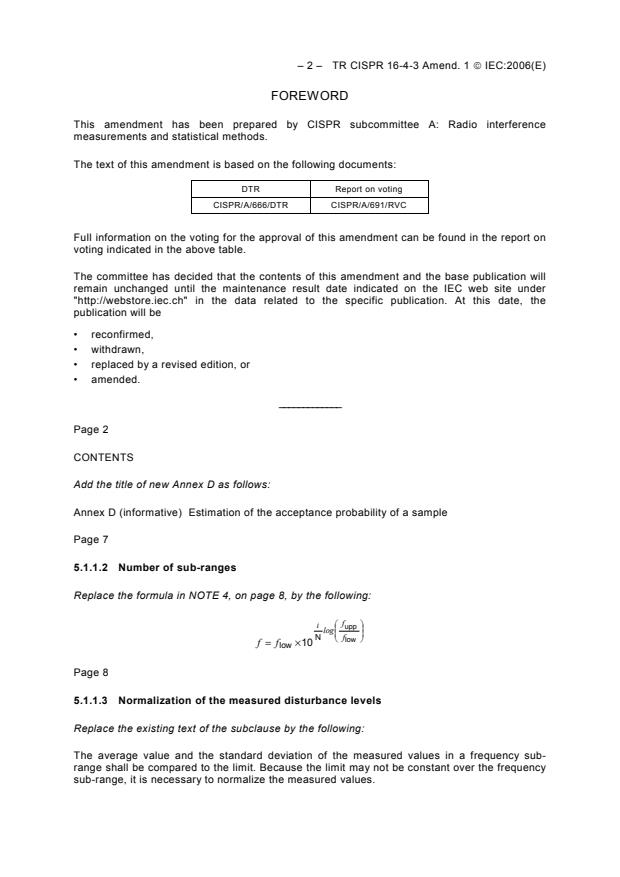
Add the title of new Annex D as follows:
Annex D (informative) Estimation of the acceptance probability of a sample
Page 7
5.1.1.2 Number of sub-ranges
Replace the formula in NOTE 4, on page 8, by the following:
⎛ f ⎞
i
upp
⎜ ⎟
log
⎜ ⎟
N f
⎝ low ⎠
f = f ×10
low
Page 8
5.1.1.3 Normalization of the measured disturbance levels
Replace the existing text of the subclause by the following:
The average value and the standard deviation of the measured values in a frequency sub-
range shall be compared to the limit. Because the limit may not be constant over the frequency
sub-range, it is necessary to normalize the measured values.
TR CISPR 16-4-3 Amend. 1 © IEC:2006(E) – 3 –
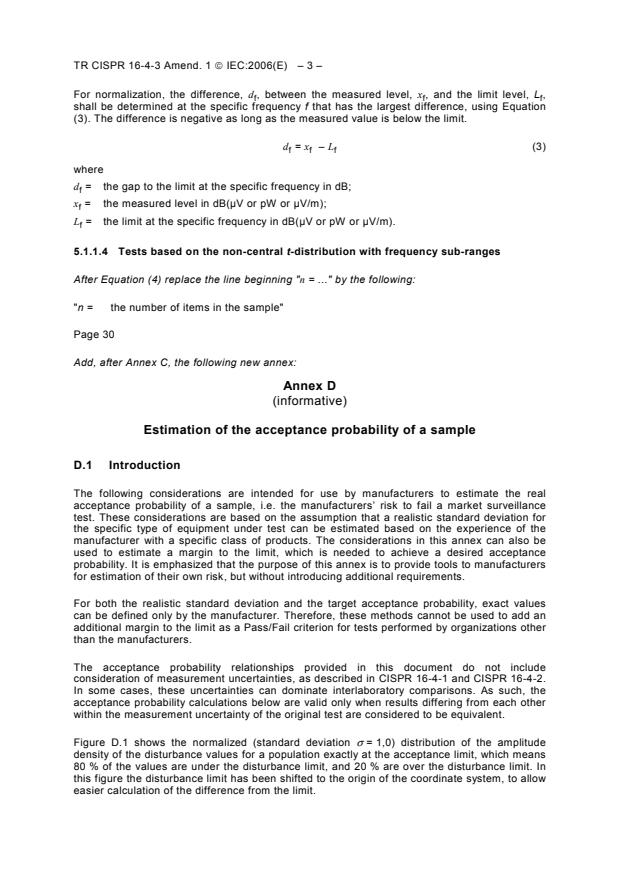
For normalization, the difference, d , between the measured level, x , and the limit level, L ,
f f f
shall be determined at the specific frequency f that has the largest difference, using Equation
(3). The difference is negative as long as the measured value is below the limit.
d = x – L (3)
f f f
where
d = the gap to the limit at the specific frequency in dB;
f
x = the measured level in dB(μV or pW or μV/m);
f
L = the limit at the specific frequency in dB(μV or pW or μV/m).
f
5.1.1.4 Tests based on the non-central t-distribution with frequency sub-ranges
After Equation (4) replace the line beginning "n = ." by the following:
"n = the number of items in the sample"
Page 30
Add, after Annex C, the following new annex:
Annex D
(informative)
Estimation of the acceptance probability of a sample
D.1 Introduction
The following considerations are intended for use by manufacturers to estimate the real
acceptance probability of a sample, i.e. the manufacturers’ risk to fail a market surveillance
test. These considerations are based on the assumption that a realistic standard deviation for
the specific type of equipment under test can be estimated based on the experience of the
manufacturer with a specific class of products. The considerations in this annex can also be
used to estimate a margin to the limit, which is needed to achieve a desired acceptance
probability. It is emphasized that the purpose of this annex is to provide tools to manufacturers
for estimation of their own risk, but without introducing additional requirements.
For both the realistic standard deviation and the target acceptance probability, exact values
can be defined only by the manufacturer. Therefore, these methods cannot be used to add an
additional margin to the limit as a Pass/Fail criterion for tests performed by organizations other
than the manufacturers.
The acceptance probability relationships provided in this document do not include
consideration of measurement uncertainties, as described in CISPR 16-4-1 and CISPR 16-4-2.
In some cases, these uncertainties can dominate interlaboratory comparisons. As such, the
acceptance probability calculations below are valid only when results differing from each other
within the measurement uncertainty of the original test are considered to be equivalent.
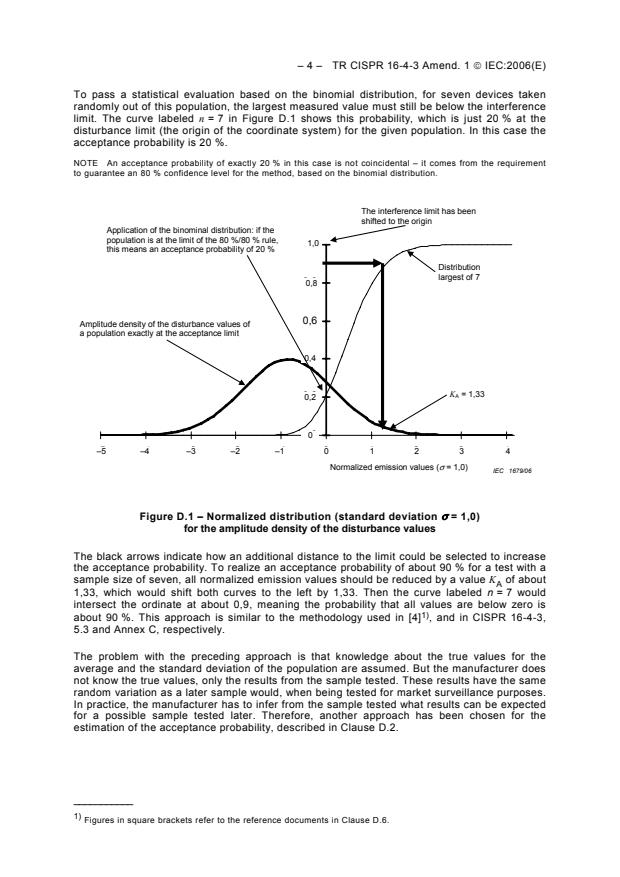
Figure D.1 shows the normalized (standard deviation σ = 1,0) distribution of the amplitude
density of the disturbance values for a population exactly at the acceptance limit, which means
80 % of the values are under the disturbance limit, and 20 % are over the disturbance limit. In
this figure the disturbance limit has been shifted to the origin of the coordinate system, to allow
easier calculation of the difference from the limit.
– 4 – TR CISPR 16-4-3 Amend. 1 © IEC:2006(E)
To pass a statistical evaluation based on the binomial distribution, for seven devices taken
randomly out of this population, the largest measured value must still be below the interference
limit. The curve labeled n = 7 in Figure D.1 shows this probability, which is just 20 % at the
disturbance limit (the origin of the coordinate system) for the given population. In this case the
acceptance probability is 20 %.
NOTE An acceptance probability of exactly 20 % in this case is not coincidental – it comes from the requirement
to guarantee an 80 % confidence level for the method, based on the binomial distribution.
The interference limit has been
shifted to the origin
Application of the binominal distribution: if the
population is at the limit of the 80 %/80 % rule,
1,0
this means an acceptance probability of 20 %
Distribution
largest of 7
0,0,88
0,6
Amplitude density of the disturbance values of
a population exactly at the acceptance limit
0,0,44
K = 1,33
A
0,0,22
0 0
-5–5 –4 -4 –3 -3 –2 -2 –1 -1 00 11 22 33 44
Normalized emission values (σ = 1,0)
IEC 1679/06
Figure D.1 – Normalized distribution (standard deviation σ = 1,0)
for the amplitude density of the disturbance values
The black arrows indicate how an additional distance to the limit could be selected to increase
the acceptance probability. To realize an acceptance probability of about 90 % for a test with a
sample size of seven, all normalized emission values should be reduced by a value K of about
A
1,33, which would shift both curves to the left by 1,33. Then the curve labeled n = 7 would
intersect the ordinate at about 0,9, meaning the probability that all values are below zero is
1)
about 90 %. This approach is similar to the methodology used in [4] , and in CISPR 16-4-3,
5.3 and Annex C, respectively.
The problem with the preceding approach is that knowledge about the true values for the
average and the standard deviation of the population are assumed. But the manufacturer does
not know the true values, only the results from the sample tested. These results have the same
random variation as a later sample would, when being tested for market surveillance purposes.
In practice, the manufacturer has to infer from the sample tested what results can be expected
for a possible sample tested later. Therefore, another approach has been chosen for the
estimation of the acceptance probability, described in Clause D.2.
___________
1)
Figures in square brackets refer to the reference documents in Clause D.6.
TR CISPR 16-4-3 Amend. 1 © IEC:2006(E) – 5 –
D.2 Estimation of the acceptance probability
The following approach is recommended to infer from existing sample test results what results
can be expected for a possible sample tested later. Using an assumption of a normal
distribution for the disturbance values, it is possible by simulation, or integration over the
distribution functions, to determine the distribution of the difference between the maximum
values of both samples. Consequently the acceptance probability for the second sample can
...