

IEC 61892-2:2019
(Main)Mobile and fixed offshore units - Electrical installations - Part 2: System design
General Information
- Abstract
IEC 61892-2:2019 is applicable to system design of electrical installations and equipment in mobile and fixed offshore units including pipeline, pumping or "pigging" stations, compressor stations and single buoy moorings, used in the offshore petroleum industry for drilling, production, accommodation, processing, storage and offloading purposes.
It applies to all installations, whether permanent, temporary, transportable or hand-held, to AC installations and DC installations, without any voltage level limitation. Referenced equipment standards may give voltage level limitations.
This document specifies requirements such as those concerning
– sources of electrical power for manned and unmanned units,
– system earthing, both for low-voltage and high-voltage installations,
– interface for electric transmission systems with power supplied from shore, between interconnected offshore units, and with power supplied by offshore units to subsea installations,
– distribution systems,
– cables and wiring systems,
– system studies and calculations,
– protection against electrical faults,
– lighting,
– energy control, monitoring and alarm systems, and
– turret/swivel.
This document gives information and guidance on topics such as
– applicable examples of HVDC VSC technology, and
– guidelines for illumination level.
This document does not apply to
– fixed equipment for medical purposes,
– electrical installations of tankers, and
– control of ignition sources other than those created by electrical equipment.
This third edition cancels and replaces the second edition published in 2012. This edition constitutes a technical revision.
This edition includes the following significant technical changes with respect to the previous edition:
a) the requirement for sources of electrical power has been rewritten. Requirements both for manned and unmanned units are given. Requirements for essential services of electrical power have been added;
b) the requirement in relation to dead start has been added;
c) the requirement for emergency stop for motor-driven fuel-oil transfer and fuel-oil pressure pumps has been added;
d) general requirements regarding cables and wiring systems have been added;
e) the description of unit interfaces to electrical transmission systems has been included;
f) requirements in relation to energy control, monitoring and alarm system have been rewritten;
g) new clauses regarding swivel/turret and unmanned facilities have been added;
h) informative annexes regarding the following have been added:
– essential source of electrical power;
– emergency source of electrical power;
– applicable examples of HVDC VSC technologies;
– swivel/turret;
– power sources for unmanned units, with separate or combined main and emergency switchboard;
– alternative power sources of electrical power – general requirements;
– illumination level;
– enhanced software simulation;
– architecture for energy control, monitoring and alarm system.
- Status
- Published
- Publication Date
- 08-Apr-2019
- Drafting Committee
- MT 18 - TC 18/MT 18
- Current Stage
- PPUB - Publication issued
- Start Date
- 09-Apr-2019
- Completion Date
- 19-Apr-2019
Overview
IEC 61892-2:2019 is an international standard developed by the International Electrotechnical Commission (IEC) that focuses on the system design of electrical installations in mobile and fixed offshore units. These units include pipeline, pumping or "pigging" stations, compressor stations, single buoy moorings, and other offshore petroleum industry facilities used for drilling, production, accommodation, processing, storage, and offloading operations. The standard applies to both alternating current (AC) and direct current (DC) electrical installations without voltage level limitations, covering permanent, temporary, transportable, and hand-held setups.
This third edition introduces significant technical revisions for enhanced safety, reliability, and operational efficiency of offshore electrical systems, emphasizing power sources, earthing, protection, system studies, and energy management.
Key Topics
Electrical Power Sources
Covers requirements for main, essential, emergency, and alternative power sources, tailored for manned and unmanned offshore units. Includes details on uninterruptible power supplies (UPS) and starting arrangements for emergency generators.System Earthing
Specifies earthing methods for low-voltage and high-voltage systems, including neutral earthing configurations and connection to hull structures to ensure personnel and equipment safety.Electrical Distribution Systems
Addresses design parameters for DC and AC power distribution networks, including load balancing, final circuits for lighting, heating, and sockets, as well as control and motor circuits.Cables and Wiring Systems
Provides comprehensive guidance on cable selection, voltage drop considerations, demand factors, cross-sectional conductor area, and separation to prevent electrical faults.System Studies and Calculations
Details techniques for electrical load studies, short-circuit and harmonic calculations, load flow analysis, and power system dynamic modeling to optimize system performance.Protection Against Electrical Faults
Defines protective device selection criteria, including short-circuit and overload protection, backup protection, and coordinated discrimination to minimize risk and damage.Additional Topics
Includes lighting requirements, energy control and monitoring systems, alarm management, and turret/swivel interfaces for offshore units.
Applications
IEC 61892-2:2019 is essential for engineers, designers, and operators in the offshore petroleum industry who are responsible for:
- Designing and implementing safe and reliable electrical systems on offshore drilling rigs, production platforms, and accommodation facilities.
- Integrating power sources from shore or adjacent units with complex offshore electrical networks.
- Ensuring compliant electrical installations in subsea structures and unmanned installations requiring autonomous power management.
- Managing energy control and alarm systems critical for operational integrity and safety compliance.
- Specifying appropriate cabling and wiring systems that withstand harsh offshore environments.
- Conducting system studies to inform design optimization, protection coordination, and fault mitigation strategies.
Related Standards
- IEC 61892-1: General requirements for electrical installations on mobile and fixed offshore units.
- IEC 61892-3: Electrical installations for equipment – specifies equipment requirements.
- IEC 61892-4: Requirements for equipment using portable and hand-held power tools and devices offshore.
- IEC 60502: Power cables with extruded insulation and their accessories for rated voltages, relevant to cable specification in offshore installations.
- IEC 62485-2: Safety requirements for secondary batteries in stationary applications, supporting battery protection requirements.
- IEC 60092 series: Covers electrical installations in ships, providing complementary guidelines for offshore marine electrical systems.
Keywords: IEC 61892-2, offshore electrical installations, system design, power sources offshore, electrical power supply, offshore platform electrical systems, AC and DC offshore power, offshore cabling, offshore power distribution, electrical protection systems, offshore energy control, HVDC offshore applications, mobile offshore units, fixed offshore units, offshore electrical earthing.
Relations
- Effective Date
- 05-Sep-2023
- Effective Date
- 05-Sep-2023
Get Certified
Connect with accredited certification bodies for this standard

DNV
DNV is an independent assurance and risk management provider.

Lloyd's Register
Lloyd's Register is a global professional services organisation specialising in engineering and technology.

FSC International
Forest Stewardship Council certification.
Sponsored listings
Frequently Asked Questions
IEC 61892-2:2019 is a standard published by the International Electrotechnical Commission (IEC). Its full title is "Mobile and fixed offshore units - Electrical installations - Part 2: System design". This standard covers: IEC 61892-2:2019 is applicable to system design of electrical installations and equipment in mobile and fixed offshore units including pipeline, pumping or "pigging" stations, compressor stations and single buoy moorings, used in the offshore petroleum industry for drilling, production, accommodation, processing, storage and offloading purposes. It applies to all installations, whether permanent, temporary, transportable or hand-held, to AC installations and DC installations, without any voltage level limitation. Referenced equipment standards may give voltage level limitations. This document specifies requirements such as those concerning – sources of electrical power for manned and unmanned units, – system earthing, both for low-voltage and high-voltage installations, – interface for electric transmission systems with power supplied from shore, between interconnected offshore units, and with power supplied by offshore units to subsea installations, – distribution systems, – cables and wiring systems, – system studies and calculations, – protection against electrical faults, – lighting, – energy control, monitoring and alarm systems, and – turret/swivel. This document gives information and guidance on topics such as – applicable examples of HVDC VSC technology, and – guidelines for illumination level. This document does not apply to – fixed equipment for medical purposes, – electrical installations of tankers, and – control of ignition sources other than those created by electrical equipment. This third edition cancels and replaces the second edition published in 2012. This edition constitutes a technical revision. This edition includes the following significant technical changes with respect to the previous edition: a) the requirement for sources of electrical power has been rewritten. Requirements both for manned and unmanned units are given. Requirements for essential services of electrical power have been added; b) the requirement in relation to dead start has been added; c) the requirement for emergency stop for motor-driven fuel-oil transfer and fuel-oil pressure pumps has been added; d) general requirements regarding cables and wiring systems have been added; e) the description of unit interfaces to electrical transmission systems has been included; f) requirements in relation to energy control, monitoring and alarm system have been rewritten; g) new clauses regarding swivel/turret and unmanned facilities have been added; h) informative annexes regarding the following have been added: – essential source of electrical power; – emergency source of electrical power; – applicable examples of HVDC VSC technologies; – swivel/turret; – power sources for unmanned units, with separate or combined main and emergency switchboard; – alternative power sources of electrical power – general requirements; – illumination level; – enhanced software simulation; – architecture for energy control, monitoring and alarm system.
IEC 61892-2:2019 is applicable to system design of electrical installations and equipment in mobile and fixed offshore units including pipeline, pumping or "pigging" stations, compressor stations and single buoy moorings, used in the offshore petroleum industry for drilling, production, accommodation, processing, storage and offloading purposes. It applies to all installations, whether permanent, temporary, transportable or hand-held, to AC installations and DC installations, without any voltage level limitation. Referenced equipment standards may give voltage level limitations. This document specifies requirements such as those concerning – sources of electrical power for manned and unmanned units, – system earthing, both for low-voltage and high-voltage installations, – interface for electric transmission systems with power supplied from shore, between interconnected offshore units, and with power supplied by offshore units to subsea installations, – distribution systems, – cables and wiring systems, – system studies and calculations, – protection against electrical faults, – lighting, – energy control, monitoring and alarm systems, and – turret/swivel. This document gives information and guidance on topics such as – applicable examples of HVDC VSC technology, and – guidelines for illumination level. This document does not apply to – fixed equipment for medical purposes, – electrical installations of tankers, and – control of ignition sources other than those created by electrical equipment. This third edition cancels and replaces the second edition published in 2012. This edition constitutes a technical revision. This edition includes the following significant technical changes with respect to the previous edition: a) the requirement for sources of electrical power has been rewritten. Requirements both for manned and unmanned units are given. Requirements for essential services of electrical power have been added; b) the requirement in relation to dead start has been added; c) the requirement for emergency stop for motor-driven fuel-oil transfer and fuel-oil pressure pumps has been added; d) general requirements regarding cables and wiring systems have been added; e) the description of unit interfaces to electrical transmission systems has been included; f) requirements in relation to energy control, monitoring and alarm system have been rewritten; g) new clauses regarding swivel/turret and unmanned facilities have been added; h) informative annexes regarding the following have been added: – essential source of electrical power; – emergency source of electrical power; – applicable examples of HVDC VSC technologies; – swivel/turret; – power sources for unmanned units, with separate or combined main and emergency switchboard; – alternative power sources of electrical power – general requirements; – illumination level; – enhanced software simulation; – architecture for energy control, monitoring and alarm system.
IEC 61892-2:2019 is classified under the following ICS (International Classification for Standards) categories: 47.020.60 - Electrical equipment of ships and of marine structures. The ICS classification helps identify the subject area and facilitates finding related standards.
IEC 61892-2:2019 has the following relationships with other standards: It is inter standard links to IEC 61892-2:2012/COR1:2013, IEC 61892-2:2012. Understanding these relationships helps ensure you are using the most current and applicable version of the standard.
IEC 61892-2:2019 is available in PDF format for immediate download after purchase. The document can be added to your cart and obtained through the secure checkout process. Digital delivery ensures instant access to the complete standard document.
Standards Content (Sample)
IEC 61892-2 ®
Edition 3.0 2019-04
INTERNATIONAL
STANDARD
NORME
INTERNATIONALE
colour
inside
Mobile and fixed offshore units – Electrical installations –
Part 2: System design
Unités mobiles et fixes en mer – Installations électriques –
Partie 2: Conception du système
All rights reserved. Unless otherwise specified, no part of this publication may be reproduced or utilized in any form
or by any means, electronic or mechanical, including photocopying and microfilm, without permission in writing from
either IEC or IEC's member National Committee in the country of the requester. If you have any questions about IEC
copyright or have an enquiry about obtaining additional rights to this publication, please contact the address below or
your local IEC member National Committee for further information.
Droits de reproduction réservés. Sauf indication contraire, aucune partie de cette publication ne peut être reproduite
ni utilisée sous quelque forme que ce soit et par aucun procédé, électronique ou mécanique, y compris la photocopie
et les microfilms, sans l'accord écrit de l'IEC ou du Comité national de l'IEC du pays du demandeur. Si vous avez des
questions sur le copyright de l'IEC ou si vous désirez obtenir des droits supplémentaires sur cette publication, utilisez
les coordonnées ci-après ou contactez le Comité national de l'IEC de votre pays de résidence.
IEC Central Office Tel.: +41 22 919 02 11
3, rue de Varembé info@iec.ch
CH-1211 Geneva 20 www.iec.ch
Switzerland
About the IEC
The International Electrotechnical Commission (IEC) is the leading global organization that prepares and publishes
International Standards for all electrical, electronic and related technologies.
About IEC publications
The technical content of IEC publications is kept under constant review by the IEC. Please make sure that you have the
latest edition, a corrigendum or an amendment might have been published.
IEC publications search - webstore.iec.ch/advsearchform Electropedia - www.electropedia.org
The advanced search enables to find IEC publications by a The world's leading online dictionary on electrotechnology,
variety of criteria (reference number, text, technical containing more than 22 000 terminological entries in English
committee,…). It also gives information on projects, replaced and French, with equivalent terms in 16 additional languages.
and withdrawn publications. Also known as the International Electrotechnical Vocabulary
(IEV) online.
IEC Just Published - webstore.iec.ch/justpublished
Stay up to date on all new IEC publications. Just Published IEC Glossary - std.iec.ch/glossary
details all new publications released. Available online and 67 000 electrotechnical terminology entries in English and
once a month by email. French extracted from the Terms and Definitions clause of
IEC publications issued since 2002. Some entries have been
IEC Customer Service Centre - webstore.iec.ch/csc collected from earlier publications of IEC TC 37, 77, 86 and
If you wish to give us your feedback on this publication or CISPR.
need further assistance, please contact the Customer Service
Centre: sales@iec.ch.
A propos de l'IEC
La Commission Electrotechnique Internationale (IEC) est la première organisation mondiale qui élabore et publie des
Normes internationales pour tout ce qui a trait à l'électricité, à l'électronique et aux technologies apparentées.
A propos des publications IEC
Le contenu technique des publications IEC est constamment revu. Veuillez vous assurer que vous possédez l’édition la
plus récente, un corrigendum ou amendement peut avoir été publié.
Recherche de publications IEC - Electropedia - www.electropedia.org
webstore.iec.ch/advsearchform Le premier dictionnaire d'électrotechnologie en ligne au
La recherche avancée permet de trouver des publications IEC monde, avec plus de 22 000 articles terminologiques en
en utilisant différents critères (numéro de référence, texte, anglais et en français, ainsi que les termes équivalents dans
comité d’études,…). Elle donne aussi des informations sur les 16 langues additionnelles. Egalement appelé Vocabulaire
projets et les publications remplacées ou retirées. Electrotechnique International (IEV) en ligne.
IEC Just Published - webstore.iec.ch/justpublished Glossaire IEC - std.iec.ch/glossary
Restez informé sur les nouvelles publications IEC. Just 67 000 entrées terminologiques électrotechniques, en anglais
Published détaille les nouvelles publications parues. et en français, extraites des articles Termes et Définitions des
Disponible en ligne et une fois par mois par email. publications IEC parues depuis 2002. Plus certaines entrées
antérieures extraites des publications des CE 37, 77, 86 et
Service Clients - webstore.iec.ch/csc CISPR de l'IEC.
Si vous désirez nous donner des commentaires sur cette
publication ou si vous avez des questions contactez-nous:
sales@iec.ch.
IEC 61892-2 ®
Edition 3.0 2019-04
INTERNATIONAL
STANDARD
NORME
INTERNATIONALE
colour
inside
Mobile and fixed offshore units – Electrical installations –
Part 2: System design
Unités mobiles et fixes en mer – Installations électriques –
Partie 2: Conception du système
INTERNATIONAL
ELECTROTECHNICAL
COMMISSION
COMMISSION
ELECTROTECHNIQUE
INTERNATIONALE
ICS 47.020.60 ISBN 978-2-8322-6667-0
– 2 – IEC 61892-2:2019 © IEC 2019
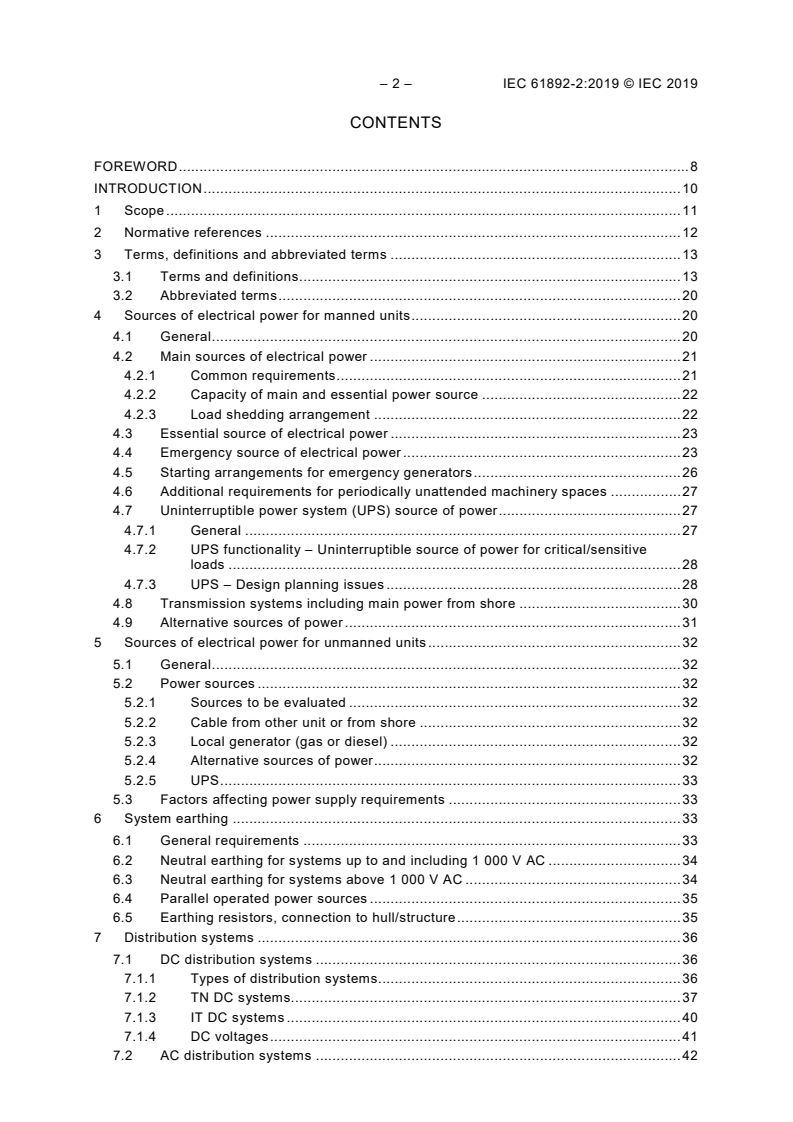
CONTENTS
FOREWORD . 8
INTRODUCTION . 10
1 Scope . 11
2 Normative references . 12
3 Terms, definitions and abbreviated terms . 13
3.1 Terms and definitions . 13
3.2 Abbreviated terms . 20
4 Sources of electrical power for manned units . 20
4.1 General . 20
4.2 Main sources of electrical power . 21
4.2.1 Common requirements . 21
4.2.2 Capacity of main and essential power source . 22
4.2.3 Load shedding arrangement . 22
4.3 Essential source of electrical power . 23
4.4 Emergency source of electrical power . 23
4.5 Starting arrangements for emergency generators . 26
4.6 Additional requirements for periodically unattended machinery spaces . 27
4.7 Uninterruptible power system (UPS) source of power . 27
4.7.1 General . 27
4.7.2 UPS functionality – Uninterruptible source of power for critical/sensitive
loads . 28
4.7.3 UPS – Design planning issues . 28
4.8 Transmission systems including main power from shore . 30
4.9 Alternative sources of power . 31
5 Sources of electrical power for unmanned units . 32
5.1 General . 32
5.2 Power sources . 32
5.2.1 Sources to be evaluated . 32
5.2.2 Cable from other unit or from shore . 32
5.2.3 Local generator (gas or diesel) . 32
5.2.4 Alternative sources of power . 32
5.2.5 UPS . 33
5.3 Factors affecting power supply requirements . 33
6 System earthing . 33
6.1 General requirements . 33
6.2 Neutral earthing for systems up to and including 1 000 V AC . 34
6.3 Neutral earthing for systems above 1 000 V AC . 34
6.4 Parallel operated power sources . 35
6.5 Earthing resistors, connection to hull/structure . 35
7 Distribution systems . 36
7.1 DC distribution systems . 36
7.1.1 Types of distribution systems . 36
7.1.2 TN DC systems. 37
7.1.3 IT DC systems . 40
7.1.4 DC voltages . 41
7.2 AC distribution systems . 42
7.2.1 Primary AC distribution systems . 42
7.2.2 Secondary AC distribution systems . 42
7.2.3 TN AC systems . 42
7.2.4 IT AC systems . 44
7.2.5 AC voltages and frequencies . 44
7.2.6 Earthing systems . 46
8 Distribution system requirements . 46
8.1 Methods of distribution . 46
8.2 Balance of loads . 47
8.2.1 Balance of load on three-wire DC systems . 47
8.2.2 Balance of loads in three- or four-wire AC systems . 47
8.3 Final circuits . 47
8.3.1 General . 47
8.3.2 Final circuits for lighting . 47
8.3.3 Final circuits for heating . 47
8.3.4 Final circuits for sockets . 47
8.4 Control circuits . 48
8.4.1 Supply systems and nominal voltages. 48
8.4.2 Circuit design . 48
8.4.3 Protection . 48
8.4.4 Arrangement of circuits . 49
8.5 Motor circuits . 49
8.5.1 Starting of motors . 49
8.5.2 Means of disconnection . 50
8.5.3 Starters remote from motors . 50
8.6 Isolation of supply to galley . 50
9 Cables and wiring systems . 50
9.1 Cables . 50
9.2 Voltage drop . 51
9.3 Demand factors . 51
9.3.1 Final circuits . 51
9.3.2 Circuits other than final circuits . 51
9.3.3 Application of diversity and demand factors . 51
9.4 Motor circuits . 51
9.5 Cross-sectional areas of conductors . 52
9.6 Correction factors for cable grouping . 52
9.7 Separation of circuits . 52
10 System study and calculations . 53
10.1 Electrical studies – General . 53
10.2 Electrical load study . 54
10.3 Load flow calculations . 55
10.4 Short-circuit calculations . 56
10.5 Protection and discrimination study . 58
10.6 Power system dynamic calculations . 59
10.7 Calculation of harmonic currents and voltages . 61
11 Protection . 61
11.1 General . 61
11.2 Characteristics and choice of protective devices with reference to short-
circuit rating . 62
– 4 – IEC 61892-2:2019 © IEC 2019
11.2.1 General . 62
11.2.2 Protective devices . 62
11.2.3 Backup protection . 63
11.2.4 Rated short-circuit breaking capacity . 63
11.2.5 Rated short-circuit making capacity . 64
11.2.6 Co-ordinated choice of protective devices with regard to discrimination
requirements . 65
11.3 Choice of protective devices with reference to overload . 65
11.3.1 Protective devices . 65
11.3.2 Fuses for overload protection . 65
11.4 Choice of protective devices with regard to their application . 65
11.4.1 General . 65
11.4.2 Generator protection . 65
11.4.3 Protection of UPS . 66
11.4.4 Protection of transformers . 67
11.4.5 Transformers – Isolation of windings. 67
11.4.6 Circuit protection . 67
11.4.7 Motor protection . 67
11.4.8 Protection of lighting circuits . 68
11.4.9 Protection of power from external sources . 68
11.4.10 Secondary cells and battery protection . 68
11.4.11 Protection of static or solid-state devices . 68
11.4.12 Protection for heat tracing systems . 69
11.5 Undervoltage protection . 69
11.5.1 Generators . 69
11.5.2 AC and DC motors . 69
11.6 Overvoltage protection . 69
11.6.1 General . 69
11.6.2 AC machines . 69
11.6.3 DC networks . 69
12 Lighting . 70
12.1 General . 70
12.2 General lighting system . 70
12.3 Emergency lighting system . 70
12.4 Escape lighting system . 71
12.5 Lighting circuits in machinery spaces, accommodation spaces, open deck
spaces, etc. . 71
12.6 Navigation and obstruction signals and lights . 71
13 Energy control, monitoring and alarm system . 72
13.1 General . 72
13.2 Alarm system . 72
13.3 Network topology . 72
13.4 Router communication . 72
13.5 Communication protocols . 72
13.6 Monitoring and fault diagnosis . 73
13.7 Cybersecurity . 73
13.8 Energy management and control systems (EMCS) . 73
13.8.1 General . 73
13.8.2 EMCS architecture . 73
13.8.3 Interaction with protection system . 74
13.8.4 Performance . 74
13.9 Electromagnetic compatibility . 74
13.10 Time identification and event logs . 75
13.11 Remote controls . 75
13.11.1 Continuous status information. 75
13.11.2 Independent control . 75
13.11.3 Exclusive control . 75
13.11.4 Interlocks in operative command. 75
13.12 Human-machine interface . 75
13.13 Emergency stop . 75
13.14 Automatic control of electrical power sources . 75
13.14.1 Initiation of starting commands . 75
13.14.2 Pre-starting conditions . 76
13.14.3 Standby indication . 76
13.15 Automatic connecting onto a dead busbar . 76
13.15.1 Connection at blackout . 76
13.15.2 Short-circuit . 76
13.16 Delayed disconnection . 76
13.17 Automatic starting arrangements for electrical motor-driven auxiliaries . 76
13.17.1 Prevention of overload via sequential restart . 76
13.17.2 Start inhibit . 76
13.18 General alarm systems . 76
13.18.1 Audibility. 76
13.18.2 Minimum sound level . 77
13.18.3 Fault tolerance. 77
13.18.4 Power supplies . 77
13.19 System integration . 77
13.19.1 Alarm functions . 77
13.19.2 Essential and emergency control functions . 77
13.20 Software . 78
13.20.1 Version control of software . 78
13.20.2 Configuration – Support functions . 78
13.20.3 Documentation . 78
13.21 Tests . 79
13.21.1 General . 79
13.21.2 Hardware . 79
13.21.3 Software . 79
13.21.4 System testing . 79
14 Special facilities – Swivel/turret . 80
14.1 Standards, codes and regulations . 80
14.2 Bonding and protective earthing of power swivel . 80
Annex A (informative) Essential source of electrical power . 81
Annex B (informative) Emergency source of electrical power . 82
Annex C (informative) Applicable examples of HVDC VSC technologies . 83
Annex D (informative) Swivel/turret . 87
D.1 General . 87
D.2 Swivel design and service location . 87
– 6 – IEC 61892-2:2019 © IEC 2019
D.3 Fault exposure of high-voltage electrical swivels . 88
D.4 Enclosure and purging system . 88
D.5 Ingress protection . 88
D.6 Anti-condensation . 89
D.7 Inspection and functional testing of swivel unit . 89
Annex E (informative) Guidelines for design of unmanned units . 90
E.1 Factors affecting power supply requirements . 90
E.2 Guideline for defining power sources requirement . 90
E.2.1 One main power supply and UPS. 90
E.2.2 One emergency power supply and UPS . 91
E.2.3 One main power supply, one emergency power supply and UPS . 91
E.2.4 Renewable sources of energy . 91
E.3 Layout. 92
E.4 Switchboard arrangements . 92
E.5 High-voltage equipment . 94
E.6 Lighting system . 95
Annex F (informative) Alternative sources of electrical power . 96
F.1 General . 96
F.2 Photovoltaic system . 96
F.3 Wind turbine system . 97
F.4 Microturbines . 100
F.5 Closed cycle vapour turbines (CCVT). 101
F.6 Thermoelectric generators (TEG) . 102
Annex G (informative) Illumination level . 104
G.1 General illumination level . 104
G.2 Emergency lighting . 104
G.3 Escape lighting . 104
G.4 Verification of lighting level . 105
Annex H (informative) Enhanced software simulation . 106
H.1 General . 106
H.2 Scope of HiL testing . 106
H.3 Schedule and work process . 106
H.4 Requirements relating to the control system vendor or system integrator . 106
H.5 Documentation and approval . 107
Annex I (informative) Architecture for energy control, monitoring and alarm system –
Level reference and segmentation architecture . 108
Bibliography . 109
Figure 1 – Continuity of supply/continuity of service . 15
Figure 2 – Power system hierarchy in an offshore unit . 21
Figure 3 – TN-S DC system . 38
Figure 4 – TN-C DC system . 39
Figure 5 – TN-C-S DC system . 40
Figure 6 – IT DC system . 41
Figure 7 – TN-S AC system . 43
Figure 8 – TN-C-S AC system . 43
Figure 9 – TN-C AC system . 44
Figure 10 – IT AC system . 44
Figure 11 – Use of FCL in emergency switchboard . 64
Figure C.1 – Typical HVDC VSC transmission between onshore grid and offshore
petroleum unit; symmetric monopole . 84
Figure C.2 – Typical symmetric and asymmetric monopole and bipole HVDC VSC
arrangement . 84
Figure C.3 – Principle drawings of possible topology arrangements for two-level (left)
and multi-level (right) types with indication of corresponding filtered (blue) and
non-filtered (green) output voltage wave forms . 86
Figure E.1 – Example of electrical arrangement for an unmanned unit . 93
Figure E.2 – Example of electrical arrangement for an unmanned unit . 94
Figure E.3 – Example of electrical arrangement for an unmanned unit . 94
Figure F.1 – PV Power generating system – Major functional elements, subsystems
and power flow diagram . 97
Figure F.2 – Typical diagram for the island function of a wind generation system –
Unmanned unit . 98
Figure F.3 – Typical diagram for the island function of a wind generation system –
Manned unit . 99
Figure F.4 – Microturbine typical block diagram . 100
Figure F.5 – CCVT operating principle block diagram . 101
Figure F.6 – Typical diagram for the thermoelectric generation system (TEG) . 102
Figure I.1 – IEC 62443 reference architecture . 108
Table 1 – Summary of principal features of the neutral earthing methods . 36
Table 2 – Voltages for DC systems . 41
Table 3 – AC systems having a nominal voltage between 100 V and 1 000 V inclusive
and related equipment . 45
Table 4 – AC three-phase systems having a nominal voltage above 1 kV and not
exceeding 35 kV and related equipment . 46
Table G.1 – General lighting illumination levels . 104
Table G.2 – Recommended measuring points for measuring illumination in an area . 105
– 8 – IEC 61892-2:2019 © IEC 2019
INTERNATIONAL ELECTROTECHNICAL COMMISSION
____________
MOBILE AND FIXED OFFSHORE UNITS –
ELECTRICAL INSTALLATIONS –
Part 2: System design
FOREWORD
1) The International Electrotechnical Commission (IEC) is a worldwide organization for standardization comprising
all national electrotechnical committees (IEC National Committees). The object of IEC is to promote
international co-operation on all questions concerning standardization in the electrical and electronic fields. To
this end and in addition to other activities, IEC publishes International Standards, Technical Specifications,
Technical Reports, Publicly Available Specifications (PAS) and Guides (hereafter referred to as "IEC
Publication(s)"). Their preparation is entrusted to technical committees; any IEC National Committee interested
in the subject dealt with may participate in this preparatory work. International, governmental and non-
governmental organizations liaising with the IEC also participate in this preparation. IEC collaborates closely
with the International Organization for Standardization (ISO) in accordance with conditions determined by
agreement between the two organizations.
2) The formal decisions or agreements of IEC on technical matters express, as nearly as possible, an international
consensus of opinion on the relevant subjects since each technical committee has representation from all
interested IEC National Committees.
3) IEC Publications have the form of recommendations for international use and are accepted by IEC National
Committees in that sense. While all reasonable efforts are made to ensure that the technical content of IEC
Publications is accurate, IEC cannot be held responsible for the way in which they are used or for any
misinterpretation by any end user.
4) In order to promote international uniformity, IEC National Committees undertake to apply IEC Publications
transparently to the maximum extent possible in their national and regional publications. Any divergence
between any IEC Publication and the corresponding national or regional publication shall be clearly indicated in
the latter.
5) IEC itself does not provide any attestation of conformity. Independent certification bodies provide conformity
assessment services and, in some areas, access to IEC marks of conformity. IEC is not responsible for any
services carried out by independent certification bodies.
6) All users should ensure that they have the latest edition of this publication.
7) No liability shall attach to IEC or its directors, employees, servants or agents including individual experts and
members of its technical committees and IEC National Committees for any personal injury, property damage or
other damage of any nature whatsoever, whether direct or indirect, or for costs (including legal fees) and
expenses arising out of the publication, use of, or reliance upon, this IEC Publication or any other IEC
Publications.
8) Attention is drawn to the Normative references cited in this publication. Use of the referenced publications is
indispensable for the correct application of this publication.
9) Attention is drawn to the possibility that some of the elements of this IEC Publication may be the subject of
patent rights. IEC shall not be held responsible for identifying any or all such patent rights.
International Standard IEC 61892-2 has been prepared by IEC technical committee 18:
Electrical installations of ships and of mobile and fixed offshore units.
This third edition cancels and replaces the second edition published in 2012. This edition
constitutes a technical revision.
This edition includes the following significant technical changes with respect to the previous
edition:
a) the requirement for sources of electrical power has been rewritten. Requirements both for
manned and unmanned units are given. Requirements for essential services of electrical
power have been added;
b) the requirement in relation to dead start has been added;
c) the requirement for emergency stop for motor-driven fuel-oil transfer and fuel-oil pressure
pumps has been added;
d) general requirements regarding cables and wiring systems have been added;
e) the description of unit interfaces to electrical transmission systems has been included;
f) requirements in relation to energy control, monitoring and alarm system have been
rewritten;
g) new clauses regarding swivel/turret and unmanned facilities have been added;
h) informative annexes regarding the following have been added:
– essential source of electrical power;
– emergency source of electrical power;
– applicable examples of HVDC VSC technologies;
– swivel/turret;
– power sources for unmanned units, with separate or combined main and emergency
switchboard;
– alternative power sources of electrical power – general requirements;
– illumination level;
– enhanced software simulation;
– architecture for energy control, monitoring and alarm system.
The text of this International Standard is based on the following documents:
FDIS Report on voting
18/1650/FDIS 18/1661/RVD
Full information on the voting for the approval of this International Standard can be found in
the report on voting indicated in the above table.
This document has been drafted in accordance with the ISO/IEC Directives, Part 2.
A list of all parts of the IEC 61892 series can be found, under the general title Mobile and
fixed offshore units – Electrical installations, on the IEC website.
The committee has decided that the contents of this document will remain unchanged until the
stability date indicated on the IEC website under "http://webstore.iec.ch" in the data related to
the specific document. At this date, the document will be
• reconfirmed,
• withdrawn,
• replaced by a revised edition, or
• amended.
IMPORTANT – The 'colour inside' logo on the cover page of this publication indicates
that it contains colours which are considered to be useful for the correct
understanding of its contents. Users should therefore print this document using a
colour printer.
– 10 – IEC 61892-2:2019 © IEC 2019
INTRODUCTION
IEC 61892 forms a series of International Standards for safety in the design, selection,
installation, maintenance and use of electrical equipment for the generation, transmission,
storage, distribution and utilization of electrical energy for all purposes in offshore units which
are used for the purpose of exploration or exploitation of petroleum resources.
This part of IEC 61892 incorporates and coordinates, as far as possible, existing rules and
forms a code of interpretation, where applicable,
...