

IEC 61892-2:2005
(Main)Mobile and fixed offshore units - Electrical installations - Part 2: System design
General Information
- Abstract
This part of IEC 61892 contains provisions for system design of electrical installations in mobile and fixed units used in the offshore petroleum industry for drilling, production, processing and for storage purposes, including pipeline, pumping or 'pigging' stations, compressor stations and exposed location single buoy moorings. It applies to all installations, whether permanent, temporary, transportable or hand-held, to a.c. installations up to and including 35 000 V and d.c. installations up to and including 750 V.(a.c. and d.c. voltages are nominal values) This standard does not apply either to fixed equipment used for medical purposes or to the electrical installations of tankers.
- Status
- Published
- Publication Date
- 23-Mar-2005
- Current Stage
- DELPUB - Deleted Publication
- Start Date
- 15-Mar-2012
- Completion Date
- 28-Aug-2026
Overview
IEC 61892-2:2005 - “Mobile and fixed offshore units – Electrical installations – Part 2: System design” is an international standard that defines system-design provisions for electrical installations on offshore petroleum units. It covers mobile and fixed units used for drilling, production, processing and storage, including pipeline/pumping (pigging) stations, compressor stations and exposed single buoy moorings. The standard applies to a.c. systems up to 35 000 V and d.c. systems up to 750 V (nominal values). It does not apply to fixed medical equipment or tankers.
Keywords: IEC 61892-2, offshore electrical installations, system design, mobile and fixed offshore units, 35 kV, 750 V.
Key topics and requirements
IEC 61892-2 addresses the full electrical system design lifecycle for offshore installations. Major technical topics include:
- Sources of electrical power - main, emergency and renewable sources; arrangement, location and output requirements; starting arrangements for emergency generators.
- System earthing - neutral earthing methods (TN, IT variants), earthing resistors and connections to hull/structure.
- Distribution systems - design for d.c. and a.c. distribution up to the stated voltage limits; distribution methods and final circuits.
- Protection and coordination - short-circuit and overload protection, discrimination studies, undervoltage/overvoltage protection and selection of protective devices.
- System studies and calculations - electrical load study, load flow, short-circuit, harmonic analysis, dynamic power system calculations and protection studies.
- Control, instrumentation and EMC - safeguarding, dependability, segregation, integration, automatic control, software and testing requirements.
- Lighting and emergency lighting - general, escape and machinery space lighting requirements and luminaires.
- Degrees of protection and documentation - enclosure protection levels, tests and required technical documentation.
These topics appear in the standard’s clauses and supporting figures/tables (system diagrams, earthing summaries, voltage tables and illumination levels).
Applications and users
IEC 61892-2 is intended for professionals involved in offshore electrical system design, installation and operation, including:
- Electrical designers and consulting engineers for offshore platforms and mobile units
- OEMs of offshore power generation and distribution equipment
- Asset operators, maintenance engineers and reliability teams
- Classification societies and surveyors assessing compliance and safety
- Project managers and EPC contractors executing offshore electrification projects
Practical use cases include design of platform power systems, emergency generator sizing and starting schemes, earthing strategy selection, short-circuit and discrimination studies, and specifying control/instrumentation architecture to meet offshore safety and continuity-of-service requirements.
Related standards
IEC 61892-2 is part of the IEC 61892 series for mobile and fixed offshore units and references other IEC standards for protection, EMC, lighting and machinery. Users should consult adjacent parts of IEC 61892 and normative references listed in the standard for implementation details.
Relations
- Effective Date
- 25-Aug-2026
- Effective Date
- 05-Sep-2023
Get Certified
Connect with accredited certification bodies for this standard

DNV
DNV is an independent assurance and risk management provider.

Lloyd's Register
Lloyd's Register is a global professional services organisation specialising in engineering and technology.

FSC International
Forest Stewardship Council certification.
Sponsored listings
Frequently Asked Questions
IEC 61892-2:2005 is a standard published by the International Electrotechnical Commission (IEC). Its full title is "Mobile and fixed offshore units - Electrical installations - Part 2: System design". This standard covers: This part of IEC 61892 contains provisions for system design of electrical installations in mobile and fixed units used in the offshore petroleum industry for drilling, production, processing and for storage purposes, including pipeline, pumping or 'pigging' stations, compressor stations and exposed location single buoy moorings. It applies to all installations, whether permanent, temporary, transportable or hand-held, to a.c. installations up to and including 35 000 V and d.c. installations up to and including 750 V.(a.c. and d.c. voltages are nominal values) This standard does not apply either to fixed equipment used for medical purposes or to the electrical installations of tankers.
This part of IEC 61892 contains provisions for system design of electrical installations in mobile and fixed units used in the offshore petroleum industry for drilling, production, processing and for storage purposes, including pipeline, pumping or 'pigging' stations, compressor stations and exposed location single buoy moorings. It applies to all installations, whether permanent, temporary, transportable or hand-held, to a.c. installations up to and including 35 000 V and d.c. installations up to and including 750 V.(a.c. and d.c. voltages are nominal values) This standard does not apply either to fixed equipment used for medical purposes or to the electrical installations of tankers.
IEC 61892-2:2005 is classified under the following ICS (International Classification for Standards) categories: 47.020.60 - Electrical equipment of ships and of marine structures. The ICS classification helps identify the subject area and facilitates finding related standards.
IEC 61892-2:2005 has the following relationships with other standards: It is inter standard links to EN ISO 13628-6:2006, IEC 61892-2:2012. Understanding these relationships helps ensure you are using the most current and applicable version of the standard.
IEC 61892-2:2005 is available in PDF format for immediate download after purchase. The document can be added to your cart and obtained through the secure checkout process. Digital delivery ensures instant access to the complete standard document.
Standards Content (Sample)
INTERNATIONAL IEC
STANDARD 61892-2
First edition
2005-03
Mobile and fixed offshore units –
Electrical installations –
Part 2:
System design
Reference number
Publication numbering
As from 1 January 1997 all IEC publications are issued with a designation in the
60000 series. For example, IEC 34-1 is now referred to as IEC 60034-1.
Consolidated editions
The IEC is now publishing consolidated versions of its publications. For example,
edition numbers 1.0, 1.1 and 1.2 refer, respectively, to the base publication, the
base publication incorporating amendment 1 and the base publication incorporating
amendments 1 and 2.
Further information on IEC publications
The technical content of IEC publications is kept under constant review by the IEC,
thus ensuring that the content reflects current technology. Information relating to
this publication, including its validity, is available in the IEC Catalogue of
publications (see below) in addition to new editions, amendments and corrigenda.
Information on the subjects under consideration and work in progress undertaken
by the technical committee which has prepared this publication, as well as the list
of publications issued, is also available from the following:
• IEC Web Site (www.iec.ch)
• Catalogue of IEC publications
The on-line catalogue on the IEC web site (www.iec.ch/searchpub) enables you to
search by a variety of criteria including text searches, technical committees
and date of publication. On-line information is also available on recently issued
publications, withdrawn and replaced publications, as well as corrigenda.
• IEC Just Published
This summary of recently issued publications (www.iec.ch/online_news/ justpub)
is also available by email. Please contact the Customer Service Centre (see
below) for further information.
• Customer Service Centre
If you have any questions regarding this publication or need further assistance,
please contact the Customer Service Centre:
Email: custserv@iec.ch
Tel: +41 22 919 02 11
Fax: +41 22 919 03 00
INTERNATIONAL IEC
STANDARD 61892-2
First edition
2005-03
Mobile and fixed offshore units –
Electrical installations –
Part 2:
System design
IEC 2005 Copyright - all rights reserved
No part of this publication may be reproduced or utilized in any form or by any means, electronic or
mechanical, including photocopying and microfilm, without permission in writing from the publisher.
International Electrotechnical Commission, 3, rue de Varembé, PO Box 131, CH-1211 Geneva 20, Switzerland
Telephone: +41 22 919 02 11 Telefax: +41 22 919 03 00 E-mail: inmail@iec.ch Web: www.iec.ch
PRICE CODE
Commission Electrotechnique Internationale
XB
International Electrotechnical Commission
Международная Электротехническая Комиссия
For price, see current catalogue
– 2 – 61892-2 IEC:2005(E)
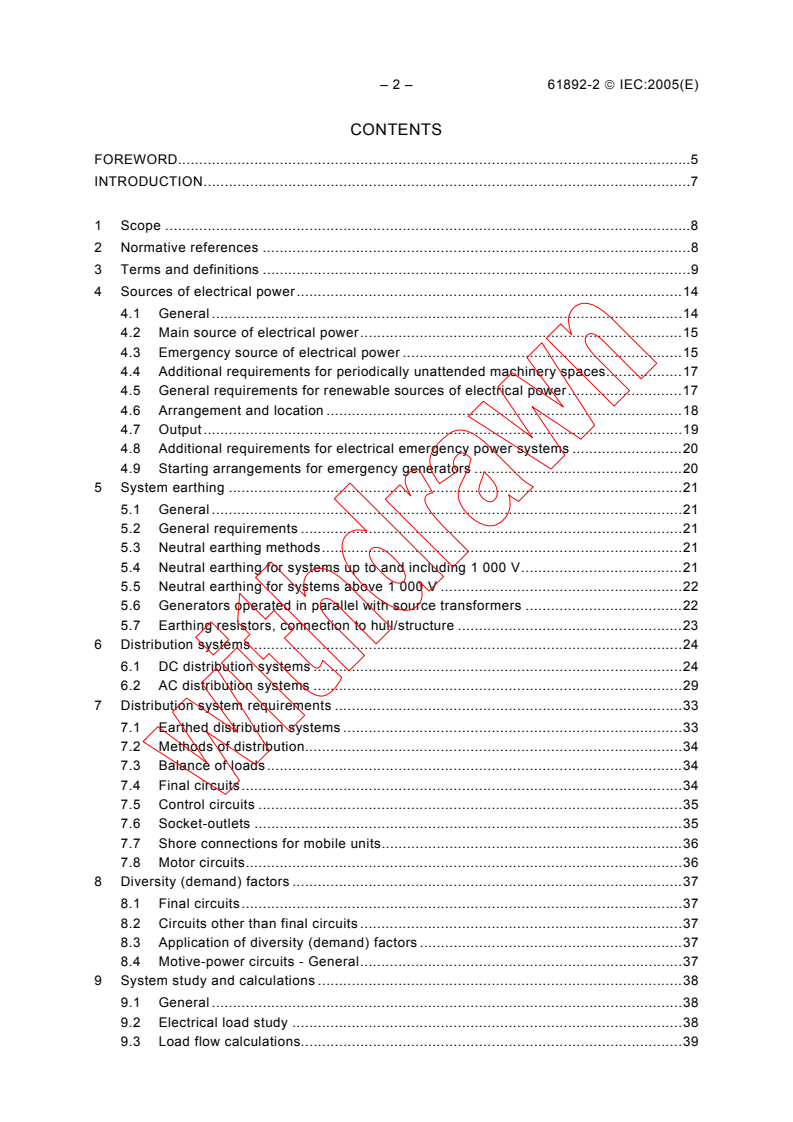
CONTENTS
FOREWORD.5
INTRODUCTION.7
1 Scope .8
2 Normative references .8
3 Terms and definitions .9
4 Sources of electrical power.14
4.1 General .14
4.2 Main source of electrical power.15
4.3 Emergency source of electrical power .15
4.4 Additional requirements for periodically unattended machinery spaces.17
4.5 General requirements for renewable sources of electrical power.17
4.6 Arrangement and location .18
4.7 Output.19
4.8 Additional requirements for electrical emergency power systems .20
4.9 Starting arrangements for emergency generators .20
5 System earthing .21
5.1 General .21
5.2 General requirements .21
5.3 Neutral earthing methods.21
5.4 Neutral earthing for systems up to and including 1 000 V.21
5.5 Neutral earthing for systems above 1 000 V .22
5.6 Generators operated in parallel with source transformers .22
5.7 Earthing resistors, connection to hull/structure .23
6 Distribution systems .24
6.1 DC distribution systems .24
6.2 AC distribution systems .29
7 Distribution system requirements .33
7.1 Earthed distribution systems .33
7.2 Methods of distribution.34
7.3 Balance of loads.34
7.4 Final circuits.34
7.5 Control circuits .35
7.6 Socket-outlets .35
7.7 Shore connections for mobile units.36
7.8 Motor circuits.36
8 Diversity (demand) factors .37
8.1 Final circuits.37
8.2 Circuits other than final circuits .37
8.3 Application of diversity (demand) factors .37
8.4 Motive-power circuits - General.37
9 System study and calculations .38
9.1 General .38
9.2 Electrical load study .38
9.3 Load flow calculations.39
61892-2 IEC:2005(E) – 3 –
9.4 Short-circuit calculations.39
9.5 Protection and discrimination study .41
9.6 Power system dynamic calculations .41
9.7 Calculation of harmonic currents and voltages.43
10 Protection.43
10.1 General .43
10.2 Characteristic and choice of protective devices with reference to short-circuit
rating .44
10.3 Choice of protective devices with reference to overload.45
10.4 Choice of protective devices with regard to their application .45
10.5 Undervoltage protection.48
10.6 Overvoltage protection.49
11 Lighting .49
11.1 General .49
11.2 General lighting system .50
11.3 Emergency lighting system .51
11.4 Escape lighting system .51
11.5 Lighting circuits in machinery spaces, accommodation spaces, open deck
spaces, etc.52
11.6 Luminaires .53
11.6.1 Discharge lamp luminaires of voltages above 250 V.53
11.6.2 Searchlights.53
12 Control and instrumentation .53
12.1 Safeguarding.53
12.2 Supply arrangement .53
12.3 Dependability .53
12.4 Safety .53
12.5 Segregation.53
12.6 Performance.54
12.7 Integration.54
12.8 Development activities.54
12.9 Electromagnetic compatability.54
12.10 Design.54
12.11 Installation and ergonomics .55
12.12 Specific installations .56
12.13 Automatic control installations for electrical power supply.58
12.14 Machinery control installations .60
12.15 Public address and general alarm systems.60
12.16 Computer based systems.61
12.17 Software.63
12.18 Tests.65
12.19 Documentation .66
13 Degrees of protection by enclosures .67
13.1 General .67
Bibliography .69
– 4 – 61892-2 © IEC:2005(E)
Figure 1 – Continuity of supply/continuity of service.14
Figure 2 – TN-S d.c. system.25
Figure 3 – TN-C d.c. system.26
Figure 4 – TN-C-S d.c. system .27
Figure 5 – IT d.c. system .28
Figure 6 – TN-S a.c. system.30
Figure 7 – TN-C-S a.c. system .30
Figure 8 – TN-C a.c. system.31
Figure 9 – IT a.c. system .31
Table 1 – Summary of principal features of the neutral earthing methods .23
Table 2 – Voltages for d.c. systems.29
Table 3 – AC systems having a nominal voltage between 100 V and 1 000 V inclusive
and related equipment .32
Table 4 – AC three-phase systems having a nominal voltage above 1 kV and not
exceeding 35 kV and related equipment*.33
Table 5 – General lighting illumination levels .50
Table 6 – Escape Lighting illumination levels.52
Table 7 – Minimum requirements for the degree of protection for mobile and fixed
offshore units.67
61892-2 IEC:2005(E) – 5 –
INTERNATIONAL ELECTROTECHNICAL COMMISSION
____________
MOBILE AND FIXED OFFSHORE UNITS –
ELECTRICAL INSTALLATIONS –
Part 2: System design
FOREWORD
1) The International Electrotechnical Commission (IEC) is a worldwide organization for standardization comprising
all national electrotechnical committees (IEC National Committees). The object of IEC is to promote
international co-operation on all questions concerning standardization in the electrical and electronic fields. To
this end and in addition to other activities, IEC publishes International Standards, Technical Specifications,
Technical Reports, Publicly Available Specifications (PAS) and Guides (hereafter referred to as “IEC
Publication(s)”). Their preparation is entrusted to technical committees; any IEC National Committee interested
in the subject dealt with may participate in this preparatory work. International, governmental and non-
governmental organizations liaising with the IEC also participate in this preparation. IEC collaborates closely
with the International Organization for Standardization (ISO) in accordance with conditions determined by
agreement between the two organizations.
2) The formal decisions or agreements of IEC on technical matters express, as nearly as possible, an international
consensus of opinion on the relevant subjects since each technical committee has representation from all
interested IEC National Committees.
3) IEC Publications have the form of recommendations for international use and are accepted by IEC National
Committees in that sense. While all reasonable efforts are made to ensure that the technical content of IEC
Publications is accurate, IEC cannot be held responsible for the way in which they are used or for any
misinterpretation by any end user.
4) In order to promote international uniformity, IEC National Committees undertake to apply IEC Publications
transparently to the maximum extent possible in their national and regional publications. Any divergence
between any IEC Publication and the corresponding national or regional publication shall be clearly indicated in
the latter.
5) IEC provides no marking procedure to indicate its approval and cannot be rendered responsible for any
equipment declared to be in conformity with an IEC Publication.
6) All users should ensure that they have the latest edition of this publication.
7) No liability shall attach to IEC or its directors, employees, servants or agents including individual experts and
members of its technical committees and IEC National Committees for any personal injury, property damage or
other damage of any nature whatsoever, whether direct or indirect, or for costs (including legal fees) and
expenses arising out of the publication, use of, or reliance upon, this IEC Publication or any other IEC
Publications.
8) Attention is drawn to the Normative references cited in this publication. Use of the referenced publications is
indispensable for the correct application of this publication.
9) Attention is drawn to the possibility that some of the elements of this IEC Publication may be the subject of
patent rights. IEC shall not be held responsible for identifying any or all such patent rights.
International Standard IEC 61892-2 has been prepared by IEC technical committee 18:
Electrical installations of ships and of mobile and fixed offshore units.
The text of this standard is based on the following documents:
FDIS Report on voting
18/965/FDIS 18/995/RVD
Full information on the voting for the approval of this standard can be found in the report on
voting indicated in the above table.
This publication has been drafted in accordance with the ISO/IEC Directives, Part 2.
– 6 – 61892-2 IEC:2005(E)
IEC 61892 consists of the following parts, under the general title: Mobile and fixed offshore
units – Electrical installations:
Part 1: General requirements and conditions
Part 2: System design
Part 3: Equipment
1)
Part 4: Cables
Part 5: Mobile units
Part 6: Installation
Part 7: Hazardous areas
The committee has decided that the contents of this publication will remain unchanged until
the maintenance result date indicated on the IEC web site under "http://webstore.iec.ch" in
the data related to the specific publication. At this date, the publication will be
• reconfirmed;
• withdrawn;
• replaced by a revised edition, or
• amended.
A bilingual version of this publication may be issued at a later date.
———————
1)
Under consideration. Before IEC 61892-4 is published, reference is made to the IEC 60092-35X series.
61892-2 IEC:2005(E) – 7 –
INTRODUCTION
IEC 61892 forms a series of International Standards intended to enable safety in the design,
selection, installation, maintenance and use of electrical equipment for the generation,
storage, distribution and utilisation of electrical energy for all purposes in offshore units,
which are being used for the purpose of exploration or exploitation of petroleum resources.
This part of IEC 61892 also incorporates and co-ordinates, as far as possible, existing rules
and forms a code of interpretation, where applicable, of the requirements of the International
Maritime Organisation, a guide for future regulations which may be prepared and a statement
of practice for offshore unit owners, constructors and appropriate organisations.
This standard is based on equipment and practices, which are in current use, but it is not
intended in any way to impede development of new or improved techniques.
The ultimate aim has been to produce a set of International standards exclusively for the
offshore petroleum industry.
– 8 – 61892-2 IEC:2005(E)
MOBILE AND FIXED OFFSHORE UNITS –
ELECTRICAL INSTALLATIONS –
Part 2: System design
1 Scope
This part of IEC 61892 contains provisions for system design of electrical installations in
mobile and fixed units used in the offshore petroleum industry for drilling, production,
processing and for storage purposes, including pipeline, pumping or 'pigging' stations,
compressor stations and exposed location single buoy moorings.
It applies to all installations, whether permanent, temporary, transportable or hand-held, to
a.c. installations up to and including 35 000 V and d.c. installations up to and including
750 V.(a.c. and d.c. voltages are nominal values)
This standard does not apply either to fixed equipment used for medical purposes or to the
electrical installations of tankers.
2 Normative references
The following referenced documents are indispensable for the application of this document.
For dated references, only the edition cited applies. For undated references, the latest edition
of the referenced document (including any amendments) applies.
IEC 60038:2002, IEC standard voltages
IEC 60092-101:2002, Electrical installations in ships – Part 101: Definitions and general
requirements
IEC 60092-504:2001, Electrical installations in ships – Part 504: Special features – Control
and instrumentation
IEC 60447, Basic and safety principles for man-machine interface, marking and identification
– Actuating principles
IEC 60533, Electrical and electronic installations in ships – Electromagnetic compatibility
2)
IEC 60617-DB:2001 Graphical symbols for diagrams – Architectural and topographical
installation plans and diagrams
IEC 60947-2:2003, Low voltage switchgear and controlgear – Part 2: Circuit-breakers
IEC 61000-2-4, Electromagnetic compatibility (EMC) – Part 2-4: Environment – Compatibility
levels in industrial plants for low-frequency conducted disturbances
IEC 61508 (all parts), Functional safety of electrical/electronic/programmable electronic
safety-related systems
———————
2)
“DB” refers to the on-line IEC database.
61892-2 IEC:2005(E) – 9 –
IEC 61511, (all parts), Functional safety – Safety instrumented systems for the process
industry sector
IEC 61892-1:2001, Mobile and fixed offshore units – Electrical installations – Part 1: General
requirements and conditions
IEC 61892-3, Mobile and fixed offshore units – Electrical installations – Part 3: Equipment
IEC 61892-5:2000, Mobile and fixed offshore units – Electrical installations – Part 5: Mobile
units
IEC 61892-7:1997, Mobile and fixed offshore units – Electrical installations – Part 7:
Hazardous areas
IEC 62271-100, High-voltage switchgear and controlgear – Part 100: High-voltage alternating-
current circuit-breakers
SOLAS, International Convention for the Safety of Life at Sea
IMO MODU Code:1990, Code for the Construction and Equipment of Mobile Offshore Drilling
Units,
3 Terms and definitions
For the purposes of this document, the following terms and definitions apply.
NOTE The definitions included in this part are those having general application in the IEC 61892 series.
Definitions applying to particular apparatus or equipment are included in the other parts of IEC 61892.
3.1
a.c. systems of distribution
3.1.1
single-phase two-wire a.c. system
system comprising two conductors only, between which the load is connected
NOTE In some countries this is designated as a two-phase system
3.1.2
three-phase three-wire a.c. system
system comprising three conductors connected to a three-phase supply
3.1.3
three-phase four-wire a.c. system
system comprising four conductors of which three are connected to a three-phase supply and
the fourth to a neutral point in the source of supply
3.2
appropriate authority
governmental body with whose rules a unit is required to comply
3.3
availability
the state of an item of being able to perform its required function
[IEV 603-05-04]
– 10 – 61892-2 IEC:2005(E)
3.4
3)
back-up protection
equipment or system which is intended to operate when a system fault is not cleared in due
time because of:
− failure or inability of a protective device closest to the fault to operate, or
− failure of a protective device, other than the protective device closest to the fault, to operate
3.5
centralized control
control of all operations of a controlled system from one central control position
3.6
computer-based system
system that consists of one or more programmable electronic devices with their connections,
peripherals and software necessary to carry out automatically specified functions
3.7
3)
continuity of service
condition. that after a fault in a circuit has been cleared, the supply to the healthy circuits is
re-established
NOTE See circuit 3 in Figure 1.
3.8
continuity of supply
condition that during and after a fault in a circuit, the supply to the healthy circuits is
permanently ensured
NOTE See circuit 3 in Figure 1.
3.9
control functions
functions intended to regulate the behaviour of equipment or systems
3.10
control position (control station)
group of control devices by which an operator can control the performance of a machine,
apparatus, process or assembly of machines and apparatus
3.11
d.c. systems of distribution
3.11.1
two-wire d.c. system
system comprising two conductors only, between which the load is connected
3.11.2
three-wire d.c. system
system comprising two conductors and a middle wire, the supply being taken from the two
outer conductors or from the middle wire and either outer conductor, the middle wire carrying
only the difference-current
3.12
diversity factor (demand factor)
ratio of the estimated total load of a group of consumers under their normal working
conditions to the sum of their nominal ratings
———————
3)
The International Electrotechnical Vocabulary (IEV) definition for this term is not applicable for this standard.
61892-2 IEC:2005(E) – 11 –
3.13
fail-to-safe
principle by which a failure or malfunction of a component of the system causes its output to
automatically adjust to a predetermined safe state
[IEV 191-15-04 modified]
3.14
function
elementary operation performed by the system which, in conjunction with other elementary
operations (system functions), enables the system to perform a task
3.15
high voltage
the set of voltage levels in excess of low voltage
[IEV 601-01-27 modified]
3.16
hull-return system
system in which insulated conductors are provided for connection to one pole or phase of the
supply, the structure of the unit or other permanently earthed structure being used for
effecting connections to the other pole or phase
3.17
integrity
capability of a system to satisfactorily perform the required functions under all the stated
conditions within a stated period of time
[IEV 191-19-07 modified]
3.18
low voltage
a set of voltage levels used for the distribution of electricity and whose upper limit is generally
accepted to be 1 000 V a.c.
[IEV 601-01-26]
3.19
machinery control room
room or spaces where centralized controls and measuring and monitoring equipment for main
equipment and essential auxiliary machinery are located together with the appropriate means
of communication
3.20
maintainability
ability of an item under given condition of use, to be retained in, or restored to, a state in
which it can perform a required function, when maintenance is performed under given
conditions and using stated procedures and resources
[IEV 191-02-07]
3.21
monitoring functions
functions intended to collect data from equipment and systems for the purpose of display and
recording
– 12 – 61892-2 IEC:2005(E)
3.22
over-current
a current exceeding the rated current
[IEV 441-11-06]
3.23
over-current discrimination
co-ordination of the operating characteristics of two or more over current protective devices
such that, on the incidence of over-currents within stated limits, the device intended to
operate within these limits does so, while the other(s) does (do) not
[IEV 441-17-15]
3.24
overload
operating conditions in an electrically undamaged circuit, which cause an over-current
[IEV 441-11-08]
3.25
4)
partial discrimination (partial selectivity)
over-current discrimination where, in the presence of two or more over-current protective
devices in series, the protective device closest to the fault effects the protection up to a given
level of short-circuit current without causing the other protective devices to operate
3.26
primary distribution system
system having electrical connection with the main source of electrical power
3.27
rated load
highest value of load specified for rated conditions
3.28
reliability
the probability that an item can perform a required function under given conditions for a given
time interval
[IEV 191-12-01]
3.29
safety functions
functions intended to prevent harm or danger to personnel
3.30
secondary distribution system
system having no electrical connection with the main source of electrical power, e.g. isolated
therefrom by a double-wound transformer or motor-generator
3.31
short-circuit
accidental or intentional conductive path between two or more conductive parts forcing the
electric potential difference between these conductive parts to be equal to or close to zero
[IEV 195-04-11]
———————
4)
The International Electrotechnical Vocabulary (IEV) definition for this term is not applicable for this standard.
61892-2 IEC:2005(E) – 13 –
3.32
software
program, procedures and associated documentation pertaining to the operation of a computer
system and including application (user) program, middleware and operating system (firmware)
program
3.33
sources of electrical power
3.32.1
emergency source of electrical power
source of electrical power intended to supply the emergency system in the event of failure of
the supply from the main source of electrical power
3.32.2
main source of electrical power
source of electrical power intended to supply all services necessary for maintaining the unit in
normal operational and habitable condition
3.34
system
collection of components organised to accomplish a specific function or set of functions
3.35
5)
total discrimination (total selectivity)
over-current discrimination where, in the presence of two or more over-current protective
devices in series, the protective device on the load side effects the protection without causing
the other protective devices to operate
3.36
usability
extent to which a system can be used by specified users to achieve specified goals with
effectiveness, efficiency and satisfaction in a specified context of use
———————
5)
The International Electrotechnical Vocabulary (IEV) definition for this term is not applicable for this standard.
– 14 – 61892-2 IEC:2005(E)
IEC 525/05
Figure 1 – Continuity of supply/continuity of service
4 Sources of electrical power
4.1 General
Electrical installations shall be such that:
4.1.1 All electrical services necessary for maintaining the unit in normal operational and
habitable condition shall be assured without recourse to the emergency source of electrical
power.
4.1.2 Electrical services essential for safety shall be assured also under various emergency
conditions.
61892-2 IEC:2005(E) – 15 –
4.1.3 When a.c. generators are involved, the design basis of the system shall include the
effect of inrush current of e.g. large motors, transformers, capacitors and chokes, connected
to the system. The voltage drop due to such current shall not cause any motor already
operating to stall or to have any adverse effect on other equipment in use.
NOTE Consideration regarding harmonic distortions should be given to installations with a high load from power
semiconductor systems.
4.1.4 The voltage profile of the system shall be confirmed by studies as defined in Clause 9.
Voltage tolerances are given in IEC 61892-1. The total voltage drop between generators or
transformers and load shall not exceed the following values:
AC systems: – normal continuous load 6 %
– motor starting 20 %
DC systems: 10 %
NOTE 1 The voltage drop should be calculated from the distribution board where regulating facilities are included,
that is, supplied by a transformer with tappings or a generator.
NOTE 2 Voltage drop calculations should take account of the power factor of the load. Where this is not known, a
value of 0,85 for normal a.c. loads and 0,3 for motor starting conditions is recommended.
NOTE 3 Where specific loads require closer tolerances for voltages in order to maintain functionality or
performance, then specific calculations should be made to confirm values of voltage drop, particularly in cables.
NOTE 4 Operating limit values for generators are given in IEC 60034-22.
4.2 Main source of electrical power
4.2.1 The main source of electrical power shall consist of at least two generator sets. For
fixed units other sources of electrical power supply arrangements may be acceptable subject
to approval by the appropriate authority.
For small installations where renewable sources of energy are used, for example photovoltaic
cells or wind generators, stationary batteries shall be provided to guarantee the distribution of
the electrical power during the time without sun or wind. The batteries’ autonomy shall be in
accordance with the appropriate authority.
4.2.2 The capacity of the generators shall be such that in the event of any one generator
being stopped, it shall still be possible to supply those services necessary to provide:
a) normal operational conditions and safety;
NOTE It is not required that full operation with maximum load shall be maintained with one generator being
stopped.
b) minimum comfortable conditions of habitability;
NOTE Minimum comfortable conditions of habitability include at least adequate services for lighting, cooking,
heating, domestic refrigeration, mechanical ventilation, sanitary and fresh water.
4.2.3 Where transformers, converters or similar appliances constitute an essential part of the
electrical supply system required by 4.2.1, the system shall be so arranged as to ensure the
same continuity of supply as stated in 4.2.2.
4.3 Emergency source of electrical power
4.3.1 A self-contained emergency source of electrical power shall be provided as required by
the appropriate authority. Provided that suitable measures are taken for safeguarding
independent emergency operation under all circumstances, the emergency source of
electrical power may, in exceptional cases and for periods of short duration, be used to supply
non-emergency circuits subject to agreement by the appropriate authority.
– 16 – 61892-2 IEC:2005(E)
NOTE For units where the main source of electrical power is located in two or more spaces which have their own
systems, including power distribution and control systems, completely independent of the systems in the other
spaces and such that a fire or other casualty in any one of the spaces will not affect the power distribution from the
others, or to the services required by 4.7.1, the requirements of 4.3.1 may be considered satisfied without an
additional emergency source of electrical power, subject to approval of the appropriate authority.
The power available, duration of supply and services provided for safety in an emergency
shall be as required by the appropriate authority.
4.3.2 Where the emergency source of electrical power is a generator it shall be:
a) driven by a suitable prime-mover with an independent supply of fuel and cooling medium;
b) started automatically upon failure of the supply from the main source of electrical power to
the emergency system, and it shall be automatically connected to the emergency system;
c) provided with a transitional source of emergency electrical power according to 4.3.4.
NOTE 1 Further consideration should be given to other conditions affecting the emergency generator prime-mover
such as environmental conditions, etc.
NOTE 2 For starting arrangements of emergency generators, see 4.9.
4.3.3 Where the emergency source of electrical power is an accumulator battery it shall be
capable of:
a) carrying the emergency electrical load without recharging whilst maintaining the voltage of
the battery throughout the discharge period within ±12 % of its nominal voltage;
b) automatic connection to the emergency switchboard in the event of failure of the main
source of electrical power supply; and
c) immediately supplying at least those services required for the transitional source of
electrical power in 4.3.4.
4.3.4 The transitional source of emergency electrical power required in Item c) of 4.3.2 shall
consist of an accumulator battery suitably located for use in an emergency which shall
operate without recharging whilst maintaining the voltage of the battery throughout the
discharge period within ±12 % of its nominal voltage and so arranged as to supply
automatically in the event of failure of either the main or the emergency source of electrical
power the services which are required by the appropriate authority. The capacity shall be
sufficient for a period of at least 30 min or for the period defined by the appropriate authority.
For mobile units, reference shall be made to IMO 1989 MODU CODE 5.3.10.
NOTE A UPS system is acceptable as a transitional source of emergency power.
4.3.5 Provision shall be made for the testing at regular intervals of the complete emergency
power system and shall include the testing of the automatic starting arrangements. Testing at
regular intervals shall also cover load operation.
4.3.6 The emergency source of electrical power may be used for the purpose of starting a
main generator set from a power blackout condition if its capability either alone or combined
with that of any other source of electrical power is sufficient to provide at the same time the
emergency services required by the appropriate authority.
Where the means for starting a main generator set from a power blackout condition is solely
electrical and the emergency source of electrical power cannot be used for this purpose, the
means for starting the generator set to be used for start-up from the power blackout condition
shall be provided with starting arrangements at least equivalent to those required for starting
the emergency generator set.
61892-2 IEC:2005(E) – 17 –
4.3.7 During changeover from the main source of electrical power to the emergency source
of electrical power, an uninterruptible power supply (UPS) system shall ensure uninterrupted
duty for consumers which require continuous power supply, and for consumers which may
malfunction upon voltage transients.
4.4 Additional requirements for periodically unattended machinery spaces
4.4.1 Units intended for operation with periodically unattended machinery spaces shall
comply with 4.4.2 to 4.4.8 inclusive.
4.4.2 Where electrical power is normally supplied by one of the unit’s generating sets,
arrangements such as load shedding, shall be provided to ensure that the safety of the unit
with regard to station-keeping, propulsion and steering, is at least equivalent to that of a unit
having the machinery space manned.
4.4.3 In the event of failure of the generating set(s) in service, provision shall be made for
the automatic starting and connection to the main switchboard of a stand-by generating set of
sufficient capacity to supply those services necessary to ensure that the safety of the unit with
regard to station-keeping, propulsion and steering, is at least equivalent to that of a unit
having the machinery space manned.
4.4.4 The arrangement shall permit automatic re-starting of all essential services, which may
be sequentially started if necessary.
4.4.5 The automatic starting system and characteristics of the stand-by generating set shall
be such as to permit the stand-by generator to carry its full load as quickly as is safe and
practicable, subject to a maximum of 45 s.
4.4.6 Arrangements shall be provided to prevent more than one automatic closing of a given
generator circuit breaker under short-circuit conditions.
4.4.7 If the electrical power is normally supplied by more than one generator operating in
parallel, provisions shall be made by means such as load shedding or by appropriate
separation of the switchboard busbar to ensure that, in the event of loss of one of these
generating sets, the remaining set(s) are kept in operation without overload to permit station-
keeping, propulsion and steering, and to ensure the safety of the unit.
4.4.8 Requirements relating to safety and alarm systems are specified in Clause 12.
4.5 General requirements for renewable sources of electrical power
4.5.1 Photovoltaic System
The system shall be sized in a way that guarantees the power for normal operating conditions
and ensures the supply of the loads even in periods of “no sun”.
When sizing the system, the following shall be taken into consideration:
– environmental conditions;
– geographic location;
– solar radiation;
– days foreseen with “no sun”;
– required energy by the loads (Wh/day);
– energy for preferential load supply;
– rated voltage and current;
– 18 – 61892-2 IEC:2005(E)
– photovoltaic module maintenance coefficient;
– safety factor;
– efficiency of storage battery.
NOTE For information on photovoltaic design and systems reference should be made to IEC 60904 series and
IEC 61194.
4.5.2 Eolic System
The system shall be sized in a way that guarantees the power for normal operating conditions
and ensures the supply of the loads even in periods of “wind lull”.
When sizing the system, the following shall be taken into consideration:
– environmental conditions;
– geographic location;
– ventilation;
– days foreseen with “wind lull”;
– required energy by the loads (Wh/day);
– energy for preferential load supply;
– rated voltage and current;
– wind generator maintenance coefficient;
– safety factor;
– efficiency of storage battery.
To allow for periods when there is no wind an altern
...