


IEC 60747-14-3:2009
(Main)Semiconductor devices - Part 14-3: Semiconductor sensors - Pressure sensors
General Information
- Abstract
IEC 60747-14-3:2009 specifies requirements for semiconductor pressure sensors measuring absolute, gauge or differential pressures. The major technical change with regard to the previous edition is the addition of a new subclause 5.9 (measuring method of linearity).
This publication should be read in conjunction with IEC 60747-1:2006.
- Status
- Published
- Publication Date
- 28-Apr-2009
- Technical Committee
- SC 47E - Discrete semiconductor devices
- Drafting Committee
- WG 1 - TC 47/SC 47E/WG 1
- Current Stage
- PPUB - Publication issued
- Start Date
- 29-Apr-2009
- Completion Date
- 15-Jul-2009
Overview
IEC 60747-14-3:2009 is an international standard developed by the International Electrotechnical Commission (IEC). This document outlines the requirements for semiconductor pressure sensors used to measure absolute, gauge, or differential pressures. As part of the IEC 60747 series, it specifically addresses semiconductor devices with a focus on the performance, characteristics, terminology, and measurement methods for pressure sensors. IEC 60747-14-3:2009 ensures uniformity in terminology and test methods, supporting manufacturers and users in selecting and comparing semiconductor pressure sensors.
Key Topics
Scope and Definitions: Covers the types and functions of semiconductor pressure sensors, including linear and on-off (switch) sensors. Outlines key terms such as absolute pressure, gauge pressure, differential pressure, reference pressure, burst pressure, and linearity error.
Sensing Methods:
- Piezoelectric sensing: Utilizes the piezoelectric effect to generate a voltage in response to applied pressure.
- Piezoresistive sensing: Measures resistance changes under strain, common in silicon-based sensors.
- Capacitive sensing: Uses changes in capacitance to detect diaphragm movement.
- Silicon vibrating sensing: Measures frequency changes in a vibrating silicon element due to pressure.
- Signal conditioning and temperature compensation: Describes integrated signal conditioning techniques and compensation for sensor temperature sensitivity.
Essential Ratings and Characteristics:
- Pressure ratings (maximum, burst, and over-pressure capability)
- Temperature ratings (operating and storage)
- Electrical ratings (supply voltage and current limits)
- Sensor-specific metrics (sensitivity, offset, linearity, hysteresis, response time)
Measurement Methods:
- Procedures to determine output voltage, sensitivity, temperature coefficients, linearity, and hysteresis
- Standard test circuits and guidance on maintaining test accuracy
Recent Technical Update: The 2009 edition introduces Subclause 5.9 on the measurement method for linearity, enhancing the reliability of sensor evaluations.
Applications
Semiconductor pressure sensors standardized by IEC 60747-14-3:2009 are widely used across multiple industries that require accurate and reliable pressure measurement, including:
- Industrial automation: Process control, pneumatic systems, and fluid management
- Automotive: Engine management, tire pressure monitoring, and safety systems
- Medical devices: Blood pressure monitors, respiratory equipment, and infusion pumps
- Consumer electronics: Altimeters, weather stations, and smartphones
- Aerospace and defense: Altitude measurement, cabin pressure monitoring, and fuel system regulation
Adherence to IEC 60747-14-3:2009 helps ensure compatibility, performance consistency, and safety in these critical applications.
Related Standards
For proper implementation and cross-referencing, IEC 60747-14-3:2009 should be used alongside the following standards:
- IEC 60747-1:2006: Semiconductor devices - Part 1: General. This foundational standard provides terminology and general requirements relevant to all parts of the IEC 60747 series.
- IEC 60747-14-1:2000: Semiconductor devices - Part 14-1: Semiconductor sensors – General and classification. Offers broader context and classification for semiconductor sensor technologies.
Other applicable standards within the IEC 60747 series address additional types of semiconductor sensors, enabling comprehensive alignment with international best practices.
Keywords: IEC 60747-14-3:2009, semiconductor pressure sensors, absolute pressure sensor, gauge pressure, differential pressure, piezoresistive pressure sensor, piezoelectric pressure sensor, sensor linearity, industrial standards, sensor measurement methods, electrotechnical standardization.
Relations
- Revises
IEC 60747-14-3:2001 - Semiconductor devices - Part 14-3: Semiconductor sensors - Pressure sensors - Effective Date
- 05-Sep-2023
Frequently Asked Questions
IEC 60747-14-3:2009 is a standard published by the International Electrotechnical Commission (IEC). Its full title is "Semiconductor devices - Part 14-3: Semiconductor sensors - Pressure sensors". This standard covers: IEC 60747-14-3:2009 specifies requirements for semiconductor pressure sensors measuring absolute, gauge or differential pressures. The major technical change with regard to the previous edition is the addition of a new subclause 5.9 (measuring method of linearity). This publication should be read in conjunction with IEC 60747-1:2006.
IEC 60747-14-3:2009 specifies requirements for semiconductor pressure sensors measuring absolute, gauge or differential pressures. The major technical change with regard to the previous edition is the addition of a new subclause 5.9 (measuring method of linearity). This publication should be read in conjunction with IEC 60747-1:2006.
IEC 60747-14-3:2009 is classified under the following ICS (International Classification for Standards) categories: 31.080.99 - Other semiconductor devices. The ICS classification helps identify the subject area and facilitates finding related standards.
IEC 60747-14-3:2009 has the following relationships with other standards: It is inter standard links to IEC 60747-14-3:2001. Understanding these relationships helps ensure you are using the most current and applicable version of the standard.
IEC 60747-14-3:2009 is available in PDF format for immediate download after purchase. The document can be added to your cart and obtained through the secure checkout process. Digital delivery ensures instant access to the complete standard document.
Standards Content (Sample)
IEC 60747-14-3 ®
Edition 2.0 2009-04
INTERNATIONAL
STANDARD
NORME
INTERNATIONALE
Semiconductor devices –
Part 14-3: Semiconductor sensors – Pressure sensors
Dispositifs à semiconducteurs –
Partie 14-3: Capteurs à semiconducteurs – Capteurs de pression
All rights reserved. Unless otherwise specified, no part of this publication may be reproduced or utilized in any form or by
any means, electronic or mechanical, including photocopying and microfilm, without permission in writing from either IEC or
IEC's member National Committee in the country of the requester.
If you have any questions about IEC copyright or have an enquiry about obtaining additional rights to this publication,
please contact the address below or your local IEC member National Committee for further information.
Droits de reproduction réservés. Sauf indication contraire, aucune partie de cette publication ne peut être reproduite
ni utilisée sous quelque forme que ce soit et par aucun procédé, électronique ou mécanique, y compris la photocopie
et les microfilms, sans l'accord écrit de la CEI ou du Comité national de la CEI du pays du demandeur.
Si vous avez des questions sur le copyright de la CEI ou si vous désirez obtenir des droits supplémentaires sur cette
publication, utilisez les coordonnées ci-après ou contactez le Comité national de la CEI de votre pays de résidence.
IEC Central Office
3, rue de Varembé
CH-1211 Geneva 20
Switzerland
Email: inmail@iec.ch
Web: www.iec.ch
About the IEC
The International Electrotechnical Commission (IEC) is the leading global organization that prepares and publishes
International Standards for all electrical, electronic and related technologies.
About IEC publications
The technical content of IEC publications is kept under constant review by the IEC. Please make sure that you have the
latest edition, a corrigenda or an amendment might have been published.
ƒ Catalogue of IEC publications: www.iec.ch/searchpub
The IEC on-line Catalogue enables you to search by a variety of criteria (reference number, text, technical committee,…).
It also gives information on projects, withdrawn and replaced publications.
ƒ IEC Just Published: www.iec.ch/online_news/justpub
Stay up to date on all new IEC publications. Just Published details twice a month all new publications released. Available
on-line and also by email.
ƒ Electropedia: www.electropedia.org
The world's leading online dictionary of electronic and electrical terms containing more than 20 000 terms and definitions
in English and French, with equivalent terms in additional languages. Also known as the International Electrotechnical
Vocabulary online.
ƒ Customer Service Centre: www.iec.ch/webstore/custserv
If you wish to give us your feedback on this publication or need further assistance, please visit the Customer Service
Centre FAQ or contact us:
Email: csc@iec.ch
Tel.: +41 22 919 02 11
Fax: +41 22 919 03 00
A propos de la CEI
La Commission Electrotechnique Internationale (CEI) est la première organisation mondiale qui élabore et publie des
normes internationales pour tout ce qui a trait à l'électricité, à l'électronique et aux technologies apparentées.
A propos des publications CEI
Le contenu technique des publications de la CEI est constamment revu. Veuillez vous assurer que vous possédez
l’édition la plus récente, un corrigendum ou amendement peut avoir été publié.
ƒ Catalogue des publications de la CEI: www.iec.ch/searchpub/cur_fut-f.htm
Le Catalogue en-ligne de la CEI vous permet d’effectuer des recherches en utilisant différents critères (numéro de référence,
texte, comité d’études,…). Il donne aussi des informations sur les projets et les publications retirées ou remplacées.
ƒ Just Published CEI: www.iec.ch/online_news/justpub
Restez informé sur les nouvelles publications de la CEI. Just Published détaille deux fois par mois les nouvelles
publications parues. Disponible en-ligne et aussi par email.
ƒ Electropedia: www.electropedia.org
Le premier dictionnaire en ligne au monde de termes électroniques et électriques. Il contient plus de 20 000 termes et
définitions en anglais et en français, ainsi que les termes équivalents dans les langues additionnelles. Egalement appelé
Vocabulaire Electrotechnique International en ligne.
ƒ Service Clients: www.iec.ch/webstore/custserv/custserv_entry-f.htm
Si vous désirez nous donner des commentaires sur cette publication ou si vous avez des questions, visitez le FAQ du
Service clients ou contactez-nous:
Email: csc@iec.ch
Tél.: +41 22 919 02 11
Fax: +41 22 919 03 00
IEC 60747-14-3 ®
Edition 2.0 2009-04
INTERNATIONAL
STANDARD
NORME
INTERNATIONALE
Semiconductor devices –
Part 14-3: Semiconductor sensors – Pressure sensors
Dispositifs à semiconducteurs –
Partie 14-3: Capteurs à semiconducteurs – Capteurs de pression
INTERNATIONAL
ELECTROTECHNICAL
COMMISSION
COMMISSION
ELECTROTECHNIQUE
PRICE CODE
INTERNATIONALE
R
CODE PRIX
ICS 31.080.99 ISBN 978-2-88910-277-8
– 2 – 60747-14-3 © IEC:2009
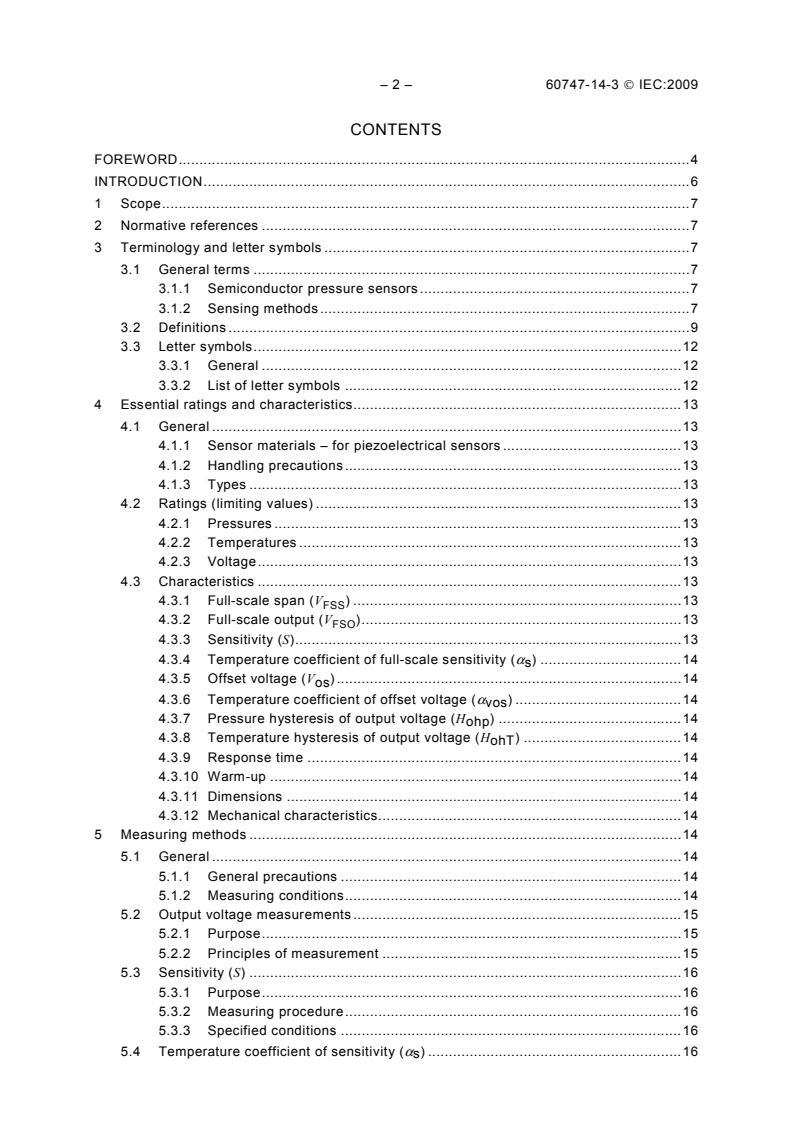
CONTENTS
FOREWORD.4
INTRODUCTION.6
1 Scope.7
2 Normative references .7
3 Terminology and letter symbols .7
3.1 General terms .7
3.1.1 Semiconductor pressure sensors.7
3.1.2 Sensing methods.7
3.2 Definitions .9
3.3 Letter symbols.12
3.3.1 General .12
3.3.2 List of letter symbols .12
4 Essential ratings and characteristics.13
4.1 General .13
4.1.1 Sensor materials – for piezoelectrical sensors .13
4.1.2 Handling precautions.13
4.1.3 Types .13
4.2 Ratings (limiting values) .13
4.2.1 Pressures .13
4.2.2 Temperatures .13
4.2.3 Voltage.13
4.3 Characteristics .13
4.3.1 Full-scale span (V ) .13
FSS
4.3.2 Full-scale output (V ).13
FSO
4.3.3 Sensitivity (S).13
4.3.4 Temperature coefficient of full-scale sensitivity (α ) .14
s
4.3.5 Offset voltage (V ).14
os
4.3.6 Temperature coefficient of offset voltage (α ) .14
vos
4.3.7 Pressure hysteresis of output voltage (H ) .14
ohp
4.3.8 Temperature hysteresis of output voltage (H ) .14
ohT
4.3.9 Response time .14
4.3.10 Warm-up .14
4.3.11 Dimensions .14
4.3.12 Mechanical characteristics.14
5 Measuring methods .14
5.1 General .14
5.1.1 General precautions .14
5.1.2 Measuring conditions.14
5.2 Output voltage measurements .15
5.2.1 Purpose.15
5.2.2 Principles of measurement .15
5.3 Sensitivity (S) .16
5.3.1 Purpose.16
5.3.2 Measuring procedure.16
5.3.3 Specified conditions .16
5.4 Temperature coefficient of sensitivity (α ) .16
s
60747-14-3 © IEC:2009 – 3 –
5.4.1 Purpose.16
5.4.2 Specified conditions .16
5.5 Temperature coefficient of full-scale span (α V ) and maximum
FSS
temperature deviation of full-scale span (ΔV ) .17
FSS
5.5.1 Purpose.17
5.5.2 Specified conditions .17
5.6 Temperature coefficient of offset voltage (α ) and (ΔV ).17
Vos os
5.6.1 Purpose.17
5.6.2 Specified conditions .17
5.7 Pressure hysteresis of output voltage (H ) .18
ohp
5.7.1 Purpose.18
5.7.2 Circuit diagram and circuit description .18
5.7.3 Specified conditions .18
5.8 Temperature hysteresis of output voltage (H ) .18
ohT
5.8.1 Purpose.18
5.8.2 Measuring procedure.18
5.8.3 Specified conditions .18
5.9 Linearity .18
5.9.1 Purpose.18
5.9.2 Specified conditions .18
5.9.3 Measuring procedure.18
Figure 1 – Basic circuit for measurement of output voltage .15
Figure 2 – Linearity test .19
– 4 – 60747-14-3 © IEC:2009
INTERNATIONAL ELECTROTECHNICAL COMMISSION
___________
SEMICONDUCTOR DEVICES –
Part 14-3: Semiconductor sensors –
Pressure sensors
FOREWORD
1) The International Electrotechnical Commission (IEC) is a worldwide organization for standardization comprising
all national electrotechnical committees (IEC National Committees). The object of IEC is to promote
international co-operation on all questions concerning standardization in the electrical and electronic fields. To
this end and in addition to other activities, IEC publishes International Standards, Technical Specifications,
Technical Reports, Publicly Available Specifications (PAS) and Guides (hereafter referred to as “IEC
Publication(s)”). Their preparation is entrusted to technical committees; any IEC National Committee interested
in the subject dealt with may participate in this preparatory work. International, governmental and non-
governmental organizations liaising with the IEC also participate in this preparation. IEC collaborates closely
with the International Organization for Standardization (ISO) in accordance with conditions determined by
agreement between the two organizations.
2) The formal decisions or agreements of IEC on technical matters express, as nearly as possible, an international
consensus of opinion on the relevant subjects since each technical committee has representation from all
interested IEC National Committees.
3) IEC Publications have the form of recommendations for international use and are accepted by IEC National
Committees in that sense. While all reasonable efforts are made to ensure that the technical content of IEC
Publications is accurate, IEC cannot be held responsible for the way in which they are used or for any
misinterpretation by any end user.
4) In order to promote international uniformity, IEC National Committees undertake to apply IEC Publications
transparently to the maximum extent possible in their national and regional publications. Any divergence
between any IEC Publication and the corresponding national or regional publication shall be clearly indicated in
the latter.
5) IEC provides no marking procedure to indicate its approval and cannot be rendered responsible for any
equipment declared to be in conformity with an IEC Publication.
6) All users should ensure that they have the latest edition of this publication.
7) No liability shall attach to IEC or its directors, employees, servants or agents including individual experts and
members of its technical committees and IEC National Committees for any personal injury, property damage or
other damage of any nature whatsoever, whether direct or indirect, or for costs (including legal fees) and
expenses arising out of the publication, use of, or reliance upon, this IEC Publication or any other IEC
Publications.
8) Attention is drawn to the Normative references cited in this publication. Use of the referenced publications is
indispensable for the correct application of this publication.
9) Attention is drawn to the possibility that some of the elements of this IEC Publication may be the subject of
patent rights. IEC shall not be held responsible for identifying any or all such patent rights.
International Standard IEC 60747-14-3 has been prepared by subcommittee 47E: Discrete
semiconductor devices, of IEC technical committee 47: Semiconductor devices.
This second edition cancels and replaces the first edition, published in 2001, and constitutes
a technical revision.
The major technical changes with regard to the previous edition are as follows: added a new
Subclause 5.9 (measuring method of linearity) (technical)
60747-14-3 © IEC:2009 – 5 –
The text of this standard is based on the following documents:
CDV Report on voting
47E/362/CDV 47E/376/RVC
Full information on the voting for the approval of this standard can be found in the report on
voting indicated in the above table.
This publication has been drafted in accordance with the ISO/IEC Directives, Part 2.
This part of IEC 60747 should be read in conjunction with IEC 60747-1:2006.
A list of all the parts in the IEC 60747 series, under the general title Semiconductor devices,
can be found on the IEC website.
The committee has decided that the contents of this publication will remain unchanged until
the maintenance result date indicated on the IEC web site under "http://webstore.iec.ch" in
the data related to the specific publication. At this date, the publication will be
• reconfirmed;
• withdrawn;
• replaced by a revised edition, or
• amended.
– 6 – 60747-14-3 © IEC:2009
INTRODUCTION
This part of IEC 60747 provides basic information on semiconductors:
– terminology;
– letter symbols;
– essential ratings and characteristics;
– measuring methods;
– acceptance and reliability.
60747-14-3 © IEC:2009 – 7 –
SEMICONDUCTOR DEVICES –
Part 14-3: Semiconductor sensors –
Pressure sensors
1 Scope
This part of IEC 60747 specifies requirements for semiconductor pressure sensors measuring
absolute, gauge or differential pressures.
2 Normative references
The following referenced documents are indispensable for the application of this document.
For dated references, only the edition cited applies. For undated references, the latest edition
of the referenced document (including any amendments) applies.
IEC 60747-1:2006, Semiconductor devices – Part 1: General
IEC 60747-14-1:2000, Semiconductor devices – Part 14-1: Semiconductor sensors – General
and classification
3 Terminology and letter symbols
3.1 General terms
3.1.1 Semiconductor pressure sensors
A semiconductor pressure sensor converts the difference between two pressures into an
electrical output quantity. One of the two pressures may be a reference pressure (see 3.2.3).
It includes linear and on-off (switch) types of sensors.
A linear sensor produces electrical output quantity changes linearly with the pressure
difference.
An on-off sensor switches an electrical output quantity on and off between two stable states
when the increasing or decreasing pressure differences cross given threshold values.
In this standard, the electrical output quantity is described as a voltage: output voltage.
However, the statements made in this standard are also applicable to other output quantities
such as those described in 3.8 of IEC 60747-14-1: changes in impedance, capacitance,
voltage ratio, frequency-modulated output or digital output.
3.1.2 Sensing methods
3.1.2.1 Piezoelectric sensing
The basic principle of piezoelectric devices is that a piezoelectric material induces a charge or
induces a voltage across itself when it is deformed by stress. The output from the sensor
is amplified in a charge amplifier which converts the charge generated by the transducer
sensor into a voltage that is proportional to the charge. The main advantages of piezoelectric
sensing are the wide operating temperature range (up to 300 °C) and high-frequency range
(up to 100 kHz).
– 8 – 60747-14-3 © IEC:2009
3.1.2.2 Piezoresistive sensing
The basic principle of a piezoresistor is the change of the resistor value when it is deformed
by stress. The sensing resistors can be either p- or n-type doped regions. The resistance of
piezoresistors is very sensitive to strain, and thus to pressure, when correctly placed on the
diaphragm of a pressure sensor. Four correctly oriented resistors are used to build a strain
gauge in the form of a resistor bridge.
An alternative to the resistor bridge is the transverse voltage strain gauge. It is a single
resistive element on a diaphragm, with voltage taps centrally located on either side of the
resistor. When a current is passed through the resistor, the voltages are equal when the
element is not under strain, but when the element is under strain, a differential voltage output
appears.
3.1.2.3 Capacitive sensing
A small dielectric gap between the diaphragm and a plate makes a capacitance which
changes with the diaphragm movement. Single capacitance or differential capacitance
techniques can be used in open- or closed-loop systems. Capacitance and capacitive
changes can be measured either in a bridge circuit or using switched-capacitor techniques.
Any of the capacitive sensing techniques used in a micromachined structure require an a.c.
voltage across the capacitor being measured. Capacitive sensing has the following
advantages: small size of elements, wide-operating temperature range, ease of trimming,
good linearity, and compatibility to CMOS signal conditioning.
3.1.2.4 Silicon vibrating sensing
The vibrating element of a silicon micromachined structure is maintained in oscillation, either
by piezoelectric or electrical field energy. The application of pressure to the silicon diaphragm
produces strain on the micromachined structure and the vibration frequency is measured to
determine applied pressure.
3.1.2.5 Signal conditioning
Semiconductor pressure sensors are mainly micromachined structures including a sensing
element. Other electrical components or functions can be performed at the same time and in
the same package on the process line. Most pressure sensors offer integrated signal
conditioning.
Signal conditioning transforms a raw sensor output into a calibrated signal. This process may
involve several functions, such as calibration of initial zero pressure offset and pressure
sensitivity, compensation of non-linear temperature errors of offset and sensitivity,
compensation of the non-linearity and output signal amplification of the pressure.
3.1.2.6 Temperature compensation
Semiconductor sensors are temperature sensitive. Some are temperature non-compensated
sensors while others are compensated with added circuitry or materials designed to
counteract known sources of error.
When non-compensated, the variations due to the temperature follow physical laws and a
temperature coefficient (α) is representative of this physical phenomena.
When compensated, the temperature remaining error is also dependant on the way the
compensation is performed. In this case, a maximum temperature deviation (Δ) better
represents this error.
60747-14-3 © IEC:2009 – 9 –
3.2 Terms and definitions
For the purposes of this document, the terms and definitions given in IEC 60747-1 and the
following apply.
3.2.1
piezoresistance coefficient
measure of the piezoresistance effect derived from the semiconductor materials under the
application of strain
3.2.2
absolute pressure
pressure using absolute vacuum as the datum point
3.2.3
reference pressure
pressure against which pressures are defined, usually absolute vacuum or ambient atmo-
spheric pressure
3.2.4
differential pressure
difference between the two (absolute) pressures that act simultaneously on opposite sides of
the membrane
3.2.5
relative pressure
differential pressure when one of the two pressures is considered to be a reference pressure
with respect to which the other pressure is being measured
3.2.6
gauge pressure
relative pressure when the ambient atmospheric pressure is used as the reference pressure
3.2.7
system pressure (or common-mode pressure)
static pressure that acts on the sensor but does not represent the pressure to be converted, in
the case of a differential pressure sensor
3.2.8
over-pressure capability
maximum pressure that may be applied to the sensor without damage or loss of calibration
accuracy
3.2.9
differential output resistance
first derivative of output voltage as a function of output current at the specified pressure.
Refers to a basic sensor (without integrated signal amplification)
NOTE In practice, the differential resistance value can be expressed as the quotient of the change of the output
voltage over the change in output current resulting from a small change in output load resistance.
3.2.10
input resistance
supply voltage divided by the supply current
3.2.11
isolation resistance
resistance between all the connected electrical terminals of the sensor and the sensor part
which is in contact with the sensed element
– 10 – 60747-14-3 © IEC:2009
NOTE In practice, this is not applicable when the sensed element, such as gas or oil, is not conductive.
3.2.12
calibrated pressure range
range of pressure within which the device is designed to operate and for which limit values of
the conversion characteristics are specified
3.2.13
temperature coefficient of offset voltage
change in offset voltage relative to the change in temperature
3.2.14
temperature coefficient of full-scale span voltage
change in full-scale span voltage relative to the change in temperature
3.2.15
temperature coefficient of the pressure sensitivity
change in the pressure sensitivity relative to the change in temperature
3.2.16
maximum temperature deviation of the offset voltage
maximum deviation of the offset voltage for a specified temperature range, compared to the
output offset voltage at the reference temperature
3.2.17
maximum temperature deviation of the full-scale span voltage
maximum deviation of the full-scale span voltage in a specified temperature range, compared
to the full-scale span voltage at reference temperature
3.2.18
full-scale pressure
pressure that defines the upper limit for the calibrated pressure range
3.2.19
zero-scale pressure
pressure that defines the lower limit for the calibrated pressure range
3.2.20
null offset (also called zero pressure offset)
electrical output present when the pressure sensor is at null, i.e. when the pressure on each
side of the sensing diaphragm is equal
3.2.21
burst pressure
pressure that causes an irreversible damage of the sensor
3.2.22
(End-point) Linearity error
difference between the actual value of the output voltage and, at the given pressure, the value
that would result if the output voltage changed linearly with pressure between the zero-scale
pressure and the full-scale pressure
3.2.23
total error
difference between the actual value of the output voltage and, at the given pressure, the value
that would result if the actual voltages were equal to their nominal values at the zero-scale
pressure and at the full-scale pressure and changed linearly with pressure between these
points
60747-14-3 © IEC:2009 – 11 –
3.2.24
accuracy
maximum deviation of actual output from nominal output over the entire pressure range and
temperature range, as a percentage of the full-scale span at 25 °C, due to all sources of error
such as linearity, hysteresis, repeatability and temperature shifts
3.2.25
hysteresis
sensor’s ability to reproduce the same output for the same input, regardless of whether the
input is increasing or decreasing. Pressure hysteresis is measured at a constant temperature,
while temperature hysteresis is measured at a constant pressure within the operating range
3.2.25.1
pressure-cycle hysteresis
difference in the output at any given pressure in the operating pressure range when this
pressure is approached from the minimum operating pressure as compared to when
approached from the maximum operating pressure at room temperature
3.2.25.2
temperature-cycle hysteresis
difference in the output at any temperature in the operating pressure range when the
temperature is approached from the minimum operating temperature as compared to when
approached from the maximum operating temperature, with fixed pressure applied
3.2.26
pressure-cycling drift of output voltage
difference between the final value of the output voltage at a given pressure after a series of
pressure cycles and the initial value at that same pressure when all other operating conditions
are being held constant
3.2.27
temperature-cycling drift of output voltage
difference between the final value of the output voltage at a given temperature after a series
of temperature cycles and the initial value at that same temperature when all other operating
conditions are being held constant
3.2.28
pressure-cycling instability range of output voltage
difference between the extreme values of output voltage that were observed at a given
pressure during a series of pressure cycles when all other operating conditions are being held
constant
3.2.29
temperature-cycling instability range of output voltage
difference between the extreme values of output voltage that were observed at a given
temperature during a series of temperature cycles, when all other operating conditions are
being held constant
3.2.30
full-scale span sensitivity
quotient of the full-scale span voltage over the calibrated pressure range
3.2.31
temperature coefficient of full-scale span sensitivity
full-scale span sensitivity relative to the change in temperature
– 12 – 60747-14-3 © IEC:2009
3.3 Letter symbols
3.3.1 General
Subclauses 4.2, 4.4 and 4.5 of IEC 60747-1 apply.
3.3.2 List of letter symbols
Name and designation Letter symbol Remarks
π for the longitudinal component of the
l
Piezoresistance coefficient
π ,π
coefficient, π for the transverse component of
l t
t
the coefficient
Absolute pressure P
abs
Reference pressure P
ref
ΔP
Differential pressure
Relative pressure P
rel
Offset voltage V
os
Full-scale pressure P
fs
P
Zero-scale pressure
zs
Burst pressure P
burst
Differential output resistance R
do
R
Isolation resistance
iso
Full-scale span V
FSS
Response time t
resp
Sensitivity S
Temperature coefficient of
α
sensitivity
s
Total error E , E (p) E for any pressure, E (p) for a specified pressure
t t t t
(End-point) linearity error E , E (p) E for any pressure, E (p) for a specified pressure
l l l l
Pressure hysteresis of output
voltage H
ohp
Temperature hysteresis of output
voltage H
ohT
Temperature coefficient of offset
voltage α
vos
Temperature coefficient of full-
α
scale span
vFSS
Maximum temperature deviation
ΔV
of the offset voltage
os
Maximum temperature deviation
ΔV
of full-scale span
FSS
Pressure-cycling drift of output
voltage ΔV
otp
Temperature-cycling drift of
output voltage ΔV
otT
Pressure-cycling instability range
of output voltage ΔV
oip
Temperature-cycling instability
range of output voltage ΔV
oiT
60747-14-3 © IEC:2009 – 13 –
4 Essential ratings and characteristics
4.1 General
4.1.1 Sensor materials – for piezoelectrical sensors
Materials used for semiconductor pressure sensors are semiconductor materials having large
piezoresistance effects, such as Si, compound semiconductors and some of the metal oxide
semiconductors. Ratings of pressure sensors depend upon the materials used.
4.1.2 Handling precautions
When handling sensors, the handling precautions given in IEC 60747-1 Clause 8 must be
observed.
4.1.3 Types
Types of semiconductor pressure sensors in which pressure might be measured must be
specified, i.e. absolute, gauge or differential pressures.
4.2 Ratings (limiting values)
4.2.1 Pressures
4.2.1.1 Maximum pressure (P )
max
4.2.1.2 Burst pressure (P )
burst
4.2.1.3 Over-pressure capability
4.2.1.4 Maximum number of pressure cycles up to a specified pressure
4.2.2 Temperatures
4.2.2.1 Minimum and maximum storage temperatures (T )
stg
4.2.2.2 Minimum and maximum operating temperatures (T )
amb
4.2.3 Voltage
Maximum supply voltage (V ) or current (I )
smax smax
4.3 Characteristics
Except where otherwise stated, characteristics apply over the operating temperature range
given in 4.2.2.2.
4.3.1 Full-scale span (V )
FSS
The algebraic difference between the end points of the output, at an operating temperature
of +25 °C.
4.3.2 Full-scale output (V )
FSO
The upper limit of sensor output over the measuring range, at an operating temperature
of +25 °C.
NOTE V =V + V
FSO
off FSS
4.3.3 Sensitivity (S)
The change in output per unit change in pressure for a specified supply voltage or current.
– 14 – 60747-14-3 © IEC:2009
4.3.4 Temperature coefficient of full-scale sensitivity (α )
s
The per cent change in sensitivity per unit change in temperature relative to the sensitivity at
a specified temperature (typically +25 °C).
4.3.5 Offset voltage (V )
os
Maximum and minimum values, at specified supply voltage or current without any pressure
applied, at a fixed operating temperature.
4.3.6 Temperature coefficient of offset voltage (α )
vos
The per cent change in offset per unit change in temperature relative to the offset at a
specified temperature (typically +25 °C)
4.3.7 Pressure hysteresis of output voltage (H )
ohp
Maximum and minimum values as a percentage of full-scale output voltage, at specified
supply voltage or current under specified pressure range.
4.3.8 Temperature hysteresis of output voltage (H )
ohT
Maximum and minimum values as a percentage of full-scale output voltage, at specified
supply voltage or current under specified temperature range.
4.3.9 Response time
Time interval between the moment when a stimulus is subjected to a specified abrupt change
and the moment when the response reaches and remains within specified limits around its
final value.
4.3.10 Warm-up
Warm-up is defined as the time required for the device to meet the specified output voltage
after the pressure has been stabilized and the electrical supply has been applied.
4.3.11 Dimensions
Dimensions with specified tolerance shall be included on technical drawings.
4.3.12 Mechanical characteristics
– Weight
– Cavity volume
– Volumetric displacement
– Hermeticity
5 Measuring methods
5.1 General
5.1.1 General precautions
The general precautions listed in Subclause 6.4 of IEC 60747-1 apply.
5.1.2 Measuring conditions
The measurements shall be made over the operating pressure range at 25 °C, unless other-
wise specified.
60747-14-3 © IEC:2009 – 15 –
5.2 Output voltage measurements
5.2.1 Purpose
To measure output voltage under specific conditions.
5.2.2 Principles of measurement
a) Circuit diagram – piezo resistive types
b) Circuit description and requirements
Internal impedance of the meters and/or measuring instrument shall not affect the
performance and the test results of the circuit to be measured.
NOTE Semiconductor pressure sensors are very sensitive to temperature; always wait for thermal
stabilization of the device under test.
A
Ammeter
Constant
Constant 2
voltage
Voltmeter current
source
V 1 source 1
V
V
Voltmeter
Voltmeter
IEC 840/01 IEC 841/01
Key
1 Output +
2 Input +
3 Input –
4 Output –
Figure 1a – Constant voltage Figure 1b – Constant current
Figure 1 – Basic circuit for measurement of output voltage
5.2.2.1 Measurement procedure – Full-scale span
Ambient temperature is stabilized.
Apply a specified voltage or current to the input terminals of the device, using the circuit
shown in Figure 1.
Place the device with connected terminals to the circuit at a specified pressure. Wait for
thermal stabilization.
Measure full-scale output: V at P .
FSO max
Measure V at zero pressure applied.
os
Calculate the full-scale span V with the following equation:
FSS
V = V – V
FSS FSO os
– 16 – 60747-14-3 © IEC:2009
5.2.2.2 Specified conditions
Ambient or reference temperature.
Applied pressure.
Supply voltage or current.
5.3 Sensitivity (S)
5.3.1 Purpose
To measure the sensitivity of the device under specified conditions.
5.3.2 Measuring procedure
Measure the voltage output for two pressures, P and P , and calculate:
1 2
S = (V – V ) / (P – P )
2 1 2 1
NOTE In practice, P and P are the end-points of the pressure range; reference temperature is 25 °C. The
1 2
sensitivity can be called in that case full-scale sensitivity.
5.3.3 Specified conditions
Ambient or reference temperature.
Pressures at which the measurements are carried out.
Supply voltage or current.
5.4 Temperature coefficient of sensitivity (α )
s
5.4.1 Purpose
To measure the temperature coefficient of sensitivity of the device under specified conditions.
5.4.1.1 Non-compensated sensors
Calculate sensitivity at P over the temperature range, relative to 25 °C:
max
(α ) = [(S(T ) – S(T )) × 100] / [(T – T ) × S(25 °C)]
s
max min max min
NOTE In practice, T is the lower point of the measuring temperature range and T is the higher point of the
min max
measuring temperature range. The unit is % S/°C.
5.4.1.2 Compensated sensors
Output deviation over the measuring temperature range, relative to 25 °C.
5.4.2 Specified conditions
Temperatures at which the measurements are carried out.
Supply voltage or current.
60747-14-3 © IEC:2009 – 17 –
5.5 Temperature coefficient of full-scale span (α V ) and maximum temperature
FSS
deviation of full-scale span (ΔV )
FSS
5.5.1 Purpose
To measure the temperature coefficient of the full-scale span of the device under specified
conditions.
5.5.1.1 Non-compensated sensors
Measure full-scale span voltage at P over the temperature range, relative to 25 °C: V
max FSS
(αV ) = [(V (T ) – V (T )) × 100] / [(T – T ) × V (25 °C)]
FSS FSS max FSS min max min FSS
NOTE 1 In practice, T is the lower point of the measuring temperature range and T is the higher point of the
min max
measuring temperature range. The unit is % V /°C
FSS
5.5.1.2 Compensated sensors
Output deviation over the temperature range of maximum operating temperature to minimum
operating temperature, relative to 25 °C.
NOTE In practice, maximum deviation of the output full-scale span is used (ΔV ). This is the maximum
FSS
deviation of the output full-scale span at a given temperature range (for example 0-85 °C), compared to the output
full-scale span at 25 °C.
(ΔV ) = Max (V (T) – V (25 °C)), whatever T is in the complete temperature range.
FSS FSS FSS
5.5.2 Specified conditions
Temperatures at which the measurements are carried out.
Supply voltage or current.
5.6 Temperature coefficient of offset voltage (α ) and (ΔV )
Vos os
5.6.1 Purpose
To measure temperature coefficient of offset voltage.
5.6.1.1 Non-compensated sensors
Calculate offset at zero pressure applied at two temperatures TH and TL:
(α ) = (V (T ) – V (T )) / (T – T )
Vos os os
max min max min
NOTE In practice, T is the lower point of the measuring temperature range and T is the higher point of the
min max
measuring temperature range. The unit is μV/°C.
5.6.1.2 Compensated sensors
Output deviation, with zero pressure applied, over the measuring temperature range, relative
to 25 °C.
NOTE In practice, maximum deviation of the output offset voltage is used (ΔV ). This is the maximum deviation
os
of the output offset at a given temperature range (usually 0-85 °C), compared to the output offset voltage at 25 °C.
(ΔV ) = Max (V (T) – V (25 °C)), whatever T is in the complete temperature range.
os os os
5.6.2 Specified conditions
Temperatures at which the measurements are carried out.
– 18 – 60747-14-3 © IEC:2009
Supply voltage or current.
5.7 Pressure hysteresis of output voltage (H )
ohp
5.7.1 Purpose
To measure pressure hysteresis of output voltage.
5.7.2 Circuit diagram and circuit description
The same circuit as that described in the measuring procedure.
For the definition and description of H , refer to 3.3 and Figure 2 in IEC 60747-14-1, where
ohp
the variable is the pressure applied and the output is the output voltage in this case, under
specified conditions.
5.7.3 Specified conditions
Temperature at which the measurements are carried out.
Supply voltage or current.
5.8 Temperature hysteresis of output voltage (H )
ohT
5.8.1 Purpose
To measure temperature hysteresis of output voltage.
5.8.2 Measuring procedure
For the definition and description of H , refer to 3.3 and Figure 2 in IEC 60747-14-1, where
ohT
the variable is the temperature and the output is the output voltage in this case, under
specified conditions.
5.8.3 Specified conditions
Pressure at which the measurements are carried out.
Supply voltage or current.
5.9 Linearity
5.9.1 Purpose
To measure the variation of output value according to input pressure against the straight line
from start point to end point.
5.9.2 Specified conditions
Ambient or reference temperature.
Pressures at which the measurements are carried out.
Supply voltage or current.
5.9.3 Measuring procedure
Measure the voltage outputs for at least five input pressures within measuring pressure range
including end-points. From the graph as shown in Figure 2 plotted of voltage output against
60747-14-3 © IEC:2009 – 19 –
increase in measurand which usually appears as a curve, a straight line is drawn from the
zero point to the full scale output point.
Usually the point which deviates most from the simple straight line will be used to specify the
'linearity' of the pressure sensor. This is quoted as a percentage of the normal full scale
output of the pressure sensor.
Output
Ideal output
voltage (V )
o
value
Real output
value
Linearity error
Pressure (P)
IEC 613/09
Figure 2 – Linearity test
___________
– 20 – 60747-14-3 © CEI:2009
SOMMAIRE
AVANT-PROPOS.22
INTRODUCTION.24
1 Domaine d’application .25
2 Références normatives.25
3 Terminologie et symboles littéraux .25
3.1 Termes généraux .25
3.1.1 Capteurs de pression à semiconducteurs .25
3.1.2 Méthodes de détection .25
3.2 Définitions .27
3.3 Symboles littéraux.30
3.3.1 Généralité
...