

IEC 61924-2:2021
(Main)Maritime navigation and radiocommunication equipment and systems - Integrated navigation systems (INS) - Part 2: Modular structure for INS - Operational and performance requirements, methods of testing and required test results
General Information
- Abstract
IEC 61924-2:2021 specifies the minimum requirements for the design, manufacture, integration, methods of testing and required test results for an integrated navigation system (INS) to comply with the International Maritime Organization (IMO) requirements of Resolution MSC.252(83), as amended by Resolution MSC.452(99). In addition, it takes account of IMO Resolution A.694(17) to which IEC 60945 is associated. When a requirement in this document is different from IEC 60945, the requirement of this document takes precedence.
- Status
- Published
- Publication Date
- 11-Feb-2021
- Technical Committee
- TC 80 - Maritime navigation and radiocommunication equipment and systems
- Drafting Committee
- WG 16 - TC 80/WG 16
- Current Stage
- PPUB - Publication issued
- Start Date
- 12-Feb-2021
- Completion Date
- 29-Jan-2021
Buy Documents


IEC 61924-2:2021 RLV - Maritime navigation and radiocommunication equipment and systems - Integrated navigation systems (INS) - Part 2: Modular structure for INS - Operational and performance requirements, methods of testing and required test results Released:2/12/2021


IEC 61924-2:2021 - Maritime navigation and radiocommunication equipment and systems - Integrated navigation systems (INS) - Part 2: Modular structure for INS - Operational and performance requirements, methods of testing and required test results Released:2/12/2021
Overview
IEC 61924-2:2021 - Maritime navigation and radiocommunication equipment and systems - Integrated navigation systems (INS) - Part 2 defines minimum operational and performance requirements, methods of testing and required test results for modular Integrated Navigation Systems (INS). Edition 2.0 (2021) specifies design, manufacture, integration and verification criteria intended to ensure compliance with IMO Resolution MSC.252(83) as amended by MSC.452(99). The document also takes account of IMO Resolution A.694(17) associated with IEC 60945; where conflicts exist, IEC 61924-2 requirements take precedence.
Key topics and technical requirements
The standard organizes INS requirements into modular sections and covers core technical areas, including:
Module A - Integration of navigational information
- Interfacing and data exchange between sensors and systems
- Data availability, validity, integrity and failure handling
- Accuracy requirements, latency, plausibility checks and marking of data
- Consistent Common Reference System (CCRS) and common reference point (CCRP)
- Integrity monitoring and sensor/source selection
Module B - Task-related INS requirements
- Functional tasks: route planning, route monitoring, collision avoidance, navigation control data, alert management, status/data display
- Task stations, display requirements, default configurations and mode/status awareness
- Human–machine interface (HMI) design, inputs and displays
- Redundancy, backup strategies, failure modes, fallback arrangements and power supply considerations
- Technical requirements for hardware, processors, communications and installation
Module C - Alert management
- Central alert management architecture, priorities, categories and states (alarm/warning/caution)
- Consistent alert presentation, audible announcements, escalation and history
- Self‑monitoring, testing of alerts and fault tolerance of alert communication
Practical applications and who uses this standard
IEC 61924-2:2021 is intended for stakeholders involved in maritime safety, navigation equipment and system integration:
- Shipbuilders and system integrators designing modular Integrated Navigation Systems (INS)
- Maritime equipment manufacturers and sensor suppliers
- Classification societies and flag administrations evaluating compliance with IMO requirements
- Ship operators, shipyards and procurement teams specifying INS performance and testing
- Test laboratories verifying operational performance, accuracy, latency and alert management
Benefits include standardized test methods, improved interoperability, robust alerting and consistent navigational information-supporting safer, IMO-compliant vessel operations.
Related standards and references
- IMO Resolution MSC.252(83) and MSC.452(99) (as amended)
- IMO Resolution A.694(17) and associated IEC 60945 requirements
For implementation details, test procedures and required result formats consult the full IEC 61924-2:2021 publication available from the IEC webstore.
Relations
- Effective Date
- 05-Sep-2023
- Effective Date
- 05-Sep-2023
Buy Documents
IEC 61924-2:2021 RLV - Maritime navigation and radiocommunication equipment and systems - Integrated navigation systems (INS) - Part 2: Modular structure for INS - Operational and performance requirements, methods of testing and required test results Released:2/12/2021
IEC 61924-2:2021 - Maritime navigation and radiocommunication equipment and systems - Integrated navigation systems (INS) - Part 2: Modular structure for INS - Operational and performance requirements, methods of testing and required test results Released:2/12/2021
Get Certified
Connect with accredited certification bodies for this standard

DNV
DNV is an independent assurance and risk management provider.

Lloyd's Register
Lloyd's Register is a global professional services organisation specialising in engineering and technology.

FSC International
Forest Stewardship Council certification.
Sponsored listings
Frequently Asked Questions
IEC 61924-2:2021 is a standard published by the International Electrotechnical Commission (IEC). Its full title is "Maritime navigation and radiocommunication equipment and systems - Integrated navigation systems (INS) - Part 2: Modular structure for INS - Operational and performance requirements, methods of testing and required test results". This standard covers: IEC 61924-2:2021 specifies the minimum requirements for the design, manufacture, integration, methods of testing and required test results for an integrated navigation system (INS) to comply with the International Maritime Organization (IMO) requirements of Resolution MSC.252(83), as amended by Resolution MSC.452(99). In addition, it takes account of IMO Resolution A.694(17) to which IEC 60945 is associated. When a requirement in this document is different from IEC 60945, the requirement of this document takes precedence.
IEC 61924-2:2021 specifies the minimum requirements for the design, manufacture, integration, methods of testing and required test results for an integrated navigation system (INS) to comply with the International Maritime Organization (IMO) requirements of Resolution MSC.252(83), as amended by Resolution MSC.452(99). In addition, it takes account of IMO Resolution A.694(17) to which IEC 60945 is associated. When a requirement in this document is different from IEC 60945, the requirement of this document takes precedence.
IEC 61924-2:2021 is classified under the following ICS (International Classification for Standards) categories: 47.020.70 - Navigation and control equipment. The ICS classification helps identify the subject area and facilitates finding related standards.
IEC 61924-2:2021 has the following relationships with other standards: It is inter standard links to IEC 61924-2:2012, IEC 61924-2:2012/COR1:2013. Understanding these relationships helps ensure you are using the most current and applicable version of the standard.
IEC 61924-2:2021 is available in PDF format for immediate download after purchase. The document can be added to your cart and obtained through the secure checkout process. Digital delivery ensures instant access to the complete standard document.
Standards Content (Sample)
IEC 61924-2 ®
Edition 2.0 2021-02
REDLINE VERSION
INTERNATIONAL
STANDARD
colour
inside
Maritime navigation and radiocommunication equipment and systems –
Integrated navigation systems (INS) –
Part 2: Modular structure for INS – Operational and performance requirements,
methods of testing and required test results
All rights reserved. Unless otherwise specified, no part of this publication may be reproduced or utilized in any form
or by any means, electronic or mechanical, including photocopying and microfilm, without permission in writing from
either IEC or IEC's member National Committee in the country of the requester. If you have any questions about IEC
copyright or have an enquiry about obtaining additional rights to this publication, please contact the address below or
your local IEC member National Committee for further information.
IEC Central Office Tel.: +41 22 919 02 11
3, rue de Varembé info@iec.ch
CH-1211 Geneva 20 www.iec.ch
Switzerland
About the IEC
The International Electrotechnical Commission (IEC) is the leading global organization that prepares and publishes
International Standards for all electrical, electronic and related technologies.
About IEC publications
The technical content of IEC publications is kept under constant review by the IEC. Please make sure that you have the
latest edition, a corrigendum or an amendment might have been published.
IEC publications search - webstore.iec.ch/advsearchform IEC online collection - oc.iec.ch
The advanced search enables to find IEC publications by a Discover our powerful search engine and read freely all the
variety of criteria (reference number, text, technical publications previews. With a subscription you will always
committee, …). It also gives information on projects, replaced have access to up to date content tailored to your needs.
and withdrawn publications.
Electropedia - www.electropedia.org
IEC Just Published - webstore.iec.ch/justpublished
The world's leading online dictionary on electrotechnology,
Stay up to date on all new IEC publications. Just Published
containing more than 22 000 terminological entries in English
details all new publications released. Available online and
and French, with equivalent terms in 18 additional languages.
once a month by email.
Also known as the International Electrotechnical Vocabulary
(IEV) online.
IEC Customer Service Centre - webstore.iec.ch/csc
If you wish to give us your feedback on this publication or
need further assistance, please contact the Customer Service
Centre: sales@iec.ch.
IEC 61924-2 ®
Edition 2.0 2021-02
REDLINE VERSION
INTERNATIONAL
STANDARD
colour
inside
Maritime navigation and radiocommunication equipment and systems –
Integrated navigation systems (INS) –
Part 2: Modular structure for INS – Operational and performance requirements,
methods of testing and required test results
INTERNATIONAL
ELECTROTECHNICAL
COMMISSION
ICS 47.020.70 ISBN 978-2-8322-9441-3
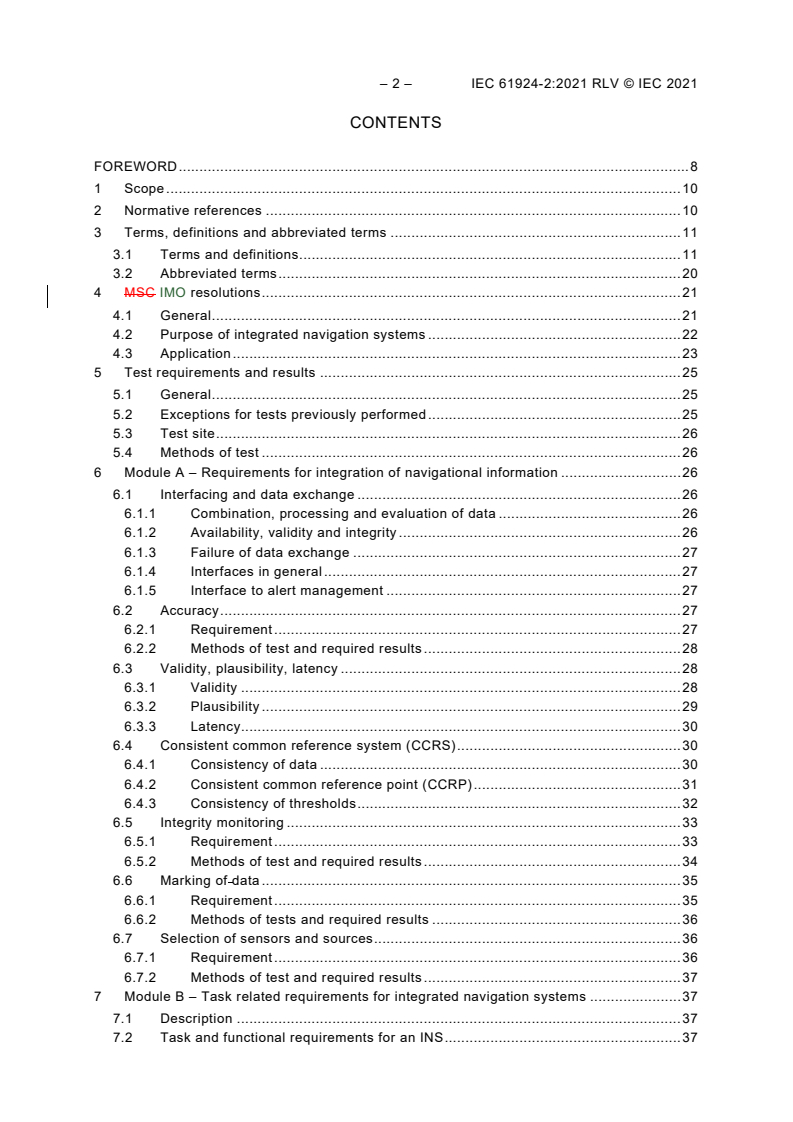
– 2 – IEC 61924-2:2021 RLV © IEC 2021
CONTENTS
FOREWORD . 8
1 Scope . 10
2 Normative references . 10
3 Terms, definitions and abbreviated terms . 11
3.1 Terms and definitions . 11
3.2 Abbreviated terms . 20
4 MSC IMO resolutions . 21
4.1 General . 21
4.2 Purpose of integrated navigation systems . 22
4.3 Application . 23
5 Test requirements and results . 25
5.1 General . 25
5.2 Exceptions for tests previously performed . 25
5.3 Test site . 26
5.4 Methods of test . 26
6 Module A – Requirements for integration of navigational information . 26
6.1 Interfacing and data exchange . 26
6.1.1 Combination, processing and evaluation of data . 26
6.1.2 Availability, validity and integrity . 26
6.1.3 Failure of data exchange . 27
6.1.4 Interfaces in general . 27
6.1.5 Interface to alert management . 27
6.2 Accuracy . 27
6.2.1 Requirement . 27
6.2.2 Methods of test and required results . 28
6.3 Validity, plausibility, latency . 28
6.3.1 Validity . 28
6.3.2 Plausibility . 29
6.3.3 Latency. 30
6.4 Consistent common reference system (CCRS) . 30
6.4.1 Consistency of data . 30
6.4.2 Consistent common reference point (CCRP) . 31
6.4.3 Consistency of thresholds . 32
6.5 Integrity monitoring . 33
6.5.1 Requirement . 33
6.5.2 Methods of test and required results . 34
6.6 Marking of data . 35
6.6.1 Requirement . 35
6.6.2 Methods of tests and required results . 36
6.7 Selection of sensors and sources . 36
6.7.1 Requirement . 36
6.7.2 Methods of test and required results . 37
7 Module B – Task related requirements for integrated navigation systems . 37
7.1 Description . 37
7.2 Task and functional requirements for an INS . 37
7.2.1 General . 37
7.2.2 Task "Route planning" . 38
7.2.3 Task "Route monitoring" . 40
7.2.4 Task "Collision avoidance" . 44
7.2.5 Task "Navigation control data" . 48
7.2.6 Task "Alert management" . 50
7.2.7 Task "Status and data display" . 50
7.3 Functional requirements for INS task stations . 52
7.3.1 Number of task stations . 52
7.3.2 Track control . 53
7.3.3 Automatic control functions . 54
7.4 Functional requirements for displays of INS . 55
7.4.1 General . 55
7.4.2 Default display configurations and operational modes . 58
7.4.3 Mode and status awareness . 59
7.4.4 Information display . 60
7.5 Human machine interface . 61
7.5.1 General . 61
7.5.2 System Equipmen design . 62
7.5.3 Display . 62
7.5.4 Input . 62
7.6 INS back-up requirements and redundancies . 63
7.6.1 General . 63
7.6.2 Hardware redundancies (back-up) . 65
7.7 System failures and fallback arrangement . 65
7.7.1 General description . 65
7.7.2 Restored operation . 65
7.7.3 Failure or change of sensor for automatic control function . 66
7.7.4 Failure of sensor . 66
7.7.5 Storage of system related parameters . 67
7.7.6 Safe response to malfunction. 67
7.7.7 Alert management . 68
7.7.8 Fallback for navigational information failure . 69
7.8 Technical requirements . 70
7.8.1 General . 70
7.8.2 Hardware and/or processors . 71
7.8.3 Power supply . 71
7.8.4 Power interruptions and shutdown . 72
7.8.5 Data communication interface and protocols . 73
7.8.6 Installation . 73
8 Module C – Alert management . 74
8.1 Description .
8.1.1 Purpose of alert management .
8.1.2 Scope of alert management .
8.1.3 Application of alert management .
8.2 General requirements .
8.2.1 Provisions .
8.2.2 Number of alerts for one situation .
– 4 – IEC 61924-2:2021 RLV © IEC 2021
8.2.3 Alerts to be handled by the alert management .
8.2.4 Logical architecture of the alert management .
8.2.5 Alert management HMI .
8.2.6 Audible announcements .
8.2.7 Display at several locations .
8.3 Priorities and categories .
8.3.1 Priorities of alerts .
8.3.2 Criteria for classification of alerts .
8.3.3 Categories of alerts .
8.4 State of alerts .
8.4.1 General .
8.4.2 Alarms .
8.4.3 Warnings .
8.4.4 Cautions .
8.4.5 Alert escalation .
8.5 Consistent presentation of alerts within the INS .
8.5.1 Requirement .
8.5.2 Methods of test and required results .
8.6 Central alert management HMI .
8.6.1 General requirements .
8.6.2 Silencing of audible alerts .
8.6.3 Category A and B alert history list .
8.7 Acknowledgement location .
8.7.1 Requirement .
8.7.2 Methods of test and required results .
8.8 Self-monitoring of alert management .
8.8.1 Monitoring of system communication .
8.8.2 Testing of alerts .
8.8.3 Failures .
8.9 Interface requirements for alert related communication .
8.9.1 Communication concept .
8.9.2 Alert priorities, states, etc. .
8.9.3 Alert source identity .
8.9.4 Acknowledge and silence.
8.9.5 Fault tolerance of alert communication .
8.10 Integration of systems in alert management .
8.10.1 Overall alert management .
8.10.2 Inclusion of other equipment .
8.10.3 Connection of other equipment .
8.1 Description . 106
8.1.1 Purpose of alert management . 106
8.1.2 Scope of alert management . 106
8.2 General requirements . 107
8.2.1 Provisions . 107
8.2.2 Requirement . 107
8.2.3 Methods of test and required results . 107
8.3 Transfer to BNWAS . 107
8.3.1 Requirement . 107
8.3.2 Methods of test and required results . 108
8.4 Testing of alerts . 108
8.4.1 Requirement . 108
8.4.2 Methods of test and required results . 108
8.5 Failures . 108
8.5.1 Requirement . 108
8.5.2 Methods of test and required results . 109
9 Module D – Documentation requirements . 109
9.1 Manuals . 109
9.1.1 Requirement . 109
9.1.2 Methods of tests and required results . 110
9.2 Information regarding the system configuration . 110
9.2.1 Requirement . 110
9.2.2 Methods of tests and required results . 110
9.3 Failure analysis . 110
9.3.1 Requirement . 110
9.3.2 Methods of test and required results . 110
9.4 Onboard familiarization material . 111
9.4.1 Requirement . 111
9.4.2 Methods of test and required results . 111
Annex A (informative) Modular structure for IMO performance standards . 112
A.1 Modular structure for radar performance standards . 112
A.2 Modular structure for track control performance standards . 114
Annex B (informative) Guidance to equipment manufacturers for the provision of on-
board familiarization material . 115
B.1 General . 115
B.2 On-board familiarization training for INS . 115
B.3 Familiarization training framework . 116
B.3.1 General description . 116
B.3.2 Detailed operation (normal conditions) . 116
Annex C (normative) Classification of alerts . 118
Annex D (normative) Default display configurations . 121
Annex E (informative) Data flow diagram/consistent common reference system
(CCRS) . 123
Annex F (normative) IEC 61162 Interfaces . 125
Annex G (informative) Guidance for testing . 133
G.1 Methods of test derived from ISO 9241-12 . 133
G.2 Observation . 133
G.3 Inspection of documented evidence . 133
G.4 Measurement . 134
G.5 Analytical evaluation . 134
Annex H (normative) Verification of CCRP calculations . 135
H.1 Scenario for verification of CCRP calculations . 135
H.2 Stationary scenario . 135
H.3 Dynamic scenario . 136
Annex I (normative) Sentence for integrity and plausibility . 137
Annex J (normative) INS alert related communication . 139
– 6 – IEC 61924-2:2021 RLV © IEC 2021
J.1 Overview. 139
J.2 Use of ALR for BNWAS . 139
J.3 Use of ALR and ACK for legacy simple sensors . 151
J.4 Use of HBT, ALF, ALC, ACN, AGL and ARC . 151
J.5 INS standardized alert identifiers . 151
J.6 Alert state transition diagram . 151
Annex K (normative informative) Sentences for advanced alert related communication . 152
Annex L (normative) Alert communication with ALR and ACK .
Annex M (normative) Icons for alert management .
Bibliography . 162
Figure E.1 – Data flow diagram/consistent common reference system (CCRS) . 124
Figure F.1 – INS logical interfaces . 125
Figure J.1 – Legacy sensor communication showing priority reduction .
Figure J.2 – Legacy sensor communication in case priority reduction is not possible .
Figure J.3 – Alerts' communication showing priority reduction .
Figure J.4 – Alerts with communication in case priority reduction is not possible .
Figure J.5 – Alert state diagram .
Figure L.1 – State diagram.
Table 1 – Applicable modules of performance standards of stand alone equipment. 24
Table 2 – Applicable modules of other standards for INS to substitute for individual
equipment . 24
Table 3 – Marking of data . 36
Table 4 – Announcement states and related conditions .
Table 5 – Announcement state and presentation for Alarms .
Table 6 – Announcement state and presentation for Warnings .
Table 7 – Announcement state and presentation for Cautions .
Table A.1 – Modular structure for radar performance standards . 112
Table A.2 – Modular structure for track control performance standards . 114
Table C.1 – Classification of INS alerts as specified in these performance standards . 118
Table C.2 – Classification for INS for alerts specified in the individual equipment
performance standards . 119
Table D.1 – Task "Route monitoring" . 121
Table D.2 – Task "Collision avoidance" . 122
Table F.1 – IEC 61162-1 sentences transmitted by the INS . 126
Table F.2 – IEC 61162-1 sentences received by the INS . 129
Table H.1 – Required results . 135
Table H.2 – Required results . 136
Table H.3 – Required results for dynamic scenario . 136
Table H.4 – Required resolution for test . 136
Table J.1 – Conversion from ALR to ALF .
Table J.2 – Conversion from ACN to ACK .
Table J.3 – Unique alert identifier at alert source .
Table M.1 – Alert management icons – Basic .
Table M.2 – Alert management icons – Additional qualifiers .
– 8 – IEC 61924-2:2021 RLV © IEC 2021
INTERNATIONAL ELECTROTECHNICAL COMMISSION
____________
MARITIME NAVIGATION AND
RADIOCOMMUNICATION EQUIPMENT AND SYSTEMS –
INTEGRATED NAVIGATION SYSTEMS (INS) –
Part 2: Modular structure for INS –
Operational and performance requirements,
methods of testing and required test results
FOREWORD
1) The International Electrotechnical Commission (IEC) is a worldwide organization for standardization comprising
all national electrotechnical committees (IEC National Committees). The object of IEC is to promote
international co-operation on all questions concerning standardization in the electrical and electronic fields. To
this end and in addition to other activities, IEC publishes International Standards, Technical Specifications,
Technical Reports, Publicly Available Specifications (PAS) and Guides (hereafter referred to as "IEC
Publication(s)"). Their preparation is entrusted to technical committees; any IEC National Committee interested
in the subject dealt with may participate in this preparatory work. International, governmental and non-
governmental organizations liaising with the IEC also participate in this preparation. IEC collaborates closely
with the International Organization for Standardization (ISO) in accordance with conditions determined by
agreement between the two organizations.
2) The formal decisions or agreements of IEC on technical matters express, as nearly as possible, an international
consensus of opinion on the relevant subjects since each technical committee has representation from all
interested IEC National Committees.
3) IEC Publications have the form of recommendations for international use and are accepted by IEC National
Committees in that sense. While all reasonable efforts are made to ensure that the technical content of IEC
Publications is accurate, IEC cannot be held responsible for the way in which they are used or for any
misinterpretation by any end user.
4) In order to promote international uniformity, IEC National Committees undertake to apply IEC Publications
transparently to the maximum extent possible in their national and regional publications. Any divergence
between any IEC Publication and the corresponding national or regional publication shall be clearly indicated in
the latter.
5) IEC itself does not provide any attestation of conformity. Independent certification bodies provide conformity
assessment services and, in some areas, access to IEC marks of conformity. IEC is not responsible for any
services carried out by independent certification bodies.
6) All users should ensure that they have the latest edition of this publication.
7) No liability shall attach to IEC or its directors, employees, servants or agents including individual experts and
members of its technical committees and IEC National Committees for any personal injury, property damage or
other damage of any nature whatsoever, whether direct or indirect, or for costs (including legal fees) and
expenses arising out of the publication, use of, or reliance upon, this IEC Publication or any other IEC
Publications.
8) Attention is drawn to the Normative references cited in this publication. Use of the referenced publications is
indispensable for the correct application of this publication.
9) Attention is drawn to the possibility that some of the elements of this IEC Publication may be the subject of
patent rights. IEC shall not be held responsible for identifying any or all such patent rights.
This redline version of the official IEC Standard allows the user to identify the changes
made to the previous edition IEC 61924-2:2012. A vertical bar appears in the margin
wherever a change has been made. Additions are in green text, deletions are in
strikethrough red text.
International Standard IEC 61924-2 has been prepared by IEC technical committee 80:
Maritime navigation and radiocommunication equipment and systems.
This second edition cancels and replaces the first edition published in 2012, of which it
constitutes a technical revision.
This edition includes the following significant technical changes with respect to the previous
edition:
a) addition of a requirement for INS to provide capability for Maritime Safety Information to
comply with requirements of the International Maritime Organization;
b) modification of Clause 8 (Alert management) and associated annexes to align it with
IEC 62923-1 concerning bridge management;
c) modifications to Annex D to incorporate newer recommendations of the International
Maritime Organization.
The text of this International Standard is based on the following documents:
FDIS Report on voting
80/977/FDIS 80/970/RVC
Full information on the voting for the approval of this International Standard can be found in
the report on voting indicated in the above table.
This document has been drafted in accordance with the ISO/IEC Directives, Part 2.
A list of all parts in the IEC 61924 series, published under the general title Maritime
navigation and radiocommunication equipment and systems – Integrated navigation systems
(INS), can be found on the IEC website.
The committee has decided that the contents of this document will remain unchanged until the
stability date indicated on the IEC website under "http://webstore.iec.ch" in the data related to
the specific document. At this date, the document will be
• reconfirmed,
• withdrawn,
• replaced by a revised edition, or
• amended.
IMPORTANT – The "colour inside" logo on the cover page of this document indicates
that it contains colours which are considered to be useful for the correct
understanding of its contents. Users should therefore print this document using a
colour printer.
– 10 – IEC 61924-2:2021 RLV © IEC 2021
MARITIME NAVIGATION AND
RADIOCOMMUNICATION EQUIPMENT AND SYSTEMS –
INTEGRATED NAVIGATION SYSTEMS (INS) –
Part 2: Modular structure for INS –
Operational and performance requirements,
methods of testing and required test results
1 Scope
This part of IEC 61924 specifies the minimum requirements for the design, manufacture,
integration, methods of testing and required test results for an integrated navigation system
(INS) to comply with the International Maritime Organization (IMO) requirements of Resolution
MSC.252(83), as amended by Resolution MSC.452(99). In addition, it takes account of IMO
Resolution A.694(17) to which IEC 60945 is associated. When a requirement in this document
is different from IEC 60945, the requirement of this document takes precedence.
NOTE 1 IEC 61924:2006 specifies the minimum requirements for the design, manufacture, integration, methods
of testing and required test results for an integrated navigation system to comply with the earlier IMO requirements
of Resolution MSC 86(70), Annex 3. Integrated navigation systems in accordance with IEC 61924:2006 are not
suitable for installation after 1 January 2011.
For bridge alert management, IMO Resolution MSC.302(87) supersedes IMO Resolution
MSC.252(83). Accordingly, this document incorporates references to IEC 62923-1 and
IEC 62923-2 which are associated with Resolution MSC.302(87) for requirements and tests,
where applicable. This document indicates which requirements and associated tests of
MSC.252(83) have been superseded by MSC.302(87).
NOTE All text of this document whose wording is identical to that in IMO Resolution MSC.252(83), as amended by
MSC.452(99), will be is printed in italics and the Resolution and paragraph number indicated between brackets.
2 Normative references
The following documents are referred to in the text in such a way that some or all of their
content constitutes requirements of this document. For dated references, only the edition
cited applies. For undated references, the latest edition of the referenced document (including
any amendments) applies.
IEC 60945:2002, Maritime navigation and radiocommunication equipment and systems –
General requirements – Methods of testing and required test results
IEC 61162 (all parts), Maritime navigation and radiocommunication equipment and systems –
Digital interfaces
IEC 61162-1:20102016, Maritime navigation and radiocommunication equipment and systems
– Digital interfaces – Part 1: Single talker and multiple listeners
IEC 61162-2, Maritime navigation and radiocommunication equipment and systems – Digital
interfaces – Part 2: Single talker and multiple listeners, high-speed transmission
IEC 61162-3, Maritime navigation and radiocommunication equipment and systems – Digital
interfaces – Part 3: Serial data instrument network
IEC 61162-450, Maritime navigation and radiocommunication equipment and systems –
Digital interfaces – Part 450: Multiple talkers and multiple listeners – Ethernet interconnection
IEC 61174:20082015, Maritime navigation and radiocommunication equipment and systems –
Electronic chart display and information system (ECDIS) – Operational and performance
requirements, methods of testing and required test results
IEC 62065:20022014, Maritime navigation and radiocommunication equipment and systems –
Track control systems – Operational and performance requirements, methods of testing and
required test results
IEC 62288:2008, Maritime navigation and radiocommunication equipment and systems –
Presentation of navigation-related information on shipborne navigational displays – General
requirements, methods of testing and required test results
IEC 62388:20072013, Maritime navigation and radiocommunication equipment and systems –
Shipborne radar – Performance requirements, methods of testing and required test results
IEC 62616:2010, Maritime navigation and radiocommunication equipment and systems –
Bridge navigational watch alarm system (BNWAS)
IEC 62923-1:2018, Maritime navigation and radiocommunication equipment and systems –
Bridge alert management – Part 1: Operational and performance requirements, methods of
testing and required test results
ISO 11674, Ships and marine technology – Heading control systems
IMO A.694(17), General requirements for shipborne radio equipment forming part of the
Global maritime distress and safety system (GMDSS) and for electronic navigational aids
IMO/ICAO, International Aeronautical and Maritime Search and Rescue Manual (IAMSAR
Manual) Volume 3
IMO MSC/Circ.982, Guidelines on ergonomic criteria for bridge equipment and layout
IMO MSC.191(79), Performance standards for presentation of navigation-related information
on shipborne navigational displays
IMO MSC.232(82), Revised performance standards for Electronic Chart Display and
Information Systems (ECDIS)
IMO MSC.252(83), Performance Standards for Integrated Navigation Systems (INS)
IMO MSC.302(87), performance standards for Bridge Alert Management (BAM)
ISO 11674:2006, Ships and marine technology – Heading control systems
IMO MSC.452(99), Amendments to the revised performance standards for integrated
navigation systems (INS) (Resolution MSC.252(83))
3 Terms, definitions and abbreviated terms
3.1 Terms and definitions
For the purposes of this document, the following terms and definitions apply.
ISO and IEC maintain terminological databases for use in standardization at the following
addresses:
– 12 – IEC 61924-2:2021 RLV © IEC 2021
• IEC Electropedia: available at http://www.electropedia.org/
• ISO Online browsing platform: available at http://www.iso.org/obp
3.1.1
accuracy
degree of conformance between the estimated or measured parameter value at a given time
and its true parameter value at that time
3.1.2
added value
functionality and information, which are provided by the INS, in addition to the requirements of
the performance standard for the individual equipment
3.1.3
aggregated alert
alert indicating the existence of multiple individual alerts of the same kind
3.1.3
aid to navigation
AtoN
any device or system external to a vessel intended to assist a navigator to determine position
or safe course, or to warn of hazards to navigation
3.1.4
AIS ASM
AIS application specific messages that are included in IEC 62288
3.1.5
alarm
the highest priority of an alert as defined in MSC.252(83). Announcing a situation or condition
requiring immediate attention, decision and if necessary action by the bridge team, to
maintain the safe navigation of the ship
condition requiring immediate attention and action by the bridge team, to maintain the safe
navigation of the ship
3.1.6
alert
announcing abnormal situations and conditions requiring attention, decision and/or action.
Alerts are divided in three priorities: alarms, warnings and cautions
announcement of abnormal situations and conditions requiring attention
Note 1 to entry: Alerts are divided in four priorities: emergency alarms, alarms, warnings and cautions. An alert
provides information about a defined state change in connection with information about how to announce this event
in a defined way to the system and the operator.
3.1.7
alert announcement
visual and, where applicable, acoustical presentation of alerts
3.1.8
alert history list
accessible list of past alerts
3.1.9
alert management
concept for the harmonized regulation of the monitoring, ha
...
IEC 61924-2 ®
Edition 2.0 2021-02
INTERNATIONAL
STANDARD
NORME
INTERNATIONALE
colour
inside
Maritime navigation and radiocommunication equipment and systems –
Integrated navigation systems (INS) –
Part 2: Modular structure for INS – Operational and performance requirements,
methods of testing and required test results
Matériels et systèmes de navigation et de radiocommunication maritimes –
Systèmes de navigation intégrés (INS) –
Partie 2: Structure modulaire des systèmes de navigation intégrés – Exigences
opérationnelles et de fonctionnement, méthodes d'essai et résultats d'essai
exigés
All rights reserved. Unless otherwise specified, no part of this publication may be reproduced or utilized in any form
or by any means, electronic or mechanical, including photocopying and microfilm, without permission in writing from
either IEC or IEC's member National Committee in the country of the requester. If you have any questions about IEC
copyright or have an enquiry about obtaining additional rights to this publication, please contact the address below or
your local IEC member National Committee for further information.
Droits de reproduction réservés. Sauf indication contraire, aucune partie de cette publication ne peut être reproduite
ni utilisée sous quelque forme que ce soit et par aucun procédé, électronique ou mécanique, y compris la photocopie
et les microfilms, sans l'accord écrit de l'IEC ou du Comité national de l'IEC du pays du demandeur. Si vous avez des
questions sur le copyright de l'IEC ou si vous désirez obtenir des droits supplémentaires sur cette publication, utilisez
les coordonnées ci-après ou contactez le Comité national de l'IEC de votre pays de résidence.
IEC Central Office Tel.: +41 22 919 02 11
3, rue de Varembé info@iec.ch
CH-1211 Geneva 20 www.iec.ch
Switzerland
About the IEC
The International Electrotechnical Commission (IEC) is the leading global organization that prepares and publishes
International Standards for all electrical, electronic and related technologies.
About IEC publications
The technical content of IEC publications is kept under constant review by the IEC. Please make sure that you have the
latest edition, a corrigendum or an amendment might have been published.
IEC publications search - webstore.iec.ch/advsearchform IEC online collection - oc.iec.ch
The advanced search enables to find IEC publications by a Discover our powerful search engine and read freely all the
variety of criteria (reference number, text, technical publications previews. With a subscription you will always
committee, …). It also gives information on projects, replaced have access to up to date content tailored to your needs.
and withdrawn publications.
Electropedia - www.electropedia.org
IEC Just Published - webstore.iec.ch/justpublished
The world's leading online dictionary on electrotechnology,
Stay up to date on all new IEC publications. Just Published
containing more than 22 000 terminological entries in English
details all new publications released. Available online and
and French, with equivalent terms in 18 additional languages.
once a month by email.
Also known as the International Electrotechnical Vocabulary
(IEV) online.
IEC Customer Service Centre - webstore.iec.ch/csc
If you wish to give us your feedback on this publication or
need further assistance, please contact the Customer Service
Centre: sales@iec.ch.
A propos de l'IEC
La Commission Electrotechnique Internationale (IEC) est la première organisation mondiale qui élabore et publie des
Normes internationales pour tout ce qui a trait à l'électricité, à l'électronique et aux technologies apparentées.
A propos des publications IEC
Le contenu technique des publications IEC est constamment revu. Veuillez vous assurer que vous possédez l’édition la
plus récente, un corrigendum ou amendement peut avoir été publié.
Recherche de publications IEC - IEC online collection - oc.iec.ch
webstore.iec.ch/advsearchform Découvrez notre puissant moteur de recherche et consultez
La recherche avancée permet de trouver des publications IEC gratuitement tous les aperçus des publications. Avec un
en utilisant différents critères (numéro de référence, texte, abonnement, vous aurez toujours accès à un contenu à jour
comité d’études, …). Elle donne aussi des informations sur adapté à vos besoins.
les projets et les publications remplacées ou retirées.
Electropedia - www.electropedia.org
IEC Just Published - webstore.iec.ch/justpublished
Le premier dictionnaire d'électrotechnologie en ligne au
Restez informé sur les nouvelles publications IEC. Just
monde, avec plus de 22 000 articles terminologiques en
Published détaille les nouvelles publications parues.
anglais et en français, ainsi que les termes équivalents dans
Disponible en ligne et une fois par mois par email.
16 langues additionnelles. Egalement appelé Vocabulaire
Electrotechnique International (IEV) en ligne.
Service Clients - webstore.iec.ch/csc
Si vous désirez nous donner des commentaires sur cette
publication ou si vous avez des questions contactez-nous:
sales@iec.ch.
IEC 61924-2 ®
Edition 2.0 2021-02
INTERNATIONAL
STANDARD
NORME
INTERNATIONALE
colour
inside
Maritime navigation and radiocommunication equipment and systems –
Integrated navigation systems (INS) –
Part 2: Modular structure for INS – Operational and performance requirements,
methods of testing and required test results
Matériels et systèmes de navigation et de radiocommunication maritimes –
Systèmes de navigation intégrés (INS) –
Partie 2: Structure modulaire des systèmes de navigation intégrés – Exigences
opérationnelles et de fonctionnement, méthodes d'essai et résultats d'essai
exigés
INTERNATIONAL
ELECTROTECHNICAL
COMMISSION
COMMISSION
ELECTROTECHNIQUE
INTERNATIONALE
ICS 47.020.70 ISBN 978-2-8322-9304-1
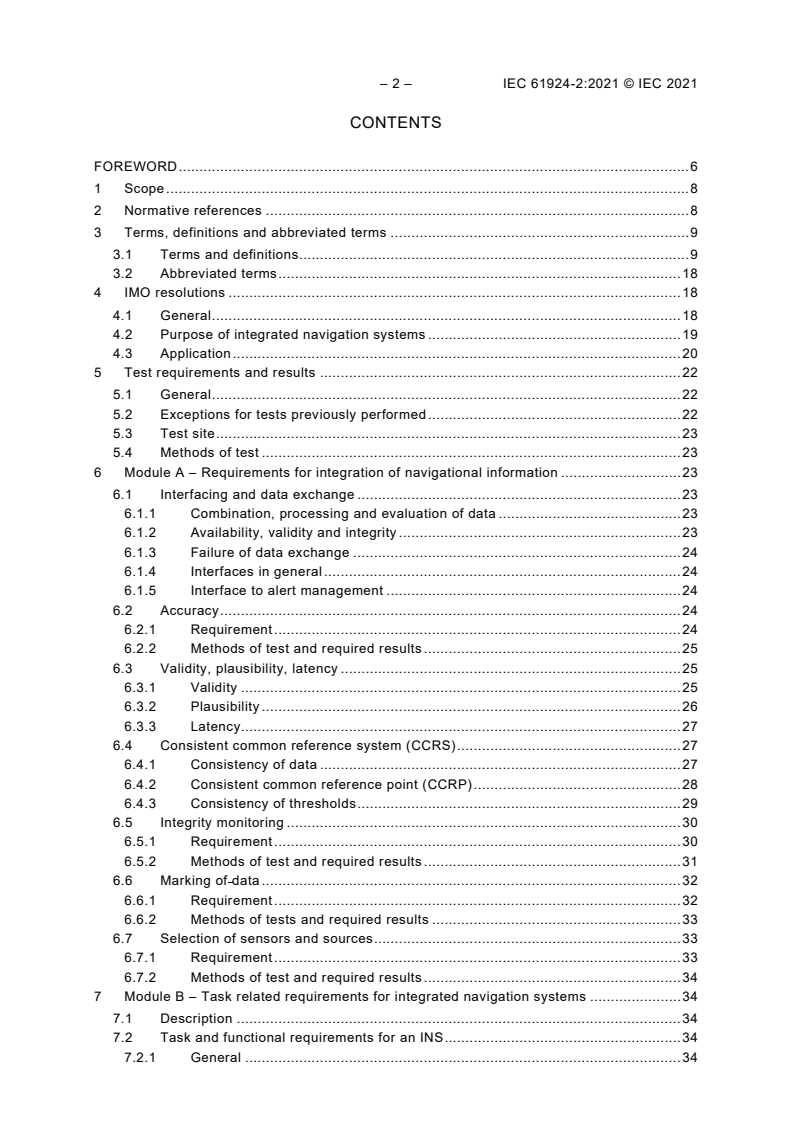
– 2 – IEC 61924-2:2021 © IEC 2021
CONTENTS
FOREWORD . 6
1 Scope . 8
2 Normative references . 8
3 Terms, definitions and abbreviated terms . 9
3.1 Terms and definitions . 9
3.2 Abbreviated terms . 18
4 IMO resolutions . 18
4.1 General . 18
4.2 Purpose of integrated navigation systems . 19
4.3 Application . 20
5 Test requirements and results . 22
5.1 General . 22
5.2 Exceptions for tests previously performed . 22
5.3 Test site . 23
5.4 Methods of test . 23
6 Module A – Requirements for integration of navigational information . 23
6.1 Interfacing and data exchange . 23
6.1.1 Combination, processing and evaluation of data . 23
6.1.2 Availability, validity and integrity . 23
6.1.3 Failure of data exchange . 24
6.1.4 Interfaces in general . 24
6.1.5 Interface to alert management . 24
6.2 Accuracy . 24
6.2.1 Requirement . 24
6.2.2 Methods of test and required results . 25
6.3 Validity, plausibility, latency . 25
6.3.1 Validity . 25
6.3.2 Plausibility . 26
6.3.3 Latency. 27
6.4 Consistent common reference system (CCRS) . 27
6.4.1 Consistency of data . 27
6.4.2 Consistent common reference point (CCRP) . 28
6.4.3 Consistency of thresholds . 29
6.5 Integrity monitoring . 30
6.5.1 Requirement . 30
6.5.2 Methods of test and required results . 31
6.6 Marking of data . 32
6.6.1 Requirement . 32
6.6.2 Methods of tests and required results . 33
6.7 Selection of sensors and sources . 33
6.7.1 Requirement . 33
6.7.2 Methods of test and required results . 34
7 Module B – Task related requirements for integrated navigation systems . 34
7.1 Description . 34
7.2 Task and functional requirements for an INS . 34
7.2.1 General . 34
7.2.2 Task "Route planning" . 35
7.2.3 Task "Route monitoring" . 37
7.2.4 Task "Collision avoidance" . 41
7.2.5 Task "Navigation control data" . 45
7.2.6 Task "Alert management" . 46
7.2.7 Task "Status and data display" . 47
7.3 Functional requirements for INS task stations . 48
7.3.1 Number of task stations . 48
7.3.2 Track control . 50
7.3.3 Automatic control functions . 51
7.4 Functional requirements for displays of INS . 52
7.4.1 General . 52
7.4.2 Default display configurations and operational modes . 55
7.4.3 Mode and status awareness . 56
7.4.4 Information display . 56
7.5 Human machine interface . 58
7.5.1 General . 58
7.5.2 Equipment design . 58
7.5.3 Display . 59
7.5.4 Input . 59
7.6 INS back-up requirements and redundancies . 60
7.6.1 General . 60
7.6.2 Hardware redundancies (back-up) . 62
7.7 System failures and fallback arrangement . 62
7.7.1 General description . 62
7.7.2 Restored operation . 62
7.7.3 Failure or change of sensor for automatic control function . 63
7.7.4 Failure of sensor . 63
7.7.5 Storage of system related parameters . 64
7.7.6 Safe response to malfunction. 64
7.7.7 Alert management . 65
7.7.8 Fallback for navigational information failure . 65
7.8 Technical requirements . 67
7.8.1 General . 67
7.8.2 Hardware and/or processors . 67
7.8.3 Power supply . 68
7.8.4 Power interruptions and shutdown . 68
7.8.5 Data communication interface and protocols . 69
7.8.6 Installation . 69
8 Module C – Alert management . 70
8.1 Description . 70
8.1.1 Purpose of alert management . 70
8.1.2 Scope of alert management . 70
8.2 General requirements . 71
8.2.1 Provisions . 71
8.2.2 Requirement . 71
8.2.3 Methods of test and required results . 72
8.3 Transfer to BNWAS . 72
8.3.1 Requirement . 72
– 4 – IEC 61924-2:2021 © IEC 2021
8.3.2 Methods of test and required results . 72
8.4 Testing of alerts . 72
8.4.1 Requirement . 72
8.4.2 Methods of test and required results . 73
8.5 Failures . 73
8.5.1 Requirement . 73
8.5.2 Methods of test and required results . 73
9 Module D – Documentation requirements . 73
9.1 Manuals . 73
9.1.1 Requirement . 73
9.1.2 Methods of tests and required results . 74
9.2 Information regarding the system configuration . 74
9.2.1 Requirement . 74
9.2.2 Methods of tests and required results . 75
9.3 Failure analysis . 75
9.3.1 Requirement . 75
9.3.2 Methods of test and required results . 75
9.4 Onboard familiarization material . 75
9.4.1 Requirement . 75
9.4.2 Methods of test and required results . 75
Annex A (informative) Modular structure for IMO performance standards . 76
A.1 Modular structure for radar performance standards . 76
A.2 Modular structure for track control performance standards . 78
Annex B (informative) Guidance to equipment manufacturers for the provision of on-
board familiarization material . 79
B.1 General . 79
B.2 On-board familiarization training for INS . 79
B.3 Familiarization training framework . 80
B.3.1 General description . 80
B.3.2 Detailed operation (normal conditions) . 80
Annex C (normative) Classification of alerts . 82
Annex D (normative) Default display configurations . 85
Annex E (informative) Data flow diagram/consistent common reference system
(CCRS) . 87
Annex F (normative) Interfaces . 89
Annex G (informative) Guidance for testing . 94
G.1 Methods of test derived from ISO 9241-12 . 94
G.2 Observation . 94
G.3 Inspection of documented evidence . 94
G.4 Measurement . 95
G.5 Analytical evaluation . 95
Annex H (normative) Verification of CCRP calculations . 96
H.1 Scenario for verification of CCRP calculations . 96
H.2 Stationary scenario . 96
H.3 Dynamic scenario . 97
Annex I (normative) Sentence for integrity and plausibility . 98
Annex J (normative) INS alert related communication . 99
J.1 Overview. 99
J.2 Use of ALR for BNWAS . 99
J.3 Use of ALR and ACK for legacy simple sensors . 99
J.4 Use of HBT, ALF, ALC, ACN, AGL and ARC . 99
J.5 INS standardized alert identifiers . 99
J.6 Alert state transition diagram . 99
Annex K (informative) Sentences for advanced alert related communication . 100
Bibliography . 101
Figure E.1 – Data flow diagram/consistent common reference system (CCRS) . 88
Figure F.1 – INS logical interfaces . 89
Table 1 – Applicable modules of performance standards of stand alone equipment. 21
Table 2 – Applicable modules of other standards for INS to substitute for individual
equipment . 21
Table 3 – Marking of data . 33
Table A.1 – Modular structure for radar performance standards . 76
Table A.2 – Modular structure for track control performance standards . 78
Table C.1 – Classification of INS alerts as specified in these performance standards . 82
Table C.2 – Classification for INS for alerts specified in the individual equipment
performance standards . 83
Table D.1 – Task "Route monitoring" . 85
Table D.2 – Task "Collision avoidance" . 86
Table F.1 – IEC 61162-1 sentences transmitted by the INS . 90
Table F.2 – IEC 61162-1 sentences received by the INS . 91
Table H.1 – Required results . 96
Table H.2 – Required results . 97
Table H.3 – Required results for dynamic scenario . 97
Table H.4 – Required resolution for test . 97
– 6 – IEC 61924-2:2021 © IEC 2021
INTERNATIONAL ELECTROTECHNICAL COMMISSION
____________
MARITIME NAVIGATION AND
RADIOCOMMUNICATION EQUIPMENT AND SYSTEMS –
INTEGRATED NAVIGATION SYSTEMS (INS) –
Part 2: Modular structure for INS –
Operational and performance requirements,
methods of testing and required test results
FOREWORD
1) The International Electrotechnical Commission (IEC) is a worldwide organization for standardization comprising
all national electrotechnical committees (IEC National Committees). The object of IEC is to promote
international co-operation on all questions concerning standardization in the electrical and electronic fields. To
this end and in addition to other activities, IEC publishes International Standards, Technical Specifications,
Technical Reports, Publicly Available Specifications (PAS) and Guides (hereafter referred to as "IEC
Publication(s)"). Their preparation is entrusted to technical committees; any IEC National Committee interested
in the subject dealt with may participate in this preparatory work. International, governmental and non-
governmental organizations liaising with the IEC also participate in this preparation. IEC collaborates closely
with the International Organization for Standardization (ISO) in accordance with conditions determined by
agreement between the two organizations.
2) The formal decisions or agreements of IEC on technical matters express, as nearly as possible, an international
consensus of opinion on the relevant subjects since each technical committee has representation from all
interested IEC National Committees.
3) IEC Publications have the form of recommendations for international use and are accepted by IEC National
Committees in that sense. While all reasonable efforts are made to ensure that the technical content of IEC
Publications is accurate, IEC cannot be held responsible for the way in which they are used or for any
misinterpretation by any end user.
4) In order to promote international uniformity, IEC National Committees undertake to apply IEC Publications
transparently to the maximum extent possible in their national and regional publications. Any divergence
between any IEC Publication and the corresponding national or regional publication shall be clearly indicated in
the latter.
5) IEC itself does not provide any attestation of conformity. Independent certification bodies provide conformity
assessment services and, in some areas, access to IEC marks of conformity. IEC is not responsible for any
services carried out by independent certification bodies.
6) All users should ensure that they have the latest edition of this publication.
7) No liability shall attach to IEC or its directors, employees, servants or agents including individual experts and
members of its technical committees and IEC National Committees for any personal injury, property damage or
other damage of any nature whatsoever, whether direct or indirect, or for costs (including legal fees) and
expenses arising out of the publication, use of, or reliance upon, this IEC Publication or any other IEC
Publications.
8) Attention is drawn to the Normative references cited in this publication. Use of the referenced publications is
indispensable for the correct application of this publication.
9) Attention is drawn to the possibility that some of the elements of this IEC Publication may be the subject of
patent rights. IEC shall not be held responsible for identifying any or all such patent rights.
International Standard IEC 61924-2 has been prepared by IEC technical committee 80:
Maritime navigation and radiocommunication equipment and systems.
This second edition cancels and replaces the first edition published in 2012, of which it
constitutes a technical revision.
This edition includes the following significant technical changes with respect to the previous
edition:
a) addition of a requirement for INS to provide capability for Maritime Safety Information to
comply with requirements of the International Maritime Organization;
b) modification of Clause 8 (Alert management) and associated annexes to align it with
IEC 62923-1 concerning bridge management;
c) modifications to Annex D to incorporate newer recommendations of the International
Maritime Organization.
The text of this International Standard is based on the following documents:
FDIS Report on voting
80/977/FDIS 80/970/RVC
Full information on the voting for the approval of this International Standard can be found in
the report on voting indicated in the above table.
This document has been drafted in accordance with the ISO/IEC Directives, Part 2.
A list of all parts in the IEC 61924 series, published under the general title Maritime
navigation and radiocommunication equipment and systems – Integrated navigation systems
(INS), can be found on the IEC website.
The committee has decided that the contents of this document will remain unchanged until the
stability date indicated on the IEC website under "http://webstore.iec.ch" in the data related to
the specific document. At this date, the document will be
• reconfirmed,
• withdrawn,
• replaced by a revised edition, or
• amended.
IMPORTANT – The "colour inside" logo on the cover page of this document indicates
that it contains colours which are considered to be useful for the correct
understanding of its contents. Users should therefore print this document using a
colour printer.
– 8 – IEC 61924-2:2021 © IEC 2021
MARITIME NAVIGATION AND
RADIOCOMMUNICATION EQUIPMENT AND SYSTEMS –
INTEGRATED NAVIGATION SYSTEMS (INS) –
Part 2: Modular structure for INS –
Operational and performance requirements,
methods of testing and required test results
1 Scope
This part of IEC 61924 specifies the minimum requirements for the design, manufacture,
integration, methods of testing and required test results for an integrated navigation system
(INS) to comply with the International Maritime Organization (IMO) requirements of Resolution
MSC.252(83), as amended by Resolution MSC.452(99). In addition, it takes account of IMO
Resolution A.694(17) to which IEC 60945 is associated. When a requirement in this document
is different from IEC 60945, the requirement of this document takes precedence.
For bridge alert management, IMO Resolution MSC.302(87) supersedes IMO Resolution
MSC.252(83). Accordingly, this document incorporates references to IEC 62923-1 and
IEC 62923-2 which are associated with Resolution MSC.302(87) for requirements and tests,
where applicable. This document indicates which requirements and associated tests of
MSC.252(83) have been superseded by MSC.302(87).
NOTE All text of this document whose wording is identical to that in IMO Resolution MSC.252(83), as amended by
MSC.452(99), is printed in italics and the Resolution and paragraph number indicated between brackets.
2 Normative references
The following documents are referred to in the text in such a way that some or all of their
content constitutes requirements of this document. For dated references, only the edition
cited applies. For undated references, the latest edition of the referenced document (including
any amendments) applies.
IEC 60945:2002, Maritime navigation and radiocommunication equipment and systems –
General requirements – Methods of testing and required test results
IEC 61162-1:2016, Maritime navigation and radiocommunication equipment and systems –
Digital interfaces – Part 1: Single talker and multiple listeners
IEC 61162-2, Maritime navigation and radiocommunication equipment and systems – Digital
interfaces – Part 2: Single talker and multiple listeners, high-speed transmission
IEC 61162-450, Maritime navigation and radiocommunication equipment and systems –
Digital interfaces – Part 450: Multiple talkers and multiple listeners – Ethernet interconnection
IEC 61174:2015, Maritime navigation and radiocommunication equipment and systems –
Electronic chart display and information system (ECDIS) – Operational and performance
requirements, methods of testing and required test results
IEC 62065:2014, Maritime navigation and radiocommunication equipment and systems –
Track control systems – Operational and performance requirements, methods of testing and
required test results
IEC 62288, Maritime navigation and radiocommunication equipment and systems –
Presentation of navigation-related information on shipborne navigational displays – General
requirements, methods of testing and required test results
IEC 62388:2013, Maritime navigation and radiocommunication equipment and systems –
Shipborne radar – Performance requirements, methods of testing and required test results
IEC 62616, Maritime navigation and radiocommunication equipment and systems – Bridge
navigational watch alarm system (BNWAS)
IEC 62923-1:2018, Maritime navigation and radiocommunication equipment and systems –
Bridge alert management – Part 1: Operational and performance requirements, methods of
testing and required test results
ISO 11674, Ships and marine technology – Heading control systems
IMO A.694(17), General requirements for shipborne radio equipment forming part of the
Global maritime distress and safety system (GMDSS) and for electronic navigational aids
IMO/ICAO, International Aeronautical and Maritime Search and Rescue Manual (IAMSAR
Manual) Volume 3
IMO MSC/Circ.982, Guidelines on ergonomic criteria for bridge equipment and layout
IMO MSC.191(79), Performance standards for presentation of navigation-related information
on shipborne navigational displays
IMO MSC.232(82), Revised performance standards for Electronic Chart Display and
Information Systems (ECDIS)
IMO MSC.252(83), Performance Standards for Integrated Navigation Systems (INS)
IMO MSC.452(99), Amendments to the revised performance standards for integrated
navigation systems (INS) (Resolution MSC.252(83))
3 Terms, definitions and abbreviated terms
3.1 Terms and definitions
For the purposes of this document, the following terms and definitions apply.
ISO and IEC maintain terminological databases for use in standardization at the following
addresses:
• IEC Electropedia: available at http://www.electropedia.org/
• ISO Online browsing platform: available at http://www.iso.org/obp
3.1.1
accuracy
degree of conformance between the estimated or measured parameter value at a given time
and its true parameter value at that time
3.1.2
added value
functionality and information, which are provided by the INS, in addition to the requirements of
the performance standard for the individual equipment
– 10 – IEC 61924-2:2021 © IEC 2021
3.1.3
aid to navigation
AtoN
device or system external to a vessel intended to assist a navigator to determine position or
safe course, or to warn of hazards to navigation
3.1.4
AIS ASM
AIS application specific messages that are included in IEC 62288
3.1.5
alarm
condition requiring immediate attention and action by the bridge team, to maintain the safe
navigation of the ship
3.1.6
alert
announcement of abnormal situations and conditions requiring attention
Note 1 to entry: Alerts are divided in four priorities: emergency alarms, alarms, warnings and cautions. An alert
provides information about a defined state change in connection with information about how to announce this event
in a defined way to the system and the operator.
3.1.7
alert announcement
visual and, where applicable, acoustical presentation of alerts
3.1.8
alert history list
accessible list of past alerts
3.1.9
alert management
concept for the harmonized regulation of the monitoring, handling, distribution and
presentation of alerts on the bridge
3.1.10
announcement
visual and/or audible signal issued to the user by the system
3.1.11
automatic control functions
functions that include automatic heading, and/or track and/or speed control or other
navigation related automatic control functions
3.1.12
backup
use of data, function and/or hardware of similar type and quality
3.1.13
Category A alert
alert where graphical, for example radar, ECDIS, information at the task station directly
assigned to the function generating the alert is necessary, as decision support for the
evaluation the alert related condition
3.1.14
Category B alert
alerts where no additional information for decision support is necessary besides the
information which can be presented at the central alert management HMI
3.1.15
caution
lowest-priority alert
awareness of a condition which does not warrant an alarm or warning condition, but still
requires attention out of the ordinary consideration of the situation or of given information
3.1.16
collision avoidance
navigational task of detecting and plotting other ships and objects to avoid collisions
3.1.17
configuration in use
sub-systems (e.g. sensors and sources, MFD workstations, automatic control function, etc.)
selected for use and tasks (e.g. collision avoidance, route monitoring, etc.) selected operative
in each MFD
Note 1 to entry: This is a subset of the available configuration which is a subset of the complete system
configuration.
3.1.18
conning position
place on the bridge with a commanding view and which is used by navigators when
commanding, manoeuvring and controlling a ship
3.1.19
consistent common reference point
CCRP
location on own ship, to which all horizontal measurements such as target range, bearing,
relative course, relative speed, closest point of approach (CPA) or time to closest point of
approach (TCPA) are referenced, typically the conning position of the bridge
3.1.20
consistent common reference system
CCRS
sub-system or function of an INS for acquisition, processing, storage, surveillance and
distribution of data and information providing identical and obligatory reference to sub-
systems and subsequent functions within an INS and to other connected equipment, if
available
Note 1 to entry: Examples of reference are: coordinate system, time zone, chart datum and depth datum.
3.1.21
degraded condition
reduction in system functionality resulting from failure
3.1.22
detected hazard
hazard identified by a sensor (for example, radar or echo sounder) or reported by a
communication device (for example AIS or NAVTEX) and which is available to the INS
3.1.23
entry field
location on a display for the input of data by the operator
Note 1 to entry: The requested information is usually alphanumeric.
3.1.24
essential functions
indispensable functions to be available as required for the relevant operational use
– 12 – IEC 61924-2:2021 © IEC 2021
3.1.25
essential information
indispensable information to be available as required for the relevant functions
3.1.26
expected precision
deviation between the measured value and the true value that is normally not exceeded by a
typical system
3.1.27
external safety related messages
data received from outside of the ship concerning the safety of navigation, through equipment
listed in SOLAS chapter V and/or Maritime Safety Information (MSI) messages
Note 1 to entry: Sources of MSI are NAVTEX (IEC 61097-6), other IMO-recognized equipment accommodating
other providers of GMDSS terrestrially-based services and recognized mobile satellite service enhanced group
calling system (IEC 61097-4 and IEC 61097-16).
3.1.28
failure analysis
logical, systematic examination of an item, including its diagrams or formulas, to identify and
analyse the probability, causes and consequences of potential and real failures
3.1.29
fallback
use of data, function or hardware of degraded quality in relation to the failed one, for example
dead reckoning for position information, heading control in case of a failure of track control
3.1.30
functionality
ability to perform an intended function
Note 1 to entry: The activity of performing a function normally employs a system of displays, controls and
instrumentation.
3.1.31
hazard
objects or conditions potentially dangerous to navigation, possibly leading to grounding or
collision, that may be detected by a sensor, reported by a communication device, retrieved
from a database or manually input to the INS
3.1.32
human factor
workload, capabilities and limits of a user trained according to the regulations of the IMO
3.1.33
human machine interface
HMI
part of a system an operator interacts with
Note 1 to entry: The interface is the aggregate of means by which the users interact with a machine, device, and
system (the system). The interface provides means for input, allowing the users to control the system and output,
allowing the system to inform the users.
3.1.34
indication
display of regular information and conditions, not part of alert management
3.1.35
integrated navigation system
INS
composite navigation system which performs at least the following tasks: collision avoidance,
route monitoring thus providing "added value" for the operator to plan, monitor and safely
navigate the progress of the ship
Note 1 to entry: The INS allows meeting the respective parts of SOLAS regulation V/19 and supports the proper
application of SOLAS regulation V/15.
3.1.36
inspection
visual check of equipment or documentation
3.1.37
integrity
ability of the INS to provide the user with information within the specified accuracy in a timely,
complete and unambiguous manner, and alerts within a spec
...