


IEC PAS 62337:2002
(Main)Milestones and activities during commissioning of electrical instrumentation and control systems in the process industry
General Information
- Abstract
- Status
- Replaced
- Publication Date
- 29-Aug-2002
- Technical Committee
- TC 65 - Industrial-process measurement, control and automation
- Current Stage
- DELPUB - Deleted Publication
- Start Date
- 08-Nov-2006
- Completion Date
- 28-Aug-2026



Relations
- Effective Date
- 05-Sep-2023
Get Certified
Connect with accredited certification bodies for this standard

DVS-ZERT GmbH
German welding certification society.
CARES (UK Certification Authority for Reinforcing Steels)
UK certification for reinforcing steels and construction.
EWF/IIW (European/International Welding Federation)
International welding personnel certification.
Sponsored listings
Frequently Asked Questions
IEC PAS 62337:2002 is a technical specification published by the International Electrotechnical Commission (IEC). Its full title is "Milestones and activities during commissioning of electrical instrumentation and control systems in the process industry". This standard covers: Milestones and activities during commissioning of electrical instrumentation and control systems in the process industry
Milestones and activities during commissioning of electrical instrumentation and control systems in the process industry
IEC PAS 62337:2002 is classified under the following ICS (International Classification for Standards) categories: 25.040.01 - Industrial automation systems in general. The ICS classification helps identify the subject area and facilitates finding related standards.
IEC PAS 62337:2002 has the following relationships with other standards: It is inter standard links to IEC 62337:2006. Understanding these relationships helps ensure you are using the most current and applicable version of the standard.
IEC PAS 62337:2002 is available in PDF format for immediate download after purchase. The document can be added to your cart and obtained through the secure checkout process. Digital delivery ensures instant access to the complete standard document.
Standards Content (Sample)
IEC/PAS 62337
Edition 1.0
2002-08
Milestones and activities during
commissioning of electrical
instrumentation and control systems
in the process industry
PUBLICLY AVAILABLE SPECIFICATION
INTERNATIONAL Reference number
ELECTROTECHNICAL
IEC/PAS 62337
COMMISSION
IEC/PAS 62337
Edition 1.0
2002-08
Milestones and activities during
commissioning of electrical
instrumentation and control systems
in the process industry
PUBLICLY AVAILABLE SPECIFICATION
INTERNATIONAL Reference number
ELECTROTECHNICAL
IEC/PAS 62337
COMMISSION
– 2 – Copyright © 2002, IEC
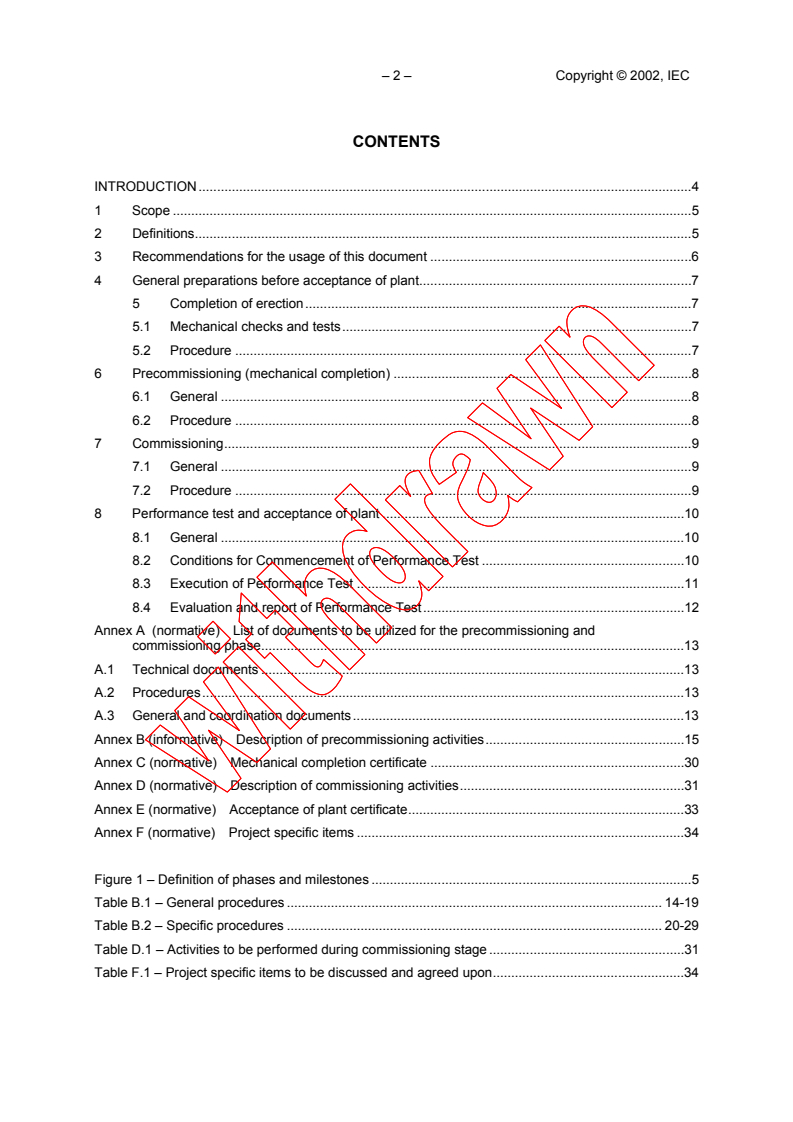
CONTENTS
INTRODUCTION.4
1 Scope.5
2 Definitions.5
3 Recommendations for the usage of this document .6
4 General preparations before acceptance of plant.7
5 Completion of erection.7
5.1 Mechanical checks and tests.7
5.2 Procedure .7
6 Precommissioning (mechanical completion) .8
6.1 General .8
6.2 Procedure .8
7 Commissioning.9
7.1 General .9
7.2 Procedure .9
8 Performance test and acceptance of plant .10
8.1 General .10
8.2 Conditions for Commencement of Performance Test .10
8.3 Execution of Performance Test .11
8.4 Evaluation and report of Performance Test.12
Annex A (normative) List of documents to be utilized for the precommissioning and
commissioning phase.13
A.1 Technical documents .13
A.2 Procedures.13
A.3 General and coordination documents.13
Annex B (informative) Description of precommissioning activities.15
Annex C (normative) Mechanical completion certificate .30
Annex D (normative) Description of commissioning activities.31
Annex E (normative) Acceptance of plant certificate.33
Annex F (normative) Project specific items .34
Figure 1 – Definition of phases and milestones .5
Table B.1 – General procedures . 14-19
Table B.2 – Specific procedures . 20-29
Table D.1 – Activities to be performed during commissioning stage .31
Table F.1 – Project specific items to be discussed and agreed upon.34
MILESTONES AND ACTIVITIES DURING COMMISSIONING
OF ELECTRICAL INSTRUMENTATION AND CONTROL SYSTEMS
IN THE PROCESS INDUSTRY
FOREWORD
A PAS is a technical specification not fulfilling the requirements for a standard, but made available to the public.
IEC-PAS 62337 has been prepared by IEC technical committee 65: Industrial-process measurement and control.
The text of this PAS is based on the This PAS was approved for
following document: publication by the P-members of the
committee concerned as indicated in
the following document:
Draft PAS Report on voting
65/291/PAS 65/300/RVD
Following publication of this PAS, the technical committee or subcommittee concerned will investigate the
possibility of transforming the PAS into an International Standard.
1) The IEC (International Electrotechnical Commission) is a worldwide organization for standardization comprising
all national electrotechnical committees (IEC National Committees). The object of the IEC is to promote
international co-operation on all questions concerning standardization in the electrical and electronic fields. To
this end and in addition to other activities, the IEC publishes International Standards. Their preparation is
entrusted to technical committees; any IEC National Committee interested in the subject dealt with may
participate in this preparatory work. International, governmental and non-governmental organizations liaising
with the IEC also participate in this preparation. The IEC collaborates closely with the International
Organization for Standardization (ISO) in accordance with conditions determined by agreement between the
two organizations.
2) The formal decisions or agreements of the IEC on technical matters express, as nearly as possible, an
international consensus of opinion on the relevant subjects since each technical committee has representation
from all interested National Committees.
3) The documents produced have the form of recommendations for international use and are published in the
form of standards, technical specifications, technical reports or guides and they are accepted by the National
Committees in that sense.
4) In order to promote international unification, IEC National Committees undertake to apply IEC International
Standards transparently to the maximum extent possible in their national and regional standards. Any
divergence between the IEC Standard and the corresponding national or regional standard shall be clearly
indicated in the latter.
5) The IEC provides no marking procedure to indicate its approval and cannot be rendered responsible for any
equipment declared to be in conformity with one of its standards.
This PAS shall remain valid for no longer than 3 years starting from 2002-09. The validity may be
extended for a single 3-year period, following which it shall be revised to become another type of
normative document, or shall be withdrawn.
– 4 – Copyright © 2002, IEC
INTRODUCTION
There is an increasing trend in the process industry to award the construction of total plants to
contractors on a lump-sum turnkey or similar commercial basis. Experience has shown that both the
process industry (hereafter called owner) and the contractor have long and expensive discussion to
lay down unambiguously the scope of activities to be taken by the contractor and the owner and their
responsibilities to achieve the hand over of the plant.
This document should lead to an improvement and acceleration of the negotiation phase and to a
mutual understanding about the scope of activities of each party.
This document does not reflect the interests of the pharmaceutical industry or other highly specialized
industries.
MILESTONES AND ACTIVITIES DURING COMMISSIONING
OF ELECTRICAL INSTRUMENTATION AND CONTROL SYSTEMS
IN THE PROCESS INDUSTRY
1 Scope
This document defines phases and milestones (see figure 1) and describes as an example activities
after the “Completion of Erection” milestone of the project and prior to the Acceptance of Plant by the
owner. For each type of process/plant the activities shall be adapted.
Acceptance
of Plant
Construction Precommissioning Commissioning Production
PHASES
Cold Hot
Completion of Mechanical Start Up Start of
MILESTONES
Erection Completion Production Performance
Test
NOTE Construction and Precommissioning activities could be overlapping.
Figure 1 – Definition of phases and milestones
2 Definitions
For the purposes of this document the following definitions apply.
2.1
precommissioning
phase, during which the activities of non-operating adjustments, cold alignment checks, cleaning, and
testing of machinery take place. Refer to Annex B for the detailed activities.
2.2
mechanical completion
milestone, which is achieved („Mechanically Complete’’) when the plant, or any part thereof, has been
erected and tested in accordance with drawings, specifications, instructions, and applicable codes and
regulations to the extent necessary to permit cold commissioning. This includes completion of all
necessary electrical and instrumentation work. This is a milestone marking the end of the
precommissioning activities.
2.3
cold commissioning
phase, during which the activities associated with the testing and operation of equipment or facilities
using test media such as water or inert substances prior to introducing any chemical in the system
take place.
2.4
start Up
milestone marking the end of Cold Commissioning. At this stage the operating range of every
instrument loops shall already be adjusted to reflect the actual working condition.
– 6 – Copyright © 2002, IEC
2.5
hot commissioning
phase, during which the activities associated with the testing and operation of equipment or facilities
using the actual process chemical prior to making an actual production run take place.
2.6
start of production
milestone marking the end of Hot Commissioning. At this stage the Plant is ready for full and
continuous operation.
2.7
performance test
milestone at which time the Owner’s personnel run the production plant, with the help and supervision
of the contractor, to its design capacity. This test is to demonstrate the Contractor’s Process
Performance and Consumption Guarantees as specified in the contract.
2.8
acceptance of plant
milestone in which the formal turn over of the plant from the contractor to the owner is carried out. At
this time the contractor is relieved from any obligation, with exception to defect liability and any other
outstanding obligations which are part of the contract. The owner resumes full responsibility in running
and maintaining the plant.
2.9
owner
company that hired a contractor to build a chemical plant, petrochemical plant, etc.
2.10
contractor
company which is hired by the owner to design and build a chemical plant, petrochemical plant, etc.
This company is responsible for all activities as described in a separate contract including e.g. the
engineering design, procurement, erection of the plant as well as the implementation of all tests and
acceptance that are necessary to deliver a serviceable plant. This company may also be responsible
in training the owner’s production as well as maintenance personnel on plant operation.
2.11
licenser
company or individual that has a process know how which willingly provides the owner with the
technology to be used in the construction, operation and maintenance of a chemical plant,
petrochemical plant, etc., or part of the process in such a plant.
2.12
vendor
manufacturer or distributor of a piece of equipment/instrument/package unit. The vendor should be the
expert for the proper installation as well as the operation of the equipment/instrument/package unit.
2.13
process Industry
refers to the following types of industries: chemical, petrochemical, waste treatment, paper, cement,
etc. It does not include such industries as equipment/machine manufacturing or other similar
industries and does not include pharmaceutical or other highly specialized industry.
3 Recommendations for the usage of this document
This document assumes that the “Acceptance of Plant” milestone will occur after the Performance
Test. If this is not the case, this document should be adapted accordingly.
4 General preparations before acceptance of plant
The following items shall be completed in accordance with the responsibilities as defined within the
Contract:
a) Documents
The agreed upon documents pursuant to Annex A, clause A.1 shall be issued by contractor to
owner.
b) Manpower Mobilization Plan
The agreed upon amount of manpower required both from the owner as well as from the
contractor including their qualification and their availability shall be available. The organization of
personnel during Precommissioning, Commissioning and Performance test shall be established.
c) Equipment and Tools
The agreed upon required tools and equipment to be supplied by the Owner or the Contractor
shall be available.
d) Raw Materials and Utilities
For the agreed upon supply of the raw materials and utilities Contractor and Owner shall agree
upon a detailed time schedule and the conditions for supply within a reasonable time period
before Completion of Erection.
e) Catalysts and Consumables
For the agreed upon supply of required catalysts, lubricants, chemicals and other consumables
Contractor and Owner shall agree upon a detailed time schedule and conditions within a
reasonable time period before Completion of Erection.
5 Completion of erection
5.1 Mechanical checks and tests
After erection of the Plant, of each piece of equipment, facility or discrete part of the Plant, mechanical
checks and tests shall be carried out by Contractor.
The mechanical checks and tests shall verify that:
a) The Plant is erected in accordance with the piping and instrument diagram, construction
drawings and the Vendor’s drawings.
b) The equipment installed and mechanically function in accordance with the project specifications;
and
c) Applicable codes as listed in the project specifications are followed for materials and work-
manship.
Items such as painting, thermal insulation and final clean up which would not affect the operation or
safety of the Plant could be excluded. All these items shall be listed and completed after
Precommissioning or Commissioning within a mutually agreed upon schedule between Contractor
and Owner, but before the Acceptance of Plant.
5.2 Procedure
The following shall apply:
a) The Contractor shall prepare and maintain on site test forms and records which shall include the
following information:
– Description of the type of test or check,
– Date and time of test or check,
– 8 – Copyright © 2002, IEC
– Identification of equipment and facilities,
– Test pressure if applicable, test data and results, including remarks, if any,
– Signature of the Owner’s personnel wittnessing data recorded, if required.
b) Check, test and records thereof shall be carried out by the Contractor’s personnel.
Wherever the Owner’s witness or attesting for the check or test is required, the Owner’s
personnel shall attend such check and test. For this purpose, the Contractor shall keep the Owner
informed of the day-to-day test plan schedule. The test plan schedule should be constantly
revised to reflect the actual progress of the work and test.
c) Any items found incomplete or requiring repair or adjustment shall be marked as such on a
separate punch list and reported by the Contractor to the Owner’s and Contractor’s personnel in
charge of the relevant construction area. The test records for items in the punch list will be left
blank, until the problem has been corrected.
d) The Contractor shall expedite and follow up the completion of all incomplete, repaired or adjusted
work items in the punch list, and shall keep these expediting records up to date.
e) Checking procedures shall be repeated until all the items on the checklist are cleared.
f) At the completion of each test, the Owner shall certify on the test records indicating the test has
been satisfactory, otherwise the Contractor shall repeat the tests. Upon the satisfactory
completion of the re-test, re-certification by the Owner shall be made accordingly.
g) A complete set of test records shall be handed over to the Owner on completion and upon such
date the Completion of Erection shall be considered as achieved.
6 Precommissioning (mechanical completion)
6.1 General
After Completion of Erection, Precommissioning activities listed in project defined in Annex B and final
steps listed in 6.2 shall be carried out in accordance with the Contract to make the Plant mechanically
complete and ready for Commissioning.
The documents to be utilized are listed in annex A.
6.2 Procedure
a) Contractor’s personnel responsible forthe checks, tests and recording of results at Completion of
Erection shall be responsible for the completion of any remaining work, adjustments and repairs
of the equipment marked on the test records during Precommissioning and for the maintenance
of appropriate records.
b) Contractor’s personnel appointed for Commissioning should also participate in Precommissioning
work to verify the satisfactory performance of the Plant.
c) During the checks and tests, the Contractor’s personnel are responsible for training the Owner’s
personnel on the operation of the Plant, as defined within the contract.
d) The Owner or Contractor shall furnish operating and maintenance personnel, according to the
Manpower Mobilization Plan, to perform those parts of Precommissioning work, which are agreed
to be the Owner’s responsibility in accordance with Annex D.
e) The Contractor shall ensure that his personnel work in close conjunction with the Owner’s
personnel by providing supervision and advice where necessary.
f) The Contractor shall prepare detailed procedures for each Precommissioning activity listed in
Annex B. Procedures shall be updated or added by the Contractor as necessary to support any
additional work.
g) Mechanical Completion shall be confirmed on each part/section/unit/facility of the Plant
individually.
h) A detailed schedule for Precommissioning of each part/section/unit/facility shall be submitted by
the Contractor to the Owner before Completion of Erection.
i) Upon completion of Precommissioning activities of each part/section/unit/facility of the Plant, the
Contractor shall submit to the Owner a written Notice of Mechanical Completion, which shall
include:
– Identity of a part/section/unit/facility of the Plant considered mechanically complete,
– A copy of all relevant completed test reports,
– The date on which the completion of the tests was achieved,
– Check list, and
– A request for acceptance of a Mechanical Completion Certificate in respect of that
part/section/unit/ facility.
j) Within an agreed period from the date of receipt of the Contractor’s written notice, the Owner
shall:
– In the case of acceptance
Sign the issued Mechanical Completion Certificate similar to the form given in Annex C or
– In the case of objection
Submit a rejection statement setting forth-remaining items to be completed or defects or
deficiencies to be corrected before the Mechanical Completion status can be accepted.
k) When the Owner rejects the Contractor’s notice the Contractor shall take any necessary action to
complete or correct the items marked and give the Owner a subsequent notice of Mechanical
Completion.
l) The Owner shall sign either a Completion Certificate or shall issue a rejection statement within an
agreed period of the date of any subsequent notice of Mechanical Completion.
m) Upon acceptance of the Mechanical Completion Certificate of the last part/section/unit/facility of
the Plant by the Owner, the Owner shall within an agreed period accept the issued respective
Mechanical Completion Certificate for the Plant similar to the form given in Annex C.
7 Commissioning
7.1 General
After the issuance by the Owner of a Mechanical Completion Certificate for a part/section/unit/facility
of the Plant, Commissioning activities listed in 7.2 shall be carried out as far as possible to enable the
Start Up and/or Start of Production.
The documents to be utilized are listed in Annex A.
7.2 Procedure
a) Commissioning shall be carried out in the following sequence:
– Warming up or cooling down
– Initial running using test media such as water or other inert substances,
– Operability adjustment,
– Feeding in,
– Stable operation,
– Loading up to the design capacity, and
– Final adjustment
– 10 – Copyright © 2002, IEC
b) At all stages of commissioning sequence, the Plant shall be operated at optimum and in safe
plant conditions. To ensure this, the Contractor may make adjustments to the condition indicated
in the Operating Manual and Process Flow Diagrams as necessary.
c) The Contractor shall specify for each discrete part of the Plant the operational data to be recorded
and the manner in which the data is to be taken.
d) All the operating data shall be recorded by the Owner on the predefined forms to be mutually
agreed upon. A copy of the operating log and analytical data from initial operation through to the
completion of Performance Test shall be made available by the Owner to the Contractor for
evaluation.
e) When any part of the Plant is pressurized or placed in hot alignment regular checking on thermal
expansion, vibration, noise and the like shall be performed by Contractor.
f) The detailed methods and procedures for each of the Commissioning tests and operations shall
be specified by the Contractor in the Operating Manual or issued to the Owner as additional work
procedures.
h) The Contractor shall arrange for the presence of the Vendor's and Licenser’s representatives at
Site to assist the Contractor’s personnel, wherever necessary.
i) The Contractor’s construction personnel appointed for Precommissioning should remain on Site
to carry out any necessary adjustment and remedial work.
8 Performance test and acceptance of plant
8.1 General
After the initial operation of the Plant, a Performance Test shall be carried out to demonstrate the
Contractor’s Process Performance and Consumption Guarantees specified in the contract.
a) Detailed Test Procedure
The Contractor shall propose a detailed Performance Test Procedures within an agreed period of
time and Contractor and Owner shall agree upon the test Procedures prior to starting the Perfor-
mance Test based on the test procedure specified in the contract.
b) Type of Operation
Unless otherwise specified in the Contract, the Performance Test will be limited to one type of
operation, raw material and one operation mode.
c) Measurement
The instrument, apparatus and method of measuring of the quantity and quality of individual
media, consumption, etc. should be specified and used to measure such streams in relation to the
Process Performance and Consumption Guarantees based on the measurement specifications
described in the contract.
The measurement tolerances, loss corrections, performance for sampling methods and analytical
the analytical procedures have to be specified on a project related basis.
d) Performance Test Schedule
The Performance Test schedule shall be determined with due regard to the actual progress of the
Works and Condition of the Plant.
8.2 Conditions for commencement of Performance Test
The Performance Test will be commenced when the following conditions are satisfied from the
viewpoint of the process design requirements:
a) Plant operation
The Plant shall be operated at the normal operating conditions shown on the applicable flow
diagrams and in the Operating Manual.
Minor variations from the conditions indicated on the flow diagrams and in the Operating Manual
to obtain optimum process performance has to be agreed upon by owner.
b) Instruments
Verify that all Plant instruments and analytical apparatus perform as expected.
c) Supply of Raw materials and Utilities by Owner or Contractor
The Plant is supplied with adequate and uninterrupted supplies of raw materials and utilities by
the Owner as required at the battery limit conditions to permit a successful Performance Test to
be completed.
d) Supply of Catalysts, Lubricants and Chemicals by Contractor or Owner
The Plant is supplied with adequate and timely supplies of catalysts, lubricants, chemicals and
other consumables to permit a successful Performance Test to be completed.
e) Transfer of Products and Waste
The Owner shall be responsible for the safe transfer of the Plant products and waste from the
battery limit of the Plant.
h) Other Conditions
Any other conditions necessary for the commencement of Performance Test as agreed between
the Owner and the Contractor have to be satisfied.
8.3 Execution of Performance Test
a) Notice of Readiness to carry out Performance Test
When the Contractor considers that the Plant is ready for Performance Test and that all of the
conditions stated in 8.2 have been fulfilled then he shall give the Owner a notice of readiness to
carry out Performance Test.
Within a predefined period of the receipt of such notice the Owner shall:
– Acknowledge that the Plant is ready for Performance Test to be conducted, or
– Submit to the Contractor a written statement setting forth in which respects the Plant is not
ready for such Test.
If the Owner considers that the Plant is not ready, then he shall specify in writing the conditions
preventing the start of Performance Test. The party who is responsible for such conditions shall
rectify the problem.
Performance Test shall be commenced as soon as the above conditions are corrected.
b) Performance Test Run
The Performance Test shall extend continuously over a period specified in the contract.
c) Two or More Units
Where the Plant includes two or more individual process units for which separate Process
Performance and Consumption Guarantees are to be demonstrated, a Performance Test or Tests
may be carried out individually on each of the units or simultaneously with any other unit or units.
d) Operating Data
Operating and analytical data recorded during the Performance Test shall be documented by the
Owner and made available to the Contractor for evaluation as stated in 8.4.
e) Sampling and Analysis
During the Performance Test, samples necessary for evaluation of the performance of the Plant
shall be taken as often as the Contractor and the Owner mutually agree or has agreed.
The samples shall include all streams, which may be necessary to check the data from which the
degree of compliance with the Process Performance and Consumption Guarantees can be
determined.
– 12 – Copyright © 2002, IEC
The locations and methods of sampling the streams shall be in accordance with those agreed
between the parties under 8.1.
f) Testing
Testing of all samples shall be carried out by the Owner’s laboratory. The Contractor’s and the
Owner’s personnel may have access to the laboratory when the samples are tested and may
check the results. However, by agreement the Contractor may also carry out testing of samples.
8.4 Evaluation and report of Performance Test
a) Evaluation of Performance Test Data
Evaluations of Performance Test data including operating and laboratory data accumulated
during, or as a part of, Performance Test shall be done by the Contractor within a predefined
period after the completion of Performance Test.
b) Abnormal Test Data
Any abnormal test data, which is not compatible with other significant data, shall be taken again
from the Plant operating conditions.
c) Tolerances
The performance of the Plant shall be evaluated on the basis of the average performance over
the entire period of the Performance Test and after adjustment with due regard to tolerances in
instrument readings according to the agreed Performance Test Procedures.
d) Report of Test Results
The Contractor shall submit to the Owner a report on Performance Test in writing, indicating
whether the Process Performance and Consumption Guarantees have been met.
The report shall include:
– Test results
– Analysis
– The Contractor’s evaluation and
– Reference information supporting the evaluation
e) Reasons for Failure
If the Performance Test results show that a Test was unsuccessful, the Contractor shall state
probable reasons for such failure.
f) Owner’s Response to the Report
Within a predefined time period after receipt of the Performance Test report, the Owner shall sig-
nify in writing agreement or comments.
g) Contractor’s Action in the case of Performance Test Failure
If the evaluation of Performance Test results show that the failure of the Performance Test is the
Contractor’s fault then the Contractor shall act in accordance with the Contract conditions.
Annex A
(normative)
List of documents to be utilized for the precommissioning
and commissioning phase
A.1 Technical documents
a) Operation manual / analytical manual
b) Design document including but not limited to the following information
– P&ID
– Equipment Index
– Instrument Index
– Equipment Specification
– Instrument Specification
– Vendor Drawings
– Technical Drawings (Layout, Panel, Loop, Electrical One Line, Motor Control Center, Civil,
Plan .)
– Software Documentation
– Operation Manuals for equipment
– Interlocking Description
– Safety Study Report
c) Others
– Special tools and equipment list
– Spare parts list
– Lubricants / Chemicals / Catalyst list
A.2 Procedures
a) Mechanical testing procedure
b) Detailed precommissioning and commissioning procedure and operation manual
c) Detailed Performance Test procedure
A.3 General and coordination documents
a) Detailed organization charts for Precommissioning and Commissioning showing (a) lines of
authorities and responsibilities and (b) functions of all key personnel
b) The job description of the members of this team
c) The scheduled dates of assignment of each member to Precommissioning and Commissioning
Organizations
d) A detailed schedule showing the time sequence which the Contractor anticipates to follow for the
various steps in Completion of Erection, Precommissioning and Commissioning of each unit and
equipment
e) The Owner’s regulations for Health, Environmental and Safety.
f) The practical organization of the relationship (meetings, reports etc.) between the Contractor and
the Owner at the phases of Precommissioning and Commissioning
g) Owner’s emergency communication route
– 14 – Copyright © 2002, IEC
Annex B
(informative)
Description of precommissioning activities
B.1 General
This checklist defines the activities and responsibilities of Contractor and Owner and the achievement
of the mechanical completion. The allocation of responsibility, i.e. whether the cross is in the left or
right column is a recommendation, which is based on practical experience but no enforcement in a
given situation. The work responsibility should be defined in accordance with actual project
requirements. Some of the activities below might not occur during erection, but nevertheless are
included in this list for completeness sake.
Table B.1 lists the general procedure and also outlines the work to be performed by the contractor and
by the owner.
Table B.2 lists the procedure applicable to specific systems or equipment including outline of the work
to be performed by the contractor and by the owner.
In any case, the Owner will oversee all Contractor activities.
Table B.1 – General procedures
(The allocation of responsibility shall be in accordance with the actual project requirements and
contractual definitions.)
Recommended
Work Responsibility
Contractor Owner
1.1 Manufacturer or Vendor Service Assistance
Where responsibility is not indicated in Part 2:
a) Obtain the assistance of the manufacturer or vendor, when X
necessary, to make a satisfactory installation as agreed on by the
Contractor and the Owner
b) Obtain the assistance of the manufacturer or vendor, as required, X
for technical assistance during run-in by the Owner’s operating
and maintenance personnel, for training, or for informational and
operating purposes
c) Furnish names and telephone numbers, including emergency X
contracts, or manufacturers’ and vendors’ technical service
representatives for use by the Owner
1.2 Permits
a) Assist the Owner in procuring all necessary permits and X
certifications required to be secured by the Owner for initial use of
the plant
b) Make applications for all necessary permits issued in the Owner’s X
name that are required for plant use, occupancy, and operation
c) Apply all necessary Authority approval X
Table B.1 (continued)
Recommended
Work Responsibility
Contractor Owner
1.3 Instructions
a) Provide an adequate vendor instruction file so that information X
may be readily retrieved throughout plant commissioning
b) Transmit to the Owner all applicable vendor’s or manufacturer’s X
instructions and drawings
c) Provide the Owner with any special instructions, such as the X
required procedures for drying liners
1.4 Removal of Rust Preventives
a) Remove all rust preventives and oils used to protect the equipment X
during the construction period
b) Provide the Owner with a record of work completed X
1.5 Lubricants
a) Provide a list of manufacturer’s recommended lubricants for use in X
the plant
b) Approve the lubricant list X
c) Provide all lubricants post installation X
d) Flush systems and install initial charge of all lubricants. Dispose of X
all flushing oil in accordance with the Owner’s Instructions
e) Maintain lubrication after initial charge X
1.6 Packing and Seals
a) Install mechanical seals and accessories, as required X
b) Install permanent packing and accessories, as required X
c) Adjust and replace mechanical seals, packing, and accessories, X
as necessary, during commissioning period
1.7 Removal of Temporary Bracing
a) Remove all temporary supports, bracing, or other foreign objects X
that were installed in vessels, ducts, piping, transformers,
machinery, or other equipment to prevent damage during shipping,
storage, and erection and repair any damage sustained
b) Remove other items as specified in items 2.7 h and 2.9 a for the X
appropriate equipment type
– 16 – Copyright © 2002, IEC
Table B.1 (continued)
Work Responsibility
Contractor Owner
1.8 Rotation and Alignment
a) Check rotating machinery for correct direction of rotation and for X
freedom of moving parts before connecting the driver
b) Perform cold alignment to the manufacturer’s tolerances and X
record data
c) Perform hot alignment X
d) Perform any doweling required X
e) Obtain the services of a factory representative to witness X
installation of equipment, as required
1.9 Tie-Ins at Unit Limits
a) Prepare all systems for safe tie-ins X X
b) Obtain approval and make the necessary tie-ins at the unit limits, X
as required by the specifications and as directed by the Owner
c) Remove blinds, car seals, and so forth, as required and as X
directed by the owner.
1.10 Leak and Pressure Tests
a) Notify the Owner of the schedule for non-operating field leak tests X
or field pressure tests on piping field fabricated equipment, unless
otherwise directed by the Owner
b) Provide any special media for test purposes X
c) Conduct all tests in accordance with applicable codes, X
specification, regulations, and the Owner’s instructions
d) Witness tests X
e) Provide records, as required X
f) Dispose of all test media in accordance with the Owner’s X
Instructions
g) Conduct all operational tightness tests X
NOTE Individual items of equipment of the following types, if pressure tested in the
fabricator’s shop, will not require re-testing in the field, unless specified by Owner.
1. Vessels
2. Shell and tube exchangers
3. Air cooled exchangers
Table B.1 (continued)
Work Responsibility
Contractor Owner
1.11 Inspection
a) Provide inspection of the plant to verify that erected facilities X
conform to flow diagrams, construction drawings, vendor prints
and specifications
b) Verify that specified materials have been installed in the plant and X
document verification to the extent required by the Owner
c) Verify and approve the plant inspection. Note any exceptions on a X
separate work order list (punch list)
d) Provide for special inspections, such as those required by X
insurance or governmental agencies
e) Perform and report routine shop inspection X
f) Perform shop inspection and witness tests, as desired X
g) Witness final shop inspections, as specified X
NOTE Shop inspected equipment will not be reopened for inspection in the field except
as specified by the Owner or as specifically noted in 2.1.
1.12 Pressure / Vacuum Safety Relief Devices
a) Provide the Owner with a list of proper pressure settings X
b) Transfer relief devices for adjustment to and from the Owner’s X
testing facility
c) Test and adjust all devices and seal wherever necessary or X
desirable Witness pressure tests on invitation
d) Install all devices after testing, adjusting and tagging X
e) Maintain records, as required X
f) Testing X
1.13 Flushing and Chemical / Mechanical Cleaning
Except as noted in 1.14, 2.4, 2.5, 2.9, 2.11, and 2.13:
a) Conduct all flushing, blowing, and chemical/mechanical cleaning X
operations where such operations can be accomplished without
using permanently installed equipment
b) Conduct all flushing and blowing operations where permanently X
installed equipment must be used to obtain proper line velocities
c) Provide any special media for flushing and/or cleaning purposes X
d) Dispose of all media in accordance with the Owner’s instructions X
– 18 – Copyright © 2002, IEC
Table B.1 (continued)
Work Responsibility
Contractor Owner
e) Turn systems over to the Owner free of trash, construction debris X
and welding slag
f) Maintain records, as required X
1.14 Temporary Screens, Strainers and Blinds
a) Provide and install all required temporary strainers X
b) Clean strainers, as required during circulation X
c) Remove strainers when System is adequately cleaned X
d) Provide, install and remove all blinds required for flushing X
e) Provide, install and remove all blinds required for isolation X
f) Maintain records, as required X
1.15 Purging / Inerting
a) Install purge / inerting connections X
b) Provide purge materials and conduct necessary purge operations X X
c) Provide inerting materials and introduce where specified X X
1.16 Drying Out
a) Dry out facilities, as specified by the Owner, to prevent X
contamination of catalysts, operating materials and/or product
b) Dry out systems, refractories, and linings when this drying X
operation is to be accomplished with temporary facilities
c) Dry out systems, refractories, and linings when this drying X
operation is to be accomplished by means of permanently installed
equipment
1.17 Vessel Packing and Fixed Beds
a) Install all inert materials such as sand, gravel, balls, rings and X
saddles
b) Install all materials, such as chemicals, resins, desiccants and X
catalysts
c) Install all mixed beds involving combinations of materials covered X
by a and b above
d) Inspect the vessel interior before and during loading to ensure X
proper installation
e) Maintain records, as required X
Table B.1 (concluded)
Work Responsibility
Contractor Owner
1.18 Housekeeping
a) Before commencement of commissioning, remove excess X
materials, temporary facilities, and scaffolding; rough sweep or
rake the area; and pick up trash. Perform washing or further clean-
up, as required
b) During commissioning and Performance Test, maintain adequate X
housekeeping practices, as required for safe operation
1.19 Maintenance, Spare Parts and Special Tools
a) After precommissioning is complete, protect equipment from X
normal weather conditions, corrosion or damage
b) After precommissioning is complete, provide adequate X
maintenance for equipment, including the cleaning of strainers and
the repairing of steam traps
c) Provide the Owner with spare parts lists, as recommended by the X
manufactures
d) After precommissioning is complete, maintain adequate spare X
parts and supplies
e) Control & Storage of spare parts until overall mechanical X
completion is achieved
1.20 Noise Survey
a) Conduct individual equipment noise surveys, as required by the X
Occupational Safety and Health Administration or the Owner’s
specifications
b) Document all survey data X
1.21 Plant Safety Inspection
a) Conduct safety inspection walkthrough surveys, as required by the X X
Occupational Safety and Health Administration and the safety
department or the Owner’s specifications
b) Document all survey data X
c) Perform any necessary changes to comply with the safety X
regulation rule through the advice of the safety department
...