

IEC 63270-1:2025
(Main)Predictive maintenance of industrial automation equipment and systems - Part 1: General requirements
General Information
- Abstract
IEC 63270-1:2025 provides guidance on the functional structure model, procedure, method, interface of function blocks. It also offers guidance on data requirements for predictive maintenance of equipment, devices and systems for industrial automation applications.
Condition monitoring is not only within the scope of this document but can also be an important input for predictive maintenance.
- Status
- Published
- Publication Date
- 16-Apr-2025
- Technical Committee
- SC 65E - Devices and integration in enterprise systems
- Drafting Committee
- WG 12 - TC 65/SC 65E/WG 12
- Current Stage
- PPUB - Publication issued
- Start Date
- 17-Apr-2025
- Completion Date
- 28-Mar-2025
Overview
IEC 63270-1:2025 establishes the general requirements for predictive maintenance in industrial automation equipment and systems. Developed by the International Electrotechnical Commission (IEC), this standard delivers structured guidance on implementing predictive maintenance strategies for industrial devices, equipment, and systems. By focusing on aspects such as the functional structure model, procedures, methods, and interface of function blocks, IEC 63270-1:2025 aids manufacturers, integrators, and plant operators in building reliable, data-driven maintenance frameworks.
A critical part of the guideline is addressing data requirements for predictive maintenance. The standard recognizes the role of condition monitoring as both an essential maintenance activity and a vital input to effective predictive maintenance solutions. Industrial automation environments-comprising diverse equipment from varied suppliers-benefit from a unified approach, driving operational efficiency and asset reliability while minimizing unexpected downtime.
Key Topics
Functional Structure Model
IEC 63270-1:2025 outlines how predictive maintenance systems are functionally structured-including sensor-based data acquisition, condition state assessment, fault diagnosis, and remaining useful life (RUL) prediction. The model facilitates both on-site and remote maintenance scenarios, adapting to technological advancements in automation.Predictive Maintenance Procedures
The standard specifies stepwise procedures for implementing predictive maintenance, including methods for categorizing failures, root cause identification, data-driven analysis, and integration with maintenance management systems.Standardized Methods
IEC 63270-1:2025 covers three principal maintenance prediction approaches:- Mechanism-based models
- Data-driven models
- Hybrid approaches combining both
Data Requirements and Device Templates
Emphasis is placed on the importance of collecting, managing, and analyzing relevant equipment data. Device templates assist in standardizing data collection according to common failure modes.Functional Interfaces
Clear designation of internal and external function block interfaces ensures seamless integration with automation management and engineering tools, supporting interoperability and scalability in industrial environments.
Applications
Implementing predictive maintenance according to IEC 63270-1:2025 benefits a wide range of industrial automation applications, such as:
Manufacturing Operations
Leveraging predictive analytics and condition monitoring to anticipate equipment failures, streamline repairs, and optimize production schedules.Process Industries
Chemical plants, oil & gas facilities, and food processing units use predictive maintenance to minimize unplanned shutdowns and manage equipment life cycles more effectively.Energy and Utilities
From power generation to distribution, predictive maintenance supports asset management strategies, enhancing reliability and meeting regulatory requirements.Asset Health Management
Plant operators and system integrators can apply the standard to develop robust asset health monitoring solutions that unify data from multi-vendor devices.Remote and On-site Maintenance
The framework provides for both local and remote monitoring, ensuring flexible deployment in diverse industrial settings.
Typical equipment addressed includes flow meters, compressors, valves, motion control systems, and transmitters-examples highlighted in the standard's annexes as application scenarios.
Related Standards
Organizations implementing IEC 63270-1:2025 may also benefit from referencing the following related standards:
- IEC TR 62390: Profile guideline for common automation devices, supporting integration and device management.
- ISO/IEC/IEEE 42010:2022: Standard for architecture description across software, systems, and enterprises.
- IEC 61918: Industrial communication networks and cabling requirements, essential for reliable data acquisition.
- IEC 62264-3: Addresses manufacturing operations management, relevant for maintenance system integration.
Using these standards alongside IEC 63270-1:2025 helps ensure interoperability, robust data management, and effective predictive maintenance of industrial automation assets.
By adopting the guidelines of IEC 63270-1:2025, industries can move toward predictive, condition-based maintenance-maximizing uptime, reducing lifecycle costs, and gaining actionable insights into equipment health.
Get Certified
Connect with accredited certification bodies for this standard

DVS-ZERT GmbH
German welding certification society.
CARES (UK Certification Authority for Reinforcing Steels)
UK certification for reinforcing steels and construction.
EWF/IIW (European/International Welding Federation)
International welding personnel certification.
Sponsored listings
Frequently Asked Questions
IEC 63270-1:2025 is a standard published by the International Electrotechnical Commission (IEC). Its full title is "Predictive maintenance of industrial automation equipment and systems - Part 1: General requirements". This standard covers: IEC 63270-1:2025 provides guidance on the functional structure model, procedure, method, interface of function blocks. It also offers guidance on data requirements for predictive maintenance of equipment, devices and systems for industrial automation applications. Condition monitoring is not only within the scope of this document but can also be an important input for predictive maintenance.
IEC 63270-1:2025 provides guidance on the functional structure model, procedure, method, interface of function blocks. It also offers guidance on data requirements for predictive maintenance of equipment, devices and systems for industrial automation applications. Condition monitoring is not only within the scope of this document but can also be an important input for predictive maintenance.
IEC 63270-1:2025 is classified under the following ICS (International Classification for Standards) categories: 25.040.01 - Industrial automation systems in general. The ICS classification helps identify the subject area and facilitates finding related standards.
IEC 63270-1:2025 is available in PDF format for immediate download after purchase. The document can be added to your cart and obtained through the secure checkout process. Digital delivery ensures instant access to the complete standard document.
Standards Content (Sample)
IEC 63270-1 ®
Edition 1.0 2025-04
INTERNATIONAL
STANDARD
NORME
INTERNATIONALE
Predictive maintenance of industrial automation equipment and systems –
Part 1: General requirements
Maintenance predictive des équipements et systèmes d'automatisation
industrielle –
Partie 1 : Exigences générales
All rights reserved. Unless otherwise specified, no part of this publication may be reproduced or utilized in any form
or by any means, electronic or mechanical, including photocopying and microfilm, without permission in writing from
either IEC or IEC's member National Committee in the country of the requester. If you have any questions about IEC
copyright or have an enquiry about obtaining additional rights to this publication, please contact the address below or
your local IEC member National Committee for further information.
Droits de reproduction réservés. Sauf indication contraire, aucune partie de cette publication ne peut être reproduite ni
utilisée sous quelque forme que ce soit et par aucun procédé, électronique ou mécanique, y compris la photocopie et
les microfilms, sans l'accord écrit de l'IEC ou du Comité national de l'IEC du pays du demandeur. Si vous avez des
questions sur le copyright de l'IEC ou si vous désirez obtenir des droits supplémentaires sur cette publication, utilisez
les coordonnées ci-après ou contactez le Comité national de l'IEC de votre pays de résidence.
IEC Secretariat Tel.: +41 22 919 02 11
3, rue de Varembé info@iec.ch
CH-1211 Geneva 20 www.iec.ch
Switzerland
About the IEC
The International Electrotechnical Commission (IEC) is the leading global organization that prepares and publishes
International Standards for all electrical, electronic and related technologies.
About IEC publications
The technical content of IEC publications is kept under constant review by the IEC. Please make sure that you have the
latest edition, a corrigendum or an amendment might have been published.
IEC publications search - webstore.iec.ch/advsearchform
IEC Products & Services Portal - products.iec.ch
The advanced search enables to find IEC publications by a Discover our powerful search engine and read freely all the
variety of criteria (reference number, text, technical publications previews, graphical symbols and the glossary.
committee, …). It also gives information on projects, replaced With a subscription you will always have access to up to date
and withdrawn publications. content tailored to your needs.
IEC Just Published - webstore.iec.ch/justpublished
Electropedia - www.electropedia.org
Stay up to date on all new IEC publications. Just Published
The world's leading online dictionary on electrotechnology,
details all new publications released. Available online and once
containing more than 22 500 terminological entries in English
a month by email.
and French, with equivalent terms in 25 additional languages.
Also known as the International Electrotechnical Vocabulary
IEC Customer Service Centre - webstore.iec.ch/csc
(IEV) online.
If you wish to give us your feedback on this publication or need
further assistance, please contact the Customer Service
Centre: sales@iec.ch.
A propos de l'IEC
La Commission Electrotechnique Internationale (IEC) est la première organisation mondiale qui élabore et publie des
Normes internationales pour tout ce qui a trait à l'électricité, à l'électronique et aux technologies apparentées.
A propos des publications IEC
Le contenu technique des publications IEC est constamment revu. Veuillez vous assurer que vous possédez l’édition la
plus récente, un corrigendum ou amendement peut avoir été publié.
Recherche de publications IEC - IEC Products & Services Portal - products.iec.ch
webstore.iec.ch/advsearchform Découvrez notre puissant moteur de recherche et consultez
La recherche avancée permet de trouver des publications IEC gratuitement tous les aperçus des publications, symboles
en utilisant différents critères (numéro de référence, texte, graphiques et le glossaire. Avec un abonnement, vous aurez
comité d’études, …). Elle donne aussi des informations sur les toujours accès à un contenu à jour adapté à vos besoins.
projets et les publications remplacées ou retirées.
Electropedia - www.electropedia.org
IEC Just Published - webstore.iec.ch/justpublished
Le premier dictionnaire d'électrotechnologie en ligne au monde,
Restez informé sur les nouvelles publications IEC. Just
avec plus de 22 500 articles terminologiques en anglais et en
Published détaille les nouvelles publications parues.
français, ainsi que les termes équivalents dans 25 langues
Disponible en ligne et une fois par mois par email.
additionnelles. Egalement appelé Vocabulaire
Electrotechnique International (IEV) en ligne.
Service Clients - webstore.iec.ch/csc
Si vous désirez nous donner des commentaires sur cette
publication ou si vous avez des questions contactez-nous:
sales@iec.ch.
IEC 63270-1 ®
Edition 1.0 2025-04
INTERNATIONAL
STANDARD
NORME
INTERNATIONALE
Predictive maintenance of industrial automation equipment and systems –
Part 1: General requirements
Maintenance predictive des équipements et systèmes d'automatisation
industrielle –
Partie 1 : Exigences générales
INTERNATIONAL
ELECTROTECHNICAL
COMMISSION
COMMISSION
ELECTROTECHNIQUE
INTERNATIONALE
ICS 25.040.01 ISBN 978-2-8327-0331-1
– 2 – IEC 63270-1:2025 © IEC 2025
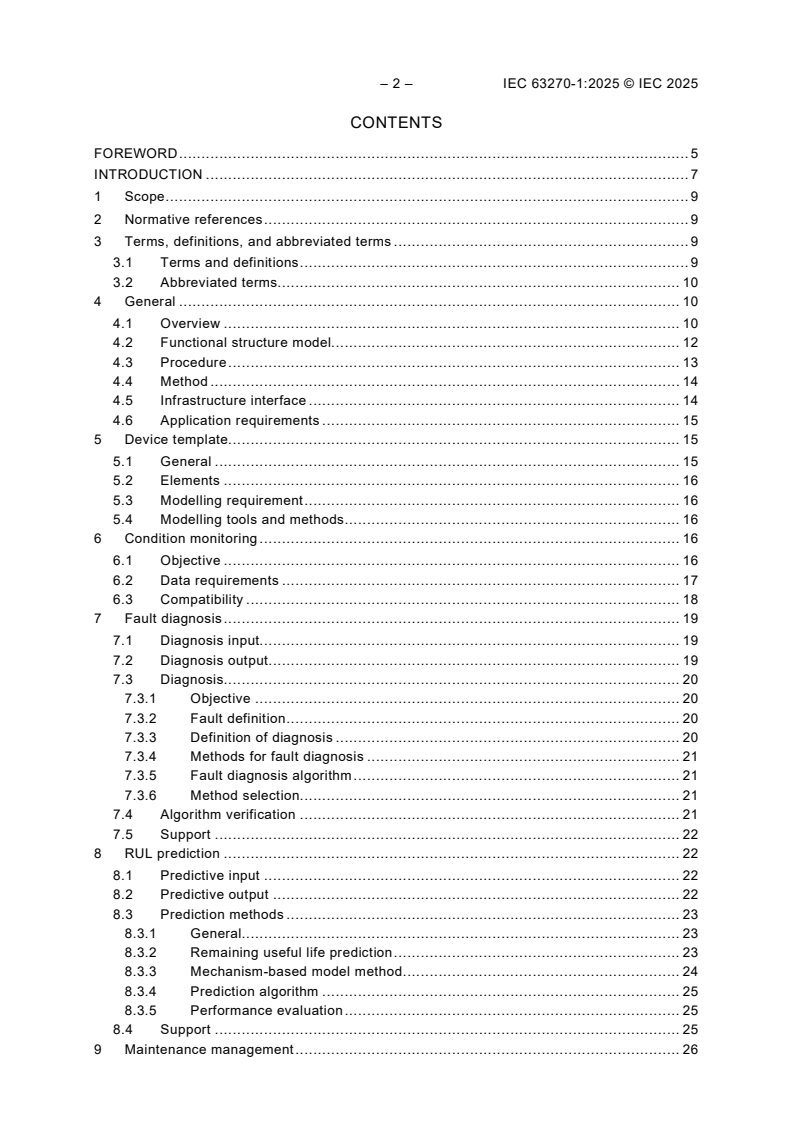
CONTENTS
FOREWORD . 5
INTRODUCTION . 7
1 Scope . 9
2 Normative references . 9
3 Terms, definitions, and abbreviated terms . 9
3.1 Terms and definitions . 9
3.2 Abbreviated terms. 10
4 General . 10
4.1 Overview . 10
4.2 Functional structure model. 12
4.3 Procedure . 13
4.4 Method . 14
4.5 Infrastructure interface . 14
4.6 Application requirements . 15
5 Device template. 15
5.1 General . 15
5.2 Elements . 16
5.3 Modelling requirement . 16
5.4 Modelling tools and methods . 16
6 Condition monitoring . 16
6.1 Objective . 16
6.2 Data requirements . 17
6.3 Compatibility . 18
7 Fault diagnosis . 19
7.1 Diagnosis input. 19
7.2 Diagnosis output . 19
7.3 Diagnosis. 20
7.3.1 Objective . 20
7.3.2 Fault definition . 20
7.3.3 Definition of diagnosis . 20
7.3.4 Methods for fault diagnosis . 21
7.3.5 Fault diagnosis algorithm . 21
7.3.6 Method selection. 21
7.4 Algorithm verification . 21
7.5 Support . 22
8 RUL prediction . 22
8.1 Predictive input . 22
8.2 Predictive output . 22
8.3 Prediction methods . 23
8.3.1 General. 23
8.3.2 Remaining useful life prediction . 23
8.3.3 Mechanism-based model method . 24
8.3.4 Prediction algorithm . 25
8.3.5 Performance evaluation . 25
8.4 Support . 25
9 Maintenance management . 26
9.1 Overview . 26
9.2 Type and relationship of maintenance processes . 26
9.3 Status and conversion . 26
9.4 System interface . 27
9.4.1 System interface overview . 27
9.4.2 System external interface . 28
Annex A (informative) Predictive maintenance in automation systems . 30
A.1 Overview . 30
A.2 Condition monitoring . 30
A.3 Fault diagnosis . 31
A.4 RUL prediction . 31
A.5 Maintenance management . 31
Annex B (informative) Device template of predictive maintenance. 33
B.1 Coriolis mass flowmeter . 33
B.2 Radar (level measurement) . 34
B.3 Temperature transmitter . 35
B.4 Motion control system . 36
Annex C (informative) Application scenarios for predictive maintenance . 38
C.1 Flow meter and compressor . 38
C.1.1 Overview . 38
C.1.2 Predictive maintenance of air compressors . 39
C.1.3 Flow meter . 40
C.2 Servo valve . 41
C.2.1 Condition monitoring based on characteristic values . 41
C.2.2 Frequency selectivity-based fault diagnosis . 42
C.2.3 Prediction based on an expert system . 42
Bibliography . 44
Figure 1 – Predictive maintenance work process . 7
Figure 2 – Automatic equipment and system predictive maintenance level. 11
Figure 3 – Functional structure model of predictive maintenance . 12
Figure 4 – Predictive maintenance flow chart. 13
Figure 5 – PM function block interface . 14
Figure 6 – An example of pump system condition monitoring . 17
Figure 7 – Mechanical damage of the motor . 17
Figure 8 – Device feature analysis and compatibility level . 18
Figure 9 – General process of fault diagnosis . 20
Figure 10 – Remaining life prediction process . 23
Figure 11 – Remaining life prediction methods . 25
Figure 12 – Maintenance status diagram . 27
Figure 13 – Interaction between the maintenance management of industrial automatic
equipment and other functions . 28
Figure A.1 – Positioning of condition monitoring, prediction, and maintenance
scheduling in manufacturing system . 30
Figure A.2 – Determining the health state of a component by processing actual input
values . 31
Figure A.3 – The relationships between time to failure, reliability, and cost . 32
– 4 – IEC 63270-1:2025 © IEC 2025
Figure B.1 – Graphical device template for a motion control system . 37
Figure C.1 – Schematic diagram of the air compressor system PM scenario . 39
Figure C.2 – Verification of the Coriolis mass flow meter . 41
Figure C.3 – Condition Monitoring of the Servo valve . 42
Figure C.4 – PM scenario of a servo valve (based on frequency selectivity). 42
Figure C.5 – PM scenario of a servo valve (based on an expert system) . 43
Table B.1 – Device template for a Coriolis mass flowmeter . 33
Table B.2 – Device template for a radar (level measurement). 34
Table B.3 – Device template for a temperature transmitter . 35
Table B.4 – Device template for a motion control system . 36
INTERNATIONAL ELECTROTECHNICAL COMMISSION
____________
PREDICTIVE MAINTENANCE OF INDUSTRIAL
AUTOMATION EQUIPMENT AND SYSTEMS –
Part 1: General requirements
FOREWORD
1) The International Electrotechnical Commission (IEC) is a worldwide organization for standardization comprising
all national electrotechnical committees (IEC National Committees). The object of IEC is to promote international
co-operation on all questions concerning standardization in the electrical and electronic fields. To this end and
in addition to other activities, IEC publishes International Standards, Technical Specifications, Technical Reports,
Publicly Available Specifications (PAS) and Guides (hereafter referred to as “IEC Publication(s)”). Their
preparation is entrusted to technical committees; any IEC National Committee interested in the subject dealt with
may participate in this preparatory work. International, governmental and non-governmental organizations liaising
with the IEC also participate in this preparation. IEC collaborates closely with the International Organization for
Standardization (ISO) in accordance with conditions determined by agreement between the two organizations.
2) The formal decisions or agreements of IEC on technical matters express, as nearly as possible, an international
consensus of opinion on the relevant subjects since each technical committee has representation from all
interested IEC National Committees.
3) IEC Publications have the form of recommendations for international use and are accepted by IEC National
Committees in that sense. While all reasonable efforts are made to ensure that the technical content of IEC
Publications is accurate, IEC cannot be held responsible for the way in which they are used or for any
misinterpretation by any end user.
4) In order to promote international uniformity, IEC National Committees undertake to apply IEC Publications
transparently to the maximum extent possible in their national and regional publications. Any divergence between
any IEC Publication and the corresponding national or regional publication shall be clearly indicated in the latter.
5) IEC itself does not provide any attestation of conformity. Independent certification bodies provide conformity
assessment services and, in some areas, access to IEC marks of conformity. IEC is not responsible for any
services carried out by independent certification bodies.
6) All users should ensure that they have the latest edition of this publication.
7) No liability shall attach to IEC or its directors, employees, servants or agents including individual experts and
members of its technical committees and IEC National Committees for any personal injury, property damage or
other damage of any nature whatsoever, whether direct or indirect, or for costs (including legal fees) and
expenses arising out of the publication, use of, or reliance upon, this IEC Publication or any other IEC
Publications.
8) Attention is drawn to the Normative references cited in this publication. Use of the referenced publications is
indispensable for the correct application of this publication.
9) IEC draws attention to the possibility that the implementation of this document may involve the use of (a)
patent(s). IEC takes no position concerning the evidence, validity or applicability of any claimed patent rights in
respect thereof. As of the date of publication of this document, IEC had not received notice of (a) patent(s), which
may be required to implement this document. However, implementers are cautioned that this may not represent
the latest information, which may be obtained from the patent database available at https://patents.iec.ch. IEC
shall not be held responsible for identifying any or all such patent rights.
IEC 63270-1 has been prepared by subcommittee SC 65E: Devices and integration in enterprise
systems, of IEC technical committee 65: Industrial process measurement, control and
automation. It is an International Standard.
The text of this International Standard is based on the following documents:
Draft Report on voting
65E/1148/FDIS 65E/1159/RVD
Full information on the voting for its approval can be found in the report on voting indicated in
the above table.
The language used for the development of this International Standard is English.
– 6 – IEC 63270-1:2025 © IEC 2025
This document was drafted in accordance with ISO/IEC Directives, Part 2, and developed in
accordance with ISO/IEC Directives, Part 1 and ISO/IEC Directives, IEC Supplement, available
at www.iec.ch/members_experts/refdocs. The main document types developed by IEC are
described in greater detail at www.iec.ch/publications.
A list of all parts in the IEC 63270 series, published under the general title Predictive
maintenance of industrial automation equipment and systems, can be found on the IEC website.
The committee has decided that the contents of this document will remain unchanged until the
stability date indicated on the IEC website under webstore.iec.ch in the data related to the
specific document. At this date, the document will be
• reconfirmed,
• withdrawn, or
• revised.
INTRODUCTION
Efficient production significantly depends on the availability of production equipment. The status
of the equipment and its components, further referred to as “assets” can be monitored and
assessed in order to guarantee the intended usage of equipment and to avoid unplanned
downtimes. The results of the predictive maintenance assessment are, for example, the
remaining useful lifetime prediction, necessary maintenance activities, etc. The results can also
lead to the optimization of production workflow by targeting the reorganization of equipment
usage. The work process of PM (predictive maintenance) is depicted in Figure 1.
Figure 1 – Predictive maintenance work process
The availability of status information is the main prerequisite for such a prediction. Modern
automation equipment is often equipped with sensors and self-monitoring capabilities. These
functions can gather data that can be used to determine the status of the equipment. However,
the equipment is delivered from different suppliers and is based on different technologies.
Therefore, there is currently no uniform solution for accessing the data and calculating status
information. Access to data is a prerequisite for predictive maintenance solutions. Therefore,
an integration project is often an integral part of the solution. This significantly hinders efforts
to implement solutions for predictive maintenance.
In addition, standards can define the definition, scope, procedure, and functional structure of
PM, as well as the relationship between PM and CBM. In predictive maintenance, industrial
automation equipment and systems play two different roles: "measuring tool" and " object of
prediction". Condition monitoring, fault diagnosis and remaining useful life prediction methods
can be based on a data-driven model, a mechanism-based model, or both. Without
standardization, it is difficult to maintain accuracy and be able to compare the PM results.
– 8 – IEC 63270-1:2025 © IEC 2025
From the description above, a need for standardization can be deduced. Providing an
appropriate method and infrastructure, comprised of a uniform ontology, predictive methods,
and system interfaces. Such an approach will facilitate the easy composition of complex
condition monitoring and predictive maintenance solutions. It will also provide critical
information for equipment and factories based on original data and analytical methods.
PREDICTIVE MAINTENANCE OF INDUSTRIAL
AUTOMATION EQUIPMENT AND SYSTEMS –
Part 1: General requirements
1 Scope
This part of IEC 63270 provides guidance on the functional structure model, procedure, method,
interface of function blocks. It also offers guidance on data requirements for predictive
maintenance of equipment, devices and systems for industrial automation applications.
Condition monitoring is not only within the scope of this document but can also be an important
input for predictive maintenance.
2 Normative references
The following documents are referred to in the text in such a way that some or all of their content
constitutes requirements of this document. For dated references, only the edition cited applies.
For undated references, the latest edition of the referenced document (including any
amendments) applies.
IEC TR 62390, Common automation device – Profile guideline
ISO/IEC/IEEE 42010:2022, Software, systems and enterprise – Architecture description
3 Terms, definitions, and abbreviated terms
3.1 Terms and definitions
For the purposes of this document, the following terms and definitions apply.
ISO and IEC maintain terminology databases for use in standardization at the following
addresses:
• IEC Electropedia: available at https://www.electropedia.org/
• ISO Online browsing platform: available at https://www.iso.org/obp
3.1.1
predictive maintenance
form of preventive maintenance performed continuously or at intervals governed by observed
conditions to monitor, diagnose or trend a structure, system or component’s condition indicators
Note 1 to entry: Results indicate present and future functional ability or the nature of, and schedule for, planned
maintenance.
[SOURCE: IEC 62342:2007, 3.14, modified – The note has been deleted.]
3.1.2
preventive maintenance
maintenance carried out at predetermined intervals or according to prescribed criteria and
intended to reduce the probability of failure or the degradation of the functioning of an item
[SOURCE: IEC 61918:2018, 3.1.62]
– 10 – IEC 63270-1:2025 © IEC 2025
3.1.3
condition monitoring
recording and evaluation of technical entity status for maintenance purposes
3.1.4
maintenance
activity including supervisory actions, intended to retain an item in, or restore it to, a state in
which it can perform a required function
3.1.5
condition-based maintenance
maintenance activity performed on the basis of the documentation of the performance
degradation of an item (as results of, for example, auto diagnostic or wear measurement)
Note 1 to entry: It is based on a proper visibility of performance degradation or intermittent failures.
[SOURCE: IEC 61918:2018, 3.1.23, modified – "preventive activity" has been replaced by
"maintenance activity".]
3.1.6
infrastructure interface
shared boundary between two function units defined by functional characteristics, signal
characteristics, or other characteristics as appropriate
[SOURCE: IEC TR 62390:2005, 3.1.16]
3.2 Abbreviated terms
CBM Condition-Based Maintenance
DTM Device Type Manager
FDT Field Device Tool
FDI Field Device Integration
FMEA Fault Modes and Effect Analysis
FTA Fault Tree Analysis
MES Manufacturing Execution System
OPC UA Open Platform Communications Unified Architecture
PM Predictive Maintenance
RUL Remaining Use Life
TBM Time-Based Maintenance
XML Extensible Markup Language
4 General
4.1 Overview
Based on the differences in requirements and purposes, the implementation of predictive
maintenance of automation equipment and systems can be divided into the following three
categories, as shown in Figure 2:
Category I: The realization of CBM, that is, through the acquisition of critical data of the
equipment’s operating state, complete functions of status identification and basic fault diagnosis
and to provide basic repair and maintenance strategies, such as alarms, shutdowns, etc. This
type of predictive maintenance can be based on MES or other information systems.
Category II: The realization of predictive-based maintenance, which means that through the
acquisition of data related to the operating status of the equipment, the functions of status
recognition, fault diagnosis, life prediction, etc., are completed in order to provide repair and
maintenance programs in advance to help with the management of equipment repair and
maintenance. This type of predictive maintenance should be based on a system that can be
interconnected with MES or other information systems.
Category III: The realization of maintenance based on whole life cycle management, that is,
through the comprehensive acquisition of equipment operating state data, complete the
functions of condition monitoring, fault diagnosis, life prediction, etc. Moreover, it can judge the
confidence of the remaining useful life to provide a complete and credible repair and
maintenance program in advance and guide the management of equipment’s repair and
maintenance. The system that performs this task can continuously optimize the prediction
results and enhance the confidence and feasibility of the prediction with the help of technologies
such as virtual simulation, artificial intelligence, and system integration. This type of
maintenance not only reduces the cost of use and maintenance of equipment but also creates
new value by optimizing operating decisions.
Breakdown maintenance and preventive maintenance are also important maintenance practices.
However, they are outside the scope of this document. It mainly focuses on the predictive
maintenance of categories I and II, and some of the contents can apply to the predictive
maintenance of categories I and III.
Figure 2 – Automatic equipment and system predictive maintenance level
– 12 – IEC 63270-1:2025 © IEC 2025
4.2 Functional structure model
The overall functional structure for PM will, however, stay rather fixed (see Figure 3). The
determination of the current state of an asset needs to be carried out using sensing functions.
According to this, a calculation of the state of health and a condition status assessment can be
carried out. This is a prerequisite for fault diagnosis and defining repair measures on the one
hand, and for remaining useful life prediction and defining maintenance actions on the other.
The fault diagnosis process includes fault identification, fault location, etc. It is not necessary
to enter the prediction process if the fault has occurred but directly enter the maintenance
management phase. If the fault does not occur or is about to occur, fault diagnosis data and
condition monitoring data are required to be transmitted together to the prediction phase to
conduct the Remaining Useful Life (RUL) prediction and transmit the RUL information to the
maintenance management phase.
RUL prediction is the major phase of predictive maintenance. The required inputs include
history information about equipment (working conditions, environment, fault information, etc.),
equipment status information, fault diagnosis information, etc. The relevant prediction methods
are described in Clause 7 of this document.
Finally, all the maintenance measures shall be seamlessly integrated into a maintenance
management solution at the Manufacturing Operation Management (MOM) level. Independent
of the specific functionalities, a systematic approach should be introduced in order to establish
a predictive maintenance system. However, cause-and-remedy actions and advice can be
derived from the predictive results.
This functional structure covers both approaches: on-site and remote maintenance. The
technological developments, particularly the communication and data processing solutions, will
enhance the use of remote monitoring and maintenance. The mapping of this functional
structure model in an automation system is depicted in Annex A.
Figure 3 – Functional structure model of predictive maintenance
The dotted lines in Figure 3 indicate that the function is not within the scope of PM. The
maintenance actions and repair measures are not within the scope of PM but shall be within
the scope of maintenance activities.
4.3 Procedure
The general process and the key steps that should be followed in the implementation of
predictive maintenance of equipment are depicted in Figure 4. The work of predictive
maintenance of equipment shall focus on identifying and avoiding root cause failure modes.
Figure 4 – Predictive maintenance flow chart
– 14 – IEC 63270-1:2025 © IEC 2025
4.4 Method
Prediction is the core of predictive maintenance. Depending on the input data, there are usually
three categories of predictive maintenance methods.
– The first category is based on the prediction using the mechanism-based model.
– The second category is prediction based on a data-driven model.
– The third category is prediction based on a hybrid model, a mixture of a mechanism-based
model method and a data-driven method, or a mixture of different data-driven methods.
The type and requirements of data acquisition vary based on the prediction method.
4.5 Infrastructure interface
The predictive maintenance function shall be modularized and contain the necessary
maintenance activities in order to realize the functions as shown in Figure 5. It shall be defined
based on the functional viewpoint as defined in ISO/IEC/IEEE 42010:2022. Therefore, a
function block shall specify the necessary parts, the overall structure, the internal interfaces
between the functional parts, and the external interfaces to relevant systems. It shall not define
a specific, technology-dependent implementation.
The parts of predictive maintenance function include functionalities for:
– data acquisition and pre-processing (sensing),
– condition state assessment,
– fault diagnosis,
– remaining useful life prediction,
– feedback from repair and maintenance measures.
Figure 5 – PM function block interface
In addition, all parts of this function block shall contain functions for common identification,
self-description, and management of parts. These functions can be realized using an asset
administration shell.
The definition of functional interfaces shall include a description of interfaces (see Figure 5).
– Between the functional parts, see item 1 of Figure 5 above.
– Between data sources and the functional parts, see item 2 of Figure 5 above.
– Between functional parts and maintenance management, see item 3 of Figure 5 above, e.g.,
to manufacturing operations management (MOM), as defined in IEC 62264-3 activities.
– Between the functional parts and engineering and commissioning tools,see item 4 of
Figure 5 above.
A mapping to specific implementation technologies can be realized based on these interface
specifications.
4.6 Application requirements
The implementation of predictive maintenance shall meet the following requirements:
1) The necessity to implement predictive maintenance shall be confirmed. Predictive
maintenance requires hardware, software, and data and requires a costly investment. In
addition, due to the accuracy of the prediction method, the implementation of predictive
maintenance can bring additional risks. Therefore, the subject of the implementation of
predictive maintenance shall have the necessity of cost and security.
2) The implementation of predictive maintenance shall be directed to faults with "deterioration"
characteristics rather than random faults. Objects that implement predictive maintenance
shall have a working process that meets the requirements for condition monitoring before a
failure occurs. Predictive maintenance will not work for failures that cannot be determined
by the failure mechanism and cannot be monitored in advance.
3) The parameters related to the fault shall be monitored. Condition monitoring is the basis for
predictive maintenance. The premise of predictive maintenance is the ability to find
monitorable parameters that have fault information. For instance, the corrosion of a fixture
casing is presently difficult to monitor with sensors. However, once cracks due to corrosion
or other fatigue factors occurs, predictive maintenance can be performed by monitoring its
vibration signals.
4) Historical data and the associated necessary tests can provide data support. Historical data
can provide information regarding fault diagnosis and location. The necessary tests can
enhance the accuracy of the prediction algorithm and are essential for the implementation
of predictive maintenance.
5) The confidence of predictive maintenance shall be within the acceptable range for the user.
Predictive maintenance with low confidence can result in an unnecessary maintenance,
which increases costs and wastes resources. Therefore, predictive maintenance is used to
help in decision-making and continuously enhance the confidence level.
5 Device template
5.1 General
Device templates are tools to build equipment models in accordance with expected failure
modes. It provides common failure modes and corresponding data requirements that can be
predicted.
Device templates are references for predictive maintenance data collection. Moreover, they do
not directly support diagnosis and prediction. However, the establishment of device templates
is a necessary process for predictive maintenance. For details about the Device template, see
Annex B.
– 16 – IEC 63270-1:2025 © IEC 2025
5.2 Elements
The basic elements of the device templates include:
– equipment: information about systems, equipment, and devices;
– failure mode: a failure mode related to each level of equipment and system, particularly a
diagnosable and predictable systemic failure;
– data requirements: necessary data for diagnosis and prediction related to the failure mode.
Device templates can also include descriptions of each element, specifying detailed
requirements for the data, such as minimum sampling frequency, sampling duration, and other
specific content as needed.
5.3 Modelling requirement
Device templates are made up of elements based on different relationships. An element is the
minimum unit of device template modelling, including necessary information.
Elements can be divided into variables, parts, and objects. Variables contain analog quantities,
discrete quantities, and static information. Analog quantities include values, such as
temperature and current. Discrete quantities include values such as operating state. Static
information is attribute information that does not change over time, such as equipment
parameters or failure modes. Parts represent the physical entity. Objects refers to a specific
type of device.
In modelling, the information entity needs to be divided into different elements to build a
component model. The object-oriented information model and modelling technology can be
used to achieve unified data organization and management, based on relevant industry
standards, coding systems, and application requirements, so that the data of each system can
be associated through a unified device object.
5.4 Modelling tools and methods
The device template modelling method consists of three steps:
– step 1: Sort out the model structure and organizational relationships based on objects;
– step 2: Create an equipment model based on the sorting results from Step 1;
– step 3: Create a device template.
There are many tools available for device templates. XML is a commonly used option for
machine-readable systems.
6 Condition monitoring
6.1 Objective
Condition monitoring is the basis for predictive maintenance. In addition, data acquisition and
condition discrimination are the core of condition monitoring. By analysing the data, such as
the running logs of the device, the running status of the device can be effectively evaluated,
and the potential abnormal conditions of the device running can be discovered dynamically and
timely to generate a targeted maintenance solution.
As the example shown in Figure 6, mechanical damage and electrical faults can be predicted
by monitoring the condition of the pump and motor.
Figure 6 – An example of pump system condition monitoring
6.2 Data requirements
The data acquisition from equipment shall be determined based on the requirements and
methods of predictive maintenance. The working conditions, alarm status, and statistical
information of the equipment are collected if the analysis method based on data statistics is
adopted. The data on the equipment’s operating state is collected if the analysis method based
on the mechanism-based model is used. In addition, the data is required to continuously and
truly reflect the operating state of the device over time.
Take the mechanical damage to the motor as an example, as shown in Figure 7. The status of
that motor can be monitored and evaluated through the acquisition of torque and speed data.
Furthermore, the real-time analysis and diagnosis of the data are conducted to perform early
maintenance when abnormal waveforms occur to reduce the loss caused by equipment failure.
Figure 7 – Mechanical damage of the motor
– 18 – IEC 63270-1:2025 © IEC 2025
The methods for data acquisition from equipment mainly include:
– basic data acquisition for the equipment;
– acquisition of working status data for equipment;
– acquisition of operating status data for equipment;
– acquisition of alarm status data for equipment;
– acquisition of statistical data on equipment;
– acquisition of management data on equipment processing status;
– other relevant data (environment, personnel).
6.3 Compatibility
Predictive maintenance requires standardized communication schemes that allow different
communication protocols to coexist in order to support data requirements. In order to ensure
the compatibility of communication schemes, indicators such as interconnection,
intercommunication, interoperability, and interchange can be considered, as can integration into
a single platform to enable the predictive maintenance solution’s easy access to data.
According to IEC TR 62390, the following aspect shall be considered in the field of eq
...