

ISO 80000-2:2019
(Main)Quantities and units - Part 2: Mathematics
General Information
- Abstract
This document specifies mathematical symbols, explains their meanings, and gives verbal equivalents and applications.
This document is intended mainly for use in the natural sciences and technology, but also applies to other areas where mathematics is used.
- Status
- Published
- Publication Date
- 25-Aug-2019
- Technical Committee
- TC 25 - Quantities and units
- Current Stage
- PPUB - Publication issued
- Start Date
- 28-Aug-2019
- Completion Date
- 01-Nov-2019
Buy Documents
ISO 80000-2:2019 - Quantities and units - Part 2: Mathematics Released:8/26/2019

ISO 80000-2:2019 - Grandeurs et unités - Partie 2: Mathématiques Released:8/26/2019
Overview
ISO 80000-2:2019 - Quantities and units - Part 2: Mathematics defines standard mathematical symbols, their meanings, verbal equivalents and typical applications. Intended primarily for the natural sciences and technology (and also applicable where mathematics is used), this second edition consolidates notation, typography and usage guidance to promote clear, unambiguous mathematical communication across scientific, engineering and standards documents.
Key topics and technical requirements
The standard organizes content in tabular form (Tables 1–16) and provides:
- Notation and typography rules - guidance on upright vs italic type for numbers, constants, functions and operators; spacing around binary operators; function argument formatting and when parentheses may be omitted.
- Rules for splitting expressions - preferred line-break points (before =, +, −, ±, …) and prohibition on duplicating symbols around breaks to avoid sign errors.
- Symbols and expressions for core mathematical areas, including:
- Variables, functions and operators
- Mathematical logic (conjunction, disjunction, implication, quantifiers)
- Sets, set operations and cardinality
- Standard number sets and intervals
- Elementary geometry and coordinate systems (Table 13)
- Operations, combinatorics, functions, exponentials, logarithms
- Circular and hyperbolic functions, complex numbers, matrices
- Scalars, vectors and tensors (clarified in this edition)
- Transforms and special functions
- Table format and usage - each table entry gives symbol/expression, verbal equivalent/meaning and non‑normative remarks/examples to aid interpretation.
The second edition updates Clause 4 (font/line-splitting clarifications), revises Clause 18 on scalars/vectors/tensors, and adds missing symbols and clarifications compared with ISO 80000-2:2009.
Practical applications
ISO 80000-2:2019 is valuable for:
- Scientific and engineering authors preparing papers, reports and standards to ensure consistent notation
- Standards committees and technical writers harmonizing mathematical symbols across documents
- Publishers and typesetters enforcing typographic rules for math content
- Software developers and documentation teams producing scientific libraries, user interfaces and API documentation where precise notation matters
- Educators and translators needing authoritative verbal equivalents for symbols
Benefits include reduced ambiguity, improved interoperability of technical documents, and consistent presentation of mathematical expressions across disciplines.
Related standards
- ISO 80000-1 (Quantities and units - Part 1: General) is a normative reference.
- ISO 80000-2 is part of the broader ISO/IEC 80000 series covering quantities, units and symbols across physical domains; consult the ISO website for related parts.
Keywords: ISO 80000-2:2019, mathematical symbols, quantities and units, notation standard, mathematical notation, scientific typography, engineering documentation.
Relations
- Effective Date
- 05-Sep-2023
Buy Documents
ISO 80000-2:2019 - Quantities and units - Part 2: Mathematics Released:8/26/2019
ISO 80000-2:2019 - Grandeurs et unités - Partie 2: Mathématiques Released:8/26/2019
Get Certified
Connect with accredited certification bodies for this standard

BSI Group
BSI (British Standards Institution) is the business standards company that helps organizations make excellence a habit.

NYCE
Mexican standards and certification body.
Sponsored listings
Frequently Asked Questions
ISO 80000-2:2019 is a standard published by the International Electrotechnical Commission (IEC). Its full title is "Quantities and units - Part 2: Mathematics". This standard covers: This document specifies mathematical symbols, explains their meanings, and gives verbal equivalents and applications. This document is intended mainly for use in the natural sciences and technology, but also applies to other areas where mathematics is used.
This document specifies mathematical symbols, explains their meanings, and gives verbal equivalents and applications. This document is intended mainly for use in the natural sciences and technology, but also applies to other areas where mathematics is used.
ISO 80000-2:2019 is classified under the following ICS (International Classification for Standards) categories: 01.060 - Quantities and units; 35.200 - Interface and interconnection equipment. The ICS classification helps identify the subject area and facilitates finding related standards.
ISO 80000-2:2019 has the following relationships with other standards: It is inter standard links to ISO 80000-2:2009. Understanding these relationships helps ensure you are using the most current and applicable version of the standard.
ISO 80000-2:2019 is available in PDF format for immediate download after purchase. The document can be added to your cart and obtained through the secure checkout process. Digital delivery ensures instant access to the complete standard document.
Standards Content (Sample)
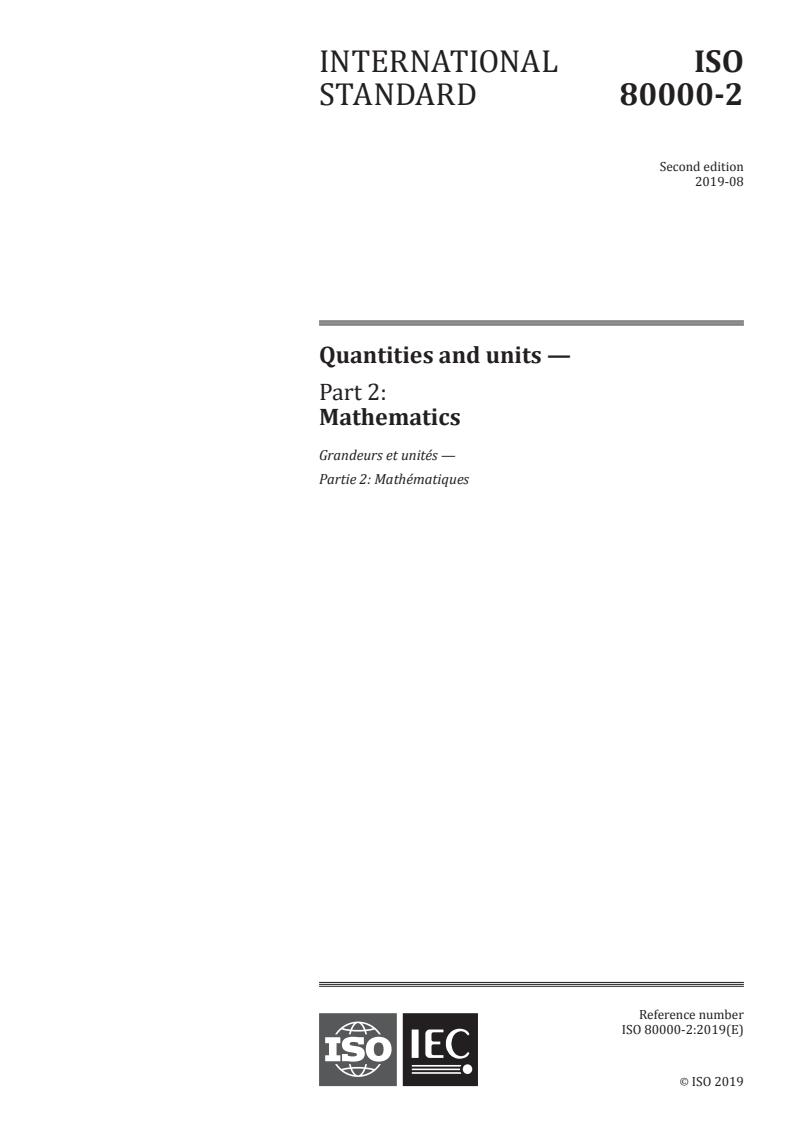
INTERNATIONAL ISO
STANDARD 80000-2
Second edition
2019-08
Quantities and units —
Part 2:
Mathematics
Grandeurs et unités —
Partie 2: Mathématiques
Reference number
©
ISO 2019
© ISO 2019
All rights reserved. Unless otherwise specified, or required in the context of its implementation, no part of this publication may
be reproduced or utilized otherwise in any form or by any means, electronic or mechanical, including photocopying, or posting
on the internet or an intranet, without prior written permission. Permission can be requested from either ISO at the address
below or ISO’s member body in the country of the requester.
ISO copyright office
CP 401 • Ch. de Blandonnet 8
CH-1214 Vernier, Geneva
Phone: +41 22 749 01 11
Fax: +41 22 749 09 47
Email: copyright@iso.org
Website: www.iso.org
Published in Switzerland
ii © ISO 2019 – All rights reserved
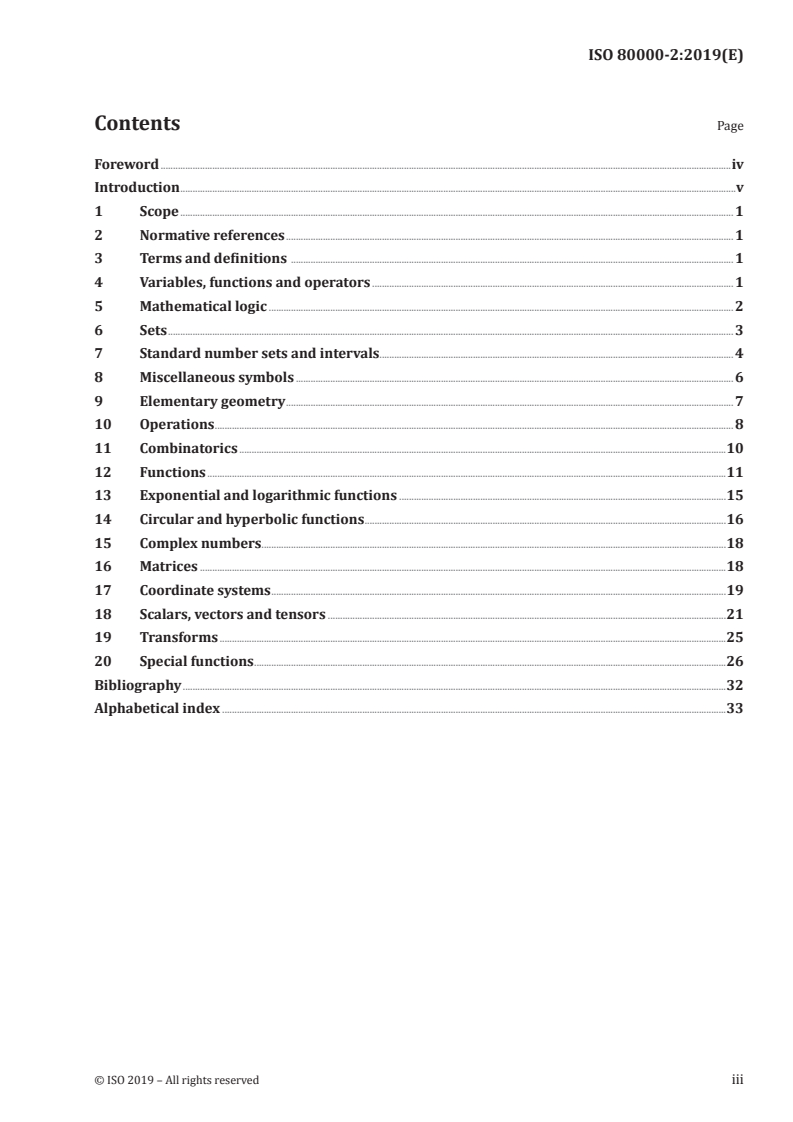
Contents Page
Foreword .iv
Introduction .v
1 Scope . 1
2 Normative references . 1
3 Terms and definitions . 1
4 Variables, functions and operators . 1
5 Mathematical logic . 2
6 Sets . 3
7 Standard number sets and intervals. 4
8 Miscellaneous symbols . 6
9 Elementary geometry . 7
10 Operations . 8
11 Combinatorics .10
12 Functions .11
13 Exponential and logarithmic functions .15
14 Circular and hyperbolic functions .16
15 Complex numbers.18
16 Matrices .18
17 Coordinate systems .19
18 Scalars, vectors and tensors .21
19 Transforms .25
20 Special functions .26
Bibliography .32
Alphabetical index .33
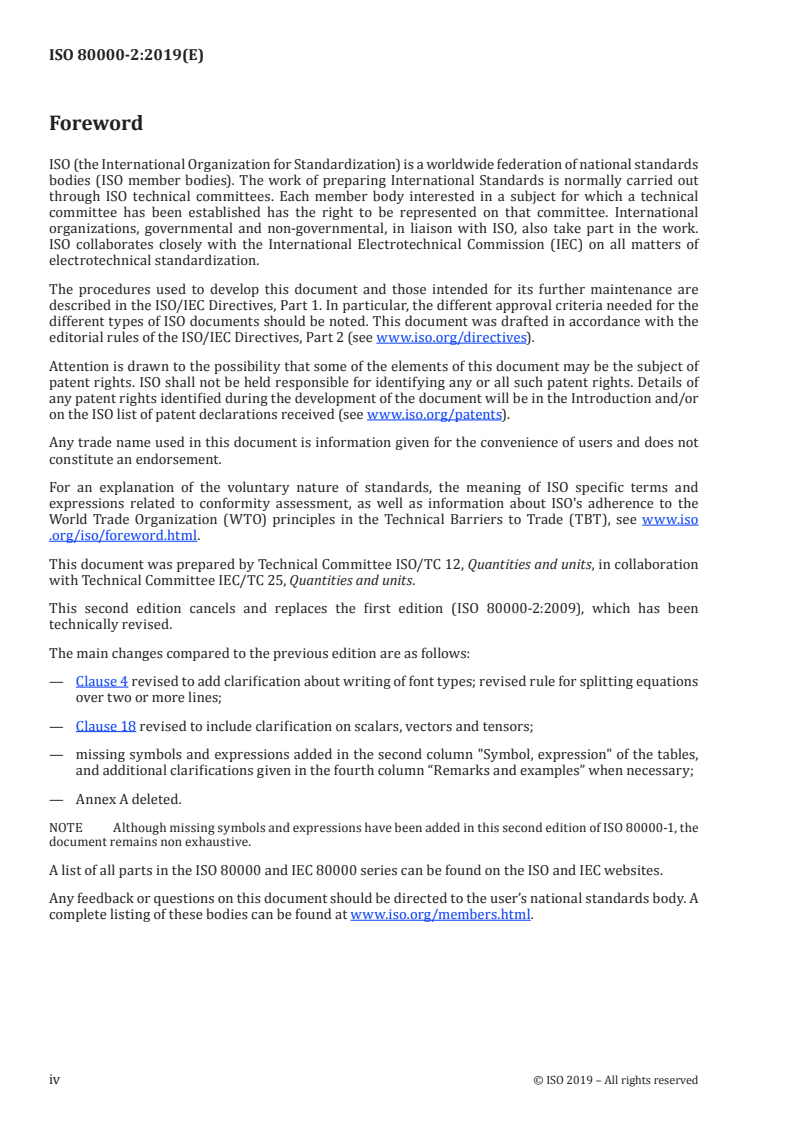
Foreword
ISO (the International Organization for Standardization) is a worldwide federation of national standards
bodies (ISO member bodies). The work of preparing International Standards is normally carried out
through ISO technical committees. Each member body interested in a subject for which a technical
committee has been established has the right to be represented on that committee. International
organizations, governmental and non-governmental, in liaison with ISO, also take part in the work.
ISO collaborates closely with the International Electrotechnical Commission (IEC) on all matters of
electrotechnical standardization.
The procedures used to develop this document and those intended for its further maintenance are
described in the ISO/IEC Directives, Part 1. In particular, the different approval criteria needed for the
different types of ISO documents should be noted. This document was drafted in accordance with the
editorial rules of the ISO/IEC Directives, Part 2 (see www .iso .org/directives).
Attention is drawn to the possibility that some of the elements of this document may be the subject of
patent rights. ISO shall not be held responsible for identifying any or all such patent rights. Details of
any patent rights identified during the development of the document will be in the Introduction and/or
on the ISO list of patent declarations received (see www .iso .org/patents).
Any trade name used in this document is information given for the convenience of users and does not
constitute an endorsement.
For an explanation of the voluntary nature of standards, the meaning of ISO specific terms and
expressions related to conformity assessment, as well as information about ISO's adherence to the
World Trade Organization (WTO) principles in the Technical Barriers to Trade (TBT), see www .iso
.org/iso/foreword .html.
This document was prepared by Technical Committee ISO/TC 12, Quantities and units, in collaboration
with Technical Committee IEC/TC 25, Quantities and units.
This second edition cancels and replaces the first edition (ISO 80000-2:2009), which has been
technically revised.
The main changes compared to the previous edition are as follows:
— Clause 4 revised to add clarification about writing of font types; revised rule for splitting equations
over two or more lines;
— Clause 18 revised to include clarification on scalars, vectors and tensors;
— missing symbols and expressions added in the second column "Symbol, expression" of the tables,
and additional clarifications given in the fourth column “Remarks and examples” when necessary;
— Annex A deleted.
NOTE Although missing symbols and expressions have been added in this second edition of ISO 80000-1, the
document remains non exhaustive.
A list of all parts in the ISO 80000 and IEC 80000 series can be found on the ISO and IEC websites.
Any feedback or questions on this document should be directed to the user’s national standards body. A
complete listing of these bodies can be found at www .iso .org/members .html.
iv © ISO 2019 – All rights reserved
Introduction
Arrangement of the tables
Each table of symbols and expressions (except Table 13) gives hints (in the third column) about the
meaning or how the expression may be read for each item (numbered in the first column) of the
symbol under consideration, usually in the context of a typical expression (second column). If more
than one symbol or expression is given for the same item, they are on an equal footing. In some cases,
e.g. for exponentiation, there is only a typical expression and no symbol. The purpose of the entries is
identification of each concept and is not intended to be a complete mathematical definition. The fourth
column “Remarks and examples” gives further information and is not normative.
Table 13 has a different format. It gives the symbols of coordinates, as well as the position vectors and
their differentials, for coordinate systems in three-dimensional spaces.
INTERNATIONAL STANDARD ISO 80000-2:2019(E)
Quantities and units —
Part 2:
Mathematics
1 Scope
This document specifies mathematical symbols, explains their meanings, and gives verbal equivalents
and applications.
This document is intended mainly for use in the natural sciences and technology, but also applies to
other areas where mathematics is used.
2 Normative references
The following documents are referred to in the text in such a way that some or all of their content
constitutes requirements of this document. For dated references, only the edition cited applies. For
undated references, the latest edition of the referenced document (including any amendments) applies.
ISO 80000-1, Quantities and units — Part 1: General
3 Terms and definitions
Tables 1 to 16 give the symbols and expressions used in the different fields of mathematics.
ISO and IEC maintain terminological databases for use in standardization at the following addresses:
— ISO Online browsing platform: available at https: //www .iso .org/obp
— IEC Electropedia: available at http: //www .electropedia .org/
4 Variables, functions and operators
It is customary to use different sorts of letters for different sorts of entities, e.g. x, y, … for numbers
or elements of some given set, f, g for functions, etc. This makes formulas more readable and helps in
setting up an appropriate context.
Variables such as x, y, etc., and running numbers, such as i in x are printed in italic type. Parameters,
∑
i
i
such as a, b, etc., which may be considered as constant in a particular context, are printed in italic type.
The same applies to functions in general, e.g. f, g.
An explicitly defined function not depending on the context is, however, printed in upright type, e.g.
sin, exp, ln, Γ. Mathematical constants, the values of which never change, are printed in upright type,
e.g. e = 2,718 281 828 …; π = 3,141 592 …; i = −1. Well-defined operators are also printed in upright
type, e.g. div, δ in δx and each d in df/dx. Some transforms use special capital letters (see Clause 19,
Transforms).
Numbers expressed in the form of digits are always printed in upright type, e.g. 351 204; 1,32; 7/8.
Binary operators, for example +, −, /, shall be preceded and followed by thin spaces. This rule does not
apply in case of unary operators, as in −17,3.
The argument of a function is written in parentheses after the symbol for the function, without a space
between the symbol for the function and the first parenthesis, e.g. f(x), cos(ω t + φ). If the symbol for the
function consists of two or more letters and the argument contains no operation symbol, such as +, −, × ,
or /, the parentheses around the argument may be omitted. In these cases, there shall be a thin space
between the symbol for the function and the argument, e.g. int 2,4; sin nπ; arcosh 2A; Ei x.
If there is any risk of confusion, parentheses should always be inserted. For example, write cos(x) + y;
do not write cos x + y, which could be mistaken for cos(x + y).
A comma, semicolon or other appropriate symbol can be used as a separator between numbers or
expressions. The comma is generally preferred, except when numbers with a decimal comma are used.
If an expression or equation must be split into two or more lines, the following method shall be used:
— Place the line breaks immediately before one of the symbols =, +, −, ±, or , or, if necessary,
immediately before one of the symbols ×, ⋅, or /.
The symbol shall not be given twice around the line break; two minus signs could for example give rise
to sign errors. If possible, the line break should not be inside of an expression in parentheses.
5 Mathematical logic
Table 1 — Symbols and expressions in mathematical logic
Symbol,
Item No. Meaning, verbal equivalent Remarks and examples
expression
2-5.1 p ∧ q conjunction of p and q,
p and q
2-5.2 p ∨ q disjunction of p and q, This “or” is inclusive, i.e. p ∨ q is true, if
either p or q, or both are true.
p or q
2-5.3 ¬ p negation of p,
not p
2-5.4 p ⇒ q p implies q, q ⇐ p has the same meaning as p ⇒ q.
if p, then q ⇒ is the implication symbol.
→ is also used as implication symbol.
2-5.5 p ⇔ q p is equivalent to q (p ⇒ q) ∧ (q ⇒ p) has the same meaning as
p ⇔ q.
⇔ is the equivalence symbol.
↔ is also used as equivalence symbol.
2-5.6 ∀x ∈ A p(x) for every x belonging to A, the If it is clear from the context which set A is
proposition p(x) is true considered, the notation ∀x p(x) can be used.
∀ is the universal quantifier.
For x ∈ A, see 2-6.1.
2-5.7 ∃x ∈ A p(x) there exists an x belonging to A for If it is clear from the context which set A is
which p(x) is true considered, the notation ∃x p(x) can be used.
∃ is the existential quantifier.
For x ∈ A, see 2-6.1.
∃ x p(x) is used to indicate that there is ex-
actly one element for which p(x) is true.
∃! is also used for ∃ .
2 © ISO 2019 – All rights reserved
6 Sets
Table 2 — Symbols and expressions for sets
Symbol,
Item No. Meaning, verbal equivalent Remarks and examples
expression
2-6.1 x ∈ A x belongs to A, A ∋ x has the same meaning as x ∈ A.
x is an element of the set A
2-6.2 y ∉ A y does not belong to A, A ∌ y has the same meaning as y ∉ A.
y is not an element of the set A The negating stroke may also be vertical.
2-6.3 {x , x , …, x } set with elements x , x , …, x Also {x | i ∈ I}, where I denotes a set of sub-
1 2 n 1 2 n i
scripts.
2-6.4 {x ∈ A | p(x)} set of those elements of A for EXAMPLE
which the proposition p(x) is true
{x ∈ R | x ≥ 5}
If it is clear from the context which set A is
considered, the notation {x | p(x)} can be
used (for example {x | x ≥ 5}, if it is clear that
real numbers are considered).
Instead of the vertical line often a colon is
used as separator:
{x ∈ A : p(x)}.
2-6.5 card A number of elements in A, The cardinality can be a transfinite number.
cardinality of A The symbol ∣∣ is also used for absolute value
A
of a real number (see 2-10.16), modulus of a
complex number (see 2-15.4) and magnitude
of a vector (see 2-18.4).
2-6.6 the empty set
∅
{}
2-6.7 B ⊆ A B is included in A, Every element of B belongs to A.
B is a subset of A ⊂ is also used, but see remark to 2-6.8.
A ⊇ B has the same meaning as B ⊆ A.
2-6.8 B ⊂ A B is properly included in A, Every element of B belongs to A, but at least
one element of A does not belong to B.
B is a proper subset of A
If ⊂ is used for 2-6.7, then ⊊ shall be used
for 2-6.8.
A ⊃ B has the same meaning as B ⊂ A.
2-6.9 A ∪ B union of A and B The set of elements which belong to at least
one of the sets A and B.
A ∪ B = {x | x ∈ A ∨ x ∈ B}
2-6.10 A ∩ B intersection of A and B The set of elements which belong to both
sets A and B.
A ∩ B = {x | x ∈ A ∧ x ∈ B}
2-6.11 union of the sets A , A , …, A The set of elements belonging to at least one
1 2 n
n
of the sets A , A , ., A
1 2 n
A
n
i
i=1 n
A = A ∪ … ∪ A
1 n
i
, and are also used,
i=1 iI∈
i=1
iI∈
where I denotes a set of subscripts.
Table 2 (continued)
Symbol,
Item No. Meaning, verbal equivalent Remarks and examples
expression
2-6.12 intersection of the sets The set of elements belonging to all sets A ,
n
A , ., A
2 n
A , A ,…, A
A
1 2 n
i
n
i=1
n
, and are also used,
i=1 iI∈
A = A ∩ … ∩ A
1 n iI∈
i
i=1
where I denotes a set of subscripts.
2-6.13 A ∖ B difference of A and B, The set of elements which belong to A but
not to B.
A minus B
A ∖ B = {x | x ∈ A ∧ x ∉ B}
The notation A − B should not be used.
CB is also used. CB is mainly used when
A A
B is a subset of A, and the symbol A may be
omitted if it is clear from the context which
set A is considered.
2-6.14 (a, b) ordered pair a, b, (a, b) = (c, d) if and only if a = c and b = d.
couple a, b If the comma can be mistaken as the deci-
mal sign, then the semicolon (;) or a stroke
(|) may be used as separator.
2-6.15 (a , a , …, a ) ordered n-tuple See remark to 2-6.14.
1 2 n
2-6.16 A × B Cartesian product of the sets A The set of ordered pairs (a, b) such that a ∈ A
and B and b ∈ B.
A × B = {(x, y) | x ∈ A ∧ y ∈ B}
2-6.17 Cartesian product of the sets The set of ordered n-tuples (x , x , …, x )
1 2 n
n
such that x ∈ A , x ∈ A , …, x ∈ A .
1 1 2 2 n n
A , A , …, A
A
1 2 n
∏ i
n
AA××.×A is denoted by A , where n is the
i=1
n
number of factors in the product.
AA=×…×A
∏ in1
i=1
2-6.18 id identity relation on set A, id is the set of all pairs (x, x) where x ∈ A.
A A
If the set A is clear from the context, the
diagonal of A × A
subscript A can be omitted.
7 Standard number sets and intervals
Table 3 — Symbols and expressions for standard number sets and intervals
Symbol,
Item No. Meaning, verbal equivalent Remarks and examples
expression
2-7.1 the set of natural numbers,
N N = {0, 1, 2, 3, …}
the set of positive integers and zero
*
N = {1, 2, 3, …}
Other restrictions can be indicated in an
obvious way, as shown below.
N = {n ∈ N | n > 5}
> 5
The symbols IN and are also used.
4 © ISO 2019 – All rights reserved
Table 3 (continued)
Symbol,
Item No. Meaning, verbal equivalent Remarks and examples
expression
2-7.2 the set of integers
Z Z = {…, −2, −1, 0, 1, 2, …}
*
Z = {n ∈ Z | n ≠ 0}
Other restrictions can be indicated in an
obvious way, as shown below.
Z = {n ∈ Z | n > −3}
> −3
The symbol is also used.
2-7.3 the set of rational numbers
Q
*
Q = {r ∈ Q | r ≠ 0}
Other restrictions can be indicated in an
obvious way, as shown below.
Q = {r ∈ Q | r < 0}
< 0
The symbols QI and ℚ are also used.
2-7.4 the set of real numbers
R
*
R = {x ∈ R | x ≠ 0}
Other restrictions can be indicated in an
obvious way, as shown below.
R = {x ∈ R | x > 0}
> 0
The symbols IR and are also used.
2-7.5 the set of complex numbers
C *
C = {z ∈ C | z ≠ 0}
The symbol is also used.
2-7.6 the set of prime numbers
P P = {2, 3, 5, 7, 11, 13, 17, …}
The symbol ℙ is also used.
2-7.7 [a, b] closed interval from a included
[a, b] = {x ∈ R | a ≤ x ≤ b}
to b included
2-7.8 (a, b] left half-open interval from a
(a, b] = {x ∈ R | a < x ≤ b}
excluded to b included
The notation ]a, b] is also used.
2-7.9 [a, b) right half-open interval from a
[a, b) = {x ∈ R | a ≤ x < b}
included to b excluded
The notation [a, b[ is also used.
2-7.10 (a, b) open interval from a excluded to b
(a, b) = {x ∈ R | a < x < b}
excluded
The notation ]a, b[ is also used.
2-7.11 (−∞, b] closed unbounded interval up to b
(−∞, b] = {x ∈ R | x ≤ b}
included
The notation ]−∞, b] is also used.
2-7.12 (−∞, b) open unbounded interval up to b
(−∞, b) = {x ∈ R | x < b}
excluded
The notation ]−∞, b[ is also used.
2-7.13 [a, +∞) closed unbounded interval on-
[a, +∞) = {x ∈ R | a ≤ x}
ward from a included
The notations [a, ∞), [a, +∞[ and [a, ∞[ are
also used.
Table 3 (continued)
Symbol,
Item No. Meaning, verbal equivalent Remarks and examples
expression
2-7.14 (a, +∞) open unbounded interval onward
(a, +∞) = {x ∈ R | a < x}
from a excluded
The notations (a, ∞), ]a, +∞[ and ]a, ∞[ are
also used.
8 Miscellaneous symbols
Table 4 — Miscellaneous symbols and expressions
Symbol,
Item No. Meaning, verbal equivalent Remarks and examples
expression
2-8.1 a = b a is equal to b The symbol ≡ may be used to emphasize
that a particular equality is an identity, i.e.
a equals b
holds universally.
But see 2-8.18 for another meaning.
2-8.2 a ≠ b a is not equal to b The negating stroke may also be vertical.
2-8.3 a ≔ b a is by definition equal to b EXAMPLE
p ≔ mv , where p is momentum, m is mass
and v is velocity.
The symbols = and ≝ are also used.
def
2-8.4 a ≙ b a corresponds to b EXAMPLES
When E = kT, then 1 eV ≙ 11 604,5 K.
When 1 cm on a map corresponds
to a length of 10 km, one may write
1 cm ≙ 10 km.
The correspondence is not symmetric.
2-8.5 a ≈ b a is approximately equal to b It depends on the user whether an approx-
imation is sufficiently good. Equality is not
excluded.
2-8.6 a ≃ b a is asymptotically equal to b EXAMPLE
1 1
≃ as x → a
sin xa− xa−
()
(For x → a, see 2-8.16.)
2-8.7 a ~ b a is proportional to b The symbol ~ is also used for equivalence
relations.
The notation a ∝ b is also used.
2-8.8 M ≅ N M is congruent to N, M and N are point sets (geometrical figures).
M is isomorphic to N This symbol is also used for isomorphisms
of mathematical structures.
2-8.9 a < b a is less than b
2-8.10 b > a b is greater than a
2-8.11 a ≤ b a is less than or equal to b
2-8.12 b ≥ a b is greater than or equal to a
2-8.13 a ≪ b a is much less than b It depends on the situation whether a is
sufficiently small as compared to b.
6 © ISO 2019 – All rights reserved
Table 4 (continued)
Symbol,
Item No. Meaning, verbal equivalent Remarks and examples
expression
2-8.14 b ≫ a b is much greater than a It depends on the situation whether b is
sufficiently great as compared to a.
2-8.15 ∞ infinity This symbol does not denote a number but
is often part of various expressions dealing
with limits.
The notations +∞, −∞ are also used.
2-8.16 x → a x tends to a This symbol occurs as part of various ex-
pressions dealing with limits.
a may be also ∞, +∞, or −∞.
2-8.17 m ∣ n m divides n For integers m and n:
∃ k ∈ Z m⋅k = n
2-8.18 n ≡ k mod m n is congruent to k modulo m For integers n, k and m:
m ∣ (n − k)
This concept of number theory must not be
confused with identity of an equation, men-
tioned in 2-8.1, column 4.
2-8.19 (a + b) parentheses It is recommended to use only parentheses
for grouping, since brackets and braces
[a + b] square brackets
often have a specific meaning in particular
{a + b} braces fields. Parentheses can be nested without
ambiguity.
〈a + b〉 angle brackets
9 Elementary geometry
Table 5 — Symbols and expressions in elementary geometry
Symbol,
Item No. Meaning, verbal equivalent Remarks and examples
expression
2-9.1 AB∥CD the straight line AB is parallel to It is written g ∥ h if g and h are the straight
the straight line CD lines determined by the points A and B, and
the points C and D, respectively.
2-9.2 AB⊥CD the straight line AB is perpendicu- It is written g ⊥ h if g and h are the straight
lar to the straight line CD lines determined by the points A and B, and
the points C and D, respectively. In a plane,
the straight lines intersect.
2-9.3 ∢ABC angle at vertex B in the triangle The angle is not oriented, it holds that
ABC ∢ABC = ∢CBA and
0 ≤ ∢ABC ≤ π rad.
For a more general definition including rota-
tion angles see ISO 80000-3.
2-9.4 line segment from A to B The line segment is the set of points
AB
between A and B on the straight line AB
including the end points A and B.
2-9.5 vector from A to B
AB If AB=CD then B, seen from A, is in the
same direction and distance as D is, seen
from C. It does not follow that A = C and B = D.
Table 5 (continued)
Symbol,
Item No. Meaning, verbal equivalent Remarks and examples
expression
2-9.6 d(A, B) distance between points A and B The distance is the length of the line
segment AB and also the magnitude of the
vectorAB .
10 Operations
Table 6 — Symbols and expressions for mathematical operations
Symbol,
Item No. Meaning, verbal equivalent Remarks and examples
expression
2-10.1 a + b a plus b This operation is named addition. The sym-
bol + is the addition symbol.
2-10.2 a − b a minus b This operation is named subtraction. The
symbol − is the subtraction symbol.
2-10.3 a ± b a plus or minus b This is a combination of two values into one
expression.
2-10.4 a ∓ b a minus or plus b −(a ± b) = −a ∓ b
2-10.5 a ⋅ b a multiplied by b, This operation is named multiplication. The
symbol for multiplication is a half-high dot
a times b
ab×
(⋅) or a cross (× ).
a b
Either symbol may be omitted if no misun-
derstanding is possible.
ab
See also 2-6.16, 2-6.17, 2-18.11, 2-18.12,
2-18.23 and 2-18.24 for the use of the dot
and cross in various products.
2-10.6 a divided by b
a a
−1
=⋅ab
b b
a/b The symbol : is often used for ratios of quan-
tity values of the same dimension.
a : b
The symbol ÷ should not be used.
2-10.7 a + a + … + a ,
1 2 n
n n
The notations a , a , a and
∑ ∑ ∑
i i i
a sum of a , a , …, a i=1 i
1 2 n
∑ i
i
i=1
a are also used.
∑
i
2-10.8 a ⋅ a ⋅ … ⋅ a ,
1 2 n
n n
The notations a , a , a and
∏ i ∏ i ∏ i
product of a , a , …, a i=1 i
a
1 2 n
∏ i
i
i=1
a are also used.
∏ i
p 2
2-10.9 a a to the power p The verbal equivalent of a is a squared; the
verbal equivalent of a is a cubed.
1/2
2-10.10 a a to the power 1/2,
If a ≥ 0, then a ≥ 0.
square root of a
a
The symbol √a should be avoided.
See remark to 2-10.11.
8 © ISO 2019 – All rights reserved
Table 6 (continued)
Symbol,
Item No. Meaning, verbal equivalent Remarks and examples
expression
1/n
2-10.11 a a to the power 1/n,
n
If a ≥ 0, then a ≥ 0.
th
n root of a
n
a
n
The symbol without the upper line √a
should be avoided.
n
If however the symbol √ or √ is used acting
on a composite expression, parentheses
shall be used to avoid ambiguity.
2-10.12 mean value of x, Mean values obtained by other methods are
x
the
arithmetic mean of x
〈x〉
— harmonic mean denoted by subscript h,
x
a — geometric mean denoted by subscript g,
— quadratic mean, often called “root mean
square”, denoted by subscript q or rms.
The subscript may only be omitted for the
arithmetic mean.
In mathematics, x is also used for the
complex conjugate of x; see 2-15.6.
2-10.13 sgn a signum a For real a:
10if a>
sgn a= 00if a=
−<10if a
See also item 2-15.7. Sometimes sgn 0 is left
undefined.
2-10.14 inf M infimum of M Greatest lower bound of a non-empty set of
numbers bounded from below.
2-10.15 sup M supremum of M Smallest upper bound of a non-empty set of
numbers bounded from above.
2-10.16 absolute value of a, The notation abs a is also used.
a
modulus of a, The symbol ∣∣ is also used for cardinality
of a set (see 2-6.5), modulus of a complex
magnitude of a
number (2-15.4) and magnitude of a vector
(see 2-18.4).
2-10.17 floor a, The notation ent a is also used.
a
the greatest integer less than or EXAMPLES
equal to the real number a
24, =2
−24, =−3
2-10.18 ceil a, “ceil” is an abbreviation of the English word
a
“ceiling”.
the least integer greater than or
equal to the real number a EXAMPLES
24, =3
−24, =−2
Table 6 (continued)
Symbol,
Item No. Meaning, verbal equivalent Remarks and examples
expression
2-10.19 int a integer part of the real number a
intsaa=⋅gn a
EXAMPLES
int(2,4) = 2
int(−2,4) = −2
2-10.20 frac a fractional part of the real number a frac a = a − int a
EXAMPLES
frac(2,4) = 0,4
frac(−2,4) = −0,4
2-10.21 min(a, b) minimum of a and b The operation generalizes to more than two
numbers and to sets of numbers. However,
an infinite set of numbers need not have a
smallest element, in this case use inf (see
2-10.14).
2-10.22 max(a, b) maximum of a and b The operation generalizes to more than two
numbers and to sets of numbers. However,
an infinite set of numbers need not have a
greatest element, in this case use sup (see
2-10.15).
11 Combinatorics
In this clause, n and k are natural numbers, with k ≤ n.
Table 7 — Symbols and expressions in combinatorics
Symbol,
Item No. Meaning, verbal equivalent Remarks and examples
expression
2-11.1 n! factorial
n
nk!==12⋅⋅3⋅…⋅n (for n > 0)
∏
k=1
0! = 1
2-11.2 falling factorial
k k
a a = a⋅(a − 1)⋅…⋅(a − k + 1) (for k > 0)
a = 1
a may be a complex number.
For a natural number n:
n!
k
n =
()nk− !
In combinatorics and statistics, the symbol
(a) is often used for the falling factorial.
k
In the theory of special functions, however,
the same symbol is often used for the rising
factorial and called Pochhammer symbol.
10 © ISO 2019 – All rights reserved
Table 7 (continued)
Symbol,
Item No. Meaning, verbal equivalent Remarks and examples
expression
2-11.3 rising factorial
k k
a a = a⋅(a + 1)⋅…⋅(a + k − 1) (for k > 0)
a = 1
a may be a complex number.
For a natural number n:
()nk+−1 !
k
n =
n−1 !
()
In the theory of special functions, the
symbol a is often used for the rising
()
k
factorial and called Pochhammer symbol. In
combinatorics and statistics, however, the
same symbol is often used for the falling
factorial.
2-11.4 binomial coefficient
n n
n!
= ()for0≤≤kn
kn!!()−k
k k
2-11.5 B Bernoulli numbers
n
n−1
n+1
BB=−
n ∑ k
n+1
k
k=0
(for n > 0)
B = 1
B =−12/ , B =0
1 23n+
2-11.6 number of combinations without
k
n
C n!
repetition
n k
C = =
n
kn!!()−k
k
2-11.7 number of combinations with
R k
nk+−1
C
repetition R k
n
C =
n
k
2-11.8 number of variations without
k
n!
V
kk
repetition
n
V ==n
n
()nk− !
The term “permutation” is used when n = k.
2-11.9 number of variations with repeti-
R k R kk
V V =n
tion
n n
12 Functions
Items 2-12.1 up to 2-12.13 concern functions in general, items 2-12.14 to 2-12.27 concern functions with
numbers as values as used in calculus.
Table 8 — Symbols and expressions for functions
Symbol,
Item No. Meaning, verbal equivalent Remarks and examples
expression
2-12.1 f, g, h, … functions A function assigns to any argument in its
domain a unique value in its range.
The arguments are said to be mapped by the
function onto the values, which are called
images of the arguments under the function.
2-12.2 f(x) value of function f for argument A function having a set of n-tuples as its
x or for argument (x , …, x ), re- domain is an n-place function.
1 n
f(x , …, x )
1 n
spectively
2-12.3 dom f domain of f Set of objects to which f assigns a value.
D( f ) is also used.
2-12.4 ran f range of f Set of values of the function f .
R( f ) is also used.
2-12.5 f: A → B f maps A into B dom f = A and ran f ⊆ B
It is not necessary that all elements of B are
values of the function f.
2-12.6 f: A ↠ B f maps A surjectively onto B dom f = A and ran f = B
2-12.7 f: A ↣ B f maps A injectively into B f: A → B and for all x, y ∈ A
if x ≠ y then f(x) ≠ f( y).
The function f is then said to be injective or
one-one.
2-12.8 f: A ⤖ B f maps A bijectively onto B f: A ↠ B and f: A ↣ B
2-12.9 x↦T(x), x ∈ A function that maps any x ∈ A onto T(x) is a defining term denoting the values
T(x) of some function for the arguments x ∈ A.
If this function is called f, then it holds
f(x) = T(x) for any x ∈ A. Therefore the de-
fining term T(x) is often used to denote the
function f .
EXAMPLE
x↦3x y, x ∈ [0, 2]
This is the quadratic function (of x depend-
ing on the parameter y) defined on the
stated interval by the term 3x y.
If no function symbol is introduced, the
term 3x y is used to denote this function.
-1 -1
2-12.10 f inverse function of f The inverse function f of a function f is
only defined if f is injective.
If f is injective then
-1 -1
dom( f ) = ran( f ), ran( f ) = dom( f ), and
-1
f ( f(x)) = x for x ∈ dom f.
-1
The inverse function f should not be
confused with the pointwise reciprocal
-1
function x ↦ f(x) .
2-12.11 composite function of f and g,
gf
()gf ()xg= ()fx()
g circle f
In the composite gf , the function g is
applied after function f has been applied.
12 © ISO 2019 – All rights reserved
Table 8 (continued)
Symbol,
Item No. Meaning, verbal equivalent Remarks and examples
expression
2-12.12 f(x) = y, EXAMPLE
f
xy→
f maps x onto y
cos
π→−1
f : x ↦ y
2-12.13 This notation is used mainly when evaluat-
b
fb()−fa()
f
ing definite integrals.
a
fb()., , . −fa()., , .
ub=
fu(., ,.)
ua=
2-12.14 limit of f(x) as x tends to a f(x) → b as x → a
lim(fx)
xa→
may be written for lim(fx)=b .
xa→
lim(fx)
xa→
Limits “from the right” (x > a) and “from the
left” (x < a) are denoted by
lim(fx) and
xa→+
lim(fx) , respectively.
xa→−
2-12.15 f(x) = O(g(x)) f(x) is upper case O of g(x), The symbol “=” here is used for historical
reasons and does not have the meaning
∣f(x)/g(x)∣ is bounded from above
of equality, because transitivity does not
in the limit implied by the context,
apply.
f(x) is of the order comparable
EXAMPLE
with or inferior to g(x)
sin(xx=O ) , when x → 0
2-12.16 f(x) = o(g(x)) f(x) is lower case o of g(x), The symbol “=” here is used for historical
reasons and does not have the meaning
f(x)/g(x) → 0 in the limit implied
of equality, because transitivity does not
by the context,
apply.
f(x) is of the order inferior to g(x)
EXAMPLE
cos(xx=+1o ) , when x → 0
2-12.17 Δf delta f, Difference of two function values implied by
the context.
finite increment of f
EXAMPLES
Δ=xx −x
Δfx = fx − fx
() () ()
2-12.18 derivative of f with respect to x Only to be used for functions of one varia-
df
ble.
dx
The independent variable may also be indi-
ddfx/
cated, for example
f ′
dfx()
, ddfx / x , fx′ and Dfx .
() () ()
dx
Df
If the independent variable is time t, f is
also used for f ′ .
Table 8 (continued)
Symbol,
Item No. Meaning, verbal equivalent Remarks and examples
expression
2-12.19 value of the derivative of f for x = a See also 2-12.18
df
dx
xa=
()ddfx/
xa=
fa′()
Dfa
()
th
2-12.20 n derivative of f with respect to x Only to be used for functions of one variable.
n
d f
n
n
d fx
dx ()
n
nn () n
, ddfx()/ x , fx() and D f are
n
nn dx
ddfx/
also used.
()n
f
(2) (3)
f ″ and f ″′ are also used for f and f ,
n
D f
respectively.
If the independent variable is time t, f is
also used for f ″′ .
2-12.21 partial derivative of f with re- Only to be used for functions of several
∂f
spect to x variables.
∂x
∂fx(, y,.)
∂f/∂x
, ∂f (x, y, …)∕∂x, ∂ f (x, y, …) and
x
∂x
∂ f
x
D fx(),,y … are also used.
x
The other independent variables may be
∂f
shown as subscripts, e.g. .
∂x
y.
This partial derivative notation is extended
to derivatives of higher order, e.g.
∂ f ∂ ∂f
=
∂x ∂x
∂x
∂ f ∂ ∂f
=
∂∂xy ∂x ∂y
∂ ∂f
Other notations, e.g. f = , are
xy
∂x ∂y
also used.
2-12.22 df total differential of f
∂f ∂f
ddfx,,y … = x+ dy+…
()
∂x ∂y
2-12.23 δf (infinitesimal) variation of f This symbol is used in variational calculus.
2-12.24 indefinite integral of f
fx()dx
∫
14 © ISO 2019 – All rights reserved
Table 8 (continued)
Symbol,
Item No. Meaning, verbal equivalent Remarks and examples
expression
2-12.25 definite integral of f from a to b This is the simple case of a function defined
b
on an interval. Integration of functions
fx()dx
defined on more general domains may also
∫
a
be defined. Special notations, e.g. ,, ,,
∫∫ ∫∫
CS V
are used for integration over a curve C, a
surface S, a three-dimensional domain V,
and a closed curve or surface, respectively.
Multiple integrals are also denoted ,
,
∫∫∫∫
etc.
2-12.26 Cauchy principal value of the
b c−δ b
integral of f with singularity at c,
− fx() dx lim fx()ddxf+ ()xx
∫ ∫∫
where ac<
δ→+0
a a c+δ
2-12.27 Cauchy principal value of the inte-
∞ a
gral of f
− fx()dx limd− fx() x
∫ ∫
a→∞
_
∞ −a
See 2-12.26.
13 Exponential and logarithmic functions
Complex arguments can be used, in particular for the base e.
Table 9 — Symbols and expressions for exponential and logarithmic functions
Symbol,
Item No. Meaning, verbal equivalent Remarks and examples
expression
2-13.1 e base of natural logarithm
n
e ≔ lim 1+ = 2,718 81 28 .
n
n→∞
This number is called Euler number.
x
2-13.2 a a to the power of x, See also 2-10.9.
exponential function to the base a
of argument x
x
2-13.3 e e to the power of x, See 2-15.5.
exp x exponential function to the base e
of argument x
2-13.4 log x logarithm to the base a of argu- log x is used when the base does not need to
a
ment x be specified.
2-13.5 ln x natural logarithm of x ln x = log x
e
log x shall not be used in place of ln x, lg x,
lb x, or log x, log x, log x.
e 10 2
2-13.6 lg x decimal logarithm of x, lg x = log x
common logarithm of x See remark to 2-13.5.
2-13.7 lb x binary logarithm of x lb x = log x
See remark to 2-13.5.
14 Circular and hyperbolic functions
Table 10 — Symbols and expressions for circular and hyperbolic functions
Symbol,
Item No. Meaning, verbal equivalent Remarks and examples
expression
2-14.1 π ratio of the circumference of a π = 3,141 592 6…
circle to its diameter
2-14.2 sin x sine of x
iixx−
ee−
sin x=
2i
3 5
sin x = x − x /3! + x /5! − …
n n
(sin x) , (cos x) , etc. (for n ≥ 2), are often
n n
written sin x, cos x, etc.
2-14.3 cos x cosine of x cos x = sin(x + π/2)
2-14.4 tan x tangent of x tan x = sin x/cos x
tg x should not be used.
2-14.5 cot x cotangent of x cot x = 1/tan x
ctg x should not be used.
2-14.6 sec x secant of x sec x = 1/cos x
2-14.7 csc x cosecant of x csc x = 1/sin x
cosec x is also used.
2-14.8 arcsin x arcus sine of x y = arcsin x ⇔ x = sin y
(for −π/2 ≤ y ≤ π/2)
The function arcsin is the inverse of the
function sin with the restriction men-
tioned above.
2-14.9 arccos x arcus cosine of x y = arccos x ⇔ x = cos y (for 0 ≤ y ≤ π)
The function arccos is the inverse of the
function cos with the restriction men-
tioned above.
2-14.10 arctan x arcus tangent of x y = arctan x ⇔ x = tan y
(for −π/2 ≤ y ≤ π/2)
The function arctan is the inverse of the
function tan with the restriction men-
tioned above.
arctg x should not be used.
2-14.11 arccot x arcus cotangent of x y = arccot x ⇔ x = cot y (for 0 ≤ y ≤ π)
The function arccot is the inverse of the
function cot with the restriction men-
tioned above.
arcctg x should not be used.
2-14.12 arcsec x arcus secant of x y = arcsec x ⇔ x = sec y
(for 0 ≤ y ≤ π, y ≠ π/2)
The function arcsec is the inverse of the
function sec with the restriction men-
tioned above.
16 © ISO 2019 – All rights reserved
Table 10 (continued)
Symbol,
Item No. Meaning, verbal equivalent Remarks and examples
expression
2-14.13 arccsc x arcus cosecant of x y = arccsc x ⇔ x = csc y
(for −π/2 ≤ y ≤ π/2, y ≠ 0)
The function arccsc is the inverse of the
function csc with the restriction men-
tioned above.
arccosec x should be avoided.
2-14.14 sinh x hyperbolic sine of x
xx−
ee−
sinh x=
sinh x = x + x /3! + …
sh x should be avoided.
2 2
2-14.15 cosh x hyperbolic cosine of x cosh x = sinh x + 1
ch x should be avoided.
2-14.16 tanh x hyperbolic tangent of x tanh x = sinh x/cosh x
th x should be avoided.
2-14.17 coth x hyperbolic cotangent of x coth x = 1/tanh x
2-14.18 sech x hyperbolic secant of x sech x = 1/cosh x
2-14.19 csch x hyperbolic cosecant of x csch x = 1/sinh x
cosech x should be avoided.
2-14.20 arsinh x inverse hyperbolic sine of x, y = arsinh x ⇔ x = sinh y
area hyperbolic sine of x The function arsinh is the inverse of the
function sinh.
arsh x should be avoided.
2-14.21 arcosh x inverse hyperbolic cosine of x, y = arcosh x ⇔ x = cosh y (for y ≥ 0)
area hyperbolic cosine of x The function arcosh is the inverse of the
function cosh with the restriction men-
tioned above.
arch x should be avoided.
2-14.22 artanh x inverse hyperbolic tangent of x, y = artanh x ⇔ x = tanh y
area hyperbolic tangent of x The function artanh is the inverse of the
function tanh.
arth x should be avoided.
2-14.23 arcoth x inverse hyperbolic cotangent of x, y = arcoth x ⇔ x = coth y (for y ≠ 0)
area hyperbolic cotangent of x The function arcoth is the inverse of the
function coth with the restriction men-
tioned above.
2-14.24 arsech x inverse hyperbolic secant of x, y = arsech x ⇔ x = sech y (for y ≥ 0)
area hyperbolic secant of x The function arsech is the inverse of the
function sech with the restriction men-
tioned above.
2-14.25 arcsch x inverse hyperbolic cosecant of x, y = arcsch x ⇔ x = csch y (for y ≥ 0)
area hyperbolic cosecant of x The function arcsch is the inverse of the
function csch with the restriction men-
tioned above.
arcosech x should be avoided.
15 Complex numbers
Table 11 — Symbols and expressions for complex numbers
Symbol,
Item No. Meaning, verbal equivalent Remarks and examples
expression
2 2
2-15.1 i imaginary unit i = j = −1
j i is used in mathematics and in physics,
j is used in electrotechnology.
2-15.2 Re z real part of z If z = x + i y, where x and y are real num-
bers, then
x = Re z and y = Im z.
2-15.3 Im z imaginary part of z See 2-15.2.
2-15.4 modulus of z
z 22
zx=+y
where x = Re z and y = Im z.
The symbol ∣∣ is also used for cardinality
of a set (see 2-6.5), absolute value of a real
number (see 2-10.16), and magnitude of a
vector (see 2-18.4).
2-15.5 arg z argument of z
iφ
If z = r e , where r = z and −π < φ ≤ π, then
φ = arg z.
It holds Re z = r cos φ and Im z = r sin φ.
2-15.6 complex conjugate of z
z z = Re z – i Im z
z*
z is mainly used in mathematics,
z* is mainly used in physics and engineering.
2-15.7 sgn z signum z
sgn z = z / z = exp (i arg z) (z ≠ 0)
sgn z = 0 for z = 0
See also item 2-10.13. Sometimes sgn 0 is
left undefined.
16 Matrices
Matrices are usually written with boldface italic capital letters and their elements with thin italic lower
case letters, but other typefaces may also be used.
Table 12 — Symbo
...
NORME ISO
INTERNATIONALE 80000-2
Deuxième édition
2019-08
Version corrigée
2021-11
Grandeurs et unités —
Partie 2:
Mathématiques
Quantities and units —
Part 2: Mathematics
Numéro de référence
DOCUMENT PROTÉGÉ PAR COPYRIGHT
© ISO 2019
Tous droits réservés. Sauf prescription différente ou nécessité dans le contexte de sa mise en œuvre, aucune partie de cette
publication ne peut être reproduite ni utilisée sous quelque forme que ce soit et par aucun procédé, électronique ou mécanique,
y compris la photocopie, ou la diffusion sur l’internet ou sur un intranet, sans autorisation écrite préalable. Une autorisation peut
être demandée à l’ISO à l’adresse ci-après ou au comité membre de l’ISO dans le pays du demandeur.
ISO copyright office
Case postale 401 • Ch. de Blandonnet 8
CH-1214 Vernier, Genève
Tél.: +41 22 749 01 11
E-mail: copyright@iso.org
Web: www.iso.org
Publié en Suisse
ii
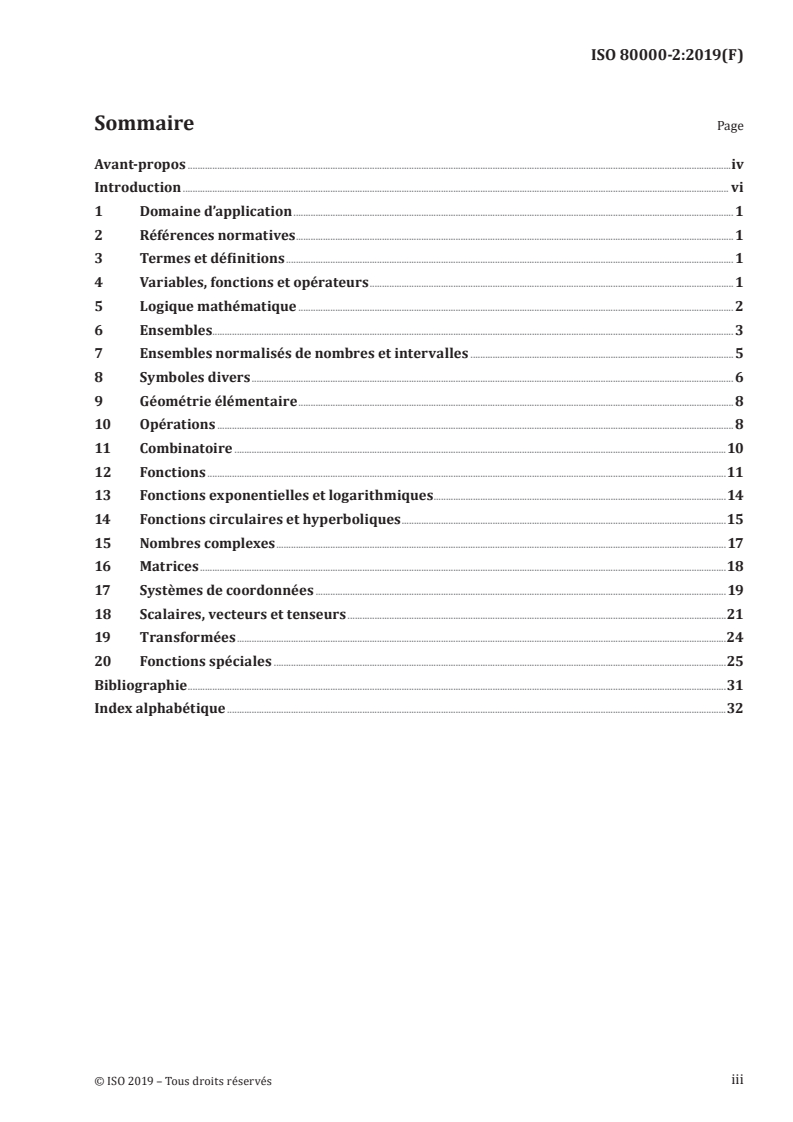
Sommaire Page
Avant-propos .iv
Introduction . vi
1 Domaine d’application . 1
2 Références normatives .1
3 Termes et définitions . 1
4 Variables, fonctions et opérateurs .1
5 Logique mathématique . 2
6 Ensembles. 3
7 Ensembles normalisés de nombres et intervalles . 5
8 Symboles divers . 6
9 Géométrie élémentaire .8
10 Opérations . 8
11 Combinatoire .10
12 Fonctions .11
13 Fonctions exponentielles et logarithmiques .14
14 Fonctions circulaires et hyperboliques .15
15 Nombres complexes .17
16 Matrices .18
17 Systèmes de coordonnées .19
18 Scalaires, vecteurs et tenseurs .21
19 Transformées .24
20 Fonctions spéciales .25
Bibliographie .31
Index alphabétique .32
iii
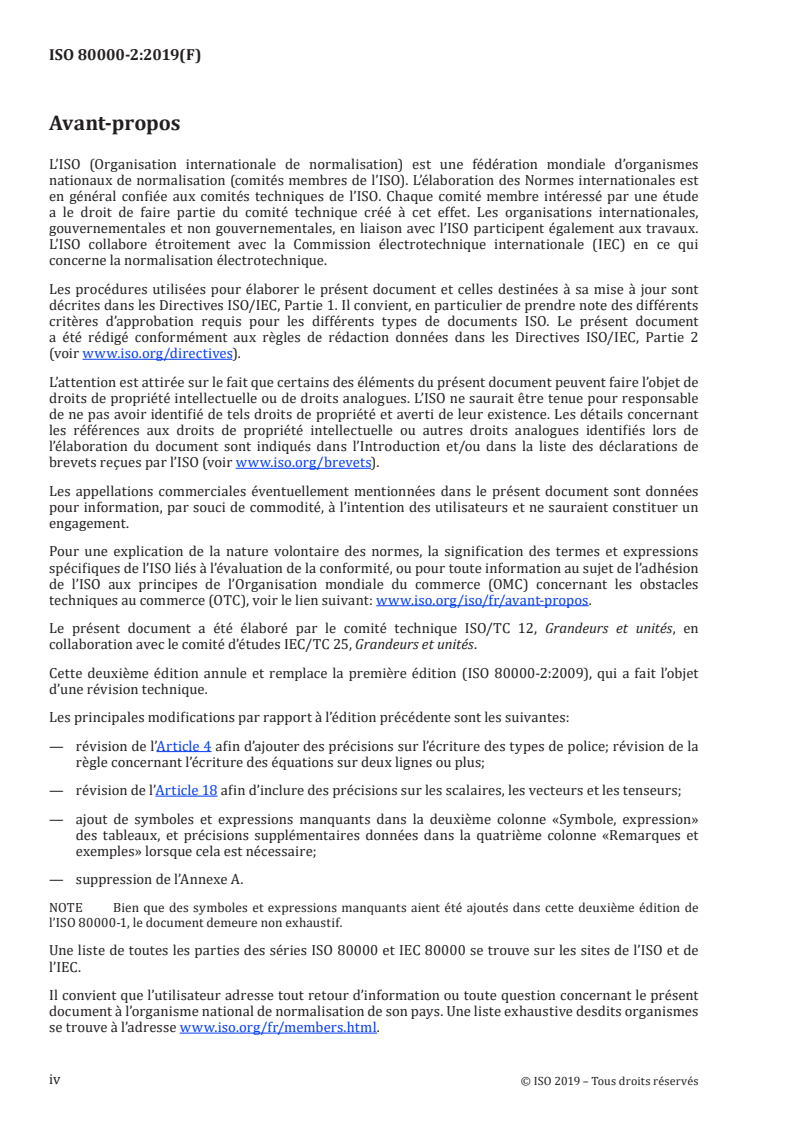
Avant-propos
L’ISO (Organisation internationale de normalisation) est une fédération mondiale d’organismes
nationaux de normalisation (comités membres de l’ISO). L’élaboration des Normes internationales est
en général confiée aux comités techniques de l’ISO. Chaque comité membre intéressé par une étude
a le droit de faire partie du comité technique créé à cet effet. Les organisations internationales,
gouvernementales et non gouvernementales, en liaison avec l’ISO participent également aux travaux.
L’ISO collabore étroitement avec la Commission électrotechnique internationale (IEC) en ce qui
concerne la normalisation électrotechnique.
Les procédures utilisées pour élaborer le présent document et celles destinées à sa mise à jour sont
décrites dans les Directives ISO/IEC, Partie 1. Il convient, en particulier de prendre note des différents
critères d’approbation requis pour les différents types de documents ISO. Le présent document
a été rédigé conformément aux règles de rédaction données dans les Directives ISO/IEC, Partie 2
(voir www.iso.org/directives).
L’attention est attirée sur le fait que certains des éléments du présent document peuvent faire l’objet de
droits de propriété intellectuelle ou de droits analogues. L’ISO ne saurait être tenue pour responsable
de ne pas avoir identifié de tels droits de propriété et averti de leur existence. Les détails concernant
les références aux droits de propriété intellectuelle ou autres droits analogues identifiés lors de
l’élaboration du document sont indiqués dans l’Introduction et/ou dans la liste des déclarations de
brevets reçues par l’ISO (voir www.iso.org/brevets).
Les appellations commerciales éventuellement mentionnées dans le présent document sont données
pour information, par souci de commodité, à l’intention des utilisateurs et ne sauraient constituer un
engagement.
Pour une explication de la nature volontaire des normes, la signification des termes et expressions
spécifiques de l’ISO liés à l’évaluation de la conformité, ou pour toute information au sujet de l’adhésion
de l’ISO aux principes de l’Organisation mondiale du commerce (OMC) concernant les obstacles
techniques au commerce (OTC), voir le lien suivant: www.iso.org/iso/fr/avant-propos.
Le présent document a été élaboré par le comité technique ISO/TC 12, Grandeurs et unités, en
collaboration avec le comité d’études IEC/TC 25, Grandeurs et unités.
Cette deuxième édition annule et remplace la première édition (ISO 80000-2:2009), qui a fait l’objet
d’une révision technique.
Les principales modifications par rapport à l’édition précédente sont les suivantes:
— révision de l’Article 4 afin d’ajouter des précisions sur l’écriture des types de police; révision de la
règle concernant l’écriture des équations sur deux lignes ou plus;
— révision de l’Article 18 afin d’inclure des précisions sur les scalaires, les vecteurs et les tenseurs;
— ajout de symboles et expressions manquants dans la deuxième colonne «Symbole, expression»
des tableaux, et précisions supplémentaires données dans la quatrième colonne «Remarques et
exemples» lorsque cela est nécessaire;
— suppression de l’Annexe A.
NOTE Bien que des symboles et expressions manquants aient été ajoutés dans cette deuxième édition de
l’ISO 80000-1, le document demeure non exhaustif.
Une liste de toutes les parties des séries ISO 80000 et IEC 80000 se trouve sur les sites de l’ISO et de
l’IEC.
Il convient que l’utilisateur adresse tout retour d’information ou toute question concernant le présent
document à l’organisme national de normalisation de son pays. Une liste exhaustive desdits organismes
se trouve à l’adresse www.iso.org/fr/members.html.
iv
La présente version corrigée de l'ISO 80000-2:2019 inclut les corrections suivantes:
— en 2-20.20, sous "Remarques et exemples", la première formule a été corrigée pour lire
m
d
m
m
L ()z =−()1 L ()z ; c-à-d ajout de +m à l'indice de L;
n nm+
m
dz
— en 2-20.21, sous "Remarques et exemples", deuxième ligne, la parenthèse a été corrigée pour lire
(pour n ∈ N , z ≤ 1); c-à-d ajout de z ≤ 1.
v
Introduction
Disposition des tableaux
Chaque tableau de symboles et expressions (excepté le Tableau 13) donne des informations d’aide (dans
la troisième colonne) sur le sens ou sur la manière dont l’expression peut être lue pour chaque élément
(numéroté dans la première colonne) du symbole considéré, généralement dans le contexte d’une
expression type (deuxième colonne). Lorsque plusieurs symboles ou expressions sont indiqués pour
le même concept, ils sont également admissibles. Dans certains cas, par exemple pour l’élévation à une
puissance, il n’existe qu’une expression type, mais pas de symbole. Le but des entrées est l’identification
de chaque concept, mais n’est pas une définition mathématique complète. La quatrième colonne,
«Remarques et exemples», donne des informations complémentaires et n’est pas normative.
Le Tableau 13 a un format différent. Il donne les symboles des coordonnées, ainsi que les rayons
vecteurs et leurs différentielles, pour des systèmes de coordonnées dans des espaces tridimensionnels.
vi
NORME INTERNATIONALE ISO 80000-2:2019(F)
Grandeurs et unités —
Partie 2:
Mathématiques
1 Domaine d’application
Le présent document spécifie les symboles mathématiques, explique leurs sens et donne leurs énoncés
et leurs applications.
Le présent document est principalement destiné à être utilisé dans les sciences de la nature et dans la
technique. Cependant, il s’applique également à d’autres domaines utilisant les mathématiques.
2 Références normatives
Les documents suivants sont cités dans le texte de sorte qu’ils constituent, pour tout ou partie de leur
contenu, des exigences du présent document. Pour les références datées, seule l’édition citée s’applique.
Pour les références non datées, la dernière édition du document de référence s’applique (y compris les
éventuels amendements).
ISO 80000-1, Grandeurs et unités — Partie 1: Généralités
3 Termes et définitions
Les Tableaux 1 à 16 donnent les symboles et les expressions utilisés dans les différents domaines des
mathématiques.
L’ISO et l’IEC tiennent à jour des bases de données terminologiques destinées à être utilisées en
normalisation, consultables aux adresses suivantes:
— ISO Online browsing platform: disponible à l’adresse https:// www .iso .org/ obp;
— IEC Electropedia: disponible à l’adresse http:// www .electropedia .org/ .
4 Variables, fonctions et opérateurs
Il est de règle d’utiliser différents types de caractères pour différents types d’entités, par exemple x, y,
… pour des nombres ou des éléments d’un ensemble donné, f, g pour des fonctions, etc. Cela facilite la
lecture des formules et la mise en place d’un contexte approprié.
Les variables, telles que x, y, etc., et les indices tels que i dans x sont imprimés en caractères
∑
i
i
italiques. Il en est de même pour les paramètres tels que a, b, etc., qui peuvent être considérés comme
constants dans un contexte particulier. La même règle s’applique aussi aux fonctions en général, par
exemple f, g.
Cependant, on écrit en caractères droits une fonction explicitement définie qui ne dépend pas du
contexte, par exemple sin, exp, ln, Γ. Les constantes mathématiques dont la valeur ne change jamais
sont imprimées en caractères droits, par exemple: e = 2,718 281 828 …; π = 3,141 592 …; i = −1.
Les opérateurs bien définis sont aussi imprimés en caractères droits, par exemple: div, δ dans δx et
chaque d dans df/dx. Certaines transformées utilisent des lettres majuscules spéciales (voir Article 19,
Transformées).
Les nombres exprimés par des chiffres sont toujours écrits en caractères droits, par exemple: 351 204;
1,32; 7/8.
Les opérateurs binaires, par exemple +, −, /, doivent être précédés et suivis d’un petit espace. Cette règle
ne s’applique pas dans le cas d’opérateurs unaires, comme dans −17,3.
L’argument d’une fonction est écrit entre parenthèses après le symbole de la fonction, sans espace
entre le symbole de la fonction et la première parenthèse, par exemple: f(x), cos(ω t + φ). Si le symbole
de la fonction comporte deux lettres ou plus et si l’argument ne contient pas de signe d’opération tel
que +, −, × , ou /, les parenthèses autour de l’argument peuvent être omises. Dans ce cas, un petit espace
doit être inséré entre le symbole de la fonction et l’argument, par exemple: int 2,4; sin nπ; arcosh 2A;
Ei x.
S’il existe un risque de confusion, il convient de toujours insérer des parenthèses. Par exemple, écrire
cos(x) + y; ne pas écrire cos x + y, qui pourrait être compris comme cos(x + y).
Une virgule, un point-virgule ou un autre symbole approprié peut être utilisé comme séparateur entre
les nombres ou expressions. La virgule est généralement préconisée, sauf dans le cas de nombres
comportant une virgule comme signe décimal.
S’il faut écrire une expression ou une équation sur deux lignes ou plus, la méthode suivante doit être
utilisée:
— effectuer la coupure immédiatement avant l’un des symboles = , +, −, ± ou , ou, si nécessaire,
immédiatement avant l’un des symboles × , ⋅ ou /.
Le symbole ne doit pas être répété au début de la ligne suivante, deux signes moins pourraient par
exemple entraîner des erreurs de signe. Il convient, si possible, que la coupure de ligne ne se trouve pas
dans une expression entre parenthèses.
5 Logique mathématique
Tableau 1 — Symboles et expressions en logique mathématique
Symbole,
N° Sens, énoncé Remarques et exemples
expression
2-5.1 p ∧ q conjonction de p et q,
p et q
2-5.2 p ∨ q disjonction de p et q, Ce «ou» est inclusif, c’est-à-dire p ∨ q est vrai si p ou
q ou les deux sont vrais.
p ou q
2-5.3 ¬ p négation de p,
non p
2-5.4 p ⇒ q p implique q, q ⇐ p a le même sens que p ⇒ q.
si p, alors q ⇒ est le symbole d’implication.
→ est également utilisé comme symbole d’implica-
tion.
2-5.5 p ⇔ q p est équivalent à q (p ⇒ q) ∧ (q ⇒ p) a le même sens que p ⇔ q.
⇔ est le symbole d’équivalence.
↔ est également utilisé comme symbole d’équiva-
lence.
Tableau 1 (suite)
Symbole,
N° Sens, énoncé Remarques et exemples
expression
2-5.6 ∀x ∈ A p(x) pour tout x appartenant à Si le contexte permet de savoir clairement quel est
A, la proposition p(x) est l’ensemble A considéré, il est possible d’utiliser la
vraie notation ∀x p(x).
∀ est le quantificateur universel.
Pour x ∈ A, voir 2-6.1.
2-5.7 ∃x ∈ A p(x) il existe un x appartenant à Si le contexte permet de savoir clairement quel est
A pour lequel p(x) est vrai l’ensemble A considéré, il est possible d’utiliser la
notation ∃x p(x).
∃ est le quantificateur existentiel.
Pour x ∈ A, voir 2-6.1.
∃ x p(x) est utilisé pour indiquer l’existence d’un
élément et d’un seul pour lequel p(x) est vrai.
∃! est aussi utilisé pour ∃ .
6 Ensembles
Tableau 2 — Symboles et expressions pour les ensembles
Symbole,
N° Sens, énoncé Remarques et exemples
expression
2-6.1 x ∈ A x appartient à A, A ∋ x a le même sens que x ∈ A.
x est un élément de l’ensemble A
2-6.2 y ∉ A y n’appartient pas à A, A ∌ y a le même sens que y ∉ A.
y n’est pas un élément de l’ensemble A La barre de négation peut aussi être verti-
cale.
2-6.3 {x , x , …, x } ensemble dont les éléments sont x , x , S’écrit aussi {x | i ∈ I}, où I est un ensemble
1 2 n 1 2 i
…, x d’indices.
n
2-6.4 {x ∈ A | p(x)} ensemble des éléments de A pour les- EXEMPLE
quels la proposition p(x) est vraie
{x ∈ R | x ≥ 5}
Si le contexte permet de savoir claire-
ment quel est l’ensemble A considéré, il
est possible d’utiliser la notation {x | p(x)}
(par exemple {x | x ≥ 5}, s’il est clair que des
nombres réels sont considérés).
Au lieu d’une barre verticale, un point-vir-
gule est souvent utilisé comme séparateur:
{x ∈ A: p(x)}.
2-6.5 card A nombre des éléments de A, Le cardinal peut être un nombre transfini.
A cardinal de A Le symbole ∣∣ est aussi utilisé pour la valeur
absolue d’un nombre réel (voir 2-10.16), le
module d’un nombre complexe (voir 2-15.4)
et la norme d’un vecteur (voir 2-18.4).
2-6.6 ∅ l’ensemble vide
{}
Tableau 2 (suite)
Symbole,
N° Sens, énoncé Remarques et exemples
expression
2-6.7 B ⊆ A B est inclus dans A, Tout élément de B appartient à A.
B est un sous-ensemble de A ⊂ est aussi utilisé, mais voir la remarque en
2-6.8.
A ⊇ B a le même sens que B ⊆ A.
2-6.8 B ⊂ A B est strictement inclus dans A, Tout élément de B appartient à A, mais au
moins un élément de A n’appartient pas à B.
B un sous-ensemble strict de A
Si ⊂ est utilisé pour 2-6.7, alors ⊊ doit être
utilisé pour 2-6.8.
A ⊃ B a le même sens que B ⊂ A.
2-6.9 A ∪ B réunion de A et de B Ensemble des éléments appartenant au
moins à un des ensembles A et B.
A ∪ B = {x | x ∈ A ∨ x ∈ B}
2-6.10 A ∩ B intersection de A et de B Ensemble des éléments appartenant à la fois
à A et à B.
A ∩ B = {x | x ∈ A ∧ x ∈ B}
2-6.11 n réunion des ensembles A , A , …, A Ensemble des éléments appartenant au
1 2 n
moins à un des ensembles A , A , ., A
A
1 2 n
i
n
i=1
n
A = A ∪ … ∪ A
1 n
i
, et sont aussi utilisés,
i=1 iI∈
i=1
iI∈
où I est un ensemble d’indices.
n
2-6.12 intersection des ensembles Ensemble des éléments appartenant à la fois
à A , A , ., A
A
1 2 n
i
A , A ,…, A
1 2 n
i=1
n
n
, et sont aussi utilisés,
i=1 iI∈
A = A ∩ … ∩ A
iI∈
1 n
i
i=1 où I est un ensemble d’indices.
2-6.13 A∖B différence de A et de B, Ensemble des éléments de A n’appartenant
pas à B.
A moins B
A∖B = {x | x ∈ A ∧ x ∉ B}
Il convient de ne pas utiliser la notation
A − B.
CB est aussi utilisé. CB est surtout
A A
utilisé lorsque B est un sous-ensemble de A,
et le symbole A peut être omis si le contexte
permet de savoir clairement quel est
l’ensemble A considéré.
2-6.14 (a, b) paire ordonnée a, b, (a, b) = (c, d) si et seulement si a = c et b = d.
couple a, b Si la virgule peut être confondue avec le
signe décimal, alors le point-virgule (;) ou
la barre (|) peuvent être utilisés comme
séparateur.
2-6.15 (a , a , …, a ) n-uple, n-uplet, multiplet Voir remarque en 2-6.14.
1 2 n
2-6.16 A × B produit cartésien des ensembles A et B Ensembles des paires (a, b) pour lesquelles
a ∈ A et b ∈ B.
A × B = {(x, y) | x ∈ A ∧ y ∈ B}
Tableau 2 (suite)
Symbole,
N° Sens, énoncé Remarques et exemples
expression
2-6.17 n produit cartésien des ensembles Ensembles des n-uples (x , x , …, x ) pour
1 2 n
lesquels x ∈ A , x ∈ A , …, x ∈ A .
A
1 1 2 2 n n
∏
i
A , A , …, A
1 2 n
i=1 n
AA××.× A est noté A , où n est le nombre
n
de facteurs dans le produit.
AA=×…×A
∏ in1
i=1
2-6.18 id application identité sur l’ensemble A, id est l’ensemble de toutes les paires (x,
A A
x) où x ∈ A. Si le contexte permet de savoir
diagonale de A × A
clairement quel est l’ensemble A considéré,
l’indice A peut être omis.
7 Ensembles normalisés de nombres et intervalles
Tableau 3 — Symboles et expressions pour les ensembles normalisés de nombres et les
intervalles
Symbole,
N° Sens, énoncé Remarques et exemples
expression
2-7.1 ensemble des entiers naturels,
N N = {0, 1, 2, 3, …}
*
ensemble des entiers positifs et de N = {1, 2, 3, …}
zéro
D’autres exclusions peuvent être indiquées de
manière évidente comme indiqué ci-dessous.
N = {n ∈ N | n > 5}
> 5
Les symboles IN et sont aussi utilisés.
2-7.2 ensemble des entiers
Z Z = {…, −2, −1, 0, 1, 2, …}
ensemble des entiers relatifs
*
Z = {n ∈ Z | n ≠ 0}
D’autres exclusions peuvent être indiquées de
manière évidente comme indiqué ci-dessous.
Z = {n ∈ Z | n > −3}
> −3
Le symbole est aussi utilisé.
2-7.3 Q ensemble des nombres rationnels,
*
Q = {r ∈ Q | r ≠ 0}
ensemble des rationnels
D’autres exclusions peuvent être indiquées de
manière évidente comme indiqué ci-dessous.
Q = {r ∈ Q | r < 0}
< 0
Les symboles QI et ℚ sont aussi utilisés.
2-7.4 R ensemble des nombres réels,
*
R = {x ∈ R | x ≠ 0}
ensemble des réels
D’autres exclusions peuvent être indiquées de
manière évidente comme indiqué ci-dessous.
R = {x ∈ R | x > 0}
> 0
Les symboles IR et sont aussi utilisés.
2-7.5 ensemble des nombres complexes
C *
C = {z ∈ C | z ≠ 0}
Le symbole est aussi utilisé.
2-7.6 P ensemble des nombres premiers P = {2, 3, 5, 7, 11, 13, 17…}
Le symbole ℙ est aussi utilisé.
Tableau 3 (suite)
Symbole,
N° Sens, énoncé Remarques et exemples
expression
2-7.7 [a, b] intervalle fermé de a inclus à b
[a, b] = {x ∈ R | a ≤ x ≤ b}
inclus
2-7.8 (a, b] intervalle semi-ouvert à gauche de (a, b] = {x ∈ R | a < x ≤ b}
a exclu à b inclus
La notation ]a, b] est aussi utilisée.
2-7.9 [a, b) intervalle semi-ouvert à droite de
[a, b) = {x ∈ R | a ≤ x < b}
a inclus à b exclu
La notation [a, b[ est aussi utilisée.
2-7.10 (a, b) intervalle ouvert de a exclu à b
(a, b) = {x ∈ R | a < x < b}
exclu
La notation ]a, b[ est aussi utilisée.
2-7.11 (−∞, b] intervalle illimité fermé finissant (−∞, b] = {x ∈ R | x ≤ b}
en b inclus
La notation ]−∞, b] est aussi utilisée.
2-7.12 (−∞, b) intervalle illimité ouvert finissant
(−∞, b) = {x ∈ R | x < b}
en b exclu
La notation ]−∞, b[ est aussi utilisée.
2-7.13 [a, +∞) intervalle illimité fermé commen- [a, +∞) = {x ∈ R | a ≤ x}
çant en a inclus
Les notations [a, ∞), [a, +∞[ et [a, ∞[ sont aussi
utilisées.
2-7.14 (a, +∞) intervalle illimité ouvert commen-
(a, +∞) = {x ∈ R | a < x}
çant en a exclu
Les notations (a, ∞), ]a, +∞[ et ]a, ∞[ sont aussi
utilisées.
8 Symboles divers
Tableau 4 — Symboles et expressions divers
Symbole,
N° Sens, énoncé Remarques et exemples
expression
2-8.1 a = b a est égal à b Le symbole ≡ peut être utilisé pour souligner qu’une
égalité particulière est une identité, c’est-à-dire
a égale b
qu’elle s’applique universellement.
Mais voir 2-8.18 pour un autre sens.
2-8.2 a ≠ b a est différent de b La barre de négation peut aussi être verticale.
2-8.3 a ≔ b a est égal par définition à b EXEMPLE
p ≔ mv , où p est la quantité de mouvement, m est la
masse et v la vitesse.
Les symboles = et ≝ sont aussi utilisés.
def
2-8.4 a ≙ b a correspond à b EXEMPLES
Si E = kT, alors 1 eV ≙ 11 604,5 K.
Si 1 cm sur une carte correspond à une longueur de
10 km, il est possible d’écrire 1 cm ≙ 10 km.
La correspondance n’est pas symétrique.
2-8.5 a ≈ b a est approximativement égal Il revient à l’utilisateur de décider si une approxi-
à b mation est suffisamment bonne. L’égalité n’est pas
exclue.
Tableau 4 (suite)
Symbole,
N° Sens, énoncé Remarques et exemples
expression
2-8.6 a ≃ b a est asymptotiquement égal EXEMPLE
à b
1 1
≃ lorsque x → a
sin()xa− xa−
(Pour x → a, voir 2-8.16.)
2-8.7 a ~ b a est proportionnel à b Le symbole ~ est aussi utilisé pour les relations
d’équivalence.
La notation a ∝ b est aussi utilisée.
2-8.8 M ≅ N M est congruent à N, M et N sont des ensembles de points (figures géomé-
triques).
M est isomorphe à N
Ce symbole est aussi utilisé pour les isomorphismes
de structures mathématiques.
2-8.9 a < b a est inférieur à b
2-8.10 b > a b est supérieur à a
2-8.11 a ≤ b a est inférieur ou égal à b
2-8.12 b ≥ a b est supérieur ou égal à a
2-8.13 a ≪ b a est très inférieur à b C’est la situation qui détermine si a est suffisamment
petit par rapport à b.
2-8.14 b ≫ a b est très supérieur à a C’est la situation qui détermine si b est suffisamment
grand par rapport à a.
2-8.15 ∞ infini Ce symbole ne désigne pas un nombre mais fait sou-
vent partie de différentes expressions relatives aux
limites.
Les notations +∞, −∞ sont aussi utilisées.
2-8.16 x → a x tend vers a Ce symbole apparaît dans différentes expressions
relatives aux limites.
a peut aussi être ∞, +∞ ou −∞.
2-8.17 m ∣ n m divise n Pour les entiers m et n:
∃ k ∈ Z m ⋅ k = n
2-8.18 n ≡ k mod m n est congruent à k modulo m Pour les entiers n, k et m:
m ∣ (n − k)
Ce concept de théorie des nombres ne doit pas être
confondu avec l’identité d’une équation, mentionnée
au 2-8.1, colonne 4.
2-8.19 (a + b) parenthèses Il est recommandé d’utiliser, pour les regroupements,
seulement les parenthèses, car les crochets et acco-
[a + b] crochets
lades ont souvent des significations spécifiques selon
{a + b} accolades le domaine. Les parenthèses peuvent être emboîtées
sans ambiguïté.
〈a + b〉 chevrons, crochets angulaires
9 Géométrie élémentaire
Tableau 5 — Symboles et expressions en géométrie élémentaire
Symbole,
N° Sens, énoncé Remarques et exemples
expression
2-9.1 AB∥CD la droite AB est parallèle à la On écrit g ∥ h si g et h sont les droites déterminées
droite CD respectivement par les points A et B et les points C
et D.
2-9.2 AB⊥CD la droite AB est perpendiculaire à On écrit g ⊥ h si g et h sont les droites déterminées
la droite CD respectivement par les points A et B et les points C
et D. Dans un plan, les droites s’intersectent.
2-9.3 ∢ABC angle de sommet B dans le L’angle n’est pas orienté, il vérifie que
triangle ABC ∢ABC = ∢CBA et
0 ≤ ∢ABC ≤ π rad.
Pour une définition plus générale incluant les
angles de rotation, voir l’ISO 80000-3.
2-9.4 segment de droite de A à B Le segment de droite est l’ensemble des points
AB
entre A et B sur la droite AB, incluant les extrémi-
tés A et B.
2-9.5 vecteur de A à B
AB Si AB=CD alors B, vu de A, est dans la même
direction et à égale distance que D vu de C. Il n’en
découle pas que A = C et B = D.
2-9.6 d(A, B) distance entre les points A et B La distance est la longueur du segment de droite
AB et aussi la norme du vecteur AB .
10 Opérations
Tableau 6 — Symboles et expressions pour les opérations mathématiques
Symbole,
N° Sens, énoncé Remarques et exemples
expression
2-10.1 a + b a plus b Cette opération est appelée addition. Le signe + est le sym-
bole de l’addition.
2-10.2 a − b a moins b Cette opération est appelée soustraction. Le signe − est le
symbole de la soustraction.
2-10.3 a ± b a plus ou moins b Il s’agit de la combinaison de deux valeurs en une expression.
2-10.4 a ∓ b a moins ou plus b −(a ± b) = −a ∓ b
2-10.5 a ⋅ b a multiplié par b, Cette opération est appelée multiplication. Le signe de la
multiplication est un point à mi-hauteur (∙) ou une croix (× ).
a × b a fois b
Il peut être omis si aucune ambiguïté n’est possible.
a b
Voir aussi 2-6.16, 2-6.17, 2-18.11, 2-18.12, 2-18.23 et 2-18.24
ab
pour l’utilisation du point et de la croix dans différents pro-
duits.
2-10.6 a divisé par b
a a
−1
=⋅ab
b b
a/b Le symbole: est souvent utilisé pour les rapports de valeurs
de grandeurs de même dimension.
a: b
Il convient de ne pas utiliser le symbole ÷ .
n n
2-10.7 a + a + … + a ,
1 2 n
Les notations a , a , a et a sont aussi
∑ i ∑ i ∑ i ∑ i
i=1 i
a
∑ i
somme de a , a , …, a
i
1 2 n
i=1
utilisées.
Tableau 6 (suite)
Symbole,
N° Sens, énoncé Remarques et exemples
expression
n
2-10.8 n a ⋅ a ⋅ … ⋅ a ,
1 2 n
Les notations a , a , a et a sont aussi
∏ ∏ ∏ ∏
i i i i
a i=1 i
∏
i
produit de a , a , …, a
i
1 2 n
i=1
utilisées.
p 2 3
2-10.9 a a puissance p L’énoncé de a est a au carré, et celui de a est a au cube.
1/2
2-10.10 a a puissance 1/2,
Si a ≥ 0, alors a ≥ 0.
racine carrée de a
a
Il convient d’éviter le symbole √a.
Voir remarque en 2-10.11.
1/n
n
2-10.11 a a puissance 1/n,
Si a ≥ 0, alors a ≥ 0.
ième
n
racine n de a
n
a
Il convient d’éviter le symbole sans la ligne supérieure √a.
n
Toutefois, si le symbole √ ou √ est utilisé pour agir sur une
expression composée, des parenthèses doivent être utilisées
pour éviter toute ambiguïté.
x
2-10.12 valeur moyenne de x, Des valeurs moyennes obtenues par d’autres méthodes sont:
〈x〉 moyenne arithmétique — la moyenne harmonique indiquée par un indice h;
de x
x
— la moyenne géométrique indiquée par un indice g;
a
— la moyenne quadratique, souvent appelée «root mean
square» en anglais, indiquée par un indice q ou rms.
L’indice ne peut être omis que pour la moyenne arithmétique.
En mathématique, x est aussi utilisé pour le conjugué du
nombre complexe x; voir 2-15.6.
2-10.13 sgn a signum a Pour tout a réel:
10si a>
sgn a= 00si a=
−<10si a
Voir aussi 2-15.7. Parfois sgn 0 est laissé indéfini.
2-10.14 inf M borne inférieure de M Plus grand minorant d’un ensemble non vide minoré de
nombres.
2-10.15 sup M borne supérieure de M Plus petit majorant d’un ensemble non vide majoré de
nombres.
2-10.16 valeur absolue de a La notation abs a est aussi utilisée.
a
Le symbole ∣∣ est aussi utilisé pour le cardinal d’un ensemble
(voir 2-6.5), le module d’un nombre complexe (2-15.4) et la
norme d’un vecteur (voir 2-18.4).
2-10.17 partie inférieure de a, La notation ent a est aussi utilisée.
a
floor a,
EXEMPLES
plus grand nombre
24, =2
entier inférieur ou égal
au nombre réel a −24, =−3
2-10.18 partie supérieure de a, «ceil» est une abréviation du mot anglais «ceiling».
a
ceil a,
EXEMPLES
plus petit nombre
24, =3
entier supérieur ou
égal au nombre réel a −24, =−2
Tableau 6 (suite)
Symbole,
N° Sens, énoncé Remarques et exemples
expression
2-10.19 int a partie entière du
intsaa=⋅gn a
nombre réel a
EXEMPLES
int(2,4) = 2
int(−2,4) = −2
2-10.20 frac a partie fractionnaire du frac a = a − int a
nombre réel a
EXEMPLES
frac(2,4) = 0,4
frac(−2,4) = −0,4
2-10.21 min(a, b) minimum de a et b L’opération se généralise à plus de deux nombres et aux
ensembles de nombres. Cependant, un ensemble infini de
nombres n’a pas nécessairement un plus petit élément; dans
ce cas, utiliser inf (voir 2-10.14).
2-10.22 max(a, b) maximum de a et b L’opération se généralise à plus de deux nombres et aux
ensembles de nombres. Cependant, un ensemble infini de
nombres n’a pas nécessairement un plus grand élément; dans
ce cas, utiliser sup (voir 2-10.15).
11 Combinatoire
Dans le présent article, n et k sont des entiers naturels, avec k ≤ n.
Tableau 7 — Symboles et expressions en combinatoire
Symbole,
N° Sens, énoncé Remarques et exemples
expression
n
2-11.1 n! factorielle n
nk!==12⋅⋅3⋅…⋅n (pour n > 0)
∏
k=1
0! = 1
2-11.2 k factorielle décroissante k
a a = a⋅(a − 1)⋅…⋅(a − k + 1) (pour k > 0)
factorielle descendante
a = 1
a peut être un nombre complexe.
Pour tout entier naturel n:
n!
k
n =
()nk− !
En combinatoire et en statistique, le symbole (a) est
k
souvent utilisé pour les factorielles décroissantes. Dans
la théorie des fonctions spéciales cependant, le même
symbole est souvent utilisé pour les factorielles crois-
santes et est appelé symbole de Pochhammer.
Tableau 7 (suite)
Symbole,
N° Sens, énoncé Remarques et exemples
expression
2-11.3 factorielle croissante
k k
a a = a⋅(a + 1)⋅…⋅(a + k − 1) (pour k > 0)
factorielle montante
a = 1
a peut être un nombre complexe.
Pour tout entier naturel n:
nk+−1 !
()
k
n =
()n−1 !
Dans la théorie des fonctions spéciales, le symbole ()a
k
est souvent utilisé pour les factorielles croissantes et
est appelé symbole de Pochhammer. En combinatoire et
en statistique cependant, le même symbole est souvent
utilisé pour les factorielles décroissantes.
2-11.4 n coefficient binomial n
n!
= ()pour0≤≤kn
kn!!−k
k k ()
2-11.5 B nombres de Bernoulli n−1
n
n+1
BB=−
n ∑ k
n+1
k
k=0
(pour n > 0)
B = 1
B =−12/ , B =0
1 23n+
2-11.6 k nombre de combinaisons
n
n!
C
n k
C = =
sans répétition
n
kn!!()−k
k
R k
2-11.7 nombre de combinaisons nk+−1
C
R k
n
C =
avec répétition
n
k
2-11.8 k nombre d’arrangements
n!
V
kk
n
V ==n
sans répétition n
()nk− !
Le terme «permutation» est utilisé lorsque n = k.
R k R kk
2-11.9 nombre d’arrangements
V V =n
n n
avec répétition
12 Fonctions
Les concepts 2-12.1 à 2-12.13 concernent les fonctions en général, tandis que les concepts 2-12.14 à
2-12.27 concernent des fonctions avec des nombres comme valeurs utilisées en calcul différentiel et
intégral.
Tableau 8 — Symboles et expressions pour les fonctions
Symbole,
N° Sens, énoncé Remarques et exemples
expression
2-12.1 f, g, h, … fonctions Une fonction assigne à tout argument dans son
domaine une valeur unique dans son image.
On dit que les arguments sont appliqués par la fonc-
tion sur les valeurs, qui sont appelées images des
arguments par la fonction.
Tableau 8 (suite)
Symbole,
N° Sens, énoncé Remarques et exemples
expression
2-12.2 f(x) valeur de la fonction f respec- Une fonction ayant un ensemble de n-uples comme
tivement pour l’argument x ou domaine est une fonction de n variables.
f(x , …, x )
1 n
pour l’argument (x , …, x )
1 n
2-12.3 dom f domaine de f Ensemble d’objets auxquels f assigne une valeur.
D( f ) est aussi utilisé.
2-12.4 ran f image de f Ensemble de valeurs de la fonction f.
R( f ) est aussi utilisé.
2-12.5 f: A → B f est une application de A dom f = A et ran f ⊆ B
vers B
Il n’est pas nécessaire que tous les éléments de B
soient des valeurs de la fonction f.
2-12.6 f: A ↠ B f est une application surjec- dom f = A et ran f = B
tive de A sur B
2-12.7 f: A ↣ B f est une application injective f: A → B et pour tous les x, y ∈ A
de A dans B
si x ≠ y alors f(x) ≠ f( y).
On dit alors que la fonction f est injective.
2-12.8 f: A ⤖ B f est une application bijective f: A ↠ B et f: A ↣ B
de A sur B
2-12.9 x↦T(x), x ∈ A fonction qui applique tout T(x) est un terme définitoire donnant les valeurs
x ∈ A à T(x) d’une certaine fonction pour les arguments x ∈ A.
Si cette fonction est appelée f, on a f(x) = T(x) pour
tout x ∈ A. Par conséquent, le terme définitoire T(x)
est souvent utilisé pour désigner la fonction f.
EXEMPLE
x↦3x y, x ∈ [0, 2]
Il s’agit de la fonction quadratique (de x dépendant
du paramètre y) définie dans l’intervalle donné par le
terme 3x y.
Si aucun symbole de fonction n’est introduit, le terme
3x y est utilisé pour désigner cette fonction.
−1 −1
2-12.10 f fonction réciproque de f, La fonction réciproque f d’une fonction f n’est défi-
fonction inverse de f nie que si f est injective.
Si f est injective alors
−1 −1
dom( f ) = ran( f ), ran( f ) = dom( f ), et
−1
f ( f(x)) = x pour x ∈ dom f.
Il convient de ne pas confondre la fonction réciproque
−1
f avec la fonction inverse d’une fonction numérique
−1
x ↦ f(x) .
2-12.11 gf fonction composée de f et g,
()gf ()xg= ()fx()
g rond f
Dans la fonction composée gf , la fonction g doit
être appliquée après la fonction f.
2-12.12 f
f(x) = y, EXEMPLE
xy→
cos
f applique x sur y
π→−1
f: x ↦ y
b
2-12.13 fb()−fa() Cette notation est principalement utilisée pour le
f
a
calcul des intégrales définies.
fb()., , . −fa()., , .
ub=
fu(., , .)
ua=
Tableau 8 (suite)
Symbole,
N° Sens, énoncé Remarques et exemples
expression
2-12.14 limite de f(x) quand x tend f(x) → b lorsque x → a
lim(fx)
xa→
vers a
peut être utilisé pour lim(fx)=b .
lim(fx)
xa→
xa→
Les limites «à droite» (x > a) et «à gauche» (x < a) sont
notées respectivement
lim(fx) et
xa→+
lim(fx) .
xa→−
2-12.15 f(x) = O(g(x)) f(x) est grand O de g(x), Le symbole «=» est utilisé ici pour des raisons his-
toriques mais n’a pas le sens d’égalité, parce que la
∣f(x)/g(x)∣ est majoré dans
transitivité ne s’applique pas.
la limite impliquée par le
contexte, EXEMPLE
f(x) est d’ordre comparable ou sin(xx=O ) , lorsque x → 0
inférieur à g(x)
2-12.16 f(x) = o(g(x)) f(x) est petit o de g(x), Le symbole «=» est utilisé ici pour des raisons his-
toriques mais n’a pas le sens d’égalité, parce que la
f(x)/g(x) → 0 dans la limite
transitivité ne s’applique pas.
impliquée par le contexte,
EXEMPLE
f(x) est d’ordre inférieur à
g(x) cos(xx=+1o ) , lorsque x → 0
2-12.17 Δf delta f, Différence entre deux valeurs de la fonction impli-
quées par le contexte.
accroissement de f
EXEMPLES
Δ=xx −x
Δfx()= fx()− fx()
2-12.18 dérivée de f par rapport à x À utiliser seulement pour les fonctions d’une seule
df
variable.
dx
ddfx/
La variable indépendante peut aussi être indiquée,
par exemple:
f ′
dfx()
Df
, ddfx()/ x , fx′() et Dfx() .
dx
Si la variable indépendante est le temps t, f est aussi
utilisé pour f ′ .
2-12.19 valeur de la dérivée de f pour Voir aussi 2-12.18
df
x = a
dx
xa=
()ddfx/
xa=
fa′
()
Dfa()
ième
n
2-12.20 dérivée n de f par rapport À utiliser seulement pour les fonctions d’une seule
d f
à x variable.
n
dx
n
nn
d fx
ddfx/ ()
nn ()n
n
, ddfx / x , fx et D f sont aussi
() ()
n
n dx
()
f
utilisés.
n
D f
(2) (3)
f ″ et f ″′ sont aussi utilisés pour f et f ,
respectivement.
Si la variable indépendante est le temps t, f est aussi
utilisé pour f ″ .
Tableau 8 (suite)
Symbole,
N° Sens, énoncé Remarques et exemples
expression
2-12.21 dérivée partielle de f par À utiliser seulement pour les fonctions de plusieurs
∂f
rapport à x variables.
∂x
∂f/∂x
∂fx(, y,.)
, ∂f (x, y, …)∕∂x, ∂ f (x, y, …) et D fx(),,y …
x
x
∂x
∂ f
x
sont aussi utilisés.
Les autres variables indépendantes peuvent être
∂f
indiquées en indice, par exemple .
∂x
y.
Cette notation de la dérivée partielle peut être éten-
due aux dérivées d’ordre supérieur, par exemple:
∂ f ∂ ∂f
=
∂x ∂x
∂x
∂ f ∂ ∂f
=
∂∂xy ∂x ∂y
∂ ∂f
D’autres notations, par exemple f = , sont
xy
∂x ∂y
aussi utilisées.
2-12.22 df différentielle totale de f
∂f ∂f
ddfx,,y … = x+ dy+…
()
∂x ∂y
2-12.23 δf variation (infinitésimale) de f Ce symbole est utilisé en calcul des variations.
2-12.24 intégrale indéfinie de f
fx()dx
∫
b
2-12.25 intégrale définie de f de a à b Ceci est le cas simple d’une fonction définie sur un
intervalle. Il est aussi possible de définir l’intégration
fx dx
()
∫
de fonctions définies sur des domaines plus généraux.
a
Les notations spéciales, par exemple ,, ,, sont
∫∫∫∫
CS V
utilisées respectivement pour l’intégration sur une
courbe C, une surface S, un domaine tridimension-
nel V et une courbe ou une surface fermée.
Les intégrales multiples sont aussi notées ,
,
∫∫∫∫
etc.
b c−δ b
2-12.26 valeur principale de Cauchy
de l’intégrale d’une fonction f
− fx dx lim fx ddxf+ xx
() () ()
∫ ∫∫
δ→+0
non définie en c, où ac<
a a c+δ
∞ a
2-12.27 valeur principale de Cauchy
de l’intégrale d’une fonction f
− fx()dx limd− fx() x
∫ ∫
a→∞
_
∞ −a
Voir 2-12.26.
13 Fonctions exponentielles et logarithmiques
Des arguments complexes peuvent être utilisés, en particulier pour la base e.
Tableau 9 — Symboles et expressions pour les fonctions exponentielles et logarithmiques
Symbole,
N° Sens, énoncé Remarques et exemples
expression
2-13.1 e base des logarithmes népé- n
riens e ≔ lim 1+ = 2,718 281 828 .
n→∞ n
Ce nombre est appelé nombre d’Euler.
x
2-13.2 a a à la puissance x, Voir aussi 2-10.9.
exponentielle de base a de
l’argument x
x
2-13.3 e e à la puissance x, Voir 2-15.5.
exp x exponentielle de base e de
l’argument x
2-13.4 log x logarithme de base a de log x est utilisé lorsqu’il n’est pas nécessaire de spéci-
a
l’argument x fier la base.
2-13.5 ln x logarithme népérien de x ln x = log x
e
log x ne doit pas être utilisé à la place de ln x, lg x, lb x,
ou log x, log x, log x.
e 10 2
2-13.6 lg x logarithme décimal de x lg x = log x
Voir remarque en 2-13.5.
2-13.7 lb x logarithme binaire de x lb x = log x
Voir remarque en 2-13.5.
14 Fonctions circulaires et hyperboliques
Tableau 10 — Symboles et expressions pour les fonctions circulaires et hyperboliques
Symbole,
N° Sens, énoncé Remarques et exemples
expression
2-14.1 π rapport de la circonférence π = 3,141 592 6…
d’un cercle à son diamètre
iixx−
2-14.2 sin x sinus x
ee−
sin x=
2i
3 5
sin x = x − x /3! + x /5! − …
n n
(sin x) , (cos x) , etc. (pour n ≥ 2), sont souvent notés
n n
sin x, cos x, etc.
2-14.3 cos x cosinus x cos x = sin(x + π/2)
2-14.4 tan x tangente x tan x = sin x/cos x
Il convient de ne pas utiliser tg x.
2-14.5 cot x cotangente x cot x = 1/tan x
Il convient de ne pas utiliser ctg x.
2-14.6 sec x sécante x sec x = 1/cos x
2-14.7 csc x cosécante x csc x = 1/sin x
cosec x est aussi utilisé.
2-14.8 arcsin x arc sinus x y = arcsin x ⇔ x = sin y
(pour −π/2 ≤ y ≤ π/2)
La fonction arcsin est la réciproque de la fonction sin
avec la restriction ci-dessus.
Tableau 10 (suite)
Symbole,
N° Sens, énoncé Remarques et exemples
expression
2-14.9 arccos x arc cosinus x y = arccos x ⇔ x = cos y (pour 0 ≤ y ≤ π)
La fonction arccos est la réciproque de la fonction cos
avec la restriction ci-dessus.
2-14.10 arctan x arc tangente x y = arctan x ⇔ x = tan y
(pour −π/2 ≤ y ≤ π/2)
La fonction arctan est la réciproque de la fonction tan
avec la restriction ci-dessus.
Il convient de ne pas utiliser arctg x.
2-14.11 arccot x arc cotangente x y = arccot x ⇔ x = cot y (pour 0 ≤ y ≤ π)
La fonction arccot est la réciproque de la fonction cot
avec la restriction ci-dessus.
Il convient de ne pas utiliser arcctg x.
2-14.12 arcsec x arc sécante x y = arcsec x ⇔ x = sec y
(pour 0 ≤ y ≤ π, y ≠ π/2)
La fonction arcsec est la réciproque de la fonction sec
avec la restriction ci-dessus.
2-14.13 arccsc x arc cosécante x y = arccsc x ⇔ x = csc y
(pour −π/2 ≤ y ≤ π/2, y ≠ 0)
La fonction arccsc est la réciproque de la fonction csc
avec la restric
...