

IEC 60746-4:2018
(Main)Expression of performance of electrochemical analyzers - Part 4: Dissolved oxygen in water measured by membrane-covered amperometric sensors
General Information
- Abstract
IEC 60746-4:2018 applies to analyzers using membrane covered amperometric sensors. It applies to analyzers suitable for use in water containing liquids, ultrapure waters, fresh or potable water, sea water or other aqueous solutions, industrial or municipal waste water from water bodies (e.g. lakes, rivers, estuaries), as well as for industrial process streams and process liquids. Whilst in principle amperometric oxygen-analyzers are applicable in gaseous phases, the expression of performance in the gas phase is outside the scope of this document. This document is applicable to analyzers specified for permanent installation in any location (indoors or outdoors) using membrane-covered amperometric sensors. This edition includes the following significant technical changes with respect to the previous edition:
a) terms and definitions have been revised to meet the requirements of ISO/IEC Directives Part 2:2016.
b) ISO 5814:2012 is cited as reference for solubility tables of dissolved oxygen in water with variable salt content at different pressure and temperature.
- Status
- Published
- Publication Date
- 12-Dec-2018
- Technical Committee
- SC 65B - Measurement and control devices
- Drafting Committee
- WG 14 - TC 65/SC 65B/WG 14
- Current Stage
- PPUB - Publication issued
- Start Date
- 13-Dec-2018
- Completion Date
- 30-Nov-2018
Overview
IEC 60746-4:2018 is an international standard published by the International Electrotechnical Commission (IEC) that defines the expression of performance for electrochemical analyzers measuring dissolved oxygen in water. Specifically, it addresses analyzers using membrane-covered amperometric sensors designed to measure oxygen levels in various aqueous environments, including ultrapure water, freshwater, seawater, and industrial or municipal wastewater. This standard focuses on analyzers suitable for permanent installation both indoors and outdoors, though it excludes performance expression in gaseous phases.
This 2018 edition is a technical revision of the original 1992 version, incorporating updated terms and definitions consistent with ISO/IEC directives and referencing ISO 5814:2012 for solubility tables of dissolved oxygen considering salt content variations, pressure, and temperature.
Key Topics
Scope and Application
The standard applies to amperometric oxygen analyzers with membrane-covered sensors used in liquid phases such as natural waters, process liquids, and wastewaters. It excludes gas phase measurements.Performance Parameters
Key performance aspects covered include zero and span drift, sensor sensitivity, stabilization time, oxygen consumption by the sensor, flow dependencies, and temperature or pressure compensation methods.Influence Quantities
The document discusses variables affecting sensor readings such as temperature, pressure, dissolved substances, and flow rates, providing guidance to standardize measurement conditions and enhance accuracy.Specification and Verification Procedures
IEC 60746-4 outlines detailed processes to specify sensor characteristics and verify analyzer performance. These include linearity testing, repeatability, interference uncertainty, output fluctuations, and time response parameters like rise and fall times.Calibration and Testing
The standard recommends approaches for sensor calibration, including batch calibration standards via saturation methods, and provides information on generating low oxygen calibration solutions to ensure reliable analyzer setup and operation.Supplementary Information
Informative annexes offer background on sensor performance characteristics, operational precautions, and calibration techniques to support end-users and manufacturers in achieving consistent measurement results.
Applications
IEC 60746-4:2018 is essential for organizations and industries requiring precise and reliable measurement of dissolved oxygen levels in water, including:
Water Quality Monitoring
Environmental agencies monitoring lakes, rivers, estuaries, and drinking water sources use analyzers compliant with this standard to ensure aquatic ecosystem health and water safety.Wastewater Treatment Plants
Operators optimize biological treatment processes by accurately measuring dissolved oxygen in municipal and industrial wastewater streams.Industrial Process Control
Industries such as chemical manufacturing and food processing utilize dissolved oxygen analyzers for process liquid monitoring to maintain product quality and comply with regulatory standards.Research and Calibration Laboratories
Scientific and calibration labs benefit from the standardized performance expression to benchmark sensor technologies and develop calibration standards.
Related Standards
IEC 60746 Series
Part of a wider IEC 60746 series that defines performance expressions for various electrochemical analyzers.ISO 5814:2012
Provides tables for the solubility of dissolved oxygen in water with variable salinity under different pressures and temperatures, referenced for accurate oxygen concentration calculation.ISO/IEC Directives Part 2:2016
Guides the formulation of terms and definitions ensuring consistency across international standards.
Summary
IEC 60746-4:2018 delivers a comprehensive framework to express, specify, and verify the performance of dissolved oxygen analyzers using membrane-covered amperometric sensors. By standardizing key influence factors, performance parameters, and calibration approaches, it enables manufacturers and end-users to achieve reliable, reproducible oxygen measurements critical for environmental monitoring, process control, and water quality assurance. Adhering to this standard ensures compliance with global best practices and supports accurate dissolved oxygen analysis in diverse aqueous settings.
Get Certified
Connect with accredited certification bodies for this standard

ECOCERT
Organic and sustainability certification.

Eurofins Food Testing Global
Global leader in food, environment, and pharmaceutical product testing.

IMP NDT d.o.o.
Non-destructive testing services. Radiography, ultrasonic, magnetic particle, penetrant, visual inspection.
Sponsored listings
Frequently Asked Questions
IEC 60746-4:2018 is a standard published by the International Electrotechnical Commission (IEC). Its full title is "Expression of performance of electrochemical analyzers - Part 4: Dissolved oxygen in water measured by membrane-covered amperometric sensors". This standard covers: IEC 60746-4:2018 applies to analyzers using membrane covered amperometric sensors. It applies to analyzers suitable for use in water containing liquids, ultrapure waters, fresh or potable water, sea water or other aqueous solutions, industrial or municipal waste water from water bodies (e.g. lakes, rivers, estuaries), as well as for industrial process streams and process liquids. Whilst in principle amperometric oxygen-analyzers are applicable in gaseous phases, the expression of performance in the gas phase is outside the scope of this document. This document is applicable to analyzers specified for permanent installation in any location (indoors or outdoors) using membrane-covered amperometric sensors. This edition includes the following significant technical changes with respect to the previous edition: a) terms and definitions have been revised to meet the requirements of ISO/IEC Directives Part 2:2016. b) ISO 5814:2012 is cited as reference for solubility tables of dissolved oxygen in water with variable salt content at different pressure and temperature.
IEC 60746-4:2018 applies to analyzers using membrane covered amperometric sensors. It applies to analyzers suitable for use in water containing liquids, ultrapure waters, fresh or potable water, sea water or other aqueous solutions, industrial or municipal waste water from water bodies (e.g. lakes, rivers, estuaries), as well as for industrial process streams and process liquids. Whilst in principle amperometric oxygen-analyzers are applicable in gaseous phases, the expression of performance in the gas phase is outside the scope of this document. This document is applicable to analyzers specified for permanent installation in any location (indoors or outdoors) using membrane-covered amperometric sensors. This edition includes the following significant technical changes with respect to the previous edition: a) terms and definitions have been revised to meet the requirements of ISO/IEC Directives Part 2:2016. b) ISO 5814:2012 is cited as reference for solubility tables of dissolved oxygen in water with variable salt content at different pressure and temperature.
IEC 60746-4:2018 is classified under the following ICS (International Classification for Standards) categories: 19.080 - Electrical and electronic testing; 71.040.40 - Chemical analysis. The ICS classification helps identify the subject area and facilitates finding related standards.
IEC 60746-4:2018 is available in PDF format for immediate download after purchase. The document can be added to your cart and obtained through the secure checkout process. Digital delivery ensures instant access to the complete standard document.
Standards Content (Sample)
IEC 60746-4 ®
Edition 2.0 2018-12
INTERNATIONAL
STANDARD
NORME
INTERNATIONALE
Expression of performance of electrochemical analyzers –
Part 4: Dissolved oxygen in water measured by membrane-covered
amperometric sensors
Expression des qualités de fonctionnement des analyseurs électrochimiques –
Partie 4: Oxygène dissous dans l'eau mesuré par des capteurs ampérométriques
recouverts d'une membrane
All rights reserved. Unless otherwise specified, no part of this publication may be reproduced or utilized in any form
or by any means, electronic or mechanical, including photocopying and microfilm, without permission in writing from
either IEC or IEC's member National Committee in the country of the requester. If you have any questions about IEC
copyright or have an enquiry about obtaining additional rights to this publication, please contact the address below or
your local IEC member National Committee for further information.
Droits de reproduction réservés. Sauf indication contraire, aucune partie de cette publication ne peut être reproduite
ni utilisée sous quelque forme que ce soit et par aucun procédé, électronique ou mécanique, y compris la photocopie
et les microfilms, sans l'accord écrit de l'IEC ou du Comité national de l'IEC du pays du demandeur. Si vous avez des
questions sur le copyright de l'IEC ou si vous désirez obtenir des droits supplémentaires sur cette publication, utilisez
les coordonnées ci-après ou contactez le Comité national de l'IEC de votre pays de résidence.
IEC Central Office Tel.: +41 22 919 02 11
3, rue de Varembé info@iec.ch
CH-1211 Geneva 20 www.iec.ch
Switzerland
About the IEC
The International Electrotechnical Commission (IEC) is the leading global organization that prepares and publishes
International Standards for all electrical, electronic and related technologies.
About IEC publications
The technical content of IEC publications is kept under constant review by the IEC. Please make sure that you have the
latest edition, a corrigenda or an amendment might have been published.
IEC Catalogue - webstore.iec.ch/catalogue Electropedia - www.electropedia.org
The stand-alone application for consulting the entire The world's leading online dictionary of electronic and
bibliographical information on IEC International Standards, electrical terms containing 21 000 terms and definitions in
Technical Specifications, Technical Reports and other English and French, with equivalent terms in 16 additional
documents. Available for PC, Mac OS, Android Tablets and languages. Also known as the International Electrotechnical
iPad. Vocabulary (IEV) online.
IEC publications search - webstore.iec.ch/advsearchform IEC Glossary - std.iec.ch/glossary
The advanced search enables to find IEC publications by a 67 000 electrotechnical terminology entries in English and
variety of criteria (reference number, text, technical French extracted from the Terms and Definitions clause of
committee,…). It also gives information on projects, replaced IEC publications issued since 2002. Some entries have been
and withdrawn publications. collected from earlier publications of IEC TC 37, 77, 86 and
CISPR.
IEC Just Published - webstore.iec.ch/justpublished
Stay up to date on all new IEC publications. Just Published IEC Customer Service Centre - webstore.iec.ch/csc
details all new publications released. Available online and If you wish to give us your feedback on this publication or
also once a month by email. need further assistance, please contact the Customer Service
Centre: sales@iec.ch.
A propos de l'IEC
La Commission Electrotechnique Internationale (IEC) est la première organisation mondiale qui élabore et publie des
Normes internationales pour tout ce qui a trait à l'électricité, à l'électronique et aux technologies apparentées.
A propos des publications IEC
Le contenu technique des publications IEC est constamment revu. Veuillez vous assurer que vous possédez l’édition la
plus récente, un corrigendum ou amendement peut avoir été publié.
Catalogue IEC - webstore.iec.ch/catalogue Electropedia - www.electropedia.org
Application autonome pour consulter tous les renseignements
Le premier dictionnaire en ligne de termes électroniques et
bibliographiques sur les Normes internationales,
électriques. Il contient 21 000 termes et définitions en anglais
Spécifications techniques, Rapports techniques et autres
et en français, ainsi que les termes équivalents dans 16
documents de l'IEC. Disponible pour PC, Mac OS, tablettes
langues additionnelles. Egalement appelé Vocabulaire
Android et iPad.
Electrotechnique International (IEV) en ligne.
Recherche de publications IEC -
Glossaire IEC - std.iec.ch/glossary
webstore.iec.ch/advsearchform
67 000 entrées terminologiques électrotechniques, en anglais
La recherche avancée permet de trouver des publications IEC et en français, extraites des articles Termes et Définitions des
en utilisant différents critères (numéro de référence, texte, publications IEC parues depuis 2002. Plus certaines entrées
comité d’études,…). Elle donne aussi des informations sur les antérieures extraites des publications des CE 37, 77, 86 et
projets et les publications remplacées ou retirées. CISPR de l'IEC.
IEC Just Published - webstore.iec.ch/justpublished Service Clients - webstore.iec.ch/csc
Restez informé sur les nouvelles publications IEC. Just Si vous désirez nous donner des commentaires sur cette
Published détaille les nouvelles publications parues. publication ou si vous avez des questions contactez-nous:
Disponible en ligne et aussi une fois par mois par email. sales@iec.ch.
IEC 60746-4 ®
Edition 2.0 2018-12
INTERNATIONAL
STANDARD
NORME
INTERNATIONALE
Expression of performance of electrochemical analyzers –
Part 4: Dissolved oxygen in water measured by membrane-covered
amperometric sensors
Expression des qualités de fonctionnement des analyseurs électrochimiques –
Partie 4: Oxygène dissous dans l'eau mesuré par des capteurs ampérométriques
recouverts d'une membrane
INTERNATIONAL
ELECTROTECHNICAL
COMMISSION
COMMISSION
ELECTROTECHNIQUE
INTERNATIONALE
ICS 19.080; 71.040.40 ISBN 978-2-8322-6274-0
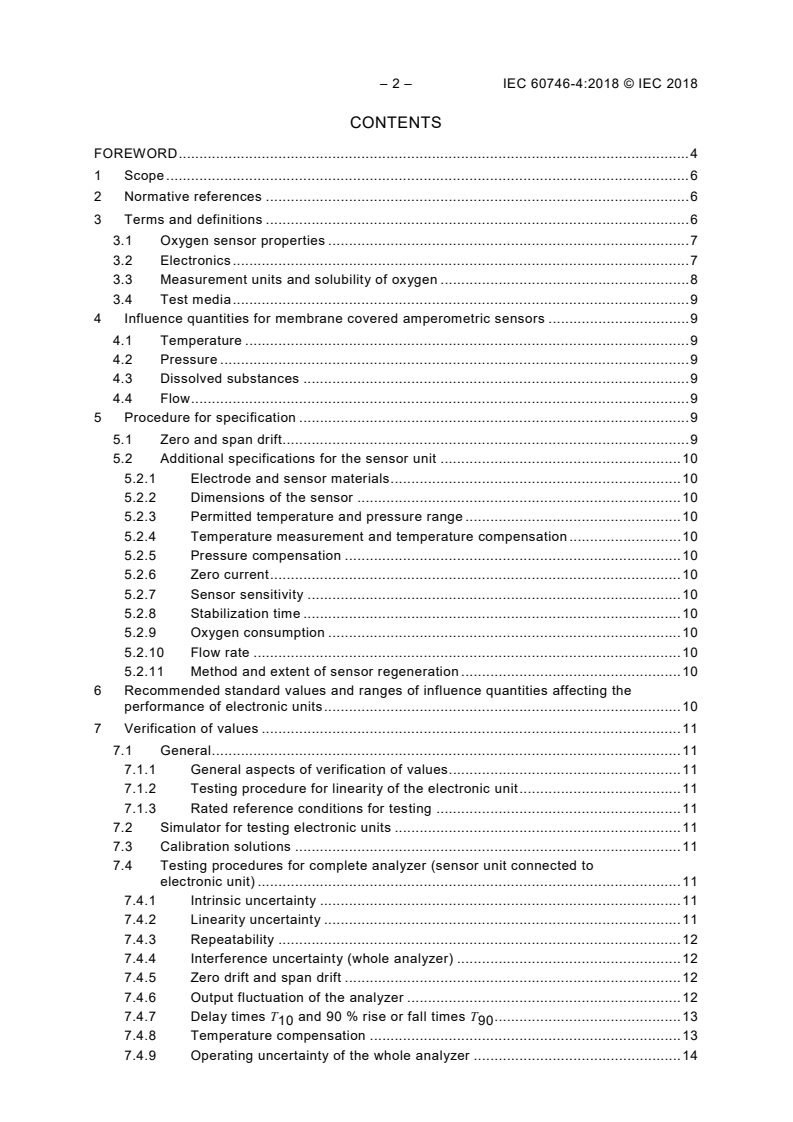
– 2 – IEC 60746-4:2018 © IEC 2018
CONTENTS
FOREWORD . 4
1 Scope . 6
2 Normative references . 6
3 Terms and definitions . 6
3.1 Oxygen sensor properties . 7
3.2 Electronics . 7
3.3 Measurement units and solubility of oxygen . 8
3.4 Test media . 9
4 Influence quantities for membrane covered amperometric sensors . 9
4.1 Temperature . 9
4.2 Pressure . 9
4.3 Dissolved substances . 9
4.4 Flow . 9
5 Procedure for specification . 9
5.1 Zero and span drift . 9
5.2 Additional specifications for the sensor unit . 10
5.2.1 Electrode and sensor materials . 10
5.2.2 Dimensions of the sensor . 10
5.2.3 Permitted temperature and pressure range . 10
5.2.4 Temperature measurement and temperature compensation . 10
5.2.5 Pressure compensation . 10
5.2.6 Zero current . 10
5.2.7 Sensor sensitivity . 10
5.2.8 Stabilization time . 10
5.2.9 Oxygen consumption . 10
5.2.10 Flow rate . 10
5.2.11 Method and extent of sensor regeneration . 10
6 Recommended standard values and ranges of influence quantities affecting the
performance of electronic units . 10
7 Verification of values . 11
7.1 General . 11
7.1.1 General aspects of verification of values . 11
7.1.2 Testing procedure for linearity of the electronic unit . 11
7.1.3 Rated reference conditions for testing . 11
7.2 Simulator for testing electronic units . 11
7.3 Calibration solutions . 11
7.4 Testing procedures for complete analyzer (sensor unit connected to
electronic unit) . 11
7.4.1 Intrinsic uncertainty . 11
7.4.2 Linearity uncertainty . 11
7.4.3 Repeatability . 12
7.4.4 Interference uncertainty (whole analyzer) . 12
7.4.5 Zero drift and span drift . 12
7.4.6 Output fluctuation of the analyzer . 12
7.4.7 Delay times T and 90 % rise or fall times T . 13
10 90
7.4.8 Temperature compensation . 13
7.4.9 Operating uncertainty of the whole analyzer . 14
7.4.10 Determination of the sensor unit residual signal . 14
7.4.11 Oxygen consumption . 14
Annex A (informative) Supplementary general information on amperometric oxygen
sensors . 15
A.1 Sensors' performance characteristics . 15
A.2 Precautions . 16
A.3 Sensor calibration techniques . 16
Annex B (informative) Technique for the preparation of batch calibration standards by
the saturation approach [10] . 18
Annex C (informative) Calibration solutions for low levels of oxygen in water
measurement . 19
C.1 System development [10] . 19
C.2 Description and operation of the system . 19
C.3 Further developments . 19
Bibliography . 25
Figure C.1 – Laboratory rig to produce water with a low level of dissolved oxygen . 21
Figure C.2 – Complete system for laboratory testing dissolved oxygen monitor . 22
Figure C.3 – Dimensions of block A . 23
Figure C.4 – Dimensions of block B . 24
– 4 – IEC 60746-4:2018 © IEC 2018
INTERNATIONAL ELECTROTECHNICAL COMMISSION
____________
EXPRESSION OF PERFORMANCE OF
ELECTROCHEMICAL ANALYZERS –
Part 4: Dissolved oxygen in water measured
by membrane-covered amperometric sensors
FOREWORD
1) The International Electrotechnical Commission (IEC) is a worldwide organization for standardization comprising
all national electrotechnical committees (IEC National Committees). The object of IEC is to promote
international co-operation on all questions concerning standardization in the electrical and electronic fields. To
this end and in addition to other activities, IEC publishes International Standards, Technical Specifications,
Technical Reports, Publicly Available Specifications (PAS) and Guides (hereafter referred to as “IEC
Publication(s)”). Their preparation is entrusted to technical committees; any IEC National Committee interested
in the subject dealt with may participate in this preparatory work. International, governmental and non-
governmental organizations liaising with the IEC also participate in this preparation. IEC collaborates closely
with the International Organization for Standardization (ISO) in accordance with conditions determined by
agreement between the two organizations.
2) The formal decisions or agreements of IEC on technical matters express, as nearly as possible, an international
consensus of opinion on the relevant subjects since each technical committee has representation from all
interested IEC National Committees.
3) IEC Publications have the form of recommendations for international use and are accepted by IEC National
Committees in that sense. While all reasonable efforts are made to ensure that the technical content of IEC
Publications is accurate, IEC cannot be held responsible for the way in which they are used or for any
misinterpretation by any end user.
4) In order to promote international uniformity, IEC National Committees undertake to apply IEC Publications
transparently to the maximum extent possible in their national and regional publications. Any divergence
between any IEC Publication and the corresponding national or regional publication shall be clearly indicated in
the latter.
5) IEC itself does not provide any attestation of conformity. Independent certification bodies provide conformity
assessment services and, in some areas, access to IEC marks of conformity. IEC is not responsible for any
services carried out by independent certification bodies.
6) All users should ensure that they have the latest edition of this publication.
7) No liability shall attach to IEC or its directors, employees, servants or agents including individual experts and
members of its technical committees and IEC National Committees for any personal injury, property damage or
other damage of any nature whatsoever, whether direct or indirect, or for costs (including legal fees) and
expenses arising out of the publication, use of, or reliance upon, this IEC Publication or any other IEC
Publications.
8) Attention is drawn to the Normative references cited in this publication. Use of the referenced publications is
indispensable for the correct application of this publication.
9) Attention is drawn to the possibility that some of the elements of this IEC Publication may be the subject of
patent rights. IEC shall not be held responsible for identifying any or all such patent rights.
International Standard IEC 60746-4 has been prepared by subcommittee 65B: Measurement
and control devices, of IEC technical committee 65: Industrial-process measurement, control
and automation.
This second edition cancels and replaces the first edition published in 1992. This edition
constitutes a technical revision.
This edition includes the following significant technical changes with respect to the previous
edition:
a) terms and definitions have been revised to meet the requirements of ISO/IEC Directives
Part 2:2016.
b) ISO 5814:2012 is cited as reference for solubility tables of dissolved oxygen in water with
variable salt content at different pressure and temperature.
The text of this International Standard is based on the following documents:
FDIS Report on voting
65B/1128/FDIS 65B/1138/RVD
Full information on the voting for the approval of this International Standard can be found in
the report on voting indicated in the above table.
This document has been drafted in accordance with the ISO/IEC Directives, Part 2.
A list of all parts in the IEC 60746 series, published under the general title Expression of
performance of electrochemical analyzers, can be found on the IEC website.
The committee has decided that the contents of this document will remain unchanged until the
stability date indicated on the IEC website under "http://webstore.iec.ch" in the data related to
the specific document. At this date, the document will be
• reconfirmed,
• withdrawn,
• replaced by a revised edition, or
• amended.
– 6 – IEC 60746-4:2018 © IEC 2018
EXPRESSION OF PERFORMANCE OF
ELECTROCHEMICAL ANALYZERS –
Part 4: Dissolved oxygen in water measured
by membrane-covered amperometric sensors
1 Scope
This part of IEC 60746 is intended:
• to specify terminology, definitions and requirements for statements by manufacturers for
analyzers, sensor units and electronic units used for the determination of dissolved
oxygen partial pressure or concentration;
• to establish performance tests for such analyzers, sensor units and electronic units;
• to provide basic documents to support the applications of quality assurance standards
[1] .
This document applies to analyzers using membrane covered amperometric sensors. It
applies to analyzers suitable for use in water containing liquids, ultrapure waters, fresh or
potable water, sea water or other aqueous solutions, industrial or municipal waste water from
water bodies (e.g. lakes, rivers, estuaries), as well as for industrial process streams and
process liquids. Whilst in principle amperometric oxygen-analyzers are applicable in gaseous
phases, the expression of performance in the gas phase is outside the scope of this
document.
This document is applicable to analyzers specified for permanent installation in any location
(indoors or outdoors) using membrane-covered amperometric sensors.
2 Normative references
The following documents are referred to in the text in such a way that some or all of their
content constitutes requirements of this document. For dated references, only the edition
cited applies. For undated references, the latest edition of the referenced document (including
any amendments) applies.
IEC 60746-1:2003, Expression of performance of electrochemical analyzers – Part 1: General
3 Terms and definitions
For the purposes of this document, the terms and definitions given in IEC 60746-1 and the
following apply.
ISO and IEC maintain terminological databases for use in standardization at the following
addresses:
• IEC Electropedia: available at http://www.electropedia.org/
• ISO Online browsing platform: available at http://www.iso.org/obp
___________
Numbers in square brackets refer to the Bibliography.
3.1 Oxygen sensor properties
3.1.1
membrane covered amperometric sensor
sensor with a membrane covered metal cathode, a metal or metal/metal salt anode, optional
auxilliary or reference electrodes and temperature sensors
Note 1 to entry: The electrochemical reduction of molecular oxygen occurs at the membrane-covered cathode.
The metal or metal/metal salt anode provides a well-defined, electrochemically reversible oxidation reaction within
the special filling electrolyte solution of the sensor. A gas-permeable membrane is employed to separate the
electrolyte filling solution from the test medium to avoid contamination and to achieve a stable diffusion potential.
In the case of applications in the gaseous phase the unit, volume fraction (v/v) are used.
Note 2 to entry: The cell can function as an electrochemical two-electrode cell, or as a potentiostatic three-
electrode cell, or either as a galvanic cell. Within potentiostatic three-electrode cells, a high-impedance, current-
free reference electrode is additionally implied to optimize the polarization voltage.
Note 3 to entry: Membrane-covered amperometric sensors are provided with temperature sensors located at the
active sites of the electrode cells being in thermal contact with the media to be measured.
3.1.2
sensor sensitivity
change in electrode current of the amperometric cell caused by the application of a partial
pressure of oxygen
3.1.3
zero current of sensor
current delivered by the sensor when the dissolved oxygen concentration or partial pressure
is zero
Note 1 to entry: The zero current is expressed in µA or in nA.
3.1.4
polarization
voltage to be applied to an amperometric cell during a time period to increase the stability of
the sensor
3.1.5
stabilization time
time period necessary for obtaining a stable measurement after reconnecting the sensor unit
to the electronic unit for polarization purposes (see 3.1.4)
Note 1 to entry: Regeneration of the sensor with a new membrane or an electrolyte change or installation of a
replacement sensor will require a subsequent stabilization time.
3.1.6
oxygen consumption
electrochemical reduction of molecular oxygen at the cathode of amperometric oxygen
sensors
3.2 Electronics
3.2.1
electronic unit
electronic device of an electrochemical two-electrode cell comprises a stabilized DC voltage
source and an electronic circuitry with a low impedance, direct current amplifier and optional
microprocessor circuitries
Note 1 to entry: If the electronic unit of the analyzer comprises a microprocessor device, the detected
amperometric signal will be digitised and evaluated to analyse the oxygen content.
Note 2 to entry: To quantify the amperometric signal of the oxygen reduction, software-based algorithmic routines
or data sets comprising solubility tables of oxygen in water (with consideration of temperature, pressure and
salinity) [2] and a vapour pressure table of water are used.
– 8 – IEC 60746-4:2018 © IEC 2018
3.2.2
auxiliary electronics
electronic devices provided for potentiostatic circuitries and for temperature and pressure
transducers
Note 1 to entry: In electronic devices for three-electrode cells, additional potentiostatic circuitries are
implemented.
3.3 Measurement units and solubility of oxygen
3.3.1
partial pressure
units for the expression of the oxygen partial pressure (pO ):
millibar (mbar) or kilopascal (kPa)
Note 1 to entry: In the case of special applications, the units mm Hg (Torr) and inch Hg may be used with known
conversion ratio [2].
Note 2 to entry: In the case of applications in the gaseous phase the unit, volume fraction (v/v) are used.
Volume fraction is the quotient of the volume of a specified component and the sum of the volumes of all
components of a gas mixture before mixing, all volumes referring to the pressure and the temperature of the gas
mixture. Volume fraction will be expressed in %. The volume fraction and volume concentration take the same
value if, at the same state conditions, the sum of the component volumes before mixing and the volume of the
mixture are equal. However, because the mixing of two or more non-ideal gases at the same state conditions is
usually accompanied by a slight contraction (or, less frequently, a slight expansion), this is not generally the case.
[SOURCE: EN 50104:2010, 3.1.5]
3.3.2
concentration
units for expression of the dissolved oxygen concentration (cO ):
.
−1
parts per million (ppm) = milligram kg
.
−1
parts per billion (ppb) = µg kg
Note 1 to entry: The mass of the test medium means in this case the mass of the sample water, including salts or
other substances dissolved or suspended in it.
Note 2 to entry: Although ppm (parts per million) units are used in this document, it is sometimes convenient to
.
−3 −3
use the units of milligrams per litre (mg dm ) or of micrograms per litre (µg·dm ).
3.3.3
oxygen saturation index
unit for the expression of the dissolved oxygen in percent (%) to express the relative
saturation of the actual oxygen concentration (parts per million), as fraction of the theoretical
oxygen concentration (parts per million) of the air-saturated solution at the actual conditions
of pressure, temperature and salinity
3.3.4
oxygen solubility
maximal possible dissolved oxygen concentration of the water sample in contact and
equilibrium with air (air-saturated solution) at the actual conditions of pressure, temperature
and salinity
Note 1 to entry: The oxygen solubility in water is dependent on other dissolved organic and inorganic compounds,
dissolved electrolytes, salt-content in seawater (salinity) [2].
3.4 Test media
3.4.1
test medium
stable mixture of gases (nitrogen, nitrogen + oxygen), saturated with water vapour or
humidifed reference air showing a known concentration or a known partial pressure of oxygen
used for performance tests
Note 1 to entry: The concentration (see 3.3.2) or partial pressure or volume fraction (see 3.3.1) of dissolved
oxygen and its uncertainty range shall be known.
3.4.2
calibration solution
stable mixture of humidified (saturated with water vapour) gases (nitrogen, oxygen) or
humidifed reference air exhibiting a known stable concentration or partial pressure or volume
fraction of oxygen (with tracable uncertainties) used for calibration of the analyzer
3.4.3
zero oxygen solution
solution with dissolved gas (pure nitrogen) or dissolved molecular or ionogenic compounds
(substitutes) used to eliminate the content of free oxygen or a gaseous phase (pure nitrogen)
saturated with water vapourSymbols
4 Influence quantities for membrane covered amperometric sensors
4.1 Temperature
the temperature has
In addition to the temperature dependent solubility-effect of oxygen [2],
an impact on membrane-covered amperometric sensors owing to the temperature-dependent
variation of the diffusion of oxygen molecules at the liquid interfaces of membrane-covered
sensors.
4.2 Pressure
Pressure affects the dissolved oxygen saturation value, or respectively the maximal oxygen
concentration or the oxygen partial pressure [2]. The air-pressure of the ambient media
(calibration with water-vapour saturated air) or respectively the sample pressure has to be
determined applying an appropriate pressure sensor or has to be manually entered at the
electronic unit (see 3.2.1).
4.3 Dissolved substances
Dissolved inorganic substances (salts, acids, alkalies) as well as organic substances have an
impact on the oxygen solubility in water.
In seawater, the salinity (salt content by weight) shall be considered in addition to the
measured temperature by employing combined salinity-temperature tables in order to
determine the correct oxygen solubility [2].
4.4 Flow
Membrane covered amperometric sensors show in principle a small, but intrinsic,
oxygen-consumption, which requires an adjusted flow-rate given at rated operation conditions.
5 Procedure for specification
5.1 Zero and span drift
Statements shall be made on zero and span drift in accordance with IEC 60746-1:2003, 6.2.5
– 10 – IEC 60746-4:2018 © IEC 2018
5.2 Additional specifications for the sensor unit
5.2.1 Electrode and sensor materials
The manufacturer shall state the composition of the electrodes of the sensor and the
construction materials in contact with the sample.
5.2.2 Dimensions of the sensor
Dimensions of the sensor shall be stated.
5.2.3 Permitted temperature and pressure range
Limiting conditions and rated ranges of use for sample conditions shall be stated including
flow rate (if appropriate), pressure and temperature.
5.2.4 Temperature measurement and temperature compensation
The temperature measurement and the temperature compensation shall be specified.
5.2.5 Pressure compensation
The sensor pressure compensation technique shall be stated if relevant.
5.2.6 Zero current
The zero current of the sensor expressed in µA or in nA shall be stated.
5.2.7 Sensor sensitivity
The change in electrode current in µA or nA caused by the application of oxygen shall be
stated at rated operation conditions, at rated reference conditions of 25 °C and at reference
pressure of 1 013 hPa.
5.2.8 Stabilization time
The period of time (minutes, hours) shall be stated that is necessary for obtaining a stable
measurement after reconnecting the sensor to the electronic unit for polarization purposes.
5.2.9 Oxygen consumption
The oxygen consumption expressed in ng or µg of oxygen per hour shall be stated at rated
operation conditions, at rated reference conditions of 25 °C and at reference pressure of
1 013 hPa.
5.2.10 Flow rate
Sample flow-rate requirements, if relevant.
5.2.11 Method and extent of sensor regeneration
The recommended time interval for sensor regeneration and the procedure for sensor
regeneration shall be stated.
6 Recommended standard values and ranges of influence quantities affecting
the performance of electronic units
See Annex A of IEC 60746-1:2003.
7 Verification of values
7.1 General
7.1.1 General aspects of verification of values
See IEC 60746-1:2003, 6.1 and 6.2.
7.1.2 Testing procedure for linearity of the electronic unit
Modify the input current in accordance with lEC 60746-1:2003, 6.2.2.
7.1.3 Rated reference conditions for testing
During all tests, sample pressure and applied flow-rate shall remain constant within ± 1 % at
the stated mean working value. If this is not possible (e.g. in the case of change of the
barometric pressure), appropriate corrections shall be made. Excepted for tests at various
temperatures, all other testing done in Clause 7 shall be conducted with the sample
temperature within ± 0,3 °C of the mean working temperature. Unless otherwise stated, the
mean temperature is 25 °C.
7.2 Simulator for testing electronic units
Testing of electronic units for linearity, zero and span adjustment, temperature compensation
and effect of influence quantities such as supply voltage and frequency, room temperature,
etc., shall be accomplished by using a suitable current source to substitute the sensor.
Caution should be used to make sure that auxiliary electronics, temperature compensation
devices or substitutes are still part of the electronics, so that the unit is fully operable and
that, with electronic units employing a polarization voltage source for the sensor, no
interaction occurs between the voltage source and the sensor simulating a current source.
7.3 Calibration solutions
See Annexes B and C.
7.4 Testing procedures for complete analyzer (sensor unit connected to electronic
unit)
7.4.1 Intrinsic uncertainty
A signal representing approximately the mid-scale value of the rated input range, resulting
from the exposure of the sensor unit to an appropriate level dissolved oxygen, is used to test
for intrinsic uncertainty as described in 6.2.1 of IEC 60746-1:2003.
7.4.2 Linearity uncertainty
7.4.2.1 Realisation of procedure
Testing procedures are given in lEC 60746-1:2003, 6.2.2.
7.4.2.2 Sensor unit
Using an appropriate electronic unit, perform the test described in 7.4.2.3.
7.4.2.3 Analyzer
The sensor unit is exposed to calibration solutions of known dissolved oxygen content
representing nearly zero, nearly full scale and at least three intermediate calibration points
whose values are approximately uniformly distributed. It is important to provide adequate
stirring. The final output of the analyzer is recorded. These steps are repeated once, and the
– 12 – IEC 60746-4:2018 © IEC 2018
linear least squares curve fit is calculated using both readings for each calibration point. The
linearity error is determined graphically or numerically and expressed in terms of percent of
rated range and corresponds to the maximum deviation for the least squares fit line. For
reasons of efficiency, this test can be combined with the test for repeatability (see 7.4.3.3).
7.4.3 Repeatability
7.4.3.1 Realisation of procedure
Testing procedures are given in lEC 60746-1:2003, 6.2.5.
7.4.3.2 Sensor unit
Using an appropriate electronic unit, perform the test described in 7.4.3.3.
7.4.3.3 Analyzer
The sensor unit is exposed to test solutions representing as nearly as possible the minimum,
the maximum and the median rated values. The steps are repeated N times (where N > 6) in
each test solution in turn, at intervals of at least ten times the instruments' 90 % (T )
response time. The recorded readings are converted to concentration units. The standard
deviation is calculated for each set of recorded values for each solution and reported as
repeatability.
7.4.4 Interference uncertainty (whole analyzer)
See IEC 60746-1:2003, 6.2.8.1.
Since the interrelationships which exist between influence quantities and results obtained are
complex, the method used for testing interfering errors is left for agreement between the
manufacturer and the user.
7.4.5 Zero drift and span drift
7.4.5.1 Sensor unit
Using an appropriate electronic unit, perform the test described in 7.4.5.2.
7.4.5.2 Analyzer
The sensor is exposed for 20 times T to a near-zero calibration solution. The data collection
device reading is adjusted to approximately 5 % of full scale to serve as a "live zero". The
sensor is then exposed for 20 times T to a calibration solution or a test solution that gives a
reading between 75 % and 95 % of full scale. The difference between the two readings is
noted. The test is repeated without further adjustment after the specified time interval, which
is used for stability determinations (see IEC 60746-1:2003, 6.2.5), has elapsed. The zero and
span drift uncertainties are reported in terms of percent of the rated range.
7.4.6 Output fluctuation of the analyzer
The sensor unit is exposed to test solutions representing as nearly as possible the minimum,
the maximum and the median rated values. The steps are repeated N times (where N > 6) in
each test solution in turn, at intervals of at least ten times the instruments 90 % time. The
data collection device readings are converted to concentration units. The standard deviation
is calculated for each set of recorded values for each solution and reported as repeatability.
7.4.7 Delay times T and 90 % rise or fall times T
10 90
7.4.7.1 Sensor unit
Using an appropriate electronic unit, perform the test as described in 7.4.7.2 or 7.4.7.3.
depending on the sensor type.
7.4.7.2 Analyzers incorporating flow-cell sensor
Two calibration solutions or stable test solutions shall be provided with means of supplying
either to the sensor inlet, at rated flowrate, selected by an appropriate two-way valve at the
inlet port. The two test solutions shall differ in dissolved oxygen concentration by at least
50 % of the rated range. With a data-collection device connected to its output terminal, the
analyzer is flushed with near-zero test solution until a constant reading is obtained. Then the
upscale test solution is introduced, and a flag is set at the recording of the data collection
device. Flow is continued until a constant reading is obtained. The values for delay time and
90 % rise time are determined from the data record. Successively, the first near-zero test
solution is introduced once more, until the constant reading is obtained, and delay time as
well as 90 % fall time are determined from the data record.
7.4.7.3 Analyzers incorporating immersion-type sensor
The test is similar, but the two test solutions are held in open containers of at least 10 litres
capacity and provided with appropriate stirring. The sensor is transferred from one container
to the other and a flag is set at the recording of the data collection device at the moment of
immersion. Care should be taken to prevent exchange of oxygen from ambient air to the test
solutions.
7.4.8 Temperature compensation
7.4.8.1 Temperature compensation test
• To compensate the temperature dependency of the temperature dependent diffusion rate
of the sensor membrane; and
• to perform the correct expression of the oxygen analyzer using the stated measuring units
(see 3.3) for the dissolved oxygen measurement;
• based on the known interrelations of: temperature, oxygen partial pressure, water vapor
pressure, solubility in water, salinity effects, ambient atmospheric and sample pressure
[2].
The complete test is performed twice with the temperature of the test solutions and at least
two different test temperatures, depending on the application of the analyzer.
7.4.8.2 Temperature compensation test – measuring unit, concentration
Within the maximum temperature – and concentration – range, the compensation of variations
of the sample temperature will be tested.
7.4.8.3 Temperature compensation test – measuring unit, partial pressure
Within the maximum temperature – and partial pressure – range, the compensation of
variations of the sample temperature will be tested.
– 14 – IEC 60746-4:2018 © IEC 2018
7.4.8.4 Temperature compensation test – measuring unit, percent (oxygen saturation
index)
The test can be performed by means of an air saturated water sample, at constant
atmospheric pressure at two different test temperatures, at rated reference conditions of
25 °C and in addition at +15 °C and at +35 °C or in addition at the minimum and maximum
specified temperature range. An additional operating uncertainty of the analyzer's 100 %
saturation value will be reported.
7.4.9 Operating uncertainty of the whole analyzer
See IEC 60746-1:2003, 3.26.
Operating uncertainty has to be tested over a sufficiently long working period, with regard to
the most important influence quantities, which may be different in each particular case. The
effect of each influence quantity shall be tested at its maximal and minimal value within the
rated operating range. For analyzers with pO or % measuring units, the effects of the
variation of barometric pressure will also be tested. It is convenient to test with the analyzed
medium at complete saturation (see Annexes A and B), but the effect of influence quantities
at a value near midscale value of the measuring range has also to be verified.
7.4.10 Determination of the sensor unit residual signal
The sensor unit is exposed to a zero oxygen solution with zero oxygen concentration and
containing no cross-interferences. These solutions can be prepared by saturating a
demineralized water solution with pure nitrogen passed through a fine-porosity frilled bubbler.
Alternatively, one may use a 2 % sodium sulfite solution in demineralized water. Precautions
shall be taken to eliminate the possibility of back diffusion of atmospheric oxygen. The
analyzer output signal after 20 times the T time is reported as the residual signal (given
−9
A).
preferentially in units of nA, 10
7.4.11 Oxygen consumption
The sensor unit is exposed to a given volume of sample water contained in a closed vessel
and the dissolved oxygen concentration is recorded for a period of several hours. The
difference between the initial and the final dissolved oxygen concentration (mg/l), multiplied
with the volume of the sample (litres) and divided by the elapsed time (hours) gives the value
of the mean oxygen consumption in mg/h (milligrams per hour) – the consumption at the mean
concentration value. The test shall be performed at constant sample temperature. Precautions
shall be taken to eliminate the possibility of back diffusion of atmospheric oxygen. It is
preferable to begin with a concentration value near saturation.
Annex A
(informative)
Supplementary general information
on amperometric oxygen sensors
A.1 Sensors' performance characteristics
These characteristics are established by its electrochemical and mass transport
characteristics. When utilizing an amperometric sensor with an external voltage source, an
electrochemical potential is impressed across the electrodes. In operation, the current due to
the oxygen present in the test sample is determined by the number of oxygen molecules
impigning the cathode in the unit of time, which depends on the dissolved oxygen
concentration as well as on its diffusion rate and on the permeability of the existing
membrane.
The oxygen reduction reaction is most generally conducted on a noble metal electrode (Au, Pt
or Rh). Silver has also been used as a working electrode but is susceptible to poisoning by
H S and other sulfur compounds. The overall reduction mechanism for oxygen at the cathode
may be expressed as:
a) Cathodic reaction at the cathode electrode:
The oxygen reduction reaction is most generally conducted on a noble metal electrode
(Au, Pt or Rh). Silver has also been used as a working electrode but is susceptible to
poisoning by H S and other sulfur compounds. The overall reduction mechanism for
oxygen at the cathode may be expressed as:
+ −
– a
...