

IEC 60245-8:1998/AMD1:2003
(Amendment)Amendment 1 - Rubber insulated cables - Rated voltages up to and including 450/750 V - Part 8: Cords for applications requiring high flexibility
General Information
- Abstract
- Status
- Published
- Publication Date
- 16-Dec-2003
- Technical Committee
- TC 20 - Electric cables
- Drafting Committee
- WG 17 - TC 20/WG 17
- Current Stage
- DELPUB - Deleted Publication
- Start Date
- 10-Apr-2026
- Completion Date
- 28-Aug-2026
Buy Documents
IEC 60245-8:1998/AMD1:2003 - Amendment 1 - Rubber insulated cables - Rated voltages up to and including 450/750 V - Part 8: Cords for applications requiring high flexibility Released:12/17/2003
Overview
The IEC 60245-8:1998/AMD1:2003 is an important amendment to the International Electrotechnical Commission’s standards governing rubber insulated cables rated for voltages up to and including 450/750 V. This part 8 amendment addresses cords designed specifically for applications that require high flexibility. It builds upon the original standard by introducing stringent specifications for cord construction, insulation, mechanical robustness, and testing requirements to ensure reliable performance under demanding flexible-use conditions.
This amendment is essential for manufacturers, designers, and users of flexible rubber insulated cables, helping to ensure safety, durability, and compliance with internationally recognized standards. It also expands on test methods and provides detailed guidelines for cables insulated with Ethylene Propylene Rubber (EPR), braided textile coverings, and enhanced construction techniques.
Key Topics
1. Cable Design and Construction
- Applicable to cords with rated voltages up to 450/750 V.
- Conductors consist of 2 or 3 cores made of Class 6 wire strands, either bare or tinned.
- Insulation is made with EPR compound type IE 4, applied by extrusion to ensure uniform thickness.
- Textile fillers are used within the cable core for improved flexibility.
- Conductors and fillers are laid with strict control over the length and direction of lay.
- Cords are covered by a robust textile braid with minimum thread counts and density to enhance mechanical protection while maintaining flexibility.
2. Mechanical and Electrical Testing
- Extensive testing is mandated to ensure compliance:
- Tensile tests before and after aging, including tests in air ovens and air bombs.
- Three-pulley flexing test requiring 2,000 cycles to simulate repeated bending.
- Kink tests to verify resistance to cable deformation over 1,500 cycles.
- Electrical tests including resistance checks and voltage withstand tests at 2,000 V.
- Ozone resistance to ensure durable performance in outdoor or chemically exposed environments.
- Measurement of insulation thickness and textile braid coverage for quality assurance.
3. Textile Braid Specifications
- The textile braid covering the cord has strict requirements including:
- Minimum 60 threads and 24 carriers ensuring dense coverage.
- At least 700 crossing points per meter to protect the cable assembly.
- A new Annex B sets out standardized methods for measurement of braid coverage.
4. Dimensions and Use Guidelines
- Defined dimensions including mean overall diameter and insulation thickness provide tolerance limits for consistent production.
- Maximum conductor temperature in normal use is specified to be 60°C.
- Practical usage guidance ensures cables are applied within their thermal and mechanical limits for extended lifespan.
Applications
IEC 60245-8:1998/AMD1:2003 is highly relevant for many industries and end-uses requiring flexible, durable power cords, including:
- Consumer Appliances: Flexible cords for power tools, kitchen appliances, and other portable devices needing frequent bending and movement.
- Industrial Equipment: Cables for machinery where repeated cable flexing is routine.
- Extension Leads and Power Distribution: Where cords must maintain integrity under mechanical stress.
- Outdoor Connections: Thanks to enhanced ozone resistance and robust textile braiding, suitable for semi-exposed applications.
- Temporary Installations: Sturdy cords for events, construction sites, or maintenance operations requiring flexible, reliable cables.
Related Standards
For a comprehensive understanding and compliance alignment, IEC 60245-8 amendment references and aligns closely with other parts of the IEC 60245 series and related standards, including:
- IEC 60245-1: Rubber Insulated Cables - Part 1: General Requirements
- IEC 60245-2: Rubber Insulated Cables - Part 2: Test Methods
- IEC 60228: Conductors of Insulated Cables - Classification and Requirements
- IEC 60811 series: Methods for Testing Electrical and Optical Fibre Cables
- IEC 60245-8 Annex B: Measurement methodology for textile braid coverage on cords
These standards collectively provide the technical framework for manufacturing, testing, and quality assurance of flexible rubber insulated cables used in professional and consumer applications.
IEC 60245-8:1998/AMD1:2003 represents a critical update focused on ensuring high-flexibility cords meet stringent performance and safety benchmarks. Adopting these standards enables manufacturers to deliver cables with proven durability, mechanical resilience, and electrical safety for a wide range of demanding environments.
Relations
- Effective Date
- 05-Sep-2023
- Effective Date
- 28-Jun-2024
Buy Documents
IEC 60245-8:1998/AMD1:2003 - Amendment 1 - Rubber insulated cables - Rated voltages up to and including 450/750 V - Part 8: Cords for applications requiring high flexibility Released:12/17/2003
Get Certified
Connect with accredited certification bodies for this standard

IMQ S.p.A. (Certification)
Italian electrical product certification.

SLG Prüf- und Zertifizierungs GmbH
German testing and certification body.

UL Solutions
Global safety science company with testing, inspection and certification.
Sponsored listings
Frequently Asked Questions
IEC 60245-8:1998/AMD1:2003 is a standard published by the International Electrotechnical Commission (IEC). Its full title is "Amendment 1 - Rubber insulated cables - Rated voltages up to and including 450/750 V - Part 8: Cords for applications requiring high flexibility". This standard covers: Amendment 1 - Rubber insulated cables - Rated voltages up to and including 450/750 V - Part 8: Cords for applications requiring high flexibility
Amendment 1 - Rubber insulated cables - Rated voltages up to and including 450/750 V - Part 8: Cords for applications requiring high flexibility
IEC 60245-8:1998/AMD1:2003 is classified under the following ICS (International Classification for Standards) categories: 29.060.20 - Cables. The ICS classification helps identify the subject area and facilitates finding related standards.
IEC 60245-8:1998/AMD1:2003 has the following relationships with other standards: It is inter standard links to IEC 60245-8:1998, IEC 60245-8:2026. Understanding these relationships helps ensure you are using the most current and applicable version of the standard.
IEC 60245-8:1998/AMD1:2003 is available in PDF format for immediate download after purchase. The document can be added to your cart and obtained through the secure checkout process. Digital delivery ensures instant access to the complete standard document.
Standards Content (Sample)
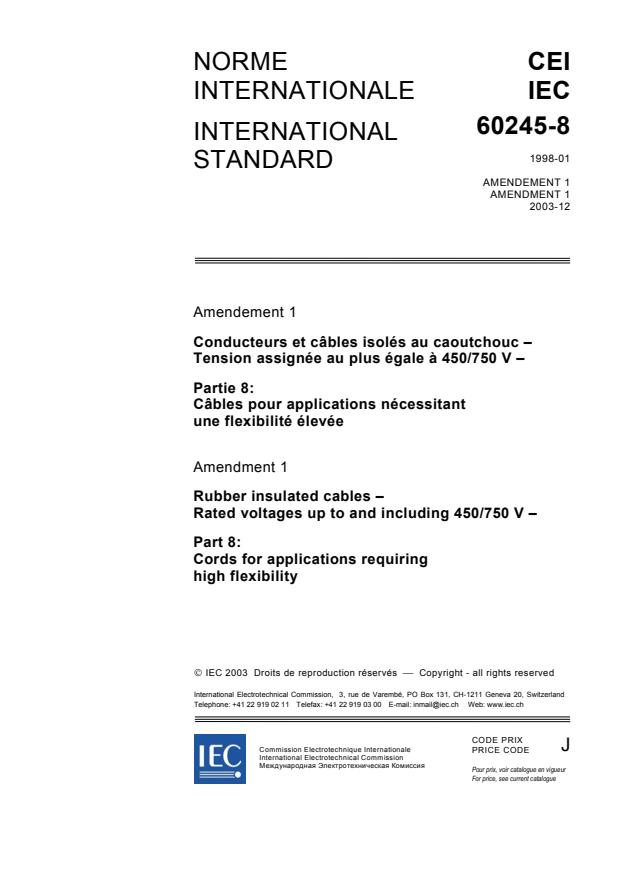
NORME CEI
INTERNATIONALE
IEC
60245-8
INTERNATIONAL
1998-01
STANDARD
AMENDEMENT 1
AMENDMENT 1
2003-12
Amendement 1
Conducteurs et câbles isolés au caoutchouc –
Tension assignée au plus égale à 450/750 V –
Partie 8:
Câbles pour applications nécessitant
une flexibilité élevée
Amendment 1
Rubber insulated cables –
Rated voltages up to and including 450/750 V –
Part 8:
Cords for applications requiring
high flexibility
IEC 2003 Droits de reproduction réservés Copyright - all rights reserved
International Electrotechnical Commission, 3, rue de Varembé, PO Box 131, CH-1211 Geneva 20, Switzerland
Telephone: +41 22 919 02 11 Telefax: +41 22 919 03 00 E-mail: inmail@iec.ch Web: www.iec.ch
CODE PRIX
J
Commission Electrotechnique Internationale
PRICE CODE
International Electrotechnical Commission
МеждународнаяЭлектротехническаяКомиссия
Pour prix, voir catalogue en vigueur
For price, see current catalogue
– 2 – 60245-8 Amend. 1 CEI:2003
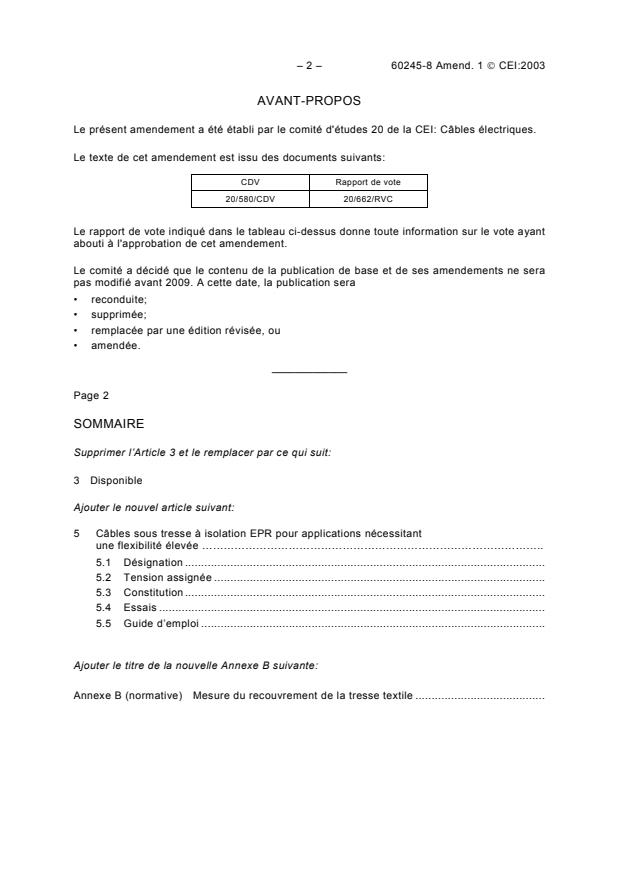
AVANT-PROPOS
Le présent amendement a été établi par le comité d'études 20 de la CEI: Câbles électriques.
Le texte de cet amendement est issu des documents suivants:
CDV Rapport de vote
20/580/CDV 20/662/RVC
Le rapport de vote indiqué dans le tableau ci-dessus donne toute information sur le vote ayant
abouti à l'approbation de cet amendement.
Le comité a décidé que le contenu de la publication de base et de ses amendements ne sera
pas modifié avant 2009. A cette date, la publication sera
• reconduite;
• supprimée;
• remplacée par une édition révisée, ou
• amendée.
_____________
Page 2
SOMMAIRE
Supprimer l’Article 3 et le remplacer par ce qui suit:
3 Disponible
Ajouter le nouvel article suivant:
5 Câbles sous tresse à isolation EPR pour applications nécessitant
une flexibilité élevée ………………………………………………………………………………….
5.1 Désignation.
5.2 Tension assignée.
5.3 Constitution.
5.4 Essais.
5.5 Guide d’emploi.
Ajouter le titre de la nouvelle Annexe B suivante:
Annexe B (normative) Mesure du recouvrement de la tresse textile .
60245-8 Amend. 1 IEC:2003 – 3 –
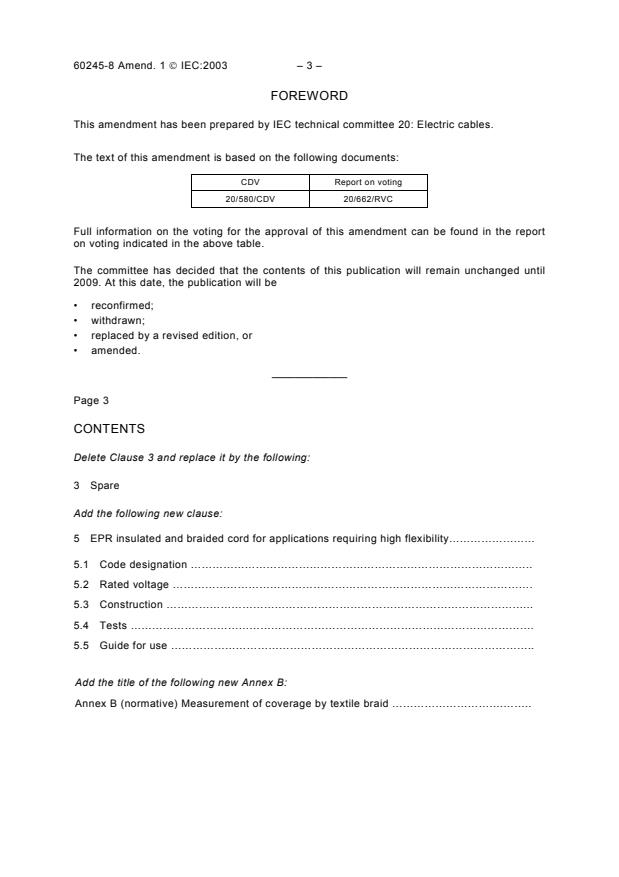
FOREWORD
This amendment has been prepared by IEC technical committee 20: Electric cables.
The text of this amendment is based on the following documents:
CDV Report on voting
20/580/CDV 20/662/RVC
Full information on the voting for the approval of this amendment can be found in the report
on voting indicated in the above table.
The committee has decided that the contents of this publication will remain unchanged until
2009. At this date, the publication will be
• reconfirmed;
• withdrawn;
• replaced by a revised edition, or
• amended.
_____________
Page 3
CONTENTS
Delete Clause 3 and replace it by the following:
3 Spare
Add the following new clause:
5 EPR insulated and braided cord for applications requiring high flexibility……………………
5.1 Code designation ………………………………………………………………………………….
5.2 Rated voltage ……………………………………………………………………………………….
5.3 Construction …………………………………………………………………………………….….
5.4 Tests ………………………………………………………………………………………………….
5.5 Guide for use ……………………………………………………………………………………….
Add the title of the following new Annex B:
Annex B (normative) Measurement of coverage by textile braid ………………………….…….
– 4 – 60245-8 Amend. 1 CEI:2003
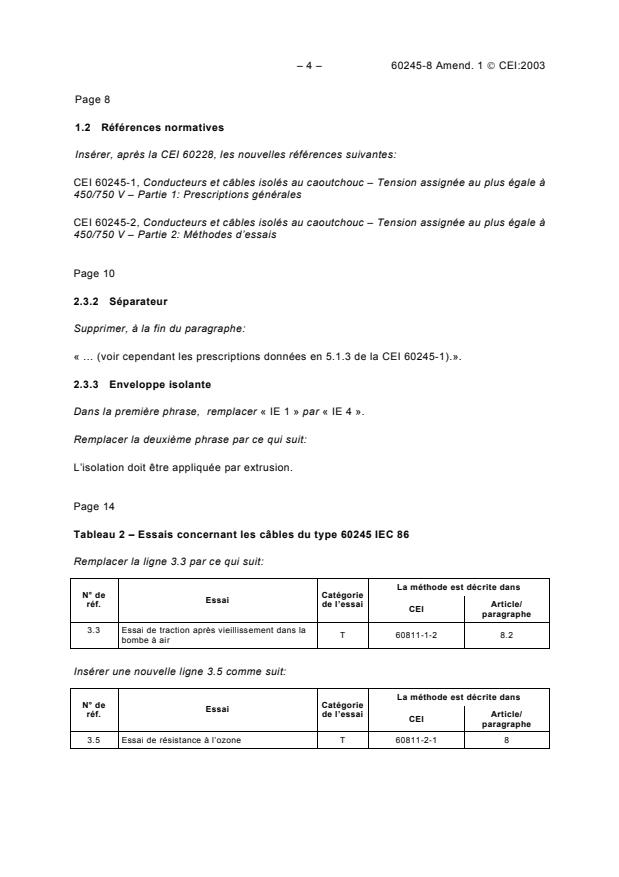
Page 8
1.2 Références normatives
Insérer, après la CEI 60228, les nouvelles références suivantes:
CEI 60245-1, Conducteurs et câbles isolés au caoutchouc – Tension assignée au plus égale à
450/750 V – Partie 1: Prescriptions générales
CEI 60245-2, Conducteurs et câbles isolés au caoutchouc – Tension assignée au plus égale à
450/750 V – Partie 2: Méthodes d’essais
Page 10
2.3.2 Séparateur
Supprimer, à la fin du paragraphe:
« … (voir cependant les prescriptions données en 5.1.3 de la CEI 60245-1).».
2.3.3 Enveloppe isolante
Dans la première phrase, remplacer « IE 1 » par « IE 4 ».
Remplacer la deuxième phrase par ce qui suit:
L’isolation doit être appliquée par extrusion.
Page 14
Tableau 2 – Essais concernant les câbles du type 60245 IEC 86
Remplacer la ligne 3.3 par ce qui suit:
La méthode est décrite dans
N° de Catégorie
Essai
Article/
réf. de l’essai
CEI
paragraphe
3.3 Essai de traction après vieillissement dans la
T 60811-1-2 8.2
bombe à air
Insérer une nouvelle ligne 3.5 comme suit:
La méthode est décrite dans
N° de Catégorie
Essai
réf. de l’essai Article/
CEI
paragraphe
3.5 Essai de résistance à l’ozone T 60811-2-1 8
60245-8 Amend. 1 IEC:2003 – 5 –
Page 9
1.2 Normative references
Insert, after IEC 60228, the following new references:
IEC 60245-1, Rubber insulated cables – Rated voltages up to and including 450V/750 V –
Part 1: General requirements
IEC 60245-2, Rubber insulated cables – Rated voltages up to and including 450V/750 V –
Part 2: Test methods
Page 11
2.3.2 Separator
Delete at the end of the paragraph:
“ …(see however the requirements given in 5.1.3 of IEC 60245-1).”
2.3.3 Insulation
In the first sentence replace “IE 1” by “IE 4”.
Replace the second sentence by the following:
The insulation shall be applied by extrusion.
Page 15
Table 2 – Tests for type 60245 IEC 86
Replace row 3.3 by the following:
Test method described in
Category
Ref.No. Test
Clause/
of test
IEC
subclause
3.3 Tensile test after ageing in an air bomb T 60811-1-2 8.2
Add a new line 3.5 as follows:
Test method described in
Category
Ref.No. Test
of test Clause/
IEC
subclause
3.5 Ozone resistance test T 60811-2-1 8
– 6 – 60245-8 Amend. 1 CEI:2003
Page 16
3 Câbles sous gaine de PVC réticulé (XLPVC) et enveloppe isolante
de caoutchouc pour applications nécessitant une flexibilité élevée
Remplacer cet article par ce qui suit:
3 Disponible
Page 26
Ajouter, après le Tableau 6, le nouvel Article 5 suivant:
5 Câbles sous tresse à isolation EPR pour applications nécessitant
une flexibilité élevée
5.1 Désignation
60245 IEC 89
5.2 Tension assignée
300/300 V
5.3 Constitution
5.3.1 Âme
Nombre d’âmes: 2 ou 3
Les âmes doivent satisfaire aux prescriptions indiquées dans le Tableau IV de la CEI 60228
pour les âmes de la Classe 6, excepté la résistance maximale de l’âme à 20 °C qui doit être
augmentée de 3 %. Les fils peuvent être nus ou étamés.
5.3.2 Séparateur
Un séparateur en matière appropriée peut être appliqué autour de chaque âme.
5.3.3 Enveloppe isolante
L’enveloppe isolante doit être en un mélange EPR de type IE 4 appliqué autour de chaque
âme.
L’enveloppe isolante doit être appliquée par extrusion.
L’épaisseur de l’enveloppe isolante doit satisfaire à la valeur spécifiée dans le Tableau 8,
colonne 2.
5.3.4 Bourrage
Le bourrage doit être en matière textile.
60245-8 Amend. 1 IEC:2003 – 7 –
Page 17
3 Rubber insulated and cross-linked PVC (XLPVC) sheathed cords
for application requiring high flexibility
Replace this clause by the following:
3 Spare
Page 27
Add, after Table 6, the following new Clause 5:
5 EPR insulated and braided cord for applications requiring high flexibility
5.1 Code designation
60245 IEC 89
5.2 Rated voltage
300/300 V
5.3 Construction
5.3.1 Conductor
Number of conductors: 2 or 3.
The conductors shall comply with the requirements given in Table IV, IEC 60228 for Class 6
conductors, except that the maximum resistance of conductors at 20 °C shall be increased by
3 %. The wires may be plain or tinned.
5.3.2 Separator
A separator of suitable material may be applied around each conductor.
5.3.3 Insulation
The insulation shall be an EPR compound of type IE 4 applied around each conductor.
The insulation shall be applied by extrusion.
The insulation thickness shall comply with the specified value given in Table 8, Column 2.
5.3.4 Fillers
The fillers shall be of textile material.
– 8 – 60245-8 Amend. 1 CEI:2003
5.3.5 Assemblage des conducteurs et des bourrages
Les conducteurs et les bourrages doivent être câblés ensemble.
La longueur maximale du pas ne doit pas être supérieure à 7,5 fois le diamètre des
conducteurs assemblés. Le sens du pas doit être le même pour les âmes et les conducteurs.
Un bourrage central peut être utilisé.
5.3.6 Tresse textile externe
L’assemblage des conducteurs et des bourrages doit être recouvert par une tresse textile:
− nombre minimal de brins: 60;
− nombre minimal de points par mètre: 700;
− nombre minimal de fuseaux: 24.
5.3.7 Dimensions extérieures
Le diamètre extérieur moyen doit être compris dans les limites données dans le Tableau 8,
colonnes 3 et 4.
5.4 Essais
La conformité aux prescriptions du 5.3 doit être vérifiée par examen et par les essais indiqués
dans le Tableau 9.
5.4.1 Vérification de la conformité avec les dispositions constructives
Pour 5.3.5, la longueur du pas d’assemblage doit être déterminée en mesurant la longueur de
10 pas sur un échantillon et en divisant cette longueur par 10. Le résultat obtenu est la
longueur du pas d’assemblage des conducteurs.
5.4.2 Essai de flexions à trois poulies
Cet essai doit être effectué en accord avec 3.5 de la CEI 60245-2.
Le nombre de cycles exigé doit être de 2 000, c’est-à-dire 4 000 mouvements simples, et
l’essai de tension doit être tel que celui spécifié dans le Tableau 2.
5.4.3 Essai de coque
Cet essai doit être effectué en accord avec 3.6 de la CEI 60245-2.
5.4.3.1 Echantillon
En vue d’éviter que la masse de traction n’atteigne le sommet de son guide et, soit percute
une fin de course, soit quitte son guide, la préparation de l’échantillon doit être effectuée de
la façon suivante:
a) Les trois torsions doivent être positionnées dans l’échantillon et provisoirement fixées
avec un ruban adhésif avant de présenter l’échantillon dans l’équipement.
b) Les extrémités de l’échantillon doivent être positionnées dans les pinces de fixation et le
ruban adhésif doit alors être retiré.
60245-8 Amend. 1 IEC:2003 – 9
...