

IEC 60245-8:1998
(Main)Rubber insulated cables - Rated voltages up to and including 450/750 V - Part 8: Cords for applications requiring high flexibility
General Information
- Abstract
Details the particular specifications for rubber or cross-linked polyvinyl chloride insulated and rubber or cross-linked polyvinyl chloride sheathed cords of rated voltage 300/300 V, for use in applications where high flexibility is required, for example iron cords.
- Status
- Published
- Publication Date
- 17-Jan-2012
- Technical Committee
- TC 20 - Electric cables
- Drafting Committee
- WG 17 - TC 20/WG 17
Buy Documents
IEC 60245-8:1998+AMD1:2003 CSV - Rubber insulated cables - Rated voltages up to and including 450/750 V - Part 8: Cords for applications requiring high flexibility Released:1/29/2004
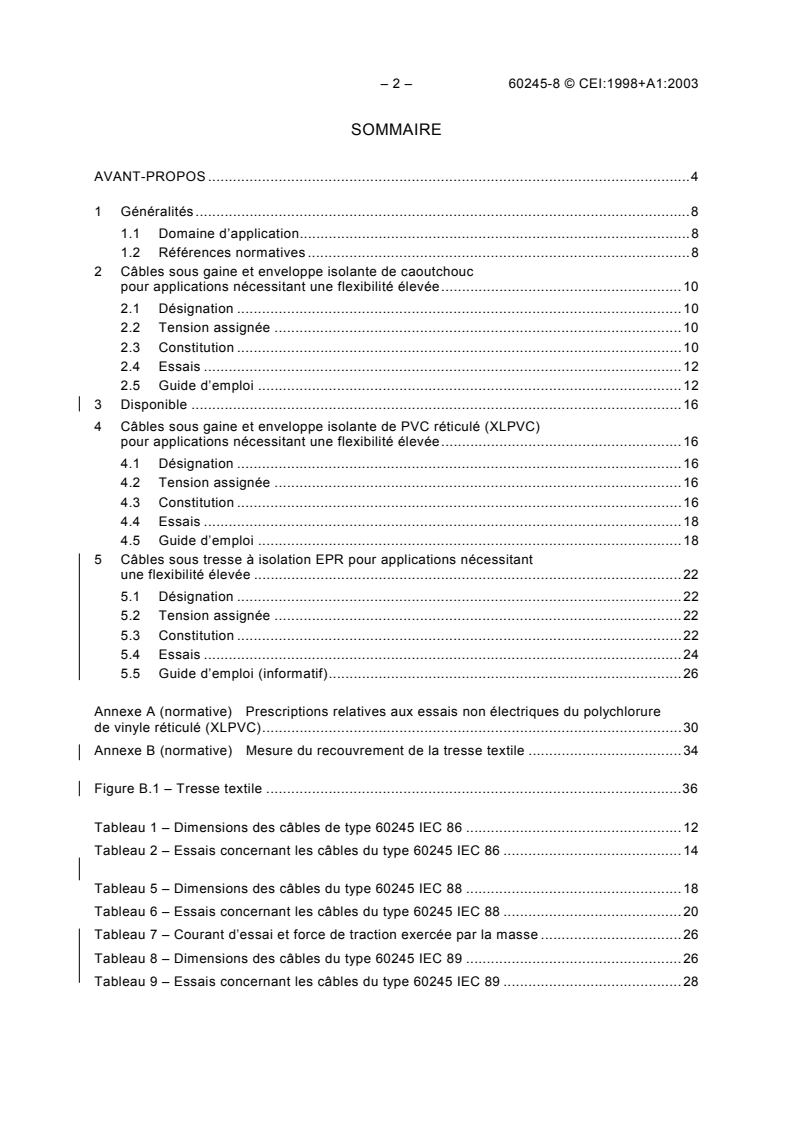
IEC 60245-8:1998+AMD1:2003 CSV - Conducteurs et câbles isolés au caoutchouc - Tension assignée au plus égale a 450/750 V - Partie 8: Câbles pour applications nécessitant une flexibilité élevée Released:1/29/2004
IEC 60245-8:1998 - Rubber insulated cables - Rated voltages up to and including 450/750 V - Part 8: Cords for applications requiring high flexibility
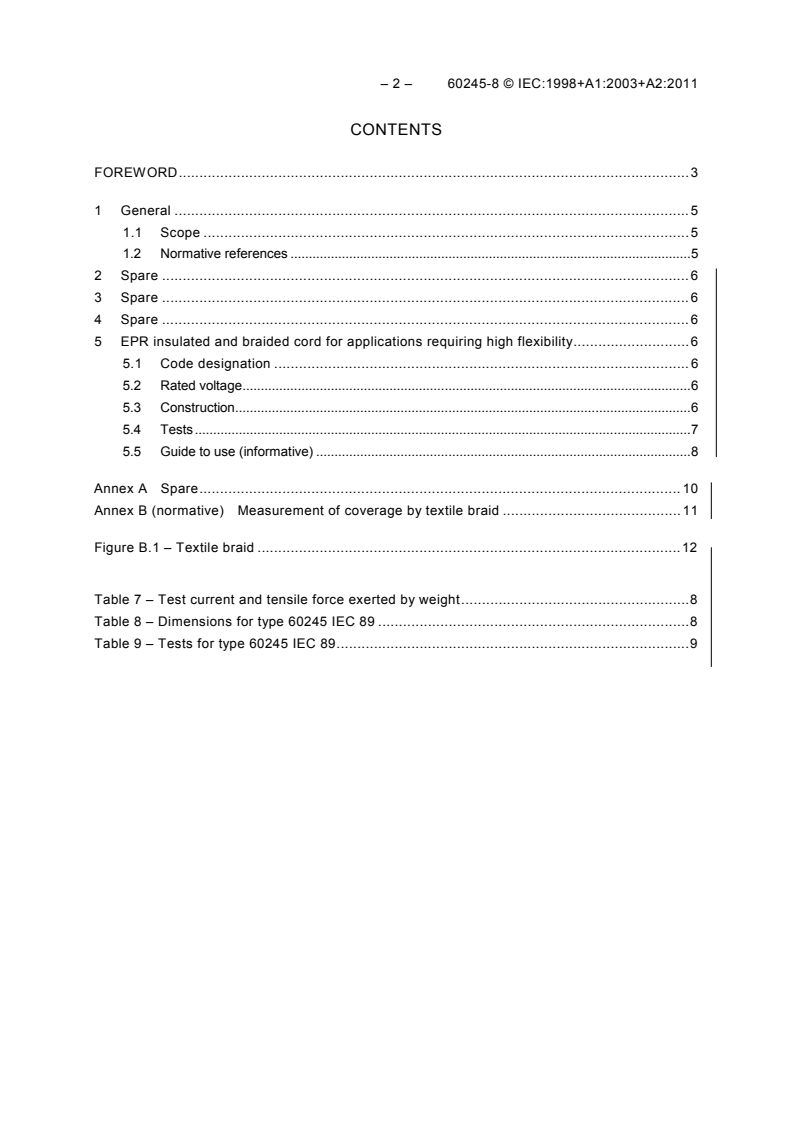
IEC 60245-8:1998+AMD1:2003+AMD2:2011 CSV - Rubber insulated cables - Rated voltages up to and including 450/750 V - Part 8: Cords for applications requiring high flexibility Released:1/18/2012
IEC 60245-8:1998+AMD1:2003 CSV - Rubber insulated cables - Rated voltages up to and including 450/750 V - Part 8: Cords for applications requiring high flexibility Released:1/29/2004
Overview
IEC 60245-8:1998 (consolidated with Amendment 1:2003) is the International Electrotechnical Commission standard that specifies requirements for rubber and cross‑linked PVC (XLPVC) insulated and sheathed cords designed for applications requiring high flexibility. It covers cords with a rated voltage of 300/300 V (e.g., iron cords and similar portable appliance leads) and is intended to be read together with IEC 60245‑1 (general requirements) and IEC 60245‑2 (test methods).
Key facts:
- Rated voltage: 300/300 V
- Typical conductor sizes covered: 0.75, 1.0 and 1.5 mm² (two‑ or three‑core cords)
- Insulation and sheath types referenced: rubber (IE4 / SE3) and XLPVC (and related EPR braided constructions are also addressed in the part)
- Maximum conductor temperature in normal use: 60 °C
- Outer marking: cords marked with 60245 IEC 86 for the rubber type
Key Topics and Technical Requirements
The standard defines construction, dimensional limits and mandatory tests to ensure safety and durability for high‑flex cords:
- Conductor construction: Class 6 flexible conductors (plain or tinned) per IEC 60228.
- Insulation & sheath: Materials, extrusion method, minimum thicknesses and requirements that the sheath be removable without damaging cores.
- Assembly: Lay length, core twisting, optional centre filler and separator requirements.
- Dimensional limits: Mean overall diameter and ovality limits for specified conductor sizes.
- Electrical tests: Conductor resistance, core voltage tests (based on insulation thickness), completed cable voltage test.
- Mechanical & environmental tests: Tensile tests (before and after ageing), hot‑set, ozone resistance, three‑pulley flexing (endurance for flexibility), and other mechanical strength checks.
- Annexes: Normative annexes cover non‑electrical tests for XLPVC and methods for measuring textile braid coverage.
Applications and Who Uses It
IEC 60245‑8 is directly applicable to:
- Manufacturers of appliance cords, especially for irons and other portable appliances requiring frequent flexing.
- Component specifiers and procurement teams sourcing high‑flexity power cords.
- Test laboratories and compliance engineers performing type and routine testing to verify conformity.
- Product safety assessors and certification bodies ensuring cords meet recognized international performance and durability criteria.
Practical benefits include improved product durability, consistent interchangeability of cords, reduced failure in flexing applications and a clear basis for regulatory or safety compliance.
Related Standards
For full compliance and test procedures, IEC 60245‑8 refers to and should be used alongside:
- IEC 60245‑1 (General requirements)
- IEC 60245‑2 (Test methods)
- IEC 60228 (Conductors of insulated cables)
- IEC 60811 series (common cable material tests)
- IEC 60332‑1 (single‑wire fire test) and IEC 60719 (dimension calculation guidance)
Keywords: IEC 60245-8, rubber insulated cables, high flexibility cords, 300/300 V, XLPVC, appliance cords, cable testing, IEC standard, flexible power cords.
Relations
- Effective Date
- 10-Feb-2026
- Effective Date
- 10-Feb-2026
- Effective Date
- 10-Feb-2026
- Effective Date
- 10-Feb-2026
- Effective Date
- 05-Sep-2023
- Effective Date
- 05-Sep-2023
- Effective Date
- 08-Mar-2024
Buy Documents
IEC 60245-8:1998+AMD1:2003 CSV - Rubber insulated cables - Rated voltages up to and including 450/750 V - Part 8: Cords for applications requiring high flexibility Released:1/29/2004
IEC 60245-8:1998+AMD1:2003 CSV - Conducteurs et câbles isolés au caoutchouc - Tension assignée au plus égale a 450/750 V - Partie 8: Câbles pour applications nécessitant une flexibilité élevée Released:1/29/2004
IEC 60245-8:1998 - Rubber insulated cables - Rated voltages up to and including 450/750 V - Part 8: Cords for applications requiring high flexibility
IEC 60245-8:1998+AMD1:2003+AMD2:2011 CSV - Rubber insulated cables - Rated voltages up to and including 450/750 V - Part 8: Cords for applications requiring high flexibility Released:1/18/2012
IEC 60245-8:1998+AMD1:2003 CSV - Rubber insulated cables - Rated voltages up to and including 450/750 V - Part 8: Cords for applications requiring high flexibility Released:1/29/2004
Get Certified
Connect with accredited certification bodies for this standard

IMQ S.p.A. (Certification)
Italian electrical product certification.

SLG Prüf- und Zertifizierungs GmbH
German testing and certification body.

UL Solutions
Global safety science company with testing, inspection and certification.
Sponsored listings
Frequently Asked Questions
IEC 60245-8:1998 is a standard published by the International Electrotechnical Commission (IEC). Its full title is "Rubber insulated cables - Rated voltages up to and including 450/750 V - Part 8: Cords for applications requiring high flexibility". This standard covers: Details the particular specifications for rubber or cross-linked polyvinyl chloride insulated and rubber or cross-linked polyvinyl chloride sheathed cords of rated voltage 300/300 V, for use in applications where high flexibility is required, for example iron cords.
Details the particular specifications for rubber or cross-linked polyvinyl chloride insulated and rubber or cross-linked polyvinyl chloride sheathed cords of rated voltage 300/300 V, for use in applications where high flexibility is required, for example iron cords.
IEC 60245-8:1998 is classified under the following ICS (International Classification for Standards) categories: 29.060.20 - Cables. The ICS classification helps identify the subject area and facilitates finding related standards.
IEC 60245-8:1998 has the following relationships with other standards: It is inter standard links to EN 61558-1:2005, EN 60598-1:2000, EN 60950:2000, EN 60838-1:2004, IEC 60245-8:1998/AMD1:2003, IEC 60245-8:1998/AMD2:2011, IEC 60245-8:2026. Understanding these relationships helps ensure you are using the most current and applicable version of the standard.
IEC 60245-8:1998 is available in PDF format for immediate download after purchase. The document can be added to your cart and obtained through the secure checkout process. Digital delivery ensures instant access to the complete standard document.
Standards Content (Sample)
INTERNATIONAL IEC
STANDARD 60245-8
Edition 1.1
2004-01
Edition 1:1998 consolidated with amendment 1:2003
Rubber insulated cables –
Rated voltages up to and including 450/750 V –
Part 8:
Cords for applications requiring
high flexibility
This English-language version is derived from the original
bilingual publication by leaving out all French-language
pages. Missing page numbers correspond to the French-
language pages.
Reference number
Publication numbering
As from 1 January 1997 all IEC publications are issued with a designation in the
60000 series. For example, IEC 34-1 is now referred to as IEC 60034-1.
Consolidated editions
The IEC is now publishing consolidated versions of its publications. For example,
edition numbers 1.0, 1.1 and 1.2 refer, respectively, to the base publication, the
base publication incorporating amendment 1 and the base publication incorporating
amendments 1 and 2.
Further information on IEC publications
The technical content of IEC publications is kept under constant review by the IEC,
thus ensuring that the content reflects current technology. Information relating to
this publication, including its validity, is available in the IEC Catalogue of
publications (see below) in addition to new editions, amendments and corrigenda.
Information on the subjects under consideration and work in progress undertaken
by the technical committee which has prepared this publication, as well as the list
of publications issued, is also available from the following:
• IEC Web Site (www.iec.ch)
• Catalogue of IEC publications
The on-line catalogue on the IEC web site (www.iec.ch/searchpub) enables you to
search by a variety of criteria including text searches, technical committees
and date of publication. On-line information is also available on recently issued
publications, withdrawn and replaced publications, as well as corrigenda.
• IEC Just Published
This summary of recently issued publications (www.iec.ch/online_news/ justpub)
is also available by email. Please contact the Customer Service Centre (see
below) for further information.
• Customer Service Centre
If you have any questions regarding this publication or need further assistance,
please contact the Customer Service Centre:
Email: custserv@iec.ch
Tel: +41 22 919 02 11
Fax: +41 22 919 03 00
INTERNATIONAL IEC
STANDARD 60245-8
Edition 1.1
2004-01
Edition 1:1998 consolidated with amendment 1:2003
Rubber insulated cables –
Rated voltages up to and including 450/750 V –
Part 8:
Cords for applications requiring
high flexibility
IEC 2004 Copyright - all rights reserved
No part of this publication may be reproduced or utilized in any form or by any means, electronic or mechanical,
including photocopying and microfilm, without permission in writing from the publisher.
International Electrotechnical Commission, 3, rue de Varembé, PO Box 131, CH-1211 Geneva 20, Switzerland
Telephone: +41 22 919 02 11 Telefax: +41 22 919 03 00 E-mail: inmail@iec.ch Web: www.iec.ch
PRICE CODE
CG
Commission Electrotechnique Internationale
International Electrotechnical Commission
МеждународнаяЭлектротехническаяКомиссия
For price, see current catalogue
60245-8 © IEC:1998+A1:2003 – 3 –
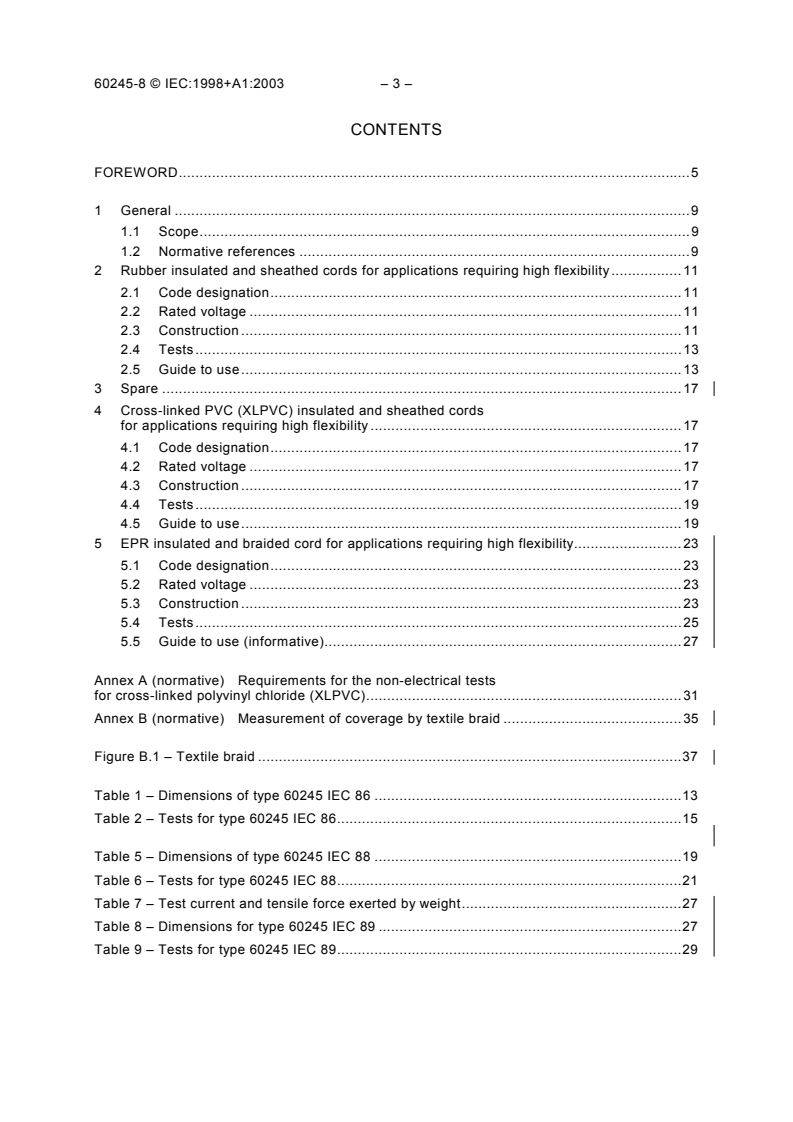
CONTENTS
FOREWORD.5
1 General .9
1.1 Scope.9
1.2 Normative references .9
2 Rubber insulated and sheathed cords for applications requiring high flexibility .11
2.1 Code designation.11
2.2 Rated voltage .11
2.3 Construction .11
2.4 Tests.13
2.5 Guide to use.13
3 Spare .17
4 Cross-linked PVC (XLPVC) insulated and sheathed cords
for applications requiring high flexibility .17
4.1 Code designation.17
4.2 Rated voltage .17
4.3 Construction .17
4.4 Tests.19
4.5 Guide to use.19
5 EPR insulated and braided cord for applications requiring high flexibility.23
5.1 Code designation.23
5.2 Rated voltage .23
5.3 Construction .23
5.4 Tests.25
5.5 Guide to use (informative).27
Annex A (normative) Requirements for the non-electrical tests
for cross-linked polyvinyl chloride (XLPVC).31
Annex B (normative) Measurement of coverage by textile braid .35
Figure B.1 – Textile braid .37
Table 1 – Dimensions of type 60245 IEC 86 .13
Table 2 – Tests for type 60245 IEC 86.15
Table 5 – Dimensions of type 60245 IEC 88 .19
Table 6 – Tests for type 60245 IEC 88.21
Table 7 – Test current and tensile force exerted by weight.27
Table 8 – Dimensions for type 60245 IEC 89 .27
Table 9 – Tests for type 60245 IEC 89.29
60245-8 © IEC:1998+A1:2003 – 5 –
INTERNATIONAL ELECTROTECHNICAL COMMISSION
–––––––––––
RUBBER INSULATED CABLES –
RATED VOLTAGES UP TO AND INCLUDING 450/750 V –
Part 8: Cords for applications requiring high flexibility
FOREWORD
1) The International Electrotechnical Commission (IEC) is a worldwide organization for standardization comprising
all national electrotechnical committees (IEC National Committees). The object of IEC is to promote
international co-operation on all questions concerning standardization in the electrical and electronic fields. To
this end and in addition to other activities, IEC publishes International Standards, Technical Specifications,
Technical Reports, Publicly Available Specifications (PAS) and Guides (hereafter referred to as “IEC
Publication(s)”). Their preparation is entrusted to technical committees; any IEC National Committee interested
in the subject dealt with may participate in this preparatory work. International, governmental and non-
governmental organizations liaising with the IEC also participate in this preparation. IEC collaborates closely
with the International Organization for Standardization (ISO) in accordance with conditions determined by
agreement between the two organizations.
2) The formal decisions or agreements of IEC on technical matters express, as nearly as possible, an international
consensus of opinion on the relevant subjects since each technical committee has representation from all
interested IEC National Committees.
3) IEC Publications have the form of recommendations for international use and are accepted by IEC National
Committees in that sense. While all reasonable efforts are made to ensure that the technical content of IEC
Publications is accurate, IEC cannot be held responsible for the way in which they are used or for any
misinterpretation by any end user.
4) In order to promote international uniformity, IEC National Committees undertake to apply IEC Publications
transparently to the maximum extent possible in their national and regional publications. Any divergence
between any IEC Publication and the corresponding national or regional publication shall be clearly indicated in
the latter.
5) IEC provides no marking procedure to indicate its approval and cannot be rendered responsible for any
equipment declared to be in conformity with an IEC Publication.
6) All users should ensure that they have the latest edition of this publication.
7) No liability shall attach to IEC or its directors, employees, servants or agents including individual experts and
members of its technical committees and IEC National Committees for any personal injury, property damage or
other damage of any nature whatsoever, whether direct or indirect, or for costs (including legal fees) and
expenses arising out of the publication, use of, or reliance upon, this IEC Publication or any other IEC
Publications.
8) Attention is drawn to the Normative references cited in this publication. Use of the referenced publications is
indispensable for the correct application of this publication.
9) Attention is drawn to the possibility that some of the elements of this IEC Publication may be the subject of
patent rights. IEC shall not be held responsible for identifying any or all such patent rights.
International Standard IEC 60245-8 has been prepared by subcommittee 20B: Low-voltage
cables, of IEC technical committee 20: Electric cables.
This consolidated version of IEC 60245-8 consists of the first edition (1998) [documents
20B/259/FDIS and 20B/269/RVD] and its amendment 1 (2003) [documents 20/580/CDV and
20/662/RVC].
The technical content is therefore identical to the base edition and its amendment and has
been prepared for user convenience.
It bears the edition number 1.1.
A vertical line in the margin shows where the base publication has been modified by
amendment 1.
60245-8 © IEC:1998+A1:2003 – 7 –
IEC 60245 consists of the following parts, under the general title: Rubber insulated cables –
Rated voltages up to and including 450/750 V:
– Part 1:1994, General requirements
– Part 2:1994, Test methods
– Part 3:1994, Heat resistant silicone insulated cables
– Part 4:1994, Cords and flexible cables
– Part 5:1994, Lift cables
– Part 6:1994, Arc welding electrode cables
– Part 7:1994, Heat resistant ethylene-vinyl-acetate rubber insulated cables
– Part 8:1997, Cords for applications requiring high flexibility
Parts 3 to 8 are for particular types of cables and should be read in conjunction with part 1 and
part 2. Further parts may be added as other types are standardised.
Annexes A and B form an integral part of this standard.
The committee has decided that the contents of the base publication and its amendment 1 will
remain unchanged until 2009. At this date, the publication will be
• reconfirmed;
• withdrawn;
• replaced by a revised edition, or
• amended.
60245-8 © IEC:1998+A1:2003 – 9 –
RUBBER INSULATED CABLES –
RATED VOLTAGES UP TO AND INCLUDING 450/750 V –
Part 8: Cords for applications requiring high flexibility
1 General
1.1 Scope
This part of IEC 60245 details the particular specifications for rubber or cross-linked polyvinyl
chloride insulated and rubber or cross-linked polyvinyl chloride sheathed cords of rated voltage
300/300 V, for use in applications where high flexibility is required, for example for iron cords.
All cables should comply with the appropriate requirements given in IEC 60245-1 and the
individual types of cables should each comply with the particular requirements of this part.
1.2 Normative references
The following referenced documents are indispensable for the application of this document. For
dated references, only the edition cited applies. For undated references, the latest edition of
the referenced document (including any amendments) applies.
IEC 60228:1978, Conductors of insulated cables
IEC 60245-1, Rubber insulated cables – Rated voltages up to and including 450V/750 V – Part 1:
General requirements
IEC 60245-2, Rubber insulated cables – Rated voltages up to and including 450V/750 V – Part 2:
Test methods
IEC 60332-1:1993, Tests on electric cables under fire conditions – Part 1: Test on a single
vertical insulated wire or cable
IEC 60719:1992, Calculation of the lower and upper limits for the average outer dimensions of
cables with circular copper conductors and of rated voltages up to and including 450/750 V
IEC 60811-1-1:1993, Common test methods for insulating and sheathing materials of electric
cables – Part 1-1: Methods for general application – Measurement of thickness and overall
dimensions – Tests for determining the mechanical properties
IEC 60811-1-2:1985, Common test methods for insulating and sheathing materials of electric
cables – Part 1-2: Methods for general application – Thermal ageing methods
IEC 60811-1-4:1985, Common test methods for insulating and sheathing materials of electric
cables – Part 1-4: Methods for general application – Tests at low temperature
60245-8 © IEC:1998+A1:2003 – 11 –
IEC 60811-2-1:1986, Common test methods for insulating and sheathing materials of electric
cables – Part 2-1: Methods specific to elastomeric compounds – Ozone resistance test – Hot
set test – Mineral oil immersion test
IEC 60811-3-1:1985, Common test methods for insulating and sheathing materials of electric
cables – Part 3-1: Methods specific to PVC compounds – Pressure test at high temperature –
Tests for resistance to cracking
IEC 60811-3-2:1985, Common test methods for insulating and sheathing materials of electric
cables – Part 3-2: Methods specific to PVC compounds – Loss of mass test – Thermal stability
tests
2 Rubber insulated and sheathed cords for applications
requiring high flexibility
2.1 Code designation
60245 IEC 86
2.2 Rated voltage
300/300 V
2.3 Construction
2.3.1 Conductor
Number of conductors: two or three.
The conductors shall be in accordance with the requirements given in IEC 60228 for class 6
conductors. The wires may be plain or tinned.
2.3.2 Separator
A separator of suitable material may be applied around each conductor.
2.3.3 Insulation
The insulation shall be a rubber compound of type IE4 applied around each conductor.
The insulation shall be applied by extrusion.
The insulation thickness shall comply with the specified value given in column 2 of table 1.
2.3.4 Assembly of cores and filler, if any
The cores shall be twisted together.
The maximum length of lay is specified in column 3 of table 1. The direction of lay shall be the
same for the conductors and for the cores.
A centre filler may be used.
60245-8 © IEC:1998+A1:2003 – 13 –
2.3.5 Sheath
The sheath shall be a rubber compound of type SE3 applied around the cores.
The thickness of the sheath shall comply with the specified value given in column 4 of table 1.
The sheath shall be extruded in a single layer and applied in such a way that it fills the spaces
between the cores.
The sheath shall be removable without damage to the cores.
2.3.6 Overall diameter
The mean overall diameter shall be within the limits given in columns 5 and 6 of table 1.
2.3.7 Outer marking
The cord shall have the marking 60245 IEC 86 printed on the outer surface of the cord. The
marking shall meet the requirements of 3.1.1, 3.2 and 3.3 of IEC 60245-1.
2.4 Tests
Compliance with the requirements of 2.3 shall be checked by inspection and by the tests given
in table 2.
For 2.3.4, the length of lay shall be determined by measuring the length of 10 pitches of a
sample and dividing this length by 10. The result is the length of lay of laid-up cores.
2.5 Guide to use
Maximum conductor temperature in normal use: 60 °C.
NOTE – Other guidelin
...
NORME CEI
INTERNATIONALE 60245-8
Edition 1.1
2004-01
Edition 1:1998 consolidée par l’amendement 1:2003
Conducteurs et câbles isolés au caoutchouc –
Tension assignée au plus égale à 450/750 V –
Partie 8:
Câbles pour applications nécessitant
une flexibilité élevée
Cette version française découle de la publication d’origine
bilingue dont les pages anglaises ont été supprimées.
Les numéros de page manquants sont ceux des pages
supprimées.
Numéro de référence
CEI 60245-8:1998+A1:2003(F)
Numérotation des publications
Depuis le 1er janvier 1997, les publications de la CEI sont numérotées à partir de
60000. Ainsi, la CEI 34-1 devient la CEI 60034-1.
Editions consolidées
Les versions consolidées de certaines publications de la CEI incorporant les
amendements sont disponibles. Par exemple, les numéros d’édition 1.0, 1.1 et 1.2
indiquent respectivement la publication de base, la publication de base incorporant
l’amendement 1, et la publication de base incorporant les amendements 1 et 2
Informations supplémentaires sur les publications de la CEI
Le contenu technique des publications de la CEI est constamment revu par la CEI
afin qu'il reflète l'état actuel de la technique. Des renseignements relatifs à cette
publication, y compris sa validité, sont disponibles dans le Catalogue des
publications de la CEI (voir ci-dessous) en plus des nouvelles éditions, amende-
ments et corrigenda. Des informations sur les sujets à l’étude et l’avancement des
travaux entrepris par le comité d’études qui a élaboré cette publication, ainsi que la
liste des publications parues, sont également disponibles par l’intermédiaire de:
• Site web de la CEI (www.iec.ch)
• Catalogue des publications de la CEI
Le catalogue en ligne sur le site web de la CEI (www.iec.ch/searchpub) vous permet
de faire des recherches en utilisant de nombreux critères, comprenant des
recherches textuelles, par comité d’études ou date de publication. Des informations
en ligne sont également disponibles sur les nouvelles publications, les publications
remplacées ou retirées, ainsi que sur les corrigenda.
• IEC Just Published
Ce résumé des dernières publications parues (www.iec.ch/online_news/justpub)
est aussi disponible par courrier électronique. Veuillez prendre contact avec le
Service client (voir ci-dessous) pour plus d’informations.
• Service clients
Si vous avez des questions au sujet de cette publication ou avez besoin de
renseignements supplémentaires, prenez contact avec le Service clients:
Email: custserv@iec.ch
Tél: +41 22 919 02 11
Fax: +41 22 919 03 00
NORME CEI
INTERNATIONALE 60245-8
Edition 1.1
2004-01
Edition 1:1998 consolidée par l’amendement 1:2003
Conducteurs et câbles isolés au caoutchouc –
Tension assignée au plus égale à 450/750 V –
Partie 8:
Câbles pour applications nécessitant
une flexibilité élevée
IEC 2004 Droits de reproduction réservés
Aucune partie de cette publication ne peut être reproduite ni utilisée sous quelque forme que ce soit et par aucun
procédé, électronique ou mécanique, y compris la photocopie et les microfilms, sans l'accord écrit de l'éditeur.
International Electrotechnical Commission, 3, rue de Varembé, PO Box 131, CH-1211 Geneva 20, Switzerland
Telephone: +41 22 919 02 11 Telefax: +41 22 919 03 00 E-mail: inmail@iec.ch Web: www.iec.ch
CODE PRIX
CG
Commission Electrotechnique Internationale
International Electrotechnical Commission
МеждународнаяЭлектротехническаяКомиссия
Pour prix, voir catalogue en vigueur
– 2 – 60245-8 © CEI:1998+A1:2003
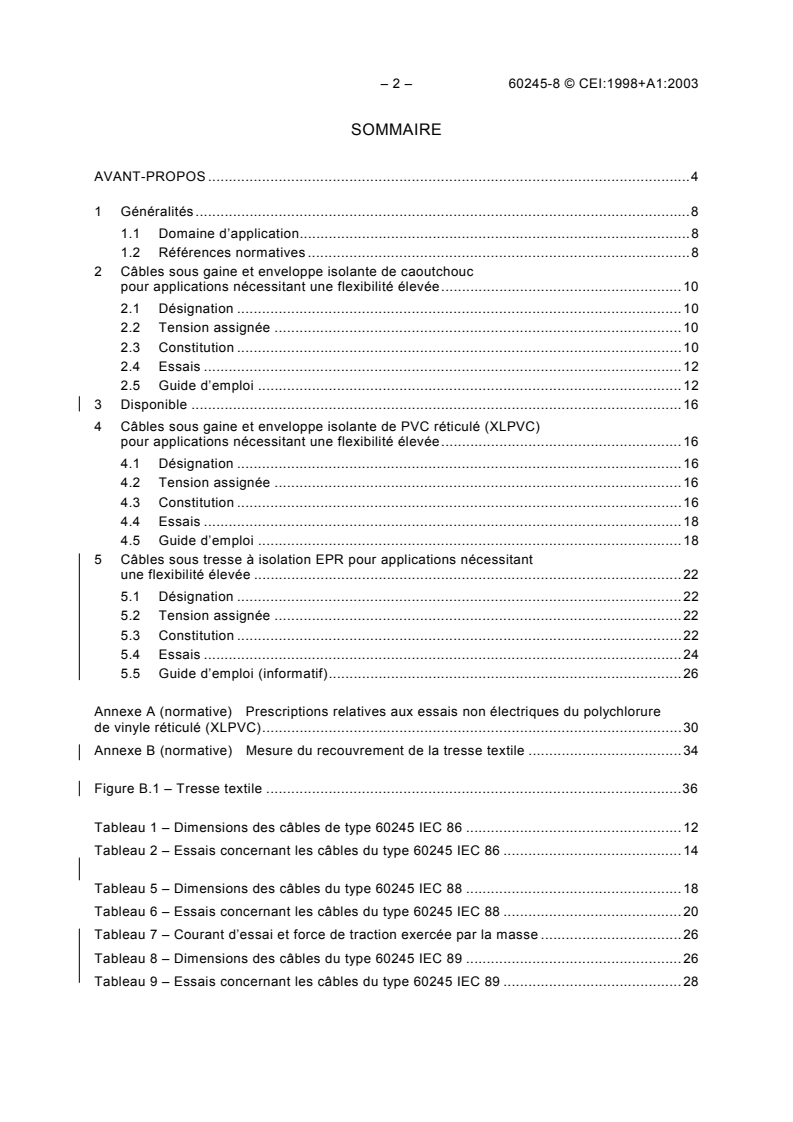
SOMMAIRE
AVANT-PROPOS .4
Généralités.8
1.1 Domaine d’application.8
1.2 Références normatives .8
2 Câbles sous gaine et enveloppe isolante de caoutchouc
pour applications nécessitant une flexibilité élevée.10
2.1 Désignation .10
2.2 Tension assignée .10
2.3 Constitution .10
2.4 Essais .12
2.5 Guide d’emploi .12
3 Disponible .16
4 Câbles sous gaine et enveloppe isolante de PVC réticulé (XLPVC)
pour applications nécessitant une flexibilité élevée.16
4.1 Désignation .16
4.2 Tension assignée .16
4.3 Constitution .16
4.4 Essais .18
4.5 Guide d’emploi .18
5 Câbles sous tresse à isolation EPR pour applications nécessitant
une flexibilité élevée .22
5.1 Désignation .22
5.2 Tension assignée .22
5.3 Constitution .22
5.4 Essais .24
5.5 Guide d’emploi (informatif).26
Annexe A (normative) Prescriptions relatives aux essais non électriques du polychlorure
de vinyle réticulé (XLPVC).30
Annexe B (normative) Mesure du recouvrement de la tresse textile .34
Figure B.1 – Tresse textile .36
Tableau 1 – Dimensions des câbles de type 60245 IEC 86 .12
Tableau 2 – Essais concernant les câbles du type 60245 IEC 86 .14
Tableau 5 – Dimensions des câbles du type 60245 IEC 88 .18
Tableau 6 – Essais concernant les câbles du type 60245 IEC 88 .20
Tableau 7 – Courant d’essai et force de traction exercée par la masse .26
Tableau 8 – Dimensions des câbles du type 60245 IEC 89 .26
Tableau 9 – Essais concernant les câbles du type 60245 IEC 89 .28
– 4 – 60245-8 © CEI:1998+A1:2003
COMMISSION ÉLECTROTECHNIQUE INTERNATIONALE
____________
CONDUCTEURS ET CÂBLES ISOLÉS AU CAOUTCHOUC –
TENSION ASSIGNÉE AU PLUS ÉGALE À 450/750 V –
Partie 8: Câbles pour applications nécessitant
une flexibilité élevée
AVANT-PROPOS
1) La Commission Electrotechnique Internationale (CEI) est une organisation mondiale de normalisation composée
de l'ensemble des comités électrotechniques nationaux (Comités nationaux de la CEI). La CEI a pour objet de
favoriser la coopération internationale pour toutes les questions de normalisation dans les domaines de
l'électricité et de l'électronique. A cet effet, la CEI – entre autres activités – publie des Normes internationales,
des Spécifications techniques, des Rapports techniques, des Spécifications accessibles au public (PAS) et des
Guides (ci-après dénommés "Publication(s) de la CEI"). Leur élaboration est confiée à des comités d'études,
aux travaux desquels tout Comité national intéressé par le sujet traité peut participer. Les organisations
internationales, gouvernementales et non gouvernementales, en liaison avec la CEI, participent également aux
travaux. La CEI collabore étroitement avec l'Organisation Internationale de Normalisation (ISO), selon des
conditions fixées par accord entre les deux organisations.
2) Les décisions ou accords officiels de la CEI concernant les questions techniques représentent, dans la mesure
du possible, un accord international sur les sujets étudiés, étant donné que les Comités nationaux de la CEI
intéressés sont représentés dans chaque comité d’études.
3) Les Publications de la CEI se présentent sous la forme de recommandations internationales et sont agréées
comme telles par les Comités nationaux de la CEI. Tous les efforts raisonnables sont entrepris afin que la CEI
s'assure de l'exactitude du contenu technique de ses publications; la CEI ne peut pas être tenue responsable de
l'éventuelle mauvaise utilisation ou interprétation qui en est faite par un quelconque utilisateur final.
4) Dans le but d'encourager l'uniformité internationale, les Comités nationaux de la CEI s'engagent, dans toute la
mesure possible, à appliquer de façon transparente les Publications de la CEI dans leurs publications
nationales et régionales. Toutes divergences entre toutes Publications de la CEI et toutes publications
nationales ou régionales correspondantes doivent être indiquées en termes clairs dans ces dernières.
5) La CEI n’a prévu aucune procédure de marquage valant indication d’approbation et n'engage pas sa
responsabilité pour les équipements déclarés conformes à une de ses Publications.
6) Tous les utilisateurs doivent s'assurer qu'ils sont en possession de la dernière édition de cette publication.
7) Aucune responsabilité ne doit être imputée à la CEI, à ses administrateurs, employés, auxiliaires ou
mandataires, y compris ses experts particuliers et les membres de ses comités d'études et des Comités
nationaux de la CEI, pour tout préjudice causé en cas de dommages corporels et matériels, ou de tout autre
dommage de quelque nature que ce soit, directe ou indirecte, ou pour supporter les coûts (y compris les frais
de justice) et les dépenses découlant de la publication ou de l'utilisation de cette Publication de la CEI ou de
toute autre Publication de la CEI, ou au crédit qui lui est accordé.
8) L'attention est attirée sur les références normatives citées dans cette publication. L'utilisation de publications
référencées est obligatoire pour une application correcte de la présente publication.
9) L’attention est attirée sur le fait que certains des éléments de la présente Publication de la CEI peuvent faire
l’objet de droits de propriété intellectuelle ou de droits analogues. La CEI ne saurait être tenue pour
responsable de ne pas avoir identifié de tels droits de propriété et de ne pas avoir signalé leur existence.
La Norme internationale CEI 60245-8 a été établie par le sous-comité 20B: Câbles de basse
tension, du comité d’études 20 de la CEI: Câbles électriques.
La présente version consolidée de la CEI 60245-8 comprend la première édition (1998)
[documents 20B/259/FDIS et 20B/269/RVD] et son amendement 1 (2003) [documents
20/580/CDV et 20/662/RVC].
Le contenu technique de cette version consolidée est donc identique à celui de l'édition de
base et à son amendement; cette version a été préparée par commodité pour l'utilisateur.
Elle porte le numéro d'édition 1.1.
Une ligne verticale dans la marge indique où la publication de base a été modifiée par
l'amendement 1.
– 6 – 60245-8 © CEI:1998+A1:2003
La CEI 60245 comprend les parties suivantes, présentées sous le titre général Conducteurs et
câbles isolés au caoutchouc – Tension assignée au plus égale à 450/750 V:
– Partie 1:1994, Prescriptions générales
– Partie 2:1994, Méthodes d'essai
– Partie 3:1994, Conducteurs isolés au silicone, résistant à la chaleur
– Partie 4:1994, Câbles souples
– Partie 5:1994, Câbles pour ascenseurs
– Partie 6:1994, Câbles souples pour électrodes de soudage à l'arc
– Partie 7:1994, Câbles isolés à l'éthylène-acétate de vinyle, résistant aux températures
élevées
– Partie 8:1997, Câbles pour applications nécessitant une flexibilité élevée
Les parties 3 à 8 concernent des types particuliers de câbles et ces publications doivent être
lues conjointement avec les parties 1 et 2. Des parties supplémentaires pourront être ajoutées
au fur et à mesure que d'autres types seront normalisés.
Les annexes A et B font partie intégrante de cette norme.
Le comité a décidé que le contenu de la publication de base et de son amendement 1 ne sera
pas modifié avant 2009. A cette date, la publication sera
• reconduite;
• supprimée;
• remplacée par une édition révisée, ou
• amendée.
– 8 – 60245-8 © CEI:1998+A1:2003
CONDUCTEURS ET CÂBLES ISOLÉS AU CAOUTCHOUC –
TENSION ASSIGNÉE AU PLUS ÉGALE À 450/750 V –
Partie 8: Câbles pour applications nécessitant
une flexibilité élevée
1 Généralités
1.1 Domaine d’application
La présente partie de la CEI 60245 précise les spécifications particulières applicables aux
câbles à enveloppe isolante de caoutchouc ou de polychlorure de vinyle réticulé, et aux câbles
sous gaine de caoutchouc ou de polychlorure de vinyle réticulé, de tension assignée égale
à 300/300 V, pour une utilisation dans les applications nécessitant une flexibilité élevée, par
exemple les cordons de fer à repasser.
II convient que tous les câbles répondent aux prescriptions appropriées données dans la
CEI 60245-1 et que les types de câbles individuels répondent aux prescriptions particulières
figurant dans la présente partie.
1.2 Références normatives
Les documents de référence suivants sont indispensables pour l'application du présent
document. Pour les références datées, seule l'édition citée s'applique. Pour les références non
datées, la dernière édition du document de référence s'applique (y compris les éventuels
amendements).
CEI 60228:1978, Ames des câbles isolés
CEI 60245-1, Conducteurs et câbles isolés au caoutchouc – Tension assignée au plus égale à
450/750 V – Partie 1: Prescriptions générales
CEI 60245-2, Conducteurs et câbles isolés au caoutchouc – Tension assignée au plus égale à
450/750 V – Partie 2: Méthodes d’essais
CEI 60332-1:1993, Essais des câbles électriques soumis au feu – Partie 1: Essai sur un
conducteur ou câble isolé vertical
CEI 60719:1992, Calcul des valeurs minimales et maximales des dimensions extérieures
moyennes des conducteurs et câbles à âmes circulaires en cuivre et de tension nominale au
plus égale à 450/750 V
CEI 60811-1-1:1993, Méthodes d’essais communes pour les matériaux d’isolation et de
gainage des câbles électriques – Partie 1-1: Méthodes d’application générale – Mesure des
épaisseurs et des dimensions extérieures – Détermination des propriétés mécaniques
CEI 60811-1-2:1985, Méthodes d’essais communes pour les matériaux d’isolation et de
gainage des câbles électriques – Partie 1-2: Méthodes d’application générale – Méthodes de
vieillissement thermique
CEI 60811-1-4:1985, Méthodes d’essais communes pour les matériaux d’isolation et de
gainage des câbles électriques – Partie 1-4: Méthodes d’application générale – Essais à basse
température
– 10 – 60245-8 © CEI:1998+A1:2003
CEI 60811-2-1:1986, Méthodes d’essais communes pour les matériaux d’isolation et de
gainage des câbles électriques – Partie 2-1: Méthodes spécifiques pour les mélanges
élastomères – Essai de résistance à l'ozone – Essai d’allongement à chaud – Essai de
résistance à l'huile
CEI 60811-3-1:1985, Méthodes d’essais communes pour les matériaux d’isolation et de
gainage des câbles électriques – Partie 3-1: Méthodes spécifiques pour les mélanges PVC –
Essai de pression à température élevée – Essai de résistance à la fissuration
CEI 60811-3-2:1985, Méthodes d’essais communes pour les matériaux d’isolation et de
gainage des câbles électriques – Partie 3-2: Méthodes spécifiques pour les mélanges PVC –
Essai de perte de masse – Essai de stabilité thermique
2 Câbles sous gaine et enveloppe isolante de caoutchouc
pour applications nécessitant une flexibilité élevée
2.1 Désignation
60245 IEC 86
2.2 Tension assignée
300/300 V
2.3 Constitution
2.3.1 Ame
Nombre d'âmes: deux ou trois.
Les âmes doivent satisfaire aux prescriptions de la CEI 60228, pour les âmes de la classe 6.
Les brins peuvent être nus ou étamés.
2.3.2 Séparateur
Un séparateur en matière appropriée peut être appliqué autour de chaque âme.
2.3.3 Enveloppe isolante
L'enveloppe isolante doit être composée d’un mélange de caoutchouc du type IE4 appliqué
autour de chaque âme.
L’isolation doit être appliquée par extrusion.
L'épaisseur de l'enveloppe isolante doit satisfaire à la valeur spécifiée indiquée dans la
colonne 2 du tableau 1.
2.3.4 Assemblage des conducteurs et bourrage éventuel
Les conducteurs doivent être câblés ensemble.
La longueur maximale du pas est spécifiée dans la colonne 3 du tableau 1. Le sens du pas doit
être le même pour les âmes et les conducteurs.
Un bourrage central peut être utilisé.
– 12 – 60245-8 © CEI:1998+A1:2003
2.3.5 Gaine
La gaine doit être composée d’un mélange de caoutchouc du type SE3 appliqué autour des
conducteurs.
L'épaisseur de la gaine doit être conforme à la valeur indiquée dans la colonne 4 du tableau 1.
La gaine doit être extrudée en une seule couche et appliquée de façon à remplir les vides entre
les conducteurs.
La gaine doit pouvoir être retirée sans dommage pour les conducteurs.
2.3.6 Diamètre extérieur
Le diamètre extérieur moyen doit être compris dans les limites données dans les colonnes 5
et 6 du tableau 1.
2.3.7 Marquage extérieur
Le câble doit porter le marquage 60245 IEC 86 imprimé sur la surface externe du câble. Le
marquage doit répondre aux prescriptions de 3.1.1, 3.2 et 3.3 de la CEI 60245-1.
2.4 Essais
La conformité aux prescriptions de 2.3 doit être vérifiée par examen et par les essais indiqués
dans le tableau 2.
Pour 2.3.4, la longueur du pas d'assemblage doit être déterminée en mesurant la longueur
prise par 10 tours d'assemblage sur un échantillon et en divisant cette longueur par 10. Le
résultat est la longueur du pas des conducteurs assemblés.
2.5 Guide d’emploi
Température maximale de l'âme en usage normal: 60 °C.
NOTE – D’
...
NORME
CEI
INTERNATIONALE
IEC
60245-8
INTERNATIONAL
Première édition
STANDARD
First edition
1998-01
Conducteurs et câbles isolés au caoutchouc –
Tension assignée au plus égale à 450/750 V –
Partie 8:
Câbles pour applications nécessitant
une flexibilité élevée
Rubber insulated cables –
Rated voltages up to and including 450/750 V –
Part 8:
Cords for applications requiring
high flexibility
Numéro de référence
Reference number
CEI/IEC 60245-8:1998
Numéros des publications Numbering
Depuis le 1er janvier 1997, les publications de la CEI As from 1 January 1997 all IEC publications are
sont numérotées à partir de 60000. issued with a designation in the 60000 series.
Publications consolidées Consolidated publications
Les versions consolidées de certaines publications de Consolidated versions of some IEC publications
la CEI incorporant les amendements sont disponibles. including amendments are available. For example,
Par exemple, les numéros d’édition 1.0, 1.1 et 1.2 edition numbers 1.0, 1.1 and 1.2 refer, respectively, to
indiquent respectivement la publication de base, la the base publication, the base publication
publication de base incorporant l’amendement 1, et la incorporating amendment 1 and the base publication
publication de base incorporant les amendements 1 incorporating amendments 1 and 2.
et 2.
Validité de la présente publication Validity of this publication
Le contenu technique des publications de la CEI est The technical content of IEC publications is kept under
constamment revu par la CEI afin qu'il reflète l'état constant review by the IEC, thus ensuring that the
actuel de la technique. content reflects current technology.
Des renseignements relatifs à la date de Information relating to the date of the reconfirmation of
reconfirmation de la publication sont disponibles dans the publication is available in the IEC catalogue.
le Catalogue de la CEI.
Les renseignements relatifs à ces révisions, à l'établis- Information on the revision work, the issue of revised
sement des éditions révisées et aux amendements editions and amendments may be obtained from
peuvent être obtenus auprès des Comités nationaux de IEC National Committees and from the following
la CEI et dans les documents ci-dessous: IEC sources:
• Bulletin de la CEI • IEC Bulletin
• Annuaire de la CEI • IEC Yearbook
Accès en ligne* On-line access*
• Catalogue des publications de la CEI • Catalogue of IEC publications
Publié annuellement et mis à jour régulièrement Published yearly with regular updates
(Accès en ligne)* (On-line access)*
Terminologie, symboles graphiques Terminology, graphical and letter
et littéraux symbols
En ce qui concerne la terminologie générale, le lecteur For general terminology, readers are referred to
se reportera à la CEI 60050: Vocabulaire Electro- IEC 60050: International Electrotechnical Vocabulary
technique International (VEI). (IEV).
Pour les symboles graphiques, les symboles littéraux For graphical symbols, and letter symbols and signs
et les signes d'usage général approuvés par la CEI, le approved by the IEC for general use, readers are
referred to publications IEC 60027: Letter symbols to
lecteur consultera la CEI 60027: Symboles littéraux à
utiliser en électrotechnique, la CEI 60417: Symboles be used in electrical technology, IEC 60417: Graphical
graphiques utilisables sur le matériel. Index, relevé et symbols for use on equipment. Index, survey and
compilation des feuilles individuelles, et la CEI 60617: compilation of the single sheets and IEC 60617:
Symboles graphiques pour schémas. Graphical symbols for diagrams.
Publications de la CEI établies par IEC publications prepared by the same
le même comité d'études technical committee
L'attention du lecteur est attirée sur les listes figurant The attention of readers is drawn to the end pages of
à la fin de cette publication, qui énumèrent les this publication which list the IEC publications issued
publications de la CEI préparées par le comité by the technical committee which has prepared the
d'études qui a établi la présente publication. present publication.
* Voir adresse «site web» sur la page de titre. * See web site address on title page.
NORME
CEI
INTERNATIONALE
IEC
60245-8
INTERNATIONAL
Première édition
STANDARD
First edition
1998-01
Conducteurs et câbles isolés au caoutchouc –
Tension assignée au plus égale à 450/750 V –
Partie 8:
Câbles pour applications nécessitant
une flexibilité élevée
Rubber insulated cables –
Rated voltages up to and including 450/750 V –
Part 8:
Cords for applications requiring
high flexibility
IEC 1998 Droits de reproduction réservés Copyright - all rights reserved
Aucune partie de cette publication ne peut être reproduite ni No part of this publication may be reproduced or utilized in
utilisée sous quelque forme que ce soit et par aucun any form or by any means, electronic or mechanical,
procédé, électronique ou mécanique, y compris la photo- including photocopying and microfilm, without permission in
copie et les microfilms, sans l'accord écrit de l'éditeur. writing from the publisher.
International Electrotechnical Commission 3, rue de Varembé Geneva, Switzerland
Telefax: +41 22 919 0300 e-mail: inmail@iec.ch IEC web site http: //www.iec.ch
CODE PRIX
Commission Electrotechnique Internationale
PRICE CODE P
International Electrotechnical Commission
Pour prix, voir catalogue en vigueur
For price, see current catalogue
– 2 – 60245-8 © CEI:1998
SOMMAIRE
Pages
AVANT-PROPOS . 4
Articles
1 Généralités . 8
1.1 Domaine d’application . 8
1.2 Références normatives. 8
2 Câbles sous gaine et enveloppe isolante de caoutchouc pour applications
nécessitant une flexibilité élevée . 10
2.1 Désignation. 10
2.2 Tension assignée . 10
2.3 Constitution. 10
2.4 Essais. 12
2.5 Guide d’emploi . 12
3 Câbles sous gaine de PVC réticulé (XLPVC) et enveloppe isolante de caoutchouc
pour applications nécessitant une flexibilité élevée . 14
3.1 Désignation. 16
3.2 Tension assignée . 16
3.3 Constitution. 16
3.4 Essais. 18
3.5 Guide d’emploi . 18
4 Câbles sous gaine et enveloppe isolante de PVC réticulé (XLPVC)
pour applications nécessitant une flexibilité élevée . 22
4.1 Désignation. 22
4.2 Tension assignée . 22
4.3 Constitution. 22
4.4 Essais. 24
4.5 Guide d’emploi . 24
Annexe A – Prescriptions relatives aux essais non électriques du polychlorure de vinyle
réticulé (XLPVC) . 28
60245-8 © IEC:1998 – 3 –
CONTENTS
Page
FOREWORD . 5
Clause
1 General. 9
1.1 Scope . 9
1.2 Normative references . 9
2 Rubber insulated and sheathed cords for applications requiring high flexibility . 11
2.1 Code designation . 11
2.2 Rated voltage. 11
2.3 Construction. 11
2.4 Tests . 13
2.5 Guide to use . 13
3 Rubber insulated and cross-linked PVC (XLPVC) sheathed cords for applications
requiring high flexibility. 15
3.1 Code designation . 17
3.2 Rated voltage. 17
3.3 Construction. 17
3.4 Tests . 19
3.5 Guide to use . 19
4 Cross-linked PVC (XLPVC) insulated and sheathed cords for applications
requiring high flexibility. 23
4.1 Code designation . 23
4.2 Rated voltage. 23
4.3 Construction. 23
4.4 Tests . 25
4.5 Guide to use . 25
Annex A – Requirements for the non-electrical tests for cross-linked
polyvinyl chloride (XLPVC). 29
– 4 – 60245-8 © CEI:1998
COMMISSION ÉLECTROTECHNIQUE INTERNATIONALE
–––––––––––
CONDUCTEURS ET CÂBLES ISOLÉS AU CAOUTCHOUC –
TENSION ASSIGNÉE AU PLUS ÉGALE À 450/750 V –
Partie 8: Câbles pour applications nécessitant
une flexibilité élevée
AVANT-PROPOS
1) La CEI (Commission Electrotechnique Internationale) est une organisation mondiale de normalisation composée
de l'ensemble des comités électrotechniques nationaux (Comités nationaux de la CEI). La CEI a pour objet de
favoriser la coopération internationale pour toutes les questions de normalisation dans les domaines de
l'électricité et de l'électronique. A cet effet, la CEI, entre autres activités, publie des Normes Internationales.
Leur élaboration est confiée à des comités d'études, aux travaux desquels tout Comité national intéressé par le
sujet traité peut participer. Les organisations internationales, gouvernementales et non gouvernementales, en
liaison avec la CEI, participent également aux travaux. La CEI collabore étroitement avec l'Organisation
Internationale de Normalisation (ISO), selon des conditions fixées par accord entre les deux organisations.
2) Les décisions ou accords officiels de la CEI concernant les questions techniques, représentent, dans la mesure
du possible un accord international sur les sujets étudiés, étant donné que les Comités nationaux intéressés
sont représentés dans chaque comité d’études.
3) Les documents produits se présentent sous la forme de recommandations internationales. Ils sont publiés
comme normes, rapports techniques ou guides et agréés comme tels par les Comités nationaux.
4) Dans le but d'encourager l'unification internationale, les Comités nationaux de la CEI s'engagent à appliquer de
façon transparente, dans toute la mesure possible, les Normes internationales de la CEI dans leurs normes
nationales et régionales. Toute divergence entre la norme de la CEI et la norme nationale ou régionale
correspondante doit être indiquée en termes clairs dans cette dernière.
5) La CEI n’a fixé aucune procédure concernant le marquage comme indication d’approbation et sa responsabilité
n’est pas engagée quand un matériel est déclaré conforme à l’une de ses normes.
6) L’attention est attirée sur le fait que certains des éléments de la présente Norme internationale peuvent faire
l’objet de droits de propriété intellectuelle ou de droits analogues. La CEI ne saurait être tenue pour
responsable de ne pas avoir identifié de tels droits de propriété et de ne pas avoir signalé leur existence.
La Norme internationale CEI 60245-8 a été établie par le sous-comité 20B: Câbles de basse
tension, du comité d’études 20 de la CEI: Câbles électriques.
Le texte de cette norme est issu des documents suivants:
FDIS Rapport de vote
20B/259/FDIS 20B/269/RVD
Le rapport de vote indiqué dans le tableau ci-dessus donne toute information sur le vote ayant
abouti à l'approbation de cette norme.
La CEI 60245 comprend les parties suivantes, présentées sous le titre général Conducteurs et
câbles isolés au caoutchouc – Tension assignée au plus égale à 450/750 V:
– Partie 1:1994, Prescriptions générales
– Partie 2:1994, Méthodes d'essai
– Partie 3:1994, Conducteurs isolés au silicone, résistant à la chaleur
– Partie 4:1994, Câbles souples
– Partie 5:1994, Câbles pour ascenseurs
– Partie 6:1994, Câbles souples pour électrodes de soudage à l'arc
60245-8 © IEC:1998 – 5 –
INTERNATIONAL ELECTROTECHNICAL COMMISSION
–––––––––––
RUBBER INSULATED CABLES –
RATED VOLTAGES UP TO AND INCLUDING 450/750 V –
Part 8: Cords for applications requiring high flexibility
FOREWORD
1) The IEC (International Electrotechnical Commission) is a worldwide organization for standardization comprising
all national electrotechnical committees (IEC National Committees). The object of the IEC is to promote
international co-operation on all questions concerning standardization in the electrical and electronic fields. To
this end and in addition to other activities, the IEC publishes International Standards. Their preparation is
entrusted to technical committees; any IEC National Committee interested in the subject dealt with may
participate in this preparatory work. International, governmental and non-governmental organizations liaising
with the IEC also participate in this preparation. The IEC collaborates closely with the International Organization
for Standardization (ISO) in accordance with conditions determined by agreement between the two
organizations.
2) The formal decisions or agreements of the IEC on technical matters express, as nearly as possible, an
international consensus of opinion on the relevant subjects since each technical committee has representation
from all interested National Committees.
3) The documents produced have the form of recommendations for international use and are published in the form
of standards, technical reports or guides and they are accepted by the National Committees in that sense.
4) In order to promote international unification, IEC National Committees undertake to apply IEC International
Standards transparently to the maximum extent possible in their national and regional standards. Any
divergence between the IEC Standard and the corresponding national or regional standard shall be clearly
indicated in the latter.
5) The IEC provides no marking procedure to indicate its approval and cannot be rendered responsible for any
equipment declared to be in conformity with one of its standards.
6) Attention is drawn to the possibility that some of the elements of this International Standard may be the subject
of patent rights. The IEC shall not be held responsible for identifying any or all such patent rights.
International Standard IEC 60245-8 has been prepared by subcommittee 20B: Low-voltage
cables, of IEC technical committee 20: Electric cables.
The text of this standard is based on the following documents:
FDIS Report on voting
20B/259/FDIS 20B/269/RVD
Full information on the voting for the approval of this standard can be found in the report on
voting indicated in the above table.
IEC 60245 consists of the following parts, under the general title: Rubber insulated cables –
Rated voltages up to and including 450/750 V:
– Part 1:1994, General requirements
– Part 2:1994, Test methods
– Part 3:1994, Heat resistant silicone insulated cables
– Part 4:1994, Cords and flexible cables
– Part 5:1994, Lift cables
– Part 6:1994, Arc welding electrode cables
– 6 – 60245-8 © CEI:1998
– Partie 7:1994, Câbles isolés à l'éthylène-acétate de vinyle, résistant aux températures
élevées
– Partie 8:1997, Câbles pour applications nécessitant une flexibilité élevée
Les parties 3 à 8 concernent des types particuliers de câbles et ces publications doivent être
lues conjointement avec les parties 1 et 2. Des parties supplémentaires pourront être ajoutées
au fur et à mesure que d'autres types seront normalisés.
L'annexe A fait partie intégrante de cette norme.
60245-8 © IEC:1998 – 7 –
– Part 7:1994, Heat resistant ethylene-vinyl-acetate rubber insulated cables
– Part 8:1997, Cords for applications requiring high flexibility
Parts 3 to 8 are for particular types of cables and should be read in conjunction with part 1 and
part 2. Further parts may be added as other types are standardised.
Annex A forms an integral part of this standard.
– 8 – 60245-8 © CEI:1998
CONDUCTEURS ET CÂBLES ISOLÉS AU CAOUTCHOUC –
TENSION ASSIGNÉE AU PLUS ÉGALE À 450/750 V –
Partie 8: Câbles pour applications nécessitant
une flexibilité élevée
1 Généralités
1.1 Domaine d’application
La présente partie de la CEI 60245 précise les spécifications particulières applicables aux
câbles à enveloppe isolante de caoutchouc ou de polychlorure de vinyle réticulé, et aux câbles
sous gaine de caoutchouc ou de polychlorure de vinyle réticulé, de tension assignée égale
à 300/300 V, pour une utilisation dans les applications nécessitant une flexibilité élevée, par
exemple les cordons de fer à repasser.
II convient que tous les câbles répondent aux prescriptions appropriées données dans la
CEI 60245-1 et que les types de câbles individuels répondent aux prescriptions particulières
figurant dans la présente partie.
1.2 Références normatives
Les documents normatifs suivants contiennent des dispositions qui, par suite de la référence
qui y est faite, constituent des dispositions valables pour la présente partie de la CEI 60245.
Au moment de la publication, les éditions indiquées étaient en vigueur. Tout document normatif
est sujet à révision et les parties prenantes aux accords fondés sur la présente partie de la
CEI 60245 sont invitées à rechercher la possibilité d'appliquer les éditions les plus récentes
des documents normatifs indiqués ci-après. Les membres de la CEI et de l’ISO possèdent le
registre des Normes internationales en vigueur.
CEI 60228:1978, Ames des câbles isolés
CEI 60332-1:1993, Essais des câbles électriques soumis au feu – Partie 1: Essai sur un
conducteur ou câble isolé vertical
CEI 60719:1992, Calcul des valeurs minimales et maximales des dimensions extérieures
moyennes des conducteurs et câbles à âmes circulaires en cuivre et de tension nominale au
plus égale à 450/750 V
CEI 60811-1-1:1993, Méthodes d’essais communes pour les matériaux d’isolation et de
gainage des câbles électriques – Partie 1-1: Méthodes d’application générale – Mesure des
épaisseurs et des dimensions extérieures – Détermination des propriétés mécaniques
CEI 60811-1-2:1985, Méthodes d’essais communes pour les matériaux d’isolation et de
gainage des câbles électriques – Partie 1-2: Méthodes d’application générale – Méthodes de
vieillissement thermique
CEI 60811-1-4:1985, Méthodes d’essais communes pour les matériaux d’isolation et de
gainage des câbles électriques – Partie 1-4: Méthodes d’application générale – Essais à basse
température
60245-8 © IEC:1998 – 9 –
RUBBER INSULATED CABLES –
RATED VOLTAGES UP TO AND INCLUDING 450/750 V –
Part 8: Cords for applications requiring high flexibility
1 General
1.1 Scope
This part of IEC 60245 details the particular specifications for rubber or cross-linked polyvinyl
chloride insulated and rubber or cross-linked polyvinyl chloride sheathed cords of rated voltage
300/300 V, for use in applications where high flexibility is required, for example for iron cords.
All cables should comply with the appropriate requirements given in IEC 60245-1 and the
individual types of cables should each comply with the particular requirements of this part.
1.2 Normative references
The following normative documents contain provisions which, through reference in this text,
constitute provisions of this part of IEC 60245. At the time of publication, the editions indicated
were valid. All normative documents are subject to revision, and parties to agreements based
on this part of IEC 60245 are encouraged to investigate the possibility of applying the most
recent editions of the normative documents listed below. Members of IEC and ISO maintain
registers of currently valid International Standards.
IEC 60228:1978, Conductors of insulated cables
IEC 60332-1:1993, Tests on electric cables under fire conditions – Part 1: Test on a single
vertical insulated wire or cable
IEC 60719:1992, Calculation of the lower and upper limits for the average outer dimensions of
cables with circular copper conductors and of rated voltages up to and including 450/750 V
IEC 60811-1-1:1993, Common test methods for insulating and sheathing materials of electric
cables – Part 1-1: Methods for general application – Measurement of thickness and overall
dimensions – Tests for determining the mechanical properties
IEC 60811-1-2:1985, Common test methods for insulating and sheathing materials of electric
cables – Part 1-2: Methods for general application – Thermal ageing methods
IEC 60811-1-4:1985, Common test methods for insulating and sheathing materials of electric
cables – Part 1-4: Methods for general application – Tests at low temperature
– 10 – 60245-8 © CEI:1998
CEI 60811-2-1:1986, Méthodes d’essais communes pour les matériaux d’isolation et de
gainage des câbles électriques – Partie 2-1: Méthodes spécifiques pour les mélanges
élastomères – Essai de résistance à l'ozone – Essai d’allongement à chaud – Essai de
résistance à l'huile
CEI 60811-3-1:1985, Méthodes d’essais communes pour les matériaux d’isolation et de
gainage des câbles électriques – Partie 3-1: Méthodes spécifiques pour les mélanges PVC –
Essai de pression à température élevée – Essai de résistance à la fissuration
CEI 60811-3-2:1985, Méthodes d’essais communes pour les matériaux d’isolation et de
gainage des câbles électriques – Partie 3-2: Méthodes spécifiques pour les mélanges PVC –
Essai de perte de masse – Essai de stabilité thermique
2 Câbles sous gaine et enveloppe isolante de caoutchouc
pour applications nécessitant une flexibilité élevée
2.1 Désignation
60245 IEC 86
2.2 Tension assignée
300/300 V
2.3 Constitution
2.3.1 Ame
Nombre d'âmes: deux ou trois.
Les âmes doivent satisfaire aux prescriptions de la CEI 60228, pour les âmes de la classe 6.
Les brins peuvent être nus ou étamés.
2.3.2 Séparateur
Un séparateur en matière appropriée peut être appliqué autour de chaque âme (voir cependant
les prescriptions données en 5.1.3 de la CEI 60245-1).
2.3.3 Enveloppe isolante
L'enveloppe isolante doit être composée d’un mélange de caoutchouc du type IE1 appliqué
autour de chaque âme.
L'enveloppe isolante doit comporter au moins deux couches, sauf si elle est appliquée par
extrusion.
L'épaisseur de l'enveloppe isolante doit satisfaire à la valeur spécifiée indiquée dans la
colonne 2 du tableau 1.
2.3.4 Assemblage des conducteurs et bourrage éventuel
Les conducteurs doivent être câblés ensemble.
La longueur maximale du pas est spécifiée dans la colonne 3 du tableau 1. Le sens du pas doit
être le même pour les âmes et les conducteurs.
Un bourrage central peut être utilisé.
60245-8 © IEC:1998 – 11 –
IEC 60811-2-1:1986, Common test methods for insulating and sheathing materials of electric
cables – Part 2-1: Methods specific to elastomeric compounds – Ozone resistance test – Hot
set test – Mineral oil immersion test
IEC 60811-3-1:1985, Common test methods for insulating and sheathing materials of electric
cables – Part 3-1: Methods specific to PVC compounds – Pressure test at high temperature –
Tests for resistance to cracking
IEC 60811-3-2:1985, Common test methods for insulating and sheathing materials of electric
cables – Part 3-2: Methods specific to PVC compounds – Loss of mass test – Thermal stability
tests
2 Rubber insulated and sheathed cords for applications
requiring high flexibility
2.1 Code designation
60245 IEC 86
2.2 Rated voltage
300/300 V
2.3 Construction
2.3.1 Conductor
Number of conductors: two or three.
The conductors shall be in accordance with the requirements given in IEC 60228 for class 6
conductors. The wires may be plain or tinned.
2.3.2 Separator
A separator of suitable material may be applied around each conductor (see however the
requirements given in 5.1.3 of IEC 60245-1).
2.3.3 Insulation
The insulation shall be a rubber compound of type IE1 applied around each conductor.
The insulation shall comprise at least two layers unless it is applied by extrusion.
The insulation thickness shall comply with the specified value given in column 2 of table 1.
2.3.4 Assembly of cores and filler, if any
The cores shall be twisted together.
The maximum length of lay is specified in column 3 of table 1. The direction of lay shall be the
same for the conductors and for the cores.
A centre filler may be used.
– 12 – 60245-8 © CEI:1998
2.3.5 Gaine
La gaine doit être composée d’un mélange de caoutchouc du type SE3 appliqué autour des
conducteurs.
L'épaisseur de la gaine doit être conforme à la valeur indiquée dans la colonne 4 du tableau 1.
La gaine doit être extrudée en une seule couche et appliquée de façon à remplir les vides entre
les conducteurs.
La gaine doit pouvoir être retirée sans dommage pour les conducteurs.
2.3.6 Diamètre extérieur
Le diamètre extérieur moyen doit être compris dans les limites données dans les colonnes 5
et 6 du tableau 1.
2.3.7 Marquage extérieur
Le câble doit porter le marquage 60245 IEC 86 imprimé sur la surface externe du câble. Le
marquage doit répondre aux prescriptions de 3.1.1, 3.2 et 3.3 de la CEI 60245-1.
2.4 Essais
La conformité aux prescriptions de 2.3 doit être vérifiée par examen et par les essais indiqués
dans le tableau 2.
Pour 2.3.4, la longueur du pas d'assemblage doit être déterminée en mesurant la longueur
prise par 10 tours d'assemblage sur un échantillon et en divisant cette longueur par 10. Le
résultat est la longueur du pas des conducteurs assemblés.
2.5 Guide d’emploi
Température maximale de l'âme en usage normal: 60 °C.
NOTE – D’autres directives sont à l’étude.
Tableau 1 – Dimensions des câbles de type 60245 IEC 86
12 3 4 5 6
Nombre et Epaisseur de Longueur Epaisseur Diamètre extérieur
1)
section l'enveloppe maximale de la moyen
nominale isolante du pas gaine
des Valeur du Valeur Limite Limite
âmes spécifiée conducteur spécifiée inférieure supérieure
mm mm mm mm mm mm
2 × 0,75 0,6 35 0,8 5,7 7,4
2 × 1 0,6 35 0,8 5,9 7,8
2 × 1,5 0,7 40 0,8 6,8 8,9
3 × 0,75 0,6 35 0,8 6,0 7,9
3 × 1 0,6 40 0,8 6,3 8,3
3 × 1,5 0,7 45 0,9 7,2 9,4
1)
Les dimensions extérieures des câbles ont été calculées conformément à la CEI 60719.
60245-8 © IEC:1998 – 13 –
2.3.5 Sheath
The sheath shall be a rubber compound of type SE3 applied around the cores.
The thickness of the sheath shall comply with the specified value given in column 4 of table 1.
The sheath shall be extruded in a single layer and applied in such a way that it fills the spaces
between the cores.
The sheath shall be removable without damage to the cores.
2.3.6 Overall diameter
The mean overall diameter shall be within the limits given in columns 5 and 6 of table 1.
2.3.7 Outer marking
The cord shall have the marking 60245 IEC 86 printed on the outer surface of the cord. The
marking shall meet the requirements of 3.1.1, 3.2 and 3.3 of IEC 60245-1.
2.4 Tests
Compliance with the requirements of 2.3 shall be checked by inspection and by the tests given
in table 2.
For 2.3.4, the length of lay shall be determined by measuring the length of 10 pitches of a
sample and dividing this length by 10. The result is the length of lay of laid-up cores.
2.5 Guide to use
Maximum conductor temperature in normal use: 60 °C.
NOTE – Other guidelines are under consideration.
Table 1 – Dimensions of type 60245 IEC 86
1 234 5 6
1)
Number and Thickness Maximum Thickness Mean overall diameter
nominal cross- of insulation length of of sheath
sectional area Specified core lay Specified
of conductors value value Lower
...
IEC 60245-8 ®
Edition 1.2 2012-01
CONSOLIDATED VERSION
INTERNATIONAL
STANDARD
NORME
INTERNATIONALE
Rubber insulated cables – Rated voltages up to and including 450/750 V –
Part 8: Cords for applications requiring high flexibility
Conducteurs et câbles isolés au caoutchouc – Tension assignée au plus égale à
450/750 V –
Partie 8: Câbles pour applications nécessitant une flexibilité élevée
All rights reserved. Unless otherwise specified, no part of this publication may be reproduced or utilized in any form
or by any means, electronic or mechanical, including photocopying and microfilm, without permission in writing from
either IEC or IEC's member National Committee in the country of the requester.
If you have any questions about IEC copyright or have an enquiry about obtaining additional rights to this publication,
please contact the address below or your local IEC member National Committee for further information.
Droits de reproduction réservés. Sauf indication contraire, aucune partie de cette publication ne peut être reproduite ni
utilisée sous quelque forme que ce soit et par aucun procédé, électronique ou mécanique, y compris la photocopie et les
microfilms, sans l'accord écrit de la CEI ou du Comité national de la CEI du pays du demandeur.
Si vous avez des questions sur le copyright de la CEI ou si vous désirez obtenir des droits supplémentaires sur cette
publication, utilisez les coordonnées ci-après ou contactez le Comité national de la CEI de votre pays de résidence.
IEC Central Office Tel.: +41 22 919 02 11
3, rue de Varembé Fax: +41 22 919 03 00
CH-1211 Geneva 20 info@iec.ch
Switzerland www.iec.ch
About the IEC
The International Electrotechnical Commission (IEC) is the leading global organization that prepares and publishes
International Standards for all electrical, electronic and related technologies.
About IEC publications
The technical content of IEC publications is kept under constant review by the IEC. Please make sure that you have the
latest edition, a corrigenda or an amendment might have been published.
Useful links:
IEC publications search - www.iec.ch/searchpub Electropedia - www.electropedia.org
The advanced search enables you to find IEC publications The world's leading online dictionary of electronic and
by a variety of criteria (reference number, text, technical electrical terms containing more than 30 000 terms and
committee,…). definitions in English and French, with equivalent terms in
It also gives information on projects, replaced and additional languages. Also known as the International
withdrawn publications. Electrotechnical Vocabulary (IEV) on-line.
IEC Just Published - webstore.iec.ch/justpublished Customer Service Centre - webstore.iec.ch/csc
Stay up to date on all new IEC publications. Just Published If you wish to give us your feedback on this publication
details all new publications released. Available on-line and or need further assistance, please contact the
also once a month by email. Customer Service Centre: csc@iec.ch.
A propos de la CEI
La Commission Electrotechnique Internationale (CEI) est la première organisation mondiale qui élabore et publie des
Normes internationales pour tout ce qui a trait à l'électricité, à l'électronique et aux technologies apparentées.
A propos des publications CEI
Le contenu technique des publications de la CEI est constamment revu. Veuillez vous assurer que vous possédez
l’édition la plus récente, un corrigendum ou amendement peut avoir été publié.
Liens utiles:
Recherche de publications CEI - www.iec.ch/searchpub Electropedia - www.electropedia.org
La recherche avancée vous permet de trouver des Le premier dictionnaire en ligne au monde de termes
publications CEI en utilisant différents critères (numéro de électroniques et électriques. Il contient plus de 30 000
référence, texte, comité d’études,…). termes et définitions en anglais et en français, ainsi que
Elle donne aussi des informations sur les projets et les les termes équivalents dans les langues additionnelles.
publications remplacées ou retirées. Egalement appelé Vocabulaire Electrotechnique
International (VEI) en ligne.
Just Published CEI - webstore.iec.ch/justpublished
Service Clients - webstore.iec.ch/csc
Restez informé sur les nouvelles publications de la CEI.
Just Published détaille les nouvelles publications parues. Si vous désirez nous donner des commentaires sur
Disponible en ligne et aussi une fois par mois par email. cette publication ou si vous avez des questions
contactez-nous: csc@iec.ch.
IEC 60245-8 ®
Edition 1.2 2012-01
CONSOLIDATED VERSION
INTERNATIONAL
STANDARD
NORME
INTERNATIONALE
Rubber insulated cables – Rated voltages up to and including 450/750 V –
Part 8: Cords for applications requiring high flexibility
Conducteurs et câbles isolés au caoutchouc – Tension assignée au plus égale à
450/750 V –
Partie 8: Câbles pour applications nécessitant une flexibilité élevée
INTERNATIONAL
ELECTROTECHNICAL
COMMISSION
COMMISSION
ELECTROTECHNIQUE
INTERNATIONALE
ICS 29.060.20 ISBN 978-2-8891-2872-3
– 2 – 60245-8 © IEC:1998+A1:2003+A2:2011
CONTENTS
FOREWORD . 3
1 General . 5
1.1 Scope . 5
1.2 Normative references . 5
2 Spare . 6
3 Spare . 6
4 Spare . 6
5 EPR insulated and braided cord for applications requiring high flexibility . 6
5.1 Code designation . 6
5.2 Rated voltage . 6
5.3 Construction . 6
5.4 Tests . 7
5.5 Guide to use (informative) . 8
Annex A Spare . 10
Annex B (normative) Measurement of coverage by textile braid . 11
Figure B.1 – Textile braid . 12
Table 7 – Test current and tensile force exerted by weight . 8
Table 8 – Dimensions for type 60245 IEC 89 . 8
Table 9 – Tests for type 60245 IEC 89 . 9
60245-8 © IEC:1998+A1:2003+A2:2011 – 3 –
INTERNATIONAL ELECTROTECHNICAL COMMISSION
–––––––––––
RUBBER INSULATED CABLES –
RATED VOLTAGES UP TO AND INCLUDING 450/750 V –
Part 8: Cords for applications requiring high flexibility
FOREWORD
1) The International Electrotechnical Commission (IEC) is a worldwide organization for standardization comprising
all national electrotechnical committees (IEC National Committees). The object of IEC is to promote
international co-operation on all questions concerning standardization in the electrical and electronic fields. To
this end and in addition to other activities, IEC publishes International Standards, Technical Specifications,
Technical Reports, Publicly Available Specifications (PAS) and Guides (hereafter referred to as “IEC
Publication(s)”). Their preparation is entrusted to technical committees; any IEC National Committee interested
in the subject dealt with may participate in this preparatory work. International, governmental and non-
governmental organizations liaising with the IEC also participate in this preparation. IEC collaborates closely
with the International Organization for Standardization (ISO) in accordance with conditions determined by
agreement between the two organizations.
2) The formal decisions or agreements of IEC on technical matters express, as nearly as possible, an international
consensus of opinion on the relevant subjects since each technical committee has representation from all
interested IEC National Committees.
3) IEC Publications have the form of recommendations for international use and are accepted by IEC National
Committees in that sense. While all reasonable efforts are made to ensure that the technical content of IEC
Publications is accurate, IEC cannot be held responsible for the way in which they are used or for any
misinterpretation by any end user.
4) In order to promote international uniformity, IEC National Committees undertake to apply IEC Publications
transparently to the maximum extent possible in their national and regional publications. Any divergence
between any IEC Publication and the corresponding national or regional publication shall be clearly indicated in
the latter.
5) IEC itself does not provide any attestation of conformity. Independent certification bodies provide conformity
assessment services and, in some areas, access to IEC marks of conformity. IEC is not responsible for any
services carried out by independent certification bodies.
6) All users should ensure that they have the latest edition of this publication.
7) No liability shall attach to IEC or its directors, employees, servants or agents including individual experts and
members of its technical committees and IEC National Committees for any personal injury, property damage or
other damage of any nature whatsoever, whether direct or indirect, or for costs (including legal fees) and
expenses arising out of the publication, use of, or reliance upon, this IEC Publication or any other IEC
Publications.
8) Attention is drawn to the Normative references cited in this publication. Use of the referenced publications is
indispensable for the correct application of this publication.
9) Attention is drawn to the possibility that some of the elements of this IEC Publication may be the subject of
patent rights. IEC shall not be held responsible for identifying any or all such patent rights.
This consolidated version of the official IEC Standard and its amendments has been prepared
for user convenience.
IEC 60245-8 edition 1.2 contains the first edition (1998-01) [documents 20B/259/FDIS and
20B/269/RVD], its amendment 1 (2003-12) [documents 20/580/CDV and 20/662/RVC] and its
amendment 2 (2011-09) [documents 20/1261/FDIS and 20/1271/RVD].
A vertical line in the margin shows where the base publication has been modified by
amendments 1 an 2.
International Standard IEC 60245-8 has been prepared by subcommittee 20B: Low-voltage cables, of
IEC technical committee 20: Electric cables.
– 4 – 60245-8 © IEC:1998+A1:2003+A2:2011
IEC 60245 consists of the following parts, under the general title: Rubber insulated cables –
Rated voltages up to and including 450/750 V:
– Part 1:1994, General requirements
– Part 2:1994, Test methods
– Part 3:1994, Heat resistant silicone insulated cables
– Part 4:1994, Cords and flexible cables
– Part 5:1994, Lift cables
– Part 6:1994, Arc welding electrode cables
– Part 7:1994, Heat resistant ethylene-vinyl-acetate rubber insulated cables
– Part 8:1997, Cords for applications requiring high flexibility
Parts 3 to 8 are for particular types of cables and should be read in conjunction with part 1 and
part 2. Further parts may be added as other types are standardised.
Annexes A and B form an integral part of this standard.
The committee has decided that the contents of the base publication and its amendments will
remain unchanged until the stability date indicated on the IEC web site under
"http://webstore.iec.ch" in the data related to the specific publication. At this date, the
publication will be
• reconfirmed,
• withdrawn,
• replaced by a revised edition, or
• amended.
60245-8 © IEC:1998+A1:2003+A2:2011 – 5 –
RUBBER INSULATED CABLES –
RATED VOLTAGES UP TO AND INCLUDING 450/750 V –
Part 8: Cords for applications requiring high flexibility
1 General
1.1 Scope
This part of IEC 60245 details the particular specifications for rubber insulated and textile braid
covered cords of rated voltage 300/300 V, for use in applications where high flexibility is
required, for example iron cords.
All cables should comply with the appropriate requirements given in IEC 60245-1 and the
individual types of cables should each comply with the particular requirements of this part.
1.2 Normative references
The following referenced documents are indispensable for the application of this document. For
dated references, only the edition cited applies. For undated references, the latest edition of
the referenced document (including any amendments) applies.
NOTE The IEC 60811 series is currently undergoing a revision, which will lead to a restructuring of its parts. A
description of this, as well as a cross-reference table between the current and planned parts is given in IEC 60811-100.
IEC 60228, Conductors of insulated cables
IEC 60245-1:2003, Rubber insulated cables – Rated voltages up to and including 450/750 V –
Part 1: General requirements
Amendment 1: 2007
IEC 60245-2:1994, Rubber insulated cables – Rated voltages up to and including 450/750 V –
Part 2: Test methods
Amendment 1:1997
Amendment 2:1997
IEC 60719, Calculation of the lower and upper limits for the average outer dimensions of cables
with circular copper conductors and of rated voltages up to and including 450/750 V
IEC 60811-1-1:1993, Common test methods for insulating and sheathing materials of electric
cables and optical cables – Part 1-1: Methods for general application – Measurement of
thickness and overall dimensions – Tests for determining the mechanical properties
Amendment 1:2001
IEC 60811-1-2:1985, Common test methods for insulating and sheathing materials of electric
cables – Part 1: Methods for general application – Section Two: Thermal ageing methods
Amendment 1:1989
Amendment 2:2000
IEC 60811-2-1:1998, Insulating and sheathing materials of electric and optical cables –
Common test methods– Part 2-1: Methods specific to elastomeric compounds – Ozone
resistance, hot set and mineral oil immersion tests
Amendment 1:2001
– 6 – 60245-8 © IEC:1998+A1:2003+A2:2011
2 Spare
3 Spare
4 Spare
5 EPR insulated and braided cord for applications requiring high flexibility
5.1 Code designation
60245 IEC 89
5.2 Rated voltage
300/300 V
5.3 Construction
5.3.1 Conductor
Number of conductors: 2 or 3.
The conductors shall comply with the requirements given in Table IV, IEC 60228 for Class 6
conductors, except that the maximum resistance of conductors at 20 °C shall be increased by
3 %. The wires may be plain or tinned.
5.3.2 Separator
A separator of suitable material may be applied around each conductor.
5.3.3 Insulation
The insulation shall be an EPR compound of type IE 4 applied around each conductor.
The insulation shall be applied by extrusion.
The insulation thickness shall comply with the specified value given in Table 8, Column 2.
5.3.4 Fillers
The fillers shall be of textile material.
5.3.5 Assembly of cores and fillers
The cores and textile fillers shall be twisted together.
The maximum length of lay shall not exceed 7,5 times the diameter of the assembly of cores.
The direction of lay shall be the same for the conductors and for the cores.
A centre filler may be used.
5.3.6 Overall textile braid
The assembly of cores and fillers shall be covered by a textile braid:
− minimum number of threads: 60;
60245-8 © IEC:1998+A1:2003+A2:2011 – 7 –
− minimum crossings per metre: 700;
− minimum number of carriers: 24.
5.3.7 Overall diameter
The mean overall diameter shall be within the limits given in Table 8, Columns 3 and 4.
5.4 Tests
Compliance with the requirements of 5.3 shall be checked by inspection and by the tests given
in Table 9.
5.4.1 Checking of compliance with constructional provisions
For 5.3.5, the length of lay shall be determined by measuring the length of 10 pitches of a
sample and dividing this length by 10. The result is the length of lay of the laid-up cores.
5.4.2 Three pulley flexing test
This test shall be carried out in accordance with 3.5 of IEC 60245-2.
The number of cycles required shall be 2 000, i.e. 4 000 single movements and the test voltage
shall be as specified in Table 2.
5.4.3 Kink test
This test shall be carried out in accordance with 3.6 of IEC 60245-2.
5.4.3.1 Sample
In order to prevent the tensioning weight reaching the top of its guide and either hitting an end-
stop or rising clear of the guide, the following sample preparation shall be carried out:
a) The three twists shall be set in the sample and temporarily secured with adhesive tape
before presenting the sample to the equipment.
b) The ends of the sample shall be located in the fixing clamps and the adhesive tape shall
then be removed.
c) The fixing clamps shall be slowly moved apart to ensure that the sample achieves a
straight orientation when the clamps are fully extended, with the tensioning weight still in
the guide and satisfying the 50 mm lift specified in 3.6.4 of IEC 60245-2. When the fully
extended position is reached, the tensioning weight shall not make contact with any end-
stop in the guide.
d) If this straight orientation is not achieved, up to 30 slow test cycles shall be performed
during which the sample shall be manipulated so that the twists are distributed more evenly
over the sample length and so that a knot does not occur during the initial phase of the test
procedure.
5.4.3.2 Requirements
A total of 1 500 cycles.
– 8 – 60245-8 © IEC:1998+A1:2003+A2:2011
Table 7 – Test current and tensile force exerted by weight
Tension force exerted
Nominal cross-sectional by weight for cords:
Test current
area of conductor
A
2 2-core 3-core
mm
N N
0,75 6 15 20
1,0 10 20 25
1,5 16 25 30
5.5 Guide to use (informative)
Maximum conductor temperature in normal use: 60 °C.
NOTE Other guidelines are under consideration.
Table 8 – Dimensions for type 60245 IEC 89
1 2 3 4
Number and nominal Mean overall diameter
Thickness of insulation,
cross-sectional area
specified value
of conductors Lower limit Upper limit
mm
mm
mm mm
2 × 0,75 0,8 5,5 7,2
2 × 1 0,8 5,7 7,6
2 × 1,5 0,8 6,2 8,2
0,8 5,9 7,7
3 × 0,75
0,8 6,2 8,1
3 × 1
0,8 6,7 8,8
3 × 1,5
60245-8 © IEC:1998+A1:2003+A2:2011 – 9 –
Table 9 – Tests for type 60245 IEC 89
1 2 3 4 5
Test method described in
Ref
Tests Category of test
Clause/
No.
IEC
subclause
1 Electrical tests
1.1 Resistance of conductors T,S 60245-2 2.1
1.2 Voltage test on completed cable at 2 000 V T,S 60245-2 2.2
1.3 Voltage test on cores at 2 000 V R 60245-2 2.3
2 Provisions covering constructional and
dimensional characteristics
2.1 Checking of compliance with constructional T,S 60245-1 Inspection and
provisions manual test
2.2 Measurement of insulation thickness T,S 60245-2 1.9
2.3 Coverage by textile braid T,S 60245-8 Annex B
2.4 Measurement of overall dimensions:
2.4.1 - Mean value T,S 60245-2 1.11
2.4.2 - Ovality T,S 60245-2 1.11
2.5 Solderability test (plain conductors) T 60245-2 1.12
3 Mechanical properties of insulation
3.1 Tensile test before ageing T 60811-1-1 9.1
...
IEC 60245-8
Edition 1.1 2004-01
INTERNATIONAL
STANDARD
NORME
INTERNATIONALE
Rubber insulated cables – Rated voltages up to and including 450/750 V –
Part 8: Cords for applications requiring high flexibility
Conducteurs et câbles isolés au caoutchouc – Tension assignée au plus égale
à 450/750 V –
Partie 8: Câbles pour applications nécessitant une flexibilité élevée
All rights reserved. Unless otherwise specified, no part of this publication may be reproduced or utilized in any form or by
any means, electronic or mechanical, including photocopying and microfilm, without permission in writing from either IEC or
IEC's member National Committee in the country of the requester.
If you have any questions about IEC copyright or have an enquiry about obtaining additional rights to this publication,
please contact the address below or your local IEC member National Committee for further information.
Droits de reproduction réservés. Sauf indication contraire, aucune partie de cette publication ne peut être reproduite
ni utilisée sous quelque forme que ce soit et par aucun procédé, électronique ou mécanique, y compris la photocopie
et les microfilms, sans l'accord écrit de la CEI ou du Comité national de la CEI du pays du demandeur.
Si vous avez des questions sur le copyright de la CEI ou si vous désirez obtenir des droits supplémentaires sur cette
publication, utilisez les coordonnées ci-après ou contactez le Comité national de la CEI de votre pays de résidence.
IEC Central Office
3, rue de Varembé
CH-1211 Geneva 20
Switzerland
Email: inmail@iec.ch
Web: www.iec.ch
About the IEC
The International Electrotechnical Commission (IEC) is the leading global organization that prepares and publishes
International Standards for all electrical, electronic and related technologies.
About IEC publications
The technical content of IEC publications is kept under constant review by the IEC. Please make sure that you have the
latest edition, a corrigenda or an amendment might have been published.
ƒ Catalogue of IEC publications: www.iec.ch/searchpub
The IEC on-line Catalogue enables you to search by a variety of criteria (reference number, text, technical committee,…).
It also gives information on projects, withdrawn and replaced publications.
ƒ IEC Just Published: www.iec.ch/online_news/justpub
Stay up to date on all new IEC publications. Just Published details twice a month all new publications released. Available
on-line and also by email.
ƒ Electropedia: www.electropedia.org
The world's leading online dictionary of electronic and electrical terms containing more than 20 000 terms and definitions
in English and French, with equivalent terms in additional languages. Also known as the International Electrotechnical
Vocabulary online.
ƒ Customer Service Centre: www.iec.ch/webstore/custserv
If you wish to give us your feedback on this publication or need further assistance, please visit the Customer Service
Centre FAQ or contact us:
Email: csc@iec.ch
Tel.: +41 22 919 02 11
Fax: +41 22 919 03 00
A propos de la CEI
La Commission Electrotechnique Internationale (CEI) est la première organisation mondiale qui élabore et publie des
normes internationales pour tout ce qui a trait à l'électricité, à l'électronique et aux technologies apparentées.
A propos des publications CEI
Le contenu technique des publications de la CEI est constamment revu. Veuillez vous assurer que vous possédez
l’édition la plus récente, un corrigendum ou amendement peut avoir été publié.
ƒ Catalogue des publications de la CEI: www.iec.ch/searchpub/cur_fut-f.htm
Le Catalogue en-ligne de la CEI vous permet d’effectuer des recherches en utilisant différents critères (numéro de référence,
texte, comité d’études,…). Il donne aussi des informations sur les projets et les publications retirées ou remplacées.
ƒ Just Published CEI: www.iec.ch/online_news/justpub
Restez informé sur les nouvelles publications de la CEI. Just Published détaille deux fois par mois les nouvelles
publications parues. Disponible en-ligne et aussi par email.
ƒ Electropedia: www.electropedia.org
Le premier dictionnaire en ligne au monde de termes électroniques et électriques. Il contient plus de 20 000 termes et
définitions en anglais et en français, ainsi que les termes équivalents dans les langues additionnelles. Egalement appelé
Vocabulaire Electrotechnique International en ligne.
ƒ Service Clients: www.iec.ch/webstore/custserv/custserv_entry-f.htm
Si vous désirez nous donner des commentaires sur cette publication ou si vous avez des questions, visitez le FAQ du
Service clients ou contactez-nous:
Email: csc@iec.ch
Tél.: +41 22 919 02 11
Fax: +41 22 919 03 00
IEC 60245-8
Edition 1.1 2004-01
INTERNATIONAL
STANDARD
NORME
INTERNATIONALE
Rubber insulated cables – Rated voltages up to and including 450/750 V –
Part 8: Cords for applications requiring high flexibility
Conducteurs et câbles isolés au caoutchouc – Tension assignée au plus égale
à 450/750 V –
Partie 8: Câbles pour applications nécessitant une flexibilité élevée
INTERNATIONAL
ELECTROTECHNICAL
COMMISSION
COMMISSION
ELECTROTECHNIQUE
PRICE CODE
INTERNATIONALE
CG
CODE PRIX
ICS 29.060.20 ISBN 2-8318-7362-2
– 2 – 60245-8 © CEI:1998+A1:2003
SOMMAIRE
AVANT-PROPOS .4
Généralités.8
1.1 Domaine d’application.8
1.2 Références normatives .8
2 Câbles sous gaine et enveloppe isolante de caoutchouc
pour applications nécessitant une flexibilité élevée.10
2.1 Désignation .10
2.2 Tension assignée .10
2.3 Constitution .10
2.4 Essais .12
2.5 Guide d’emploi .12
3 Disponible .16
4 Câbles sous gaine et enveloppe isolante de PVC réticulé (XLPVC)
pour applications nécessitant une flexibilité élevée.16
4.1 Désignation .16
4.2 Tension assignée .16
4.3 Constitution .16
4.4 Essais .18
4.5 Guide d’emploi .18
5 Câbles sous tresse à isolation EPR pour applications nécessitant
une flexibilité élevée .22
5.1 Désignation .22
5.2 Tension assignée .22
5.3 Constitution .22
5.4 Essais .24
5.5 Guide d’emploi (informatif).26
Annexe A (normative) Prescriptions relatives aux essais non électriques du polychlorure
de vinyle réticulé (XLPVC).30
Annexe B (normative) Mesure du recouvrement de la tresse textile .34
Figure B.1 – Tresse textile .36
Tableau 1 – Dimensions des câbles de type 60245 IEC 86 .12
Tableau 2 – Essais concernant les câbles du type 60245 IEC 86 .14
Tableau 5 – Dimensions des câbles du type 60245 IEC 88 .18
Tableau 6 – Essais concernant les câbles du type 60245 IEC 88 .20
Tableau 7 – Courant d’essai et force de traction exercée par la masse .26
Tableau 8 – Dimensions des câbles du type 60245 IEC 89 .26
Tableau 9 – Essais concernant les câbles du type 60245 IEC 89 .28
60245-8 © IEC:1998+A1:2003 – 3 –
CONTENTS
FOREWORD.5
1 General .9
1.1 Scope.9
1.2 Normative references .9
2 Rubber insulated and sheathed cords for applications requiring high flexibility .11
2.1 Code designation.11
2.2 Rated voltage .11
2.3 Construction .11
2.4 Tests.13
2.5 Guide to use.13
3 Spare .17
4 Cross-linked PVC (XLPVC) insulated and sheathed cords
for applications requiring high flexibility .17
4.1 Code designation.17
4.2 Rated voltage .17
4.3 Construction .17
4.4 Tests.19
4.5 Guide to use.19
5 EPR insulated and braided cord for applications requiring high flexibility.23
5.1 Code designation.23
5.2 Rated voltage .23
5.3 Construction .23
5.4 Tests.25
5.5 Guide to use (informative).27
Annex A (normative) Requirements for the non-electrical tests
for cross-linked polyvinyl chloride (XLPVC).31
Annex B (normative) Measurement of coverage by textile braid .35
Figure B.1 – Textile braid .37
Table 1 – Dimensions of type 60245 IEC 86 .13
Table 2 – Tests for type 60245 IEC 86.15
Table 5 – Dimensions of type 60245 IEC 88 .19
Table 6 – Tests for type 60245 IEC 88.21
Table 7 – Test current and tensile force exerted by weight.27
Table 8 – Dimensions for type 60245 IEC 89 .27
Table 9 – Tests for type 60245 IEC 89.29
– 4 – 60245-8 © CEI:1998+A1:2003
COMMISSION ÉLECTROTECHNIQUE INTERNATIONALE
____________
CONDUCTEURS ET CÂBLES ISOLÉS AU CAOUTCHOUC –
TENSION ASSIGNÉE AU PLUS ÉGALE À 450/750 V –
Partie 8: Câbles pour applications nécessitant
une flexibilité élevée
AVANT-PROPOS
1) La Commission Electrotechnique Internationale (CEI) est une organisation mondiale de normalisation composée
de l'ensemble des comités électrotechniques nationaux (Comités nationaux de la CEI). La CEI a pour objet de
favoriser la coopération internationale pour toutes les questions de normalisation dans les domaines de
l'électricité et de l'électronique. A cet effet, la CEI – entre autres activités – publie des Normes internationales,
des Spécifications techniques, des Rapports techniques, des Spécifications accessibles au public (PAS) et des
Guides (ci-après dénommés "Publication(s) de la CEI"). Leur élaboration est confiée à des comités d'études,
aux travaux desquels tout Comité national intéressé par le sujet traité peut participer. Les organisations
internationales, gouvernementales et non gouvernementales, en liaison avec la CEI, participent également aux
travaux. La CEI collabore étroitement avec l'Organisation Internationale de Normalisation (ISO), selon des
conditions fixées par accord entre les deux organisations.
2) Les décisions ou accords officiels de la CEI concernant les questions techniques représentent, dans la mesure
du possible, un accord international sur les sujets étudiés, étant donné que les Comités nationaux de la CEI
intéressés sont représentés dans chaque comité d’études.
3) Les Publications de la CEI se présentent sous la forme de recommandations internationales et sont agréées
comme telles par les Comités nationaux de la CEI. Tous les efforts raisonnables sont entrepris afin que la CEI
s'assure de l'exactitude du contenu technique de ses publications; la CEI ne peut pas être tenue responsable de
l'éventuelle mauvaise utilisation ou interprétation qui en est faite par un quelconque utilisateur final.
4) Dans le but d'encourager l'uniformité internationale, les Comités nationaux de la CEI s'engagent, dans toute la
mesure possible, à appliquer de façon transparente les Publications de la CEI dans leurs publications
nationales et régionales. Toutes divergences entre toutes Publications de la CEI et toutes publications
nationales ou régionales correspondantes doivent être indiquées en termes clairs dans ces dernières.
5) La CEI n’a prévu aucune procédure de marquage valant indication d’approbation et n'engage pas sa
responsabilité pour les équipements déclarés conformes à une de ses Publications.
6) Tous les utilisateurs doivent s'assurer qu'ils sont en possession de la dernière édition de cette publication.
7) Aucune responsabilité ne doit être imputée à la CEI, à ses administrateurs, employés, auxiliaires ou
mandataires, y compris ses experts particuliers et les membres de ses comités d'études et des Comités
nationaux de la CEI, pour tout préjudice causé en cas de dommages corporels et matériels, ou de tout autre
dommage de quelque nature que ce soit, directe ou indirecte, ou pour supporter les coûts (y compris les frais
de justice) et les dépenses découlant de la publication ou de l'utilisation de cette Publication de la CEI ou de
toute autre Publication de la CEI, ou au crédit qui lui est accordé.
8) L'attention est attirée sur les références normatives citées dans cette publication. L'utilisation de publications
référencées est obligatoire pour une application correcte de la présente publication.
9) L’attention est attirée sur le fait que certains des éléments de la présente Publication de la CEI peuvent faire
l’objet de droits de propriété intellectuelle ou de droits analogues. La CEI ne saurait être tenue pour
responsable de ne pas avoir identifié de tels droits de propriété et de ne pas avoir signalé leur existence.
La Norme internationale CEI 60245-8 a été établie par le sous-comité 20B: Câbles de basse
tension, du comité d’études 20 de la CEI: Câbles électriques.
La présente version consolidée de la CEI 60245-8 comprend la première édition (1998)
[documents 20B/259/FDIS et 20B/269/RVD] et son amendement 1 (2003) [documents
20/580/CDV et 20/662/RVC].
Le contenu technique de cette version consolidée est donc identique à celui de l'édition de
base et à son amendement; cette version a été préparée par commodité pour l'utilisateur.
Elle porte le numéro d'édition 1.1.
Une ligne verticale dans la marge indique où la publication de base a été modifiée par
l'amendement 1.
60245-8 © IEC:1998+A1:2003 – 5 –
INTERNATIONAL ELECTROTECHNICAL COMMISSION
–––––––––––
RUBBER INSULATED CABLES –
RATED VOLTAGES UP TO AND INCLUDING 450/750 V –
Part 8: Cords for applications requiring high flexibility
FOREWORD
1) The International Electrotechnical Commission (IEC) is a worldwide organization for standardization comprising
all national electrotechnical committees (IEC National Committees). The object of IEC is to promote
international co-operation on all questions concerning standardization in the electrical and electronic fields. To
this end and in addition to other activities, IEC publishes International Standards, Technical Specifications,
Technical Reports, Publicly Available Specifications (PAS) and Guides (hereafter referred to as “IEC
Publication(s)”). Their preparation is entrusted to technical committees; any IEC National Committee interested
in the subject dealt with may participate in this preparatory work. International, governmental and non-
governmental organizations liaising with the IEC also participate in this preparation. IEC collaborates closely
with the International Organization for Standardization (ISO) in accordance with conditions determined by
agreement between the two organizations.
2) The formal decisions or agreements of IEC on technical matters express, as nearly as possible, an international
consensus of opinion on the relevant subjects since each technical committee has representation from all
interested IEC National Committees.
3) IEC Publications have the form of recommendations for international use and are accepted by IEC National
Committees in that sense. While all reasonable efforts are made to ensure that the technical content of IEC
Publications is accurate, IEC cannot be held responsible for the way in which they are used or for any
misinterpretation by any end user.
4) In order to promote international uniformity, IEC National Committees undertake to apply IEC Publications
transparently to the maximum extent possible in their national and regional publications. Any divergence
between any IEC Publication and the corresponding national or regional publication shall be clearly indicated in
the latter.
5) IEC provides no marking procedure to indicate its approval and cannot be rendered responsible for any
equipment declared to be in conformity with an IEC Publication.
6) All users should ensure that they have the latest edition of this publication.
7) No liability shall attach to IEC or its directors, employees, servants or agents including individual experts and
members of its technical committees and IEC National Committees for any personal injury, property damage or
other damage of any nature whatsoever, whether direct or indirect, or for costs (including legal fees) and
expenses arising out of the publication, use of, or reliance upon, this IEC Publication or any other IEC
Publications.
8) Attention is drawn to the Normative references cited in this publication. Use of the referenced publications is
indispensable for the correct application of this publication.
9) Attention is drawn to the possibility that some of the elements of this IEC Publication may be the subject of
patent rights. IEC shall not be held responsible for identifying any or all such patent rights.
International Standard IEC 60245-8 has been prepared by subcommittee 20B: Low-voltage
cables, of IEC technical committee 20: Electric cables.
This consolidated version of IEC 60245-8 consists of the first edition (1998) [documents
20B/259/FDIS and 20B/269/RVD] and its amendment 1 (2003) [documents 20/580/CDV and
20/662/RVC].
The technical content is therefore identical to the base edition and its amendment and has
been prepared for user convenience.
It bears the edition number 1.1.
A vertical line in the margin shows where the base publication has been modified by
amendment 1.
– 6 – 60245-8 © CEI:1998+A1:2003
La CEI 60245 comprend les parties suivantes, présentées sous le titre général Conducteurs et
câbles isolés au caoutchouc – Tension assignée au plus égale à 450/750 V:
– Partie 1:1994, Prescriptions générales
– Partie 2:1994, Méthodes d'essai
– Partie 3:1994, Conducteurs isolés au silicone, résistant à la chaleur
– Partie 4:1994, Câbles souples
– Partie 5:1994, Câbles pour ascenseurs
– Partie 6:1994, Câbles souples pour électrodes de soudage à l'arc
– Partie 7:1994, Câbles isolés à l'éthylène-acétate de vinyle, résistant aux températures
élevées
– Partie 8:1997, Câbles pour applications nécessitant une flexibilité élevée
Les parties 3 à 8 concernent des types particuliers de câbles et ces publications doivent être
lues conjointement avec les parties 1 et 2. Des parties supplémentaires pourront être ajoutées
au fur et à mesure que d'autres types seront normalisés.
Les annexes A et B font partie intégrante de cette norme.
Le comité a décidé que le contenu de la publication de base et de son amendement 1 ne sera
pas modifié avant 2009. A cette date, la publication sera
• reconduite;
• supprimée;
• remplacée par une édition révisée, ou
• amendée.
60245-8 © IEC:1998+A1:2003 – 7 –
IEC 60245 consists of the following parts, under the general title: Rubber insulated cables –
Rated voltages up to and including 450/750 V:
– Part 1:1994, General requirements
– Part 2:1994, Test methods
– Part 3:1994, Heat resistant silicone insulated cables
– Part 4:1994, Cords and flexible cables
– Part 5:1994, Lift cables
– Part 6:1994, Arc welding electrode cables
– Part 7:1994, Heat resistant ethylene-vinyl-acetate rubber insulated cables
– Part 8:1997, Cords for applications requiring high flexibility
Parts 3 to 8 are for particular types of cables and should be read in conjunction with part 1 and
part 2. Further parts may be added as other types are standardised.
Annexes A and B form an integral part of this standard.
The committee has decided that the contents of the base publication and its amendment 1 will
remain unchanged until 2009. At this date, the publication will be
• reconfirmed;
• withdrawn;
• replaced by a revised edition, or
• amended.
– 8 – 60245-8 © CEI:1998+A1:2003
CONDUCTEURS ET CÂBLES ISOLÉS AU CAOUTCHOUC –
TENSION ASSIGNÉE AU PLUS ÉGALE À 450/750 V –
Partie 8: Câbles pour applications nécessitant
une flexibilité élevée
1 Généralités
1.1 Domaine d’application
La présente partie de la CEI 60245 précise les spécifications particulières applicables aux
câbles à enveloppe isolante de caoutchouc ou de polychlorure de vinyle réticulé, et aux câbles
sous gaine de caoutchouc ou de polychlorure de vinyle réticulé, de tension assignée égale
à 300/300 V, pour une utilisation dans les applications nécessitant une flexibilité élevée, par
exemple les cordons de fer à repasser.
II convient que tous les câbles répondent aux prescriptions appropriées données dans la
CEI 60245-1 et que les types de câbles individuels répondent aux prescriptions particulières
figurant dans la présente partie.
1.2 Références normatives
Les documents de référence suivants sont indispensables pour l'application du présent
document. Pour les références datées, seule l'édition citée s'applique. Pour les références non
datées, la dernière édition du document de référence s'applique (y compris les éventuels
amendements).
CEI 60228:1978, Ames des câbles isolés
CEI 60245-1, Conducteurs et câbles isolés au caoutchouc – Tension assignée au plus égale à
450/750 V – Partie 1: Prescriptions générales
CEI 60245-2, Conducteurs et câbles isolés au caoutchouc – Tension assignée au plus égale à
450/750 V – Partie 2: Méthodes d’essais
CEI 60332-1:1993, Essais des câbles électriques soumis au feu – Partie 1: Essai sur un
conducteur ou câble isolé vertical
CEI 60719:1992, Calcul des valeurs minimales et maximales des dimensions extérieures
moyennes des conducteurs et câbles à âmes circulaires en cuivre et de tension nominale au
plus égale à 450/750 V
CEI 60811-1-1:1993, Méthodes d’essais communes pour les matériaux d’isolation et de
gainage des câbles électriques – Partie 1-1: Méthodes d’application générale – Mesure des
épaisseurs et des dimensions extérieures – Détermination des propriétés mécaniques
CEI 60811-1-2:1985, Méthodes d’essais communes pour les matériaux d’isolation et de
gainage des câbles électriques – Partie 1-2: Méthodes d’application générale – Méthodes de
vieillissement thermique
CEI 60811-1-4:1985, Méthodes d’essais communes pour les matériaux d’isolation et de
gainage des câbles électriques – Partie 1-4: Méthodes d’application générale – Essais à basse
température
60245-8 © IEC:1998+A1:2003 – 9 –
RUBBER INSULATED CABLES –
RATED VOLTAGES UP TO AND INCLUDING 450/750 V –
Part 8: Cords for applications requiring high flexibility
1 General
1.1 Scope
This part of IEC 60245 details the particular specifications for rubber or cross-linked polyvinyl
chloride insulated and rubber or cross-linked polyvinyl chloride sheathed cords of rated voltage
300/300 V, for use in applications where high flexibility is required, for example for iron cords.
All cables should comply with the appropriate requirements given in IEC 60245-1 and the
individual types of cables should each comply with the particular requirements of this part.
1.2 Normative references
The following referenced documents are indispensable for the application of this document. For
dated references, only the edition cited applies. For undated references, the latest edition of
the referenced document (including any amendments) applies.
IEC 60228:1978, Conductors of insulated cables
IEC 60245-1, Rubber insulated cables – Rated voltages up to and including 450V/750 V – Part 1:
General requirements
IEC 60245-2, Rubber insulated cables – Rated voltages up to and including 450V/750 V – Part 2:
Test methods
IEC 60332-1:1993, Tests on electric cables under fire conditions – Part 1: Test on a single
vertical insulated wire or cable
IEC 60719:1992, Calculation of the lower and upper limits for the average outer dimensions of
cables with circular copper conductors and of rated voltages up to and including 450/750 V
IEC 60811-1-1:1993, Common test methods for insulating and sheathing materials of electric
cables – Part 1-1: Methods for general application – Measurement of thickness and overall
dimensions – Tests for determining the mechanical properties
IEC 60811-1-2:1985, Common test methods for insulating and sheathing materials of electric
cables – Part 1-2: Methods for general application – Thermal ageing methods
IEC 60811-1-4:1985, Common test methods for insulating and sheathing materials of electric
cables – Part 1-4: Methods for general application – Tests at low temperature
– 10 – 60245-8 © CEI:1998+A1:2003
CEI 60811-2-1:1986, Méthodes d’essais communes pour les matériaux d’isolation et de
gainage des câbles électriques – Partie 2-1: Méthodes spécifiques pour les mélanges
élastomères – Essai de résistance à l'ozone – Essai d’allongement à chaud – Essai de
résistance à l'huile
CEI 60811-3-1:1985, Méthodes d’essais communes pour les matériaux d’isolation et de
gainage des câbles électriques – Partie 3-1: Méthodes spécifiques pour les mélanges PVC –
Essai de pression à température élevée – Essai de résistance à la fissuration
CEI 60811-3-2:1985, Méthodes d’essais communes pour les matériaux d’isolation et de
gainage des câbles électriques – Partie 3-2: Méthodes spécifiques pour les mélanges PVC –
Essai de perte de masse – Essai de stabilité thermique
2 Câbles sous gaine et enveloppe isolante de caoutchouc
pour applications nécessitant une flexibilité élevée
2.1 Désignation
60245 IEC 86
2.2 Tension assignée
300/300 V
2.3 Constitution
2.3.1 Ame
Nombre d'âmes: deux ou trois.
Les âmes doivent satisfaire aux prescriptions de la CEI 60228, pour les âmes de la classe 6.
Les brins peuvent être nus ou étamés.
2.3.2 Séparateur
Un séparateur en matière appropriée peut être appliqué autour de chaque âme.
2.3.3 Enveloppe isolante
L'enveloppe isolante doit être composée d’un mélange de caoutchouc du type IE4 appliqué
autour de chaque âme.
L’isolation doit être appliquée par extrusion.
L'épaisseur de l'enveloppe isolante doit satisfaire à la valeur spécifiée indiquée dans la
colonne 2 du tableau 1.
2.3.4 Assemblage des conducteurs et bourrage éventuel
Les conducteurs doivent être câblés ensemble.
La longueur maximale du pas est spécifiée dans la colonne 3 du tableau 1. Le sens du pas doit
être le même pour les âmes et les conducteurs.
Un bourrage central peut être utilisé.
60245-8 © IEC:1998+A1:2003 – 11 –
IEC 60811-2-1:1986, Common test methods for insulating and sheathing materials of electric
cables – Part 2-1: Methods specific to elastomeric compounds – Ozone resistance test – Hot
set test – Mineral oil immersion test
IEC 60811-3-1:1985, Common test methods for insulating and sheathing materials of electric
cables – Part 3-1: Methods specific to PVC compounds – Pressure test at high temperature –
Tests for resistance to cracking
IEC 60811-3-2:1985, Common test methods for insulating and sheathing materials of electric
cables – Part 3-2: Methods specific to PVC compounds – Loss of mass test – Thermal stability
tests
2 Rubber insulated and sheathed cords for applications
requiring high flexibility
2.1 Code designation
60245 IEC 86
2.2 Rated voltage
300/300 V
2.3 Construction
2.3.1 Conductor
Number of conductors: two or three.
The conductors shall be in accordance with the requirements given in IEC 60228 for class 6
conductors. The wires may be plain or tinned.
2.3.2 Separator
A separator of suitable material may be applied around each conductor.
2.3.3 Insulation
The insulation shall be a rubber compound of type IE4 applied around each conductor.
The insulation shall be applied by extrusion.
The insulation thickness shall comply with the specified value given in column 2 of table 1.
2.3.4 Assembly of cores and filler, if any
The cores shall be twisted together.
The maximum length of lay is specified in column 3 of table 1. The direction of lay shall be the
same for the conductors and for the cores.
A centre filler may be used.
– 12 – 60245-8 © CEI:1998+A1:2003
2.3.5 Gaine
La gaine doit être composée d’un mélange de caoutchouc du type SE3 appliqué autour des
conducteurs.
L'épaisseur de la gaine doit être conforme à la valeur indiquée dans la colonne 4 du tableau 1.
La gaine doit être extrudée en une seule couche et appliquée de façon à remplir les vides entre
les conducteurs.
La gaine doit pouvoir être retirée sans dommage pour les conducteurs.
2.3.6 Diamètre extérieur
Le diamètre extérieur moyen doit être compris dans les limites données dans les colonnes 5
et 6 du tableau 1.
2.3.7 Marquage extérieur
Le câble doit porter le marquage 60245 IEC 86 imprimé sur la surface externe du câble. Le
marquage doit répondre aux prescriptions de 3.1.1, 3.2 et 3.3 de la CEI 60245-1.
2.4 Essais
La conformité aux prescriptions de 2.3 doit être vérifiée par examen et par les essais indiqués
dans le tableau 2.
Pour 2.3.4, la longueur du pas d'assemblage doit être déterminée en mesurant la longueur
prise par 10 tours d'assemblage sur un échantillon et en divisant cette longueur par 10. Le
résultat est la longueur du pas des conducteurs assemblés.
2.5 Guide d’emploi
Température maximale de l'âme en usage normal: 60 °C.
NOTE – D’autres directives sont à l’étude.
Tableau 1 – Dimensions des câbles de type 60245 IEC 86
1 2 3 4 5 6
Nombre et Epaisseur de Longueur Epaisseur Diamètre extérieur
1)
section l'enveloppe maximale de la moyen
nominale isolante du pas gaine
des Valeur du Valeur Limite Limite
âmes spécifiée conducteur spécifiée inférieure supérieure
mm mm mm mm mm mm
2 × 0,75 0,6 35 0,8 5,7 7,4
2 × 1 0,6 35 0,8 5,9 7,8
2 × 1,5 0,7 40 0,8 6,8 8,9
3 × 0,75 0,6 35 0,8 6,0 7,9
3 × 1 0,6 40 0,8 6,3 8,3
3 × 1,5 0,7 45 0,9 7,2 9,4
1)
Les dimensions extérieures des câbles ont été calculées conformément à la CEI 60719.
60245-8 © IEC:1998+A1:2003 – 13 –
2.3.5 Sheath
The sheath shall be a rubber compound of type SE3 applied around the cores.
The thickness of the sheath shall comply with the specified value given in column 4 of table 1.
The sheath shall be extruded in a single layer and applied in such a way that it fills the spaces
between the cores.
The sheath shall be removable without damage to the cores.
2.3.6 Overall diameter
The mean overall diameter shall be within the limits given in columns 5 and 6 of table 1.
2.3.7 Outer marking
The cord shall have the marking 60245 IEC 86 printed on the outer surface of the cord. The
marking shall meet the requirements of 3.1.1, 3.2 and 3.3 of IEC 60245-1.
2.4 Tests
Compliance with the requirements of 2.3 shall be checked by inspection and by the tests given
in table 2.
For 2.3.4, the length of lay shall be determined by measuring the length of 10 pitches of a
sample and dividing this length by 10. The result is the length of lay of laid-up cores.
2.5 Guide to use
Maximum conductor temperature in normal use: 60 °C.
NOTE – Other guidelines are under consideration.
Table 1 – Dimensions of type 60245 IEC 86
1 2 3 4 5 6
Number and Thickness Maximum Thickness
1)
nominal cross- of insulation length of of sheath Mean overall diameter
sectional area Specified core lay Specified
of conductors value value Lower limit Upper limit
mm mm mm mm mm mm
2 × 0,75 0,6 35 0,8 5,7 7,4
2 × 1 0,6 35 0,8 5,9 7,8
2 × 1,5 0,7 40 0,8 6,8 8,9
3 × 0,75 0,6 35 0,8 6,0 7,9
3 × 1 0,6 40 0,8 6,3 8,3
3 × 1,5 0,7 45 0,9 7,2 9,4
1)
The overall dimensions of the cables have been calculated in accordance with IEC 60719.
– 14 – 60245-8 © CEI:1998+A1:2003
Tableau 2 – Essais concernant les câbles du type 60245 IEC 86
1 2 3 4
N° de
Catégorie
réfé- Essai Méthode d'essai décrite dans
de l'essai
rence
CEI article/paragraphe
1 Essais électriques
1.1 Résistance des âmes T,S 60245-2 2.1
1.2. Essai de tension sur conducteurs, selon
l'épaisseur spécifiée de l'enveloppe isolante:
1.2.1 – à 1 500 V pour les épaisseurs au plus égales T 60245-2 2.3
à 0,6 mm
1.2.2 – à 2 000 V pour les épaisseurs supérieures à T 60245-2 2.3
0,6 mm
1.3 Essai de tension sur câble complet à 2 000 V T,S 60245-2 2.2
2 Prescriptions relatives aux dispositions 60245-1,
constructives et aux caractéristiques 60245-2 et
dimensionnelles 60245-8
2.1 Vérification de la conformité aux dispositions T,S 60245-1 Examen et essais
constructives à la main
2.2 Mesure de l'épaisseur de l'enveloppe isolante T,S 60245-2 1.9
2.3 Mesure de l'épaisseur de la gaine T,S 60245-2 1.10
2.4 Mesure du diamètre extérieur:
2.4.1 – valeur moyenne T,S 60245-2 1.11
2.4.2 – ovalisation T,S 60245-2 1.11
2.5 Mesure de la longueur du pas d'assemblage T,S 60245-8 2.4
3 Propriétés mécaniques de l'enveloppe isolante
3.1 Essai de traction avant vieillissement T 60811-1-1 9.1
3.2 Essai de traction après vieillissement dans T 60245-2 4
l'étuve à air
3.3 Essai de traction après vieillissement dans la T 60811-1-2 8.2
bombe à air
3.4 Essai d'allongement à chaud T 60811-2-1 9
3.5 Essai de résistance à l’ozone T 60811-2-1 8
4 Propriétés mécaniques de la gaine
4.1 Essai de traction avant vieillissement T 60811-1-1 9.2
4.2 Essai de traction après vieillissement dans T 60811-1-2 8.1.3.1
l'étuve à air
4.3 Essai d'allongement à chaud T 60811-2-1 9
5 Résistance mécanique du câble complet
5.1 Essai de flexions à trois poulies suivi, après T 60245-2 3.5 et 2.3
immersion dans l'eau, d'un essai de tension
sur conducteurs.
Pour les tensions, voir 1.2 ci-dessus.
5.2 Essai de coque suivi, après immersion dans T 60245-2 3.6 et 2.3
l'eau, d'un essai de tension sur conducteurs.
Pour les tensions, voir 1.2 ci-dessus.
60245-8 © IEC:1998+A1:2003 – 15 –
Table 2 – Tests for type 60245 IEC 86
1 2 3 4
Refer- Category
Test Test method described in
ence of test
No. IEC clause/subclause
1 Electric tests
1.1 Resistance of conductors T,S 60245-2 2.1
1.2 Voltage test on cores according to specified
insulation thickness:
1.2.1 – at 1 500 V up to and including 0,6 mm T 60245-2 2.3
1.2.2 – at 2 000 V exceeding 0,6 mm T 60245-2 2.3
1.3 Voltage test on completed cable at 2 000 V T,S 60245-2 2.2
2 Provisions covering constructional and 60245-1,
dimensional characteristics 60245-2 and 60245-8
2.1 Checking of compliance with constructional T,S 60245-1 Inspection and
provisions manual tests
2.2 Measurement of thickness of insulation T,S 60245-2 1.9
2.3 Measurement of thickness of sheath T,S 60245-2 1.10
2.4 Measurement of overall diameter:
2.4.1 – mean value T,S 60245-2 1.11
2.4.2 – ovality T,S 60245-2 1.11
2.5 Measurement of core lay length T,S 60245-8 2.4
3 Mechanical properties of insulation
3.1 Tensile test before ageing T 60811-1-1 9.1
3.2 Tensile test after ageing in the air oven T 60245-2 4
3.3 Tensile test after ageing in an air bomb T 60811-1-2 8.2
3.4 Hot set test T 60811-2-1 9
3.5 Ozone resistance test T 60811-2-1 8
4 Mechanical properties of sheath
4.1 Tensile test before ageing T 60811-1-1 9.2
4.2 Tensile test after ageing in the air oven T 60811-1-2 8.1.3.1
4.3 Hot set test T 60811-2-1 9
5 Mechanical strength of completed cable
5.1 Three pulley flexing test followed, after T 60245-2 3.5 and 2.3
immersion in water, by a voltage test on cores
For voltages, see 1.2 above.
5.2 Kink test followed, after immersion in water, by T 60245-2 3.6 and 2.3
a voltage test on cores
For voltages, see 1.2 above.
– 16 – 60245-8 © CEI:1998+A1:2003
3 Disponible
4 Câbles sous gaine et enveloppe isolante de PVC réticulé (XLPVC)
pour applications nécessitant une flexibilité élevée
4.1 Désignation
60245 IEC 88
4.2 Tension assignée
300/300 V
4.3 Constitution
4.3.1 Ame
Nombre d'âmes: deux ou trois.
Les âmes doivent satisfaire aux prescriptions de la CEI 60228, pour les âmes de la classe 6.
Les brins peuvent être nus ou étamés.
4.3.2 Enveloppe isolante
L'enveloppe isolante doit être composée d’un mélange de XLPVC du type XP1, conforme à
l'annexe A, appliqué autour de chaque âme.
L'enveloppe isolante doit être appliquée par extrusion.
L'épaisseur de l'enveloppe isolante doit satisfaire à la valeur spécifiée indiquée dans la
colonne 2 du tableau 5.
4.3.3 Assemblage des conducteurs et bourrage éventuel
Les conducteurs doivent être câblés ensemble.
La longueur maximale du pas est spécifiée dans la colonne 3 du tableau 5. Le sens du pas doit
être le même pour les âmes et les conducteurs.
Un bourrage central peut être utilisé.
4.3.4 Gaine
La gaine doit être composée d’un mélange de XLPVC du type SX1, conforme à l'annexe A,
appliqué autour des conducteurs.
L'épaisseur de la gaine doit être conforme à la valeur indiquée dans la colonne 4 du tableau 5.
La gaine doit être circulaire et extrudée en une seule couche autour des conducteurs
assemblés de façon à couvrir les vides dûment remplis par un matériau compatible avec
l'enveloppe isolante et la gaine.
La gaine doit pouvoir être retirée sans dommage pour les conducteurs.
60245-8 © IEC:1998+A1:2003 – 17 –
3 Spare
4 Cross-linked PVC (XLPVC) insulated and sheathed cords for applications
requiring high flexibility
4.1 Code designation
60245 IEC 88
4.2 Rated voltage
300/300 V
4.3 Construction
4.3.1 Conductor
Number of conductors: two or three.
The conductors shall be in accordance with the requirements given in IEC 60228 for class 6
conductors. The wires may be plain or tinned.
4.3.2 Insulation
The insulation shall be a XLPVC compound of type XP1, in accordance with annex A, applied
around each conductor.
The insulation shall be applied by extrusion.
The insulation thickness shall comply with the specified value given in column 2 of table 5.
4.3.3 Assembly of cores and filler, if any
The cores shall be twisted together.
The maximum length of lay is specified in column 3 of table 5. The direction of lay shall be the
same for the conductors and for the cores.
A centre filler may be used.
4.3.4 Sheath
The sheath shall be a XLPVC compound of type SX1, in accordance with annex A, applied
around the core assembly.
The thickness of the sheath shall comply with the specified value given in column 4 of table 5.
The sheath shall be circular and extruded in a single layer around the laid-up cores, covering
the interstices appropriately filled with suitable materials which are compatible with insulation
and sheath.
The sheath shall be removable without damage to the cores.
– 18 – 60245-8 © CEI:1998+A1:2003
4.3.5 Diamètre extérieur
Le diamètre extérieur moyen doit être compris dans les limites données dans les colonnes 5
et 6 du tableau 5.
4.3.6 Marquage extérieur
Le câble doit porter le marquage 60245 IEC 88 imprimé sur la surface externe du câble. Le
marquage doit répondre aux prescriptions de 3.1.1, 3.2 et 3.3 de la CEI 60245-1.
4.4 Essais
La conformité aux prescriptions de 4.3 doit être vérifiée par examen et par les essais indiqués
dans le tableau 6.
Pour 4.3.3, la longueur du pas d'assemblage doit être déterminée en mesurant la longueur
prise par 10 tours d'assemblag
...