

IEC 61347-1:2007
(Main)Lamp controlgear - Part 1: General and safety requirements
General Information
- Abstract
This part of IEC 61347 specifies general and safety requirements for lamp controlgear for use on d.c. supplies up to 250 V and/or a.c. supplies up to 1 000 V at 50 Hz or 60 Hz. This second edition cancels and replaces the first edition published in 2000 and its Amendment 1 (2003). It constitutes a technical revision. The definition clause has been extended (rated no-load output voltage, controllable ballasts, control terminals, control signal). General requirements for lamp control gear which do not have their own enclosure have been added. The informative information (for ballasts in lamp standards) is now transformed into a normative requirement (in ballast standards). The test schedule has been minimised where possible, see 5.7 and Annex J. For printed circuit boards, the (non-) inflammability requirements have been specified. An Annex on conformity testing during manufacture has been added.
- Status
- Published
- Publication Date
- 26-Nov-2012
- Technical Committee
- SC 34C - Auxiliaries for lamps
- Drafting Committee
- WG 1 - TC 34/SC 34C/WG 1
- Current Stage
- DELPUB - Deleted Publication
- Start Date
- 19-Feb-2015
- Completion Date
- 28-Aug-2026
Buy Documents
IEC 61347-1:2007+AMD1:2010 CSV - Lamp controlgear - Part 1: General and safety requirements Released:11/29/2010
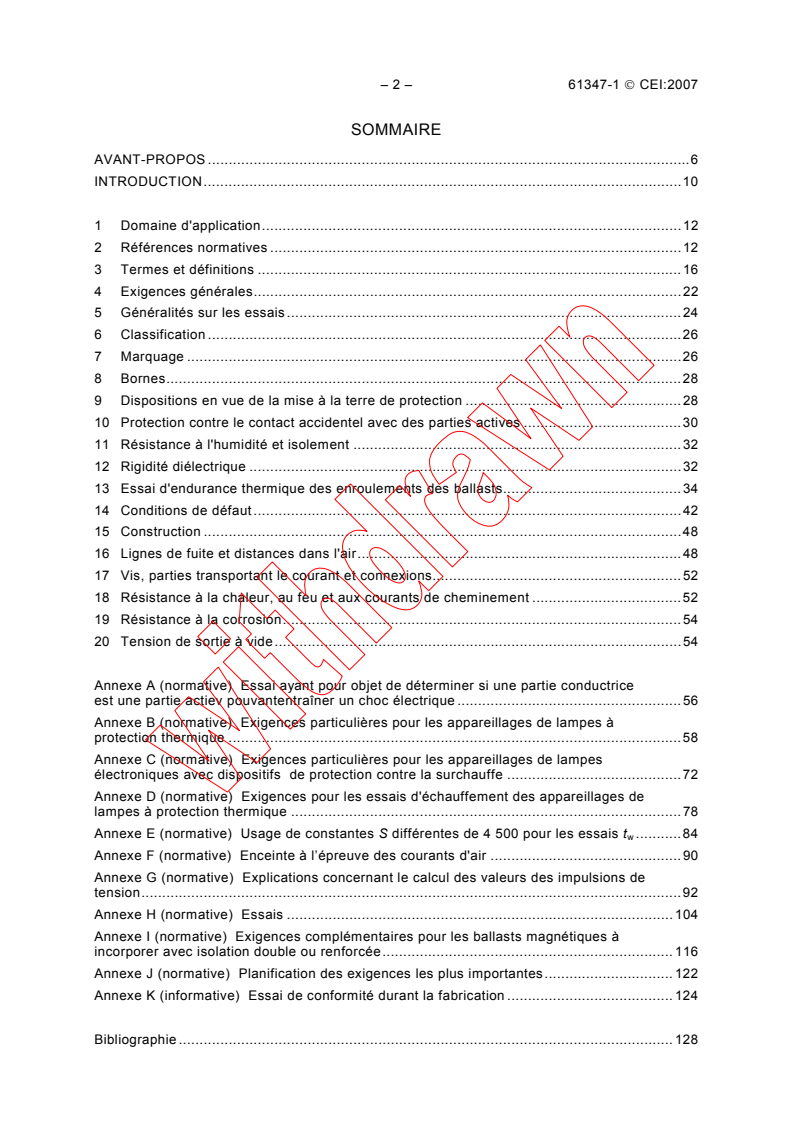
IEC 61347-1:2007 - Lamp controlgear - Part 1: General and safety requirements Released:1/31/2007
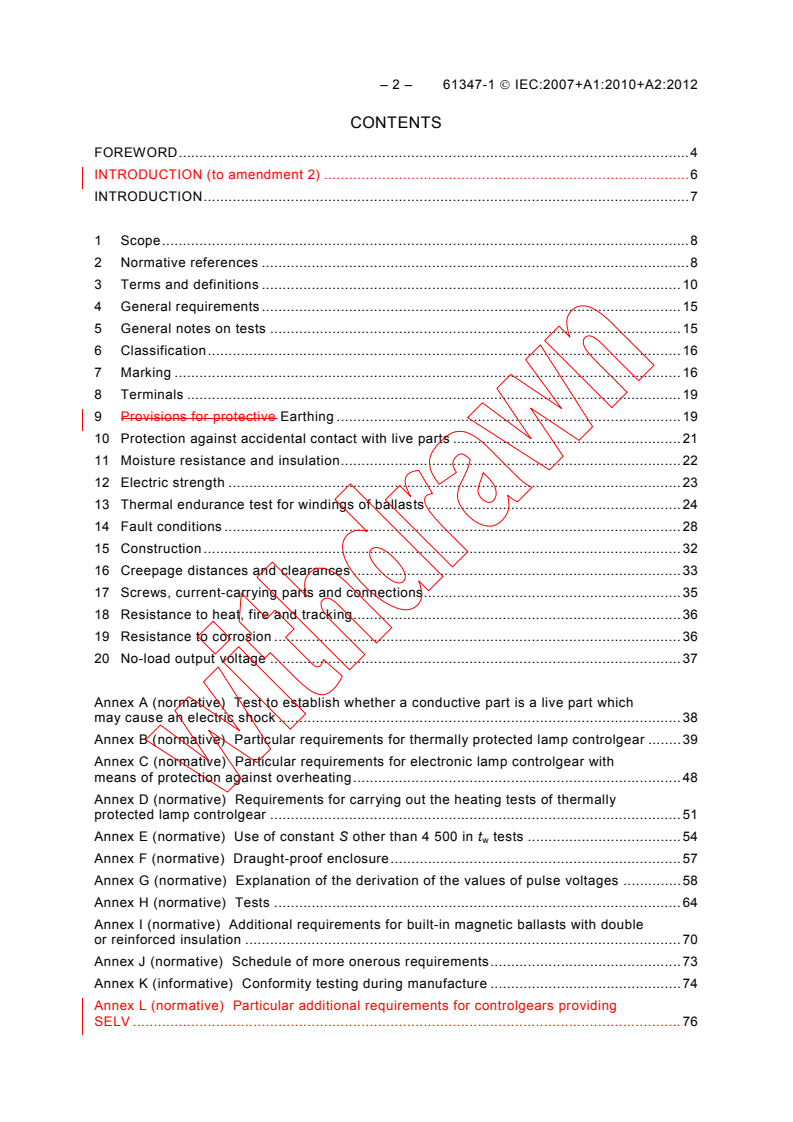
IEC 61347-1:2007+AMD1:2010+AMD2:2012 CSV - Lamp controlgear - Part 1: General and safety requirements Released:11/27/2012
Overview
IEC 61347-1:2007 is an international standard developed by the International Electrotechnical Commission (IEC) that sets out general and safety requirements for lamp controlgear. This standard applies to lamp controlgear used with direct current (d.c.) supplies up to 250 V and alternating current (a.c.) supplies up to 1,000 V at frequencies of 50 Hz or 60 Hz. The 2007 edition, along with its amendments in 2010 and 2012, represents a comprehensive technical revision incorporating important updates to definitions, construction, testing, and safety protocols.
As lamp controlgear forms a crucial component in electrical lighting systems-controlling the operation and performance of lamps-this standard ensures safe, reliable, and consistent functionality across global applications. It addresses all types of lamp controlgear, including those without enclosures, and covers electronic, thermally protected, and magnetic ballasts.
Key Topics
Scope and Definitions: IEC 61347-1 details the operational voltage ranges and clearly defines critical terms such as rated no-load output voltage, controllable ballasts, control terminals, and control signals.
General Requirements: Establishes foundational safety, construction, and performance criteria. Emphasizes moisture resistance, insulation, electric strength, and thermal endurance.
Testing Procedures: Specifies a streamlined test schedule with a focus on manufacturing conformity and product longevity, including endurance tests for lamp winding and thermal protection.
Safety Features: Addresses protection against accidental contact with live electrical parts, provisions for protective earthing, and requirements for enclosure materials to resist heat, fire, corrosion, and tracking.
Markings and Terminals: Requires clear marking for identification and safety, and specifies the design and safety considerations of terminals and connectors.
Material Standards: Outlines insulation material standards, particularly for double or reinforced insulation to secure safety in harsh electrical environments.
Annexes: Contains normative and informative annexes with additional requirements, testing methods for electronic and magnetic ballasts, dielectric strength tests, and manufacturer conformity testing guidance.
Applications
IEC 61347-1:2007 is vital for manufacturers, engineers, and safety inspectors involved with:
Lamp Controlgear Design and Manufacturing: Ensuring products comply with international safety and performance standards for use in residential, commercial, and industrial lighting systems.
Quality Assurance and Conformity Testing: Guiding conformity evaluation during production to maintain compliance with global electrical safety regulations.
Electrical Equipment Safety Compliance: Supporting regulatory bodies and certification agencies in assessing lamp controlgear safety for various markets.
Installation and Maintenance: Informing electricians and maintenance personnel of safe handling and operational criteria for lamps and associated controlgear.
Product Development: Assisting in the design of controllable ballasts and integration of advanced control signals while maintaining compliance with insulation and electrical safety requirements.
Related Standards
IEC 61347-2 Series: Pertains to particular requirements for specific types of lamp controlgear such as electromagnetic and electronic ballasts.
IEC 60598: Covers general requirements for luminaires, including electrical safety and performance consistent with lamp controlgear standards.
IEC 60065: Safety requirements for audio, video, and similar electronic apparatus, which share some electrical safety testing principles.
ISO/IEC 17025: Specifies general requirements for competence of testing and calibration laboratories involved in the conformity testing of lamp controlgear.
IEC 60730: Concerns automatic electrical controls for household and similar use, relevant when lamp controlgear includes control features.
Keywords: IEC 61347-1, lamp controlgear, general requirements, safety standards, lamp ballast, electrical insulation, thermal protection, conformity testing, d.c. supply, a.c. supply, electrical equipment safety, international standards, IEC standards.
Relations
- Effective Date
- 05-Sep-2023
- Effective Date
- 05-Sep-2023
- Effective Date
- 05-Sep-2023
- Effective Date
- 05-Sep-2023
- Effective Date
- 05-Sep-2023
- Effective Date
- 05-Sep-2023
Buy Documents
IEC 61347-1:2007+AMD1:2010 CSV - Lamp controlgear - Part 1: General and safety requirements Released:11/29/2010
IEC 61347-1:2007 - Lamp controlgear - Part 1: General and safety requirements Released:1/31/2007
IEC 61347-1:2007+AMD1:2010+AMD2:2012 CSV - Lamp controlgear - Part 1: General and safety requirements Released:11/27/2012
Get Certified
Connect with accredited certification bodies for this standard

IMQ S.p.A. (Certification)
Italian electrical product certification.

SLG Prüf- und Zertifizierungs GmbH
German testing and certification body.

UL Solutions
Global safety science company with testing, inspection and certification.
Sponsored listings
Frequently Asked Questions
IEC 61347-1:2007 is a standard published by the International Electrotechnical Commission (IEC). Its full title is "Lamp controlgear - Part 1: General and safety requirements". This standard covers: This part of IEC 61347 specifies general and safety requirements for lamp controlgear for use on d.c. supplies up to 250 V and/or a.c. supplies up to 1 000 V at 50 Hz or 60 Hz. This second edition cancels and replaces the first edition published in 2000 and its Amendment 1 (2003). It constitutes a technical revision. The definition clause has been extended (rated no-load output voltage, controllable ballasts, control terminals, control signal). General requirements for lamp control gear which do not have their own enclosure have been added. The informative information (for ballasts in lamp standards) is now transformed into a normative requirement (in ballast standards). The test schedule has been minimised where possible, see 5.7 and Annex J. For printed circuit boards, the (non-) inflammability requirements have been specified. An Annex on conformity testing during manufacture has been added.
This part of IEC 61347 specifies general and safety requirements for lamp controlgear for use on d.c. supplies up to 250 V and/or a.c. supplies up to 1 000 V at 50 Hz or 60 Hz. This second edition cancels and replaces the first edition published in 2000 and its Amendment 1 (2003). It constitutes a technical revision. The definition clause has been extended (rated no-load output voltage, controllable ballasts, control terminals, control signal). General requirements for lamp control gear which do not have their own enclosure have been added. The informative information (for ballasts in lamp standards) is now transformed into a normative requirement (in ballast standards). The test schedule has been minimised where possible, see 5.7 and Annex J. For printed circuit boards, the (non-) inflammability requirements have been specified. An Annex on conformity testing during manufacture has been added.
IEC 61347-1:2007 is classified under the following ICS (International Classification for Standards) categories: 29.140.99 - Other standards related to lamps. The ICS classification helps identify the subject area and facilitates finding related standards.
IEC 61347-1:2007 has the following relationships with other standards: It is inter standard links to IEC 61347-1:2007/AMD2:2012, IEC 61347-1:2007/AMD1:2010, IEC 61347-1:2000/ISH1:2006, IEC 61347-1:2000/AMD1:2003, IEC 61347-1:2015, IEC 61347-1:2000. Understanding these relationships helps ensure you are using the most current and applicable version of the standard.
IEC 61347-1:2007 is available in PDF format for immediate download after purchase. The document can be added to your cart and obtained through the secure checkout process. Digital delivery ensures instant access to the complete standard document.
Standards Content (Sample)
IEC 61347-1 ®
Edition 2.1 2010-11
INTERNATIONAL
STANDARD
NORME
INTERNATIONALE
colour
inside
Lamp controlgear –
Part 1: General and safety requirements
Appareillages de lampes –
Partie 1: Exigences générales et exigences de sécurité
All rights reserved. Unless otherwise specified, no part of this publication may be reproduced or utilized in any form or by
any means, electronic or mechanical, including photocopying and microfilm, without permission in writing from either IEC or
IEC's member National Committee in the country of the requester.
If you have any questions about IEC copyright or have an enquiry about obtaining additional rights to this publication,
please contact the address below or your local IEC member National Committee for further information.
Droits de reproduction réservés. Sauf indication contraire, aucune partie de cette publication ne peut être reproduite
ni utilisée sous quelque forme que ce soit et par aucun procédé, électronique ou mécanique, y compris la photocopie
et les microfilms, sans l'accord écrit de la CEI ou du Comité national de la CEI du pays du demandeur.
Si vous avez des questions sur le copyright de la CEI ou si vous désirez obtenir des droits supplémentaires sur cette
publication, utilisez les coordonnées ci-après ou contactez le Comité national de la CEI de votre pays de résidence.
IEC Central Office
3, rue de Varembé
CH-1211 Geneva 20
Switzerland
Email: inmail@iec.ch
Web: www.iec.ch
About the IEC
The International Electrotechnical Commission (IEC) is the leading global organization that prepares and publishes
International Standards for all electrical, electronic and related technologies.
About IEC publications
The technical content of IEC publications is kept under constant review by the IEC. Please make sure that you have the
latest edition, a corrigenda or an amendment might have been published.
ƒ Catalogue of IEC publications: www.iec.ch/searchpub
The IEC on-line Catalogue enables you to search by a variety of criteria (reference number, text, technical committee,…).
It also gives information on projects, withdrawn and replaced publications.
ƒ IEC Just Published: www.iec.ch/online_news/justpub
Stay up to date on all new IEC publications. Just Published details twice a month all new publications released. Available
on-line and also by email.
ƒ Electropedia: www.electropedia.org
The world's leading online dictionary of electronic and electrical terms containing more than 20 000 terms and definitions
in English and French, with equivalent terms in additional languages. Also known as the International Electrotechnical
Vocabulary online.
ƒ Customer Service Centre: www.iec.ch/webstore/custserv
If you wish to give us your feedback on this publication or need further assistance, please visit the Customer Service
Centre FAQ or contact us:
Email: csc@iec.ch
Tel.: +41 22 919 02 11
Fax: +41 22 919 03 00
A propos de la CEI
La Commission Electrotechnique Internationale (CEI) est la première organisation mondiale qui élabore et publie des
normes internationales pour tout ce qui a trait à l'électricité, à l'électronique et aux technologies apparentées.
A propos des publications CEI
Le contenu technique des publications de la CEI est constamment revu. Veuillez vous assurer que vous possédez
l’édition la plus récente, un corrigendum ou amendement peut avoir été publié.
ƒ Catalogue des publications de la CEI: www.iec.ch/searchpub/cur_fut-f.htm
Le Catalogue en-ligne de la CEI vous permet d’effectuer des recherches en utilisant différents critères (numéro de référence,
texte, comité d’études,…). Il donne aussi des informations sur les projets et les publications retirées ou remplacées.
ƒ Just Published CEI: www.iec.ch/online_news/justpub
Restez informé sur les nouvelles publications de la CEI. Just Published détaille deux fois par mois les nouvelles
publications parues. Disponible en-ligne et aussi par email.
ƒ Electropedia: www.electropedia.org
Le premier dictionnaire en ligne au monde de termes électroniques et électriques. Il contient plus de 20 000 termes et
définitions en anglais et en français, ainsi que les termes équivalents dans les langues additionnelles. Egalement appelé
Vocabulaire Electrotechnique International en ligne.
ƒ Service Clients: www.iec.ch/webstore/custserv/custserv_entry-f.htm
Si vous désirez nous donner des commentaires sur cette publication ou si vous avez des questions, visitez le FAQ du
Service clients ou contactez-nous:
Email: csc@iec.ch
Tél.: +41 22 919 02 11
Fax: +41 22 919 03 00
IEC 61347-1 ®
Edition 2.1 2010-11
INTERNATIONAL
STANDARD
NORME
INTERNATIONALE
colour
inside
Lamp controlgear –
Part 1: General and safety requirements
Appareillages de lampes –
Partie 1: Exigences générales et exigences de sécurité
INTERNATIONAL
ELECTROTECHNICAL
COMMISSION
COMMISSION
ELECTROTECHNIQUE
PRICE CODE
INTERNATIONALE
CQ
CODE PRIX
ICS 29.140.99 ISBN 978-2-88912-235-6
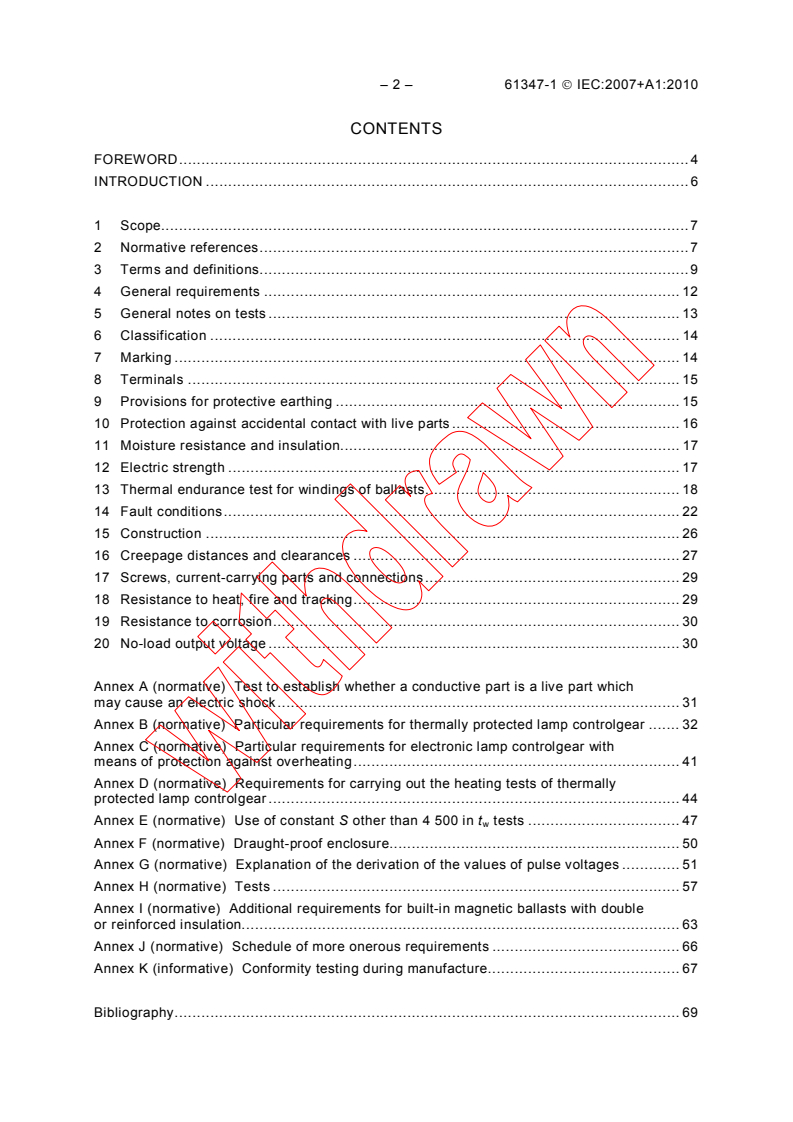
– 2 – 61347-1 Ó IEC:2007+A1:2010
CONTENTS
FOREW ORD . 4
INTRODUCTION . 6
1 Sc o pe . 7
2 Normative references . 7
3 Terms and definitions . 9
4 General requirements . 12
5 General notes on tests . 13
6 Classification . 14
7 Marking . 14
8 Terminals . 15
9 Provisions for protective earthing . 15
10 Protection against accidental contact with live parts . 16
11 Moisture resistance and insulation. 17
12 Electric strength . 17
13 Thermal endurance test for windings of ballasts . 18
14 Fault conditions . 22
15 Construction . 26
16 Creepage distances and clearances . 27
17 Screws, current-carrying parts and connections . 29
18 Resistance to heat, fire and tracking . 29
19 Resistance to corrosion . 30
20 No-load output voltage . 30
Annex A (normative) Test to establish whether a conductive part is a live part which
may cause an electric shock . 31
Annex B (normative) Particular requirements for thermally protected lamp controlgear . 32
Annex C (normative) Particular requirements for electronic lamp controlgear with
means of protection against overheating . 41
Annex D (normative) Requirements for carrying out the heating tests of thermally
protected lamp controlgear . 44
Annex E (normative) Use of constant S other than 4 500 in t tests . 47
w
Annex F (normative) Draught-proof enclosure. 50
Annex G (normative) Explanation of the derivation of the values of pulse voltages . 51
Annex H (normative) Tests . 57
Annex I (normative) Additional requirements for built-in magnetic ballasts with double
or reinforced insulation. 63
Annex J (normative) Schedule of more onerous requirements . 66
Annex K (informative) Conformity testing during manufacture . 67
Bibliography . 69
61347-1 Ó IEC:2007+A1:2010 – 3 –
Figure 1 – Relation between winding temperature and endurance test duration 20
Figure 2 – Creepage distances between conductors on printed boards not conductively
connected to the supply mains . 24
Figure 3 – Test circuit for controlgear . 26
Figure B.1 – Test circuit for thermally protected lamp controlgear . 39
Figure D.1 – Example of heating enclosure for thermally protected ballasts . 46
Figure E.1 – Assessment of claimed value of S . 49
Figure G.1 – Circuit for measuring short-duration pulse energy . 54
Figure G.2 – Suitable circuit for producing and applying long-duration pulses . 56
Figure H.1 – Test arrangement for heating test . 62
Table 1 – Electric strength test voltage . 18
Table 2 – Theoretical test temperatures for ballasts subjected to an endurance test
duration of 30 days . 21
Table 3 – Minimum distances for a.c. (50/60 Hz) sinusoidal voltages . 28
Table 4 – Minimum distances for non-sinusoidal pulse voltages . 28
Table B.1 – Thermal protection operation . 36
Table B.2 – Thermal protection operation . 37
Table G.1 – Component values for measurement of pulse energy . 55
Table K.1 – Minimum values for electrical tests . 68
– 4 – 61347-1 Ó IEC:2007+A1:2010
INTERNATIONAL ELECTROTECHNICAL COMMISSION
___________
LAMP CONTROLGEAR –
Part 1: General and safety requirements
FOREWORD
1) The International Electrotechnical Commission (IEC) is a worldwide organization for standardization comprising
all national electrotechnical committees (IEC National Committees). The object of IEC is to promote
international co-operation on all questions concerning standardization in the electrical and electronic fields. To
this end and in addition to other activities, IEC publishes International Standards, Technical Specifications,
Technical Reports, Publicly Available Specifications (PAS) and Guides (hereafter referred to as “IEC
Publication(s)”). Their preparation is entrusted to technical committees; any IEC National Committee interested
in the subject dealt with may participate in this preparatory work. International, governmental and non-
governmental organizations liaising with the IEC also participate in this preparation. IEC collaborates closely
with the International Organization for Standardization (ISO) in accordance with conditions determined by
agreement between the two organizations.
2) The formal decisions or agreements of IEC on technical matters express, as nearly as possible, an international
consensus of opinion on the relevant subjects since each technical committee has representation from all
interested IEC National Committees.
3) IEC Publications have the form of recommendations for international use and are accepted by IEC National
Committees in that sense. While all reasonable efforts are made to ensure that the technical content of IEC
Publications is accurate, IEC cannot be held responsible for the way in which they are used or for any
misinterpretation by any end user.
4) In order to promote international uniformity, IEC National Committees undertake to apply IEC Publications
transparently to the maximum extent possible in their national and regional publications. Any divergence
between any IEC Publication and the corresponding national or regional publication shall be clearly indicated in
the latter.
5) IEC itself does not provide any attestation of conformity. Independent certification bodies provide conformity
assessment services and, in some areas, access to IEC marks of conformity. IEC is not responsible for any
services carried out by independent certification bodies.
6) All users should ensure that they have the latest edition of this publication.
7) No liability shall attach to IEC or its directors, employees, servants or agents including individual experts and
members of its technical committees and IEC National Committees for any personal injury, property damage or
other damage of any nature whatsoever, whether direct or indirect, or for costs (including legal fees) and
expenses arising out of the publication, use of, or reliance upon, this IEC Publication or any other IEC
Publications.
8) Attention is drawn to the Normative references cited in this publication. Use of the referenced publications is
indispensable for the correct application of this publication.
9) Attention is drawn to the possibility that some of the elements of this IEC Publication may be the subject of
patent rights. IEC shall not be held responsible for identifying any or all such patent rights.
This consolidated version of IEC 61347-1 consists of the second edition (2007)
[documents 34C/776/FDIS and 34C/779/RVD] and its amendment 1 (2010) [documents
34C/916/FDIS and 34C/918/RVD]. It bears the edition number 2.1.
The technical content is therefore identical to the base edition and its amendment and
has been prepared for user convenience. A vertical line in the margin shows where the
base publication has been modified by amendment 1. Additions and deletions are
displayed in red, with deletions being struck through.
61347-1 Ó IEC:2007+A1:2010 – 5 –
International Standard IEC 61347-1 has been prepared by subcommittee 34C: Auxiliaries for
lamps, of IEC technical committee 34: Lamps and related equipment.
The definition clause has been extended (rated no-load output voltage, controllable ballasts,
control terminals, control signal). General requirements for lamp control gear which do not
have their own enclosure have been added. The informative information (for ballasts in lamp
standards) is now transformed into a normative requirement (in ballast standards). The test
schedule has been minimised where possible, see 5.7 and Annex J. For printed circuit
boards, the (non-) inflammability requirements have been specified. An Annex on conformity
testing during manufacture has been added.
This publication has been drafted in accordance with the ISO/IEC Directives, Part 2.
This Part 1 is to be used in conjunction with the appropriate part 2, which contains clauses to
supplement or modify the corresponding clauses in Part 1, to provide the relevant
requirements for each type of product.
NOTE In this standard, the following print types are used:
– Requirements proper: in roman type.
– Test specifications: in italic type.
– Explanatory matter: in smaller roman type.
A list of all parts of the IEC 61347 series, published under the general title Lamp controlgear, can be
found on the IEC website.
The committee has decided that the contents of the base publication and its amendments will
remain unchanged until the stability date indicated on the IEC web site under
"http://webstore.iec.ch" in the data related to the specific publication. At this date, the publication will
be
reconfirmed,
withdrawn,
replaced by a revised edition, or
amended.
IMPORTANT – The “colour inside” logo on the cover page of this publication indicates
that it contains colours which are considered to be useful for the correct understanding
of its contents. Users should therefore print this publication using a colour printer.
– 6 – 61347-1 Ó IEC:2007+A1:2010
INTRODUCTION
This part of IEC 61347 provides a set of general and safety requirements and tests which are
considered to be generally applicable to most types of lamp controlgear and which can be
called up as required by the different parts that make up IEC 61347-2. This Part 1 is thus not
to be regarded as a specification in itself for any type of lamp controlgear, and its provisions
apply only to particular types of lamp controlgear, to the extent determined by the appropriate
part 2 of IEC 61347.
The parts which make up IEC 61347-2, in referring to any of the clauses of this part, specify
the extent to which such a clause is applicable and the order in which the tests are to be
performed; they also include additional requirements as necessary. The order in which the
clauses of this part are numbered has no particular significance, as the order in which their
provisions apply is determined for each type of lamp controlgear by the appropriate part 2 of
IEC 61347-2 series. All such parts are self-contained and therefore do not contain references
to each other.
Where the requirements of any of the clauses of this part of IEC 61347 are referred to in
the various parts that make up IEC 61347-2 by the phrase "The requirements of clause n of
IEC 61347-1 apply", this phrase will be interpreted as meaning that all requirements of the
clause in question of Part 1 apply, except any which are clearly inapplicable to the particular
type of lamp controlgear covered by the part 2 concerned.
Lamp controlgear which complies with the text of this standard will not necessarily be judged
to comply with the safety principles of the standard if, when examined and tested, it is found
to have other features which impair the level of safety covered by these requirements.
Lamp controlgear employing materials or having forms of construction differing from those
detailed in the requirements of this standard may be examined and tested according to the
intent of the requirement and, if found to be substantially equivalent, may be judged to comply
with the safety principles of the standard.
Performance requirements for lamp controlgear are the subject of IEC 60921, IEC 60923,
IEC 60925, IEC 60927, IEC 60929, IEC 61047 and IEC 62384 (in preparation) as appropriate
for the type of lamp controlgear.
NOTE Safety requirements ensure that electrical equipment constructed in accordance with these requirements
does not endanger the safety of persons, domestic animals or property when properly installed and maintained and
used in applications for which it was intended.
Requirements for electronic lamp controlgear for other types of lamps will be the subject of a
separate standard, as the need arises.
NOTE Controlgear can consist of a printed circuit board and may incorporate the following:
– controlgear;
– lampholder(s);
– switch(es);
– supply terminals.
The lamp controlgear should comply with this standard.
The lampholders(s), switch(es) and supply terminals should comply with their own standards.
61347-1 Ó IEC:2007+A1:2010 – 7 –
LAMP CONTROLGEAR –
Part 1: General and safety requirements
1 Scope
This part of IEC 61347 specifies general and safety requirements for lamp controlgear for use
on d.c. supplies up to 250 V and/or a.c. supplies up to 1 000 V at 50 Hz or 60 Hz.
This standard also covers lamp controlgear for lamps which are not yet standardized.
Tests dealt with in this standard are type tests. Requirements for testing individual lamp
controlgear during production are not included.
Requirements for semi-luminaires are given in IEC 60598-1 (see definition 1.2.60).
In addition to the requirements given in this Part 1 of IEC 61347, Annex B sets out general
and safety requirements applicable to thermally protected lamp controlgear.
Annex C sets out additional general and safety requirements as they apply to electronic lamp
controlgear with means of protection against overheating.
Additional requirements for built-in ballasts with double or reinforced insulation are given in
Annex I.
NOTE It can be expected that lamp control gear which comply with this standard will not compromise safety
between 90 % and 110 % of their rated supply voltage in independent use and when operated in luminaires
complying with the safety standard IEC 60598-1 and the relevant part IEC 60598-2-xx and with lamps complying
with the relevant lamp standards. Performance requirements may require tighter limits.
2 Normative references
The following referenced documents are indispensable for the application of this document.
For dated references, only the edition cited applies. For undated references, the latest edition
of the referenced document (including any amendments) applies.
IEC 60081, Double-capped fluorescent lamps – Performance specifications
IEC 60317-0-1:1997, Specifications for particular types of winding wires – Part 0: General
1)
requirements – Section 1: Enamelled round copper wire
Amendment 1 (1999)
Amendment 2 (2005)
IEC 60384-14, Fixed capacitors for use in electronic equipment – Part 14: Sectional
specification: Fixed capacitors for electromagnetic interference suppression and connection to
the supply mains
IEC 60417, Graphical symbols for use on equipment
________
1)
There exists a consolidated edition 2.2 (2005) including the base publication and its Amendments 1 and 2.
– 8 – 61347-1 Ó IEC:2007+A1:2010
2)
IEC 60529:1989 , Degrees of protection provided by enclosures (IP Code)
Amendment 1 (1999)
IEC 60598-1:2003, Luminaires – Part 1: General requirements and tests
IEC 60664-3, Insulation coordination for equipment within low-voltage systems – Part 3: Use
of coating, potting or moulding for protection against pollution
IEC 60691:2002, Thermal-links – Requirements and application guide
IEC 60695-2-10, Fire hazard testing – Part 2-10: Glowing/hot-wire based test methods –
Glow-wire apparatus and common test procedure
IEC 60695-11-5, Fire hazard testing – Part 11-5: Test flames – Needle-flame test method –
Apparatus, confirmatory test arrangement and guidance
IEC 60730-2-3, Automatic electrical controls for household and similar use – Part 2: Particular
requirements for thermal protectors for ballasts for tubular fluorescent lamps
IEC 60901, Single-capped fluorescent lamps – Performance specifications
IEC 60921:2004, Ballasts for tubular fluorescent lamps – Performance requirements
IEC 60923:2005, Auxiliaries for lamps – Ballasts for discharge lamps (excluding tubular
fluorescent lamps) – Performance requirements
IEC 60929:2006, AC-supplied electronic ballasts for tubular fluorescent lamps – Performance
requirements
IEC 60990:1999, Methods of measurement of touch current and protective conductor current
IEC 61189-2: Test methods for electrical materials, printed boards and other interconnection
structures and assemblies – Part 2: Test methods for materials for interconnection structures
IEC 61249-2 (all parts), Materials for printed boards and other interconnecting structures
IEC 61347-2 (all parts), Lamp controlgear – Part 2: Particular requirements
IEC 61347-2-8, Lamp controlgear – Part 2-8: Particular requirements for ballasts for
fluorescent lamps
IEC 61347-2-9:2000, Lamp controlgear – Part 2-9: Particular requirements for ballasts for
discharge lamps (excluding fluorescent lamps)
Amendment 1 (2003)
Amendment 2 (2006)
ISO 4046-4:2002, Paper, board, pulp and related terms – Vocabulary – Part 4: Paper and
board grades and converted products
________
) There exists a consolidated edition 2.1 (2001) including the base publication and its Amendment 1.
61347-1 Ó IEC:2007+A1:2010 – 9 –
3 Terms and definitions
For the purposes of document, the following terms and definitions apply.
3.1
lamp controlgear
one or more components between the supply and one or more lamps which may serve to
transform the supply voltage, limit the current of the lamp(s) to the required value, provide
starting voltage and preheating current, prevent cold starting, correct power factor or reduce
radio interference.
3.1.1
built-in lamp controlgear
lamp controlgear generally designed to be built into a luminaire, a box, an enclosure or
the like and not intended to be mounted outside a luminaire, etc. without special precautions.
NOTE The controlgear compartment in the base of a road lighting column is considered to be an enclosure.
3.1.2
independent lamp controlgear
lamp controlgear consisting of one or more separate elements so designed that it can be
mounted separately outside a luminaire, with protection according to the marking of the lamp
controlgear and without any additional enclosure.
NOTE This may consist of a built-in lamp controlgear housed in a suitable enclosure which provides all the
necessary protection according to its markings.
3.1.3
integral lamp controlgear
lamp controlgear which forms a non-replaceable part of a luminaire and which cannot be
tested separately from the luminaire
3.2
ballast
unit inserted between the supply and one or more discharge lamps which by means of
inductance, capacitance, or a combination of inductance and capacitance, serves mainly to
limit the current of the lamp(s) to the required value.
NOTE It may also include means for transforming the supply voltage and arrangements which help provide
starting voltage and pre-heating current.
3.2.1
d.c. supplied electronic ballast
d.c. to a.c invertor using semiconductor devices which may include stabilizing elements for
supplying power to one or more fluorescent lamps
3.2.2
reference ballast
special inductive ballast designed for the purpose of providing comparison standards for use
in testing ballasts and for the selection of reference lamps, and essentially characterized by a
stable voltage-to-current ratio, which is relatively uninfluenced by variations in current,
temperature and magnetic surroundings (see also Annex C of IEC 60921 and Annex A
of IEC 60923)
– 10 – 61347-1 Ó IEC:2007+A1:2010
3.2.3
controllable ballast
electronic ballast whose lamp operating characteristics can be changed by means of a signal
via mains or extra control input
3.3
reference lamp
lamp selected for testing ballasts which, when associated with a reference ballast, has electrical
characteristics which are close to the rated values as stated in the relevant lamp standard
3.4
calibration current of a reference ballast
value of the current on which are based the calibration and control of the reference ballast
NOTE Such a current should preferably be approximately equal to the rated running current of the lamps for
which the reference ballast is suitable.
3.5
supply voltage
voltage applied to the complete circuit of lamp(s) and lamp controlgear
3.6
working voltage
highest r.m.s. voltage which may occur across any insulation at rated supply voltage,
transients being neglected, in open-circuit conditions or during normal operation
3.7
design voltage
voltage declared by the manufacturer to which all the lamp controlgear characteristics are
related. This value is not less than 85 % of the maximum value of the rated voltage range
3.8
voltage range
range of supply voltage over which the ballast is intended to be operated
3.9
rated no-load output voltage
the output voltage when the ballast is connected to rated supply voltage at rated frequency,
with no load on the output, transient and starting phase being neglected
3.10
supply current
current supplied to the complete circuit of lamp(s) and lamp controlgear
3.11
live part
conductive part which may cause an electric shock in normal use. The neutral conductor is,
however, regarded as a live part
NOTE The test to determine whether or not a conductive part is a live part which may cause an electric shock is
given in Annex A.
3.12
type test
test or series of tests made on a type-test sample for the purpose of checking compliance of
the design of a given product with the requirements of the relevant standard
61347-1 Ó IEC:2007+A1:2010 – 11 –
3.13
type-test sample
sample consisting of one or more similar units submitted by the manufacturer or responsible
vendor for the purpose of a type test
3.14
circuit power factor
l
power factor of the combination of lamp controlgear and the lamp or lamps for which the lamp
controlgear is designed
3.15
high power factor ballast
ballast having a circuit power factor of at least 0,85 (leading or lagging)
NOTE 1 The value 0,85 takes into account the distortion of the current waveform.
NOTE 2 For North America, a high power factor is defined as a power factor of at least 0,9.
3.16
rated maximum temperature
t
c
highest permissible temperature which may occur on the outer surface (at the indicated place,
if marked) under normal operating conditions and at the rated voltage or the maximum of the
rated voltage range
3.17
rated maximum operating temperature of a lamp controlgear winding
t
w
winding temperature assigned by the manufacturer as the highest temperature at which
50 Hz/60 Hz lamp controlgear may be expected to have a service life of at least 10 years'
continuous operation
3.18
rectifying effect
effect which may occur at the end of lamp life when one cathode is either broken or has
insufficient electron emission, resulting in the arc current being constantly unequal in
consecutive half-cycles
3.19
test duration of endurance test
D
optional duration of the endurance test on which the temperature conditions are based
3.20
degradation of insulation of a ballast winding
S
constant which determines the degradation of ballast insulation
3.21
ignitor
device intended to generate voltage pulses to start discharge lamps and which does not
provide for the preheating of electrodes
NOTE The element that releases the starting voltage pulse may be either triggered or non-triggered.
– 12 – 61347-1 Ó IEC:2007+A1:2010
3.22
protective earth (ground)
(IEC 60417-5019 (2002-10)
terminal to which are connected parts which are connected to earth for safety reasons
3.23
functional earth (ground)
(IEC 60417-5017 (2002-10)
terminal to which are connected parts which may be necessary to connect to earth for
reasons other than safety
NOTE 1 In some instances, starting aids adjacent to the lamp(s) are connected to one of the output terminals but
need not be connected to the earth on the supply side.
NOTE 2 In some cases, functional earthing may be necessary to facilitate starting or for e.m.c. purposes.
3.24
frame (chassis)
(IEC 60417-5020 (2002-10)
terminal whose potential is taken as reference
3.25
control terminals
connections, other than power supply terminals, to the electronic ballast, which are used to
exchange information with the ballast
NOTE The power supply terminals can also be used to exchange information with the ballast.
3.26
control signal
signal, which may be an a.c. or d.c. voltage, and which by analogue, digital or other means
may be modulated to exchange information with the ballast
4 General requirements
Lamp controlgear shall be so designed and constructed that in normal use it operates without
danger to the user or surroundings.
Compliance is checked by carrying out all the tests specified.
In addition, independent lamp controlgear shall comply with the requirements of IEC 60598-1,
including the classification and marking requirements of that standard such as IP
F
classification, marking, etc. Built-in ballasts with double or reinforced insulation shall
comply additionally with the requirements of Annex I.
Some built-in lamp controlgear do not have their own enclosure and are composed of printed
circuit boards and electrical components thereon, and shall comply with the requirements of
IEC 60598-1 when built into the luminaire. Integral lamp controlgear not having their own
enclosure shall be treated as integral components of luminaires defined in Clause 0.5 in
IEC 60598-1 and shall be tested assembled in the luminaire.
61347-1 Ó IEC:2007+A1:2010 – 13 –
NOTE It is recommended for the luminaire manufacturer to confer about the relevant test requirements with the
controlgear manufacturer, if necessary.
In the lamp safety standards, “Information for ballast design” is given for the safe operation of
lamps. This shall be regarded as normative when testing ballasts.
5 General notes on tests
5.1 Tests according to this standard are type tests.
NOTE The requirements and tolerances permitted by this standard are related to testing of a type-test sample
submitted by the manufacturer for that purpose. Compliance of the type-test sample does not ensure compliance of
the whole production of a manufacturer with this safety standard.
Conformity of production is the responsibility of the manufacturer and may include routine tests and quality
assurance in addition to type testing.
5.2 Unless otherwise specified, the tests are carried out at an ambient temperature of 10 °C
to 30 °C.
5.3 Unless otherwise specified, the type test is carried out on one sample consisting of one
or more items submitted for the purpose of the type test.
In general, all tests are carried out on each type of lamp controlgear or, where a range of
similar lamp controlgear is involved, for each wattage in the range or on a representative
selection from the range, as agreed with the manufacturer.
Certain countries require that three samples of lamp controlgear be tested and, in such cases,
if more than one sample fails, then the type is rejected. If one sample fails, the test is
repeated using three other samples and all of these shall comply with the test requirements.
5.4 The tests shall be carried out in the order listed in this standard unless otherwise
specified in parts 2 of IEC 61347.
5.5 For the thermal test, independent lamp controlgear shall be mounted in a test corner
consisting of three dull-black painted wooden/wood fibre boards 15 mm to 20 mm thick and
arranged so as to resemble two walls and the ceiling of a room. The lamp controlgear is
secured to the ceiling as close as possible to the walls, the ceiling extending at least 250 mm
beyond the other side of the lamp controlgear.
5.6 For d.c. supplied ballasts intended for use from a battery supply it is permissible to
substitute a d.c. power source other than a battery, provided that the source impedance is
equivalent to that of a battery.
NOTE A non-inductive capacitor of appropriate rated voltage and with a capacitance of at least 50 mF, connected
across the supply terminals of the unit under test normally provides a source impedance simulating that of a
battery.
5.7 When testing lamp control gear to the requirements of this standard, earlier test reports
may be updated in accordance with this edition by submitting a new sample for test together
with the previous test report.
Full type testing may not generally be necessary and the product and the previous test results
shall only be reviewed against any amended clause marked “R” as scheduled in normative
Annex J: Schedule of more onerous requirements.
– 14 – 61347-1 Ó IEC:2007+A1:2010
6 Classification
Lamp controlgear is classified, according to the method of installation, as
– built-in;
– independent;
– integral.
7 Marking
7.1 Items to be marked
The parts that make up IEC 61347-2 state which of the following items shall be marked as
mandatory markings or provided as information to be given either on the lamp controlgear or
made available in the manufacturer’s catalogue or similar.
a) Mark of origin (trade mark, manufacturer's name or name of the responsible vendor/
supplier).
b) Model number or type reference of the manufacturer.
c) Symbol for independent lamp controlgear if applicable.
d) The correlation between replaceable and interchangeable parts, including fuses, of lamp
controlgear shall be marked unambiguously by legends on the lamp controlgear or, with
the exception of fuses, be specified in the manufacturer's catalogue.
e) Rated supply voltage (or voltages, if there are several), voltage range, supply frequency
and supply current(s); the supply current may be given in the manufacturer's literature.
f) The earthing terminals (if any) shall be identified by the symbol, , or These
symbols shall not be placed on screws or other easily removable parts.
NOTE For the use of the symbols, see IEC 60417.
g) The claimed value of the rated maximum operating temperature of the winding following
the symbol t , values increasing in multiples of 5 °C.
w
h) Indication that the lamp controlgear does not rely upon the luminaire enclosure for
protection against accidental contact with live parts.
i) Indication of the cross-section of conductors for which the terminals, if any, are suitable.
Symbol: relevant value(s) in square millimetres (mm²) followed by a small square.
j) The lamp type and rated wattage or wattage range for which the lamp controlgear is
suitable, or the designation as indicated on the lamp data sheet of the type(s) of lamp(s)
for which the lamp controlgear is designed. If the lamp controlgear is intended to be used
with more than one lamp, the number and rated wattages of each lamp shall be indicated.
NOTE 1 For lamp controlgear specified in IEC 61347-2-2, it is assumed that a marked wattage range includes
all ratings within the range unless otherwise indicated in the manufacturer’s literature.
k) Wiring diagram indicating the position and purpose of terminals. In the case of lamp
controlgear having no terminals, a clear indication shall be given on the wiring diagram of
the significance of the code used for connecting wires. Lamp controlgear that operates in
specific circuits only shall be identified accordingly, for example by marking or wiring
diagram.
61347-1 Ó IEC:2007+A1:2010 – 15 –
l) Value of t
.
c
If this relates to a certain place on the lamp controlgear, this place shall be indicated or
shall be specified in the manufacturer's catalogue.
m) Symbol for temperature declared, thermally protected controlgear (see Annex B). The
dots in the triangle shall be replaced by the value of the rated maximum case temperature
in degrees Celsius assigned by the manufacturer, values increasing in multiples of 10.
n) Heat sink(s) required additional to the lamp controlgear.
o) The limiting temperature of the winding under abnormal conditions which shall be
respected when the controlgear is built into a luminaire, as information for luminaire
design.
NOTE 2 In the case of lamp controlgear intended for circuits which do not produce abnormal conditions, or
are for use only with starting devices which exempt the lamp controlgear from the abnormal conditions of
Annex C of IEC 60598-1, the winding temperature under abnormal conditions is not indicated.
p) The test period for the endurance test for lamp controlgear which, at the manufacturer's
choice, shall be tested for a period longer than 30 days, may be indicated with the symbol
D, followed by the appropriate number of days, 60, 90 or 120 in 10-day periods, the whole
being placed between the brackets immediately after the t indication. For example, (D6)
w
for controlgear to be tested for a period of 60 days.
NOTE 3 The standard endurance test period of 30 days need not be indicated.
q) For lamp controlgear for which a constant S other than 4 500 is claimed by the manu-
facturer, the symbol S together with its appropriate value in thousands, for example "S6",
if S has a value of 6 000.
NOTE 4 Preferred values of S are: 4 500, 5 000, 6 000, 8 000, 11 000, 16 000.
r) The rated no-load output voltage, when it is higher than the supply voltage.
7.2 Durability and legibility of marking
Marking shall be durable and legible.
Compliance is checked by inspection and by trying to remove the marking by rubbing lightly,
for 15 s each time, with two pieces of cloth, one soaked with water and the other with
petroleum spirit.
The marking shall be legible after the test.
NOTE The petroleum spirit used should consist of a solvent hexane with a content of aromatics of maximum
0,1 % volume percentage, a kauri-butanol value of 29, an initial boiling-point of approximately 65 °C, a dry-point of
approximately 69 °C and a density of approximately 0,68 g/cm³.
8 Terminals
Screw terminals shall comply with Clause 14 of IEC 60598-1.
Screwless terminals shall comply with Clause 15 of IEC 60598-1.
9 Provisions for protective earthing
Earthing terminals shall comply with the requirements of Clause 8. The electrical connection/
clamping means shall be adequately locked against loosening, and it shall not be possible to
loosen the electrical connection/clamping means by hand without the use of a tool. For
screwless terminals, it shall not be possible to loosen the clamping means/electrical
connection unintentionally.
– 16 – 61347-1 Ó IEC:2007+A1:2010
Earthing of lamp controlgear (other than independent lamp controlgear) via means of fixing
the lamp controlgear to earthed metal is permitted. However, if a lamp controlgear has an
earthing terminal, this terminal shall only be used for earthing the lamp controlgear.
All parts of an earthing terminal shall be such as to minimize the danger of electrolytic corrosion
resulting from contact with the earth conductor or any other metal in contact with them.
The screw and the other parts of the earthing terminal shall be made of brass or other metal
no less resistant to corrosion, or material with a non-rusting surface and at least one of the
contact surfaces shall be bare metal.
Compliance is checked by inspection, by manual test and according to the requirements of
Clause 8.
Lamp controlgear with conductors for protective earthing provided by tracks on printed circuit
boards shall be tested as follows.
A current from an a.c. source of 25 A is passed for 1 min between the earthing terminal or
earthing contact via the track on the printed board and each of the accessible metal parts
in turn.
After the test, the requirements of 7.2.1 of IEC 60598-1 shall apply.
The voltage drop
...
NORME CEI
INTERNATIONALE
IEC
61347-1
INTERNATIONAL
Deuxième édition
STANDARD
Second edition
2007-01
Appareillages de lampes –
Partie 1:
Exigences générales et exigences de sécurité
Lamp controlgear –
Part 1:
General and safety requirements
Numéro de référence
Reference number
CEI/IEC 61347-1:2007
Numérotation des publications Publication numbering
Depuis le 1er janvier 1997, les publications de la CEI As from 1 January 1997 all IEC publications are
sont numérotées à partir de 60000. Ainsi, la CEI 34-1 issued with a designation in the 60000 series. For
devient la CEI 60034-1. example, IEC 34-1 is now referred to as IEC 60034-1.
Editions consolidées Consolidated editions
Les versions consolidées de certaines publications de la The IEC is now publishing consolidated versions of its
CEI incorporant les amendements sont disponibles. Par publications. For example, edition numbers 1.0, 1.1
exemple, les numéros d’édition 1.0, 1.1 et 1.2 indiquent and 1.2 refer, respectively, to the base publication,
respectivement la publication de base, la publication de the base publication incorporating amendment 1 and
base incorporant l’amendement 1, et la publication de the base publication incorporating amendments 1
base incorporant les amendements 1 et 2. and 2.
Informations supplémentaires Further information on IEC publications
sur les publications de la CEI
Le contenu technique des publications de la CEI est The technical content of IEC publications is kept
constamment revu par la CEI afin qu'il reflète l'état under constant review by the IEC, thus ensuring that
actuel de la technique. Des renseignements relatifs à the content reflects current technology. Information
cette publication, y compris sa validité, sont dispo- relating to this publication, including its validity, is
nibles dans le Catalogue des publications de la CEI available in the IEC Catalogue of publications
(voir ci-dessous) en plus des nouvelles éditions, (see below) in addition to new editions, amendments
amendements et corrigenda. Des informations sur les and corrigenda. Information on the subjects under
sujets à l’étude et l’avancement des travaux entrepris consideration and work in progress undertaken by the
par le comité d’études qui a élaboré cette publication, technical committee which has prepared this
ainsi que la liste des publications parues, sont publication, as well as the list of publications issued,
également disponibles par l’intermédiaire de: is also available from the following:
• Site web de la CEI (www.iec.ch) • IEC Web Site (www.iec.ch)
• Catalogue des publications de la CEI • Catalogue of IEC publications
Le catalogue en ligne sur le site web de la CEI The on-line catalogue on the IEC web site
(www.iec.ch/searchpub) vous permet de faire des (www.iec.ch/searchpub) enables you to search by a
recherches en utilisant de nombreux critères, variety of criteria including text searches,
comprenant des recherches textuelles, par comité technical committees and date of publication. On-
d’études ou date de publication. Des informations en line information is also available on recently
ligne sont également disponibles sur les nouvelles issued publications, withdrawn and replaced
publications, les publications remplacées ou retirées, publications, as well as corrigenda.
ainsi que sur les corrigenda.
• IEC Just Published • IEC Just Published
Ce résumé des dernières publications parues This summary of recently issued publications
(www.iec.ch/online_news/justpub) est aussi dispo- (www.iec.ch/online_news/justpub) is also available
nible par courrier électronique. Veuillez prendre by email. Please contact the Customer Service
contact avec le Service client (voir ci-dessous) Centre (see below) for further information.
pour plus d’informations.
• Service clients • Customer Service Centre
Si vous avez des questions au sujet de cette If you have any questions regarding this
publication ou avez besoin de renseignements publication or need further assistance, please
supplémentaires, prenez contact avec le Service contact the Customer Service Centre:
clients:
Email: custserv@iec.ch Email: custserv@iec.ch
Tél: +41 22 919 02 11 Tel: +41 22 919 02 11
Fax: +41 22 919 03 00 Fax: +41 22 919 03 00
.
NORME CEI
INTERNATIONALE
IEC
61347-1
INTERNATIONAL
Deuxième édition
STANDARD
Second edition
2007-01
Appareillages de lampes –
Partie 1:
Exigences générales et exigences de sécurité
Lamp controlgear –
Part 1:
General and safety requirements
© IEC 2007 Droits de reproduction réservés ⎯ Copyright - all rights reserved
Aucune partie de cette publication ne peut être reproduite ni No part of this publication may be reproduced or utilized in any
utilisée sous quelque forme que ce soit et par aucun procédé, form or by any means, electronic or mechanical, including
électronique ou mécanique, y compris la photocopie et les photocopying and microfilm, without permission in writing from
microfilms, sans l'accord écrit de l'éditeur. the publisher.
International Electrotechnical Commission, 3, rue de Varembé, PO Box 131, CH-1211 Geneva 20, Switzerland
Telephone: +41 22 919 02 11 Telefax: +41 22 919 03 00 E-mail: inmail@iec.ch Web: www.iec.ch
CODE PRIX
XB
PRICE CODE
Commission Electrotechnique Internationale
International Electrotechnical Commission
МеждународнаяЭлектротехническаяКомиссия
Pour prix, voir catalogue en vigueur
For price, see current catalogue
– 2 – 61347-1 © CEI:2007
SOMMAIRE
AVANT-PROPOS .6
INTRODUCTION.10
1 Domaine d'application.12
2 Références normatives .12
3 Termes et définitions .16
4 Exigences générales.22
5 Généralités sur les essais.24
6 Classification .26
7 Marquage .26
8 Bornes.28
9 Dispositions en vue de la mise à la terre de protection .28
10 Protection contre le contact accidentel avec des parties actives .30
11 Résistance à l'humidité et isolement .32
12 Rigidité diélectrique .32
13 Essai d'endurance thermique des enroulements des ballasts.34
14 Conditions de défaut.42
15 Construction .48
16 Lignes de fuite et distances dans l'air.48
17 Vis, parties transportant le courant et connexions.52
18 Résistance à la chaleur, au feu et aux courants de cheminement .52
19 Résistance à la corrosion.54
20 Tension de sortie à vide.54
Annexe A (normative) Essai ayant pour objet de déterminer si une partie conductrice
est une partie actiev pouvantentraîner un choc électrique .56
Annexe B (normative) Exigences particulières pour les appareillages de lampes à
protection thermique .58
Annexe C (normative) Exigences particulières pour les appareillages de lampes
électroniques avec dispositifs de protection contre la surchauffe .72
Annexe D (normative) Exigences pour les essais d'échauffement des appareillages de
lampes à protection thermique .78
Annexe E (normative) Usage de constantes S différentes de 4 500 pour les essais t .84
w
Annexe F (normative) Enceinte à l’épreuve des courants d'air .90
Annexe G (normative) Explications concernant le calcul des valeurs des impulsions de
tension.92
Annexe H (normative) Essais . 104
Annexe I (normative) Exigences complémentaires pour les ballasts magnétiques à
incorporer avec isolation double ou renforcée. 116
Annexe J (normative) Planification des exigences les plus importantes. 122
Annexe K (informative) Essai de conformité durant la fabrication . 124
Bibliographie . 128
61347-1 © IEC:2007 – 3 –
CONTENTS
FOREWORD.7
INTRODUCTION.11
1 Scope.13
2 Normative references .13
3 Terms and definitions .17
4 General requirements .23
5 General notes on tests .25
6 Classification.27
7 Marking .27
8 Terminals .29
9 Provisions for protective earthing .29
10 Protection against accidental contact with live parts .31
11 Moisture resistance and insulation.33
12 Electric strength .33
13 Thermal endurance test for windings of ballasts .35
14 Fault conditions .43
15 Construction .49
16 Creepage distances and clearances .49
17 Screws, current-carrying parts and connections.53
18 Resistance to heat, fire and tracking.53
19 Resistance to corrosion .55
20 No-load output voltage .55
Annex A (normative) Test to establish whether a conductive part is a live part which
may cause an electric shock.57
Annex B (normative) Particular requirements for thermally protected lamp controlgear .59
Annex C (normative) Particular requirements for electronic lamp controlgear with
means of protection against overheating .73
Annex D (normative) Requirements for carrying out the heating tests of thermally
protected lamp controlgear .79
Annex E (normative) Use of constant S other than 4 500 in t tests .85
w
Annex F (normative) Draught-proof enclosure.91
Annex G (normative) Explanation of the derivation of the values of pulse voltages .93
Annex H (normative) Tests .105
Annex I (normative) Additional requirements for built-in magnetic ballasts with double
or reinforced insulation .117
Annex J (normative) Schedule of more onerous requirements.123
Annex K (informative) Conformity testing during manufacture .125
Bibliography.129
– 4 – 61347-1 © CEI:2007
Figure 1 – Relation entre la température de l’enroulement et la durée de l’essai
d’endurance .38
Figure 2 – Lignes de fuite entre conducteurs sur cartes imprimées qui ne sont pas reliés
conductivement au réseau d'alimentation .46
Figure D.1 – Exemple d'enceinte chauffante pour les ballasts avec protection thermique .82
Figure E.1 – Contrôle de la valeur revendiquée de S.88
Figure G.1 – Circuit pour la mesure de l’énergie des impulsions de courte durée .98
Figure G.2 – Circuit convenant à la production et à l’application de tensions d’impulsion
de longue durée . 102
Figure H.1 – Disposition pour l’essai d’échauffement . 114
Tableau 1 – Tension d'essai de rigidité diélectrique .34
Tableau 2 – Températures théoriques d'essai pour les ballasts soumis à un essai
d'endurance d'une durée de 30 jours .40
Tableau 3 – Distances minimales pour tensions alternatives sinusoïdales (50 Hz/60 Hz).50
Tableau 4 – Distances minimales pour tensions impulsionnelles non sinusoïdales .52
Tableau B.1 – Fonctionnement avec protection thermique .66
Tableau B.2 – Fonctionnement avec protection thermique .68
Tableau G.1 – Valeurs des composants pour la mesure de l'énergie de l'impulsion . 100
Tableau K.1 – Valeurs minimales pour les essais électriques. 126
61347-1 © IEC:2007 – 5 –
Figure 1 – Relation between winding temperature and endurance test duration .39
Figure 2 – Creepage distances between conductors on printed boards not conductively
connected to the supply mains.47
Figure D.1 – Example of heating enclosure for thermally protected ballasts .83
Figure E.1 – Assessment of claimed value of S.89
Figure G.1 – Circuit for measuring short-duration pulse energy.99
Figure G.2 – Suitable circuit for producing and applying long-duration pulses .103
Figure H.1 – Test arrangement for heating test .115
Table 1 – Electric strength test voltage .35
Table 2 – Theoretical test temperatures for ballasts subjected to an endurance test
duration of 30 days .41
Table 3 – Minimum distances for a.c. (50/60 Hz) sinusoidal voltages .51
Table 4 – Minimum distances for non-sinusoidal pulse voltages.53
Table B.1 – Thermal protection operation .67
Table B.2 – Thermal protection operation .69
Table G.1 – Component values for measurement of pulse energy.101
Table K.1 – Minimum values for electrical tests .127
– 6 – 61347-1 © CEI:2007
COMMISSION ÉLECTROTECHNIQUE INTERNATIONALE
___________
APPAREILLAGES DE LAMPES –
Partie 1: Exigences générales et exigences de sécurité
AVANT-PROPOS
1) La Commission Electrotechnique Internationale (CEI) est une organisation mondiale de normalisation composée
de l'ensemble des comités électrotechniques nationaux (Comités nationaux de la CEI). La CEI a pour objet de
favoriser la coopération internationale pour toutes les questions de normalisation dans les domaines de
l'électricité et de l'électronique. A cet effet, la CEI – entre autres activités – publie des Normes internationales,
des Spécifications techniques, des Rapports techniques, des Spécifications accessibles au public (PAS) et des
Guides (ci-après dénommés "Publication(s) de la CEI"). Leur élaboration est confiée à des comités d'études,
aux travaux desquels tout Comité national intéressé par le sujet traité peut participer. Les organisations
internationales, gouvernementales et non gouvernementales, en liaison avec la CEI, participent également aux
travaux. La CEI collabore étroitement avec l'Organisation Internationale de Normalisation (ISO), selon des
conditions fixées par accord entre les deux organisations.
2) Les décisions ou accords officiels de la CEI concernant les questions techniques représentent, dans la mesure
du possible, un accord international sur les sujets étudiés, étant donné que les Comités nationaux de la CEI
intéressés sont représentés dans chaque comité d’études.
3) Les Publications de la CEI se présentent sous la forme de recommandations internationales et sont agréées
comme telles par les Comités nationaux de la CEI. Tous les efforts raisonnables sont entrepris afin que la CEI
s'assure de l'exactitude du contenu technique de ses publications; la CEI ne peut pas être tenue responsable de
l'éventuelle mauvaise utilisation ou interprétation qui en est faite par un quelconque utilisateur final.
4) Dans le but d'encourager l'uniformité internationale, les Comités nationaux de la CEI s'engagent, dans toute la
mesure possible, à appliquer de façon transparente les Publications de la CEI dans leurs publications
nationales et régionales. Toutes divergences entre toutes Publications de la CEI et toutes publications
nationales ou régionales correspondantes doivent être indiquées en termes clairs dans ces dernières.
5) La CEI n’a prévu aucune procédure de marquage valant indication d’approbation et n'engage pas sa
responsabilité pour les équipements déclarés conformes à une de ses Publications.
6) Tous les utilisateurs doivent s'assurer qu'ils sont en possession de la dernière édition de cette publication.
7) Aucune responsabilité ne doit être imputée à la CEI, à ses administrateurs, employés, auxiliaires ou
mandataires, y compris ses experts particuliers et les membres de ses comités d'études et des Comités
nationaux de la CEI, pour tout préjudice causé en cas de dommages corporels et matériels ou de tout autre
dommage de quelque nature que ce soit, directe ou indirecte ou pour supporter les coûts (y compris les frais de
justice) et les dépenses découlant de la publication ou de l'utilisation de cette Publication de la CEI ou de toute
autre Publication de la CEI ou au crédit qui lui est accordé.
8) L'attention est attirée sur les références normatives citées dans cette publication. L'utilisation de publications
référencées est obligatoire pour une application correcte de la présente publication.
9) L’attention est attirée sur le fait que certains des éléments de la présente Publication de la CEI peuvent faire
l’objet de droits de propriété intellectuelle ou de droits analogues. La CEI ne saurait être tenue pour
responsable de ne pas avoir identifié de tels droits de propriété et de ne pas avoir signalé leur existence.
La Norme internationale CEI 61347-1 a été établie par le sous-comité 34C: Appareils auxi-
liaires pour lampes, du comité d’études 34 de la CEI: Lampes et équipements associés.
Cette deuxième édition annule et remplace la première édition parue en 2000 et son
Amendement 1 (2003). Cette édition constitue une révision technique. Les définitions ont été
étendues (tension de sortie nominale à vide, ballast commandable, bornes de commande,
signal de commande). Ont été ajoutées: les exigences générales pour les appareillages de
lampes qui ne disposent pas de leur propre enveloppe, les exigences de non-inflammabilité
pour les circuits imprimés et une annexe sur les essais de conformité. Les données
informatives (concernant les ballasts dans les normes de lampe) sont maintenant devenues
des exigences normatives (dans les normes ballasts). Là où cela est possible, le programme
des essais a été minimisé, voir 5.7 et l’Annexe J.
61347-1 © IEC:2007 – 7 –
INTERNATIONAL ELECTROTECHNICAL COMMISSION
___________
LAMP CONTROLGEAR –
Part 1: General and safety requirements
FOREWORD
1) The International Electrotechnical Commission (IEC) is a worldwide organization for standardization comprising
all national electrotechnical committees (IEC National Committees). The object of IEC is to promote
international co-operation on all questions concerning standardization in the electrical and electronic fields. To
this end and in addition to other activities, IEC publishes International Standards, Technical Specifications,
Technical Reports, Publicly Available Specifications (PAS) and Guides (hereafter referred to as “IEC
Publication(s)”). Their preparation is entrusted to technical committees; any IEC National Committee interested
in the subject dealt with may participate in this preparatory work. International, governmental and non-
governmental organizations liaising with the IEC also participate in this preparation. IEC collaborates closely
with the International Organization for Standardization (ISO) in accordance with conditions determined by
agreement between the two organizations.
2) The formal decisions or agreements of IEC on technical matters express, as nearly as possible, an international
consensus of opinion on the relevant subjects since each technical committee has representation from all
interested IEC National Committees.
3) IEC Publications have the form of recommendations for international use and are accepted by IEC National
Committees in that sense. While all reasonable efforts are made to ensure that the technical content of IEC
Publications is accurate, IEC cannot be held responsible for the way in which they are used or for any
misinterpretation by any end user.
4) In order to promote international uniformity, IEC National Committees undertake to apply IEC Publications
transparently to the maximum extent possible in their national and regional publications. Any divergence
between any IEC Publication and the corresponding national or regional publication shall be clearly indicated in
the latter.
5) IEC provides no marking procedure to indicate its approval and cannot be rendered responsible for any
equipment declared to be in conformity with an IEC Publication.
6) All users should ensure that they have the latest edition of this publication.
7) No liability shall attach to IEC or its directors, employees, servants or agents including individual experts and
members of its technical committees and IEC National Committees for any personal injury, property damage or
other damage of any nature whatsoever, whether direct or indirect, or for costs (including legal fees) and
expenses arising out of the publication, use of, or reliance upon, this IEC Publication or any other IEC
Publications.
8) Attention is drawn to the Normative references cited in this publication. Use of the referenced publications is
indispensable for the correct application of this publication.
9) Attention is drawn to the possibility that some of the elements of this IEC Publication may be the subject of
patent rights. IEC shall not be held responsible for identifying any or all such patent rights.
International Standard IEC 61347-1 has been prepared by subcommittee 34C: Auxiliaries for
lamps, of IEC technical committee 34: Lamps and related equipment.
This second edition cancels and replaces the first edition published in 2000 and its
Amendment 1 (2003). It constitutes a technical revision. The definition clause has been
extended (rated no-load output voltage, controllable ballasts, control terminals, control
signal). General requirements for lamp control gear which do not have their own enclosure
have been added. The informative information (for ballasts in lamp standards) is now
transformed into a normative requirement (in ballast standards). The test schedule has been
minimised where possible, see 5.7 and Annex J. For printed circuit boards, the (non-)
inflammability requirements have been specified. An Annex on conformity testing during
manufacture has been added.
– 8 – 61347-1 © CEI:2007
Le texte de cette norme est issu des documents suivants:
FDIS Rapport de vote
34C/776/FDIS 34C/779/RVD
Le rapport de vote indiqué dans le tableau ci-dessus donne toute information sur le vote ayant
abouti à l'approbation de cette norme.
Cette publication a été rédigée selon les Directives ISO/CEI, Partie 2.
La présente Partie 1 doit être utilisée conjointement avec la partie 2 appropriée, qui comporte
les articles complétant ou modifiant les articles correspondants de la Partie 1, afin d'établir les
règles complètes pour chaque type d'appareil.
NOTE Dans la présente norme, les caractères suivants sont employés:
– Exigences proprement dites: caractères romains.
– Modalités d'essais: caractères italiques.
– NOTES: petits caractères romains.
Une liste de toutes les parties de la CEI 61347, sous le titre général: Appareillages de lampes,
est disponible sur le site web de la CEI.
Le comité a décidé que le contenu de cette publication ne sera pas modifié avant la date de
maintenance indiquée sur le site web de la CEI sous «http://webstore.iec.ch» dans les données
relatives à la publication recherchée. A cette date, la publication sera
• reconduite;
• supprimée;
• remplacée par une édition révisée, ou
• amendée.
61347-1 © IEC:2007 – 9 –
The text of this standard is based on the following documents:
FDIS Report on voting
34C/776/FDIS 34C/779/RVD
Full information on the voting for the approval of this standard can be found in the report on
voting indicated in the above table.
This publication has been drafted in accordance with the ISO/IEC Directives, Part 2.
This Part 1 is to be used in conjunction with the appropriate part 2, which contains clauses to
supplement or modify the corresponding clauses in Part 1, to provide the relevant
requirements for each type of product.
NOTE In this standard, the following print types are used:
– Requirements proper: in roman type.
– Test specifications: in italic type.
– Explanatory matter: in smaller roman type.
A list of all parts of the IEC 61347 series, published under the general title Lamp controlgear, can be
found on the IEC website.
The committee has decided that the contents of this publication will remain unchanged until
the maintenance result date indicated on the IEC web site under "http://webstore.iec.ch" in
the data related to the specific publication. At this date, the publication will be
• reconfirmed;
• withdrawn;
• replaced by a revised edition, or
• amended.
– 10 – 61347-1 © CEI:2007
INTRODUCTION
La présente partie de la CEI 61347 donne un ensemble d’exigences générales et de sécurité et
d’essais qui sont considérés comme pouvant s'appliquer de manière générale à la plupart des
types d'appareillages de lampes et qui peuvent être rappelés, selon les besoins, dans les
parties composant la CEI 61347-2. La présente Partie 1 ne peut donc pas être considérée
comme étant une spécification en elle-même pour n'importe quel type d'appareillage
de lampes, et ses dispositions s'appliquent seulement aux types particuliers d'appareillages de
lampes, dans le domaine déterminé par la partie 2 appropriée de la CEI 61347.
Les parties qui composent la CEI 61347-2, en faisant référence à un quelconque des articles
de la présente partie, spécifient le domaine dans lequel cet article est applicable et l'ordre dans
lequel les essais seront à effectuer; elles incluent aussi des exigences supplémentaires, si
nécessaire. L'ordre dans lequel les articles de la présente partie sont numérotés n'a pas de
signification particulière car l'ordre dans lequel leurs dispositions s'appliquent est déterminé
pour chaque type d'appareillage de lampe par la partie 2 appropriée de la série CEI 61347-2.
Toutes ces parties sont autonomes et, par conséquent, ne contiennent pas de références les
unes aux autres.
Quand les exigences de l'un quelconque des articles de la présente partie de la CEI 61347
sont citées en référence dans les parties composant la CEI 61347-2 par la phrase «Les
exigences de l'Article n de la CEI 61347-1 s'appliquent», cette phrase sera interprétée comme
signifiant que toutes les exigences de cet article de la Partie 1 s'appliquent, excepté
éventuellement celles qui d'évidence ne s'appliquent pas au type particulier d'appareillage de
lampe couvert par la partie 2 considérée.
Les appareillages de lampes qui sont conformes au texte de cette norme ne seront pas
nécessairement jugés comme étant conformes aux principes de sécurité de la norme si,
lorsqu'ils sont examinés et essayés, il est trouvé qu'ils ont d'autres caractéristiques qui altèrent
le niveau de sécurité objet de ces exigences.
Un appareillage de lampe présentant des dispositions de construction différentes ou utilisant
des matériaux différents de ceux détaillés dans les exigences de cette norme peut être
examiné et soumis aux essais dans l'esprit des exigences et, s'il est trouvé qu'il est prati-
quement équivalent, peut être jugé comme satisfaisant aux principes de sécurité de la norme.
Les exigences de performance pour les appareillages de lampes sont le sujet des normes CEI
suivantes: CEI 60921, CEI 60923, CEI 60925, CEI 60929, CEI 61047 et CEI 62384 (en
préparation) en fonction du type d’appareillage de lampe.
NOTE Les exigences de sécurité garantissent que les équipements électriques construits selon ces exigences
sont, lorsqu'ils sont correctement montés et entretenus et qu'ils sont utilisés pour les applications auxquelles ils
sont destinés, sans danger pour les personnes, les animaux domestiques ou les biens.
Des exigences pour des appareillages électroniques de lampes pour d'autres types de lampes
feront l'objet de normes séparées, si le besoin apparaît.
NOTE L’appareillage peut se présenter sous la forme d’un circuit imprimé et peut incorporer ce qui suit:
– appareillage;
– douille(s);
– commutateur(s);
– bornes pour l’alimentation.
Il convient que l’appareillage de lampe soit conforme à cette norme.
Il convient que les douilles, commutateurs et bornes pour l’alimentation soient conformes à leurs normes
respectives.
61347-1 © IEC:2007 – 11 –
INTRODUCTION
This part of IEC 61347 provides a set of general and safety requirements and tests which are
considered to be generally applicable to most types of lamp controlgear and which can be
called up as required by the different parts that make up IEC 61347-2. This Part 1 is thus not
to be regarded as a specification in itself for any type of lamp controlgear, and its provisions
apply only to particular types of lamp controlgear, to the extent determined by the appropriate
part 2 of IEC 61347.
The parts which make up IEC 61347-2, in referring to any of the clauses of this part, specify
the extent to which such a clause is applicable and the order in which the tests are to be
performed; they also include additional requirements as necessary. The order in which the
clauses of this part are numbered has no particular significance, as the order in which their
provisions apply is determined for each type of lamp controlgear by the appropriate part 2 of
IEC 61347-2 series. All such parts are self-contained and therefore do not contain references
to each other.
Where the requirements of any of the clauses of this part of IEC 61347 are referred to in
the various parts that make up IEC 61347-2 by the phrase "The requirements of clause n of
IEC 61347-1 apply", this phrase will be interpreted as meaning that all requirements of the
clause in question of Part 1 apply, except any which are clearly inapplicable to the particular
type of lamp controlgear covered by the part 2 concerned.
Lamp controlgear which complies with the text of this standard will not necessarily be judged
to comply with the safety principles of the standard if, when examined and tested, it is found
to have other features which impair the level of safety covered by these requirements.
Lamp controlgear employing materials or having forms of construction differing from those
detailed in the requirements of this standard may be examined and tested according to the
intent of the requirement and, if found to be substantially equivalent, may be judged to comply
with the safety principles of the standard.
Performance requirements for lamp controlgear are the subject of IEC 60921, IEC 60923,
IEC 60925, IEC 60927, IEC 60929, IEC 61047 and IEC 62384 (in preparation) as appropriate
for the type of lamp controlgear.
NOTE Safety requirements ensure that electrical equipment constructed in accordance with these requirements
does not endanger the safety of persons, domestic animals or property when properly installed and maintained and
used in applications for which it was intended.
Requirements for electronic lamp controlgear for other types of lamps will be the subject of a
separate standard, as the need arises.
NOTE Controlgear can consist of a printed circuit board and may incorporate the following:
– controlgear;
– lampholder(s);
– switch(es);
– supply terminals.
The lamp controlgear should comply with this standard.
The lampholders(s), switch(es) and supply terminals should comply with their own standards.
– 12 – 61347-1 © CEI:2007
APPAREILLAGES DE LAMPES –
Partie 1: Exigences générales et exigences de sécurité
1 Domaine d'application
La présente partie de la CEI 61347 spécifie les exigences générales et les exigences
de sécurité pour les appareillages de lampes destinés à être utilisés sur des alimentations à
courant continu jusqu'à 250 V et/ou sur des alimentations à courant alternatif jusqu'à 1 000 V
à 50 Hz ou 60 Hz.
La présente norme traite aussi des appareillages de lampes pour les lampes qui ne sont pas
encore normalisées.
Les essais traités dans cette norme sont des essais de type. Les exigences pour les essais
individuels des appareillages de lampes pendant la production ne sont pas incluses.
Les exigences pour les semi-luminaires sont données dans la CEI 60598-1 (voir la définition
1.2.60)
En complément aux exigences générales données dans cette Partie 1 de la CEI 61347,
l'Annexe B donne des exigences générales et de sécurité applicables aux appareillages de
lampes à protection thermique.
L’Annexe C comporte les exigences générales et de sécurité complémentaires qui s’appliquent
aux appareillages de lampes avec protection contre la surchauffe.
Les exigences supplémentaires pour les ballasts à incorporer à isolation double ou renforcée
sont données dans l’Annexe I.
2 Références normatives
Les documents de référence suivants sont indispensables pour l'application du présent
document. Pour les références datées, seule l'édition citée s'applique. Pour les références non
datées, la dernière édition du document de référence s'applique (y compris les éventuels
amendements).
CEI 60081, Lampes à fluorescence à deux culots – Prescriptions de performance
CEI 60317-0-1:1997, Spécifications pour types particuliers de fils de bobinage – Partie 0:
)
Prescriptions générales – Section 1: Fil de section circulaire en cuivre émaillé
Amendement 1 (1999)
Amendement 2 (2005)
CEI 60417, Symboles graphiques utilisables sur le matériel
)
CEI 60529:1989, Degrés de protection procurés par les enveloppes (Code IP)
Amendement 1 (1999)
________
)
Il existe une édition consolidée 2.2 (2005) comprenant la publication de base et ses amendements 1 et 2.
)
Il existe une édition consolidée 2.1 (2001) comprenant la publication de base et son amendement 1.
61347-1 © IEC:2007 – 13 –
LAMP CONTROLGEAR –
Part 1: General and safety requirements
1 Scope
This part of IEC 61347 specifies general and safety requirements for lamp controlgear for use
on d.c. supplies up to 250 V and/or a.c. supplies up to 1 000 V at 50 Hz or 60 Hz.
This standard also covers lamp controlgear for lamps which are not yet standardized.
Tests dealt with in this standard are type tests. Requirements for testing individual lamp
controlgear during production are not included.
Requirements for semi-luminaires are given in IEC 60598-1 (see definition 1.2.60).
In addition to the requirements given in this Part 1 of IEC 61347, Annex B sets out general
and safety requirements applicable to thermally protected lamp controlgear.
Annex C sets out additional general and safety requirements as they apply to electronic lamp
controlgear with means of protection against overheating.
Additional requirements for built-in ballasts with double or reinforced insulation are given in
Annex I.
2 Normative references
The following referenced documents are indispensable for the application of this document.
For dated references, only the edition cited applies. For undated references, the latest edition
of the referenced document (including any amendments) applies.
IEC 60081, Double-capped fluorescent lamps – Performance specifications
IEC 60317-0-1:1997, Specifications for particular types of winding wires – Part 0: General
1)
requirements – Section 1: Enamelled round copper wire
Amendment 1 (1999)
Amendment 2 (2005)
IEC 60417, Graphical symbols for use on equipment
2)
IEC 60529:1989 , Degrees of protection provided by enclosures (IP Code)
Amendment 1 (1999)
________
1)
There exists a consolidated edition 2.2 (2005) including the base publication and its Amendments 1 and 2.
) There exists a consolidated edition 2.1 (2001) including the base publication and its Amendment 1.
– 14 – 61347-1 © CEI:2007
CEI 60598-1:2003, Luminaires – Partie 1: Prescriptions générales et essais
CEI 60664-3, Coordination de l'isolement des matériels dans les systèmes (réseaux) à basse
tension – Partie 3: Utilisation de revêtement, d'empotage ou de moulage pour la protection
contre la pollution
CEI 60691, Protecteurs thermiques – Prescriptions et guide d'application
CEI 60695-2-10, Essais relatifs aux risques du feu – Partie 2-10: Essais au fil
incandescent/chauffant – Appareillage et méthode commune d’essai
CEI 60695-11-5, Essais relatifs aux risques du feu – Partie 11-5: Flammes d'essai – Méthode
d’essai au brûleur-aiguille – Appareillage, dispositif d’essai de vérification et lignes directrices
CEI 60730-2-3, Dispositifs de commande électrique automatiques à usage domestique et
analogue – Partie 2-3: Règles particulières pour les protecteurs thermiques des ballasts pour
lampes tubulaires à fluorescence
CEI 60901, Lampes à fluorescence à culot unique – Prescriptions de performances
CEI 60921:2004, Ballasts pour lampes tubulaires à fluorescence – Exigences de performances
CEI 60923:2005, Appareillages de lampes – Ballasts pour lampes à décharge (à l'exclusion
des lampes tubulaires à fluorescence) – Exigences de performance
CEI 60929:2006, Ballasts électroniques alimentés en courant alternatif pour lampes tubulaires
à fluorescence – Exigences de performances
CEI 60990:1999, Méthodes de mesure du courant de contact et du courant dans le conducteur
de protection
CEI 61189-2:2006, Test methods for electrical materials, printed boards and other
interconnection structures and assemblies – Part 2: Test methods for materials for
interconnection structures (disponible en anglais seulement)
CEI 61249-2 (toutes les parties), Matériaux pour circuits imprimés et autres structures
d’interconnexion
CEI 61347-2 (toutes les parties), Appareillages de lampes – Partie 2 : Exigences particulières
CEI 61347-2-8, Appareillages de lampes – Partie 2-8: Prescriptions particulières pour les
ballasts pour lampes fluorescentes
CEI 61347-2-9:2000, Appareillages de lampes – Partie 2-9: Prescriptions particulières pour les
ballasts pour lampes à décharge (à l'expulsion des lampes fluorescentes)
Amendement 1 (2003)
Amendement 2 (2006)
ISO 4046-4:2002 Papier, carton, pâtes et termes connexes – Vocabulaire – Partie 4:
Catégories et produits transformés de papier et de carton
61347-1 © IEC:2007 – 15 –
IEC 60598-1:2003, Luminaires – Part 1: General requirements and tests
IEC 60664-3, Insulation coordination for equipment within low-voltage systems – Part 3: Use
of coating, potting or moulding for protection against pollution
IEC 60691:2002, Thermal-links – Requirements and application guide
IEC 60695-2-10,
...
IEC 61347-1 ®
Edition 2.2 2012-11
INTERNATIONAL
STANDARD
NORME
INTERNATIONALE
colour
inside
Lamp controlgear –
Part 1: General and safety requirements
Appareillages de lampes –
Partie 1: Exigences générales et exigences de sécurité
All rights reserved. Unless otherwise specified, no part of this publication may be reproduced or utilized in any form
or by any means, electronic or mechanical, including photocopying and microfilm, without permission in writing from
either IEC or IEC's member National Committee in the country of the requester.
If you have any questions about IEC copyright or have an enquiry about obtaining additional rights to this publication,
please contact the address below or your local IEC member National Committee for further information.
Droits de reproduction réservés. Sauf indication contraire, aucune partie de cette publication ne peut être reproduite ni
utilisée sous quelque forme que ce soit et par aucun procédé, électronique ou mécanique, y compris la photocopie et les
microfilms, sans l'accord écrit de la CEI ou du Comité national de la CEI du pays du demandeur.
Si vous avez des questions sur le copyright de la CEI ou si vous désirez obtenir des droits supplémentaires sur cette
publication, utilisez les coordonnées ci-après ou contactez le Comité national de la CEI de votre pays de résidence.
IEC Central Office Tel.: +41 22 919 02 11
3, rue de Varembé Fax: +41 22 919 03 00
CH-1211 Geneva 20 info@iec.ch
Switzerland www.iec.ch
About the IEC
The International Electrotechnical Commission (IEC) is the leading global organization that prepares and publishes
International Standards for all electrical, electronic and related technologies.
About IEC publications
The technical content of IEC publications is kept under constant review by the IEC. Please make sure that you have the
latest edition, a corrigenda or an amendment might have been published.
Useful links:
IEC publications search - www.iec.ch/searchpub Electropedia - www.electropedia.org
The advanced search enables you to find IEC publications The world's leading online dictionary of electronic and
by a variety of criteria (reference number, text, technical electrical terms containing more than 30 000 terms and
committee,…). definitions in English and French, with equivalent terms in
It also gives information on projects, replaced and additional languages. Also known as the International
withdrawn publications. Electrotechnical Vocabulary (IEV) on-line.
IEC Just Published - webstore.iec.ch/justpublished Customer Service Centre - webstore.iec.ch/csc
Stay up to date on all new IEC publications. Just Published If you wish to give us your feedback on this publication
details all new publications released. Available on-line and or need further assistance, please contact the
also once a month by email. Customer Service Centre: csc@iec.ch.
A propos de la CEI
La Commission Electrotechnique Internationale (CEI) est la première organisation mondiale qui élabore et publie des
Normes internationales pour tout ce qui a trait à l'électricité, à l'électronique et aux technologies apparentées.
A propos des publications CEI
Le contenu technique des publications de la CEI est constamment revu. Veuillez vous assurer que vous possédez
l’édition la plus récente, un corrigendum ou amendement peut avoir été publié.
Liens utiles:
Recherche de publications CEI - www.iec.ch/searchpub Electropedia - www.electropedia.org
La recherche avancée vous permet de trouver des Le premier dictionnaire en ligne au monde de termes
publications CEI en utilisant différents critères (numéro de électroniques et électriques. Il contient plus de 30 000
référence, texte, comité d’études,…). termes et définitions en anglais et en français, ainsi que
Elle donne aussi des informations sur les projets et les les termes équivalents dans les langues additionnelles.
publications remplacées ou retirées. Egalement appelé Vocabulaire Electrotechnique
International (VEI) en ligne.
Just Published CEI - webstore.iec.ch/justpublished
Service Clients - webstore.iec.ch/csc
Restez informé sur les nouvelles publications de la CEI.
Just Published détaille les nouvelles publications parues. Si vous désirez nous donner des commentaires sur
Disponible en ligne et aussi une fois par mois par email. cette publication ou si vous avez des questions
contactez-nous: csc@iec.ch.
IEC 61347-1 ®
Edition 2.2 2012-11
INTERNATIONAL
STANDARD
NORME
INTERNATIONALE
colour
inside
Lamp controlgear –
Part 1: General and safety requirements
Appareillages de lampes –
Partie 1: Exigences générales et exigences de sécurité
INTERNATIONAL
ELECTROTECHNICAL
COMMISSION
COMMISSION
ELECTROTECHNIQUE
INTERNATIONALE
ICS 29.140.99 ISBN 978-2-8322-0504-4
– 2 – 61347-1 IEC:2007+A1:2010+A2:2012
CONTENTS
FOREWORD . 4
INTRODUCTION (to amendment 2) . 6
INTRODUCTION . 7
1 Scope . 8
2 Normative references . 8
3 Terms and definitions . 10
4 General requirements . 15
5 General notes on tests . 15
6 Classification . 16
7 Marking . 16
8 Terminals . 19
9 Provisions for protective Earthing . 19
10 Protection against accidental contact with live parts . 21
11 Moisture resistance and insulation . 22
12 Electric strength . 23
13 Thermal endurance test for windings of ballasts . 24
14 Fault conditions . 28
15 Construction . 32
16 Creepage distances and clearances . 33
17 Screws, current-carrying parts and connections . 35
18 Resistance to heat, fire and tracking . 36
19 Resistance to corrosion . 36
20 No-load output voltage . 37
Annex A (normative) Test to establish whether a conductive part is a live part which
may cause an electric shock . 38
Annex B (normative) Particular requirements for thermally protected lamp controlgear . 39
Annex C (normative) Particular requirements for electronic lamp controlgear with
means of protection against overheating . 48
Annex D (normative) Requirements for carrying out the heating tests of thermally
protected lamp controlgear . 51
Annex E (normative) Use of constant S other than 4 500 in t tests . 54
w
Annex F (normative) Draught-proof enclosure . 57
Annex G (normative) Explanation of the derivation of the values of pulse voltages . 58
Annex H (normative) Tests . 64
Annex I (normative) Additional requirements for built-in magnetic ballasts with double
or reinforced insulation . 70
Annex J (normative) Schedule of more onerous requirements . 73
Annex K (informative) Conformity testing during manufacture . 74
Annex L (normative) Particular additional requirements for controlgears providing
SELV . 76
61347-1 IEC:2007+A1:2010+A2:2012 – 3 –
Annex M (informative) Dielectric strength test voltages for controlgear intended for the
use in impulse withstand Category III . 86
Annex N (normative) Requirements for insulation materials used for double or
reinforced insulation . 87
Annex O (normative) Additional requirements for built-in electronic controlgear with
double or reinforced insulation . 91
Bibliography . 94
Figure 1 – Relation between winding temperature and endurance test duration . 26
Figure 2 – Creepage distances between conductors on printed boards not conductively
connected to the supply mains . 30
Figure 3 – Test circuit for controlgear . 32
Figure B.1 – Test circuit for thermally protected lamp controlgear . 46
Figure D.1 – Example of heating enclosure for thermally protected ballasts . 53
Figure E.1 – Assessment of claimed value of S . 56
Figure G.1 – Circuit for measuring short-duration pulse energy . 61
Figure G.2 – Suitable circuit for producing and applying long-duration pulses . 63
Figure H.1 – Test arrangement for heating test . 69
Figure N.1a – Mandrel . 90
Figure N.1b – Position of mandrel . 90
Figure N.1c – Position of metal foil on paper . 90
Figure N.1 –Test arrangement for checking mechanical withstanding of insulating
materials in thin sheet layers . 90
Table 1 – Electric strength test voltage . 23
Table 2 – Theoretical test temperatures for ballasts subjected to an endurance test
duration of 30 days . 27
Table 3 – Minimum distances for a.c. (50/60 Hz) sinusoidal voltages . 34
Table 4 – Minimum distances for non-sinusoidal pulse voltages . 35
Table 5 – Working voltage and U steps . 18
out
Table B.1 – Thermal protection operation . 43
Table B.2 – Thermal protection operation . 44
Table G.1 – Component values for measurement of pulse energy . 62
Table K.1 – Minimum values for electrical tests . 75
Table L.1 – Symbols for marking if marking is used . 78
Table L.2 – Values of temperatures in normal use . 79
Table L.3 – Values of insulation resistances . 80
Table L.4 – Table of dielectric strength test voltages for controlgears intended for use
in impulse withstand Category II . 81
Table L.5 – Creepage distances (cr), clearances (cl) and distances through insulation
(dti) for the impulse withstand category II material group III a (175 < CTI < 400) . 83
Table M.1 – Table of dielectric strength test voltages for controlgears intended for use
in impulse withstand Category III . 86
Table N.1 – Electric strength test voltage required during the mandrel test . 89
– 4 – 61347-1 IEC:2007+A1:2010+A2:2012
INTERNATIONAL ELECTROTECHNICAL COMMISSION
___________
LAMP CONTROLGEAR –
Part 1: General and safety requirements
FOREWORD
1) The International Electrotechnical Commission (IEC) is a worldwide organization for standardization comprising
all national electrotechnical committees (IEC National Committees). The object of IEC is to promote
international co-operation on all questions concerning standardization in the electrical and electronic fields. To
this end and in addition to other activities, IEC publishes International Standards, Technical Specifications,
Technical Reports, Publicly Available Specifications (PAS) and Guides (hereafter referred to as “IEC
Publication(s)”). Their preparation is entrusted to technical committees; any IEC National Committee interested
in the subject dealt with may participate in this preparatory work. International, governmental and non-
governmental organizations liaising with the IEC also participate in this preparation. IEC collaborates closely
with the International Organization for Standardization (ISO) in accordance with conditions determined by
agreement between the two organizations.
2) The formal decisions or agreements of IEC on technical matters express, as nearly as possible, an international
consensus of opinion on the relevant subjects since each technical committee has representation from all
interested IEC National Committees.
3) IEC Publications have the form of recommendations for international use and are accepted by IEC National
Committees in that sense. While all reasonable efforts are made to ensure that the technical content of IEC
Publications is accurate, IEC cannot be held responsible for the way in which they are used or for any
misinterpretation by any end user.
4) In order to promote international uniformity, IEC National Committees undertake to apply IEC Publications
transparently to the maximum extent possible in their national and regional publications. Any divergence
between any IEC Publication and the corresponding national or regional publication shall be clearly indicated in
the latter.
5) IEC itself does not provide any attestation of conformity. Independent certification bodies provide conformity
assessment services and, in some areas, access to IEC marks of conformity. IEC is not responsible for any
services carried out by independent certification bodies.
6) All users should ensure that they have the latest edition of this publication.
7) No liability shall attach to IEC or its directors, employees, servants or agents including individual experts and
members of its technical committees and IEC National Committees for any personal injury, property damage or
other damage of any nature whatsoever, whether direct or indirect, or for costs (including legal fees) and
expenses arising out of the publication, use of, or reliance upon, this IEC Publication or any other IEC
Publications.
8) Attention is drawn to the Normative references cited in this publication. Use of the referenced publications is
indispensable for the correct application of this publication.
9) Attention is drawn to the possibility that some of the elements of this IEC Publication may be the subject of
patent rights. IEC shall not be held responsible for identifying any or all such patent rights.
This consolidated version of IEC 61347-1 consists of the second edition (2007)
[documents 34C/776/FDIS and 34C/779/RVD], its amendment 1 (2010) [documents
34C/916/FDIS and 34C/918/RVD] and its amendment 2 (2012) [documents 34C/1023/FDIS
and 34C/1029/RVD]. It bears the edition number 2.2.
The technical content is therefore identical to the base edition and its amendments and
has been prepared for user convenience. A vertical line in the margin shows where the
base publication has been modified by amendments 1 and 2. Additions and deletions
are displayed in red, with deletions being struck through.
61347-1 IEC:2007+A1:2010+A2:2012 – 5 –
International Standard IEC 61347-1 has been prepared by subcommittee 34C: Auxiliaries for
lamps, of IEC technical committee 34: Lamps and related equipment.
The definition clause has been extended (rated no-load output voltage, controllable ballasts,
control terminals, control signal). General requirements for lamp control gear which do not
have their own enclosure have been added. The informative information (for ballasts in lamp
standards) is now transformed into a normative requirement (in ballast standards). The test
schedule has been minimised where possible, see 5.7 and Annex J. For printed circuit
boards, the (non-) inflammability requirements have been specified. An Annex on conformity
testing during manufacture has been added.
This publication has been drafted in accordance with the ISO/IEC Directives, Part 2.
This Part 1 is to be used in conjunction with the appropriate part 2, which contains clauses to
supplement or modify the corresponding clauses in Part 1, to provide the relevant
requirements for each type of product.
NOTE In this standard, the following print types are used:
– Requirements proper: in roman type.
– Test specifications: in italic type.
– Explanatory matter: in smaller roman type.
A list of all parts of the IEC 61347 series, published under the general title Lamp controlgear,
can be found on the IEC website.
The committee has decided that the contents of the base publication and its amendments will
remain unchanged until the stability date indicated on the IEC web site under
"http://webstore.iec.ch" in the data related to the specific publication. At this date, the
publication will be
• reconfirmed,
• withdrawn,
• replaced by a revised edition, or
• amended.
IMPORTANT – The “colour inside” logo on the cover page of this publication indicates
that it contains colours which are considered to be useful for the correct understanding
of its contents. Users should therefore print this publication using a colour printer.
– 6 – 61347-1 IEC:2007+A1:2010+A2:2012
INTRODUCTION
(to amendment 2)
Work is currently underway to modify creepage distances and clearances requirements
regarding:
• working voltages with operating frequencies up to 30 kHz and with higher operating
frequencies then 30 kHz;
• impulse and resonance ignition;
• basic, supplementary and reinforced insulation;
• insulation between circuits;
• coated or potted controlgear.
This information is expected to be incorporated into the future Edition 3 of IEC 61347-1.
61347-1 IEC:2007+A1:2010+A2:2012 – 7 –
INTRODUCTION
This part of IEC 61347 provides a set of general and safety requirements and tests which are
considered to be generally applicable to most types of lamp controlgear and which can be
called up as required by the different parts that make up IEC 61347-2. This Part 1 is thus not
to be regarded as a specification in itself for any type of lamp controlgear, and its provisions
apply only to particular types of lamp controlgear, to the extent determined by the appropriate
part 2 of IEC 61347.
The parts which make up IEC 61347-2, in referring to any of the clauses of this part, specify
the extent to which such a clause is applicable and the order in which the tests are to be
performed; they also include additional requirements as necessary. The order in which the
clauses of this part are numbered has no particular significance, as the order in which their
provisions apply is determined for each type of lamp controlgear by the appropriate part 2 of
IEC 61347-2 series. All such parts are self-contained and therefore do not contain references
to each other.
Where the requirements of any of the clauses of this part of IEC 61347 are referred to in
the various parts that make up IEC 61347-2 by the phrase "The requirements of clause n of
IEC 61347-1 apply", this phrase will be interpreted as meaning that all requirements of the
clause in question of Part 1 apply, except any which are clearly inapplicable to the particular
type of lamp controlgear covered by the part 2 concerned.
Lamp controlgear which complies with the text of this standard will not necessarily be judged
to comply with the safety principles of the standard if, when examined and tested, it is found
to have other features which impair the level of safety covered by these requirements.
Lamp controlgear employing materials or having forms of construction differing from those
detailed in the requirements of this standard may be examined and tested according to the
intent of the requirement and, if found to be substantially equivalent, may be judged to comply
with the safety principles of the standard.
Performance requirements for lamp controlgear are the subject of IEC 60921, IEC 60923,
IEC 60925, IEC 60927, IEC 60929, IEC 61047 and IEC 62384 (in preparation) as appropriate
for the type of lamp controlgear.
NOTE Safety requirements ensure that electrical equipment constructed in accordance with these requirements
does not endanger the safety of persons, domestic animals or property when properly installed and maintained and
used in applications for which it was intended.
Requirements for electronic lamp controlgear for other types of lamps will be the subject of a
separate standard, as the need arises.
NOTE Controlgear can consist of a printed circuit board and may incorporate the following:
– controlgear;
– lampholder(s);
– switch(es);
– supply terminals.
The lamp controlgear should comply with this standard.
The lampholders(s), switch(es) and supply terminals should comply with their own standards.
– 8 – 61347-1 IEC:2007+A1:2010+A2:2012
LAMP CONTROLGEAR –
Part 1: General and safety requirements
1 Scope
This part of IEC 61347 specifies general and safety requirements for lamp controlgear for use
on d.c. supplies up to 250 V and/or a.c. supplies up to 1 000 V at 50 Hz or 60 Hz.
This standard also covers lamp controlgear for lamps which are not yet standardized.
Tests dealt with in this standard are type tests. Requirements for testing individual lamp
controlgear during production are not included.
Requirements for semi-luminaires are given in IEC 60598-1 (see definition 1.2.60).
In addition to the requirements given in this Part 1 of IEC 61347, Annex B sets out general
and safety requirements applicable to thermally protected lamp controlgear.
Annex C sets out additional general and safety requirements as they apply to electronic lamp
controlgear with means of protection against overheating.
Additional requirements for built-in ballasts with double or reinforced insulation are given in
Annex I.
Particular requirements for controlgears providing safety extra low voltage (from now on
SELV) are given in Annex L.
NOTE It can be expected that lamp control gear which comply with this standard will not compromise safety
between 90 % and 110 % of their rated supply voltage in independent use and when operated in luminaires
complying with the safety standard IEC 60598-1 and the relevant part IEC 60598-2-xx and with lamps complying
with the relevant lamp standards. Performance requirements may require tighter limits.
2 Normative references
The following referenced documents are indispensable for the application of this document.
For dated references, only the edition cited applies. For undated references, the latest edition
of the referenced document (including any amendments) applies.
IEC 60065:2001, Audio, video and similar electronic apparatus – Safety requirements
IEC 60081, Double-capped fluorescent lamps – Performance specifications
IEC 60085:1987, Electrical insulation – Thermal classification and designation
IEC 60216 (all parts), Electrical insulating materials – Properties of thermal endurance
IEC 60317-0-1:1997 2008, Specifications for particular types of windings wires – Part 0-1:
1)
General requirements – Section 1: Enamelled round copper wire
Amendment 1 (1999)
Amendment 2 (2005)
________
1)
There exists a consolidated edition 2.2 (2005) including the base publication and its Amendments 1 and 2.
61347-1 IEC:2007+A1:2010+A2:2012 – 9 –
IEC 60384-14, Fixed capacitors for use in electronic equipment – Part 14: Sectional
specification: Fixed capacitors for electromagnetic interference suppression and connection to
the supply mains
IEC 60417, Graphical symbols for use on equipment
2)
IEC 60529:1989 , Degrees of protection provided by enclosures (IP Code)
Amendment 1 (1999)
IEC 60598-1:2003 2008, Luminaires – Part 1: General requirements and tests
IEC 60598-2 (all Parts 2), Luminaires – Part 2: Particular requirements.
IEC 60664-1:2007, Insulation coordination for equipment within low-voltage systems – Part 1:
Principles, requirements and tests
IEC 60664-3, Insulation coordination for equipment within low-voltage systems – Part 3: Use
of coating, potting or moulding for protection against pollution
IEC 60691:2002, Thermal-links – Requirements and application guide
IEC 60695-2-10, Fire hazard testing – Part 2-10: Glowing/hot-wire based test methods –
Glow-wire apparatus and common test procedure
IEC 60695-11-5, Fire hazard testing – Part 11-5: Test flames – Needle-flame test method –
Apparatus, confirmatory test arrangement and guidance
IEC 60730-2-3, Automatic electrical controls for household and similar use – Part 2: Particular
requirements for thermal protectors for ballasts for tubular fluorescent lamps
IEC 60884-2-4, Plugs and socket-outlets for household and similar purposes – Part 2-4:
Particular requirements for plugs and socket outlets for SELV
IEC 60901, Single-capped fluorescent lamps – Performance specifications
IEC 60906-3, IEC System of plugs and socket-outlets for household and similar purposes –
Part 3: SELV plugs and socket-outlets, 16 A 6 V, 12 V, 24 V, 48 V, a.c. and d.c.
IEC 60921:2004, Ballasts for tubular fluorescent lamps – Performance requirements
IEC 60923:2005, Auxiliaries for lamps – Ballasts for discharge lamps (excluding tubular
fluorescent lamps) – Performance requirements
IEC 60929:2006, AC-supplied electronic ballasts for tubular fluorescent lamps – Performance
requirements
IEC 60950-1, Information technology equipment – Safety – Part 1: General requirements
IEC 60990:1999, Methods of measurement of touch current and protective conductor current
IEC 61189-2: Test methods for electrical materials, printed boards and other interconnection
structures and assemblies – Part 2: Test methods for materials for interconnection structures
IEC 61249-2 (all parts), Materials for printed boards and other interconnecting structures
IEC 61347-2 (all parts), Lamp controlgear – Part 2: Particular requirements
IEC 61347-2-8, Lamp controlgear – Part 2-8: Particular requirements for ballasts for
fluorescent lamps
________
)
There exists a consolidated edition 2.1 (2001) including the base publication and its Amendment 1.
– 10 – 61347-1 IEC:2007+A1:2010+A2:2012
IEC 61347-2-9:2000, Lamp controlgear – Part 2-9: Particular requirements for ballasts for
discharge lamps (excluding fluorescent lamps)
Amendment 1 (2003)
Amendment 2 (2006)
IEC 61558-1:2005, Safety of power transformers, power supplies, reactors and similar
products – Part 1: General requirements and tests
IEC 61558-2-6:2009, Safety of transformers, reactors, power supply units and similar products
for supply voltages up to 1 100 V – Part 2-6: Particular requirements and tests for safety
isolating transformers and power supply units incorporating safety isolating transformers
IEC 61558-2-16:2009, Safety of transformers, reactors, power supply units and similar
products for supply voltages up to 1 100 V – Part 2-16: Particular requirements and tests for
switch mode power supply units and transformers for switch mode power supply units
ISO 4046-4:2002, Paper, board, pulp and related terms – Vocabulary – Part 4: Paper and
board grades and converted products
3 Terms and definitions
For the purposes of document, the following terms and definitions apply.
3.1
lamp controlgear
one or more components between the supply and one or more lamps which may serve to
transform the supply voltage, limit the current of the lamp(s) to the required value, provide
starting voltage and preheating current, prevent cold starting, correct power factor or reduce
radio interference.
3.1.1
built-in lamp controlgear
lamp controlgear generally designed to be built into a luminaire, a box, an enclosure or
the like and not intended to be mounted outside a luminaire, etc. without special precautions.
NOTE The controlgear compartment in the base of a road lighting column is considered to be an enclosure.
3.1.2
independent lamp controlgear
lamp controlgear consisting of one or more separate elements so designed that it can be
mounted separately outside a luminaire, with protection according to the marking of the lamp
controlgear and without any additional enclosure.
NOTE This may consist of a built-in lamp controlgear housed in a suitable enclosure which provides all the
necessary protection according to its markings.
3.1.3
integral lamp controlgear
lamp controlgear which forms a non-replaceable part of a luminaire and which cannot be
tested separately from the luminaire
3.2
ballast
unit inserted between the supply and one or more discharge lamps which by means of
inductance, capacitance, or a combination of inductance and capacitance, serves mainly to
limit the current of the lamp(s) to the required value.
NOTE It may also include means for transforming the supply voltage and arrangements which help provide
starting voltage and pre-heating current.
61347-1 IEC:2007+A1:2010+A2:2012 – 11 –
3.2.1
d.c. supplied electronic ballast
d.c. to a.c invertor using semiconductor devices which may include stabilizing elements for
supplying power to one or more fluorescent lamps
3.2.2
reference ballast
special inductive ballast designed for the purpose of providing comparison standards for use
in testing ballasts and for the selection of reference lamps, and essentially characterized by a
stable voltage-to-current ratio, which is relatively uninfluenced by variations in current,
temperature and magnetic surroundings (see also Annex C of IEC 60921 and Annex A
of IEC 60923)
3.2.3
controllable ballast
electronic ballast whose lamp operating characteristics can be changed by means of a signal
via mains or extra control input
3.3
reference lamp
lamp selected for testing ballasts which, when associated with a reference ballast, has electrical
characteristics which are close to the rated values as stated in the relevant lamp standard
3.4
calibration current of a reference ballast
value of the current on which are based the calibration and control of the reference ballast
NOTE Such a current should preferably be approximately equal to the rated running current of the lamps for
which the reference ballast is suitable.
3.5
supply voltage
voltage applied to the complete circuit of lamp(s) and lamp controlgear
3.6
working voltage
highest r.m.s. voltage which may occur across any insulation at rated supply voltage,
transients being neglected, in open-circuit conditions or during normal operation
3.7
design voltage
voltage declared by the manufacturer to which all the lamp controlgear characteristics are
related. This value is not less than 85 % of the maximum value of the rated voltage range
3.8
voltage range
range of supply voltage over which the ballast is intended to be operated
3.9
rated no-load output voltage
the output voltage when the ballast is connected to rated supply voltage at rated frequency,
with no load on the output, transient and starting phase being neglected
3.10
supply current
current supplied to the complete circuit of lamp(s) and lamp controlgear
– 12 – 61347-1 IEC:2007+A1:2010+A2:2012
3.11
live part
conductive part which may cause an electric shock in normal use. The neutral conductor is,
however, regarded as a live part
NOTE The test to determine whether or not a conductive part is a live part which may cause an electric shock is
given in Annex A.
3.12
type test
test or series of tests made on a type-test sample for the purpose of checking compliance of
the design of a given product with the requirements of the relevant standard
3.13
type-test sample
sample consisting of one or more similar units submitted by the manufacturer or responsible
vendor for the purpose of a type test
3.14
circuit power factor
λ
power factor of the combination of lamp controlgear and the lamp or lamps for which the lamp
controlgear is designed
3.15
high power factor ballast
ballast having a circuit power factor of at least 0,85 (leading or lagging)
NOTE 1 The value 0,85 takes into account the distortion of the current waveform.
NOTE 2 For North America, a high power factor is defined as a power factor of at least 0,9.
3.16
rated maximum temperature
t
c
highest permissible temperature which may occur on the outer surface (at the indicated place,
if marked) under normal operating conditions and at the rated voltage or the maximum of the
rated voltage range
3.17
rated maximum operating temperature of a lamp controlgear winding
t
w
winding temperature assigned by the manufacturer as the highest temperature at which
50 Hz/60 Hz lamp controlgear may be expected to have a service life of at least 10 years'
continuous operation
3.18
rectifying effect
effect which may occur at the end of lamp life when one cathode is either broken or has
insufficient electron emission, resulting in the arc current being constantly unequal in
consecutive half-cycles
3.19
test duration of endurance test
D
optional duration of the endurance test on which the temperature conditions are based
3.20
degradation of insulation of a ballast winding
S
constant which determines the degradation of ballast insulation
61347-1 IEC:2007+A1:2010+A2:2012 – 13 –
3.21
ignitor
device intended to generate voltage pulses to start discharge lamps and which does not
provide for the preheating of electrodes
NOTE The element that releases the starting voltage pulse may be either triggered or non-triggered.
3.22
protective earth (ground)
(IEC 60417-5019 (2002-10)
terminal to which are connected parts which are connected to earth for safety reasons
3.23
functional earth (ground)
(IEC 60417-5017 (2002-10)
terminal to which are connected parts which may be necessary to connect to earth for
reasons other than safety
NOTE 1 In some instances, starting aids adjacent to the lamp(s) are connected to one of the output terminals but
need not be connected to the earth on the supply side.
NOTE 2 In some cases, functional earthing may be necessary to facilitate starting or for e.m.c. purposes.
Note 1 to entry: In some cases, functional earthing may be necessary to facilitate starting and/or to avoid radio
interference.
3.24
frame (chassis)
(IEC 60417-5020 (2002-10)
terminal whose potential is taken as reference
3.25
control terminals
connections, other than power supply terminals, to the electronic ballast, which are used to
exchange information with the ballast
NOTE The power supply terminals can also be used to exchange information with the ballast.
3.26
control signal
signal, which may be an a.c. or d.c. voltage, and which by analogue, digital or other means
may be modulated to exchange information with the ballast
3.27
extra-low voltage
ELV
voltage which does not exceed 50 V a.c. or 120 V ripple free d.c. between conductors, or
between any conductor and earth (voltage band 1 of IEC 60449:1973)
Note 1 to entry: “Ripple free” is conventionally defined for sinusoidal ripple voltage as a ripple content of not more
than 10 % r.m.s. The maximum peak value does not exceed 140 V for a nominal 120 V ripple-free d.c. system.
3.28
safety extra low voltage
SELV
ELV in a circuit which is isolated from the mains supply by insulation not less than that
between the primary and secondary circuits of a safety isolating transformer according to
IEC 61558-2-6
– 14 – 61347-1 IEC:2007+A1:2010+A2:2012
Note 1 to entry: Maximum voltage lower than 50 V a.c. r.m.s. or 120 V ripple free d.c. may be specified in
particular requirements, especially when direct contact with current-carrying parts is allowed.
Note 2 to entry: The voltage limit should not be exceeded at any load between full loads and no-load when the
source is a safety isolation transformer.
Note 3 to entry: “Ripple free” is conventionally an r.m.s. ripple voltage not more than 10 % of the d.c. component:
the maximum peak value does not exceed 140 V for a nominal 120 V ripple free d.c. system and 70 V for a nominal
60 V ripple free system.
3.29
body
term used in this standard as a general term which includes all accessible metal parts, shafts,
handles, knobs, grips and the like, accessible metal fixing screws and metal foil applied on
accessible surfaces of insulating material and does not include non-accessible metal parts
3.30
impulse withstand category
DEPRECATED: overvoltage category
numeral defining a transient overvoltage condition
Note 1 to entry: Impulse withstand categories I, II, III and IV are used. For detailed information, see IEC 60664-1
and IEC 60598-1.
3.31
class I lamp controlgear
independent controlgear in which protection against electric shock does not rely on basic
insulation only, but which includes an additional safety precaution in such a way that means
are provided for the connection of accessible conductive parts to the protective (earthing)
conductor in the fixed wiring of the installation in such a way that accessible conductive parts
cannot become live in the event of a failure of the basic insulation
Note 1 to entry: Class I lamp independent controlgear may have parts with double or reinforced insulation.
Note 2 to entry: Class I lamp independent controlgear may have parts in which protection against shock relies on
operation at safety extra-low voltage (SELV)
3.32
class II lamp controlgear
independent controlgear in which protection against electric shock does not rely on basic
insulation only, but in which additional safety precautions such as double insulation or
reinforced insulation are provided, there being no provision for protective earthing or reliance
upon installation conditions
3.33
class III lamp controlgear
independent controlgear in which protection against electric shock relies on supply at safety
extra-low voltage (SELV) and in which voltages higher than those of SELV are not generated
3.34
protective impedance device
component or assembly of components the impedance and construction of which are such as
to ensure that steady state touch current and charge are limited to a non-hazardous level
3.35
maximum working voltage
U
out
maximum occurring working voltage (r.m.s.) between the output terminals or between the
output terminals and earth, during normal or abnormal operating condition
Note 1 to entry: Transients and ignition voltages have to be neglected.
3.36
basic insulation
insulation of parts which provide protection against electrical shock under fault-free conditions
61347-1 IEC:2007+A1:2010+A2:2012 – 15 –
3.37
double insulation
insulation of parts with two layers of insulation which provide protection against electrical
shock under single fault condition
3.38
reinforced insulation
Insulation of parts which provide a degree of protection as double insulation
4 General requirements
Lamp controlgear shall be so designed and constructed that in normal use it operates without
danger to the user or surroundings.
Compliance is checked by carrying out all the tests specified.
Requirements for insulation materials used for double or reinforced insulation of controlgear
are specified in Annex N of this standard.
In addition, independent lamp controlgear shall comply with the requirements of IEC 60598-1,
including the classification and marking requirements of that standard such as IP
F
classification, marking, etc. Built-in ballasts with double or reinforced insulation shall
comply additionally with the requirements of Annex I.
Built-in electronic controlgear with double or reinforced insulation shall comply additionally
with the requirements of Annex O.
Some built-in lamp controlgear do not have their own enclosure and are composed of printed
circuit boards and electrical components thereon, and shall comply with the requirements of
IEC 60598-1 when built into the luminaire. Integral lamp controlgear not having their own
enclosure shall be treated as integral components of luminaires defined in Clause 0.5 in
IEC 60598-1 and shall be tested assembled in the luminaire.
NOTE It is recommen
...