

IEC 61347-1:2007/AMD2:2012
(Amendment)Amendment 2 - Lamp controlgear - Part 1: General and safety requirements
General Information
- Abstract
- Status
- Published
- Publication Date
- 26-Nov-2012
- Technical Committee
- SC 34C - Auxiliaries for lamps
- Drafting Committee
- WG 1 - TC 34/SC 34C/WG 1
- Current Stage
- DELPUB - Deleted Publication
- Start Date
- 19-Feb-2015
- Completion Date
- 28-Aug-2026
Overview
IEC 61347-1:2007/AMD2:2012 is an important amendment to the international standard focusing on lamp controlgear, addressing general and safety requirements in detail. Published by the International Electrotechnical Commission (IEC), this amendment brings essential updates relevant to the design, safety, and functionality of lamp controlgear utilized in electrical lighting systems.
This standard is critical for manufacturers, engineers, and safety professionals involved in the development and certification of controlgear that supports lamps in residential, commercial, and industrial applications. It ensures consistent safety, reliability, and performance criteria, particularly emphasizing insulation, earthing, voltage classifications, and marking requirements.
Key Topics
General and Safety Requirements
The amendment clarifies and extends the fundamental safety requirements applicable to lamp controlgear, including provisions for electrical insulation, protective earthing, mechanical and electrical marking, and testing protocols.Safety Extra-Low Voltage (SELV)
Introduces specific guidelines for lamp controlgear producing SELV circuits, detailing insulation resistance, creepage distances, clearances, and reinforced insulation concepts to enhance user safety.Insulation and Earthing
Defines critical parameters for basic, double, and reinforced insulation, alongside stringent requirements for protective and functional earthing terminals, including performance during tests simulating fault conditions.Marking and Identification
Specifies mandatory markings such as working voltage, earthing symbols, and SELV indicators to ensure clear identification and safe use of controlgear, with emphasis on markings for built-in or open controlgear.Technical Definitions and Terminology
Expands on critical terms like extra-low voltage (ELV), protective impedance devices, functional earthing, and impulse withstand categories to standardize concepts across the industry.Testing and Compliance
Details testing methodologies to assess insulation endurance, thermal classification, earthing connection integrity, and safety under transient and steady-state conditions, aligned with other referenced IEC standards.
Applications
IEC 61347-1:2007/AMD2:2012 applies broadly to various types of lamp controlgear, including:
- Independent controlgear used in luminaires and lighting fixtures
- Built-in electronic controlgear incorporated in lighting assemblies
- Controlgear producing SELV for enhanced safety in sensitive environments
- Transformers, power supplies, and components supporting lighting systems operating up to specified voltage and frequency ranges
This standard is essential for manufacturers ensuring their lamp controlgear products meet international safety norms, helping reduce risks of electric shock, fire, and equipment failure. It is particularly valuable for lighting designers, electrical installation professionals, testing laboratories, and regulatory agencies worldwide.
Related Standards
To effectively comply with IEC 61347-1:2007/AMD2:2012, it is crucial to consider the following related IEC standards:
- IEC 60598-1:2008 – Luminaires – General requirements and tests
- IEC 61558-1:2005 / IEC 61558-2-6:2009 / IEC 61558-2-16:2009 – Safety standards for transformers and power supplies
- IEC 60664-1:2007 – Insulation coordination within low-voltage systems
- IEC 60065:2001 – Safety requirements for audio, video, and similar electronic apparatus
- IEC 60906-3 – System of plugs and socket-outlets for SELV circuits
- IEC 60317-0-1:2008 – Specifications for particular types of winding wires
- IEC 60085:1987 – Electrical insulation thermal classification and designation
- IEC 60216 – Properties of electrical insulating materials related to thermal endurance
These complementary standards provide a comprehensive framework ensuring lamp controlgear and associated equipment meet rigorous safety, performance, and compatibility requirements globally.
Keywords: IEC 61347-1 Amendment 2, lamp controlgear safety, SELV lamp controlgear, electrical insulation requirements, protective earthing standard, lamp controlgear marking, lamp controlgear testing, IEC lamp controlgear standard, lighting controlgear safety, IEC electrical safety standards.
Relations
- Effective Date
- 05-Sep-2023
- Effective Date
- 05-Sep-2023
Get Certified
Connect with accredited certification bodies for this standard

IMQ S.p.A. (Certification)
Italian electrical product certification.

SLG Prüf- und Zertifizierungs GmbH
German testing and certification body.

UL Solutions
Global safety science company with testing, inspection and certification.
Sponsored listings
Frequently Asked Questions
IEC 61347-1:2007/AMD2:2012 is a standard published by the International Electrotechnical Commission (IEC). Its full title is "Amendment 2 - Lamp controlgear - Part 1: General and safety requirements". This standard covers: Amendment 2 - Lamp controlgear - Part 1: General and safety requirements
Amendment 2 - Lamp controlgear - Part 1: General and safety requirements
IEC 61347-1:2007/AMD2:2012 is classified under the following ICS (International Classification for Standards) categories: 29.140.99 - Other standards related to lamps. The ICS classification helps identify the subject area and facilitates finding related standards.
IEC 61347-1:2007/AMD2:2012 has the following relationships with other standards: It is inter standard links to IEC 61347-1:2007, IEC 61347-1:2015. Understanding these relationships helps ensure you are using the most current and applicable version of the standard.
IEC 61347-1:2007/AMD2:2012 is available in PDF format for immediate download after purchase. The document can be added to your cart and obtained through the secure checkout process. Digital delivery ensures instant access to the complete standard document.
Standards Content (Sample)
IEC 61347-1 ®
Edition 2.0 2012-11
INTERNATIONAL
STANDARD
NORME
INTERNATIONALE
AMENDMENT 2
AMENDEMENT 2
Lamp controlgear –
Part 1: General and safety requirements
Appareillages de lampes –
Partie 1: Exigences générales et exigences de sécurité
IEC 61347-1:2007/A2:2012
All rights reserved. Unless otherwise specified, no part of this publication may be reproduced or utilized in any form
or by any means, electronic or mechanical, including photocopying and microfilm, without permission in writing from
either IEC or IEC's member National Committee in the country of the requester.
If you have any questions about IEC copyright or have an enquiry about obtaining additional rights to this publication,
please contact the address below or your local IEC member National Committee for further information.
Droits de reproduction réservés. Sauf indication contraire, aucune partie de cette publication ne peut être reproduite ni
utilisée sous quelque forme que ce soit et par aucun procédé, électronique ou mécanique, y compris la photocopie et les
microfilms, sans l'accord écrit de la CEI ou du Comité national de la CEI du pays du demandeur.
Si vous avez des questions sur le copyright de la CEI ou si vous désirez obtenir des droits supplémentaires sur cette
publication, utilisez les coordonnées ci-après ou contactez le Comité national de la CEI de votre pays de résidence.
IEC Central Office Tel.: +41 22 919 02 11
3, rue de Varembé Fax: +41 22 919 03 00
CH-1211 Geneva 20 info@iec.ch
Switzerland www.iec.ch
About the IEC
The International Electrotechnical Commission (IEC) is the leading global organization that prepares and publishes
International Standards for all electrical, electronic and related technologies.
About IEC publications
The technical content of IEC publications is kept under constant review by the IEC. Please make sure that you have the
latest edition, a corrigenda or an amendment might have been published.
Useful links:
IEC publications search - www.iec.ch/searchpub Electropedia - www.electropedia.org
The advanced search enables you to find IEC publications The world's leading online dictionary of electronic and
by a variety of criteria (reference number, text, technical electrical terms containing more than 30 000 terms and
committee,…). definitions in English and French, with equivalent terms in
It also gives information on projects, replaced and additional languages. Also known as the International
withdrawn publications. Electrotechnical Vocabulary (IEV) on-line.
IEC Just Published - webstore.iec.ch/justpublished Customer Service Centre - webstore.iec.ch/csc
Stay up to date on all new IEC publications. Just Published If you wish to give us your feedback on this publication
details all new publications released. Available on-line and or need further assistance, please contact the
also once a month by email. Customer Service Centre: csc@iec.ch.
A propos de la CEI
La Commission Electrotechnique Internationale (CEI) est la première organisation mondiale qui élabore et publie des
Normes internationales pour tout ce qui a trait à l'électricité, à l'électronique et aux technologies apparentées.
A propos des publications CEI
Le contenu technique des publications de la CEI est constamment revu. Veuillez vous assurer que vous possédez
l’édition la plus récente, un corrigendum ou amendement peut avoir été publié.
Liens utiles:
Recherche de publications CEI - www.iec.ch/searchpub Electropedia - www.electropedia.org
La recherche avancée vous permet de trouver des Le premier dictionnaire en ligne au monde de termes
publications CEI en utilisant différents critères (numéro de électroniques et électriques. Il contient plus de 30 000
référence, texte, comité d’études,…). termes et définitions en anglais et en français, ainsi que
Elle donne aussi des informations sur les projets et les les termes équivalents dans les langues additionnelles.
publications remplacées ou retirées. Egalement appelé Vocabulaire Electrotechnique
International (VEI) en ligne.
Just Published CEI - webstore.iec.ch/justpublished
Service Clients - webstore.iec.ch/csc
Restez informé sur les nouvelles publications de la CEI.
Just Published détaille les nouvelles publications parues. Si vous désirez nous donner des commentaires sur
Disponible en ligne et aussi une fois par mois par email. cette publication ou si vous avez des questions
contactez-nous: csc@iec.ch.
IEC 61347-1 ®
Edition 2.0 2012-11
INTERNATIONAL
STANDARD
NORME
INTERNATIONALE
AMENDMENT 2
AMENDEMENT 2
Lamp controlgear –
Part 1: General and safety requirements
Appareillages de lampes –
Partie 1: Exigences générales et exigences de sécurité
INTERNATIONAL
ELECTROTECHNICAL
COMMISSION
COMMISSION
ELECTROTECHNIQUE
PRICE CODE
INTERNATIONALE
CODE PRIX V
ICS 29.140.99 ISBN 978-2-83220-477-1
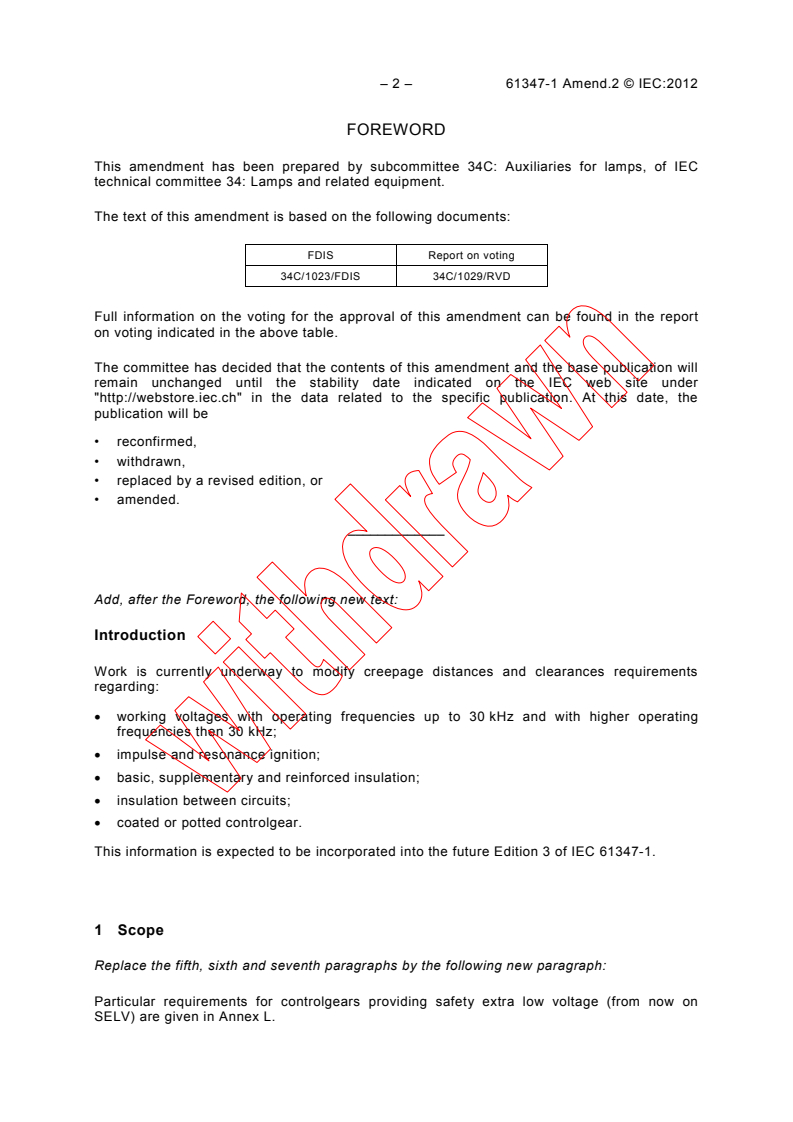
– 2 – 61347-1 Amend.2 © IEC:2012
FOREWORD
This amendment has been prepared by subcommittee 34C: Auxiliaries for lamps, of IEC
technical committee 34: Lamps and related equipment.
The text of this amendment is based on the following documents:
FDIS Report on voting
34C/1023/FDIS 34C/1029/RVD
Full information on the voting for the approval of this amendment can be found in the report
on voting indicated in the above table.
The committee has decided that the contents of this amendment and the base publication will
remain unchanged until the stability date indicated on the IEC web site under
"http://webstore.iec.ch" in the data related to the specific publication. At this date, the
publication will be
• reconfirmed,
• withdrawn,
• replaced by a revised edition, or
• amended.
_____________
Add, after the Foreword, the following new text:
Introduction
Work is currently underway to modify creepage distances and clearances requirements
regarding:
• working voltages with operating frequencies up to 30 kHz and with higher operating
frequencies then 30 kHz;
• impulse and resonance ignition;
• basic, supplementary and reinforced insulation;
• insulation between circuits;
• coated or potted controlgear.
This information is expected to be incorporated into the future Edition 3 of IEC 61347-1.
1 Scope
Replace the fifth, sixth and seventh paragraphs by the following new paragraph:
Particular requirements for controlgears providing safety extra low voltage (from now on
SELV) are given in Annex L.
61347-1 Amend.2 © IEC:2012 – 3 –
2 Normative references
Add the following new references:
IEC 60065:2001, Audio, video and similar electronic apparatus – Safety requirements
IEC 60085:1987, Electrical insulation – Thermal classification and designation
IEC 60216 (all parts), Electrical insulating materials – Properties of thermal endurance
IEC 60598-2 (all Parts 2), Luminaires – Part 2: Particular requirements.
IEC 60664-1:2007, Insulation coordination for equipment within low-voltage systems – Part 1:
Principles, requirements and tests
IEC 60884-2-4, Plugs and socket-outlets for household and similar purposes – Part 2-4:
Particular requirements for plugs and socket outlets for SELV
IEC 60906-3, IEC System of plugs and socket-outlets for household and similar purposes –
Part 3: SELV plugs and socket-outlets, 16 A 6 V, 12 V, 24 V, 48 V, a.c. and d.c.
IEC 60950-1, Information technology equipment – Safety – Part 1: General requirements
IEC 61558-1:2005, Safety of power transformers, power supplies, reactors and similar
products – Part 1: General requirements and tests
IEC 61558-2-6:2009, Safety of transformers, reactors, power supply units and similar products
for supply voltages up to 1 100 V – Part 2-6: Particular requirements and tests for safety
isolating transformers and power supply units incorporating safety isolating transformers
IEC 61558-2-16:2009, Safety of transformers, reactors, power supply units and similar
products for supply voltages up to 1 100 V – Part 2-16: Particular requirements and tests for
switch mode power supply units and transformers for switch mode power supply units
Replace the references to IEC 60317-0-1:1997 and IEC 60598-1:2003 by the following:
IEC 60317-0-1:2008, Specifications for particular types of windings wires – Part 0-1: General
requirements – Enamelled round copper wire
IEC 60598-1:2008, Luminaires – Part 1: General requirements and tests
3 Terms and definitions
3.23
functional earthing (ground)
Replace the existing Notes 1 and 2 of the existing definition by the following Note to entry:
Note 1 to entry: In some cases, functional earthing may be necessary to facilitate starting and/or to avoid radio
interference.
Add, after Definition 3.26, the following new definitions:
– 4 – 61347-1 Amend.2 © IEC:2012
3.27
extra-low voltage
ELV
voltage which does not exceed 50 V a.c. or 120 V ripple free d.c. between conductors, or
between any conductor and earth (voltage band 1 of IEC 60449:1973)
Note 1 to entry: “Ripple free” is conventionally defined for sinusoidal ripple voltage as a ripple content of not more
than 10 % r.m.s. The maximum peak value does not exceed 140 V for a nominal 120 V ripple-free d.c. system.
3.28
safety extra low voltage
SELV
ELV in a circuit which is isolated from the mains supply by insulation not less than that
between the primary and secondary circuits of a safety isolating transformer according to
IEC 61558-2-6
Note 1 to entry: Maximum voltage lower than 50 V a.c. r.m.s. or 120 V ripple free d.c. may be specified in
particular requirements, especially when direct contact with current-carrying parts is allowed.
Note 2 to entry: The voltage limit should not be exceeded at any load between full loads and no-load when the
source is a safety isolation transformer.
Note 3 to entry: “Ripple free” is conventionally an r.m.s. ripple voltage not more than 10 % of the d.c. component:
the maximum peak value does not exceed 140 V for a nominal 120 V ripple free d.c. system and 70 V for a nominal
60 V ripple free system.
3.29
body
term used in this standard as a general term which includes all accessible metal parts, shafts,
handles, knobs, grips and the like, accessible metal fixing screws and metal foil applied on
accessible surfaces of insulating material and does not include non-accessible metal parts
3.30
impulse withstand category
DEPRECATED: overvoltage category
numeral defining a transient overvoltage condition
Note 1 to entry: Impulse withstand categories I, II, III and IV are used. For detailed information, see IEC 60664-1
and IEC 60598-1.
3.31
class I lamp controlgear
independent controlgear in which protection against electric shock does not rely on basic
insulation only, but which includes an additional safety precaution in such a way that means
are provided for the connection of accessible conductive parts to the protective (earthing)
conductor in the fixed wiring of the installation in such a way that accessible conductive parts
cannot become live in the event of a failure of the basic insulation
Note 1 to entry: Class I lamp independent controlgear may have parts with double or reinforced insulation.
Note 2 to entry: Class I lamp independent controlgear may have parts in which protection against shock relies on
operation at safety extra-low voltage (SELV)
3.32
class II lamp controlgear
independent controlgear in which protection against electric shock does not rely on basic
insulation only, but in which additional safety precautions such as double insulation or
reinforced insulation are provided, there being no provision for protective earthing or reliance
upon installation conditions
3.33
class III lamp controlgear
independent controlgear in which protection against electric shock relies on supply at safety
extra-low voltage (SELV) and in which voltages higher than those of SELV are not generated
61347-1 Amend.2 © IEC:2012 – 5 –
3.34
protective impedance device
component or assembly of components the impedance and construction of which are such as
to ensure that steady state touch current and charge are limited to a non-hazardous level
3.35
maximum working voltage
U
out
maximum occurring working voltage (r.m.s.) between the output terminals or between the
output terminals and earth, during normal or abnormal operating condition
Note 1 to entry: Transients and ignition voltages have to be neglected.
3.36
basic insulation
insulation of parts which provide protection against electrical shock under fault-free conditions
3.37
double insulation
insulation of parts with two layers of insulation which provide protection against electrical
shock under single fault condition
3.38
reinforced insulation
Insulation of parts which provide a degree of protection as double insulation
4 General requirements
Add, after the second paragraph, the following new paragraph:
Requirements for insulation materials used for double or reinforced insulation of controlgear
are specified in Annex N of this standard.
Add, after the third paragraph, the following new paragraph:
Built-in electronic controlgear with double or reinforced insulation shall comply additionally
with the requirements of Annex O.
Add, at the end of Clause 4, the following new paragraph:
Controlgears providing SELV shall comply with the additional requirements given in Annex L.
This includes especially insulation resistance, electric strength, creepage distances and
clearances between the primary and secondary circuit.
5 General notes on tests
Add, at the end of Subclause 5.3, the following new paragraph:
If the tests of 14.3 or 15.5 of IEC 61558-1:2005 have to made, three additional samples are
needed. These samples are used only for the test of 14.3 or 15.5 of IEC 61558-1:2005,
respectively.
– 6 – 61347-1 Amend.2 © IEC:2012
7.1 Items to be marked
Add, after the first paragraph of Subclause 7.1, but before the alphabetical list, the following
new paragraph:
For controlgear without an enclosure, and classified as built-in (e.g. open printed circuit board
assembly), only items a) and b) are to be considered mandatory for marking on the
controlgear. Other mandatory markings required by the IEC 61347-2 part shall be provided as
information to be given either on the controlgear or made available in the manufacturer’s
catalogue or similar.
Replace the existing point f) by the following new point f):
f) The earthing terminals (if any) shall be identified by the symbol or .
These symbols shall not be placed on screws or other easily removable parts.
If the lamp control gear is market with an earthing symbol, the manufacturer’s instruction
shall contain the information whether it is permitted to use the control gear also without
connection to earth.
NOTE For the use of symbols, see IEC 60417.
Add, at the end of Subclause 7.1, the following new items, table and text:
s) Symbol indicating the kind of controlgear providing SELV.
t) The earthing terminals of an independent controlgear used for the connection of lamp
compartments (if any) shall be marked with the symbol:
This symbol shall not be placed on screws or other easily removable parts. The symbol size of
the earthing terminals of an independent controlgear used for the connection of lamp
compartments shall be at least 5 mm (over all, including letters).
u) Declaration of the maximum working voltage U (r.m.s.) between
out
• output terminals, or
• any output terminal and earth (if applicable)
in steps as described in Table 5.
Table 5 – Working voltage and U steps
out
Working voltage < 50 V < 500 V > 500 V
U in steps of 1 V 10 V 50 V
out
The highest of the specified voltage values shall be marked on the controlgear as “Output
working voltage = …V” or “U-OUT = …V” or “U = …V”.
out
NOTE 5 Item u) is not applicable to terminals with SELV-circuits as defined in IEC 61558-1.
61347-1 Amend.2 © IEC:2012 – 7 –
9 Provisions for protective earthing
Replace the existing title and content of Clause 9 by the following:
9 Earthing
9.1 Provisions for protective earthing (Symbol: IEC 60417-5019 (2006-08))
Earthing terminals shall comply with the requirements of Clause 8. The electrical connection/
clamping means shall be adequately locked against loosening, and it shall not be possible to
loosen the electrical connection/clamping means by hand without the use of a tool. For
screwless terminals, it shall not be possible to loosen the clamping means/electrical
connection unintentionally.
All parts of an earthing terminal shall be such as to minimize the danger of electrolytic
corrosion resulting from contact with the earth conductor or any other metal in contact with
them.
The screw and the other parts of the earthing terminal shall be made of brass or other metal
no less resistant to corrosion, or material with a non-rusting surface and at least one of the
contact surfaces shall be bare metal.
Compliance is checked according to 7.2.3 of IEC 60598-1:2008.
9.2 Provisions for functional earthing (Symbol: IEC 60417-5018 (2011-07))
Functional earthing terminals shall comply with the requirements of Clause 8 and 9.1.
The functional earthing contact (potential) of a lamp controlgear shall be insulated from the
live parts by double or reinforced insulation.
9.3 Lamp controlgear with conductors for protective earthing by tracks on printed
circuit boards
If a printed circuit board track is used for earthing internally, in the independent, built-in or
integral lamp controlgear, it shall withstand the following test.
A current from an a.c. source of 25 A is passed for 1 min between the earthing terminal or
earthing contact via the track on the printed circuit board and each of the accessible metal
parts in turn.
After the test and after cooling the controlgear to ambient temperature, the requirements of
7.2.3 of IEC 60598-1:2008 shall apply.
9.4 Earthing of built-in lamp controlgear
It is allowed to earth built-in lamp controlgear by means of fixing the controlgear to earthed
metal of the luminaire.
For compliance, see 7.2 of IEC 60598-1:2008.
If a lamp controlgear has an earthing terminal, this terminal shall only be used for earthing the
built-in lamp controlgear.
Earthing of the luminaire or other equipment via the built-in lamp controlgear is not allowed.
– 8 – 61347-1 Amend.2 © IEC:2012
9.5 Earthing via independent controlgear
9.5.1 Earth connection to other equipment
Independent lamp controlgear may have earthing terminals that allow the onward earth
connection to other equipment in the installation. For looping or through connection, the
conductor shall have a minimum cross-section of 1,5 mm and be of copper, or an equivalent
conductive material shall be used.
Protective earthing wires within the luminaire shall be in line with 5.3.1.1 and Clause 7 of
IEC 60598-1:2008. For looping-through, a minimum cross section of 1,5 mm is required.
Compliance is checked by inspection and measurement.
9.5.2 Earthing of the lamp compartments powered via the independent lamp
controlgear
Independent lamp controlgear may have earthing terminals that allow the earthing of the lamp
compartment, which are powered by this controlgear. In this case, the earth path between the
input and output earth terminals of the controlgear shall withstand the following test.
A current from an a.c. source of 25 A is passed for 1 min between the earthing terminal or
earthing contact (via the track on the printed circuit board, if used for protective earth) and
each of the accessible metal parts in turn.
After the test and after cooling the control gear at ambient temperature, a current of at least
10 A, derived from the source with a no-load voltage not exceeding 12 V, shall be passed
between the earthing terminal or earthing contact and each of the accessible metal parts in
turn. The voltage drop between the earthing terminal or earthing contact and the accessible
metal part shall be measured and the resistance shall be calculated from the current and the
voltage drop. In no case shall the calculated resistance value exceed 0,5 Ω.
The output earthing terminals to the lamp compartment shall be marked as described in 7.1 t).
10 Protection against accidental contact with live parts
Add, after Subclause 10.2, the following new subclauses:
10.3 For controlgears providing SELV, the accessible conductive parts shall be electrically
separated from live parts by at least double or reinforced insulation. There shall be no
connection between the output circuit and the body or the protective earthing circuit, if any.
Moreover, the construction shall be such that there is no possibility of any connection
between these circuits, either directly or indirectly, through other conductive parts, except by
deliberate action (see 10.4).
SELV output circuits shall be electrically separated from earth by at least basic insulation.
The expression “circuits” also covers windings of internal transformers (HF and others) of the
controlgear.
In controlgears providing ELV conductive parts are regarded as live parts and shall be
insulated accordingly.
Compliance is checked by inspection, relevant insulation tests and measurements. See also
Annex L.
61347-1 Amend.2 © IEC:2012 – 9 –
10.4 Controlgears providing SELV may have accessible conductive parts in the SELV circuit;
if: the rated output voltage under load does not exceed 25 V r.m.s. or 60 V d.c. ripple free d.c.
where the voltage exceeds 25 V r.m.s. or 60 V ripple free d.c., the touch current does not
exceed:
– for a.c.: 0,7 mA (peak);
– for d.c.: 2,0 mA;
– the no-load output does not exceed 35 V peak or 60 V ripple free d.c.
NOTE The limits given are based on IEC 60364-4-41.
Compliance is checked by measuring the output voltage when steady conditions are
established, the controlgear being connected to rated supply voltage and rated frequency. For
the test under load the controlgear is loaded with a resistance which would give rated output
(current or wattage respectively) at rated output voltage. For controlgears with more than one
supply voltage, the requirements are applicable for each of the rated supply voltages.
The touch current is checked by measurement in accordance with Annex G from IEC 60598-1.
For controlgears providing SELV with rated output voltages or currents exceeding the values
given above at least one of the conductive parts in the SELV circuit shall be insulated by
insulation capable of withstanding a test voltage of 500 V r.m.s. for 1 min.
Accessible conductive parts separated by double or reinforced insulation, e.g. live parts and
the body or primary and secondary circuits, may be bridged (conductive bridged) by resistors
or Y2 capacitors provided they consists of at least two separate components of the same
rated value (resistance or capacitance) and are rated for the total working voltage and whose
impedance is unlikely to change significantly during the individual lifetime of the controlgear.
In addition, accessible conductive parts separated by double or reinforced insulation from live
parts, as above, may be bridged by a single Y1 capacitor.
Y1 or Y2 capacitors shall comply with relevant requirements of IEC 60384-14 and if resistors
are used they shall comply with the requirements of test (a) in 14.1 of IEC 60065:2001.
11 Moisture resistance and insulation
Replace, after the third paragraph after the note, the rest of the text of Clause 11 by the
following:
Insulation resistance shall be not less than 2 MΩ for basic insulation and 4 MΩ for double or
reinforced insulation between live parts and the body. For insulation between primary and
secondary circuits, in controlgear providing SELV, other values apply (see Annex L).
Insulation shall be adequate
a) between live parts and outer metal parts, including fixing screws and metal foil in contact
with outer insulating parts;
b) between live parts and control terminals, where relevant.
In the case of lamp controlgear having an internal connection or component between one or
more output terminals and the earth terminal, such a connection shall be removed during
this test.
For the test the input and output terminals shall be bonded together. Controlgear, having
insulation cover or envelope is wrapped with metal foil.
– 10 – 61347-1 Amend.2 © IEC:2012
12 Electric strength
Replace the existing Table 1 by the following new Table 1:
Table 1 – Electric strength test voltage
Test voltage
Working voltage U
V
Basic insulation for voltages of SELV 500
Up to and including 50 V 500
Basic insulation 2 U + 1 000
Above 50 V up to and including 1 000 V Supplementary insulation 2 U + 1 000
Double or reinforced insulation 4 U + 2 000
Where both reinforced insulation and double insulation are used, care shall be taken that the voltage applied to
the reinforced insulation does not overstress the basic insulation or the supplementary insulation.
When testing the controlgear the input should be tested with a test voltage which corresponds with the supply
voltage and the output related part should be tested with a test voltage which corresponds with U .
out
Add the following sentence after Table 1:
For solid or thin sheet insulation used for double or reinforced insulation Annex N applies.
13 Termal endurance test for windings of ballasts
Add, after the second paragraph “Compliance is checked by the following test.", the following
new note:
NOTE 5 For windings included in controlgears providing SELV, see modifications specified in IEC 61558-1,
Annex U.
14 Fault conditions
Add, after the second paragraph, the following new text:
If a lamp controlgear marked with a protective earthing symbol and the manufacturer declared
in the instructions that the use of the controlgear without earthing contact is permitted then
the operation under fault conditions shall be made with and without earthing connection.
If a lamp controlgear marked with a functional earthing symbol and the manufacturer declared
in the instructions that the use of the controlgear without functional earthing contact is
permitted then the operation under fault conditions shall be made with and without earthing
connection.
Add, after the first paragraph of Subclause 14.1, the following new paragraphs:
Creepage and clearance distances below the values of Clause 16 are not allowed between
live parts and accessible metal parts.
61347-1 Amend.2 © IEC:2012 – 11 –
The test shall be carried out on one item for each fault condition. If one of the items fails, the
test shall be repeated with three new items, none of which shall fail.
Delete the existing NOTE.
Subclause 14.5 of Amendment 1
Add, after the second NOTE introduced in Amendment 1, the following new text:
Insulation shall be adequate between input and output terminals bonded together, and all
exposed metal parts and the control terminals, were relevant. Controlgear, having insulation
cover or envelope is wrapped with metal foil.
Delete, in Subclause 14.6 of Amendment 1, in the first sentence and under item a), the words
“at least”.
−0
Add, in Subclause 14.6, in the first sentence and under item a), after 160 A % the word
+10
“r.m.s.”.
15 Construction
Add, after Subclause 15.2, the following new subclause:
15.3 Plugs and socket-outlets used in SELV or ELV circuits
For controlgears providing SELV or ELV socket-outlets, the output circuit shall be such that
there is no dangerous compatibility between such a socket-outlet and a plug intended for
direct connection to a socket-outlet which could be used for the input circuit in relation to
installation rules, voltages and frequencies.
Plugs and socket-outlets for SELV system shall comply with the requirements of IEC 60906-3
and IEC 60884-2-4. However, plugs and socket-outlets for SELV systems with both a rated
current ~ 3 A and a maximum voltage of 25 V a.c. or 60 V d.c. with a power not exceeding
72 W are allowed to comply only with the following requirements:
– plugs shall not be able to enter socket-outlets of other standardised systems;
– socket-outlets shall not admit plugs of other standardised voltage systems;
– socket-outlets shall not have a protective earth contact.
As IEC 60906-3 covers only 6 V, 12 V, 24 V and 48 V output voltage, controlgear with
intermediate output voltages shall be able to withstand the nearest upper voltage.
16 Creepage distances and clearances
Replace the first paragraph by the following:
Creepage distances and clearances shall be not less than the values given in Tables 3 and 4,
as appropriate, unless otherwise specified in Clause 14 and for controlgears providing SELV,
where Subclause L.1 1 applies.
– 12 – 61347-1 Amend.2 © IEC:2012
Replace the paragraph before Table 3 by the following:
Distances which provide basic insulation on printed circuit boards are exempt from the
requirements of this clause because they are tested according to Clause 14. This exemption
is not applicable where double or reinforced insulation barriers are provided on printed circuit
boards.
Replace Table 3 by the following new Table 3:
Table 3 – Minimum distances for a.c. (50/60 Hz) sinusoidal voltages
RMS working voltage not exceeding 50 150 250 500 750 1 000
V
Distances in mm
Creepage distances
– Basic insulation PTI
≥ 600
0,6 0,8 1,5 3 4 5,5
< 600
1,2 1,6 2,5 5 8 10
– Supplementary insulation PTI*
≥ 600
– 0,8 1,5 3 4 5,5
< 600
– 1,6 2,5 5 8 10
– Reinforced insulation
– 3,2 5 6 8 11
Clearances
– Basic insulation
0,2 0,8 1,5 3 4 5,5
– Supplementary insulation
– 0,8 1,5 3 4 5,5
– Reinforced insulation
– 1,6 3 6 8 11
NOTE 1 PTI (proof tracking index) in accordance with IEC 60112.
NOTE 2 In the case of creepage distances to parts not energized or not intended to be earthed where
tracking cannot occur, the values specified for material with PTI ≥ 600 apply for all materials (in spite of
the real PTI). For creepage distances subjected to working voltages of less than 60 s duration, the values
specified for materials with PTI ≥ 600 apply for all materials.
NOTE 3 For creepage distances not liable to contamination by dust or moisture, the values specified for
materials with PTI ≥ 600 apply (regardless of the real PTI).
NOTE 4 For lamp controlgear specified in IEC 61347-2-1, accessible metal parts are rigidly placed in
relation to live parts.
NOTE 5 The creepage distances and clearances specified in this clause do not apply to those devices
specified in IEC 61347-2-1 which comply with the dimensions specified in IEC 60155. In such instances,
the requirements of that standard apply.
Table 4 – replacement
This correction only applies to the French version.
20 No-load output voltage
Replace the existing text of Clause 20 by the following:
The requirements of this clause are only applicable for magnetic lamp controlgear with
integrated transformer, operating with supply frequencies.
61347-1 Amend.2 © IEC:2012 – 13 –
If a magnetic lamp controlgear is connected at rated supply voltage and rated frequency with
no-load on the output, the output voltage shall not differ from the rated value of the no-load
output voltage declared by the manufacturer by more than 10 %.
Annex A – Test to establish whether a conductive part is a live part which may
cause an electric shock
Replace the existing text of Annex A by the following:
A.1 In order to determine whether a conductive part is a live part which may cause an
electric shock, the lamp controlgear is operated at rated voltage and nominal supply
frequency. A conductive part is not a live part if the requirements of Clause A.2 or A.3 are
met.
For the test according to Clause A.2 and A.3,
– one pole of the supply of the DUT shall be at earth potential,
– the measurements shall be carried out between the part concerned and any accessible
conductive part and/or earth.
NOTE The purpose of this annex is to establish if a conductive part may cause electric shock if touched. It does
not give response about the kind and level of insulation used.
A.2 The voltage shall be measured by using a measuring circuit consisting of a non-
inductive resistance of 50 kΩ.
– the voltage shall not exceed 35 V a.c. peak or 60 V ripple free d.c.
A.3 Where the voltage exceeds 35 V a.c. peak or 60 V ripple free d.c. or a protective
impedance device is used the touch-current shall not exceed:
– for a.c.: 0,7 mA (peak);
– for d.c.: 2,0 mA.
Compliance is checked according Annex G of IEC 60598-1:2008.
Annex B – Particular requirements for thermally protected lamp controlgear,
Amendment 1
B.9.5.2 Test sequence
Add, at the end of Subclause B.9.5.2, the following note:
NOTE In Japan, (t + 5) °C is required instead of (t + 20) °C for this test.
w w
– 14 – 61347-1 Amend.2 © IEC:2012
Add, after Annex K, the following new Annexes L ,M, N and O:
Annex L
(normative)
Particular additional requirements for controlgears
providing SELV
L.1 General
This annex applies to controlgears for use as SELV supply for luminaires. It consists of the
relevant requirements of IEC 61558-1:2005 according to 4.2 of that standard, for associated
transformers and IEC 61558-2-6 for safety isolating transformers. In addition, for controlgears
containing HF-transformers, relevant requirements of IEC 61558-2-16 also apply.
L.2 Terms and definitions
L.2.1
short-circuit proof controlgear
controlgear not exceeding the specified temperature limits when overloaded or short-circuited,
and which continues to meet all requirements of this standard after removal of the overload or
short-circuit
L.2.2
non-inherently short-circuit proof controlgear
short-circuit proof controlgear equipped with a protective device which opens the input circuit
or the output circuit, or reduces the current in the input circuit or the output circuit when the
controlgear is overloaded or short-circuited and which continues to meet all requirements of
this standard after the removal of the overload or short circuit and, if possible, after resetting
or replacing of the protective device
Note 1 to entry: Examples of protective devices are fuses, overload releases, thermal fuses, thermal links, thermal
cut-outs and PTC resistors, automatic break-off mechanical devices and fuses as printed circuits on printed circuit
boards.
Note 2 to entry: In case of protection by a device which can neither be replaced nor reset, the wording “continue
to meet all requirements of this standard after removal of the overload” does not imply that the controlgear
continues to operate.
L.2.3
inherently short-circuit proof controlgear
short-circuit proof controlgear not equipped with a device to protect the controlgear and in
case of overload or short circuit, by construction, does not exceed the specified temperature
limits and continues to operate and meet all the requirements of this standard after the
removal of the overload or short circuit
L.2.4
fail-safe controlgear
controlgear which, under abnormal conditions, permanently fails to function by the interruption
of the input circuit but presents no danger to the user or surroundings
Note 1 to entry: Any non-resetting and non-replaceable protective device may be used.
61347-1 Amend.2 © IEC:2012 – 15 –
L.2.5
non short-circuit proof controlgear
controlgears intended to be protected against excessive temperature by means of a protective
device not provided with the controlgear, and which continues to meet all the requirements of
this standard after the removal of the overload or short circuit and resetting of the protective
device
L.2.6
separating HF transformer
component part of the controlgear for which the rated frequency is much higher than the
supply frequency
Note 1 to entry: This HF-transformer can be the separation between the input and output circuit(s) in the
controlgear.
L.3 Classification
Controlgears are classified as follows:
a) According to their protection against electric shock
Independent controlgears are classified as follows:
– Class I controlgears;
– Class II controlgears;
– Class III controlgears.
b) According to the short-circuit protection or protection against abnormal use
Controlgears are classified as follows:
– non-inherently short-circuit proof controlgear;
– inherently short-circuit proof controlgear;
– fail-safe controlgear;
– non-short-circuit proof controlgear.
L.4 Marking
When symbols are used, they shall be as follows (see Table L.1):
Table L.1 – Symbols for marking if marking is used
PRI Input
SEC Output
Direct current
N Neutral
Single phase
Fuse link (add symbol for time-current characteristic)
t Rated maximum ambient temperature
a
Frame or core terminal
Fail-safe lamp controlgear
F F
or
– 16 – 61347-1 Amend.2 © IEC:2012
Non-short-circuit proof lamp controlgear
or
Short-circuit proof lamp controlgear
(inherently or non-inherently)
or
Safety isolating lamp controlgear (SELV lamp controlgear)
L.5 Protection against electric shock
Controlgears providing SELV shall, in addition to the requirements given in 10.3 and 10.4,
comply with relevant requirements specified in 9.2 of IEC 61558-1:2005,
Compliance is checked by the test described in 9.2 of IEC 61558-1:2005.
L.6 Heating
Controlgear providing SELV and their supports or mounting surfaces shall not attain
excessive temperature in normal use.
Compliance is checked by the relevant tests of Clause 14 of IEC 61558-1:2005, but with the
following adjustments:
– Subclause 14.1, 10th paragraph:
Replace 10 % by 6 %;
– Replace Table 1 by the following Table L.2:
Table L.2 – Values of temperatures in normal use
Temperature
Parts
°C
Case of capacitor
c
– if t is marked t
c c
– if t is not marked
c
Windings (with bobbins and laminations have contact), if the winding
insulation is
a
– of class A material
– of class E material
– of class B material
– of class F material
– of class H material
b
– of other material
–
a
The material classification is in accordance with IEC 60085 or IEC 60317-0-1 or equivalent standard.
b
If material other than those specified in IEC 60085:1987 under Class A, E, B, F and H are used, they shall
withstand the tests of 14.3 in IEC 61558-1:2005.
c
The maximum temperature of capacitor, bridging the separation transformer, shall be lower than 50 °C if is
not marked, in the case t is marked the maximum temperature is t . For other components, see Table 12.1 of
c c
IEC 60598-1:2008.
61347-1 Amend.2 © IEC:2012 – 17 –
– Subclause 14.1, third and second paragraph from the end:
Replace the reference to "18.3" by "L.8.3" of this annex.
– Subclause 14.3, first paragraph:
Replace the references to "14.2, 19.12.3 and 26.3" by "L.6" of this annex, and
– Subclause 14.3.4, first paragraph:
Replace the references to "18.1, 18.2, 18.3" and "18.4" by "Clause L.8" of this annex.
For moulded-in transformers specially prepared, samples provided with thermocouples shall
be submitted for testing.
L.7 Short-circuit and overload protection
Controlgears providing SELV shall not become unsafe due to short-circuits and over-loads
which may occur in normal use.
Compliance is checked by the relevant tests of Clause 15 of IEC 61558-1:2005, but with the
following adjustments:
– Subclause 15.1, second paragraph:
Replace the reference to "14.1" by "L.6" of this annex
– Subclause 15.1, second paragraph after Table 3:
Replace the reference to "Clause 9" to "Clause 10" of this standard
– Subclause 15.1, third paragraph after Table 3:
Replace the reference to "18.3" by "L.8.3" of this annex
– Subclause 15.3.4:
This subclause is not applicable.
– Subclause 15.5.1, third paragraph:
Replace the reference to "14.2" by "L.6" of this annex.
L.8 Insulation resistance and electric strength
L.8.1 General
The insulation resistance and the electric strength of controlgears providing SELV shall be
adequate.
Compliance is checked by the tests of Clauses 11 and 12 and Subclauses L.8.2 and L.8.3,
which are made immediately after the test of Clause 11 in the humidity or in the room in which
the specimen was brought to the prescribed temperature, after reassembly of those parts
which may have been removed.
L.8.2 Insulation resistance
Insulation resistance is measured with a d.c. voltage of approximately 500 V applied, the
measurement being made 1 min after application of the voltage.
The insulation resistance shall be not less than that shown in Table L.3.
– 18 – 61347-1 Amend.2 © IEC:2012
Table L.3 – Values of insulation resistances
Insulation
Insulation to be tested resistance
MΩ
Between input circuits and output circuits 5
Between metal part of class II convertors which are separated from live parts by basic insulation 5
only and the body
Between metal foil in contact with the inner and outer surfaces of enclosures of insulating material 2
L.8.3 Electric strength
Immediately after the test of L.8.2, the insulation is subjected for 1 min to a voltage of
substantially sine-wave from at rated mains frequency. The value of the test voltage and the
points of application are given in Table L.4.
NOTE In Annex M, test voltages are given for controlgear intended to be used in luminaires where a higher
availability is called by one of the Parts 2 of IEC 60598-2.
Table L.4 – Table of dielectric strength test voltages for controlgears
intended for use in impulse withstand Category II
Working voltage
a
V
b
Application of dielectric strength test voltage
600 1 000
< 50 ≤ 150 > 150
≤ 300
1) Between live parts of input circuits and live parts of output
500 2 000 3 000 4 200 5 000
circuits (double or reinforced insulation)
2) Over basic or supplementary insulation between:
250 1 000 1 500 2 100 2 500
a) live parts having different polarity as in normal use, i.e. not
under fault condition. Test not applicable within the same
winding
b) live parts and the body, if intended to be connected to
protective earth
c) accessible conductive parts and a metal rod of the
same diameter as the flexible cable or cord (or metallic foil
wrapped round the cord) inserted inside inlet bushing, cord
guards and anchorage, an the like
d) live parts and an intermediate conductive part
e) intermediate conductive parts and the body
f) each input circuit and all other input circuits connected
together
3) Over reinforced insulation between the body and live
500 2 000 3 000 4 200 5 000
parts
a
Values of dielectric strength test voltage for intermediate values of working voltage are found by
interpolation between tabulated values, except for the span 150 V – 300 V.
b
For the construction according to 19.12.3 b) and 26.2.4.1 of IEC 61558-1:2005 test b), the voltage is
multiplied by the factor of 1,25. For the construction according to 26.2.4.2 of IEC 61558-1:2005, the voltage is
multiplied by the factor 1,35.
L.9 Construction
L.9.1 The construction of transformers used in controlgears providing SELV shall be such
that they comply with all relevant parts specified in 19.12 of IEC 61558-1:2005, and Clau
...