


IEC 62642-4:2010
(Main)Alarm systems - Intrusion and hold-up systems - Part 4: Warning devices
Alarm systems - Intrusion and hold-up systems - Part 4: Warning devices
IEC 62642-4:2010 includes requirements for warning devices used for notification in intrusion and hold up alarm systems installed in buildings. Four grades of warning device are described corresponding to each of the four security grades given in IEC 62642-1. Requirements are also given for four environmental classes covering applications in internal and outdoor locations as specified in IEC 62599-1.
Systèmes d'alarme - Systèmes d'alarme contre l'intrusion et les hold-up - Partie 4: Dispositifs d'avertissement
La CEI 62642-4:2010 comporte des exigences sur les dispositifs d'avertissement utilisés pour la notification dans les systèmes d'alarme contre l'intrusion et les hold-up installés dans les bâtiments. Quatre grades de dispositifs d'avertissement sont décrits, correspondant aux quatre grades de sécurité indiqués dans la CEI 62642-1. Des exigences sont également données pour les quatre classes d'environnement qui couvrent les applications situées à l'intérieur et à l'extérieur, tel que spécifié dans la CEI 62599-1.
General Information
- Status
- Published
- Publication Date
- 06-Oct-2010
- Technical Committee
- TC 79 - Alarm and electronic security systems
- Current Stage
- PPUB - Publication issued
- Start Date
- 07-Oct-2010
- Completion Date
- 31-Oct-2010
Overview
IEC 62642-4:2010 is an international standard published by the International Electrotechnical Commission (IEC) that specifies requirements for warning devices used in intrusion and hold-up alarm systems installed in buildings. This standard is part 4 of the IEC 62642 series and focuses specifically on warning devices that alert occupants or security personnel during security breaches. It defines four grades of warning devices that correspond with the four security grades outlined in IEC 62642-1, ensuring devices meet security needs for different protection levels. Additionally, the standard covers four environmental classes that address internal and outdoor installation conditions as specified in IEC 62599-1.
Key Topics
Warning Device Requirements: The standard details functional, acoustic, tamper protection, environmental, electromagnetic compatibility (EMC), safety, electrical, and self-test requirements for warning devices.
Functional Performance: Specifies response criteria including triggering times, acoustic output levels, and maximum sound duration to ensure timely and effective alerting during intrusion or hold-up events.
Tamper Protection and Detection: Defines protection methods and tamper detection techniques to safeguard warning devices from sabotage, including opening detection, removal from mounting, and penetration attempts.
Environmental Classes: Requirements accommodate four environmental classes allowing warning devices to be suitable for internal or outdoor applications with varying environmental exposures.
Self-Test Requirements: Mandates local and remote self-test capabilities so devices can automatically verify operational readiness, ensuring reliable notification systems.
Acoustic Output: Standardizes sound output levels measured in decibels for different grades, ensuring appropriate audibility for each security level.
Electrical and Power Specifications: Includes connection standards, operating parameters, and conditions for self-powered warning devices with battery backup and power monitoring.
Applications
IEC 62642-4:2010 is essential for manufacturers, system integrators, and security professionals involved in the design, installation, and maintenance of alarm systems. Applications include:
Commercial and Residential Security: Ensuring alarm systems in offices, retail stores, homes, and public buildings have effective warning devices meeting security grade requirements.
Outdoor and Harsh Environments: Deploying warning devices that withstand environmental stresses such as weather and temperature, for external perimeter security.
Integrated Security Systems: Assisting integration of warning devices with intrusion and hold-up alarm panels to enhance overall system reliability and response.
Tamper-Resistant Security Solutions: Providing guidance on tamper detection for warning devices to prevent unauthorized compromise or disabling of alarms.
Regulatory Compliance: Supporting compliance with international and national security standards, ensuring products are certified and meet global market requirements.
Related Standards
- IEC 62642-1: Defines the security grades for intrusion and hold-up alarm systems to which the warning devices in IEC 62642-4 correspond.
- IEC 62599-1: Specifies environmental classes and testing methods applicable for alarm system components including warning devices.
- IEC 62642 Series: Covers other parts of the intrusion and hold-up alarm systems, including control and indicating equipment.
- ISO/IEC 27001: Although primarily an information security standard, IEC 62642-4 contributes to physical security controls referenced in broader security management frameworks.
Summary
IEC 62642-4:2010 establishes essential requirements for warning devices used in intrusion and hold-up alarm systems. By defining specifications on functionality, tamper protection, acoustic output, environmental durability, and self-testing, this standard ensures warning devices effectively notify of security breaches in a reliable and auditable manner. Compliance with IEC 62642-4 enhances security system performance across various applications in commercial, residential, and public environments, providing assurance of international quality and safety standards. This makes IEC 62642-4 a critical reference for manufacturers, security professionals, and regulatory bodies worldwide.


Get Certified
Connect with accredited certification bodies for this standard

NSF International
Global independent organization facilitating standards development and certification.

CIS Institut d.o.o.
Personal Protective Equipment (PPE) certification body. Notified Body NB-2890 for EU Regulation 2016/425 PPE.

Kiwa BDA Testing
Building and construction product certification.
Sponsored listings
Frequently Asked Questions
IEC 62642-4:2010 is a standard published by the International Electrotechnical Commission (IEC). Its full title is "Alarm systems - Intrusion and hold-up systems - Part 4: Warning devices". This standard covers: IEC 62642-4:2010 includes requirements for warning devices used for notification in intrusion and hold up alarm systems installed in buildings. Four grades of warning device are described corresponding to each of the four security grades given in IEC 62642-1. Requirements are also given for four environmental classes covering applications in internal and outdoor locations as specified in IEC 62599-1.
IEC 62642-4:2010 includes requirements for warning devices used for notification in intrusion and hold up alarm systems installed in buildings. Four grades of warning device are described corresponding to each of the four security grades given in IEC 62642-1. Requirements are also given for four environmental classes covering applications in internal and outdoor locations as specified in IEC 62599-1.
IEC 62642-4:2010 is classified under the following ICS (International Classification for Standards) categories: 13.320 - Alarm and warning systems. The ICS classification helps identify the subject area and facilitates finding related standards.
IEC 62642-4:2010 is available in PDF format for immediate download after purchase. The document can be added to your cart and obtained through the secure checkout process. Digital delivery ensures instant access to the complete standard document.
Standards Content (Sample)
IEC 62642-4 ®
Edition 1.0 2010-10
INTERNATIONAL
STANDARD
NORME
INTERNATIONALE
Alarm systems – Intrusion and hold-up systems –
Part 4: Warning devices
Systèmes d'alarme – Systèmes d'alarme contre l'intrusion et les hold-up –
Partie 4: Dispositifs d'avertissement
All rights reserved. Unless otherwise specified, no part of this publication may be reproduced or utilized in any form or by
any means, electronic or mechanical, including photocopying and microfilm, without permission in writing from either IEC or
IEC's member National Committee in the country of the requester.
If you have any questions about IEC copyright or have an enquiry about obtaining additional rights to this publication,
please contact the address below or your local IEC member National Committee for further information.
Droits de reproduction réservés. Sauf indication contraire, aucune partie de cette publication ne peut être reproduite
ni utilisée sous quelque forme que ce soit et par aucun procédé, électronique ou mécanique, y compris la photocopie
et les microfilms, sans l'accord écrit de la CEI ou du Comité national de la CEI du pays du demandeur.
Si vous avez des questions sur le copyright de la CEI ou si vous désirez obtenir des droits supplémentaires sur cette
publication, utilisez les coordonnées ci-après ou contactez le Comité national de la CEI de votre pays de résidence.
IEC Central Office
3, rue de Varembé
CH-1211 Geneva 20
Switzerland
Email: inmail@iec.ch
Web: www.iec.ch
About the IEC
The International Electrotechnical Commission (IEC) is the leading global organization that prepares and publishes
International Standards for all electrical, electronic and related technologies.
About IEC publications
The technical content of IEC publications is kept under constant review by the IEC. Please make sure that you have the
latest edition, a corrigenda or an amendment might have been published.
ƒ Catalogue of IEC publications: www.iec.ch/searchpub
The IEC on-line Catalogue enables you to search by a variety of criteria (reference number, text, technical committee,…).
It also gives information on projects, withdrawn and replaced publications.
ƒ IEC Just Published: www.iec.ch/online_news/justpub
Stay up to date on all new IEC publications. Just Published details twice a month all new publications released. Available
on-line and also by email.
ƒ Electropedia: www.electropedia.org
The world's leading online dictionary of electronic and electrical terms containing more than 20 000 terms and definitions
in English and French, with equivalent terms in additional languages. Also known as the International Electrotechnical
Vocabulary online.
ƒ Customer Service Centre: www.iec.ch/webstore/custserv
If you wish to give us your feedback on this publication or need further assistance, please visit the Customer Service
Centre FAQ or contact us:
Email: csc@iec.ch
Tel.: +41 22 919 02 11
Fax: +41 22 919 03 00
A propos de la CEI
La Commission Electrotechnique Internationale (CEI) est la première organisation mondiale qui élabore et publie des
normes internationales pour tout ce qui a trait à l'électricité, à l'électronique et aux technologies apparentées.
A propos des publications CEI
Le contenu technique des publications de la CEI est constamment revu. Veuillez vous assurer que vous possédez
l’édition la plus récente, un corrigendum ou amendement peut avoir été publié.
ƒ Catalogue des publications de la CEI: www.iec.ch/searchpub/cur_fut-f.htm
Le Catalogue en-ligne de la CEI vous permet d’effectuer des recherches en utilisant différents critères (numéro de référence,
texte, comité d’études,…). Il donne aussi des informations sur les projets et les publications retirées ou remplacées.
ƒ Just Published CEI: www.iec.ch/online_news/justpub
Restez informé sur les nouvelles publications de la CEI. Just Published détaille deux fois par mois les nouvelles
publications parues. Disponible en-ligne et aussi par email.
ƒ Electropedia: www.electropedia.org
Le premier dictionnaire en ligne au monde de termes électroniques et électriques. Il contient plus de 20 000 termes et
définitions en anglais et en français, ainsi que les termes équivalents dans les langues additionnelles. Egalement appelé
Vocabulaire Electrotechnique International en ligne.
ƒ Service Clients: www.iec.ch/webstore/custserv/custserv_entry-f.htm
Si vous désirez nous donner des commentaires sur cette publication ou si vous avez des questions, visitez le FAQ du
Service clients ou contactez-nous:
Email: csc@iec.ch
Tél.: +41 22 919 02 11
Fax: +41 22 919 03 00
IEC 62642-4 ®
Edition 1.0 2010-10
INTERNATIONAL
STANDARD
NORME
INTERNATIONALE
Alarm systems – Intrusion and hold-up systems –
Part 4: Warning devices
Systèmes d'alarme – Systèmes d'alarme contre l'intrusion et les hold-up –
Partie 4: Dispositifs d'avertissement
INTERNATIONAL
ELECTROTECHNICAL
COMMISSION
COMMISSION
ELECTROTECHNIQUE
PRICE CODE
INTERNATIONALE
W
CODE PRIX
ICS 13.320 ISBN 978-2-88912-199-1
– 2 – 62642-4 © IEC:2010
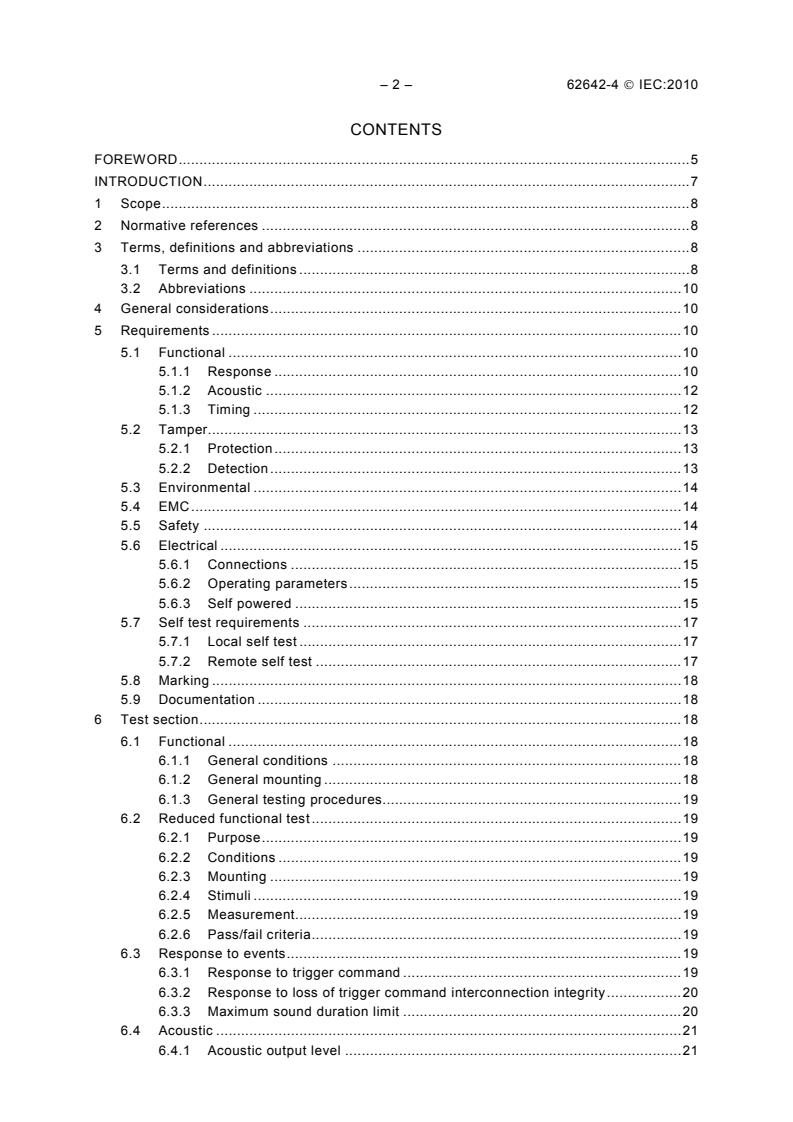
CONTENTS
FOREWORD.5
INTRODUCTION.7
1 Scope.8
2 Normative references .8
3 Terms, definitions and abbreviations .8
3.1 Terms and definitions .8
3.2 Abbreviations .10
4 General considerations.10
5 Requirements .10
5.1 Functional .10
5.1.1 Response .10
5.1.2 Acoustic .12
5.1.3 Timing .12
5.2 Tamper.13
5.2.1 Protection.13
5.2.2 Detection.13
5.3 Environmental .14
5.4 EMC.14
5.5 Safety .14
5.6 Electrical .15
5.6.1 Connections .15
5.6.2 Operating parameters.15
5.6.3 Self powered .15
5.7 Self test requirements .17
5.7.1 Local self test .17
5.7.2 Remote self test .17
5.8 Marking .18
5.9 Documentation .18
6 Test section.18
6.1 Functional .18
6.1.1 General conditions .18
6.1.2 General mounting .18
6.1.3 General testing procedures.19
6.2 Reduced functional test.19
6.2.1 Purpose.19
6.2.2 Conditions .19
6.2.3 Mounting .19
6.2.4 Stimuli .19
6.2.5 Measurement.19
6.2.6 Pass/fail criteria.19
6.3 Response to events.19
6.3.1 Response to trigger command .19
6.3.2 Response to loss of trigger command interconnection integrity.20
6.3.3 Maximum sound duration limit .20
6.4 Acoustic .21
6.4.1 Acoustic output level .21
62642-4 © IEC:2010 – 3 –
6.5 Tamper.22
6.5.1 Opening by normal means .22
6.5.2 Protection.22
6.5.3 Detection of opening by normal means .23
6.5.4 Detection of removal from mounting .24
6.5.5 Detection of penetration .24
6.6 Electrical tests.25
6.6.1 Operating voltage range and current consumption .25
6.6.2 Slow rise of remote power source voltage.25
6.6.3 Remote power source voltage step change.26
6.6.4 Storage device standby time.26
6.6.5 Storage device operating time .27
6.6.6 Storage device recharge rate.28
6.6.7 Loss of remote power .28
6.6.8 Remote power short circuit protection.29
6.6.9 Storage device monitoring – Low voltage.29
6.6.10 Storage device monitoring – Failure .30
6.7 Marking .30
6.7.1 Purpose.30
6.7.2 Conditions .31
6.7.3 Mounting .31
6.7.4 Stimuli .31
6.7.5 Measurement.31
6.7.6 Pass/fail criteria.31
6.8 Documentation .31
6.8.1 Purpose.31
6.8.2 Conditions .31
6.8.3 Mounting .31
6.8.4 Stimuli .31
6.8.5 Measurement.31
6.8.6 Pass/fail criteria.31
6.9 Environmental .31
6.9.1 Impact .31
6.9.2 Further environmental tests .32
Annex A (normative) Sound level test for warning devices .34
Annex B (informative) Example remote test protocol .37
Bibliography.38
Figure A.1 – Suggested method of mounting.35
Figure A.2 – Measurement positions – Surface mounted devices .36
Figure A.3 – Measurement positions – Pole mounted devices .36
Table 1 – Warning device functionality.11
Table 2 – Warning device responses .11
Table 3 – Acoustic output levels .12
Table 4 – Enclosure construction .13
Table 5 – Tool dimension for tamper detection.13
– 4 – 62642-4 © IEC:2010
Table 6 – Tamper detection .14
Table 7 – Removal from mounting.14
Table 8 – Storage device standby duration .16
Table 9 – Recharge periods .16
Table 10 – Self test monitoring .17
Table 11 – Environmental tests selection .33
62642-4 © IEC:2010 – 5 –
INTERNATIONAL ELECTROTECHNICAL COMMISSION
____________
ALARM SYSTEMS –
INTRUSION AND HOLD-UP SYSTEMS –
Part 4: Warning devices
FOREWORD
1) The International Electrotechnical Commission (IEC) is a worldwide organization for standardization comprising
all national electrotechnical committees (IEC National Committees). The object of IEC is to promote
international co-operation on all questions concerning standardization in the electrical and electronic fields. To
this end and in addition to other activities, IEC publishes International Standards, Technical Specifications,
Technical Reports, Publicly Available Specifications (PAS) and Guides (hereafter referred to as “IEC
Publication(s)”). Their preparation is entrusted to technical committees; any IEC National Committee interested
in the subject dealt with may participate in this preparatory work. International, governmental and non-
governmental organizations liaising with the IEC also participate in this preparation. IEC collaborates closely
with the International Organization for Standardization (ISO) in accordance with conditions determined by
agreement between the two organizations.
2) The formal decisions or agreements of IEC on technical matters express, as nearly as possible, an international
consensus of opinion on the relevant subjects since each technical committee has representation from all
interested IEC National Committees.
3) IEC Publications have the form of recommendations for international use and are accepted by IEC National
Committees in that sense. While all reasonable efforts are made to ensure that the technical content of IEC
Publications is accurate, IEC cannot be held responsible for the way in which they are used or for any
misinterpretation by any end user.
4) In order to promote international uniformity, IEC National Committees undertake to apply IEC Publications
transparently to the maximum extent possible in their national and regional publications. Any divergence
between any IEC Publication and the corresponding national or regional publication shall be clearly indicated in
the latter.
5) IEC itself does not provide any attestation of conformity. Independent certification bodies provide conformity
assessment services and, in some areas, access to IEC marks of conformity. IEC is not responsible for any
services carried out by independent certification bodies.
6) All users should ensure that they have the latest edition of this publication.
7) No liability shall attach to IEC or its directors, employees, servants or agents including individual experts and
members of its technical committees and IEC National Committees for any personal injury, property damage or
other damage of any nature whatsoever, whether direct or indirect, or for costs (including legal fees) and
expenses arising out of the publication, use of, or reliance upon, this IEC Publication or any other IEC
Publications.
8) Attention is drawn to the Normative references cited in this publication. Use of the referenced publications is
indispensable for the correct application of this publication.
9) Attention is drawn to the possibility that some of the elements of this IEC Publication may be the subject of
patent rights. IEC shall not be held responsible for identifying any or all such patent rights.
International Standard IEC 62642-4 has been prepared by IEC technical committee 79: Alarm
and electronic security systems.
This standard is based on EN 50131-4 (2009).
The text of this standard is based on the following documents:
FDIS Report on voting
79/308/FDIS 79/319/RVD
Full information on the voting for the approval of this standard can be found in the report on
voting indicated in the above table.
This publication has been drafted in accordance with the ISO/IEC Directives, Part 2.
– 6 – 62642-4 © IEC:2010
A list of all parts of the IEC 62642 series can be found, under the general title Alarm systems
– Intrusion and hold-up systems, on the IEC website.
The committee has decided that the contents of this publication will remain unchanged until
the stability result date indicated on the IEC web site under "http://webstore.iec.ch" in the data
related to the specific publication. At this date, the publication will be
• reconfirmed,
• withdrawn,
• replaced by a revised edition, or
• amended.
62642-4 © IEC:2010 – 7 –
INTRODUCTION
This part 4 of the IEC 62642 series of standard gives requirements for warning devices used
in intrusion and hold-up alarm systems. The other parts of this series of standards are as
follows:
Part 1 System requirements
Part 2-2 Intrusion detectors – Passive infrared detectors
Part 2-3 Intrusion detectors – Microwave detectors
Part 2-4 Intrusion detectors – Combined passive infrared / microwave detectors
Part 2-5 Intrusion detectors – Combined passive infrared / ultrasonic detectors
Part 2-6 Intrusion detectors – Opening contacts (magnetic)
Part 2-71 Intrusion detectors – Glass break detectors – Acoustic
Part 2-72 Intrusion detectors – Glass break detectors – Passive
Part 2-73 Intrusion detectors – Glass break detectors – Active
Part 3 Control and indicating equipment
Part 4 Warning devices
Part 5-3 Interconnections – Requirements for equipment using radio frequency techniques
Part 6 Power supplies
Part 7 Application guidelines
Part 8 Security fog devices/systems
– 8 – 62642-4 © IEC:2010
ALARM SYSTEMS –
INTRUSION AND HOLD-UP SYSTEMS –
Part 4: Warning devices
1 Scope
This part of the IEC 62642 includes requirements for warning devices used for notification in
intrusion and hold up alarm systems installed in buildings. Four grades of warning device are
described corresponding to each of the four security grades given in IEC 62642-1.
Requirements are also given for four environmental classes covering applications in internal
and outdoor locations as specified in IEC 62599-1.
2 Normative references
The following referenced documents are indispensable for the application of this document.
For dated references, only the edition cited applies. For undated references, the latest edition
of the referenced document (including any amendments) applies.
IEC 60065, Audio, video and similar electronic apparatus – Safety requirements
IEC 60068-1:1988, Environmental testing – Part 1: General and guidance
IEC 60068-2-75, Environmental testing – Part 2-75: Tests – Test Eh: Hammer tests
IEC 60529, Degrees of protection provided by enclosures (IP Code)
IEC 60950-1, Information technology equipment – Safety – Part 1: General requirements
IEC 61000-6-3, Electromagnetic compatibility (EMC) – Part 6-3: Generic standards –
Emission standard for residential, commercial and light-industrial environments
IEC 61672-1 , Electroacoustics – Sound level meters – Part 1: Specifications
IEC 62599-1, Alarm systems – Part 1: Environmental test methods
IEC 62599-2, Alarm systems – Part 2: Electromagnetic compatibility – Immunity requirements
for components of fire and security alarm systems
IEC 62642-1, Alarm systems – Intrusion and hold-up systems – Part 1: System requirements
IEC 62642-6, Alarm systems – Intrusion and hold-up systems – Part 6: Power supplies
3 Terms, definitions and abbreviations
3.1 Terms and definitions
For the purposes of this document, the following terms and definitions apply.
___________
Under preparation.
62642-4 © IEC:2010 – 9 –
3.1.1
audible alarm
distinctive sound generated in response to an alarm condition
3.1.2
warning device
device that gives an audible alarm in response to a notification
NOTE A warning device may also provide alert indications.
3.1.3
external warning device
warning device designed to be located outside the supervised premises which gives an
external audible alarm in response to a notification
3.1.4
internal warning device
warning device designed to be located within the supervised premises which gives an internal
audible alarm in response to a notification
3.1.5
enclosure
housing that contains the components, normally comprises a backplate and a cover
3.1.6
external power source
energy supply external to the I&HAS which may be non-continuous, e.g. mains supply
3.1.7
remote power source
electrical supply, which is not a part of the warning device, meeting the requirements of
IEC 62642-6
3.1.8
remotely powered warning device
warning device that does not incorporate its own power source
3.1.9
self powered warning device
warning device that incorporates its own power source
3.1.10
standby condition
operational mode of a self powered warning device during which it is powered from its internal
storage device, whilst not notifying an alarm condition
3.1.11
failure (of the storage device)
condition of the storage device where it is no longer able to power the warning device
3.1.12
low voltage (of the storage device)
voltage specified by the warning device manufacturer which indicates that the storage device
is nearly discharged
3.1.13
trigger command
notification signal or message passed to the warning device
– 10 – 62642-4 © IEC:2010
3.1.14
visible damage
damage that would be visible to a person of normal eyesight viewing at a distance of 2 m
under an illumination level of 2 000 lx
3.2 Abbreviations
For the purposes of this document, the following abbreviations apply.
CIE control and indicating equipment
EPS external power source
I&HAS intrusion and hold-up alarm system(s)
WD warning device
IWD internal warning device
4 General considerations
This standard considers two different categories of warning device, remotely powered and self
powered devices.
Self powered warning devices are classified into one of four types, dependent upon the
recharge characteristics of the storage device and the source of recharge power. These four
types are defined in Table 8.
5 Requirements
5.1 Functional
5.1.1 Response
Depending upon the grade, warning devices shall have the functionality as defined in Table 1.
Where a function is provided, the warning device shall operate in accordance with the
requirements of Table 2.
62642-4 © IEC:2010 – 11 –
Table 1 – Warning device functionality
Self powered Remotely powered
Function Grade Grade
1 2 3 4 1 2 3 4
Trigger command M M M M M M M M
Tamper signal or message
M M M M M M M M
output
Fault signal or message
b b
Op Op M M Op Op Op Op
output
a
Monitor of remote power M M M M Op Op Op Op
Monitor integrity of trigger
Op Op M M Op Op Op Op
command interconnection
b b
Local self test Op Op M M Op Op Op Op
Remote test input Op Op Op M Op Op Op Op
Key
Op Optional
M Mandatory
a
Remote power monitoring only applies to warning devices with a remote power source and an internal storage
device, see types X and Z as defined in Table 8.
b
Mandatory for type W devices as defined in Table 8.
Table 2 – Warning device responses
Self powered WD Remote powered WD
Tamper Tamper Fault signal
Event
Audible Fault signal Audible
signal or signal or or message
alarm or message alarm a
message message
Trigger command M NP NP M NP NP
Tamper event at the
Op M NP Op M NP
WD
Loss of remote power b b b
N/A Op Op
Op Op Op
source
Loss of trigger
command c c c
Op Op Op
Op Op Op
interconnection
integrity
Local self test pass NP NP NP NP NP NP
a
Local self test fail NP NP NP NP M
M
d d
Remote self test pass NP NP M NP NP M
d d
Remote self test fail NP NP M NP NP M
Key
M Mandatory
Op Optional
NP Not Permitted
N/A Not applicable
a
The provision of a fault signal or message is not mandatory for all grades, see Table 1.
b
At least one of these actions shall occur at the warning device. For grade 3 and grade 4 warning devices, if the
loss of remote power source can be shown to be caused by a fault then a fault signal is generated, otherwise a
tamper signal is generated.
c
At least one of these actions shall occur at the warning device. For grade 3 and grade 4 warning devices, if the
loss of trigger command integrity can be shown to be caused by a fault then a fault signal is generated,
otherwise a tamper signal shall be generated.
d
The response to a remote test pass is different from the response to a remote test fail.
– 12 – 62642-4 © IEC:2010
5.1.2 Acoustic
A warning device shall produce a varying sound output, which is distinctive and likely to
attract attention, with a mean acoustic output of no less than that defined in Table 3 at 1 m
from the mounting surface of the warning device throughout the manufacturers specified
operating voltage range. Peak acoustic output levels, taken at 30° intervals in the horizontal
plane, shall not be below the minimum individual level defined in Table 3 at 1 m from the
mounting surface. The mean acoustic output shall be calculated by the arithmetic sum of
these values divided by the number of measurements. For surface mounted devices (e.g. wall
mounted devices) this is required at angles between 15° and 165° to the surface, and for pole
mounted devices, it is for the full 360°.
Table 3 – Acoustic output levels
Internal warning device External warning device
Minimum mean acoustic output
80 dB(A) 100 dB(A)
level
Minimum individual acoustic
75 dB(A) 95 dB(A)
output level
NOTE 1 It is considered restrictive to define exact waveforms of acceptable alarm tones, therefore the
only tests that can be applied are on the acoustic output level and that the tone is varying.
NOTE 2 Voice alarms are deemed to meet the requirements of a varying sound output.
NOTE 3 A warning device may also provide audible alert indications providing such indications are
easily distinguishable from an alarm.
NOTE 4 The acoustic output (sound level and/or frequency) of a warning device may be subject to
variation depending on local or national requirements.
5.1.3 Timing
A trigger command exceeding 400 ms shall be processed by the warning device.
A warning device shall commence its audible alarm within 1 s of receiving a valid trigger
command to do so. It shall cease its audible alarm within 1 s of receiving a valid cancellation
of the trigger command.
The warning device shall sound between these signals.
The maximum time for which an audible warning device shall sound continuously is 15 min.
NOTE 1 Where applicable this requirement may be achieved by the CIE.
NOTE 2 The duration of the operational period of a warning device may be subject to variation depending on local
or national requirements
A tamper signal or message shall be generated within 1 s of a tamper condition occurring.
There shall be a response to loss of remote power source or loss of trigger command
interconnection integrity according to Tables 1 and 2, within 10 s of the fault occurring.
A response to local test fail according to Tables 1 and 2 shall occur within 10 s of detection of
the fault.
62642-4 © IEC:2010 – 13 –
5.2 Tamper
5.2.1 Protection
All component parts shall be housed in an enclosure meeting the impact requirements of the
appropriate grade given in Table 4.
Provision shall be made to allow adequate fixing of the enclosure to the mounting surface.
Table 4 – Enclosure construction
Internal warning device External warning device
Grade
1 2 3 4 1 2 3 4
Resistance to impact
06 06 07 08 07 07 08 08
(IK rating according to IEC 62262)
The cover of the enclosure shall be secured with one or more screws or bolts or alternatively
by a mechanical lock. The cover of the enclosure shall be opened only with the use of one or
more keys or suitable tools.
It shall not be possible, without causing visible damage, to gain access to any electrical
connections, or elements providing adjustment, without first generating a tamper signal or
message.
When the unit is mounted normally, it shall not be possible, without causing visible damage,
to introduce a tool, as defined in Table 5, such that the operation of the warning device could
be adversely affected.
Table 5 – Tool dimension for tamper detection
Dimensions in millimetres
Grade 1 Grade 2 Grade 3 Grade 4
Steel rod, diameter (± 0,05 mm) 2,5 2,5 1 1
Flat bar dimensions (± 0,05 mm) 10 × 1 × 300 10 × 1 × 300 5 × 0,5 × 300 5 × 0,5 × 300
5.2.2 Detection
The tamper detection requirements for warning devices relative to the security grade are
given in Table 6.
Opening the warning device enclosure by normal means shall generate a tamper signal or
message. The enclosure shall not permit the introduction of a tool of dimension as specified in
Table 5 and type as specified in IEC 60529, to defeat the tamper detection.
Attempts to remove the warning device from its mounting surface for a distance defined in
Table 7 in a perpendicular direction shall generate a tamper signal or message according to
Table 6.
It shall not be possible to defeat the removal from mounting detection by sliding a
25 mm × 1 mm × 300 mm blade, or by use of pliers (of thickness 5 mm and reach 150 mm),
between the mounting surface and the warning device.
The warning device shall include means to detect penetration of the enclosure, which could
cause mis-operation of the warning device, as specified in Table 6, when a hole of 4 mm is
made in the enclosure.
– 14 – 62642-4 © IEC:2010
Table 6 – Tamper detection
Internal warning device External warning device
Security grade
1 2 3 4 1 2 3 4
Opening by normal means M M M M M M M M
Removal from mounting – Op M M M Op M M M
Wire free WD
Removal from mounting – Op Op M M Op Op M M
Wired WD
Detection of penetration of
Op Op Op Op Op Op Op M
enclosure
Key
Op Optional
M Mandatory
Table 7 – Removal from mounting
Grade 1 Grade 2 Grade 3 Grade 4
Maximum distance before tamper
a
10 mm 10 mm 5 mm 5 mm
detection
a
If removal from mounting detection is provided.
5.3 Environmental
The environmental classification shall be as described in IEC 62642-1. All the relevant
environmental tests shall be carried out at the appropriate level for all security grades, as
given in IEC 62599-1.
The warning device shall meet the requirements of the relevant environmental class as
specified by the manufacturer.
For operational tests, the warning device shall not generate unintentional activations, tamper,
fault or other signals or messages, when subjected to the specified range of environmental
conditions.
For endurance tests, the warning device shall continue to meet the requirements of this
standard after being subjected to the specified range of environmental conditions.
See 6.9 for the relevant tests and severity.
5.4 EMC
For all grades of WD the WD shall not generate or be affected by the EMC conditions and
severity levels defined in IEC 62599-2 and IEC 61000-6-3.
5.5 Safety
The warning device shall provide protection against electrical shock and consequential
hazards by compliance with the requirements of IEC 60950-1 or IEC 60065.
62642-4 © IEC:2010 – 15 –
5.6 Electrical
5.6.1 Connections
The means of electrical connection shall be appropriate for the physical size and current
carrying capacity of the required conductors. The method of termination shall not damage the
conductors.
Terminal blocks and other components utilised for connections shall be identifiable with
numbers or other marks specified in the documentation
If external metal enclosures are used with a facility to connect to the equi-potential bonding,
e.g. for the purpose of protection from lightning strikes, then there shall be the provision to
clamp wires with a cross sectional area of 4 mm² to 16 mm².
5.6.2 Operating parameters
5.6.2.1 Voltage range
The warning device shall meet all the functional requirements when the supply voltage range
lies between the manufacturers stated values.
5.6.2.2 Slow remote power source voltage rise
–1
When the warning device is subject to a slow input voltage rise from zero of 1 Vs , then it
shall function normally when the supply voltage reaches the minimum operating voltage.
5.6.2.3 Remote power source voltage step change
When the warning device is subject to a step in the input voltage between maximum and
minimum, and vice versa, there shall be no change in the status of the warning device, and no
signals or messages shall be generated.
5.6.2.4 Current consumption
The warning device’s quiescent and peak current consumption on each connection shall not
exceed those specified by the manufacturer in the alarm sounding and non alarm sounding
states, at the nominal supply voltage.
5.6.3 Self powered
Where a self powered warning device’s own power source is not used to power other I&HAS
components, then the requirements of IEC 62642-6 do not apply to that power source.
Where a self powered warning device incorporates its own storage device, the following
additional requirements apply.
5.6.3.1 Storage device operating time
The storage device shall have sufficient capacity for at least 10 consecutive maximum sound
duration periods, or at least 30 min; whichever is the shorter. At the end of this time, the
individual acoustic output 1 m from the warning device at, at least, one of the measurement
points specified in 5.1.2, shall meet the requirements of Table 3.
5.6.3.2 Storage device standby time
The storage device shall have sufficient capacity to maintain the warning device in standby
condition for the periods specified in Table 8.
– 16 – 62642-4 © IEC:2010
Table 8 – Storage device standby duration
Integral
Remote power Storage device
Type recharge Grade 1 Grade 2 Grade 3 Grade 4
source type
capability
Non Not
W None 1 year 1 year 1 year 1 year
rechargeable applicable
Non Not
X Yes 24 h 24 h 120 h 120 h
rechargeable applicable
Y None Rechargeable Yes 24 h 24 h 120 h 120 h
Yes, from
remote
Z Yes Rechargeable 12 h 12 h 60 h 60 h
power
source
NOTE 1 A type W warning device could, for example, have a dry cell as its only means of power. This storage
device has no means of recharge, and will need replacing before it is completely exhausted.
NOTE 2 A type X warning device could, for example, be remotely powered from the I&HAS and with a dry cell as
its storage device. This storage device has no means of recharge, and will need replacing before it is completely
exhausted.
NOTE 3 A type Y warning device could, for example, recharge its storage device by means of a solar cell, or
connection to an external power source (e.g. mains supply).
NOTE 4 A type Z warning device could, for example, be normally powered from the I&HAS, and this power source
is also used to recharge its storage device.
At the end of the standby period, the storage device shall meet the operating time
requirements of 5.6.3.1.
For types X and Z, where loss of remote power supply causes the warning device to activate
(see Table 2) then the requirements of Table 8 do not apply, and the storage device shall only
meet the operating time requirements of 5.6.3.1.
5.6.3.3 Recharge rate
Type Y and Z warning devices shall be capable of supplying current at the appropriate voltage
to recharge the storage device equivalent to 80 % of that supplied by the storage device in
meeting the requirements of 5.6.3.1 and 5.6.3.2 within the periods as specified in Table 9.
Table 9 – Recharge periods
Grade 1 Grade 2 Grade 3 Grade 4
Time to recharge 72 h 72 h 24 h 24 h
5.6.3.4 Remote power monitoring
Where the warning device has a remote power source and this power source is lost, then the
warning device shall respond according to Table 2.
5.6.3.5 Remote power short circuit protection
Where the warning device has a remote power source it shall not be possible to discharge the
storage device through a short circuit applied to the remote power source connections.
62642-4 © IEC:2010 – 17 –
5.7 Self test requirements
5.7.1 Local self test
5.7.1.1 General
A local self test shall be performed under the control of the warning device.
A fault signal or message shall be generated within 10 s of detection of any of the conditions
in Table 10.
Table 10 – Self test monitoring
Grade 1 Grade 2 Grade 3 Grade 4
Storage device – low
a a
Op Op M M
voltage
Storage device –
Op Op M M
failure
Key
Op Optional
M Mandatory
a
Mandatory for type W devices as defined in Table 8.
5.7.1.2 Storage device monitoring
5.7.1.2.1 Storage device monitoring – Low voltage
The voltage of non rechargeable storage devices shall be monitored continuously. The
voltage of rechargeable storage devices shall only be monitored when the warning device is in
its standby condition.
A storage device low voltage fault occurs when the voltage of the storage device falls below
that specified by the warning device manufacturer. This voltage shall be greater than the
minimum voltage required to operate the warning device.
5.7.1.2.2 Storage device monitoring – Failure
Where the storage device is rechargeable, means shall be provided to determine whether the
storage device is no longer able to power the warning device e.g. by applying a load to the
storage device and monitoring the terminal voltage. These means shall not be achieved by
monitoring terminal voltage alone.
The maximum time period for detection of a storage device failure shall be 24 h.
5.7.2 Remote self test
Any remote test sequence shall not prevent the warning device from operating in accordance
with Table 2.
If a remote test is initiated, the warning device shall not remain in test mode for a period in
excess of 60 s.
An audible alarm or a tamper signal or message shall not be used to communicate the pass or
fail of a remote test request. One possible test sequence is shown in Annex B.
– 18 – 62642-4 © IEC:2010
5.8 Marking
The warning device shall be marked in accordance with IEC 62642-1.
5.9 Documentation
The warning device shall be accompanied by documentation in accordance with IEC 62642-1.
Additionally, the documentation shall contain the following information:
a) brief description of operation;
b) type of warning device (i.e. internal or external, remote or self powered);
c) installation requirements, (e.g. wall or pole mounting);
d) method of adjustment/configuration;
e) operating instructions;
f) connection details, including sufficient detail to enable effective interface and operation as
part of the I&HAS;
g) supply voltage range and nominal supply voltage(s);
h) quiescent and peak current consumption on each connection in the alarm sounding and
non alarm sounding states, at the nominal supply voltage;
i) suitable storage device type, capacity and low voltage failure threshold (where applicable);
j) response of the warning device to loss of remote power, and trigger command
interconnection integrity (where applicable);
k) for type Y devices the conditions required to guarantee the storage device recharge time;
l) type of acoustic output, (e.g. tone, vo
...
Questions, Comments and Discussion
Ask us and Technical Secretary will try to provide an answer. You can facilitate discussion about the standard in here.
Loading comments...