

IEC 61000-3-3:1994
(Main)Electromagnetic compatibility (EMC) - Part 3: Limits - Section 3: Limitation of voltage fluctuations and flicker in low-voltage supply systems for equipment with rated current <= 16 A
General Information
- Abstract
This section of IEC 61000-3 is concerned with the limitation of voltage fluctuations and flicker impressed on the public low-voltage system. It specifies limits of voltage changes which may be produced by an equipment tested under specified conditions and gives guidance on methods of assessment. This section is applicable to electrical and electronic equipment having an input current up to and including 16 A per phase and intended to be connected to public low-voltage distribution systems of between 220 V and 250 V at 50 Hz line to neutral. This publication supersedes IEC 60555-3.
- Status
- Published
- Publication Date
- 12-Oct-2005
- Technical Committee
- SC 77A - EMC - Low frequency phenomena
- Drafting Committee
- WG 2 - TC 77/SC 77A/WG 2
- Current Stage
- DELPUB - Deleted Publication
- Start Date
- 23-Jun-2008
- Completion Date
- 28-Aug-2026
Buy Documents
IEC 61000-3-3:1994+AMD1:2001 CSV - Electromagnetic compatibility (EMC) - Part 3-3: Limits - Limitation of voltage changes, voltage fluctuations and flicker in public low-voltage supply systems, for equipment with rated current <= 16 A per phase and not subject to conditional connection Released:3/12/2002
IEC 61000-3-3:1994+AMD1:2001+AMD2:2005 CSV - Electromagnetic compatibility (EMC) - Part 3-3: Limits - Limitation of voltage changes, voltage fluctuations and flicker in public low-voltage supply systems, for equipment with rated current ? 16 A per phase and not subject to conditional connection Released:10/13/2005
IEC 61000-3-3:1994+AMD1:2001 CSV - Compatibilité électromagnétique (CEM) - Partie 3-3: Limites - Limitation des variations de tension, des fluctuations de tension et du papillotement dans les réseaux publics d'alimentation basse tension, pour les matériels ayant un courant assigné <= 16 A par phase et non soumis a un raccordement conditionnel Released:3/12/2002
IEC 61000-3-3:1994+AMD1:2001+AMD2:2005 CSV - Compatibilité électromagnétique (CEM) - Partie 3-3: Limites - Limitation des variations de tension, des fluctuations de tension et du papillotement dans les réseaux publics d'alimentation basse tension, pour les matériels ayant un courant assigné ? 16 A par phase et non soumis a un raccordement conditionnel Released:10/13/2005
IEC 61000-3-3:1994+AMD1:2001 CSV - Electromagnetic compatibility (EMC) - Part 3-3: Limits - Limitation of voltage changes, voltage fluctuations and flicker in public low-voltage supply systems, for equipment with rated current <= 16 A per phase and not subject to conditional connection Released:3/12/2002
IEC 61000-3-3:1994+AMD1:2001+AMD2:2005 CSV - Electromagnetic compatibility (EMC) - Part 3-3: Limits - Limitation of voltage changes, voltage fluctuations and flicker in public low-voltage supply systems, for equipment with rated current ? 16 A per phase and not subject to conditional connection Released:10/13/2005
Overview
IEC 61000-3-3:1994 (consolidated with A1:2001 and A2:2005) is an International Electrotechnical Commission (IEC) standard addressing electromagnetic compatibility (EMC) for low-voltage equipment. It defines limits and assessment methods for voltage changes, voltage fluctuations and flicker impressed on public low-voltage supply systems by equipment with a rated input current ≤ 16 A per phase. The standard applies to equipment intended for connection to public low-voltage systems of 220–250 V line-to-neutral at 50 Hz and supersedes IEC 60555-3.
Key topics and technical requirements
- Scope and applicability: Limits are for equipment not subject to conditional connection; tests are type tests using a reference test circuit (see figure 1) and a reference impedance (Z).
- Quantities and definitions: Formal definitions for r.m.s. voltage shape U(t), voltage change characteristic ΔU(t), maximum change ΔUmax, relative change d(t) and steady-state change dc.
- Assessment methods:
- Flickermeter (functional specifications referenced) - measurement of short-term flicker (Pst) and long-term flicker (Plt).
- Simulation and analytical methods for evaluating voltage-change characteristics and flicker contribution.
- Use of characteristic curves (e.g., P = 1 curve) and shape factors for different waveform types.
- Measurement and test conditions: Requirements for measurement accuracy, observation periods, test supply voltage and reference impedance, and procedures for manual switching and specific equipment types (Annexes A and B).
- Limits and evaluation: Specifies admissible limits of voltage changes and provides guidance for calculating and interpreting d, Pst and Plt values.
Practical applications
- Ensuring product design and manufacturing comply with EMC limits for voltage flicker and disturbances that can affect lighting and other customers on a shared low-voltage network.
- Performing type testing and conformity assessment for household appliances, power supplies and small electrical equipment (≤ 16 A).
- Guiding mitigation measures (soft-start, damping, input filtering) to reduce flicker and voltage changes.
- Informing utilities and installers about the expected network impact of connected equipment.
Who uses this standard
- EMC engineers and product designers in appliance, electronics and lighting industries
- Test laboratories and certification bodies performing IEC EMC compliance testing
- Regulatory authorities, utilities and grid planners assessing equipment impact on public low-voltage networks
- Compliance teams preparing technical documentation for market access
Related standards
- IEC 61000-3-2 (harmonic current limits)
- IEC 61000-3-5 (flicker for >16 A equipment)
- IEC 61000-3-11 (equipment ≤75 A and conditional connection)
- IEC 60868 / IEC 61000-4-15 (flickermeter specifications)
- IEC 60725 (reference impedances)
- IEC 60335-2-11 (appliance-specific safety requirements)
Keywords: IEC 61000-3-3, EMC standard, voltage fluctuations, flicker, low-voltage supply, rated current ≤16 A, flickermeter, Pst, Plt, type test.
Relations
- Effective Date
- 25-Aug-2026
- Effective Date
- 10-Feb-2026
- Effective Date
- 05-Sep-2023
- Effective Date
- 05-Sep-2023
- Effective Date
- 05-Sep-2023
Buy Documents
IEC 61000-3-3:1994+AMD1:2001 CSV - Electromagnetic compatibility (EMC) - Part 3-3: Limits - Limitation of voltage changes, voltage fluctuations and flicker in public low-voltage supply systems, for equipment with rated current <= 16 A per phase and not subject to conditional connection Released:3/12/2002
IEC 61000-3-3:1994+AMD1:2001+AMD2:2005 CSV - Electromagnetic compatibility (EMC) - Part 3-3: Limits - Limitation of voltage changes, voltage fluctuations and flicker in public low-voltage supply systems, for equipment with rated current ? 16 A per phase and not subject to conditional connection Released:10/13/2005
IEC 61000-3-3:1994+AMD1:2001 CSV - Compatibilité électromagnétique (CEM) - Partie 3-3: Limites - Limitation des variations de tension, des fluctuations de tension et du papillotement dans les réseaux publics d'alimentation basse tension, pour les matériels ayant un courant assigné <= 16 A par phase et non soumis a un raccordement conditionnel Released:3/12/2002
IEC 61000-3-3:1994+AMD1:2001+AMD2:2005 CSV - Compatibilité électromagnétique (CEM) - Partie 3-3: Limites - Limitation des variations de tension, des fluctuations de tension et du papillotement dans les réseaux publics d'alimentation basse tension, pour les matériels ayant un courant assigné ? 16 A par phase et non soumis a un raccordement conditionnel Released:10/13/2005
IEC 61000-3-3:1994+AMD1:2001 CSV - Electromagnetic compatibility (EMC) - Part 3-3: Limits - Limitation of voltage changes, voltage fluctuations and flicker in public low-voltage supply systems, for equipment with rated current <= 16 A per phase and not subject to conditional connection Released:3/12/2002
IEC 61000-3-3:1994+AMD1:2001+AMD2:2005 CSV - Electromagnetic compatibility (EMC) - Part 3-3: Limits - Limitation of voltage changes, voltage fluctuations and flicker in public low-voltage supply systems, for equipment with rated current ? 16 A per phase and not subject to conditional connection Released:10/13/2005
Get Certified
Connect with accredited certification bodies for this standard

ANCE
Mexican certification and testing association.

Intertek Slovenia
Intertek testing, inspection, and certification services in Slovenia.

LNE (Laboratoire National de Métrologie et d'Essais)
French national laboratory for metrology and testing.
Sponsored listings
Frequently Asked Questions
IEC 61000-3-3:1994 is a standard published by the International Electrotechnical Commission (IEC). Its full title is "Electromagnetic compatibility (EMC) - Part 3: Limits - Section 3: Limitation of voltage fluctuations and flicker in low-voltage supply systems for equipment with rated current <= 16 A". This standard covers: This section of IEC 61000-3 is concerned with the limitation of voltage fluctuations and flicker impressed on the public low-voltage system. It specifies limits of voltage changes which may be produced by an equipment tested under specified conditions and gives guidance on methods of assessment. This section is applicable to electrical and electronic equipment having an input current up to and including 16 A per phase and intended to be connected to public low-voltage distribution systems of between 220 V and 250 V at 50 Hz line to neutral. This publication supersedes IEC 60555-3.
This section of IEC 61000-3 is concerned with the limitation of voltage fluctuations and flicker impressed on the public low-voltage system. It specifies limits of voltage changes which may be produced by an equipment tested under specified conditions and gives guidance on methods of assessment. This section is applicable to electrical and electronic equipment having an input current up to and including 16 A per phase and intended to be connected to public low-voltage distribution systems of between 220 V and 250 V at 50 Hz line to neutral. This publication supersedes IEC 60555-3.
IEC 61000-3-3:1994 is classified under the following ICS (International Classification for Standards) categories: 33.100.10 - Emission. The ICS classification helps identify the subject area and facilitates finding related standards.
IEC 61000-3-3:1994 has the following relationships with other standards: It is inter standard links to EN ISO 10535:2006, EN 61558-1:1997, IEC 61000-3-3:1994/AMD2:2005, IEC 61000-3-3:1994/AMD1:2001, IEC 61000-3-3:2008. Understanding these relationships helps ensure you are using the most current and applicable version of the standard.
IEC 61000-3-3:1994 is available in PDF format for immediate download after purchase. The document can be added to your cart and obtained through the secure checkout process. Digital delivery ensures instant access to the complete standard document.
Standards Content (Sample)
INTERNATIONAL IEC
STANDARD
61000-3-3
Edition 1.1
2002-03
Edition 1:1994 consolidated with amendment 1:2001
Electromagnetic compatibility (EMC) –
Part 3-3:
Limits – Limitation of voltage changes,
voltage fluctuations and flicker in public
low-voltage supply systems, for equipment
with rated current ≤≤≤≤16 A per phase and
not subject to conditional connection
This English-language version is derived from the original
bilingual publication by leaving out all French-language
pages. Missing page numbers correspond to the French-
language pages.
Reference number
Publication numbering
As from 1 January 1997 all IEC publications are issued with a designation in the
60000 series. For example, IEC 34-1 is now referred to as IEC 60034-1.
Consolidated editions
The IEC is now publishing consolidated versions of its publications. For example,
edition numbers 1.0, 1.1 and 1.2 refer, respectively, to the base publication, the base
publication incorporating amendment 1 and the base publication incorporating
amendments 1 and 2.
Further information on IEC publications
The technical content of IEC publications is kept under constant review by the IEC,
thus ensuring that the content reflects current technology. Information relating to this
publication, including its validity, is available in the IEC Catalogue of publications
(see below) in addition to new editions, amendments and corrigenda. Information on
the subjects under consideration and work in progress undertaken by the technical
committee which has prepared this publication, as well as the list of publications
issued, is also available from the following:
• IEC Web Site (www.iec.ch)
• Catalogue of IEC publications
The on-line catalogue on the IEC web site (www.iec.ch/searchpub) enables you to
search by a variety of criteria including text searches, technical committees and
date of publication. On-line information is also available on recently issued
publications, withdrawn and replaced publications, as well as corrigenda.
• IEC Just Published
This summary of recently issued publications (www.iec.ch/online_news/ justpub) is
also available by email. Please contact the Customer Service Centre (see below)
for further information.
• Customer Service Centre
If you have any questions regarding this publication or need further assistance,
please contact the Customer Service Centre:
Email: custserv@iec.ch
Tel: +41 22 919 02 11
Fax: +41 22 919 03 00
INTERNATIONAL IEC
STANDARD
61000-3-3
Edition 1.1
2002-03
Edition 1:1994 consolidated with amendment 1:2001
Electromagnetic compatibility (EMC) –
Part 3-3:
Limits – Limitation of voltage changes,
voltage fluctuations and flicker in public
low-voltage supply systems, for equipment
with rated current ≤≤≤≤16 A per phase and
not subject to conditional connection
IEC 2002 Copyright - all rights reserved
No part of this publication may be reproduced or utilized in any form or by any means, electronic or mechanical,
including photocopying and microfilm, without permission in writing from the publisher.
International Electrotechnical Commission, 3, rue de Varembé, PO Box 131, CH-1211 Geneva 20, Switzerland
Telephone: +41 22 919 02 11 Telefax: +41 22 919 03 00 E-mail: inmail@iec.ch Web: www.iec.ch
PRICE CODE
U
Commission Electrotechnique Internationale
International Electrotechnical Commission
Международная Электротехническая Комиссия
For price, see current catalogue
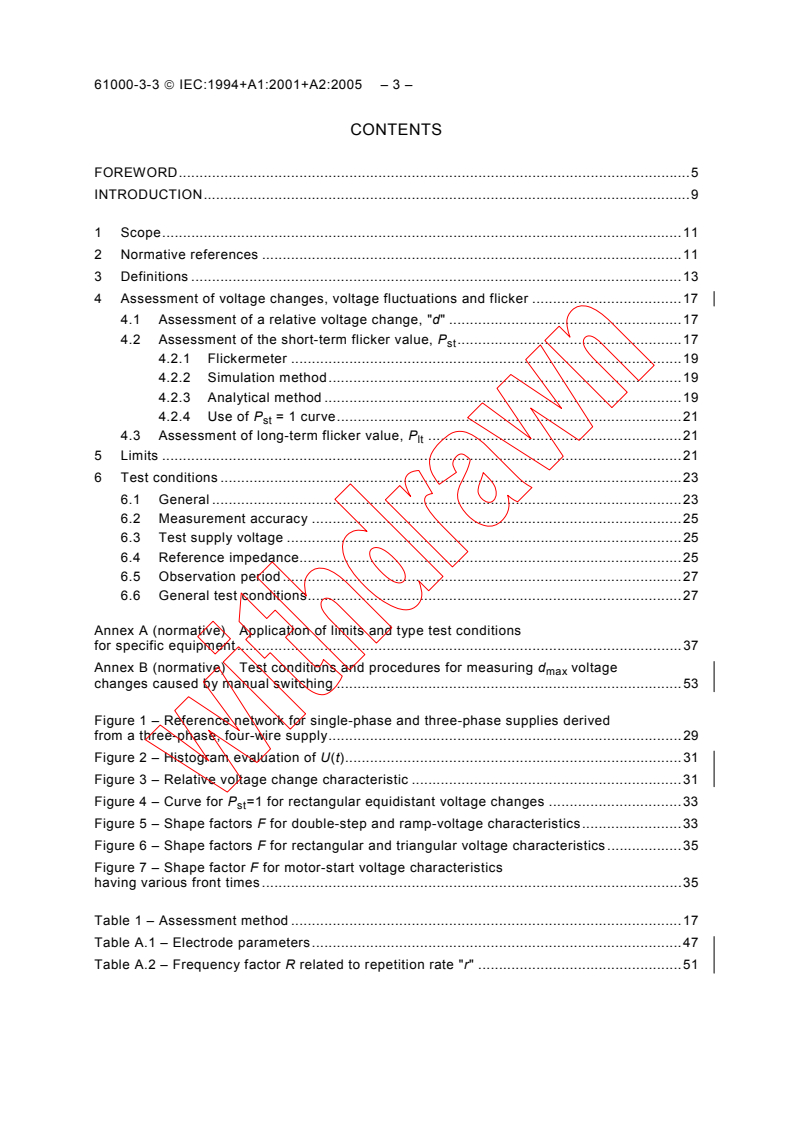
61000-3-3 IEC:1994+A1:2001 – 3 –
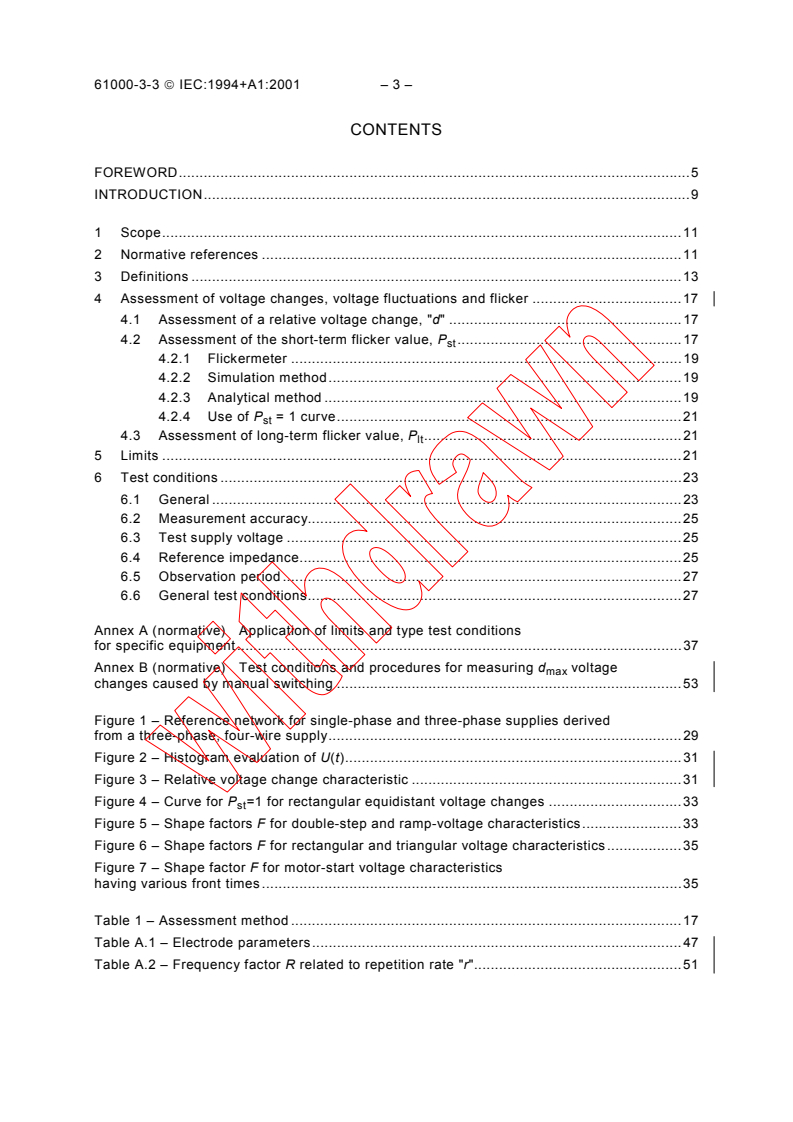
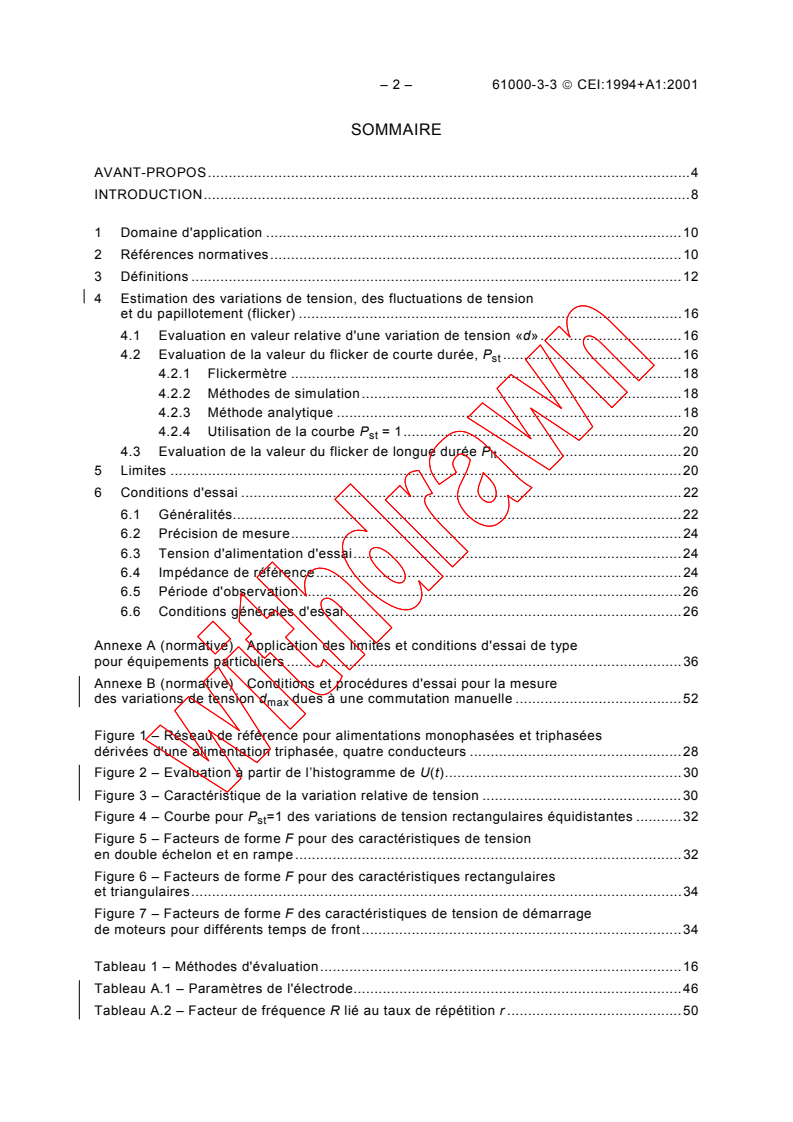
CONTENTS
FOREWORD.5
INTRODUCTION.9
1 Scope.11
2 Normative references .11
3 Definitions .13
4 Assessment of voltage changes, voltage fluctuations and flicker .17
4.1 Assessment of a relative voltage change, "d" .17
4.2 Assessment of the short-term flicker value, P .17
st
4.2.1 Flickermeter .19
4.2.2 Simulation method.19
4.2.3 Analytical method .19
4.2.4 Use of P = 1 curve.21
st
4.3 Assessment of long-term flicker value, P .21
lt
5 Limits .21
6 Test conditions .23
6.1 General .23
6.2 Measurement accuracy.25
6.3 Test supply voltage .25
6.4 Reference impedance.25
6.5 Observation period .27
6.6 General test conditions.27
Annex A (normative) Application of limits and type test conditions
for specific equipment.37
Annex B (normative) Test conditions and procedures for measuring d voltage
max
changes caused by manual switching .53
Figure 1 – Reference network for single-phase and three-phase supplies derived
from a three-phase, four-wire supply.29
Figure 2 – Histogram evaluation of U(t).31
Figure 3 – Relative voltage change characteristic .31
Figure 4 – Curve for P =1 for rectangular equidistant voltage changes .33
st
Figure 5 – Shape factors F for double-step and ramp-voltage characteristics.33
Figure 6 – Shape factors F for rectangular and triangular voltage characteristics.35
Figure 7 – Shape factor F for motor-start voltage characteristics
having various front times .35
Table 1 – Assessment method .17
Table A.1 – Electrode parameters.47
Table A.2 – Frequency factor R related to repetition rate "r".51
61000-3-3 IEC:1994+A1:2001 – 5 –
INTERNATIONAL ELECTROTECHNICAL COMMISSION
____________
ELECTROMAGNETIC COMPATIBILITY (EMC) –
Part 3-3: Limits – Limitation of voltage changes, voltage fluctuations
and flicker in public low-voltage supply systems, for equipment
with rated current ≤≤≤≤16 A per phase and not subject
to conditional connection
FOREWORD
1) The IEC (International Electrotechnical Commission) is a worldwide organization for standardization comprising
all national electrotechnical committees (IEC National Committees). The object of the IEC is to promote
international co-operation on all questions concerning standardization in the electrical and electronic fields. To
this end and in addition to other activities, the IEC publishes International Standards. Their preparation is
entrusted to technical committees; any IEC National Committee interested in the subject dealt with may
participate in this preparatory work. International, governmental and non-governmental organizations liaising
with the IEC also participate in this preparation. The IEC collaborates closely with the International
Organization for Standardization (ISO) in accordance with conditions determined by agreement between the
two organizations.
2) The formal decisions or agreements of the IEC on technical matters express, as nearly as possible, an
international consensus of opinion on the relevant subjects since each technical committee has representation
from all interested National Committees.
3) The documents produced have the form of recommendations for international use and are published in the form
of standards, technical specifications, technical reports or guides and they are accepted by the National
Committees in that sense.
4) In order to promote international unification, IEC National Committees undertake to apply IEC International
Standards transparently to the maximum extent possible in their national and regional standards. Any
divergence between the IEC Standard and the corresponding national or regional standard shall be clearly
indicated in the latter.
5) The IEC provides no marking procedure to indicate its approval and cannot be rendered responsible for any
equipment declared to be in conformity with one of its standards.
6) Attention is drawn to the possibility that some of the elements of this International Standard may be the subject
of patent rights. The IEC shall not be held responsible for identifying any or all such patent rights.
International Standard IEC 61000-3-3 has been prepared by subcommittee 77A: Low-
frequency phenomena, of IEC technical committee 77: Electromagnetic compatibility.
This consolidated version of IEC 6000-3-3 is based on the first edition (1994) [documents
77A(BC)38 and 77A(BC)40] and its amendment 1 (2001) [documents 77A/326/FDIS and
77A/328/RVD].
It bears the edition number 1.1.
A vertical line in the margin shows where the base publication has been modified by
amendment 1.
This first edition of IEC 61000-3-3 cancels and replaces IEC 60555-3, published in 1982, and
amendment 1 (1990).
Annexes A and B form an integral part of this standard.
61000-3-3 IEC:1994+A1:2001 – 7 –
The committee has decided that the contents of the base publication and its amendments will
remain unchanged until 2005. At this date, the publication will be
• reconfirmed;
• withdrawn;
• replaced by a revised edition, or
• amended.
61000-3-3 IEC:1994+A1:2001 – 9 –
INTRODUCTION
IEC 61000 is published in separate parts according to the following structure:
Part 1: General
General considerations (introduction, fundamental principles)
Definitions, terminology
Part 2: Environment
Description of the environment
Classification of the environment
Compatibility levels
Part 3: Limits
Emission limits
Immunity limits (in so far as they do not fall under the responsibility of product committees)
Part 4: Testing and measurement techniques
Measurement techniques
Testing techniques
Part 5: Installation and mitigation guidelines
Installation guidelines
Mitigation methods and devices
Part 9: Miscellaneous
Each part is further subdivided into sections which are to be published either as International
Standards or as Technical Reports.
These standards and reports will be published in chronological order and numbered
accordingly.
This part is a Product Family Standard.
The limits in this standard relate to the voltage changes experienced by consumers connected
at the interface between the public supply low-voltage network and the equipment user’s
installation. Consequently, if the actual impedance of the supply at the supply terminals of
equipment connected within the equipment user’s installation exceeds the test impedance,
it is possible that supply disturbance exceeding the limits may occur.
61000-3-3 IEC:1994+A1:2001 – 11 –
ELECTROMAGNETIC COMPATIBILITY (EMC) –
Part 3-3: Limits – Limitation of voltage changes, voltage fluctuations
and flicker in public low-voltage supply systems, for equipment
with rated current ≤≤≤≤16 A per phase and not subject
to conditional connection
1 Scope
This part of IEC 61000-3 is concerned with the limitation of voltage fluctuations and flicker
impressed on the public low-voltage system.
It specifies limits of voltage changes which may be produced by an equipment tested under
specified conditions and gives guidance on methods of assessment.
This part of IEC 61000 is applicable to electrical and electronic equipment having an input
current equal to or less than 16 A per phase, intended to be connected to public low-voltage
distribution systems of between 220 V and 250 V line to neutral at 50 Hz, and not subject to
conditional connection.
Equipment which does not comply with the limits of this part of IEC 61000 when tested with
the reference impedance Z of 6.4, and which therefore cannot be declared compliant with
ref
this part, may be retested or evaluated to show conformity with IEC 61000-3-11. Part 3-11 is
applicable to equipment with rated input current ≤75 A per phase and subject to conditional
connection.
The tests according to this part are type tests. Particular test conditions are given in annex A
and the test circuit is shown in figure 1.
NOTE The limits in this part of IEC 61000 are based mainly on the subjective severity of flicker imposed on the
light from 230 V/60 W coiled-coil filament lamps by fluctuations of the supply voltage. For systems with nominal
voltage less than 220 V line to neutral and/or frequency of 60 Hz, the limits and reference circuit values are under
consideration.
2 Normative references
The following normative documents contain provisions which, through reference in this text,
constitute provisions of this International Standard. At the time of publication, the editions
indicated were valid. All normative documents are subject to revision, and parties to
agreements based on this International Standard are encouraged to investigate the possibility
of applying the most recent editions of the normative documents indicated below. Members of
the IEC and the ISO maintain registers of currently valid International Standards.
IEC 60050(161):1990, International Electrotechnical Vocabulary (IEV) – Chapter 161:
Electromagnetic compatibility
61000-3-3 IEC:1994+A1:2001 – 13 –
IEC 60335-2-11:1993, Safety of household and similar electrical appliances – Part 2:
Particular requirements for tumbler dryers
IEC 60725:1981, Considerations on reference impedances for use in determining the
disturbance characteristics of household appliances and similar electrical equipment
1)
IEC 60868:1986, Flickermeter – Functional and design specifications
Amendment No. 1 (1990)
IEC 60974-1: Arc welding equipment – Part 1: Welding power sources
IEC 61000-3-2: Electromagnetic compatibility (EMC) – Part 3-2: Limits – Limits for harmonic
≤
current emissions (equipment input current 16 A per phase)
IEC 61000-3-5:1994, Electromagnetic compatibility (EMC) – Part 3: Limits – Section 5:
Limitations of voltage fluctuations and flicker in low-voltage power supply systems for
equipment with rated current greater than 16 A
IEC 61000-3-11: Electromagnetic compatibility (EMC) – Part 3-11: Limits – Limitation of
voltage changes, voltage fluctuations and flicker in public low-voltage supply systems –
Equipment with rated current ≤75 A and subject to conditional connection
3 Definitions
For the purpose of this part of IEC 61000-3, the following definitions apply.
3.1
r.m.s. voltage shape, U(t)
the time function of r.m.s. voltage, evaluated as a single value for each successive half period
between zero-crossings of the source voltage (see figure 2)
3.2
voltage change characteristic, ΔΔΔΔU(t)
the time function of the r.m.s. voltage change evaluated as a single value for each successive
half period between zero-crossings of the source voltage between time intervals in which the
voltage is in a steady-state condition for at least 1 s (see figure 2)
NOTE Since this characteristic is only used for assessments using calculations, the voltage in the steady-state
condition is assumed to be constant within the measurement accuracy (see 6.2).
3.3
maximum voltage change characteristic, ΔΔΔΔU
max
the difference between maximum and minimum r.m.s. values of a voltage change
characteristic (see figure 2)
________
1)
IEC 60868 will be withdrawn and replaced by IEC 61000-4-15 in 2003. Flickermeters complying with IEC 61000-4-15
may also be used for flicker measurements associated with this part of IEC 61000-3.
61000-3-3 IEC:1994+A1:2001 – 15 –
3.4
steady-state voltage change, ΔΔΔΔU
c
the difference between two adjacent steady-state voltages separated by at least one voltage
change characteristic (see figure 2)
NOTE Definitions 3.2 to 3.4 relate to absolute phase-to-neutral voltages. The ratios of these magnitudes to the
phase-to-neutral value of the nominal voltage (U ) of the reference network in figure 1 are called:
n
– relative voltage change characteristic: d(t) (definition 3.2);
– maximum relative voltage change: d (definition 3.3);
max
– relative steady-state voltage change: d (definition 3.4).
c
These definitions are explained by the example in figure 3.
3.5
voltage fluctuation
series of changes of r.m.s. voltage evaluated as a single value for each successive half-
period between zero-crossings of the source voltage
3.6
flicker
impression of unsteadiness of visual sensation induced by a light stimulus whose luminance
or spectral distribution fluctuates with time. [IEV 161-08-13]
3.7
short-term flicker indicator, P
st
the flicker severity evaluated over a short period (in minutes); P = 1 is the conventional
st
threshold of irritability
3.8
long-term flicker indicator, P
lt
the flicker severity evaluated over a long period (a few hours) using successive P values
st
3.9
flickermeter:
an instrument designed to measure any quantity representative of flicker
NOTE Measurements are normally P and P . [IEV 161-08-14]
st lt
3.10
flicker impression time, t
f
value with a time dimension which describes the flicker impression of a voltage change
characteristic
3.11
conditional connection
connection of equipment requiring the user’s supply at the interface point to have an
impedance lower than the reference impedance Z in order that the equipment emissions
ref
comply with the limits in this part.
NOTE Meeting the voltage change limits may not be the only condition for connection; emission limits for other
phenomena such as harmonics, may also have to be satisfied.
3.12
interface point
interface between a public supply network and a user’s installation
61000-3-3 IEC:1994+A1:2001 – 17 –
4 Assessment of voltage changes, voltage fluctuations and flicker
4.1 Assessment of a relative voltage change, "d"
The basis for flicker evaluation is the voltage change characteristic at the terminals of
the equipment under test, that is the difference ΔU of any two successive values of the phase-
to-neutral voltages U(t ) and U(t ):
1 2
ΔU = U(t ) – U(t)(1)
1 2
The r.m.s. values U(t ), U(t ) of the voltage shall be measured or calculated. When deducing
1 2
r.m.s. values from oscillographic waveform, account should be taken of any waveform
distortion that may be present. The voltage change ΔU is due to the change of the voltage
drop across the complex reference impedance Z, caused by the complex fundamental input
current change, ΔI, of the equipment under test. ΔI and ΔI are the active and reactive parts
p q
respectively of the current change, ΔI.
ΔI = ΔI
– j · ΔI = I(t ) – I(t)(2)
p q 1 2
NOTE 1 I is positive for lagging currents and negative for leading currents.
q
NOTE 2 If the harmonic distortion of the currents I(t ) and I(t ) is less than 10 %, the total r.m.s. value may be
1 2
applied instead of the r.m.s. values of their fundamental currents.
NOTE 3 For single-phase and symmetrical three-phase equipment the voltage change can, provided X is positive
(inductive), be approximated to:
ΔU = ΔI · R + ΔI · X (3)
p q
where
ΔI and ΔI are the active and reactive parts respectively of the current change ΔI;
p q
R and X are the elements of the complex reference impedance Z (see figure 1).
The relative voltage change is given by:
"d" = ΔU/U (4)
n
4.2 Assessment of the short-term flicker value, P
st
The short-term flicker value P is defined in amendment 1 to IEC 60868.
st
Table 1 shows alternative methods for evaluating P , due to voltage fluctuations of different
st
types:
Table 1 – Assessment method
Types of voltage fluctuations Methods of evaluation P
st
All voltage fluctuataions
Direct measurement
(on-line evaluation)
All voltage fluctuations where U(t) is defined Simulation
Direct measurement
Voltage change characteristics according Analytical method
to figures 5 to 7 with an occurrence rate Simulation
less than 1 per second Direct measurement
Rectangular voltage change at equal intervals Use of the P = 1 curve of figure 4
st
61000-3-3 IEC:1994+A1:2001 – 19 –
4.2.1 Flickermeter
All types of voltage fluctuations may be assessed by direct measurement using a flickermeter
which complies with the specification given in IEC 60868, and is connected as described in
clause 6 of this part. This is the reference method for application of the limits.
4.2.2 Simulation method
In the case where the relative voltage change characteristic d(t) is known, P can be
st
evaluated using a computer simulation.
4.2.3 Analytical method
For voltage change characteristics of the types shown in figures 5, 6 and 7, the P value can
st
be evaluated by an analytical method using equations (5) and (6).
NOTE 1 The value of P obtained using this method is expected to be within ±10 % of the result which would be
st
obtained by direct measurement (reference method).
NOTE 2 This method is not recommended if the time duration between the end of one voltage change and the
start of the next is less than 1 s.
4.2.3.1 Description of the analytical method
Each relative voltage change characterisitic shall be expressed by a flicker impression time,
t , in seconds:
f
3,2
t = 2,3 (F · d ) (5)
f max
– the maximum relative voltage change d is expressed as a percentage of the nominal
max
voltage;
– the shape factor, F, is associated with the shape of the voltage change characteristic
(see 4.2.3.2).
The sum of the flicker impression times, Σt , of all evaluation periods within a total interval of
f
the length T , in seconds, is the basis for the P evaluation. If the total time interval T is
p st p
chosen according to 6.5, it is an "observation period", and:
1/3,2
P = (Σt /T ) (6)
st f p
4.2.3.2 Shape factor
The shape factor, F, converts a relative voltage change characteristic d(t) into a flicker
equivalent relative step voltage change (F · d ).
max
NOTE 1 The shape factor, F, is equal to 1,0 for step voltage changes.
NOTE 2 The relative voltage change characteristic may be measured directly (see figure 1) or calculated from the
r.m.s. current of the equipment under test (see equations (1) to (4)).
The relative voltage change characteristic shall be obtained from a histogram of U(t)
(see figure 3).
The shape factor may be deduced from figures 5, 6 and 7, provided that the relative voltage
change characteristic matches a characteristic shown in the figures. If the characteristics
match, proceed as follows:
61000-3-3 IEC:1994+A1:2001 – 21 –
– find the maximum relative voltage change d (according to figure 3); and
max
– find the time T(ms) appropriate to the voltage change characteristic as shown in figures 5,
6 and 7 and, using this value, obtain the required shape factor, F.
NOTE 3 Extrapolation outside the range of the figures may lead to unacceptable errors.
4.2.4 Use of P = 1 curve
st
In the case of rectangular voltage changes of the same amplitude "d" separated by equal time
intervals, the curve of figure 4 may be used to deduce the amplitude corresponding to P = 1
st
for a particular rate of repetition; this amplitude is called d . The P value corresponding to
lim st
the voltage change "d" is then given by P = d/d .
st lim
4.3 Assessment of long-term flicker value, P
lt
The long-term flicker value P is defined in IEC 60868, appendix A.2, and shall be applied
lt
with the value of N = 12 (see 6.5).
It is generally necessary to assess the value of P for equipment which is normally operated
lt
for more than 30 min at a time.
5 Limits
The limits shall be applicable to voltage fluctuations and flicker at the supply terminals of the
equipment under test, measured or calculated according to clause 4 under test conditions
described in clause 6 and annex A. Tests made to prove compliance with the limits are
considered to be type tests.
The following limits apply:
– the value of P shall not be greater than 1,0;
st
– the value of P shall not be greater than 0,65;
lt
– the value of d(t) during a voltage change shall not exceed 3,3 % for more than 500 ms;
– the relative steady-state voltage change, d , shall not exceed 3,3 %;
c
– the maximum relative voltage change d , shall not exceed
max
a) 4 % without additional conditions;
b) 6 % for equipment which is:
– switched manually, or
– switched automatically more frequently than twice per day, and also has either a
delayed restart (the delay being not less than a few tens of seconds), or manual
restart, after a power supply interruption.
NOTE The cycling frequency will be further limited by the P and P limit. For example: a d of 6 % producing a
st lt max
rectangular voltage change characteristic twice per hour will give a P of about 0,65.
lt
61000-3-3 IEC:1994+A1:2001 – 23 –
c) 7 % for equipment which is
– attended whilst in use (for example: hair dryers, vacuum cleaners, kitchen
equipment such as mixers, garden equipment such as lawn mowers, portable tools
such as electric drills), or
– switched on automatically, or is intended to be switched on manually, no more than
twice per day, and also has either a delayed restart (the delay being not less than a
few tens of seconds) or manual restart, after a power supply interruption.
In the case of equipment having several separately controlled circuits in accordance with 6.6,
limits b) and c) shall apply only if there is delayed or manual restart after a power supply
interruption; for all equipment with automatic switching which is energised immediately on
restoration of supply after a power supply interruption, limits a) shall apply; for all equipment
with manual switching, limits b) or c) shall apply depending on the rate of switching.
P and P requirements shall not be applied to voltage changes caused by manual switching.
st lt
The limits shall not be applied to voltage changes associated with emergency switching or
emergency interruptions.
6 Test conditions
6.1 General
Tests need not be made on equipment which is unlikely to produce significant voltage
fluctuations or flicker.
It may be necessary to determine, by examination of the circuit diagram and specification of
the equipment and by a short functional test, whether significant voltage fluctuations are likely
to be produced.
For voltage changes caused by manual switching, equipment is deemed to comply without
further testing if the maximum r.m.s. input current (including inrush current) evaluated over
each 10 ms half-period between zero-crossings does not exceed 20 A, and the supply current
after inrush is within a variation band of 1,5 A.
If measurement methods are used, the maximum relative voltage change d caused by
max
manual switching shall be measured in accordance with annex B.
Tests to prove the compliance of the equipment with the limits shall be made using the test
circuit in figure 1.
The test circuit consists of:
– the test supply voltage (see 6.3);
– the reference impedance (see 6.4);
– the equipment under
...
INTERNATIONAL IEC
STANDARD 61000-3-3
Edition 1.2
2005-10
Edition 1:1994 consolidated with amendments 1:2001 and 2:2005
Electromagnetic compatibility (EMC) –
Part 3-3:
Limits – Limitation of voltage changes,
voltage fluctuations and flicker in public
low-voltage supply systems, for equipment
with rated current ≤16 A per phase and
not subject to conditional connection
This English-language version is derived from the original
bilingual publication by leaving out all French-language
pages. Missing page numbers correspond to the French-
language pages.
Reference number
Publication numbering
As from 1 January 1997 all I EC publications are issued with a designation in the
60000 series. For example, IEC 34-1 is now referred to as IEC 60034-1.
Consolidated editions
The IEC is now publishing consolidated versions of its publications. For example,
edition numbers 1.0, 1.1 and 1.2 refer, respectively, to the base publication, the
base publication incorporating amendment 1 and the base publication incorporating
amendments 1 and 2.
Further information on IEC publications
The technical content of IEC publications is kept under constant review by the IEC,
thus ensuring that the content reflects current technology. Information relating to
this publication, including its validity, is available in the IEC Catalogue of
publications (see below) in addition to new editions, amendments and corrigenda.
Information on the subjects under consideration and work in progress und ertaken
by the technical committee which has prepared this publication, as well as the list
of publications issued, is also available from the following:
• IEC Web Site (www.iec.ch)
• Catalogue of IEC publications
The on-line catalogue on the IEC web site ( www.iec.ch/searchpub) enables you to
search by a variety of criteria including text searches, technical committees
and date of publication. On-line information is also available on recently issued
publications, withdrawn and replaced publications, as well as corrigenda.
• IEC Just Published
This summary of recently issued publications ( www.iec.ch/online_news/ justpub)
is also available by email. Please contact the Customer Service Centre (see
below) for further information.
• Customer Service Centre
If you have any questions regarding this publication or need further assistance,
please contact the Customer Service Centre:
Email: custserv@iec.ch
Tel: +41 22 919 02 11
Fax: +41 22 919 03 00
INTERNATIONAL IEC
STANDARD 61000-3-3
Edition 1.2
2005-10
Edition 1:1994 consolidated with amendments 1:2001 and 2:2005
Electromagnetic compatibility (EMC) –
Part 3-3:
Limits – Limitation of voltage changes,
voltage fluctuations and flicker in public
low-voltage supply systems, for equipment
with rated current ≤16 A per phase and
not subject to conditional connection
IEC 2005 Copyright - all rights reserved
No part of this publication may be reproduced or utilized in any form or by any means, electronic or mechanical,
including photocopying and microfilm, without permission in writing from the publisher.
International Electrotechnical Commission, 3, rue de Varembé, PO Box 131, CH-1211 Geneva 20, Switzerland
Telephone: +41 22 919 02 11 Telefax: +41 22 919 03 00 E-mail: inmail@iec.ch Web: www.iec.ch
PRICE CODE
CM
Commission Electrotechnique Internationale
International Electrotechnical Commission
МеждународнаяЭлектротехническаяКомиссия
For price, see current catalogue
61000-3-3 IEC:1994+A1:2001+A2:2005 – 3 –
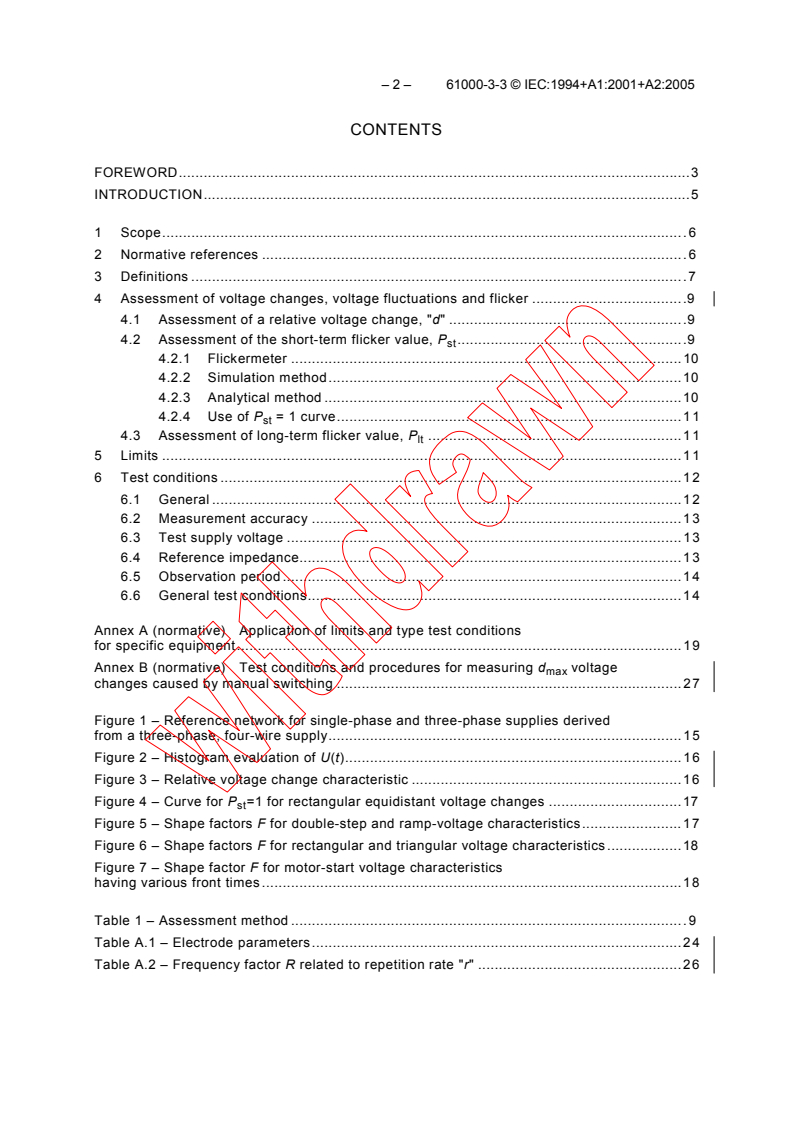
CONTENTS
FOREWORD.5
INTRODUCTION.9
1 Scope.11
2 Normative references.11
3 Definitions.13
4 Assessment of voltage changes, voltage fluctuations and flicker .17
4.1 Assessment of a relative voltage change, "d" .17
......................................................17
4.2 Assessment of the short-term flicker value, P
st
4.2.1 Flickermeter.19
4.2.2 Simulation method.19
4.2.3 Analytical method.19
4.2.4 Use of P = 1 curve.21
st
4.3 Assessment of long-term flicker value, P .21
lt
5 Limits.21
6 Test conditions.23
6.1 General.23
6.2 Measurement accuracy.25
6.3 Test supply voltage.25
6.4 Reference impedance.25
6.5 Observation period.27
6.6 General test conditions.27
Annex A (normative) Application of limits and type test conditions
for specific equipment.37
Annex B (normative) Test conditions and procedures for measuring d voltage
max
changes caused by manual switching .53
Figure 1 – Reference network for single-phase and three-phase supplies derived
from a three-phase, four-wire supply.29
Figure 2 – Histogram evaluation of U(t).31
Figure 3 – Relative voltage change characteristic .31
Figure 4 – Curve for P =1 for rectangular equidistant voltage changes .33
st
Figure 5 – Shape factors F for double-step and ramp-voltage characteristics.33
Figure 6 – Shape factors F for rectangular and triangular voltage characteristics.35
Figure 7 – Shape factor F for motor-start voltage characteristics
having various front times .35
Table 1 – Assessment method .17
Table A.1 – Electrode parameters.47
Table A.2 – Frequency factor R related to repetition rate "r" .51
61000-3-3 © IEC:1994+A1:2001+A2:2005 – 5 –
INTERNATIONAL ELECTROTECHNICAL COMMISSION
____________
ELECTROMAGNETIC COMPATIBILITY (EMC) –
Part 3-3: Limits – Limitation of voltage changes, voltage fluctuations
and flicker in public low-voltage supply systems, for equipment
with rated current ≤16 A per phase and not subject
to conditional connection
FOREWORD
1) The International Electrotechnical Commission (IEC) is a worldwide organization for standardization comprising
all national electrotechnical committees (IEC National Committees). The object of IEC is to promote
international co-operation on all questions concerning standardization in the electrical and electronic fields. To
this end and in addition to other activities, IEC publishes International Standards, Technical Specifications,
Technical Reports, Publicly Available Specifications (PAS) and Guides (hereafter referred to as “IEC
Publication(s)”). Their preparation is entrusted to technical committees; any IEC National Committee interested
in the subject dealt with may participate in this preparatory work. International, governmental and non-
governmental organizations liaising with the IEC also participate in this preparation. IEC collaborates closely
with the International Organization for Standardization (ISO) in accordance with conditions determined by
agreement between the two organizations.
2) The formal decisions or agreements of IEC on technical matters express, as nearly as possible, an international
consensus of opinion on the relevant subjects since each technical committee has representation from all
interested IEC National Committees.
3) IEC Publications have the form of recommendations for international use and are accepted by IEC National
Committees in that sense. While all reasonable efforts are made to ensure that the technical content of IEC
Publications is accurate, IEC cannot be held responsible for the way in which they are used or for any
misinterpretation by any end user.
4) In order to promote international uniformity, IEC National Committees undertake to apply IEC Publications
transparently to the maximum extent possible in their national and regional publications. Any divergence
between any IEC Publication and the corresponding national or regional publication shall be clearly indicated in
the latter.
5) IEC provides no marking procedure to indicate its approval and cannot be rendered responsible for any
equipment declared to be in conformity with an IEC Publication.
6) All users should ensure that they have the latest edition of this publication.
7) No liability shall attach to IEC or its directors, employees, servants or agents including individual experts and
members of its technical committees and IEC National Committees for any personal injury, property damage or
other damage of any nature whatsoever, whether direct or indirect, or for costs (including legal fees) and
expenses arising out of the publication, use of, or reliance upon, this IEC Publication or any other IEC
Publications.
8) Attention is drawn to the Normative references cited in this publication. Use of the referenced publications is
indispensable for the correct application of this publication.
9) Attention is drawn to the possibility that some of the elements of this IEC Publication may be the subject of
patent rights. IEC shall not be held responsible for identifying any or all such patent rights.
International Standard IEC 61000-3-3 has been prepared by subcommittee 77A: Low-
frequency phenomena, of IEC technical committee 77: Electromagnetic compatibility.
This consolidated version of IEC 61000-3-3 consists of the first edition (1994) [documents
77A(BC)38 and 77A(BC)40], its amendment 1 (2001) [documents 77A/326/FDIS and
77A/328/RVD] and its amendment 2 (2005) [documents 77A/493/FDIS and 77A/502/RVD].
The technical content is therefore identical to the base edition and its amendments and has
been prepared for user convenience.
It bears the edition number 1.2.
A vertical line in the margin shows where the base publication has been modified by
amendments 1 et 2.
61000-3-3 IEC:1994+A1:2001+A2:2005 – 7 –
Annexes A and B form an integral part of this standard.
The committee has decided that the contents of the base publication and its amendments will
remain unchanged until the maintenance result date indicated on the IEC web site under
"http://webstore.iec.ch" in the data related to the specific publication. At this date,
the publication will be
• reconfirmed,
• withdrawn,
• replaced by a revised edition, or
• amended.
61000-3-3 IEC:1994+A1:2001+A2:2005 – 9 –
INTRODUCTION
IEC 61000 is published in separate parts according to the following structure:
Part 1: General
General considerations (introduction, fundamental principles)
Definitions, terminology
Part 2: Environment
Description of the environment
Classification of the environment
Compatibility levels
Part 3: Limits
Emission limits
Immunity limits (in so far as they do not fall under the responsibility of product committees)
Part 4: Testing and measurement techniques
Measurement techniques
Testing techniques
Part 5: Installation and mitigation guidelines
Installation guidelines
Mitigation methods and devices
Part 9: Miscellaneous
Each part is further subdivided into sections which are to be published either as International
Standards or as Technical Reports.
These standards and reports will be published in chronological order and numbered
accordingly.
This part is a Product Family Standard.
The limits in this standard relate to the voltage changes experienced by consumers connected
at the interface between the public supply low-voltage network and the equipment user’s
installation. Consequently, if the actual impedance of the supply at the supply terminals of
equipment connected within the equipment user’s installation exceeds the test impedance,
it is possible that supply disturbance exceeding the limits may occur.
61000-3-3 IEC:1994+A1:2001+A2:2005 – 11 –
ELECTROMAGNETIC COMPATIBILITY (EMC) –
Part 3-3: Limits – Limitation of voltage changes, voltage fluctuations
and flicker in public low-voltage supply systems, for equipment
with rated current ≤16 A per phase and not subject
to conditional connection
1 Scope
This part of IEC 61000 is concerned with the limitation of voltage fluctuations and flicker
impressed on the public low-voltage system.
It specifies limits of voltage changes which may be produced by an equipment tested under
specified conditions and gives guidance on methods of assessment.
This part of IEC 61000 is applicable to electrical and electronic equipment having an input
current equal to or less than 16 A per phase, intended to be connected to public low-voltage
distribution systems of between 220 V and 250 V line to neutral at 50 Hz, and not subject to
conditional connection.
Equipment which does not comply with the limits of this part of IEC 61000 when tested with
the reference impedance Z of 6.4, and which therefore cannot be declared compliant with
ref
this part, may be retested or evaluated to show conformity with IEC 61000-3-11. Part 3-11 is
applicable to equipment with rated input current ≤75 A per phase and subject to conditional
connection.
The tests according to this part are type tests. Particular test conditions are given in annex A
and the test circuit is shown in figure 1.
NOTE The limits in this part of IEC 61000 are based mainly on the subjective severity of flicker imposed on the
light from 230 V/60 W coiled-coil filament lamps by fluctuations of the supply voltage. For systems with nominal
voltage less than 220 V line to neutral and/or frequency of 60 Hz, the limits and reference circuit values are under
consideration.
2 Normative references
The following referenced documents are indispensable for the application of this document.
For dated references, only the edition cited applies. For undated references, the latest edition
of the referenced document (including any amendments) applies.
IEC 60050(161):1990, International Electrotechnical Vocabulary (IEV) – Chapter 161:
Electromagnetic compatibility
61000-3-3 IEC:1994+A1:2001+A2:2005 – 13 –
IEC 60335-2-11:1993, Safety of household and similar electrical appliances – Part 2:
Particular requirements for tumbler dryers
IEC 60725:1981, Considerations on reference impedances for use in determining the
disturbance characteristics of household appliances and similar electrical equipment
1)
IEC 60868:1986, Flickermeter – Functional and design specifications
Amendment No. 1 (1990)
IEC 60974-1: Arc welding equipment – Part 1: Welding power sources
IEC 61000-3-2: Electromagnetic compatibility (EMC) – Part 3-2: Limits – Limits for harmonic
≤16 A per phase)
current emissions (equipment input current
IEC 61000-3-5:1994, Electromagnetic compatibility (EMC) – Part 3: Limits – Section 5:
Limitations of voltage fluctuations and flicker in low-voltage power supply systems for
equipment with rated current greater than 16 A
IEC 61000-3-11: Electromagnetic compatibility (EMC) – Part 3-11: Limits – Limitation of
voltage changes, voltage fluctuations and flicker in public low-voltage supply systems –
Equipment with rated current ≤75 A and subject to conditional connection
3 Definitions
For the purpose of this part of IEC 61000-3, the following definitions apply.
3.1
r.m.s. voltage shape, U(t)
the time function of r.m.s. voltage, evaluated as a single value for each successive half period
between zero-crossings of the source voltage (see figure 2)
3.2
voltage change characteristic, ΔU(t)
the time function of the r.m.s. voltage change evaluated as a single value for each successive
half period between zero-crossings of the source voltage between time intervals in which the
voltage is in a steady-state condition for at least 1 s (see figure 2)
NOTE Since this characteristic is only used for assessments using calculations, the voltage in the steady-state
condition is assumed to be constant within the measurement accuracy (see 6.2).
3.3
maximum voltage change characteristic, ΔU
max
the difference between maximum and minimum r.m.s. values of a voltage change
characteristic (see figure 2)
________
1)
IEC 60868 will be withdrawn and replaced by IEC 61000-4-15 in 2003. Flickermeters complying with IEC 61000-4-15
may also be used for flicker measurements associated with this part of IEC 61000-3.
61000-3-3 IEC:1994+A1:2001+A2:2005 – 15 –
3.4
steady-state voltage change, ΔU
c
the difference between two adjacent steady-state voltages separated by at least one voltage
change characteristic (see figure 2)
NOTE Definitions 3.2 to 3.4 relate to absolute phase-to-neutral voltages. The ratios of these magnitudes to the
phase-to-neutral value of the nominal voltage (U ) of the reference network in figure 1 are called:
n
– relative voltage change characteristic: d(t) (definition 3.2);
– maximum relative voltage change: d (definition 3.3);
max
– relative steady-state voltage change: d (definition 3.4).
c
These definitions are explained by the example in figure 3.
3.5
voltage fluctuation
series of changes of r.m.s. voltage evaluated as a single value for each successive half-
period between zero-crossings of the source voltage
3.6
flicker
impression of unsteadiness of visual sensation induced by a light stimulus whose luminance
or spectral distribution fluctuates with time. [IEV 161-08-13]
3.7
short-term flicker indicator, P
st
the flicker severity evaluated over a short period (in minutes); P = 1 is the conventional
st
threshold of irritability
3.8
long-term flicker indicator, P
lt
the flicker severity evaluated over a long period (a few hours) using successive P values
st
3.9
flickermeter:
an instrument designed to measure any quantity representative of flicker
NOTE Measurements are normally P and P . [IEV 161-08-14]
st lt
3.10
flicker impression time, t
f
value with a time dimension which describes the flicker impression of a voltage change
characteristic
3.11
conditional connection
connection of equipment requiring the user’s supply at the interface point to have an
impedance lower than the reference impedance Z in order that the equipment emissions
ref
comply with the limits in this part.
NOTE Meeting the voltage change limits may not be the only condition for connection; emission limits for other
phenomena such as harmonics, may also have to be satisfied.
3.12
interface point
interface between a public supply network and a user’s installation
61000-3-3 IEC:1994+A1:2001+A2:2005 – 17 –
4 Assessment of voltage changes, voltage fluctuations and flicker
4.1 Assessment of a relative voltage change, "d"
The basis for flicker evaluation is the voltage change characteristic at the terminals of
the equipment under test, that is the difference ΔU of any two successive values of the phase-
to-neutral voltages U(t ) and U(t ):
1 2
ΔU = U(t ) – U(t) (1)
1 2
The r.m.s. values U(t ), U(t ) of the voltage shall be measured or calculated. When deducing
1 2
r.m.s. values from oscillographic waveform, account should be taken of any waveform
distortion that may be present. The voltage change ΔU is due to the change of the voltage
drop across the complex reference impedance Z, caused by the complex fundamental input
current change, ΔI, of the equipment under test. ΔI and ΔI are the active and reactive parts
p q
respectively of the current change, ΔI.
ΔI = ΔI – j · ΔI = I(t ) – I(t) (2)
p q 1 2
NOTE 1 I is positive for lagging currents and negative for leading currents.
q
NOTE 2 If the harmonic distortion of the currents I(t ) and I(t ) is less than 10 %, the total r.m.s. value may be
1 2
applied instead of the r.m.s. values of their fundamental currents.
NOTE 3 For single-phase and symmetrical three-phase equipment the voltage change can, provided X is positive
(inductive), be approximated to:
ΔU = ΔI · R + ΔI · X (3)
p q
where
ΔI and ΔI are the active and reactive parts respectively of the current change ΔI;
p q
R and X are the elements of the complex reference impedance Z (see figure 1).
The relative voltage change is given by:
"d" = ΔU/U (4)
n
4.2 Assessment of the short-term flicker value, P
st
The short-term flicker value P is defined in amendment 1 to IEC 60868.
st
Table 1 shows alternative methods for evaluating P , due to voltage fluctuations of different
st
types:
Table 1 – Assessment method
Types of voltage fluctuations Methods of evaluation P
st
All voltage fluctuataions
Direct measurement
(on-line evaluation)
All voltage fluctuations where U(t) is defined Simulation
Direct measurement
Voltage change characteristics according Analytical method
to figures 5 to 7 with an occurrence rate Simulation
less than 1 per second Direct measurement
Rectangular voltage change at equal intervals Use of the P = 1 curve of figure 4
st
61000-3-3 IEC:1994+A1:2001+A2:2005 – 19 –
4.2.1 Flickermeter
All types of voltage fluctuations may be assessed by direct measurement using a flickermeter
which complies with the specification given in IEC 60868, and is connected as described in
clause 6 of this part. This is the reference method for application of the limits.
4.2.2 Simulation method
In the case where the relative voltage change characteristic d(t) is known, P can be
st
evaluated using a computer simulation.
4.2.3 Analytical method
For voltage change characteristics of the types shown in figures 5, 6 and 7, the P value can
st
be evaluated by an analytical method using equations (5) and (6).
NOTE 1 The value of P obtained using this method is expected to be within ±10 % of the result which would be
st
obtained by direct measurement (reference method).
NOTE 2 This method is not recommended if the time duration between the end of one voltage change and the
start of the next is less than 1 s.
4.2.3.1 Description of the analytical method
Each relative voltage change characterisitic shall be expressed by a flicker impression time,
t , in seconds:
f
3,2
t = 2,3 (F · d ) (5)
f max
– the maximum relative voltage change d is expressed as a percentage of the nominal
max
voltage;
– the shape factor, F, is associated with the shape of the voltage change characteristic
(see 4.2.3.2).
The sum of the flicker impression times, Σt , of all evaluation periods within a total interval of
f
the length T , in seconds, is the basis for the P evaluation. If the total time interval T is
p st p
chosen according to 6.5, it is an "observation period", and:
1/3,2
P = (Σt /T ) (6)
st f p
4.2.3.2 Shape factor
The shape factor, F, converts a relative voltage change characteristic d(t) into a flicker
equivalent relative step voltage change (F · d ).
max
NOTE 1 The shape factor, F, is equal to 1,0 for step voltage changes.
NOTE 2 The relative voltage change characteristic may be measured directly (see figure 1) or calculated from the
r.m.s. current of the equipment under test (see equations (1) to (4)).
The relative voltage change characteristic shall be obtained from a histogram of U(t)
(see figure 3).
The shape factor may be deduced from figures 5, 6 and 7, provided that the relative voltage
change characteristic matches a characteristic shown in the figures. If the characteristics
match, proceed as follows:
61000-3-3 IEC:1994+A1:2001+A2:2005 – 21 –
– find the maximum relative voltage change d (according to figure 3); and
max
– find the time T(ms) appropriate to the voltage change characteristic as shown in figures 5,
6 and 7 and, using this value, obtain the required shape factor, F.
NOTE 3 Extrapolation outside the range of the figures may lead to unacceptable errors.
4.2.4 Use of P = 1 curve
st
In the case of rectangular voltage changes of the same amplitude "d" separated by equal time
intervals, the curve of figure 4 may be used to deduce the amplitude corresponding to P = 1
st
for a particular rate of repetition; this amplitude is called d . The P value corresponding to
lim st
the voltage change "d" is then given by P = d/d .
st lim
4.3 Assessment of long-term flicker value, P
lt
The long-term flicker value P is defined in IEC 60868, appendix A.2, and shall be applied
lt
with the value of N = 12 (see 6.5).
It is generally necessary to assess the value of P for equipment which is normally operated
lt
for more than 30 min at a time.
5 Limits
The limits shall be applicable to voltage fluctuations and flicker at the supply terminals of the
equipment under test, measured or calculated according to clause 4 under test conditions
described in clause 6 and annex A. Tests made to prove compliance with the limits are
considered to be type tests.
The following limits apply:
– the value of P shall not be greater than 1,0;
st
– the value of P shall not be greater than 0,65;
lt
– the value of d(t) during a voltage change shall not exceed 3,3 % for more than 500 ms;
– the relative steady-state voltage change, d , shall not exceed 3,3 %;
c
– the maximum relative voltage change d , shall not exceed
max
a) 4 % without additional conditions;
b) 6 % for equipment which is:
– switched manually, or
– switched automatically more frequently than twice per day, and also has either a
delayed restart (the delay being not less than a few tens of seconds), or manual
restart, after a power supply interruption.
NOTE The cycling frequency will be further limited by the P and P limit. For example: a d of 6 % producing a
st lt max
rectangular voltage change characteristic twice per hour will give a Plt of about 0,65.
61000-3-3 IEC:1994+A1:2001+A2:2005 – 23 –
c) 7 % for equipment which is
– attended whilst in use (for example: hair dryers, vacuum cleaners, kitchen
equipment such as mixers, ga
...
NORME CEI
INTERNATIONALE
61000-3-3
Edition 1.1
2002-03
Edition 1:1994 consolidée par l’amendement 1:2001
Compatibilité électromagnétique (CEM) –
Partie 3-3:
Limites – Limitation des variations de tension,
des fluctuations de tension et du papillotement
dans les réseaux publics d'alimentation basse
tension, pour les matériels ayant un courant
assigné ≤≤≤≤16 A par phase et non soumis à
un raccordement conditionnel
Cette version française découle de la publication d’origine
bilingue dont les pages anglaises ont été supprimées.
Les numéros de page manquants sont ceux des pages
supprimées.
Numéro de référence
CEI 61000-3-3:1994+A1:2001(F)
Numérotation des publications
Depuis le 1er janvier 1997, les publications de la CEI sont numérotées à partir de
60000. Ainsi, la CEI 34-1 devient la CEI 60034-1.
Editions consolidées
Les versions consolidées de certaines publications de la CEI incorporant les
amendements sont disponibles. Par exemple, les numéros d’édition 1.0, 1.1 et 1.2
indiquent respectivement la publication de base, la publication de base incorporant
l’amendement 1, et la publication de base incorporant les amendements 1 et 2
Informations supplémentaires sur les publications de la CEI
Le contenu technique des publications de la CEI est constamment revu par la CEI
afin qu'il reflète l'état actuel de la technique. Des renseignements relatifs à cette
publication, y compris sa validité, sont disponibles dans le Catalogue des
publications de la CEI (voir ci-dessous) en plus des nouvelles éditions, amende-
ments et corrigenda. Des informations sur les sujets à l’étude et l’avancement des
travaux entrepris par le comité d’études qui a élaboré cette publication, ainsi que la
liste des publications parues, sont également disponibles par l’intermédiaire de:
• Site web de la CEI (www.iec.ch)
• Catalogue des publications de la CEI
Le catalogue en ligne sur le site web de la CEI (www.iec.ch/searchpub) vous permet
de faire des recherches en utilisant de nombreux critères, comprenant des
recherches textuelles, par comité d’études ou date de publication. Des informations
en ligne sont également disponibles sur les nouvelles publications, les publications
remplacées ou retirées, ainsi que sur les corrigenda.
• IEC Just Published
Ce résumé des dernières publications parues (www.iec.ch/online_news/justpub)
est aussi disponible par courrier électronique. Veuillez prendre contact avec le
Service client (voir ci-dessous) pour plus d’informations.
• Service clients
Si vous avez des questions au sujet de cette publication ou avez besoin de
renseignements supplémentaires, prenez contact avec le Service clients:
Email: custserv@iec.ch
Tél: +41 22 919 02 11
Fax: +41 22 919 03 00
NORME CEI
INTERNATIONALE
61000-3-3
Edition 1.1
2002-03
Edition 1:1994 consolidée par l’amendement 1:2001
Compatibilité électromagnétique (CEM) –
Partie 3-3:
Limites – Limitation des variations de tension,
des fluctuations de tension et du papillotement
dans les réseaux publics d'alimentation basse
tension, pour les matériels ayant un courant
assigné ≤≤≤≤16 A par phase et non soumis à
un raccordement conditionnel
IEC 2002 Droits de reproduction réservés
Aucune partie de cette publication ne peut être reproduite ni utilisée sous quelque forme que ce soit et par aucun
procédé, électronique ou mécanique, y compris la photocopie et les microfilms, sans l'accord écrit de l'éditeur.
International Electrotechnical Commission, 3, rue de Varembé, PO Box 131, CH-1211 Geneva 20, Switzerland
Telephone: +41 22 919 02 11 Telefax: +41 22 919 03 00 E-mail: inmail@iec.ch Web: www.iec.ch
CODE PRIX
U
Commission Electrotechnique Internationale
International Electrotechnical Commission
Международная Электротехническая Комиссия
Pour prix, voir catalogue en vigueur
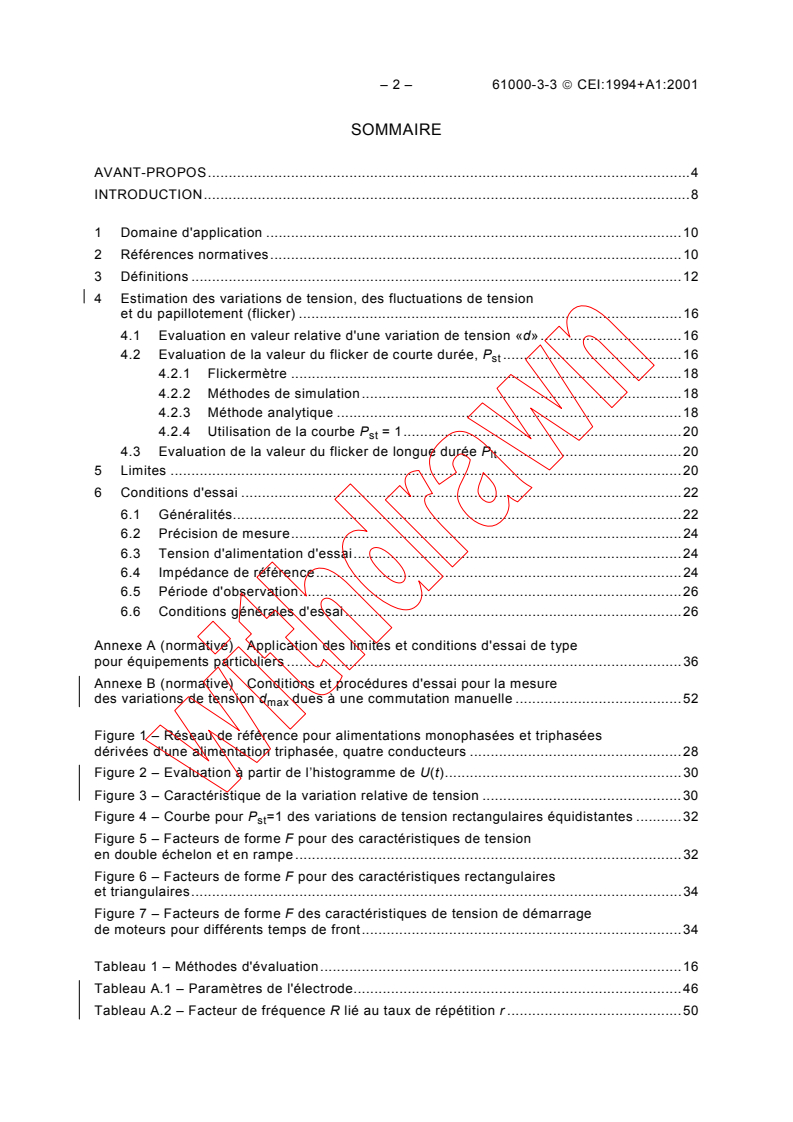
– 2 – 61000-3-3 CEI:1994+A1:2001
SOMMAIRE
AVANT-PROPOS.4
INTRODUCTION.8
1 Domaine d'application .10
2 Références normatives.10
3 Définitions .12
4 Estimation des variations de tension, des fluctuations de tension
et du papillotement (flicker) .16
4.1 Evaluation en valeur relative d'une variation de tension «d».16
4.2 Evaluation de la valeur du flicker de courte durée, P .16
st
4.2.1 Flickermètre .18
4.2.2 Méthodes de simulation.18
4.2.3 Méthode analytique .18
4.2.4 Utilisation de la courbe P = 1.20
st
4.3 Evaluation de la valeur du flicker de longue durée P .20
lt
5 Limites .20
6 Conditions d'essai .22
6.1 Généralités.22
6.2 Précision de mesure.24
6.3 Tension d'alimentation d'essai.24
6.4 Impédance de référence.24
6.5 Période d'observation.26
6.6 Conditions générales d'essai.26
Annexe A (normative) Application des limites et conditions d'essai de type
pour équipements particuliers .36
Annexe B (normative) Conditions et procédures d'essai pour la mesure
des variations de tension d dues à une commutation manuelle .52
max
Figure 1 – Réseau de référence pour alimentations monophasées et triphasées
dérivées d'une alimentation triphasée, quatre conducteurs .28
Figure 2 – Evaluation à partir de l’histogramme de U(t).30
Figure 3 – Caractéristique de la variation relative de tension .30
Figure 4 – Courbe pour P =1 des variations de tension rectangulaires équidistantes .32
st
Figure 5 – Facteurs de forme F pour des caractéristiques de tension
en double échelon et en rampe.32
Figure 6 – Facteurs de forme F pour des caractéristiques rectangulaires
et triangulaires.34
Figure 7 – Facteurs de forme F des caractéristiques de tension de démarrage
de moteurs pour différents temps de front.34
Tableau 1 – Méthodes d'évaluation.16
Tableau A.1 – Paramètres de l'électrode.46
Tableau A.2 – Facteur de fréquence R lié au taux de répétition r .50
– 4 – 61000-3-3 CEI:1994+A1:2001
COMMISSION ÉLECTROTECHNIQUE INTERNATIONALE
____________
COMPATIBILITÉ ÉLECTROMAGNÉTIQUE (CEM) –
Partie 3-3: Limites – Limitation des variations de tension,
des fluctuations de tension et du papillotement dans
les réseaux publics d'alimentation basse tension,
pour les matériels ayant un courant assigné ≤≤≤≤16 A par phase et
non soumis à un raccordement conditionnel
AVANT-PROPOS
1) La CEI (Commission Electrotechnique Internationale) est une organisation mondiale de normalisation
composée de l'ensemble des comités électrotechniques nationaux (Comités nationaux de la CEI). La CEI a
pour objet de favoriser la coopération internationale pour toutes les questions de normalisation dans les
domaines de l'électricité et de l'électronique. A cet effet, la CEI, entre autres activités, publie des Normes
internationales. Leur élaboration est confiée à des comités d'études, aux travaux desquels tout Comité national
intéressé par le sujet traité peut participer. Les organisations internationales, gouvernementales et non
gouvernementales, en liaison avec la CEI, participent également aux travaux. La CEI collabore étroitement
avec l'Organisation Internationale de Normalisation (ISO), selon des conditions fixées par accord entre les
deux organisations.
2) Les décisions ou accords officiels de la CEI concernant les questions techniques représentent, dans la mesure
du possible, un accord international sur les sujets étudiés, étant donné que les Comités nationaux intéressés
sont représentés dans chaque comité d’études.
3) Les documents produits se présentent sous la forme de recommandations internationales. Ils sont publiés
comme normes, spécifications techniques, rapports techniques ou guides et agréés comme tels par les
Comités nationaux.
4) Dans le but d'encourager l'unification internationale, les Comités nationaux de la CEI s'engagent à appliquer de
façon transparente, dans toute la mesure possible, les Normes internationales de la CEI dans leurs normes
nationales et régionales. Toute divergence entre la norme de la CEI et la norme nationale ou régionale
correspondante doit être indiquée en termes clairs dans cette dernière.
5) La CEI n’a fixé aucune procédure concernant le marquage comme indication d’approbation et sa responsabilité
n’est pas engagée quand un matériel est déclaré conforme à l’une de ses normes.
6) L’attention est attirée sur le fait que certains des éléments de la présente Norme internationale peuvent faire
l’objet de droits de propriété intellectuelle ou de droits analogues. La CEI ne saurait être tenue pour
responsable de ne pas avoir identifié de tels droits de propriété et de ne pas avoir signalé leur existence.
La Norme internationale CEI 61000-3-3 a été établie par le sous-comité 77A: Phénomènes
basse fréquence, du comité d'études 77 de la CEI: Compatibilité électromagnétique.
La présente version consolidée de la CEI 61000-3-3 est issue de la première édition (1994)
[documents 77A(BC)38 et 77A(BC)40] et de son amendement 1 (2001) [documents
77A/326/FDIS et 77A/328/RVD].
Elle porte le numéro d'édition 1.1.
Une ligne verticale dans la marge indique où la publication de base a été modifiée par
l'amendement 1.
Cette première édition de la CEI 61000-3-3 annule et remplace la CEI 60555-3, parue en
1982 et sa modification 1 (1990).
Les annexes A et B font partie intégrante de cette norme.
– 6 – 61000-3-3 CEI:1994+A1:2001
Le comité a décidé que le contenu de la publication de base et de ses amendements ne sera
pas modifié avant 2005. A cette date, la publication sera
• reconduite;
• supprimée;
• remplacée par une édition révisée, ou
• amendée.
– 8 – 61000-3-3 CEI:1994+A1:2001
INTRODUCTION
La CEI 61000 est publiée sous forme de plusieurs parties conformément à la structure
suivante:
Partie 1: Généralités
Considérations générales (introduction, principes fondamentaux)
Définitions, terminologie
Partie 2: Environnement
Description de l'environnement
Classification de l'environnement
Niveaux de compatibilité
Partie 3: Limites
Limites d'émission
Limites d'immunité (dans la mesure où elles ne relèvent pas des comités de produit)
Partie 4: Techniques d'essais et de mesure
Techniques de mesure
Techniques d'essais
Partie 5: Guides d'installation et d'atténuation
Guides d'installation
Méthodes et dispositifs d'atténuation
Partie 9: Divers
Chaque partie est à son tour subdivisée en sections qui seront publiées soit comme Normes
internationales, soit comme Rapports techniques.
Ces normes et rapports seront publiés chronologiquement et numérotés en conséquence.
La présente partie est une Norme de Famille de Produits.
Les limites mentionnées dans la présente norme concernent les variations de tension rencon-
trées par les consommateurs connectés au point de raccordement entre le réseau public
d'alimentation basse tension et les matériels de l'installation de l'utilisateur. Par conséquent,
il est possible que des perturbations dépassant les limites aient lieu si l’impédance
d’alimentation aux bornes d’alimentation de l’appareil connecté à l’intérieur de l’installation de
l’utilisateur est supérieure à l’impédance d’essai.
– 10 – 61000-3-3 CEI:1994+A1:2001
COMPATIBILITÉ ÉLECTROMAGNÉTIQUE (CEM) –
Partie 3-3: Limites – Limitation des variations de tension,
des fluctuations de tension et du papillotement dans
les réseaux publics d'alimentation basse tension,
pour les matériels ayant un courant assigné ≤≤16 A par phase et
≤≤
non soumis à un raccordement conditionnel
1 Domaine d'application
La présente partie de la CEI 61000-3 traite des limitations des fluctuations de tension et du
flicker appliqués sur le réseau de distribution public basse tension.
Elle spécifie les limites des variations de tension pouvant être produites par un équipement
essayé dans des conditions spécifiées et formule des recommandations pour les méthodes
d'évaluation.
La présente partie de la CEI 61000 s'applique aux matériels électriques et électroniques
ayant un courant appelé inférieur ou égal à 16 A par phase et destinés à être raccordés à des
réseaux publics de distribution basse tension présentant une tension nominale phase-neutre
comprise entre 220 V et 250 V à 50 Hz et non soumis à un raccordement conditionnel.
Les matériels qui ne sont pas conformes aux limites indiquées dans cette partie de la
CEI 61000 lorsqu'ils sont testés sur l'impédance de référence Z de 6.4, et qui de ce fait ne
ref
peuvent vérifier cette partie, peuvent être à nouveau testés ou évalués pour satisfaire aux
prescriptions de la CEI 61000-3-11, qui s'applique aux matériels ayant un courant appelé
≤75 A par phase et soumis à un raccordement conditionnel.
Les essais effectués selon la présente partie sont des essais de type. Les conditions d'essai
pour des équipements particuliers sont données en annexe A, et les circuits d'essai sont
indiqués en figure 1.
NOTE Les limites de la présente partie de la CEI 61000 sont principalement fondées sur la sévérité subjective du
papillotement (flicker) provenant de la lumière émise par une lampe à filament bi-spiralé de 230 V/60 W soumise à
des fluctuations de la tension d'alimentation. Pour les réseaux dont la tension nominale phase-neutre est inférieure
à 220 V et/ou la fréquence est de 60 Hz, les limites et les valeurs de référence du circuit sont à l'étude.
2 Références normatives
Les documents normatifs suivants contiennent des dispositions qui, par suite de la référence
qui y est faite, constituent des dispositions valables pour la présente Norme internationale.
Au moment de la publication, les éditions indiquées étaient en vigueur. Tout document
normatif est sujet à révision et les parties prenantes aux accords fondés sur la présente
Norme internationale sont invitées à rechercher la possibilité d'appliquer l'édition la plus
récente des documents normatifs indiqués ci-après. Les membres de la CEI et de l'ISO
possèdent le registre des Normes internationales en vigueur.
CEI 60050(161):1990, Vocabulaire Electrotechnique International (VEI) – Chapitre 161:
Compatibilité électromagnétique
– 12 – 61000-3-3 CEI:1994+A1:2001
CEI 60335-2-11:1993, Sécurité des appareils électrodomestiques et analogues – Partie 2:
Règles particulières pour les sèche-linge à tambour
CEI 60725:1981, Considérations sur les impédances de références à utiliser pour la
détermination des caractéristiques de perturbation des appareils électrodomestiques et les
équipements analogues
1)
CEI 60868:1986, Flickermètre – Spécifications fonctionnelles et de conception
Modification n° 1 (1990)
CEI 60974-1: Matériel de soudage électrique – Partie 1: Sources de courant pour soudage
CEI 61000-3-2: Compatibilité électromagnétique (CEM) – Partie 3-2: Limites – Limites pour
les émissions de courant harmonique (courant appelé par les appareils ≤16 A par phase)
CEI 61000-3-5:1994, Compatibilité électromagnétique (CEM) – Partie 3: Limites – Section 5:
Limitation des fluctuations de tension et du flicker dans les réseaux basse tension pour les
équipements ayant un courant appelé supérieur à 16 A
CEI 61000-3-11: Compatibilité électromagnétique (CEM) – Partie 3-11: Limites – Limitations
des variations de tension, des fluctuations de tension et du papillotement dans les réseaux
publics d'alimentation basse tension, pour les équipements ayant un courant appelé ≤75 A et
soumis à un raccordement conditionn
3 Définitions
Pour les besoins de la présente partie de la CEI 61000-3, les définitions suivantes sont
applicables.
3.1
forme de la tension efficace, U(t)
fonction temporelle de la tension efficace, évaluée comme valeur unique pour chaque demi-
période consécutive comprise entre les passages par zéro de la tension source (voir la figure 2)
3.2
caractéristique de la variation de tension, ΔΔΔΔU(t)
fonction temporelle de la variation de tension efficace évaluée comme valeur unique pour
chaque demi-période consécutive comprise entre les passages par zéro de la tension source,
comportant des intervalles de temps dont la tension est en régime permanent pendant au
moins 1 s (voir figure 2)
NOTE Cette caractéristique étant seulement utilisée par l’évaluation de la mesure, la tension en régime
permanent est considérée comme étant constante pour la précision de cette mesure (voir 6.2).
3.3
caractéristique de la variation maximale de tension, ΔΔΔΔU
max
différence entre les valeurs de tension efficace maximale et minimale d'une caractéristique de
variation de tension (voir figure 2)
________
1)
La CEI 60868 sera supprimée et remplacée par la CEI 61000-4-15 en 2003. Les flickermètres conformes à la
CEI 61000-4-15 peuvent également être utilisés pour les mesures de papillotement associées à la présente
partie de la CEI 61000-3.
– 14 – 61000-3-3 CEI:1994+A1:2001
3.4
variation de tension permanente, ΔΔΔΔU
c
différence entre deux tensions stables consécutives, séparées par au moins une variation de
tension (voir figure 2)
NOTE Les définitions 3.2 à 3.4 concernent des variations absolues de tensions entre phase et neutre.
Les rapports de ces grandeurs et de la valeur phase-neutre de la tension nominale (U ) du réseau de référence de
n
la figure 1 sont dénommés:
– caractéristique de la variation relative de tension: d(t) (définition 3.2);
– valeur relative maximale de la variation de tension: d (définition 3.3);
max
– variation relative de la tension permanente: d (définition 3.4).
c
Ces définitions sont expliquées dans l'exemple de la figure 3.
3.5
fluctuation de tension
série de variations de la tension efficace évaluée comme valeur unique pour chaque demi-
période consécutive entre les passages par zéro de la tension source
3.6
flicker (papillotement)
impression d'instabilité de la sensation visuelle due à un stimulus lumineux dont la luminance
ou la répartition spectrale fluctue dans le temps. [VEI 161-08-13]
3.7
mesure du flicker de courte durée, P
st
sévérité du flicker évaluée sur une période de courte durée (en minutes), P = 1 est, par
st
convention, le seuil de gêne
3.8
mesure du flicker de longue durée, P
lt
sévérité du flicker évaluée sur une période de longue durée (quelques heures) en utilisant les
valeurs successives des P
st
3.9
flickermètre
appareil destiné à mesurer une grandeur représentative du phénomène de papillotement
NOTE Les mesures sont, normalement, P et P . [VEI 161-08-14]
st lt
3.10
temps d'impression de flicker, t
f
valeur dont la dimension temporelle définit l'impression de papillotement d'une caractéristique
de variation de tension
3.11
raccordement conditionnel
disposition requérant que l'alimentation de l'utilisateur au point de raccordement présente une
impédance inférieure à l'impédance de référence Z , afin que les émissions provenant de
ref
ces matériels soient conformes aux limites énoncées dans la présente partie.
NOTE Le respect des limites de variation de tension peut ne pas constituer la seule condition posée pour le
raccordement. Il peut également s'avérer nécessaire de respecter les limites d'émission pour d'autres
phénomènes, tels que les harmoniques.
3.12
point de raccordement
interface entre un réseau public d'alimentation et l'installation électrique d'un utilisateur
– 16 – 61000-3-3 CEI:1994+A1:2001
4 Estimation des variations de tension, des fluctuations de tension
et du papillotement (flicker)
4.1 Evaluation en valeur relative d'une variation de tension «d»
L'évaluation du flicker est faite à partir de la caractéristique de la variation de tension aux
bornes de l'équipement en essai, c'est-à-dire de la différence ΔU entre deux valeurs
consécutives des tensions entre phase et neutre U(t ) et U(t ):
1 2
ΔU = U(t ) – U(t)(1)
1 2
Les valeurs efficaces U(t ), U(t ) de la tension doivent être soit mesurées, soit calculées.
1 2
Lorsque ces valeurs sont déduites à partir de courbes relevées à l'oscilloscope, il convient de
tenir compte d'une éventuelle distorsion du signal. La variation de tension ΔU est due à une
variation de la chute de tension aux bornes de l'impédance complexe Z, causée par la
variation ΔI, du courant I à l'entrée de l'équipement en essai. ΔI et ΔI sont respectivement
p q
les parties actives et réactives de la variation de courant, ΔI.
ΔI = ΔI – j · ΔI = I(t ) – I(t)(2)
p q 1 2
NOTE 1 I est positif pour des courants en retard sur la tension et négatif pour des courants en avance.
q
NOTE 2 Si la distorsion harmonique des courants I(t ) et I(t ) est inférieure à 10 %, on pourra utiliser la valeur
1 2
efficace totale au lieu des valeurs efficaces de leurs courants fondamentaux.
NOTE 3 Pour des matériels monophasés et triphasés symétriques, et à condition que X soit positif (inductif),
la variation de tension peut être d'environ:
ΔU = ΔI · R + ΔI · X (3)
p q
où
ΔI et ΔI sont les parties active et réactive de la variation de courant ΔI.
p q
R et X sont les éléments de la valeur complexe de l'impédance de référence Z (voir figure 1).
La valeur relative de la variation de tension est donnée par:
«d» = ΔU/U (4)
n
4.2 Evaluation de la valeur du flicker de courte durée, P
st
La valeur du flicker de courte durée, P , est définie dans la modification 1 de la CEI 60868.
st
Le tableau 1 présente différentes possibilités d'évaluation du P dues à des fluctuations de
st
tension de différents types:
Tableau 1 – Méthodes d'évaluation
Types de fluctuations de tension Méthodes d'évaluation du P
st
Toutes fluctuations de tension confondues
Mesure directe
(évaluation directe)
Toutes fluctuations de tension confondues Simulation
où U(t) est défini Mesure directe
Caractéristiques de la variation de tension selon Méthode analytique
les figures 5 à 7 avec une fréquence d'apparition Simulation
inférieure à 1 par seconde Mesure directe
Variations de tension rectangulaires à intervalles
Utilisation de la courbe P = 1 de la figure 4
st
réguliers
– 18 – 61000-3-3 CEI:1994+A1:2001
4.2.1 Flickermètre
Toute fluctuation de tension peut être évaluée par mesure directe en utilisant un flickermètre
qui satisfait aux spécifications données dans la CEI 60868 et qui est raccordé comme indiqué
à l'article 6 de la présente partie. C'est la méthode de référence pour la détermination des
limites.
4.2.2 Méthodes de simulation
Lorsque la caractéristique de la variation relative de tension d(t) est connue, la valeur du P
st
peut être évaluée par simulation informatique.
4.2.3 Méthode analytique
Pour des caractéristiques de la variation de tension des types présentés aux figures 5, 6 et 7,
la valeur du P peut être évaluée par une méthode analytique à l'aide des équations (5) et (6).
st
NOTE 1 On peut estimer que la valeur du P obtenue par cette méthode est, à ±10 % près, égale à celle obtenue
st
par la méthode de mesure directe (méthode de référence).
NOTE 2 On ne recommande pas l'utilisation de cette méthode si le temps séparant la fin d'une variation de
tension et le début de la suivante est inférieur à 1 s.
4.2.3.1 Description de la méthode analytique
Chaque caractéristique de la variation relative de tension doit être représentée par un temps
de rémanence, t , exprimé en secondes:
f
3,2
t = 2,3 (F · d ) (5)
f max
– la variation de tension relative maximale d est exprimée en pourcentage de la tension
max
nominale;
– le facteur de forme, F, est associé à la forme de la caractéristique de la variation de
tension de l'onde (voir article 4.2.3.2).
La somme des temps de rémanence, Σt , de toutes les périodes d'évaluation à l'intérieur d'un
f
intervalle de temps total T , exprimé en secondes, est la base de l'évaluation du P .
p st
Si l'intervalle de temps total, T , est choisi selon la méthode de 6.5, on l'appelle «temps
p
d'observation» et:
1/3,2
P = (Σt /T ) (6)
st f p
4.2.3.2 Facteur de forme
Le facteur de forme, F, transforme une caractéristique de la variation relative de tension d(t)
en un échelon relatif de tension, de valeur (F · d ) équivalent pour le calcul du flicker.
max
NOTE 1 Pour des échelons de variation de tension, le facteur de forme F est égal à 1,0.
NOTE 2 La caractéristique de la variation relative de tension peut être mesurée directement (voir figure 1) ou
calculée à partir de la valeur efficace du courant de l'équipement en essai (voir équations (1) à (4)).
La caractéristique de la variation relative de tension doit être obtenue à partir d'un
histogramme de U(t) (voir figure 3).
Le facteur de forme peut être déduit des figures 5, 6 et 7 si la forme de la caractéristique de
la variation relative de tension correspond à une des caractéristiques de ces figures. Si les
formes d'onde correspondent, procéder comme suit:
– 20 – 61000-3-3 CEI:1994+A1:2001
– trouver la variation de tension relative maximale d (selon la figure 3); et
max
– trouver la durée T(ms) appropriée à la caractéristique de la variation de tension selon la
méthode indiquée aux figures 5, 6 et 7; le facteur de forme F recherché est ensuite obtenu
à partir de cette valeur.
NOTE 3 Une extrapolation qui serait effectuée en dehors du domaine d'application de ces figures pourrait
conduire à des erreurs inacceptables.
4.2.4 Utilisation de la courbe P = 1
st
Dans le cas où les variations de tension sont rectangulaires et de même amplitude, «d»,
séparées par des intervalles de temps égaux, la courbe de la figure 4 peut servir à déduire
l'amplitude correspondant à P = 1 pour un taux de répétition particulier; cette amplitude est
st
appelée d . La valeur du P correspondant à la variation de tension «d» est alors donnée
lim st
par P = d/d .
st lim
4.3 Evaluation de la valeur du flicker de longue durée P
lt
La valeur du flicker de longue durée P est définie dans l'annexe A.2 de la CEI 60868 et doit
lt
être calculée avec la valeur N = 12 (voir 6.5).
Il faut généralement évaluer la valeur du P pour tous les appareils qui fonctionnent plus de
lt
30 min sans arrêt.
5 Limites
Les limites doivent pouvoir s'appliquer aux fluctuations de tension et au papillotement aux
bornes d'alimentation de matériel soumis à essai, et doivent être mesurées ou calculées
conformément à l'article 4 dans les conditions d'essai définies à l'article 6 et à l'annexe A. Les
essais, effectués pour s'assurer de la conformité aux limites, sont considérés comme des
essais de type.
Les limites suivantes s'appliquent:
– la valeur de P ne doit pas être supérieure à 1,0;
st
– la valeur de P ne doit pas être supérieure à 0,65;
lt
– la valeur de d(t) lors d'une variation de tension ne doit pas dépasser 3,3 % pour une durée
de plus de 500 ms;
– la variation relative de la tension permanente d ne doit pas dépasser 3,3 %;
c
– la variation relative maximale de la tension d , ne doit pas dépasser
max
a) 4 % s'il n'y a pas de condition supplémentaire;
b) 6 % pour les matériels
− commutés manuellement,
− commutés automatiquement plus de deux fois par jour, et dont le démarrage est
retardé (le délai étant au minimum de plusieurs dizaines de secondes) ou
manuellement, suite à l'interruption de l'alimentation.
NOTE La fréquence de cyclage est également limitée par la valeur de P et de P . Par exemple, avec une valeur
st t
l
d de 6 % produisant une variation de tension rectangulaire d'une fréquence de deux par heure, on obtient une
max
valeur P d'environ 0,65.
lt
– 22 – 61000-3-3 CEI:1994+A1:2001
c) 7 % pour les matériels
– qui sont sous surveillance pendant leur utilisation (par exemple sèche-cheveux,
aspirateurs, matériels de cuisine comme les mixeurs, matériels de jardinage
comme les tondeuses à gazon, outils portables comme les perceuses électriques)
ou
– qui sont mis sous tension automatiquement ou sont destinés à être mis sous
tension manuellement deux fois par jour au maximum et dont le redémarrage est
retardé (le délai étant au minimum de plusieurs dizaines de secondes) ou manuel,
suite à l'interruption de l'alimentation.
Dans le cas d’un matériel ayant plusieurs circuits de contrôles séparés, en accord avec 6.6,
les limites b) et c) doivent s’appliquer uniquement s’il existe un redémarrage avec retard ou
manuel suite à une coupure d’alimentation; pour tout matériel mis sous tension
immédiatement après une interruption d’alimentation, la limite a) doit s’appliquer; pour tout
matériel avec redémarrage manuel, les limites b) et c) doivent s’appliquer suivant le taux de
commutation.
Les prescriptions relatives à P et P ne doivent pas s'appliquer aux variations de tension
st lt
dues à une commutation manuelle.
Ces limites ne doivent pas s'appliquer aux commutations d'urgence ni aux interruptions
d'urgence.
6 Conditions d'essai
6.1 Généralités
Il n'est pas nécessaire d'effectuer les essais sur les appareils non susceptibles de produire
des fluctuations de tension ou un flicker significatif.
Il peut s'avérer nécessaire de déterminer si d'importantes fluctuations de tension sont
susceptibles de se produire, par un examen du diagramme du circuit et des spécifications des
matériels et par un essai fonctionnel sommaire.
Pour les variations de tension dues à une commutation manuelle, on estime que les matériels
sont conformes et qu'il n'est pas nécessaire d'effectuer d'autres essais si le courant appelé
efficace maximal (comprenant l'appel de courant) évalué toutes les demi-périodes de 10 ms
entre les passages par zéro ne dépasse pas 20 A et si le courant d'alimentation après
enclenchement varie avec une fluctuation de 1,5 A.
Si des méthodes de mesure sont utilisées, la variation relative maximale de tension d due
max
à une commutation manuelle doit être mesurée conformément à l'annexe B.
Les essais réalisés afin de démontrer la conformité des appareils aux limites doivent être
effectués en utilisant le circuit d'essai de la figure 1.
Le circuit d'essai comporte:
– une tension d'alimentation d'essai (voir 6.3);
– une impédance de référence (voir 6.4);
– l'appareil en essai (voir annexe A);
– si nécessaire, un flickermètre (voir la CEI 60868).
– 24 – 61000-3-3 CEI:1994+A1:2001
La variation de tension relative d(t) peut être mesurée directement ou déduite du courant
efficace, comme indiqué en 4.1. Pour déterminer la valeur du P de l'appareil en essai, une
st
des méthodes décrites en 4.2 doit être utilisée. En
...
NORME CEI
INTERNATIONALE 61000-3-3
Edition 1.2
2005-10
Edition 1:1994 consolidée par les amendements 1:2001 et 2:2005
Compatibilité électromagnétique (CEM) –
Partie 3-3:
Limites – Limitation des variations de tension,
des fluctuations de tension et du papillotement
dans les réseaux publics d'alimentation basse
tension, pour les matériels ayant un courant
assigné ≤16 A par phase et non soumis à
un raccordement conditionnel
Cette version française découle de la publication d’origine
bilingue dont les pages anglaises ont été supprimées.
Les numéros de page manquants sont ceux des pages
supprimées.
Numéro de référence
CEI 61000-3-3:1994+A1:2001+A2:2005(F)
Numérotation des publications
Depuis le 1er janvier 1997, les publications de la CEI sont numérotées à partir de
60000. Ainsi, la CEI 34-1 devient la CEI 60034-1.
Editions consolidées
Les versions consolidées de certaines publications de la CEI incorporant les
amendements sont disponibles. Par exemple, les numéros d’édition 1.0, 1.1 et 1.2
indiquent respectivement la publication de base, la publication de base incorporant
l’amendement 1, et la publication de base incorporant les amendements 1 et 2
Informations supplémentaires sur les publications de la CEI
Le contenu technique des publications de la CEI est constamment revu par la CEI
afin qu'il reflète l'état actuel de la technique. Des renseignements relatifs à cette
publication, y compris sa validité, sont disponibles dans le Catalogue des
publications de la CEI (voir ci-dessous) en plus des nouvelles éditions, amende-
ments et corrigenda. Des informations sur les sujets à l’étude et l’avancement des
travaux entrepris par le comité d’études qui a élaboré cette publication, ainsi que la
liste des publications parues, sont également disponibles par l’intermédiaire de:
• Site web de la CEI (www.iec.ch)
• Catalogue des publications de la CEI
Le catalogue en ligne sur le site web de la CEI (www.iec.ch/searchpub) vous permet
de faire des recherches en utilisant de nombreux critères, comprenant des
recherches textuelles, par comité d’études ou date de publication. Des informations
en ligne sont également disponibles sur les nouvelles publications, les publications
remplacées ou retirées, ainsi que sur les corrigenda.
• IEC Just Published
Ce résumé des dernières publications parues (www.iec.ch/online_news/justpub)
est aussi disponible par courrier électronique. Veuillez prendre contact avec le
Service client (voir ci-dessous) pour plus d’informations.
• Service clients
Si vous avez des questions au sujet de cette publication ou avez besoin de
renseignements supplémentaires, prenez contact avec le Service clients:
Email: custserv@iec.ch
Tél: +41 22 919 02 11
Fax: +41 22 919 03 00
NORME CEI
INTERNATIONALE 61000-3-3
Edition 1.2
2005-10
Edition 1:1994 consolidée par les amendements 1:2001 et 2:2005
Compatibilité électromagnétique (CEM) –
Partie 3-3:
Limites – Limitation des variations de tension,
des fluctuations de tension et du papillotement
dans les réseaux publics d'alimentation basse
tension, pour les matériels ayant un courant
assigné ≤16 A par phase et non soumis à
un raccordement conditionnel
IEC 2005 Droits de reproduction réservés
Aucune partie de cette publication ne peut être reproduite ni utilisée sous quelque forme que ce soit et par aucun
procédé, électronique ou mécanique, y compris la photocopie et les microfilms, sans l'accord écrit de l'éditeur.
International Electrotechnical Commission, 3, rue de Varembé, PO Box 131, CH-1211 Geneva 20, Switzerland
Telephone: +41 22 919 02 11 Telefax: +41 22 919 03 00 E-mail: inmail@iec.ch Web: www.iec.ch
CODE PRIX
CM
Commission Electrotechnique Internationale
International Electrotechnical Commission
МеждународнаяЭлектротехническаяКомиссия
Pour prix, voir catalogue en vigueur
– 2 – 61000-3-3 CEI:1994+A1:2001+A2:2005
SOMMAIRE
AVANT-PROPOS.4
INTRODUCTION.8
1 Domaine d'application.10
2 Références normatives.10
3 Définitions.12
4 Estimation des variations de tension, des fluctuations de tension
et du papillotement (flicker) .16
4.1 Evaluation en valeur relative d'une variation de tension «d».16
4.2 Evaluation de la valeur du flicker de courte durée, P .16
st
4.2.1 Flickermètre.18
4.2.2 Méthodes de simulation.18
4.2.3 Méthode analytique.18
4.2.4 Utilisation de la courbe P = 1.20
st
............................................20
4.3 Evaluation de la valeur du flicker de longue durée P
lt
5 Limites.20
6 Conditions d'essai.22
6.1 Généralités.22
6.2 Précision de mesure.24
6.3 Tension d'alimentation d'essai.24
6.4 Impédance de référence.24
6.5 Période d'observation.26
6.6 Conditions générales d'essai.26
Annexe A (normative) Application des limites et conditions d'essai de type
pour équipements particuliers .36
Annexe B (normative) Conditions et procédures d'essai pour la mesure
des variations de tension d dues à une commutation manuelle .52
max
Figure 1 – Réseau de référence pour alimentations monophasées et triphasées
dérivées d'une alimentation triphasée, quatre conducteurs .28
Figure 2 – Evaluation à partir de l’histogramme de U(t).30
Figure 3 – Caractéristique de la variation relative de tension .30
Figure 4 – Courbe pour P =1 des variations de tension rectangulaires équidistantes .32
st
Figure 5 – Facteurs de forme F pour des caractéristiques de tension
en double échelon et en rampe.32
Figure 6 – Facteurs de forme F pour des caractéristiques rectangulaires
et triangulaires.34
Figure 7 – Facteurs de forme F des caractéristiques de tension de démarrage
de moteurs pour différents temps de front.34
Tableau 1 – Méthodes d'évaluation.16
Tableau A.1 – Paramètres de l'électrode.46
Tableau A.2 – Facteur de fréquence R lié au taux de répétition r .50
– 4 – 61000-3-3 © CEI:1994+A1:2001+A2:2005
COMMISSION ÉLECTROTECHNIQUE INTERNATIONALE
____________
COMPATIBILITÉ ÉLECTROMAGNÉTIQUE (CEM) –
Partie 3-3: Limites – Limitation des variations de tension,
des fluctuations de tension et du papillotement dans
les réseaux publics d'alimentation basse tension,
pour les matériels ayant un courant assigné ≤16 A par phase et
non soumis à un raccordement conditionnel
AVANT-PROPOS
1) La Commission Electrotechnique Internationale (CEI) est une organisation mondiale de normalisation
composée de l'ensemble des comités électrotechniques nationaux (Comités nationaux de la CEI). La CEI a
pour objet de favoriser la coopération internationale pour toutes les questions de normalisation dans les
domaines de l'électricité et de l'électronique. A cet effet, la CEI – entre autres activités – publie des Normes
internationales, des Spécifications techniques, des Rapports techniques, des Spécifications accessibles au
public (PAS) et des Guides (ci-après dénommés "Publication(s) de la CEI"). Leur élaboration est confiée à des
comités d'études, aux travaux desquels tout Comité national intéressé par le sujet traité peut participer. Les
organisations internationales, gouvernementales et non gouvernementales, en liaison avec la CEI, participent
également aux travaux. La CEI collabore étroitement avec l'Organisation Internationale de Normalisation (ISO),
selon des conditions fixées par accord entre les deux organisations.
2) Les décisions ou accords officiels de la CEI concernant les questions techniques représentent, dans la mesure
du possible, un accord international sur les sujets étudiés, étant donné que les Comités nationaux de la CEI
intéressés sont représentés dans chaque comité d’études.
3) Les Publications de la CEI se présentent sous la forme de recommandations internationales et sont agréées
comme telles par les Comités nationaux de la CEI. Tous les efforts raisonnables sont entrepris afin que la CEI
s'assure de l'exactitude du contenu technique de ses publications; la CEI ne peut pas être tenue responsable
de l'éventuelle mauvaise utilisation ou interprétation qui en est faite par un quelconque utilisateur final.
4) Dans le but d'encourager l'uniformité internationale, les Comités nationaux de la CEI s'engagent, dans toute la
mesure possible, à appliquer de façon transparente les Publications de la CEI dans leurs publications
nationales et régionales. Toutes divergences entre toutes Publications de la CEI et toutes publications
nationales ou régionales correspondantes doivent être indiquées en termes clairs dans ces dernières.
5) La CEI n’a prévu aucune procédure de marquage valant indication d’approbation et n'engage pas sa
responsabilité pour les équipements déclarés conformes à une de ses Publications.
6) Tous les utilisateurs doivent s'assurer qu'ils sont en possession de la dernière édition de cette publication.
7) Aucune responsabilité ne doit être imputée à la CEI, à ses administrateurs, employés, auxiliaires ou
mandataires, y compris ses experts particuliers et les membres de ses comités d'études et des Comités
nationaux de la CEI, pour tout préjudice causé en cas de dommages corporels et matériels, ou de tout autre
dommage de quelque nature que ce soit, directe ou indirecte, ou pour supporter les coûts (y compris les frais
de justice) et les dépenses découlant de la publication ou de l'utilisation de cette Publication de la CEI ou de
toute autre Publication de la CEI, ou au crédit qui lui est accordé.
8) L'attention est attirée sur les références normatives citées dans cette publication. L'utilisation de publications
référencées est obligatoire pour une application correcte de la présente publication.
9) L’attention est attirée sur le fait que certains des éléments de la présente Publication de la CEI peuvent faire
l’objet de droits de propriété intellectuelle ou de droits analogues. La CEI ne saurait être tenue pour
responsable de ne pas avoir identifié de tels droits de propriété et de ne pas avoir signalé leur existence.
La Norme internationale CEI 61000-3-3 a été établie par le sous-comité 77A: Phénomènes
basse fréquence, du comité d'études 77 de la CEI: Compatibilité électromagnétique.
La présente version consolidée de la CEI 61000-3-3 comprend la première édition (1994)
[documents 77A(BC)38 et 77A(BC)40], son amendement 1 (2001) [documents 77A/326/FDIS
et 77A/328/RVD] et son amendement 2 (2005) [documents 77A/493/FDIS et 77A/502/RVD].
Le contenu technique de cette version consolidée est donc identique à celui de l'édition de
base et à ses amendements; cette version a été préparée par commodité pour l'utilisateur.
Elle porte le numéro d'édition 1.2.
Une ligne verticale dans la marge indique où la publication de base a été modifiée par les
amendements 1 et 2.
– 6 – 61000-3-3 CEI:1994+A1:2001+A2:2005
Les annexes A et B font partie intégrante de cette norme.
Le comité a décidé que le contenu de la publication de base et de ses amendements ne sera
pas modifié avant la date de maintenance indiquée sur le site web de la CEI sous
"http://webstore.iec.ch" dans les données relatives à la publication recherchée. A cette date,
la publication sera
• reconduite,
• supprimée,
• remplacée par une édition révisée, ou
• amendée.
– 8 – 61000-3-3 CEI:1994+A1:2001+A2:2005
INTRODUCTION
La CEI 61000 est publiée sous forme de plusieurs parties conformément à la structure
suivante:
Partie 1: Généralités
Considérations générales (introduction, principes fondamentaux)
Définitions, terminologie
Partie 2: Environnement
Description de l'environnement
Classification de l'environnement
Niveaux de compatibilité
Partie 3: Limites
Limites d'émission
Limites d'immunité (dans la mesure où elles ne relèvent pas des comités de produit)
Partie 4: Techniques d'essais et de mesure
Techniques de mesure
Techniques d'essais
Partie 5: Guides d'installation et d'atténuation
Guides d'installation
Méthodes et dispositifs d'atténuation
Partie 9: Divers
Chaque partie est à son tour subdivisée en sections qui seront publiées soit comme Normes
internationales, soit comme Rapports techniques.
Ces normes et rapports seront publiés chronologiquement et numérotés en conséquence.
La présente partie est une Norme de Famille de Produits.
Les limites mentionnées dans la présente norme concernent les variations de tension rencon-
trées par les consommateurs connectés au point de raccordement entre le réseau public
d'alimentation basse tension et les matériels de l'installation de l'utilisateur. Par conséquent,
il est possible que des perturbations dépassant les limites aient lieu si l’impédance
d’alimentation aux bornes d’alimentation de l’appareil connecté à l’intérieur de l’installation de
l’utilisateur est supérieure à l’impédance d’essai.
– 10 – 61000-3-3 CEI:1994+A1:2001+A2:2005
COMPATIBILITÉ ÉLECTROMAGNÉTIQUE (CEM) –
Partie 3-3: Limites – Limitation des variations de tension,
des fluctuations de tension et du papillotement dans
les réseaux publics d'alimentation basse tension,
pour les matériels ayant un courant assigné ≤16 A par phase et
non soumis à un raccordement conditionnel
1 Domaine d'application
La présente partie de la CEI 61000 traite des limitations des fluctuations de tension et du
flicker appliqués sur le réseau de distribution public basse tension.
Elle spécifie les limites des variations de tension pouvant être produites par un équipement
essayé dans des conditions spécifiées et formule des recommandations pour les méthodes
d'évaluation.
La présente partie de la CEI 61000 s'applique aux matériels électriques et électroniques
ayant un courant appelé inférieur ou égal à 16 A par phase et destinés à être raccordés à des
réseaux publics de distribution basse tension présentant une tension nominale phase-neutre
comprise entre 220 V et 250 V à 50 Hz et non soumis à un raccordement conditionnel.
Les matériels qui ne sont pas conformes aux limites indiquées dans cette partie de la
CEI 61000 lorsqu'ils sont testés sur l'impédance de référence Z de 6.4, et qui de ce fait ne
ref
peuvent vérifier cette partie, peuvent être à nouveau testés ou évalués pour satisfaire aux
prescriptions de la CEI 61000-3-11, qui s'applique aux matériels ayant un courant appelé
≤75 A par phase et soumis à un raccordement conditionnel.
Les essais effectués selon la présente partie sont des essais de type. Les conditions d'essai
pour des équipements particuliers sont données en annexe A, et les circuits d'essai sont
indiqués en figure 1.
NOTE Les limites de la présente partie de la CEI 61000 sont principalement fondées sur la sévérité subjective du
papillotement (flicker) provenant de la lumière émise par une lampe à filament bi-spiralé de 230 V/60 W soumise à
des fluctuations de la tension d'alimentation. Pour les réseaux dont la tension nominale phase-neutre est inférieure
à 220 V et/ou la fréquence est de 60 Hz, les limites et les valeurs de référence du circuit sont à l'étude.
2 Références normatives
Les documents de référence suivants sont indispensables pour l'application du présent
document. Pour les références datées, seule l'édition citée s'applique. Pour les références
non datées, la dernière édition du document de référence s'applique (y compris les éventuels
amendements).
CEI 60050(161):1990, Vocabulaire Electrotechnique International (VEI) – Chapitre 161:
Compatibilité électromagnétique
– 12 – 61000-3-3 CEI:1994+A1:2001+A2:2005
CEI 60335-2-11:1993, Sécurité des appareils électrodomestiques et analogues – Partie 2:
Règles particulières pour les sèche-linge à tambour
CEI 60725:1981, Considérations sur les impédances de références à utiliser pour la
détermination des caractéristiques de perturbation des appareils électrodomestiques et les
équipements analogues
1)
CEI 60868:1986, Flickermètre – Spécifications fonctionnelles et de conception
Modification n° 1 (1990)
CEI 60974-1: Matériel de soudage électrique – Partie 1: Sources de courant pour soudage
CEI 61000-3-2: Compatibilité électromagnétique (CEM) – Partie 3-2: Limites – Limites pour
les émissions de courant harmonique (courant appelé par les appareils ≤16 A par phase)
CEI 61000-3-5:1994, Compatibilité électromagnétique (CEM) – Partie 3: Limites – Section 5:
Limitation des fluctuations de tension et du flicker dans les réseaux basse tension pour les
équipements ayant un courant appelé supérieur à 16 A
CEI 61000-3-11: Compatibilité électromagnétique (CEM) – Partie 3-11: Limites – Limitations
des variations de tension, des fluctuations de tension et du papillotement dans les réseaux
publics d'alimentation basse tension, pour les équipements ayant un courant appelé ≤75 A et
soumis à un raccordement conditionn
3 Définitions
Pour les besoins de la présente partie de la CEI 61000-3, les définitions suivantes sont
applicables.
3.1
forme de la tension efficace, U(t)
fonction temporelle de la tension efficace, évaluée comme valeur unique pour chaque demi-
période consécutive comprise entre les passages par zéro de la tension source (voir la figure 2)
3.2
caractéristique de la variation de tension, ΔU(t)
fonction temporelle de la variation de tension efficace évaluée comme valeur unique pour
chaque demi-période consécutive comprise entre les passages par zéro de la tension source,
comportant des intervalles de temps dont la tension est en régime permanent pendant au
moins 1 s (voir figure 2)
NOTE Cette caractéristique étant seulement utilisée par l’évaluation de la mesure, la tension en régime
permanent est considérée comme étant constante pour la précision de cette mesure (voir 6.2).
3.3
caractéristique de la variation maximale de tension, ΔU
max
différence entre les valeurs de tension efficace maximale et minimale d'une caractéristique de
variation de tension (voir figure 2)
________
1)
La CEI 60868 sera supprimée et remplacée par la CEI 61000-4-15 en 2003. Les flickermètres conformes à la
CEI 61000-4-15 peuvent également être utilisés pour les mesures de papillotement associées à la présente
partie de la CEI 61000-3.
– 14 – 61000-3-3 CEI:1994+A1:2001+A2:2005
3.4
variation de tension permanente, ΔU
c
différence entre deux tensions stables consécutives, séparées par au moins une variation de
tension (voir figure 2)
NOTE Les définitions 3.2 à 3.4 concernent des variations absolues de tensions entre phase et neutre.
Les rapports de ces grandeurs et de la valeur phase-neutre de la tension nominale (U ) du réseau de référence de
n
la figure 1 sont dénommés:
– caractéristique de la variation relative de tension: d(t) (définition 3.2);
– valeur relative maximale de la variation de tension: d (définition 3.3);
max
– variation relative de la tension permanente: d (définition 3.4).
c
Ces définitions sont expliquées dans l'exemple de la figure 3.
3.5
fluctuation de tension
série de variations de la tension efficace évaluée comme valeur unique pour chaque demi-
période consécutive entre les passages par zéro de la tension source
3.6
flicker (papillotement)
impression d'instabilité de la sensation visuelle due à un stimulus lumineux dont la luminance
ou la répartition spectrale fluctue dans le temps. [VEI 161-08-13]
3.7
mesure du flicker de courte durée, P
st
sévérité du flicker évaluée sur une période de courte durée (en minutes), P = 1 est, par
st
convention, le seuil de gêne
3.8
mesure du flicker de longue durée, P
lt
sévérité du flicker évaluée sur une période de longue durée (quelques heures) en utilisant les
valeurs successives des P
st
3.9
flickermètre
appareil destiné à mesurer une grandeur représentative du phénomène de papillotement
NOTE Les mesures sont, normalement, P et P . [VEI 161-08-14]
st lt
3.10
temps d'impression de flicker, t
f
valeur dont la dimension temporelle définit l'impression de papillotement d'une caractéristique
de variation de tension
3.11
raccordement conditionnel
disposition requérant que l'alimentation de l'utilisateur au point de raccordement présente une
impédance inférieure à l'impédance de référence Z , afin que les émissions provenant de
ref
ces matériels soient conformes aux limites énoncées dans la présente partie.
NOTE Le respect des limites de variation de tension peut ne pas constituer la seule condition posée pour le
raccordement. Il peut également s'avérer nécessaire de respecter les limites d'émission pour d'autres
phénomènes, tels que les harmoniques.
3.12
point de raccordement
interface entre un réseau public d'alimentation et l'installation électrique d'un utilisateur
– 16 – 61000-3-3 CEI:1994+A1:2001+A2:2005
4 Estimation des variations de tension, des fluctuations de tension
et du papillotement (flicker)
4.1 Evaluation en valeur relative d'une variation de tension «d»
L'évaluation du flicker est faite à partir de la caractéristique de la variation de tension aux
bornes de l'équipement en essai, c'est-à-dire de la différence ΔU entre deux valeurs
consécutives des tensions entre phase et neutre U(t ) et U(t ):
1 2
ΔU = U(t ) – U(t) (1)
1 2
Les valeurs efficaces U(t ), U(t ) de la tension doivent être soit mesurées, soit calculées.
1 2
Lorsque ces valeurs sont déduites à partir de courbes relevées à l'oscilloscope, il convient de
tenir compte d'une éventuelle distorsion du signal. La variation de tension ΔU est due à une
variation de la chute de tension aux bornes de l'impédance complexe Z, causée par la
, du courant I à l'entrée de l'équipement en essai. ΔI et ΔI sont respectivement
variation ΔI
p q
les parties actives et réactives de la variation de courant, ΔI.
ΔI = ΔI – j · ΔI = I(t ) – I(t) (2)
p q 1 2
NOTE 1 I est positif pour des courants en retard sur la tension et négatif pour des courants en avance.
q
NOTE 2 Si la distorsion harmonique des courants I(t ) et I(t ) est inférieure à 10 %, on pourra utiliser la valeur
1 2
efficace totale au lieu des valeurs efficaces de leurs courants fondamentaux.
NOTE 3 Pour des matériels monophasés et triphasés symétriques, et à condition que X soit positif (inductif),
la variation de tension peut être d'environ:
ΔU = ΔI · R + ΔI · X (3)
p q
où
ΔI et ΔI sont les parties active et réactive de la variation de courant ΔI.
p q
R et X sont les éléments de la valeur complexe de l'impédance de référence Z (voir figure 1).
La valeur relative de la variation de tension est donnée par:
«d» = ΔU/U (4)
n
4.2 Evaluation de la valeur du flicker de courte durée, P
st
La valeur du flicker de courte durée, P , est définie dans la modification 1 de la CEI 60868.
st
Le tableau 1 présente différentes possibilités d'évaluation du P dues à des fluctuations de
st
tension de différents types:
Tableau 1 – Méthodes d'évaluation
Types de fluctuations de tension Méthodes d'évaluation du P
st
Toutes fluctuations de tension confondues
Mesure directe
(évaluation directe)
Toutes fluctuations de tension confondues Simulation
où U(t) est défini Mesure directe
Caractéristiques de la variation de tension selon Méthode analytique
les figures 5 à 7 avec une fréquence d'apparition Simulation
inférieure à 1 par seconde Mesure directe
Variations de tension rectangulaires à intervalles
Utilisation de la courbe P = 1 de la figure 4
st
réguliers
– 18 – 61000-3-3 CEI:1994+A1:2001+A2:2005
4.2.1 Flickermètre
Toute fluctuation de tension peut être évaluée par mesure directe en utilisant un flickermètre
qui satisfait aux spécifications données dans la CEI 60868 et qui est raccordé comme indiqué
à l'article 6 de la présente partie. C'est la méthode de référence pour la détermination des
limites.
4.2.2 Méthodes de simulation
Lorsque la caractéristique de la variation relative de tension d(t) est connue, la valeur du P
st
peut être évaluée par simulation informatique.
4.2.3 Méthode analytique
Pour des caractéristiques de la variation de tension des types présentés aux figures 5, 6 et 7,
la valeur du P peut être évaluée par une méthode analytique à l'aide des équations (5) et (6).
st
NOTE 1 On peut estimer que la valeur du P obtenue par cette méthode est, à ±10 % près, égale à celle obtenue
st
par la méthode de mesure directe (méthode de référence).
NOTE 2 On ne recommande pas l'utilisation de cette méthode si le temps séparant la fin d'une variation de
tension et le début de la suivante est inférieur à 1 s.
4.2.3.1 Description de la méthode analytique
Chaque caractéristique de la variation relative de tension doit être représentée par un temps
de rémanence, t , exprimé en secondes:
f
3,2
t = 2,3 (F · d ) (5)
f max
– la variation de tension relative maximale d est exprimée en pourcentage de la tension
max
nominale;
– le facteur de forme, F, est associé à la forme de la caractéristique de la variation de
tension de l'onde (voir article 4.2.3.2).
La somme des temps de rémanence, Σt , de toutes les périodes d'évaluation à l'intérieur d'un
f
intervalle de temps total T , exprimé en secondes, est la base de l'évaluation du P .
p st
Si l'intervalle de temps total, T , est choisi selon la méthode de 6.5, on l'appelle «temps
p
d'observation» et:
1/3,2
P = (Σt /T ) (6)
st f p
4.2.3.2 Facteur de forme
Le facteur de forme, F, transforme une caractéristique de la variation relative de tension d(t)
en un échelon relatif de tension, de valeur (F · d ) équivalent pour le calcul du flicker.
max
NOTE 1 Pour des échelons de variation de tension, le facteur de forme F est égal à 1,0.
NOTE 2 La caractéristique de la variation relative de tension peut être mesurée directement (voir figure 1) ou
calculée à partir de la valeur efficace du courant de l'équipement en essai (voir équations (1) à (4)).
La caractéristique de la variation relative de tension doit être obtenue à partir d'un
histogramme de U(t) (voir figure 3).
Le facteur de forme peut être déduit des figures 5, 6 et 7 si la forme de la caractéristique de
la variation relative de tension correspond à une des caractéristiques de ces figures. Si les
formes d'onde correspondent, procéder comme suit:
– 20 – 61000-3-3 CEI:1994+A1:2001+A2:2005
– trouver la variation de tension relative maximale d (selon la figure 3); et
max
– trouver la durée T(ms) appropriée à la caractéristique de la variation de tension selon la
méthode indiquée aux figures 5, 6 et 7; le facteur de forme F recherché est ensuite obtenu
à partir de cette valeur.
NOTE 3 Une extrapolation qui serait effectuée en dehors du domaine d'application de ces figures pourrait
conduire à des erreurs inacceptables.
4.2.4 Utilisation de la courbe P = 1
st
Dans le cas où les variations de tension sont rectangulaires et de même amplitude, «d»,
séparées par des intervalles de temps égaux, la courbe de la figure 4 peut servir à déduire
l'amplitude correspondant à P = 1 pour un taux de répétition particulier; cette amplitude est
st
appelée d . La valeur du P correspondant à la variation de tension «d» est alors donnée
lim st
par P = d/d .
st lim
4.3 Evaluation de la valeur du flicker de longue durée P
lt
La valeur du flicker de longue durée P est définie dans l'annexe A.2 de la CEI 60868 et doit
lt
être calculée avec la valeur N = 12 (voir 6.5).
Il faut généralement évaluer la valeur du P pour tous les appareils qui fonctionnent plus de
lt
30 min sans arrêt.
5 Limites
Les limites doivent pouvoir s'appliquer aux fluctuations de tension et au papillotement aux
bornes d'alimentation de matériel soumis à essai, et doivent être mesurées ou calculées
conformément à l'article 4 dans les conditions d'essai définies à l'article 6 et à l'annexe A. Les
essais, effectués pour s'assurer de la conformité aux limites, sont considérés comme des
essais de type.
Les limites suivantes s'appliquent:
– la valeur de P ne doit pas être supérieure à 1,0;
st
– la valeur de P ne doit pas être supérieure à 0,65;
lt
– la valeur de d(t) lors d'une variation de tension ne doit pas dépasser 3,3 % pour une durée
de plus de 500 ms;
– la variation relative de la tension permanente d ne doit pas dépasser 3,3 %;
c
– la variation relative maximale de la tension d , ne doit pas dépasser
max
a) 4 % s'il n'y a pas de condition supplémentaire;
b) 6 % pour les matériels
− commutés manuellement,
− commutés automatiquement plus de deux fois par jour, et dont le démarrage est
retardé (le délai étant au minimum de plusieurs dizaines de secondes) ou
manuellement, suite à l'interruption de l'alimentation.
NOTE La fréquence de cyclage est également limitée par la valeur de P et de P . Par exemple, avec une valeur
st t
l
d de 6 % produisant une variation de tension rectangulaire d'une fréquence de deux par heure, on obtient une
max
valeur P d'environ 0,65.
lt
– 22 – 61000-3-3 CEI:1994+A1:2001+A2:2005
c) 7 % pour les matériels
– qui sont sous surveillance pendant leur utilisation (par exemple sèche-cheveux,
aspirateurs, matériels de cuisine comme les mixeurs, matériels de jardinage
comme les tondeuses à gazon, outils portables comme les perceuses électriques)
ou
– qui sont mis sous tension automatiquement ou sont destinés à être mis sous
tension manuellement deux fois par jour au maximum et dont le redémarrage est
retardé (le délai étant au minimum de plusieurs dizaines de secondes) ou manuel,
suite à l'interruption de l'alimentation.
Dans le cas d’un matériel ayant plusieurs circuits de contrôles séparés, en a
...
NORME CEI
INTERNATIONALE IEC
61000-3-3
INTERNATIONAL
Edition 1.1
STANDARD
2002-03
Edition 1:1994 consolidée par l'amendement 1:2001
Edition 1:1994 consolidated with amendment 1:2001
Compatibilité électromagnétique (CEM) –
Partie 3-3:
Limites – Limitation des variations de tension,
des fluctuations de tension et du papillotement
dans les réseaux publics d'alimentation basse
tension, pour les matériels ayant un courant
assigné ≤≤≤≤16 A par phase et non soumis à
un raccordement conditionnel
Electromagnetic compatibility (EMC) –
Part 3-3:
Limits – Limitation of voltage changes,
voltage fluctuations and flicker in public
low-voltage supply systems, for equipment
with rated current ≤≤≤≤16 A per phase and
not subject to conditional connection
Numéro de référence
Reference number
CEI/IEC 61000-3-3:1994+A1:2001
Numérotation des publications Publication numbering
Depuis le 1er janvier 1997, les publications de la CEI As from 1 January 1997 all IEC publications are
sont numérotées à partir de 60000. Ainsi, la CEI 34-1 issued with a designation in the 60000 series. For
devient la CEI 60034-1. example, IEC 34-1 is now referred to as IEC 60034-1.
Editions consolidées Consolidated editions
Les versions consolidées de certaines publications de la The IEC is now publishing consolidated versions of its
CEI incorporant les amendements sont disponibles. Par publications. For example, edition numbers 1.0, 1.1
exemple, les numéros d’édition 1.0, 1.1 et 1.2 indiquent and 1.2 refer, respectively, to the base publication,
respectivement la publication de base, la publication de the base publication incorporating amendment 1 and
base incorporant l’amendement 1, et la publication de the base publication incorporating amendments 1
base incorporant les amendements 1 et 2. and 2.
Informations supplémentaires Further information on IEC publications
sur les publications de la CEI
Le contenu technique des publications de la CEI est The technical content of IEC publications is kept
constamment revu par la CEI afin qu'il reflète l'état under constant review by the IEC, thus ensuring that
actuel de la technique. Des renseignements relatifs à the content reflects current technology. Information
cette publication, y compris sa validité, sont dispo- relating to this publication, including its validity, is
nibles dans le Catalogue des publications de la CEI available in the IEC Catalogue of publications
(voir ci-dessous) en plus des nouvelles éditions, (see below) in addition to new editions, amendments
amendements et corrigenda. Des informations sur les and corrigenda. Information on the subjects under
sujets à l’étude et l’avancement des travaux entrepris consideration and work in progress undertaken by the
par le comité d’études qui a élaboré cette publication, technical committee which has prepared this
ainsi que la liste des publications parues, sont publication, as well as the list of publications issued,
également disponibles par l’intermédiaire de: is also available from the following:
• Site web de la CEI (www.iec.ch) • IEC Web Site (www.iec.ch)
• Catalogue des publications de la CEI • Catalogue of IEC publications
Le catalogue en ligne sur le site web de la CEI The on-line catalogue on the IEC web site
(www.iec.ch/catlg-f.htm) vous permet de faire des (www.iec.ch/catlg-e.htm) enables you to search
recherches en utilisant de nombreux critères, by a variety of criteria including text searches,
comprenant des recherches textuelles, par comité technical committees and date of publication. On-
d’études ou date de publication. Des informations line information is also available on recently
en ligne sont également disponibles sur les issued publications, withdrawn and replaced
nouvelles publications, les publications rempla- publications, as well as corrigenda.
cées ou retirées, ainsi que sur les corrigenda.
• IEC Just Published
• IEC Just Published
Ce résumé des dernières publications parues
This summary of recently issued publications
(www.iec.ch/JP.htm) est aussi disponible par
(www.iec.ch/JP.htm) is also available by email.
courrier électronique. Veuillez prendre contact
Please contact the Customer Service Centre (see
avec le Service client (voir ci-dessous) pour plus
below) for further information.
d’informations.
• Service clients
• Customer Service Centre
Si vous avez des questions au sujet de cette
If you have any questions regarding this
publication ou avez besoin de renseignements
publication or need further assistance, please
supplémentaires, prenez contact avec le Service
contact the Customer Service Centre:
clients:
Email: custserv@iec.ch
Email: custserv@iec.ch
Tél: +41 22 919 02 11
Tel: +41 22 919 02 11
Fax: +41 22 919 03 00
Fax: +41 22 919 03 00
.
NORME CEI
INTERNATIONALE IEC
61000-3-3
INTERNATIONAL
Edition 1.1
STANDARD
2002-03
Edition 1:1994 consolidée par l'amendement 1:2001
Edition 1:1994 consolidated with amendment 1:2001
Compatibilité électromagnétique (CEM) –
Partie 3-3:
Limites – Limitation des variations de tension,
des fluctuations de tension et du papillotement
dans les réseaux publics d'alimentation basse
tension, pour les matériels ayant un courant
assigné ≤≤≤≤16 A par phase et non soumis à
un raccordement conditionnel
Electromagnetic compatibility (EMC) –
Part 3-3:
Limits – Limitation of voltage changes,
voltage fluctuations and flicker in public
low-voltage supply systems, for equipment
with rated current ≤≤≤≤16 A per phase and
not subject to conditional connection
IEC 2002 Droits de reproduction réservés Copyright - all rights reserved
Aucune partie de cette publication ne peut être reproduite ni No part of this publication may be reproduced or utilized in
utilisée sous quelque forme que ce soit et par aucun procédé, any form or by any means, electronic or mechanical,
électronique ou mécanique, y compris la photocopie et les including photocopying and microfilm, without permission in
microfilms, sans l'accord écrit de l'éditeur. writing from the publisher.
International Electrotechnical Commission 3, rue de Varembé Geneva, Switzerland
Telefax: +41 22 919 0300 e-mail: inmail@iec.ch IEC web site http://www.iec.ch
CODE PRIX
Commission Electrotechnique Internationale
U
PRICE CODE
International Electrotechnical Commission
Pour prix, voir catalogue en vigueur
For price, see current catalogue
– 2 – 61000-3-3 CEI:1994+A1:2001
SOMMAIRE
AVANT-PROPOS.4
INTRODUCTION.8
1 Domaine d'application .10
2 Références normatives.10
3 Définitions .12
4 Estimation des variations de tension, des fluctuations de tension
et du papillotement (flicker) .16
4.1 Evaluation en valeur relative d'une variation de tension «d».16
4.2 Evaluation de la valeur du flicker de courte durée, P .16
st
4.2.1 Flickermètre .18
4.2.2 Méthodes de simulation.18
4.2.3 Méthode analytique .18
4.2.4 Utilisation de la courbe P = 1.20
st
4.3 Evaluation de la valeur du flicker de longue durée P .20
lt
5 Limites .20
6 Conditions d'essai .22
6.1 Généralités.22
6.2 Précision de mesure.24
6.3 Tension d'alimentation d'essai.24
6.4 Impédance de référence.24
6.5 Période d'observation.26
6.6 Conditions générales d'essai.26
Annexe A (normative) Application des limites et conditions d'essai de type
pour équipements particuliers .36
Annexe B (normative) Conditions et procédures d'essai pour la mesure
des variations de tension d dues à une commutation manuelle .52
max
Figure 1 – Réseau de référence pour alimentations monophasées et triphasées
dérivées d'une alimentation triphasée, quatre conducteurs .28
Figure 2 – Evaluation à partir de l’histogramme de U(t).30
Figure 3 – Caractéristique de la variation relative de tension .30
Figure 4 – Courbe pour P =1 des variations de tension rectangulaires équidistantes .32
st
Figure 5 – Facteurs de forme F pour des caractéristiques de tension
en double échelon et en rampe.32
Figure 6 – Facteurs de forme F pour des caractéristiques rectangulaires
et triangulaires.34
Figure 7 – Facteurs de forme F des caractéristiques de tension de démarrage
de moteurs pour différents temps de front.34
Tableau 1 – Méthodes d'évaluation.16
Tableau A.1 – Paramètres de l'électrode.46
Tableau A.2 – Facteur de fréquence R lié au taux de répétition r .50
61000-3-3 IEC:1994+A1:2001 – 3 –
CONTENTS
FOREWORD.5
INTRODUCTION.9
1 Scope.11
2 Normative references .11
3 Definitions .13
4 Assessment of voltage changes, voltage fluctuations and flicker .17
4.1 Assessment of a relative voltage change, "d" .17
4.2 Assessment of the short-term flicker value, P .17
st
4.2.1 Flickermeter .19
4.2.2 Simulation method.19
4.2.3 Analytical method .19
4.2.4 Use of P = 1 curve.21
st
4.3 Assessment of long-term flicker value, P .21
lt
5 Limits .21
6 Test conditions .23
6.1 General .23
6.2 Measurement accuracy.25
6.3 Test supply voltage .25
6.4 Reference impedance.25
6.5 Observation period .27
6.6 General test conditions.27
Annex A (normative) Application of limits and type test conditions
for specific equipment.37
Annex B (normative) Test conditions and procedures for measuring d voltage
max
changes caused by manual switching .53
Figure 1 – Reference network for single-phase and three-phase supplies derived
from a three-phase, four-wire supply.29
Figure 2 – Histogram evaluation of U(t).31
Figure 3 – Relative voltage change characteristic .31
Figure 4 – Curve for P =1 for rectangular equidistant voltage changes .33
st
Figure 5 – Shape factors F for double-step and ramp-voltage characteristics.33
Figure 6 – Shape factors F for rectangular and triangular voltage characteristics.35
Figure 7 – Shape factor F for motor-start voltage characteristics
having various front times .35
Table 1 – Assessment method .17
Table A.1 – Electrode parameters.47
Table A.2 – Frequency factor R related to repetition rate "r".51
– 4 – 61000-3-3 CEI:1994+A1:2001
COMMISSION ÉLECTROTECHNIQUE INTERNATIONALE
____________
COMPATIBILITÉ ÉLECTROMAGNÉTIQUE (CEM) –
Partie 3-3: Limites – Limitation des variations de tension,
des fluctuations de tension et du papillotement dans
les réseaux publics d'alimentation basse tension,
pour les matériels ayant un courant assigné ≤≤≤≤16 A par phase et
non soumis à un raccordement conditionnel
AVANT-PROPOS
1) La CEI (Commission Electrotechnique Internationale) est une organisation mondiale de normalisation
composée de l'ensemble des comités électrotechniques nationaux (Comités nationaux de la CEI). La CEI a
pour objet de favoriser la coopération internationale pour toutes les questions de normalisation dans les
domaines de l'électricité et de l'électronique. A cet effet, la CEI, entre autres activités, publie des Normes
internationales. Leur élaboration est confiée à des comités d'études, aux travaux desquels tout Comité national
intéressé par le sujet traité peut participer. Les organisations internationales, gouvernementales et non
gouvernementales, en liaison avec la CEI, participent également aux travaux. La CEI collabore étroitement
avec l'Organisation Internationale de Normalisation (ISO), selon des conditions fixées par accord entre les
deux organisations.
2) Les décisions ou accords officiels de la CEI concernant les questions techniques représentent, dans la mesure
du possible, un accord international sur les sujets étudiés, étant donné que les Comités nationaux intéressés
sont représentés dans chaque comité d’études.
3) Les documents produits se présentent sous la forme de recommandations internationales. Ils sont publiés
comme normes, spécifications techniques, rapports techniques ou guides et agréés comme tels par les
Comités nationaux.
4) Dans le but d'encourager l'unification internationale, les Comités nationaux de la CEI s'engagent à appliquer de
façon transparente, dans toute la mesure possible, les Normes internationales de la CEI dans leurs normes
nationales et régionales. Toute divergence entre la norme de la CEI et la norme nationale ou régionale
correspondante doit être indiquée en termes clairs dans cette dernière.
5) La CEI n’a fixé aucune procédure concernant le marquage comme indication d’approbation et sa responsabilité
n’est pas engagée quand un matériel est déclaré conforme à l’une de ses normes.
6) L’attention est attirée sur le fait que certains des éléments de la présente Norme internationale peuvent faire
l’objet de droits de propriété intellectuelle ou de droits analogues. La CEI ne saurait être tenue pour
responsable de ne pas avoir identifié de tels droits de propriété et de ne pas avoir signalé leur existence.
La Norme internationale CEI 61000-3-3 a été établie par le sous-comité 77A: Phénomènes
basse fréquence, du comité d'études 77 de la CEI: Compatibilité électromagnétique.
La présente version consolidée de la CEI 61000-3-3 est issue de la première édition (1994)
[documents 77A(BC)38 et 77A(BC)40] et de son amendement 1 (2001) [documents
77A/326/FDIS et 77A/328/RVD].
Elle porte le numéro d'édition 1.1.
Une ligne verticale dans la marge indique où la publication de base a été modifiée par
l'amendement 1.
Cette première édition de la CEI 61000-3-3 annule et remplace la CEI 60555-3, parue en
1982 et sa modification 1 (1990).
Les annexes A et B font partie intégrante de cette norme.
61000-3-3 IEC:1994+A1:2001 – 5 –
INTERNATIONAL ELECTROTECHNICAL COMMISSION
____________
ELECTROMAGNETIC COMPATIBILITY (EMC) –
Part 3-3: Limits – Limitation of voltage changes, voltage fluctuations
and flicker in public low-voltage supply systems, for equipment
with rated current ≤≤≤≤16 A per phase and not subject
to conditional connection
FOREWORD
1) The IEC (International Electrotechnical Commission) is a worldwide organization for standardization comprising
all national electrotechnical committees (IEC National Committees). The object of the IEC is to promote
international co-operation on all questions concerning standardization in the electrical and electronic fields. To
this end and in addition to other activities, the IEC publishes International Standards. Their preparation is
entrusted to technical committees; any IEC National Committee interested in the subject dealt with may
participate in this preparatory work. International, governmental and non-governmental organizations liaising
with the IEC also participate in this preparation. The IEC collaborates closely with the International
Organization for Standardization (ISO) in accordance with conditions determined by agreement between the
two organizations.
2) The formal decisions or agreements of the IEC on technical matters express, as nearly as possible, an
international consensus of opinion on the relevant subjects since each technical committee has representation
from all interested National Committees.
3) The documents produced have the form of recommendations for international use and are published in the form
of standards, technical specifications, technical reports or guides and they are accepted by the National
Committees in that sense.
4) In order to promote international unification, IEC National Committees undertake to apply IEC International
Standards transparently to the maximum extent possible in their national and regional standards. Any
divergence between the IEC Standard and the corresponding national or regional standard shall be clearly
indicated in the latter.
5) The IEC provides no marking procedure to indicate its approval and cannot be rendered responsible for any
equipment declared to be in conformity with one of its standards.
6) Attention is drawn to the possibility that some of the elements of this International Standard may be the subject
of patent rights. The IEC shall not be held responsible for identifying any or all such patent rights.
International Standard IEC 61000-3-3 has been prepared by subcommittee 77A: Low-
frequency phenomena, of IEC technical committee 77: Electromagnetic compatibility.
This consolidated version of IEC 6000-3-3 is based on the first edition (1994) [documents
77A(BC)38 and 77A(BC)40] and its amendment 1 (2001) [documents 77A/326/FDIS and
77A/328/RVD].
It bears the edition number 1.1.
A vertical line in the margin shows where the base publication has been modified by
amendment 1.
This first edition of IEC 61000-3-3 cancels and replaces IEC 60555-3, published in 1982, and
amendment 1 (1990).
Annexes A and B form an integral part of this standard.
– 6 – 61000-3-3 CEI:1994+A1:2001
Le comité a décidé que le contenu de la publication de base et de ses amendements ne sera
pas modifié avant 2005. A cette date, la publication sera
• reconduite;
• supprimée;
• remplacée par une édition révisée, ou
• amendée.
61000-3-3 IEC:1994+A1:2001 – 7 –
The committee has decided that the contents of the base publication and its amendments will
remain unchanged until 2005. At this date, the publication will be
• reconfirmed;
• withdrawn;
• replaced by a revised edition, or
• amended.
– 8 – 61000-3-3 CEI:1994+A1:2001
INTRODUCTION
La CEI 61000 est publiée sous forme de plusieurs parties conformément à la structure
suivante:
Partie 1: Généralités
Considérations générales (introduction, principes fondamentaux)
Définitions, terminologie
Partie 2: Environnement
Description de l'environnement
Classification de l'environnement
Niveaux de compatibilité
Partie 3: Limites
Limites d'émission
Limites d'immunité (dans la mesure où elles ne relèvent pas des comités de produit)
Partie 4: Techniques d'essais et de mesure
Techniques de mesure
Techniques d'essais
Partie 5: Guides d'installation et d'atténuation
Guides d'installation
Méthodes et dispositifs d'atténuation
Partie 9: Divers
Chaque partie est à son tour subdivisée en sections qui seront publiées soit comme Normes
internationales, soit comme Rapports techniques.
Ces normes et rapports seront publiés chronologiquement et numérotés en conséquence.
La présente partie est une Norme de Famille de Produits.
Les limites mentionnées dans la présente norme concernent les variations de tension rencon-
trées par les consommateurs connectés au point de raccordement entre le réseau public
d'alimentation basse tension et les matériels de l'installation de l'utilisateur. Par conséquent,
il est possible que des perturbations dépassant les limites aient lieu si l’impédance
d’alimentation aux bornes d’alimentation de l’appareil connecté à l’intérieur de l’installation de
l’utilisateur est supérieure à l’impédance d’essai.
61000-3-3 IEC:1994+A1:2001 – 9 –
INTRODUCTION
IEC 61000 is published in separate parts according to the following structure:
Part 1: General
General considerations (introduction, fundamental principles)
Definitions, terminology
Part 2: Environment
Description of the environment
Classification of the environment
Compatibility levels
Part 3: Limits
Emission limits
Immunity limits (in so far as they do not fall under the responsibility of product committees)
Part 4: Testing and measurement techniques
Measurement techniques
Testing techniques
Part 5: Installation and mitigation guidelines
Installation guidelines
Mitigation methods and devices
Part 9: Miscellaneous
Each part is further subdivided into sections which are to be published either as International
Standards or as Technical Reports.
These standards and reports will be published in chronological order and numbered
accordingly.
This part is a Product Family Standard.
The limits in this standard relate to the voltage changes experienced by consumers connected
at the interface between the public supply low-voltage network and the equipment user’s
installation. Consequently, if the actual impedance of the supply at the supply terminals of
equipment connected within the equipment user’s installation exceeds the test impedance,
it is possible that supply disturbance exceeding the limits may occur.
– 10 – 61000-3-3 CEI:1994+A1:2001
COMPATIBILITÉ ÉLECTROMAGNÉTIQUE (CEM) –
Partie 3-3: Limites – Limitation des variations de tension,
des fluctuations de tension et du papillotement dans
les réseaux publics d'alimentation basse tension,
pour les matériels ayant un courant assigné ≤≤16 A par phase et
≤≤
non soumis à un raccordement conditionnel
1 Domaine d'application
La présente partie de la CEI 61000-3 traite des limitations des fluctuations de tension et du
flicker appliqués sur le réseau de distribution public basse tension.
Elle spécifie les limites des variations de tension pouvant être produites par un équipement
essayé dans des conditions spécifiées et formule des recommandations pour les méthodes
d'évaluation.
La présente partie de la CEI 61000 s'applique aux matériels électriques et électroniques
ayant un courant appelé inférieur ou égal à 16 A par phase et destinés à être raccordés à des
réseaux publics de distribution basse tension présentant une tension nominale phase-neutre
comprise entre 220 V et 250 V à 50 Hz et non soumis à un raccordement conditionnel.
Les matériels qui ne sont pas conformes aux limites indiquées dans cette partie de la
CEI 61000 lorsqu'ils sont testés sur l'impédance de référence Z de 6.4, et qui de ce fait ne
ref
peuvent vérifier cette partie, peuvent être à nouveau testés ou évalués pour satisfaire aux
prescriptions de la CEI 61000-3-11, qui s'applique aux matériels ayant un courant appelé
≤75 A par phase et soumis à un raccordement conditionnel.
Les essais effectués selon la présente partie sont des essais de type. Les conditions d'essai
pour des équipements particuliers sont données en annexe A, et les circuits d'essai sont
indiqués en figure 1.
NOTE Les limites de la présente partie de la CEI 61000 sont principalement fondées sur la sévérité subjective du
papillotement (flicker) provenant de la lumière émise par une lampe à filament bi-spiralé de 230 V/60 W soumise à
des fluctuations de la tension d'alimentation. Pour les réseaux dont la tension nominale phase-neutre est inférieure
à 220 V et/ou la fréquence est de 60 Hz, les limites et les valeurs de référence du circuit sont à l'étude.
2 Références normatives
Les documents normatifs suivants contiennent des dispositions qui, par suite de la référence
qui y est faite, constituent des dispositions valables pour la présente Norme internationale.
Au moment de la publication, les éditions indiquées étaient en vigueur. Tout document
normatif est sujet à révision et les parties prenantes aux accords fondés sur la présente
Norme internationale sont invitées à rechercher la possibilité d'appliquer l'édition la plus
récente des documents normatifs indiqués ci-après. Les membres de la CEI et de l'ISO
possèdent le registre des Normes internationales en vigueur.
CEI 60050(161):1990, Vocabulaire Electrotechnique International (VEI) – Chapitre 161:
Compatibilité électromagnétique
61000-3-3 IEC:1994+A1:2001 – 11 –
ELECTROMAGNETIC COMPATIBILITY (EMC) –
Part 3-3: Limits – Limitation of voltage changes, voltage fluctuations
and flicker in public low-voltage supply systems, for equipment
with rated current ≤≤≤≤16 A per phase and not subject
to conditional connection
1 Scope
This part of IEC 61000-3 is concerned with the limitation of voltage fluctuations and flicker
impressed on the public low-voltage system.
It specifies limits of voltage changes which may be produced by an equipment tested under
specified conditions and gives guidance on methods of assessment.
This part of IEC 61000 is applicable to electrical and electronic equipment having an input
current equal to or less than 16 A per phase, intended to be connected to public low-voltage
distribution systems of between 220 V and 250 V line to neutral at 50 Hz, and not subject to
conditional connection.
Equipment which does not comply with the limits of this part of IEC 61000 when tested with
the reference impedance Z of 6.4, and which therefore cannot be declared compliant with
ref
this part, may be retested or evaluated to show conformity with IEC 61000-3-11. Part 3-11 is
applicable to equipment with rated input current ≤75 A per phase and subject to conditional
connection.
The tests according to this part are type tests. Particular test conditions are given in annex A
and the test circuit is shown in figure 1.
NOTE The limits in this part of IEC 61000 are based mainly on the subjective severity of flicker imposed on the
light from 230 V/60 W coiled-coil filament lamps by fluctuations of the supply voltage. For systems with nominal
voltage less than 220 V line to neutral and/or frequency of 60 Hz, the limits and reference circuit values are under
consideration.
2 Normative references
The following normative documents contain provisions which, through reference in this text,
constitute provisions of this International Standard. At the time of publication, the editions
indicated were valid. All normative documents are subject to revision, and parties to
agreements based on this International Standard are encouraged to investigate the possibility
of applying the most recent editions of the normative documents indicated below. Members of
the IEC and the ISO maintain registers of currently valid International Standards.
IEC 60050(161):1990, International Electrotechnical Vocabulary (IEV) – Chapter 161:
Electromagnetic compatibility
– 12 – 61000-3-3 CEI:1994+A1:2001
CEI 60335-2-11:1993, Sécurité des appareils électrodomestiques et analogues – Partie 2:
Règles particulières pour les sèche-linge à tambour
CEI 60725:1981, Considérations sur les impédances de références à utiliser pour la
détermination des caractéristiques de perturbation des appareils électrodomestiques et les
équipements analogues
1)
CEI 60868:1986, Flickermètre – Spécifications fonctionnelles et de conception
Modification n° 1 (1990)
CEI 60974-1: Matériel de soudage électrique – Partie 1: Sources de courant pour soudage
CEI 61000-3-2: Compatibilité électromagnétique (CEM) – Partie 3-2: Limites – Limites pour
les émissions de courant harmonique (courant appelé par les appareils ≤16 A par phase)
CEI 61000-3-5:1994, Compatibilité électromagnétique (CEM) – Partie 3: Limites – Section 5:
Limitation des fluctuations de tension et du flicker dans les réseaux basse tension pour les
équipements ayant un courant appelé supérieur à 16 A
CEI 61000-3-11: Compatibilité électromagnétique (CEM) – Partie 3-11: Limites – Limitations
des variations de tension, des fluctuations de tension et du papillotement dans les réseaux
publics d'alimentation basse tension, pour les équipements ayant un courant appelé ≤75 A et
soumis à un raccordement conditionn
3 Définitions
Pour les besoins de la présente partie de la CEI 61000-3, les définitions suivantes sont
applicables.
3.1
forme de la tension efficace, U(t)
fonction temporelle de la tension efficace, évaluée comme valeur unique pour chaque demi-
période consécutive comprise entre les passages par zéro de la tension source (voir la figure 2)
3.2
caractéristique de la variation de tension, ΔΔΔΔU(t)
fonction temporelle de la variation de tension efficace évaluée comme valeur unique pour
chaque demi-période consécutive comprise entre les passages par zéro de la tension source,
comportant des intervalles de temps dont la tension est en régime permanent pendant au
moins 1 s (voir figure 2)
NOTE Cette caractéristique étant seulement utilisée par l’évaluation de la mesure, la tension en régime
permanent est considérée comme étant constante pour la précision de cette mesure (voir 6.2).
3.3
caractéristique de la variation maximale de tension, ΔΔΔΔU
max
différence entre les valeurs de tension efficace maximale et minimale d'une caractéristique de
variation de tension (voir figure 2)
________
1)
La CEI 60868 sera supprimée et remplacée par la CEI 61000-4-15 en 2003. Les flickermètres conformes à la
CEI 61000-4-15 peuvent également être utilisés pour les mesures de papillotement associées à la présente
partie de la CEI 61000-3.
61000-3-3 IEC:1994+A1:2001 – 13 –
IEC 60335-2-11:1993, Safety of household and similar electrical appliances – Part 2:
Particular requirements for tumbler dryers
IEC 60725:1981, Considerations on reference impedances for use in determining the
disturbance characteristics of household appliances and similar electrical equipment
1)
IEC 60868:1986, Flickermeter – Functional and design specifications
Amendment No. 1 (1990)
IEC 60974-1: Arc welding equipment – Part 1: Welding power sources
IEC 61000-3-2: Electromagnetic compatibility (EMC) – Part 3-2: Limits – Limits for harmonic
≤
current emissions (equipment input current 16 A per phase)
IEC 61000-3-5:1994, Electromagnetic compatibility (EMC) – Part 3: Limits – Section 5:
Limitations of voltage fluctuations and flicker in low-voltage power supply systems for
equipment with rated current greater than 16 A
IEC 61000-3-11: Electromagnetic compatibility (EMC) – Part 3-11: Limits – Limitation of
voltage changes, voltage fluctuations and flicker in public low-voltage supply systems –
Equipment with rated current ≤75 A and subject to conditional connection
3 Definitions
For the purpose of this part of IEC 61000-3, the following definitions apply.
3.1
r.m.s. voltage shape, U(t)
the time function of r.m.s. voltage, evaluated as a single value for each successive half period
between zero-crossings of the source voltage (see figure 2)
3.2
voltage change characteristic, ΔΔΔΔU(t)
the time function of the r.m.s. voltage change evaluated as a single value for each successive
half period between zero-crossings of the source voltage between time intervals in which the
voltage is in a steady-state condition for at least 1 s (see figure 2)
NOTE Since this characteristic is only used for assessments using calculations, the voltage in the steady-state
condition is assumed to be constant within the measurement accuracy (see 6.2).
3.3
maximum voltage change characteristic, ΔΔΔΔU
max
the difference between maximum and minimum r.m.s. values of a voltage change
characteristic (see figure 2)
________
1)
IEC 60868 will be withdrawn and replaced by IEC 61000-4-15 in 2003. Flickermeters complying with IEC 61000-4-15
may also be used for flicker measurements associated with this part of IEC 61000-3.
– 14 – 61000-3-3 CEI:1994+A1:2001
3.4
variation de tension permanente, ΔΔΔΔU
c
différence entre deux tensions stables consécutives, séparées par au moins une variation de
tension (voir figure 2)
NOTE Les définitions 3.2 à 3.4 concernent des variations absolues de tensions entre phase et neutre.
Les rapports de ces grandeurs et de la valeur phase-neutre de la tension nominale (U ) du réseau de référence de
n
la figure 1 sont dénommés:
– caractéristique de la variation relative de tension: d(t) (définition 3.2);
– valeur relative maximale de la variation de tension: d (définition 3.3);
max
– variation relative de la tension permanente: d (définition 3.4).
c
Ces définitions sont expliquées dans l'exemple de la figure 3.
3.5
fluctuation de tension
série de variations de la tension efficace évaluée comme valeur unique pour chaque demi-
période consécutive entre les passages par zéro de la tension source
3.6
flicker (papillotement)
impression d'instabilité de la sensation visuelle due à un stimulus lumineux dont la luminance
ou la répartition spectrale fluctue dans le temps. [VEI 161-08-13]
3.7
mesure du flicker de courte durée, P
st
sévérité du flicker évaluée sur une période de courte durée (en minutes), P = 1 est, par
st
convention, le seuil de gêne
3.8
mesure du flicker de longue durée, P
lt
sévérité du flicker évaluée sur une période de longue durée (quelques heures) en utilisant les
valeurs successives des P
st
3.9
flickermètre
appareil destiné à mesurer une grandeur représentative du phénomène de papillotement
NOTE Les mesures sont, normalement, P et P . [VEI 161-08-14]
st lt
3.10
temps d'impression de flicker, t
f
valeur dont la dimension temporelle définit l'impression de papillotement d'une caractéristique
de variation de tension
3.11
raccordement conditionnel
disposition requérant que l'alimentation de l'utilisateur au point de raccordement présente une
impédance inférieure à l'impédance de référence Z , afin que les émissions provenant de
ref
ces matériels soient conformes aux limites énoncées dans la présente partie.
NOTE Le respect des limites de variation de tension peut ne pas constituer la seule condition posée pour le
raccordement. Il peut également s'avérer nécessaire de respecter les limites d'émission pour d'autres
phénomènes, tels que les harmoniques.
3.12
point de raccordement
interface entre un réseau public d'alimentation et l'installation électrique d'un utilisateur
61000-3-3 IEC:1994+A1:2001 – 15 –
3.4
steady-state voltage change, ΔΔΔΔU
c
the difference between two adjacent steady-state voltages separated by at least one voltage
change characteristic (see figure 2)
NOTE Definitions 3.2 to 3.4 relate to absolute phase-to-neutral voltages. The ratios of these magnitudes to the
phase-to-neutral value of the nominal voltage (U ) of the reference network in figure 1 are called:
n
– relative voltage change characteristic: d(t) (definition 3.2);
– maximum relative voltage change: d (definition 3.3);
max
– relative steady-state voltage change: d (definition 3.4).
c
These definitions are explained by the example in figure 3.
3.5
voltage fluctuation
series of changes of r.m.s. voltage evaluated as a single value for each successive half-
period between zero-crossings of the source voltage
3.6
flicker
impression of unsteadiness of visual sensation induced by a light stimulus whose luminance
or spectral distribution fluctuates with time. [IEV 161-08-13]
3.7
short-term flicker indicator, P
st
the flicker severity evaluated over a short period (in minutes); P = 1 is the conventional
st
threshold of irritability
3.8
long-term flicker indicator, P
lt
the flicker severity evaluated over a long period (a few hours) using successive P values
st
3.9
flickermeter:
an instrument designed to measure any quantity representative of flicker
NOTE Measurements are normally P and P . [IEV 161-08-14]
st lt
3.10
flicker impression time, t
f
value with a time dimension which describes the flicker impression of a voltage change
characteristic
3.11
conditional connection
connection of equipment requiring the user’s supply at the interface point to have an
impedance lower than the reference impedance Z in order that the equipment emissions
ref
comply with the limits in this part.
NOTE Meeting the voltage change limits may not be the only condition for connection; emission limits for other
phenomena such as harmonics, may also have to be satisfied.
3.12
interface point
interface between a public supply network and a user’s installation
– 16 – 61000-3-3 CEI:1994+A1:2001
4 Estimation des variations de tension, des fluctuations de tension
et du papillotement (flicker)
4.1 Evaluation en valeur relative d'une variation de tension «d»
L'évaluation du flicker est faite à partir de la caractéristique de la variation de tension aux
bornes de l'équipement en essai, c'est-à-dire de la différence ΔU entre deux valeurs
consécutives des tensions entre phase et neutre U(t ) et U(t ):
1 2
ΔU = U(t ) – U(t)(1)
1 2
Les valeurs efficaces U(t ), U(t ) de la tension doivent être soit mesurées, soit calculées.
1 2
Lorsque ces valeurs sont déduites à partir de courbes relevées à l'oscilloscope, il convient de
tenir compte d'une éventuelle distorsion du signal. La variation de tension ΔU est due à une
variation de la chute de tension aux bornes de l'impédance complexe Z, causée par la
variation ΔI, du courant I à l'entrée de l'équipement en essai. ΔI et ΔI sont respectivement
p q
les parties actives et réactives de la variation de courant, ΔI.
ΔI = ΔI – j · ΔI = I(t ) – I(t)(2)
p q 1 2
NOTE 1 I est positif pour des courants en retard sur la tension et négatif pour des courants en avance.
q
NOTE 2 Si la distorsion harmonique des courants I(t ) et I(t ) est inférieure à 10 %, on pourra utiliser la valeur
1 2
efficace totale au lieu des valeurs efficaces de leurs courants fondamentaux.
NOTE 3 Pour des matériels monophasés et triphasés symétriques, et à condition que X soit positif (inductif),
la variation de tension peut être d'environ:
ΔU = ΔI · R + ΔI · X (3)
p q
où
ΔI et ΔI sont les parties active et réactive de la variation de courant ΔI.
p q
R et X sont les éléments de la valeur complexe de l'impédance de référence Z (voir figure 1).
La valeur relative de la variation de tension est donnée par:
«d» = ΔU/U (4)
n
4.2 Evaluation de la valeur du flicker de courte durée, P
st
La valeur du flicker de courte durée, P , est définie dans la modification 1 de la CEI 60868.
st
Le tableau 1 présente différentes possibilités d'évaluation du P dues à des fluctuations de
st
tension de différents types:
Tableau 1 – Méthodes d'évaluation
Types de fluctuations de tension Méthodes d'évaluation du P
st
Toutes fluctuations de tension confondues
Mesure directe
(évaluation directe)
Toutes fluctuations de tension confondues Simulation
où U(t) est défini Mesure directe
Caractéristiques de la variation de tension selon Méthode analytique
les figures 5 à 7 avec une fréquence d'apparition Simulation
inférieure à 1 par seconde Mesure directe
Variations de tension rectangulaires à intervalles
Utilisation de la courbe P = 1 de la figure 4
st
réguliers
61000-3-3 IEC:1994+A1:2001 – 17 –
4 Assessment of voltage changes, voltage fluctuations and flicker
4.1 Assessment of a relative voltage change, "d"
The basis for flicker evaluation is the voltage change characteristic at the terminals of
the equipment under test, that is the difference ΔU of any two successive values of the phase-
to-neutral voltages U(t ) and U(t ):
1 2
ΔU = U(t ) – U(t)(1)
1 2
The r.m.s. values U(t ), U(t ) of the voltage shall be measured or calculated. When deducing
1 2
r.m.s. values from oscillographic waveform, account should be taken of any waveform
distortion that may be present. The voltage change ΔU is due to the change of the voltage
drop across the complex reference impedance Z, caused by the complex fundamental input
current change, ΔI, of the equipment under test. Δ
...
IEC 61000-3-3
Edition 1.2 2005-10
INTERNATIONAL
STANDARD
NORME
INTERNATIONALE
Electromagnetic compatibility (EMC) –
Part 3-3: Limits – Limitation of voltage changes, voltage fluctuations and flicker
in public low-voltage supply systems, for equipment with rated current ≤16 A
per phase and not subject to conditional connection
Compatibilité électromagnétique (CEM) –
Partie 3-3: Limites – Limitation des variations de tension, des fluctuations
de tension et du papillotement dans les réseaux publics d'alimentation basse
tension, pour les matériels ayant un courant assigné ≤16 A par phase et
non soumis à un raccordement conditionnel
All rights reserved. Unless otherwise specified, no part of this publication may be reproduced or utilized in any form or by
any means, electronic or mechanical, including photocopying and microfilm, without permission in writing from either IEC or
IEC's member National Committee in the country of the requester.
If you have any questions about IEC copyright or have an enquiry about obtaining additional rights to this publication,
please contact the address below or your local IEC member National Committee for further information.
Droits de reproduction réservés. Sauf indication contraire, aucune partie de cette publication ne peut être reproduite
ni utilisée sous quelque forme que ce soit et par aucun procédé, électronique ou mécanique, y compris la photocopie
et les microfilms, sans l'accord écrit de la CEI ou du Comité national de la CEI du pays du demandeur.
Si vous avez des questions sur le copyright de la CEI ou si vous désirez obtenir des droits supplémentaires sur cette
publication, utilisez les coordonnées ci-après ou contactez le Comité national de la CEI de votre pays de résidence.
IEC Central Office
3, rue de Varembé
CH-1211 Geneva 20
Switzerland
Email: inmail@iec.ch
Web: www.iec.ch
About the IEC
The International Electrotechnical Commission (IEC) is the leading global organization that prepares and publishes
International Standards for all electrical, electronic and related technologies.
About IEC publications
The technical content of IEC publications is kept under constant review by the IEC. Please make sure that you have the
latest edition, a corrigenda or an amendment might have been published.
ƒ Catalogue of IEC publications: www.iec.ch/searchpub
The IEC on-line Catalogue enables you to search by a variety of criteria (reference number, text, technical committee,…).
It also gives information on projects, withdrawn and replaced publications.
ƒ IEC Just Published: www.iec.ch/online_news/justpub
Stay up to date on all new IEC publications. Just Published details twice a month all new publications released. Available
on-line and also by email.
ƒ Electropedia: www.electropedia.org
The world's leading online dictionary of electronic and electrical terms containing more than 20 000 terms and definitions
in English and French, with equivalent terms in additional languages. Also known as the International Electrotechnical
Vocabulary online.
ƒ Customer Service Centre: www.iec.ch/webstore/custserv
If you wish to give us your feedback on this publication or need further assistance, please visit the Customer Service
Centre FAQ or contact us:
Email: csc@iec.ch
Tel.: +41 22 919 02 11
Fax: +41 22 919 03 00
A propos de la CEI
La Commission Electrotechnique Internationale (CEI) est la première organisation mondiale qui élabore et publie des
normes internationales pour tout ce qui a trait à l'électricité, à l'électronique et aux technologies apparentées.
A propos des publications CEI
Le contenu technique des publications de la CEI est constamment revu. Veuillez vous assurer que vous possédez
l’édition la plus récente, un corrigendum ou amendement peut avoir été publié.
ƒ Catalogue des publications de la CEI: www.iec.ch/searchpub/cur_fut-f.htm
Le Catalogue en-ligne de la CEI vous permet d’effectuer des recherches en utilisant différents critères (numéro de référence,
texte, comité d’études,…). Il donne aussi des informations sur les projets et les publications retirées ou remplacées.
ƒ Just Published CEI: www.iec.ch/online_news/justpub
Restez informé sur les nouvelles publications de la CEI. Just Published détaille deux fois par mois les nouvelles
publications parues. Disponible en-ligne et aussi par email.
ƒ Electropedia: www.electropedia.org
Le premier dictionnaire en ligne au monde de termes électroniques et électriques. Il contient plus de 20 000 termes et
définitions en anglais et en français, ainsi que les termes équivalents dans les langues additionnelles. Egalement appelé
Vocabulaire Electrotechnique International en ligne.
ƒ Service Clients: www.iec.ch/webstore/custserv/custserv_entry-f.htm
Si vous désirez nous donner des commentaires sur cette publication ou si vous avez des questions, visitez le FAQ du
Service clients ou contactez-nous:
Email: csc@iec.ch
Tél.: +41 22 919 02 11
Fax: +41 22 919 03 00
IEC 61000-3-3
Edition 1.2 2005-10
INTERNATIONAL
STANDARD
NORME
INTERNATIONALE
Electromagnetic compatibility (EMC) –
Part 3-3: Limits – Limitation of voltage changes, voltage fluctuations and flicker
in public low-voltage supply systems, for equipment with rated current ≤16 A
per phase and not subject to conditional connection
Compatibilité électromagnétique (CEM) –
Partie 3-3: Limites – Limitation des variations de tension, des fluctuations
de tension et du papillotement dans les réseaux publics d'alimentation basse
tension, pour les matériels ayant un courant assigné ≤16 A par phase et
non soumis à un raccordement conditionnel
INTERNATIONAL
ELECTROTECHNICAL
COMMISSION
COMMISSION
ELECTROTECHNIQUE
PRICE CODE
INTERNATIONALE
CM
CODE PRIX
ICS 33.100.10 ISBN 2-8318-8209-5
61000-3-3 IEC:1994+A1:2001+A2:2005 –– 2 – 3 – 61000-3-3 © IEC:1994+A1:2001+A2:2005
CONTENTS
FOREWORD.3
INTRODUCTION.5
1 Scope.6
2 Normative references .6
3 Definitions .7
4 Assessment of voltage changes, voltage fluctuations and flicker .9
4.1 Assessment of a relative voltage change, "d" .9
.......................................................9
4.2 Assessment of the short-term flicker value, P
st
4.2.1 Flickermeter .10
4.2.2 Simulation method.10
4.2.3 Analytical method .10
4.2.4 Use of P = 1 curve.11
st
4.3 Assessment of long-term flicker value, P .11
lt
5 Limits .11
6 Test conditions.12
6.1 General.12
6.2 Measurement accuracy .13
6.3 Test supply voltage .13
6.4 Reference impedance.13
6.5 Observation period.14
6.6 General test conditions.14
Annex A (normative) Application of limits and type test conditions
for specific equipment.19
Annex B (normative) Test conditions and procedures for measuring d voltage
max
changes caused by manual switching .27
Figure 1 – Reference network for single-phase and three-phase supplies derived
from a three-phase, four-wire supply.15
Figure 2 – Histogram evaluation of U(t).16
Figure 3 – Relative voltage change characteristic .16
Figure 4 – Curve for P =1 for rectangular equidistant voltage changes .17
st
Figure 5 – Shape factors F for double-step and ramp-voltage characteristics.17
Figure 6 – Shape factors F for rectangular and triangular voltage characteristics.18
Figure 7 – Shape factor F for motor-start voltage characteristics
having various front times .18
Table 1 – Assessment method .9
Table A.1 – Electrode parameters.24
Table A.2 – Frequency factor R related to repetition rate "r" .26
61000-3-3 © IEC:1994+A1:2001+A2:200561000-3-3 © IEC:1994+A1:2001+A2:2005 –– 3 – 5 –
INTERNATIONAL ELECTROTECHNICAL COMMISSION
____________
ELECTROMAGNETIC COMPATIBILITY (EMC) –
Part 3-3: Limits – Limitation of voltage changes, voltage fluctuations
and flicker in public low-voltage supply systems, for equipment
with rated current ≤16 A per phase and not subject
to conditional connection
FOREWORD
1) The International Electrotechnical Commission (IEC) is a worldwide organization for standardization comprising
all national electrotechnical committees (IEC National Committees). The object of IEC is to promote
international co-operation on all questions concerning standardization in the electrical and electronic fields. To
this end and in addition to other activities, IEC publishes International Standards, Technical Specifications,
Technical Reports, Publicly Available Specifications (PAS) and Guides (hereafter referred to as “IEC
Publication(s)”). Their preparation is entrusted to technical committees; any IEC National Committee interested
in the subject dealt with may participate in this preparatory work. International, governmental and non-
governmental organizations liaising with the IEC also participate in this preparation. IEC collaborates closely
with the International Organization for Standardization (ISO) in accordance with conditions determined by
agreement between the two organizations.
2) The formal decisions or agreements of IEC on technical matters express, as nearly as possible, an international
consensus of opinion on the relevant subjects since each technical committee has representation from all
interested IEC National Committees.
3) IEC Publications have the form of recommendations for international use and are accepted by IEC National
Committees in that sense. While all reasonable efforts are made to ensure that the technical content of IEC
Publications is accurate, IEC cannot be held responsible for the way in which they are used or for any
misinterpretation by any end user.
4) In order to promote international uniformity, IEC National Committees undertake to apply IEC Publications
transparently to the maximum extent possible in their national and regional publications. Any divergence
between any IEC Publication and the corresponding national or regional publication shall be clearly indicated in
the latter.
5) IEC provides no marking procedure to indicate its approval and cannot be rendered responsible for any
equipment declared to be in conformity with an IEC Publication.
6) All users should ensure that they have the latest edition of this publication.
7) No liability shall attach to IEC or its directors, employees, servants or agents including individual experts and
members of its technical committees and IEC National Committees for any personal injury, property damage or
other damage of any nature whatsoever, whether direct or indirect, or for costs (including legal fees) and
expenses arising out of the publication, use of, or reliance upon, this IEC Publication or any other IEC
Publications.
8) Attention is drawn to the Normative references cited in this publication. Use of the referenced publications is
indispensable for the correct application of this publication.
9) Attention is drawn to the possibility that some of the elements of this IEC Publication may be the subject of
patent rights. IEC shall not be held responsible for identifying any or all such patent rights.
International Standard IEC 61000-3-3 has been prepared by subcommittee 77A: Low-
frequency phenomena, of IEC technical committee 77: Electromagnetic compatibility.
This consolidated version of IEC 61000-3-3 consists of the first edition (1994) [documents
77A(BC)38 and 77A(BC)40], its amendment 1 (2001) [documents 77A/326/FDIS and
77A/328/RVD] and its amendment 2 (2005) [documents 77A/493/FDIS and 77A/502/RVD].
The technical content is therefore identical to the base edition and its amendments and has
been prepared for user convenience.
It bears the edition number 1.2.
A vertical line in the margin shows where the base publication has been modified by
amendments 1 et 2.
61000-3-3 IEC:1994+A1:2001+A2:2005 –– 4 – 7 – 61000-3-3 © IEC:1994+A1:2001+A2:2005
Annexes A and B form an integral part of this standard.
The committee has decided that the contents of the base publication and its amendments will
remain unchanged until the maintenance result date indicated on the IEC web site under
"http://webstore.iec.ch" in the data related to the specific publication. At this date,
the publication will be
• reconfirmed,
• withdrawn,
• replaced by a revised edition, or
• amended.
61000-3-3 © IEC:1994+A1:2001+A2:200561000-3-3 IEC:1994+A1:2001+A2:2005 –– 5 – 9 –
INTRODUCTION
IEC 61000 is published in separate parts according to the following structure:
Part 1: General
General considerations (introduction, fundamental principles)
Definitions, terminology
Part 2: Environment
Description of the environment
Classification of the environment
Compatibility levels
Part 3: Limits
Emission limits
Immunity limits (in so far as they do not fall under the responsibility of product committees)
Part 4: Testing and measurement techniques
Measurement techniques
Testing techniques
Part 5: Installation and mitigation guidelines
Installation guidelines
Mitigation methods and devices
Part 9: Miscellaneous
Each part is further subdivided into sections which are to be published either as International
Standards or as Technical Reports.
These standards and reports will be published in chronological order and numbered
accordingly.
This part is a Product Family Standard.
The limits in this standard relate to the voltage changes experienced by consumers connected
at the interface between the public supply low-voltage network and the equipment user’s
installation. Consequently, if the actual impedance of the supply at the supply terminals of
equipment connected within the equipment user’s installation exceeds the test impedance,
it is possible that supply disturbance exceeding the limits may occur.
61000-3-3 IEC:1994+A1:2001+A2:2005 –– 6 – 11 – 61000-3-3 © IEC:1994+A1:2001+A2:2005
ELECTROMAGNETIC COMPATIBILITY (EMC) –
Part 3-3: Limits – Limitation of voltage changes, voltage fluctuations
and flicker in public low-voltage supply systems, for equipment
with rated current ≤16 A per phase and not subject
to conditional connection
1 Scope
This part of IEC 61000 is concerned with the limitation of voltage fluctuations and flicker
impressed on the public low-voltage system.
It specifies limits of voltage changes which may be produced by an equipment tested under
specified conditions and gives guidance on methods of assessment.
This part of IEC 61000 is applicable to electrical and electronic equipment having an input
current equal to or less than 16 A per phase, intended to be connected to public low-voltage
distribution systems of between 220 V and 250 V line to neutral at 50 Hz, and not subject to
conditional connection.
Equipment which does not comply with the limits of this part of IEC 61000 when tested with
the reference impedance Z of 6.4, and which therefore cannot be declared compliant with
ref
this part, may be retested or evaluated to show conformity with IEC 61000-3-11. Part 3-11 is
applicable to equipment with rated input current ≤75 A per phase and subject to conditional
connection.
The tests according to this part are type tests. Particular test conditions are given in annex A
and the test circuit is shown in figure 1.
NOTE The limits in this part of IEC 61000 are based mainly on the subjective severity of flicker imposed on the
light from 230 V/60 W coiled-coil filament lamps by fluctuations of the supply voltage. For systems with nominal
voltage less than 220 V line to neutral and/or frequency of 60 Hz, the limits and reference circuit values are under
consideration.
2 Normative references
The following referenced documents are indispensable for the application of this document.
For dated references, only the edition cited applies. For undated references, the latest edition
of the referenced document (including any amendments) applies.
IEC 60050(161):1990, International Electrotechnical Vocabulary (IEV) – Chapter 161:
Electromagnetic compatibility
61000-3-3 © IEC:1994+A1:2001+A2:200561000-3-3 IEC:1994+A1:2001+A2:2005 –– 7 – 13 –
IEC 60335-2-11:1993, Safety of household and similar electrical appliances – Part 2:
Particular requirements for tumbler dryers
IEC 60725:1981, Considerations on reference impedances for use in determining the
disturbance characteristics of household appliances and similar electrical equipment
1)
IEC 60868:1986, Flickermeter – Functional and design specifications
Amendment No. 1 (1990)
IEC 60974-1: Arc welding equipment – Part 1: Welding power sources
IEC 61000-3-2: Electromagnetic compatibility (EMC) – Part 3-2: Limits – Limits for harmonic
≤16 A per phase)
current emissions (equipment input current
IEC 61000-3-5:1994, Electromagnetic compatibility (EMC) – Part 3: Limits – Section 5:
Limitations of voltage fluctuations and flicker in low-voltage power supply systems for
equipment with rated current greater than 16 A
IEC 61000-3-11: Electromagnetic compatibility (EMC) – Part 3-11: Limits – Limitation of
voltage changes, voltage fluctuations and flicker in public low-voltage supply systems –
Equipment with rated current ≤75 A and subject to conditional connection
3 Definitions
For the purpose of this part of IEC 61000-3, the following definitions apply.
3.1
r.m.s. voltage shape, U(t)
the time function of r.m.s. voltage, evaluated as a single value for each successive half period
between zero-crossings of the source voltage (see figure 2)
3.2
voltage change characteristic, ΔU(t)
the time function of the r.m.s. voltage change evaluated as a single value for each successive
half period between zero-crossings of the source voltage between time intervals in which the
voltage is in a steady-state condition for at least 1 s (see figure 2)
NOTE Since this characteristic is only used for assessments using calculations, the voltage in the steady-state
condition is assumed to be constant within the measurement accuracy (see 6.2).
3.3
maximum voltage change characteristic, ΔU
max
the difference between maximum and minimum r.m.s. values of a voltage change
characteristic (see figure 2)
________
1)
IEC 60868 will be withdrawn and replaced by IEC 61000-4-15 in 2003. Flickermeters complying with IEC 61000-4-15
may also be used for flicker measurements associated with this part of IEC 61000-3.
61000-3-3 IEC:1994+A1:2001+A2:2005 –– 8 – 15 – 61000-3-3 © IEC:1994+A1:2001+A2:2005
3.4
steady-state voltage change, ΔU
c
the difference between two adjacent steady-state voltages separated by at least one voltage
change characteristic (see figure 2)
NOTE Definitions 3.2 to 3.4 relate to absolute phase-to-neutral voltages. The ratios of these magnitudes to the
phase-to-neutral value of the nominal voltage (U ) of the reference network in figure 1 are called:
n
– relative voltage change characteristic: d(t) (definition 3.2);
– maximum relative voltage change: d (definition 3.3);
max
– relative steady-state voltage change: d (definition 3.4).
c
These definitions are explained by the example in figure 3.
3.5
voltage fluctuation
series of changes of r.m.s. voltage evaluated as a single value for each successive half-
period between zero-crossings of the source voltage
3.6
flicker
impression of unsteadiness of visual sensation induced by a light stimulus whose luminance
or spectral distribution fluctuates with time. [IEV 161-08-13]
3.7
short-term flicker indicator, P
st
the flicker severity evaluated over a short period (in minutes); P = 1 is the conventional
st
threshold of irritability
3.8
long-term flicker indicator, P
lt
the flicker severity evaluated over a long period (a few hours) using successive P values
st
3.9
flickermeter:
an instrument designed to measure any quantity representative of flicker
NOTE Measurements are normally P and P . [IEV 161-08-14]
st lt
3.10
flicker impression time, t
f
value with a time dimension which describes the flicker impression of a voltage change
characteristic
3.11
conditional connection
connection of equipment requiring the user’s supply at the interface point to have an
impedance lower than the reference impedance Z in order that the equipment emissions
ref
comply with the limits in this part.
NOTE Meeting the voltage change limits may not be the only condition for connection; emission limits for other
phenomena such as harmonics, may also have to be satisfied.
3.12
interface point
interface between a public supply network and a user’s installation
61000-3-3 © IEC:1994+A1:2001+A2:200561000-3-3 IEC:1994+A1:2001+A2:2005 –– 9 – 17 –
4 Assessment of voltage changes, voltage fluctuations and flicker
4.1 Assessment of a relative voltage change, "d"
The basis for flicker evaluation is the voltage change characteristic at the terminals of
the equipment under test, that is the difference ΔU of any two successive values of the phase-
to-neutral voltages U(t ) and U(t ):
1 2
ΔU = U(t ) – U(t) (1)
1 2
The r.m.s. values U(t ), U(t ) of the voltage shall be measured or calculated. When deducing
1 2
r.m.s. values from oscillographic waveform, account should be taken of any waveform
distortion that may be present. The voltage change ΔU is due to the change of the voltage
drop across the complex reference impedance Z, caused by the complex fundamental input
current change, ΔI, of the equipment under test. ΔI and ΔI are the active and reactive parts
p q
respectively of the current change, ΔI.
ΔI = ΔI – j · ΔI = I(t ) – I(t) (2)
p q 1 2
NOTE 1 I is positive for lagging currents and negative for leading currents.
q
NOTE 2 If the harmonic distortion of the currents I(t ) and I(t ) is less than 10 %, the total r.m.s. value may be
1 2
applied instead of the r.m.s. values of their fundamental currents.
NOTE 3 For single-phase and symmetrical three-phase equipment the voltage change can, provided X is positive
(inductive), be approximated to:
ΔU = ΔI · R + ΔI · X (3)
p q
where
ΔI and ΔI are the active and reactive parts respectively of the current change ΔI;
p q
R and X are the elements of the complex reference impedance Z (see figure 1).
The relative voltage change is given by:
"d" = ΔU/U (4)
n
4.2 Assessment of the short-term flicker value, P
st
The short-term flicker value P is defined in amendment 1 to IEC 60868.
st
Table 1 shows alternative methods for evaluating P , due to voltage fluctuations of different
st
types:
Table 1 – Assessment method
Types of voltage fluctuations Methods of evaluation P
st
All voltage fluctuataions
Direct measurement
(on-line evaluation)
All voltage fluctuations where U(t) is defined Simulation
Direct measurement
Voltage change characteristics according Analytical method
to figures 5 to 7 with an occurrence rate Simulation
less than 1 per second Direct measurement
Rectangular voltage change at equal intervals Use of the P = 1 curve of figure 4
st
61000-3-3 IEC:1994+A1:2001+A2:2005 –– 10 – 19 – 61000-3-3 © IEC:1994+A1:2001+A2:2005
4.2.1 Flickermeter
All types of voltage fluctuations may be assessed by direct measurement using a flickermeter
which complies with the specification given in IEC 60868, and is connected as described in
clause 6 of this part. This is the reference method for application of the limits.
4.2.2 Simulation method
In the case where the relative voltage change characteristic d(t) is known, P can be
st
evaluated using a computer simulation.
4.2.3 Analytical method
For voltage change characteristics of the types shown in figures 5, 6 and 7, the P value can
st
be evaluated by an analytical method using equations (5) and (6).
NOTE 1 The value of P obtained using this method is expected to be within ±10 % of the result which would be
st
obtained by direct measurement (reference method).
NOTE 2 This method is not recommended if the time duration between the end of one voltage change and the
start of the next is less than 1 s.
4.2.3.1 Description of the analytical method
Each relative voltage change characterisitic shall be expressed by a flicker impression time,
t , in seconds:
f
3,2
t = 2,3 (F · d ) (5)
f max
– the maximum relative voltage change d is expressed as a percentage of the nominal
max
voltage;
– the shape factor, F, is associated with the shape of the voltage change characteristic
(see 4.2.3.2).
The sum of the flicker impression times, Σt , of all evaluation periods within a total interval of
f
the length T , in seconds, is the basis for the P evaluation. If the total time interval T is
p st p
chosen according to 6.5, it is an "observation period", and:
1/3,2
P = (Σt /T ) (6)
st f p
4.2.3.2 Shape factor
The shape factor, F, converts a relative voltage change characteristic d(t) into a flicker
equivalent relative step voltage change (F · d ).
max
NOTE 1 The shape factor, F, is equal to 1,0 for step voltage changes.
NOTE 2 The relative voltage change characteristic may be measured directly (see figure 1) or calculated from the
r.m.s. current of the equipment under test (see equations (1) to (4)).
The relative voltage change characteristic shall be obtained from a histogram of U(t)
(see figure 3).
The shape factor may be deduced from figures 5, 6 and 7, provided that the relative voltage
change characteristic matches a characteristic shown in the figures. If the characteristics
match, proceed as follows:
61000-3-3 © IEC:1994+A1:2001+A2:200561000-3-3 IEC:1994+A1:2001+A2:2005 –– 11 – 21 –
– find the maximum relative voltage change d (according to figure 3); and
max
– find the time T(ms) appropriate to the voltage change characteristic as shown in figures 5,
6 and 7 and, using this value, obtain the required shape factor, F.
NOTE 3 Extrapolation outside the range of the figures may lead to unacceptable errors.
4.2.4 Use of P = 1 curve
st
In the case of rectangular voltage changes of the same amplitude "d" separated by equal time
intervals, the curve of figure 4 may be used to deduce the amplitude corresponding to P = 1
st
for a particular rate of repetition; this amplitude is called d . The P value corresponding to
lim st
the voltage change "d" is then given by P = d/d .
st lim
4.3 Assessment of long-term flicker value, P
lt
The long-term flicker value P is defined in IEC 60868, appendix A.2, and shall be applied
lt
with the value of N = 12 (see 6.5).
It is generally necessary to assess the value of P for equipment which is normally operated
lt
for more than 30 min at a time.
5 Limits
The limits shall be applicable to voltage fluctuations and flicker at the supply terminals of the
equipment under test, measured or calculated according to clause 4 under test conditions
described in clause 6 and annex A. Tests made to prove compliance with the limits are
considered to be type tests.
The following limits apply:
– the value of P shall not be greater than 1,0;
st
– the value of P shall not be greater than 0,65;
lt
– the value of d(t) during a voltage change shall not exceed 3,3 % for more than 500 ms;
– the relative steady-state voltage change, d , shall not exceed 3,3 %;
c
– the maximum relative voltage change d , shall not exceed
max
a) 4 % without additional conditions;
b) 6 % for equipment which is:
– switched manually, or
– switched automatically more frequently than twice per day, and also has either a
delayed restart (the delay being not less than a few tens of seconds), or manual
restart, after a power supply interruption.
NOTE The cycling frequency will be further limited by the P and P limit. For example: a d of 6 % producing a
st lt max
rectangular voltage change characteristic twice per hour will give a Plt of about 0,65.
61000-3-3 IEC:1994+A1:2001+A2:2005 –– 12 – 23 – 61000-3-3 © IEC:1994+A1:2001+A2:2005
c) 7 % for equipment which is
– attended whilst in use (for example: hair dryers, vacuum cleaners, kitchen
equipment such as mixers, garden equipment such as lawn mowers, portable tools
such as electric drills), or
– switched on automatically, or is intended to be switched on manually, no more than
twice per day, and also has either a delayed restart (the delay being not less than a
few tens of seconds) or manual restart, after a power supply interruption.
In the case of equipment having several separately controlled circuits in accordance with 6.6,
limits b) and c) shall apply only if there is delayed or manual restart after a power supply
interruption; for all equipment with automatic switching which is energised immediately on
restoration of supply after a power supply interruption, limits a) shall apply; for all equipment
with manual switching, limits b) or c) shall apply depending on the rate of switching.
P and P requirements shall not be applied to voltage changes caused by manual switching.
st lt
The limits shall not be applied to voltage changes associated with emergency switching or
emergency interruptions.
6 Test conditions
6.1 General
Tests need not be made on equipment which is unlikely to produce significant voltage
fluctuations or flicker.
It may be necessary to determine, by examination of the circuit diagram and specification of
the equipment and by a short functional test, whether significant voltage fluctuations are likely
to be produced.
For voltage changes caused by manual switching, equipment is deemed to comply without
further testing if the maximum r.m.s. input current (including inrush current) evaluated over
each 10 ms half-period between zero-crossings does not exceed 20 A, and the supply current
after inrush is within a variation band of 1,5 A.
If measurement methods are used, the maximum relative voltage change d caused by
max
manual switching shall be measured in accordance with annex B.
Tests to prove the compliance of the equipment with the limits shall be made using the test
circuit in figure 1.
The test circuit consists of:
– the test supply voltage (see 6.3);
– the reference impedance (see 6.4);
– the equipment under test (see annex A);
– if necessary, a flickermeter (see IEC 60868).
61000-3-3 © IEC:1994+A1:2001+A2:200561000-3-3 IEC:1994+A1:2001+A2:2005 –– 13 – 25 –
The relative voltage change d(t) may be measured directly or derived from the r.m.s. current
as described in 4.1. To determine the P value of the equipment under test, one of the
st
methods described in 4.2 shall be used. In case of doubt, the P shall be measured using
st
the reference method with a flickermeter.
NOTE If balanced multiphase equipment is tested, it is acceptable to measure only one of the three line-to-neutral
vol t a ges .
6.2 Measurement accuracy
The magnitude of the current shall be measured with an accuracy of ±1 % or better. If instead
of active and reactive current the phase angle is used, its error shall not exceed ±2°.
The relative voltage change "d" shall be determined with a total accuracy better than ±8 %
with reference to the maximum value d . The total impedance of the circuit, excluding the
max
appliance under test, but including the internal impedance of the supply source, shall be equal
to the reference impedance. The stability and tolerance of this total impedance shall be
adequate to ensure that the overall accuracy of ±8 % is achieved during the whole
assessment procedure.
NOTE The following method is not recommended where the measured values are close to the limits.
When the source impedance is not well defined, for example where the source impedance is
subject to unpredictable variations, an impedance having resistance and inductance equal to
the reference impedance may be connected between the supply and the terminals of the
equipment under test. Measurements can then be made of the voltages at the source side of
the reference impedance and at the equipment terminals. In that case, the maximum relative
, measured at the supply terminals shall be less than 20 % of the
voltage change, d
max
maximum value d measured at the equipment terminals.
max
6.3 Test supply voltage
The test supply voltage (open-circuit voltage) shall be the rated voltage of the equipment. If a
voltage range is stipulated for the equipment, the test voltage shall be 230 V single-phase or
400 V three-phase. The test voltage shall be maintained within ±2 % of the nominal value.
The frequency shall be 50 Hz ± 0,5 %.
The percentage total harmonic distortion of the supply voltage shall be less than 3 %.
value is less
Fluctuations of the test supply voltage during a test may be neglected if the P
st
than 0,4. This condition shall be verified before and after each test.
6.4 Reference impedance
For equipment under test the reference impedance, Z according to IEC 60725, is a con-
ref,
ventional impedance used in the calculation and measurement of the relative voltage change
"d", and the P and P values.
st lt
The impedance values of the various elements are given in figure 1.
61000-3-3 IEC:1994+A1:2001+A2:2005 –– 14 – 27 – 61000-3-3 © IEC:1994+A1:2001+A2:2005
6.5 Observation period
The observation period, T , for the assessment of flicker values by flicker measurement,
p
flicker simulation, or analytical method shall be:
– for P , T = 10 min;
st p
– for P , T = 2 h.
lt p
The observation period shall include that part of the whole operation cycle in which the
equipment under test produces the most unfavourable sequence of voltage changes.
For the assessment of P , the cycle of operation shall be repeated continuously, unless
st
stated otherwise in annex A. The minimum time to restart the equipment shall be included in
this observation period when testing equipment that stops automatically at the end of a cycle
of operation which lasts for less than the observation period.
For P assessment, the cycle of operation shall not be repeated, unless stated otherwise in
lt
annex A, when testing equipment with a cycle of operation of less than 2 h and which is not
normally used continuously.
NOTE For example, in the case of equipment with a cycle of operation lasting 45 min, five consecutive P values
st
will be measured during a total period of 50 min, and the remaining seven P values in the 2 h observation period
st
will be deemed to be zero.
6.6 General test conditions
The test conditions for the measurement of voltage fluctuations and flicker are given below.
For equipment not mentioned in annex A, controls or automatic programs shall be set to
produce the most unfavourable sequence of voltage changes, using only those combinations
of controls and programmes which are mentioned by the manufacturer in the instruction
manual, or are otherwise likely to be used. Particular test conditions for equipment not
included in annex A are under consideration.
The equipment shall be tested in the condition in which it is supplied by the manufacturer.
Preliminary operation of motor drives may be needed before the tests to ensure that results
corresponding to those of normal use are obtained.
NOTE Operating conditions include mechanical and/or electrical loading conditions.
For motors, locked-rotor measurements may be used to determine the largest r.m.s. voltage
change, d , occurring during motor starting.
max
For equipment having several separately controlled circuits, the following conditions apply:
– each circuit shall be considered as a single item of equipment if it is intended to be used
independently, provided that the controls are not designed to switch at the same instant;
– if the control of separate circuits are designed to switch simultaneously, the group of
circuits so controlled are considered as a single item of equipment.
For control systems regulating part of a load only, the voltage fluctuations produced by each
variable part of the load alone shall be considered.
Detailed type test conditions for some equipment are given in annex A.
61000-3-3 © IEC:1994+A1:2001+A2:200561000-3-3 IEC:1994+A1:2001+A2:2005 –– 15 – 29 –
EUT equipment under test
M measuring equipment
S supply source consisting of the supply voltage generator G and reference impedance Z with the elements:
R = 0,24 Ω; jX = 0,15 Ω à 50 Hz;
A A
R = 0,16 Ω; jX = 0,10 Ω à 50 Hz.
N N
The elements include the actual generator impedance.
When the source impedance is not well defined, see 6.2.
G voltage source in accordance with 6.3.
NOTE In general, three-phase loads are balanced, and R and X can be neglected, as there is no current in the
N N
neutral wire.
Figure 1 – Reference network for single-phase and three-phase supplies
derived from a three-phase, four-wire supply
61000-3-3 IEC:1994+A1:2001+A2:2005 –– 16 – 31 – 61000-3-3 © IEC:1994+A1:2001+A2:2005
U(t)
ΔU
c
ΔU(t)
ΔU
max
t t
1 t t
2 3
10 ms
IEC 047/01
Figure 2 – Histogram evaluation of U(t)
U(t)
U
n
d
c
d(t)
d
max
t
t t t
1 2 3
IEC 048/01
Figure 3 – Relative voltage change characteristic
61000-3-3 © IEC:1994+A1:2001+A2:200561000-3-3 IEC:1994+A1:2001+A2:2005 –– 17 – 33 –
NOTE 1 200 voltage changes per minute give 10 Hz flicker.
Figure 4 – Curve for P =1 for rectangular equidistant voltage changes
st
Figure 5 – Shape factors F for double-step and ramp-voltage characteristics
61000-3-3 IEC:1994+A1:2001+A2:2005 –– 18 – 35 – 61000-3-3 © IEC:1994+A1:2001+A2:2005
Figure 6 – Shape factors F for rectangular and triangular voltage characteristics
NOTE T = t – t , T = t – t (see figure 3).
t 3 2 f 2 1
Figure 7 – Shape factor F for motor-start voltage characteristics
having various front times
61000-3-3 © IEC:1994+A1:2001+A2:200561000-3-3 IEC:1994+A1:2001+A2:2005 –– 19 – 37 –
Annex A
(normative)
Application of limits and type test conditions
for specific equipment
A.1 Test conditions for cookers
For cookers designed for use in domestic premises, the evaluation of P shall not be required.
lt
The tests of P shall be performed at steady-state temperature conditions, unless stated
st
otherwise.
Each heater shall be tested separately as follows.
A.1.1 Hotplates
Hotplates shall be tested using standard saucepans with diameter, height and water quantity
as follows:
Diameter of
Height of the pot Quantity of water
the hotplate
(mm) (mm) (g)
145 about 140 1 000 ± 50
180 about 140 1 500 ± 50
220 about 120 2 000 ± 50
Possible losses by evaporation have to be compensated for during the time of measurement.
In all of the following tests the hotplate shall comply with the limits given in clause 5.
a) Boiling temperature range: set the control to the position where the water just boils. The
test is made five times and the mean value of the test results calculated.
b) Frying temperature range: fill the pot, without a lid, with silicone oil to 1,5 times the
quantity of water shown in the table. Set the control to a temperature of 180 °C measured
by a thermocouple in the geometric centre of the oil.
c) Total range of power settings: the total power range shall be checked continuously during
a 10 min observation period. If control switches have discrete stages, test all stages up to
a maximum of 20 stages. If there are no discrete stages, divide the total range into 10
equally spaced steps. The measurements shall then be made starting at the highest power
stage.
61000-3-3 IEC:1994+A1:2001+A2:2005 –– 20 – 39 – 61000-3-3 © IEC:1994+A1:2001+A2:2005
A.1.2 Baking ovens
The oven shall be tested empty with the door closed. Adjust the control so that a
thermocouple fixed in the geometric centre measures a mean temperature of 220 °C for con-
ventional ovens and 200 °C for hot air oven.
A.1.3 Grills
The grill shall be tested empty with the door closed, if not otherwise stated by the
manufacturer. If a control is available it shall be set to the lowest, the medium and the highest
setting for grilling operation; and the worst result recorded.
A.1.4 Baking oven/grill combinations
The oven/grill combination shall be tested empty with the door closed. Adjust the control so
that a thermocouple fixed in the geometric centre measures a mean temperature of 250 °C,
or that available temperature closest to this value.
A.1.5 Microwave ovens
The microwave oven or the microwave function of a combination oven shall be tested at the
lowest, the medium and a third stage which is the highest adjustable power less than or equal
to 90 % of the maximum power. Load the oven with a glass bowl containing
...