

IEC 60079-7:2015
(Main)Explosive atmospheres - Part 7: Equipment protection by increased safety "e"
General Information
- Abstract
IEC 60079-7:2015 specifies the requirements for the design, construction, testing and marking of electrical equipment and Ex Components with type of protection increased safety "e" intended for use in explosive gas atmospheres. Electrical equipment and Ex Components of type of protection increased safety "e" are either:
- Level of Protection "eb" (EPL "Mb" or "Gb"); or
- Level of Protection "ec" (EPL "Gc"). Level of Protection "eb" applies to equipment or Ex Components, including their connections, conductors, windings, lamps, and batteries; but not including semiconductors or electrolytic capacitors. Level of Protection "ec" applies to equipment or Ex Components, including their connections, conductors, windings, lamps, and batteries; and also including semiconductors and electrolytic capacitors. The requirements of this standard apply to both Levels of Protection unless otherwise stated. For Level of Protection "eb", this standard applies to electrical equipment where the rated voltage does not exceed 11 kV r.m.s., a.c. or d.c. For Level of Protection "ec", this standard applies to electrical equipment where the rated voltage does not exceed 15 kV r.m.s., a.c. or d.c. This standard supplements and modifies the general requirements of IEC 60079-0. Where a requirement of this standard conflicts with a requirement of IEC 60079-0, the requirement of this standard takes precedence. This fifth edition cancels and replaces the fourth edition published in 2006, and constitutes a technical revision. Refer to the Foreword of the document for a complete listing of the technical changes between edition 5.0 and previous edition of the document. Keywords: electrical equipment and Ex Components with type of protection increased safety "e" intended for use in explosive gas atmospheres. The contents of the Interpretation sheet 1 of September 2016 have been included in this copy.
- Status
- Published
- Publication Date
- 03-Aug-2017
- Technical Committee
- TC 31 - Equipment for explosive atmospheres
- Drafting Committee
- MT 60079-7 - TC 31/MT 60079-7
- Current Stage
- PPUB - Publication issued
- Start Date
- 26-Jun-2015
- Completion Date
- 30-Jun-2015
Buy Documents
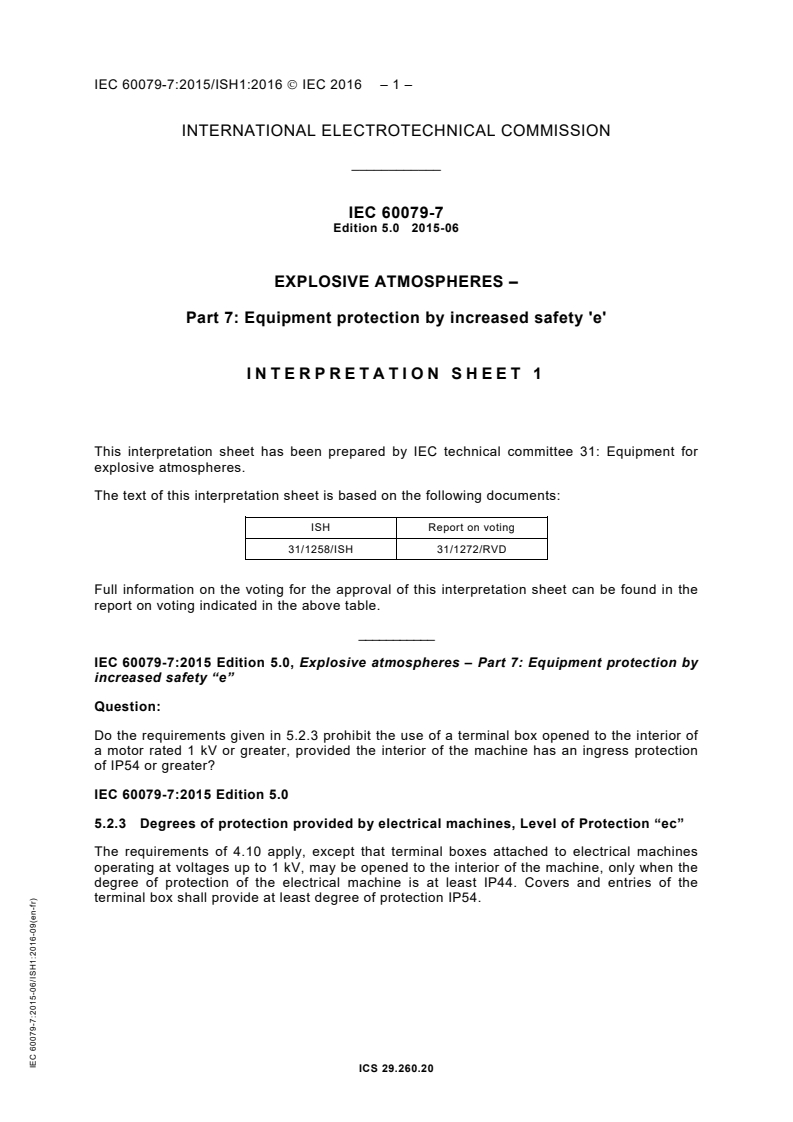
IEC 60079-7:2015 - Explosive atmospheres - Part 7: Equipment protection by increased safety "e" Released:6/26/2015

IEC 60079-7:2015+AMD1:2017 CSV - Explosive atmospheres - Part 7: Equipment protection by increased safety "e" Released:8/4/2017
IEC 60079-7:2015 - Explosive atmospheres - Part 7: Equipment protection by increased safety "e" Released:6/26/2015
Overview
IEC 60079-7:2015 - Explosive atmospheres - Part 7: Equipment protection by increased safety "e" specifies requirements for the design, construction, testing and marking of electrical equipment and Ex Components employing the increased safety protection concept "e" for use in explosive gas atmospheres. The standard covers two Levels of Protection: "eb" (EPL Mb or Gb) and "ec" (EPL Gc). It supplements and, where applicable, takes precedence over the general requirements in IEC 60079-0. Key limits in this edition include rated voltage ceilings: eb up to 11 kV r.m.s. and ec up to 15 kV r.m.s.
Key topics and technical requirements
The standard addresses practical and technical requirements needed to achieve increased safety "e" for electrical equipment in explosive atmospheres:
- Scope of protection: Definitions and applicability of Level of Protection eb (excludes semiconductors and electrolytic capacitors) and ec (includes them).
- Constructional requirements: Enclosure design, fasteners, clearances and creepage distances, ingress protection (IP ratings) and degrees of protection for enclosures.
- Electrical connections and wiring: Field and factory connections, plug/socket provisions, internal wiring, and printed wiring boards (PWBs) with conformal coatings (Level ec).
- Materials and components: Solid electrical insulating materials, windings, conductor and insulation specifications, temperature limitations and permissible surface temperatures.
- Supplementary equipment rules: Specific rules for electrical machines, luminaires, batteries and cells, fuses, resistance heating and other equipment types.
- Type verification and tests: Dielectric strength, machine tests (starting currents, overspeed for magnets), mechanical/impact tests, battery verification and other type tests required for certification.
- Interpretations and clarifications: Includes Interpretation Sheet 1 (Sep 2016) clarifying IP requirements for terminal boxes in motors (e.g., conditions involving IP44/IP54 and motors ≥1 kV).
Practical applications
IEC 60079-7:2015 is used to ensure that electrical equipment intended for hazardous (explosive) gas atmospheres does not become an ignition source due to excessive temperatures, sparks, or electrical faults. Typical applications:
- Design and manufacture of motors, luminaires, junction boxes, control gear and Ex Components with increased safety "e".
- Type testing and certification by notified bodies and test laboratories for hazardous area equipment.
- Specification and procurement of equipment for oil & gas, chemical, petrochemical, mining and processing plants where explosive gas atmospheres may be present.
- Engineering and safety assessments for equipment selection in Zone 1/2 hazardous areas (gas).
Who should use this standard
- Electrical equipment designers and manufacturers
- Certification bodies and test laboratories
- Plant engineers, procurement and maintenance teams in hazardous industries
- Compliance and safety engineers responsible for hazardous area installations
Related standards
- IEC 60079-0 (general requirements for explosive atmospheres) - primary normative reference
- IEC 60529 / IEC 60034-5 - referenced for ingress protection (IP) and machine enclosure testing (as noted in Interpretation Sheet)
Relations
- Effective Date
- 25-Aug-2026
- Effective Date
- 25-Aug-2026
- Effective Date
- 25-Aug-2026
- Effective Date
- 08-Jul-2026
- Effective Date
- 11-Mar-2026
- Effective Date
- 10-Feb-2026
- Effective Date
- 05-Sep-2023
- Effective Date
- 05-Sep-2023
- Revises
IEC 60079-7:2006 - Explosive atmospheres - Part 7: Equipment protection by increased safety "e" - Effective Date
- 05-Sep-2023
Buy Documents
IEC 60079-7:2015 - Explosive atmospheres - Part 7: Equipment protection by increased safety "e" Released:6/26/2015
IEC 60079-7:2015+AMD1:2017 CSV - Explosive atmospheres - Part 7: Equipment protection by increased safety "e" Released:8/4/2017
IEC 60079-7:2015 - Explosive atmospheres - Part 7: Equipment protection by increased safety "e" Released:6/26/2015
Get Certified
Connect with accredited certification bodies for this standard

IMQ S.p.A. (Certification)
Italian electrical product certification.

SLG Prüf- und Zertifizierungs GmbH
German testing and certification body.

UL Solutions
Global safety science company with testing, inspection and certification.
Sponsored listings
Frequently Asked Questions
IEC 60079-7:2015 is a standard published by the International Electrotechnical Commission (IEC). Its full title is "Explosive atmospheres - Part 7: Equipment protection by increased safety "e"". This standard covers: IEC 60079-7:2015 specifies the requirements for the design, construction, testing and marking of electrical equipment and Ex Components with type of protection increased safety "e" intended for use in explosive gas atmospheres. Electrical equipment and Ex Components of type of protection increased safety "e" are either: - Level of Protection "eb" (EPL "Mb" or "Gb"); or - Level of Protection "ec" (EPL "Gc"). Level of Protection "eb" applies to equipment or Ex Components, including their connections, conductors, windings, lamps, and batteries; but not including semiconductors or electrolytic capacitors. Level of Protection "ec" applies to equipment or Ex Components, including their connections, conductors, windings, lamps, and batteries; and also including semiconductors and electrolytic capacitors. The requirements of this standard apply to both Levels of Protection unless otherwise stated. For Level of Protection "eb", this standard applies to electrical equipment where the rated voltage does not exceed 11 kV r.m.s., a.c. or d.c. For Level of Protection "ec", this standard applies to electrical equipment where the rated voltage does not exceed 15 kV r.m.s., a.c. or d.c. This standard supplements and modifies the general requirements of IEC 60079-0. Where a requirement of this standard conflicts with a requirement of IEC 60079-0, the requirement of this standard takes precedence. This fifth edition cancels and replaces the fourth edition published in 2006, and constitutes a technical revision. Refer to the Foreword of the document for a complete listing of the technical changes between edition 5.0 and previous edition of the document. Keywords: electrical equipment and Ex Components with type of protection increased safety "e" intended for use in explosive gas atmospheres. The contents of the Interpretation sheet 1 of September 2016 have been included in this copy.
IEC 60079-7:2015 specifies the requirements for the design, construction, testing and marking of electrical equipment and Ex Components with type of protection increased safety "e" intended for use in explosive gas atmospheres. Electrical equipment and Ex Components of type of protection increased safety "e" are either: - Level of Protection "eb" (EPL "Mb" or "Gb"); or - Level of Protection "ec" (EPL "Gc"). Level of Protection "eb" applies to equipment or Ex Components, including their connections, conductors, windings, lamps, and batteries; but not including semiconductors or electrolytic capacitors. Level of Protection "ec" applies to equipment or Ex Components, including their connections, conductors, windings, lamps, and batteries; and also including semiconductors and electrolytic capacitors. The requirements of this standard apply to both Levels of Protection unless otherwise stated. For Level of Protection "eb", this standard applies to electrical equipment where the rated voltage does not exceed 11 kV r.m.s., a.c. or d.c. For Level of Protection "ec", this standard applies to electrical equipment where the rated voltage does not exceed 15 kV r.m.s., a.c. or d.c. This standard supplements and modifies the general requirements of IEC 60079-0. Where a requirement of this standard conflicts with a requirement of IEC 60079-0, the requirement of this standard takes precedence. This fifth edition cancels and replaces the fourth edition published in 2006, and constitutes a technical revision. Refer to the Foreword of the document for a complete listing of the technical changes between edition 5.0 and previous edition of the document. Keywords: electrical equipment and Ex Components with type of protection increased safety "e" intended for use in explosive gas atmospheres. The contents of the Interpretation sheet 1 of September 2016 have been included in this copy.
IEC 60079-7:2015 is classified under the following ICS (International Classification for Standards) categories: 29.260.20 - Electrical apparatus for explosive atmospheres. The ICS classification helps identify the subject area and facilitates finding related standards.
IEC 60079-7:2015 has the following relationships with other standards: It is inter standard links to EN ISO 12643-1:2023, EN ISO 16904:2016, EN ISO 20257-1:2020, EN ISO 16315:2016, EN ISO 16923:2026, EN 61800-2:2015, IEC 60079-7:2015/AMD1:2017, IEC 60079-7:2015/ISH1:2016, IEC 60079-7:2006. Understanding these relationships helps ensure you are using the most current and applicable version of the standard.
IEC 60079-7:2015 is available in PDF format for immediate download after purchase. The document can be added to your cart and obtained through the secure checkout process. Digital delivery ensures instant access to the complete standard document.
Standards Content (Sample)
IEC 60079-7 ®
Edition 5.0 2015-06
INTERNATIONAL
STANDARD
Explosive atmospheres –
Part 7: Equipment protection by increased safety ''e''
All rights reserved. Unless otherwise specified, no part of this publication may be reproduced or utilized in any form
or by any means, electronic or mechanical, including photocopying and microfilm, without permission in writing from
either IEC or IEC's member National Committee in the country of the requester. If you have any questions about IEC
copyright or have an enquiry about obtaining additional rights to this publication, please contact the address below or
your local IEC member National Committee for further information.
IEC Central Office Tel.: +41 22 919 02 11
3, rue de Varembé Fax: +41 22 919 03 00
CH-1211 Geneva 20 info@iec.ch
Switzerland www.iec.ch
About the IEC
The International Electrotechnical Commission (IEC) is the leading global organization that prepares and publishes
International Standards for all electrical, electronic and related technologies.
About IEC publications
The technical content of IEC publications is kept under constant review by the IEC. Please make sure that you have the
latest edition, a corrigenda or an amendment might have been published.
IEC Catalogue - webstore.iec.ch/catalogue Electropedia - www.electropedia.org
The stand-alone application for consulting the entire The world's leading online dictionary of electronic and
bibliographical information on IEC International Standards, electrical terms containing more than 30 000 terms and
Technical Specifications, Technical Reports and other definitions in English and French, with equivalent terms in 15
documents. Available for PC, Mac OS, Android Tablets and additional languages. Also known as the International
iPad. Electrotechnical Vocabulary (IEV) online.
IEC publications search - www.iec.ch/searchpub IEC Glossary - std.iec.ch/glossary
The advanced search enables to find IEC publications by a More than 60 000 electrotechnical terminology entries in
variety of criteria (reference number, text, technical English and French extracted from the Terms and Definitions
committee,…). It also gives information on projects, replaced clause of IEC publications issued since 2002. Some entries
and withdrawn publications. have been collected from earlier publications of IEC TC 37,
77, 86 and CISPR.
IEC Just Published - webstore.iec.ch/justpublished
Stay up to date on all new IEC publications. Just Published IEC Customer Service Centre - webstore.iec.ch/csc
details all new publications released. Available online and If you wish to give us your feedback on this publication or
also once a month by email. need further assistance, please contact the Customer Service
Centre: csc@iec.ch.
IEC 60079-7 ®
Edition 5.0 2015-06
INTERNATIONAL
STANDARD
Explosive atmospheres –
Part 7: Equipment protection by increased safety ''e''
INTERNATIONAL
ELECTROTECHNICAL
COMMISSION
ICS 29.260.20 ISBN 978-2-8322-2710-7
INTERNATIONAL ELECTROTECHNICAL COMMISSION
____________
IEC 60079-7
Edition 5.0 2015-06
EXPLOSIVE ATMOSPHERES –
Part 7: Equipment protection by increased safety 'e'
INTERPRETATION SHEET 1
This interpretation sheet has been prepared by IEC technical committee 31: Equipment for
explosive atmospheres.
The text of this interpretation sheet is based on the following documents:
ISH Report on voting
31/1258/ISH 31/1272/RVD
Full information on the voting for the approval of this interpretation sheet can be found in the
report on voting indicated in the above table.
___________
increased safety “e”
Question:
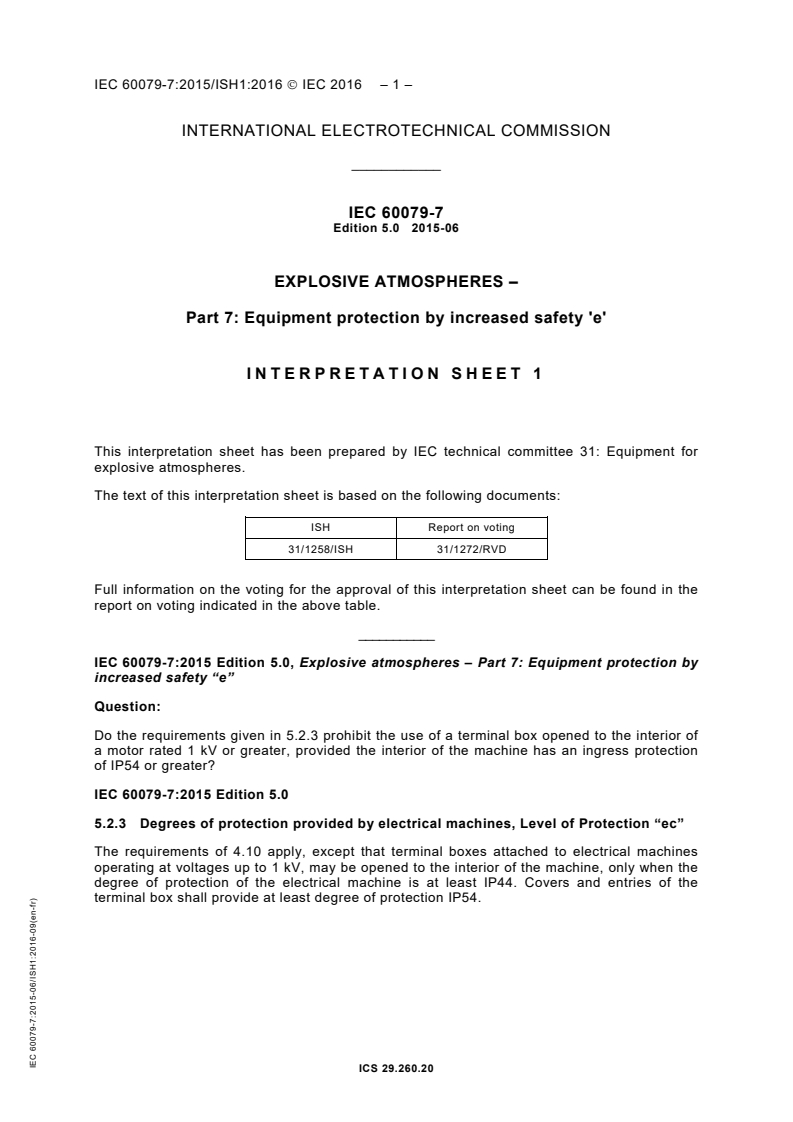
Do the requirements given in 5.2.3 prohibit the use of a terminal box opened to the interior of
a motor rated 1 kV or greater, provided the interior of the machine has an ingress protection
of IP54 or greater?
5.2.3 Degrees of protection provided by electrical machines, Level of Protection “ec”
The requirements of 4.10 apply, except that terminal boxes attached to electrical machines
operating at voltages up to 1 kV, may be opened to the interior of the machine, only when the
degree of protection of the electrical machine is at least IP44. Covers and entries of the
terminal box shall provide at least degree of protection IP54.
ICS 29.260.20
– 2 – IEC 60079-7:2015/ISH1:2016 IEC 2016
Answer:
No. As long as the interior of the machine has an ingress protection of IP54 or greater,
determined in accordance with IEC 60079-0, there is no limitation to less than 1 kV. If the
interior of the machine has an ingress rating of IP44 or lower, the use of a terminal box open
to the interior of a motor rated 1 kV or greater is not permitted.
NOTE Many manufacturers opt to declare IP44 for the machine for certification purposes, whilst claiming a rating
of IP54 or higher, by assessment, for contractual purposes in order to avoid the difficult testing required for
certification of the IP of larger machines. As such, this additional IP rating need only comply with IEC 60529 or
IEC 60034-5 as applicable, and not with any of the testing detailed in IEC 60079-0.
– 2 – IEC 60079-7:2015 © IEC 2015
CONTENTS
FOREWORD . 8
1 Scope . 14
2 Normative references . 15
3 Terms and definitions . 17
4 Constructional requirements . 21
4.1 Level of Protection . 21
4.2 Electrical connections . 21
4.2.1 General . 21
4.2.2 Field wiring connections . 22
4.2.3 Factory connections. 23
4.2.4 External plug and socket connections for field wiring connection . 25
4.3 Clearances . 26
4.4 Creepage distances . 26
4.5 Printed wiring boards with conformal coating, Level of Protection “ec” . 32
4.6 Solid electrical insulating materials . 33
4.6.1 Specification . 33
4.6.2 Long-term thermal stability . 33
4.7 Windings . 34
4.7.1 General . 34
4.7.2 Insulated conductors . 34
4.7.3 Winding impregnation . 34
4.7.4 Conductor dimensions . 34
4.7.5 Sensing elements . 35
4.8 Temperature limitations . 35
4.8.1 General . 35
4.8.2 Conductors . 35
4.8.3 Insulated windings . 36
4.9 Wiring internal to equipment . 36
4.10 Degrees of protection provided by enclosures . 37
4.11 Fasteners . 38
5 Supplementary requirements for specific electrical equipment . 38
5.1 General . 38
5.2 Electrical machines . 38
5.2.1 General . 38
5.2.2 Degrees of protection provided by electrical machines, Level of
Protection “eb” . 39
5.2.3 Degrees of protection provided by electrical machines, Level of
Protection “ec” . 39
5.2.4 Connection facilities for external conductors . 39
5.2.5 Internal fans . 39
5.2.6 Minimum air gap . 39
5.2.7 Rotating electrical machines with cage rotors . 40
5.2.8 Limiting temperature . 42
5.2.9 Machines with permanent magnet rotors . 45
5.2.10 Stator winding insulation system . 45
5.2.11 Supplemental winding requirements Level of Protection “eb” . 46
5.2.12 Bearing seals and shaft seals . 46
5.2.13 Neutral point connections . 47
5.3 Luminaires, hand lights, or caplights . 47
5.3.1 General . 47
5.3.2 Light source . 48
5.3.3 Minimum distance between lamp and protective cover . 49
5.3.4 Electrical spacings . 49
5.3.5 Lampholders and lamp caps . 50
5.3.6 Auxiliaries for Luminaires in Level of Protection “ec” . 53
5.3.7 Surface temperatures . 54
5.3.8 Limiting temperatures . 55
5.3.9 Luminaires for tubular fluorescent bi-pin lamps . 55
5.3.10 Tests for resistance to impact . 56
5.4 Analog measuring instruments and instrument transformers . 56
5.4.1 General . 56
5.4.2 Limiting temperature . 56
5.4.3 Short-circuit currents . 56
5.4.4 Short time thermal current . 57
5.4.5 Measuring instruments supplied by current transformers . 57
5.4.6 Moving coils . 57
5.4.7 External secondary circuits . 57
5.5 Transformers other than instrument transformers . 57
5.6 Supplementary requirements for equipment incorporating cells and batteries . 58
5.6.1 Type of cells and batteries . 58
5.6.2 Requirements for cells and batteries ≤25 Ah . 59
5.6.3 Requirements for valve-regulated or vented cells or batteries >25 Ah . 62
5.6.4 Charging of cells and batteries . 65
5.7 General purpose connection and junction boxes . 66
5.8 Resistance heating equipment (other than trace heating systems) . 66
5.8.1 General . 66
5.8.2 Heating resistors . 66
5.8.3 Temperature coefficient . 67
5.8.4 Insulating material . 67
5.8.5 Cold-start current . 67
5.8.6 Electrical safety device . 67
5.8.7 Electrically conductive covering . 67
5.8.8 Exclusion of explosive atmosphere . 68
5.8.9 Conductor cross-section . 68
5.8.10 Limiting temperature . 68
5.8.11 Safety device . 68
5.9 Supplementary requirements for fuses . 69
5.9.1 General . 69
5.9.2 Temperature class of equipment . 70
5.9.3 Fuse mounting . 70
5.9.4 Fuse enclosures . 70
5.9.5 Replacement fuse identification . 70
5.10 Other electrical equipment . 70
6 Type verifications and type tests. 70
6.1 Dielectric strength . 70
– 4 – IEC 60079-7:2015 © IEC 2015
6.2 Rotating electrical machines . 71
6.2.1 Determination of starting current ratio I / I and the time t . 71
A N
E
6.2.2 Mounting of machine for test . 71
6.2.3 Additional tests for machines . 71
6.2.4 Overspeed test of cemented magnets . 73
6.3 Luminaires . 73
6.3.1 Battery operated luminaires . 73
6.3.2 Impact and drop tests . 73
6.3.3 Mechanical tests for screw lampholders other than E10 . 74
6.3.4 Abnormal operation of luminaires . 75
6.3.5 Sulphur dioxide test for Level of Protection “eb” for the connection of bi-
pin lamp caps to lampholders . 76
6.3.6 Vibration test for Level of Protection “eb” for luminaires with bi-pin
lamps . 77
6.3.7 Test for wiring of luminaires subject to high-voltage impulses from
ignitors . 78
6.3.8 Tests for electronic starters for tubular fluorescent lamps and for
ignitors in Level of Protection “ec” for discharge lamps . 78
6.3.9 Test for starter holders for luminaires in Level of Protection “ec” . 79
6.4 Measuring instruments and instrument transformers . 79
6.5 Transformers other than instrument transformers . 80
6.6 Verification and tests for cells and batteries of Level of Protection “eb” . 80
6.6.1 General . 80
6.6.2 Insulation resistance . 80
6.6.3 Mechanical shock test . 80
6.6.4 Test for ventilation of Level of Protection “eb” battery container . 81
6.7 Verification and tests for cells and batteries of Level of Protection “ec” . 82
6.7.1 General . 82
6.7.2 Insulation resistance . 82
6.7.3 Mechanical shock test . 82
6.7.4 Test for ventilation of Level of Protection “ec” battery container . 82
6.8 General purpose connection and junction boxes . 83
6.8.1 General . 83
6.8.2 Maximum dissipated power method . 83
6.8.3 Defined arrangement method . 83
6.9 Resistance heating equipment . 83
6.10 Terminal insulating material tests . 84
7 Routine verifications and routine tests . 85
7.1 Dielectric tests . 85
7.2 Dielectric tests for batteries . 86
7.3 Inter-turn overvoltage tests . 86
8 Ex Component certificates . 86
8.1 General . 86
8.2 Terminals . 86
9 Marking and instructions . 87
9.1 General marking . 87
9.2 Ex Component enclosures . 88
9.3 Instructions for use . 88
9.3.1 Battery operated equipment . 88
9.3.2 Terminals . 88
9.3.3 Luminaires . 88
9.3.4 Machines . 89
9.4 Warning markings . 89
10 Documentation . 90
Annex A (normative) Temperature determination of electrical machines – Methods of
test and of calculation . 91
A.1 General . 91
A.2 Determination of maximum service temperatures . 91
A.2.1 Rotor temperature – normal operation . 91
A.2.2 Winding temperature – normal operation . 91
A.3 Determination of maximum surface temperatures . 92
A.3.1 General . 92
A.3.2 Locked rotor tests . 92
A.4 Optional calculation of maximum surface temperature . 93
A.4.1 General . 93
A.4.2 Rotor temperature . 93
A.4.3 Stator temperature . 93
A.5 Determination of t time . 93
E
A.6 Arduous starting conditions . 94
A.7 Motors operated with a converter . 94
Annex B (normative) Type tests for specific forms of resistance heating devices or
resistance heating units (other than trace heater) . 95
B.1 Resistance heating devices subjected to mechanical stresses . 95
B.2 Resistance heating devices or units intended for immersion . 95
B.3 Resistance heating devices or units having hygroscopic insulating material . 95
B.4 Verification of limiting temperature of resistance heating devices (other than
trace heaters) . 95
B.4.1 General . 95
B.4.2 Safety devices . 95
B.4.3 Resistance heating unit of stabilized design. 96
B.4.4 Heating device with temperature self-limiting characteristic . 96
Annex C (informative) Cage motors – Thermal protection in service . 97
Annex D (informative) Resistance heating devices and units – Additional electrical
protection . 98
D.1 Objective . 98
D.2 Method of protection . 98
Annex E (informative) Combinations of terminals and conductors for general purpose
connection and junction boxes . 99
E.1 General . 99
E.2 Maximum dissipated power method. 99
E.3 Defined arrangement method . 99
Annex F (normative) Dimensions of copper conductors . 102
Annex G (normative) Test procedure for T5 (only 8 W),T8, T10 and T12 lamps. 103
G.1 Asymmetric pulse test . 103
G.1.1 General . 103
G.1.2 Test procedure . 103
G.2 Asymmetric power test . 104
G.2.1 General . 104
– 6 – IEC 60079-7:2015 © IEC 2015
G.2.2 Test procedure . 105
Annex H (normative) Alternative separation distances for Level of Protection “ec”
equipment under controlled environments . 108
H.1 General . 108
H.2 Specific Conditions of Use . 108
H.3 Control of pollution access . 109
H.4 Voltage limitation . 109
H.5 Control of overvoltages and transient protection . 109
H.6 Alternative separation distances . 109
Annex I (informative) Application, installation, and testing considerations for Level of
Protection “ec” asynchronous machines. 111
I.1 Surface temperature . 111
I.2 Starting . 111
I.3 Rated voltage and surface discharges . 112
Annex J (informative) Luminaires incorporating LEDs . 113
J.1 LEDs for EPL Gb . 113
J.2 LEDs for EPL Gc . 113
Bibliography . 114
Figure 1 – Determination of creepage distances and clearances . 32
Figure 2 – Minimum values of the time t (in seconds) of motors in relation to the
E
starting current ratio I /I . 43
A N
Figure 3 – Arrangement for the luminaire vibration test . 77
Figure A.1 – Diagram illustrating the determination of time t . 94
E
Figure E.1 – Example of defined terminal/conductor arrangement table . 101
Figure G.1 – Asymmetric pulse test circuit . 104
Figure G.2 – Asymmetric power detection circuit . 106
Figure G.3 – Flow Chart – Asymmetric power Test for T8, T10, T12 and T5 (8 W
lamps) . 107
Table 1 – Tracking resistance of insulating materials . 27
Table 2 – Minimum Creepage distances, clearances and separations . 28
Table 3 – Conditions for the determination of maximum surface temperature . 35
Table 4 – Maximum temperatures for insulated windings . 36
Table 5 – Potential air gap sparking risk assessment for cage rotor ignition risk factors . 42
Table 6 – Stator insulation system tests of Level of Protection “ec” machines . 46
Table 7 – Assumed voltage of neutral points . 47
Table 8 – Minimum distance between lamp and protective cover . 49
Table 9 – Creepage distances and clearances at peak values of pulse voltages greater
than 1,5 kV . 50
Table 10 – Creepage distances and clearances for screw lampholder and lamp cap . 51
Table 11 − Resistance to the effect of short-circuit currents . 57
Table 12 – Types and use of cells and batteries . 59
Table 13 – Explosion test mixtures . 72
Table 14 – Tests for resistance to impact . 74
Table 15 – Insertion torque and minimum removal torque . 74
Table 16 – Power dissipation of cathodes of lamps supplied by electronic ballasts . 76
Table 17 – Value for pull-out tests . 85
Table 18 – Creepage distances and clearances for screw lamp caps . 89
Table 19 − Text of warning markings. 89
Table F.1 – Standard cross-sections of copper conductors . 102
Table H.1 – Alternative separation distances for equipment under controlled
environments . 110
– 8 – IEC 60079-7:2015 © IEC 2015
INTERNATIONAL ELECTROTECHNICAL COMMISSION
____________
EXPLOSIVE ATMOSPHERES –
Part 7: Equipment protection
by increased safety ''e''
FOREWORD
1) The International Electrotechnical Commission (IEC) is a worldwide organization for standardization comprising
all national electrotechnical committees (IEC National Committees). The object of IEC is to promote
international co-operation on all questions concerning standardization in the electrical and electronic fields. To
this end and in addition to other activities, IEC publishes International Standards, Technical Specifications,
Technical Reports, Publicly Available Specifications (PAS) and Guides (hereafter referred to as “IEC
Publication(s)”). Their preparation is entrusted to technical committees; any IEC National Committee interested
in the subject dealt with may participate in this preparatory work. International, governmental and non-
governmental organizations liaising with the IEC also participate in this preparation. IEC collaborates closely
with the International Organization for Standardization (ISO) in accordance with conditions determined by
agreement between the two organizations.
2) The formal decisions or agreements of IEC on technical matters express, as nearly as possible, an international
consensus of opinion on the relevant subjects since each technical committee has representation from all
interested IEC National Committees.
3) IEC Publications have the form of recommendations for international use and are accepted by IEC National
Committees in that sense. While all reasonable efforts are made to ensure that the technical content of IEC
Publications is accurate, IEC cannot be held responsible for the way in which they are used or for any
misinterpretation by any end user.
4) In order to promote international uniformity, IEC National Committees undertake to apply IEC Publications
transparently to the maximum extent possible in their national and regional publications. Any divergence
between any IEC Publication and the corresponding national or regional publication shall be clearly indicated in
the latter.
5) IEC itself does not provide any attestation of conformity. Independent certification bodies provide conformity
assessment services and, in some areas, access to IEC marks of conformity. IEC is not responsible for any
services carried out by independent certification bodies.
6) All users should ensure that they have the latest edition of this publication.
7) No liability shall attach to IEC or its directors, employees, servants or agents including individual experts and
members of its technical committees and IEC National Committees for any personal injury, property damage or
other damage of any nature whatsoever, whether direct or indirect, or for costs (including legal fees) and
expenses arising out of the publication, use of, or reliance upon, this IEC Publication or any other IEC
Publications.
8) Attention is drawn to the Normative references cited in this publication. Use of the referenced publications is
indispensable for the correct application of this publication.
9) Attention is drawn to the possibility that some of the elements of this IEC Publication may be the subject of
patent rights. IEC shall not be held responsible for identifying any or all such patent rights.
International Standard IEC 60079-7 has been prepared by IEC Technical Committee 31:
Equipment for explosive atmospheres.
This fifth edition cancels and replaces the fourth edition published in 2006, and constitutes a
technical revision.
The requirements for Type of Protection “nA” have been relocated from IEC 60079-15. To
assist the user of this document, the significant changes with respect to the previous edition
are shown below in two separate tables, one showing the changes from IEC 60079-7, Edition
4 (2006) for “e” to IEC 60079-7, Edition 5 (2014) for “eb”; and the other showing the changes
from IEC 60079-15, Edition 4 (2010) for “nA” to IEC 60079-7, Edition 5 (2014) for “ec”.
The significance of the changes between IEC Standard, IEC 60079-7, Edition 5 (2014) (for
“eb”) and IEC 60079-7, Edition 4 (2006) (for “e”) are as listed below:
for “e” to “eb” Type
Explanation of the significance of the changes Clause Minor and Extension Major
editorial technical
changes changes
Scope 1 X
Clarification of applicability
Notes added to address short circuits and short-term
thermal excursions
Clarification of resistance heating definitions 3.13 X
Addition of terminal insulation material tests 4.2.2.4 C1
Soldered Connections 4.2.2.5 C2
4.2.3.3
Silver-Soldered connections 4.2.3.3 X
Clarification of “duplicated” contacts 4.2.3.4a) X
External plug and socket connections for field wiring 4.2.4 X
connection of batteries
Clarification of conditions for the determination of 4.8.1 X
maximum surface temperature
Table 3
Maximum temperatures for insulated windings Table 4 X
Degrees of protection provided by enclosures 4.10.1 x C3
Clarification of applicability 5.2.1 X
Minimum air gap for motors 5.2.6 X
Devices for limiting winding temperature protection 5.2.8.2 X
5.2.8.3
Permanent magnet motors 5.2.9 X
6.2.4
9.3.4c)
Added Tungsten-Halogen lamp 5.3.2.2 X
5.3.2.3
5.3.2.4
Added spacings for < 10 W lamps 5.3.3 X
Permission added for re-lamping outside of hazardous 5.3.5.2.2 X
area
Added bayonet lamps 5.3.5.4.2 X
Added contact requirements for bayonet lamps 5.3.5.5 X
Renaming of “Type” of cells and batteries 5.6.2 X
Clarification of approaches for general purpose 5.7 X
junctions boxes
6.9
Annex E
Clarified temperature monitoring and control 5.8 X
Clarification of testing of battery powered luminaires 6.3.1 X
Clarification of impact tests 6.3.2.2 X
Added abnormal tests for discharge lamps 6.3.4.1 C4
Added T5 8W 6.3.4.3 X
Table 16
– 10 – IEC 60079-7:2015 © IEC 2015
for “e” to “eb” Type
Explanation of the significance of the changes Clause Minor and Extension Major
editorial technical
changes changes
To maintain T4 temperature class, cathode power or 6.3.4.3 C5
ambient temperature reduced
Table 16
Clarification of routine tests for terminal boxes 7.1 X
Marking of “e” replaced by “eb” 9.1 See “Information about the background
of Changes”
Ex Component enclosures 9.2 C6
Highlight essential documentation for rotating 10 X
electrical machines
Temperature tests Annex A X
The significance of the changes between IEC Standard, IEC 60079-7, Edition 5 (2015) (for
“ec”) and IEC 60079-15, Edition 4 (2010) (for “nA”) are as listed below:
for “nA” to “ec” Type
Explanation of the significance of the changes Clause Minor and Extension Major
editorial technical
changes changes
Scope 1 X
Clarification of applicability
Notes added to address short circuits and short-term
thermal excursions
Clarification of resistance heating definitions 3.13 X
Soldered Connections 4.2.2.5 C7
4.2.3.3
Silver-Soldered connections 4.2.3.3 X
Evaluation of pluggable connections 4.2.3.5a) X
External plug and socket connections for field wiring 4.2.4 X
connection
Minimum separation distances for encapsulated or 4.3 X
solid insulation replaced by requirements for solid
4.4
insulating materials
4.5
Table 2
Alternative separation distances for equipment under 4.3
X
controlled environments
4.4
Annex H
Thermal stability of solid insulating materials C8
4.6
Clarification of conditions for the determination of 4.8.1 X
maximum surface temperature
Table 3
Maximum temperatures for insulated windings X
Table 4
Clarification of applicability 5.2.1 X
Permanent magnet motors 5.2.9
X
6.2.4
9.3.4c)
Clarified applicability to handlights and caplights 5.3 X
for “nA” to “ec” Type
Explanation of the significance of the changes Clause Minor and Extension Major
editorial technical
changes changes
Addition of permitted light sources 5.3.2 X
Annex J
5.3.4
Added spacings for 10 W & 100-200 W lamps X
Added LED as a light source 5.3.2.5 X
5.3.4.3
Clarified internal spacings for LED packages 5.3.4.3 X
Added spacings for 10 V lamps 5.3.5.3.2 X
Clarification of temperature testing 5.3.7 X
Renaming of “Type” of cells and batteries 5.6.1 X
Clarification of approaches for general purpose 5.7 X
junctions boxes
6.8
Annex E
Clarified temperature monitoring and control 5.8 X
Clarification of permitted fuses 5.9.1 X
Clarification of testing of battery powered luminaires 6.3.1 X
Addition of end-of-life tests 6.3.4.3.2 C9
Table 16
Dielectric tests based on industrial standards 7.1 X
Clarification of routine tests for terminal boxes 7.1 X
Marking of “nA” is replaced by “ec” 9.1 See “Information about the background
of Changes”
Ex Component enclosures 9.2 C10
Highlight essential documentation for rotating 10 X
electrical machines
Temperature tests Annex A X
Alternative separation distances Annex H A1
NOTE The technical changes referred to include the significance of technical changes in the revised IEC
Standard, but they do not form an exhaustive list of all modifications from the previous version.
Explanations:
A) Definitions
Minor and editorial changes clarification
decrease of technical requirements
minor technical change
editorial corrections
These are changes which modify requirements in an editorial or a minor technical way. They
include changes of the wording to clarify technical requirements without any technical change,
or a reduction in level of existing requirement.
Extension addition of technical options
These are changes which add new or modify existing technical requirements, in a way that
new options are given, but without increasing requirements for equipment that was fully
– 12 – IEC 60079-7:2015 © IEC 2015
compliant with the previous standard. Therefore, these will not have to be considered for
products in conformity with the preceding edition.
Major technical changes addition of technical requirements
increase of technical requirements
These are changes to technical requirements (addition,
...
IEC 60079-7 ®
Edition 5.1 2017-08
CONSOLIDATED VERSION
INTERNATIONAL
STANDARD
NORME
INTERNATIONALE
colour
inside
Explosive atmospheres –
Part 7: Equipment protection by increased safety "e"
Atmosphères explosives –
Partie 7: Protection du matériel par sécurité augmentée «e»
All rights reserved. Unless otherwise specified, no part of this publication may be reproduced or utilized in any form
or by any means, electronic or mechanical, including photocopying and microfilm, without permission in writing from
either IEC or IEC's member National Committee in the country of the requester. If you have any questions about IEC
copyright or have an enquiry about obtaining additional rights to this publication, please contact the address below or
your local IEC member National Committee for further information.
Droits de reproduction réservés. Sauf indication contraire, aucune partie de cette publication ne peut être reproduite
ni utilisée sous quelque forme que ce soit et par aucun procédé, électronique ou mécanique, y compris la photocopie
et les microfilms, sans l'accord écrit de l'IEC ou du Comité national de l'IEC du pays du demandeur. Si vous avez des
questions sur le copyright de l'IEC ou si vous désirez obtenir des droits supplémentaires sur cette publication, utilisez
les coordonnées ci-après ou contactez le Comité national de l'IEC de votre pays de résidence.
IEC Central Office Tel.: +41 22 919 02 11
3, rue de Varembé info@iec.ch
CH-1211 Geneva 20 www.iec.ch
Switzerland
About the IEC
The International Electrotechnical Commission (IEC) is the leading global organization that prepares and publishes
International Standards for all electrical, electronic and related technologies.
About IEC publications
The technical content of IEC publications is kept under constant review by the IEC. Please make sure that you have the
latest edition, a corrigendum or an amendment might have been published.
IEC publications search - webstore.iec.ch/advsearchform Electropedia - www.electropedia.org
The advanced search enables to find IEC publications by a The world's leading online dictionary on electrotechnology,
variety of criteria (reference number, text, technical containing more than 22 000 terminological entries in English
committee,…). It also gives information on projects, replaced and French, with equivalent terms in 16 additional languages.
and withdrawn publications. Also known as the International Electrotechnical Vocabulary
(IEV) online.
IEC Just Published - webstore.iec.ch/justpublished
Stay up to date on all new IEC publications. Just Published IEC Glossary - std.iec.ch/glossary
details all new publications released. Available online and 67 000 electrotechnical terminology entries in English and
once a month by email. French extracted from the Terms and definitions clause of
IEC publications issued between 2002 and 2015. Some
IEC Customer Service Centre - webstore.iec.ch/csc entries have been collected from earlier publications of IEC
If you wish to give us your feedback on this publication or TC 37, 77, 86 and CISPR.
need further assistance, please contact the Customer Service
Centre: sales@iec.ch.
A propos de l'IEC
La Commission Electrotechnique Internationale (IEC) est la première organisation mondiale qui élabore et publie des
Normes internationales pour tout ce qui a trait à l'électricité, à l'électronique et aux technologies apparentées.
A propos des publications IEC
Le contenu technique des publications IEC est constamment revu. Veuillez vous assurer que vous possédez l’édition la
plus récente, un corrigendum ou amendement peut avoir été publié.
Recherche de publications IEC - Electropedia - www.electropedia.org
webstore.iec.ch/advsearchform Le premier dictionnaire d'électrotechnologie en ligne au
La recherche avancée permet de trouver des publications IEC monde, avec plus de 22 000 articles terminologiques en
en utilisant différents critères (numéro de référence, texte, anglais et en français, ainsi que les termes équivalents dans
comité d’études,…). Elle donne aussi des informations sur les 16 langues additionnelles. Egalement appelé Vocabulaire
projets et les publications remplacées ou retirées. Electrotechnique International (IEV) en ligne.
IEC Just Published - webstore.iec.ch/justpublished Glossaire IEC - std.iec.ch/glossary
Restez informé sur les nouvelles publications IEC. Just 67 000 entrées terminologiques électrotechniques, en anglais
Published détaille les nouvelles publications parues. et en français, extraites des articles Termes et définitions des
Disponible en ligne et une fois par mois par email. publications IEC parues entre 2002 et 2015. Plus certaines
entrées antérieures extraites des publications des CE 37, 77,
Service Clients - webstore.iec.ch/csc 86 et CISPR de l'IEC.
Si vous désirez nous donner des commentaires sur cette
publication ou si vous avez des questions contactez-nous:
sales@iec.ch.
IEC 60079-7 ®
Edition 5.1 2017-08
CONSOLIDATED VERSION
INTERNATIONAL
STANDARD
NORME
INTERNATIONALE
colour
inside
Explosive atmospheres –
Part 7: Equipment protection by increased safety "e"
Atmosphères explosives –
Partie 7: Protection du matériel par sécurité augmentée «e»
INTERNATIONAL
ELECTROTECHNICAL
COMMISSION
COMMISSION
ELECTROTECHNIQUE
INTERNATIONALE
ICS 29.260.20 ISBN 978-2-8322-4708-2
IEC 60079-7 ®
Edition 5.1 2017-08
CONSOLIDATED VERSION
REDLINE VERSION
VERSION REDLINE
colour
inside
Explosive atmospheres –
Part 7: Equipment protection by increased safety "e"
Atmosphères explosives –
Partie 7: Protection du matériel par sécurité augmentée «e»
INTERNATIONAL ELECTROTECHNICAL COMMISSION
____________
IEC 60079-7
Edition 5.0 2015-06
EXPLOSIVE ATMOSPHERES –
Part 7: Equipment protection by increased safety 'e'
INTERPRETATION SHEET 1
This interpretation sheet has been prepared by IEC technical committee 31: Equipment for
explosive atmospheres.
The text of this interpretation sheet is based on the following documents:
ISH Report on voting
31/1258/ISH 31/1272/RVD
Full information on the voting for the approval of this interpretation sheet can be found in the
report on voting indicated in the above table.
___________
increased safety “e”
Question:
Do the requirements given in 5.2.3 prohibit the use of a terminal box opened to the interior of
a motor rated 1 kV or greater, provided the interior of the machine has an ingress protection
of IP54 or greater?
5.2.3 Degrees of protection provided by electrical machines, Level of Protection “ec”
The requirements of 4.10 apply, except that terminal boxes attached to electrical machines
operating at voltages up to 1 kV, may be opened to the interior of the machine, only when the
degree of protection of the electrical machine is at least IP44. Covers and entries of the
terminal box shall provide at least degree of protection IP54.
ICS 29.260.20
– 2 – IEC 60079-7:2015/ISH1:2016 IEC 2016
Answer:
No. As long as the interior of the machine has an ingress protection of IP54 or greater,
determined in accordance with IEC 60079-0, there is no limitation to less than 1 kV. If the
interior of the machine has an ingress rating of IP44 or lower, the use of a terminal box open
to the interior of a motor rated 1 kV or greater is not permitted.
NOTE Many manufacturers opt to declare IP44 for the machine for certification purposes, whilst claiming a rating
of IP54 or higher, by assessment, for contractual purposes in order to avoid the difficult testing required for
certification of the IP of larger machines. As such, this additional IP rating need only comply with IEC 60529 or
IEC 60034-5 as applicable, and not with any of the testing detailed in IEC 60079-0.
– 2 – IEC 60079-7:2015+AMD1:2017 CSV
© IEC 2017
CONTENTS
FOREWORD . 8
1 Scope . 14
2 Normative references . 15
3 Terms and definitions . 17
4 Constructional requirements . 21
4.1 Level of Protection . 21
4.2 Electrical connections . 21
4.2.1 General . 21
4.2.2 Field wiring connections . 22
4.2.3 Factory connections. 23
4.2.4 External plug and socket connections for field wiring connection . 25
4.3 Clearances . 26
4.4 Creepage distances . 26
4.5 Printed wiring boards with conformal coating, Level of Protection “ec” . 32
4.6 Solid electrical insulating materials . 33
4.6.1 Specification . 33
4.6.2 Long-term thermal stability . 33
4.7 Windings . 34
4.7.1 General . 34
4.7.2 Insulated conductors . 34
4.7.3 Winding impregnation . 34
4.7.4 Conductor dimensions . 34
4.7.5 Sensing elements . 35
4.8 Temperature limitations . 35
4.8.1 General . 35
4.8.2 Conductors . 35
4.8.3 Insulated windings . 36
4.9 Wiring internal to equipment . 37
4.10 Degrees of protection provided by enclosures . 37
4.11 Fasteners . 38
5 Supplementary requirements for specific electrical equipment . 38
5.1 General . 38
5.2 Electrical machines . 38
5.2.1 General . 38
5.2.2 Degrees of protection provided by electrical machines, Level of
Protection “eb” . 39
5.2.3 Degrees of protection provided by electrical machines, Level of
Protection “ec” . 39
5.2.4 Connection facilities for external conductors . 39
5.2.5 Internal fans . 40
5.2.6 Minimum air gap . 40
5.2.7 Rotating electrical machines with cage rotors . 41
5.2.8 Limiting temperature . 43
5.2.9 Machines with permanent magnet rotors . 46
5.2.10 Stator winding insulation system . 46
5.2.11 Supplemental winding requirements Level of Protection “eb” . 47
© IEC 2017
5.2.12 Bearing seals and shaft seals . 47
5.2.13 Neutral point connections . 48
5.3 Luminaires, hand lights, or caplights . 48
5.3.1 General . 48
5.3.2 Light source . 49
5.3.3 Minimum distance between lamp and protective cover . 50
5.3.4 Electrical spacings . 50
5.3.5 Lampholders and lamp caps . 51
5.3.6 Auxiliaries for Luminaires in Level of Protection “ec” . 54
5.3.7 Surface temperatures . 55
5.3.8 Limiting temperatures . 56
5.3.9 Luminaires for tubular fluorescent bi-pin lamps . 56
5.3.10 Tests for resistance to impact . 57
5.4 Analog measuring instruments and instrument transformers . 57
5.4.1 General . 57
5.4.2 Limiting temperature . 57
5.4.3 Short-circuit currents . 57
5.4.4 Short time thermal current . 58
5.4.5 Measuring instruments supplied by current transformers . 58
5.4.6 Moving coils . 58
5.4.7 External secondary circuits . 58
5.5 Transformers other than instrument transformers . 58
5.6 Supplementary requirements for equipment incorporating cells and batteries . 59
5.6.1 Type of cells and batteries . 59
5.6.2 Requirements for cells and batteries ≤25 Ah . 60
5.6.3 Requirements for valve-regulated or vented cells or batteries >25 Ah . 63
5.6.4 Charging of cells and batteries . 66
5.7 General purpose connection and junction boxes . 67
5.8 Resistance heating equipment (other than trace heating systems) . 67
5.8.1 General . 67
5.8.2 Heating resistors . 67
5.8.3 Temperature coefficient . 68
5.8.4 Insulating material . 68
5.8.5 Cold-start current . 68
5.8.6 Electrical safety device . 68
5.8.7 Electrically conductive covering . 68
5.8.8 Exclusion of explosive atmosphere . 69
5.8.9 Conductor cross-section . 69
5.8.10 Limiting temperature . 69
5.8.11 Safety device . 69
5.9 Supplementary requirements for fuses . 70
5.9.1 General . 70
5.9.2 Temperature class of equipment . 71
5.9.3 Fuse mounting . 71
5.9.4 Fuse enclosures . 71
5.9.5 Replacement fuse identification . 71
5.10 Other electrical equipment . 71
6 Type verifications and type tests. 71
6.1 Dielectric strength . 71
– 4 – IEC 60079-7:2015+AMD1:2017 CSV
© IEC 2017
6.2 Rotating electrical machines . 72
6.2.1 Determination of starting current ratio I / I and the time t . 72
A N
E
6.2.2 Mounting of machine for test . 72
6.2.3 Additional tests for machines . 72
6.2.4 Overspeed test of cemented magnets . 74
6.3 Luminaires . 74
6.3.1 Battery operated luminaires . 74
6.3.2 Impact and drop tests . 74
6.3.3 Mechanical tests for screw lampholders other than E10 . 75
6.3.4 Abnormal operation of luminaires . 76
6.3.5 Sulphur dioxide test for Level of Protection “eb” for the connection of bi-
pin lamp caps to lampholders . 77
6.3.6 Vibration test for Level of Protection “eb” for luminaires with bi-pin
lamps . 78
6.3.7 Test for wiring of luminaires subject to high-voltage impulses from
ignitors . 79
6.3.8 Tests for electronic starters for tubular fluorescent lamps and for
ignitors in Level of Protection “ec” for discharge lamps . 79
6.3.9 Test for starter holders for luminaires in Level of Protection “ec” . 80
6.4 Measuring instruments and instrument transformers . 80
6.5 Transformers other than instrument transformers . 81
6.6 Verification and tests for cells and batteries of Level of Protection “eb” . 81
6.6.1 General . 81
6.6.2 Insulation resistance . 81
6.6.3 Mechanical shock test . 81
6.6.4 Test for ventilation of Level of Protection “eb” battery container . 82
6.7 Verification and tests for cells and batteries of Level of Protection “ec” . 83
6.7.1 General . 83
6.7.2 Insulation resistance . 83
6.7.3 Mechanical shock test . 83
6.7.4 Test for ventilation of Level of Protection “ec” battery container . 83
6.8 General purpose connection and junction boxes . 84
6.8.1 General . 84
6.8.2 Maximum dissipated power method . 84
6.8.3 Defined arrangement method . 84
6.9 Resistance heating equipment . 84
6.10 Terminal insulating material tests . 85
7 Routine verifications and routine tests . 86
7.1 Dielectric tests . 86
7.2 Dielectric tests for batteries . 87
7.3 Inter-turn overvoltage tests . 87
8 Ex Component certificates . 87
8.1 General . 87
8.2 Terminals . 87
9 Marking and instructions . 88
9.1 General marking . 88
9.2 Ex Component enclosures . 89
9.3 Instructions for use . 89
9.3.1 Battery operated equipment . 89
© IEC 2017
9.3.2 Terminals . 89
9.3.3 Luminaires . 89
9.3.4 Machines . 90
9.4 Warning markings . 90
10 Documentation . 91
Annex A (normative) Temperature determination of electrical machines – Methods of
test and of calculation . 92
A.1 General . 92
A.2 Determination of maximum service temperatures . 92
A.2.1 Rotor temperature – normal operation . 92
A.2.2 Winding temperature – normal operation . 92
A.3 Determination of maximum surface temperatures . 93
A.3.1 General . 93
A.3.2 Locked rotor tests . 93
A.4 Optional calculation of maximum surface temperature . 94
A.4.1 General . 94
A.4.2 Rotor temperature . 94
A.4.3 Stator temperature . 94
A.5 Determination of t time . 94
E
A.6 Arduous starting conditions . 95
A.7 Motors operated with a converter . 95
Annex B (normative) Type tests for specific forms of resistance heating devices or
resistance heating units (other than trace heater) . 96
B.1 Resistance heating devices subjected to mechanical stresses . 96
B.2 Resistance heating devices or units intended for immersion . 96
B.3 Resistance heating devices or units having hygroscopic insulating material . 96
B.4 Verification of limiting temperature of resistance heating devices (other than
trace heaters) . 96
B.4.1 General . 96
B.4.2 Safety devices . 96
B.4.3 Resistance heating unit of stabilized design. 97
B.4.4 Heating device with temperature self-limiting characteristic . 97
Annex C (informative) Cage motors – Thermal protection in service . 98
Annex D (informative) Resistance heating devices and units – Additional electrical
protection . 99
D.1 Objective . 99
D.2 Method of protection . 99
Annex E (informative) Combinations of terminals and conductors for general purpose
connection and junction boxes . 100
E.1 General . 100
E.2 Maximum dissipated power method. 100
E.3 Defined arrangement method . 100
Annex F (normative) Dimensions of copper conductors . 103
Annex G (normative) Test procedure for T5 (only 8 W),T8, T10 and T12 lamps. 104
G.1 Asymmetric pulse test . 104
G.1.1 General . 104
G.1.2 Test procedure . 104
G.2 Asymmetric power test . 105
G.2.1 General . 105
– 6 – IEC 60079-7:2015+AMD1:2017 CSV
© IEC 2017
G.2.2 Test procedure . 106
Annex H (normative) Alternative separation distances for Level of Protection “ec”
equipment under controlled environments . 109
H.1 General . 109
H.2 Specific Conditions of Use . 109
H.3 Control of pollution access . 110
H.4 Voltage limitation . 110
H.5 Control of overvoltages and transient protection . 110
H.6 Alternative separation distances . 110
Annex I (informative) Application, installation, and testing considerations for Level of
Protection “ec” asynchronous machines . 112
I.1 Surface temperature . 112
I.2 Starting . 112
I.3 Rated voltage and surface discharges . 113
Annex J (informative) Luminaires incorporating LEDs . 114
J.1 LEDs for EPL Gb . 114
J.2 LEDs for EPL Gc . 114
Bibliography . 115
Figure 1 – Determination of creepage distances and clearances . 32
Figure 2 – Minimum values of the time t (in seconds) of motors in relation to the
E
starting current ratio I /I . 44
A N
Figure 3 – Arrangement for the luminaire vibration test . 78
Figure A.1 – Diagram illustrating the determination of time t . 95
E
Figure E.1 – Example of defined terminal/conductor arrangement table . 102
Figure G.1 – Asymmetric pulse test circuit . 105
Figure G.2 – Asymmetric power detection circuit . 107
Figure G.3 – Flow Chart – Asymmetric power Test for T8, T10, T12 and T5 (8 W
lamps) . 108
Table 1 – Tracking resistance of insulating materials . 27
Table 2 – Minimum Creepage distances, clearances and separations . 28
Table 3 – Conditions for the determination of maximum surface temperature . 35
Table 4 – Maximum temperatures for insulated windings . 36
Table 5 – Potential air gap sparking risk assessment for cage rotor ignition risk factors . 43
Table 6 – Stator insulation system tests of Level of Protection “ec” machines . 47
Table 7 – Assumed voltage of neutral points . 48
Table 8 – Minimum distance between lamp and protective cover . 50
Table 9 – Creepage distances and clearances at peak values of pulse voltages greater
than 1,5 kV . 51
Table 10 – Creepage distances and clearances for screw lampholder and lamp cap . 52
Table 11 − Resistance to the effect of short-circuit currents . 58
Table 12 – Types and use of cells and batteries . 60
Table 13 – Explosion test mixtures . 73
Table 14 – Tests for resistance to impact . 75
Table 15 – Insertion torque and minimum removal torque . 75
© IEC 2017
Table 16 – Power dissipation of cathodes of lamps supplied by electronic ballasts . 77
Table 17 – Value for pull-out tests . 86
Table 18 – Creepage distances and clearances for screw lamp caps . 90
Table 19 − Text of warning markings. 90
Table 20 – Separation in compound-filled cable sealing boxes . 40
Table F.1 – Standard cross-sections of copper conductors . 103
Table H.1 – Alternative separation distances for equipment under controlled
environments . 111
– 8 – IEC 60079-7:2015+AMD1:2017 CSV
© IEC 2017
INTERNATIONAL ELECTROTECHNICAL COMMISSION
____________
EXPLOSIVE ATMOSPHERES –
Part 7: Equipment protection
by increased safety ''e''
FOREWORD
1) The International Electrotechnical Commission (IEC) is a worldwide organization for standardization comprising
all national electrotechnical committees (IEC National Committees). The object of IEC is to promote
international co-operation on all questions concerning standardization in the electrical and electronic fields. To
this end and in addition to other activities, IEC publishes International Standards, Technical Specifications,
Technical Reports, Publicly Available Specifications (PAS) and Guides (hereafter referred to as “IEC
Publication(s)”). Their preparation is entrusted to technical committees; any IEC National Committee interested
in the subject dealt with may participate in this preparatory work. International, governmental and non-
governmental organizations liaising with the IEC also participate in this preparation. IEC collaborates closely
with the International Organization for Standardization (ISO) in accordance with conditions determined by
agreement between the two organizations.
2) The formal decisions or agreements of IEC on technical matters express, as nearly as possible, an international
consensus of opinion on the relevant subjects since each technical committee has representation from all
interested IEC National Committees.
3) IEC Publications have the form of recommendations for international use and are accepted by IEC National
Committees in that sense. While all reasonable efforts are made to ensure that the technical content of IEC
Publications is accurate, IEC cannot be held responsible for the way in which they are used or for any
misinterpretation by any end user.
4) In order to promote international uniformity, IEC National Committees undertake to apply IEC Publications
transparently to the maximum extent possible in their national and regional publications. Any divergence
between any IEC Publication and the corresponding national or regional publication shall be clearly indicated in
the latter.
5) IEC itself does not provide any attestation of conformity. Independent certification bodies provide conformity
assessment services and, in some areas, access to IEC marks of conformity. IEC is not responsible for any
services carried out by independent certification bodies.
6) All users should ensure that they have the latest edition of this publication.
7) No liability shall attach to IEC or its directors, employees, servants or agents including individual experts and
members of its technical committees and IEC National Committees for any personal injury, property damage or
other damage of any nature whatsoever, whether direct or indirect, or for costs (including legal fees) and
expenses arising out of the publication, use of, or reliance upon, this IEC Publication or any other IEC
Publications.
8) Attention is drawn to the Normative references cited in this publication. Use of the referenced publications is
indispensable for the correct application of this publication.
9) Attention is drawn to the possibility that some of the elements of this IEC Publication may be the subject of
patent rights. IEC shall not be held responsible for identifying any or all such patent rights.
This consolidated version of the official IEC Standard and its amendment(s) has been
prepared for user convenience.
IEC 60079-7 edition 5.1 contains the fifth edition (2015-06) [documents 31/1182/FDIS and
31/1194/RVD], its interpretation sheet (2016-09), and its amendment 1 (2017-08)
[documents 31/1301/CDV and 31/1324/RVC].
In this Redline version, a vertical line in the margin shows where the technical
content is modified by amendment 1. Additions are in green text, deletions are in
strikethrough red text. A separate Final version with all changes accepted is
available in this publication.
© IEC 2017
International Standard IEC 60079-7 has been prepared by IEC Technical Committee 31:
Equipment for explosive atmospheres.
This fifth edition cancels and replaces the fourth edition published in 2006, and constitutes a
technical revision.
The requirements for Type of Protection “nA” have been relocated from IEC 60079-15. To
assist the user of this document, the significant changes with respect to the previous edition
are shown below in two separate tables, one showing the changes from IEC 60079-7, Edition
4 (2006) for “e” to IEC 60079-7, Edition 5 (2014) for “eb”; and the other showing the changes
from IEC 60079-15, Edition 4 (2010) for “nA” to IEC 60079-7, Edition 5 (2014) for “ec”.
The significance of the changes between IEC Standard, IEC 60079-7, Edition 5 (2014) (for
“eb”) and IEC 60079-7, Edition 4 (2006) (for “e”) are as listed below:
for “e” to “eb” Type
Explanation of the significance of the changes Clause Minor and Extension Major
editorial technical
changes changes
Scope 1 X
Clarification of applicability
Notes added to address short circuits and short-term
thermal excursions
Clarification of resistance heating definitions 3.13 X
Addition of terminal insulation material tests 4.2.2.4 C1
Soldered Connections 4.2.2.5 C2
4.2.3.3
Silver-Soldered connections 4.2.3.3 X
Clarification of “duplicated” contacts 4.2.3.4a) X
External plug and socket connections for field wiring 4.2.4 X
connection of batteries
Clarification of conditions for the determination of 4.8.1 X
maximum surface temperature
Table 3
Maximum temperatures for insulated windings Table 4 X
Degrees of protection provided by enclosures 4.10.1 x C3
Clarification of applicability 5.2.1 X
Minimum air gap for motors 5.2.6 X
Devices for limiting winding temperature protection 5.2.8.2 X
5.2.8.3
Permanent magnet motors 5.2.9 X
6.2.4
9.3.4c)
Added Tungsten-Halogen lamp 5.3.2.2 X
5.3.2.3
5.3.2.4
5.3.3 X
Added spacings for < 10 W lamps
Permission added for re-lamping outside of hazardous 5.3.5.2.2 X
area
Added bayonet lamps 5.3.5.4.2 X
Added contact requirements for bayonet lamps 5.3.5.5 X
– 10 – IEC 60079-7:2015+AMD1:2017 CSV
© IEC 2017
for “e” to “eb” Type
Explanation of the significance of the changes Clause Minor and Extension Major
editorial technical
changes changes
Renaming of “Type” of cells and batteries 5.6.2 X
Clarification of approaches for general purpose 5.7 X
junctions boxes
6.9
Annex E
Clarified temperature monitoring and control 5.8 X
Clarification of testing of battery powered luminaires 6.3.1 X
Clarification of impact tests 6.3.2.2 X
Added abnormal tests for discharge lamps 6.3.4.1 C4
Added T5 8W 6.3.4.3 X
Table 16
To maintain T4 temperature class, cathode power or 6.3.4.3 C5
ambient temperature reduced
Table 16
Clarification of routine tests for terminal boxes 7.1 X
Marking of “e” replaced by “eb” 9.1 See “Information about the background
of Changes”
Ex Component enclosures 9.2 C6
Highlight essential documentation for rotating 10 X
electrical machines
Temperature tests Annex A X
The significance of the changes between IEC Standard, IEC 60079-7, Edition 5 (2015) (fo
...
IEC 60079-7 ®
Edition 5.0 2015-06
INTERNATIONAL
STANDARD
NORME
INTERNATIONALE
Explosive atmospheres –
Part 7: Equipment protection by increased safety «e»
Atmosphères explosives –
Partie 7: Protection du matériel par sécurité augmentée «e»
All rights reserved. Unless otherwise specified, no part of this publication may be reproduced or utilized in any form
or by any means, electronic or mechanical, including photocopying and microfilm, without permission in writing from
either IEC or IEC's member National Committee in the country of the requester. If you have any questions about IEC
copyright or have an enquiry about obtaining additional rights to this publication, please contact the address below or
your local IEC member National Committee for further information.
Droits de reproduction réservés. Sauf indication contraire, aucune partie de cette publication ne peut être reproduite
ni utilisée sous quelque forme que ce soit et par aucun procédé, électronique ou mécanique, y compris la photocopie
et les microfilms, sans l'accord écrit de l'IEC ou du Comité national de l'IEC du pays du demandeur. Si vous avez des
questions sur le copyright de l'IEC ou si vous désirez obtenir des droits supplémentaires sur cette publication, utilisez
les coordonnées ci-après ou contactez le Comité national de l'IEC de votre pays de résidence.
IEC Central Office Tel.: +41 22 919 02 11
3, rue de Varembé Fax: +41 22 919 03 00
CH-1211 Geneva 20 info@iec.ch
Switzerland www.iec.ch
About the IEC
The International Electrotechnical Commission (IEC) is the leading global organization that prepares and publishes
International Standards for all electrical, electronic and related technologies.
About IEC publications
The technical content of IEC publications is kept under constant review by the IEC. Please make sure that you have the
latest edition, a corrigenda or an amendment might have been published.
IEC Catalogue - webstore.iec.ch/catalogue Electropedia - www.electropedia.org
The stand-alone application for consulting the entire The world's leading online dictionary of electronic and
bibliographical information on IEC International Standards, electrical terms containing more than 30 000 terms and
Technical Specifications, Technical Reports and other definitions in English and French, with equivalent terms in 15
documents. Available for PC, Mac OS, Android Tablets and additional languages. Also known as the International
iPad. Electrotechnical Vocabulary (IEV) online.
IEC publications search - www.iec.ch/searchpub IEC Glossary - std.iec.ch/glossary
The advanced search enables to find IEC publications by a More than 60 000 electrotechnical terminology entries in
variety of criteria (reference number, text, technical English and French extracted from the Terms and Definitions
committee,…). It also gives information on projects, replaced clause of IEC publications issued since 2002. Some entries
and withdrawn publications. have been collected from earlier publications of IEC TC 37,
77, 86 and CISPR.
IEC Just Published - webstore.iec.ch/justpublished
Stay up to date on all new IEC publications. Just Published IEC Customer Service Centre - webstore.iec.ch/csc
details all new publications released. Available online and If you wish to give us your feedback on this publication or
also once a month by email. need further assistance, please contact the Customer Service
Centre: csc@iec.ch.
A propos de l'IEC
La Commission Electrotechnique Internationale (IEC) est la première organisation mondiale qui élabore et publie des
Normes internationales pour tout ce qui a trait à l'électricité, à l'électronique et aux technologies apparentées.
A propos des publications IEC
Le contenu technique des publications IEC est constamment revu. Veuillez vous assurer que vous possédez l’édition la
plus récente, un corrigendum ou amendement peut avoir été publié.
Catalogue IEC - webstore.iec.ch/catalogue Electropedia - www.electropedia.org
Application autonome pour consulter tous les renseignements
Le premier dictionnaire en ligne de termes électroniques et
bibliographiques sur les Normes internationales,
électriques. Il contient plus de 30 000 termes et définitions en
Spécifications techniques, Rapports techniques et autres
anglais et en français, ainsi que les termes équivalents dans
documents de l'IEC. Disponible pour PC, Mac OS, tablettes
15 langues additionnelles. Egalement appelé Vocabulaire
Android et iPad.
Electrotechnique International (IEV) en ligne.
Recherche de publications IEC - www.iec.ch/searchpub
Glossaire IEC - std.iec.ch/glossary
Plus de 60 000 entrées terminologiques électrotechniques, en
La recherche avancée permet de trouver des publications IEC
en utilisant différents critères (numéro de référence, texte, anglais et en français, extraites des articles Termes et
comité d’études,…). Elle donne aussi des informations sur les Définitions des publications IEC parues depuis 2002. Plus
projets et les publications remplacées ou retirées. certaines entrées antérieures extraites des publications des
CE 37, 77, 86 et CISPR de l'IEC.
IEC Just Published - webstore.iec.ch/justpublished
Service Clients - webstore.iec.ch/csc
Restez informé sur les nouvelles publications IEC. Just
Published détaille les nouvelles publications parues. Si vous désirez nous donner des commentaires sur cette
Disponible en ligne et aussi une fois par mois par email. publication ou si vous avez des questions contactez-nous:
csc@iec.ch.
IEC 60079-7 ®
Edition 5.0 2015-06
INTERNATIONAL
STANDARD
NORME
INTERNATIONALE
Explosive atmospheres –
Part 7: Equipment protection by increased safety «e»
Atmosphères explosives –
Partie 7: Protection du matériel par sécurité augmentée «e»
INTERNATIONAL
ELECTROTECHNICAL
COMMISSION
COMMISSION
ELECTROTECHNIQUE
INTERNATIONALE
ICS 29.260.20 ISBN 978-2-8322-2885-2
INTERNATIONAL ELECTROTECHNICAL COMMISSION
____________
IEC 60079-7
Edition 5.0 2015-06
EXPLOSIVE ATMOSPHERES –
Part 7: Equipment protection by increased safety 'e'
INTERPRETATION SHEET 1
This interpretation sheet has been prepared by IEC technical committee 31: Equipment for
explosive atmospheres.
The text of this interpretation sheet is based on the following documents:
ISH Report on voting
31/1258/ISH 31/1272/RVD
Full information on the voting for the approval of this interpretation sheet can be found in the
report on voting indicated in the above table.
___________
increased safety “e”
Question:
Do the requirements given in 5.2.3 prohibit the use of a terminal box opened to the interior of
a motor rated 1 kV or greater, provided the interior of the machine has an ingress protection
of IP54 or greater?
5.2.3 Degrees of protection provided by electrical machines, Level of Protection “ec”
The requirements of 4.10 apply, except that terminal boxes attached to electrical machines
operating at voltages up to 1 kV, may be opened to the interior of the machine, only when the
degree of protection of the electrical machine is at least IP44. Covers and entries of the
terminal box shall provide at least degree of protection IP54.
ICS 29.260.20
– 2 – IEC 60079-7:2015/ISH1:2016 IEC 2016
Answer:
No. As long as the interior of the machine has an ingress protection of IP54 or greater,
determined in accordance with IEC 60079-0, there is no limitation to less than 1 kV. If the
interior of the machine has an ingress rating of IP44 or lower, the use of a terminal box open
to the interior of a motor rated 1 kV or greater is not permitted.
NOTE Many manufacturers opt to declare IP44 for the machine for certification purposes, whilst claiming a rating
of IP54 or higher, by assessment, for contractual purposes in order to avoid the difficult testing required for
certification of the IP of larger machines. As such, this additional IP rating need only comply with IEC 60529 or
IEC 60034-5 as applicable, and not with any of the testing detailed in IEC 60079-0.
– 2 – IEC 60079-7:2015 © IEC 2015
CONTENTS
FOREWORD . 8
1 Scope . 14
2 Normative references . 15
3 Terms and definitions . 17
4 Constructional requirements . 21
4.1 Level of Protection . 21
4.2 Electrical connections . 21
4.2.1 General . 21
4.2.2 Field wiring connections . 22
4.2.3 Factory connections. 23
4.2.4 External plug and socket connections for field wiring connection . 25
4.3 Clearances . 26
4.4 Creepage distances . 26
4.5 Printed wiring boards with conformal coating, Level of Protection “ec” . 32
4.6 Solid electrical insulating materials . 33
4.6.1 Specification . 33
4.6.2 Long-term thermal stability . 33
4.7 Windings . 34
4.7.1 General . 34
4.7.2 Insulated conductors . 34
4.7.3 Winding impregnation . 34
4.7.4 Conductor dimensions . 34
4.7.5 Sensing elements . 35
4.8 Temperature limitations . 35
4.8.1 General . 35
4.8.2 Conductors . 35
4.8.3 Insulated windings . 36
4.9 Wiring internal to equipment . 36
4.10 Degrees of protection provided by enclosures . 37
4.11 Fasteners . 38
5 Supplementary requirements for specific electrical equipment . 38
5.1 General . 38
5.2 Electrical machines . 38
5.2.1 General . 38
5.2.2 Degrees of protection provided by electrical machines, Level of
Protection “eb” . 39
5.2.3 Degrees of protection provided by electrical machines, Level of
Protection “ec” . 39
5.2.4 Connection facilities for external conductors . 39
5.2.5 Internal fans . 39
5.2.6 Minimum air gap . 39
5.2.7 Rotating electrical machines with cage rotors . 40
5.2.8 Limiting temperature . 42
5.2.9 Machines with permanent magnet rotors . 45
5.2.10 Stator winding insulation system . 45
5.2.11 Supplemental winding requirements Level of Protection “eb” . 46
5.2.12 Bearing seals and shaft seals . 46
5.2.13 Neutral point connections . 47
5.3 Luminaires, hand lights, or caplights . 47
5.3.1 General . 47
5.3.2 Light source . 48
5.3.3 Minimum distance between lamp and protective cover . 49
5.3.4 Electrical spacings . 49
5.3.5 Lampholders and lamp caps . 50
5.3.6 Auxiliaries for Luminaires in Level of Protection “ec” . 53
5.3.7 Surface temperatures . 54
5.3.8 Limiting temperatures . 55
5.3.9 Luminaires for tubular fluorescent bi-pin lamps . 55
5.3.10 Tests for resistance to impact . 56
5.4 Analog measuring instruments and instrument transformers . 56
5.4.1 General . 56
5.4.2 Limiting temperature . 56
5.4.3 Short-circuit currents . 56
5.4.4 Short time thermal current . 57
5.4.5 Measuring instruments supplied by current transformers . 57
5.4.6 Moving coils . 57
5.4.7 External secondary circuits . 57
5.5 Transformers other than instrument transformers . 57
5.6 Supplementary requirements for equipment incorporating cells and batteries . 58
5.6.1 Type of cells and batteries . 58
5.6.2 Requirements for cells and batteries ≤25 Ah . 59
5.6.3 Requirements for valve-regulated or vented cells or batteries >25 Ah . 62
5.6.4 Charging of cells and batteries . 65
5.7 General purpose connection and junction boxes . 66
5.8 Resistance heating equipment (other than trace heating systems) . 66
5.8.1 General . 66
5.8.2 Heating resistors . 66
5.8.3 Temperature coefficient . 67
5.8.4 Insulating material . 67
5.8.5 Cold-start current . 67
5.8.6 Electrical safety device . 67
5.8.7 Electrically conductive covering . 67
5.8.8 Exclusion of explosive atmosphere . 68
5.8.9 Conductor cross-section . 68
5.8.10 Limiting temperature . 68
5.8.11 Safety device . 68
5.9 Supplementary requirements for fuses . 69
5.9.1 General . 69
5.9.2 Temperature class of equipment . 70
5.9.3 Fuse mounting . 70
5.9.4 Fuse enclosures . 70
5.9.5 Replacement fuse identification . 70
5.10 Other electrical equipment . 70
6 Type verifications and type tests. 70
6.1 Dielectric strength . 70
– 4 – IEC 60079-7:2015 © IEC 2015
6.2 Rotating electrical machines . 71
6.2.1 Determination of starting current ratio I / I and the time t . 71
A N
E
6.2.2 Mounting of machine for test . 71
6.2.3 Additional tests for machines . 71
6.2.4 Overspeed test of cemented magnets . 73
6.3 Luminaires . 73
6.3.1 Battery operated luminaires . 73
6.3.2 Impact and drop tests . 73
6.3.3 Mechanical tests for screw lampholders other than E10 . 74
6.3.4 Abnormal operation of luminaires . 75
6.3.5 Sulphur dioxide test for Level of Protection “eb” for the connection of bi-
pin lamp caps to lampholders . 76
6.3.6 Vibration test for Level of Protection “eb” for luminaires with bi-pin
lamps . 77
6.3.7 Test for wiring of luminaires subject to high-voltage impulses from
ignitors . 78
6.3.8 Tests for electronic starters for tubular fluorescent lamps and for
ignitors in Level of Protection “ec” for discharge lamps . 78
6.3.9 Test for starter holders for luminaires in Level of Protection “ec” . 79
6.4 Measuring instruments and instrument transformers . 79
6.5 Transformers other than instrument transformers . 80
6.6 Verification and tests for cells and batteries of Level of Protection “eb” . 80
6.6.1 General . 80
6.6.2 Insulation resistance . 80
6.6.3 Mechanical shock test . 80
6.6.4 Test for ventilation of Level of Protection “eb” battery container . 81
6.7 Verification and tests for cells and batteries of Level of Protection “ec” . 82
6.7.1 General . 82
6.7.2 Insulation resistance . 82
6.7.3 Mechanical shock test . 82
6.7.4 Test for ventilation of Level of Protection “ec” battery container . 82
6.8 General purpose connection and junction boxes . 83
6.8.1 General . 83
6.8.2 Maximum dissipated power method . 83
6.8.3 Defined arrangement method . 83
6.9 Resistance heating equipment . 83
6.10 Terminal insulating material tests . 84
7 Routine verifications and routine tests . 85
7.1 Dielectric tests . 85
7.2 Dielectric tests for batteries . 86
7.3 Inter-turn overvoltage tests . 86
8 Ex Component certificates . 86
8.1 General . 86
8.2 Terminals . 86
9 Marking and instructions . 87
9.1 General marking . 87
9.2 Ex Component enclosures . 88
9.3 Instructions for use . 88
9.3.1 Battery operated equipment . 88
9.3.2 Terminals . 88
9.3.3 Luminaires . 88
9.3.4 Machines . 89
9.4 Warning markings . 89
10 Documentation . 90
Annex A (normative) Temperature determination of electrical machines – Methods of
test and of calculation . 91
A.1 General . 91
A.2 Determination of maximum service temperatures . 91
A.2.1 Rotor temperature – normal operation . 91
A.2.2 Winding temperature – normal operation . 91
A.3 Determination of maximum surface temperatures . 92
A.3.1 General . 92
A.3.2 Locked rotor tests . 92
A.4 Optional calculation of maximum surface temperature . 93
A.4.1 General . 93
A.4.2 Rotor temperature . 93
A.4.3 Stator temperature . 93
A.5 Determination of t time . 93
E
A.6 Arduous starting conditions . 94
A.7 Motors operated with a converter . 94
Annex B (normative) Type tests for specific forms of resistance heating devices or
resistance heating units (other than trace heater) . 95
B.1 Resistance heating devices subjected to mechanical stresses . 95
B.2 Resistance heating devices or units intended for immersion . 95
B.3 Resistance heating devices or units having hygroscopic insulating material . 95
B.4 Verification of limiting temperature of resistance heating devices (other than
trace heaters) . 95
B.4.1 General . 95
B.4.2 Safety devices . 95
B.4.3 Resistance heating unit of stabilized design. 96
B.4.4 Heating device with temperature self-limiting characteristic . 96
Annex C (informative) Cage motors – Thermal protection in service . 97
Annex D (informative) Resistance heating devices and units – Additional electrical
protection . 98
D.1 Objective . 98
D.2 Method of protection . 98
Annex E (informative) Combinations of terminals and conductors for general purpose
connection and junction boxes . 99
E.1 General . 99
E.2 Maximum dissipated power method. 99
E.3 Defined arrangement method . 99
Annex F (normative) Dimensions of copper conductors . 102
Annex G (normative) Test procedure for T5 (only 8 W),T8, T10 and T12 lamps. 103
G.1 Asymmetric pulse test . 103
G.1.1 General . 103
G.1.2 Test procedure . 103
G.2 Asymmetric power test . 104
G.2.1 General . 104
– 6 – IEC 60079-7:2015 © IEC 2015
G.2.2 Test procedure . 105
Annex H (normative) Alternative separation distances for Level of Protection “ec”
equipment under controlled environments . 108
H.1 General . 108
H.2 Specific Conditions of Use . 108
H.3 Control of pollution access . 109
H.4 Voltage limitation . 109
H.5 Control of overvoltages and transient protection . 109
H.6 Alternative separation distances . 109
Annex I (informative) Application, installation, and testing considerations for Level of
Protection “ec” asynchronous machines. 111
I.1 Surface temperature . 111
I.2 Starting . 111
I.3 Rated voltage and surface discharges . 112
Annex J (informative) Luminaires incorporating LEDs . 113
J.1 LEDs for EPL Gb . 113
J.2 LEDs for EPL Gc . 113
Bibliography . 114
Figure 1 – Determination of creepage distances and clearances . 32
Figure 2 – Minimum values of the time t (in seconds) of motors in relation to the
E
starting current ratio I /I . 43
A N
Figure 3 – Arrangement for the luminaire vibration test . 77
Figure A.1 – Diagram illustrating the determination of time t . 94
E
Figure E.1 – Example of defined terminal/conductor arrangement table . 101
Figure G.1 – Asymmetric pulse test circuit . 104
Figure G.2 – Asymmetric power detection circuit . 106
Figure G.3 – Flow Chart – Asymmetric power Test for T8, T10, T12 and T5 (8 W
lamps) . 107
Table 1 – Tracking resistance of insulating materials . 27
Table 2 – Minimum Creepage distances, clearances and separations . 28
Table 3 – Conditions for the determination of maximum surface temperature . 35
Table 4 – Maximum temperatures for insulated windings . 36
Table 5 – Potential air gap sparking risk assessment for cage rotor ignition risk factors . 42
Table 6 – Stator insulation system tests of Level of Protection “ec” machines . 46
Table 7 – Assumed voltage of neutral points . 47
Table 8 – Minimum distance between lamp and protective cover . 49
Table 9 – Creepage distances and clearances at peak values of pulse voltages greater
than 1,5 kV . 50
Table 10 – Creepage distances and clearances for screw lampholder and lamp cap . 51
Table 11 − Resistance to the effect of short-circuit currents . 57
Table 12 – Types and use of cells and batteries . 59
Table 13 – Explosion test mixtures . 72
Table 14 – Tests for resistance to impact . 74
Table 15 – Insertion torque and minimum removal torque . 74
Table 16 – Power dissipation of cathodes of lamps supplied by electronic ballasts . 76
Table 17 – Value for pull-out tests . 85
Table 18 – Creepage distances and clearances for screw lamp caps . 89
Table 19 − Text of warning markings. 89
Table F.1 – Standard cross-sections of copper conductors . 102
Table H.1 – Alternative separation distances for equipment under controlled
environments . 110
– 8 – IEC 60079-7:2015 © IEC 2015
INTERNATIONAL ELECTROTECHNICAL COMMISSION
____________
EXPLOSIVE ATMOSPHERES –
Part 7: Equipment protection
by increased safety ''e''
FOREWORD
1) The International Electrotechnical Commission (IEC) is a worldwide organization for standardization comprising
all national electrotechnical committees (IEC National Committees). The object of IEC is to promote
international co-operation on all questions concerning standardization in the electrical and electronic fields. To
this end and in addition to other activities, IEC publishes International Standards, Technical Specifications,
Technical Reports, Publicly Available Specifications (PAS) and Guides (hereafter referred to as “IEC
Publication(s)”). Their preparation is entrusted to technical committees; any IEC National Committee interested
in the subject dealt with may participate in this preparatory work. International, governmental and non-
governmental organizations liaising with the IEC also participate in this preparation. IEC collaborates closely
with the International Organization for Standardization (ISO) in accordance with conditions determined by
agreement between the two organizations.
2) The formal decisions or agreements of IEC on technical matters express, as nearly as possible, an international
consensus of opinion on the relevant subjects since each technical committee has representation from all
interested IEC National Committees.
3) IEC Publications have the form of recommendations for international use and are accepted by IEC National
Committees in that sense. While all reasonable efforts are made to ensure that the technical content of IEC
Publications is accurate, IEC cannot be held responsible for the way in which they are used or for any
misinterpretation by any end user.
4) In order to promote international uniformity, IEC National Committees undertake to apply IEC Publications
transparently to the maximum extent possible in their national and regional publications. Any divergence
between any IEC Publication and the corresponding national or regional publication shall be clearly indicated in
the latter.
5) IEC itself does not provide any attestation of conformity. Independent certification bodies provide conformity
assessment services and, in some areas, access to IEC marks of conformity. IEC is not responsible for any
services carried out by independent certification bodies.
6) All users should ensure that they have the latest edition of this publication.
7) No liability shall attach to IEC or its directors, employees, servants or agents including individual experts and
members of its technical committees and IEC National Committees for any personal injury, property damage or
other damage of any nature whatsoever, whether direct or indirect, or for costs (including legal fees) and
expenses arising out of the publication, use of, or reliance upon, this IEC Publication or any other IEC
Publications.
8) Attention is drawn to the Normative references cited in this publication. Use of the referenced publications is
indispensable for the correct application of this publication.
9) Attention is drawn to the possibility that some of the elements of this IEC Publication may be the subject of
patent rights. IEC shall not be held responsible for identifying any or all such patent rights.
International Standard IEC 60079-7 has been prepared by IEC Technical Committee 31:
Equipment for explosive atmospheres.
This fifth edition cancels and replaces the fourth edition published in 2006, and constitutes a
technical revision.
The requirements for Type of Protection “nA” have been relocated from IEC 60079-15. To
assist the user of this document, the significant changes with respect to the previous edition
are shown below in two separate tables, one showing the changes from IEC 60079-7, Edition
4 (2006) for “e” to IEC 60079-7, Edition 5 (2014) for “eb”; and the other showing the changes
from IEC 60079-15, Edition 4 (2010) for “nA” to IEC 60079-7, Edition 5 (2014) for “ec”.
The significance of the changes between IEC Standard, IEC 60079-7, Edition 5 (2014) (for
“eb”) and IEC 60079-7, Edition 4 (2006) (for “e”) are as listed below:
for “e” to “eb” Type
Explanation of the significance of the changes Clause Minor and Extension Major
editorial technical
changes changes
Scope 1 X
Clarification of applicability
Notes added to address short circuits and short-term
thermal excursions
Clarification of resistance heating definitions 3.13 X
Addition of terminal insulation material tests 4.2.2.4 C1
Soldered Connections 4.2.2.5 C2
4.2.3.3
Silver-Soldered connections 4.2.3.3 X
Clarification of “duplicated” contacts 4.2.3.4a) X
External plug and socket connections for field wiring 4.2.4 X
connection of batteries
Clarification of conditions for the determination of 4.8.1 X
maximum surface temperature
Table 3
Maximum temperatures for insulated windings Table 4 X
Degrees of protection provided by enclosures 4.10.1 x C3
Clarification of applicability 5.2.1 X
Minimum air gap for motors 5.2.6 X
Devices for limiting winding temperature protection 5.2.8.2 X
5.2.8.3
Permanent magnet motors 5.2.9 X
6.2.4
9.3.4c)
Added Tungsten-Halogen lamp 5.3.2.2 X
5.3.2.3
5.3.2.4
Added spacings for < 10 W lamps 5.3.3 X
Permission added for re-lamping outside of hazardous 5.3.5.2.2 X
area
Added bayonet lamps 5.3.5.4.2 X
Added contact requirements for bayonet lamps 5.3.5.5 X
Renaming of “Type” of cells and batteries 5.6.2 X
Clarification of approaches for general purpose 5.7 X
junctions boxes
6.9
Annex E
Clarified temperature monitoring and control 5.8 X
Clarification of testing of battery powered luminaires 6.3.1 X
Clarification of impact tests 6.3.2.2 X
Added abnormal tests for discharge lamps 6.3.4.1 C4
Added T5 8W 6.3.4.3 X
Table 16
– 10 – IEC 60079-7:2015 © IEC 2015
for “e” to “eb” Type
Explanation of the significance of the changes Clause Minor and Extension Major
editorial technical
changes changes
To maintain T4 temperature class, cathode power or 6.3.4.3 C5
ambient temperature reduced
Table 16
Clarification of routine tests for terminal boxes 7.1 X
Marking of “e” replaced by “eb” 9.1 See “Information about the background
of Changes”
Ex Component enclosures 9.2 C6
Highlight essential documentation for rotating 10 X
electrical machines
Temperature tests Annex A X
The significance of the changes between IEC Standard, IEC 60079-7, Edition 5 (2015) (for
“ec”) and IEC 60079-15, Edition 4 (2010) (for “nA”) are as listed below:
for “nA” to “ec” Type
Explanation of the significance of the changes Clause Minor and Extension Major
editorial technical
changes changes
Scope 1 X
Clarification of applicability
Notes added to address short circuits and short-term
thermal excursions
Clarification of resistance heating definitions 3.13 X
Soldered Connections 4.2.2.5 C7
4.2.3.3
Silver-Soldered connections 4.2.3.3 X
Evaluation of pluggable connections 4.2.3.5a) X
External plug and socket connections for field wiring 4.2.4 X
connection
Minimum separation distances for encapsulated or 4.3 X
sol
...