

IEC 63240-1:2024
(Main)Active assisted living (AAL) reference architecture and architecture model - Part 1: Reference architecture
General Information
- Abstract
IEC 63240-1:2024 specifies the AAL reference architecture. This document defines concepts and introduces terminology. It provides generic rules for designers of AAL systems and services with the aim to facilitate systems design and enable interoperability between components. This document identifies safety, security, privacy, and other requirements for AAL systems such as usability, accessibility, and trustworthiness (reliability, resilience) and sets up a process to identify the needs on the body area network (BAN), edge and cloud computing in the architecture perspective.
IEC 63240-1:2024 cancels and replaces the first edition published in 2020. This edition constitutes a technical revision.
This edition includes the following significant technical changes with respect to the previous edition:
a) clarifying the Introduction;
b) new terms and definitions have been added in 3.1;
c) adaption of terms according to the IEV in the whole document;
d) reference to ethical considerations of AI when applied in the AAL context has been added in Clause 5;
e) clarifying the description of AAL reference architecture in 6.3.1;
f) process to identify the needs on BAN, edge and cloud computing in the architecture perspective has been added in 6.3.2 and 6.3.3;
g) new figures have been added in 6.3.2 and 6.3.3;
h) reference to standards inventory has been added in 7.1;
i) clarification of 7.5;
j) Annex A has been added;
k) updated bibliography.
- Status
- Published
- Publication Date
- 07-Nov-2024
- Technical Committee
- SyC AAL - Active Assisted Living
- Drafting Committee
- WG 2 - SyC AAL/WG 2
- Current Stage
- PPUB - Publication issued
- Start Date
- 08-Nov-2024
- Completion Date
- 25-Nov-2024
Buy Documents
IEC 63240-1:2024 - Active assisted living (AAL) reference architecture and architecture model - Part 1: Reference architecture Released:11/8/2024
REDLINE IEC 63240-1:2024 RLV - Active assisted living (AAL) reference architecture and architecture model - Part 1: Reference architecture/8/2024
Overview - IEC 63240-1:2024 (AAL reference architecture)
IEC 63240-1:2024 specifies the Active Assisted Living (AAL) reference architecture. It defines core concepts, terminology and generic rules for designers of AAL systems and services to promote interoperability, consistent systems design and consideration of non‑functional requirements. This second edition cancels and replaces the 2020 edition and is a technical revision that clarifies the introduction and architecture descriptions, adds new terms, addresses ethical considerations for AI in AAL, and formalizes a process to identify needs for body area networks (BAN), edge computing and cloud computing.
Key technical topics and requirements
- Concepts and terminology: Standardized definitions for AAL devices, gateways, backend systems and architecture elements to support consistent implementation and documentation.
- Reference architecture description: A conceptual model that maps components from BAN → edge → cloud and shows how AAL services are architected for home, edge and cloud deployments.
- BAN, edge and cloud needs: Process guidance for identifying functional and deployment needs at the body area network, edge nodes and cloud layers (new in this edition).
- Security, privacy and trustworthiness: Identification of safety, security and privacy requirements alongside trustworthiness attributes such as reliability and resilience.
- Usability and accessibility: Guidance to ensure AAL systems include usability and accessibility from early design phases.
- AI and ethics: Explicit reference to ethical considerations when applying AI/ML in AAL contexts (added in Clause 5).
- Standards inventory and normative alignment: References to related standards and adaptation of terminology to the International Electrotechnical Vocabulary (IEV).
Practical applications and who uses this standard
IEC 63240-1:2024 is intended for:
- System architects and software engineers designing interoperable AAL platforms and services.
- Device manufacturers of wearables, sensors and gateways who need interface and integration guidance.
- Service providers and operators implementing home- and cloud-based AAL services with attention to security, privacy and accessibility.
- Regulators and procurement teams creating specifications, conformity requirements or regulatory frameworks for AAL deployments.
- Researchers and integrators assessing BAN-to-cloud system topologies, edge offloading strategies, and ethical AI usage in assisted living.
Practical uses include designing BAN topologies for wearables, specifying edge/cloud split for latency-sensitive services, defining security/privacy controls across the architecture, and ensuring accessibility and usability are baked into product requirements.
Related standards and resources
- IEC 63240 series - Part 2: Architecture model (companion document).
- IEC TS 63134 (referenced in Annex A examples) and the IEV / Electropedia for standardized vocabulary.
- Consult the IEC standards inventory and bibliography in Clause 7 and Annex A for cross‑references and implementation resources.
Keywords: IEC 63240-1:2024, AAL reference architecture, active assisted living, BAN, edge computing, cloud computing, security, privacy, usability, accessibility, AI ethics.
Relations
- Effective Date
- 05-Sep-2023
Buy Documents
IEC 63240-1:2024 - Active assisted living (AAL) reference architecture and architecture model - Part 1: Reference architecture Released:11/8/2024
REDLINE IEC 63240-1:2024 RLV - Active assisted living (AAL) reference architecture and architecture model - Part 1: Reference architecture/8/2024
Get Certified
Connect with accredited certification bodies for this standard

BSI Group
BSI (British Standards Institution) is the business standards company that helps organizations make excellence a habit.

TÜV Rheinland
TÜV Rheinland is a leading international provider of technical services.

TÜV SÜD
TÜV SÜD is a trusted partner of choice for safety, security and sustainability solutions.
Sponsored listings
Frequently Asked Questions
IEC 63240-1:2024 is a standard published by the International Electrotechnical Commission (IEC). Its full title is "Active assisted living (AAL) reference architecture and architecture model - Part 1: Reference architecture". This standard covers: IEC 63240-1:2024 specifies the AAL reference architecture. This document defines concepts and introduces terminology. It provides generic rules for designers of AAL systems and services with the aim to facilitate systems design and enable interoperability between components. This document identifies safety, security, privacy, and other requirements for AAL systems such as usability, accessibility, and trustworthiness (reliability, resilience) and sets up a process to identify the needs on the body area network (BAN), edge and cloud computing in the architecture perspective. IEC 63240-1:2024 cancels and replaces the first edition published in 2020. This edition constitutes a technical revision. This edition includes the following significant technical changes with respect to the previous edition: a) clarifying the Introduction; b) new terms and definitions have been added in 3.1; c) adaption of terms according to the IEV in the whole document; d) reference to ethical considerations of AI when applied in the AAL context has been added in Clause 5; e) clarifying the description of AAL reference architecture in 6.3.1; f) process to identify the needs on BAN, edge and cloud computing in the architecture perspective has been added in 6.3.2 and 6.3.3; g) new figures have been added in 6.3.2 and 6.3.3; h) reference to standards inventory has been added in 7.1; i) clarification of 7.5; j) Annex A has been added; k) updated bibliography.
IEC 63240-1:2024 specifies the AAL reference architecture. This document defines concepts and introduces terminology. It provides generic rules for designers of AAL systems and services with the aim to facilitate systems design and enable interoperability between components. This document identifies safety, security, privacy, and other requirements for AAL systems such as usability, accessibility, and trustworthiness (reliability, resilience) and sets up a process to identify the needs on the body area network (BAN), edge and cloud computing in the architecture perspective. IEC 63240-1:2024 cancels and replaces the first edition published in 2020. This edition constitutes a technical revision. This edition includes the following significant technical changes with respect to the previous edition: a) clarifying the Introduction; b) new terms and definitions have been added in 3.1; c) adaption of terms according to the IEV in the whole document; d) reference to ethical considerations of AI when applied in the AAL context has been added in Clause 5; e) clarifying the description of AAL reference architecture in 6.3.1; f) process to identify the needs on BAN, edge and cloud computing in the architecture perspective has been added in 6.3.2 and 6.3.3; g) new figures have been added in 6.3.2 and 6.3.3; h) reference to standards inventory has been added in 7.1; i) clarification of 7.5; j) Annex A has been added; k) updated bibliography.
IEC 63240-1:2024 is classified under the following ICS (International Classification for Standards) categories: 11.020.99 - Other standards related to health care in general; 11.180 - Aids for disabled or handicapped persons. The ICS classification helps identify the subject area and facilitates finding related standards.
IEC 63240-1:2024 has the following relationships with other standards: It is inter standard links to IEC 63240-1:2020. Understanding these relationships helps ensure you are using the most current and applicable version of the standard.
IEC 63240-1:2024 is available in PDF format for immediate download after purchase. The document can be added to your cart and obtained through the secure checkout process. Digital delivery ensures instant access to the complete standard document.
Standards Content (Sample)
IEC 63240-1 ®
Edition 2.0 2024-11
INTERNATIONAL
STANDARD
colour
inside
Active assisted living (AAL) reference architecture and architecture model –
Part 1: Reference architecture
All rights reserved. Unless otherwise specified, no part of this publication may be reproduced or utilized in any form
or by any means, electronic or mechanical, including photocopying and microfilm, without permission in writing from
either IEC or IEC's member National Committee in the country of the requester. If you have any questions about IEC
copyright or have an enquiry about obtaining additional rights to this publication, please contact the address below or
your local IEC member National Committee for further information.
IEC Secretariat Tel.: +41 22 919 02 11
3, rue de Varembé info@iec.ch
CH-1211 Geneva 20 www.iec.ch
Switzerland
About the IEC
The International Electrotechnical Commission (IEC) is the leading global organization that prepares and publishes
International Standards for all electrical, electronic and related technologies.
About IEC publications
The technical content of IEC publications is kept under constant review by the IEC. Please make sure that you have the
latest edition, a corrigendum or an amendment might have been published.
IEC publications search - webstore.iec.ch/advsearchform IEC Products & Services Portal - products.iec.ch
The advanced search enables to find IEC publications by a Discover our powerful search engine and read freely all the
variety of criteria (reference number, text, technical publications previews, graphical symbols and the glossary.
committee, …). It also gives information on projects, replaced With a subscription you will always have access to up to date
and withdrawn publications. content tailored to your needs.
IEC Just Published - webstore.iec.ch/justpublished
Electropedia - www.electropedia.org
Stay up to date on all new IEC publications. Just Published
The world's leading online dictionary on electrotechnology,
details all new publications released. Available online and once
containing more than 22 500 terminological entries in English
a month by email.
and French, with equivalent terms in 25 additional languages.
Also known as the International Electrotechnical Vocabulary
IEC Customer Service Centre - webstore.iec.ch/csc
(IEV) online.
If you wish to give us your feedback on this publication or need
further assistance, please contact the Customer Service
Centre: sales@iec.ch.
IEC 63240-1 ®
Edition 2.0 2024-11
INTERNATIONAL
STANDARD
colour
inside
Active assisted living (AAL) reference architecture and architecture model –
Part 1: Reference architecture
INTERNATIONAL
ELECTROTECHNICAL
COMMISSION
ICS 11.020.99; 11.180 ISBN 978-2-8322-9900-5
– 2 – IEC 63240-1:2024 © IEC 2024
CONTENTS
FOREWORD . 4
INTRODUCTION . 6
1 Scope . 7
2 Normative references . 7
3 Terms, definitions and abbreviated terms . 7
3.1 Terms and definitions . 7
3.2 Abbreviated terms . 12
4 General . 12
5 Relationship between IoT and AAL . 12
6 AAL reference architecture . 13
6.1 Purpose of AAL reference architecture . 13
6.2 Users of AAL reference architecture . 13
6.3 Description of AAL reference architecture . 14
6.3.1 Description of conceptual AAL reference architecture . 14
6.3.2 Cloud and edge computing . 15
6.3.3 Body area network (BAN) . 19
7 Security requirements in the context of AAL . 20
7.1 General . 20
7.2 Privacy requirements . 21
7.3 Security requirements . 21
7.4 Areas relating to AAL security for consideration . 21
7.5 Use of AI for cyberthreats . 21
7.6 AAL privacy risk examples . 22
7.6.1 Monitoring location . 22
7.6.2 Monitoring health and well-being . 22
7.6.3 IoT . 22
7.6.4 Frame risks for the AAL system . 22
Annex A (informative) Examples referring to the conceptual level of AAL reference
architecture . 23
A.1 Personal health check with wearable sensors (Use case 1:
IEC TS 63134:2020 and IEC TS 63134:2020/AMD1:2022) and with
smartphone support . 23
A.2 Personal trainer (Use case 8: IEC TS 63134:2020 and
IEC TS 63134:2020/AMD1:2022) without smartphone support . 23
Bibliography . 24
Figure 1 – Conceptual AAL reference architecture . 14
Figure 2 – Cloud and edge computing (conceptual) . 15
Figure 3 – AAL reference architecture: Home computing . 16
Figure 4 – AAL reference architecture: Cloud computing . 16
Figure 5 – AAL reference architecture: Edge computing . 17
Figure 6 – Cross-domain solution. 18
Figure 7 – Scalability and potential for savings . 18
Figure 8 – Example of a BAN system (cloud computing at home) . 19
Figure 9 – Example of a BAN system (cloud computing outside the home environment,
e.g., in the neighbourhood) . 20
Figure 10 – Security process within the context of AAL standards . 21
– 4 – IEC 63240-1:2024 © IEC 2024
INTERNATIONAL ELECTROTECHNICAL COMMISSION
____________
ACTIVE ASSISTED LIVING (AAL) REFERENCE
ARCHITECTURE AND ARCHITECTURE MODEL –
Part 1: Reference architecture
FOREWORD
1) The International Electrotechnical Commission (IEC) is a worldwide organization for standardization comprising
all national electrotechnical committees (IEC National Committees). The object of IEC is to promote international
co-operation on all questions concerning standardization in the electrical and electronic fields. To this end and
in addition to other activities, IEC publishes International Standards, Technical Specifications, Technical Reports,
Publicly Available Specifications (PAS) and Guides (hereafter referred to as "IEC Publication(s)"). Their
preparation is entrusted to technical committees; any IEC National Committee interested in the subject dealt with
may participate in this preparatory work. International, governmental and non-governmental organizations liaising
with the IEC also participate in this preparation. IEC collaborates closely with the International Organization for
Standardization (ISO) in accordance with conditions determined by agreement between the two organizations.
2) The formal decisions or agreements of IEC on technical matters express, as nearly as possible, an international
consensus of opinion on the relevant subjects since each technical committee has representation from all
interested IEC National Committees.
3) IEC Publications have the form of recommendations for international use and are accepted by IEC National
Committees in that sense. While all reasonable efforts are made to ensure that the technical content of IEC
Publications is accurate, IEC cannot be held responsible for the way in which they are used or for any
misinterpretation by any end user.
4) In order to promote international uniformity, IEC National Committees undertake to apply IEC Publications
transparently to the maximum extent possible in their national and regional publications. Any divergence between
any IEC Publication and the corresponding national or regional publication shall be clearly indicated in the latter.
5) IEC itself does not provide any attestation of conformity. Independent certification bodies provide conformity
assessment services and, in some areas, access to IEC marks of conformity. IEC is not responsible for any
services carried out by independent certification bodies.
6) All users should ensure that they have the latest edition of this publication.
7) No liability shall attach to IEC or its directors, employees, servants or agents including individual experts and
members of its technical committees and IEC National Committees for any personal injury, property damage or
other damage of any nature whatsoever, whether direct or indirect, or for costs (including legal fees) and
expenses arising out of the publication, use of, or reliance upon, this IEC Publication or any other IEC
Publications.
8) Attention is drawn to the Normative references cited in this publication. Use of the referenced publications is
indispensable for the correct application of this publication.
9) IEC draws attention to the possibility that the implementation of this document may involve the use of (a)
patent(s). IEC takes no position concerning the evidence, validity or applicability of any claimed patent rights in
respect thereof. As of the date of publication of this document, IEC had not received notice of (a) patent(s), which
may be required to implement this document. However, implementers are cautioned that this may not represent
the latest information, which may be obtained from the patent database available at https://patents.iec.ch. IEC
shall not be held responsible for identifying any or all such patent rights.
IEC 63240-1 has been prepared by IEC systems committee AAL: Active Assisted Living. It is
an International Standard.
This second edition cancels and replaces the first edition published in 2020. This edition
constitutes a technical revision.
This edition includes the following significant technical changes with respect to the previous
edition:
a) clarifying the Introduction;
b) new terms and definitions have been added in 3.1;
c) adaption of terms according to the IEV in the whole document;
d) reference to ethical considerations of AI when applied in the AAL context has been added
in Clause 5;
e) clarifying the description of AAL reference architecture in 6.3.1;
f) process to identify the needs on BAN, edge and cloud computing in the architecture
perspective has been added in 6.3.2 and 6.3.3;
g) new figures have been added in 6.3.2 and 6.3.3;
h) reference to standards inventory has been added in 7.1;
i) clarification of 7.5;
j) Annex A has been added;
k) updated bibliography.
The text of this International Standard is based on the following documents:
Draft Report on voting
SyCAAL/322/CDV SyCAAL/362A/RVC
Full information on the voting for its approval can be found in the report on voting indicated in
the above table.
The language used for the development of this International Standard is English.
This document was drafted in accordance with ISO/IEC Directives, Part 2, and developed in
accordance with ISO/IEC Directives, Part 1 and ISO/IEC Directives, IEC Supplement, available
at www.iec.ch/members_experts/refdocs. The main document types developed by IEC are
described in greater detail at www.iec.ch/publications.
A list of all parts in the IEC 63240 series, published under the general title Active assisted living
reference architecture and architecture model, can be found on the IEC website.
The committee has decided that the contents of this document will remain unchanged until the
stability date indicated on the IEC website under webstore.iec.ch in the data related to the
specific document. At this date, the document will be
• reconfirmed,
• withdrawn, or
• revised.
IMPORTANT – The "colour inside" logo on the cover page of this document indicates
that it contains colours which are considered to be useful for the correct understanding
of its contents. Users should therefore print this document using a colour printer.
– 6 – IEC 63240-1:2024 © IEC 2024
INTRODUCTION
IEC Systems Committee for Active Assisted Living (SyC AAL) is developing an architecture
model and a reference architecture for AAL to guide the development and deployment of AAL
services and technologies. IEC 63240 consists of the following parts, under the general title
Active assisted living (AAL) reference architecture and architecture model:
• Part 1: Reference architecture;
• Part 2: Architecture model.
This document provides information to ensure usability and accessibility from the earliest stages
of design and provides guidance to developers on how to incorporate these requirements.
Additional requirements such as security, privacy, and trustworthiness are introduced and
considered.
The first edition of IEC 63240-1 was published in 2020. Since the publication of
IEC 63240-1:2020, IEC SyC AAL has been collecting issues from a variety of sources including
comments from IEC National Committees. At the September 2021 online meeting of IEC SyC
AAL, it was decided to set up a process to identify the needs of body area network (BAN), edge
and cloud computing in the architecture perspective. These items are considered in this
document.
The target audience for this document includes the following stakeholders who have an interest
in the AAL system:
• AAL users and service provider personnel who can learn about AAL user needs and how to
operate AAL systems;
• consumer electronics and information and communication technology device manufacturers
who want to understand AAL device interface and interoperability requirements;
• stakeholders who are interested in the usability, accessibility and performance of the AAL
system as well as AAL operators who need to understand the system requirements;
• regulators who are responsible for developing and supervising AAL systems and the related
regulations.
ACTIVE ASSISTED LIVING (AAL) REFERENCE
ARCHITECTURE AND ARCHITECTURE MODEL –
Part 1: Reference architecture
1 Scope
This document specifies the AAL reference architecture.
This document defines concepts and introduces terminology. It provides generic rules for
designers of AAL systems and services with the aim to facilitate systems design and enable
interoperability between components.
This document identifies safety, security, privacy, and other requirements for AAL systems such
as usability, accessibility, and trustworthiness (reliability, resilience) and sets up a process to
identify the needs on the body area network (BAN), edge and cloud computing in the
architecture perspective.
2 Normative references
There are no normative references in this document.
3 Terms, definitions and abbreviated terms
3.1 Terms and definitions
For the purposes of this document, the following terms and definitions apply.
ISO and IEC maintain terminology databases for use in standardization at the following
addresses:
• IEC Electropedia: available at https://www.electropedia.org/
• ISO Online browsing platform: available at https://www.iso.org/obp
3.1.1
AAL device
device (IEV 151-11-20) used in an AAL system
EXAMPLE Examples are sensors and actuators that contain one or more components (functionality).
Note 1 to entry: External conditions and events include measurements of temperature, motion, and electrical
conditions.
Note 2 to entry: There are 1) medical devices (IEV 871-06-06), as defined by regulatory agencies, 2) personal
health devices and sensors (IEV 871-04-29) for fitness, wellbeing, personal comfort, and personal security and 3)
devices that can serve as aggregators of personal data produced by the user of the device.
[SOURCE: IEC 60050-871:2023, 871-07-01]
– 8 – IEC 63240-1:2024 © IEC 2024
3.1.2
AAL gateway
functional unit that connects two computer networks with different network architectures and
protocols used in an AAL service (IEV 871-01-04)
Note 1 to entry: The computer networks may be local area networks, wide area networks, or other types of networks.
Note 2 to entry: Examples of gateways are a LAN gateway, a mail gateway used in an AAL service.
[SOURCE: IEC 60050-732:2010, 732-01-17, modified – The term "gateway" has been replaced
by "AAL gateway". In the definition and in Note 2 to entry, "used in an AAL service" has been
added.]
3.1.3
AAL platform backend system
AAL backend system
system that houses a number of components (and functionalities) in order to collect the data
from AAL gateways or AAL devices directly over a wide area network connection, and that can
also implement components for the remote management of the AAL gateways or AAL devices
(e.g. firmware update) and components for interfacing with AAL information systems or
other- information systems
[SOURCE: IEC 60050-871:2023, 871-07-04]
3.1.4
AAL application
AAL application and services
program or application that interacts with the AAL users or within the network infrastructure to
transmit or exchange data and information in the network
[SOURCE: IEC 61907:2009, 3.1.13, modified – The term in the source entry is "(network)
service function". In the definition, "network users" has been replaced by "AAL users" and the
note to entry has been omitted.]
3.1.5
AAL user
active assisted living user
person who uses or benefits from, or uses and benefits from, AAL devices, systems or services
[SOURCE: IEC 60050-871:2018, 871-02-05]
3.1.6
AAL service
active assisted living service
action or function of an AAL system creating an added value for customers
EXAMPLE An AAL service could comprise, for example
– configuration and maintenance of AAL systems,
– assistant systems to support the home environment.
Note 1 to entry: An AAL service can consist of several individual services.
[SOURCE: IEC 60050-871:2018, 871-01-04]
3.1.7
AAL information system
collection of technical and human resources that provide the storage, computing, distribution,
and communication for the information required by an AAL service (IEV 871-01-04)
Note 1 to entry: An AAL information system can contain various types of personal information.
[SOURCE: IEC 60050-871:2023, 871-07-02]
3.1.8
consumer electronics, pl
CE
electronic devices designed to be purchased and used by end users or consumers for daily and
non-commercial/non-professional purposes
Note 1 to entry: Consumer electronics are among the most commonly used form of electronic, computing and
communication devices.
3.1.9
information and communication technology
ICT
technology that comprises all devices, networking components, applications and systems that
combined allow people and organizations to interact in the digital world
3.1.10
network connection
connection that comprises both local and wide area networks
EXAMPLE Network connection can comprise, for example LAN or internet.
3.1.11
interface
boundary between two functional units, defined by functional characteristics, signal
characteristics, or other characteristics as appropriate
Note 1 to entry: This concept includes the specification of the connection of two devices having different functions.
[SOURCE: IEC 60050-871:2018, 871-04-18]
3.1.12
other-information system
collection of technical and human resources that provide the storage, computing,
distribution, and communication for the information not specific to AAL services (IEV 871-01-04)
Note 1 to entry: An other-information system can include in part a health information system (HIS), of which
examples include:
• electronic health records (IEV 871-06-01);
• primary care practice electronic medical records (EMRs);
• pharmacy systems; or
• laboratory information systems.
Note 2 to entry: It is possible that AAL care recipients' data need be shared with these systems. For example, in
the context of an AAL care recipient who is suffering from chronic diseases and is monitored at home by a
telemonitoring system, it is possible that a vital signs summary report need be shared with the primary care
physician's EMRs.
[SOURCE: IEC 60050-871:2023, 871-05-12]
– 10 – IEC 63240-1:2024 © IEC 2024
3.1.13
edge computing
distributed computing (3.1.14) in which processing and storage takes place at or near the edge
(3.1.15) where the nearness is defined by the system's requirements
[SOURCE: ISO/IEC TR 23188:2020, 3.1.3]
3.1.14
distributed computing
model of computing in which a set of nodes (3.1.16) coordinates its activities by means of digital
messages passed between the nodes (3.1.16)
[SOURCE: ISO/IEC TR 23188:2020, 3.1.1]
3.1.15
edge
boundary between pertinent digital and physical entities, delineated by networked sensors and
actuators
Note 1 to entry: Pertinent digital entities means that the digital entities which need to be considered can vary
depending on the system under consideration and the context in which those entities are used.
[SOURCE: ISO/IEC TR 23188:2020, 3.1.2]
3.1.16
node
networked machine with processing and storage capabilities
[SOURCE: ISO/IEC TR 23188:2020, 3.1.5]
3.1.17
cloud service
one or more capabilities offered via cloud computing invoked using a defined interface
[SOURCE: IEC 60050-741:2020, 741-01-08]
3.1.18
cloud computing
paradigm for enabling network access to a scalable and elastic pool of shareable physical or
virtual resources with self-service provisioning and administration on-demand
[SOURCE: IEC 60050-741:2020, 741-01-07]
3.1.19
AAL home platform
IT platform offering AAL services, which is integrated in an existing home environment
infrastructure
[SOURCE: IEC 60050-871:2018, 871-05-01]
3.1.20
home environment
environment within a home, including the totality of appliances [e.g. household technology,
home network, furnishings]
[SOURCE: IEC 60050-871:2018, 871-03-02]
...
IEC 63240-1 ®
Edition 2.0 2024-11
REDLINE VERSION
INTERNATIONAL
STANDARD
colour
inside
Active assisted living (AAL) reference architecture and architecture model –
Part 1: Reference architecture
All rights reserved. Unless otherwise specified, no part of this publication may be reproduced or utilized in any form
or by any means, electronic or mechanical, including photocopying and microfilm, without permission in writing from
either IEC or IEC's member National Committee in the country of the requester. If you have any questions about IEC
copyright or have an enquiry about obtaining additional rights to this publication, please contact the address below or
your local IEC member National Committee for further information.
IEC Secretariat Tel.: +41 22 919 02 11
3, rue de Varembé info@iec.ch
CH-1211 Geneva 20 www.iec.ch
Switzerland
About the IEC
The International Electrotechnical Commission (IEC) is the leading global organization that prepares and publishes
International Standards for all electrical, electronic and related technologies.
About IEC publications
The technical content of IEC publications is kept under constant review by the IEC. Please make sure that you have the
latest edition, a corrigendum or an amendment might have been published.
IEC publications search - webstore.iec.ch/advsearchform IEC Products & Services Portal - products.iec.ch
The advanced search enables to find IEC publications by a Discover our powerful search engine and read freely all the
variety of criteria (reference number, text, technical publications previews, graphical symbols and the glossary.
committee, …). It also gives information on projects, replaced With a subscription you will always have access to up to date
and withdrawn publications. content tailored to your needs.
IEC Just Published - webstore.iec.ch/justpublished
Electropedia - www.electropedia.org
Stay up to date on all new IEC publications. Just Published
The world's leading online dictionary on electrotechnology,
details all new publications released. Available online and once
containing more than 22 500 terminological entries in English
a month by email.
and French, with equivalent terms in 25 additional languages.
Also known as the International Electrotechnical Vocabulary
IEC Customer Service Centre - webstore.iec.ch/csc
(IEV) online.
If you wish to give us your feedback on this publication or need
further assistance, please contact the Customer Service
Centre: sales@iec.ch.
IEC 63240-1 ®
Edition 2.0 2024-11
REDLINE VERSION
INTERNATIONAL
STANDARD
colour
inside
Active assisted living (AAL) reference architecture and architecture model –
Part 1: Reference architecture
INTERNATIONAL
ELECTROTECHNICAL
COMMISSION
ICS 11.020.99; 11.180 ISBN 978-2-8327-0027-3
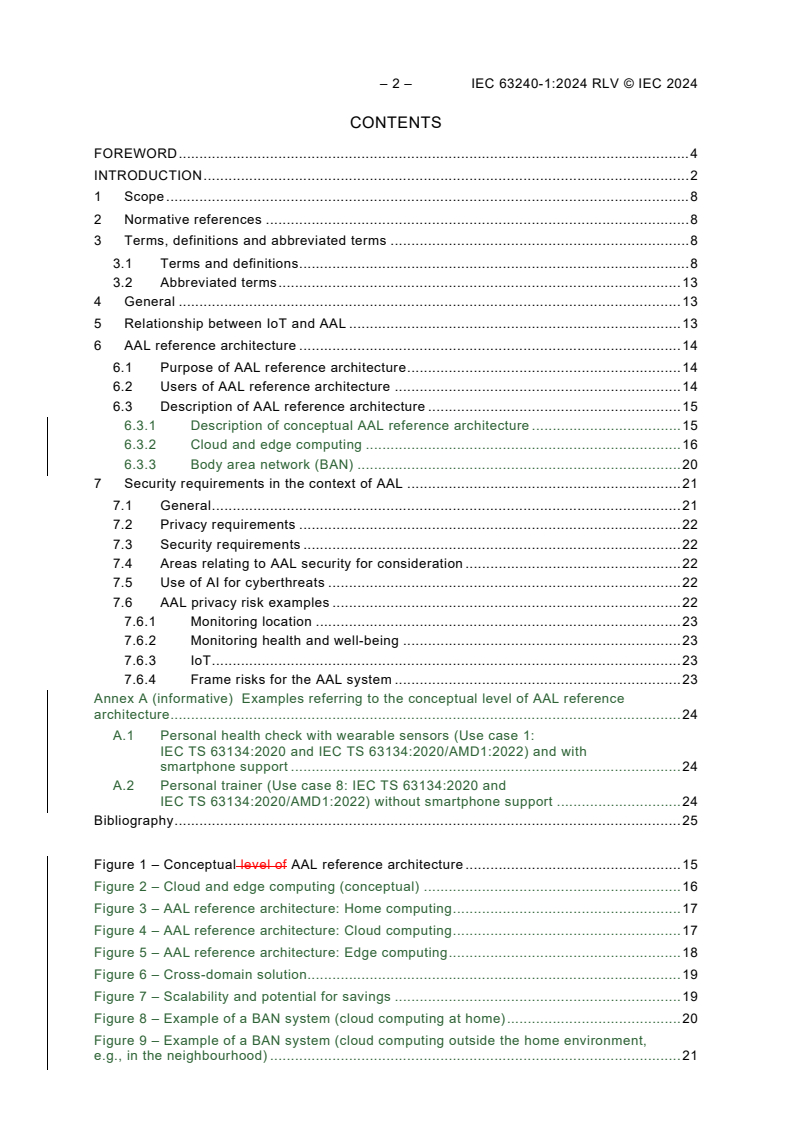
– 2 – IEC 63240-1:2024 RLV © IEC 2024
CONTENTS
FOREWORD . 4
INTRODUCTION . 2
1 Scope . 8
2 Normative references . 8
3 Terms, definitions and abbreviated terms . 8
3.1 Terms and definitions . 8
3.2 Abbreviated terms . 13
4 General . 13
5 Relationship between IoT and AAL . 13
6 AAL reference architecture . 14
6.1 Purpose of AAL reference architecture . 14
6.2 Users of AAL reference architecture . 14
6.3 Description of AAL reference architecture . 15
6.3.1 Description of conceptual AAL reference architecture . 15
6.3.2 Cloud and edge computing . 16
6.3.3 Body area network (BAN) . 20
7 Security requirements in the context of AAL . 21
7.1 General . 21
7.2 Privacy requirements . 22
7.3 Security requirements . 22
7.4 Areas relating to AAL security for consideration . 22
7.5 Use of AI for cyberthreats . 22
7.6 AAL privacy risk examples . 22
7.6.1 Monitoring location . 23
7.6.2 Monitoring health and well-being . 23
7.6.3 IoT . 23
7.6.4 Frame risks for the AAL system . 23
Annex A (informative) Examples referring to the conceptual level of AAL reference
architecture . 24
A.1 Personal health check with wearable sensors (Use case 1:
IEC TS 63134:2020 and IEC TS 63134:2020/AMD1:2022) and with
smartphone support . 24
A.2 Personal trainer (Use case 8: IEC TS 63134:2020 and
IEC TS 63134:2020/AMD1:2022) without smartphone support . 24
Bibliography . 25
Figure 1 – Conceptual level of AAL reference architecture . 15
Figure 2 – Cloud and edge computing (conceptual) . 16
Figure 3 – AAL reference architecture: Home computing . 17
Figure 4 – AAL reference architecture: Cloud computing . 17
Figure 5 – AAL reference architecture: Edge computing . 18
Figure 6 – Cross-domain solution. 19
Figure 7 – Scalability and potential for savings . 19
Figure 8 – Example of a BAN system (cloud computing at home) . 20
Figure 9 – Example of a BAN system (cloud computing outside the home environment,
e.g., in the neighbourhood) . 21
Figure 10 – Security process within the context of AAL standards . 22
– 4 – IEC 63240-1:2024 RLV © IEC 2024
INTERNATIONAL ELECTROTECHNICAL COMMISSION
____________
ACTIVE ASSISTED LIVING (AAL) REFERENCE
ARCHITECTURE AND ARCHITECTURE MODEL –
Part 1: Reference architecture
FOREWORD
1) The International Electrotechnical Commission (IEC) is a worldwide organization for standardization comprising
all national electrotechnical committees (IEC National Committees). The object of IEC is to promote international
co-operation on all questions concerning standardization in the electrical and electronic fields. To this end and
in addition to other activities, IEC publishes International Standards, Technical Specifications, Technical Reports,
Publicly Available Specifications (PAS) and Guides (hereafter referred to as "IEC Publication(s)"). Their
preparation is entrusted to technical committees; any IEC National Committee interested in the subject dealt with
may participate in this preparatory work. International, governmental and non-governmental organizations liaising
with the IEC also participate in this preparation. IEC collaborates closely with the International Organization for
Standardization (ISO) in accordance with conditions determined by agreement between the two organizations.
2) The formal decisions or agreements of IEC on technical matters express, as nearly as possible, an international
consensus of opinion on the relevant subjects since each technical committee has representation from all
interested IEC National Committees.
3) IEC Publications have the form of recommendations for international use and are accepted by IEC National
Committees in that sense. While all reasonable efforts are made to ensure that the technical content of IEC
Publications is accurate, IEC cannot be held responsible for the way in which they are used or for any
misinterpretation by any end user.
4) In order to promote international uniformity, IEC National Committees undertake to apply IEC Publications
transparently to the maximum extent possible in their national and regional publications. Any divergence between
any IEC Publication and the corresponding national or regional publication shall be clearly indicated in the latter.
5) IEC itself does not provide any attestation of conformity. Independent certification bodies provide conformity
assessment services and, in some areas, access to IEC marks of conformity. IEC is not responsible for any
services carried out by independent certification bodies.
6) All users should ensure that they have the latest edition of this publication.
7) No liability shall attach to IEC or its directors, employees, servants or agents including individual experts and
members of its technical committees and IEC National Committees for any personal injury, property damage or
other damage of any nature whatsoever, whether direct or indirect, or for costs (including legal fees) and
expenses arising out of the publication, use of, or reliance upon, this IEC Publication or any other IEC
Publications.
8) Attention is drawn to the Normative references cited in this publication. Use of the referenced publications is
indispensable for the correct application of this publication.
9) IEC draws attention to the possibility that the implementation of this document may involve the use of (a)
patent(s). IEC takes no position concerning the evidence, validity or applicability of any claimed patent rights in
respect thereof. As of the date of publication of this document, IEC had not received notice of (a) patent(s), which
may be required to implement this document. However, implementers are cautioned that this may not represent
the latest information, which may be obtained from the patent database available at https://patents.iec.ch. IEC
shall not be held responsible for identifying any or all such patent rights.
This redline version of the official IEC Standard allows the user to identify the changes
made to the previous edition IEC 63240-1:2020. A vertical bar appears in the margin
wherever a change has been made. Additions are in green text, deletions are in
strikethrough red text.
IEC 63240-1 has been prepared by IEC systems committee AAL: Active Assisted Living. It is
an International Standard.
This second edition cancels and replaces the first edition published in 2020. This edition
constitutes a technical revision.
This edition includes the following significant technical changes with respect to the previous
edition:
a) clarifying the Introduction;
b) new terms and definitions have been added in 3.1;
c) adaption of terms according to the IEV in the whole document;
d) reference to ethical considerations of AI when applied in the AAL context has been added
in Clause 5;
e) clarifying the description of AAL reference architecture in 6.3.1;
f) process to identify the needs on BAN, edge and cloud computing in the architecture
perspective has been added in 6.3.2 and 6.3.3;
g) new figures have been added in 6.3.2 and 6.3.3;
h) reference to standards inventory has been added in 7.1;
i) clarification of 7.5;
j) Annex A has been added;
k) updated bibliography.
The text of this International Standard is based on the following documents:
Draft Report on voting
SyCAAL/322/CDV SyCAAL/362A/RVC
Full information on the voting for its approval can be found in the report on voting indicated in
the above table.
The language used for the development of this International Standard is English.
This document was drafted in accordance with ISO/IEC Directives, Part 2, and developed in
accordance with ISO/IEC Directives, Part 1 and ISO/IEC Directives, IEC Supplement, available
at www.iec.ch/members_experts/refdocs. The main document types developed by IEC are
described in greater detail at www.iec.ch/publications.
A list of all parts in the IEC 63240 series, published under the general title Active assisted living
reference architecture and architecture model, can be found on the IEC website.
– 6 – IEC 63240-1:2024 RLV © IEC 2024
The committee has decided that the contents of this document will remain unchanged until the
stability date indicated on the IEC website under webstore.iec.ch in the data related to the
specific document. At this date, the document will be
• reconfirmed,
• withdrawn, or
• revised.
IMPORTANT – The "colour inside" logo on the cover page of this document indicates
that it contains colours which are considered to be useful for the correct understanding
of its contents. Users should therefore print this document using a colour printer.
INTRODUCTION
IEC Systems Committee for Active Assisted Living (SyC AAL) is developing an architecture
model and a reference architecture for AAL to guide the development and deployment of AAL
services and technologies. IEC 63240 consists of the following parts, under the general title
Active assisted living (AAL) reference architecture and architecture model:
• Part 1: Reference architecture;
• Part 2: Architecture model.
This document provides information to ensure usability and accessibility from the earliest stages
of design and provides guidance to developers on how to incorporate these requirements.
Additional requirements such as security, privacy, and trustworthiness are introduced and
considered.
This document captures the results the work of SyC AAL on architecture and interoperability.
This document reflects contributions and discussions by SyC AAL experts, mirror committees
and liaison members. This document also contains material gathered from reports and group
output from the SyC AAL meetings in November 2015 (Tokyo), April 2016 (Wellington), October
2016 (Frankfurt), April 2017 (Beijing), September 2017 (Cleveland), December 2017
(Eindhoven), May 2018 (Tokyo), October 2018 (Seoul), June 2019 (Frankfurt) and October 2019
(Shanghai), as well as information obtained during various web meetings.
Experts from liaison organizations and the following national committees have contributed: CA,
CH, CN, DE, GB, IN, JP, KR, NL, NZ, SE, US.
The first edition of IEC 63240-1 was published in 2020. Since the publication of
IEC 63240-1:2020, IEC SyC AAL has been collecting issues from a variety of sources including
comments from IEC National Committees. At the September 2021 online meeting of IEC SyC
AAL, it was decided to set up a process to identify the needs of body area network (BAN), edge
and cloud computing in the architecture perspective. These items are considered in this
document.
The target audience for this document includes the following stakeholders who have an interest
in the AAL system:
• AAL users and service provider personnel who can learn about AAL user needs and how to
operate AAL systems;
• consumer electronics and information and communication technology device manufacturers
who want to understand AAL device interface and interoperability requirements;
• stakeholders who are interested in the usability, accessibility and performance of the AAL
system as well as AAL operators who need to understand the system requirements;
• regulators who are responsible for developing and supervising AAL systems and the related
regulations.
– 8 – IEC 63240-1:2024 RLV © IEC 2024
ACTIVE ASSISTED LIVING (AAL) REFERENCE
ARCHITECTURE AND ARCHITECTURE MODEL –
Part 1: Reference architecture
1 Scope
This document specifies the AAL reference architecture.
This document defines concepts and introduces terminology. It provides generic rules for
designers of AAL systems and services with the aim to facilitate systems design and enable
interoperability between components.
This document identifies safety, security, privacy, and other requirements for AAL systems such
as usability, accessibility, and trustworthiness (reliability, resilience) and sets up a process to
identify the needs on the body area network (BAN), edge and cloud computing in the
architecture perspective.
2 Normative references
There are no normative references in this document.
3 Terms, definitions and abbreviated terms
3.1 Terms and definitions
For the purposes of this document, the following terms and definitions apply.
ISO and IEC maintain terminology databases for use in standardization at the following
addresses:
• IEC Electropedia: available at https://www.electropedia.org/
• ISO Online browsing platform: available at https://www.iso.org/obp
3.1.1
AAL device
material element or assembly of such elements intended to perform a required function used in
an AAL service (IEV 871-01-04)
Note 1 to entry: There are 1) medical devices (IEV 871-06-06), as defined by regulatory agencies, 2) personal
health devices and sensors (IEV 871-04-29) for fitness, well-being, personal comfort and personal security and 3)
devices which can serve as aggregators of personal data produced by the user of the device.
[SOURCE: IEC 60050-151:2001, 151-11-20, modified – The term "device" has been replaced
by "AAL device". In the definition, "used in an AAL service" has been added.]
device (IEV 151-11-20) used in an AAL system
EXAMPLE Examples are sensors and actuators that contain one or more components (functionality).
Note 1 to entry: External conditions and events include measurements of temperature, motion, and electrical
conditions.
Note 2 to entry: There are 1) medical devices (IEV 871-06-06), as defined by regulatory agencies, 2) personal
health devices and sensors (IEV 871-04-29) for fitness, wellbeing, personal comfort, and personal security and 3)
devices that can serve as aggregators of personal data produced by the user of the device.
[SOURCE: IEC 60050-871:2023, 871-07-01]
3.1.2
AAL gateway
functional unit that connects two computer networks with different network architectures and
protocols used in an AAL service (IEV 871-01-04)
Note 1 to entry: The computer networks may be local area networks, wide area networks, or other types of networks.
Note 2 to entry: Examples of gateways are a LAN gateway, a mail gateway used in an AAL service.
[SOURCE: IEC 60050-732:2010, 732-01-17, modified – The term "gateway" has been replaced
by "AAL gateway". In the definition and in Note 2 to entry, "used in an AAL service" has been
added.]
3.1.3
AAL platform backend system
AAL backend system
system that houses a number of components (and functionalities) in order to collect the data
from AAL gateways or AAL devices directly over a wide area network connection, and that can
also implement components for the remote management of the AAL gateways or AAL devices
(e.g. firmware update) and components for interfacing with AAL information systems or
other- information systems
[SOURCE: IEC 60050-871:2023, 871-07-04]
3.1.4
AAL application
AAL application and services
program or application that interacts with the AAL users or within the network infrastructure to
transmit or exchange data and information in the network
[SOURCE: IEC 61907:2009, 3.1.13, modified – The term in the source entry is "(network)
service function". In the definition, "network users" has been replaced by "AAL users" and the
note to entry has been omitted.]
3.1.5
AAL user
active assisted living user
person who uses or benefits from, or uses and benefits from, AAL devices, systems or services
[SOURCE: IEC 60050-871:2018, 871-02-05]
3.1.6
AAL service
active assisted living service
action or function of an AAL system creating an added value for customers
EXAMPLE An AAL service could comprise, for example
– configuration and maintenance of AAL systems,
– assistant systems to support the home and living environment.
Note 1 to entry: An AAL service can consist of several individual services.
[SOURCE: IEC 60050-871:2018, 871-01-04]
– 10 – IEC 63240-1:2024 RLV © IEC 2024
3.1.7
AAL information system
collection of technical and human resources that provide the storage, computing, distribution,
and communication for the information required by an AAL service (IEV 871-01-04)
Note 1 to entry: An AAL information system can contain various types of personal information.
Note 2 to entry: See http://whatis.techtarget.com/definition/IS-information-system-or-information-services
[accessed 2020-10-20]. The definition is based on the first sentence, in which "IS (information system) is the " was
omitted and "all or some part of an enterprise" was replaced by "an AAL service (IEV 871-01-04)". Note 1 to entry
was added.
[SOURCE: IEC 60050-871:2023, 871-07-02]
3.1.8
consumer electronics, pl
CE
electronic devices designed to be purchased and used by end users or consumers for daily and
non-commercial/non-professional purposes
Note 1 to entry: Consumer electronics are among the most commonly used form of electronic, computing and
communication devices.
3.1.9
information and communication technology
ICT
technology that comprises all devices, networking components, applications and systems that
combined allow people and organizations to interact in the digital world
3.1.10
network connection
connection that comprises both local and wide area networks
EXAMPLE Network connection can comprise, for example LAN or internet.
3.1.11
interface
boundary between two functional units, defined by functional characteristics, signal
characteristics, or other characteristics as appropriate
Note 1 to entry: This concept includes the specification of the connection of two devices having different functions.
[SOURCE: IEC 60050-871:2018, 871-04-18]
3.1.12
other-information system
collection of technical and human resources that provide the storage, computing,
distribution, and communication for the information not specific to AAL services (IEV 871-01-04)
Note 1 to entry: Health information system (HIS) can be part of an other information system. An other-information
system can include in part a health information system (HIS), of which examples include:
• electronic health records (IEV 871-06-01);
• primary care practice electronic medical records (EMRs);
• pharmacy systems; or
• laboratory information systems.
Note 2 to entry: It is possible that AAL care recipients' data need be shared with other information these systems.
For example, in the context of an AAL care recipient who is suffering from chronic diseases and is monitored at home
by a telemonitoring system, it is possible that a vital signs summary report need be shared with the primary care
physician's EMRs.
Note 3 to entry: See http://whatis.techtarget.com/definition/IS-information-system-or-information-services
[accessed 2020-10-20]. The definition is based on the first sentence, in which "IS (information system) is the " was
omitted and "required by all or some part of an enterprise" was replaced by "not specific to AAL services". Notes 1
and 2 to entry were added.
[SOURCE: IEC 60050-871:2023, 871-05-12]
3.1.13
edge computing
distributed computing (3.1.14) in which processing and storage takes place at or near the edge
(3.1.15) where the nearness is defined by the system's requirements
[SOURCE: ISO/IEC TR 23188:2020, 3.1.3]
3.1.14
distributed computing
model of computing in which a set of nodes (3.1.16) coordinates its activities by means of digital
messages passed between the nodes (3.1.16)
[SOURCE: ISO/IEC TR 23188:2020, 3.1.1]
3.1.15
edge
boundary between pertinent digital and physical entities, delineated by networked sensors and
actuators
Note 1 to entry: Pertinent digital entities means that the digital entities which need to be considered can vary
depending on the system under consideration and the context in which those entities are used.
[SOURCE: ISO/IEC TR 23188:2020, 3.1.2]
3.1.16
node
networked machine with processing and storage capabilities
[SOURCE: ISO/IEC TR 23188:2020, 3.1.5]
3.1.17
cloud service
one or more capabilities offered via cloud computing invoked using a defined interface
[SOURCE: IEC 60050-741:2020, 741-01-08]
3.1.18
cloud computing
paradigm for enabling network access to a scalable and elastic pool of shareable physical or
virtual resources with self-service provisioning and administration on-demand
[SOURCE: IEC 60050-741:2020, 741-01-07]
3.1.19
AAL home platform
IT platform offering AAL services, which is integrated in an existing home environment
infrastructure
[SOURCE: IEC 60050-871:2018, 871-05-01]
– 12 – IEC 63240-1:2024 RLV © IEC 2024
3.1.20
home environment
environment within a home, including the totality of appliances [e.g. household technology,
home network, furnishings]
[SOURCE: IEC 60050-871:2018, 871-03-02]
3.1.21
IT platform
hardware and software system in which application software is executed
EXAMPLE A combination of an operating system and hardware on which software is executed, a certain type of
computer or computers of a certain architecture.
Note 1 to entry: In the AAL context an AAL IT platform is the interaction between hardware and software
components used by an AAL application.
[SOURCE: IEC 60050-871:2018, 871-05-07]
3.1.22
home service
service which is offered in home environments
3.1.23
home and neighbourhood service
service which is offered in home environments and neighbourhood environments
3.1.24
AAL cloud application and service
AAL software application and service offered via cloud computing
3.1.25
AAL edge application and service
AAL software application and service offered via edge computing
3.1.26
AAL cloud platform
IT platform offering AAL services, offered via cloud computing
3.1.27
AAL edge platform
IT platform offering AAL services, offered via edge computing
3.1.28
device
material element or assembly of such elements intended to perform a required function
Note 1 to entry: A device may form part of a larger device.
[SOURCE: IEC 60050-151:2001, 151-11-20]
3.1.29
gateway
functional unit that connects two computer networks with different network architectures and
protocols
Note 1 to entry: The computer networks may be local area networks, wide area networks, or other types of networks.
Note 2 to entry: Examples of gateways are a LAN gateway, a mail gateway.
[SOURCE: IEC 60050-732:2010, 732-01-17]
3.1.30
personal health record
PHR
representation of information regarding or relevant to the health, including wellness,
development, and welfare of a subject of care, which may be stand-alone or integrating health
information from multiple sources, and for which the individual, or their authorized
representative, manages and controls the PHR content and grants permissions for access by
and/or sharing with other parties
[SOURCE: ISO/TR 14639-2:2014, 2.60]
3.1.31
electronic health record
EHR
repository of information regarding the health status of a person, in computer processable form,
stored and transmitted securely, and accessible by multiple authorized users
Note 1 to entry: An electronic health record has a standardized or commonly agreed logical information model which
is independent of electronic health record systems. Its primary purpose is the support of continuing, efficient and
quality integrated healthcare.
Note 2 to entry: An electronic health record contains information which is retrospective, concurrent, and prospective.
[SOURCE: IEC 60050-871:2018, 871-06-01]
3.2 Abbreviated terms
AAL active assisted living
ADL activities of daily living
AI artificial intelligence
BAN body area network
IADL instrumental activities of daily living
IoT Internet of Things
4 General
AAL (active assisted living) was lacking an International Standard on a reference architecture
to serve as an abstraction a concept of the domain. The objective of this document is to give
an overview of the basis for implementing concrete architectures for different families of AAL
applications. The proposed reference architecture defines design and implementation of, for
example, communication and data flow between AAL components and how the architecture
should be constructed.
5 Relationship between IoT and AAL
AAL and IoT share a common technical architecture model and a technical
"thing"-services-based framework with the emphasis on the AAL user who consumes or applies
assisted living "thing"-related services. AAL is a specific use of IoT, where IoT is understood
as being the possibility of connecting things to each other. IoT is an enabler for other application
systems and application domains. More specifically, it is an enabler for other "thing"-related
services in these application systems and application domains.
uman-centric IoT" approach. This means that
AAL can be considered as one instance of a "h
the base for AAL is the IoT technical architecture, but specific or different requirements exist
due to the user-centricity of AAL. In AAL, users include lay operators who are not IT
– 14 – IEC 63240-1:2024 RLV © IEC 2024
professionals as users. There are also other IoT application domains that are human-centric
such as the patient-centric medical thing-related services or healthcare thing-related services.
AAL is a human-centric use of IoT to create adapted localities (e.g., homes, points-of-care) with
the aim of assisting humans. AAL is a human-centric domain at the point-of-care where services
to people based on technical, IoT services are most commonly applied.
AAL utilizes IoT and designs "thing"-related services that serve the needs of an AAL user when
interacting with the AAL cyber-physical system.
The key AAL requirements are safety, security, privacy, technical assistance, and additional
requirements (e.g., resilience and reliability of the system).
Also, ethical considerations of AI when applied in the AAL context are required especially
because of the human-centric approach (see IEC SRD 63416:2023).
These requirements can also apply to other domains where people play an important role such
as the healthcare and medical domain.
Smart home and smart energy are domains in which domain-specific smart thing-based services
are applied. "Smart services" of these and other domains should be interoperable and combined
in processes which serve the needs of the user of such "smart", connected services. AAL users
can benefit from "smart", connected services in which AAL services are combined with services
of other domains.
AAL systems are designed and implemented to assist people who need AAL services realized
by means of "things".
6 AAL reference architecture
6.1 Purpose of AAL reference architecture
The reference architecture defines concepts and introduces terminology on an abstract level.
The reference architecture provides generic rules for designers of AAL systems and services
with the aim to facilitate systems design and enable interoperability between components. The
AAL reference architecture enables secure and interoperable AAL services (all AAL services,
including end-to-end services) by describing the generic architecture. The purpose of the
reference architecture is to develop a framework that provides an overall view on components
and how they relate to each other, which enables users to fit use cases for AAL within the
framework. Components could can be actors, devices, and other building blocks. Thus, it
describes connections between technical entities and associations of people to the technical
entities.
The reference architecture is specific to AAL; however, it is not limited to current technological
solutions and use scenarios.
6.2 Users of AAL reference architecture
Potential users of the AAL reference architecture are designers and developers of AAL systems
and services, as well as manufacturers, procurers and all other stakeholders that are interested
in an abstract framework that allows them to map their use cases.
Users should use the reference architecture during the development of use cases, AAL services,
systems, or components, and to better understand how different components can be
interconnected.
Users can develop guidelines for secure interoperability based on the reference architecture.
6.3 Description of AAL reference architecture
6.3.1 Description of conceptual AAL reference architecture
Figure 1 – Conceptual level of AAL reference architecture
Figure 1 depicts the AAL reference architecture on a conceptual level. There can be a user
interface in every building block. It shows the flow of information from one building block to the
next over defined interfaces of the reference architecture.
– 16 – IEC 63240-1:2024 RLV © IEC 2024
The AAL reference architecture consists of several building blocks. Building blocks are entities
which are on their own or in combination with other entities capable of delivering AAL services.
Building blocks are connected to each other by interfaces.
The four building blocks on the left hand-side of Figure 1, i.e., "AAL devices", "AAL gateway",
"AAL platform backend system" and "AAL application and services", are intended for local AAL
services. The other two building blocks on the right hand-side of Figure 1, i.e., "AAL information
systems" and "other-information systems" are intended for remote services.
Therefore, AAL application and services (or AAL applications) refer to local services whereas
AAL information systems are more of a cloud driven remote service.
"Network connection" connects the local services and remote services via a network. "Network
connection" can be the Internet connection or connection via telephone. In some cases, it can
be the intranet connection within a private network service.
See Annex A for examples referring to the conceptual level of AAL reference architecture.
6.3.2 Cloud and edge computing
In the future, solutions must be able to work even more closely together in order to reuse
solutions that have already been purchased and installed and to combine data for completely
new applications. This requires open platforms that can react dynamically to changes. In order
to be able to dynamically add, update or exchange third-party offerings, whether hardware or
software, as cost-effectively as possible, it is recommended that solutions be implemented on
open semantic platforms (such as AAL backend systems). For this purpose, architectures
should be set up in such a way that they can be implemented either without cloud services, or
be combined with cloud services, or be purely implemented on the cloud side. As shown in
Figure 2, AAL applications can be implemented on open platforms either in the home
environment (3.1.20 / IEV 871-03-02) and/or using cloud services (3.1.17 / IEV 741-01-08). The
latter implementation is known as cloud computing (3.1.18 / IEV 741-01-07). Edge computing
(3.1.13) can be important in AAL applications where remote management of data and/or control
is inadequate, for example, in terms of response time, privacy, security, and safety.
Figure 2 – Cloud and edge computing (conceptual)
Figure 3 – AAL reference architecture: Home computing
Figure 3 depicts the AAL reference architecture for home computing. In this case, AAL home
platform (3.1.19 / IEV 871-05-01) is the AAL platform backend system shown in Figure 1.
Figure 4 – AAL reference architecture: Cloud computing
– 18 – IEC 63240-1:2024 RLV © IEC 2024
Figure 4 depicts the AAL reference architecture for cloud computing. In this case, the AAL cloud
platform (3.1.26) is the AAL platform backend shown in Figure 1 and implemented in the cloud
service. AAL cloud application and services (3.1.24) are the AAL application and services
shown in Figure 1 and implemented on the AAL cloud platform in cloud service. The AAL
gateway is directly connected to the internet. In this cloud computing reference architecture,
AAL devices and AAL gateway are not necessarily implemented only in a home environment
(3.1.20) but can be part of a home and neighbourhood service (3.1.23).
Figure 5 – AAL reference architecture: Edge computing
Figure 5 depicts the AAL reference architecture for edge computing. In this case, an AAL edge
platform (3.1.27) is used as the AAL platform backend system in the home and neighbourhood
service. AAL edge application and services (3.1.25) are implemented on the AAL edge platform
and used as the AAL application and services defined in Figure 1 in the home and
neighbourhood services. In the edge computing (3.1.13) architecture, AAL edge application and
services coordinate their activities with AAL cloud application and services.
As shown in Figure 6, it shall be possible to connect AAL devices, including sensors and
actuators, via different protocols so that products from different manufacturers can be
integrated via an AAL gateway (including controller function, e.g., for protocol conversion).
In solutions that are implemented together both on the client and server sides, the data is
mirrored via a server-side AAL gateway and can thus be evaluated on both sides, and services
can also be implemented on both sides. On both the server and client side, it should be possible
to connect several platforms with each other in order to implement cross-domain solutions (see
Figure 6).
In addition, the architecture should enable scaling from the connected home to other buildings,
and to the neighbourhood. Between the boundaries of these different domains, at the gateway
and at all cloud connections, requirements particularly for a high level of security, for privacy
protection, and for IT security shall be implemented (see Figure 7). See Clause 7 for security
requirements in the context of AAL as well as further standards and national and international
regulations in the context of security requirements (see also the "standards inventory mapping",
a work in progress https://mapping.iec.ch/#/maps/97).
Figure 6 – Cross-domain solution
Software architectures should be built in such a way that they allow data to be merged across
system boundaries in order to enable remote monitoring and interoperability. As societal needs
change, it is possible that remote monitoring and interoperability will be required due to the
necessity for social distancing caused by a pandemic or similar situation. Software architectures
should also link with other domains such as transport, energy and water supply to ensure
optimal reusability, extensibility and interoperability (see Figure 7).
Figure 7 – Scalability and potential for savings
– 20 – IEC 63240-1:2024 RLV © IEC 2024
In the configuration shown in Figure 7, the user is considered to embody the body space. The
body space (user) is mobile and can move within the home (see Figure 7) or outside home (see
number 1 in Figure 7). The user can also go to another mobile space such as their car or public
transport (see number 2 in Figure 7) and be on the move in other spaces (see number 3 in
Figure 7). Here, too, there is a sharp distinction between the spaces due to privacy and IT
protection. In this sense, a robot is also a mobile space that shall be able to communicate with
the sensors and actuators of other spaces, such as the building or individual apartments (see
number 4 in Figure 7), but also with the users. Otherwise, data across domain boundaries
cannot be delimited in a secure way.
6.3.3 Body area network (BAN)
A body area network (BAN), also referred to as a wireless body area network (WBAN), a body
sensor network (BSN) or a medical body area network (MBAN), is a wireless network of
wearable computing devices. BAN devices can be embedded inside the body as implants, they
can be attached to the body in a fixed position, or they can be devices carried in different
positions, such as in clothes pockets, by hand, or in various bags.
While there is a trend towards the miniaturization of devices, body area networks consist of
several miniaturized body sensor units (BSUs) called sensor nodes together with a single body
central unit (BCU) called a hub. Larger decimetre (tab and pad) sized smart devices still play
an important role in terms of acting as a data coordinator or data gateway and providing a user
interface to view and manage BAN applications, in-situ.
Figure 8 – Example of a BAN system (cloud computing at home)
Figure 9 – Example of a BAN system (cloud computing outside
the home environment, e.g., in the neighbourhood)
Figure 8 and Figure 9 depict examples of BAN systems in the cloud computing environment.
The BAN can be operated both in the home environment (see Figure 8) and outside the home
environment. As shown in Figure 9, it is possible to leave the home environment.
7 Security requirements in the context of AAL
7.1 General
Security and cybersecurity threats affect organizations, products, and services. Security
measures now focus on response time from the time of the attack rather than on the r
...