

IEC 63240-2:2020
(Main)Active assisted living (AAL) reference architecture and architecture model - Part 2: Architecture model
General Information
- Abstract
IEC 63240-2:2020 specifies the AAL architecture model.
This document defines concepts and introduces terminology. IEC 63240-1 provides generic rules for designers of AAL systems and services with the aim to facilitate systems design and enable interoperability between components. This document provides a framework to analyse use cases on a common view and terminology, which is a foundation for communication to discuss the interoperability of the components of the AAL system. This document allows for the mapping of defined AAL use cases and supports the identification of interoperability issues and gap analysis of the standards.
This document also identifies safety, security, privacy, and other requirements for AAL systems such as usability, accessibility, and trustworthiness (reliability, resilience).
- Status
- Published
- Publication Date
- 17-Nov-2020
- Technical Committee
- SyC AAL - Active Assisted Living
- Drafting Committee
- WG 2 - SyC AAL/WG 2
- Current Stage
- PPUB - Publication issued
- Start Date
- 18-Nov-2020
- Completion Date
- 18-Dec-2020
Overview
IEC 63240-2:2020 - Active Assisted Living (AAL) reference architecture and architecture model (Part 2) specifies the AAL architecture model and terminology. It provides a common framework to analyse AAL use cases, map components (devices, gateways, backend systems), and discuss interoperability. The standard complements IEC 63240-1 (reference architecture) by focusing on the architecture model, concepts and vocabulary that support design, gap analysis and standards harmonization for AAL solutions.
Key topics
- AAL architecture model structure - described as a multi‑axis model (X: levels of assistance, Y: component composition, Z: model and process views) to give a consistent system view.
- Component definitions - clear terms for AAL device, AAL gateway, AAL platform/backend system, AAL application/service, AAL information system and other information systems.
- Layered views and figures - actor (physical) layer, communication layer, information/data model layer, function (service) layer, stakeholder layer and business layer are illustrated to support implementation planning.
- Interoperability and use‑case mapping - framework to map defined AAL use cases to the architecture model, enabling identification of interoperability issues and standards gaps.
- Non‑functional requirements - identifies essential requirements such as safety, security, privacy, usability, accessibility, and trustworthiness (reliability, resilience).
- Relationship to IoT - discusses how AAL relates to IoT technologies while maintaining AAL‑specific terminology and requirements.
Applications
IEC 63240-2 is practical for:
- System architects and designers creating interoperable AAL systems and services.
- Device and consumer electronics manufacturers building AAL devices, gateways or backend components who need standardized terminology and interface considerations.
- Integrators and software developers mapping AAL use cases to system components and identifying interoperability risks.
- Service providers, healthcare organizations and regulators assessing requirements for safety, privacy, accessibility and resilience in AAL deployments.
- Standards bodies and test labs performing gap analysis and aligning other standards with AAL needs.
Who should use this standard
- AAL users and service provider personnel
- Consumer electronics and ICT device manufacturers
- AAL system integrators and operators
- Regulators and policy makers
- Standards developers and testing organizations
Related standards and SEO keywords
- See IEC 63240-1 (AAL reference architecture) for generic design rules.
- Relevant keywords: IEC 63240-2, AAL architecture model, active assisted living, AAL reference architecture, interoperability, AAL devices, AAL gateway, AAL backend, safety security privacy, usability accessibility, AAL use cases.
IEC 63240-2:2020 is a foundational document for anyone building, assessing or regulating AAL systems who needs a common architecture model and shared terminology to enable interoperable, safe and trustworthy assisted‑living solutions.
Get Certified
Connect with accredited certification bodies for this standard

BSI Group
BSI (British Standards Institution) is the business standards company that helps organizations make excellence a habit.

TÜV Rheinland
TÜV Rheinland is a leading international provider of technical services.

TÜV SÜD
TÜV SÜD is a trusted partner of choice for safety, security and sustainability solutions.
Sponsored listings
Frequently Asked Questions
IEC 63240-2:2020 is a standard published by the International Electrotechnical Commission (IEC). Its full title is "Active assisted living (AAL) reference architecture and architecture model - Part 2: Architecture model". This standard covers: IEC 63240-2:2020 specifies the AAL architecture model. This document defines concepts and introduces terminology. IEC 63240-1 provides generic rules for designers of AAL systems and services with the aim to facilitate systems design and enable interoperability between components. This document provides a framework to analyse use cases on a common view and terminology, which is a foundation for communication to discuss the interoperability of the components of the AAL system. This document allows for the mapping of defined AAL use cases and supports the identification of interoperability issues and gap analysis of the standards. This document also identifies safety, security, privacy, and other requirements for AAL systems such as usability, accessibility, and trustworthiness (reliability, resilience).
IEC 63240-2:2020 specifies the AAL architecture model. This document defines concepts and introduces terminology. IEC 63240-1 provides generic rules for designers of AAL systems and services with the aim to facilitate systems design and enable interoperability between components. This document provides a framework to analyse use cases on a common view and terminology, which is a foundation for communication to discuss the interoperability of the components of the AAL system. This document allows for the mapping of defined AAL use cases and supports the identification of interoperability issues and gap analysis of the standards. This document also identifies safety, security, privacy, and other requirements for AAL systems such as usability, accessibility, and trustworthiness (reliability, resilience).
IEC 63240-2:2020 is classified under the following ICS (International Classification for Standards) categories: 11.020.99 - Other standards related to health care in general; 11.180 - Aids for disabled or handicapped persons. The ICS classification helps identify the subject area and facilitates finding related standards.
IEC 63240-2:2020 is available in PDF format for immediate download after purchase. The document can be added to your cart and obtained through the secure checkout process. Digital delivery ensures instant access to the complete standard document.
Standards Content (Sample)
IEC 63240-2 ®
Edition 1.0 2020-11
INTERNATIONAL
STANDARD
colour
inside
Active assisted living (AAL) reference architecture and architecture model –
Part 2: Architecture model
All rights reserved. Unless otherwise specified, no part of this publication may be reproduced or utilized in any form
or by any means, electronic or mechanical, including photocopying and microfilm, without permission in writing from
either IEC or IEC's member National Committee in the country of the requester. If you have any questions about IEC
copyright or have an enquiry about obtaining additional rights to this publication, please contact the address below or
your local IEC member National Committee for further information.
IEC Central Office Tel.: +41 22 919 02 11
3, rue de Varembé info@iec.ch
CH-1211 Geneva 20 www.iec.ch
Switzerland
About the IEC
The International Electrotechnical Commission (IEC) is the leading global organization that prepares and publishes
International Standards for all electrical, electronic and related technologies.
About IEC publications
The technical content of IEC publications is kept under constant review by the IEC. Please make sure that you have the
latest edition, a corrigendum or an amendment might have been published.
IEC publications search - webstore.iec.ch/advsearchform Electropedia - www.electropedia.org
The advanced search enables to find IEC publications by a The world's leading online dictionary on electrotechnology,
variety of criteria (reference number, text, technical containing more than 22 000 terminological entries in English
committee,…). It also gives information on projects, replaced and French, with equivalent terms in 16 additional languages.
and withdrawn publications. Also known as the International Electrotechnical Vocabulary
(IEV) online.
IEC Just Published - webstore.iec.ch/justpublished
Stay up to date on all new IEC publications. Just Published IEC Glossary - std.iec.ch/glossary
details all new publications released. Available online and once 67 000 electrotechnical terminology entries in English and
a month by email. French extracted from the Terms and Definitions clause of IEC
publications issued since 2002. Some entries have been
IEC Customer Service Centre - webstore.iec.ch/csc collected from earlier publications of IEC TC 37, 77, 86 and
If you wish to give us your feedback on this publication or need CISPR.
further assistance, please contact the Customer Service
Centre: sales@iec.ch.
IEC 63240-2 ®
Edition 1.0 2020-11
INTERNATIONAL
STANDARD
colour
inside
Active assisted living (AAL) reference architecture and architecture model –
Part 2: Architecture model
INTERNATIONAL
ELECTROTECHNICAL
COMMISSION
ICS 11.020.99; 11.180 ISBN 978-2-8322-9081-1
– 2 – IEC 63240-2:2020 © IEC 2020
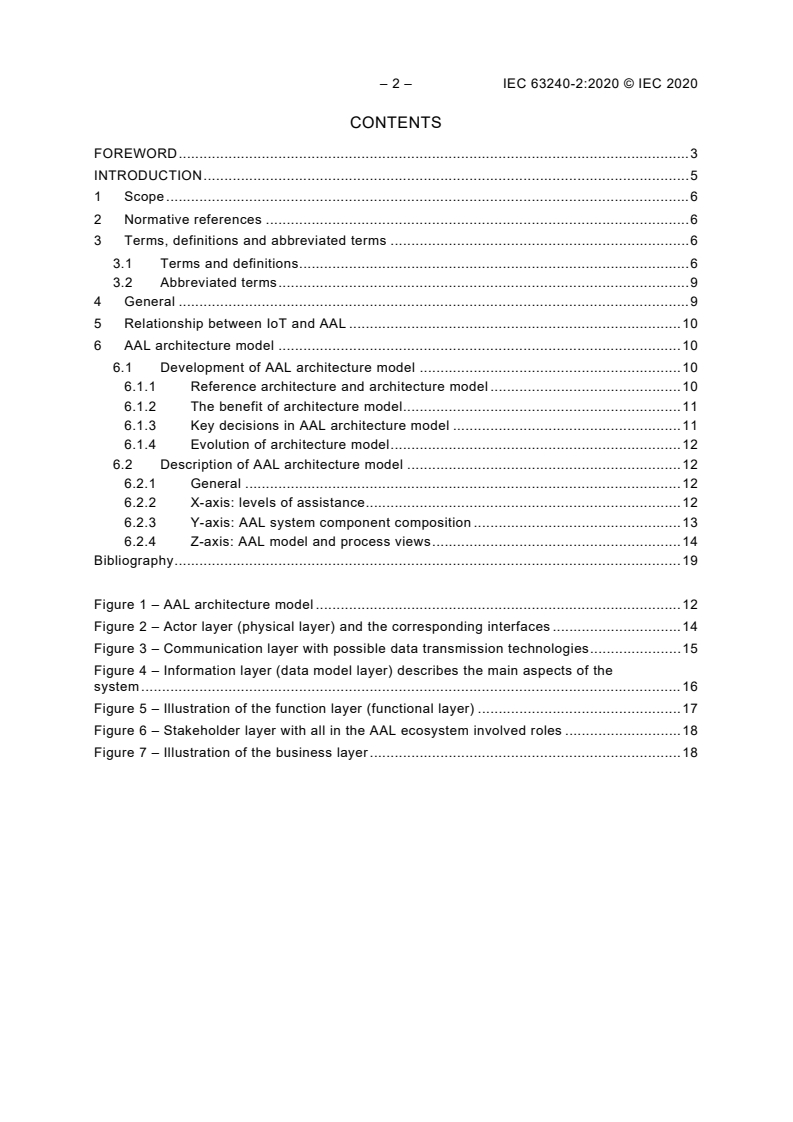
CONTENTS
FOREWORD . 3
INTRODUCTION . 5
1 Scope . 6
2 Normative references . 6
3 Terms, definitions and abbreviated terms . 6
3.1 Terms and definitions . 6
3.2 Abbreviated terms . 9
4 General . 9
5 Relationship between IoT and AAL . 10
6 AAL architecture model . 10
6.1 Development of AAL architecture model . 10
6.1.1 Reference architecture and architecture model . 10
6.1.2 The benefit of architecture model. 11
6.1.3 Key decisions in AAL architecture model . 11
6.1.4 Evolution of architecture model . 12
6.2 Description of AAL architecture model . 12
6.2.1 General . 12
6.2.2 X-axis: levels of assistance . 12
6.2.3 Y-axis: AAL system component composition . 13
6.2.4 Z-axis: AAL model and process views . 14
Bibliography . 19
Figure 1 – AAL architecture model . 12
Figure 2 – Actor layer (physical layer) and the corresponding interfaces . 14
Figure 3 – Communication layer with possible data transmission technologies . 15
Figure 4 – Information layer (data model layer) describes the main aspects of the
system . 16
Figure 5 – Illustration of the function layer (functional layer) . 17
Figure 6 – Stakeholder layer with all in the AAL ecosystem involved roles . 18
Figure 7 – Illustration of the business layer . 18
INTERNATIONAL ELECTROTECHNICAL COMMISSION
____________
ACTIVE ASSISTED LIVING (AAL) REFERENCE ARCHITECTURE AND
ARCHITECTURE MODEL –
Part 2: Architecture model
FOREWORD
1) The International Electrotechnical Commission (IEC) is a worldwide organization for standardization comprising
all national electrotechnical committees (IEC National Committees). The object of IEC is to promote international
co-operation on all questions concerning standardization in the electrical and electronic fields. To this end and
in addition to other activities, IEC publishes International Standards, Technical Specifications, Technical Reports,
Publicly Available Specifications (PAS) and Guides (hereafter referred to as "IEC Publication(s)"). Their
preparation is entrusted to technical committees; any IEC National Committee interested in the subject dealt with
may participate in this preparatory work. International, governmental and non-governmental organizations liaising
with the IEC also participate in this preparation. IEC collaborates closely with the International Organization for
Standardization (ISO) in accordance with conditions determined by agreement between the two organizations.
2) The formal decisions or agreements of IEC on technical matters express, as nearly as possible, an international
consensus of opinion on the relevant subjects since each technical committee has representation from all
interested IEC National Committees.
3) IEC Publications have the form of recommendations for international use and are accepted by IEC National
Committees in that sense. While all reasonable efforts are made to ensure that the technical content of IEC
Publications is accurate, IEC cannot be held responsible for the way in which they are used or for any
misinterpretation by any end user.
4) In order to promote international uniformity, IEC National Committees undertake to apply IEC Publications
transparently to the maximum extent possible in their national and regional publications. Any divergence between
any IEC Publication and the corresponding national or regional publication shall be clearly indicated in the latter.
5) IEC itself does not provide any attestation of conformity. Independent certification bodies provide conformity
assessment services and, in some areas, access to IEC marks of conformity. IEC is not responsible for any
services carried out by independent certification bodies.
6) All users should ensure that they have the latest edition of this publication.
7) No liability shall attach to IEC or its directors, employees, servants or agents including individual experts and
members of its technical committees and IEC National Committees for any personal injury, property damage or
other damage of any nature whatsoever, whether direct or indirect, or for costs (including legal fees) and
expenses arising out of the publication, use of, or reliance upon, this IEC Publication or any other IEC
Publications.
8) Attention is drawn to the Normative references cited in this publication. Use of the referenced publications is
indispensable for the correct application of this publication.
9) Attention is drawn to the possibility that some of the elements of this IEC Publication may be the subject of patent
rights. IEC shall not be held responsible for identifying any or all such patent rights.
International Standard IEC 63240-2 has been prepared by IEC systems committee AAL: Active
Assisted Living.
The text of this International Standard is based on the following documents:
Draft Report on voting
SyCAAL/177/CDV SyCAAL/191/RVC
Full information on the voting for the approval of this International Standard can be found in the
report on voting indicated in the above table.
This document has been drafted in accordance with the ISO/IEC Directives, Part 2.
– 4 – IEC 63240-2:2020 © IEC 2020
A list of all parts in the IEC 63240 series, published under the general title Active assisted living
reference architecture and architecture model, can be found on the IEC website.
The committee has decided that the contents of this document will remain unchanged until the
stability date indicated on the IEC website under "http://webstore.iec.ch" in the data related to
the specific document. At this date, the document will be
• reconfirmed,
• withdrawn,
• replaced by a revised edition, or
• amended.
IMPORTANT – The 'colour inside' logo on the cover page of this publication indicates
that it contains colours which are considered to be useful for the correct understanding
of its contents. Users should therefore print this document using a colour printer.
INTRODUCTION
IEC SyC AAL is developing an architecture model and a reference architecture for AAL to guide
the development and deployment of AAL services and technologies. IEC 63240 consists of the
following parts, under the general title Active assisted living (AAL) reference architecture and
architecture model:
• Part 1: Reference architecture;
• Part 2: Architecture model.
This document provides information to ensure usability and accessibility from the earliest stages
of design and provides guidance to developers on how to incorporate these requirements.
Additional requirements such as security, privacy, and trustworthiness are introduced and
considered.
This document captures the results the work of SyC AAL on architecture and interoperability.
This document reflects contributions and discussions by SyC AAL experts, mirror committees
and liaison members. This document also contains material gathered from reports and group
output from the SyC AAL meetings in November 2015 (Tokyo), April 2016 (Wellington), October
2016 (Frankfurt), April 2017 (Beijing), September 2017 (Cleveland), December 2017
(Eindhoven), May 2018 (Tokyo), October 2018 (Seoul), June 2019 (Frankfurt) and October 2019
(Shanghai), as well as information obtained during various web meetings.
Experts from liaison organizations and the following national committees have contributed: CA,
CH, CN, DE, GB, IN, JP, KR, NL, NZ, SE, US.
The target audience for this document includes the following stakeholders who have an interest
in the AAL system:
• AAL users and service provider personnel who can learn about AAL user needs and how to
operate AAL systems;
• consumer electronics and information and communication technology device manufacturers
who want to understand AAL devices and interface and interoperability requirements;
• stakeholders who are interested in the usability, accessibility and performance of the AAL
system as well as AAL operators who need to understand the system requirements;
• regulators who are responsible for developing and supervising AAL and related regulations.
– 6 – IEC 63240-2:2020 © IEC 2020
ACTIVE ASSISTED LIVING (AAL) REFERENCE ARCHITECTURE AND
ARCHITECTURE MODEL –
Part 2: Architecture model
1 Scope
This document specifies the AAL architecture model.
This document defines concepts and introduces terminology. IEC 63240-1 provides generic
rules for designers of AAL systems and services with the aim to facilitate systems design and
enable interoperability between components. This document provides a framework to analyse
use cases on a common view and terminology, which is a foundation for communication to
discuss the interoperability of the components of the AAL system. This document allows for the
mapping of defined AAL use cases and supports the identification of interoperability issues and
gap analysis of the standards.
This document also identifies safety, security, privacy, and other requirements for AAL systems
such as usability, accessibility, and trustworthiness (reliability, resilience).
2 Normative references
There are no normative references in this document.
3 Terms, definitions and abbreviated terms
3.1 Terms and definitions
For the purposes of this document, the following terms and definitions apply.
ISO and IEC maintain terminological databases for use in standardization at the following
addresses:
• IEC Electropedia: available at http://www.electropedia.org/
• ISO Online browsing platform: available at http://www.iso.org/obp
3.1.1
IADL
instrumental activity of daily living
human action that involves physical/social/cognitive skills related to independent living in
addition to ADL
Note 1 to entry: IADL includes various actions: transportation, communication (i.e. use of telephone, emails),
shopping, meal preparation, housekeeping, managing medications and managing personal finances.
Note 2 to entry: See also ISO/IWA 18:2016 [1], 3.3.
3.1.2
IADL assistance
assistance with instrumental activities of daily living
3.1.3
ADL
activity of daily living
most basic human action that involves physical self-maintenance ability
Note 1 to entry: ADL comprises the following six areas: transferring, bathing, eating, dressing, continence and
grooming and toileting.
Note 2 to entry: See also ISO/IWA 18:2016 [1], 3.3.
3.1.4
ADL assistance
assistance with activities of daily living
3.1.5
AAL device
material element or assembly of such elements intended to perform a required function used in
an AAL service (IEV 871-01-04).
Note 1 to entry: There are 1) medical devices (IEV 871-06-06), as defined by regulatory agencies, 2) personal
health devices and sensors (IEV 871-04-29) for fitness, well-being, personal comfort and personal security and 3)
devices which can serve as aggregators of personal data produced by the user of the device.
[SOURCE: IEC 60050-151:2001 [2], 151-11-20, modified – The term "device" has been
replaced by "AAL device". In the definition, "used in an AAL service" has been added.]
3.1.6
AAL gateway
functional unit that connects two computer networks with different network architectures and
protocols used in an AAL service (IEV 871-01-04)
Note 1 to entry: The computer networks may be local area networks, wide area networks, or other types of networks.
Note 2 to entry: Examples of gateways are a LAN gateway, a mail gateway used in an AAL service.
[SOURCE: IEC 60050-732:2010 [3], 732-01-17, modified – The term "gateway" has been
replaced by "AAL gateway". In the definition and in Note 2 to entry, "used in an AAL service"
has been added.]
3.1.7
AAL platform backend system
AAL backend system
system that houses a number of components (functionalities) in order to collect the data from
AAL gateways or AAL devices directly over a wide area network connection, and that can also
implement components for the remote management of AAL gateway or AAL device (e.g.
firmware update) and components for interfacing with AAL information systems or other
information systems
3.1.8
AAL applications and services
AAL application
program or application that interacts with the AAL users or within the network infrastructure to
transmit or exchange data and information in the network
[SOURCE: IEC 61907:2009 [4], 3.1.13 – modified. The term in the source entry is "(network)
service function". In the definition, "network users" has been replaced by "AAL users".]
3.1.9
AAL service
action or function of an AAL system creating an added value for customers
– 8 – IEC 63240-2:2020 © IEC 2020
EXAMPLE 1 Configuration and maintenance of AAL systems.
EXAMPLE 2 Assistant systems to support the home and living environment.
Note 1 to entry: An AAL service can consist of several individual services.
[SOURCE: IEC 60050-871:2018 [5], 871-01-04]
3.1.10
AAL information system
collection of technical and human resources that provide the storage, computing, distribution,
and communication for the information required by an AAL service (IEV 871-01-04)
Note 1 to entry: An AAL information system can contain various types of personal information.
Note 2 to entry: See http://whatis.techtarget.com/definition/IS-information-system-or-information-services
[accessed 2020-10-20]. The definition is based on the first sentence in which "IS (information system) is the " was
omitted and "all or some part of an enterprise" was replaced by "an AAL service (871-01-04). Note 1 to entry was
added.
3.1.11
other information system
collection of technical and human resources that provide the storage, computing, distribution,
and communication for the information not specific to AAL services
Note 1 to entry: Health information system (HIS) can be part of another information system. Examples of HIS include
• electronic health records (IEV 871-06-01),
• primary care practice electronic medical records (EMRs),
• pharmacy systems, and
• laboratory information systems.
Note 2 to entry: It is possible that AAL care recipients' data need to be shared with other information systems. For
example, in the context of an AAL care recipient who is suffering from chronic diseases and is monitored at home by
a telemonitoring system, it is possible that a vital signs summary report needs to be shared with the primary care
physician’s EMR.
Note 3 to entry: See http://whatis.techtarget.com/definition/IS-information-system-or-information-services
[accessed 2020-10-20]. The definition is based on the first sentence in which "IS (information system) is the " was
omitted and "required by all or some part of an enterprise" was replaced by "not specific to AAL services". Notes 1
and 2 to entry were added.
3.1.12
actor layer
layer of an architecture model in which the content is derived from the use case information on
actors
Note 1 to entry: Actors can be persons, technical components, or organizations that can be associated to domains
(Levels of assistance: X-axis) relevant for the underlying use case. In the same manner the hierarchical zones
(System component composition: Y-axis) can be identified indicating where individual actors reside.
Note 2 to entry: See CEN-CENELEC-ETSI Smart Grid Coordination Group, Smart Grid Reference Architecture,
November 2012, 7.3.3.2. The definition has been derived from the first sentence in which "The content of the
component layer is" has been replaced by "layer of architecture model in which the content is". Note 1 to entry was
added.
3.1.13
communication layer
layer of an architecture model that describes protocols and actions for the interoperable
exchange of information between the actors of a use case
Note 1 to entry: See CEN-CENELEC-ETSI Smart Grid Coordination Group, Smart Grid Reference Architecture,
November 2012, 7.3.3.6. The definition has been derived from the first sentence in which "The emphasis of the
communication layer is to describe" has been replaced by "layer of an architecture model that describes" and "the
use case actors" has been replaced by "the actors of a use case". "mechanisms" has b
...