

IEC 63474:2026
(Main)Electrical and electronic household and office equipment - Measurement of networked standby power of edge equipment
General Information
- Abstract
IEC 63474:2026 specifies methods of measurement of electrical power in networked standby mode and the reporting of the results for edge equipment.
The measurement of power and energy use in non-active mode, other than networked standby mode, is covered by IEC 62301, including the input voltage range.
This document applies to edge equipment that is powered by:
– low voltage mains AC power (LV ≤ 1 000 V AC), or
– an external power supply that provides low voltage (LV ≤ 1 000 V) or extra low voltage (ELV ≤ 50 V) AC or DC power, or
– a separate source of extra low voltage DC power (ELV ≤ 50 V DC), or
– an internal main battery
Conditions that are outside the scope of this document are as follows:
– active modes (primary function)
– other non-active modes (which are either covered by IEC 62301 or by specific product group standards),
– conditions where main batteries are being charged other than in maintenance mode,
– disconnected condition of the equipment.
This document applies to the following product groups where a networked standby mode present:
– edge equipment with a network reactivation function, such as household appliances, information technology equipment, audio, video and multimedia systems and equipment,
– digital radio receivers with an emergency warning function,
– gas burning equipment with electrical components.
NOTE 1 The measurements of power, energy use and performance of products during their intended use (when performing their primary functions) are generally specified in product standards and are not covered by this document.
NOTE 2 Interconnecting equipment (equipment that provides network infrastructure and function) is outside the scope of this document. Measurement of electrical power in networked standby mode for interconnecting equipment is the subject of ETSI standard EN 303 423.
This document also provides a method to test power management and to test whether it is possible to deactivate wireless network connection(s).
NOTE 4 Edge equipment can also include auxiliary batteries.
This document has the status of a horizontal publication in accordance with IEC GUIDE 108.
This second edition cancels and replaces the first edition published in 2023. This edition constitutes a technical revision. This edition includes the following significant technical changes with respect to the previous edition:
- the scope and the measurement method were extended to battery operated products;
- terms and definitions, and measurement conditions have been updated and aligned for both IEC 62301 (ED3) and this document, IEC 63474 (ED2)
- Status
- Published
- Publication Date
- 08-Jun-2026
- Drafting Committee
- JWG 2 (TA 19) - TC 100/TA 19/JWG 2 (TA 19)
- Current Stage
- PPUB - Publication issued
- Start Date
- 09-Jun-2026
- Completion Date
- 05-Jun-2026
Overview
IEC 63474:2026 is an international standard published by the International Electrotechnical Commission (IEC) that specifies uniform methods for measuring the electrical power consumed by edge equipment in networked standby mode. This second edition extends the measurement methodology to include battery-operated products and harmonizes terms and measurement conditions with IEC 62301. The standard addresses energy efficiency in a variety of electrical and electronic household and office equipment that can connect to a network and can be reactivated remotely, aiming to support consistent reporting and comparison of standby power data worldwide.
The standard covers equipment powered by:
- Low voltage mains AC power (up to 1,000 V AC)
- External power supplies with low voltage (up to 1,000 V) or extra low voltage (up to 50 V) AC/DC
- Extra low voltage DC power sources (up to 50 V DC)
- Internal main batteries
The focus is solely on networked standby power-the condition where equipment is awaiting reactivation via a wired or wireless network. Modes such as active (performing primary functions), other non-active modes, or while charging batteries (except in maintenance mode), are outside its scope.
Key Topics
- Networked Standby Mode: Measurement protocols for edge devices that maintain connectivity to networks and can be remotely reactivated, ensuring that devices are tested according to real-world usage where they are not fully shut down but ready to respond to network commands.
- Applicable Product Groups: Household appliances, IT equipment, audio/video gear, multimedia systems, digital radio receivers (especially those supporting emergency alerts), and gas-burning appliances with electronic controls.
- Measurement Methodology: Specifies test procedures, conditions for test environments, required instrumentation, network port configuration, and the documentation of device status and settings during measurement.
- Power Management Testing: Includes methods to assess whether devices allow deactivation of wireless network connections, impacting standby energy consumption.
- Expanded Scope: The second edition includes battery-powered equipment, reflecting modern usage where devices often operate on or switch between multiple power sources.
- Harmonization of Definitions: Aligns closely with IEC 62301 to guarantee consistency in terminology and testing through updated definitions for primary/secondary/tertiary functions and operating modes.
Applications
IEC 63474:2026 is essential for:
- Manufacturers of household and office edge equipment aiming for energy efficiency compliance and eco-labeling.
- Testing laboratories and certification bodies seeking standardized procedures for verifying standby power consumption.
- Regulators and policymakers developing energy saving policies and requirements for networked equipment.
- R&D teams working on product eco-design and power management optimization.
Practical value includes:
- Ensuring accurate, repeatable power consumption measurements for devices in networked standby, essential for eco-design, product labeling, and compliance.
- Enabling valid comparisons across product categories and international markets.
- Supporting energy efficiency initiatives and reducing unnecessary energy consumption in network-ready devices.
Related Standards
When applying IEC 63474:2026, also consider:
- IEC 62301: Measurement of standby power of household electrical appliances in non-networked modes.
- IEC 63103: Covers networked standby power measurement for lighting equipment.
- ETSI EN 303 423: Pertains to networked standby power measurement of interconnecting equipment (infrastructure devices).
- IEC 62104: Characteristics of DAB (Digital Audio Broadcast) radio receivers, relevant for emergency warning function testing.
By implementing IEC 63474:2026, organizations can ensure that measurement of networked standby power for edge equipment is accurate, harmonized, and aligned with global energy efficiency standards.
Relations
- Effective Date
- 05-Sep-2023
Get Certified
Connect with accredited certification bodies for this standard

BSI Group
BSI (British Standards Institution) is the business standards company that helps organizations make excellence a habit.

NYCE
Mexican standards and certification body.
Sponsored listings
Frequently Asked Questions
IEC 63474:2026 is a standard published by the International Electrotechnical Commission (IEC). Its full title is "Electrical and electronic household and office equipment - Measurement of networked standby power of edge equipment". This standard covers: IEC 63474:2026 specifies methods of measurement of electrical power in networked standby mode and the reporting of the results for edge equipment. The measurement of power and energy use in non-active mode, other than networked standby mode, is covered by IEC 62301, including the input voltage range. This document applies to edge equipment that is powered by: – low voltage mains AC power (LV ≤ 1 000 V AC), or – an external power supply that provides low voltage (LV ≤ 1 000 V) or extra low voltage (ELV ≤ 50 V) AC or DC power, or – a separate source of extra low voltage DC power (ELV ≤ 50 V DC), or – an internal main battery Conditions that are outside the scope of this document are as follows: – active modes (primary function) – other non-active modes (which are either covered by IEC 62301 or by specific product group standards), – conditions where main batteries are being charged other than in maintenance mode, – disconnected condition of the equipment. This document applies to the following product groups where a networked standby mode present: – edge equipment with a network reactivation function, such as household appliances, information technology equipment, audio, video and multimedia systems and equipment, – digital radio receivers with an emergency warning function, – gas burning equipment with electrical components. NOTE 1 The measurements of power, energy use and performance of products during their intended use (when performing their primary functions) are generally specified in product standards and are not covered by this document. NOTE 2 Interconnecting equipment (equipment that provides network infrastructure and function) is outside the scope of this document. Measurement of electrical power in networked standby mode for interconnecting equipment is the subject of ETSI standard EN 303 423. This document also provides a method to test power management and to test whether it is possible to deactivate wireless network connection(s). NOTE 4 Edge equipment can also include auxiliary batteries. This document has the status of a horizontal publication in accordance with IEC GUIDE 108. This second edition cancels and replaces the first edition published in 2023. This edition constitutes a technical revision. This edition includes the following significant technical changes with respect to the previous edition: - the scope and the measurement method were extended to battery operated products; - terms and definitions, and measurement conditions have been updated and aligned for both IEC 62301 (ED3) and this document, IEC 63474 (ED2)
IEC 63474:2026 specifies methods of measurement of electrical power in networked standby mode and the reporting of the results for edge equipment. The measurement of power and energy use in non-active mode, other than networked standby mode, is covered by IEC 62301, including the input voltage range. This document applies to edge equipment that is powered by: – low voltage mains AC power (LV ≤ 1 000 V AC), or – an external power supply that provides low voltage (LV ≤ 1 000 V) or extra low voltage (ELV ≤ 50 V) AC or DC power, or – a separate source of extra low voltage DC power (ELV ≤ 50 V DC), or – an internal main battery Conditions that are outside the scope of this document are as follows: – active modes (primary function) – other non-active modes (which are either covered by IEC 62301 or by specific product group standards), – conditions where main batteries are being charged other than in maintenance mode, – disconnected condition of the equipment. This document applies to the following product groups where a networked standby mode present: – edge equipment with a network reactivation function, such as household appliances, information technology equipment, audio, video and multimedia systems and equipment, – digital radio receivers with an emergency warning function, – gas burning equipment with electrical components. NOTE 1 The measurements of power, energy use and performance of products during their intended use (when performing their primary functions) are generally specified in product standards and are not covered by this document. NOTE 2 Interconnecting equipment (equipment that provides network infrastructure and function) is outside the scope of this document. Measurement of electrical power in networked standby mode for interconnecting equipment is the subject of ETSI standard EN 303 423. This document also provides a method to test power management and to test whether it is possible to deactivate wireless network connection(s). NOTE 4 Edge equipment can also include auxiliary batteries. This document has the status of a horizontal publication in accordance with IEC GUIDE 108. This second edition cancels and replaces the first edition published in 2023. This edition constitutes a technical revision. This edition includes the following significant technical changes with respect to the previous edition: - the scope and the measurement method were extended to battery operated products; - terms and definitions, and measurement conditions have been updated and aligned for both IEC 62301 (ED3) and this document, IEC 63474 (ED2)
IEC 63474:2026 is classified under the following ICS (International Classification for Standards) categories: 35.020 - Information technology (IT) in general. The ICS classification helps identify the subject area and facilitates finding related standards.
IEC 63474:2026 has the following relationships with other standards: It is inter standard links to IEC 63474:2023. Understanding these relationships helps ensure you are using the most current and applicable version of the standard.
IEC 63474:2026 is available in PDF format for immediate download after purchase. The document can be added to your cart and obtained through the secure checkout process. Digital delivery ensures instant access to the complete standard document.
Standards Content (Sample)
IEC 63474 ®
Edition 2.0 2026-06
INTERNATIONAL
STANDARD
HORIZONTAL PUBLICATION
GROUP ENERGY EFFICIENCY PUBLICATION
Electrical and electronic household and office equipment - Measurement of
networked standby power of edge equipment
ICS 35.020 ISBN 978-2-8327-1245-0
All rights reserved. Unless otherwise specified, no part of this publication may be reproduced or utilized in any form or
by any means, electronic or mechanical, including photocopying and microfilm, without permission in writing from either
IEC or IEC's member National Committee in the country of the requester. If you have any questions about IEC copyright
or have an enquiry about obtaining additional rights to this publication, please contact the address below or your local
IEC member National Committee for further information.
IEC Secretariat Tel.: +41 22 919 02 11
3, rue de Varembé info@iec.ch
CH-1211 Geneva 20 www.iec.ch
Switzerland
About the IEC
The International Electrotechnical Commission (IEC) is the leading global organization that prepares and publishes
International Standards for all electrical, electronic and related technologies.
About IEC publications
The technical content of IEC publications is kept under constant review by the IEC. Please make sure that you have the
latest edition, a corrigendum or an amendment might have been published.
IEC publications search - IEC Products & Services Portal - products.iec.ch
webstore.iec.ch/advsearchform Discover our powerful search engine and read freely all the
The advanced search enables to find IEC publications by a publications previews, graphical symbols and the glossary.
variety of criteria (reference number, text, technical With a subscription you will always have access to up to date
committee, …). It also gives information on projects, content tailored to your needs.
replaced and withdrawn publications.
Electropedia - www.electropedia.org
The world's leading online dictionary on electrotechnology,
IEC Just Published - webstore.iec.ch/justpublished
Stay up to date on all new IEC publications. Just Published containing more than 22 500 terminological entries in English
details all new publications released. Available online and and French, with equivalent terms in 25 additional languages.
once a month by email. Also known as the International Electrotechnical Vocabulary
(IEV) online.
IEC Customer Service Centre - webstore.iec.ch/csc
If you wish to give us your feedback on this publication or
need further assistance, please contact the Customer
Service Centre: sales@iec.ch.
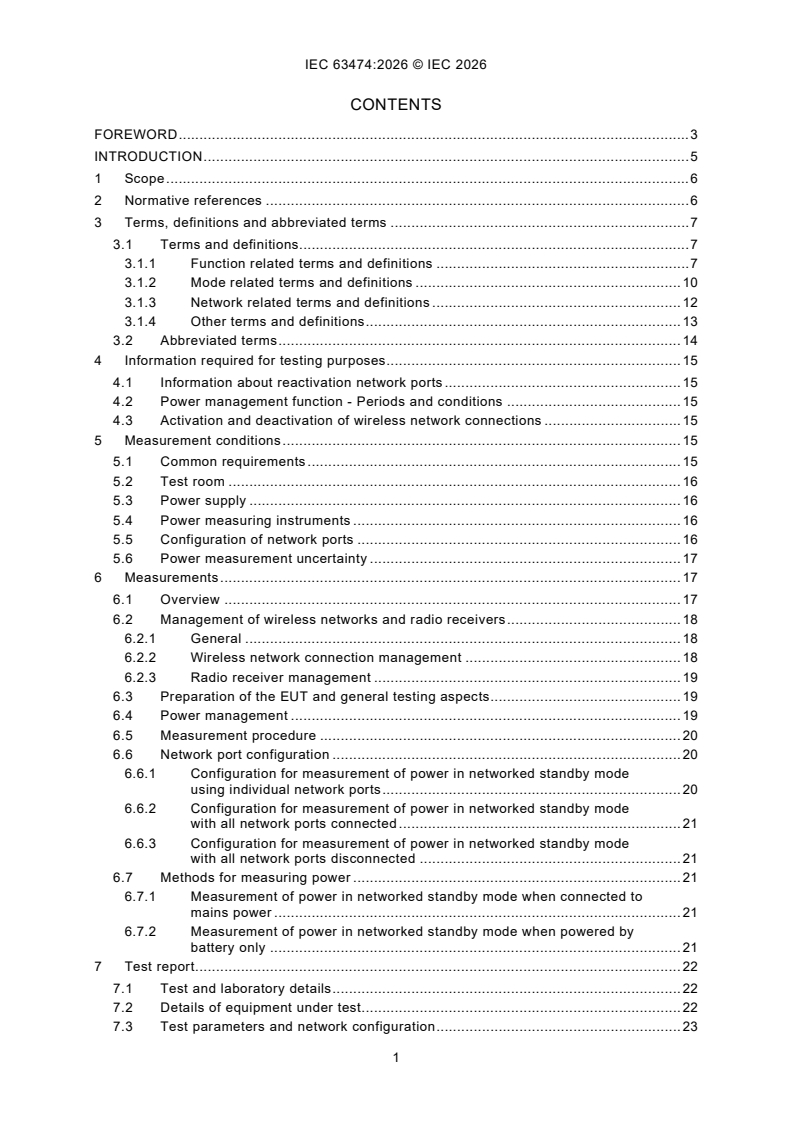
CONTENTS
FOREWORD . 3
INTRODUCTION . 5
1 Scope . 6
2 Normative references . 6
3 Terms, definitions and abbreviated terms . 7
3.1 Terms and definitions. 7
3.1.1 Function related terms and definitions . 7
3.1.2 Mode related terms and definitions . 10
3.1.3 Network related terms and definitions . 12
3.1.4 Other terms and definitions . 13
3.2 Abbreviated terms . 14
4 Information required for testing purposes . 15
4.1 Information about reactivation network ports . 15
4.2 Power management function - Periods and conditions . 15
4.3 Activation and deactivation of wireless network connections . 15
5 Measurement conditions . 15
5.1 Common requirements . 15
5.2 Test room . 16
5.3 Power supply . 16
5.4 Power measuring instruments . 16
5.5 Configuration of network ports . 16
5.6 Power measurement uncertainty . 17
6 Measurements . 17
6.1 Overview . 17
6.2 Management of wireless networks and radio receivers . 18
6.2.1 General . 18
6.2.2 Wireless network connection management . 18
6.2.3 Radio receiver management . 19
6.3 Preparation of the EUT and general testing aspects . 19
6.4 Power management . 19
6.5 Measurement procedure . 20
6.6 Network port configuration . 20
6.6.1 Configuration for measurement of power in networked standby mode
using individual network ports . 20
6.6.2 Configuration for measurement of power in networked standby mode
with all network ports connected . 21
6.6.3 Configuration for measurement of power in networked standby mode
with all network ports disconnected . 21
6.7 Methods for measuring power . 21
6.7.1 Measurement of power in networked standby mode when connected to
mains power . 21
6.7.2 Measurement of power in networked standby mode when powered by
battery only . 21
7 Test report . 22
7.1 Test and laboratory details . 22
7.2 Details of equipment under test. 22
7.3 Test parameters and network configuration . 23
7.4 Measured and documented data . 23
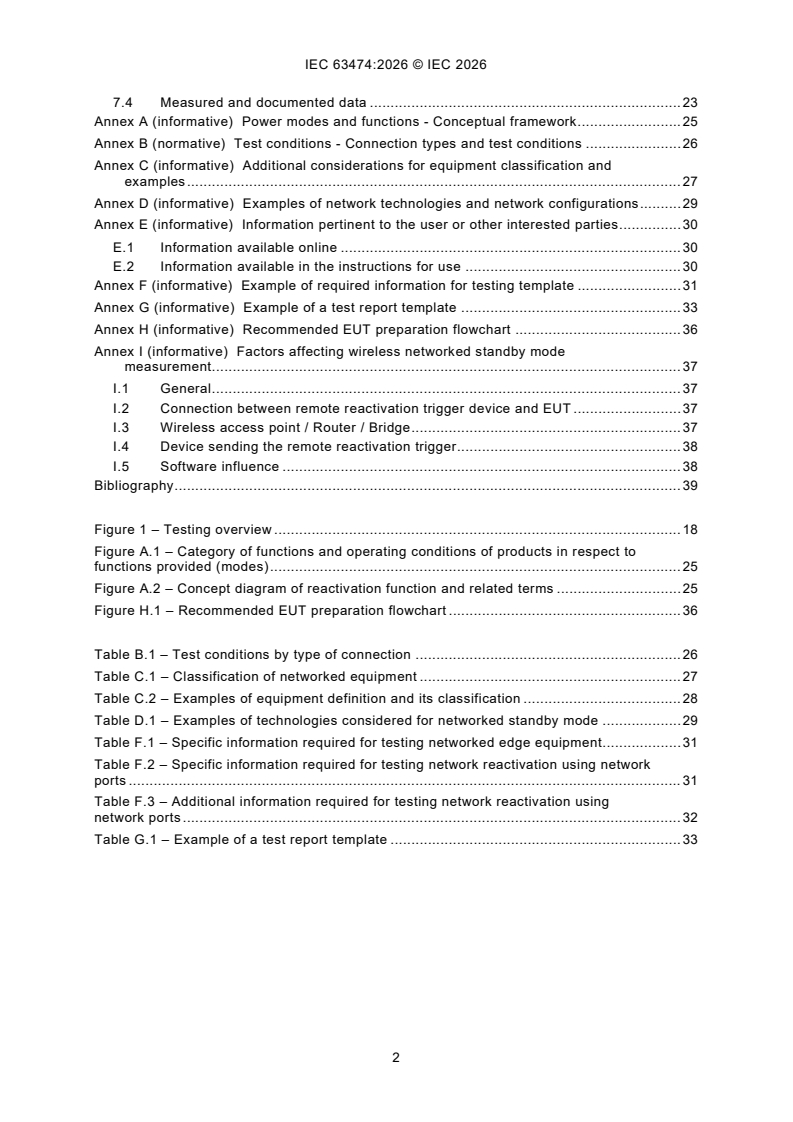
Annex A (informative) Power modes and functions - Conceptual framework . 25
Annex B (normative) Test conditions - Connection types and test conditions . 26
Annex C (informative) Additional considerations for equipment classification and
examples . 27
Annex D (informative) Examples of network technologies and network configurations . 29
Annex E (informative) Information pertinent to the user or other interested parties . 30
E.1 Information available online . 30
E.2 Information available in the instructions for use . 30
Annex F (informative) Example of required information for testing template . 31
Annex G (informative) Example of a test report template . 33
Annex H (informative) Recommended EUT preparation flowchart . 36
Annex I (informative) Factors affecting wireless networked standby mode
measurement. 37
I.1 General . 37
I.2 Connection between remote reactivation trigger device and EUT . 37
I.3 Wireless access point / Router / Bridge . 37
I.4 Device sending the remote reactivation trigger . 38
I.5 Software influence . 38
Bibliography . 39
Figure 1 – Testing overview . 18
Figure A.1 – Category of functions and operating conditions of products in respect to
functions provided (modes) . 25
Figure A.2 – Concept diagram of reactivation function and related terms . 25
Figure H.1 – Recommended EUT preparation flowchart . 36
Table B.1 – Test conditions by type of connection . 26
Table C.1 – Classification of networked equipment . 27
Table C.2 – Examples of equipment definition and its classification . 28
Table D.1 – Examples of technologies considered for networked standby mode . 29
Table F.1 – Specific information required for testing networked edge equipment . 31
Table F.2 – Specific information required for testing network reactivation using network
ports . 31
Table F.3 – Additional information required for testing network reactivation using
network ports . 32
Table G.1 – Example of a test report template . 33
INTERNATIONAL ELECTROTECHNICAL COMMISSION
____________
Electrical and electronic household and office equipment – Measurement
of networked standby power of edge equipment
FOREWORD
1) The International Electrotechnical Commission (IEC) is a worldwide organization for
standardization comprising all national electrotechnical committees (IEC National Committees).
The object of IEC is to promote international co-operation on all questions concerning
standardization in the electrical and electronic fields. To this end and in addition to other
activities, IEC publishes International Standards, Technical Specifications, Technical Reports,
Publicly Available Specifications (PAS) and Guides (hereafter referred to as "IEC
Publication(s)"). Their preparation is entrusted to technical committees; any IEC National
Committee interested in the subject dealt with may participate in this preparatory work.
International, governmental and non-governmental organizations liaising with the IEC also
participate in this preparation. IEC collaborates closely with the International Organization for
Standardization (ISO) in accordance with conditions determined by agreement between the two
organizations.
2) The formal decisions or agreements of IEC on technical matters express, as nearly as
possible, an international consensus of opinion on the relevant subjects since each technical
committee has representation from all interested IEC National Committees.
3) IEC Publications have the form of recommendations for international use and are accepted
by IEC National Committees in that sense. While all reasonable efforts are made to ensure that
the technical content of IEC Publications is accurate, IEC cannot be held responsible for the
way in which they are used or for any misinterpretation by any end user.
4) In order to promote international uniformity, IEC National Committees undertake to apply IEC
Publications transparently to the maximum extent possible in their national and regional
publications. Any divergence between any IEC Publication and the corresponding national or
regional publication shall be clearly indicated in the latter.
5) IEC itself does not provide any attestation of conformity. Independent certification bodies
provide conformity assessment services and, in some areas, access to IEC marks of conformity.
IEC is not responsible for any services carried out by independent certification bodies.
6) All users should ensure that they have the latest edition of this publication.
7) No liability shall attach to IEC or its directors, employees, servants or agents including
individual experts and members of its technical committees and IEC National Committees for
any personal injury, property damage or other damage of any nature whatsoever, whether direct
or indirect, or for costs (including legal fees) and expenses arising out of the publication, use
of, or reliance upon, this IEC Publication or any other IEC Publications.
8) Attention is drawn to the Normative references cited in this publication. Use of the referenced
publications is indispensable for the correct application of this publication.
9) IEC draws attention to the possibility that the implementation of this document may involve
the use of (a) patent(s). IEC takes no position concerning the evidence, validity or applicability
of any claimed patent rights in respect thereof. As of the date of publication of this document,
IEC had not received notice of (a) patent(s), which may be required to implement this document.
However, implementers are cautioned that this may not represent the latest information, which
may be obtained from the patent database available at https://patents.iec.ch. IEC shall not be
held responsible for identifying any or all such patent rights.
IEC 63474 has been prepared by IEC technical committee 100: Audio, video and multimedia
systems and equipment and IEC technical committee 59: Performance of household and similar
electrical appliances. It is an International Standard.
It has the status of a group energy efficiency publication in accordance with IEC Guide 118.
This second edition cancels and replaces the first edition published in 2023. This edition
constitutes a technical revision.
This edition includes the following significant technical changes with respect to the previous
edition:
a) the scope and the measurement method were extended to battery operated products;
b) terms and definitions, and measurement conditions have been updated and aligned for both
IEC 62301 (ED3) and this document, IEC 63474 (ED2).
The text of this International Standard is based on the following documents:
Draft Report on voting
100/4461/FDIS 100/4481/RVD
Full information on the voting for its approval can be found in the report on voting indicated in
the above table.
The language used for the development of this International Standard is English.
This document was drafted in accordance with ISO/IEC Directives, Part 2, and developed in
accordance with ISO/IEC Directives, Part 1 and ISO/IEC Directives, IEC Supplement, available
at www.iec.ch/members_experts/refdocs. The main document types developed by IEC are
described in greater detail at www.iec.ch/standardsdev/publications.
The committee has decided that the contents of this document will remain unchanged until the
stability date indicated on the IEC website under webstore.iec.ch in the data related to the
specific document. At this date, the document will be
– reconfirmed,
– withdrawn, or
– revised.
INTRODUCTION
The methods specified in this document are intended to define requirements for the
measurement of power used by equipment having one or more wired or wireless network port(s)
in those modes that are able to resume a function by way of a remotely initiated trigger or
reactivation trigger from a network connection (networked standby mode).
For the measurement of power used in non-active mode other than networked standby mode,,
reference is made to IEC 62301 [1].
This document also provides a method to test power management and to test whether it is
possible to deactivate wireless network connection(s).
IEC 63474:2023 [2] (ED1) was based on EN 50643:2018 [3]. It was submitted to the National
Committees for voting under the Fast Track Procedure.
1 Scope
This document specifies methods of measurement of electrical power in networked standby
mode and the reporting of the results for edge equipment.
The measurement of power and energy use in non-active mode, other than networked standby
mode, is covered by IEC 62301 [1], including the input voltage range.
This document applies to edge equipment that is powered by:
– low voltage mains AC power (LV ≤ 1 000 V AC), or
– an external power supply that provides low voltage (LV ≤ 1 000 V) or extra low voltage (ELV
≤ 50 V) AC or DC power, or
– a separate source of extra low voltage DC power (ELV ≤ 50 V DC), or
– an internal main battery.
Conditions that are outside the scope of this document are as follows:
– active modes (primary function),
– other non-active modes (which are either covered by IEC 62301 [1] or by specific product
group standards),
– conditions where main batteries are being charged other than in maintenance mode,
– disconnected condition of the equipment.
This document applies to the following product groups where a networked standby mode is
present:
– edge equipment with a network reactivation function, such as household appliances,
information technology equipment, audio, video and multimedia systems and equipment,
– digital radio receivers with an emergency warning function,
– gas burning equipment with electrical components.
NOTE 1 The measurements of power, energy use and performance of products during their intended use (when
performing their primary functions) are generally specified in product standards and are not covered by this
document.
NOTE 2 Networked standby mode for lighting equipment and the measurement of power is specified in
IEC 63103 [4].
NOTE 3 Interconnecting equipment (equipment that provides network infrastructure and function) is outside the
scope of this document. Measurement of electrical power in networked standby mode for interconnecting equipment
is the subject of ETSI standard EN 303 423 [5].
This document also provides a method to test power management and to test whether it is
possible to deactivate wireless network connection(s).
NOTE 4 Edge equipment can also include auxiliary batteries.
This group EE publication is primarily intended to be used as an EE standard for the products
mentioned in the scope, but is also intended to be used by TCs in the preparation of publications
for products which are included in the boundary mentioned in the scope of this document.
2 Normative references
The following documents are referred to in the text in such a way that some or all of their content
constitutes requirements of this document. For dated references, only the edition cited applies.
For undated references, the latest edition of the referenced document (including any
amendments) applies.
IEC 62104, Characteristics of DAB receivers
IEC 62301, Household electrical appliances - Measurement of standby power
3 Terms, definitions and abbreviated terms
3.1 Terms and definitions
For the purposes of this document, the terms and definitions given in IEC 62301 as well as the
following apply.
NOTE Annex A shows the conceptual framework of power modes and functions.
ISO and IEC maintain terminological databases for use in standardization at the following
addresses:
– ISO Online browsing platform: available at https://www.iso.org/obp
– IEC Electropedia: available at http://www.electropedia.org/
3.1.1 Function related terms and definitions
3.1.1.1
function
predetermined operation undertaken by a product
Note 1 to entry: Functions can be controlled by an interaction of the user, of other technical systems, and of the
system itself, from measurable inputs from the environment and/or time.
Note 2 to entry: A function can be classified as primary function (3.1.1.2), secondary function (3.1.1.3) or tertiary
function (3.1.1.4), which are broad categories. The specific categorization of a function can be determined for each
type of equipment.
3.1.1.2
primary function
function (3.1.1.1) providing a main intended purpose
EXAMPLE Cleaning of clothes by a washing machine, displaying of video or providing sound by a television.
Note 1 to entry: Products can have more than one primary function.
Note 2 to entry: Figure A.1 provides a structured overview as an aid to understanding functional relationships and
energy use applicable in electrotechnical products. Additional terms and definitions to fulfil the particular needs of
product sectors should be defined within the structure of the concepts shown in Figure A.1.
[SOURCE: IEC 60050-904:2014 [6], 904-03-02, modified - Subject field added, the word ‘main’
added to the definition, Example and new Note 1 to entry added, existing Note 1 to entry
becomes Note 2 to entry, reference to Table 1 replaced by reference to Figure A.1 in Note 2 to
entry, and the table is omitted from this term entry.]
3.1.1.3
secondary function
function (3.1.1.1) that enables, supplements or enhances a primary function
(3.1.1.2)
EXAMPLE 1 Secondary functions can include status information functions, network (3.1.3.1) integrity functions,
reactivation functions, or sensor-based functions.
EXAMPLE 2 Timer informing of the remaining time for completion of the washing program or the delay start function
(3.1.1.1) of a washing machine.
Note 1 to entry: Figure A.1 provides a structured overview as an aid to understanding functional relationships and
energy use applicable in electrotechnical products. Additional terms and definitions to fulfil the particular needs of
product sectors should be defined within the structure of the concepts shown in Figure A.1.
[SOURCE: IEC 60050-904:2014 [6], 904-03-03, modified - Subject field added, Examples
added, in Note 1 to entry 'Table 1' replaced by 'Figure A.1', and the table is omitted from this
term entry.]
3.1.1.4
tertiary function
function (3.1.1.1) other than a primary or a secondary function (3.1.1.3)
EXAMPLE 1 An electromagnetic compatibility (EMC) filter, if present, can provide its function (3.1.1.1) in non-active
mode (3.1.2.3) and active mode (3.1.2.2).
EXAMPLE 2 Event and failure data recorder in a washing machine for service and design improvement purposes.
Note 1 to entry: Primary functions, secondary functions and tertiary functions are not distinguished by whether they
are necessary or non-necessary.
Note 2 to entry: Figure A.1 provides a structured overview as an aid to understanding functional relationships and
energy use applicable in electrotechnical products. Additional terms and definitions to fulfil the particular needs of
product sectors should be defined within the structure of the concepts shown in Figure A.1.
[SOURCE: IEC 60050-904:2014 [6], 904-03-04, modified - Subject field added, in Example 1
'off mode, partial on mode and on mode' replaced by 'non-active mode and active mode',
Example 2 was amended, new 'Note 1 to entry' and 'Note 2 to entry' added. Note 1 to entry
renumbered Note 3 to entry and reference to 'Table 1' replaced by reference to 'Figure A.1' and
the table is deleted from the term entry.]
3.1.1.5
status information function
function (3.1.1.1) by which the product provides usage-orientated information
EXAMPLE 1 Date, time, timer information, or past or future operation.
EXAMPLE 2 A reactivation function (3.1.1.7) indicated using a simple optical indicator (e.g. a light-emitting diode
(LED)).
Note 1 to entry: Displayed content that relates to the primary function (3.1.1.2) of a display, e.g. displaying moving
images, is not status information. The primary display of a product can provide status information in active mode
(3.1.2.2) .
Note 2 to entry: Figure A.1 provides a structured overview as an aid to understanding functional relationships and
energy use applicable in electrotechnical products. Additional terms and definitions to fulfil the particular needs of
product sectors should be defined within the structure of the concepts shown in Figure A.1.
[SOURCE: IEC 60050-904:2014 [6], 904-03-07, modified - Subject field added, in the definition,
the wording 'equipment provides simple use-oriented' replaced by 'product provides usage-
oriented', original 'Note 1 to entry' was changed to 'EXAMPLE', new 'Note 1 to entry' added, in
Note 2 to entry the reference to 'Table 1' replaced by reference to 'Figure A.1' and the table is
deleted from the term entry.]
3.1.1.6
network integrity function
function (3.1.1.1) to maintain a network (3.1.3.1) communication path external
to the product
Note 1 to entry: The communication can be via wired or wireless interfaces.
Note 2 to entry: In order to communicate, it is necessary for the product to have at least one network port (3.1.3.5)
activated.
Note 3 to entry: Figure A.1 provides a structured overview as an aid to understanding functional relationships and
energy use applicable in electrotechnical products. Additional terms and definitions to fulfil the particular needs of
product sectors should be defined within the structure of the concepts shown in Figure A.1.
[SOURCE: IEC 60050-904:2014 [6], 904-03-08, modified - Subject field added, in the definition
and notes, 'equipment' replaced by 'product' and the word 'network' added, original 'Note 3 to
entry' deleted, in Note 3 to entry the reference to 'Table 1' is replaced by a reference to 'Figure
A.1' and the table is deleted from the term entry.]
3.1.1.7
reactivation function
function (3.1.1.1) allowing a product to be switched into a different mode
(3.1.2.1) with additional functions via an internal signal, manually using a control on the product,
with a remote control unit, or via an externally initiated signal
EXAMPLE 1 A timer could provide the internal signal leading to reactivation.
EXAMPLE 2 The reactivation function may be indicated using a simple optical device (e.g. a light-emitting diode
(LED)).
Note 1 to entry: The mode (3.1.2.1) after reactivation can be an active mode (3.1.2.2) .
Note 2 to entry: Figure A.1 provides a structured overview as an aid to understanding functional relationships and
energy use applicable in electrotechnical products. Additional terms and definitions to fulfil the particular needs of
product sectors should be defined within the structure of the concepts shown in Figure A.1. Figure A.2 provides a
concept diagram.
[SOURCE: IEC 60050-904:2014 [6], 904-03-06, modified - Subject field added, definition
extended to cover both internal reactivation function and 'network reactivation function', original
Note 1 to entry reformatted as Example 2, new Note 1 to entry added, original Note 2 to entry
deleted, in Note 2 to entry the reference to 'Table 1' is replaced by a reference to 'Figure A.1',
the table is deleted from the term entry, and the sentence 'Figure A.2 provides a concept
diagram' added.]
3.1.1.8
internal reactivation function
reactivation function (3.1.1.7) where the product is switched into a different mode
(3.1.2.1) via an internal signal, with its remote control unit, or manually using a control on the
product
Note 1 to entry: Figure A.1 provides a structured overview as an aid to understanding functional relationships and
energy use applicable in electrotechnical products. Additional terms and definitions to fulfil the particular needs of
product sectors should be defined within the structure of the concepts shown in Figure A.1. Figure A.2 provides a
concept diagram.
3.1.1.9
network reactivation function
reactivation function (3.1.1.7) where the product is switched into a different mode
(3.1.2.1) via an external signal through a network (3.1.3.1)
Note 1 to entry: Figure A.1 provides a structured overview as an aid to understanding functional relationships and
energy use applicable in electrotechnical products. Additional terms and definitions to fulfil the particular needs of
product sectors should be defined within the structure of the concepts shown in Figure A.1. Figure A.2 provides a
concept diagram.
3.1.1.10
sensor-based function
function (3.1.1.1) using a sensor to monitor a certain condition, internally or
externally to the product
3.1.1.11
protective function
function (3.1.1.1) that operates to prevent harm to persons or damage to property
EXAMPLE Protective functions can operate in different modes, for instance:
– a back-siphonage device fitted to a dishwasher can operate in any non-active (3.1.2.3) modes,
– a flood protection device fitted to a washing machine can operate in any non-active (3.1.2.3) modes,
– a no-movement deactivation switch fitted to an iron can operate in an active mode (3.1.2.2) , and
– a touch control for a cooking hob requires a minimum of two activation steps (switch on and set level) to
commence heating for the primary function (3.1.1.2) to prevent accidental operation.
Note 1 to entry: Figure A.1 provides a structured overview as an aid to understanding functional relationships and
energy use applicable in electrotechnical products. Additional terms and definitions to fulfil the particular needs of
product sectors should be defined within the structure of the concepts shown in Figure A.1.
[SOURCE: IEC 60050-904:2014 [6], 904-03-05, modified - The wording 'after the occurrence of
a failure in the equipment so as' has been deleted from the definition. Mode names updated in
Note 1 to entry. Note 2 to entry updated.]
3.1.1.12
emergency warning and alert function
EWF
automatic receiver switching and emergency reactivation by alarm
announcement broadcast signal
3.1.1.13
power management
power management function
automatic control mechanism that achieves within a preset timeframe, or other conditions, a
certain power demand consistent with a pre-determined level of functionality
[SOURCE: IEC 60050-904:2014 [6], 904-03-01, modified - In the definition, the wording 'the
smallest input power' has been replaced by 'within a preset timeframe, or other conditions, a
certain power demand' and Note 1 to entry has been omitted.]
3.1.1.14
power supply function
ability of the charging circuitry or power supply to directly power
some or all of the functions of the battery powered product without drawing power from the
battery
Note 1 to entry: This can include main batteries charging or main batteries removed.
Note 2 to entry: Chargers with a power supply function do not show the typical recharging pattern of chargers
without a power supply function as the batteries are not permanently discharged by internal processes, display
information and networked standby (3.1.2.5) energy use. This energy use can be supplied exclusively from the power
supply unit or also proportionally from the battery and the power supply unit.
3.1.2 Mode related terms and definitions
3.1.2.1
mode
condition that has any combination of functions
Note 1 to entry: A mode with one or no functions can be a valid combination.
Note 2 to entry: Any transition of a product to a different mode, either through user intervention or automatically
initiated, is not part of either mode.
Note 3 to entry: A mode can have functions with variable power draw.
Note 4 to entry: Figure A.1 provides a structured overview as an aid to understanding functional relationships and
energy use applicable in electrotechnical products. Additional terms and definitions to fulfil the particular needs of
product sectors should be defined within the structure of the concepts shown in Figure A.1.
3.1.2.2
active mode
on mode
mode (3.1.2.1) in which the product is connected to a power source and provides at least one
primary function (3.1.1.2)
Note 1 to entry: The terms "on", "in-use", and "operation" also describe this mode (3.1.2.1) .
Note 2 to entry: This includes conditions during which the equipment can promptly provide a primary function
(3.1.1.2) but is not doing so, such as:
– when content on a media playing device is paused,
– when noise cancelling is active but no audio is playing.
Note 3 to entry: Figure A.1 provides a structured overview as an aid to understanding functional relationships and
energy use applicable in electrotechnical products. Additional terms and definitions to fulfil the particular needs of
product sectors should be defined within the structure of the concepts shown in Figure A.1.
3.1.2.3
non-active mode
non-active
mode (3.1.2.1) in which the product is connected to a power source and provides no primary
function (3.1.1.2)
Note 1 to entry: This can include modes such as off mode (3.1.2.6), standby mode (3.1.2.4) and networked standby
mode (3.1.2.5), as applicable. Product groups can have product specific non-active (3.1.2.3) modes which can be
identified and named as appropriate.
Note 2 to entry: Figure A.1 provides a structured overview as an aid to understanding functional relationships and
energy use applicable in electrotechnical products. Additional terms and definitions to fulfil the particular needs of
product sectors should be defined within the structure of the concepts shown in Figure A.1.
3.1.2.4
standby mode
standby
non-active mode (3.1.2.3) providing at least one secondary function (3.1.1.3)
Note 1 to entry: Figure A.1 provides a structured overview as an aid to understanding functional relationships and
energy use applicable in electrotechnical products. Additional terms and definitions to fulfil the particular needs of
product sectors should be defined within the structure of the concepts shown in Figure A.1.
3.1.2.5
networked standby mode
networked standby
standby mode (3.1.2.4) in which the edge equipment (3.1.3.3) is able to switch into a different
mode (3.1.2.1) via a network reactivation function (3.1.1.9)
Note 1 to entry: Figure A.1 provides a structured overview as an aid to understanding functional relationships and
energy use applicable in electrotechnical products. Additional terms and definitions to fulfil the particular needs of
product sectors should be defined within the structure of the concepts shown in Figure A.1.
3.1.2.6
off mode
off
non-active mode (3.1.2.3) in which the product is providing no secondary function (3.1.1.3)
Note 1 to entry: Figure A.1 provides a structured overview as an aid to understanding functional relationships and
energy use applicable in electrotechnical products. Additional terms and definitions to fulfil the particular needs of
product sectors should be defined within the structure of the concepts shown in Figure A.1.
3.1.2.7
maintenance mode
mode (3.1.2.1) of a charging circuitry that maintains a battery at a pre-set charge limit
while the battery remains connected to the charging circuitry
Note 1 to entry: Some products can periodically charge the battery while connected to mains power and run some
functions from the battery between these charging cycles. This is still considered to be maintenance mode. Not all
products have a maintenance mode.
Note 2 to entry: Maintenance mode can include the display of information or status and networked standby mode
(3.1.2.5) when connected to a network (3.1.3.1). This mode (3.1.2.1) is focusing on the state of the main battery
(3.1.4.4) and is independent from other functions present.
3.1.3 Network related terms and definitions
3.1.3.1
network
communication infrastructure with a topology of links, an architecture, including the physical
components, organisational principles, communication procedures and formats (protocols)
EXAMPLE A network can include connections that use layers in the open systems interconnection (OSI) model ®
such as Wi-Fi (IEEE 802.11 [7]) and wired networks (IEEE 802.3 [8]) as well as other types of two way digital data
® ®
links that possibly do not use all OSI layers or IP addresses such as HDMI (CEC), Bluetooth , USB and DVI. A
network does not normally include any form of one way communication (for example from an infrared remote control)
or broadcast signal (the exception being the emergency warning and alert function (3.1.1.12)).
3.1.3.2
networked equipment
equipment that can connect to a network (3.1.3.1) and has one or more network ports (3.1.3.5)
3.1.3.3
edge equipment
networked equipment (3.1.3.2) that can interact with a network (3.1.3.1) or other products and
that does not have, as its primary function (3.1.1.2), the passing of network (3.1.3.1) traffic to
provide a network (3.1.3.1)
Note 1 to entry: Examples of edge equipment are given in Annex C.
Note 2 to entry: Some edge equipment can provide some network (3.1.3.1) functions found in interconnecting
equipment (3.1.3.4) in addition to their primary function (3.1.1.2).
3.1.3.4
interconnecting equipment
high network availability equipment
networked equipment (3.1.3.2) that has, as its primary function (3.1.1.2), the passing of network
(3.1.3.1) traffic to provide a network (3.1.3.1)
Note 1 to entry: Examples of interconnecting equipment are given in Annex C.
3.1.3.5
network port
wired or wireless physical interface of the network (3.1.3.1) connection located on the product
Note 1 to entry: IEC 60050-701:1988 [9], 701-02-10 defines "port (of a network (3.1.3.1))" as "a termination through
which signals can enter or leave a network (3.1.3.1)".
Note 2 to entry: The broadcast receiver interface of DAB+ radio receivers with EWF is regarded as a network port
for the purposes of this document.
3.1.3.6
physical network port
physical (hardware) medium of a network port (3.1.3.5)
Note 1 to entry: A physical network port can consist of multiple logical network (3.1.3.1) ports.
Note 2 to entry: A physical network port can host two or more network (3.1.3.1) technologies.
3.1.3.7
logical network port
network (3.1.3.1) technology running over a physical network port (3.1.3.6)
3.1.3.8
reactivation network port
network port (3.1.3.5) through which the product can receive a remote reactivation trigger
(3.1.3.9)
Note 1 to entry: Reactivation is remotely initiated by a signal that comes from outside the equipment via a network
(3.1.3.1).
3.1.3.9
remote reactivation trigger
externally initiated signal received via a network (3.1.3.1) connection that brings the networked
equipment (3.1.3.2) into a different mode (3.1.2.1) providing additional functions
Note 1 to entry: A transition to a different mode (3.1.2.1) can include a condition where the networked equipment
(3.1.3.2) is waiting for a confirmation to change mode (3.1.2.1).
Note 2 to entry: The digital radio broadcast signal for EWF (3.1.1.12) is considered a remote reactivation trigger.
3.1.4 Other terms and definitions
3.1.4.1
instructions for use
information that is provided for users of the product
Note 1 to entry: Instructions for use can include a user manual and can be in paper or electronic form.
[SOURCE: IEC 62301:2026 [10], 3.1.4.1]
3.1.4.2
rated frequency
supply frequency (range) of the electricity supply designated by the manufacturer
[SOURCE: IEC 62301:2026 [10], 3.1.4.2]
3.1.4.3
rated voltage
supply voltage (range) of the electricity supply designated by the manufacturer
[SOURCE: IEC 62301:2026 [10], 3.1.4.3]
3.1.4.4
main battery
energy storage device capable of powering primary or secondary functions in addition to any
tertiary functions
3.1.4.5
auxiliary battery
energy storage device intended to power tertiary functions only
Note 1 to entry: Memory retention and remote control batteries are examples of auxiliary batteries.
3.1.4.6
fully charged
point during charging when, according to product settings or time period, the main
battery (3.1.4.4) will not be further charged
Note 1 to entry: A battery can be fully charged when the energy stored is less than the technical capacity of the
battery as stated by the supplier.
Note 2 to entry: Fully charged status can be confirmed by an indicator on the product.
3.1.4.7
maintenance power
representative power of the battery-operated product in maintenance mode (3.1.2.7)
3.1.4.8
equipment under test
EUT
product being tested using the methods described in this document
[SOURCE: IEC 60268-23:2023 [11], 3.1, modified - The wording 'equipment to be measured'
replaced by 'product being tested'.]
3.2 Abbreviated terms
For the purposes of this document, the following abbreviations apply.
DAB digital audio broadcasting
Data Over Cable Service Interface Specification
DOCSIS
DTIM delivery traffic indication message
Digital Visual Interface
DVI
EPS external power supply
EUT equipment under test
EWF emergency warning and alert function ®
High-Definition Multimedia Interface
HDMI
LAN local area network ®
Multimedia over Coax Alliance
MoCA
PLC power line communication
RF radio frequency
TWT target wake time
Universal Serial Bus (IEC 62680 series [12])
USB
WAN wide area network ®
wireless LAN (IEEE 802.11 [7])
Wi-Fi
___________
The DOCSIS specifications are the result of a cooperative effort undertaken at the direction of Cable Television
Laboratories,
...