

IEC 63474:2023
(Main)Electrical and electronic household and office equipment - Measurement of networked standby power consumption of edge equipment
General Information
- Abstract
IEC 63474:2023 specifies methods of measurement of electrical power consumption in networked standby and the reporting of the results for edge equipment.
Power consumption in standby (other than networked standby) is covered by EN 50564, including the input voltage range.
This document also provides a method to test power management and to test whether it is possible to deactivate wireless network connection(s).
This document does not apply to the measurement of electrical power consumption in networked standby for interconnecting equipment.
- Status
- Published
- Publication Date
- 22-May-2023
- Current Stage
- DELPUB - Deleted Publication
- Start Date
- 09-Jun-2026
- Completion Date
- 28-Aug-2026
Overview
IEC 63474:2023 - Electrical and electronic household and office equipment – Measurement of networked standby power consumption of edge equipment is an International Standard developed by the International Electrotechnical Commission (IEC). This document specifies standardized methods for measuring and reporting the electrical power consumption of edge equipment in networked standby mode. The goal is to provide a consistent framework for manufacturers, laboratories, and regulatory bodies to assess, compare, and communicate the energy usage of household and office devices that remain connected to a network in standby condition.
IEC 63474:2023 focuses on "edge equipment," including consumer electronics, information technology products, and similar appliances that can connect to a network but do not primarily act as network traffic intermediaries. It also provides guidance on verifying power management features and the ability to deactivate wireless network connections. Networked standby energy use is an increasingly important consideration for power efficiency, energy labeling, and eco-design initiatives worldwide.
Key Topics
- Measurement Procedures: IEC 63474:2023 details the precise methods for measuring power consumption when edge equipment is in networked standby, ensuring repeatability and comparability across products and laboratories.
- Networked Standby Definition: The standard defines networked standby as a condition where equipment can resume functions upon receiving a trigger from a network connection.
- Testing Wireless and Wired Ports: Procedures are included for evaluating both wired and wireless network ports, covering activation, deactivation, and configuration for accurate measurement.
- Power Management Verification: The document specifies how to test and report on equipment's automated power management functions, including the transition to networked standby and back to active mode.
- Information Disclosure: Manufacturers are guided on the type of information to provide for testing, such as power management time periods, network protocols, and procedures for connection management.
- Exclusions: The standard does not cover interconnecting equipment (such as network switches or routers), which is addressed by other standards like EN 303 423.
Applications
Implementing IEC 63474:2023 brings practical value in several key areas:
- Eco-design Compliance: Regulatory authorities and manufacturers can use this standard to meet international energy efficiency requirements for household and office equipment.
- Product Development: Designers and engineers can optimize devices to minimize networked standby consumption, improving energy ratings and competitive advantage.
- Energy Labeling: Certification and labeling schemes can reliably assess and compare energy consumption in networked standby mode using standardized methods.
- Testing and Certification: Accredited laboratories use these methods for conformity assessment, ensuring reported results are robust and globally accepted.
- User Information: Clear disclosure requirements help inform end-users on how products consume power in networked standby and how functions such as wireless deactivation impact energy use.
Related Standards
- EN 50564: Covers the measurement of low power consumption, including standby and off modes, for household and office equipment. Essential for measuring non-networked standby modes.
- EN 303 423: Focuses on the measurement of power consumption in networked standby for interconnecting equipment, such as network switches, distinct from edge equipment.
- IEC 60050: International Electrotechnical Vocabulary, offering definitions for key network and power management terms.
- Other IEC/ISO Directives: Ensure harmonized terminology and procedures across international standards in electrotechnical fields.
Summary
IEC 63474:2023 provides a unified methodology for measuring the networked standby power consumption of edge devices, enabling compliance, transparency, and optimization in line with modern energy efficiency standards. By adopting this international standard, stakeholders can ensure environmentally responsible product operation, clarity in reporting, and support for global regulatory frameworks concerning connected household and office equipment.
Relations
- Effective Date
- 05-Sep-2023
Get Certified
Connect with accredited certification bodies for this standard

BSI Group
BSI (British Standards Institution) is the business standards company that helps organizations make excellence a habit.

NYCE
Mexican standards and certification body.
Sponsored listings
Frequently Asked Questions
IEC 63474:2023 is a standard published by the International Electrotechnical Commission (IEC). Its full title is "Electrical and electronic household and office equipment - Measurement of networked standby power consumption of edge equipment". This standard covers: IEC 63474:2023 specifies methods of measurement of electrical power consumption in networked standby and the reporting of the results for edge equipment. Power consumption in standby (other than networked standby) is covered by EN 50564, including the input voltage range. This document also provides a method to test power management and to test whether it is possible to deactivate wireless network connection(s). This document does not apply to the measurement of electrical power consumption in networked standby for interconnecting equipment.
IEC 63474:2023 specifies methods of measurement of electrical power consumption in networked standby and the reporting of the results for edge equipment. Power consumption in standby (other than networked standby) is covered by EN 50564, including the input voltage range. This document also provides a method to test power management and to test whether it is possible to deactivate wireless network connection(s). This document does not apply to the measurement of electrical power consumption in networked standby for interconnecting equipment.
IEC 63474:2023 is classified under the following ICS (International Classification for Standards) categories: 35.020 - Information technology (IT) in general. The ICS classification helps identify the subject area and facilitates finding related standards.
IEC 63474:2023 has the following relationships with other standards: It is inter standard links to IEC 63474:2026. Understanding these relationships helps ensure you are using the most current and applicable version of the standard.
IEC 63474:2023 is available in PDF format for immediate download after purchase. The document can be added to your cart and obtained through the secure checkout process. Digital delivery ensures instant access to the complete standard document.
Standards Content (Sample)
IEC 63474 ®
Edition 1.0 2023-05
INTERNATIONAL
STANDARD
NORME
INTERNATIONALE
Electrical and electronic household and office equipment – Measurement of
networked standby power consumption of edge equipment
Appareils électriques et électroniques pour application domestique et
équipement de bureau – Mesurage de la consommation d'énergie en veille avec
maintien de la connexion au réseau des équipements de périphérie
All rights reserved. Unless otherwise specified, no part of this publication may be reproduced or utilized in any form
or by any means, electronic or mechanical, including photocopying and microfilm, without permission in writing from
either IEC or IEC's member National Committee in the country of the requester. If you have any questions about IEC
copyright or have an enquiry about obtaining additional rights to this publication, please contact the address below or
your local IEC member National Committee for further information.
Droits de reproduction réservés. Sauf indication contraire, aucune partie de cette publication ne peut être reproduite ni
utilisée sous quelque forme que ce soit et par aucun procédé, électronique ou mécanique, y compris la photocopie et
les microfilms, sans l'accord écrit de l'IEC ou du Comité national de l'IEC du pays du demandeur. Si vous avez des
questions sur le copyright de l'IEC ou si vous désirez obtenir des droits supplémentaires sur cette publication, utilisez
les coordonnées ci-après ou contactez le Comité national de l'IEC de votre pays de résidence.
IEC Secretariat Tel.: +41 22 919 02 11
3, rue de Varembé info@iec.ch
CH-1211 Geneva 20 www.iec.ch
Switzerland
About the IEC
The International Electrotechnical Commission (IEC) is the leading global organization that prepares and publishes
International Standards for all electrical, electronic and related technologies.
About IEC publications
The technical content of IEC publications is kept under constant review by the IEC. Please make sure that you have the
latest edition, a corrigendum or an amendment might have been published.
IEC publications search - webstore.iec.ch/advsearchform IEC Products & Services Portal - products.iec.ch
The advanced search enables to find IEC publications by a Discover our powerful search engine and read freely all the
variety of criteria (reference number, text, technical publications previews. With a subscription you will always have
committee, …). It also gives information on projects, replaced access to up to date content tailored to your needs.
and withdrawn publications.
Electropedia - www.electropedia.org
IEC Just Published - webstore.iec.ch/justpublished
The world's leading online dictionary on electrotechnology,
Stay up to date on all new IEC publications. Just Published
containing more than 22 300 terminological entries in English
details all new publications released. Available online and once
and French, with equivalent terms in 19 additional languages.
a month by email.
Also known as the International Electrotechnical Vocabulary
(IEV) online.
IEC Customer Service Centre - webstore.iec.ch/csc
If you wish to give us your feedback on this publication or need
further assistance, please contact the Customer Service
Centre: sales@iec.ch.
A propos de l'IEC
La Commission Electrotechnique Internationale (IEC) est la première organisation mondiale qui élabore et publie des
Normes internationales pour tout ce qui a trait à l'électricité, à l'électronique et aux technologies apparentées.
A propos des publications IEC
Le contenu technique des publications IEC est constamment revu. Veuillez vous assurer que vous possédez l’édition la
plus récente, un corrigendum ou amendement peut avoir été publié.
Recherche de publications IEC - Découvrez notre puissant moteur de recherche et consultez
webstore.iec.ch/advsearchform gratuitement tous les aperçus des publications. Avec un
La recherche avancée permet de trouver des publications IEC abonnement, vous aurez toujours accès à un contenu à jour
en utilisant différents critères (numéro de référence, texte, adapté à vos besoins.
comité d’études, …). Elle donne aussi des informations sur les
projets et les publications remplacées ou retirées. Electropedia - www.electropedia.org
Le premier dictionnaire d'électrotechnologie en ligne au monde,
IEC Just Published - webstore.iec.ch/justpublished
avec plus de 22 300 articles terminologiques en anglais et en
Restez informé sur les nouvelles publications IEC. Just
français, ainsi que les termes équivalents dans 19 langues
Published détaille les nouvelles publications parues.
additionnelles. Egalement appelé Vocabulaire
Disponible en ligne et une fois par mois par email.
Electrotechnique International (IEV) en ligne.
Service Clients - webstore.iec.ch/csc
Si vous désirez nous donner des commentaires sur cette
publication ou si vous avez des questions contactez-nous:
sales@iec.ch.
IEC Products & Services Portal - products.iec.ch
IEC 63474 ®
Edition 1.0 2023-05
INTERNATIONAL
STANDARD
NORME
INTERNATIONALE
Electrical and electronic household and office equipment – Measurement of
networked standby power consumption of edge equipment
Appareils électriques et électroniques pour application domestique et
équipement de bureau – Mesurage de la consommation d'énergie en veille avec
maintien de la connexion au réseau des équipements de périphérie
INTERNATIONAL
ELECTROTECHNICAL
COMMISSION
COMMISSION
ELECTROTECHNIQUE
INTERNATIONALE
ICS 35.020 ISBN 978-2-8322-7029-5
– 2 – IEC 63474:2023 © IEC 2023
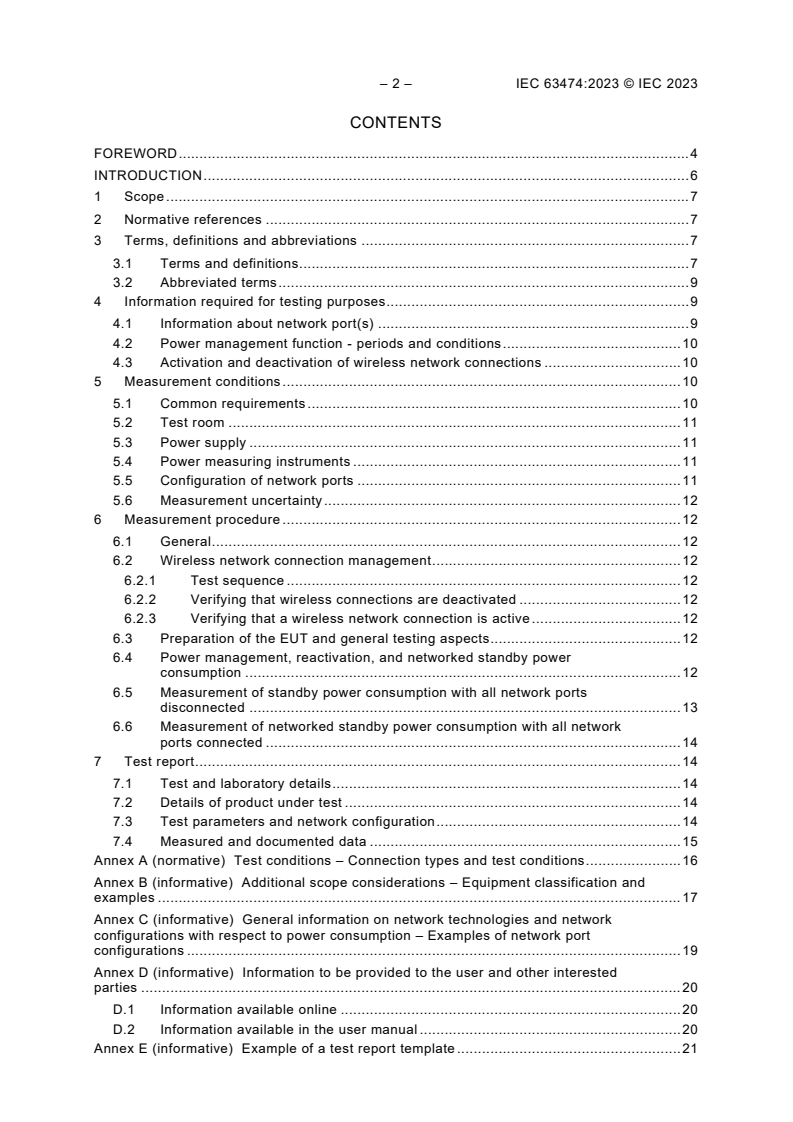
CONTENTS
FOREWORD . 4
INTRODUCTION . 6
1 Scope . 7
2 Normative references . 7
3 Terms, definitions and abbreviations . 7
3.1 Terms and definitions . 7
3.2 Abbreviated terms . 9
4 Information required for testing purposes . 9
4.1 Information about network port(s) . 9
4.2 Power management function - periods and conditions . 10
4.3 Activation and deactivation of wireless network connections . 10
5 Measurement conditions . 10
5.1 Common requirements . 10
5.2 Test room . 11
5.3 Power supply . 11
5.4 Power measuring instruments . 11
5.5 Configuration of network ports . 11
5.6 Measurement uncertainty . 12
6 Measurement procedure . 12
6.1 General . 12
6.2 Wireless network connection management . 12
6.2.1 Test sequence . 12
6.2.2 Verifying that wireless connections are deactivated . 12
6.2.3 Verifying that a wireless network connection is active . 12
6.3 Preparation of the EUT and general testing aspects . 12
6.4 Power management, reactivation, and networked standby power
consumption . 12
6.5 Measurement of standby power consumption with all network ports
disconnected . 13
6.6 Measurement of networked standby power consumption with all network
ports connected . 14
7 Test report . 14
7.1 Test and laboratory details . 14
7.2 Details of product under test . 14
7.3 Test parameters and network configuration . 14
7.4 Measured and documented data . 15
Annex A (normative) Test conditions – Connection types and test conditions . 16
Annex B (informative) Additional scope considerations – Equipment classification and
examples . 17
Annex C (informative) General information on network technologies and network
configurations with respect to power consumption – Examples of network port
configurations . 19
Annex D (informative) Information to be provided to the user and other interested
parties . 20
D.1 Information available online . 20
D.2 Information available in the user manual . 20
Annex E (informative) Example of a test report template . 21
Bibliography . 23
Table A.1 – Test conditions by type of connection. 16
Table B.1 – Classification of networked equipment . 17
Table B.2 – Examples of equipment definition and its classification . 18
Table C.1 – Examples of technologies considered for networked standby . 19
– 4 – IEC 63474:2023 © IEC 2023
INTERNATIONAL ELECTROTECHNICAL COMMISSION
____________
ELECTRICAL AND ELECTRONIC HOUSEHOLD AND OFFICE EQUIPMENT –
MEASUREMENT OF NETWORKED STANDBY POWER
CONSUMPTION OF EDGE EQUIPMENT
FOREWORD
1) The International Electrotechnical Commission (IEC) is a worldwide organization for standardization comprising
all national electrotechnical committees (IEC National Committees). The object of IEC is to promote international
co-operation on all questions concerning standardization in the electrical and electronic fields. To this end and
in addition to other activities, IEC publishes International Standards, Technical Specifications, Technical Reports,
Publicly Available Specifications (PAS) and Guides (hereafter referred to as "IEC Publication(s)"). Their
preparation is entrusted to technical committees; any IEC National Committee interested in the subject dealt with
may participate in this preparatory work. International, governmental and non-governmental organizations liaising
with the IEC also participate in this preparation. IEC collaborates closely with the International Organization for
Standardization (ISO) in accordance with conditions determined by agreement between the two organizations.
2) The formal decisions or agreements of IEC on technical matters express, as nearly as possible, an international
consensus of opinion on the relevant subjects since each technical committee has representation from all
interested IEC National Committees.
3) IEC Publications have the form of recommendations for international use and are accepted by IEC National
Committees in that sense. While all reasonable efforts are made to ensure that the technical content of IEC
Publications is accurate, IEC cannot be held responsible for the way in which they are used or for any
misinterpretation by any end user.
4) In order to promote international uniformity, IEC National Committees undertake to apply IEC Publications
transparently to the maximum extent possible in their national and regional publications. Any divergence between
any IEC Publication and the corresponding national or regional publication shall be clearly indicated in the latter.
5) IEC itself does not provide any attestation of conformity. Independent certification bodies provide conformity
assessment services and, in some areas, access to IEC marks of conformity. IEC is not responsible for any
services carried out by independent certification bodies.
6) All users should ensure that they have the latest edition of this publication.
7) No liability shall attach to IEC or its directors, employees, servants or agents including individual experts and
members of its technical committees and IEC National Committees for any personal injury, property damage or
other damage of any nature whatsoever, whether direct or indirect, or for costs (including legal fees) and
expenses arising out of the publication, use of, or reliance upon, this IEC Publication or any other IEC
Publications.
8) Attention is drawn to the Normative references cited in this publication. Use of the referenced publications is
indispensable for the correct application of this publication.
9) IEC draws attention to the possibility that the implementation of this document may involve the use of (a)
patent(s). IEC takes no position concerning the evidence, validity or applicability of any claimed patent rights in
respect thereof. As of the date of publication of this document, IEC had received notice of (a) patent(s), which
may be required to implement this document. However, implementers are cautioned that this may not represent
the latest information, which may be obtained from the patent database available at https://patents.iec.ch. IEC
shall not be held responsible for identifying any or all such patent rights.
IEC 63474 has been prepared by technical area 19: Environmental and energy aspects for
multimedia systems and equipment, of IEC technical committee 100: Audio, video and
multimedia systems and equipment. It is an International Standard.
The text of this document is based on EN 50643:2018. It was submitted to the National
Committees for voting under the Fast Track Procedure.
The text of this International Standard is based on the following documents:
Draft Report on voting
100/3836/CDV 100/3898/RVC
Full information on the voting for its approval can be found in the report on voting indicated in
the above table.
The language used for the development of this International Standard is English.
This document was drafted in accordance with ISO/IEC Directives, Part 2, and developed in
accordance with ISO/IEC Directives, Part 1 and ISO/IEC Directives, IEC Supplement, available
at www.iec.ch/members_experts/refdocs. The main document types developed by IEC are
described in greater detail at www.iec.ch/standardsdev/publications.
The committee has decided that the contents of this document will remain unchanged until the
stability date indicated on the IEC website under webstore.iec.ch in the data related to the
specific document. At this date, the document will be
• reconfirmed,
• withdrawn,
• replaced by a revised edition, or
• amended.
– 6 – IEC 63474:2023 © IEC 2023
INTRODUCTION
The methods defined in this document are intended to define requirements for the measurement
of the power consumed by the equipment having one or more wired or wireless network port(s)
able to resume a function by way of a remotely initiated trigger or reactivation trigger from a
network connection.
For the measurement of low power consumption, reference is made to EN 50564:2011. This
document also provides a method to test power management and whether it is possible to
deactivate wireless network connection(s).
ELECTRICAL AND ELECTRONIC HOUSEHOLD AND OFFICE EQUIPMENT –
MEASUREMENT OF NETWORKED STANDBY POWER
CONSUMPTION OF EDGE EQUIPMENT
1 Scope
This document specifies methods of measurement of electrical power consumption in networked
standby and the reporting of the results for edge equipment.
Power consumption in standby (other than networked standby) is covered by EN 50564,
including the input voltage range.
This document also provides a method to test power management and to test whether it is
possible to deactivate wireless network connection(s).
NOTE 1 This document applies to electrical products with a rated input voltage of 230 V a.c. for single phase
products and 400 V a.c. for three-phase products.
NOTE 2 The measurement of energy consumption and performance of products during intended use are generally
specified in product standards and are not covered by this document.
NOTE 3 The term "products" in this document includes household appliances or information technology products,
consumer electronics, audio, video and multimedia systems; however, the measurement methodology can be applied
to other products.
This document does not apply to the measurement of electrical power consumption in
networked standby for interconnecting equipment.
NOTE 4 Measurement of electrical power consumption in networked standby for interconnecting equipment is the
subject of ETSI standard EN 303 423.
2 Normative references
The following documents are referred to in the text in such way that some or all of their content
constitutes requirements of this document. For dated references, only the edition cited applies.
For undated references, the latest edition of the referenced document (including any
amendments) applies.
EN 50564:2011, Electrical and electronic household and office equipment – Measurement of
low power consumption
3 Terms, definitions and abbreviations
3.1 Terms and definitions
For the purposes of this document, the terms and definitions given in EN 50564:2011 as well
as in the following apply.
ISO and IEC maintain terminological databases for use in standardization at the following
addresses:
• ISO Online browsing platform: available at https://www.iso.org/obp
• IEC Electropedia: available at http://www.electropedia.org/
– 8 – IEC 63474:2023 © IEC 2023
3.1.1
edge equipment
networked equipment that can be connected to a network and interact with that network or other
equipment and that does not have, as its primary function, the passing of network traffic to
provide a network
Note 1 to entry: Examples of edge equipment are given in Annex B.
3.1.2
interconnecting equipment
networked equipment that has, as its primary function, the passing of network traffic to provide
a network
Note 1 to entry: Examples of interconnecting equipment are given in Annex B.
3.1.3
network
communication infrastructure with a topology of links, an architecture, including the physical
components, organisational principles, communication procedures and formats (protocols)
3.1.4
network availability
capability of the equipment to resume functions after a remotely initiated trigger has been
detected by a network port
3.1.5
network port
wired or wireless physical interface of the network connection located on the equipment through
which the equipment can be remotely activated
Note 1 to entry: International Electrotechnical Vocabulary (IEC 60050) defines "port (of a network)" as: "a
termination through which signals can enter or leave a network".
3.1.6
networked equipment
equipment that can connect to a network and has one or more network ports
3.1.7
networked standby
condition in which the equipment is able to resume a function by way of a remotely initiated
trigger from a network connection
3.1.8
networked television set
television set that can connect to a network and has one or more network ports
3.1.9
reactivation trigger
signal that brings the EUT back to an active mode
Note 1 to entry: The reactivation is remotely initiated by a signal that comes from outside the equipment via a
network.
3.1.10
logical network port
network technology running over a physical network port
3.1.11
physical network port
physical (hardware) medium of a network port that can host two or more network technologies
Note 1 to entry: A physical network port can consist of multiple logical network ports.
3.1.12
power management
automatic control mechanism that achieves the smallest input power consistent with a
pre-determined level of functionality
[SOURCE: IEC 60050-904:2014, 904-03-01, modified – Note 1 to entry has been omitted.]
3.2 Abbreviated terms
For the purposes of this document, the following abbreviations apply.
CPU central processing unit
DOCSIS Data Over Cable Service Interface Specification
EUT equipment under test
HDMI® High-Definition Multimedia Interface
HiNA high network availability
LAN local area network
MoCA® Multimedia over Coax Alliance
PLC power line communication
USB Universal Serial Bus (IEC 62280 series)
WAN wide area network
4 Information required for testing purposes
4.1 Information about network port(s)
For each type of physical and associated logical network port, the following information shall
be provided by the manufacturer:
a) the default time after which the power management function, or a similar function,
automatically switches the equipment into networked standby, and, if available, the
procedure for:
1) setting a time other than the default time; and/or
2) manually switching the equipment into networked standby;
NOTE 1 The word "manually" in the above context refers to any user operation intervention such as pushing a
button on the EuT itself, or sending a message from another machine.
___________
The DOCSIS specifications are the result of a cooperative effort undertaken at the direction of Cable Television
Laboratories, Inc. for the benefit of the cable industry and its customers. This information is given for the
convenience of users of this document and does not constitute an endorsement by IEC of the product named.
Equivalent products may be used if they can be shown to lead to the same results.
2 ® ®
HDMI and HDMI High-Definition Multimedia Interface are registered trademarks of HDMI Licensing
Administrator, Inc. This information is given for the convenience of users of this document and does not constitute
an endorsement by IEC of the product named. Equivalent products may be used if they can be shown to lead to
the same results.
MoCA® is a global member-driven, non-profit Alliance developing multi-gigabit coax connectivity standards. This
information is given for the convenience of users of this document and does not constitute an endorsement by
IEC of the product named. Equivalent products may be used if they can be shown to lead to the same results.
– 10 – IEC 63474:2023 © IEC 2023
b) the characteristics of the reactivation trigger (message, signal…) that is used to reactivate
the equipment when in networked standby and how to remotely initiate it;
c) the maximum performance specifications, for example the maximum speed or data rate
supported by that network port;
d) the (maximum) power consumption of the equipment in a condition providing networked
standby into which power management function, or a similar function, will switch the
equipment, if only this port is used for remote activation, for example the declared power
consumption of the equipment under defined conditions for a type of port;
e) the communication protocol used by equipment, except for networked televisions;
f) the radio frequency range at which each radio wireless logical network port operates;
g) the characteristics of wireless logical network ports other than radio wireless logical network
ports.
NOTE 2 Annex D describes examples of product information for networked equipment.
4.2 Power management function - periods and conditions
The manufacturer shall provide information on:
a) whether the equipment under test provides a power management or a similar function. If the
EUT does not provide power management or a similar function, the manufacturer shall
explain why such a function would be inappropriate for the intended use;
b) the default period of time after which the power management function, or a similar function,
switches the equipment automatically into a condition providing networked standby.
NOTE 1 A maximum default period of 20 min can be given during which the equipment has not been providing its
main function.
NOTE 2 A maximum default period of 4 h following the last user interaction and/or channel change can be given.
4.3 Activation and deactivation of wireless network connections
The manufacturer shall provide information on the procedure the user needs to follow in order
to activate and deactivate each wireless network connection, if any.
The above requirement does not apply to equipment that relies on a single wireless network
connection for intended use and does not have a wired network connection.
5 Measurement conditions
5.1 Common requirements
The general conditions for measurements specified in EN 50564:2011, 4.1 shall apply.
The tests described in Clause 6 shall be repeated, if applicable, for each type of network port.
Each type of logical network port (as declared by the manufacturer) using the same physical
network port shall be tested.
Where the manufacturer declares that multiple physical network ports have the same technical
and logical specification(s), tests shall be executed with any one of these physical network ports
being connected (the other ones being deactivated for wireless network ports and disconnected
for wired network ports).
When a logical network port, as declared by the manufacturer, supports multiple editions of a
communication technology standard (e.g. for backward compatibility), the logical network port
is tested only in accordance with the specifications of the latest standard edition used by the
EUT for retrieving a reactivation message. Examples are shown in Annex C.
NOTE Some devices can be designed to switch to a lower data rate during networked standby in order to further
reduce energy consumption.
In order to restrict influence of external factors, the reactivation trigger shall be initiated within
a local test network without external network connections. If a network connection external to
the local test network is necessary for remote activation, this external network connection shall
be established and maintained during testing so that the reactivation trigger can be received;
where identified in the information provided by the manufacturer (see Clause 4), the stability of
this external network connection may be checked or monitored.
EXAMPLE 1 External factors can be maintenance, information/software update or a denial of service attack.
EXAMPLE 2 External network connections can be WAN, cable network, satellite link, etc.
Where this document is referenced by more specific standards or procedures, these should
define and name the relevant conditions to which this test procedure is applied.
5.2 Test room
The requirements specified in EN 50564:2011, 4.2 shall apply.
5.3 Power supply
The requirements specified in EN 50564:2011, 4.3 shall apply.
5.4 Power measuring instruments
The requirements specified in EN 50564:2011, 4.4 shall apply.
5.5 Configuration of network ports
When testing only one type of network port, the procedure given in 6.4 shall be followed. The
network ports of the EUT, other than the network port under test, shall be deactivated for
wireless network ports and disconnected for wired network ports, if possible. Logical network
ports that can only be activated and deactivated together shall be tested together following the
same procedures used for individual network ports.
The network port under test shall have networked standby functionality enabled and shall be
connected to appropriate test equipment which will form the network configuration for the test.
If more than one type of reactivation trigger is available per type of network port to reactivate
the EUT when in networked standby, the configuration resulting in the highest power
consumption in networked standby shall be determined, as given below:
a) At least once, all configurations shall be set up with the information provided in 4.1 and
tested following the procedure given in Clause 6 to determine the related power
consumption to determine the configuration with the highest power consumption.
b) When the configuration with the reactivation trigger resulting in the highest power
consumption in networked standby is known, this configuration shall be selected to conduct
the measurement. The source of this information shall be additionally given in the test report.
c) When the power consumption does not depend on the configuration and its reactivation
trigger used, the configuration with the default reactivation trigger setting shall be selected.
The test equipment shall be able to test the EUT at the maximum performance level of the
network port's protocol supported by hardware and software of the EUT.
When testing the maximum configuration of network ports (see 6.6), the maximum number of
wired network ports allowed for be the EUT shall be connected, and the maximum number of
wireless network ports allowed by the EUT shall be activated.
– 12 – IEC 63474:2023 © IEC 2023
5.6 Measurement uncertainty
Uncertainty introduced by the instrument that measures the input power shall be determined
according to EN 50564:2011, 4.4.1. EN 50564:2011, Annex D also describes the determination
of measurement uncertainty, taking other parameters into account.
In order to avoid additional sources of uncertainty for networked equipment, cable lengths and
measurement distances specified in Annex A shall be applied. The test network should be
restricted to the necessary test and ancillary equipment, directly related connected devices and
the EUT.
6 Measurement procedure
6.1 General
The requirements specified in EN 50564:2011, 5.1 shall apply.
6.2 Wireless network connection management
6.2.1 Test sequence
Wireless network connection management shall be tested using the following steps, using
(where applicable) information supplied by the manufacturer:
a) identify all wireless network connections supported by the EUT and make sure the EUT is
connected to a suitable transceiving device (e.g. antenna), using information provided in
accordance with 4.3;
b) deactivate all wireless network connections supported by the EUT;
c) verify that all wireless transmitters corresponding to the wireless network connections
identified in step 1 are deactivated, in accordance with 6.2.2.
NOTE On some edge devices, a wireless network technology running on different frequencies (e.g. RF networks
operating at 2,4 GHz and 5,0 GHz) is seen as a single wireless network connection, if carrier frequencies cannot be
switched on or off separately.
6.2.2 Verifying that wireless connections are deactivated
To verify that wireless transmitters are off, a suitable detection device shall be used to
determine that wireless signals are not transmitted by the EUT in the operating frequencies or
wavelengths identified by the manufacturer for each wireless network connection.
NOTE For determining whether an RF transmitter has been deactivated, an antenna connected to a suitable
measurement instrument (including an RF Spectrum Analyser, RF Fast Fourier Transform analyser, or an RF
Receiver) is used.
6.2.3 Verifying that a wireless network connection is active
A wireless network connection is deemed to be active when it allows the EUT to identify other
devices or to be identified by them by transmitting wireless signals.
6.3 Preparation of the EUT and general testing aspects
The requirements specified in EN 50564:2011, 5.2 shall apply.
6.4 Power management, reactivation, and networked standby power consumption
This clause describes the procedure to test the power management function, measure the
network standby power consumption, and test the reactivation function. This procedure shall
be applied to each type of logical network port on an individual basis. Where network ports
cannot be managed separately, the procedure shall be applied to groups of network ports
managed simultaneously.
The EUT shall be tested using the following steps, using information supplied by the
manufacturer (see Clause 4):
a) determine the main functions provided by the EUT (including whether it has HiNA
functionality) as well as other devices which depend on any function provided by the EUT
in order to operate as intended. If the EUT is equipment with HiNA functionality, the HiNA
function shall be enabled;
b) configure the EUT and dependent devices so that the power management function
automatically initiates the transition of the EUT into a condition having networked standby
and the logical network port through which the EUT will be reactivated is enabled; disable
all other logical network ports;
c) measure, with an accuracy of 10 s, the time after which the power management function
automatically initiates the transition of the EUT into a condition providing networked standby
by the following steps:
• leave the EUT in a mode where it is not providing a main function (as determined in
step 1) and no other devices are dependent on its functions. Start the timer used for
measurement;
• measure the time taken until the power management function initiates an automatic
power mode change instigating network standby;
NOTE 1 According to the EU Regulation 801/2013, the default period of time after which the power management
function, or a similar function, switches the equipment automatically into a condition providing networked standby
is not to be set to exceed 20 minutes.
NOTE 2 After no more than 4 hours in on mode following the last user interaction and/or a channel change, the
television set can be automatically switched from on mode to a condition of networked standby or any other
condition which does not exceed the applicable power consumption requirements for conditions providing
networked standby.
d) when the EUT has entered a condition providing networked standby, measure the power
consumption in accordance with EN 50564:2011, 5.3. For an EUT requiring connection to
an external network, if stability of networked standby power consumption is not attained,
then the network connection shall be checked to detect influence of external factors (see
5.1);
NOTE 3 Instability of power consumption due to external influences can be compared with periodic or cyclic
patterns being present. See EN 50564:2011, 5.3.2, Note 2.
e) verify that the EUT can be reactivated through the network port configuration being tested.
The EUT shall be reactivated using a network trigger appropriate for the logical network port
being tested. The required reactivation trigger shall be declared by the manufacturer. If this
reactivation trigger uses proprietary technology, it shall be specified in detail or provided by
the manufacturer. If the reactivation trigger does not initiate reactivation of the EUT, the
EUT is not considered to be in networked standby.
Steps b) to e) above shall be repeated for each type of logical network port.
If the EUT can be manually set to networked standby, perform steps d) and e) of 6.4 after
manually setting the EUT to networked standby. This shall also be repeated for each type of
logical network port.
6.5 Measurement of standby power consumption with all network ports disconnected
The EUT shall be tested using the following steps, using information (including whether it has
HiNA functionality) supplied by the manufacturer (see Clause 4):
a) configure the EUT and dependent devices so that all wired network ports are disconnected
and all wireless network ports are deactivated (in accordance with 5.5);
b) configure the EUT that the power management function automatically initiates the transition
of the EUT into a condition having standby (or a similar low power mode). If applicable, the
EUT may be manually set to standby;
– 14 – IEC 63474:2023 © IEC 2023
NOTE Equipment with HiNA functionality does not normally go automatically into standby or similar low power
mode.
c) measure the power consumption in accordance with EN 50564:2011, 5.3, when the EUT
has entered a stable condition providing standby or a similar low power mode.
6.6 Measurement of networked standby power consumption with all network ports
connected
The EUT shall be tested using the following steps, utilizing information (including whether it has
HiNA functionality) supplied by the manufacturer (see Clause 4):
a) configure the EUT and dependent devices so that all wired network ports are connected and
all wireless network ports are activated (in accordance with 5.5);
b) configure the EUT that the power management function automatically initiates the transition
of the EUT into a condition having networked standby for all logical network ports. If
applicable, the EUT may be manually set to networked standby;
c) when the EUT has entered a condition providing networked standby, measure the power
consumption in accordance with EN 50564:2011, 5.3. For an EUT requiring connection to
an external network, if stability of networked standby power consumption is not attained,
then the network connection shall be checked to detect influence of external factors (see
5.1 and NOTE 3 of 6.4).
7 Test report
7.1 Test and laboratory details
The requirements specified in EN 50564:2011, 6.4 shall apply.
7.2 Details of product under test
The requirements specified in EN 50564:2011, 6.1 shall apply.
In addition, the following information shall be provided:
a) the number and type of network ports and, with the exception of wireless network ports,
where these ports are located on the equipment; in particular, it shall be declared if the
same physical network port accommodates two or more types of logical network ports;
b) whether all network ports are deactivated before delivery;
c) the normal range of frequencies or wavelengths for each wireless network port;
d) whether the equipment is declared as HiNA equipment or equipment with HiNA functionality.
When no information is provided relating to point d), equipment shall be considered to be neither
HiNA equipment nor equipment with HiNA functionality.
7.3 Test parameters and network configuration
The requirements specified in EN 50564:2011, 6.2 shall apply.
The configuration of the test network in accordance with 5.5 (and Annex A), 6.2, 6.4 and 6.5
shall be documented for each measurement conducted in respect to interconnecting equipment
and access point used (name of manufacturer, model name and serial number, relevant
settings), the cabling (type and length), layout and distances for wireless connections and
network connection speeds.
Where manufacturer instructions have been used, this shall be documented.
7.4 Measured and documented data
The requirements specified in EN 50564:2011, 6.3 shall apply. In addition, the following
information shall be provided in the test report:
a) network configuration used for each type of network port (for example where applicable:
cable length and type, distance from the EUT, network equipment used and network
connection speeds);
b) time taken for the EUT to automatically transition the EUT into a condition providing
networked standby mode for each type of network port;
c) power measurements in networked standby mode, for each type of network port (following
automatic transition to networked standby);
d) power measurements in networked standby mode, for each type of network port (following
manual transition to networked standby);
e) confirmation of successful remote reactivation for each type of network port;
f) confirmation of successful deactivation for each wireless network connection, where
applicable;
g) power measurement in networked standby mode, for all wired network port connected and
all wireless network ports activated, except for networked televisions.
NOTE Annex E provides an example of a test report template.
– 16 – IEC 63474:2023 © IEC 2023
Annex A
(normative)
Test conditions – Connection types and test conditions
Table A.1 lists the connection types to be considered for networked standby on edge devices.
For types of network connections not described in Table A.1, the manufacturer of the EUT shall
specify the test conditions. Connection requirements and cable length (or distance to
reactivation source) shall comply with the given values, in order to ensure repeatability of the
tests.
Table A.1 – Test conditions by type of connection
Type of connection Cable length / distance from Connection requirements
wireless reactivation signal
source (m)
Applicable to all WAN connections N/A – see connection types below. TCP/IP link established,
synchronized, and operating under
Cable length is 2 m ± 0,2 m.
normal conditions.
LAN Fast Ethernet port Cable length is 10 m ± 0,5 m. All ports active, link established at
100 Mbit/s.
LAN Gigabit Ethernet ports Cable length is 10 m ± 0,5 m. All ports active, link established at
1 000 Mbit/s.
Wi-Fi 802.11g or 11a Client is 1 to 5 m away from AP in Beacon on, 1 Wi-Fi client
the same room. associated, avoid interference in
the same band. Ensure no other
devices connected to wireless
router.
Wi-Fi 802.11n or 11ac Client is 1 to 5 m away from AP in Beacon on, 1 Wi-Fi 802.11n client
the same room. associa
...