

IEC TR 62368-2:2025
(Main)Audio/video, information and communication technology equipment - Part 2: Explanatory information related to IEC 62368-1:2023
General Information
- Abstract
IEC TR 62368-2:2025 identifies the purpose and applicability of IEC 62368-1:2023 and the exclusions from the scope. The scope excludes requirements for functional safety. Functional safety is addressed in IEC 61508-1. Because the scope includes computers that can control safety systems, functional safety requirements would necessarily include requirements for computer processes and software. The requirements provided in IEC 60950-23 can be modified and added to IEC 62368 as another -X document. However, because of the hazard-based nature of IEC 62368-1, the requirements from IEC 60950-23 have been incorporated into the body of IEC 62368-1 and made more generic. The intent of the addition of the IEC 60950-23 requirements is to maintain the overall intent of the technical requirements from IEC 60950-23, incorporate them into IEC 62368-1 following the overall format of IEC 62368-1 and simplify and facilitate the application of these requirements. Robots traditionally are covered under the scopes of ISO documents, typically maintained by ISO TC 299. ISO TC 299 has working groups for personal care robots and service robots, and produces for example, ISO 13482, Robots and robotic devices - Safety requirements for personal care robots. In this document, only those subclauses from IEC 62368-1 considered to need further background reference information or explanation to benefit the user in applying the relevant requirements are included. Therefore, not all numbered subclauses are cited. Unless otherwise noted, all references are to clauses, subclauses, annexes, figures or tables located in IEC 62368‑1:2023. This fourth edition cancels and replaces the third edition published in 2018. This edition constitutes a technical revision.
This edition includes the following significant technical changes with respect to the previous edition:
a) It takes into account changes made in the fourth edition of IEC 62368-1 (IEC 62368-1:2023) as identified in the Foreword of IEC 62368 1:2023
- Status
- Published
- Publication Date
- 02-Jul-2025
- Technical Committee
- TC 108 - Safety of electronic equipment within the field of audio/video, information technology and communication technology
- Drafting Committee
- WG HBSDT - TC 108/WG HBSDT
- Current Stage
- PPUB - Publication issued
- Start Date
- 03-Jul-2025
- Completion Date
- 10-May-2024
Buy Documents


IEC TR 62368-2:2025 - Audio/video, information and communication technology equipment - Part 2: Explanatory information related to IEC 62368-1:2023 Released:7/3/2025
REDLINE IEC TR 62368-2:2025 RLV - Audio/video, information and communication technology equipment - Part 2: Explanatory information related to IEC 62368-1:2023/3/2025
Overview
IEC TR 62368-2:2025 is a Technical Report that provides explanatory information and background to IEC 62368-1:2023 - the hazard-based safety standard for audio/video, information and communication technology (AV/ICT) equipment. Edition 4.0 (2025) cancels and replaces the 2018 edition and takes into account the technical changes introduced in IEC 62368-1:2023. This TR clarifies the purpose, applicability and exclusions of IEC 62368‑1 and offers guidance on selected subclauses to aid consistent application of the hazard-based approach.
Key topics and technical focus
The report supplies explanatory material (not additional normative requirements) on selected subjects from IEC 62368‑1, including:
- Energy source classifications and HBSE (hazard-based safety engineering) concepts that underpin IEC 62368‑1
- Electrically-caused injury and fire: insulation, protective conductors, touch voltage/current, backfeed safeguards and fire ignition sources
- Components and safeguards: guidance on switches, varistors, capacitors, printed boards and interconnection cables
- Battery safety and protection circuits, including special considerations for secondary lithium batteries
- Mechanical, thermal and radiation hazards: moving parts, stability, touch temperature limits, lasers, optical/X‑radiation and acoustic energy
- Tests, markings and instructions: normal/abnormal/single-fault test conditions, equipment markings and instructional safeguards
- Informative annexes with practical background on surge suppressors, R‑C discharge time constants for X/Y capacitors, material flammability and test methods
The TR also explains the rationale for integrating certain requirements from IEC 60950‑23 into IEC 62368‑1, and clarifies exclusions - notably that functional safety requirements are outside scope and are covered in standards such as IEC 61508‑1.
Practical applications and users
IEC TR 62368-2:2025 is primarily useful for:
- Product safety engineers and designers of AV/ICT equipment seeking clear guidance on applying IEC 62368‑1
- Test laboratories and certification bodies verifying conformance to IEC 62368‑1:2023
- Compliance managers and regulators assessing safety claims and documentation
- Manufacturers addressing battery, surge protection and component selection issues
The TR helps teams implement hazard-based design choices, interpret test expectations and harmonize product documentation and markings.
Related standards
- IEC 62368‑1:2023 (normative parent standard)
- IEC 60950‑23 (legacy requirements incorporated where applicable)
- IEC 61508‑1 (functional safety - excluded from IEC 62368‑1 scope)
- ISO standards referenced for robots (e.g., ISO 13482) where robot safety topics overlap
Keywords: IEC TR 62368-2:2025, IEC 62368-1:2023, AV/ICT equipment safety, hazard-based standard, battery protection, surge suppressor, product safety guidance.
Relations
- Effective Date
- 05-Sep-2023
Buy Documents
IEC TR 62368-2:2025 - Audio/video, information and communication technology equipment - Part 2: Explanatory information related to IEC 62368-1:2023 Released:7/3/2025
REDLINE IEC TR 62368-2:2025 RLV - Audio/video, information and communication technology equipment - Part 2: Explanatory information related to IEC 62368-1:2023/3/2025
Get Certified
Connect with accredited certification bodies for this standard

BSI Group
BSI (British Standards Institution) is the business standards company that helps organizations make excellence a habit.

NYCE
Mexican standards and certification body.

ANCE
Mexican certification and testing association.
Sponsored listings
Frequently Asked Questions
IEC TR 62368-2:2025 is a technical report published by the International Electrotechnical Commission (IEC). Its full title is "Audio/video, information and communication technology equipment - Part 2: Explanatory information related to IEC 62368-1:2023". This standard covers: IEC TR 62368-2:2025 identifies the purpose and applicability of IEC 62368-1:2023 and the exclusions from the scope. The scope excludes requirements for functional safety. Functional safety is addressed in IEC 61508-1. Because the scope includes computers that can control safety systems, functional safety requirements would necessarily include requirements for computer processes and software. The requirements provided in IEC 60950-23 can be modified and added to IEC 62368 as another -X document. However, because of the hazard-based nature of IEC 62368-1, the requirements from IEC 60950-23 have been incorporated into the body of IEC 62368-1 and made more generic. The intent of the addition of the IEC 60950-23 requirements is to maintain the overall intent of the technical requirements from IEC 60950-23, incorporate them into IEC 62368-1 following the overall format of IEC 62368-1 and simplify and facilitate the application of these requirements. Robots traditionally are covered under the scopes of ISO documents, typically maintained by ISO TC 299. ISO TC 299 has working groups for personal care robots and service robots, and produces for example, ISO 13482, Robots and robotic devices - Safety requirements for personal care robots. In this document, only those subclauses from IEC 62368-1 considered to need further background reference information or explanation to benefit the user in applying the relevant requirements are included. Therefore, not all numbered subclauses are cited. Unless otherwise noted, all references are to clauses, subclauses, annexes, figures or tables located in IEC 62368‑1:2023. This fourth edition cancels and replaces the third edition published in 2018. This edition constitutes a technical revision. This edition includes the following significant technical changes with respect to the previous edition: a) It takes into account changes made in the fourth edition of IEC 62368-1 (IEC 62368-1:2023) as identified in the Foreword of IEC 62368 1:2023
IEC TR 62368-2:2025 identifies the purpose and applicability of IEC 62368-1:2023 and the exclusions from the scope. The scope excludes requirements for functional safety. Functional safety is addressed in IEC 61508-1. Because the scope includes computers that can control safety systems, functional safety requirements would necessarily include requirements for computer processes and software. The requirements provided in IEC 60950-23 can be modified and added to IEC 62368 as another -X document. However, because of the hazard-based nature of IEC 62368-1, the requirements from IEC 60950-23 have been incorporated into the body of IEC 62368-1 and made more generic. The intent of the addition of the IEC 60950-23 requirements is to maintain the overall intent of the technical requirements from IEC 60950-23, incorporate them into IEC 62368-1 following the overall format of IEC 62368-1 and simplify and facilitate the application of these requirements. Robots traditionally are covered under the scopes of ISO documents, typically maintained by ISO TC 299. ISO TC 299 has working groups for personal care robots and service robots, and produces for example, ISO 13482, Robots and robotic devices - Safety requirements for personal care robots. In this document, only those subclauses from IEC 62368-1 considered to need further background reference information or explanation to benefit the user in applying the relevant requirements are included. Therefore, not all numbered subclauses are cited. Unless otherwise noted, all references are to clauses, subclauses, annexes, figures or tables located in IEC 62368‑1:2023. This fourth edition cancels and replaces the third edition published in 2018. This edition constitutes a technical revision. This edition includes the following significant technical changes with respect to the previous edition: a) It takes into account changes made in the fourth edition of IEC 62368-1 (IEC 62368-1:2023) as identified in the Foreword of IEC 62368 1:2023
IEC TR 62368-2:2025 is classified under the following ICS (International Classification for Standards) categories: 33.160.01 - Audio, video and audiovisual systems in general; 35.020 - Information technology (IT) in general. The ICS classification helps identify the subject area and facilitates finding related standards.
IEC TR 62368-2:2025 has the following relationships with other standards: It is inter standard links to IEC TR 62368-2:2019. Understanding these relationships helps ensure you are using the most current and applicable version of the standard.
IEC TR 62368-2:2025 is available in PDF format for immediate download after purchase. The document can be added to your cart and obtained through the secure checkout process. Digital delivery ensures instant access to the complete standard document.
Standards Content (Sample)
IEC TR 62368-2 ®
Edition 4.0 2025-07
TECHNICAL
REPORT
Audio/video, information and communication technology equipment -
Part 2: Explanatory information related to IEC 62368-1:2023
ICS 33.160.01 ISBN 978-2-8327-0533-9
All rights reserved. Unless otherwise specified, no part of this publication may be reproduced or utilized in any form or
by any means, electronic or mechanical, including photocopying and microfilm, without permission in writing from either
IEC or IEC's member National Committee in the country of the requester. If you have any questions about IEC copyright
or have an enquiry about obtaining additional rights to this publication, please contact the address below or your local
IEC member National Committee for further information.
IEC Secretariat Tel.: +41 22 919 02 11
3, rue de Varembé info@iec.ch
CH-1211 Geneva 20 www.iec.ch
Switzerland
About the IEC
The International Electrotechnical Commission (IEC) is the leading global organization that prepares and publishes
International Standards for all electrical, electronic and related technologies.
About IEC publications
The technical content of IEC publications is kept under constant review by the IEC. Please make sure that you have the
latest edition, a corrigendum or an amendment might have been published.
IEC publications search - IEC Products & Services Portal - products.iec.ch
webstore.iec.ch/advsearchform Discover our powerful search engine and read freely all the
The advanced search enables to find IEC publications by a publications previews, graphical symbols and the glossary.
variety of criteria (reference number, text, technical With a subscription you will always have access to up to date
committee, …). It also gives information on projects, content tailored to your needs.
replaced and withdrawn publications.
Electropedia - www.electropedia.org
The world's leading online dictionary on electrotechnology,
IEC Just Published - webstore.iec.ch/justpublished
Stay up to date on all new IEC publications. Just Published containing more than 22 500 terminological entries in English
details all new publications released. Available online and and French, with equivalent terms in 25 additional languages.
once a month by email. Also known as the International Electrotechnical Vocabulary
(IEV) online.
IEC Customer Service Centre - webstore.iec.ch/csc
If you wish to give us your feedback on this publication or
need further assistance, please contact the Customer
Service Centre: sales@iec.ch.
CONTENTS
FOREWORD . 8
INTRODUCTION . 11
0 Principles of this product safety standard . 12
1 Scope . 15
2 Normative references . 15
3 Terms, definitions and abbreviations . 15
4 General requirements . 18
4.2 Energy source classifications . 20
4.6 Fixing of conductors and conductive parts . 24
4.7 Equipment for direct insertion into mains socket-outlets . 25
4.8 Equipment containing coin or button cell batteries . 25
4.9 Likelihood of fire or shock due to entry of conductive objects . 26
5 Electrically-caused injury . 26
5.4 Insulation materials and requirements . 42
5.5 Components as safeguards . 68
5.6 Protective conductor . 71
5.7 Prospective touch voltage, touch current and protective conductor current . 73
5.8 Backfeed safeguard in battery backed up supplies . 78
6 Electrically-caused fire . 80
6.2 Classification of power sources and potential ignition sources . 80
6.3 Safeguards against fire under normal operating conditions and abnormal
operating conditions . 84
6.4 Safeguards against fire under single fault conditions . 90
6.6 Safeguards against fire due to the connection of additional equipment . 115
7 Injury caused by hazardous substances . 115
8 Mechanically-caused injury . 119
8.1 General . 119
8.2 Mechanical energy source classifications . 119
8.3 Safeguards against mechanical energy sources . 120
8.4 Safeguards against parts with sharp edges and corners . 121
8.5 Safeguards against moving parts . 121
8.6 Stability of equipment . 122
8.7 Equipment mounted to a wall, ceiling or other structure . 123
8.8 Handle strength . 124
8.9 Wheels or casters attachment requirements . 124
8.10 Carts, stands, and similar carriers . 124
8.11 Mounting means for slide-rail mounted equipment (SRME) . 125
9 Thermal burn injury . 126
9.1 General . 126
9.2 Thermal energy source classifications. 130
9.3 Touch temperature limits. 131
9.4 Safeguards against thermal energy sources . 135
9.6 Requirements for wireless power transmitters . 136
10 Radiation . 137
10.2 Radiation energy source classifications . 137
10.3 Safeguards against laser radiation . 140
10.4 Safeguards against optical radiation from lamps and lamp systems
(including LED types) . 140
10.5 Safeguards against X-radiation . 140
10.6 Safeguards against acoustic energy sources . 140
Annex A Examples of equipment within the scope of IEC 62368-1 . 144
Annex B Normal operating condition tests, abnormal operating condition tests
and single fault condition tests . 144
B.1 General – Equipment safeguards during various operating conditions . 144
B.2 – B.3 – B.4 Operating modes . 148
Annex C UV radiation . 149
Annex D Test generators . 149
Annex E Test conditions for equipment intended to amplify audio signals . 149
Annex F Equipment markings, instructions, and instructional safeguards . 150
F.3 Equipment markings . 150
F.4 Instructions . 156
F.5 Instructional safeguards . 156
Annex G Components . 157
G.1 Switches . 157
G.7 Mains power supply cords and interconnection cables . 161
G.8 Varistors . 161
G.9 Integrated circuit (IC) current limiters . 162
G.11 Capacitors and RC units . 163
G.13 Printed boards . 167
G.14 Coatings on component terminals . 167
G.15 Pressurized liquid filled components or LFC assemblies . 167
Annex H Criteria for telephone ringing signals . 174
H.2 Method A . 174
H.3 Method B . 176
Annex J Insulated winding wires for use without interleaved insulation . 176
Annex K Safety interlocks . 176
K.7.1 Safety interlocks . 176
Annex L Disconnect devices . 177
Annex M Equipment containing batteries and their protection circuits . 178
M.1 General requirements . 178
M.2 Safety of batteries and their cells . 178
M.3 Protection circuits for batteries provided within the equipment . 186
M.4 Additional safeguards for equipment containing a secondary lithium battery . 186
Annex O Measurement of creepage distances and clearances . 189
Annex P Safeguards against conductive objects . 190
P.1 General . 190
P.2 Safeguards against entry or consequences of entry of a foreign object . 190
P.3 Safeguards against spillage of internal liquids . 191
P.4 Metallized coatings and adhesives securing parts . 192
Annex Q Circuits intended for interconnection with building wiring . 192
Q.2 Test for external circuits – paired conductor cable . 192
Annex R Limited short-circuit test . 193
Annex S Tests for resistance to heat and fire . 193
S.1 Flammability test for fire enclosure and fire barrier materials of equipment
where the steady-state power does not exceed 4 000 W . 193
S.2 Flammability test for fire enclosure and fire barrier integrity . 193
S.3 Flammability tests for the bottom of a fire enclosure . 194
S.4 Flammability classification of materials . 194
S.5 Flammability test for fire enclosure materials of equipment with a steady
state power exceeding 4 000 W . 194
S.6 Grille covering material, cloth, and reticulated foam . 195
Annex T Mechanical strength tests . 195
T.2 Steady force test, 10 N . 195
T.3 Steady force test, 30 N . 195
T.4 Steady force test, 100 N . 195
T.5 Steady force test, 250 N . 195
T.6 Enclosure impact test. 195
T.7 Drop test . 196
T.8 Stress relief test . 196
T.9 Glass impact test . 196
T.10 Glass fragmentation test . 196
Annex U Mechanical strength of CRTs and protection against the effects of
implosion . 196
U.2 Test method and compliance criteria for non-intrinsically protected CRTs . 196
Annex V Determination of accessible parts . 197
Annex X Alternative method for determining clearances for insulation in circuits
connected to an AC mains not exceeding 420 V peak (300 V RMS) . 197
Annex Y Construction requirements for outdoor enclosures. 198
Y.3 Resistance to corrosion . 199
Annex A (informative) Background information related to the use of surge suppressors . 200
A.1 Industry demand for incorporating surge suppressors in the equipment . 200
A.2 Considerations on surge suppressors bridging both sides of a safeguard . 202
A.3 Considerations on a surge suppresser used for ID1 external circuit in class II
equipment . 203
A.4 Information about follow current (or follow-on current) . 209
Annex B (informative) Background information related to measurement of discharges
– Determining the R-C discharge time constant for X and Y capacitors . 215
B.1 General . 215
B.2 EMC filters . 215
B.3 The safety issue and solution . 215
B.4 The requirement . 216
B.5 100 MΩ probes . 216
B.6 The R-C time constant and its parameters . 217
B.7 Time constant measurement. . 220
B.8 Effect of probe resistance . 223
B.9 Effect of probe capacitance . 224
B.10 Determining the time constant . 224
B.11 Conclusion . 226
Annex C (informative) Background information related to resistance to candle flame
ignition . 227
Annex D (informative) Surge suppressers used between mains and an external circuit
ID1 as specified in Table 13 . 228
Bibliography . 229
Figure 1 – Risk reduction as given in ISO/IEC Guide 51 . 13
Figure 2 – HBSE Process Chart . 14
Figure 3 – Protective bonding conductor as part of a safeguard . 17
Figure 4 – Safeguards for protecting an ordinary person . 21
Figure 5 – Safeguards for protecting an instructed person . 22
Figure 6 – Safeguards for protecting a skilled person . 22
Figure 7 – Flow chart showing the intent of the glass requirements . 24
Figure 8 – Conventional time/current zones of effects of AC currents (15 Hz to 100 Hz)
on persons for a current path corresponding to left hand to feet (see IEC 60479-
1:2018, Figure 20) . 29
Figure 9 – Conventional time/current zones of effects of DC currents on persons for a
longitudinal upward current path (see IEC 60479-1:2018, Figure 22) . 30
Figure 10 – Illustration that limits depend on both voltage and current . 31
Figure 11 – Typical example . 38
Figure 12 – Example 1 . 39
Figure 13 – Example 2 . 39
Figure 14 – Flow chart for determining clearances . 45
Figure 15 – Illustration of working voltage . 46
Figure 16 – Illustration of transient voltages on paired conductor external circuits . 48
Figure 17 – Illustration of transient voltages on coaxial-cable external circuits . 49
Figure 18 – Examples of transmission mode and applied conductors . 50
Figure 19 – Basic and reinforced insulation in Table 14; ratio reinforced to basic . 51
Figure 20 – Reinforced clearances according to Rule 1, Rule 2, and Table 14 . 53
Figure 21 – Example illustrating accessible internal wiring . 61
Figure 22 – Waveform on insulation without surge suppressors and no breakdown . 63
Figure 23 – Waveforms on insulation during breakdown without surge suppressors . 64
Figure 24 – Waveforms on insulation with surge suppressors in operation . 64
Figure 25 – Waveform on short-circuited surge suppressor and insulation . 64
Figure 26 – Normal operating condition. 66
Figure 27 – Single fault condition . 66
Figure 28 – Single fault condition; hazardous situation if 5.4.11 is not fulfilled . 67
Figure 29 – Parts earthed in one piece of equipment . 67
Figure 30 – Equipment 2 with connection to a network . 68
Figure 31 – Example for an ES2 source . 68
Figure 32 – Example for an ES3 source . 69
Figure 33 – Overview of protective conductors . 71
Figure 34 – Example of a typical touch current measuring network . 74
Figure 35 – Touch current from a floating circuit . 76
Figure 36 – Touch current from an earthed circuit . 76
Figure 37 – Summation of touch currents in a PABX . 77
Figure 38 – Possible safeguards against electrically-caused fire . 84
Figure 39 – Fire clause flow chart . 87
Figure 40 – Prevent ignition flow chart . 93
Figure 41 – Control fire spread summary . 94
Figure 42 – Control fire spread PS2 . 95
Figure 43 – Control fire spread PS3 . 96
Figure 44 – Fire cone application to a large component . 105
Figure 45 – Calculation of side opening size . 112
Figure 46 – Flowchart demonstrating the hierarchy of hazard management . 118
Figure 47 – Model for chemical injury. 119
Figure 48 – Direction of forces to be applied . 123
Figure 49 – Model for a burn injury . 127
Figure 50 – Model for safeguards against thermal burn injury . 129
Figure 51 – Model for absence of a thermal hazard. 129
Figure 52 – Model for presence of a thermal hazard with a physical safeguard in place . 129
Figure 53 – Model for presence of a thermal hazard with behavioural safeguard in
place . 130
Figure 54 – Direct plug in . 132
Figure 55 – External power supply . 132
Figure 56 – Examples of symmetrical single coils . 137
Figure 57 – LED parameters . 137
Figure 58 – Flowchart for evaluation of Image projectors (beamers) . 139
Figure 59 – Graphical representation of L ,T . 141
Aeq
Figure 60 – Overview of operating modes . 148
Figure 61 – Typical examples of class I equipment . 151
Figure 62 – Typical examples of class I equipment with class II construction . 152
Figure 63 – Typical examples of class II equipment . 153
Figure 64 – Typical examples of class II equipment with functional earth . 154
Figure 65 – Typical examples of class II equipment with functional earth, making use of
a class I mains connector . 155
Figure 66 – Typical examples of class II equipment with functional earth, making use of
a class I mains connector and a separate functional earthing connection . 156
Figure 67 – Voltage-current characteristics (Typical data) . 158
Figure 68 – Example of IC current limiter circuit . 163
Figure 69 – Example of application of Rule 3, first dash . 165
Figure 70 – Example of application of Rule 3, second dash . 166
Figure 71 – Example on how to use Table G.12 . 166
Figure 72 – Decision flowchart . 168
Figure 73 – Illustration of a self-contained LFC system . 170
Figure 74 – Illustration of a modular LFC system . 171
Figure 75 – Example illustration of a rack modular LFC subsystems with internal and
external connections. . 172
Figure 76 – CDU liquid cooling system within a data centre . 173
Figure 77 – Non-CDU liquid cooling system within data centre . 173
Figure 78 – Current limit curves . 175
Figure 79 – Example of a dummy battery circuit . 187
Figure 80 – Calculating side openings . 191
Figure 81 – Example of a circuit with two power sources . 193
Figure A.1 – Installation has poor earthing and bonding; equipment damaged
(from ITU-T Recommendation K.66) . 201
Figure A.2 – Installation has poor earthing and bonding; using main earth bar for
protection against lightning strike (from ITU-T Recommendation K.66) . 201
Figure A.3 – Installation with poor earthing and bonding, using a varistor . 202
Figure A.4 – Typical example of a surge suppressor and a voltage fall . 202
Figure A.5 – An example of surge voltage drop by an MOV and two GDTs (measured
in laboratory) . 204
Figure A.6 – An example of ports of telecommunication equipment . 208
Figure A.7 – V-I properties of gas discharge tubes . 210
Figure A.8 – Holdover . 211
Figure A.9 – Relation of the V-I characteristic of a gas discharge tube and the output
characteristic of the power supply . 212
Figure A.10 – V-I and V-t characteristics . 213
Figure A.11 – Follow-on current pictures . 214
Figure B.1 – Typical EMC filter schematic . 215
Figure B.2 – 100 MΩ oscilloscope probes . 217
Figure B.3 – Combinations of EUT resistance and capacitance for 1 s time constant . 219
Figure B.4 – 240 V mains followed by capacitor discharge . 221
Figure B.5 – Time constant measurement schematic . 222
Figure B.6 – Worst-case measured time constant values for 100 MΩ and 10 MΩ probes . 226
Figure D.1 – Example of circuit configuration of a surge suppresser . 228
Table 1 – General summary of required safeguards . 22
Table 2 – Time/current zones for AC 15 Hz to 100 Hz for hand to feet pathway (see
IEC 60479-1:2018, Table 11) . 30
Table 3 – Time/current zones for DC for hand to feet pathway (see IEC 60479-1:2018,
Table 13) . 31
Table 4 – Limit values of accessible capacitance (threshold of pain) . 34
Table 5 – Total body resistances R for a current path hand to hand, DC, for large
T
surface areas of contact in dry condition . 36
Table 6 – Insulation requirements for external circuits . 49
Table 7 – Voltage drop across clearance and solid insulation in series . 55
Table 8 – Examples of application of various safeguards . 86
Table 9 – Basic safeguards against fire under normal operating conditions and
abnormal operating conditions . 89
Table 10 – Supplementary safeguards against fire under single fault conditions . 90
Table 11 – Method 1: Reduce the likelihood of ignition . 92
Table 12 – Method 2: Control fire spread . 100
Table 13 – Fire barrier and fire enclosure flammability requirements . 107
Table 14 – Summary – Fire enclosure and fire barrier material requirements . 111
Table 15 – Control of chemical hazards . 117
Table 16 – Overview of requirements for dose-based systems . 143
Table 17 – Overview of supply voltage . 147
Table 18 – Safety of batteries and their cells – requirements (expanded information on
documents and scope) . 180
Table A.1 – Permissible power-frequency stress voltage (except for US and Japan) . 204
Table A.2 – TOV parameters for US systems quoted from IEC 61643-12:2020 . 205
Table A.3 – TOV test parameters for Japanese systems quoted from IEC 61643-
12:2020 . 205
Table A.4 – Peak voltage of TOV in countries conforming to IEC 60364-4-44 . 206
Table A.5 – Peak voltage of TOV in USA . 206
Table A.6 – Peak voltage of TOV in Japan . 206
Table A.7 – The value of U for major mains voltages . 207
peak2
Table B.1 – 100 MΩ oscilloscope probes . 217
Table B.2 – Capacitor discharge . 218
Table B.3 – Maximum T values for combinations of R and C for
measured EUT EUT
T of 1 s . 225
EUT
INTERNATIONAL ELECTROTECHNICAL COMMISSION
____________
Audio/video, information and communication technology equipment -
Part 2: Explanatory information related to IEC 62368-1:2023
FOREWORD
1) The International Electrotechnical Commission (IEC) is a worldwide organization for standardization comprising
all national electrotechnical committees (IEC National Committees). The object of IEC is to promote international
co-operation on all questions concerning standardization in the electrical and electronic fields. To this end and
in addition to other activities, IEC publishes International Standards, Technical Specifications, Technical Reports,
Publicly Available Specifications (PAS) and Guides (hereafter referred to as “IEC Publication(s)”). Their
preparation is entrusted to technical committees; any IEC National Committee interested in the subject dealt with
may participate in this preparatory work. International, governmental and non-governmental organizations liaising
with the IEC also participate in this preparation. IEC collaborates closely with the International Organization for
Standardization (ISO) in accordance with conditions determined by agreement between the two organizations.
2) The formal decisions or agreements of IEC on technical matters express, as nearly as possible, an international
consensus of opinion on the relevant subjects since each technical committee has representation from all
interested IEC National Committees.
3) IEC Publications have the form of recommendations for international use and are accepted by IEC National
Committees in that sense. While all reasonable efforts are made to ensure that the technical content of IEC
Publications is accurate, IEC cannot be held responsible for the way in which they are used or for any
misinterpretation by any end user.
4) In order to promote international uniformity, IEC National Committees undertake to apply IEC Publications
transparently to the maximum extent possible in their national and regional publications. Any divergence between
any IEC Publication and the corresponding national or regional publication shall be clearly indicated in the latter.
5) IEC itself does not provide any attestation of conformity. Independent certification bodies provide conformity
assessment services and, in some areas, access to IEC marks of conformity. IEC is not responsible for any
services carried out by independent certification bodies.
6) All users should ensure that they have the latest edition of this publication.
7) No liability shall attach to IEC or its directors, employees, servants or agents including individual experts and
members of its technical committees and IEC National Committees for any personal injury, property damage or
other damage of any nature whatsoever, whether direct or indirect, or for costs (including legal fees) and
expenses arising out of the publication, use of, or reliance upon, this IEC Publication or any other IEC
Publications.
8) Attention is drawn to the Normative references cited in this publication. Use of the referenced publications is
indispensable for the correct application of this publication.
9) IEC draws attention to the possibility that the implementation of this document may involve the use of (a)
patent(s). IEC takes no position concerning the evidence, validity or applicability of any claimed patent rights in
respect thereof. As of the date of publication of this document, IEC had not received notice of (a) patent(s), which
may be required to implement this document. However, implementers are cautioned that this may not represent
the latest information, which may be obtained from the patent database available at https://patents.iec.ch. IEC
shall not be held responsible for identifying any or all such patent rights.
IEC TR 62368-2 has been prepared by IEC technical committee TC 108: Safety of electronic
equipment within the field of audio/video, information technology and communication
technology. It is a Technical Report.
This fourth edition cancels and replaces the third edition published in 2018. This edition
constitutes a technical revision.
This edition includes the following significant technical changes with respect to the previous
edition:
a) It takes into account changes made in the fourth edition of IEC 62368-1 (IEC 62368-1:2023)
as identified in the Foreword of IEC 62368-1:2023.
The text of this Technical Report is based on the following documents:
Draft Report on voting
108/794/DTR 108/825/RVDTR
Full information on the voting for its approval can be found in the report on voting indicated in
the above table.
The language used for the development of this Technical Report is English.
This document was drafted in accordance with ISO/IEC Directives, Part 2, and developed in
accordance with ISO/IEC Directives, Part 1 and ISO/IEC Directives, IEC Supplement, available
at www.iec.ch/members_experts/refdocs. The main document types developed by IEC are
described in greater detail at www.iec.ch/publications.
In this document, the following print types are used:
– notes/explanatory matter: in smaller roman type;
– tables and figures that are included in the rationale have linked fields (shaded in grey if
“field shading” is active);
– terms that are defined in IEC 62368-1: in bold type.
Where coloured shading is used:
– green colour stands for level 1 energy sources
– yellow/orange colour stands for level 2 energy sources
– red colour stands for level 3 energy sources.
In this document, where the term (HBSDT) is used, it stands for Hazard Based Standard
Development Team, which is the Working Group of IEC TC 108 responsible for the development
and maintenance of IEC 62368-1.
A list of all parts of the IEC 62368 series can be found, under the general title Audio/video,
information and communication technology equipment, on the IEC website.
In this document, only those subclauses from IEC 62368-1 considered to need further
background reference information or explanation to benefit the user in applying the relevant
requirements are included. Therefore, not all numbered subclauses are cited. Unless otherwise
noted, all references are to clauses, subclauses, annexes, figures or tables located in
IEC 62368-1:2023.
The entries in this document can have one or two of the following subheadings in addition to
the Rationale statement:
Source – where the source is known and is a document that is accessible to the general public,
a reference is provided.
Purpose – where there is a need and when it can prove helpful to the understanding of the
Rationale, a Purpose statement has been added.
The committee has decided that the contents of this document will remain unchanged until the
stability date indicated on the IEC website under webstore.iec.ch in the data related to the
specific document. At this date, the document will be
• reconfirmed,
• withdrawn, or
• revised.
INTRODUCTION
IEC 62368-1 is based on the principles of hazard-based safety engineering, which is a different
way of developing and specifying safety considerations than that of the current practice. While
IEC 62368-1 is different from traditional IEC safety documents in its approach and while it is
believed that IEC 62368-1 provides a number of advantages, its introduction and evolution are
not intended to result in significant changes to the existing safety philosophy that led to the
development of the safety requirements contained in IEC 60065 and IEC 60950-1. The
predominant reason behind the creation of IEC 62368-1 is to simplify the problems created by
the merging of the technologies of ITE and CE. The techniques used are novel, so a learning
process and experience in its application are needed.
0 Principles of this product safety standard
Clause 0 is informative and provides a rationale for the normative clauses of
IEC 62368-1:2023.
0.5.1 General
ISO/IEC Guide 51:2014, 6.3.5 states:
“When reducing risks, the order of priority shall be as follows:
a) inherently safe design;
b) guards and protective devices;
c) information for end users.
Inherently safe design measures are the first and most important step in the risk
reduction process. This is because protective measures inherent to the
characteristics of the product or system are likely to remain effective, whereas
experience has shown that even well-designed guards and protective devices
can fail or be violated and information for use might not be follo
...
IEC TR 62368-2 ®
Edition 4.0 2025-07
TECHNICAL
REPORT
REDLINE VERSION
Audio/video, information and communication technology equipment -
Part 2: Explanatory information related to IEC 62368-1:2023
ICS 33.160.01 ISBN 978-2-8327-0562-9
All rights reserved. Unless otherwise specified, no part of this publication may be reproduced or utilized in any form or
by any means, electronic or mechanical, including photocopying and microfilm, without permission in writing from either
IEC or IEC's member National Committee in the country of the requester. If you have any questions about IEC copyright
or have an enquiry about obtaining additional rights to this publication, please contact the address below or your local
IEC member National Committee for further information.
IEC Secretariat Tel.: +41 22 919 02 11
3, rue de Varembé info@iec.ch
CH-1211 Geneva 20 www.iec.ch
Switzerland
About the IEC
The International Electrotechnical Commission (IEC) is the leading global organization that prepares and publishes
International Standards for all electrical, electronic and related technologies.
About IEC publications
The technical content of IEC publications is kept under constant review by the IEC. Please make sure that you have the
latest edition, a corrigendum or an amendment might have been published.
IEC publications search - IEC Products & Services Portal - products.iec.ch
webstore.iec.ch/advsearchform Discover our powerful search engine and read freely all the
The advanced search enables to find IEC publications by a publications previews, graphical symbols and the glossary.
variety of criteria (reference number, text, technical With a subscription you will always have access to up to date
committee, …). It also gives information on projects, content tailored to your needs.
replaced and withdrawn publications.
Electropedia - www.electropedia.org
The world's leading online dictionary on electrotechnology,
IEC Just Published - webstore.iec.ch/justpublished
Stay up to date on all new IEC publications. Just Published containing more than 22 500 terminological entries in English
details all new publications released. Available online and and French, with equivalent terms in 25 additional languages.
once a month by email. Also known as the International Electrotechnical Vocabulary
(IEV) online.
IEC Customer Service Centre - webstore.iec.ch/csc
If you wish to give us your feedback on this publication or
need further assistance, please contact the Customer
Service Centre: sales@iec.ch.
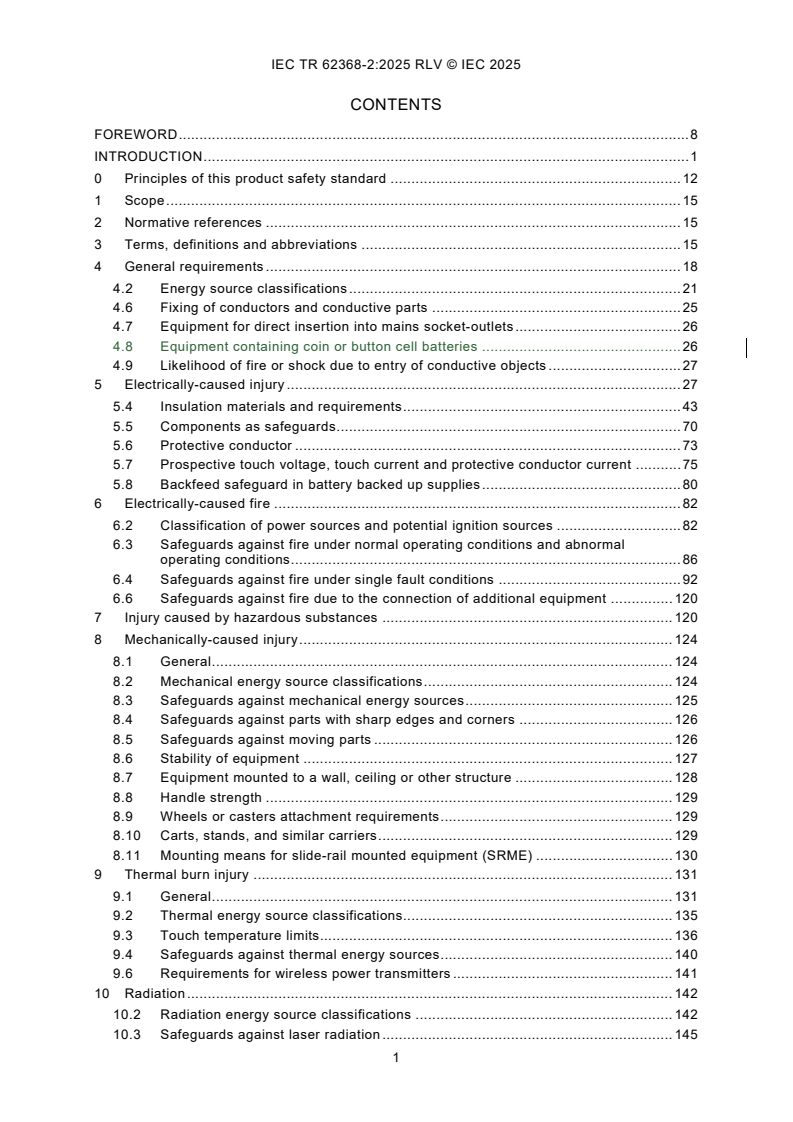
CONTENTS
FOREWORD . 8
INTRODUCTION . 1
0 Principles of this product safety standard . 12
1 Scope . 15
2 Normative references . 15
3 Terms, definitions and abbreviations . 15
4 General requirements . 18
4.2 Energy source classifications . 21
4.6 Fixing of conductors and conductive parts . 25
4.7 Equipment for direct insertion into mains socket-outlets . 26
4.8 Equipment containing coin or button cell batteries . 26
4.9 Likelihood of fire or shock due to entry of conductive objects . 27
5 Electrically-caused injury . 27
5.4 Insulation materials and requirements . 43
5.5 Components as safeguards . 70
5.6 Protective conductor . 73
5.7 Prospective touch voltage, touch current and protective conductor current . 75
5.8 Backfeed safeguard in battery backed up supplies . 80
6 Electrically-caused fire . 82
6.2 Classification of power sources and potential ignition sources . 82
6.3 Safeguards against fire under normal operating conditions and abnormal
operating conditions . 86
6.4 Safeguards against fire under single fault conditions . 92
6.6 Safeguards against fire due to the connection of additional equipment . 120
7 Injury caused by hazardous substances . 120
8 Mechanically-caused injury . 124
8.1 General . 124
8.2 Mechanical energy source classifications . 124
8.3 Safeguards against mechanical energy sources . 125
8.4 Safeguards against parts with sharp edges and corners . 126
8.5 Safeguards against moving parts . 126
8.6 Stability of equipment . 127
8.7 Equipment mounted to a wall, ceiling or other structure . 128
8.8 Handle strength . 129
8.9 Wheels or casters attachment requirements . 129
8.10 Carts, stands, and similar carriers . 129
8.11 Mounting means for slide-rail mounted equipment (SRME) . 130
9 Thermal burn injury . 131
9.1 General . 131
9.2 Thermal energy source classifications. 135
9.3 Touch temperature limits. 136
9.4 Safeguards against thermal energy sources . 140
9.6 Requirements for wireless power transmitters . 141
10 Radiation . 142
10.2 Radiation energy source classifications . 142
10.3 Safeguards against laser radiation . 145
10.4 Safeguards against optical radiation from lamps and lamp systems
(including LED types) . 145
10.5 Safeguards against X-radiation . 145
10.6 Safeguards against acoustic energy sources . 145
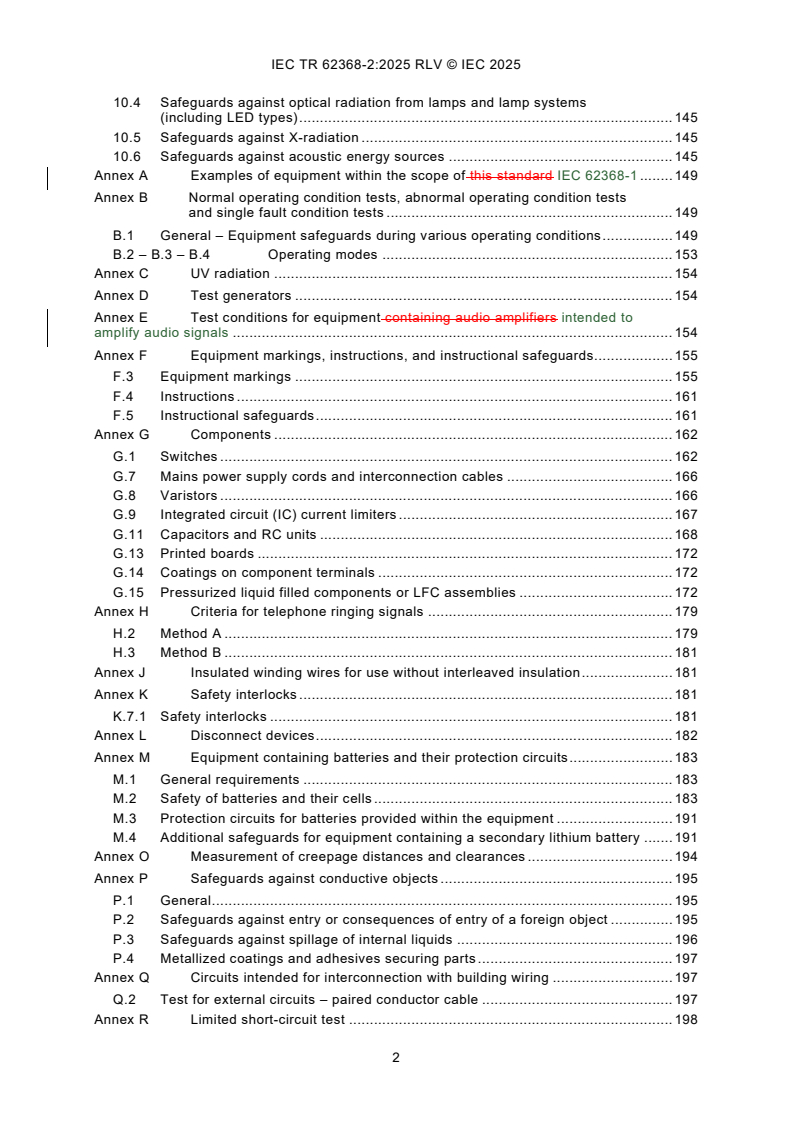
Annex A Examples of equipment within the scope of this standard IEC 62368-1 . 149
Annex B Normal operating condition tests, abnormal operating condition tests
and single fault condition tests . 149
B.1 General – Equipment safeguards during various operating conditions . 149
B.2 – B.3 – B.4 Operating modes . 153
Annex C UV radiation . 154
Annex D Test generators . 154
Annex E Test conditions for equipment containing audio amplifiers intended to
amplify audio signals . 154
Annex F Equipment markings, instructions, and instructional safeguards . 155
F.3 Equipment markings . 155
F.4 Instructions . 161
F.5 Instructional safeguards . 161
Annex G Components . 162
G.1 Switches . 162
G.7 Mains power supply cords and interconnection cables . 166
G.8 Varistors . 166
G.9 Integrated circuit (IC) current limiters . 167
G.11 Capacitors and RC units . 168
G.13 Printed boards . 172
G.14 Coatings on component terminals . 172
G.15 Pressurized liquid filled components or LFC assemblies . 172
Annex H Criteria for telephone ringing signals . 179
H.2 Method A . 179
H.3 Method B . 181
Annex J Insulated winding wires for use without interleaved insulation . 181
Annex K Safety interlocks . 181
K.7.1 Safety interlocks . 181
Annex L Disconnect devices . 182
Annex M Equipment containing batteries and their protection circuits . 183
M.1 General requirements . 183
M.2 Safety of batteries and their cells . 183
M.3 Protection circuits for batteries provided within the equipment . 191
M.4 Additional safeguards for equipment containing a secondary lithium battery . 191
Annex O Measurement of creepage distances and clearances . 194
Annex P Safeguards against conductive objects . 195
P.1 General . 195
P.2 Safeguards against entry or consequences of entry of a foreign object . 195
P.3 Safeguards against spillage of internal liquids . 196
P.4 Metallized coatings and adhesives securing parts . 197
Annex Q Circuits intended for interconnection with building wiring . 197
Q.2 Test for external circuits – paired conductor cable . 197
Annex R Limited short-circuit test . 198
Annex S Tests for resistance to heat and fire . 198
S.1 Flammability test for fire enclosure and fire barrier materials of equipment
where the steady-state power does not exceed 4 000 W . 198
S.2 Flammability test for fire enclosure and fire barrier integrity . 198
S.3 Flammability tests for the bottom of a fire enclosure . 199
S.4 Flammability classification of materials . 199
S.5 Flammability test for fire enclosure materials of equipment with a steady
state power exceeding 4 000 W . 199
S.6 Grille covering material, cloth, and reticulated foam . 200
Annex T Mechanical strength tests . 200
T.2 Steady force test, 10 N . 200
T.3 Steady force test, 30 N . 200
T.4 Steady force test, 100 N . 200
T.5 Steady force test, 250 N . 200
T.6 Enclosure impact test. 200
T.7 Drop test . 201
T.8 Stress relief test . 201
T.9 Glass impact test . 201
T.10 Glass fragmentation test . 201
Annex U Mechanical strength of CRTs and protection against the effects of
implosion . 201
U.2 Test method and compliance criteria for non-intrinsically protected CRTs . 201
Annex V Determination of accessible parts . 202
Annex X Alternative method for determining clearances for insulation in circuits
connected to an AC mains not exceeding 420 V peak (300 V RMS) . 202
Annex Y Construction requirements for outdoor enclosures. 203
Y.3 Resistance to corrosion . 204
Annex A (informative) Background information related to the use of SPDs surge
suppressors . 205
A.1 Industry demand for incorporating SPDs surge suppressors in the equipment . 205
A.2 Technical environment of relevant component standards .
A.3 Technical discussion .
A.2 Considerations on surge suppressors bridging both sides of a safeguard . 211
A.3 Considerations on a surge suppresser used for ID1 external circuit in class II
equipment . 212
A.4 Information about follow current (or follow-on current) . 207
Annex B (informative) Background information related to measurement of discharges
– Determining the R-C discharge time constant for X and Y capacitors . 227
B.1 General . 227
B.2 EMC filters . 227
B.3 The safety issue and solution . 227
B.4 The requirement . 228
B.5 100 MΩ probes . 228
B.6 The R-C time constant and its parameters . 229
B.7 Time constant measurement. . 232
B.8 Effect of probe resistance . 235
B.9 Effect of probe capacitance . 236
B.10 Determining the time constant . 236
B.11 Conclusion . 238
Annex C (informative) Background information related to resistance to candle flame
ignition . 239
Annex D (informative) Surge suppressers used between mains and an external circuit
ID1 as specified in Table 13 . 240
Bibliography . 241
Figure 1 – Risk reduction as given in ISO/IEC Guide 51 . 13
Figure 2 – HBSE Process Chart . 14
Figure 3 – Protective bonding conductor as part of a safeguard . 18
Figure 4 – Safeguards for protecting an ordinary person . 22
Figure 5 – Safeguards for protecting an instructed person . 22
Figure 6 – Safeguards for protecting a skilled person . 23
Figure 7 – Flow chart showing the intent of the glass requirements . 25
Figure 8 – Conventional time/current zones of effects of AC currents (15 Hz to 100 Hz)
on persons for a current path corresponding to left hand to feet (see IEC TS 60479-
1:20052018, Figure 20) . 30
Figure 9 – Conventional time/current zones of effects of DC currents on persons for a
longitudinal upward current path (see IEC TS 60479-1:20052018, Figure 22) . 31
Figure 10 – Illustration that limits depend on both voltage and current . 32
Figure 11 – Typical example . 39
Figure 12 – Example 1 . 40
Figure 13 – Example 2 . 40
Figure 14 – Flow chart for determining clearances . 47
Figure 15 – Illustration of working voltage . 48
Figure 16 – Illustration of transient voltages on paired conductor external circuits . 50
Figure 17 – Illustration of transient voltages on coaxial-cable external circuits . 51
Figure 18 – Examples of transmission mode and applied conductors . 52
Figure 19 – Basic and reinforced insulation in Table 14 of IEC 62368-1:2018;
ratio reinforced to basic . 53
Figure 20 – Reinforced clearances according to Rule 1, Rule 2, and Table 14 . 55
Figure 21 – Example illustrating accessible internal wiring . 63
Figure 22 – Waveform on insulation without surge suppressors and no breakdown . 66
Figure 23 – Waveforms on insulation during breakdown without surge suppressors . 66
Figure 24 – Waveforms on insulation with surge suppressors in operation . 66
Figure 25 – Waveform on short-circuited surge suppressor and insulation . 67
Figure 26 – Normal operating condition. 68
Figure 27 – Single fault condition . 68
Figure 28 – Single fault condition; hazardous situation if 5.4.11 is not fulfilled . 69
Figure 29 – Parts earthed in one piece of equipment . 69
Figure 30 – Equipment 2 with connection to a network . 70
Figure 31 – Example for an ES2 source . 70
Figure 32 – Example for an ES3 source . 71
Figure 33 – Overview of protective conductors . 73
Figure 34 – Example of a typical touch current measuring network . 76
Figure 35 – Touch current from a floating circuit . 78
Figure 36 – Touch current from an earthed circuit . 78
Figure 37 – Summation of touch currents in a PABX . 79
Figure 38 – Possible safeguards against electrically-caused fire . 86
Figure 39 – Fire clause flow chart . 89
Figure 40 – Prevent ignition flow chart . 95
Figure 41 – Control fire spread summary . 96
Figure 42 – Control fire spread PS2 . 97
Figure 43 – Control fire spread PS3 . 98
Figure 44 – Fire cone application to a large component . 110
Figure 45 – Calculation of side opening size . 117
Figure 46 – Flowchart demonstrating the hierarchy of hazard management . 123
Figure 47 – Model for chemical injury. 124
Figure 48 – Direction of forces to be applied . 128
Figure 49 – Model for a burn injury . 132
Figure 50 – Model for safeguards against thermal burn injury . 134
Figure 51 – Model for absence of a thermal hazard. 134
Figure 52 – Model for presence of a thermal hazard with a physical safeguard in place . 134
Figure 53 – Model for presence of a thermal hazard with behavioural safeguard in
place . 135
Figure 54 – Direct plug in . 137
Figure 55 – External power supply . 137
Figure 56 – Examples of symmetrical single coils . 142
Figure 57 – LED parameters . 142
Figure 58 – Flowchart for evaluation of Image projectors (beamers) . 144
Figure 59 – Graphical representation of L ,T . 146
Aeq
Figure 60 – Overview of operating modes . 153
Figure 61 – Typical examples of class I equipment . 156
Figure 62 – Typical examples of class I equipment with class II construction . 157
Figure 63 – Typical examples of class II equipment . 158
Figure 64 – Typical examples of class II equipment with functional earth . 159
Figure 65 – Typical examples of class II equipment with functional earth, making use of
a class I mains connector . 160
Figure 66 – Typical examples of class II equipment with functional earth, making use of
a class I mains connector and a separate functional earthing connection . 161
Figure 67 – Voltage-current characteristics (Typical data) . 163
Figure 68 – Example of IC current limiter circuit . 168
Figure 69 – Example of application of Rule 3, first dash . 170
Figure 70 – Example of application of Rule 3, second dash . 171
Figure 71 – Example on how to use Table G.12 . 171
Figure 72 – Decision flowchart . 173
Figure 73 – Illustration of a self-contained LFC system . 175
Figure 74 – Illustration of a modular LFC system . 176
Figure 75 – Example illustration of a rack modular LFC subsystems with internal and
external connections. . 177
Figure 76 – CDU liquid cooling system within a data centre . 178
Figure 77 – Non-CDU liquid cooling system within data centre . 178
Figure 78 – Current limit curves . 180
Figure 79 – Example of a dummy battery circuit . 192
Figure 80 – Calculating side openings . 196
Figure 81 – Example of a circuit with two power sources . 198
Figure A.1 – Installation has poor earthing and bonding; equipment damaged
(from ITU-T Recommendation K.66) . 206
Figure A.2 – Installation has poor earthing and bonding; using main earth bar for
protection against lightning strike (from ITU-T Recommendation K.66) . 206
Figure A.3 – Installation with poor earthing and bonding, using a varistor and a GDT
for protection against a lightning strike . 207
Figure A.4 – Typical example of a surge suppressor and a voltage fall . 207
Figure A.4 – Installation with poor earthing and bonding; equipment damaged (TV set) .
Figure A.5 – Safeguards .
Figure A.5 – An example of surge voltage drop by an MOV and two GDTs (measured
in laboratory) . 213
Figure A.6 – Discharge stages .
Figure A.6 – An example of ports of telecommunication equipment . 217
Figure A.8 – Discharge .
Figure A.7 – V-I properties of gas discharge tubes . 219
Figure A.8 – Holdover . 220
Figure A.9 – Relation of the V-I characteristic of a gas discharge tube and the output
characteristic of the power supply . 221
Figure A.10 – V-I and V-t characteristics . 224
Figure A.11 – Follow-on current pictures . 225
Figure B.1 – Typical EMC filter schematic . 227
Figure B.2 – 100 MΩ oscilloscope probes . 229
Figure B.3 – Combinations of EUT resistance and capacitance for 1 s time constant . 231
Figure B.4 – 240 V mains followed by capacitor discharge . 233
Figure B.5 – Time constant measurement schematic . 234
Figure B.6 – Worst-case measured time constant values for 100 MΩ and 10 MΩ probes . 238
Figure D.1 – Example of circuit configuration of a surge suppresser . 240
Table 1 – General summary of required safeguards . 23
Table 2 – Time/current zones for AC 15 Hz to 100 Hz for hand to feet pathway (see
IEC TS 60479-1:20052018, Table 11) . 30
Table 3 – Time/current zones for DC for hand to feet pathway (see IEC TS 60479-
1:20052018, Table 13) . 31
Table 4 – Limit values of accessible capacitance (threshold of pain) . 34
Table 5 – Total body resistances R for a current path hand to hand, DC, for large
T
surface areas of contact in dry condition . 37
Table 6 – Insulation requirements for external circuits . 51
Table 7 – Voltage drop across clearance and solid insulation in series . 57
Table 8 – Examples of application of various safeguards . 88
Table 9 – Basic safeguards against fire under normal operating conditions and
abnormal operating conditions . 91
Table 10 – Supplementary safeguards against fire under single fault conditions . 92
Table 11 – Method 1: Reduce the likelihood of ignition . 94
Table 12 – Method 2: Control fire spread . 102
Table 13 – Fire barrier and fire enclosure flammability requirements . 112
Table 14 – Summary – Fire enclosure and fire barrier material requirements . 116
Table 15 – Control of chemical hazards . 122
Table 16 – Overview of requirements for dose-based systems . 148
Table 17 – Overview of supply voltage . 152
Table 18 – Safety of batteries and their cells – requirements (expanded information on
documents and scope) . 185
Table A.1 – Permissible power-frequency stress voltage (except for US and Japan) . 213
Table A.2 – TOV parameters for US systems quoted from IEC 61643-12:2020 . 214
Table A.3 – TOV test parameters for Japanese systems quoted from IEC 61643-
12:2020 . 214
Table A.4 – Peak voltage of TOV in countries conforming to IEC 60364-4-44 . 215
Table A.5 – Peak voltage of TOV in USA . 215
Table A.6 – Peak voltage of TOV in Japan . 215
Table A.7 – The value of U for major mains voltages . 216
peak2
Table B.1 – 100 MΩ oscilloscope probes . 229
Table B.2 – Capacitor discharge . 230
Table B.3 – Maximum T values for combinations of R and C for
measured EUT EUT
T of 1 s . 237
EUT
INTERNATIONAL ELECTROTECHNICAL COMMISSION
____________
Audio/video, information and communication technology equipment -
Part 2: Explanatory information related to IEC 62368-1:2023
FOREWORD
1) The International Electrotechnical Commission (IEC) is a worldwide organization for standardization comprising
all national electrotechnical committees (IEC National Committees). The object of IEC is to promote international
co-operation on all questions concerning standardization in the electrical and electronic fields. To this end and
in addition to other activities, IEC publishes International Standards, Technical Specifications, Technical Reports,
Publicly Available Specifications (PAS) and Guides (hereafter referred to as “IEC Publication(s)”). Their
preparation is entrusted to technical committees; any IEC National Committee interested in the subject dealt with
may participate in this preparatory work. International, governmental and non-governmental organizations liaising
with the IEC also participate in this preparation. IEC collaborates closely with the International Organization for
Standardization (ISO) in accordance with conditions determined by agreement between the two organizations.
2) The formal decisions or agreements of IEC on technical matters express, as nearly as possible, an international
consensus of opinion on the relevant subjects since each technical committee has representation from all
interested IEC National Committees.
3) IEC Publications have the form of recommendations for international use and are accepted by IEC National
Committees in that sense. While all reasonable efforts are made to ensure that the technical content of IEC
Publications is accurate, IEC cannot be held responsible for the way in which they are used or for any
misinterpretation by any end user.
4) In order to promote international uniformity, IEC National Committees undertake to apply IEC Publications
transparently to the maximum extent possible in their national and regional publications. Any divergence between
any IEC Publication and the corresponding national or regional publication shall be clearly indicated in the latter.
5) IEC itself does not provide any attestation of conformity. Independent certification bodies provide conformity
assessment services and, in some areas, access to IEC marks of conformity. IEC is not responsible for any
services carried out by independent certification bodies.
6) All users should ensure that they have the latest edition of this publication.
7) No liability shall attach to IEC or its directors, employees, servants or agents including individual experts and
members of its technical committees and IEC National Committees for any personal injury, property damage or
other damage of any nature whatsoever, whether direct or indirect, or for costs (including legal fees) and
expenses arising out of the publication, use of, or reliance upon, this IEC Publication or any other IEC
Publications.
8) Attention is drawn to the Normative references cited in this publication. Use of the referenced publications is
indispensable for the correct application of this publication.
9) IEC draws attention to the possibility that the implementation of this document may involve the use of (a)
patent(s). IEC takes no position concerning the evidence, validity or applicability of any claimed patent rights in
respect thereof. As of the date of publication of this document, IEC had not received notice of (a) patent(s), which
may be required to implement this document. However, implementers are cautioned that this may not represent
the latest information, which may be obtained from the patent database available at https://patents.iec.ch. IEC
shall not be held responsible for identifying any or all such patent rights.
This redline version of the official IEC Standard allows the user to identify the changes made
to the previous edition IEC TR 62368-2:2018. A vertical bar appears in the margin wherever a
change has been made. Additions are in green text, deletions are in strikethrough red text.
IEC TR 62368-2 has been prepared by IEC technical committee TC 108: Safety of electronic
equipment within the field of audio/video, information technology and communication
technology. It is a Technical Report.
This fourth edition cancels and replaces the third edition published in 2018. This edition
constitutes a technical revision.
This edition includes the following significant technical changes with respect to the previous
edition:
a) It takes into account changes made in the fourth edition of IEC 62368-1 (IEC 62368-1:2023)
as identified in the Foreword of IEC 62368-1:2023.
The text of this Technical Report is based on the following documents:
Draft Report on voting
108/794/DTR 108/825/RVDTR
Full information on the voting for its approval can be found in the report on voting indicated in
the above table.
The language used for the development of this Technical Report is English.
This document was drafted in accordance with ISO/IEC Directives, Part 2, and developed in
accordance with ISO/IEC Directives, Part 1 and ISO/IEC Directives, IEC Supplement, available
at www.iec.ch/members_experts/refdocs. The main document types developed by IEC are
described in greater detail at www.iec.ch/publications.
In this document, the following print types are used:
– notes/explanatory matter: in smaller roman type;
– tables and figures that are included in the rationale have linked fields (shaded in grey if
“field shading” is active);
– terms that are defined in IEC 62368-1: in bold type.
Where coloured shading is used:
– green colour stands for level 1 energy sources
– yellow/orange colour stands for level 2 energy sources
– red colour stands for level 3 energy sources.
In this document, where the term (HBSDT) is used, it stands for Hazard Based Standard
Development Team, which is the Working Group of IEC TC 108 responsible for the development
and maintenance of IEC 62368-1.
A list of all parts of the IEC 62368 series can be found, under the general title Audio/video,
information and communication technology equipment, on the IEC website.
In this document, only those subclauses from IEC 62368-1 considered to need further
background reference information or explanation to benefit the user in applying the relevant
requirements are included. Therefore, not all numbered subclauses are cited. Unless otherwise
noted, all references are to clauses, subclauses, annexes, figures or tables located in
IEC 62368-1:2023.
The entries in this document can have one or two of the following subheadings in addition to
the Rationale statement:
Source – where the source is known and is a document that is accessible to the general public,
a reference is provided.
Purpose – where there is a need and when it can prove helpful to the understanding of the
Rationale, a Purpose statement has been added.
The committee has decided that the contents of this document will remain unchanged until the
stability date indicated on the IEC website under webstore.iec.ch in the data related to the
specific document. At this date, the document will be
• reconfirmed,
• withdrawn, or
• revised.
INTRODUCTION
IEC 62368-1 is based on the principles of hazard-based safety engineering, which is a different
way of developing and specifying safety considerations than that of
...