

IEC 63316:2026
(Main)Audio/video, information and communication technology equipment – Safety – Power transfer between communication equipment ports using communication wires and cables cabling at non-mains voltage above 60 V DC and ES2/ES3 AC voltage
General Information
- Abstract
IEC 63316:2026 prescribes safeguards, test methods and compliance requirements intended to reduce the risk of electrical shock and fire associated with voltage and current at voltages greater than 60 V DC and 60 V AC.
This document applies to equipment ports intended to supply and receive operating power from communications equipment ports using communication wires and cables. It covers particular requirements for circuits that are designed to transfer AC or DC power from a power sourcing equipment (PSE) (3.1.2) to a powered device (PD) (3.1.3), including repeaters, amplifiers, Optical Network Units, Remote DSLAMs, service provider terminating equipment, remote telecommunications cabinets and equipment, and midspan passive equipment connected to the PSE (3.1.2) and PD (3.1.3).
The power transfer of equipment ports covered by this document uses non-mains AC voltage or non-mains DC voltage above 60 V DC classified as ES2 according to 5.2.1.2 of IEC 62368-1:2023 or, in some very controlled cases, classified as ES3 according to IEC 62368-1:2023.
EXAMPLES
- DC power transfer using voltages above 60 V DC but ≤ 120 V DC, classified as ES2;
- Some telecommunications networks where the voltage was formerly called TNV-3 (see IEC 62368-1:2023, Table W.3), typically used for line, span or express powering outside North America, Long Range Reverse Power Feeding, HDSLx line powering ISDN, Line Powering Primary Rate E1;
- Some North American telecommunications networks between the utility service providers´ PSE (3.1.2) and service providers side of the PD (3.1.3) at the PNI (3.1.8);
- For DC power transfer using voltages ≥ 120 V DC at ES3: RFT circuits and the associated telecommunications network equipment and cabling used by communications service providers and communications utilities (for example, line powered E1/T1, HDSLx, SHDSLx, xDSL, repeaters, and telecommunications line powering up or line powering down converters as applicable), Optical Network Units, remote DSLAMs, etc. These RFT circuits are used between the utility service providers PSE (3.1.2) and service providers side of the PD (3.1.3) at the PNI (3.1.8). The customer facing ports of this equipment are at voltage not exceeding 60 V DC and are covered by IEC 62368-1:2023, see Annex A for deployment topologies;
- For AC/DC remote powering voltage above ES1 over coaxial cable in circuits used by cable television utility service providers for repeaters, amplifiers, Optical Network Units. The customer facing ports of this equipment are at voltage not exceeding 60 V DC that are covered by IEC 62368-1:2023.
NOTE 1 Any communications cable that permits power transfer between communication equipment is considered a communication cable even if communication does not take place. For example, a line powering up or line powering down converters as applicable used to power remote telecommunications equipment, can provide limited communications RFT power and not necessarily any superimposed data or signalling.
This document does not cover equipment interfaces within the scope of IEC 63315.
NOTE 2 IEC 63315 covers equipment intended to either supply or receive charging, or operating power from ICT interfaces using ICT wires and cables such as PoE, USB, HDMI, etc, or any of these combined.
This document does not cover ringing signals that are in the scope of IEC 62368-1 or in the scope of IEC 62949:2017.
This document does not cover traditional telecommunications technologies which operate at voltages not exceeding 60 V DC (circuits classified as ES1 according to 5.2.1.1 of IEC 62368-1:2023 and Table ID1a, 1b, or 1c in Table 13 of IEC 62368-1:2023) with or without ringing signals (classified as ES2 according to 5.2.1.1 of IEC 62368-1:2023 and external circuit ID1a, 1b, or 1c in Table 13 of IEC 62368-1:2023). Examples of traditional telecommunications technologies include Analogue Telephony, ISDN, T1, E1, VDSL, SHDSL, DDS, etc.
This document does not cover communications over ma
- Status
- Published
- Publication Date
- 24-Mar-2026
- Technical Committee
- TC 108 - Safety of electronic equipment within the field of audio/video, information technology and communication technology
- Drafting Committee
- PT 63316 - TC 108/PT 63316
- Current Stage
- PPUB - Publication issued
- Start Date
- 25-Mar-2026
- Completion Date
- 03-Apr-2026
Buy Documents
IEC 63316:2026 - Audio/video, information and communication technology equipment – Safety – Power transfer between communication equipment ports using communication wires and cables cabling at non-mains voltage above 60 V DC and ES2/ES3 AC voltage
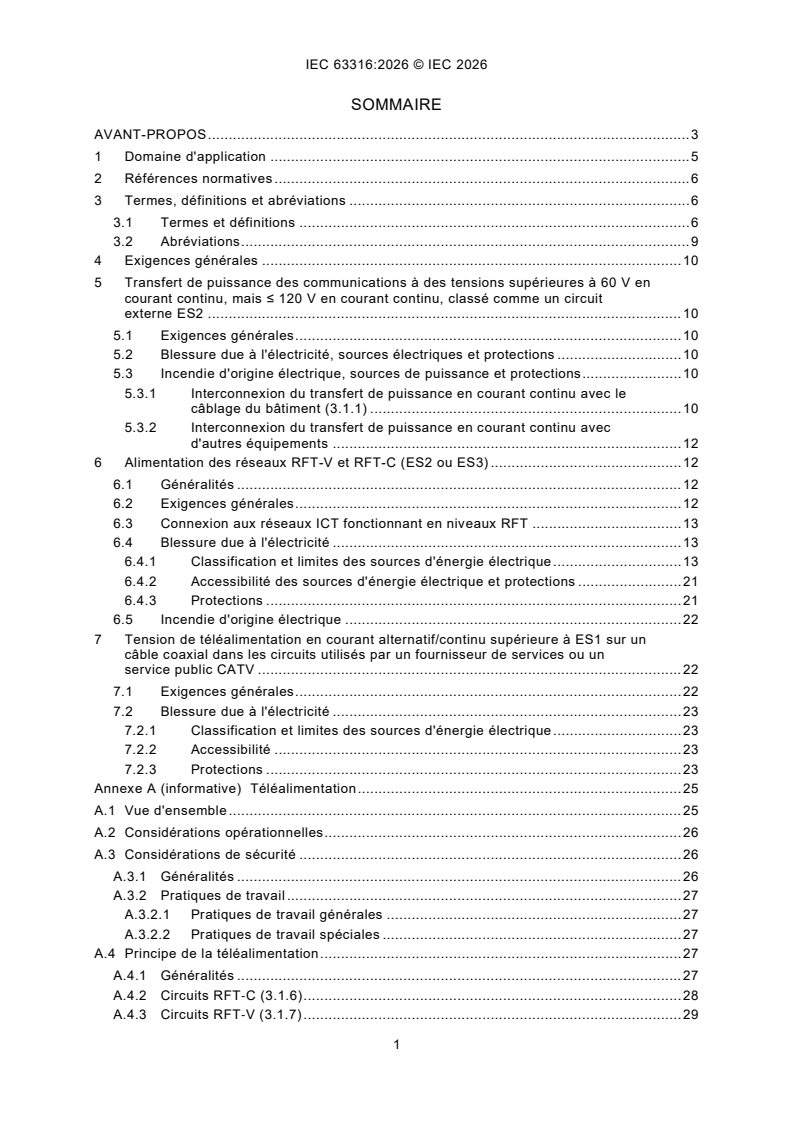
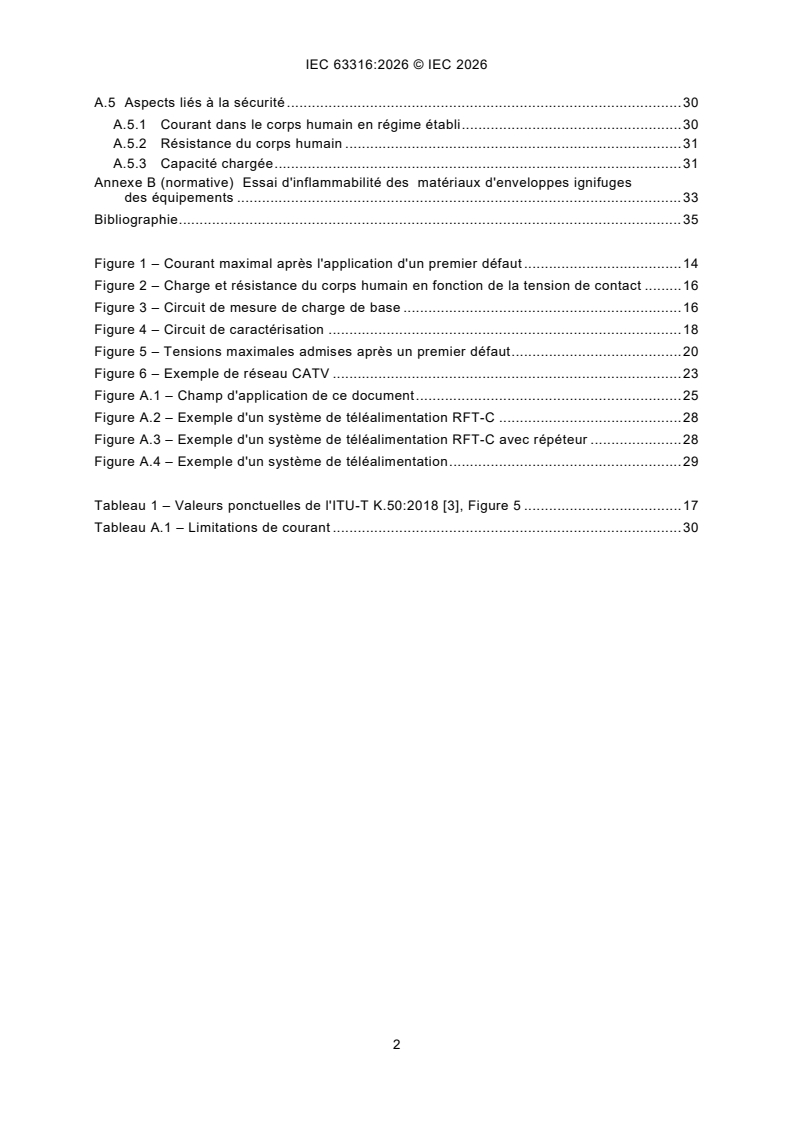
IEC 63316:2026 - Équipements des technologies audio/vidéo, de l'information et de la communication - Sécurité - Transfert de puissance entre les acces d'équipements de communication au moyen de fils et de câbles de communication a une tension ne provenant pas du réseau d'alimentation supérieure a 60 V en courant continu et a une tension ES2/ES3 en courant alternatif
Overview
IEC 63316:2026 defines safety requirements for power transfer between communication equipment ports using communication wires and cables where the active voltage exceeds 60 V DC or 60 V AC, but is supplied at non-mains voltages. This standard prescribes safeguards, testing procedures, and compliance criteria aimed at reducing risks of electric shock and fire, specifically for advanced communication and network equipment powered through data or telecommunications cables rather than traditional mains connections.
This document is applicable to equipment that supplies and receives power through dedicated communication cabling - including but not limited to power sourcing equipment (PSE) and powered devices (PD) such as repeaters, amplifiers, Optical Network Units (ONUs), Remote DSLAMs, and related service provider equipment. IEC 63316:2026 is especially relevant in contexts where power is conveyed over network cables at voltage levels above typical safety extra-low voltage (SELV) but below mains voltage, classified as ES2 or in tightly controlled environments, ES3, according to IEC 62368-1.
Key Topics
Scope and Safety Requirements
- Addresses equipment interfaces that use non-mains DC and AC voltages above 60 V DC, classified as ES2 or ES3 energy sources.
- Focuses on communication equipment ports used for both power delivery and operation in ICT and AV settings.
- Prescribes safeguards to minimize risks of electric shock and electrically-caused fire.
Circuit Types and Applications
- Clarifies requirements for circuits supplying above 60 V DC but ≤120 V DC (ES2), and for those using higher DC voltages (≥120 V DC, ES3) in remote feeding telecommunication (RFT) circuits.
- Includes guidelines for remote power feeding in telecommunications and cable networks where higher voltages are required.
Exclusions
- Does not apply to traditional telecommunication technologies operating below 60 V DC (e.g., analog telephony, ISDN, T1, E1, VDSL).
- Excludes equipment under IEC 63315 (which covers PoE, USB, HDMI, and similar ICT interface-powered devices).
- Does not address ringing signals (covered by IEC 62368-1 and IEC 62949).
- Excludes sections of networks that fall under direct mains power or higher-voltage distribution.
Compliance and Testing
- Explains test methods and requirements for determining compliance, referencing key elements of IEC 62368-1.
- Calls for specific power and current limitations, such as limiting output current to prevent cable overheating and fire in building wiring scenarios.
Applications
IEC 63316:2026 provides practical guidance and a robust safety framework for:
Telecommunications Networks
- Powering remote assets such as repeaters, Remote DSLAMs, ONUs, and similar devices over long distances via telecommunications cables.
- Managing network elements in service provider infrastructure using RFT-V and RFT-C circuit concepts (referencing ITU-T K.50).
Cable Television Utility Circuits
- Enabling the safe remote powering of network amplifiers and related equipment over coaxial cabling at voltages above ES1, particularly in global CATV deployments.
Service Provider Installations
- Ensuring separation of public and private network segments, especially at the public network interface (PNI).
- Supporting advanced network deployments outside North America involving higher voltage supplies (for example, long-range reverse power feeding, HDSLx, line-powered ISDN/E1 systems).
Equipment Manufacturers
- Guiding design of compliant PSE and PD hardware for safer deployment in global communication infrastructure.
Related Standards
When implementing IEC 63316:2026, the following standards are also relevant:
- IEC 62368-1:2023 – Audio/video, information and communication technology equipment – Safety requirements; referenced throughout IEC 63316:2026 for energy source classifications and test methodologies.
- IEC 60728-11:2023 – Cable networks for TV and interactive services – Safety; relevant for CATV network safety and remote powering scenarios.
- ITU-T K.50 – Remote feeding telecommunication guidelines; foundational for RFT circuit definitions.
- IEC 63315 – For equipment interfaces utilizing ICT wires and cables for power (PoE, USB, HDMI, etc.); distinct scope from IEC 63316.
- IEC 62949:2017 – Safety of communication cables with regard to ringing signals; referenced for exclusion.
By following IEC 63316:2026, manufacturers, network operators, and integrators can ensure their communication equipment adheres to stringent international safety requirements, supporting the deployment of reliable and safe power-over-communication solutions in evolving ICT infrastructures.
Buy Documents
IEC 63316:2026 - Audio/video, information and communication technology equipment – Safety – Power transfer between communication equipment ports using communication wires and cables cabling at non-mains voltage above 60 V DC and ES2/ES3 AC voltage
IEC 63316:2026 - Équipements des technologies audio/vidéo, de l'information et de la communication - Sécurité - Transfert de puissance entre les acces d'équipements de communication au moyen de fils et de câbles de communication a une tension ne provenant pas du réseau d'alimentation supérieure a 60 V en courant continu et a une tension ES2/ES3 en courant alternatif
Get Certified
Connect with accredited certification bodies for this standard

BSI Group
BSI (British Standards Institution) is the business standards company that helps organizations make excellence a habit.

NYCE
Mexican standards and certification body.

ANCE
Mexican certification and testing association.
Sponsored listings
Frequently Asked Questions
IEC 63316:2026 is a standard published by the International Electrotechnical Commission (IEC). Its full title is "Audio/video, information and communication technology equipment – Safety – Power transfer between communication equipment ports using communication wires and cables cabling at non-mains voltage above 60 V DC and ES2/ES3 AC voltage". This standard covers: IEC 63316:2026 prescribes safeguards, test methods and compliance requirements intended to reduce the risk of electrical shock and fire associated with voltage and current at voltages greater than 60 V DC and 60 V AC. This document applies to equipment ports intended to supply and receive operating power from communications equipment ports using communication wires and cables. It covers particular requirements for circuits that are designed to transfer AC or DC power from a power sourcing equipment (PSE) (3.1.2) to a powered device (PD) (3.1.3), including repeaters, amplifiers, Optical Network Units, Remote DSLAMs, service provider terminating equipment, remote telecommunications cabinets and equipment, and midspan passive equipment connected to the PSE (3.1.2) and PD (3.1.3). The power transfer of equipment ports covered by this document uses non-mains AC voltage or non-mains DC voltage above 60 V DC classified as ES2 according to 5.2.1.2 of IEC 62368-1:2023 or, in some very controlled cases, classified as ES3 according to IEC 62368-1:2023. EXAMPLES - DC power transfer using voltages above 60 V DC but ≤ 120 V DC, classified as ES2; - Some telecommunications networks where the voltage was formerly called TNV-3 (see IEC 62368-1:2023, Table W.3), typically used for line, span or express powering outside North America, Long Range Reverse Power Feeding, HDSLx line powering ISDN, Line Powering Primary Rate E1; - Some North American telecommunications networks between the utility service providers´ PSE (3.1.2) and service providers side of the PD (3.1.3) at the PNI (3.1.8); - For DC power transfer using voltages ≥ 120 V DC at ES3: RFT circuits and the associated telecommunications network equipment and cabling used by communications service providers and communications utilities (for example, line powered E1/T1, HDSLx, SHDSLx, xDSL, repeaters, and telecommunications line powering up or line powering down converters as applicable), Optical Network Units, remote DSLAMs, etc. These RFT circuits are used between the utility service providers PSE (3.1.2) and service providers side of the PD (3.1.3) at the PNI (3.1.8). The customer facing ports of this equipment are at voltage not exceeding 60 V DC and are covered by IEC 62368-1:2023, see Annex A for deployment topologies; - For AC/DC remote powering voltage above ES1 over coaxial cable in circuits used by cable television utility service providers for repeaters, amplifiers, Optical Network Units. The customer facing ports of this equipment are at voltage not exceeding 60 V DC that are covered by IEC 62368-1:2023. NOTE 1 Any communications cable that permits power transfer between communication equipment is considered a communication cable even if communication does not take place. For example, a line powering up or line powering down converters as applicable used to power remote telecommunications equipment, can provide limited communications RFT power and not necessarily any superimposed data or signalling. This document does not cover equipment interfaces within the scope of IEC 63315. NOTE 2 IEC 63315 covers equipment intended to either supply or receive charging, or operating power from ICT interfaces using ICT wires and cables such as PoE, USB, HDMI, etc, or any of these combined. This document does not cover ringing signals that are in the scope of IEC 62368-1 or in the scope of IEC 62949:2017. This document does not cover traditional telecommunications technologies which operate at voltages not exceeding 60 V DC (circuits classified as ES1 according to 5.2.1.1 of IEC 62368-1:2023 and Table ID1a, 1b, or 1c in Table 13 of IEC 62368-1:2023) with or without ringing signals (classified as ES2 according to 5.2.1.1 of IEC 62368-1:2023 and external circuit ID1a, 1b, or 1c in Table 13 of IEC 62368-1:2023). Examples of traditional telecommunications technologies include Analogue Telephony, ISDN, T1, E1, VDSL, SHDSL, DDS, etc. This document does not cover communications over ma
IEC 63316:2026 prescribes safeguards, test methods and compliance requirements intended to reduce the risk of electrical shock and fire associated with voltage and current at voltages greater than 60 V DC and 60 V AC. This document applies to equipment ports intended to supply and receive operating power from communications equipment ports using communication wires and cables. It covers particular requirements for circuits that are designed to transfer AC or DC power from a power sourcing equipment (PSE) (3.1.2) to a powered device (PD) (3.1.3), including repeaters, amplifiers, Optical Network Units, Remote DSLAMs, service provider terminating equipment, remote telecommunications cabinets and equipment, and midspan passive equipment connected to the PSE (3.1.2) and PD (3.1.3). The power transfer of equipment ports covered by this document uses non-mains AC voltage or non-mains DC voltage above 60 V DC classified as ES2 according to 5.2.1.2 of IEC 62368-1:2023 or, in some very controlled cases, classified as ES3 according to IEC 62368-1:2023. EXAMPLES - DC power transfer using voltages above 60 V DC but ≤ 120 V DC, classified as ES2; - Some telecommunications networks where the voltage was formerly called TNV-3 (see IEC 62368-1:2023, Table W.3), typically used for line, span or express powering outside North America, Long Range Reverse Power Feeding, HDSLx line powering ISDN, Line Powering Primary Rate E1; - Some North American telecommunications networks between the utility service providers´ PSE (3.1.2) and service providers side of the PD (3.1.3) at the PNI (3.1.8); - For DC power transfer using voltages ≥ 120 V DC at ES3: RFT circuits and the associated telecommunications network equipment and cabling used by communications service providers and communications utilities (for example, line powered E1/T1, HDSLx, SHDSLx, xDSL, repeaters, and telecommunications line powering up or line powering down converters as applicable), Optical Network Units, remote DSLAMs, etc. These RFT circuits are used between the utility service providers PSE (3.1.2) and service providers side of the PD (3.1.3) at the PNI (3.1.8). The customer facing ports of this equipment are at voltage not exceeding 60 V DC and are covered by IEC 62368-1:2023, see Annex A for deployment topologies; - For AC/DC remote powering voltage above ES1 over coaxial cable in circuits used by cable television utility service providers for repeaters, amplifiers, Optical Network Units. The customer facing ports of this equipment are at voltage not exceeding 60 V DC that are covered by IEC 62368-1:2023. NOTE 1 Any communications cable that permits power transfer between communication equipment is considered a communication cable even if communication does not take place. For example, a line powering up or line powering down converters as applicable used to power remote telecommunications equipment, can provide limited communications RFT power and not necessarily any superimposed data or signalling. This document does not cover equipment interfaces within the scope of IEC 63315. NOTE 2 IEC 63315 covers equipment intended to either supply or receive charging, or operating power from ICT interfaces using ICT wires and cables such as PoE, USB, HDMI, etc, or any of these combined. This document does not cover ringing signals that are in the scope of IEC 62368-1 or in the scope of IEC 62949:2017. This document does not cover traditional telecommunications technologies which operate at voltages not exceeding 60 V DC (circuits classified as ES1 according to 5.2.1.1 of IEC 62368-1:2023 and Table ID1a, 1b, or 1c in Table 13 of IEC 62368-1:2023) with or without ringing signals (classified as ES2 according to 5.2.1.1 of IEC 62368-1:2023 and external circuit ID1a, 1b, or 1c in Table 13 of IEC 62368-1:2023). Examples of traditional telecommunications technologies include Analogue Telephony, ISDN, T1, E1, VDSL, SHDSL, DDS, etc. This document does not cover communications over ma
IEC 63316:2026 is classified under the following ICS (International Classification for Standards) categories: 33.160.01 - Audio, video and audiovisual systems in general; 35.020 - Information technology (IT) in general. The ICS classification helps identify the subject area and facilitates finding related standards.
IEC 63316:2026 is available in PDF format for immediate download after purchase. The document can be added to your cart and obtained through the secure checkout process. Digital delivery ensures instant access to the complete standard document.
Standards Content (Sample)
IEC 63316 ®
Edition 1.0 2026-03
INTERNATIONAL
STANDARD
Audio/video, information and communication technology equipment - Safety -
Power transfer between communication equipment ports using communication
wires and cables cabling at non-mains voltage above 60 V DC and ES2/ES3 AC
voltage
ICS 33.160.01; 35.020 ISBN 978-2-8327-1147-7
All rights reserved. Unless otherwise specified, no part of this publication may be reproduced or utilized in any form or
by any means, electronic or mechanical, including photocopying and microfilm, without permission in writing from either
IEC or IEC's member National Committee in the country of the requester. If you have any questions about IEC copyright
or have an enquiry about obtaining additional rights to this publication, please contact the address below or your local
IEC member National Committee for further information.
IEC Secretariat Tel.: +41 22 919 02 11
3, rue de Varembé info@iec.ch
CH-1211 Geneva 20 www.iec.ch
Switzerland
About the IEC
The International Electrotechnical Commission (IEC) is the leading global organization that prepares and publishes
International Standards for all electrical, electronic and related technologies.
About IEC publications
The technical content of IEC publications is kept under constant review by the IEC. Please make sure that you have the
latest edition, a corrigendum or an amendment might have been published.
IEC publications search - IEC Products & Services Portal - products.iec.ch
webstore.iec.ch/advsearchform Discover our powerful search engine and read freely all the
The advanced search enables to find IEC publications by a publications previews, graphical symbols and the glossary.
variety of criteria (reference number, text, technical With a subscription you will always have access to up to date
committee, …). It also gives information on projects, content tailored to your needs.
replaced and withdrawn publications.
Electropedia - www.electropedia.org
The world's leading online dictionary on electrotechnology,
IEC Just Published - webstore.iec.ch/justpublished
Stay up to date on all new IEC publications. Just Published containing more than 22 500 terminological entries in English
details all new publications released. Available online and and French, with equivalent terms in 25 additional languages.
once a month by email. Also known as the International Electrotechnical Vocabulary
(IEV) online.
IEC Customer Service Centre - webstore.iec.ch/csc
If you wish to give us your feedback on this publication or
need further assistance, please contact the Customer
Service Centre: sales@iec.ch.
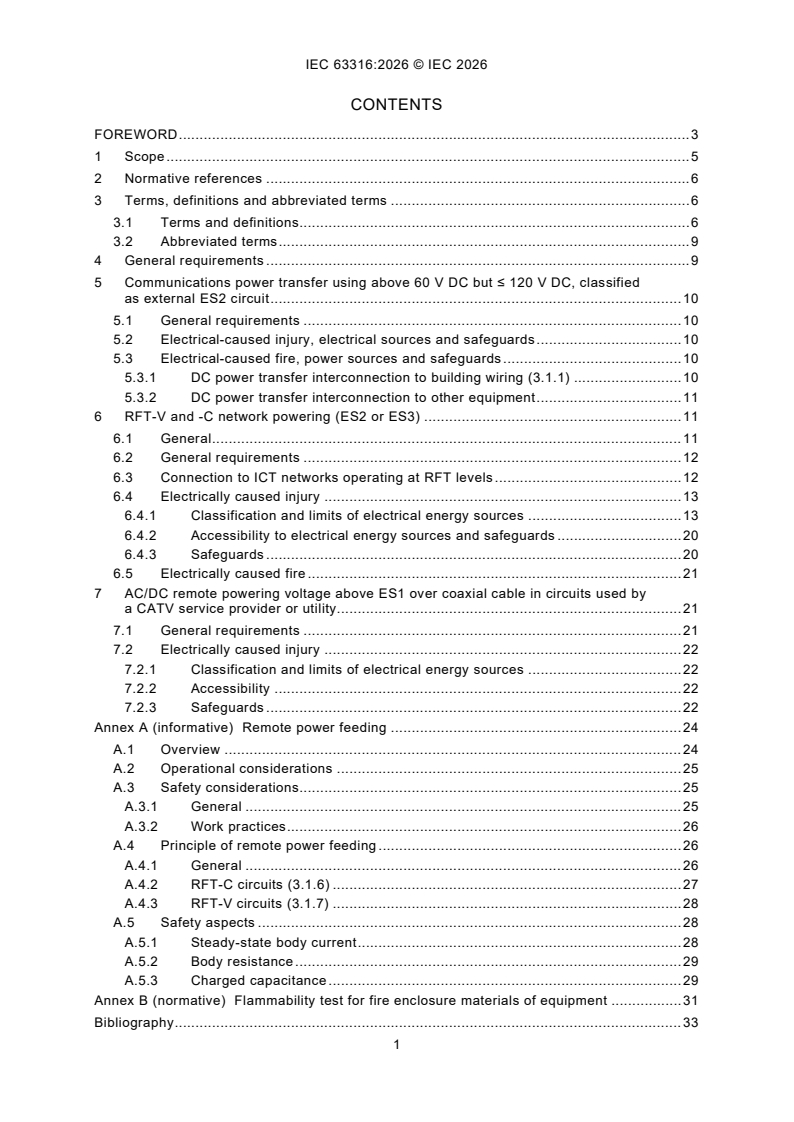
CONTENTS
FOREWORD . 3
1 Scope . 5
2 Normative references . 6
3 Terms, definitions and abbreviated terms . 6
3.1 Terms and definitions. 6
3.2 Abbreviated terms . 9
4 General requirements . 9
5 Communications power transfer using above 60 V DC but ≤ 120 V DC, classified
as external ES2 circuit . 10
5.1 General requirements . 10
5.2 Electrical-caused injury, electrical sources and safeguards . 10
5.3 Electrical-caused fire, power sources and safeguards . 10
5.3.1 DC power transfer interconnection to building wiring (3.1.1) . 10
5.3.2 DC power transfer interconnection to other equipment . 11
6 RFT-V and -C network powering (ES2 or ES3) . 11
6.1 General . 11
6.2 General requirements . 12
6.3 Connection to ICT networks operating at RFT levels . 12
6.4 Electrically caused injury . 13
6.4.1 Classification and limits of electrical energy sources . 13
6.4.2 Accessibility to electrical energy sources and safeguards . 20
6.4.3 Safeguards . 20
6.5 Electrically caused fire . 21
7 AC/DC remote powering voltage above ES1 over coaxial cable in circuits used by
a CATV service provider or utility. 21
7.1 General requirements . 21
7.2 Electrically caused injury . 22
7.2.1 Classification and limits of electrical energy sources . 22
7.2.2 Accessibility . 22
7.2.3 Safeguards . 22
Annex A (informative) Remote power feeding . 24
A.1 Overview . 24
A.2 Operational considerations . 25
A.3 Safety considerations. 25
A.3.1 General . 25
A.3.2 Work practices . 26
A.4 Principle of remote power feeding . 26
A.4.1 General . 26
A.4.2 RFT-C circuits (3.1.6) . 27
A.4.3 RFT-V circuits (3.1.7) . 28
A.5 Safety aspects . 28
A.5.1 Steady-state body current . 28
A.5.2 Body resistance . 29
A.5.3 Charged capacitance . 29
Annex B (normative) Flammability test for fire enclosure materials of equipment . 31
Bibliography . 33
Figure 1 – Maximum current after a single fault is applied . 14
Figure 2 – Charge and body resistance versus touch voltage . 15
Figure 3 – Basic charge measuring circuit . 16
Figure 4 – Characterization circuit . 17
Figure 5 – Maximum voltages permitted after a single fault . 19
Figure 6 – CATV network example . 22
Figure A.1 – Field of application of this document . 24
Figure A.2 – Example of a remote power feeding RFT-C system . 27
Figure A.3 – Example of a remote power feeding RFT-C system with a repeater . 27
Figure A.4 – Example of a remote power feeding system . 28
Table 1 – Spot values from ITU-T K.50:2018 [3], Figure 5 . 16
Table A.1 – Current limits . 29
INTERNATIONAL ELECTROTECHNICAL COMMISSION
____________
Audio/video, information and communication technology equipment -
Safety - Power transfer between communication equipment ports using
communication wires and cables cabling at non-mains voltage above
60 V DC and ES2/ES3 AC voltage
FOREWORD
1) The International Electrotechnical Commission (IEC) is a worldwide organization for standardization comprising
all national electrotechnical committees (IEC National Committees). The object of IEC is to promote international
co-operation on all questions concerning standardization in the electrical and electronic fields. To this end and
in addition to other activities, IEC publishes International Standards, Technical Specifications, Technical Reports,
Publicly Available Specifications (PAS) and Guides (hereafter referred to as "IEC Publication(s)"). Their
preparation is entrusted to technical committees; any IEC National Committee interested in the subject dealt with
may participate in this preparatory work. International, governmental and non-governmental organizations liaising
with the IEC also participate in this preparation. IEC collaborates closely with the International Organization for
Standardization (ISO) in accordance with conditions determined by agreement between the two organizations.
2) The formal decisions or agreements of IEC on technical matters express, as nearly as possible, an international
consensus of opinion on the relevant subjects since each technical committee has representation from all
interested IEC National Committees.
3) IEC Publications have the form of recommendations for international use and are accepted by IEC National
Committees in that sense. While all reasonable efforts are made to ensure that the technical content of IEC
Publications is accurate, IEC cannot be held responsible for the way in which they are used or for any
misinterpretation by any end user.
4) In order to promote international uniformity, IEC National Committees undertake to apply IEC Publications
transparently to the maximum extent possible in their national and regional publications. Any divergence between
any IEC Publication and the corresponding national or regional publication shall be clearly indicated in the latter.
5) IEC itself does not provide any attestation of conformity. Independent certification bodies provide conformity
assessment services and, in some areas, access to IEC marks of conformity. IEC is not responsible for any
services carried out by independent certification bodies.
6) All users should ensure that they have the latest edition of this publication.
7) No liability shall attach to IEC or its directors, employees, servants or agents including individual experts and
members of its technical committees and IEC National Committees for any personal injury, property damage or
other damage of any nature whatsoever, whether direct or indirect, or for costs (including legal fees) and
expenses arising out of the publication, use of, or reliance upon, this IEC Publication or any other IEC
Publications.
8) Attention is drawn to the Normative references cited in this publication. Use of the referenced publications is
indispensable for the correct application of this publication.
9) IEC draws attention to the possibility that the implementation of this document may involve the use of (a)
patent(s). IEC takes no position concerning the evidence, validity or applicability of any claimed patent rights in
respect thereof. As of the date of publication of this document, IEC had not received notice of (a) patent(s), which
may be required to implement this document. However, implementers are cautioned that this may not represent
the latest information, which may be obtained from the patent database available at https://patents.iec.ch. IEC
shall not be held responsible for identifying any or all such patent rights.
IEC 63316 was prepared by IEC Technical Committee 108: Safety of electronic equipment
within the field of audio/video, information technology and communication technology. It is an
International Standard.
This first edition cancels and replaces Clause 6 of IEC 62368-3 published in 2017. This edition
constitutes a technical revision.
This edition includes the following significant technical changes with respect to Clause 6 of
IEC 62368-3 published in 2017:
a) DC power transfer at voltages above 60 V DC but ≤ 120 V DC (ES2), including
telecommunications networks formerly known as TNV-3;
b) DC power transfer at voltages ≥ 120 V DC at ES3, such as RFT circuits and associated
telecommunications equipment;
c) AC/DC remote powering above ES1 over coaxial cable in cable television utility service
provider circuits for repeaters, amplifiers, and ONUs;
d) clarification on communication cable permitting power transfer, regardless of data
transmission presence.
The text of this International Standard is based on the following documents:
Draft Report on voting
108/856/FDIS 108/858/RVD
Full information on the voting for its approval can be found in the report on voting indicated in
the above table.
The language used for the development of this International Standard is English.
This document was drafted in accordance with ISO/IEC Directives, Part 2, and developed in
accordance with ISO/IEC Directives, Part 1 and ISO/IEC Directives, IEC Supplement, available
at www.iec.ch/members_experts/refdocs. The main document types developed by IEC are
described in greater detail at www.iec.ch/publications.
In this document, the following print types are used:
– compliance statements: italic type;
– terms defined in Clause 3: bold type.
The committee has decided that the contents of this document will remain unchanged until the
stability date indicated on the IEC website under webstore.iec.ch in the data related to the
specific document. At this date, the document will be
– reconfirmed,
– withdrawn, or
– revised.
1 Scope
This document prescribes safeguards, test methods and compliance requirements intended to
reduce the risk of electrical shock and fire associated with voltage and current at voltages
greater than 60 V DC and 60 V AC.
This document applies to equipment ports intended to supply and receive operating power from
communications equipment ports using communication wires and cables. It covers particular
requirements for circuits that are designed to transfer AC or DC power from a power sourcing
equipment (PSE) (3.1.2) to a powered device (PD) (3.1.3), including repeaters, amplifiers,
Optical Network Units, Remote DSLAMs, service provider terminating equipment, remote
telecommunications cabinets and equipment, and midspan passive equipment connected to the
PSE (3.1.2) and PD (3.1.3).
The power transfer of equipment ports covered by this document uses non-mains AC voltage
or non-mains DC voltage above 60 V DC classified as ES2 according to 5.2.1.2 of
IEC 62368-1:2023 or, in some very controlled cases, classified as ES3 according to
IEC 62368-1:2023.
EXAMPLES
− DC power transfer using voltages above 60 V DC but ≤ 120 V DC, classified as ES2;
− Some telecommunications networks where the voltage was formerly called TNV-3 (see IEC 62368-1:2023,
Table W.3), typically used for line, span or express powering outside North America, Long Range Reverse
Power Feeding, HDSLx line powering ISDN, Line Powering Primary Rate E1;
− Some North American telecommunications networks between the utility service providers´ PSE (3.1.2) and
service providers side of the PD (3.1.3) at the PNI (3.1.8);
− For DC power transfer using voltages ≥ 120 V DC at ES3: RFT circuits and the associated
telecommunications network equipment and cabling used by communications service providers and
communications utilities (for example, line powered E1/T1, HDSLx, SHDSLx, xDSL, repeaters, and
telecommunications line powering up or line powering down converters as applicable), Optical Network Units,
remote DSLAMs, etc. These RFT circuits are used between the utility service providers PSE (3.1.2) and
service providers side of the PD (3.1.3) at the PNI (3.1.8). The customer facing ports of this equipment are at
voltage not exceeding 60 V DC and are covered by IEC 62368-1:2023, see Annex A for deployment
topologies;
− For AC/DC remote powering voltage above ES1 over coaxial cable in circuits used by cable television utility
service providers for repeaters, amplifiers, Optical Network Units. The customer facing ports of this equipment
are at voltage not exceeding 60 V DC that are covered by IEC 62368-1:2023.
NOTE 1 Any communications cable that permits power transfer between communication equipment is considered a
communication cable even if communication does not take place. For example, a line powering up or line powering
down converters as applicable used to power remote telecommunications equipment, can provide limited
communications RFT power and not necessarily any superimposed data or signalling.
This document does not cover equipment interfaces within the scope of IEC 63315.
NOTE 2 IEC 63315 covers equipment intended to either supply or receive charging, or operating power from ICT
interfaces using ICT wires and cables such as PoE, USB, HDMI, etc, or any of these combined.
This document does not cover ringing signals that are in the scope of IEC 62368-1 or in the
scope of IEC 62949:2017.
This document does not cover traditional telecommunications technologies which operate at
voltages not exceeding 60 V DC (circuits classified as ES1 according to 5.2.1.1 of
IEC 62368-1:2023 and Table ID1a, 1b, or 1c in Table 13 of IEC 62368-1:2023) with or without
ringing signals (classified as ES2 according to 5.2.1.1 of IEC 62368-1:2023 and external circuit
ID1a, 1b, or 1c in Table 13 of IEC 62368-1:2023). Examples of traditional telecommunications
technologies include Analogue Telephony, ISDN, T1, E1, VDSL, SHDSL, DDS, etc.
This document does not cover communications over mains and high-voltage power
transmission and distribution lines.
2 Normative references
The following documents are referred to in the text in such a way that some or all of their content
constitutes requirements of this document. For dated references, only the edition cited applies.
For undated references, the latest edition of the referenced document (including any
amendments) applies.
IEC 60695-11-5:2016, Fire hazard testing - Part 11-5: Test flames - Needle-flame test method -
Apparatus, confirmatory test arrangement and guidance
IEC 60728-11:2023, Cable networks for television signals, sound signals and interactive
services - Part 11: Safety
IEC 62368-1:2023, Audio/video, information and communication technology equipment - Part 1:
Safety requirements
3 Terms, definitions and abbreviated terms
3.1 Terms and definitions
For the purposes of this document, the terms and definitions given in IEC 62368-1:2023 and
the following apply.
ISO and IEC maintain terminology databases for use in standardization at the following
addresses:
– IEC Electropedia: available at https://www.electropedia.org/
– ISO Online browsing platform: available at https://www.iso.org/obp
3.1.1
building wiring
ICT and AV wires or cables that are intended to be installed wholly within a structure
EXAMPLE Wire or cables installed in walls, under floors, in plenums, risers, etc. in a building or structure, that are
used to connect ICT and AV equipment in different locations within the building and that is not mains. It also includes
devices associated with the interconnection of the equipment. The cables can be conductive or non-conductive, such
as fiber optic cable and connectorization.
Note 1 to entry: Under certain circumstances, building wiring (3.1.1) can run outside the building for connection
to equipment (for example, a video camera outside of the building).
Note 2 to entry: Within this document building wiring (3.1.1) excludes dedicated wires and cables dedicated to
specific known equipment and for connecting known equipment on each end at the time of installation of such
controlled wire and cables.
3.1.2
power sourcing equipment
PSE
equipment, other than dedicated external power supply unit intended to supply specific
equipment, supplying AC or DC power from a communications port to other communications
equipment through communications wiring or cables
Note 1 to entry: It should be noted that ISO/IEC/IEEE 8802-3:2021 [1] has a similar but different definition, however
PoE is not covered by this document.
3.1.3
powered device
PD
equipment supplied with AC or DC power by a PSE (3.1.2) into a communications port from
communications wiring or cables
Note 1 to entry: It should be noted that ISO/IEC/IEEE 8802-3:2021 [1] has a similar but different definition, however
PoE is not covered by this document.
Note 2 to entry: Some in-line devices can just function as a PSE (3.1.2) to inject power into the cable connecting
to PD (3.1.3) equipment. ISO/IEC/IEEE 8802-3:2021 [1] identifies such devices as Midspan PSE (3.1.2), however
PoE is not covered by this document.
Note 3 to entry: Some PD (3.1.3) equipment can also have a PSE (3.1.2) output to pass on unused power to other
PD (3.1.3) equipment, such as repeaters and in-line amplifiers.
3.1.4
information and communication technology network
ICT network
metallically terminated transmission medium and its associated equipment and ICT wiring and
communication cables
Note 1 to entry: The cable or wiring consists of two or more conductors intended for communication or power
transfer between the various pieces of communications related equipment. The equipment can be located within the
same or separate structures, buildings or locations, excluding:
− the mains system for supply, transmission and distribution of electrical power, if used as a communication
transmission medium;
− a dedicated HBES/BACS network. The requirement for interconnection with external circuits in an HBES/BACS
network is given in IEC 63044-3:2017 and IEC 63044-3:2017/AMD1:2021 [2];
− end customer terminal equipment and associated wiring and cabling that is operating at ES1 DC voltages.
Note 2 to entry: This can include twisted pairs, and can include circuits, that are subjected to transients as indicated
by Table 13 of IEC 62368-1:2023 (assumed to be 1,5 kV).
Note 3 to entry: An ICT network can be:
− publicly or privately owned;
− subject to longitudinal (common mode) as well as transverse (differential) voltages and currents induced from
nearby power lines or electric traction lines.
Note 4 to entry: Examples of ICT networks addressed within this document are:
– a telecommunication service provider or utility's RFT T1/E1, HDSLx, or span/line-powering network that is
metallically isolated from the end customers terminal equipment (see Annex A);
– a RFT public data network located in the service providers utility space;
– a Long Range reverse powering network operating above 60 V DC;
– a private RFT network with electrical interface characteristics similar to the above;
– a cable television network located in the service providers utility space.
Note 5 to entry: For information about circuit voltages and signals, which can be present, see Annex H of
IEC 62368-1:2023. For RFT, see ITU-T K.50 [3]. For remote powering voltage above ES1 over coaxial cable in
circuits used by cable television utility service providers, see IEC 60728-11.
3.1.5
remote feeding telecommunication circuit
RFT circuit
equipment circuit within the ICT network (3.1.4), without a direct mains connection, or a limited
current circuit, or ES1 PS2 circuit, or some ES2 PS2 circuits intended, to supply or receive DC
power, at voltages, currents and powers that do not exceed defined values under specified
operational conditions when connected to paired-conductor communications network on which
overvoltages are possible
Note 1 to entry: A telecommunications signal is not required to be present on an RFT circuit (3.1.5), but the power
delivered is used to provide a telecommunication service.
Note 2 to entry: Specified conditions include normal operating conditions and single fault conditions and can
include abnormal operating conditions and basic safeguard and supplementary safeguard failure conditions.
Note 3 to entry: In the context of this document, RFT circuits (3.1.5) can be regarded as ES3 and some ES2
voltages which are intended to become external circuits as defined in Table 13 of IEC 62368-1:2023. RFT circuits
(3.1.5) are defined and based on ITU-T K.50 [3].
3.1.6
RFT‑C circuit
RFT circuit (3.1.5) which is so designed and safeguarded that under normal operating
conditions, abnormal operating conditions, and single fault conditions, the current in the
circuit does not exceed defined values
Note 1 to entry: ITU-T K.50 [3] is the basis for these limits.
Note 2 to entry: The limit values of current under normal operating conditions and single fault conditions are
specified in 6.4.1.1.
Note 3 to entry: RFT-C is used outside of North America, unless it also meets RFT-V limits (see Annex A).
3.1.7
RFT‑V circuit
RFT circuit (3.1.5) which is so designed and safeguarded that under normal operating
conditions and single fault conditions, the voltage and current are limited, and the accessible
area of contact is limited
Note 1 to entry: ITU-T K.50 [3] is the basis for these limits.
Note 2 to entry: The limit values of voltage under normal operating conditions and single fault conditions are
specified in 6.4.1.2.
Note 3 to entry: RFT-V is used only in North America as it does not have safe limits from conductor to conductor.
Most limits are conductor to earth (see Annex A).
3.1.8
public network interface
PNI
point of demarcation between public and private network
Note 1 to entry: In many cases, the public network interface is the point of connection between the network provider's
facilities and the customer premises cabling.
[SOURCE: ITU-T K.50:2018 [3], 3.2.12]
3.1.9
residual differential current device
RCD
mechanical switching device or association of devices designed to make, carry and break
currents under normal service conditions and to cause the opening of the contacts when the
residual current attains a given value under specified conditions
Note 1 to entry: This term is also known as ground-fault circuit interrupter or GFCI.
Note 2 to entry: A RCD (3.1.9) can be a combination of various separate elements designed to detect and evaluate
the residual current and to make and break current.
Note 3 to entry: In the following countries an RCD (3.1.9) can be either electrical, electronic, mechanical or a
combination thereof: US, Canada, Japan, United Kingdom.
[SOURCE: IEC 60050-442:2019 [4], 442-05-02, modified – Addition of "differential" in the term;
addition of the notes.]
3.2 Abbreviated terms
AV audio/video
BACS building automation and control system
DDS digital data service
DSL digital subscriber line
DSLAM digital subscriber line access multiplexer
E1 E-carrier 1
EUT equipment under test
GFCI ground-fault circuit interrupter
HBES home and building electronic system
HDMI high-definition multimedia interface
HDSL high bit-rate digital subscriber line
ICT information and communication technology
ISDN integrated service digital network
LPS limited power source
ONU optical network unit
PoE power over ethernet
RFT remote feeding telecommunication
SHDSL symmetric high bit-rate digital subscriber line
T1 transmission system 1
TNV telecommunication network voltage
USB universal serial bus
VDSL very high speed digital subscriber line
4 General requirements
The subclauses of IEC 62368-1:2023 apply as far as reasonable. However, this document takes
precedence when there is a conflict. Where safety aspects are similar to those of
IEC 62368-1:2023, the relevant clause or subclause of IEC 62368-1:2023 is given for reference
in a note in the relevant subclause. Where a requirement in this document refers to a
requirement or criterion of IEC 62368-1:2023, a specific reference to IEC 62368-1:2023 is made.
5 Communications power transfer using above 60 V DC but ≤ 120 V DC,
classified as external ES2 circuit
5.1 General requirements
This situation was formerly known as TNV-2 and TNV-3 and is used as an alternative to RFT-C
when RFT-C cannot provide enough power to remote equipment. This type of powering is
permitted on traditional telecommunications circuits. The maximum rated output voltage of the
PSE (3.1.2) under normal operating conditions shall not exceed the rated limits of the
intended communication systems power source functional specifications under conditions of no
load, normal load, and maximum rated load.
Generally, the requirements of IEC 62368-1:2023 shall be followed. However, the limit in
IEC 62368-1:2023, Clause Q.1 of 60 V DC is replaced with 120 V DC.
Where a PD (3.1.3) or PSE (3.1.2) have the capability to change power source and power sink
roles, all the requirements for both the PD (3.1.3) and PSE (3.1.2) shall apply to the power
feeding circuit in each mode as applicable.
NOTE Equipment can have multiple ports serving different PSE (3.1.2) and PD (3.1.3) roles simultaneously in any
combination.
5.2 Electrical-caused injury, electrical sources and safeguards
The requirements of IEC 62368-1:2023, Clause 5 apply as applicable.
External circuits that could reasonably be expected to be accessible by an ordinary person
either within the ICT network (3.1.4), or at the far end of the circuit (for example,
plugs/jacks/terminal blocks), shall have the external circuit conductors assumed to be
accessible to an ordinary person (regardless of accessibility at the equipment), and shall be
limited to ES1 per Table 4 of IEC 62368-1:2023.
5.3 Electrical-caused fire, power sources and safeguards
5.3.1 DC power transfer interconnection to building wiring (3.1.1)
To protect the communication cables, including building wiring (3.1.1), and other devices
including the PD (3.1.3), the PSE (3.1.2) shall implement power limiting control to reduce the
likelihood of ignition and shall limit the output current to a value that does not cause damage to
the wiring system.
To reduce the likelihood of ignition, the PSE (3.1.2) circuit that provides power shall comply
with the requirements for a limited power source (LPS) of Clause Q.1 of IEC 62368-1:2023,
except that the voltage may be up to 120 V DC, or be power limited to PS2 under:
– normal operating conditions; and
– abnormal operating conditions of overload on the output of the PSE (3.1.2); and
– abnormal operating conditions of short-circuit on the output of the PSE (3.1.2); and
– single fault conditions.
Compliance is checked in accordance with 6.2 of IEC 62368-1:2023 or Clause Q.1 of
IEC 62368-1:2023.
NOTE 1 This means that a fire enclosure is normally not required in the power feeding load circuits of the PD
(3.1.3) or the PSE (3.1.2).
To reduce the likelihood of injury or property damage due to an electrically-caused fire
originating within the equipment, equipment shall be provided with the safeguards specified in
Clause Q.1 of IEC 62368-1:2023.
For interconnection of PSE (3.1.2) circuits to other devices for DC power transfer via building
wiring (3.1.1), where it is unknown whether remotely attached devices comply with this
document, the PSE (3.1.2) shall limit the output current to a value that does not cause damage
to the ICT network (3.1.4) due to overheating, under any conditions of external load up to and
including short circuits. The maximum continuous current from the equipment shall not exceed
a current limit that is suitable for the minimum wire gauge specified in the equipment installation
instructions.
The current limit shall be 1,3 A per conductor if such wiring is not specified and the network
wiring is not known to be sufficient to carry a higher current.
NOTE 2 The current limit can be achieved by using an overcurrent protective device that can be a discrete device
such as a fuse, or a circuit that performs that function.
NOTE 3 The minimum wire diameter normally used in telecommunication wiring is 0,4 mm, for which the maximum
continuous current for a multipair cable is 1,3 A. This building wiring (3.1.1) is not usually controlled by the
equipment installation instructions, since the building wiring (3.1.1) is often installed independent of the equipment
installation.
NOTE 4 Further current limitation (e.g. current limiting protectors) in the installation for building wiring (3.1.1) can
be considered necessary for equipment intended to be connected to networks that are subject to overvoltages, due
to operating parameters for protective devices.
For a PD (3.1.3) that receives multiple power input circuits from one or more PSE (3.1.2), the
PD (3.1.3) shall also implement power limiting (other than voltage is extended to up to 120 V DC)
in accordance with Annex Q of IEC 62368-1:2023 to control additive power from returning to
another PSE (3.1.2) under normal operating conditions, abnormal operating conditions
and single fault conditions.
The requirement for single fault condition does not apply to an IC current limiter in compliance
with Clause G.9 of IEC 62368-1:2023.
Compliance is checked with 6.2 of IEC 62368-1:2023 or Clause Q.1 of IEC 62368-1:2023.
NOTE 5 These safeguards typically apply to equipment that are not located in close proximity to each other and are
connected via building wiring.
5.3.2 DC power transfer interconnection to other equipment
For interconnection of DC power transfer PSE (3.1.2) circuits to other equipment, via either
direct plug-in connectors or other means, the requirements of 5.3.1 apply.
6 RFT-V and -C network powering (ES2 or ES3)
6.1 General
RFT networks are based on definition in ITU-T K.50 [3] and the requirements in Clause 6 are
derived from that recommendation and are to be used in conjunction with applicable portions of
IEC 62368-1:2023. ITU-T K.50:2018 [3], Figure 1 titled field of application depicts the
architecture used for RFT.
NOTE ITU-T K.50 [3] defines two methods for safe powering of telecommunication systems over the network. They
are both based on IEC 60479-1:2018 [5]. The first method, called RFT-V, which starts at 60 V DC, limits the touch
voltage (and above 80 V DC limits the current), so that the insulation or the resistance of the body limits the current
conducted by service personnel to tolerable levels. The second method, called RFT-C, limits the current of the remote
power feeding circuit, so that higher voltages can be used. Both methods have been used and defined for many years
by various operators. RFT-V is used in North America and is based on the US and Canadian Electrical codes and
Electrical safety codes, in conjunction with Telcordia GR-1089-CORE [6], UL 2391 [7], ATIS 0600337 [8],
IEC 62368-1:2023, and NFPA 70 [9]. RFT-C is used outside USA and Canada and is based on DIN VDE 0800-3 test
[10].
6.2 General requirements
PSE (3.1.2) and PD (3.1.3) hardware designed for RFT-V limits shall only be connected to PSE
(3.1.2) and PD (3.1.3) hardware intended for RFT-V, unless the equipment meets both the
RFT-V and RFT-C requirements.
PSE (3.1.2) and PD (3.1.3) hardware designed for RFT-C limits shall only be connected to PSE
(3.1.2) and PD (3.1.3) hardware intended for RFT-C, unless the equipment meets both RFT-C
and RFT-V requirements.
RFT-C and RFT-V are typically > 120 V DC levels in most countries but starts at 60 V DC due
to North American safety standard deviations.
RFT DC voltage levels are characterized as follows:
– ≤ 60 V DC shall be treated like an ES1;
– > 60 V DC, but ≤ 120 V DC shall be treated like an ES2, (or as an RFT-V in North America);
– > 120 V DC shall be treated like ES2 (RFT).
NOTE 1 Treating RFT-C and RFT-V similarly to ES1/ES2 external circuits is considered acceptable, since the
controls on RFT [residual current devices (RCD (3.1.9)), voltage or current limits] and its limited accessibility, and
limitations on where it occurs in the network, substantially mitigate the safety hazard to customers of service
providers as well as the general public if a fault were to occur in the PSE (3.1.2), the PD (3.1.3), or the cabling.
NOTE 2 Remote Feeding Telecommunications (RFT) powering is a very specific technology used for supplying
Network Interface Units (NIU's), Integrated/intelligent Network Interface Devices (INIDS), repeaters, ONU's, and
telecommunications down converters via typically a long distance (hundreds of metres to many kilometres) over
traditional outside plant twisted pair telecommunication cables.
RFT voltages are isolated from the public side of the network at the public network interface
(PNI) (3.1.8) providing safeguards to the public side of the PNI (3.1.8) and shall not exceed
the ES2 levels as described in IEC 62368-1:2023.
NOTE 3 In North America voltages are limited to ES1 voltage limits.
Access to the conductors of the RFT circuit (3.1.5) is restricted to a telecommunications service
provider's or utilities assigned and appropriately trained skilled person. Access by an
instructed person is restricted in accordance with 5.3.2.1 and 5.3.2.2 of IEC 62368-1:2023.
Access by an ordinary person is not allowed.
NOTE 4 Clause 6 covers power feeding to remote equipment at voltages in excess of the typical voltage limits for
telecommunications networks (for example, ES1/ES2), see Annex A.
Where a PD (3.1.3) or PSE (3.1.2) has the capability to change the power source and power
sink roles, all the requirements from this clause for both the PD (3.1.3) and PSE (3.1.2) shall
apply to the power feeding circuit in each mode as applicable.
6.3 Connection to ICT networks operating at RFT levels
An RFT circuit (3.1.5) can be directly connected to an ICT network (3.1.4), but shall not be
directly connected to non- RFT circuits (3.1.5) in ICT networks (3.1.4).
6.4 Electrically caused injury
6.4.1 Classification and limits of electrical energy sources
6.4.1.1 RFT‑C circuit (3.1.6) limits
6.4.1.1.1 General
Unless the current limits in 6.4.1.1.2 to 6.4.1.1.4 are inherently met, the RFT-C circuit (3.1.6)
shall have a monitoring and control device (for example, a balance control) that maintains the
current under the required current limits.
6.4.1.1.2 Limits under normal operating conditions
Under normal operating conditions, an RFT-C circuit (3.1.6) shall comply with all of the
following:
a) the steady state current that can flow from the RFT-C circuit (3.1.6) PSE (3.1.2) into the
RFT-C network shall not exceed 60 mA DC under any load condition;
b) the steady state current that can flow from one conductor of the RFT-C circuit (3.1.6) PSE
(3.1.2) through the RFT-C network to earth shall not exceed 2 mA DC;
c) if the voltage rating of the wiring of the RFT-C network is specified, the PSE (3.1.2) voltage
shall be limited to this value or to a maximum value of 1 500 V, whichever is lower;
d) if the voltage rating of the wiring of the RFT-C network is not specified, the PSE (3.1.2)
voltage shall be limited to 800 V between conductors of the telecommunication network.
NOTE In North America, RFT-C is limited to 200 V DC from any conductor to earth.
RFT-C criteria are not intended to preclude the use of a single PSE (3.1.2) with several
individual 60 mA DC rated power sources, each of which feeds multiple telecommunications
conductors and goes to a single or multiple remote PD (3.1.3) load circuit, provided the PD
(3.1.3) prevents currents on other 60 mA DC powering pairs from being combined outside the
PD (3.1.3) equipment. It is also permissible to use multiple conductors to share the 60 mA DC
from a PSE (3.1.2) output to minimize cable losses due to current and resistance.
Compliance is checked by inspection and measurement. 6.4.1.1.2, item b) is checked by using
a resistor of 2 000 Ω ± 40 Ω.
6.4.1.1.3 Limits under single fault conditions
In the event of a single failure of insulation or of a component (excluding components with
double or reinforced insulation) within RFT-C circuit (3.1.6) PSE (3.1.2) or PD (3.1.3) hardware,
or a failure of the insulation between one conductor of the RFT network and earth, the current
in an RFT-C circuit (3.1.6) shall not exceed the relevant limit given in Figure 1.
Compliance is checked by inspection and measurement while simulating, one at a time, such
failures of components and insulations that are likely to occur in the equipment, and failure of
insulations between each connection point for the ICT network (3.1.4) and earth. A resistor of
(350 ± 7) Ω is used between conductors and (2 000 ± 40) Ω is used between one conductor and
earth. In Figure 1, the time is measured from the initiation of the failure.
Figure 1 – Maximum current after a single fault is applied
6.4.1.1.4 Limits with one conductor earthed
If one conductor of an RFT‑C circuit (3.1.6) that normally connects to an RFT network is
accidentally earthed:
– the current from the other conductor to earth, under any external load condition, shall not
exceed the relevant line-to-earth limit given in Figure 1; and
– the open circuit voltage to earth of the other conductor shall not exceed the maximum RFT-
C circuit (3.1.6) voltage determined in 6.4.1.1.2 c) and 6.4.1.1.2 d), the measurement being
made after 2 s; and
– unless the current limits in 6.4.1.1.2 c) and 6.4.1.1.2 d) are inherently met, the RFT-C circuit
(3.1.6) shall have a monitoring and control device (for example, an RCD (3.1.9), balance
control) that operates in such a way as to maintain the required current limits.
Compliance is checked by inspection and measurement. A resistor (2 000 ± 40) Ω is used
between the other conductor and earth. The time i
...
IEC 63316 ®
Edition 1.0 2026-03
NORME
INTERNATIONALE
Équipements des technologies audio/vidéo, de l'information et de la
communication - Sécurité - Transfert de puissance entre les accès
d'équipements de communication au moyen de fils et de câbles de
communication à une tension ne provenant pas du réseau d'alimentation
supérieure à 60 V en courant continu et à une tension ES2/ES3 en courant
alternatif
ICS 33.160.01; 35.020 ISBN 978-2-8327-1147-7
Droits de reproduction réservés. Sauf indication contraire, aucune partie de cette publication ne peut être reproduite ni
utilisée sous quelque forme que ce soit et par aucun procédé, électronique ou mécanique, y compris la photocopie et
les microfilms, sans l'accord écrit de l'IEC ou du Comité national de l'IEC du pays du demandeur. Si vous avez des
questions sur le copyright de l'IEC ou si vous désirez obtenir des droits supplémentaires sur cette publication, utilisez
les coordonnées ci-après ou contactez le Comité national de l'IEC de votre pays de résidence.
IEC Secretariat Tel.: +41 22 919 02 11
3, rue de Varembé info@iec.ch
CH-1211 Geneva 20 www.iec.ch
Switzerland
A propos de l'IEC
La Commission Electrotechnique Internationale (IEC) est la première organisation mondiale qui élabore et publie des
Normes internationales pour tout ce qui a trait à l'électricité, à l'électronique et aux technologies apparentées.
A propos des publications IEC
Le contenu technique des publications IEC est constamment revu. Veuillez vous assurer que vous possédez l’édition la
plus récente, un corrigendum ou amendement peut avoir été publié.
Recherche de publications IEC - IEC Products & Services Portal - products.iec.ch
webstore.iec.ch/advsearchform Découvrez notre puissant moteur de recherche et consultez
La recherche avancée permet de trouver des publications gratuitement tous les aperçus des publications, symboles
IEC en utilisant différents critères (numéro de référence, graphiques et le glossaire. Avec un abonnement, vous aurez
texte, comité d’études, …). Elle donne aussi des toujours accès à un contenu à jour adapté à vos besoins.
informations sur les projets et les publications remplacées
ou retirées. Electropedia - www.electropedia.org
Le premier dictionnaire d'électrotechnologie en ligne au
IEC Just Published - webstore.iec.ch/justpublished monde, avec plus de 22 500 articles terminologiques en
Restez informé sur les nouvelles publications IEC. Just anglais et en français, ainsi que les termes équivalents
dans 25 langues additionnelles. Egalement appelé
Published détaille les nouvelles publications parues.
Disponible en ligne et une fois par mois par email. Vocabulaire Electrotechnique International (IEV) en ligne.
Service Clients - webstore.iec.ch/csc
Si vous désirez nous donner des commentaires sur cette
publication ou si vous avez des questions contactez-
nous: sales@iec.ch.
SOMMAIRE
AVANT-PROPOS . 3
1 Domaine d'application . 5
2 Références normatives . 6
3 Termes, définitions et abréviations . 6
3.1 Termes et définitions . 6
3.2 Abréviations . 9
4 Exigences générales . 10
5 Transfert de puissance des communications à des tensions supérieures à 60 V en
courant continu, mais ≤ 120 V en courant continu, classé comme un circuit
externe ES2 . 10
5.1 Exigences générales . 10
5.2 Blessure due à l'électricité, sources électriques et protections . 10
5.3 Incendie d'origine électrique, sources de puissance et protections . 10
5.3.1 Interconnexion du transfert de puissance en courant continu avec le
câblage du bâtiment (3.1.1) . 10
5.3.2 Interconnexion du transfert de puissance en courant continu avec
d'autres équipements . 12
6 Alimentation des réseaux RFT-V et RFT-C (ES2 ou ES3) . 12
6.1 Généralités . 12
6.2 Exigences générales . 12
6.3 Connexion aux réseaux ICT fonctionnant en niveaux RFT . 13
6.4 Blessure due à l'électricité . 13
6.4.1 Classification et limites des sources d'énergie électrique . 13
6.4.2 Accessibilité des sources d'énergie électrique et protections . 21
6.4.3 Protections . 21
6.5 Incendie d'origine électrique . 22
7 Tension de téléalimentation en courant alternatif/continu supérieure à ES1 sur un
câble coaxial dans les circuits utilisés par un fournisseur de services ou un
service public CATV . 22
7.1 Exigences générales . 22
7.2 Blessure due à l'électricité . 23
7.2.1 Classification et limites des sources d'énergie électrique . 23
7.2.2 Accessibilité . 23
7.2.3 Protections . 23
Annexe A (informative) Téléalimentation . 25
A.1 Vue d'ensemble . 25
A.2 Considérations opérationnelles . 26
A.3 Considérations de sécurité . 26
A.3.1 Généralités . 26
A.3.2 Pratiques de travail . 27
A.3.2.1 Pratiques de travail générales . 27
A.3.2.2 Pratiques de travail spéciales . 27
A.4 Principe de la téléalimentation . 27
A.4.1 Généralités . 27
A.4.2 Circuits RFT‑C (3.1.6) . 28
A.4.3 Circuits RFT‑V (3.1.7) . 29
A.5 Aspects liés à la sécurité . 30
A.5.1 Courant dans le corps humain en régime établi . 30
A.5.2 Résistance du corps humain . 31
A.5.3 Capacité chargée . 31
Annexe B (normative) Essai d'inflammabilité des matériaux d'enveloppes ignifuges
des équipements . 33
Bibliographie . 35
Figure 1 – Courant maximal après l'application d'un premier défaut . 14
Figure 2 – Charge et résistance du corps humain en fonction de la tension de contact . 16
Figure 3 – Circuit de mesure de charge de base . 16
Figure 4 – Circuit de caractérisation . 18
Figure 5 – Tensions maximales admises après un premier défaut . 20
Figure 6 – Exemple de réseau CATV . 23
Figure A.1 – Champ d'application de ce document . 25
Figure A.2 – Exemple d'un système de téléalimentation RFT-C . 28
Figure A.3 – Exemple d'un système de téléalimentation RFT-C avec répéteur . 28
Figure A.4 – Exemple d'un système de téléalimentation . 29
Tableau 1 – Valeurs ponctuelles de l'ITU-T K.50:2018 [3], Figure 5 . 17
Tableau A.1 – Limitations de courant . 30
COMMISSION ÉLECTROTECHNIQUE INTERNATIONALE
____________
Équipements des technologies audio/vidéo, de l'information et de la
communication - Sécurité - Transfert de puissance entre les accès
d'équipements de communication au moyen de fils et de câbles de
communication à une tension ne provenant pas du réseau d'alimentation
supérieure à 60 V en courant continu et à une tension ES2/ES3 en courant
alternatif
AVANT-PROPOS
1) La Commission Électrotechnique Internationale (IEC) est une organisation mondiale de normalisation composée
de l'ensemble des comités électrotechniques nationaux (Comités nationaux de l'IEC). L'IEC a pour objet de
favoriser la coopération internationale pour toutes les questions de normalisation dans les domaines de
l'électricité et de l'électronique. À cet effet, l'IEC – entre autres activités – publie des Normes internationales,
des Spécifications techniques, des Rapports techniques, des Spécifications accessibles au public (PAS) et des
Guides (ci-après dénommés "Publication(s) de l'IEC"). Leur élaboration est confiée à des comités d'études, aux
travaux desquels tout Comité national intéressé par le sujet traité peut participer. Les organisations
internationales, gouvernementales et non gouvernementales, en liaison avec l'IEC, participent également aux
travaux. L'IEC collabore étroitement avec l'Organisation Internationale de Normalisation (ISO), selon des
conditions fixées par accord entre les deux organisations.
2) Les décisions ou accords officiels de l'IEC concernant les questions techniques représentent, dans la mesure du
possible, un accord international sur les sujets étudiés, étant donné que les Comités nationaux de l'IEC intéressés
sont représentés dans chaque comité d'études.
3) Les Publications de l'IEC se présentent sous la forme de recommandations internationales et sont agréées
comme telles par les Comités nationaux de l'IEC. Tous les efforts raisonnables sont entrepris afin que l'IEC
s'assure de l'exactitude du contenu technique de ses publications; l'IEC ne peut pas être tenue responsable de
l'éventuelle mauvaise utilisation ou interprétation qui en est faite par un quelconque utilisateur final.
4) Dans le but d'encourager l'uniformité internationale, les Comités nationaux de l'IEC s'engagent, dans toute la
mesure possible, à appliquer de façon transparente les Publications de l'IEC dans leurs publications nationales
et régionales. Toutes divergences entre toutes Publications de l'IEC et toutes publications nationales ou
régionales correspondantes doivent être indiquées en termes clairs dans ces dernières.
5) L'IEC elle-même ne fournit aucune attestation de conformité. Des organismes de certification indépendants
fournissent des services d'évaluation de conformité et, dans certains secteurs, accèdent aux marques de
conformité de l'IEC. L'IEC n'est responsable d'aucun des services effectués par les organismes de certification
indépendants.
6) Tous les utilisateurs doivent s'assurer qu'ils sont en possession de la dernière édition de cette publication.
7) Aucune responsabilité ne doit être imputée à l'IEC, à ses administrateurs, employés, auxiliaires ou mandataires,
y compris ses experts particuliers et les membres de ses comités d'études et des Comités nationaux de l'IEC,
pour tout préjudice causé en cas de dommages corporels et matériels, ou de tout autre dommage de quelque
nature que ce soit, directe ou indirecte, ou pour supporter les coûts (y compris les frais de justice) et les dépenses
découlant de la publication ou de l'utilisation de cette Publication de l'IEC ou de toute autre Publication de l'IEC,
ou au crédit qui lui est accordé.
8) L'attention est attirée sur les références normatives citées dans cette publication. L'utilisation de publications
référencées est obligatoire pour une application correcte de la présente publication.
9) L'IEC attire l'attention sur le fait que la mise en application du présent document peut entraîner l'utilisation d'un
ou de plusieurs brevets. L'IEC ne prend pas position quant à la preuve, à la validité et à l'applicabilité de tout
droit de brevet revendiqué à cet égard. À la date de publication du présent document, l'IEC n'avait pas reçu
notification qu'un ou plusieurs brevets pouvaient être nécessaires à sa mise en application. Toutefois, il y a lieu
d'avertir les responsables de la mise en application du présent document que des informations plus récentes
sont susceptibles de figurer dans la base de données de brevets, disponible à l'adresse https://patents.iec.ch.
L'IEC ne saurait être tenue pour responsable de ne pas avoir identifié de tels droits de brevets.
L'IEC 63316 a été établie par le comité d'études 108 de l'IEC: Sécurité des appareils
électroniques dans le domaine de l'audio, de la vidéo, du traitement de l'information et des
technologies de la communication. Il s'agit d'une Norme internationale.
Cette première édition annule et remplace l'Article 6 de l'IEC 62368-3 parue en 2017. Cette
édition constitue une révision technique.
Cette édition inclut les modifications techniques majeures suivantes par rapport à l'Article 6 de
l'IEC 62368-3 parue en 2017:
a) transfert de puissance en courant continu à des tensions supérieures à 60 V mais ≤ 120 V
en courant continu (ES2), y compris les réseaux de télécommunication anciennement
désignés par TRT-3;
b) transfert de puissance en courant continu à des tensions ≥ 120 V en courant continu (ES3),
comme les circuits RFT et les équipements de télécommunication associés;
c) téléalimentation en courant alternatif/en courant continu supérieure à ES1 sur un câble
coaxial dans les circuits de fournisseurs de services publics de télévision par câble pour les
répéteurs, les amplificateurs et les unités de réseaux optiques (ONU, Optical Network Unit);
d) clarification concernant le câble de communication permettant le transfert de puissance,
indépendamment de la présence d'une transmission de données.
Le texte de cette Norme internationale est issu des documents suivants:
Projet Rapport de vote
108/856/FDIS 108/858/RVD
Le rapport de vote indiqué dans le tableau ci-dessus donne toute information sur le vote ayant
abouti à son approbation.
La langue employée pour l'élaboration de cette Norme internationale est l'anglais.
Ce document a été rédigé selon les Directives ISO/IEC, Partie 2, il a été développé selon les
Directives ISO/IEC, Partie 1 et les Directives ISO/IEC, Supplément IEC, disponibles sous
www.iec.ch/members_experts/refdocs. Les principaux types de documents développés par
l'IEC sont décrits plus en détail sous www.iec.ch/publications.
Dans le présent document, les caractères d'imprimerie suivants sont utilisés:
– énoncés de conformité: caractères italiques;
– termes définis à l'Article 3: caractères gras.
Le comité a décidé que le contenu de ce document ne sera pas modifié avant la date de stabilité
indiquée sur le site web de l'IEC sous webstore.iec.ch dans les données relatives au document
recherché. A cette date, le document sera
– reconduit,
– supprimé, ou
– révisé.
1 Domaine d'application
Le présent document spécifie les protections, les méthodes d'essai et les exigences de
conformité destinées à réduire le risque de choc électrique et d'incendie associé aux tensions
et aux courants à des tensions supérieures à 60 V en courant continu et à 60 V en courant
alternatif.
Le présent document s'applique aux accès d'équipements destinés à fournir et à recevoir la
puissance de fonctionnement par des accès d'équipements de communication au moyen de fils
et câbles de communication. Il couvre les exigences particulières relatives aux circuits conçus
pour transférer la puissance en courant alternatif ou continu d'un équipement source
d'alimentation (PSE, Power Sourcing Equipment) (3.1.2) vers un dispositif alimenté
(PD, Powered Device) (3.1.3), y compris les répéteurs, amplificateurs, unités de réseaux
optiques, multiplexeurs d'accès de ligne d'abonné (DSLAM, Digital Subscriber Line Access
Multiplexer) à distance, équipements de terminaison des fournisseurs de services, armoires et
équipements de télécommunication à distance, ainsi que les équipements passifs de jonction
connectés au PSE (3.1.2) et au PD (3.1.3).
Le transfert de puissance des accès d'équipements couverts par le présent document utilise
une tension alternative qui ne provient pas du réseau d'alimentation ou une tension continue
qui ne provient pas du réseau d'alimentation supérieure à 60 V en courant continu,
classée ES2 conformément au 5.2.1.2 de l'IEC 62368-1:2023 ou, dans certains cas très
contrôlés, classée ES3 conformément à l'IEC 62368-1:2023.
EXEMPLES
− Transfert de puissance en courant continu à des tensions supérieures à 60 V en courant continu, mais ≤ 120 V
en courant continu, classé ES2.
− Certains réseaux de télécommunication où la tension était auparavant appelée TRT-3 (voir
l'IEC 62368-1:2023, Tableau W.3), couramment utilisés pour l'alimentation en ligne, de tronçon ou expresse
en dehors de l'Amérique du Nord, l'alimentation inverse (RPF, Reverse Power Feeding) longue distance,
l'alimentation en ligne HDSLx RNIS, l'alimentation en ligne à débit primaire E1.
− Certains réseaux de télécommunication en Amérique du Nord entre le PSE (3.1.2) du fournisseur de services
publics et le côté fournisseur de services du PD (3.1.3) à l'interface du réseau public (PNI) (3.1.8).
− Pour le transfert de puissance en courant continu à des tensions ≥ 120 V en courant continu à ES3:
circuits RFT et équipements et câblages de réseau de télécommunication associés utilisés par les
fournisseurs de services de communication et les services publics de communication (par exemple, E1/T1,
HDSLx, SHDSLx, xDSL, répéteurs et convertisseurs abaisseurs d'alimentation ou élévateurs d'alimentation
de télécommunication, selon le cas), unités de réseaux optiques, DSLAM à distance, etc. Ces circuits RFT
sont utilisés entre le PSE (3.1.2) du fournisseur de services publics et le côté fournisseur de services du PD
(3.1.3) à la PNI (3.1.8). Les accès orientés clients de ces équipements sont à une tension qui ne dépasse
pas 60 V en courant continu et sont couverts par l'IEC 62368-1:2023, voir l'Annexe A pour les topologies de
déploiement.
− Pour une tension de téléalimentation en courant alternatif/en courant continu supérieure à ES1 sur un câble
coaxial dans les circuits utilisés par les fournisseurs de services publics de télévision par câble pour les
répéteurs, les amplificateurs, les unités de réseaux optiques. Les accès orientés clients de ces équipements
sont à une tension qui ne dépasse pas 60 V en courant continu et sont couverts par l'IEC 62368-1:2023.
NOTE 1 Tout câble de communication qui permet le transfert de puissance entre des équipements de
communication est considéré comme un câble de communication, même si la communication n'a pas lieu. Par
exemple, un convertisseur abaisseur d'alimentation ou élévateur d'alimentation, selon le cas, utilisé pour alimenter
des équipements de télécommunication à distance peut fournir une puissance RFT de communication limitée et pas
nécessairement des données ou signalisations superposées.
Le présent document ne couvre pas les interfaces d'équipements relevant du domaine
d'application de l'IEC 63315.
NOTE 2 L'IEC 63315 traite des équipements destinés à fournir ou à recevoir une puissance de charge ou de
fonctionnement à partir d'interfaces ICT utilisant des fils et des câbles ICT, tels que PoE, USB, HDMI, etc., ou l'un
quelconque de ces éléments combinés.
Le présent document ne couvre pas les signaux de sonnerie relevant du domaine d'application
de l'IEC 62368-1 ou du domaine d'application de l'IEC 62949:2017.
Le présent document ne couvre pas les technologies de télécommunication traditionnelles qui
fonctionnent à des tensions ne dépassant pas 60 V en courant continu (circuits classés ES1
conformément au 5.2.1.1 de l'IEC 62368-1:2023 et identifiés ID 1a, 1b, ou 1c dans le
Tableau 13 de l'IEC 62368-1:2023) avec ou sans signaux de sonnerie (classés ES2
conformément au 5.2.1.1 de l'IEC 62368-1:2023 et circuits externes identifiés ID 1a, 1b, ou
1c dans le Tableau 13 de l'IEC 62368-1:2023). La téléphonie analogique, RNIS, T1, E1, VDSL,
SHDSL, DDS, etc. sont des exemples de technologies de communication traditionnelles.
Le présent document ne couvre pas les communications sur les lignes du réseau
d'alimentation et les lignes de transmission et de distribution d'énergie à haute tension.
2 Références normatives
Les documents suivants sont cités dans le texte de sorte qu'ils constituent, pour tout ou partie
de leur contenu, des exigences du présent document. Pour les références datées, seule
l'édition citée s'applique. Pour les références non datées, la dernière édition du document de
référence s'applique (y compris les éventuels amendements).
IEC 60695-11-5:2016, Essais relatifs aux risques du feu - Partie 11-5: Flammes d'essai -
Méthode d'essai au brûleur-aiguille - Appareillage, dispositif d'essai de vérification et lignes
directrices
IEC 60728-11:2023, Réseaux de distribution par câbles pour signaux de télévision, signaux de
radiodiffusion sonore et services interactifs - Partie 11: Sécurité
IEC 62368-1:2023: Équipements des technologies de l'audio/vidéo, de l'information et de la
communication - Partie 1: Exigences de sécurité
3 Termes, définitions et abréviations
3.1 Termes et définitions
Pour les besoins du présent document, les termes et définitions de l'IEC 62368-1:2023, ainsi
que les suivants s'appliquent.
L'ISO et l'IEC tiennent à jour des bases de données terminologiques destinées à être utilisées
en normalisation, consultables aux adresses suivantes:
– IEC Electropedia: disponible à l'adresse https://www.electropedia.org/
– ISO Online browsing platform: disponible à l'adresse https://www.iso.org/obp
3.1.1
câblage du bâtiment
fils ou câbles ICT et AV destinés à être entièrement installés dans une structure
EXEMPLE Fils ou câbles installés dans des murs, sous-sols, plénums, contremarches, etc. dans un bâtiment ou
une structure et dont la fonction est de connecter des équipements ICT et AV à différents emplacements dans le
bâtiment et qui ne sont pas raccordés au réseau d'alimentation. Ils incluent également les dispositifs associés à
l'interconnexion de l'équipement. Les câbles peuvent être conducteurs ou non conducteurs, comme les câbles à fibre
optique et les connectiques.
Note 1 à l'article: Dans certaines circonstances, le câblage du bâtiment (3.1.1) peut passer à l'extérieur du
bâtiment pour être connecté à un équipement (caméra vidéo située à l'extérieur du bâtiment, par exemple).
Note 2 à l'article: Dans le présent document, le câblage du bâtiment (3.1.1) exclut les fils et câbles spécifiques à
des équipements particuliers connus et destinés à connecter des équipements connus à chaque extrémité au moment
de l'installation de ces fils et câbles contrôlés.
3.1.2
équipement source d'alimentation
PSE
équipement, autre qu'un bloc d'alimentation externe spécifique destiné à alimenter des
équipements spécifiques, qui fournit de la puissance en courant alternatif ou en courant continu
à partir d'un accès de communication aux autres équipements de communication au moyen de
câblage ou de câbles de communication
Note 1 à l'article: Il convient de noter que l'ISO/IEC/IEEE 8802-3:2021 [1] comporte une définition similaire, mais
différente. Cependant, la technologie PoE (Power over Ethernet) n'est pas couverte par le présent document.
Note 2 à l'article: L'abréviation "PSE" est dérivée du terme anglais développé correspondant "power sourcing
equipment".
3.1.3
dispositif alimenté
PD
équipement alimenté en puissance en courant alternatif ou en courant continu par un PSE
(3.1.2) à partir d'un accès de communication au moyen de câblage ou de câbles de
communication
Note 1 à l'article: Il convient de noter que l'ISO/IEC/IEEE 8802-3:2021 [1] comporte une définition similaire, mais
différente. Cependant, la technologie PoE (Power over Ethernet) n'est pas couverte par le présent document.
Note 2 à l'article: Certains dispositifs en ligne peuvent seulement fonctionner comme des PSE (3.1.2) afin
d'injecter de la puissance dans le câble qui établit la connexion avec le PD (3.1.3). L'ISO/IEC/IEEE 8802-3:2021 [1]
identifie ces dispositifs comme des PSE (3.1.2) de jonction. Cependant, la technologie PoE n'est pas couverte par
le présent document.
Note 3 à l'article: Certains PD (3.1.3) peuvent également être équipés d'une sortie PSE (3.1.2) pour transmettre la
puissance non utilisée aux autres PD (3.1.3), tels que les répéteurs et les amplificateurs en ligne.
Note 4 à l'article: L'abréviation "PD" est dérivée du terme anglais développé correspondant "powered device".
3.1.4
réseau des technologies de l'information et de la communication
réseau ICT
moyen de transmission à terminaison métallique et ses équipements associés, ainsi que les
câblages et câbles de communication ICT
Note 1 à l'article: Le câble ou le câblage est composé d'au moins deux conducteurs destinés à la communication
ou au transfert de puissance entre les différents équipements de communication. Les équipements peuvent se situer
dans la même structure, le même bâtiment ou le même emplacement ou dans des structures, bâtiments ou
emplacements séparés, à l'exception:
− du réseau d'alimentation pour la production, la transmission et la distribution électrique, s'ils sont utilisés
comme vecteur de transmission de communication;
− d'un réseau HBES/SGTB dédié. L'exigence d'interconnexion avec des circuits externes dans un réseau
HBES/SGTB est donnée dans l'IEC 63044-3:2017 et dans l'IEC 63044-3:2017/AMD1:2021 [2];
− les équipements terminaux du client final et les câbles et câblages associés qui fonctionnent à des tensions
continues ES1.
Note 2 à l'article: Cela peut inclure des paires torsadées ainsi que des circuits soumis à des transitoires, comme
cela est indiqué dans le Tableau 13 de l'IEC 62368-1:2023 (en prenant pour hypothèse une tension de 1,5 kV).
Note 3 à l'article: Un réseau ICT peut être:
− public ou privé;
− soumis à des tensions et courants longitudinaux (mode commun), ainsi que transversaux (différentiels) induits
par les lignes d'énergie ou les lignes de traction électrique dans le voisinage.
Note 4 à l'article: Exemples de réseaux ICT traités dans le présent document:
− un réseau RFT T1/E1, HDSLx, ou le réseau d'alimentation de tronçon/en ligne d'un fournisseur de services de
télécommunication ou d'un service public de télécommunication, qui est métalliquement isolé des équipements
terminaux des clients finaux (voir l'Annexe A);
− un réseau public de données RFT situé dans l'espace public des fournisseurs de services;
− un réseau d'alimentation inverse longue distance dont la tension est supérieure à 60 V en courant continu;
− un réseau privé RFT avec des caractéristiques d'interface électriques analogues à celles des réseaux ci-dessus;
− un réseau de télévision par câble situé dans l'espace public des fournisseurs de services.
Note 5 à l'article: Pour plus d'informations sur les tensions et les signaux de circuits qui peuvent être présents, voir
l'Annexe H de l'IEC 62368-1:2023. Pour les RFT, voir l'ITU-T K.50 [3]. Pour une tension de téléalimentation
supérieure à ES1 sur un câble coaxial dans les circuits utilisés par les fournisseurs de services publics de télévision
par câble; voir l'IEC 60728-11.
3.1.5
circuit de télécommunication à fonction de téléalimentation
circuit RFT
circuit d'équipement dans le réseau ICT (3.1.4), sans connexion directe au réseau
d'alimentation, ou circuit à courant limité ou circuit ES1 PS2 ou certains circuits ES2 PS2,
destiné à fournir ou à recevoir de la puissance en courant continu à des tensions, des courants
et des puissances qui ne dépassent pas les valeurs définies dans les conditions de
fonctionnement spécifiées, lorsque le circuit est connecté à un réseau de communication à
conducteurs à paires dans lequel des surtensions sont possibles
Note 1 à l'article: Il n'est pas exigé qu'un signal de télécommunication soit présent sur un circuit RFT (3.1.5), mais
la puissance délivrée est utilisée pour fournir un service de télécommunication.
Note 2 à l'article: Les conditions spécifiées incluent les conditions normales de fonctionnement et les conditions
de premier défaut et peuvent inclure les conditions anormales de fonctionnement et les conditions de défaillance
de protection principale et de protection supplémentaire.
Note 3 à l'article: Dans le contexte du présent document, les circuits RFT (3.1.5) peuvent être considérés comme
des tensions ES3 et certaines tensions ES2 destinées à devenir des circuits externes, comme cela est défini dans
le Tableau 13 de l'IEC 62368-1:2023. Les circuits RFT (3.1.5) sont définis et fondés sur l'ITU-T K.50 [3].
Note 4 à l'article: L'abréviation "RFT" est dérivée du terme anglais développé correspondant "remote feeding
telecommunication".
3.1.6
circuit RFT‑C
circuit RFT (3.1.5) conçu et protégé de sorte que, dans les conditions normales de
fonctionnement, dans les conditions anormales de fonctionnement et dans les conditions
de premier défaut, le courant dans le circuit ne dépasse pas les valeurs définies
Note 1 à l'article: L'ITU-T K.50 [3] sert de base à ces limites.
Note 2 à l'article: Les valeurs limites de courant dans les conditions normales de fonctionnement et dans les
conditions de premier défaut sont spécifiées au 6.4.1.1.
Note 3 à l'article: Le RFT-C est utilisé en dehors de l'Amérique du Nord, sauf s'il respecte également les limites
du RFT-V (voir l'Annexe A).
3.1.7
circuit RFT‑V
circuit RFT (3.1.5) conçu et protégé de sorte que, dans les conditions normales de
fonctionnement et dans les conditions de premier défaut, la tension et le courant sont limités
et la surface de contact accessible est limitée
Note 1 à l'article: L'ITU-T K.50 [3] sert de base à ces limites.
Note 2 à l'article: Les valeurs limites de tension dans les conditions normales de fonctionnement et dans les
conditions de premier défaut sont spécifiées au 6.4.1.2.
Note 3 à l'article: Le RFT-V est utilisé uniquement en Amérique du Nord, car il ne comporte pas de limites de
sécurité entre conducteurs. La plupart des limites sont entre les conducteurs et la terre (voir l'Annexe A).
3.1.8
interface du réseau public
PNI
point de démarcation entre le réseau public et le réseau privé
Note 1 à l'article: Dans de nombreux cas, l'interface du réseau public est le point de connexion entre les installations
du fournisseur du réseau et le câblage présent dans l'installation du client.
Note 2 à l'article: L'abréviation "PNI" est dérivée du terme anglais développé correspondant "public network
interface".
[SOURCE: ITU-T K.50:2018 [3], 3.2.12]
3.1.9
dispositif à courant différentiel résiduel
DDR
dispositif mécanique de coupure ou combinaison de dispositifs dont la fonction est d'établir,
supporter et couper des courants dans les conditions de service normales et de provoquer
l'ouverture des contacts quand le courant différentiel atteint, dans des conditions spécifiées,
une valeur donnée
Note 1 à l'article: Ce terme est également connu sous le nom de disjoncteur de fuite à la terre (GFCI, Ground Fault
Circuit Interrupter).
Note 2 à l'article: Un DDR (3.1.9) peut être une combinaison de différents éléments distincts conçus pour détecter
et évaluer le courant résiduel, et pour établir et couper le courant.
Note 3 à l'article: Dans les pays suivants, un DDR (3.1.9) peut être électrique et/ou électronique et/ou mécanique:
États-Unis, Canada, Japon, Royaume-Uni.
[SOURCE: IEC 60050-442:2019 [4], 442-05-02, modifié – Les notes ont été ajoutées.]
3.2 Abréviations
AV audio/vidéo
DDS (Digital Data Service) service de ligne numérique DDS
DSL (Digital Subscriber Line) ligne d'abonné numérique
DSLAM (Digital Subscriber Line Access multiplexeur d'accès de lignes d'abonnés
Multiplexer) numériques
E1 (E-carrier 1) système de transmission E1
EUT (Equipment under test) équipement en essai
GFCI (Ground-Fault Circuit Interrupter) disjoncteur différentiel de fuite à la terre
HBES (Home and Building Electronic système électronique pour les foyers
System) domestiques et les bâtiments
HDMI (High-Definition Multimedia interface multimédia haute définition
Interface)
HDSL (High bit-rate Digital Subscriber ligne d'abonné numérique à haut débit
Line)
ICT (Information and Communication technologies de l'information et de la
Technology) communication
LPS (Limited Power Source) source à puissance limitée
ONU (Optical Network Unit) unité de réseau optique
PoE (Power over Ethernet) alimentation électrique par câble Ethernet
RFT (Remote Feeding Telecommunication) télécommunication à fonction de
téléalimentation
RNIS réseau numérique à intégration de services
SGTB système de gestion technique du bâtiment
SHDSL (Symmetric High bit-rate Digital ligne d'abonné numérique à haut débit
Subscriber Line) symétrique
T1 (Transmission system 1) système de transmission T1
TRT tension du réseau de télécommunication
USB (Universal Serial Bus) bus série universel
VDSL (Very High Speed Digital Subscriber ligne d'abonné numérique à très grande
Line) vitesse
4 Exigences générales
Les paragraphes de l'IEC 62368-1:2023 s'appliquent dans la mesure du raisonnable. Toutefois,
le présent document prévaut en cas de contradiction. Lorsque les aspects liés à la sécurité sont
similaires à ceux de l'IEC 62368-1:2023, l'article ou le paragraphe correspondant de
l'IEC 62368-1:2023 est indiqué à titre de référence dans une note du paragraphe correspondant.
Lorsqu'une exigence du présent document fait référence à une exigence ou à un critère de
l'IEC 62368-1:2023, une référence spécifique à l'IEC 62368-1:2023 est fournie.
5 Transfert de puissance des communications à des tensions supérieures à
60 V en courant continu, mais ≤ 120 V en courant continu, classé comme un
circuit externe ES2
5.1 Exigences générales
Cette situation était auparavant désignée TRT-2 et TRT-3; elle est utilisée comme alternative
au RFT-C lorsque ce dernier ne peut pas fournir une puissance suffisante aux équipements à
distance. Ce type d'alimentation est admis sur les circuits de télécommunication traditionnels.
La tension assignée de sortie maximale du PSE (3.1.2) dans des conditions normales de
fonctionnement ne doit pas dépasser les limites assignées des spécifications fonctionnelles
de la source d'alimentation des systèmes de communication prévus dans des conditions de
charge nulle, de charge normale et de charge assignée maximale.
Généralement, les exigences de l'IEC 62368-1:2023 doivent être respectées. Cependant, la
limite de 60 V en courant continu de l'IEC 62368-1:2023, Article Q.1 est remplacée par 120 V
en courant continu.
Lorsqu'un PD (3.1.3) ou un PSE (3.1.2) a la capacité de changer les rôles de source
d'alimentation et de récepteur d'alimentation, toutes les exigences relatives au PD (3.1.3) et au
PSE (3.1.2) doivent s'appliquer au circuit d'alimentation dans chaque mode, selon le cas.
NOTE L'équipement peut comporter plusieurs accès qui assurent différents rôles PSE (3.1.2) et PD (3.1.3)
simultanément dans n'importe quelle combinaison.
5.2 Blessure due à l'électricité, sources électriques et protections
Les exigences de l'IEC 62368-1:2023, Article 5 s'appliquent, selon le cas.
Lorsque des circuits externes peuvent raisonnablement être présumés accessibles par une
personne ordinaire au sein du réseau ICT (3.1.4) ou à l'extrémité du circuit
(fiches/prises/blocs terminaux, par exemple), les conducteurs de ces circuits externes doivent
être considérés comme étant accessibles à une personne ordinaire (indépendamment de
l'accessibilité au niveau de l'équipement), et doivent être limités à ES1 selon le Tableau 4 de
l'IEC 62368-1:2023.
5.3 Incendie d'origine électrique, sources de puissance et protections
5.3.1 Interconnexion du transfert de puissance en courant continu avec le câblage
du bâtiment (3.1.1)
Pour protéger les câbles de communication, y compris le câblage du bâtiment (3.1.1), et les
autres dispositifs, y compris le PD (3.1.3), le PSE (3.1.2) doit mettre en œuvre une commande
de limitation de puissance pour réduire la probabilité d'inflammation et doit limiter le courant de
sortie à une valeur qui n'endommage pas le réseau de câblage.
Pour réduire la probabilité d'inflammation, le circuit PSE (3.1.2) qui fournit la puissance doit
satisfaire aux exigences relatives aux sources à puissance limitée (LPS) de l'Article Q.1 de
l'IEC 62368-1:2023, excepté que la tension peut aller jusqu'à 120 V en courant continu, ou la
puissance peut être limitée à PS2 dans:
– les conditions normales de fonctionnement; et
– les conditions anormales de fonctionnement de surcharge à la sortie du PSE (3.1.2); et
– les conditions anormales de fonctionnement de court-circuit à la sortie du PSE (3.1.2);
et
– les conditions de premier défaut.
La conformité est vérifiée conformément au 6.2 de l'IEC 62368-1:2023 ou à l'Article Q.1 de
l'IEC 62368-1:2023.
NOTE 1 Cela signifie qu'une enveloppe ignifuge n'est normalement pas exigée dans les circuits de charge
d'alimentation du PD (3.1.3) ou du PSE (3.1.2).
Pour réduire la probabilité de blessures ou de dommages matériels causés par un incendie
d'origine électrique dans l'équipement, l'équipement doit être équipé des protections
spécifiées à l'Article Q.1 de l'IEC 62368-1:2023.
Pour interconnecter des circuits PSE (3.1.2) avec d'autres dispositifs pour le transfert de
puissance en courant continu par le câblage du bâtiment (3.1.1), lorsqu'il n'est pas possible
de savoir si les dispositifs raccordés à distance sont conformes au présent document, le PSE
(3.1.2) doit limiter le courant de sortie à une valeur qui n'endommage pas le réseau ICT (3.1.4)
à la suite d'un échauffement, quelle que soit la condition de charge externe, y compris les
courts-circuits. Le courant maximal permanent provenant de l'équipement ne doit pas dépasser
une limite de courant qui est appropriée à la section minimale du fil spécifiée dans les
instructions d'installation de l'équipement.
La limite de courant doit être de 1,3 A par conducteur si ce câblage n'est pas spécifié et si le
câblage du réseau n'est pas réputé suffisant pour supporter un courant d'intensité supérieure.
NOTE 2 La limite de courant peut être atteinte au moyen d'un dispositif de protection contre les surintensités, qui
peut être un dispositif discret tel qu'un fusible ou un circuit qui assure cette fonction.
NOTE 3 Le diamètre de fil minimal normalement utilisé dans les câblages de télécommunication est de 0,4 mm,
pour lequel le courant maximal permanent pour un câble multipaire est de 1,3 A. Ce câblage du bâtiment (3.1.1)
n'est généralement pas soumis aux instructions d'installation de l'équipement, car le câblage du bâtiment (3.1.1)
est souvent installé indépendamment de l'installation de l'équipement.
NOTE 4 Une limitation de courant supplémentaire (par exemple, des protecteurs limiteurs de courant) dans
l'installation du câblage du bâtiment (3.1.1) peut être jugée nécessaire pour les équipements destinés à être
connectés à des réseaux soumis à des surtensions, en raison des paramètres de fonctionnement des dispositifs de
protection.
Pour un PD (3.1.3) qui reçoit plusieurs circuits d'entrée d'alimentation d'un ou de plusieurs PSE
(3.1.2), le PD (3.1.3) doit également mettre en œuvre une limitation de puissance (autre qu'une
extension de la tension à 120 V en courant continu) conformément à l'Annexe Q de
l'IEC 62368-1:2023 pour éviter qu'une puissance additionnelle ne soit renvoyée à un autre PSE
(3.1.2) dans des conditions normales de fonctionnement, des conditions anormales de
fonctionnement et des conditions de premier défaut.
L'exigence relative à la condition de premier défaut ne s'applique pas à un limiteur de courant
sur circuit intégré conformément à l'Article G.9 de l'IEC 62368-1:2023.
La conformité est vérifiée conformément au 6.2 de l'IEC 62368-1:2023 ou à l'Article Q.1 de
l'IEC 62368-1:2023.
NOTE 5 Ces protections s'appliquent généralement aux équipements qui ne sont pas situés à proximité les uns
des autres et qui sont raccordés au câblage du bâtiment.
5.3.2 Interconnexion du transfert de puissance en courant continu avec d'autres
équipements
Pour l'interconnexion des circuits PSE (3.1.2) de transfert de puissance en courant continu avec
d'autres équipements, par l'intermédiaire de connecteurs à enficher directement ou d'autres
moyens, les exigences du 5.3.1 s'appliquent.
6 Alimentation des réseaux RFT-V et RFT-C (ES2 ou ES3)
6.1 Généralités
Les réseaux RFT sont fondés sur la définition donnée dans l'ITU-T K.50 [3] et les exigences de
l'Article 6 ont été établies à partir de cette recommandation et doivent être utilisées
conjointement avec les parties applicables de l'IEC 62368-1:2023. La Figure 1 de
l'ITU-T K.50:2018 [3], intitulée Champ d'application, représen
...