


IEC 61993-2:2018
(Main)Maritime navigation and radiocommunication equipment and systems - Automatic identification systems (AIS) - Part 2: Class A shipborne equipment of the automatic identification system (AIS) - Operational and performance requirements, methods of test and required test results
Maritime navigation and radiocommunication equipment and systems - Automatic identification systems (AIS) - Part 2: Class A shipborne equipment of the automatic identification system (AIS) - Operational and performance requirements, methods of test and required test results
IEC 61993-2:2018 specifies the minimum operational and performance requirements, methods of testing and required test results conforming to performance standards adopted by IMO in Resolution MSC.74(69):1998, Annex 3. This document incorporates the applicable technical characteristics of Class A shipborne equipment included in Recommendation ITU-R M.1371 and takes into account the ITU Radio Regulations, where applicable. In addition, it takes account of IMO Resolution A.694(17) to which IEC 60945 is associated. When a requirement in this document is different from IEC 60945, the requirement of this document takes precedence. This document also specifies the minimum requirements both for the means to input and display data and for the interfaces to other equipment suitable to be used as means of input and display data. This third edition cancels and replaces the second edition published in 2012. This edition constitutes a technical revision. This edition includes the following technical changes with respect to the previous edition:
a) it incorporates the technical characteristics included in Recommendation ITU R M.1371-5:2014;
b) it introduces the concept of locating device groups in order to include EPIRB AIS and MOB AIS in addition to AIS SART;
c) it adds security features for configuration input by introducing a new sentence SSA;
d) it adds optional implementation of IEC 61162-450/460 interfaces;
e) it adds requirements for bridge alert management (BAM);
f) it introduces extended dimension values used by towing vessels;
g) it adds a software update requirement.
Matériels et systèmes de navigation et de radiocommunication maritimes - Systèmes d'identification automatique (AIS) - Partie 2: Équipement AIS de type Classe A embarqués - Exigences d'exploitation et de fonctionnement, méthodes d'essai et résultats d'essai exigés
L'IEC 61993-2:2018 spécifie les exigences minimales d'exploitation et de fonctionnement, les méthodes d'essai et les résultats d'essai exigés selon les normes de fonctionnement adoptées par l'OMI dans la Résolution MSC.74(69):1998, Annexe 3. Le présent document intègre les caractéristiques techniques applicables des équipements de bord de Classe A inclus dans la Recommandation UIT-R M.1371 et tient compte des Règlements des radiocommunications de l'UIT, le cas échéant. De plus, elle tient compte de la Résolution A.694(17) de l'OMI à laquelle l'IEC 60945 est associée. Si une exigence du présent document est différente de l'IEC 60945, cette exigence prévaut. Le présent document spécifie également les exigences minimales en matière d'entrée et d'affichage des données, et pour les interfaces avec d'autres matériels utilisables comme moyens d'entrée et d'affichage des données. Cette troisième édition annule et remplace la deuxième édition publiée en 2012. Cette édition constitue une révision technique. Cette édition inclut les modifications techniques majeures suivantes par rapport à l'édition précédente:
a) elle intègre les caractéristiques techniques incluses dans la Recommandation UIT R M.1371-5:2014;
b) elle introduit le concept de localisation de groupes de dispositifs afin d'inclure EPIRB AIS et MOB AIS en plus d'AIS SART;
c) elle ajoute des fonctions de sécurité pour l'entrée de configuration en introduisant une nouvelle sentence SSA;
d) elle ajoute une mise en œuvre facultative des interfaces IEC 61162-450/460;
e) elle ajoute des exigences en matière de gestion des alertes à la passerelle (BAM);
f) elle introduit des valeurs de dimension étendues utilisées par les bateaux-remorqueurs;
g) elle ajoute une exigence de mise à jour logicielle.
General Information
- Status
- Published
- Publication Date
- 18-Jul-2018
- Technical Committee
- TC 80 - Maritime navigation and radiocommunication equipment and systems
- Drafting Committee
- WG 15 - TC 80/WG 15
- Current Stage
- PPUB - Publication issued
- Start Date
- 19-Jul-2018
- Completion Date
- 27-Jul-2018
Relations
- Effective Date
- 05-Sep-2023
Overview - IEC 61993-2:2018 (AIS Class A)
IEC 61993-2:2018 specifies the operational and performance requirements, test methods and required test results for Class A shipborne Automatic Identification System (AIS) equipment. It implements IMO performance standards (Resolution MSC.74(69):1998, Annex 3), incorporates technical characteristics from Recommendation ITU‑R M.1371, and aligns with relevant ITU Radio Regulations. This third edition adds technical updates including support for EPIRB/MOB AIS, configuration security, optional IEC 61162‑450/460 interfaces, bridge alert management (BAM), towing‑vessel dimensions, and software update requirements.
Key topics and technical requirements
- Scope and conformity
- Minimum operational/performance requirements for AIS Class A shipborne equipment.
- When conflicts occur, this standard takes precedence over IEC 60945 for AIS-specific requirements.
- Performance and functional areas
- Time and position sourcing (UTC and GNSS integration).
- Transmitter and receiver technical characteristics (physical layer, link layer, network and transport layers).
- Reporting intervals, message composition and ship reporting capacity.
- User interface and data handling
- Minimum Keyboard and Display (MKD) requirements and display/input specifications.
- Interfaces to other systems, including mandatory and optional IEC 61162‑450/460 integration for modern NMEA‑over‑Ethernet systems.
- Data protection, event logs, alarms/alerts and fallback arrangements (built‑in test equipment and status messages).
- New/updated features in Edition 3
- Incorporation of ITU‑R M.1371‑5 technical characteristics.
- Locating device groups to include EPIRB AIS and MOB AIS alongside AIS SART.
- Security features for configuration input (SSA).
- Bridge Alert Management (BAM) requirements.
- Software update and maintenance rules.
- Extended dimension reporting for towing vessels.
- Testing and verification
- Methods and required results for environmental, EMC, power, operational and conformance tests.
- Test conditions, standard test signals and measurement uncertainties.
Applications - who uses this standard
- Marine electronics manufacturers designing AIS Class A transceivers and integrated systems.
- Shipbuilders and ship owners/operators verifying AIS equipment meets regulatory requirements.
- Test laboratories and certification bodies performing conformance testing, EMC and environmental tests.
- Maritime administrations, flag states and classification societies assessing equipment for SOLAS/IMO compliance.
- System integrators and bridge equipment vendors implementing BAM, IEC 61162‑450/460 interfaces and data networks.
Related standards
- IMO Resolution MSC.74(69):1998 Annex 3 (AIS performance standards)
- ITU‑R Recommendation M.1371 (AIS technical characteristics)
- IEC 60945 (general maritime equipment requirements) - AIS‑specific deviations in IEC 61993‑2 take precedence
- IEC 61162‑450 / ‑460 (optional digital interfaces)
Keywords: IEC 61993‑2, AIS Class A, automatic identification system, shipborne equipment, IMO, ITU‑R M.1371, IEC 61162‑450, bridge alert management, EPIRB AIS, MOB AIS, software update, performance requirements, methods of test.
Buy Documents
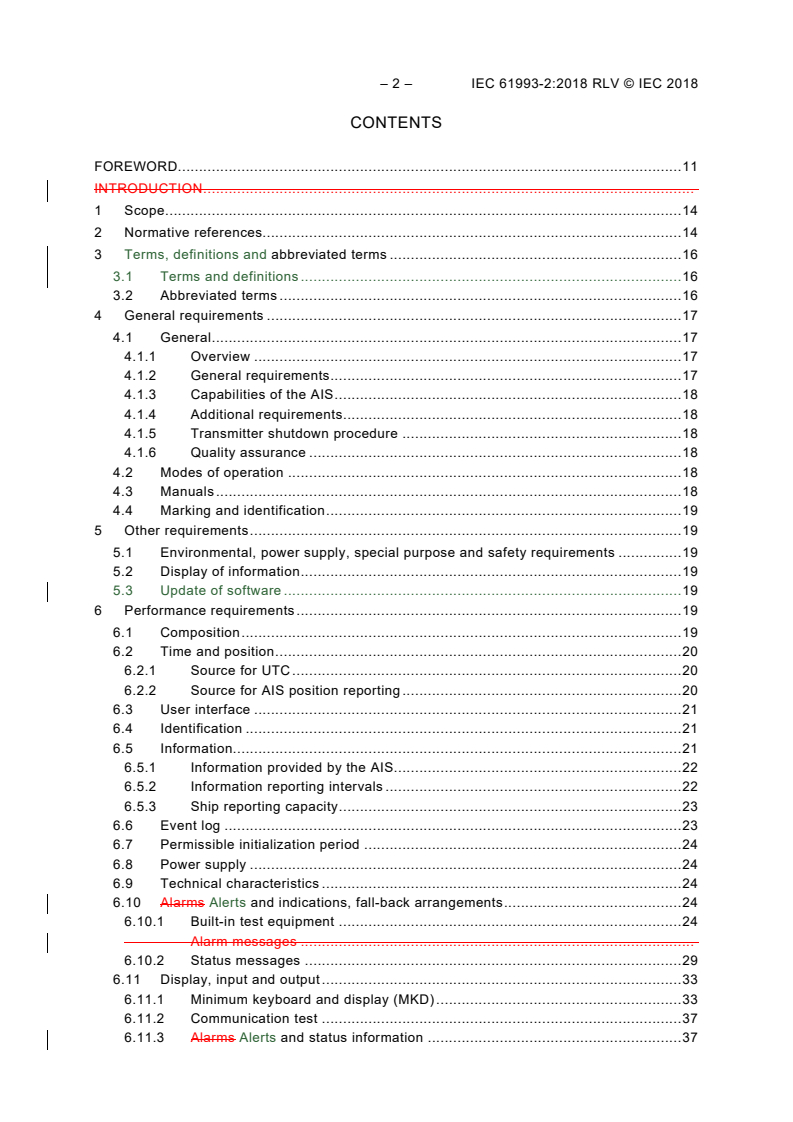
IEC 61993-2:2018 RLV - Maritime navigation and radiocommunication equipment and systems - Automatic identification systems (AIS) - Part 2: Class A shipborne equipment of the automatic identification system (AIS) - Operational and performance requirements, methods of test and required test results Released:7/19/2018 Isbn:9782832259030

IEC 61993-2:2018 - Maritime navigation and radiocommunication equipment and systems - Automatic identification systems (AIS) - Part 2: Class A shipborne equipment of the automatic identification system (AIS) - Operational and performance requirements, methods of test and required test results Released:7/19/2018 Isbn:9782832258651
Get Certified
Connect with accredited certification bodies for this standard

DNV
DNV is an independent assurance and risk management provider.

Lloyd's Register
Lloyd's Register is a global professional services organisation specialising in engineering and technology.

ABS Quality Evaluations Inc.
American Bureau of Shipping quality certification.
Sponsored listings
Frequently Asked Questions
IEC 61993-2:2018 is a standard published by the International Electrotechnical Commission (IEC). Its full title is "Maritime navigation and radiocommunication equipment and systems - Automatic identification systems (AIS) - Part 2: Class A shipborne equipment of the automatic identification system (AIS) - Operational and performance requirements, methods of test and required test results". This standard covers: IEC 61993-2:2018 specifies the minimum operational and performance requirements, methods of testing and required test results conforming to performance standards adopted by IMO in Resolution MSC.74(69):1998, Annex 3. This document incorporates the applicable technical characteristics of Class A shipborne equipment included in Recommendation ITU-R M.1371 and takes into account the ITU Radio Regulations, where applicable. In addition, it takes account of IMO Resolution A.694(17) to which IEC 60945 is associated. When a requirement in this document is different from IEC 60945, the requirement of this document takes precedence. This document also specifies the minimum requirements both for the means to input and display data and for the interfaces to other equipment suitable to be used as means of input and display data. This third edition cancels and replaces the second edition published in 2012. This edition constitutes a technical revision. This edition includes the following technical changes with respect to the previous edition: a) it incorporates the technical characteristics included in Recommendation ITU R M.1371-5:2014; b) it introduces the concept of locating device groups in order to include EPIRB AIS and MOB AIS in addition to AIS SART; c) it adds security features for configuration input by introducing a new sentence SSA; d) it adds optional implementation of IEC 61162-450/460 interfaces; e) it adds requirements for bridge alert management (BAM); f) it introduces extended dimension values used by towing vessels; g) it adds a software update requirement.
IEC 61993-2:2018 specifies the minimum operational and performance requirements, methods of testing and required test results conforming to performance standards adopted by IMO in Resolution MSC.74(69):1998, Annex 3. This document incorporates the applicable technical characteristics of Class A shipborne equipment included in Recommendation ITU-R M.1371 and takes into account the ITU Radio Regulations, where applicable. In addition, it takes account of IMO Resolution A.694(17) to which IEC 60945 is associated. When a requirement in this document is different from IEC 60945, the requirement of this document takes precedence. This document also specifies the minimum requirements both for the means to input and display data and for the interfaces to other equipment suitable to be used as means of input and display data. This third edition cancels and replaces the second edition published in 2012. This edition constitutes a technical revision. This edition includes the following technical changes with respect to the previous edition: a) it incorporates the technical characteristics included in Recommendation ITU R M.1371-5:2014; b) it introduces the concept of locating device groups in order to include EPIRB AIS and MOB AIS in addition to AIS SART; c) it adds security features for configuration input by introducing a new sentence SSA; d) it adds optional implementation of IEC 61162-450/460 interfaces; e) it adds requirements for bridge alert management (BAM); f) it introduces extended dimension values used by towing vessels; g) it adds a software update requirement.
IEC 61993-2:2018 is classified under the following ICS (International Classification for Standards) categories: 47.020.70 - Navigation and control equipment. The ICS classification helps identify the subject area and facilitates finding related standards.
IEC 61993-2:2018 has the following relationships with other standards: It is inter standard links to IEC 61993-2:2012. Understanding these relationships helps ensure you are using the most current and applicable version of the standard.
IEC 61993-2:2018 is available in PDF format for immediate download after purchase. The document can be added to your cart and obtained through the secure checkout process. Digital delivery ensures instant access to the complete standard document.
Standards Content (Sample)
IEC 61993-2 ®
Edition 3.0 2018-07
REDLINE VERSION
INTERNATIONAL
STANDARD
colour
inside
Maritime navigation and radiocommunication equipment and systems –
Automatic identification systems (AIS) –
Part 2: Class A shipborne equipment of the automatic identification
system (AIS) – Operational and performance requirements, methods of test
and required test results
All rights reserved. Unless otherwise specified, no part of this publication may be reproduced or utilized in any form
or by any means, electronic or mechanical, including photocopying and microfilm, without permission in writing from
either IEC or IEC's member National Committee in the country of the requester. If you have any questions about IEC
copyright or have an enquiry about obtaining additional rights to this publication, please contact the address below or
your local IEC member National Committee for further information.
IEC Central Office Tel.: +41 22 919 02 11
3, rue de Varembé info@iec.ch
CH-1211 Geneva 20 www.iec.ch
Switzerland
About the IEC
The International Electrotechnical Commission (IEC) is the leading global organization that prepares and publishes
International Standards for all electrical, electronic and related technologies.
About IEC publications
The technical content of IEC publications is kept under constant review by the IEC. Please make sure that you have the
latest edition, a corrigenda or an amendment might have been published.
IEC Catalogue - webstore.iec.ch/catalogue Electropedia - www.electropedia.org
The stand-alone application for consulting the entire The world's leading online dictionary of electronic and
bibliographical information on IEC International Standards, electrical terms containing 21 000 terms and definitions in
Technical Specifications, Technical Reports and other English and French, with equivalent terms in 16 additional
documents. Available for PC, Mac OS, Android Tablets and languages. Also known as the International Electrotechnical
iPad. Vocabulary (IEV) online.
IEC publications search - webstore.iec.ch/advsearchform IEC Glossary - std.iec.ch/glossary
The advanced search enables to find IEC publications by a 67 000 electrotechnical terminology entries in English and
variety of criteria (reference number, text, technical French extracted from the Terms and Definitions clause of
committee,…). It also gives information on projects, replaced IEC publications issued since 2002. Some entries have been
and withdrawn publications. collected from earlier publications of IEC TC 37, 77, 86 and
CISPR.
IEC Just Published - webstore.iec.ch/justpublished
Stay up to date on all new IEC publications. Just Published IEC Customer Service Centre - webstore.iec.ch/csc
details all new publications released. Available online and If you wish to give us your feedback on this publication or
also once a month by email. need further assistance, please contact the Customer Service
Centre: sales@iec.ch.
IEC 61993-2 ®
Edition 3.0 2018-07
REDLINE VERSION
INTERNATIONAL
STANDARD
colour
inside
Maritime navigation and radiocommunication equipment and systems –
Automatic identification systems (AIS) –
Part 2: Class A shipborne equipment of the automatic identification
system (AIS) – Operational and performance requirements, methods of test
and required test results
INTERNATIONAL
ELECTROTECHNICAL
COMMISSION
ICS 47.020.70 ISBN 978-2-8322-5903-0
– 2 – IEC 61993-2:2018 RLV © IEC 2018
CONTENTS
FOREWORD . 11
INTRODUCTION .
1 Scope . 14
2 Normative references. 14
3 Terms, definitions and abbreviated terms . 16
3.1 Terms and definitions . 16
3.2 Abbreviated terms . 16
4 General requirements . 17
4.1 General . 17
4.1.1 Overview . 17
4.1.2 General requirements . 17
4.1.3 Capabilities of the AIS . 18
4.1.4 Additional requirements . 18
4.1.5 Transmitter shutdown procedure . 18
4.1.6 Quality assurance . 18
4.2 Modes of operation . 18
4.3 Manuals . 18
4.4 Marking and identification . 19
5 Other requirements . 19
5.1 Environmental, power supply, special purpose and safety requirements . 19
5.2 Display of information . 19
5.3 Update of software . 19
6 Performance requirements . 19
6.1 Composition . 19
6.2 Time and position . 20
6.2.1 Source for UTC . 20
6.2.2 Source for AIS position reporting . 20
6.3 User interface . 21
6.4 Identification . 21
6.5 Information. 21
6.5.1 Information provided by the AIS . 22
6.5.2 Information reporting intervals . 22
6.5.3 Ship reporting capacity . 23
6.6 Event log . 23
6.7 Permissible initialization period . 24
6.8 Power supply . 24
6.9 Technical characteristics . 24
6.10 Alarms Alerts and indications, fall-back arrangements . 24
6.10.1 Built-in test equipment . 24
Alarm messages .
6.10.2 Status messages . 29
6.11 Display, input and output . 33
6.11.1 Minimum keyboard and display (MKD) . 33
6.11.2 Communication test . 37
6.11.3 Alarms Alerts and status information . 37
6.11.4 Data protection . 38
6.11.5 Distance calculation . 39
6.12 Protection from invalid controls . 39
7 Technical requirements . 39
7.1 General . 39
7.2 Physical layer . 40
7.2.1 General . 40
7.2.2 Transmitter parameters . 40
7.2.3 Receiver parameters . 42
7.3 Link layer . 42
7.3.1 General . 42
7.3.2 Link sublayer 1: Medium Access Control (MAC) . 43
7.3.3 Link sublayer 2: Data Link Service (DLS) . 43
7.3.4 Link sublayer 3 – Link Management Entity (LME) . 43
7.4 Network layer . 46
7.4.1 General . 46
7.4.2 Management of regional operating settings . 46
7.5 Transport layer . 47
7.6 Presentation interface . 47
7.6.1 General . 47
7.6.2 Automatic input of sensor data . 48
7.6.3 High-speed input/output ports . 49
7.6.4 Long-range communication ports . 55
7.6.5 Optional IEC 61162-450/-460 interface . 57
7.6.6 Test of the optional IEC 61162-450/-460 interface . 60
7.6.7 BIIT alarm alert output . 61
8 Long-range applications . 62
8.1 General . 62
8.2 Long-range application by two-way interface . 62
8.2.1 General . 62
8.2.2 Interrogations and responses . 62
8.2.3 Manual and automatic response . 62
8.2.4 Data formats and contents . 62
8.2.5 Addressing AIS-units . 63
8.3 Long-range application by broadcast . 63
9 Test conditions . 64
9.1 Normal and extreme test conditions . 64
9.1.1 Normal test conditions . 64
9.1.2 Extreme test conditions . 64
9.2 Standard test environment . 64
9.3 Additional test arrangements . 65
9.3.1 Arrangements for test signals applied to the receiver input . 65
9.3.2 Encoder for receiver measurements . 65
9.3.3 Waiver for receivers . 65
9.3.4 Impedance . 65
9.3.5 Artificial antenna (dummy load) . 65
9.3.6 Facilities for access . 65
9.3.7 Modes of operation of the transmitter . 65
– 4 – IEC 61993-2:2018 RLV © IEC 2018
9.4 Common test conditions for protection from invalid controls . 66
9.5 Measurement uncertainties . 66
10 Test signals . 66
10.1 Standard test signal number 1 (DSC) . 66
10.2 Standard test signal number 2 (TDMA) . 67
10.3 Standard test signal number 3 (TDMA) . 67
10.4 Standard test signal number 4 (PRBS) . 67
10.5 Standard test signal number 5 (PRBS) . 67
11 Power supply, special purpose and safety tests . 68
12 Environmental tests . 68
13 EMC tests . 68
14 Operational tests . 69
14.1 Identification and operating modes . 69
14.1.1 Autonomous mode . 69
14.1.2 Assigned mode . 69
14.1.3 Polled mode . 70
14.1.4 Addressed operation . 70
14.1.5 Broadcast operation . 71
14.1.6 Multiple slot messages . 72
14.2 Manuals, marking and identification . 73
14.2.1 Method of measurement . 73
14.2.2 Required results . 73
14.3 Information. 73
14.3.1 Information provided by the AIS . 73
14.3.2 Reporting intervals . 74
14.4 Event log . 75
14.4.1 Method of measurement . 76
14.4.2 Required results . 76
14.5 Software update . 76
14.5.1 Method of measurement . 76
14.5.2 Required results . 76
14.6 Initialization period . 76
14.6.1 Method of measurement . 76
14.6.2 Required results . 76
14.7 Technical characteristics . 76
14.7.1 Channel selection . 76
14.7.2 Transceiver protection . 77
14.7.3 Automatic power setting . 77
14.8 Alarms Alerts Alerts and indicators, fall-back arrangements . 77
14.8.1 Loss of power supply . 77
14.8.2 Monitoring of functions and integrity . 78
14.8.3 Monitoring of sensor data . 81
14.9 Display, input and output . 85
14.9.1 Data input/output facilities . 85
14.9.2 Initiate message transmission . 86
14.9.3 Communication test . 86
14.9.4 System control . 87
14.9.5 Display of received targets . 87
14.9.6 Display of position quality . 88
14.9.7 Display of targets if optional filter is implemented . 89
14.9.8 Display of received safety related messages . 89
14.9.9 Presentation of navigation information . 89
15 Physical tests . 90
15.1 TDMA transmitter . 90
15.1.1 Frequency error . 90
15.1.2 Carrier power . 91
15.1.3 Slotted transmission spectrum . 91
15.1.4 Modulation accuracy . 92
15.1.5 Transmitter output power characteristics . 93
15.2 TDMA receivers . 94
15.2.1 Sensitivity . 94
15.2.2 Error behaviour at high input levels . 95
15.2.3 Co-channel rejection . 95
15.2.4 Adjacent channel selectivity . 96
15.2.5 Spurious response rejection . 96
15.2.6 Intermodulation response rejection and blocking . 98
15.2.7 Transmit to receive switching time . 99
15.2.8 Immunity to out-of-band energy . 100
15.3 Conducted spurious emissions . 101
15.3.1 Spurious emissions from the transmitter . 101
15.3.2 Spurious emissions from the receiver . 101
16 Specific tests of link layer . 102
16.1 TDMA synchronisation . 102
16.1.1 Synchronisation test using UTC . 102
16.1.2 Synchronisation test using UTC with repeated messages . 103
16.1.3 Synchronisation test without UTC, semaphore . 103
16.1.4 Synchronisation test without UTC . 103
16.1.5 Reception of un-synchronised messages . 104
16.2 Time division (frame format) . 104
16.2.1 Method of measurement . 104
16.2.2 Required results . 104
16.3 Synchronisation and jitter accuracy . 104
16.3.1 Definition . 104
16.3.2 Method of measurement . 104
16.3.3 Required results . 104
16.4 Data encoding (bit stuffing). 105
16.4.1 Method of measurement . 105
16.4.2 Required results . 105
16.5 Frame check sequence . 105
16.5.1 Method of measurement . 105
16.5.2 Required results . 105
16.6 Slot allocation (channel access protocols) . 105
16.6.1 Network entry . 105
16.6.2 Autonomous scheduled transmissions (SOTDMA) . 105
16.6.3 Autonomous scheduled transmissions (ITDMA). 106
16.6.4 Safety related/binary message transmission . 106
16.6.5 Transmission of Message 5 (ITDMA) . 107
– 6 – IEC 61993-2:2018 RLV © IEC 2018
16.6.6 Assigned operation . 107
16.6.7 Group assignment . 108
16.6.8 Fixed allocated transmissions (FATDMA) . 111
16.6.9 Randomisation of message transmissions. 112
16.7 Message formats . 112
16.7.1 Received messages . 112
16.7.2 Transmitted messages . 112
17 Specific tests of network layer . 113
17.1 Dual channel operation – Alternate transmissions . 113
17.1.1 Method of measurement . 113
17.1.2 Required results . 113
17.2 Regional area designation by VDL message . 113
17.2.1 Method of measurement . 113
17.2.2 Required results . 114
17.3 Regional area designation by serial message . 115
17.4 Regional area designation with lost position . 115
17.4.1 Method of measurement . 115
17.4.2 Required results . 115
17.5 Power setting . 115
17.5.1 Method of measurement . 115
17.5.2 Required results . 115
17.6 Message priority handling . 115
17.6.1 Method of measurement . 115
17.6.2 Required results . 115
17.7 Slot reuse and FATDMA reservations . 115
17.7.1 Method of measurement . 115
17.7.2 Required results . 116
17.8 Management of received regional operating settings . 116
17.8.1 Test for replacement or erasure of dated or remote regional operating
settings . 116
17.8.2 Test of correct input via presentation interface or MKD . 117
17.8.3 Test of addressed telecommand . 118
17.8.4 Test for invalid regional operating areas . 118
17.9 Continuation of autonomous mode reporting interval . 119
17.9.1 Method of test . 119
17.9.2 Required results . 119
18 Specific tests of transport layer . 119
18.1 Addressed messages . 119
18.1.1 Transmission . 119
18.1.2 Acknowledgement . 119
18.1.3 Transmission retry . 120
18.1.4 Acknowledgement of addressed safety related messages . 120
18.1.5 Behaviour of NavStatus 14 reception . 120
18.2 Interrogation responses . 121
18.2.1 Method of measurement . 121
18.2.2 Required results . 121
19 Specific presentation interface tests . 121
19.1 General . 121
19.2 Checking manufacturer's documentation . 121
19.3 Electrical test . 122
19.3.1 Method of measurement . 122
19.3.2 Required results . 122
19.4 Test of input sensor interface performance . 122
19.4.1 Method of measurement . 122
19.4.2 Required results . 122
19.5 Test of sensor input . 122
19.5.1 Test of GNS input . 122
19.5.2 Test of RMC input . 123
19.5.3 Test of DTM input . 123
19.5.4 Test of GBS input . 124
19.5.5 Test of VBW input . 124
19.5.6 Test of VTG input . 125
19.5.7 Test of HDT/THS input . 125
19.5.8 Test of ROT input . 125
19.5.9 Test of different inputs . 126
19.5.10 Test of multiple inputs . 127
19.6 Test of high-speed output . 127
19.6.1 Method of measurement . 127
19.6.2 Required results . 127
19.7 High-speed output interface performance . 127
19.7.1 Method of measurement . 127
19.7.2 Required results . 127
19.8 Output of undefined VDL messages . 127
19.8.1 Method of measurement . 127
19.8.2 Required results . 128
19.9 Test of high-speed input . 128
19.9.1 General . 128
19.9.2 Test of VSD input sentence . 128
19.9.3 Test of SSD input sentence . 128
19.9.4 Test of EPV input sentence . 129
19.9.5 Test of the pilot port access level . 129
20 Long-range functionality tests . 130
20.1 Long-range application by two-way interface . 130
20.1.1 LR interrogation . 130
20.1.2 LR "all ships" interrogation . 130
20.1.3 Consecutive LR "all ships" interrogations . 131
20.2 Long-range application by broadcast . 131
20.2.1 Long-range broadcast . 131
20.2.2 Multiple assignment operation . 132
Annex A (informative) Block diagram of AIS . 134
Annex B (normative) AIS interface overview (see Table 13) . 135
Annex C (informative) Block diagram of standard test environment .
Annex C (normative) DSC functionality . 137
C.1 DSC compatibility . 137
C.2 DSC receiver tests . 137
C.2.1 Maximum sensitivity . 137
C.2.2 Error behaviour at high input levels . 137
– 8 – IEC 61993-2:2018 RLV © IEC 2018
C.2.3 Co-channel rejection . 138
C.2.4 Adjacent channel selectivity . 138
C.2.5 Spurious response rejection . 138
C.2.6 Intermodulation response rejection . 139
C.2.7 Blocking or desensitisation . 140
C.2.8 Conducted spurious emissions from the receiver . 141
C.3 DSC functionality tests . 141
C.3.1 Definition . 141
C.3.2 Method of measurement . 141
C.3.3 Required results . 142
Annex D (informative) Alarm Alert handling with ALR/ACK . 147
Annex E (informative) Optional PI port sentences .
Annex E (normative) Calculation of area size and distance . 150
E.1 Importance of a common method for area size and distance calculations . 150
E.2 Calculation of area sizes . 150
E.3 Calculation of general distances . 151
E.3.1 General . 151
E.3.2 Great-circle . 151
E.3.3 Rhumb-line distance . 151
Annex F (normative) New interface sentences – Sender signature authentication
(SSA) . 152
Annex G (normative) Updated interface sentences . 154
G.1 General . 154
G.2 VSD – AIS voyage static data . 154
Annex H (normative) Transmission of binary Messages 25 and 26 .
Annex H (informative) Conversion between IEC 61162-1 sentences and IEC 61162-3
parameter group numbers . 160
Annex I (normative) Extended tow dimension values . 162
I.1 Purpose and background . 162
I.2 Method . 162
Bibliography . 164
Figure 1 – OSI layer model . 40
Figure 2 – Power versus time characteristics . 41
Figure 3 – Format for repeating four-packet cluster . 67
Figure 4 – Measurement arrangement for frequency error . 90
Figure 5 – Measurement arrangement for carrier power . 91
Figure 6 – Emission mask for slotted transmission . 92
Figure 7 – Measurement arrangement for modulation accuracy . 93
Figure 8 – Measurement arrangement . 94
Figure 9 – Measurement arrangement with two generators . 95
Figure 10 – SINAD or PER/BER measuring equipment . 97
Figure 11 – Test set-up . 99
Figure 12 – Transmit to receive switching time measurement setup . 100
Figure 13 – Regional area scenario . 114
Figure C.1 – Measurement arrangement for inter-modulation . 140
Figure D.1 – State diagram of IEC 61993-2 Ed.2 Alert handling . 149
Figure I.1 – Input, extension and transmitted dimensional values . 163
Table – Integrity alarm conditions signalled using ALR sentence formatter .
Table – Property identifier .
Table 1 –Talker IDs for automatic detection of electronic position fixing system type . 21
Table 2 – Information reporting intervals for autonomous mode. 23
Table 3 – Required conditions for BIIT and reaction of the system to the condition
detected . 27
Table 4 – Classification of required alerts . 28
Table 5 – Mapping between BAM alert states and ALR alert states . 29
Table 6 – Sensor status indications signalled using TXT sentence formatter . 30
Table 7 – Position sensor fall-back conditions . 31
Table 8 – Use of accuracy (PA) flag . 32
Table 9 – ROT sensor fallback conditions . 33
Table 10 – Identification of locating devices when active . 34
Table 11 – Identification of locating devices when in test mode . 35
Ta
...
IEC 61993-2 ®
Edition 3.0 2018-07
INTERNATIONAL
STANDARD
NORME
INTERNATIONALE
Maritime navigation and radiocommunication equipment and systems –
Automatic identification systems (AIS) –
Part 2: Class A shipborne equipment of the automatic identification
system (AIS) – Operational and performance requirements, methods of test
and required test results
Matériels et systèmes de navigation et de radiocommunication maritimes –
Systèmes d'identification automatique (AIS)
Partie 2: Équipements AIS de type Classe A embarqués – Exigences
d'exploitation et de fonctionnement, méthodes d'essai et résultats
d'essai exigés
All rights reserved. Unless otherwise specified, no part of this publication may be reproduced or utilized in any form
or by any means, electronic or mechanical, including photocopying and microfilm, without permission in writing from
either IEC or IEC's member National Committee in the country of the requester. If you have any questions about IEC
copyright or have an enquiry about obtaining additional rights to this publication, please contact the address below or
your local IEC member National Committee for further information.
Droits de reproduction réservés. Sauf indication contraire, aucune partie de cette publication ne peut être reproduite
ni utilisée sous quelque forme que ce soit et par aucun procédé, électronique ou mécanique, y compris la photocopie
et les microfilms, sans l'accord écrit de l'IEC ou du Comité national de l'IEC du pays du demandeur. Si vous avez des
questions sur le copyright de l'IEC ou si vous désirez obtenir des droits supplémentaires sur cette publication, utilisez
les coordonnées ci-après ou contactez le Comité national de l'IEC de votre pays de résidence.
IEC Central Office Tel.: +41 22 919 02 11
3, rue de Varembé info@iec.ch
CH-1211 Geneva 20 www.iec.ch
Switzerland
About the IEC
The International Electrotechnical Commission (IEC) is the leading global organization that prepares and publishes
International Standards for all electrical, electronic and related technologies.
About IEC publications
The technical content of IEC publications is kept under constant review by the IEC. Please make sure that you have the
latest edition, a corrigenda or an amendment might have been published.
IEC Catalogue - webstore.iec.ch/catalogue Electropedia - www.electropedia.org
The stand-alone application for consulting the entire The world's leading online dictionary of electronic and
bibliographical information on IEC International Standards, electrical terms containing 21 000 terms and definitions in
Technical Specifications, Technical Reports and other English and French, with equivalent terms in 16 additional
documents. Available for PC, Mac OS, Android Tablets and languages. Also known as the International Electrotechnical
iPad. Vocabulary (IEV) online.
IEC publications search - webstore.iec.ch/advsearchform IEC Glossary - std.iec.ch/glossary
The advanced search enables to find IEC publications by a 67 000 electrotechnical terminology entries in English and
variety of criteria (reference number, text, technical French extracted from the Terms and Definitions clause of
committee,…). It also gives information on projects, replaced IEC publications issued since 2002. Some entries have been
and withdrawn publications. collected from earlier publications of IEC TC 37, 77, 86 and
CISPR.
IEC Just Published - webstore.iec.ch/justpublished
Stay up to date on all new IEC publications. Just Published IEC Customer Service Centre - webstore.iec.ch/csc
details all new publications released. Available online and If you wish to give us your feedback on this publication or
also once a month by email. need further assistance, please contact the Customer Service
Centre: sales@iec.ch.
A propos de l'IEC
La Commission Electrotechnique Internationale (IEC) est la première organisation mondiale qui élabore et publie des
Normes internationales pour tout ce qui a trait à l'électricité, à l'électronique et aux technologies apparentées.
A propos des publications IEC
Le contenu technique des publications IEC est constamment revu. Veuillez vous assurer que vous possédez l’édition la
plus récente, un corrigendum ou amendement peut avoir été publié.
Catalogue IEC - webstore.iec.ch/catalogue Electropedia - www.electropedia.org
Application autonome pour consulter tous les renseignements
Le premier dictionnaire en ligne de termes électroniques et
bibliographiques sur les Normes internationales,
électriques. Il contient 21 000 termes et définitions en anglais
Spécifications techniques, Rapports techniques et autres
et en français, ainsi que les termes équivalents dans 16
documents de l'IEC. Disponible pour PC, Mac OS, tablettes
langues additionnelles. Egalement appelé Vocabulaire
Android et iPad.
Electrotechnique International (IEV) en ligne.
Recherche de publications IEC -
Glossaire IEC - std.iec.ch/glossary
webstore.iec.ch/advsearchform
67 000 entrées terminologiques électrotechniques, en anglais
La recherche avancée permet de trouver des publications IEC et en français, extraites des articles Termes et Définitions des
en utilisant différents critères (numéro de référence, texte, publications IEC parues depuis 2002. Plus certaines entrées
comité d’études,…). Elle donne aussi des informations sur les antérieures extraites des publications des CE 37, 77, 86 et
projets et les publications remplacées ou retirées. CISPR de l'IEC.
IEC Just Published - webstore.iec.ch/justpublished Service Clients - webstore.iec.ch/csc
Restez informé sur les nouvelles publications IEC. Just Si vous désirez nous donner des commentaires sur cette
Published détaille les nouvelles publications parues. publication ou si vous avez des questions contactez-nous:
Disponible en ligne et aussi une fois par mois par email. sales@iec.ch.
IEC 61993-2 ®
Edition 3.0 2018-07
INTERNATIONAL
STANDARD
NORME
INTERNATIONALE
Maritime navigation and radiocommunication equipment and systems –
Automatic identification systems (AIS) –
Part 2: Class A shipborne equipment of the automatic identification
system (AIS) – Operational and performance requirements, methods of test
and required test results
Matériels et systèmes de navigation et de radiocommunication maritimes –
Systèmes d'identification automatique (AIS)
Partie 2: Équipements AIS de type Classe A embarqués – Exigences
d'exploitation et de fonctionnement, méthodes d'essai et résultats
d'essai exigés
INTERNATIONAL
ELECTROTECHNICAL
COMMISSION
COMMISSION
ELECTROTECHNIQUE
INTERNATIONALE
ICS 47.020.70 ISBN 978-2-8322-5865-1
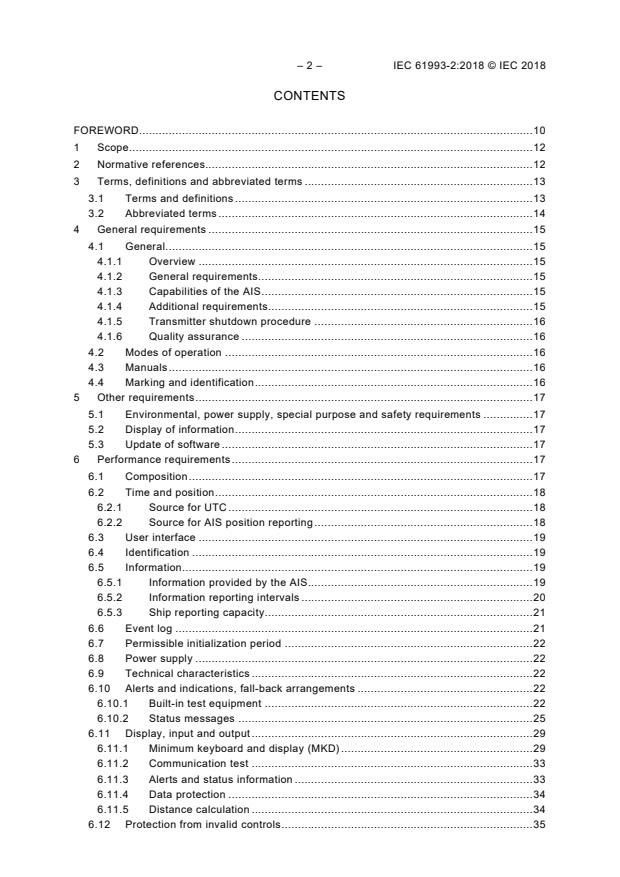
– 2 – IEC 61993-2:2018 © IEC 2018
CONTENTS
FOREWORD . 10
1 Scope . 12
2 Normative references. 12
3 Terms, definitions and abbreviated terms . 13
3.1 Terms and definitions . 13
3.2 Abbreviated terms . 14
4 General requirements . 15
4.1 General . 15
4.1.1 Overview . 15
4.1.2 General requirements . 15
4.1.3 Capabilities of the AIS . 15
4.1.4 Additional requirements . 15
4.1.5 Transmitter shutdown procedure . 16
4.1.6 Quality assurance . 16
4.2 Modes of operation . 16
4.3 Manuals . 16
4.4 Marking and identification . 16
5 Other requirements . 17
5.1 Environmental, power supply, special purpose and safety requirements . 17
5.2 Display of information . 17
5.3 Update of software . 17
6 Performance requirements . 17
6.1 Composition . 17
6.2 Time and position . 18
6.2.1 Source for UTC . 18
6.2.2 Source for AIS position reporting . 18
6.3 User interface . 19
6.4 Identification . 19
6.5 Information. 19
6.5.1 Information provided by the AIS . 19
6.5.2 Information reporting intervals . 20
6.5.3 Ship reporting capacity . 21
6.6 Event log . 21
6.7 Permissible initialization period . 22
6.8 Power supply . 22
6.9 Technical characteristics . 22
6.10 Alerts and indications, fall-back arrangements . 22
6.10.1 Built-in test equipment . 22
6.10.2 Status messages . 25
6.11 Display, input and output . 29
6.11.1 Minimum keyboard and display (MKD) . 29
6.11.2 Communication test . 33
6.11.3 Alerts and status information . 33
6.11.4 Data protection . 34
6.11.5 Distance calculation . 34
6.12 Protection from invalid controls . 35
7 Technical requirements . 35
7.1 General . 35
7.2 Physical layer . 35
7.2.1 General . 36
7.2.2 Transmitter parameters . 36
7.2.3 Receiver parameters . 37
7.3 Link layer . 37
7.3.1 General . 37
7.3.2 Link sublayer 1: Medium Access Control (MAC) . 38
7.3.3 Link sublayer 2: Data Link Service (DLS) . 38
7.3.4 Link sublayer 3 – Link Management Entity (LME) . 38
7.4 Network layer . 41
7.4.1 General . 41
7.4.2 Management of regional operating settings . 41
7.5 Transport layer . 42
7.6 Presentation interface . 42
7.6.1 General . 42
7.6.2 Automatic input of sensor data . 43
7.6.3 High speed input/output ports . 44
7.6.4 Long-range communication ports . 50
7.6.5 Optional IEC 61162-450/-460 interface . 52
7.6.6 Test of the optional IEC 61162-450/-460 interface . 55
7.6.7 BIIT alert output . 56
8 Long-range applications . 57
8.1 General . 57
8.2 Long-range application by two-way interface . 57
8.2.1 General . 57
8.2.2 Interrogations and responses . 57
8.2.3 Manual and automatic response . 57
8.2.4 Data formats and contents . 57
8.2.5 Addressing AIS-units . 58
8.3 Long-range application by broadcast . 58
9 Test conditions . 59
9.1 Normal and extreme test conditions . 59
9.1.1 Normal test conditions . 59
9.1.2 Extreme test conditions . 59
9.2 Standard test environment . 59
9.3 Additional test arrangements . 60
9.3.1 Arrangements for test signals applied to the receiver input . 60
9.3.2 Encoder for receiver measurements . 60
9.3.3 Waiver for receivers . 60
9.3.4 Impedance . 60
9.3.5 Artificial antenna (dummy load) . 60
9.3.6 Facilities for access . 60
9.3.7 Modes of operation of the transmitter . 60
9.4 Common test conditions for protection from invalid controls . 61
9.5 Measurement uncertainties . 61
10 Test signals . 61
– 4 – IEC 61993-2:2018 © IEC 2018
10.1 Standard test signal number 1 (DSC) . 61
10.2 Standard test signal number 2 (TDMA) . 61
10.3 Standard test signal number 3 (TDMA) . 61
10.4 Standard test signal number 4 (PRBS) . 62
10.5 Standard test signal number 5 (PRBS) . 62
11 Power supply, special purpose and safety tests . 63
12 Environmental tests . 63
13 EMC tests . 63
14 Operational tests . 63
14.1 Identification and operating modes . 63
14.1.1 Autonomous mode . 63
14.1.2 Assigned mode . 64
14.1.3 Polled mode . 64
14.1.4 Addressed operation . 65
14.1.5 Broadcast operation . 66
14.1.6 Multiple slot messages . 67
14.2 Manuals, marking and identification . 67
14.2.1 Method of measurement . 67
14.2.2 Required results . 68
14.3 Information. 68
14.3.1 Information provided by the AIS . 68
14.3.2 Reporting intervals . 68
14.4 Event log . 70
14.4.1 Method of measurement . 70
14.4.2 Required results . 70
14.5 Software update . 70
14.5.1 Method of measurement . 70
14.5.2 Required results . 71
14.6 Initialization period . 71
14.6.1 Method of measurement . 71
14.6.2 Required results . 71
14.7 Technical characteristics . 71
14.7.1 Channel selection . 71
14.7.2 Transceiver protection . 71
14.7.3 Automatic power setting . 72
14.8 Alerts and indicators, fall-back arrangements . 72
14.8.1 Loss of power supply . 72
14.8.2 Monitoring of functions and integrity . 72
14.8.3 Monitoring of sensor data . 75
14.9 Display, input and output . 78
14.9.1 Data input/output facilities . 79
14.9.2 Initiate message transmission . 79
14.9.3 Communication test . 80
14.9.4 System control . 80
14.9.5 Display of received targets . 81
14.9.6 Display of position quality . 82
14.9.7 Display of targets if optional filter is implemented . 82
14.9.8 Display of received safety related messages . 83
14.9.9 Presentation of navigation information . 83
15 Physical tests . 83
15.1 TDMA transmitter . 84
15.1.1 Frequency error . 84
15.1.2 Carrier power . 84
15.1.3 Slotted transmission spectrum . 85
15.1.4 Modulation accuracy . 86
15.1.5 Transmitter output power characteristics . 86
15.2 TDMA receivers . 87
15.2.1 Sensitivity . 87
15.2.2 Error behaviour at high input levels . 88
15.2.3 Co-channel rejection . 88
15.2.4 Adjacent channel selectivity . 89
15.2.5 Spurious response rejection . 89
15.2.6 Intermodulation response rejection and blocking . 92
15.2.7 Transmit to receive switching time . 93
15.2.8 Immunity to out-of-band energy . 93
15.3 Conducted spurious emissions . 94
15.3.1 Spurious emissions from the transmitter . 94
15.3.2 Spurious emissions from the receiver . 95
16 Specific tests of link layer . 95
16.1 TDMA synchronisation . 95
16.1.1 Synchronisation test using UTC . 95
16.1.2 Synchronisation test using UTC with repeated messages . 96
16.1.3 Synchronisation test without UTC, semaphore . 96
16.1.4 Synchronisation test without UTC . 97
16.1.5 Reception of un-synchronised messages . 97
16.2 Time division (frame format) . 97
16.2.1 Method of measurement . 97
16.2.2 Required results . 97
16.3 Synchronisation and jitter accuracy . 97
16.3.1 Definition . 97
16.3.2 Method of measurement . 97
16.3.3 Required results . 98
16.4 Data encoding (bit stuffing). 98
16.4.1 Method of measurement . 98
16.4.2 Required results . 98
16.5 Frame check sequence . 98
16.5.1 Method of measurement . 98
16.5.2 Required results . 98
16.6 Slot allocation (channel access protocols) . 98
16.6.1 Network entry . 98
16.6.2 Autonomous scheduled transmissions (SOTDMA) . 99
16.6.3 Autonomous scheduled transmissions (ITDMA). 99
16.6.4 Safety related/binary message transmission . 99
16.6.5 Transmission of Message 5 (ITDMA) . 100
16.6.6 Assigned operation . 100
16.6.7 Group assignment . 101
16.6.8 Fixed allocated transmissions (FATDMA) . 104
– 6 – IEC 61993-2:2018 © IEC 2018
16.6.9 Randomisation of message transmissions. 105
16.7 Message formats . 105
16.7.1 Received messages . 105
16.7.2 Transmitted messages . 105
17 Specific tests of network layer . 106
17.1 Dual channel operation – Alternate transmissions . 106
17.1.1 Method of measurement . 106
17.1.2 Required results . 106
17.2 Regional area designation by VDL message . 106
17.2.1 Method of measurement . 106
17.2.2 Required results . 107
17.3 Regional area designation by serial message . 107
17.4 Regional area designation with lost position . 107
17.4.1 Method of measurement . 107
17.4.2 Required results . 107
17.5 Power setting . 107
17.5.1 Method of measurement . 107
17.5.2 Required results . 108
17.6 Message priority handling . 108
17.6.1 Method of measurement . 108
17.6.2 Required results . 108
17.7 Slot reuse and FATDMA reservations . 108
17.7.1 Method of measurement . 108
17.7.2 Required results . 108
17.8 Management of received regional operating settings . 109
17.8.1 Test for replacement or erasure of dated or remote regional operating
settings . 109
17.8.2 Test of correct input via presentation interface or MKD . 110
17.8.3 Test of addressed telecommand . 110
17.8.4 Test for invalid regional operating areas . 111
17.9 Continuation of autonomous mode reporting interval . 111
17.9.1 Method of test . 111
17.9.2 Required results . 111
18 Specific tests of transport layer . 111
18.1 Addressed messages . 112
18.1.1 Transmission . 112
18.1.2 Acknowledgement . 112
18.1.3 Transmission retry . 112
18.1.4 Acknowledgement of addressed safety related messages . 112
18.1.5 Behaviour of NavStatus 14 reception . 112
18.2 Interrogation responses . 113
18.2.1 Method of measurement . 113
18.2.2 Required results . 113
19 Specific presentation interface tests . 113
19.1 General . 113
19.2 Checking manufacturer's documentation . 113
19.3 Electrical test . 114
19.3.1 Method of measurement . 114
19.3.2 Required results . 114
19.4 Test of input sensor interface performance . 114
19.4.1 Method of measurement . 114
19.4.2 Required results . 114
19.5 Test of sensor input . 114
19.5.1 Test of GNS input . 114
19.5.2 Test of RMC input . 115
19.5.3 Test of DTM input . 115
19.5.4 Test of GBS input . 116
19.5.5 Test of VBW input . 117
19.5.6 Test of VTG input . 117
19.5.7 Test of HDT/THS input . 117
19.5.8 Test of ROT input . 118
19.5.9 Test of different inputs . 118
19.5.10 Test of multiple inputs . 119
19.6 Test of high speed output . 119
19.6.1 Method of measurement . 119
19.6.2 Required results . 119
19.7 High speed output interface performance . 119
19.7.1 Method of measurement . 119
19.7.2 Required results . 120
19.8 Output of undefined VDL messages . 120
19.8.1 Method of measurement . 120
19.8.2 Required results . 120
19.9 Test of high speed input . 120
19.9.1 General . 120
19.9.2 Test of VSD input sentence . 120
19.9.3 Test of SSD input sentence . 120
19.9.4 Test of EPV input sentence . 121
19.9.5 Test of the Pilot Port access level . 122
20 Long-range functionality tests . 122
20.1 Long-range application by two-way interface . 122
20.1.1 LR interrogation . 122
20.1.2 LR "all ships" interrogation . 122
20.1.3 Consecutive LR "all ships" interrogations . 123
20.2 Long-range application by broadcast . 123
20.2.1 Long-range broadcast . 123
20.2.2 Multiple assignment operation . 124
Annex A (informative) Block diagram of AIS . 126
Annex B (normative) AIS interface overview . 127
Annex C (normative) DSC functionality . 128
C.1 DSC compatibility . 128
C.2 DSC receiver tests . 128
C.2.1 Maximum sensitivity . 128
C.2.2 Error behaviour at high input levels . 128
C.2.3 Co-channel rejection . 129
C.2.4 Adjacent channel selectivity . 129
C.2.5 Spurious response rejection . 129
C.2.6 Intermodulation response rejection . 130
– 8 – IEC 61993-2:2018 © IEC 2018
C.2.7 Blocking or desensitisation . 131
C.2.8 Conducted spurious emissions from the receiver . 132
C.3 DSC functionality tests . 132
C.3.1 Definition . 132
C.3.2 Method of measurement . 132
C.3.3 Required results . 133
Annex D (informative) Alert handling with ALR/ACK . 134
Annex E (normative) Calculation of area size and distance . 136
E.1 Importance of a common method for area size and distance calculations . 136
E.2 Calculation of area sizes . 136
E.3 Calculation of general distances . 137
E.3.1 General . 137
E.3.2 Great-circle . 137
E.3.3 Rhumb-line distance . 137
Annex F (normative) New interface sentences – Sender signature authentication
(SSA) . 138
Annex G (normative) Updated interface sentences . 140
G.1 General . 140
G.2 VSD – AIS voyage static data . 140
Annex H (informative) Conversion between IEC 61162-1 sentences and IEC 61162-3
parameter group numbers . 142
Annex I (normative) Extended tow dimension values . 144
I.1 Purpose and background . 144
I.2 Method . 144
Bibliography . 146
Figure 1 – OSI layer model . 35
Figure 2 – Power versus time characteristics . 36
Figure 3 – Format for repeating four-packet cluster . 62
Figure 4 – Measurement arrangement for frequency error . 84
Figure 5 – Measurement arrangement for carrier power . 84
Figure 6 – Emission mask for slotted transmission . 85
Figure 7 – Measure
...
Questions, Comments and Discussion
Ask us and Technical Secretary will try to provide an answer. You can facilitate discussion about the standard in here.
Loading comments...