

IEC 62108:2016
(Main)Concentrator photovoltaic (CPV) modules and assemblies - Design qualification and type approval
General Information
- Abstract
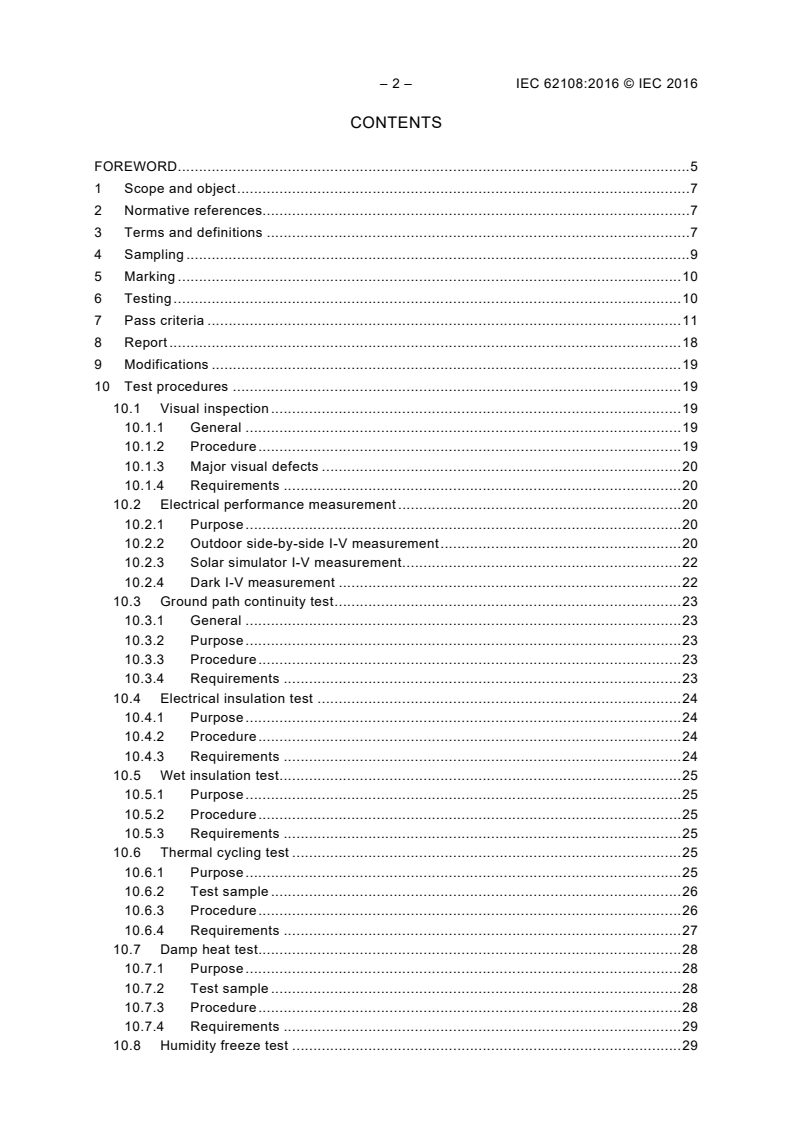
IEC 62108:2016 specifies the minimum requirements for the design qualification and type approval of concentrator photovoltaic (CPV) modules and assemblies suitable for long-term operation in general open-air climates as defined in IEC 60721-2-1. The test sequence is partially based on that specified in IEC 61215-1. The object of this test standard is to determine the electrical, mechanical, and thermal characteristics of the CPV modules and assemblies and to show that the CPV modules and assemblies are capable of withstanding prolonged exposure in climates described in the scope. This new edition includes the following main technical changes with regard to the previous one:
a) changes in outdoor exposure from 1000 h to 500 h;
b) changes in current cycling during thermal cycling test;
c) added dust ingress test;
d) eliminated thermal cycling associated with damp heat test;
e) eliminated UV exposure test.
- Status
- Published
- Publication Date
- 25-Sep-2016
- Technical Committee
- TC 82 - Solar photovoltaic energy systems
- Drafting Committee
- WG 7 - TC 82/WG 7
- Current Stage
- DELPUB - Deleted Publication
- Start Date
- 02-Jun-2022
- Completion Date
- 22-Nov-2018
Buy Documents
IEC 62108:2016 RLV - Concentrator photovoltaic (CPV) modules and assemblies - Design qualification and type approval Released:9/26/2016
IEC 62108:2016 - Concentrator photovoltaic (CPV) modules and assemblies - Design qualification and type approval Released:9/26/2016
Overview
IEC 62108:2016 - "Concentrator photovoltaic (CPV) modules and assemblies - Design qualification and type approval" - specifies minimum requirements and test sequences for the design qualification and type approval of CPV modules and assemblies intended for long‑term operation in general open‑air climates (as defined in IEC 60721‑2‑1). The standard’s objective is to determine electrical, mechanical and thermal characteristics and to verify that CPV products can withstand prolonged environmental exposure. The 2016 edition updates key test requirements compared with the prior edition (see Key changes).
Key topics and requirements
The standard defines a structured qualification program covering visual, electrical, mechanical and environmental tests. Major technical topics include:
- Test sequence and sampling for type approval and design qualification
- Electrical performance measurements (I‑V curves, dark I‑V, solar simulator and outdoor side‑by‑side)
- Mechanical tests (mechanical load, hail impact, robustness of terminations)
- Environmental and durability tests:
- Thermal cycling and thermal management checks
- Damp heat and humidity‑freeze tests
- Water spray and wet insulation tests
- Dust ingress protection test (new in 2016)
- Hot‑spot endurance, off‑axis beam damage and bypass diode thermal tests
- Safety and installation checks: ground path continuity, electrical insulation
- Pass criteria, reporting and retesting guidance (annexes detail retesting after modifications)
Key changes in Edition 2 (2016):
- Outdoor exposure reduced from 1000 h to 500 h
- Changes to current cycling during thermal cycling tests
- Added dust ingress test
- Eliminated thermal cycling associated with damp heat test
- Removed UV exposure test
Practical applications
IEC 62108:2016 is used to:
- Qualify and type‑approve CPV modules and assemblies for commercial deployment
- Provide objective test evidence for product reliability, warranty and procurement specifications
- Guide R&D and design validation for CPV manufacturers to improve thermal, optical and mechanical robustness
- Inform test laboratories and certification bodies when performing CPV qualification testing
Typical users include CPV module and system manufacturers, independent test labs, certification bodies, project developers, system integrators and procurement engineers.
Related standards
- IEC 61215‑1 (test sequence reference basis for PV design qualification)
- IEC 60721‑2‑1 (classification of environmental conditions - open‑air climates)
- Other PV and safety standards referenced for complementary electrical and mechanical requirements
Keywords: IEC 62108:2016, concentrator photovoltaic, CPV modules, design qualification, type approval, environmental testing, dust ingress, thermal cycling, damp heat, CPV assemblies.
Relations
- Effective Date
- 05-Sep-2023
- Effective Date
- 05-Sep-2023
Buy Documents
IEC 62108:2016 RLV - Concentrator photovoltaic (CPV) modules and assemblies - Design qualification and type approval Released:9/26/2016
IEC 62108:2016 - Concentrator photovoltaic (CPV) modules and assemblies - Design qualification and type approval Released:9/26/2016
Get Certified
Connect with accredited certification bodies for this standard

DNV
DNV is an independent assurance and risk management provider.

Lloyd's Register
Lloyd's Register is a global professional services organisation specialising in engineering and technology.
DNV Energy Systems
Energy and renewable energy certification.
Sponsored listings
Frequently Asked Questions
IEC 62108:2016 is a standard published by the International Electrotechnical Commission (IEC). Its full title is "Concentrator photovoltaic (CPV) modules and assemblies - Design qualification and type approval". This standard covers: IEC 62108:2016 specifies the minimum requirements for the design qualification and type approval of concentrator photovoltaic (CPV) modules and assemblies suitable for long-term operation in general open-air climates as defined in IEC 60721-2-1. The test sequence is partially based on that specified in IEC 61215-1. The object of this test standard is to determine the electrical, mechanical, and thermal characteristics of the CPV modules and assemblies and to show that the CPV modules and assemblies are capable of withstanding prolonged exposure in climates described in the scope. This new edition includes the following main technical changes with regard to the previous one: a) changes in outdoor exposure from 1000 h to 500 h; b) changes in current cycling during thermal cycling test; c) added dust ingress test; d) eliminated thermal cycling associated with damp heat test; e) eliminated UV exposure test.
IEC 62108:2016 specifies the minimum requirements for the design qualification and type approval of concentrator photovoltaic (CPV) modules and assemblies suitable for long-term operation in general open-air climates as defined in IEC 60721-2-1. The test sequence is partially based on that specified in IEC 61215-1. The object of this test standard is to determine the electrical, mechanical, and thermal characteristics of the CPV modules and assemblies and to show that the CPV modules and assemblies are capable of withstanding prolonged exposure in climates described in the scope. This new edition includes the following main technical changes with regard to the previous one: a) changes in outdoor exposure from 1000 h to 500 h; b) changes in current cycling during thermal cycling test; c) added dust ingress test; d) eliminated thermal cycling associated with damp heat test; e) eliminated UV exposure test.
IEC 62108:2016 is classified under the following ICS (International Classification for Standards) categories: 27.160 - Solar energy engineering. The ICS classification helps identify the subject area and facilitates finding related standards.
IEC 62108:2016 has the following relationships with other standards: It is inter standard links to IEC 62108:2007, IEC 62108:2022. Understanding these relationships helps ensure you are using the most current and applicable version of the standard.
IEC 62108:2016 is available in PDF format for immediate download after purchase. The document can be added to your cart and obtained through the secure checkout process. Digital delivery ensures instant access to the complete standard document.
Standards Content (Sample)
IEC 62108 ®
Edition 2.0 2016-09
REDLINE VERSION
INTERNATIONAL
STANDARD
colour
inside
Concentrator photovoltaic (CPV) modules and assemblies – Design qualification
and type approval
All rights reserved. Unless otherwise specified, no part of this publication may be reproduced or utilized in any form
or by any means, electronic or mechanical, including photocopying and microfilm, without permission in writing from
either IEC or IEC's member National Committee in the country of the requester. If you have any questions about IEC
copyright or have an enquiry about obtaining additional rights to this publication, please contact the address below or
your local IEC member National Committee for further information.
IEC Central Office Tel.: +41 22 919 02 11
3, rue de Varembé Fax: +41 22 919 03 00
CH-1211 Geneva 20 info@iec.ch
Switzerland www.iec.ch
About the IEC
The International Electrotechnical Commission (IEC) is the leading global organization that prepares and publishes
International Standards for all electrical, electronic and related technologies.
About IEC publications
The technical content of IEC publications is kept under constant review by the IEC. Please make sure that you have the
latest edition, a corrigenda or an amendment might have been published.
IEC Catalogue - webstore.iec.ch/catalogue Electropedia - www.electropedia.org
The stand-alone application for consulting the entire The world's leading online dictionary of electronic and
bibliographical information on IEC International Standards, electrical terms containing 20 000 terms and definitions in
Technical Specifications, Technical Reports and other English and French, with equivalent terms in 15 additional
documents. Available for PC, Mac OS, Android Tablets and languages. Also known as the International Electrotechnical
iPad. Vocabulary (IEV) online.
IEC publications search - www.iec.ch/searchpub IEC Glossary - std.iec.ch/glossary
The advanced search enables to find IEC publications by a 65 000 electrotechnical terminology entries in English and
variety of criteria (reference number, text, technical French extracted from the Terms and Definitions clause of
committee,…). It also gives information on projects, replaced IEC publications issued since 2002. Some entries have been
and withdrawn publications. collected from earlier publications of IEC TC 37, 77, 86 and
CISPR.
IEC Just Published - webstore.iec.ch/justpublished
Stay up to date on all new IEC publications. Just Published IEC Customer Service Centre - webstore.iec.ch/csc
details all new publications released. Available online and If you wish to give us your feedback on this publication or
also once a month by email. need further assistance, please contact the Customer Service
Centre: csc@iec.ch.
IEC 62108 ®
Edition 2.0 2016-09
REDLINE VERSION
INTERNATIONAL
STANDARD
colour
inside
Concentrator photovoltaic (CPV) modules and assemblies – Design qualification
and type approval
INTERNATIONAL
ELECTROTECHNICAL
COMMISSION
ICS 27.160 ISBN 978-2-8322-3668-0
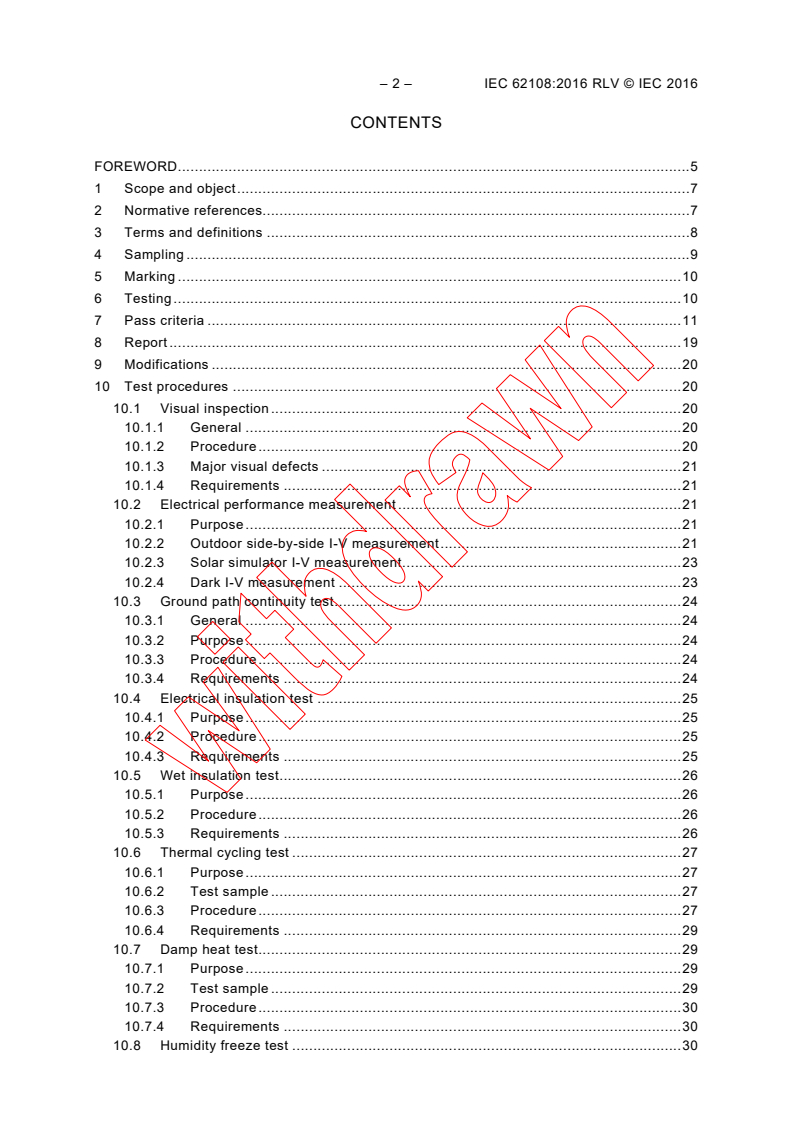
– 2 – IEC 62108:2016 RLV © IEC 2016
CONTENTS
FOREWORD . 5
1 Scope and object . 7
2 Normative references. 7
3 Terms and definitions . 8
4 Sampling . 9
5 Marking . 10
6 Testing . 10
7 Pass criteria . 11
8 Report . 19
9 Modifications . 20
10 Test procedures . 20
10.1 Visual inspection . 20
10.1.1 General . 20
10.1.2 Procedure . 20
10.1.3 Major visual defects . 21
10.1.4 Requirements . 21
10.2 Electrical performance measurement . 21
10.2.1 Purpose . 21
10.2.2 Outdoor side-by-side I-V measurement . 21
10.2.3 Solar simulator I-V measurement . 23
10.2.4 Dark I-V measurement . 23
10.3 Ground path continuity test . 24
10.3.1 General . 24
10.3.2 Purpose . 24
10.3.3 Procedure . 24
10.3.4 Requirements . 24
10.4 Electrical insulation test . 25
10.4.1 Purpose . 25
10.4.2 Procedure . 25
10.4.3 Requirements . 25
10.5 Wet insulation test . 26
10.5.1 Purpose . 26
10.5.2 Procedure . 26
10.5.3 Requirements . 26
10.6 Thermal cycling test . 27
10.6.1 Purpose . 27
10.6.2 Test sample . 27
10.6.3 Procedure . 27
10.6.4 Requirements . 29
10.7 Damp heat test . 29
10.7.1 Purpose . 29
10.7.2 Test sample . 29
10.7.3 Procedure . 30
10.7.4 Requirements . 30
10.8 Humidity freeze test . 30
10.8.1 Purpose . 30
10.8.2 Test sample . 30
10.8.3 Procedure . 31
10.8.4 Requirements . 31
10.9 Hail impact test . 32
10.9.1 Purpose . 32
10.9.2 Apparatus . 32
10.9.3 Procedure . 33
10.9.4 Requirements . 33
10.10 Water spray test . 33
10.10.1 General . 33
10.10.2 Purpose . 33
10.10.3 Procedure . 34
10.10.4 Requirements . 34
10.11 Bypass/blocking diode thermal test . 34
10.11.1 Purpose . 34
10.11.2 Test sample . 35
10.11.3 Apparatus . 35
10.11.4 Procedure . 35
10.11.5 Requirements . 36
10.11.6 Procedure 2 – Alternate method . 36
10.12 Robustness of terminations test . 37
10.12.1 Purpose . 37
10.12.2 Types of terminations . 37
10.12.3 Procedure . 38
10.12.4 Requirements . 38
10.13 Mechanical load test . 39
10.13.1 Purpose . 39
10.13.2 Procedure . 40
10.13.3 Requirements . 40
10.14 Off-axis beam damage test . 40
10.14.1 General . 40
10.14.2 Purpose . 40
10.14.3 Special case . 40
10.14.4 Procedure . 40
10.14.5 Requirements . 41
10.15 Ultraviolet conditioning test .
10.15.1 Purpose .
10.15.2 Procedure .
10.15 Outdoor exposure test . 41
10.15.1 Purpose . 41
10.15.2 Procedure . 42
10.15.3 Requirements . 42
10.16 Hot-spot endurance test . 42
10.17 Dust ingress protection test . 42
10.17.1 Purpose . 42
10.17.2 Procedure . 43
10.17.3 Requirements . 43
Annex A (informative) Summary of test conditions and requirements . 44
– 4 – IEC 62108:2016 RLV © IEC 2016
Annex B (normative) Retesting guideline . 47
B.1 Product or process modifications requiring limited retesting to maintain
certification . 47
B.2 Modifications of CPV cell technology . 47
B.3 Modifications in optical encapsulation on the cell (Includes optical coupling
between the cell and a glass secondary optical element bonded to the cell) . 48
B.4 Modification in cell encapsulation outside of intended light path . 48
B.5 Modification of cell package substrate used for heat transfer . 48
B.6 Accessible optics (primary or secondary) . 49
B.7 Inaccessible optics (secondary) . 49
B.8 Frame and/or mounting structure . 49
B.9 Enclosure. 50
B.10 Wiring compartment/junction box . 50
B.11 Interconnection terminals . 50
B.12 Interconnection materials or technique (to cells and between receivers) . 51
B.13 Change in electrical circuit design in an identical package . 51
B.14 Output power . 51
B.15 Thermal energy transfer means . 52
B.16 Adhesives . 52
Bibliography .
Figure 1 – Schematic of point-focus dish PV concentrator . 13
Figure 2 – Schematic of linear-focus trough PV concentrator . 14
Figure 3 – Schematic of point-focus fresnel lens PV concentrator . 15
Figure 4 – Schematic of linear-focus fresnel lens PV concentrator . 16
Figure 5 – Schematic of a heliostat CPV . 17
Figure 6 – Qualification test sequence for CPV modules . 18
Figure 7 – Qualification test sequence for CPV assemblies . 19
Figure 8 – Temperature and current profile of thermal cycle test (not to scale) . 29
Figure 9 – Profile of humidity-freeze test conditions . 32
Figure 10 – Bypass diode thermal test . 37
Table 1 – Terms used for CPVs . 9
Table 2 – Allocation of test samples to typical test sequences . 11
Table 3 – Thermal cycle test options for sequence A . 29
Table 4 – Pre-thermal cycle test options for sequence B .
Table 4 – Humidity freeze test options for sequence B . 31
Table 5 – Minimum wind loads . 39
Table A.1 – Summary of test conditions and requirements . 44
INTERNATIONAL ELECTROTECHNICAL COMMISSION
____________
CONCENTRATOR PHOTOVOLTAIC (CPV) MODULES AND ASSEMBLIES –
DESIGN QUALIFICATION AND TYPE APPROVAL
FOREWORD
1) The International Electrotechnical Commission (IEC) is a worldwide organization for standardization comprising
all national electrotechnical committees (IEC National Committees). The object of IEC is to promote
international co-operation on all questions concerning standardization in the electrical and electronic fields. To
this end and in addition to other activities, IEC publishes International Standards, Technical Specifications,
Technical Reports, Publicly Available Specifications (PAS) and Guides (hereafter referred to as “IEC
Publication(s)”). Their preparation is entrusted to technical committees; any IEC National Committee interested
in the subject dealt with may participate in this preparatory work. International, governmental and non-
governmental organizations liaising with the IEC also participate in this preparation. IEC collaborates closely
with the International Organization for Standardization (ISO) in accordance with conditions determined by
agreement between the two organizations.
2) The formal decisions or agreements of IEC on technical matters express, as nearly as possible, an international
consensus of opinion on the relevant subjects since each technical committee has representation from all
interested IEC National Committees.
3) IEC Publications have the form of recommendations for international use and are accepted by IEC National
Committees in that sense. While all reasonable efforts are made to ensure that the technical content of IEC
Publications is accurate, IEC cannot be held responsible for the way in which they are used or for any
misinterpretation by any end user.
4) In order to promote international uniformity, IEC National Committees undertake to apply IEC Publications
transparently to the maximum extent possible in their national and regional publications. Any divergence
between any IEC Publication and the corresponding national or regional publication shall be clearly indicated in
the latter.
5) IEC itself does not provide any attestation of conformity. Independent certification bodies provide conformity
assessment services and, in some areas, access to IEC marks of conformity. IEC is not responsible for any
services carried out by independent certification bodies.
6) All users should ensure that they have the latest edition of this publication.
7) No liability shall attach to IEC or its directors, employees, servants or agents including individual experts and
members of its technical committees and IEC National Committees for any personal injury, property damage or
other damage of any nature whatsoever, whether direct or indirect, or for costs (including legal fees) and
expenses arising out of the publication, use of, or reliance upon, this IEC Publication or any other IEC
Publications.
8) Attention is drawn to the Normative references cited in this publication. Use of the referenced publications is
indispensable for the correct application of this publication.
9) Attention is drawn to the possibility that some of the elements of this IEC Publication may be the subject of
patent rights. IEC shall not be held responsible for identifying any or all such patent rights.
This redline version of the official IEC Standard allows the user to identify the changes
made to the previous edition. A vertical bar appears in the margin wherever a change
has been made. Additions are in green text, deletions are in strikethrough red text.
– 6 – IEC 62108:2016 RLV © IEC 2016
International Standard IEC 62108 has been prepared by IEC technical committee 82: Solar
photovoltaic energy systems.
This second edition cancels and replaces the first edition, issued in 2007. It constitutes a
technical revision.
The main technical changes with regard to the previous edition are as follows:
a) Changes in outdoor exposure from 1000 h to 500 h.
b) Changes in current cycling during thermal cycling test.
c) Added dust ingress test.
d) Eliminated thermal cycling associated with damp heat test.
e) Eliminated UV exposure test.
The text of this standard is based on the following documents:
FDIS Report on voting
82/1142/FDIS 82/1161/RVD
Full information on the voting for the approval of this standard can be found in the report on
voting indicated in the above table.
This publication has been drafted in accordance with the ISO/IEC Directives, Part 2.
The committee has decided that the contents of this publication will remain unchanged until
the stability date indicated on the IEC website under "http://webstore.iec.ch" in the data
related to the specific publication. At this date, the publication will be
• reconfirmed,
• withdrawn,
• replaced by a revised edition, or
• amended.
IMPORTANT – The “colour inside” logo on the cover page of this publication indicates
that it contains colours which are considered to be useful for the correct understanding
of its contents. Users should therefore print this publication using a colour printer.
CONCENTRATOR PHOTOVOLTAIC (CPV) MODULES AND ASSEMBLIES –
DESIGN QUALIFICATION AND TYPE APPROVAL
1 Scope and object
This International Standard specifies the minimum requirements for the design qualification
and type approval of concentrator photovoltaic (CPV) modules and assemblies suitable for
long-term operation in general open-air climates as defined in IEC 60721-2-1. The test
sequence is partially based on that specified in IEC 61215-1 for the design qualification and
type approval of flat-plate terrestrial crystalline silicon PV modules. However, some changes
have been made to account for the special features of CPV receivers and modules,
particularly with regard to the separation of on-site and in-lab tests, effects of tracking
alignment, high current density, and rapid temperature changes, which have resulted in the
formulation of some new test procedures or new requirements.
The object of this test standard is to determine the electrical, mechanical, and thermal
characteristics of the CPV modules and assemblies and to show, as far as possible within
reasonable constraints of cost and time, that the CPV modules and assemblies are capable of
withstanding prolonged exposure in climates described in the scope. The actual life of CPV
modules and assemblies so qualified will depend on their design, production, environment,
and the conditions under which they are operated.
This standard shall be used in conjunction with the retest guidelines described in Annex B.
2 Normative references
The following documents, in whole or in part, are normatively referenced in this document and
are indispensable for its application. For dated references, only the edition cited applies. For
undated references, the latest edition of the referenced document (including any
amendments) applies.
IEC 60068-2-21:2006, Environmental testing – Part 2-21: Tests – Test U: Robustness of
terminations and integral mounting devices
IEC 60529, Degrees of protection provided by enclosures (IP Code)
IEC 61215:2005, Crystalline silicon Terrestrial photovoltaic (PV) modules – Design
qualification and type approval
IEC 61215-2:2016, Terrestrial photovoltaic (PV) modules – Design qualification and type
approval – Part 2: Test procedures
IEC 62670-1, Photovoltaic concentrators (CPV) – Performance testing – Part 1: Standard
conditions
ISO/IEC 17025:2005, General requirements for the competence of testing and calibration
laboratories
ANSI/UL 1703:2002 ed.3 March 15, Standard for Safety: Flat-Plate Photovoltaic Modules and
Panels
– 8 – IEC 62108:2016 RLV © IEC 2016
3 Terms and definitions
For the purposes of this document, the following terms and definitions apply. See also Table 1.
3.1
concentrator
term associated with photovoltaic devices that use concentrated sunlight
3.2
concentrator cell
basic photovoltaic device that is used under the illumination of concentrated sunlight
3.3
concentrator optics
optical device that performs one or more of the following functions from its input to output:
increasing the light intensity, filtering the spectrum, modifying light intensity distribution, or
changing light direction. Typically, it is a lens or a mirror
Note 1 to entry: A primary optics receives unconcentrated sunlight directly from the sun. A secondary optics
receives concentrated or modified sunlight from another optical device, such as primary optics or another
secondary optics.
3.4
concentrator receiver
group of one or more concentrator cells and secondary optics (if present) that accepts
concentrated sunlight and incorporates the means for thermal and electric energy transfer. A
receiver could be made of several sub-receivers. The sub-receiver is a physically stand-alone,
smaller portion of the full-size receiver
3.5
concentrator module
group of receivers, optics, and other related components, such as interconnection and
mounting, that accepts unconcentrated sunlight. All above components are usually
prefabricated as one unit, and the focus point is not field adjustable
Note 1 to entry: A module could be made of several sub-modules. The sub-module is a physically stand-alone,
smaller portion of the full-size module.
3.6
concentrator assembly
group of receivers, optics, and other related components, such as interconnection and
mounting, that accepts unconcentrated sunlight. All above components would usually be
shipped separately and need some field installation, and the focus point is field adjustable
Note 1 to entry: An assembly could be made of several sub-assemblies. The sub-assembly is a physically stand-
alone, smaller portion of the full-size assembly.
3.7
representative samples for CPV
see details in Clause 4
3.7
control unit
hardware that is not stressed, but is included in each measurement to enable greater
confidence in consistent measurements
Table 1 – Terms used for CPVs
Primary optics
CPV Module –
prefabricated and
Secondary optics
the focus point is not field
adjustable, such as most
Fresnel lens systems
CPV cells
CPV receiver
Electric energy
transfer means
Thermal energy
CPV Assembly –
transfer means needs some field
installation and the focus
point is field adjustable,
Interconnection
such as most reflective
systems
Mounting
IEC
4 Sampling
Figures 1 to 5 are schematics of cells, receivers, modules, and assemblies.
For non-field-adjustable focus-point CPV systems or modules, 7 modules and 2 receivers are
required to complete all the specified tests, plus one receiver for the bypass/blocking diode
thermal test (intrusive or non-intrusive). For details, see Figure 6. For field-adjustable focus-
point CPV systems or assemblies, 9 receivers (including secondary optics sections, if
applicable) and 7 primary optics sections are required to complete all the specified tests, plus
one receiver for the bypass/blocking diode thermal test (intrusive or non-intrusive). For details,
see Figure 7.
In the case that a full-size module or assembly is too large to fit into available testing
equipment, such as environmental chambers, or a full-size module or assembly is too
expensive (e.g., for a 20 kW reflective dish concentrator system, 9 receiver samples account
for 180 kW of PV cells), a smaller representative sample may can be used. However, even if
representative samples are used for the other test, a full-size module or assembly should
shall be installed and tested for outdoor exposure. This can be conducted either in the testing
lab, or through on-site witness.
Representative samples should shall include all components, except some repeated parts. If
possible, the representative samples should shall use sub-receivers, sub-modules, or sub-
assemblies. During the design and manufacturing of the representative samples, much
attention should shall be paid to reach the maximum similarity to the full-size component in all
electrical, mechanical, and thermal characteristics related to quality and reliability.
Specifically, the cell string in representative samples should shall be long enough to include
at least two bypass diodes, but in no case less than ten cells. The encapsulations,
interconnects, terminations, and the clearance distances around all edges should shall be the
same as on the actual full-size products. Other representative components, including
lens/housing joints, receiver/housing joints, and end plate/lens should shall also be included
and tested.
– 10 – IEC 62108:2016 RLV © IEC 2016
Test samples should be taken at random from a production batch or batches. When the
samples to be tested are prototypes of a new design and not from production, or
representative samples are used, these facts should be noted in the test report (see Clause 8).
The test samples should shall have been manufactured from specified materials and
components in accordance with the relevant drawings and process instructions and should
have been subjected to the manufacturer’s normal inspection, quality control, and production
acceptance procedures. They should shall be complete in every detail and should be
accompanied by the manufacturer’s handling, mounting, connection, and operation manuals.
Samples should shall not be subjected to other special procedures that are not a part of
standard production.
If the intrusive bypass/blocking diode thermal test is to be performed, an additional specially
manufactured receiver is required with extra electrical and thermal detector leads so that each
individual diode can be accessed separately.
5 Marking
Each receiver or module section should shall carry the following clear and indelible markings:
– Name, monogram, or symbol of manufacturer.
– Type or model number.
– Serial number.
– Polarity of terminals or leads (color coding is permissible).
– Maximum system voltage for which the module or assembly is suitable.
– Nominal maximum output power and its tolerance at specified condition.
– The date, place of manufacture, and cell materials should shall be marked, or be traceable
from the serial number.
If representative samples are used, the same markings as on full-size products should shall
be included for all tests, and the marking should be capable of surviving all test sequences.
6 Testing
If recommended by the manufacturer, before beginning the testing, all testing samples,
including the control module and control receiver, should shall be exposed to the direct
normal irradiation (DNI) of sunlight (either natural or simulated) for a total of 5 kWh/m to 5,5
kWh/m while open circuited. This procedure is designed to reduce the initial photon
degradation effects.
In this standard all references to short-circuit current I , open-circuit voltage V , maximum
sc oc
output power P , and other measures are all based on DNI 900 W/m , cell temperature 25 °C,
m
spectrum at Air Mass 1,5D (under consideration), and wind speed 3 m/s Concentrator
Standard Test Condition (CSTC), which is defined in IEC 62670-1. A formal Concentrator
Standard Test Condition (CSTC) definition will be given in a future IEC CPV standard, which
is under consideration. Alternatively, Concentrator Standard Operating Conditions (CSOC), as
defined in IEC 62670-1, may be used consistently.
The test samples should shall be randomly divided into groups and subjected to the
qualification test sequences in Figure 6 or Figure 7. Test procedures and requirements are
detailed in Clause 10, and summarized in Annex A. The allocation of test samples to typical
test sequences is given in Table 2.
After initial tests and inspections, one module or one receiver/mirror section should shall be
removed from the test sequence as a control unit. Preferably, the control unit should be
stored in the dark at room temperature to reduce the electrical performance degradation, but
it may be kept outdoors with a dark cover. As shown in Figure 6 for modules or in Figure 7 for
assemblies, the test sequence is performed both in-lab and on-site. If the CPV receiver uses
crystalline silicon, a 1-sun measurement (flash or outdoor) can be used as a diagnostic tool
throughout the program. If the distance between these two locations is considerable or public
shipping companies are involved, a dark current-voltage (I-V) curve measurement before and
after the shipping should be performed to evaluate any possible changes on testing samples.
If a particular manufacturer produces only specific components, such as receivers, lenses, or
mirrors, the design qualification and type approval testing may can be conducted only on
applicable test sequences, and a partial certification can be issued independently.
If some test procedures in this standard are not applicable to a specific design configuration,
the manufacturer should discuss this with the certifying body and testing agency to develop a
comparable test program, based on the principles described in this standard. Any changes
and deviations shall be recorded and reported in details, as required in Clause 8 j).
Table 2 – Allocation of test samples to typical test sequences
Test Module Assembly
sequence
receiver module receiver mirror
Control 1 1 1
A 2 2
B 2 2 2
C 2 2 2
D 1 1 1
E 1 (full-size) 1 (full-size) 1 (full-size)
F 1 1
Total 3 7 10 7
7 Pass criteria
A concentrator photovoltaic module or assembly design should shall be judged to have
passed the qualification tests, and therefore to be IEC 62108 type approved, if each test
sample meets all the following criteria:
a) The relative power degradation in sequence A to D does not exceed 13 % if the I-V
measurement is under outdoor natural sunlight, or 8 % if the I-V measurement is under
solar simulator.
b) The relative power degradation in sequence E does not exceed 7 % for natural sunlight I-V
measurement, or 5 % for solar simulator I-V measurement, because the 1 000 kWh/m
DNI outdoor exposure and 50 kWh/m ultraviolet (UV) tests are is not an accelerated
stress test.
c) No sample has exhibited any open circuit during the tests.
d) There is no visual evidence of a major defect, as defined in 10.1.2.
e) The insulation test requirements are met at the beginning and the end of each sequence.
f) The wet leakage current test requirements are met at the beginning and the end of each
sequence.
g) Specific requirements of the individual tests are met.
If there are some failures observed during the test, the following judgment and re-test
procedure should shall apply:
– 12 – IEC 62108:2016 RLV © IEC 2016
h) If two or more test samples do not meet pass criteria, the design shall be deemed not to
have met the qualification requirements.
i) Should one sample fail any test, another two samples meeting the requirements of Clause
4 could be subjected to the whole of the relevant test sequence from the beginning.
j) In case i), if both samples pass the test sequence, the design should shall be judged to
have met the qualification requirements.
k) In case i), if one or both of these samples also fail, the design shall be deemed not to
have met the qualification requirements.
l) In case h) or k), the entire test program illustrated in Figure 6 or Figure 7 should shall be
re-performed, usually after some design or processing improvement.
ASSEMBLY
Primary optics
Cooling tubes
RECEIVER
Secondary
optics mirrors
Solar cell
SUB-RECEIVER
IEC
Figure 1 – Schematic of point-focus dish PV concentrator
– 14 – IEC 62108:2016 RLV © IEC 2016
ASSEMBLY
Heat sink
RECEIVER
Solar cell
IEC
Figure 2 – Schematic of linear-focus trough PV concentrator
Modules
ARRAY
Tracker
mechanism
Rear view
Fresnel lens
parquets
MODULE
Primary (300X)
Fresnel lens
Solar cell
Reflective
Insulated
secondary
electrode
Solar cell
RECEIVER
Module
back
Heat
spreader
IEC
Figure 3 – Schematic of point-focus fresnel lens PV concentrator
– 16 – IEC 62108:2016 RLV © IEC 2016
Module
Fresnel lens
Cross-section
Solar cell
Heat spreader
RECEIVER
Solar cell receiver
IEC
Figure 4 – Schematic of linear-focus fresnel lens PV concentrator
Cooling fins
and fans
RECEIVER
Solar cells
ASSEMBLY
PRIMARY
OPTICS
IEC
Figure 5 – Schematic of a heliostat CPV
– 18 – IEC 62108:2016 RLV © IEC 2016
START
7 modules (labeled as "m") and 2 receivers "r", at least one in full size, are required.
1 receiver specially constructed for intrusive bypass/blocking diode thermal test, when required.
Visual
On-site testing In-lab testing
10.1
7 m + 2 r
Elect. perf. SBS
Sequence F
10.2
7 m + 2 r
1 r
Elect. perf. dark
10.2 If long-distance shipping is involved,
Elect. perf. dark
10.2
5 m + 2 r
5 m + 2 r
use dark I-V to evaluate any changes
Bypass/blocking
10.11
diode 1 r
Ground continuity
10.3
2 m
Ground continuity
10.3
5 m + 2 r
Dry/wet insul 10.4
2 m 10.5
Dry/wet insul
10.4
Control 5 m + 2r
10.5
1 m
Sequence D
1 m
Sequence E
1 m (full size)
Mechanical load
10.13
1 m
Outdoor
10.15
1 m
Sequence A Sequence B Sequence C
Terminations
10.12
2 r 2 m 2 m
1 m
Water spray
10.10
1 m
Thermal cycle Humidity freeze Damp heat Hail impact
10.9
10.6
10.6 10.7
2 r 2 m 2 m 1 m
Off-axis beam
10.14
1 m Bypass diode Dust IP Hot-spot
10.16
10.11 10.17
non-intrusive, 1 r 2 m 1 m
Ground continuity
10.3
1 m
10.2
If long-distance shipping is involved, Ground continuity
Elec. perf. dark
10.3
5 m + 2 r
5 m + 2 r
use dark I-V to evaluate any changes
Elec. perf. SBS
7 m + 2 r 10.2
Elect. perf. Dark
5 m + 2 r 10.2
On-site testing In-lab testing
Visual
10.1
7 m + 2 r
END
IEC
Figure 6 – Qualification test sequence for CPV modules
START
9 receivers (labeled as "r") and 5 mirrors "mir", at least one pair in full size, are required.
1 receiver specially constructed for intrusive bypass diode thermal test, when required.
Visual
On-site testing In-lab testing
10.1
9 r + 5 mir
Elect. perf. SBS
Sequence F
10.2
9 r + 5 mir
1 r
Elect. perf. dark
10.2 If long-distance shipping is involved,
Elect. perf. dark
10.2
7 r + 3 mir
7 r + 3 mir
use dark I-V to evaluate any changes
Bypass/blocking
10.11
diode 1 r
Ground continuity
10.3
2 r + 2 mir
Ground continuity
10.3
7 r + 3 mir
Dry/wet insul 10.4
2 r + 2 mir 10.5
Dry/wet insul
10.4
Control 7 r + 3 mir
10.5
1 r + 1 mir
Sequence D
Sequence E
1 r + 1 mir
1 m + 1 mir
(full size)
Mechanical load
10.13
1 r + 1 mir
Outdoor
10.15
1 r + 1 mir
Sequence A Sequence B Sequence C
Terminations
10.12
2 r 2 r 2 r + 2 mir
1 r + 1 mir
Water spray
10.10
1 r + 1 mir
Thermal cycle Humidity freeze Damp heat Hail impact
10.9
10.6 10.6 10.7
1 r + 1 mir
2 r 2 r 2 r + 2 mir
Off-axis beam
10.14
1 r + 1 mir Bypass diode Dust IP Hot-spot
10.16
10.11 10.17
non-intrusive, 1 r 2 r 1 r + 1 mir
Ground continuity
10.3
1 r + 1 mir
10.2
If long-distance shipping is involved, Ground continuity
Elec. perf. dark
10.3
7 r + 3 mir
7 r + 3 mir
use dark I-V to evaluate any changes
Elec. perf. SBS
9 r + 5 mir 10.2
Elect. perf. dark
7 r + 3 mir 10.2
On-site testing In-lab testing
Visual
10.1
9 r + 5 mir
END
IEC
Figure 7 – Qualification test sequence for CPV assemblies
8 Report
Following type approval, a certified report of the qualification tests, with measured
performance characteristics and details of any f
...
IEC 62108 ®
Edition 2.0 2016-09
INTERNATIONAL
STANDARD
NORME
INTERNATIONALE
Concentrator photovoltaic (CPV) modules and assemblies – Design qualification
and type approval
Modules et ensembles photovoltaïques à concentration – Qualification de la
conception et homologation
All rights reserved. Unless otherwise specified, no part of this publication may be reproduced or utilized in any form
or by any means, electronic or mechanical, including photocopying and microfilm, without permission in writing from
either IEC or IEC's member National Committee in the country of the requester. If you have any questions about IEC
copyright or have an enquiry about obtaining additional rights to this publication, please contact the address below or
your local IEC member National Committee for further information.
Droits de reproduction réservés. Sauf indication contraire, aucune partie de cette publication ne peut être reproduite
ni utilisée sous quelque forme que ce soit et par aucun procédé, électronique ou mécanique, y compris la photocopie
et les microfilms, sans l'accord écrit de l'IEC ou du Comité national de l'IEC du pays du demandeur. Si vous avez des
questions sur le copyright de l'IEC ou si vous désirez obtenir des droits supplémentaires sur cette publication, utilisez
les coordonnées ci-après ou contactez le Comité national de l'IEC de votre pays de résidence.
IEC Central Office Tel.: +41 22 919 02 11
3, rue de Varembé Fax: +41 22 919 03 00
CH-1211 Geneva 20 info@iec.ch
Switzerland www.iec.ch
About the IEC
The International Electrotechnical Commission (IEC) is the leading global organization that prepares and publishes
International Standards for all electrical, electronic and related technologies.
About IEC publications
The technical content of IEC publications is kept under constant review by the IEC. Please make sure that you have the
latest edition, a corrigenda or an amendment might have been published.
IEC Catalogue - webstore.iec.ch/catalogue Electropedia - www.electropedia.org
The stand-alone application for consulting the entire The world's leading online dictionary of electronic and
bibliographical information on IEC International Standards, electrical terms containing 20 000 terms and definitions in
Technical Specifications, Technical Reports and other English and French, with equivalent terms in 15 additional
documents. Available for PC, Mac OS, Android Tablets and languages. Also known as the International Electrotechnical
iPad. Vocabulary (IEV) online.
IEC publications search - www.iec.ch/searchpub IEC Glossary - std.iec.ch/glossary
The advanced search enables to find IEC publications by a 65 000 electrotechnical terminology entries in English and
variety of criteria (reference number, text, technical French extracted from the Terms and Definitions clause of
committee,…). It also gives information on projects, replaced IEC publications issued since 2002. Some entries have been
and withdrawn publications. collected from earlier publications of IEC TC 37, 77, 86 and
CISPR.
IEC Just Published - webstore.iec.ch/justpublished
Stay up to date on all new IEC publications. Just Published IEC Customer Service Centre - webstore.iec.ch/csc
details all new publications released. Available online and If you wish to give us your feedback on this publication or
also once a month by email. need further assistance, please contact the Customer Service
Centre: csc@iec.ch.
A propos de l'IEC
La Commission Electrotechnique Internationale (IEC) est la première organisation mondiale qui élabore et publie des
Normes internationales pour tout ce qui a trait à l'électricité, à l'électronique et aux technologies apparentées.
A propos des publications IEC
Le contenu technique des publications IEC est constamment revu. Veuillez vous assurer que vous possédez l’édition la
plus récente, un corrigendum ou amendement peut avoir été publié.
Catalogue IEC - webstore.iec.ch/catalogue Electropedia - www.electropedia.org
Application autonome pour consulter tous les renseignements
Le premier dictionnaire en ligne de termes électroniques et
bibliographiques sur les Normes internationales,
électriques. Il contient 20 000 termes et définitions en anglais
Spécifications techniques, Rapports techniques et autres
et en français, ainsi que les termes équivalents dans 15
documents de l'IEC. Disponible pour PC, Mac OS, tablettes
langues additionnelles. Egalement appelé Vocabulaire
Android et iPad.
Electrotechnique International (IEV) en ligne.
Recherche de publications IEC - www.iec.ch/searchpub
Glossaire IEC - std.iec.ch/glossary
La recherche avancée permet de trouver des publications IEC 65 000 entrées terminologiques électrotechniques, en anglais
en utilisant différents critères (numéro de référence, texte, et en français, extraites des articles Termes et Définitions des
comité d’études,…). Elle donne aussi des informations sur les publications IEC parues depuis 2002. Plus certaines entrées
projets et les publications remplacées ou retirées. antérieures extraites des publications des CE 37, 77, 86 et
CISPR de l'IEC.
IEC Just Published - webstore.iec.ch/justpublished
Service Clients - webstore.iec.ch/csc
Restez informé sur les nouvelles publications IEC. Just
Published détaille les nouvelles publications parues. Si vous désirez nous donner des commentaires sur cette
Disponible en ligne et aussi une fois par mois par email. publication ou si vous avez des questions contactez-nous:
csc@iec.ch.
IEC 62108 ®
Edition 2.0 2016-09
INTERNATIONAL
STANDARD
NORME
INTERNATIONALE
Concentrator photovoltaic (CPV) modules and assemblies – Design qualification
and type approval
Modules et ensembles photovoltaïques à concentration – Qualification de la
conception et homologation
INTERNATIONAL
ELECTROTECHNICAL
COMMISSION
COMMISSION
ELECTROTECHNIQUE
INTERNATIONALE
ICS 27.160 ISBN 978-2-8322-3627-7
– 2 – IEC 62108:2016 © IEC 2016
CONTENTS
FOREWORD . 5
1 Scope and object . 7
2 Normative references. 7
3 Terms and definitions . 7
4 Sampling . 9
5 Marking . 10
6 Testing . 10
7 Pass criteria . 11
8 Report . 18
9 Modifications . 19
10 Test procedures . 19
10.1 Visual inspection . 19
10.1.1 General . 19
10.1.2 Procedure . 19
10.1.3 Major visual defects . 20
10.1.4 Requirements . 20
10.2 Electrical performance measurement . 20
10.2.1 Purpose . 20
10.2.2 Outdoor side-by-side I-V measurement . 20
10.2.3 Solar simulator I-V measurement . 22
10.2.4 Dark I-V measurement . 22
10.3 Ground path continuity test . 23
10.3.1 General . 23
10.3.2 Purpose . 23
10.3.3 Procedure . 23
10.3.4 Requirements . 23
10.4 Electrical insulation test . 24
10.4.1 Purpose . 24
10.4.2 Procedure . 24
10.4.3 Requirements . 24
10.5 Wet insulation test . 25
10.5.1 Purpose . 25
10.5.2 Procedure . 25
10.5.3 Requirements . 25
10.6 Thermal cycling test . 25
10.6.1 Purpose . 25
10.6.2 Test sample . 26
10.6.3 Procedure . 26
10.6.4 Requirements . 27
10.7 Damp heat test . 28
10.7.1 Purpose . 28
10.7.2 Test sample . 28
10.7.3 Procedure . 28
10.7.4 Requirements . 29
10.8 Humidity freeze test . 29
10.8.1 Purpose . 29
10.8.2 Test sample . 29
10.8.3 Procedure . 29
10.8.4 Requirements . 29
10.9 Hail impact test . 30
10.9.1 Purpose . 30
10.9.2 Apparatus . 30
10.9.3 Procedure . 31
10.9.4 Requirements . 31
10.10 Water spray test . 31
10.10.1 General . 31
10.10.2 Purpose . 31
10.10.3 Procedure . 32
10.10.4 Requirements . 32
10.11 Bypass/blocking diode thermal test . 32
10.11.1 Purpose . 32
10.11.2 Test sample . 33
10.11.3 Apparatus . 33
10.11.4 Procedure . 33
10.11.5 Requirements . 33
10.11.6 Procedure 2 – Alternate method . 34
10.12 Robustness of terminations test . 35
10.12.1 Purpose . 35
10.12.2 Types of terminations . 35
10.12.3 Procedure . 35
10.12.4 Requirements . 36
10.13 Mechanical load test . 36
10.13.1 Purpose . 36
10.13.2 Procedure . 37
10.13.3 Requirements . 37
10.14 Off-axis beam damage test . 37
10.14.1 General . 37
10.14.2 Purpose . 37
10.14.3 Special case . 37
10.14.4 Procedure . 37
10.14.5 Requirements . 38
10.15 Outdoor exposure test . 38
10.15.1 Purpose . 38
10.15.2 Procedure . 38
10.15.3 Requirements . 38
10.16 Hot-spot endurance test . 39
10.17 Dust ingress protection test . 39
10.17.1 Purpose . 39
10.17.2 Procedure . 39
10.17.3 Requirements . 39
Annex A (informative) Summary of test conditions and requirements . 40
Annex B (normative) Retesting guideline . 43
B.1 Product or process modifications requiring limited retesting to maintain
certification . 43
– 4 – IEC 62108:2016 © IEC 2016
B.2 Modifications of CPV cell technology . 43
B.3 Modifications in optical encapsulation on the cell (Includes optical coupling
between the cell and a glass secondary optical element bonded to the cell) . 44
B.4 Modification in cell encapsulation outside of intended light path . 44
B.5 Modification of cell package substrate used for heat transfer . 44
B.6 Accessible optics (primary or secondary) . 45
B.7 Inaccessible optics (secondary) . 45
B.8 Frame and/or mounting structure . 45
B.9 Enclosure. 46
B.10 Wiring compartment/junction box . 46
B.11 Interconnection terminals . 46
B.12 Interconnection materials or technique (to cells and between receivers) . 47
B.13 Change in electrical circuit design in an identical package . 47
B.14 Output power . 47
B.15 Thermal energy transfer means . 48
B.16 Adhesives . 48
Figure 1 – Schematic of point-focus dish PV concentrator . 12
Figure 2 – Schematic of linear-focus trough PV concentrator . 13
Figure 3 – Schematic of point-focus fresnel lens PV concentrator . 14
Figure 4 – Schematic of linear-focus fresnel lens PV concentrator . 15
Figure 5 – Schematic of a heliostat CPV . 16
Figure 6 – Qualification test sequence for CPV modules . 17
Figure 7 – Qualification test sequence for CPV assemblies . 18
Figure 8 – Temperature and current profile of thermal cycle test (not to scale) . 28
Figure 9 – Profile of humidity-freeze test conditions . 30
Figure 10 – Bypass diode thermal test . 34
Table 1 – Terms used for CPV . 9
Table 2 – Allocation of test samples to typical test sequences . 11
Table 3 – Thermal cycle test options for sequence A . 27
Table 4 – Humidity freeze test options for sequence B . 29
Table 5 – Minimum wind loads . 36
Table A.1 – Summary of test conditions and requirements . 40
INTERNATIONAL ELECTROTECHNICAL COMMISSION
____________
CONCENTRATOR PHOTOVOLTAIC (CPV) MODULES AND ASSEMBLIES –
DESIGN QUALIFICATION AND TYPE APPROVAL
FOREWORD
1) The International Electrotechnical Commission (IEC) is a worldwide organization for standardization comprising
all national electrotechnical committees (IEC National Committees). The object of IEC is to promote
international co-operation on all questions concerning standardization in the electrical and electronic fields. To
this end and in addition to other activities, IEC publishes International Standards, Technical Specifications,
Technical Reports, Publicly Available Specifications (PAS) and Guides (hereafter referred to as “IEC
Publication(s)”). Their preparation is entrusted to technical committees; any IEC National Committee interested
in the subject dealt with may participate in this preparatory work. International, governmental and non-
governmental organizations liaising with the IEC also participate in this preparation. IEC collaborates closely
with the International Organization for Standardization (ISO) in accordance with conditions determined by
agreement between the two organizations.
2) The formal decisions or agreements of IEC on technical matters express, as nearly as possible, an international
consensus of opinion on the relevant subjects since each technical committee has representation from all
interested IEC National Committees.
3) IEC Publications have the form of recommendations for international use and are accepted by IEC National
Committees in that sense. While all reasonable efforts are made to ensure that the technical content of IEC
Publications is accurate, IEC cannot be held responsible for the way in which they are used or for any
misinterpretation by any end user.
4) In order to promote international uniformity, IEC National Committees undertake to apply IEC Publications
transparently to the maximum extent possible in their national and regional publications. Any divergence
between any IEC Publication and the corresponding national or regional publication shall be clearly indicated in
the latter.
5) IEC itself does not provide any attestation of conformity. Independent certification bodies provide conformity
assessment services and, in some areas, access to IEC marks of conformity. IEC is not responsible for any
services carried out by independent certification bodies.
6) All users should ensure that they have the latest edition of this publication.
7) No liability shall attach to IEC or its directors, employees, servants or agents including individual experts and
members of its technical committees and IEC National Committees for any personal injury, property damage or
other damage of any nature whatsoever, whether direct or indirect, or for costs (including legal fees) and
expenses arising out of the publication, use of, or reliance upon, this IEC Publication or any other IEC
Publications.
8) Attention is drawn to the Normative references cited in this publication. Use of the referenced publications is
indispensable for the correct application of this publication.
9) Attention is drawn to the possibility that some of the elements of this IEC Publication may be the subject of
patent rights. IEC shall not be held responsible for identifying any or all such patent rights.
International Standard IEC 62108 has been prepared by IEC technical committee 82: Solar
photovoltaic energy systems.
This second edition cancels and replaces the first edition, issued in 2007. It constitutes a
technical revision.
The main technical changes with regard to the previous edition are as follows:
a) Changes in outdoor exposure from 1000 h to 500 h.
b) Changes in current cycling during thermal cycling test.
c) Added dust ingress test.
d) Eliminated thermal cycling associated with damp heat test.
e) Eliminated UV exposure test.
– 6 – IEC 62108:2016 © IEC 2016
The text of this standard is based on the following documents:
FDIS Report on voting
82/1142/FDIS 82/1161/RVD
Full information on the voting for the approval of this standard can be found in the report on
voting indicated in the above table.
This publication has been drafted in accordance with the ISO/IEC Directives, Part 2.
The committee has decided that the contents of this publication will remain unchanged until
the stability date indicated on the IEC website under "http://webstore.iec.ch" in the data
related to the specific publication. At this date, the publication will be
• reconfirmed,
• withdrawn,
• replaced by a revised edition, or
• amended.
CONCENTRATOR PHOTOVOLTAIC (CPV) MODULES AND ASSEMBLIES –
DESIGN QUALIFICATION AND TYPE APPROVAL
1 Scope and object
This International Standard specifies the minimum requirements for the design qualification
and type approval of concentrator photovoltaic (CPV) modules and assemblies suitable for
long-term operation in general open-air climates as defined in IEC 60721-2-1. The test
sequence is partially based on that specified in IEC 61215-1 for the design qualification and
type approval of flat-plate terrestrial crystalline silicon PV modules. However, some changes
have been made to account for the special features of CPV receivers and modules,
particularly with regard to the separation of on-site and in-lab tests, effects of tracking
alignment, high current density, and rapid temperature changes, which have resulted in the
formulation of some new test procedures or new requirements.
The object of this test standard is to determine the electrical, mechanical, and thermal
characteristics of the CPV modules and assemblies and to show, as far as possible within
reasonable constraints of cost and time, that the CPV modules and assemblies are capable of
withstanding prolonged exposure in climates described in the scope. The actual life of CPV
modules and assemblies so qualified will depend on their design, production, environment,
and the conditions under which they are operated.
This standard shall be used in conjunction with the retest guidelines described in Annex B.
2 Normative references
The following documents, in whole or in part, are normatively referenced in this document and
are indispensable for its application. For dated references, only the edition cited applies. For
undated references, the latest edition of the referenced document (including any
amendments) applies.
IEC 60068-2-21:2006, Environmental testing – Part 2-21: Tests – Test U: Robustness of
terminations and integral mounting devices
IEC 60529, Degrees of protection provided by enclosures (IP Code)
IEC 61215-2:2016, Terrestrial photovoltaic (PV) modules – Design qualification and type
approval – Part 2: Test procedures
IEC 62670-1, Photovoltaic concentrators (CPV) – Performance testing – Part 1: Standard
conditions
ANSI/UL 1703:2002, Standard for Safety: Flat-Plate Photovoltaic Modules and Panels
3 Terms and definitions
For the purposes of this document, the following terms and definitions apply. See also Table 1.
3.1
concentrator
term associated with photovoltaic devices that use concentrated sunlight
– 8 – IEC 62108:2016 © IEC 2016
3.2
concentrator cell
basic photovoltaic device that is used under the illumination of concentrated sunlight
3.3
concentrator optics
optical device that performs one or more of the following functions from its input to output:
increasing the light intensity, filtering the spectrum, modifying light intensity distribution, or
changing light direction. Typically, it is a lens or a mirror
Note 1 to entry: A primary optics receives unconcentrated sunlight directly from the sun. A secondary optics
receives concentrated or modified sunlight from another optical device, such as primary optics or another
secondary optics.
3.4
concentrator receiver
group of one or more concentrator cells and secondary optics (if present) that accepts
concentrated sunlight and incorporates the means for thermal and electric energy transfer. A
receiver could be made of several sub-receivers. The sub-receiver is a physically stand-alone,
smaller portion of the full-size receiver
3.5
concentrator module
group of receivers, optics, and other related components, such as interconnection and
mounting, that accepts unconcentrated sunlight. All above components are usually
prefabricated as one unit, and the focus point is not field adjustable
Note 1 to entry: A module could be made of several sub-modules. The sub-module is a physically stand-alone,
smaller portion of the full-size module.
3.6
concentrator assembly
group of receivers, optics, and other related components, such as interconnection and
mounting, that accepts unconcentrated sunlight. All above components would usually be
shipped separately and need some field installation, and the focus point is field adjustable
Note 1 to entry: An assembly could be made of several sub-assemblies. The sub-assembly is a physically stand-
alone, smaller portion of the full-size assembly.
3.7
control unit
hardware that is not stressed, but is included in each measurement to enable greater
confidence in consistent measurements
Table 1 – Terms used for CPV
Primary optics
CPV Module –
prefabricated and
Secondary optics
the focus point is not field
adjustable, such as most
Fresnel lens systems
CPV cells
CPV receiver
Electric energy
transfer means
Thermal energy
CPV Assembly –
transfer means needs some field
installation and the focus
point is field adjustable,
Interconnection
such as most reflective
systems
Mounting
IEC
4 Sampling
Figures 1 to 5 are schematics of cells, receivers, modules, and assemblies.
For non-field-adjustable focus-point CPV systems or modules, 7 modules and 2 receivers are
required to complete all the specified tests, plus one receiver for the bypass/blocking diode
thermal test (intrusive or non-intrusive). For details, see Figure 6. For field-adjustable focus-
point CPV systems or assemblies, 9 receivers (including secondary optics sections, if
applicable) and 7 primary optics sections are required to complete all the specified tests, plus
one receiver for the bypass/blocking diode thermal test (intrusive or non-intrusive). For details,
see Figure 7.
In the case that a full-size module or assembly is too large to fit into available testing
equipment, such as environmental chambers, or a full-size module or assembly is too
expensive (e.g., for a 20 kW reflective dish concentrator system, 9 receiver samples account
for 180 kW of PV cells), a smaller representative sample can be used. However, even if
representative samples are used for the other test, a full-size module or assembly shall be
installed and tested for outdoor exposure. This can be conducted either in the testing lab, or
through on-site witness.
Representative samples shall include all components, except some repeated parts. If possible,
the representative samples shall use sub-receivers, sub-modules, or sub-assemblies. During
the design and manufacturing of the representative samples, much attention shall be paid to
reach the maximum similarity to the full-size component in all electrical, mechanical, and
thermal characteristics related to quality and reliability.
Specifically, the cell string in representative samples shall be long enough to include at least
two bypass diodes, but in no case less than ten cells. The encapsulations, interconnects,
terminations, and the clearance distances around all edges shall be the same as on the actual
full-size products. Other representative components, including lens/housing joints,
receiver/housing joints, and end plate/lens shall also be included and tested.
Test samples should be taken at random from a production batch or batches. When the
samples to be tested are prototypes of a new design and not from production, or
representative samples are used, these facts should be noted in the test report (see Clause 8).
– 10 – IEC 62108:2016 © IEC 2016
The test samples shall have been manufactured from specified materials and components in
accordance with the relevant drawings and process instructions and should have been
subjected to the manufacturer’s normal inspection, quality control, and production acceptance
procedures. They shall be complete in every detail and should be accompanied by the
manufacturer’s handling, mounting, connection, and operation manuals. Samples shall not be
subjected to other special procedures that are not a part of standard production.
If the intrusive bypass/blocking diode thermal test is to be performed, an additional specially
manufactured receiver is required with extra electrical and thermal detector leads so that each
individual diode can be accessed separately.
5 Marking
Each receiver or module section shall carry the following clear and indelible markings:
– Name, monogram, or symbol of manufacturer.
– Type or model number.
– Serial number.
– Polarity of terminals or leads (color coding is permissible).
– Maximum system voltage for which the module or assembly is suitable.
– Nominal maximum output power and its tolerance at specified condition.
– The date, place of manufacture, and cell materials shall be marked, or be traceable from
the serial number.
If representative samples are used, the same markings as on full-size products shall be
included for all tests, and the marking should be capable of surviving all test sequences.
6 Testing
If recommended by the manufacturer, before beginning the testing, all testing samples,
including the control module and control receiver, shall be exposed to the direct normal
2 2
irradiation (DNI) of sunlight (either natural or simulated) for a total of 5 kWh/m to 5,5 kWh/m
while open circuited. This procedure is designed to reduce the initial photon degradation
effects.
In this standard all references to short-circuit current I , open-circuit voltage V , maximum
sc oc
output power P , are based on Concentrator Standard Test Condition (CSTC), which is
m
defined in IEC 62670-1. Alternatively, Concentrator Standard Operating Conditions (CSOC),
as defined in IEC 62670-1, may be used consistently.
The test samples shall be randomly divided into groups and subjected to the qualification test
sequences in Figure 6 or Figure 7. Test procedures and requirements are detailed in Clause
10, and summarized in Annex A. The allocation of test samples to typical test sequences is
given in Table 2.
After initial tests and inspections, one module or one receiver/mirror section shall be removed
from the test sequence as a control unit. Preferably, the control unit should be stored in the
dark at room temperature to reduce the electrical performance degradation, but it may be kept
outdoors with a dark cover. As shown in Figure 6 for modules or in Figure 7 for assemblies,
the test sequence is performed both in-lab and on-site. If the CPV receiver uses crystalline
silicon, a 1-sun measurement (flash or outdoor) can be used as a diagnostic tool throughout
the program. If the distance between these two locations is considerable or public shipping
companies are involved, a dark current-voltage (I-V) curve measurement before and after the
shipping should be performed to evaluate any possible changes on testing samples.
If a particular manufacturer produces only specific components, such as receivers, lenses, or
mirrors, the design qualification and type approval testing can be conducted only on
applicable test sequences, and a partial certification can be issued independently.
If some test procedures in this standard are not applicable to a specific design configuration,
the manufacturer should discuss this with the certifying body and testing agency to develop a
comparable test program, based on the principles described in this standard. Any changes
and deviations shall be recorded and reported in details, as required in Clause 8 j).
Table 2 – Allocation of test samples to typical test sequences
Test Module Assembly
sequence
receiver module receiver mirror
Control 1 1 1
A 2 2
B 2 2 2
C 2 2 2
D 1 1 1
E 1 (full-size) 1 (full-size) 1 (full-size)
F 1 1
Total 3 7 10 7
7 Pass criteria
A concentrator photovoltaic module or assembly design shall be judged to have passed the
qualification tests, and therefore to be IEC 62108 type approved, if each test sample meets all
the following criteria:
a) The relative power degradation in sequence A to D does not exceed 13 % if the I-V
measurement is under outdoor natural sunlight, or 8 % if the I-V measurement is under
solar simulator.
b) The relative power degradation in sequence E does not exceed 7 % for natural sunlight I-V
measurement, or 5 % for solar simulator I-V measurement, because the 1 000 kWh/m
DNI outdoor exposure test is not an accelerated stress test.
c) No sample has exhibited any open circuit during the tests.
d) There is no visual evidence of a major defect, as defined in 10.1.2.
e) The insulation test requirements are met at the beginning and the end of each sequence.
f) The wet leakage current test requirements are met at the beginning and the end of each
sequence.
g) Specific requirements of the individual tests are met.
If there are some failures observed during the test, the following judgment and re-test
procedure shall apply:
h) If two or more test samples do not meet pass criteria, the design shall be deemed not to
have met the qualification requirements.
i) Should one sample fail any test, another two samples meeting the requirements of Clause
4 could be subjected to the whole of the relevant test sequence from the beginning.
j) In case i), if both samples pass the test sequence, the design shall be judged to have met
the qualification requirements.
k) In case i), if one or both of these samples also fail, the design shall be deemed not to
have met the qualification requirements.
– 12 – IEC 62108:2016 © IEC 2016
l) In case h) or k), the entire test program illustrated in Figure 6 or Figure 7 shall be re-
performed, usually after some design or processing improvement.
ASSEMBLY
Primary optics
Cooling tubes
RECEIVER
Secondary
optics mirrors
Solar cell
SUB-RECEIVER
IEC
Figure 1 – Schematic of point-focus dish PV concentrator
ASSEMBLY
Heat sink
RECEIVER
Solar cell
IEC
Figure 2 – Schematic of linear-focus trough PV concentrator
– 14 – IEC 62108:2016 © IEC 2016
Modules
ARRAY
Tracker
mechanism
Rear view
Fresnel lens
parquets
MODULE
Primary (300X)
Fresnel lens
Solar cell
Reflective
Insulated
secondary
electrode
Solar cell
RECEIVER
Module
back
Heat
spreader
IEC
Figure 3 – Schematic of point-focus fresnel lens PV concentrator
Module
Fresnel lens
Cross-section
Solar cell
Heat spreader
RECEIVER
Solar cell receiver
IEC
Figure 4 – Schematic of linear-focus fresnel lens PV concentrator
– 16 – IEC 62108:2016 © IEC 2016
Cooling fins
and fans
RECEIVER
Solar cells
ASSEMBLY
PRIMARY
OPTICS
IEC
Figure 5 – Schematic of a heliostat CPV
START
7 modules (labeled as "m") and 2 receivers "r", at least one in full size, are required.
1 receiver specially constructed for intrusive bypass/blocking diode thermal test, when required.
Visual
On-site testing In-lab testing
10.1
7 m + 2 r
Elect. perf. SBS
Sequence F
10.2
7 m + 2 r
1 r
Elect. perf. dark
10.2 If long-distance shipping is involved,
Elect. perf. dark
10.2
5 m + 2 r
5 m + 2 r
use dark I-V to evaluate any changes
Bypass/blocking
10.11
diode 1 r
Ground continuity
10.3
2 m
Ground continuity
10.3
5 m + 2 r
Dry/wet insul 10.4
2 m 10.5
Dry/wet insul
10.4
Control 5 m + 2r
10.5
1 m
Sequence D
Sequence E 1 m
1 m (full size)
Mechanical load
10.13
1 m
Outdoor
10.15
1 m
Sequence A Sequence B Sequence C
Terminations
10.12
2 r 2 m 2 m
1 m
Water spray
10.10
1 m
Thermal cycle Humidity freeze Damp heat Hail impact
10.9
10.6 10.6 10.7
2 r 2 m 2 m 1 m
Off-axis beam
10.14
1 m Bypass diode Dust IP Hot-spot
10.16
10.11 10.17
non-intrusive, 1 r 2 m 1 m
Ground continuity
10.3
1 m
10.2
If long-distance shipping is involved, Ground continuity
Elec. perf. dark
10.3
5 m + 2 r
5 m + 2 r
use dark I-V to evaluate any changes
Elec. perf. SBS
7 m + 2 r 10.2
Elect. perf. dark
5 m + 2 r 10.2
On-site testing In-lab testing
Visual
10.1
7 m + 2 r
END
IEC
Figure 6 – Qualification test sequence for CPV modules
– 18 – IEC 62108:2016 © IEC 2016
START
9 receivers (labeled as "r") and 5 mirrors "mir", at least one pair in full size, are required.
1 receiver specially constructed for intrusive bypass diode thermal test, when required.
Visual
On-site testing In-lab testing
10.1
9 r + 5 mir
Elect. perf. SBS
Sequence F
10.2
9 r + 5 mir
1 r
Elect. perf. dark
10.2 If long-distance shipping is involved,
Elect. perf. dark
10.2
7 r + 3 mir
7 r + 3 mir
use dark I-V to evaluate any changes
Bypass/blocking
10.11
diode 1 r
Ground continuity
10.3
2 r + 2 mir
Ground continuity
10.3
7 r + 3 mir
Dry/wet insul 10.4
2 r + 2 mir 10.5
Dry/wet insul
10.4
Control 7 r + 3 mir
10.5
1 r + 1 mir
Sequence D
Sequence E
1 r + 1 mir
1 m + 1 mir
(full size)
Mechanical load
10.13
1 r + 1 mir
Outdoor
10.15
1 r + 1 mir
Sequence A Sequence B Sequence C
Terminations
10.12
2 r 2 r 2 r + 2 mir
1 r + 1 mir
Water spray
10.10
1 r + 1 mir
Thermal cycle Humidity freeze Damp heat Hail impact
10.9
10.6 10.6 10.7
2 r 2 r 2 r + 2 mir 1 r + 1 mir
Off-axis beam
10.14
1 r + 1 mir Bypass diode Dust IP Hot-spot
10.16
10.11 10.17
non-intrusive, 1 r 2 r 1 r + 1 mir
Ground continuity
10.3
1 r + 1 mir
10.2
If long-distance shipping is involved, Ground continuity
Elec. perf. dark
...