

IEC 61223-3-2:1996
(Main)Evaluation and routine testing in medical imaging departments - Part 3-2: Acceptance tests - Imaging performance of mammographic X-ray equipment
General Information
- Abstract
Applies to those components of X-ray equipment which influence the image quality in radiograms produced with mammographic X-ray equipment using intensifying screens with radiographic film for both contact and magnification modes of operation. Defines the essential parameters which describe the performance of the above-mentioned components of X-ray equipment with regard to imaging properties, and defines the methods of testing whether measured quantities related to those parameters comply with specified tolerances.
- Status
- Published
- Publication Date
- 05-Nov-1996
- Technical Committee
- SC 62B - Medical imaging equipment, software, and systems
- Drafting Committee
- WG 23 - TC 62/SC 62B/WG 23
- Current Stage
- DELPUB - Deleted Publication
- Start Date
- 09-Jul-2007
- Completion Date
- 28-Aug-2026
Overview
IEC 61223-3-2:1996 is an international standard developed by the International Electrotechnical Commission (IEC) that focuses on the acceptance testing of mammographic X-ray equipment in medical imaging departments. Specifically, it addresses the evaluation of components that influence image quality in radiograms produced using intensifying screens and radiographic films, applicable for both contact and magnification operating modes. The standard is essential for ensuring that new or newly installed mammographic X-ray equipment meets established imaging performance requirements before being used clinically.
Key Topics
IEC 61223-3-2:1996 covers the following key subjects relevant to acceptance testing and imaging performance in mammographic X-ray equipment:
- Scope of Applicability: Applies to components affecting image quality in mammographic systems using film and intensifying screens, excluding specialized accessories such as biopsy plates or stereotactic devices.
- Essential Imaging Parameters: Defines critical parameters that describe the performance of mammographic X-ray equipment components, regarding their impact on imaging properties.
- Testing Procedures: Outlines non-invasive testing methods for validating compliance with specified imaging standards and tolerances.
- Test Documentation: Describes the type of documentation required for acceptance testing, such as compliance statements with relevant IEC standards, equipment lists, performance specifications, test results, and user manuals.
- General Test Conditions and Procedures: Specifies prerequisites for testing, including the need for accurate equipment identification, verification of complete documentation and delivery, and preliminary testing of related imaging chain components (such as film processors and cassettes).
- Terminology: Provides standardized definitions for terms used within tests and reports, ensuring clarity and uniformity in communication.
Applications
The practical applications of IEC 61223-3-2 in the field of medical imaging and radiology include:
- Quality Assurance in Mammography: Facilitating systematic acceptance testing ensures that mammographic X-ray equipment delivers optimal image quality, crucial for accurate diagnosis.
- Regulatory Compliance: Assisting health facilities and equipment suppliers in meeting international and national regulatory requirements for imaging performance in mammography.
- Procurement and Installation: Guiding purchasers and installers of mammography equipment through a standardized process to verify that delivered systems conform to contractual and clinical expectations.
- Routine Clinical Practice: Supporting ongoing quality assurance by establishing test protocols that can be used as a reference during subsequent routine or constancy tests (in conjunction with related standards).
- Detection of Performance Issues: Allowing early identification of functional or quality defects in newly installed mammography systems, thereby reducing the risk of suboptimal diagnostic images.
Related Standards
IEC 61223-3-2:1996 is part of a comprehensive framework for the evaluation and maintenance of medical imaging equipment quality. Other notable related standards include:
- IEC 61223-1: Covers general aspects of evaluation and routine testing in medical imaging departments.
- IEC 61223-2-1: Focuses on constancy tests for film processors.
- IEC 61223-2-2: Details constancy tests for radiographic cassettes and changers, including film-screen contact and sensitivity checks.
- IEC 601-1 series: General safety requirements for medical electrical equipment.
- IEC 601-2 series: Specific safety requirements for X-ray related components.
- IEC 336, IEC 417N, IEC 788, IEC 878: Standards on terminology, symbols, and component-specific characteristics relevant to medical imaging.
Conclusion
Implementing IEC 61223-3-2:1996 in medical imaging departments greatly enhances the reliability and diagnostic effectiveness of mammographic X-ray equipment. By adhering to these internationally recognized acceptance testing procedures, healthcare providers ensure safer, higher-quality imaging services for breast cancer screening and diagnosis.
Relations
- Effective Date
- 05-Sep-2023
Get Certified
Connect with accredited certification bodies for this standard

BSI Group
BSI (British Standards Institution) is the business standards company that helps organizations make excellence a habit.

TÜV Rheinland
TÜV Rheinland is a leading international provider of technical services.

TÜV SÜD
TÜV SÜD is a trusted partner of choice for safety, security and sustainability solutions.
Sponsored listings
Frequently Asked Questions
IEC 61223-3-2:1996 is a standard published by the International Electrotechnical Commission (IEC). Its full title is "Evaluation and routine testing in medical imaging departments - Part 3-2: Acceptance tests - Imaging performance of mammographic X-ray equipment". This standard covers: Applies to those components of X-ray equipment which influence the image quality in radiograms produced with mammographic X-ray equipment using intensifying screens with radiographic film for both contact and magnification modes of operation. Defines the essential parameters which describe the performance of the above-mentioned components of X-ray equipment with regard to imaging properties, and defines the methods of testing whether measured quantities related to those parameters comply with specified tolerances.
Applies to those components of X-ray equipment which influence the image quality in radiograms produced with mammographic X-ray equipment using intensifying screens with radiographic film for both contact and magnification modes of operation. Defines the essential parameters which describe the performance of the above-mentioned components of X-ray equipment with regard to imaging properties, and defines the methods of testing whether measured quantities related to those parameters comply with specified tolerances.
IEC 61223-3-2:1996 is classified under the following ICS (International Classification for Standards) categories: 11.040.50 - Radiographic equipment. The ICS classification helps identify the subject area and facilitates finding related standards.
IEC 61223-3-2:1996 has the following relationships with other standards: It is inter standard links to IEC 61223-3-2:2007. Understanding these relationships helps ensure you are using the most current and applicable version of the standard.
IEC 61223-3-2:1996 is available in PDF format for immediate download after purchase. The document can be added to your cart and obtained through the secure checkout process. Digital delivery ensures instant access to the complete standard document.
Standards Content (Sample)
NORME
CEI
INTERNATIONALE
IEC
1223-3-2
INTERNATIONAL
Première édition
STANDARD
First edition
1996-10
Essais d’évaluation et de routine
dans les services d’imagerie médicale –
Partie 3-2:
Essais d’acceptation – Performance d’imagerie
des appareils de mammographie à rayonnement X
Evaluation and routine testing
in medical imaging departments –
Part 3-2:
Acceptance tests – Imaging performance of
mammographic X-ray equipment
Numéro de référence
Reference number
CEI/IEC 1223-3-2 : 1996
Validité de la présente publication Validity of this publication
Le contenu technique des publications de la CEI est cons- The technical content of IEC publications is kept under
tamment revu par la CEI afin qu'il reflète l'état actuel de constant review by the IEC, thus ensuring that the content
la technique. reflects current technology.
Des renseignements relatifs à la date de reconfirmation de Information relating to the date of the reconfirmation of the
la publication sont disponibles auprès du Bureau Central de publication is available from the IEC Central Office.
la CEI.
Les renseignements relatifs à ces révisions, à l'établis- Information on the revision work, the issue of revised
sement des éditions révisées et aux amendements peuvent editions and amendments may be obtained from IEC
être obtenus auprès des Comités nationaux de la CEI et National Committees and from the following IEC
dans les documents ci-dessous: sources:
• Bulletin de la CEI • IEC Bulletin
• Annuaire de la CEI • IEC Yearbook
Publié annuellement Published yearly
• Catalogue des publications de la CEI • Catalogue of IEC publications
Publié annuellement et mis à jour régulièrement Published yearly with regular updates
Terminologie Terminology
En ce qui concerne la terminologie générale, le lecteur se For general terminology, readers are referred to IEC 50:
reportera à la CEI 50: Vocabulaire Electrotechnique Inter- International Electrotechnical Vocabulary (IEV), which is
national (VEI), qui se présente sous forme de chapitres issued in the form of separate chapters each dealing
séparés traitant chacun d'un sujet défini. Des détails with a specific field. Full details of the IEV will be
complets sur le VEI peuvent être obtenus sur demande. supplied on request. See also the IEC Multilingual
Voir également le dictionnaire multilingue de la CEI. Dictionary.
Les termes et définitions figurant dans la présente publi- The terms and definitions contained in the present publi-
cation ont été soit tirés du VEI, soit spécifiquement cation have either been taken from the IEV or have been
approuvés aux fins de cette publication. specifically approved for the purpose of this publication.
Symboles graphiques et littéraux Graphical and letter symbols
Pour les symboles graphiques, les symboles littéraux et les For graphical symbols, and letter symbols and signs
signes d'usage général approuvés par la CEI, le lecteur approved by the IEC for general use, readers are referred to
consultera: publications:
– la CEI 27: Symboles littéraux à utiliser en – IEC 27: Letter symbols to be used in electrical
électro-technique; technology;
– la CEI 417: Symboles graphiques utilisables – IEC 417: Graphical symbols for use on
sur le matériel. Index, relevé et compilation des equipment. Index, survey and compilation of the
feuilles individuelles; single sheets;
– la CEI 617: Symboles graphiques pour schémas; – IEC 617: Graphical symbols for diagrams;
et pour les appareils électromédicaux, and for medical electrical equipment,
– la CEI 878: Symboles graphiques pour – IEC 878: Graphical symbols for electromedical
équipements électriques en pratique médicale. equipment in medical practice.
Les symboles et signes contenus dans la présente publi- The symbols and signs contained in the present publication
cation ont été soit tirés de la CEI 27, de la CEI 417, de la have either been taken from IEC 27, IEC 417, IEC 617
CEI 617 et/ou de la CEI 878, soit spécifiquement approuvés and/or IEC 878, or have been specifically approved for the
aux fins de cette publication. purpose of this publication.
Publications de la CEI établies par le IEC publications prepared by the same
même comité d'études technical committee
L'attention du lecteur est attirée sur les listes figurant à la fin The attention of readers is drawn to the end pages of this
de cette publication, qui énumèrent les publications de la publication which list the IEC publications issued by the
CEI préparées par le comité d'études qui a établi la technical committee which has prepared the present
présente publication. publication.
NORME
CEI
INTERNATIONALE
IEC
1223-3-2
INTERNATIONAL
Première édition
STANDARD
First edition
1996-10
Essais d’évaluation et de routine
dans les services d’imagerie médicale –
Partie 3-2:
Essais d’acceptation – Performance d’imagerie
des appareils de mammographie à rayonnement X
Evaluation and routine testing
in medical imaging departments –
Part 3-2:
Acceptance tests – Imaging performance of
mammographic X-ray equipment
CEI 1996 Droits de reproduction réservés Copyright - all rights reserved
Aucune partie de cette publication ne peut être reproduite ni No part of this publication may be reproduced or utilized
utilisée sous quelque forme que ce soit et par aucun procédé, in any form or by any means, electronic or mechanical,
électronique ou mécanique, y compris la photocopie et les including photocopying and microfilm, without permission
microfilms, sans l'accord écrit de l'éditeur. in writing from the publisher
Bureau central de la Commission Electrotechnique Internationale 3, rue de Varembé Genève, Suisse
CODE PRIX
Commission Electrotechnique Internationale
S
International Electrotechnical Commission PRICE CODE
Pour prix, voir catalogue en vigueur
For price, see current catalogue
– 2 – 1223-3-2 © CEI:1996
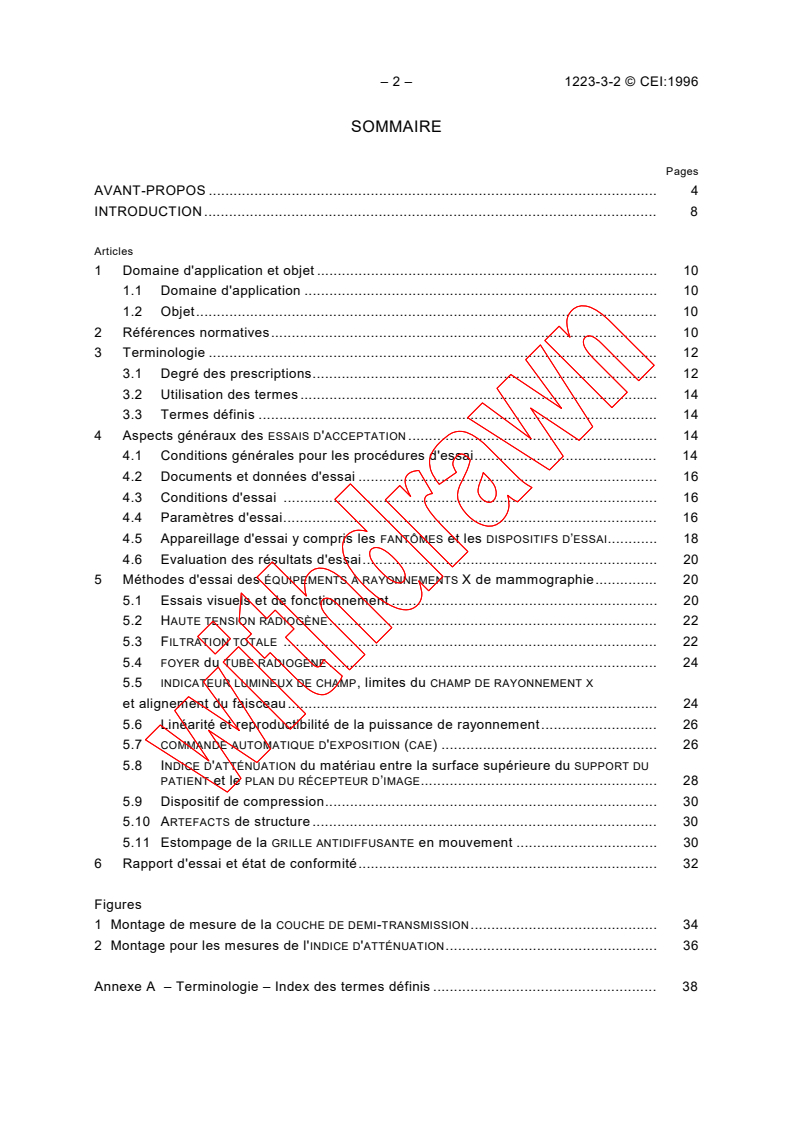
SOMMAIRE
Pages
AVANT-PROPOS . 4
INTRODUCTION . 8
Articles
1 Domaine d'application et objet . 10
1.1 Domaine d'application . 10
1.2 Objet. 10
2 Références normatives. 10
3 Terminologie . 12
3.1 Degré des prescriptions. 12
3.2 Utilisation des termes . 14
3.3 Termes définis . 14
4 Aspects généraux des ESSAIS D'ACCEPTATION . 14
4.1 Conditions générales pour les procédures d'essai. 14
4.2 Documents et données d'essai . 16
4.3 Conditions d'essai . 16
4.4 Paramètres d'essai. 16
4.5 Appareillage d'essai y compris les FANTÔMES et les DISPOSITIFS D’ESSAI. 18
4.6 Evaluation des résultats d'essai. 20
5 Méthodes d'essai des ÉQUIPEMENTS À RAYONNEMENTS X de mammographie. 20
5.1 Essais visuels et de fonctionnement . 20
5.2 HAUTE TENSION RADIOGÈNE. 22
5.3 FILTRATION TOTALE . 22
5.4 FOYER du TUBE RADIOGÈNE . 24
5.5 INDICATEUR LUMINEUX DE CHAMP, limites du CHAMP DE RAYONNEMENT X
et alignement du faisceau. 24
5.6 Linéarité et reproductibilité de la puissance de rayonnement. 26
5.7 COMMANDE AUTOMATIQUE D'EXPOSITION (CAE) . 26
5.8 INDICE D'ATTÉNUATION du matériau entre la surface supérieure du SUPPORT DU
PATIENT et le PLAN DU RÉCEPTEUR D’IMAGE. 28
5.9 Dispositif de compression. 30
5.10 ARTEFACTS de structure . 30
5.11 Estompage de la GRILLE ANTIDIFFUSANTE en mouvement . 30
6 Rapport d'essai et état de conformité. 32
Figures
1 Montage de mesure de la COUCHE DE DEMI-TRANSMISSION. 34
2 Montage pour les mesures de l'INDICE D'ATTÉNUATION. 36
Annexe A – Terminologie – Index des termes définis . 38
1223-3-2 © IEC:1996 − 3 −
CONTENTS
Page
FOREWORD . 5
INTRODUCTION . 9
Clause
1 Scope and object. 11
1.1 Scope . 11
1.2 Object. 11
2 Normative references . 11
3 Terminology . 13
3.1 Degree of requirements . 13
3.2 Use of terms. 15
3.3 Defined terms. 15
4 General aspects of ACCEPTANCE TESTS. 15
4.1 General conditions to be considered in test procedures. 15
4.2 Documents and data for the tests . 17
4.3 Test conditions . 17
4.4 Test parameters . 17
4.5 Test equipment including PHANTOMS and TEST DEVICES. 19
4.6 Evaluating the test results. 21
5 Test methods for mammographic X-RAY EQUIPMENT. 21
5.1 Visual and functional tests . 21
5.2 X-RAY TUBE VOLTAGE . 23
5.3 TOTAL FILTRATION. 23
5.4 X-RAY TUBE FOCAL SPOT . 25
5.5 LIGHT-FIELD INDICATOR, X-RAY FIELD limitation and beam alignment . 25
5.6 Linearity and reproducibility of radiation output . 27
5.7 AUTOMATIC EXPOSURE CONTROL (AEC) . 27
5.8 ATTENUATION RATIO of material between the upper surface of the
PATIENT SUPPORT and the IMAGE RECEPTOR PLANE. 29
5.9 Compression device . 31
5.10 Structural ARTIFACTS. 31
5.11 Moving ANTI-SCATTER GRID blurring . 31
6 Test report and statement of compliance. 33
Figures
1 Set-up for HALF-VALUE LAYER measurements . 35
2 Set-up for ATTENUATION RATIO measurements. 37
Annex A – Terminology – Index of defined terms. 39
– 4 – 1223-3-2 © CEI:1996
COMMISSION ÉLECTROTECHNIQUE INTERNATIONALE
___________
ESSAIS D'ÉVALUATION ET DE ROUTINE
DANS LES SERVICES D'IMAGERIE MÉDICALE –
Partie 3-2: Essais d'acceptation –
Performance d'imagerie des appareils de mammographie
à rayonnement X
AVANT-PROPOS
1) La CEI (Commission Electrotechnique Internationale) est une organisation mondiale de normalisation
composée de l'ensemble des comités électrotechniques nationaux (Comités nationaux de la CEI). La CEI a
pour objet de favoriser la coopération internationale pour toutes les questions de normalisation dans les
domaines de l'électricité et de l'électronique. A cet effet, la CEI, entre autres activités, publie des Normes
Internationales. Leur élaboration est confiée à des comités d'études, aux travaux desquels tout Comité
national intéressé par le sujet traité peut participer. Les organisations internationales, gouvernementales et
non gouvernementales, en liaison avec la CEI, participent également aux travaux. La CEI collabore
étroitement avec l'Organisation Internationale de Normalisation (ISO), selon des conditions fixées par accord
entre les deux organisations.
2) Les décisions ou accords officiels de la CEI concernant les questions techniques, représentent, dans la
mesure du possible un accord international sur les sujets étudiés, étant donné que les Comités nationaux
intéressés sont représentés dans chaque comité d’études.
3) Les documents produits se présentent sous la forme de recommandations internationales. Ils sont publiés
comme normes, rapports techniques ou guides et agréés comme tels par les Comités nationaux.
4) Dans le but d'encourager l'unification internationale, les Comités nationaux de la CEI s'engagent à appliquer
de façon transparente, dans toute la mesure possible, les Normes internationales de la CEI dans leurs normes
nationales et régionales. Toute divergence entre la norme de la CEI et la norme nationale ou régionale
correspondante doit être indiquée en termes clairs dans cette dernière.
5) La CEI n’a fixé aucune procédure concernant le marquage comme indication d’approbation et sa
responsabilité n’est pas engagée quand un matériel est déclaré conforme à l’une de ses normes.
6) L’attention est attirée sur le fait que certains des éléments de la présente Norme internationale peuvent faire
l’objet de droits de propriété intellectuelle ou de droits analogues. La CEI ne saurait être tenue pour
responsable de ne pas avoir identifié de tels droits de propriété et de ne pas avoir signalé leur existence.
La présente partie de la Norme internationale CEI 1223-3-2 a été établie par le sous-comité
62B: Appareils d'imagerie de diagnostic du comité d'études 62 de la CEI: Equipements
électriques dans la pratique médicale.
Le texte de cette norme est issu des documents suivants:
FDIS Rapport de vote
62B/287/FDIS 62B/300/RVD
Le rapport de vote indiqué dans le tableau ci-dessus donne toute information sur le vote ayant
abouti à l'approbation de cette norme.
L'annexe A fait partie intégrante de la présente norme.
La version française de cette norme n’a pas été soumise au vote.
1223-3-2 © IEC:1996 − 5 −
INTERNATIONAL ELECTROTECHNICAL COMMISSION
_____________
EVALUATION AND ROUTINE TESTING
IN MEDICAL IMAGING DEPARTMENTS –
Part 3-2: Acceptance tests –
Imaging performance of mammographic X-ray equipment
FOREWORD
1) The IEC (International Electrotechnical Commission) is a worldwide organization for standardization
comprising all national electrotechnical committees (IEC National Committees). The object of the IEC is to
promote international co-operation on all questions concerning standardization in the electrical and electronic
fields. To this end and in addition to other activities, the IEC publishes International Standards. Their
preparation is entrusted to technical committees; any IEC National Committee interested in the subject dealt
with may participate in this preparatory work. International, governmental and non-governmental organizations
liaising with the IEC also participate in this preparation. The IEC collaborates closely with the International
Organization for Standardization (ISO) in accordance with conditions determined by agreement between the
two organizations.
2) The formal decisions or agreements of the IEC on technical matters express, as nearly as possible, an
international consensus of opinion on the relevant subjects since each technical committee has representation
from all interested National Committees.
3) The documents produced have the form of recommendations for international use and are published in the
form of standards, technical reports or guides and they are accepted by the National Committees in that
sense.
4) In order to promote international unification, IEC National Committees undertake to apply IEC International
Standards transparently to the maximum extent possible in their national and regional standards. Any
divergence between the IEC Standard and the corresponding national or regional standard shall be clearly
indicated in the latter.
5) The IEC provides no marking procedure to indicate its approval and cannot be rendered responsible for any
equipment declared to be in conformity with one of its standards.
6) Attention is drawn to the possibility that some of the elements of this International Standard may be the
subject of patent rights. The IEC shall not be held responsible for identifying any or all such patent rights.
International Standard IEC 1223-3-2 has been prepared by subcommittee 62B: Diagnostic
imaging equipment, of IEC technical committee 62: Electrical equipment in medical practice.
The text of this standard is based on the following documents:
FDIS Report on voting
62B/287/FDIS 62B/300/RVD
Full information on the voting for the approval of this standard can be found in the report on
voting indicated in the above table.
Annex A forms an integral part of this standard.
The French version of this standard has not been voted upon.
– 6 – 1223-3-2 © CEI:1996
Les caractères d'imprimerie suivants sont utilisés dans la présente norme:
– Prescriptions, conformité des éléments à l'essai et définitions: caractères romains
– Explications, conseils, notes, affirmations générales, exceptions et références: caractères de plus petite
taille
– Spécifications d'essai: italique
–TERMES DÉFINIS DANS LA CEI 788 OU DANS LA CEI 1223: PETITES MAJUSCULES (VOIR
ANNEXE A).
1223-3-2 © IEC:1996 − 7 −
In this standard, the following print types are used:
– Requirements, compliance with which can be tested, and definitions: roman type;
– Explanations, advice, notes, general statements, exceptions and references: smaller type;
– Test specifications: italic type;
–TERMS DEFINED IN IEC 788 OR IN IEC 1223: SMALL CAPITALS (SEE ANNEX A).
– 8 – 1223-3-2 © CEI:1996
INTRODUCTION
La présente norme appartient à une série de Normes internationales indiquant des méthodes
d'essai d'acceptation et d'essai de cohérence pour des sous-systèmes et des systèmes (par
exemple, ÉQUIPEMENT DE DIAGNOSTIC À RAYONNEMENT X), comprenant le traitement de films
utilisés dans les services d'imagerie médicale.
1223-3-2 © IEC:1996 − 9 −
INTRODUCTION
This standard is part of a series of International Standards which give methods of acceptance
testing and constancy testing for subsystems and systems (such as diagnostic X-RAY
EQUIPMENT), including film processing, used in medical imaging departments.
– 10 – 1223-3-2 © CEI:1996
ESSAIS D'ÉVALUATION ET DE ROUTINE
DANS LES SERVICES D'IMAGERIE MÉDICALE –
Partie 3-2: Essais d'acceptation –
Performance d'imagerie des appareils de mammographie
à rayonnement X
1 Domaine d’application et objet
1.1 Domaine d’application
La présente partie de la CEI 1223 s'applique aux composants des ÉQUIPEMENTS À
RAYONNEMENT X qui ont une influence sur la qualité d'image des RADIOGRAMMES produits par
les ÉQUIPEMENTS À RAYONNEMENT X pour la mammographie, qui utilisent des ÉCRANS
RENFORÇATEURS à FILM RADIOGRAPHIQUE pour les deux modes de fonctionnement par contact et
par grossissement.
La présente norme ne s'applique pas aux ACCESSOIRES spéciaux des ÉQUIPEMENTS À
RAYONNEMENT X pour la mammographie tels que les plaques de biopsie et les dispositifs
stéréotaxiques.
1.2 Objet
La présente norme définit:
a) les paramètres essentiels décrivant les performances des composants ci-dessus des
ÉQUIPEMENTS À RAYONNEMENT X en rapport avec leurs propriétés d'imagerie;
b) les méthodes pour vérifier si les quantités mesurées liées à ces paramètres sont en
accord avec les tolérances spécifiées.
Ces méthodes reposent sur des mesures non invasives utilisant un appareillage d'essai
convenable, effectuées au cours de la construction ou après l'installation. Des rapports
certifiés couvrant les étapes de la procédure d'installation peuvent être utilisés dans le cadre
des essais d'acceptation.
Le but est de vérifier la conformité de l'installation avec les spécifications établies concernant
la qualité d'image et de détecter les défauts de fonctionnement touchant cette qualité, qui sont
contraires à ces spécifications.
La présente Norme Internationale ne spécifie pas par elle-même de tolérances pour les
paramètres à l'étude. On ne désire pas non plus traiter:
c) les aspects de la sécurité mécanique et électrique;
d) les aspects des performances mécaniques, électriques et celles du logiciel sauf s'ils sont
essentiels aux performances des essais affectant directement la qualité d'image.
2 Références normatives
Les documents normatifs suivants contiennent des dispositions qui, par suite de référence qui
y est faite, constituent des dispositions valables pour la présente norme. Au moment de la
publication, les éditions indiquées étaient en vigueur. Tout document normatif est sujet à
révision et les parties prenantes aux accords fondés sur la présente norme sont invitées à
rechercher la possibilité d'appliquer les éditions les plus récentes des documents normatifs
indiqués ci-après. Les membres de la CEI et de l'ISO possèdent le registre des documents
normatifs en vigueur.
1223-3-2 © IEC:1996 − 11 −
EVALUATION AND ROUTINE TESTING
IN MEDICAL IMAGING DEPARTMENTS –
Part 3-2: Acceptance tests –
Imaging performance of mammographic X-ray equipment
1 Scope and object
1.1 Scope
This part of IEC 1223 applies to those components of X-RAY EQUIPMENT which influence the
image quality in RADIOGRAMS produced with mammographic X-RAY EQUIPMENT using
INTENSIFYING SCREENS with RADIOGRAPHIC FILM for both contact and magnification modes of
operation.
This standard does not apply to special ACCESSORIES of mammographic X-RAY EQUIPMENT such
as biopsy plates and stereotactic devices.
1.2 Object
This part of IEC 1223 defines:
a) the essential parameters which describe the performance of the above-mentioned
components of X-RAY EQUIPMENT with regard to imaging properties;
b) methods of testing whether measured quantities related to those parameters comply with
specified tolerances.
These methods mainly rely on non-invasive measurements, using appropriate test equipment,
performed during the installation or after the installation is completed. Signed statements
covering steps in the installation procedure can be used as part of the acceptance testing.
The aim is to verify compliance of the installation with specifications affecting the image quality,
and to detect malfunctions affecting the image quality that are not in agreement with those
specifications.
This standard does not in itself specify tolerances for the parameters under investigation.
Neither is it intended to consider:
c) aspects of mechanical and electrical safety;
d) aspects of mechanical, electrical and software performance unless they are essential to
the performance of the tests directly affecting the image quality.
2 Normative references
The following normative documents contain provisions which, through reference in this text,
constitute provisions of this part of IEC 1223. At the time of publication, the editions indicated
were valid. All normative documents are subject to revision, and parties to agreements based
on this part of IEC 1223 are encouraged to investigate the possibility of applying the most
recent editions of the normative documents listed below. Members of IEC and ISO maintain
registers of currently valid International Standards.
– 12 – 1223-3-2 © CEI:1996
CEI 336: 1993, Gaines équipées pour diagnostic médical – Caractéristiques des foyers
CEI 417N: 1995, Symboles graphiques utilisables sur le matériel: Index, relevé et compilation
des feuilles individuelles – Treizième complément
CEI 601-1: 1988, Appareils électromédicaux – Première partie: Règles générales de sécurité
Amendement 1: 1991
Amendement 2: 1995
CEI 601-1-3: 1994, Appareils électromédicaux – Première partie: Règles générales de sécurité.
3. Norme collatérale: Règles générales pour la radioprotection dans les équipements à
rayonnement X de diagnostic
CEI 601-2-7: 1987, Appareils électromédicaux – Deuxième partie: Règles particulières de
sécurité pour générateurs radiologiques de groupes radiogènes de diagnostic
CEI 601-2-28: 1993, Appareils électromédicaux – Partie 2: Règles particulières de sécurité
pour ensembles radiogènes à rayonnement X et les gaines équipées pour diagnostic médical
CEI 601-2-32: 1994, Appareils électromédicaux – Partie 2: Règles particulières de sécurité
pour les équipements associés aux équipements à rayonnement X
CEI 788: 1984, Radiologie médicale – Terminologie
CEI 878: 1988, Symboles graphiques pour équipements électriques en pratique médicale
CEI 1223-1: 1993, Essais d'évaluation et de routine dans les services d'imagerie médicale –
Partie 1: Aspects généraux
CEI 1223-2-1: 1993, Essais d'évaluation et de routine dans les services d'imagerie médicale –
Partie 2-1: Essais de constance – Appareils de traitement de film
CEI 1223-2-2: 1993, Essais d'évaluation et de routine dans les services d'imagerie médicale –
Partie 2-2: Essais de constance – Cassettes radiographiques et changeurs de films – Contact
écran-film et sensibilité relative de l'ensemble écran-cassette
CEI 1223-2-3: 1993, Essais d'évaluation et de routine dans les services d'imagerie médicale –
Partie 2-3: Essais de constance – Eclairage inactinique des chambres noires
ISO 2092: 1981, Métaux légers et leurs alliages – Code de désignation basé sur les symboles
chimiques
3 Terminologie
3.1 Degré des prescriptions
Dans la présente norme, certains termes (qui ne sont pas imprimés en PETITES MAJUSCULES)
ont un sens particulier:
– "doit" indique que l'application d'une prescription est obligatoire pour être en
conformité avec la présente norme;
– "il convient de"indique que l'application d'une prescription est fortement recommandée
mais n'est pas obligatoire pour être en conformité avec la présente norme;
1223-3-2 © IEC:1996 − 13 −
IEC 336: 1993, X-ray tube assemblies for medical diagnosis – Characteristics of focal spots
IEC 417N: 1995, Graphical symbols for use on equipment. Index, survey and compilation of the
single sheets – Thirteenth supplement
IEC 601-1: 1988, Medical electrical equipment – Part 1: General requirements for safety
Amendment 1 (1991)
Amendment 2 (1995)
IEC 601-1-3: 1994, Medical electrical equipment – Part 1: General requirements for safety.
3. Collateral Standard: General requirements for radiation protection in diagnostic X-ray
equipment
IEC 601-2-7: 1987, Medical electrical equipment – Part 2: Particular requirements for the safety
of high-voltage generators of diagnostic X-ray generators
IEC 601-2-28: 1993, Medical electrical equipment – Part 2: Particular requirements for the
safety of X-ray source assemblies and X-ray tube assemblies for medical diagnosis
IEC 601-2-32: 1994, Medical electrical equipment – Part 2: Particular requirements for the
safety of associated equipment of X-ray equipment
IEC 788: 1984, Medical radiology – Terminology
IEC 878: 1988, Graphical symbols for electrical equipment in medical practice
IEC 1223-1: 1993, Evaluation and routine testing in medical imaging departments – Part 1:
General aspects
IEC 1223-2-1: 1993, Evaluation and routine testing in medical imaging departments – Part 2-1:
Constancy tests – Film processors
IEC 1223-2-2: 1993, Evaluation and routine testing in medical imaging departments – Part 2-2:
Constancy tests – Radiographic cassettes and film changers – Film-screen contact and relative
sensitivity of the screen-cassette assembly
IEC 1223-2-3: 1993, Evaluation and routine testing in medical imaging departments – Part 2-3:
Constancy tests – Darkroom safelight conditions
ISO 2092: 1981, Light metals and their alloys – Code of designation based on chemical
symbols
3 Terminology
3.1 Degree of requirements
In this part of IEC 1223, certain terms (which are not printed in SMALL CAPITALS) have particular
meanings, as follows:
– "shall" indicates a requirement that is mandatory for compliance;
– "should" indicates a strong recommendation that is not mandatory for compliance;
– 14 – 1223-3-2 © CEI:1996
– "peut" indique que l'application d'une prescription peut être réalisée d'une
certaine manière pour être en conformité avec la présente norme;
– "spécifique" est utilisé pour signaler des informations précises indiquées dans la
présente norme ou citées en référence dans d'autres normes, se
rapportant généralement à des conditions particulières de fonctionnement,
des dispositions d'essai ou des valeurs en liaison avec la conformité;
– "spécifié" est utilisé pour signaler des informations précises données par le
CONSTRUCTEUR dans les DOCUMENTS D'ACCOMPAGNEMENT ou dans la
documentation concernant l'APPAREIL considéré, concernant généralement
les buts recherchés ou les paramètres et les conditions associés à son
utilisation ou aux essais pour déterminer la conformité.
3.2 Utilisation des termes
Dans la présente norme, les termes imprimés en PETITES MAJUSCULES sont utilisés selon le
sens défini dans la CEI 788, dans d'autres publications de la CEI ou dans le paragraphe 3.3 de
la présente Norme (voir l'annexe A). Quand un terme défini est utilisé pour qualifier un autre
terme défini ou non défini, il n'est pas imprimé en PETITES MAJUSCULES, sauf si le concept ainsi
qualifié est défini, ou reconnu comme un terme dérivé sans définition.
NOTE – On soulignera que dans les cas où le concept étudié n'est pas expressément limité à la définition
donnée dans l'une des publications répertoriées ci-dessus, un terme correspondant est imprimé en minuscules.
3.3 Termes définis
3.3.1 ARTEFACT: structure apparente visible à l'image, ne représentant aucune structure au
sein de l'objet et ne pouvant s'expliquer par le bruit ou la FONCTION DE TRANSFERT DE
MODULATION du système.
4 Aspects généraux des ESSAIS D'ACCEPTATION
4.1 Conditions générales pour les procédures d'essai
Le but d’un ESSAI D’ACCEPTATION est de vérifier que les caractéristiques spécifiées pour les
ÉQUIPEMENTS respectent les tolérances spécifiées. Certaines prescriptions sont imposées par
la législation. D'autres prescriptions et spécifications peuvent figurer dans le contrat de
commande, dans la brochure du fournisseur ou dans d'autres normes, par exemple la série
CEI 601.
Avant d'appliquer les procédures d'essai de performance, un inventaire de l'APPAREIL à l'essai
doit être établi. L'ÉQUIPEMENT À RAYONNEMENT X et ses composants doivent être identifiés sans
ambiguïté, par exemple en ce qui concerne le NUMÉRO DE SÉRIE et vérifiés vis-à-vis du contrat
de commande. La vérification doit aussi porter sur le constat que les DOCUMENTS
D'ACCOMPAGNEMENT contenant les protocoles d'essai sont complets, que leur fourniture est
complète et qu'ils se rapportent bien à l'APPAREIL fourni.
Les chargeurs à ÉCRANS RENFORÇATEURS, les films et le traitement des films sont des parties
essentielles de la chaîne de l'imagerie. Il est de la responsabilité de l'UTILISATEUR de s'assurer
que ces composants fonctionnent de manière correcte, par exemple en ce qui concerne la
sensibilité, le contraste, l'absence d'ARTEFACTS. Un essai de la performance de ces
composants doit précéder toute mesure de l'ESSAI D'ACCEPTATION comprenant les films de
l'ÉQUIPEMENT À RAYONNEMENT X, par exemple des ESSAIS DE CONSTANCE, en conformité avec la
CEI 1223-2-1, la CEI 1223-2-2, la CEI 1223-2-3.
Les mesures non invasives sont préférées pour les ESSAIS D'ACCEPTATION. Lorsque des essais
invasifs font partie du programme, on doit démontrer que l'APPAREIL a été remis en fonction
dans son état d'origine.
1223-3-2 © IEC:1996 − 15 −
– "may" indicates a permitted manner of complying with a requirement or of
avoiding the need to comply;
– "specific" is used to indicate definitive information stated in this standard or
referenced in other standards, usually concerning particular operating
conditions, test arrangements or values connected with compliance;
– "specified" is used to indicate definitive information stated by the MANUFACTURER in
ACCOMPANYING DOCUMENTS or in other documentation relating to the
EQUIPMENT under consideration, usually concerning its intended purpose,
or the parameters or conditions associated with its use, or with testing to
determine compliance.
3.2 Use of terms
In this part of IEC 1223, terms printed in SMALL CAPITALS are used as defined in IEC 788 or
other IEC publications, or in 3.3 of this standard; see annex A. Where a defined term is used as
a qualifier with another defined or undefined term, it is not printed in SMALL CAPITALS, unless the
concept thus qualified is defined, or recognized as a derived term without a definition.
NOTE – Attention is drawn to the fact that, in cases where the concept addressed is not strongly confined to the
definition given in one of the publications listed above, a corresponding term is printed in lower case letters.
3.3 Defined terms
3.3.1 ARTIFACT: Apparent structure visible in the image which does not represent a structure
within the object, and which cannot be explained by noise or the MODULATION TRANSFER
FUNCTION of the system.
4 General aspects of ACCEPTANCE TESTS
4.1 General conditions to be considered in test procedures
The aim of an ACCEPTANCE TEST is to demonstrate that the specified characteristics of the
EQUIPMENT lie within the specified tolerances. Some requirements are enforced by legislation.
Other requirements and specifications may be in the order contract, in the supplier’s brochure,
or in other standards, such as IEC 601 series.
Prior to the performance test procedures, an inventory of the EQUIPMENT under test shall be
established. The X-RAY EQUIPMENT and its components shall be unambiguously identified, for
example with respect to type and SERIAL NUMBER, and checked against the order contract. The
check shall also encompass ascertaining that the ACCOMPANYING DOCUMENTS, including test
protocols, are complete, that delivery is complete, and that the documents relate to the
EQUIPMENT delivered.
Cassettes with INTENSIFYING SCREENS, films and film processing are vital parts in the imaging
chain. It is the responsibility of the USER to ensure that these components perform in an
acceptable way, for example with respect to sensitivity, contrast and absence of ARTIFACTS. A
test of the performance of these components shall precede any ACCEPTANCE TEST
measurements involving films of the X-RAY EQUIPMENT, for example CONSTANCY TESTS
according to IEC 1223-2-1, IEC 1223-2-2, IEC 1223-2-3.
Non-invasive measurements are preferred for ACCEPTANCE TESTS. Whenever invasive tests are
part of the programme, it shall be shown that the EQUIPMENT has been restored to its original
condition.
– 16 – 1223-3-2 © CEI:1996
4.2 Documents et données d'essai
Avec l’ÉQUIPEMENT À RAYONNEMENT X, les documents suivants sont exigés:
– déclaration de conformité avec les parties applicables des CEI 601;
– la liste de l'ÉQUIPEMENT et de ses parties commandés et la liste réelle des fournitures
(CEI 601-1);
– les spécifications de performance convenues entre l'acheteur et le fournisseur;
– les résultats d'essais à partir des essais faits en usine ou pendant l'installation traitant
des points importants pour la qualité de l'image comme par exemple, la VALEUR NOMINALE DU
FOYER;
– INSTRUCTIONS D'UTILISATION c'est-à-dire un manuel d'ensemble traitant du fonctionnement
de l'APPAREIL;
– des détails sur les conditions de fonctionnement réelles selon lesquelles l'ÉQUIPEMENT À
RAYONNEMENT X est à utiliser en pratique et si celles-ci entraînent une limitation du domaine
d'application des essais, par exemple des lieux de travail particuliers;
– un guide concernant l'étendue et la fréquence des procédures de maintenance;
– des rapports sur les essais précédents, le cas échéant;
– des données concernant les changements techniques.
4.3 Conditions d’essai
On peut identifier différentes catégories d'essai:
– examen visuel;
– essais de fonctionnement;
– performances de l'appareil;
– vérification de l'incertitude des valeurs des variables.
Les essais doivent fournir les informations raisonnablement nécessaires à la mise en évidence
des performances sur la plage complète de toutes les variables accessibles à l'OPÉRATEUR.
Toutes les données correspondantes telles que l'identification des ÉQUIPEMENTS À RAYON-
NEMENTS X de mammographie, l'identification de l'appareillage d'essai utilisé, la disposition
géométrique, l'identification et les résultats d'essai des ÉQUIPEMENTS ASSOCIÉS (film, écran,
traitement) doivent être notés avec les résultats d'essai. Le registre doit inclure le lieu, la date
et les noms des personnes réalisant les essais.
4.4 Paramètres d'essais
Les éléments suivants font l'objet des mesures des ESSAIS D'ACCEPTATION:
– identification des ÉQUIPEMENTS;
– vérification des documents;
– essais visuels et essais de fonctionnement;
– HAUTE TENSION RADIOGÈNE;
– PRODUIT COURANT-TEMPS;
– PRODUIT COURANT-TEMPS minimal;
– TEMPS DE CHARGE;
– FOYER;
– FILTRATION TOTALE;
– force de compression;
– sortie du rayonnement;
– INDICE D'ATTÉNUATION;
– densité optique.
1223-3-2 © IEC:1996 − 17 −
4.2 Documents and data for the tests
Together with the X-RAY EQUIPMENT, the following documentation is required:
– statements of compliance with applicable parts of IEC 601;
– list of EQUIPMENT/parts of EQUIPMENT ordered and actual delivery list (IEC 601-1);
– performance specification as agreed upon between the purchaser and the supplier;
– results from tests performed in the factory or during installation covering items of
importance to quality, such as the NOMINAL FOCAL SPOT VALUE;
– INSTRUCTIONS FOR USE, including a comprehensive guidance for the operation of the
EQUIPMENT;
– details of the actual operating conditions under which the X-RAY EQUIPMENT is to be used
in practice, and whether this results in a limitation of the scope of the tests, such as special
work places;
– guidance as to the extent and frequency of maintenance procedures;
– reports on previous tests where applicable;
– data on technical changes.
4.3 Test conditions
Different categories of tests can be identified:
– visual inspection;
– functional tests;
– system performance;
– check of the uncertainty in the values of variables.
The tests shall yield information reasonably necessary for a demonstration of performance over
the full range of OPERATOR accessible variables.
All relevant data, such as the identification of the mammographic X-RAY EQUIPMENT tested,
identification of the test equipment used, geometrical setup, operating characteristics,
correction factors and test results of the ASSOCIATED EQUIPMENT (film, screen, processing) shall
be recorded with the test results. The record shall include the location, the date and the names
of the persons performing the tests.
4.4 Test parameters
The following parameters are subject to ACCEPTANCE TESTING:
– identification of EQUIPMENT;
– check of documents;
– visual and functional tests;
–X-RAY TUBE VOLTAGE;
– CURRENT TIME PRODUCT;
– minimum CURRENT TIME PRODUCT;
– LOADING TIME;
– FOCAL SPOT;
– TOTAL FILTRATION;
– compression force;
– radiation output;
– ATTENUATION RATIO;
– optical density.
– 18 – 1223-3-2 © CEI:1996
4.5 Appareillage d’essai y compris les FANTÔMES et les DISPOSITIFS D’ESSAI
4.5.1 Généralités
On doit certifier que les appareils de mesure utilisés pour les ESSAIS D'ACCEPTATION sont
étalonnés suivant une norme nationale ou internationale quand une telle norme existe.
4.5.2 Instrument de mesure de haute tension
L'instrument de mesure de haute tension doit déterminer la valeur de crête des HAUTES
TENSIONS RADIOGÈNES dans une gamme spécifiée. Des appareils conçus pour un mesurage
direct ou indirect peuvent être utilisés. L'incertitude doit être inférieure à ±2 % ou ±0,7 kV, en
prenant la plus grande valeur.
NOTE – Des dispositions spéciales d'un ÉQUIPEMENT À RAYONNEMENT X pour la mammographie telles que les
ANODES au molybdène et des FILTRES sélectifs de la raie K possibles doivent être pris en compte lors de
l'étalonnage des dispositifs utilisés pour les mesures indirectes. L'incertitude désirée avec les méthodes d'essai
non invasives peut souvent n'être réalisée qu'après un étalonnage spécial pour le type d'ÉQUIPEMENT À
RAYONNEMENT X en essai.
4.5.3 Instrument de mesure du PRODUIT COURANT-TEMPS
La gamme de cet appareil doit couvrir la gamme du PRODUIT COURANT-TEMPS qu’on peut
sélectionner avec l'ÉQUIPEMENT À RAYONNEMENT X, généralement de 0 mAs à 800 mAs.
L'incertitude doit être de ±5 % ou de ±0,5 mAs en prenant la plus grande valeur. Si on doit
utiliser un appareil de mesure du PRODUIT COURANT-TEMPS incorporé pour l'ESSAI
D'ACCEPTATION, il doit respecter les spécifications mentionnées ci-dessus, prouvées par des
procédures d'étalonnage.
4.5.4 Instrument de mesure du TEMPS DE CHARGE
L'instru
...