

IEC 61892-1:2019
(Main)Mobile and fixed offshore units - Electrical installations - Part 1: General requirements and conditions
General Information
- Abstract
IEC 61892-1:2019 is applicable to electrical installations and equipment in mobile and fixed offshore units, including pipeline, pumping or "pigging" stations, compressor stations and single buoy moorings, used in the offshore petroleum industry for drilling, production, accommodation, processing, storage and offloading purposes.
It applies to all installations, whether permanent, temporary, transportable or hand-held, to AC installations and DC installations without any voltage level limitation. Referenced equipment standards may give voltage level limitations.
This document specifies requirements such as those concerning
– environmental conditions,
– power supply characteristics,
– location of electrical equipment in units,
– protection against external influences,
– protection against electrical shock, and
– ignition source control.
This document gives information and guidance on topics such as
– cold climate protection, and
– surface treatment and protective painting system.
This document does not apply to
– fixed equipment for medical purposes,
– electrical installations of tankers, and
– control of ignition sources other than those created by electrical equipment.
This fourth edition cancels and replaces the third edition published in 2015. This edition constitutes a technical revision.
This edition includes the following significant technical changes with respect to the previous edition:
a) voltage limitations have been removed;
b) definitions for fixed offshore units and mobile offshore units have been included;
c) tables for ambient air temperature and relative humidity have been removed, as this information will normally be given in owner's/operator's documentation for specific projects;
d) the requirement as to ignition source control has been moved from IEC 61892-7 to this document;
e) tables for voltage characteristics have been updated;
f) requirements for a minimum degree of protection for equipment have been moved from IEC 61892-2 to this document.
- Status
- Published
- Publication Date
- 08-Apr-2019
- Drafting Committee
- MT 18 - TC 18/MT 18
- Current Stage
- PPUB - Publication issued
- Start Date
- 09-Apr-2019
- Completion Date
- 19-Apr-2019
Buy Documents
IEC 61892-1:2019 RLV - Mobile and fixed offshore units - Electrical installations - Part 1: General requirements and conditions Released:4/9/2019
IEC 61892-1:2019 - Mobile and fixed offshore units - Electrical installations - Part 1: General requirements and conditions Released:4/9/2019
Overview
IEC 61892-1:2019 - "Mobile and fixed offshore units - Electrical installations - Part 1: General requirements and conditions" is the fourth edition (2019) of the IEC guidance for electrical installations on offshore petroleum units. It applies to electrical installations and equipment in mobile and fixed offshore units (including pipeline, pumping/"pigging" stations, compressor stations and single buoy moorings) used for drilling, production, accommodation, processing, storage and offloading. The standard covers both AC and DC installations without an intrinsic voltage limit (referenced equipment standards may impose limits).
Key topics and requirements
This part establishes high-level requirements and conditions for offshore electrical installations, including:
- Environmental conditions - design parameters and considerations for ambient conditions (note: project-specific ambient tables are normally provided by owners/operators).
- Power supply characteristics - AC and DC distribution system characteristics and updated voltage/frequency guidance.
- Location and mechanical protection - siting of electrical equipment, clearance, creepage, vibration and shock precautions.
- Protection against external influences - protection from heat, water, steam, oil and other external hazards.
- Protection against electrical shock - principles and requirements to minimize personnel risk.
- Ignition source control - requirements to control ignition sources created by electrical equipment (moved into this part from IEC 61892‑7).
- Degree of protection and enclosures - minimum degree of protection for offshore equipment (requirements moved from IEC 61892‑2).
- Guidance topics - cold climate protection measures, surface treatment and protective painting systems, and information on DC distribution considerations.
The standard explicitly does not apply to fixed medical equipment, tanker electrical installations, or control of ignition sources not created by electrical equipment.
Applications and users
IEC 61892-1 is used by professionals involved in the lifecycle of offshore electrical systems:
- Offshore platform and FPSO owners/operators for setting project requirements
- Design and engineering teams for electrical system design and equipment selection
- Installation contractors and maintenance teams for safe selection, installation and servicing
- Surveyors, inspectors and certification bodies for compliance assessment
- Regulators and technical authorities referencing best practice for offshore electrical safety
Practical uses include design briefs, specification of equipment degrees of protection, layout and routing decisions, emergency shutdown and ignition-source control planning, and cold-climate or corrosion-protection strategies.
Related standards
- Other parts of the IEC 61892 series (detailed equipment and installation rules)
- IEC 61892‑2 (equipment protection requirements - related provisions moved into Part 1)
- IEC 61892‑7 (previous location of ignition source control requirements)
- Relevant IMO and national offshore regulations and referenced IEC equipment standards
Keywords: IEC 61892-1, offshore electrical installations, mobile and fixed offshore units, ignition source control, degree of protection, cold climate protection.
Relations
- Effective Date
- 05-Sep-2023
Buy Documents
IEC 61892-1:2019 RLV - Mobile and fixed offshore units - Electrical installations - Part 1: General requirements and conditions Released:4/9/2019
IEC 61892-1:2019 - Mobile and fixed offshore units - Electrical installations - Part 1: General requirements and conditions Released:4/9/2019
Get Certified
Connect with accredited certification bodies for this standard

DNV
DNV is an independent assurance and risk management provider.

Lloyd's Register
Lloyd's Register is a global professional services organisation specialising in engineering and technology.

FSC International
Forest Stewardship Council certification.
Sponsored listings
Frequently Asked Questions
IEC 61892-1:2019 is a standard published by the International Electrotechnical Commission (IEC). Its full title is "Mobile and fixed offshore units - Electrical installations - Part 1: General requirements and conditions". This standard covers: IEC 61892-1:2019 is applicable to electrical installations and equipment in mobile and fixed offshore units, including pipeline, pumping or "pigging" stations, compressor stations and single buoy moorings, used in the offshore petroleum industry for drilling, production, accommodation, processing, storage and offloading purposes. It applies to all installations, whether permanent, temporary, transportable or hand-held, to AC installations and DC installations without any voltage level limitation. Referenced equipment standards may give voltage level limitations. This document specifies requirements such as those concerning – environmental conditions, – power supply characteristics, – location of electrical equipment in units, – protection against external influences, – protection against electrical shock, and – ignition source control. This document gives information and guidance on topics such as – cold climate protection, and – surface treatment and protective painting system. This document does not apply to – fixed equipment for medical purposes, – electrical installations of tankers, and – control of ignition sources other than those created by electrical equipment. This fourth edition cancels and replaces the third edition published in 2015. This edition constitutes a technical revision. This edition includes the following significant technical changes with respect to the previous edition: a) voltage limitations have been removed; b) definitions for fixed offshore units and mobile offshore units have been included; c) tables for ambient air temperature and relative humidity have been removed, as this information will normally be given in owner's/operator's documentation for specific projects; d) the requirement as to ignition source control has been moved from IEC 61892-7 to this document; e) tables for voltage characteristics have been updated; f) requirements for a minimum degree of protection for equipment have been moved from IEC 61892-2 to this document.
IEC 61892-1:2019 is applicable to electrical installations and equipment in mobile and fixed offshore units, including pipeline, pumping or "pigging" stations, compressor stations and single buoy moorings, used in the offshore petroleum industry for drilling, production, accommodation, processing, storage and offloading purposes. It applies to all installations, whether permanent, temporary, transportable or hand-held, to AC installations and DC installations without any voltage level limitation. Referenced equipment standards may give voltage level limitations. This document specifies requirements such as those concerning – environmental conditions, – power supply characteristics, – location of electrical equipment in units, – protection against external influences, – protection against electrical shock, and – ignition source control. This document gives information and guidance on topics such as – cold climate protection, and – surface treatment and protective painting system. This document does not apply to – fixed equipment for medical purposes, – electrical installations of tankers, and – control of ignition sources other than those created by electrical equipment. This fourth edition cancels and replaces the third edition published in 2015. This edition constitutes a technical revision. This edition includes the following significant technical changes with respect to the previous edition: a) voltage limitations have been removed; b) definitions for fixed offshore units and mobile offshore units have been included; c) tables for ambient air temperature and relative humidity have been removed, as this information will normally be given in owner's/operator's documentation for specific projects; d) the requirement as to ignition source control has been moved from IEC 61892-7 to this document; e) tables for voltage characteristics have been updated; f) requirements for a minimum degree of protection for equipment have been moved from IEC 61892-2 to this document.
IEC 61892-1:2019 is classified under the following ICS (International Classification for Standards) categories: 47.020.60 - Electrical equipment of ships and of marine structures. The ICS classification helps identify the subject area and facilitates finding related standards.
IEC 61892-1:2019 has the following relationships with other standards: It is inter standard links to IEC 61892-1:2015. Understanding these relationships helps ensure you are using the most current and applicable version of the standard.
IEC 61892-1:2019 is available in PDF format for immediate download after purchase. The document can be added to your cart and obtained through the secure checkout process. Digital delivery ensures instant access to the complete standard document.
Standards Content (Sample)
IEC 61892-1 ®
Edition 4.0 2019-04
REDLINE VERSION
INTERNATIONAL
STANDARD
colour
inside
Mobile and fixed offshore units – Electrical installations –
Part 1: General requirements and conditions
All rights reserved. Unless otherwise specified, no part of this publication may be reproduced or utilized in any form
or by any means, electronic or mechanical, including photocopying and microfilm, without permission in writing from
either IEC or IEC's member National Committee in the country of the requester. If you have any questions about IEC
copyright or have an enquiry about obtaining additional rights to this publication, please contact the address below or
your local IEC member National Committee for further information.
IEC Central Office Tel.: +41 22 919 02 11
3, rue de Varembé info@iec.ch
CH-1211 Geneva 20 www.iec.ch
Switzerland
About the IEC
The International Electrotechnical Commission (IEC) is the leading global organization that prepares and publishes
International Standards for all electrical, electronic and related technologies.
About IEC publications
The technical content of IEC publications is kept under constant review by the IEC. Please make sure that you have the
latest edition, a corrigendum or an amendment might have been published.
IEC publications search - webstore.iec.ch/advsearchform Electropedia - www.electropedia.org
The advanced search enables to find IEC publications by a The world's leading online dictionary on electrotechnology,
variety of criteria (reference number, text, technical containing more than 22 000 terminological entries in English
committee,…). It also gives information on projects, replaced and French, with equivalent terms in 16 additional languages.
and withdrawn publications. Also known as the International Electrotechnical Vocabulary
(IEV) online.
IEC Just Published - webstore.iec.ch/justpublished
Stay up to date on all new IEC publications. Just Published IEC Glossary - std.iec.ch/glossary
details all new publications released. Available online and 67 000 electrotechnical terminology entries in English and
once a month by email. French extracted from the Terms and Definitions clause of
IEC publications issued since 2002. Some entries have been
IEC Customer Service Centre - webstore.iec.ch/csc collected from earlier publications of IEC TC 37, 77, 86 and
If you wish to give us your feedback on this publication or CISPR.
need further assistance, please contact the Customer Service
Centre: sales@iec.ch.
IEC 61892-1 ®
Edition 4.0 2019-04
REDLINE VERSION
INTERNATIONAL
STANDARD
colour
inside
Mobile and fixed offshore units – Electrical installations –
Part 1: General requirements and conditions
INTERNATIONAL
ELECTROTECHNICAL
COMMISSION
ICS 47.020.60 ISBN 978-2-8322-6822-3
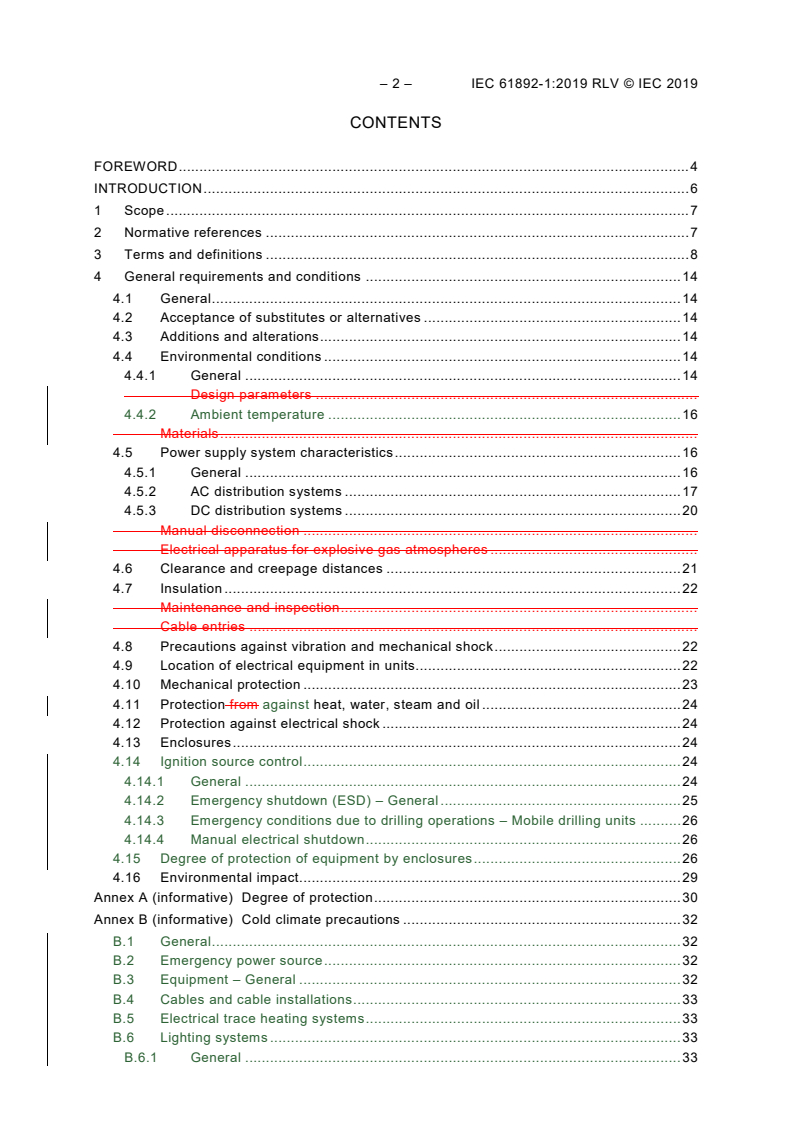
– 2 – IEC 61892-1:2019 RLV © IEC 2019
CONTENTS
FOREWORD . 4
INTRODUCTION . 6
1 Scope . 7
2 Normative references . 7
3 Terms and definitions . 8
4 General requirements and conditions . 14
4.1 General . 14
4.2 Acceptance of substitutes or alternatives . 14
4.3 Additions and alterations . 14
4.4 Environmental conditions . 14
4.4.1 General . 14
Design parameters .
4.4.2 Ambient temperature . 16
Materials .
4.5 Power supply system characteristics . 16
4.5.1 General . 16
4.5.2 AC distribution systems . 17
4.5.3 DC distribution systems . 20
Manual disconnection .
Electrical apparatus for explosive gas atmospheres .
4.6 Clearance and creepage distances . 21
4.7 Insulation . 22
Maintenance and inspection .
Cable entries .
4.8 Precautions against vibration and mechanical shock . 22
4.9 Location of electrical equipment in units. 22
4.10 Mechanical protection . 23
4.11 Protection from against heat, water, steam and oil . 24
4.12 Protection against electrical shock . 24
4.13 Enclosures . 24
4.14 Ignition source control . 24
4.14.1 General . 24
4.14.2 Emergency shutdown (ESD) – General . 25
4.14.3 Emergency conditions due to drilling operations – Mobile drilling units . 26
4.14.4 Manual electrical shutdown . 26
4.15 Degree of protection of equipment by enclosures . 26
4.16 Environmental impact. 29
Annex A (informative) Degree of protection . 30
Annex B (informative) Cold climate precautions . 32
B.1 General . 32
B.2 Emergency power source . 32
B.3 Equipment – General . 32
B.4 Cables and cable installations . 33
B.5 Electrical trace heating systems . 33
B.6 Lighting systems . 33
B.6.1 General . 33
B.6.2 Emergency lights . 33
B.7 Electrical rotating machines . 33
B.8 Explosion protected equipment . 33
Annex C (informative) Specification of surface treatment and protective painting
system . 34
C.1 Objectives . 34
C.2 General and specification. 34
C.2.1 General . 34
C.2.2 Atmospheric corrosivity categories for protective painting systems . 34
C.2.3 Durability performance of a protective painting system . 35
Annex D (informative) DC distribution systems.
D.1 DC distribution systems .
Bibliography . 38
Figure D.1 – Typical configuration of DC distribution system .
Table – Operational design parameters – Ambient temperature .
Table – Design parameters – Relative humidity .
Table 1 – Voltage characteristics . 17
Table 2 – Frequency characteristics . 19
Table 3 – Tolerances for DC system . 20
Table 4 – Fast transients . 21
Table 5 – Minimum requirements for the degree of protection for mobile and fixed
offshore units . 27
Table A.1 – Degrees of protection against foreign objects indicated by the first
characteristic numeral . 30
Table A.2 – Degrees of protection against water indicated by the second characteristic
numeral . 31
Table C.1 – Description of typical atmospheric environments related to the estimation
of corrosivity categories . 35
– 4 – IEC 61892-1:2019 RLV © IEC 2019
INTERNATIONAL ELECTROTECHNICAL COMMISSION
____________
MOBILE AND FIXED OFFSHORE UNITS –
ELECTRICAL INSTALLATIONS –
Part 1: General requirements and conditions
FOREWORD
1) The International Electrotechnical Commission (IEC) is a worldwide organization for standardization comprising
all national electrotechnical committees (IEC National Committees). The object of IEC is to promote
international co-operation on all questions concerning standardization in the electrical and electronic fields. To
this end and in addition to other activities, IEC publishes International Standards, Technical Specifications,
Technical Reports, Publicly Available Specifications (PAS) and Guides (hereafter referred to as "IEC
Publication(s)"). Their preparation is entrusted to technical committees; any IEC National Committee interested
in the subject dealt with may participate in this preparatory work. International, governmental and non-
governmental organizations liaising with the IEC also participate in this preparation. IEC collaborates closely
with the International Organization for Standardization (ISO) in accordance with conditions determined by
agreement between the two organizations.
2) The formal decisions or agreements of IEC on technical matters express, as nearly as possible, an international
consensus of opinion on the relevant subjects since each technical committee has representation from all
interested IEC National Committees.
3) IEC Publications have the form of recommendations for international use and are accepted by IEC National
Committees in that sense. While all reasonable efforts are made to ensure that the technical content of IEC
Publications is accurate, IEC cannot be held responsible for the way in which they are used or for any
misinterpretation by any end user.
4) In order to promote international uniformity, IEC National Committees undertake to apply IEC Publications
transparently to the maximum extent possible in their national and regional publications. Any divergence
between any IEC Publication and the corresponding national or regional publication shall be clearly indicated in
the latter.
5) IEC itself does not provide any attestation of conformity. Independent certification bodies provide conformity
assessment services and, in some areas, access to IEC marks of conformity. IEC is not responsible for any
services carried out by independent certification bodies.
6) All users should ensure that they have the latest edition of this publication.
7) No liability shall attach to IEC or its directors, employees, servants or agents including individual experts and
members of its technical committees and IEC National Committees for any personal injury, property damage or
other damage of any nature whatsoever, whether direct or indirect, or for costs (including legal fees) and
expenses arising out of the publication, use of, or reliance upon, this IEC Publication or any other IEC
Publications.
8) Attention is drawn to the Normative references cited in this publication. Use of the referenced publications is
indispensable for the correct application of this publication.
9) Attention is drawn to the possibility that some of the elements of this IEC Publication may be the subject of
patent rights. IEC shall not be held responsible for identifying any or all such patent rights.
This redline version of the official IEC Standard allows the user to identify the changes
made to the previous edition. A vertical bar appears in the margin wherever a change
has been made. Additions are in green text, deletions are in strikethrough red text.
International Standard IEC 61892-1 has been prepared by IEC technical committee 18:
Electrical installations of ships and of mobile and fixed offshore units.
This fourth edition cancels and replaces the third edition published in 2015. This edition
constitutes a technical revision.
This edition includes the following significant technical changes with respect to the previous
edition:
a) voltage limitations have been removed;
b) definitions for fixed offshore units and mobile offshore units have been included;
c) tables for ambient air temperature and relative humidity have been removed, as this
information will normally be given in owner's/operator's documentation for specific
projects;
d) the requirement as to ignition source control has been moved from IEC 61892-7 to this
document;
e) tables for voltage characteristics have been updated;
f) requirements for a minimum degree of protection for equipment have been moved from
IEC 61892-2 to this document.
The text of this International Standard is based on the following documents:
FDIS Report on voting
18/1649/FDIS 18/1664/RVD
Full information on the voting for the approval of this International Standard can be found in
the report on voting indicated in the above table.
This document has been drafted in accordance with the ISO/IEC Directives, Part 2.
A list of all parts of the IEC 61892 series, published under the general title Mobile and fixed
offshore units – Electrical installations, can be found on the IEC website.
The committee has decided that the contents of this document will remain unchanged until the
stability date indicated on the IEC website under "http://webstore.iec.ch" in the data related to
the specific document. At this date, the document will be
• reconfirmed,
• withdrawn,
• replaced by a revised edition, or
• amended.
IMPORTANT – The “colour inside” logo on the cover page of this publication indicates
that it contains colours which are considered to be useful for the correct understanding
of its contents. Users should therefore print this publication using a colour printer.
– 6 – IEC 61892-1:2019 RLV © IEC 2019
INTRODUCTION
IEC 61892 forms a series of International Standards is intended to enable for safety in the
design, selection, installation, maintenance and use of electrical equipment for the
generation, transmission, storage, distribution and utilization of electrical energy for all
purposes in offshore units which are used for the purpose of exploration or exploitation of
petroleum resources.
This part of IEC 61892 incorporates and coordinates, as far as possible, existing rules and
forms a code of interpretation, where applicable, of the requirements of the International
Maritime Organization (IMO), and constitutes a guide for future regulations which may be
prepared and a statement of practice for offshore unit owners, constructors designers,
installers and appropriate organizations.
This document is based on equipment solutions and practices methods which are in current
use, but it is not intended in any way to impede the development of new or improved
techniques.
The ultimate aim has been to produce a set of International Standards exclusively for the
offshore petroleum industry.
In this revision, voltage limitations have been removed. However, voltage limitations may be
given in the referenced equipment standards. The removal of voltage limitations is considered
necessary due to the interconnection of, and supply from shore to offshore units. In such
cases, transmission voltages up to 132 kV AC and 150 kV DC are used and higher voltages
are being planned.
The IEC 61892 series aims to constitute a set of International Standards for the offshore
petroleum industry, but it is not intended to prevent their use beyond petroleum installations.
MOBILE AND FIXED OFFSHORE UNITS –
ELECTRICAL INSTALLATIONS –
Part 1: General requirements and conditions
1 Scope
This part of IEC 61892 contains provisions for is applicable to electrical installations and
equipment in mobile and fixed offshore units, including pipeline, pumping or "pigging"
stations, compressor stations and exposed location single buoy moorings, used in the
offshore petroleum industry for drilling, production, accommodation, processing, storage and
offloading purposes.
It applies to all installations, whether permanent, temporary, transportable or hand-held, to AC
installations up to and including 35 000 V and DC installations up to and including 1 500 V
(AC and DC voltages are nominal values) without any voltage level limitation. Referenced
equipment standards may give voltage level limitations.
This document specifies requirements such as those concerning
– environmental conditions,
– power supply characteristics,
– location of electrical equipment in units,
– protection against external influences,
– protection against electrical shock, and
– ignition source control.
This document gives information and guidance on topics such as
– cold climate protection, and
– surface treatment and protective painting system.
This document does not apply either to
– fixed equipment for medical purposes or to the,
– electrical installations of tankers, and
– control of ignition sources other than those created by electrical equipment.
NOTE 1 For medical rooms, IEC 60364-7-710 provides more information specific requirements. Requirements for
tankers are given in IEC 60092-502.
NOTE 2 Guidance on protection of non-electrical equipment can be found in ISO 80079-36, ISO 80079-37 and
IMO 2009 MODU Code, 6.7.
2 Normative references
The following documents are referred to in the text in such a way that some or all of their
content constitutes requirements of this document. For dated references, only the edition
cited applies. For undated references, the latest edition of the referenced document (including
any amendments) applies.
IEC 60034 (all parts), Rotating electrical machines
– 8 – IEC 61892-1:2019 RLV © IEC 2019
IEC 60034-1:2010, Rotating electrical machines – Part 1: Rating and performance
IEC 60079 (all parts), Explosive atmospheres
IEC 60364-4-41, Low-voltage installations – Part 4-41: Protection for safety – Protection
against electric shock
IEC 60529, Degrees of protection provided by enclosures (IP Code)
IEC 61000-2-4:2002, Electromagnetic compatibility (EMC) – Part 2-4: Environment –
Compatibility levels in industrial plants for low-frequency conducted disturbances
IEC 61140, Protection against electric shock – Common aspects for installation and
equipment
IEC 61892-2:2012 2019, Mobile and fixed offshore units – Electrical installations – Part 2:
System design
IEC 61892-3, Mobile and fixed offshore units – Electrical installations – Part 3: Equipment
IEC 61892-5, Mobile and fixed offshore units – Electrical installations – Part 5: Mobile units
IEC 61892-6:2019, Mobile and fixed offshore units – Electrical installations – Part 6:
Installation
IEC 61892-7:2019, Mobile and fixed offshore units – Electrical installations – Part 7:
Hazardous areas
ISO 8468, Ships and marine technology – Ship's bridge layout and associated equipment –
Requirements and guidelines
ISO 11064 (all parts), Ergonomic design of control centres
IMO, International Convention for the Safety of Life at Sea (SOLAS):1974, Consolidated
edition 2009 2014
IMO, 2009 MODU Code, Code for the Construction and Equipment of Mobile Offshore Drilling
Units, 2009, 2010 Edition
3 Terms and definitions
For the purposes of this document, the following terms and definitions apply.
ISO and IEC maintain terminological databases for use in standardization at the following
addresses:
• IEC Electropedia: available at http://www.electropedia.org/
• ISO Online browsing platform: available at http://www.iso.org/obp
NOTE The terms and definitions included in this document are those that have general application in the
IEC 61892 series. Terms and definitions applying to particular apparatus or equipment are included in the other
parts of the IEC 61892 series.
3.1
offshore unit
construction, buoyant or non-buoyant, designed and built for installation or operation at an
offshore location
Note 1 to entry: Topside interface of subsea installed equipment which is an integral part of production and
transport systems assigned to fixed and floating offshore units, as well as a temporary interface to mobile offshore
units, are also considered as part of the offshore unit.
3.2
unmanned offshore unit
offshore unit normally unmanned, remote controlled without need of human presence for
operability and without living quarter facilities
Note 1 to entry: An unmanned offshore unit may also contain a survival shelter to support occasional site
maintenance.
3.3
fixed offshore unit
buoyant or non-buoyant construction engaged in offshore operations including drilling,
production, storage or support functions, and which is designed and built for installation at a
particular offshore location
Note 1 to entry: LNG production units and LNG storage and regasification unit terminals are also considered to be
fixed offshore units. FPSO/FSO on location is also considered as a fixed offshore unit. Floating LNG terminals and
FPSOs with detachable arrangements are also considered to be fixed offshore units.
3.4
mobile offshore unit
buoyant construction engaged in offshore operations including drilling, production, storage,
accommodation or support functions, not intended for service at one particular offshore site
and which can be relocated without major dismantling or modification, for example barges,
semisubmersible or jack-up unit and drill-ships
3.5
manned unit
offshore unit with need of human presence for operation and maintenance, and provided with
living quarter facility
3.6
satellite unit
small offshore unit, normally unmanned, connected to a larger unit by means of a pipeline,
power cable and/or umbilical
3.7
appropriate authority
governmental body and/or classification society with whose rules a unit is required to comply
3.8
equipment
single apparatus or set of devices or apparatuses, or the set of main devices of an
installation, or all devices necessary to perform a specific task
EXAMPLE Power transformer, measuring equipment.
[SOURCE: IEC 60050-151:2001, 151-11-25, modified – The words "the equipment of a
substation" have been removed from the example.]
3.9
apparatus
device or assembly of devices which can be used as an independent unit for specific functions
– 10 – IEC 61892-1:2019 RLV © IEC 2019
[SOURCE: IEC 60050-151:2001, 151-11-22, modified – The note has been deleted.]
3.4
rooms with a controlled atmosphere
rooms where the temperature and humidity can be controlled within specified limits
3.10
IP
degree of protection of enclosure
numerical classification according to IEC 60529 preceded by the symbol IP applied to the
enclosure of electrical apparatus to provide:
– protection of persons against contact with, or approach to, live parts and against contact
with moving parts (other than smooth rotating shafts and the like) inside the enclosure,
– protection of the electrical apparatus against ingress of solid foreign objects, and
– where indicated by the classification, protection of the electrical apparatus against harmful
ingress of water
Note 1 to entry: Explanation of the numerals used for classification of degree of protection is given in Tables A.1
and A.2.
[SOURCE: IEC 60050-426:2008, 426-04-02, modified – Note 1 to entry has been added.]
3.11
primary distribution system
system which is galvanically connected to the generator or, in offshore units with power
supply from another unit or shore via cable, connected to the switchboard where the voltage
regulation takes place
3.12
secondary distribution system
system without galvanic connection to the generator or to the switchboard where the voltage
regulation takes place
3.13
distribution board
assembly containing different types of switchgear and controlgear associated with one or
more outgoing electric circuits fed from one or more incoming electric circuits, together with
terminals for the neutral and protective conductors, if required
[SOURCE: IEC 60050-826:2004, 826-16-08, modified – The words "if required" have been
added.]
3.14
earth
ground, US, CA
general mass of the metal structure or hull of the unit
3.15
earthed
connected to the general mass of the metal structure or hull of the unit in such a manner as
will to ensure at all times an immediate discharge of electrical energy without danger
3.16
emergency service
services required to allow safe shutdown of the unit and provide safety oriented services for
the personnel on the unit during an emergency situation for a defined time
EXAMPLE Emergency shutdown system, emergency lighting, firefighting, alarm and telecommunication systems
are examples of emergency services.
3.17
essential service
services essential for the navigation, steering or manoeuvring of the mobile unit, or for the
safety of human life, or for special characteristics of the unit (for example special services)
services required to maintain the unit in a defined state of readiness and habitation for a
period defined by the user for situations other than normal operation and without recourse to
the emergency source of power except than in an emergency situation
EXAMPLE Services required to maintain the unit in a minimum comfortable condition of habitability, maintaining
heading control thrusters for turret moored floating units and fuel transfer/bunkering operations are examples of
essential services.
3.18
frequency
3.18.1
cyclic frequency variation
periodic deviation in frequency during normal operation such as might be caused by regularly
repeated loading
± ( f − f ) × 100
max. min.
%
2 f
nominal
3.18.2
frequency tolerance
maximum departure from nominal frequency during normal operation conditions excluding
transient and cyclic frequency variations
Note 1 to entry: Frequency tolerance is a steady state tolerance and includes variations caused by loads and
governor characteristics. It also includes variations due to environmental conditions.
3.18.3
frequency transient
sudden change in frequency which goes outside the frequency tolerance limits and returns to
and remains inside these limits within a specified recovery time after initiation of the
disturbance (time range: seconds)
3.19
live part
conductor or conductive part intended to be energized in normal operation, including a neutral
conductor, but by convention not a PEN conductor or PEM conductor or PEL conductor
Note 1 to entry: This concept does not necessarily imply a risk of electric shock.
[SOURCE: IEC 60050-195:1998, 195-02-19]
3.20
PEN conductor
conductor combining the functions of both a protective earthing conductor and a neutral
conductor
[SOURCE: IEC 60050-195:1998, 195-02-12]
3.21
PEM conductor
conductor combining the functions of both a protective earthing conductor and a mid-point
conductor
– 12 – IEC 61892-1:2019 RLV © IEC 2019
[SOURCE: IEC 60050-195:1998, 195-02-13]
3.22
PEL conductor
conductor combining the functions of both a protective earthing conductor and a line
conductor
[SOURCE: IEC 60050-195:1998, 195-02-14]
3.23
petroleum
complex mixture of hydrocarbons that occurs in the earth in liquid or gaseous forms
3.24
point
any termination of the fixed wiring intended for the attachment of a luminaire or for connecting
to the supply of a current-using appliance
3.25
voltages
3.25.1
voltage tolerance
maximum departure from nominal user voltage during normal operating conditions, excluding
transient and cyclic voltage variations
Note 1 to entry: Voltage tolerance is a steady state tolerance and includes voltage drop in cables and voltage
regulator characteristics. It also includes variations due to environmental conditions.
3.25.2
voltage unbalance tolerance
difference maximum permissible unbalance, expressed in percent of nominal voltage,
between the highest and lowest phase to phase voltage
3.25.3
cyclic voltage variation
periodic voltage deviation (max. to min. RMS values) of the nominal voltage, such as might be
caused by regularly repeated loading
±(UU −× ) 100
max. min.
%
2 U
nominal
3.25.4
voltage transient
sudden change in voltage (excluding spikes) which goes outside the nominal voltage
tolerance limits and returns to and remains inside those limits within a specified recovery time
after the initiation of the disturbance (time range: seconds)
3.26
recovery time
3.26.1
voltage transient recovery time
time elapsed from exceeding the normal steady state voltage tolerance until the voltage
recovers and remains within the normal steady state tolerance limits
3.26.2
frequency transient recovery time
time elapsed from exceeding the normal steady state frequency tolerance until the frequency
recovers and remains within the frequency steady state tolerance limits
3.27
waveform
3.27.1
THD
total harmonic distortion
ratio of the RMS value of the sum of all the harmonic components up to a specified order
(recommended notation "H") to the RMS value of the fundamental component
hH=
Q
( )
h
THD = ∑
h = 2
Q
( )
where
Q represents either current or voltage;
Q is the RMS value of the fundamental component;
h is the harmonic order;
Q is the RMS value of the harmonic component of order h;
h
H is 50 for the purpose of the compatibility levels in this document.
Note 1 to entry: THD takes account of harmonics only. For the case where interharmonics are to be included,
reference is made to IEC 61000-2-4:2002, A.3.1.
Note 2 to entry: This note applies to the French language only.
[SOURCE: IEC 61000-2-4:2002, 3.2.7, modified – Note 1 to entry is modified has been
rephrased, and Note 2 to entry has been added.]
3.27.2
single harmonic content
ratio of the effective RMS value of the harmonic to the RMS value of the fundamental,
expressed as a percentage
3.28
umbilical
group of functional components, such as electrical cables, optical fibre cables, hoses and
tubes, laid up or bundled together or in combination with each other, that generally provides
hydraulics, fluid injection, power and/or communication services
[SOURCE: ISO 13628-5:2009, 3.1.47, modified – Note 1 to entry has been omitted.]
3.29
equipment protection level
EPL
level of protection assigned to equipment based on its likelihood of becoming a source of
ignition and distinguishing the differences between explosive gas atmospheres, explosive dust
atmospheres, and the explosive atmospheres in mines susceptible to firedamp
Note 1 to entry: This note applies to the French language only.
[SOURCE: IEC 60079-0:2017, 3.33, modified – The note to entry has been added in English.]
– 14 – IEC 61892-1:2019 RLV © IEC 2019
4 General requirements and conditions
4.1 General
This clause contains requirements and conditions which are common to all equipment and
electrical installations in the IEC 61892 series.
Electrical installations in units shall be such that:
a) essential services will be maintained under various emergency conditions;
a) the safety of crew, contractors, visitors and unit will be the unit and any people present
onboard is ensured;
b) the requirements with respect to safety in this document are considered followed;
c) the requirements of the International Convention for the Safety of Life at Sea (SOLAS) are
met as far as applicable;
d) the requirements of the IMO MODU Code are met as far as applicable.
For floating and mobile buoyant units, all machinery and equipment shall operate satisfactorily
under the static and dynamic inclination limits according to IEC 61892-5.
The appropriate authority may have additional requirements which have to be complied with.
NOTE Emergency conditions are normally defined in the safety assessment of the installation.
4.2 Acceptance of substitutes or alternatives
In the IEC 61892 series, where any special type of equipment, construction, or arrangement is
specified, the use of any other equipment, construction or arrangement is admissible,
provided it is not less effective and reliable at least of equal safety, effectiveness, and
reliability.
4.3 Additions and alterations
An addition or alteration, temporary or permanent, shall not be made to an existing electrical
installation until it has been ascertained that the ratings and the condition of existing
accessories, conductors, switchgear, etc. affected, are adequate for the new situation.
Special attention is drawn to those factors affecting the existing system design such as
current-carrying capacity, short-circuit level, voltage drop, harmonics, stability and proper
discrimination of the protective devices.
4.4 Environmental conditions
4.4.1 General
Electrical equipment shall operate satisfactorily under various environmental conditions in the
location for which the unit is designed.
Environmental conditions are characterised by a number of variables:
a) one set including mainly climatic conditions, biological conditions, as well as conditions
dependent upon chemically and mechanically active substances and mechanical
conditions;
b) another set dependent mainly upon locations within unit, operational patterns and
transient conditions.
NOTE For further information regarding environmental conditions in conjunction with some selected locations,
operational patterns and transient conditions which are considered to be generally representative,
see IEC 60721-3-6.
NOTE 1 Environmental conditions will normally be specified in the overall design documentation for each project,
based on the place of operation.
NOTE 2 Guidance on of surface treatment and protective painting system is given in Annex C.
4.4.2 Design parameters
4.4.2.1 General
Design parameters based on environmental conditions applicable to certain types of
equipment may be determined according to location. Where no data is available, Table 1 and
Table 2 give recommended values.
In certain areas, e.g. arctic areas, lower temperatures than those given in the tables have to
be taken into consideration. In certain areas, also a higher temperature than given in the
tables has to be taken into consideration.
4.4.2.2 Temperature
For a specific project, the project documentation may give specific information regarding
ambient temperature. In absence of such information, the following may be used:
In other parts of the IEC 61892 series, where no "high air temperature" has been specified as
a design parameter for equipment, a value of 45 ºC shall apply.
Where equipment is designed to operate with temperatures higher or lower than those stated
in Table 1, permissible temperature rises may be reduced or increased accordingly.
Table 1 – Operational design parameters – Ambient temperature
Type of equipment Value
º
C
High air temperature
Cables 45
Generators and motors 50
Switchgear 45
Transformers 45
Control and instrumentation 55
Other electrical equipment 45
Low air temperature
Control and instrumentation 5 (general)
Control and instrumentation −25 (open deck)
High water temperature
Generators and motors 35
NOTE The lower design temperature will normally be specified in the product
standard.
For batteries, see IEC 61892-6.
Sea water temperature is max 32 °C.
4.4.2.3 Relative humidity
Design values for relative humidity are given in Table 2.
– 16 – IEC 61892-1:2019 RLV © IEC 2019
Table 2 – Design parameters – Relative humidity
Value
o
% C
95 Up to 45
70 Above 45
4.5 Materials
In general, all electrical equipment shall be constructed of durable, flame-retardant, moisture-
resistant materials, which are not subject to deterioration in the atmosphere and at the
temperatures to which they are likely to be exposed.
Equipment enclosures located outdoor, in naturally ventilated and wash down areas shall be
made of proven seawater resistant materials.
NOTE 1 Examples of such material are seawater resistant aluminium, stainless steel or UV resistant plastic
material.
Suitable means shall be taken to prevent galvanic corrosion when securing dissimilar metals,
for example aluminium to the steel structure or hull of a unit.
NOTE 2 For further information regarding environmental conditions; refer to IEC 60721-3-6.
4.4.2 Ambient temperature
For a specific project, the project documentation may give specific information regarding
ambient temperature. In the absence of such information, the following shall apply.
In other parts of the IEC 61892 series, where no maximum ambient air temperature has been
specified as a design parameter for equipment, a value of 40 °C shall apply.
Mobile offshore units shall comply with IEC 61892-5.
NOTE 1 The Classification societies normally require an ambient air temperature of 45 °C. Other values of
ambient air temperature can be considered according to specific local conditions.
For a fixed unit, design temperature shall be based on the environmental condition of the
place of operation.
NOTE 2 For cold climate precautions, see Annex B.
4.5 Power supply system characteristics
4.5.1 General
Unless otherwise stated in other parts of this document, when supplied from general
distribution systems the equipment shall function with due regard to voltage and frequency
variations, harmonic distortion and conducted disturbances. The characteristics of general
distribution systems are given in the following subclauses of 4.5.
Where the power supply is obtained from the shore, due regard should be paid to the effect
that the quality of the supply, if different from that specified in 4.5, may have on the
performance of equipment.
For systems where semiconductors are connected and have a total rating which is a
significant portion of the total system rating, it may be feasible to suppress the harmonics.
Consideration should be given to taking appropriate measures to attenuate these effects of
the distribution system so that safe operation is assured. Care should be taken in selecting
consumers supplied from an electric power supply system with a higher harmonic content
than that specified in 4.5.2.3.
Electrical equipment which requires a higher quality power supply may need additional
provisions to be made locally. Where additional equipment is fitted to achieve this higher
quality power supply, it may be required to be duplicated and segregated to the same degree
as the electrical equipment it supplies.
Special attention should be paid to the installation of electrical equipment which may
influence the quality of power supply on a local basis or react with any harmonics present on
the general distribution system.
Variable frequency/voltage systems may be admissible provided safe operation of the system
is assured and equipment is suitably rated for the expected variations.
4.5.2 AC distribution systems
4.5.2.1 General
The voltages referred to in 4.5.2.2 are measured at the point where the equipment is installed.
Electric motors are normally designed for a combination of voltage and frequency variations
which is less than the combined limits given in this clause. For combined voltage and
frequency variations for electric motors, reference is made to IEC 60034-1.
4.5.2.2 Voltage characteristics
Requirements for voltage characteristics are given in Table 1. Tolerances are expressed as a
percentage of the nominal voltage.
Table 1 – Voltage characteristics
Voltage characteristics Value
Voltage toler
...
IEC 61892-1 ®
Edition 4.0 2019-04
INTERNATIONAL
STANDARD
NORME
INTERNATIONALE
Mobile and fixed offshore units – Electrical installations –
Part 1: General requirements and conditions
Unités mobiles et fixes en mer – Installations électriques –
Partie 1: Exigences générales et conditions
All rights reserved. Unless otherwise specified, no part of this publication may be reproduced or utilized in any form
or by any means, electronic or mechanical, including photocopying and microfilm, without permission in writing from
either IEC or IEC's member National Committee in the country of the requester. If you have any questions about IEC
copyright or have an enquiry about obtaining additional rights to this publication, please contact the address below or
your local IEC member National Committee for further information.
Droits de reproduction réservés. Sauf indication contraire, aucune partie de cette publication ne peut être reproduite
ni utilisée sous quelque forme que ce soit et par aucun procédé, électronique ou mécanique, y compris la photocopie
et les microfilms, sans l'accord écrit de l'IEC ou du Comité national de l'IEC du pays du demandeur. Si vous avez des
questions sur le copyright de l'IEC ou si vous désirez obtenir des droits supplémentaires sur cette publication, utilisez
les coordonnées ci-après ou contactez le Comité national de l'IEC de votre pays de résidence.
IEC Central Office Tel.: +41 22 919 02 11
3, rue de Varembé info@iec.ch
CH-1211 Geneva 20 www.iec.ch
Switzerland
About the IEC
The International Electrotechnical Commission (IEC) is the leading global organization that prepares and publishes
International Standards for all electrical, electronic and related technologies.
About IEC publications
The technical content of IEC publications is kept under constant review by the IEC. Please make sure that you have the
latest edition, a corrigendum or an amendment might have been published.
IEC publications search - webstore.iec.ch/advsearchform Electropedia - www.electropedia.org
The advanced search enables to find IEC publications by a The world's leading online dictionary on electrotechnology,
variety of criteria (reference number, text, technical containing more than 22 000 terminological entries in English
committee,…). It also gives information on projects, replaced and French, with equivalent terms in 16 additional languages.
and withdrawn publications. Also known as the International Electrotechnical Vocabulary
(IEV) online.
IEC Just Published - webstore.iec.ch/justpublished
Stay up to date on all new IEC publications. Just Published IEC Glossary - std.iec.ch/glossary
details all new publications released. Available online and 67 000 electrotechnical terminology entries in English and
once a month by email. French extracted from the Terms and Definitions clause of
IEC publications issued since 2002. Some entries have been
IEC Customer Service Centre - webstore.iec.ch/csc collected from earlier publications of IEC TC 37, 77, 86 and
If you wish to give us your feedback on this publication or CISPR.
need further assistance, please contact the Customer Service
Centre: sales@iec.ch.
A propos de l'IEC
La Commission Electrotechnique Internationale (IEC) est la première organisation mondiale qui élabore et publie des
Normes internationales pour tout ce qui a trait à l'électricité, à l'électronique et aux technologies apparentées.
A propos des publications IEC
Le contenu technique des publications IEC est constamment revu. Veuillez vous assurer que vous possédez l’édition la
plus récente, un corrigendum ou amendement peut avoir été publié.
Recherche de publications IEC - Electropedia - www.electropedia.org
webstore.iec.ch/advsearchform Le premier dictionnaire d'électrotechnologie en ligne au
La recherche avancée permet de trouver des publications IEC monde, avec plus de 22 000 articles terminologiques en
en utilisant différents critères (numéro de référence, texte, anglais et en français, ainsi que les termes équivalents dans
comité d’études,…). Elle donne aussi des informations sur les 16 langues additionnelles. Egalement appelé Vocabulaire
projets et les publications remplacées ou retirées. Electrotechnique International (IEV) en ligne.
IEC Just Published - webstore.iec.ch/justpublished Glossaire IEC - std.iec.ch/glossary
Restez informé sur les nouvelles publications IEC. Just 67 000 entrées terminologiques électrotechniques, en anglais
Published détaille les nouvelles publications parues. et en français, extraites des articles Termes et Définitions des
Disponible en ligne et une fois par mois par email. publications IEC parues depuis 2002. Plus certaines entrées
antérieures extraites des publications des CE 37, 77, 86 et
Service Clients - webstore.iec.ch/csc CISPR de l'IEC.
Si vous désirez nous donner des commentaires sur cette
publication ou si vous avez des questions contactez-nous:
sales@iec.ch.
IEC 61892-1 ®
Edition 4.0 2019-04
INTERNATIONAL
STANDARD
NORME
INTERNATIONALE
Mobile and fixed offshore units – Electrical installations –
Part 1: General requirements and conditions
Unités mobiles et fixes en mer – Installations électriques –
Partie 1: Exigences générales et conditions
INTERNATIONAL
ELECTROTECHNICAL
COMMISSION
COMMISSION
ELECTROTECHNIQUE
INTERNATIONALE
ICS 47.020.60 ISBN 978-2-8322-6663-2
– 2 – IEC 61892-1:2019 © IEC 2019
CONTENTS
FOREWORD . 4
INTRODUCTION . 6
1 Scope . 7
2 Normative references . 7
3 Terms and definitions . 8
4 General requirements and conditions . 13
4.1 General . 13
4.2 Acceptance of substitutes or alternatives . 14
4.3 Additions and alterations . 14
4.4 Environmental conditions . 14
4.4.1 General . 14
4.4.2 Ambient temperature . 14
4.5 Power supply system characteristics . 14
4.5.1 General . 14
4.5.2 AC distribution systems . 15
4.5.3 DC distribution systems . 18
4.6 Clearance and creepage distances . 19
4.7 Insulation . 19
4.8 Precautions against vibration and mechanical shock . 19
4.9 Location of electrical equipment in units. 19
4.10 Mechanical protection . 20
4.11 Protection against heat, water, steam and oil . 20
4.12 Protection against electrical shock . 21
4.13 Enclosures . 21
4.14 Ignition source control . 21
4.14.1 General . 21
4.14.2 Emergency shutdown (ESD) – General . 22
4.14.3 Emergency conditions due to drilling operations – Mobile drilling units . 23
4.14.4 Manual electrical shutdown . 23
4.15 Degree of protection of equipment by enclosures . 23
4.16 Environmental impact. 26
Annex A (informative) Degree of protection . 27
Annex B (informative) Cold climate precautions . 29
B.1 General . 29
B.2 Emergency power source . 29
B.3 Equipment – General . 29
B.4 Cables and cable installations . 29
B.5 Electrical trace heating systems . 29
B.6 Lighting systems . 30
B.6.1 General . 30
B.6.2 Emergency lights . 30
B.7 Electrical rotating machines . 30
B.8 Explosion protected equipment . 30
Annex C (informative) Specification of surface treatment and protective painting
system . 31
C.1 Objectives . 31
C.2 General and specification. 31
C.2.1 General . 31
C.2.2 Atmospheric corrosivity categories for protective painting systems . 31
C.2.3 Durability performance of a protective painting system . 32
Bibliography . 34
Table 1 – Voltage characteristics . 16
Table 2 – Frequency characteristics . 17
Table 3 – Tolerances for DC system . 18
Table 4 – Fast transients . 19
Table 5 – Minimum requirements for the degree of protection for mobile and fixed
offshore units . 24
Table A.1 – Degrees of protection against foreign objects indicated by the first
characteristic numeral . 27
Table A.2 – Degrees of protection against water indicated by the second characteristic
numeral . 28
Table C.1 – Description of typical atmospheric environments related to the estimation
of corrosivity categories . 32
– 4 – IEC 61892-1:2019 © IEC 2019
INTERNATIONAL ELECTROTECHNICAL COMMISSION
____________
MOBILE AND FIXED OFFSHORE UNITS –
ELECTRICAL INSTALLATIONS –
Part 1: General requirements and conditions
FOREWORD
1) The International Electrotechnical Commission (IEC) is a worldwide organization for standardization comprising
all national electrotechnical committees (IEC National Committees). The object of IEC is to promote
international co-operation on all questions concerning standardization in the electrical and electronic fields. To
this end and in addition to other activities, IEC publishes International Standards, Technical Specifications,
Technical Reports, Publicly Available Specifications (PAS) and Guides (hereafter referred to as "IEC
Publication(s)"). Their preparation is entrusted to technical committees; any IEC National Committee interested
in the subject dealt with may participate in this preparatory work. International, governmental and non-
governmental organizations liaising with the IEC also participate in this preparation. IEC collaborates closely
with the International Organization for Standardization (ISO) in accordance with conditions determined by
agreement between the two organizations.
2) The formal decisions or agreements of IEC on technical matters express, as nearly as possible, an international
consensus of opinion on the relevant subjects since each technical committee has representation from all
interested IEC National Committees.
3) IEC Publications have the form of recommendations for international use and are accepted by IEC National
Committees in that sense. While all reasonable efforts are made to ensure that the technical content of IEC
Publications is accurate, IEC cannot be held responsible for the way in which they are used or for any
misinterpretation by any end user.
4) In order to promote international uniformity, IEC National Committees undertake to apply IEC Publications
transparently to the maximum extent possible in their national and regional publications. Any divergence
between any IEC Publication and the corresponding national or regional publication shall be clearly indicated in
the latter.
5) IEC itself does not provide any attestation of conformity. Independent certification bodies provide conformity
assessment services and, in some areas, access to IEC marks of conformity. IEC is not responsible for any
services carried out by independent certification bodies.
6) All users should ensure that they have the latest edition of this publication.
7) No liability shall attach to IEC or its directors, employees, servants or agents including individual experts and
members of its technical committees and IEC National Committees for any personal injury, property damage or
other damage of any nature whatsoever, whether direct or indirect, or for costs (including legal fees) and
expenses arising out of the publication, use of, or reliance upon, this IEC Publication or any other IEC
Publications.
8) Attention is drawn to the Normative references cited in this publication. Use of the referenced publications is
indispensable for the correct application of this publication.
9) Attention is drawn to the possibility that some of the elements of this IEC Publication may be the subject of
patent rights. IEC shall not be held responsible for identifying any or all such patent rights.
International Standard IEC 61892-1 has been prepared by IEC technical committee 18:
Electrical installations of ships and of mobile and fixed offshore units.
This fourth edition cancels and replaces the third edition published in 2015. This edition
constitutes a technical revision.
This edition includes the following significant technical changes with respect to the previous
edition:
a) voltage limitations have been removed;
b) definitions for fixed offshore units and mobile offshore units have been included;
c) tables for ambient air temperature and relative humidity have been removed, as this
information will normally be given in owner's/operator's documentation for specific
projects;
d) the requirement as to ignition source control has been moved from IEC 61892-7 to this
document;
e) tables for voltage characteristics have been updated;
f) requirements for a minimum degree of protection for equipment have been moved from
IEC 61892-2 to this document.
The text of this International Standard is based on the following documents:
FDIS Report on voting
18/1649/FDIS 18/1664/RVD
Full information on the voting for the approval of this International Standard can be found in
the report on voting indicated in the above table.
This document has been drafted in accordance with the ISO/IEC Directives, Part 2.
A list of all parts of the IEC 61892 series, published under the general title Mobile and fixed
offshore units – Electrical installations, can be found on the IEC website.
The committee has decided that the contents of this document will remain unchanged until the
stability date indicated on the IEC website under "http://webstore.iec.ch" in the data related to
the specific document. At this date, the document will be
• reconfirmed,
• withdrawn,
• replaced by a revised edition, or
• amended.
– 6 – IEC 61892-1:2019 © IEC 2019
INTRODUCTION
IEC 61892 forms a series of International Standards for safety in the design, selection,
installation, maintenance and use of electrical equipment for the generation, transmission,
storage, distribution and utilization of electrical energy for all purposes in offshore units which
are used for the purpose of exploration or exploitation of petroleum resources.
This part of IEC 61892 incorporates and coordinates, as far as possible, existing rules and
forms a code of interpretation, where applicable, of the requirements of the International
Maritime Organization (IMO), and constitutes a guide for future regulations which may be
prepared and a statement of practice for offshore unit owners, designers, installers and
appropriate organizations.
This document is based on solutions and methods which are in current use, but it is not
intended to impede the development of new or improved techniques.
In this revision, voltage limitations have been removed. However, voltage limitations may be
given in the referenced equipment standards. The removal of voltage limitations is considered
necessary due to the interconnection of, and supply from shore to offshore units. In such
cases, transmission voltages up to 132 kV AC and 150 kV DC are used and higher voltages
are being planned.
The IEC 61892 series aims to constitute a set of International Standards for the offshore
petroleum industry, but it is not intended to prevent their use beyond petroleum installations.
MOBILE AND FIXED OFFSHORE UNITS –
ELECTRICAL INSTALLATIONS –
Part 1: General requirements and conditions
1 Scope
This part of IEC 61892 is applicable to electrical installations and equipment in mobile and
fixed offshore units, including pipeline, pumping or "pigging" stations, compressor stations
and single buoy moorings, used in the offshore petroleum industry for drilling, production,
accommodation, processing, storage and offloading purposes.
It applies to all installations, whether permanent, temporary, transportable or hand-held, to AC
installations and DC installations without any voltage level limitation. Referenced equipment
standards may give voltage level limitations.
This document specifies requirements such as those concerning
– environmental conditions,
– power supply characteristics,
– location of electrical equipment in units,
– protection against external influences,
– protection against electrical shock, and
– ignition source control.
This document gives information and guidance on topics such as
– cold climate protection, and
– surface treatment and protective painting system.
This document does not apply to
– fixed equipment for medical purposes,
– electrical installations of tankers, and
– control of ignition sources other than those created by electrical equipment.
NOTE 1 For medical rooms, IEC 60364-7-710 provides specific requirements. Requirements for tankers are given
in IEC 60092-502.
NOTE 2 Guidance on protection of non-electrical equipment can be found in ISO 80079-36, ISO 80079-37 and
IMO 2009 MODU Code, 6.7.
2 Normative references
The following documents are referred to in the text in such a way that some or all of their
content constitutes requirements of this document. For dated references, only the edition
cited applies. For undated references, the latest edition of the referenced document (including
any amendments) applies.
IEC 60364-4-41, Low-voltage installations – Part 4-41: Protection for safety – Protection
against electric shock
– 8 – IEC 61892-1:2019 © IEC 2019
IEC 61000-2-4:2002, Electromagnetic compatibility (EMC) – Part 2-4: Environment –
Compatibility levels in industrial plants for low-frequency conducted disturbances
IEC 61892-2:2019, Mobile and fixed offshore units – Electrical installations – Part 2: System
design
IEC 61892-3, Mobile and fixed offshore units – Electrical installations – Part 3: Equipment
IEC 61892-5, Mobile and fixed offshore units – Electrical installations – Part 5: Mobile units
IEC 61892-6:2019, Mobile and fixed offshore units – Electrical installations – Part 6:
Installation
IEC 61892-7:2019, Mobile and fixed offshore units – Electrical installations – Part 7:
Hazardous areas
ISO 8468, Ships and marine technology – Ship's bridge layout and associated equipment –
Requirements and guidelines
ISO 11064 (all parts), Ergonomic design of control centres
IMO, International Convention for the Safety of Life at Sea (SOLAS), consolidated edition
IMO, 2009 MODU Code, Code for the Construction and Equipment of Mobile Offshore Drilling
Units, 2009, 2010 Edition
3 Terms and definitions
For the purposes of this document, the following terms and definitions apply.
ISO and IEC maintain terminological databases for use in standardization at the following
addresses:
• IEC Electropedia: available at http://www.electropedia.org/
• ISO Online browsing platform: available at http://www.iso.org/obp
NOTE The terms and definitions included in this document are those that have general application in the
IEC 61892 series. Terms and definitions applying to particular apparatus or equipment are included in the other
parts of the IEC 61892 series.
3.1
offshore unit
construction, buoyant or non-buoyant, designed and built for installation or operation at an
offshore location
Note 1 to entry: Topside interface of subsea installed equipment which is an integral part of production and
transport systems assigned to fixed and floating offshore units, as well as a temporary interface to mobile offshore
units, are also considered as part of the offshore unit.
3.2
unmanned offshore unit
offshore unit normally unmanned, remote controlled without need of human presence for
operability and without living quarter facilities
Note 1 to entry: An unmanned offshore unit may also contain a survival shelter to support occasional site
maintenance.
3.3
fixed offshore unit
buoyant or non-buoyant construction engaged in offshore operations including drilling,
production, storage or support functions, and which is designed and built for installation at a
particular offshore location
Note 1 to entry: LNG production units and LNG storage and regasification unit terminals are also considered to be
fixed offshore units. FPSO/FSO on location is also considered as a fixed offshore unit. Floating LNG terminals and
FPSOs with detachable arrangements are also considered to be fixed offshore units.
3.4
mobile offshore unit
buoyant construction engaged in offshore operations including drilling, production, storage,
accommodation or support functions, not intended for service at one particular offshore site
and which can be relocated without major dismantling or modification, for example barges,
semisubmersible or jack-up unit and drill-ships
3.5
manned unit
offshore unit with need of human presence for operation and maintenance, and provided with
living quarter facility
3.6
satellite unit
small offshore unit, normally unmanned, connected to a larger unit by means of a pipeline,
power cable and/or umbilical
3.7
appropriate authority
governmental body and/or classification society with whose rules a unit is required to comply
3.8
equipment
single apparatus or set of devices or apparatuses, or the set of main devices of an
installation, or all devices necessary to perform a specific task
EXAMPLE Power transformer, measuring equipment.
[SOURCE: IEC 60050-151:2001, 151-11-25, modified – The words "the equipment of a
substation" have been removed from the example.]
3.9
apparatus
device or assembly of devices which can be used as an independent unit for specific functions
[SOURCE: IEC 60050-151:2001, 151-11-22, modified – The note has been deleted.]
3.10
IP
degree of protection of enclosure
numerical classification according to IEC 60529 preceded by the symbol IP applied to the
enclosure of electrical apparatus to provide:
– protection of persons against contact with, or approach to, live parts and against contact
with moving parts (other than smooth rotating shafts and the like) inside the enclosure,
– protection of the electrical apparatus against ingress of solid foreign objects, and
– where indicated by the classification, protection of the electrical apparatus against harmful
ingress of water
– 10 – IEC 61892-1:2019 © IEC 2019
Note 1 to entry: Explanation of the numerals used for classification of degree of protection is given in Tables A.1
and A.2.
[SOURCE: IEC 60050-426:2008, 426-04-02, modified – Note 1 to entry has been added.]
3.11
primary distribution system
system which is galvanically connected to the generator or, in offshore units with power
supply from another unit or shore via cable, connected to the switchboard where the voltage
regulation takes place
3.12
secondary distribution system
system without galvanic connection to the generator or to the switchboard where the voltage
regulation takes place
3.13
distribution board
assembly containing different types of switchgear and controlgear associated with one or
more outgoing electric circuits fed from one or more incoming electric circuits, together with
terminals for the neutral and protective conductors, if required
[SOURCE: IEC 60050-826:2004, 826-16-08, modified – The words "if required" have been
added.]
3.14
earth
ground, US, CA
general mass of the metal structure or hull of the unit
3.15
earthed
connected to the general mass of the metal structure or hull of the unit in such a manner as to
ensure at all times an immediate discharge of electrical energy without danger
3.16
emergency service
services required to allow safe shutdown of the unit and provide safety oriented services for
the personnel on the unit during an emergency situation for a defined time
EXAMPLE Emergency shutdown system, emergency lighting, firefighting, alarm and telecommunication systems
are examples of emergency services.
3.17
essential service
services required to maintain the unit in a defined state of readiness and habitation for a
period defined by the user for situations other than normal operation and without recourse to
the emergency source of power except than in an emergency situation
EXAMPLE Services required to maintain the unit in a minimum comfortable condition of habitability, maintaining
heading control thrusters for turret moored floating units and fuel transfer/bunkering operations are examples of
essential services.
3.18
frequency
3.18.1
cyclic frequency variation
periodic deviation in frequency during normal operation such as might be caused by regularly
repeated loading
± ( f − f )× 100
max. min.
%
2 f
nominal
3.18.2
frequency tolerance
maximum departure from nominal frequency during normal operation conditions excluding
transient and cyclic frequency variations
Note 1 to entry: Frequency tolerance is a steady state tolerance and includes variations caused by loads and
governor characteristics.
3.18.3
frequency transient
sudden change in frequency which goes outside the frequency tolerance limits and returns to
and remains inside these limits within a specified recovery time after initiation of the
disturbance (time range: seconds)
3.19
live part
conductor or conductive part intended to be energized in normal operation, including a neutral
conductor, but by convention not a PEN conductor or PEM conductor or PEL conductor
Note 1 to entry: This concept does not necessarily imply a risk of electric shock.
[SOURCE: IEC 60050-195:1998, 195-02-19]
3.20
PEN conductor
conductor combining the functions of both a protective earthing conductor and a neutral
conductor
[SOURCE: IEC 60050-195:1998, 195-02-12]
3.21
PEM conductor
conductor combining the functions of both a protective earthing conductor and a mid-point
conductor
[SOURCE: IEC 60050-195:1998, 195-02-13]
3.22
PEL conductor
conductor combining the functions of both a protective earthing conductor and a line
conductor
[SOURCE: IEC 60050-195:1998, 195-02-14]
3.23
petroleum
complex mixture of hydrocarbons that occurs in the earth in liquid or gaseous forms
3.24
point
termination of the fixed wiring intended for the attachment of a luminaire or for
connecting to the supply of a current-using appliance
– 12 – IEC 61892-1:2019 © IEC 2019
3.25
voltages
3.25.1
voltage tolerance
maximum departure from nominal user voltage during normal operating conditions, excluding
transient and cyclic voltage variations
Note 1 to entry: Voltage tolerance is a steady state tolerance and includes voltage drop in cables and voltage
regulator characteristics. It also includes variations due to environmental conditions.
3.25.2
voltage unbalance tolerance
maximum permissible unbalance, expressed in percent of nominal voltage, between the
highest and lowest phase voltage
3.25.3
cyclic voltage variation
periodic voltage deviation (max. to min. RMS values) of the nominal voltage, such as might be
caused by regularly repeated loading
±(UU −× ) 100
max. min.
%
2 U
nominal
3.25.4
voltage transient
sudden change in voltage (excluding spikes) which goes outside the nominal voltage
tolerance limits and returns to and remains inside those limits within a specified recovery time
after the initiation of the disturbance (time range: seconds)
3.26
recovery time
3.26.1
voltage transient recovery time
time elapsed from exceeding the steady state voltage tolerance until the voltage recovers and
remains within the steady state tolerance limits
3.26.2
frequency transient recovery time
time elapsed from exceeding the steady state frequency tolerance until the frequency
recovers and remains within the steady state tolerance limits
3.27
waveform
3.27.1
THD
total harmonic distortion
ratio of the RMS value of the sum of all the harmonic components up to a specified order
(recommended notation "H") to the RMS value of the fundamental component
hH=
Q
( )
h
THD = ∑
h= 2
Q
( )
where
Q represents either current or voltage;
Q is the RMS value of the fundamental component;
h is the harmonic order;
Q is the RMS value of the harmonic component of order h;
h
H is 50 for the purpose of the compatibility levels in this document.
Note 1 to entry: THD takes account of harmonics only. For the case where interharmonics are to be included,
reference is made to IEC 61000-2-4:2002, A.3.1.
Note 2 to entry: This note applies to the French language only.
[SOURCE: IEC 61000-2-4:2002, 3.2.7, modified – Note 1 to entry has been rephrased, and
Note 2 to entry has been added.]
3.27.2
single harmonic content
ratio of the effective RMS value of the harmonic to the RMS value of the fundamental,
expressed as a percentage
3.28
umbilical
group of functional components, such as electrical cables, optical fibre cables, hoses and
tubes, laid up or bundled together or in combination with each other, that generally provides
hydraulics, fluid injection, power and/or communication services
[SOURCE: ISO 13628-5:2009, 3.1.47, modified – Note 1 to entry has been omitted.]
3.29
equipment protection level
EPL
level of protection assigned to equipment based on its likelihood of becoming a source of
ignition and distinguishing the differences between explosive gas atmospheres, explosive dust
atmospheres, and the explosive atmospheres in mines susceptible to firedamp
Note 1 to entry: This note applies to the French language only.
[SOURCE: IEC 60079-0:2017, 3.33, modified – The note to entry has been added in English.]
4 General requirements and conditions
4.1 General
This clause contains requirements and conditions which are common to all equipment and
electrical installations in the IEC 61892 series.
Electrical installations shall be such that:
a) the safety of the unit and any people present onboard is ensured;
b) the requirements with respect to safety in this document are followed;
c) the requirements of the International Convention for the Safety of Life at Sea (SOLAS) are
met as far as applicable;
d) the requirements of the IMO MODU Code are met as far as applicable.
For buoyant units, all machinery and equipment shall operate satisfactorily under the static
and dynamic inclination limits according to IEC 61892-5.
The appropriate authority may have additional requirements which have to be complied with.
– 14 – IEC 61892-1:2019 © IEC 2019
4.2 Acceptance of substitutes or alternatives
In the IEC 61892 series, where any special type of equipment, construction, or arrangement is
specified, the use of any other equipment, construction or arrangement is admissible,
provided it is at least of equal safety, effectiveness, and reliability.
4.3 Additions and alterations
An addition or alteration, temporary or permanent, shall not be made to an existing electrical
installation until it has been ascertained that the ratings and the condition of existing
accessories, conductors, switchgear, etc. affected, are adequate for the new situation.
Special attention is drawn to those factors affecting the existing system design such as
current-carrying capacity, short-circuit level, voltage drop, harmonics, stability and proper
discrimination of the protective devices.
4.4 Environmental conditions
4.4.1 General
Electrical equipment shall operate satisfactorily under various environmental conditions in the
location for which the unit is designed.
Environmental conditions are characterised by a number of variables:
a) one set including mainly climatic conditions, as well as conditions dependent upon
chemically and mechanically active substances and mechanical conditions;
b) another set dependent mainly upon locations within unit, operational patterns and
transient conditions.
NOTE 1 Environmental conditions will normally be specified in the overall design documentation for each project,
based on the place of operation.
NOTE 2 Guidance on of surface treatment and protective painting system is given in Annex C.
4.4.2 Ambient temperature
For a specific project, the project documentation may give specific information regarding
ambient temperature. In the absence of such information, the following shall apply.
In other parts of the IEC 61892 series, where no maximum ambient air temperature has been
specified as a design parameter for equipment, a value of 40 °C shall apply.
Mobile offshore units shall comply with IEC 61892-5.
NOTE 1 The Classification societies normally require an ambient air temperature of 45 °C. Other values of
ambient air temperature can be considered according to specific local conditions.
For a fixed unit, design temperature shall be based on the environmental condition of the
place of operation.
NOTE 2 For cold climate precautions, see Annex B.
4.5 Power supply system characteristics
4.5.1 General
Unless otherwise stated in other parts of this document, when supplied from general
distribution systems the equipment shall function with due regard to voltage and frequency
variations, harmonic distortion and conducted disturbances. The characteristics of general
distribution systems are given in the following subclauses of 4.5.
Where the power supply is obtained from the shore, due regard should be paid to the effect
that the quality of the supply, if different from that specified in 4.5, may have on the
performance of equipment.
For systems where semiconductors are connected and have a total rating which is a
significant portion of the total system rating, it may be feasible to suppress the harmonics.
Consideration should be given to taking appropriate measures to attenuate these effects of
the distribution system so that safe operation is assured. Care should be taken in selecting
consumers supplied from an electric power supply system with a higher harmonic content
than that specified in 4.5.2.3.
Electrical equipment which requires a higher quality power supply may need additional
provisions to be made locally. Where additional equipment is fitted to achieve this higher
quality power supply, it may be required to be duplicated and segregated to the same degree
as the electrical equipment it supplies.
4.5.2 AC distribution systems
4.5.2.1 General
The voltages referred to in 4.5.2.2 are measured at the point where the equipment is installed.
4.5.2.2 Voltage characteristics
Requirements for voltage characteristics are given in Table 1. Tolerances are expressed as a
percentage of the nominal voltage.
– 16 – IEC 61892-1:2019 © IEC 2019
Table 1 – Voltage characteristics
System withstand requirements
Voltage characteristics Value Comments
Steady state voltage tolerance on switchboards
Voltage tolerance +6 %
and distribution panels which electrical system
−10 %
and consumers in general shall withstand.
Voltage transient variation +15 % Transient voltage tolerance on switchboards
and distribution panels which consumers in
−15 %
general shall withstand.
Max. voltage variation +20 % Voltage excursions (sum of transient and
steady state deviation) on switchboards and
−20 %
distribution panels which electrical system and
consumers in general shall withstand.
System operational requirements
Voltage characteristics Value Comments
Voltage tolerance in primary +2,5 % Steady state voltage tolerance on generator
distribution system switchboards.
−2,5 %
For offshore units with power supply from other
unit or shore via cable, this applies to the
switchboard were the voltage regulation takes
place.
Voltage tolerance in secondary +5 % Steady state voltage tolerance on switchboards
distribution system and distribution panels in secondary
−5 %
distribution system.
Voltage transients:
slow transients e.g. due to load +20 %
variation tolerance (deviation from
nominal voltage) −15 %
a
Maximum 1,5 s
voltage transients recovery time
Voltage unbalance 7 % Including phase voltage unbalance as a result
of unbalance of load.
Voltages are root mean square (RMS) unless otherwise stated.
a
After a transient condition has been initiated, the voltage in a main distribution system shall not differ from
the voltage before the transient was initiated by more than ±3 % within 1,5 s. In an emergency system the
limit is ±4% within 5 s.
The transient voltage drop at the point where equipment is installed can be up to −20 %. The
correct operating condition for a contactor is based upon a value of the control supply voltage
not less than 85 % of its rated value. The contactor shall not drop at a voltage above 75 % of
the rated control supply voltage.
The sum of voltage excursions at any point on the system (tolerances and transients) from
+20
nominal voltage should not exceed %.
−20
The requirements for voltage tolerances are valid for local generation (voltage controlled by
generator AVR). When power is supplied from sources external to the unit (voltage controlled
by transformer OLTC, on-load tap changer), it may not be possible to obtain these values.
4.5.2.3 Harmonic distortion (voltage waveform)
For voltage harmonic distortion, acceptance limits shall correspond to IEC 61000-2-4:2002,
Class 1.
Distorting equipment emission levels shall be such that the above limits shall not be exceeded
in normal operating conditions.
When operating with split sections (i.e. an open bus-tie breaker or an out-of-service
component such as a filter), the limits of IEC 61000-2-4:2002, Class 2 may be accepted.
For certain electrical installations, where it is confirmed by design study that it is not practical
to comply with the requirements of IEC 61000-2-4:2002, Class 1, higher values, as given in
Class 2 may be accepted, provided the generation and distribution equipment as well as
consumers are designed to operate at such higher limits.
IEC 61000-2-4:2002 (Table 2 and Table 5) Class 1, states that no single harmonic shall
exceed 3 % and the THD shall not exceed 5 %.
IEC 61000-2-4:2002 (Table 2 and Table 5) Class 2, states that no single harmonic shall
exceed 6 % and the THD shall not exceed 8 %.
4.5.2.4 Frequency characteristics
Requirements for frequency characteristics are given in Table 2. Tolerances are expressed as
a percentage of the nominal frequency.
Table 2 – Frequency characteristics
System withstand requirements
Frequency characteristics Value Comments
Frequency tolerance (continuous) +5 % Steady state frequency tolerance which
consumers in general shall withstand.
−5 %
Cyclic frequency variation 0,5 %
(continuous)
Frequency transient tolerance +10 % Transient frequency tolerance which
consumers in general shall
...