

IEC TR 62518:2009
(Main)Rare earth sintered magnets - Stability of the magnetic properties at elevated temperatures
General Information
- Abstract
IEC/TR 62518:2009(E) describes the temperature behaviour of rare earth sintered magnets in detail for use in designing magnetic circuits exposed to elevated temperatures. The temperature behaviour of SmCo5, Sm2Co17 and Nd-Fe-B sintered magnets is described. The various changes of open circuit flux which can occur due to temperature are discussed in Clause 4. The long term stability of the magnets is discussed in Clause 5. The experimental procedures are described in Clause 6. Results of the measurements of the flux loss occurring at the ambient temperature after heating isothermally at 50 °C, 75 °C, 100 °C, 125 °C, 150 °C and 200 °C for up to 1000 h are given in Clause 7. The effect of length to diameter ratio (L/D) of the magnet samples and the influence of HcJ on the flux loss were also studied. The results are discussed in Clause 8. The data in this technical report was provided by the Institute of Electrical Engineers of Japan (IEEJ) and its subcommittees. This data has been gathered from the members of these sub-committees. The temperature stability correlated with the complex corrosion behaviour and the spin re-orientation phenomena at cryogenic temperatures will not be given in this technical report.
- Status
- Published
- Publication Date
- 16-Mar-2009
- Technical Committee
- TC 68 - Magnetic alloys and steels
- Drafting Committee
- WG 5 - TC 68/WG 5
- Current Stage
- PPUB - Publication issued
- Start Date
- 17-Mar-2009
- Completion Date
- 15-Jun-2009
Overview - IEC TR 62518:2009 in brief
IEC TR 62518:2009 is a Technical Report from IEC that documents the temperature stability of rare earth sintered magnets. It specifically addresses the behaviour of SmCo5, Sm2Co17 and Nd‑Fe‑B sintered magnets when exposed to elevated temperatures. The report is intended to support the design of magnetic circuits and permanent‑magnet devices that operate at higher-than-ambient temperatures.
Key topics covered
- Classification of flux loss: reversible, irreversible and permanent changes of open‑circuit flux (Clause 4).
- Long‑term ageing: mechanisms and considerations for stability over time (Clause 5).
- Experimental procedures: standardized measurement approaches for open‑circuit flux and demagnetization behaviour (Clause 6). The report references flux measurement techniques (e.g., fluxgate/integrating and pulse recording fluxmeters).
- Temperature stability data: measured flux loss after isothermal exposures at 50 °C, 75 °C, 100 °C, 125 °C, 150 °C and 200 °C for up to 1000 h (Clause 7).
- Influence factors: effects of specimen geometry (length‑to‑diameter ratio L/D) and intrinsic coercivity (HcJ) on irreversible flux loss are discussed and compared (Clauses 7.3–7.5).
- Demagnetization and coefficients: temperature dependence of B and H (demagnetization curves), reversible temperature coefficients and non‑linearity notes (Clause 7, Annex B).
- Data provenance and limits: measurements were provided by IEEJ subcommittees; the report does not cover corrosion‑linked stability or cryogenic spin re‑orientation phenomena.
Practical applications and users
IEC TR 62518:2009 is useful for:
- Design engineers of electric motors, generators and actuators who must account for magnet performance at elevated temperatures (e.g., heavy‑duty permanent‑magnet motors).
- Magnet material developers and manufacturers seeking comparative stability data for SmCo and Nd‑Fe‑B sintered magnets.
- Reliability and test laboratories implementing thermal ageing and flux‑loss measurement procedures.
- System integrators in automotive, aerospace, industrial drives and renewable‑energy sectors where high temperature operation affects magnetic circuit performance.
Practical outcomes include improved magnetic circuit design margins, selection of appropriate magnet grades (considering HcJ and Curie temperature), and guidance for accelerated ageing tests.
Related standards and guidance
- IEC TR 62518 is a Technical Report from IEC TC 68 (Magnetic alloys and steels).
- For measurement terms and definitions, consult Electropedia and other IEC publications referenced in the TR.
- Use this TR alongside product‑specific IEC/ISO standards and national test methods when specifying qualification tests.
Keywords: IEC TR 62518:2009, rare earth sintered magnets, temperature stability, SmCo5, Sm2Co17, Nd‑Fe‑B, flux loss, HcJ, L/D ratio, elevated temperatures, magnetic circuit design.
Get Certified
Connect with accredited certification bodies for this standard

IMQ S.p.A. (Certification)
Italian electrical product certification.

SLG Prüf- und Zertifizierungs GmbH
German testing and certification body.

UL Solutions
Global safety science company with testing, inspection and certification.
Sponsored listings
Frequently Asked Questions
IEC TR 62518:2009 is a technical report published by the International Electrotechnical Commission (IEC). Its full title is "Rare earth sintered magnets - Stability of the magnetic properties at elevated temperatures". This standard covers: IEC/TR 62518:2009(E) describes the temperature behaviour of rare earth sintered magnets in detail for use in designing magnetic circuits exposed to elevated temperatures. The temperature behaviour of SmCo5, Sm2Co17 and Nd-Fe-B sintered magnets is described. The various changes of open circuit flux which can occur due to temperature are discussed in Clause 4. The long term stability of the magnets is discussed in Clause 5. The experimental procedures are described in Clause 6. Results of the measurements of the flux loss occurring at the ambient temperature after heating isothermally at 50 °C, 75 °C, 100 °C, 125 °C, 150 °C and 200 °C for up to 1000 h are given in Clause 7. The effect of length to diameter ratio (L/D) of the magnet samples and the influence of HcJ on the flux loss were also studied. The results are discussed in Clause 8. The data in this technical report was provided by the Institute of Electrical Engineers of Japan (IEEJ) and its subcommittees. This data has been gathered from the members of these sub-committees. The temperature stability correlated with the complex corrosion behaviour and the spin re-orientation phenomena at cryogenic temperatures will not be given in this technical report.
IEC/TR 62518:2009(E) describes the temperature behaviour of rare earth sintered magnets in detail for use in designing magnetic circuits exposed to elevated temperatures. The temperature behaviour of SmCo5, Sm2Co17 and Nd-Fe-B sintered magnets is described. The various changes of open circuit flux which can occur due to temperature are discussed in Clause 4. The long term stability of the magnets is discussed in Clause 5. The experimental procedures are described in Clause 6. Results of the measurements of the flux loss occurring at the ambient temperature after heating isothermally at 50 °C, 75 °C, 100 °C, 125 °C, 150 °C and 200 °C for up to 1000 h are given in Clause 7. The effect of length to diameter ratio (L/D) of the magnet samples and the influence of HcJ on the flux loss were also studied. The results are discussed in Clause 8. The data in this technical report was provided by the Institute of Electrical Engineers of Japan (IEEJ) and its subcommittees. This data has been gathered from the members of these sub-committees. The temperature stability correlated with the complex corrosion behaviour and the spin re-orientation phenomena at cryogenic temperatures will not be given in this technical report.
IEC TR 62518:2009 is classified under the following ICS (International Classification for Standards) categories: 29.030 - Magnetic materials. The ICS classification helps identify the subject area and facilitates finding related standards.
IEC TR 62518:2009 is available in PDF format for immediate download after purchase. The document can be added to your cart and obtained through the secure checkout process. Digital delivery ensures instant access to the complete standard document.
Standards Content (Sample)
IEC/TR 62518 ®
Edition 1.0 2009-03
TECHNICAL
REPORT
Rare earth sintered magnets – Stability of the magnetic properties at elevated
temperatures
IEC/TR 62518:2009(E)
All rights reserved. Unless otherwise specified, no part of this publication may be reproduced or utilized in any form or by
any means, electronic or mechanical, including photocopying and microfilm, without permission in writing from either IEC or
IEC's member National Committee in the country of the requester.
If you have any questions about IEC copyright or have an enquiry about obtaining additional rights to this publication,
please contact the address below or your local IEC member National Committee for further information.
Droits de reproduction réservés. Sauf indication contraire, aucune partie de cette publication ne peut être reproduite
ni utilisée sous quelque forme que ce soit et par aucun procédé, électronique ou mécanique, y compris la photocopie
et les microfilms, sans l'accord écrit de la CEI ou du Comité national de la CEI du pays du demandeur.
Si vous avez des questions sur le copyright de la CEI ou si vous désirez obtenir des droits supplémentaires sur cette
publication, utilisez les coordonnées ci-après ou contactez le Comité national de la CEI de votre pays de résidence.
IEC Central Office
3, rue de Varembé
CH-1211 Geneva 20
Switzerland
Email: inmail@iec.ch
Web: www.iec.ch
About IEC publications
The technical content of IEC publications is kept under constant review by the IEC. Please make sure that you have the
latest edition, a corrigenda or an amendment might have been published.
ƒ Catalogue of IEC publications: www.iec.ch/searchpub
The IEC on-line Catalogue enables you to search by a variety of criteria (reference number, text, technical committee,…).
It also gives information on projects, withdrawn and replaced publications.
ƒ IEC Just Published: www.iec.ch/online_news/justpub
Stay up to date on all new IEC publications. Just Published details twice a month all new publications released. Available
on-line and also by email.
ƒ Electropedia: www.electropedia.org
The world's leading online dictionary of electronic and electrical terms containing more than 20 000 terms and definitions
in English and French, with equivalent terms in additional languages. Also known as the International Electrotechnical
Vocabulary online.
ƒ Customer Service Centre: www.iec.ch/webstore/custserv
If you wish to give us your feedback on this publication or need further assistance, please visit the Customer Service
Centre FAQ or contact us:
Email: csc@iec.ch
Tel.: +41 22 919 02 11
Fax: +41 22 919 03 00
IEC/TR 62518 ®
Edition 1.0 2009-03
TECHNICAL
REPORT
Rare earth sintered magnets – Stability of the magnetic properties at elevated
temperatures
INTERNATIONAL
ELECTROTECHNICAL
COMMISSION
PRICE CODE
U
ICS 29.030 ISBN 978-2-88910-753-7
– 2 – TR 62518 © IEC:2009(E)
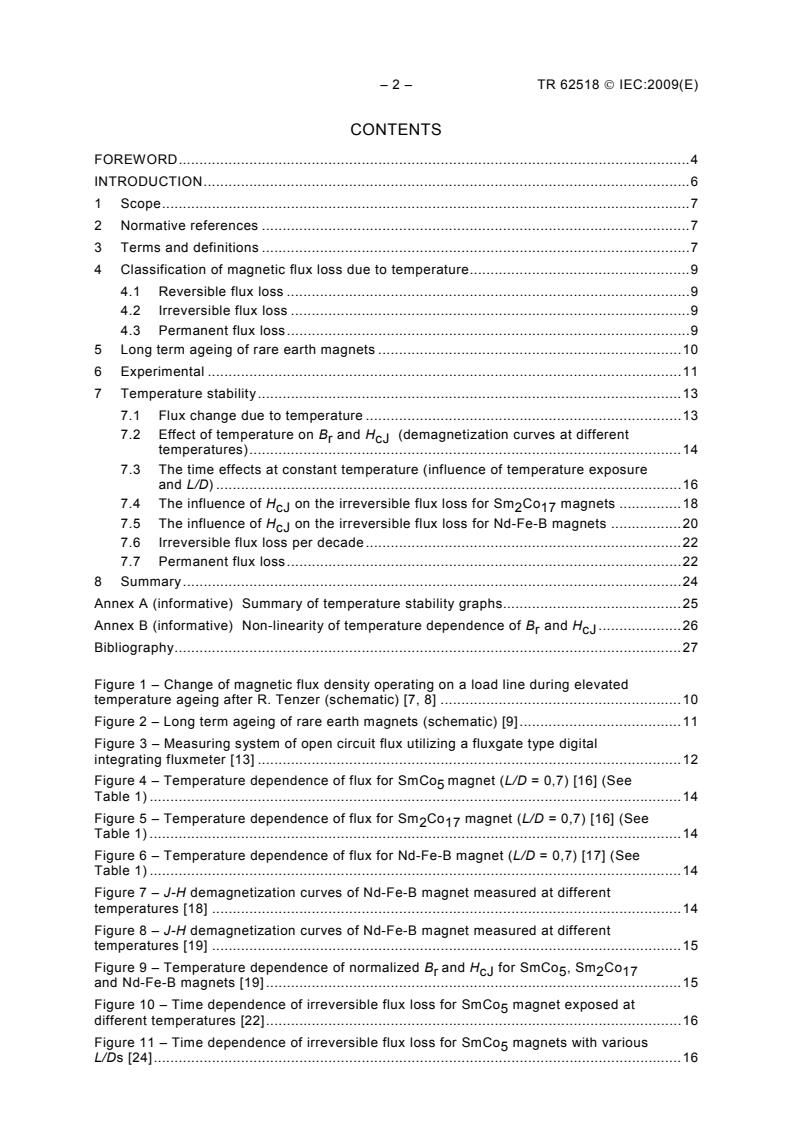
CONTENTS
FOREWORD.4
INTRODUCTION.6
1 Scope.7
2 Normative references .7
3 Terms and definitions .7
4 Classification of magnetic flux loss due to temperature.9
4.1 Reversible flux loss .9
4.2 Irreversible flux loss .9
4.3 Permanent flux loss.9
5 Long term ageing of rare earth magnets .10
6 Experimental .11
7 Temperature stability.13
7.1 Flux change due to temperature .13
7.2 Effect of temperature on B and H (demagnetization curves at different
r cJ
temperatures).14
7.3 The time effects at constant temperature (influence of temperature exposure
and L/D) .16
7.4 The influence of H on the irreversible flux loss for Sm Co magnets .18
cJ 2 17
7.5 The influence of H on the irreversible flux loss for Nd-Fe-B magnets .20
cJ
7.6 Irreversible flux loss per decade.22
7.7 Permanent flux loss.22
8 Summary.24
Annex A (informative) Summary of temperature stability graphs.25
Annex B (informative) Non-linearity of temperature dependence of B and H .26
r cJ
Bibliography.27
Figure 1 – Change of magnetic flux density operating on a load line during elevated
temperature ageing after R. Tenzer (schematic) [7, 8] .10
Figure 2 – Long term ageing of rare earth magnets (schematic) [9].11
Figure 3 – Measuring system of open circuit flux utilizing a fluxgate type digital
integrating fluxmeter [13] .
Figure 4 – Temperature dependence of flux for SmCo magnet (L/D = 0,7) [16] (See
Table 1) .14
Figure 5 – Temperature dependence of flux for Sm Co magnet (L/D = 0,7) [16] (See
2 17
Table 1) .14
Figure 6 – Temperature dependence of flux for Nd-Fe-B magnet (L/D = 0,7) [17] (See
Table 1) .
Figure 7 – J-H demagnetization curves of Nd-Fe-B magnet measured at different
temperatures [18] .14
Figure 8 – J-H demagnetization curves of Nd-Fe-B magnet measured at different
temperatures [19] .15
Figure 9 – Temperature dependence of normalized B and H for SmCo , Sm Co
r cJ 5 2 17
and Nd-Fe-B magnets [19] .
Figure 10 – Time dependence of irreversible flux loss for SmCo magnet exposed at
different temperatures [22].16
Figure 11 – Time dependence of irreversible flux loss for SmCo magnets with various
L/Ds [24].16
TR 62518 © IEC:2009(E) – 3 –
Figure 12 – Time dependence of irreversible flux loss for Sm Co magnet exposed at
2 17
different temperatures (Material 1) [22] .17
Figure 13 – Time dependence of irreversible flux loss for Sm Co magnets with
2 17
various L/Ds (Material 2) [24].17
Figure 14 – Time dependence of irreversible flux loss for Nd-Fe-B magnet exposed at
different temperatures [23].17
Figure 15 – Temperature dependence of irreversible flux loss after exposure for 100 h
for Nd-Fe-B magnets with various L/Ds [25] .17
Figure 16 – Time dependence of irreversible flux loss for a Sm Co magnet with H
2 17 cJ
= 0,48 MA/m and L/D = 0,7 [26] .19
Figure 17 – Time dependence of irreversible flux loss for a Sm Co magnet with H
2 17 cJ
= 1,19 MA/m and L/D = 0,7 [27] .19
Figure 18 – Time dependence of irreversible flux loss for a Sm Co magnet with H
2 17 cJ
= 1,97 MA/m and L/D = 0,7 [28] .19
Figure 19 – Time dependence of irreversible flux loss for a Nd-Fe-B magnet with H =
cJ
1,16 MA/m and L/D = 0,7 [30] .20
Figure 20 – Time dependence of irreversible flux loss for a Nd-Fe-B magnet with H =
cJ
1,66 MA/m and L/D = 0,7 [31] .20
Figure 21 – Time dependence of irreversible flux loss for a Nd-Fe-B magnet with H =
cJ
2,17 MA/m and L/D = 0,7 [32] .21
Figure 22 – Time dependence of irreversible flux loss for a Nd-Fe-B magnet with H =
cJ
2,45 MA/m and L/D = 0,7 [33] .21
Figure 23 – Comparison of irreversible flux loss for Sm Co magnets with different
2 17
H 21
cJ
Figure 24 – Comparison of irreversible flux loss for Nd-Fe-B magnets with different H .21
cJ
Figure 25 – Relationship between irreversible flux loss per decade and initial flux loss .23
Figure B.1 – Temperature dependence of normalized B and H to show the non-
r cJ
linearity (see data for Nd-Fe-B magnets in Figure 9) .26
Table 1 – Magnetic properties of the rare earth magnets employed for the open circuit
flux measurements to determine the reversible temperature coefficient of the magnetic
flux .13
Table 2 – Reversible temperature coefficient of the magnetic flux determined by
temperature cycling .13
Table 3 – Temperature coefficients of B and H for SmCo , Sm Co and Nd-Fe-B
r cJ 5 2 17
magnets (temperature range for the coefficient: 25 °C to 150 °C) .16
Table 4 – Magnetic properties of the specimens for the experiments to evaluate the
effects of temperature and L/D on irreversible flux loss.18
Table 5 – Magnetic properties of the Sm Co magnets for the experiment to evaluate
2 17
the influence of H on the irreversible flux loss .20
cJ
Table 6 – The magnetic properties of Nd-Fe-B magnets for the evaluation of the
influence of H on irreversible flux loss measured by a pulse recording fluxmeter .22
cJ
Table 7 – The permanent flux loss of Sm Co magnets after exposure for 1 000 h at
2 17
different temperatures.23
Table 8 – The permanent flux loss of Nd-Fe-B magnets after exposure for 1 000 h at
different temperatures.23
Table 9 – Basic magnetic properties of the three intermetallic compounds.24
Table A.1 – Summary of temperature stability graphs .25
– 4 – TR 62518 © IEC:2009(E)
INTERNATIONAL ELECTROTECHNICAL COMMISSION
____________
RARE EARTH SINTERED MAGNETS –
STABILITY OF THE MAGNETIC PROPERTIES
AT ELEVATED TEMPERATURES
FOREWORD
1) The International Electrotechnical Commission (IEC) is a worldwide organization for standardization comprising
all national electrotechnical committees (IEC National Committees). The object of IEC is to promote
international co-operation on all questions concerning standardization in the electrical and electronic fields. To
this end and in addition to other activities, IEC publishes International Standards, Technical Specifications,
Technical Reports, Publicly Available Specifications (PAS) and Guides (hereafter referred to as “IEC
Publication(s)”). Their preparation is entrusted to technical committees; any IEC National Committee interested
in the subject dealt with may participate in this preparatory work. International, governmental and non-
governmental organizations liaising with the IEC also participate in this preparation. IEC collaborates closely
with the International Organization for Standardization (ISO) in accordance with conditions determined by
agreement between the two organizations.
2) The formal decisions or agreements of IEC on technical matters express, as nearly as possible, an international
consensus of opinion on the relevant subjects since each technical committee has representation from all
interested IEC National Committees.
3) IEC Publications have the form of recommendations for international use and are accepted by IEC National
Committees in that sense. While all reasonable efforts are made to ensure that the technical content of IEC
Publications is accurate, IEC cannot be held responsible for the way in which they are used or for any
misinterpretation by any end user.
4) In order to promote international uniformity, IEC National Committees undertake to apply IEC Publications
transparently to the maximum extent possible in their national and regional publications. Any divergence
between any IEC Publication and the corresponding national or regional publication shall be clearly indicated in
the latter.
5) IEC provides no marking procedure to indicate its approval and cannot be rendered responsible for any
equipment declared to be in conformity with an IEC Publication.
6) All users should ensure that they have the latest edition of this publication.
7) No liability shall attach to IEC or its directors, employees, servants or agents including individual experts and
members of its technical committees and IEC National Committees for any personal injury, property damage or
other damage of any nature whatsoever, whether direct or indirect, or for costs (including legal fees) and
expenses arising out of the publication, use of, or reliance upon, this IEC Publication or any other IEC
Publications.
8) Attention is drawn to the Normative references cited in this publication. Use of the referenced publications is
indispensable for the correct application of this publication.
9) Attention is drawn to the possibility that some of the elements of this IEC Publication may be the subject of
patent rights. IEC shall not be held responsible for identifying any or all such patent rights.
The main task of IEC technical committees is to prepare International Standards. However, a
technical committee may propose the publication of a technical report when it has collected
data of a different kind from that which is normally published as an International Standard, for
example "state of the art".
IEC 62518, which is a technical report, has been prepared by IEC technical committee 68:
Magnetic alloys and steels.
The text of this technical report is based on the following documents:
Enquiry draft Report on voting
68/376/DTR 68/383/RVC
Full information on the voting for the approval of this technical report can be found in the
report on voting indicated in the above table.
TR 62518 © IEC:2009(E) – 5 –
This publication has been drafted in accordance with the ISO/IEC Directives, Part 2.
The committee has decided that the contents of this publication will remain unchanged until
the maintenance result date indicated on the IEC web site under "http://webstore.iec.ch" in
the data related to the specific publication. At this date, the publication will be
• reconfirmed,
• withdrawn,
• replaced by a revised edition, or
• amended.
A bilingual version of this publication may be issued at a later date.
– 6 – TR 62518 © IEC:2009(E)
INTRODUCTION
SmCo was the first sintered rare earth magnet to be developed (1967) [1] , followed by
Sm Co [2, 3, 4] and Nd-Fe-B [5]. These magnets are used in a wide variety of applications.
2 17
Recently, these magnets have been used in higher temperature applications such as in heavy
duty permanent magnet motors. For these high temperature applications, the temperature
stability of the permanent magnet has to be considered along with the design of the magnetic
circuit. This is particularly relevant for the relatively inexpensive Nd-Fe-B magnetic material
which has a comparatively low Curie temperature. The temperature stability of the rare earth
sintered magnets has a critical influence on the reliability of high temperature motors and this
will, in turn, contribute to energy savings in the future.
Therefore, the subject of this technical report will be of considerable interest to the
manufacturers of this type of motor and to the developers of permanent magnet materials.
—————————
The figures in square brackets refer to the Bibliography.
TR 62518 © IEC:2009(E) – 7 –
RARE EARTH SINTERED MAGNETS –
STABILITY OF THE MAGNETIC PROPERTIES
AT ELEVATED TEMPERATURES
1 Scope
The scope of this technical report is to describe the temperature behaviour of rare earth
sintered magnets in detail for use in designing magnetic circuits exposed to elevated
temperatures. The temperature behaviour of SmCo , Sm Co and Nd-Fe-B sintered magnets
5 2 17
is described.
The various changes of open circuit flux which can occur due to temperature are discussed in
Clause 4. The long term stability of the magnets is discussed in Clause 5. The experimental
procedures are described in Clause 6. Results of the measurements of the flux loss occurring
at the ambient temperature after heating isothermally at 50 °C, 75 °C, 100 °C, 125 °C, 150 °C
and 200 °C for up to 1000 h are given in Clause 7. The effect of length to diameter ratio (L/D)
of the magnet samples and the influence of H on the flux loss were also studied. The results
cJ
are discussed in Clause 8.
The data in this technical report was provided by the Institute of Electrical Engineers of Japan
(IEEJ) and its subcommittees. This data has been gathered from the members of these sub-
committees.
The temperature stability correlated with the complex corrosion behaviour and the spin re-
orientation phenomena at cryogenic temperatures will not be given in this technical report.
2 Normative references
IEC 60050-121, International Electrotechnical Vocabulary − Part 121: Electromagnetism
IEC 60050-151, International Electrotechnical Vocabulary − Part 151: Electrical and magnetic
devices
− Chapter 221: Magnetic
IEC 60050-221:1990, International Electrotechnical Vocabulary
materials and components
Amendment 1 (1993)
IEC 60404-8-1, Magnetic materials − Part 8-1: Specifications for individual materials −
Magnetically hard materials
3 Terms and definitions
For the purpose of this document, the following terms and definitions apply. In addition, most
of the technical terms used in this document are defined in IEC 60050-121, IEC 60050-151,
and IEC 60404-8-1(the product standard).
3.1
magnetic flux loss
the reduction due to an external influence, primarily temperature, in the flux of permanent
magnets in a magnetized state, unit of Wb. Three kinds of flux loss, reversible flux loss,
irreversible flux loss and permanent flux loss, are used to discuss the temperature stability of
rare earth sintered magnets.
– 8 – TR 62518 © IEC:2009(E)
3.2
reversible flux loss
a magnetization change which is recovered by the removal of a disturbing influence such as
temperature. Irreversible flux loss is the partial demagnetization change caused by the
temperature changes. The irreversible flux loss is fully recovered by remagnetization.
Permanent flux loss is caused by permanent change in the metallurgical state and is generally
time and temperature dependent. The permanent loss cannot be recovered to the initial
magnetization value by remagnetization.
3.3
uniformity field strength
H
k
the uniformity field strength (of a magnetically hard material) as defined in IEC 60050-221-02-
62 (Amendment 1 (1993)) was originally called “knee field” [6]. H is the negative value of the
k
magnetic field strength when the magnetic polarization of a magnetically hard material is
brought from saturation to 90 % of the value of the remanent magnetic polarization by a
monotonically changing magnetic field.
3.4
reversible temperature coefficient
the reversible temperature coefficient of magnetic flux is the percentage changes in flux
per degrees Celsius by the change in temperature, which is reversible. The temperature
coefficient is expressed as %/°C. The temperature range must be stated to make them
quantify. The reversible temperature coefficient of magnetic flux (denoted as α(φ)) is the
quotient of the percentage change of magnetic flux by that change in temperature:
α(φ)=(φ – φ )/ φ ・1/(θ – θ )
θ ref ref ref
where φ and φ are the flux at temperature θ and θ respectively.
θ ref ref
Generally rare earth sintered magnets exhibit a non-linear change of flux with temperature.
“Temperature coefficient of B (denoted as α(B ))” can be defined from the temperature
r r
dependence of B in the temperature range to have the quantitative values. The temperature
r
coefficient of B is the quotient of the relative change of B due to a change in temperature by
r r
that change in temperature:
α(B )=(B – B )/B B ・1/(θ – θ )
r rθrref rref rθ ref
where B and B are the B at temperature of θ and θ respectively. “Temperature
rθ rref r ref
coefficient of H (denoted as α(H ))” can be also defined as mentioned above.
cJ cJ
The revised evaluation method for temperature coefficients of B and H are given in IEC/TR
r cJ
61807(1999) in which the temperature dependence of B and H is expressed by a quadratic
r cJ
function of temperature, see Annex B. To define the “temperature coefficient” the temperature
range must be stated because of the non-linearity of the temperature dependence.
3.5
anisotropy field
H
A
the anisotropy field (denoted as H ) is the field required to rotate into the hard direction or the
A
field to saturate the material in the hard direction, and it is a measure of the anisotropy. The
relationship between H , K (crystalline anisotropy constant) and M (saturation
A u s
magnetization) is as follows:
=2K /μ M
H
A u 0 s
TR 62518 © IEC:2009(E) – 9 –
4 Classification of magnetic flux loss due to temperature
4.1 Reversible flux loss
The reversible change in the magnetic properties of rare earth magnets as a function of
temperature originates from the change in saturation magnetization. Reversible flux loss is a
magnetization change which is recovered by the removal of a disturbing influence such as
temperature.
4.2 Irreversible flux loss
With irreversible flux loss, after the removal of the disturbing influence, the magnetization
does not return to its original value. Examples of the disturbing influence are temperature
changes, local temperature fluctuations and magnetic fields. The irreversible flux loss is fully
recovered by remagnetization.
4.3 Permanent flux loss
Permanent flux loss is caused by a permanent change in the metallurgical state and is
generally time and temperature dependent. Examples are precipitation and growth, oxidation,
the annealing effects and radiation damage. The permanent flux loss cannot be recovered to
the initial magnetization value by remagnetization.
The various flux losses mentioned above are shown in Figure 1. The figures were
schematically presented by R. Tenzer [7, 8]. In Figure 1 the magnetic flux density B vs
temperature and demagnetization curves at various temperatures with a certain load line are
given to explain the three kinds of losses.
The curves in Figure 1(a) apply only for short temperature excursions, for example from 25°C
to θ °C. Magnetic flux density B changes reversibly along a demagnetization curve at various
temperatures. B (25) - B (θ) is called the “reversible flux loss”. This flux loss is fully
d d
recovered by returning the magnet to room temperature.
Curves in Figure 1(b) apply for larger temperature excursions. In this case a part of the flux
change will be recovered on cooling, B ’(25) - B ’(θ). The other part, B (25) - B ’(25), can be
d d d d
recovered by remagnetization and is called the “irreversible flux loss”.
When the exposure temperature exceeds several hundred degrees Celsius, changes in the
microstructure of the magnet, surface oxidation etc., cause an additional flux loss which will
no longer be recovered by remagnetization. B (25) - B ”(25) in Figure 1(c) is called the
d d
“permanent flux loss”. The reversible B vs θ closely reflects the temperature variation of
d
saturation magnetization and remanence. It is commonly approximated by a straight line and
is called “the reversible temperature coefficient”, see 3.4.
– 10 – TR 62518 © IEC:2009(E)
2525˚˚CC BB
BB
B/HB/H
BB ((25)25)
dd
°°
CC
θθ
BB (( ))
θθθθθθ BB (2(255))
dd
dd
BB (( ))
θθ
dd
°°
2525°°CC CC
θθ 00
HH
TTeemmperperaturaturee
(a(a) R) Reevveersirsibbllee e effffeect: ct: BB ”” (2(255)=)=BB ’’((25)25)==BB (2(255))
dd dd dd
BBB
2525˚˚CC
BBB
B/HB/H
BBB (((25)25)25)
ddd
°°
θθ CC
BBB ’’’(((25)25)25)
BBB (2(2(2555)))
ddd
ddd
BBB ’’’(2(2(2555)))
BB ’’(( ))
θθ ddd
dd
BBB ((( )))
θθθ
ddd
°° 000
252525°°°CCC CC
θθθθ
HHH
TTeemmperperaturaturee
””(2(255))==BB ((25)25)>>BB ’’(2(255))
(b(b) Ir) Irrerevveersirsibbllee e effffeecct: t: BB
dd dd dd
BB 2525˚˚CC
BB
((25)25)
BB
dd
B/HB/H
BB ”” ((25)25)
dd
BB ’’((25)25) BB (2(255))
dd
dd °°
θθ CC
BB ’’(( ))
θθ BB ”” (2(255))
dd
dd
BB ’’(2(255))
dd
BB ’’(( ))
θθθθ
dd
°° °° 00
2525 CC CC
θθ
HH
TTeemmperperaturaturee
((cc)) P Peerrmmaanent enent effecffect: t: BB ””((25)25) ≠≠BB ((25)25)
dd dd
IEC 382/09
Figure 1 – Change of magnetic flux density operating on a load line during elevated
temperature ageing after R. Tenzer (schematic) [7, 8]
5 Long term ageing of rare earth magnets
When a magnet is newly magnetized and the flux (open circuit flux or its operating-point
induction) is observed for a long period of time, a slow decay is found to occur. It usually
follows a time function. This behaviour is shown in Figure 2 schematically after K. J. Strnat [9].
The change can be separated into three stages. First, there is a relatively fast initial flux loss,
ab. This is followed by a long period of increasing stability, marked the “plateau”, bc, during
which there is often a constant irreversible flux loss per logarithmic time cycle on the plateau.
This time dependency of B on the plateau is proportional to log t (t is time) from the result of
the magnetic after-effect which was given by Street et al. [10]. To show this constant flux
change, the “irreversible flux loss per decade” [the flux change per decade (%/decade)] is
used. The irreversible flux loss per decade is the flux loss during the time period ranging from
1 h to 10 h, from 10 h to 100 h or from 100 h to 1 000 h.
At higher temperatures and for some magnets, the flux decline, cd, will later accelerate and is
sometimes catastrophic. This was observed very clearly for rare earth bonded magnets with
an improper surface treatment under harsh environment conditions. For rare earth sintered
magnets only small flux changes were observed. The temperature stability correlated with the
complex corrosion behaviour will not be given in this technical report.
TR 62518 © IEC:2009(E) – 11 –
IInnititial fial flluxux llooss: mss: maainlyinly magmagnneettic chanic changgee,,
rrecovecovererablable bye by rreemmaaggnenettiizziingng
aa
PlatPlateau: conseau: consttaanntt f flluxux loss loss peperr log logaarriitthhmmiicc
timetime cy cyclecle
B B (%)(%)
bb
Long tLong teerrmm insinsttabilabiliittyy
cc
dd
22 33
00 11 1010 1010 1010
TiTimeme (h (h)) IEC 383/09
Figure 2 – Long term ageing of rare earth magnets (schematic) [9]
6 Experimental
The dimensions of the specimens used are 10 mm in diameter and 12 mm in length (diameter:
D, L: length), D = 10 mm and L = 7 mm, D = 10 mm and L = 3 mm and D = 10 mm and L = 2
mm. The relationship between length to diameter ratio (L/D) and the permeance coefficient
(P ) for cylinders was obtained by Du-Xing Chen et al. [11]. The permeance coefficient is a
c
, to its self-demagnetisation field, H , P = B /μ H .
ratio of the magnetic flux density, B
d d c d 0 d
The initial magnetization was performed with a pulsed magnetic field of 4,1 MA/m to 4,5 MA/m
(5,1 T to 5,6 T). The rise time to the peak field was longer than 1 ms. The flux (open circuit
flux) was measured with a close fitting pickup coil and a digital integrating fluxmeter. Usually,
specimens were pulled out of the close fitting pickup coil. In this experiment, the coil was
fixed and specimens passed through the coil [12].
After measuring the flux in the initial state, specimens were kept in an oven with an air
atmosphere in which the temperature was controlled to ±1 °C. Specimens were placed in the
oven at a distance of 150 mm from each other to avoid magnetic interaction. During the long
term stability tests, the specimens were cooled to roo
...