

IEC 60404-1:2016
(Main)Magnetic materials - Part 1: Classification
General Information
- Abstract
IEC 60404-1:2016 is intended to classify commercially available magnetic materials. The term "magnetic materials" denotes substances where the application requires the existence of ferromagnetic or ferrimagnetic properties. The classification of magnetic materials is based upon the generally recognized existence of two main groups of products:
- soft magnetic materials (coercivity less than or equal to 1 000 A/m);
- hard magnetic materials (coercivity greater than 1 000 A/m). This edition includes the following significant technical changes with respect to the previous edition:
a) Removal of all tables and values describing typical properties of the material to be consistent with the aim of the document to be a classification and not a specification.
b) Enlargement of the Ni content for the classes E1 and E3.
c) Enlargement of the Co content for the classes F3.
d) Addition of a new class: U5 bonded rare earth-iron-nitrogen magnets.
- Status
- Published
- Publication Date
- 24-Jul-2025
- Technical Committee
- TC 68 - Magnetic alloys and steels
- Drafting Committee
- WG 1 - TC 68/WG 1
- Current Stage
- PPUB - Publication issued
- Start Date
- 24-Oct-2016
- Completion Date
- 31-Dec-2016
Buy Documents
IEC 60404-1:2016+AMD1:2025 CSV - Magnetic materials - Part 1: Classification Released:7/25/2025
IEC 60404-1:2016 - Magnetic materials - Part 1: Classification Released:10/24/2016
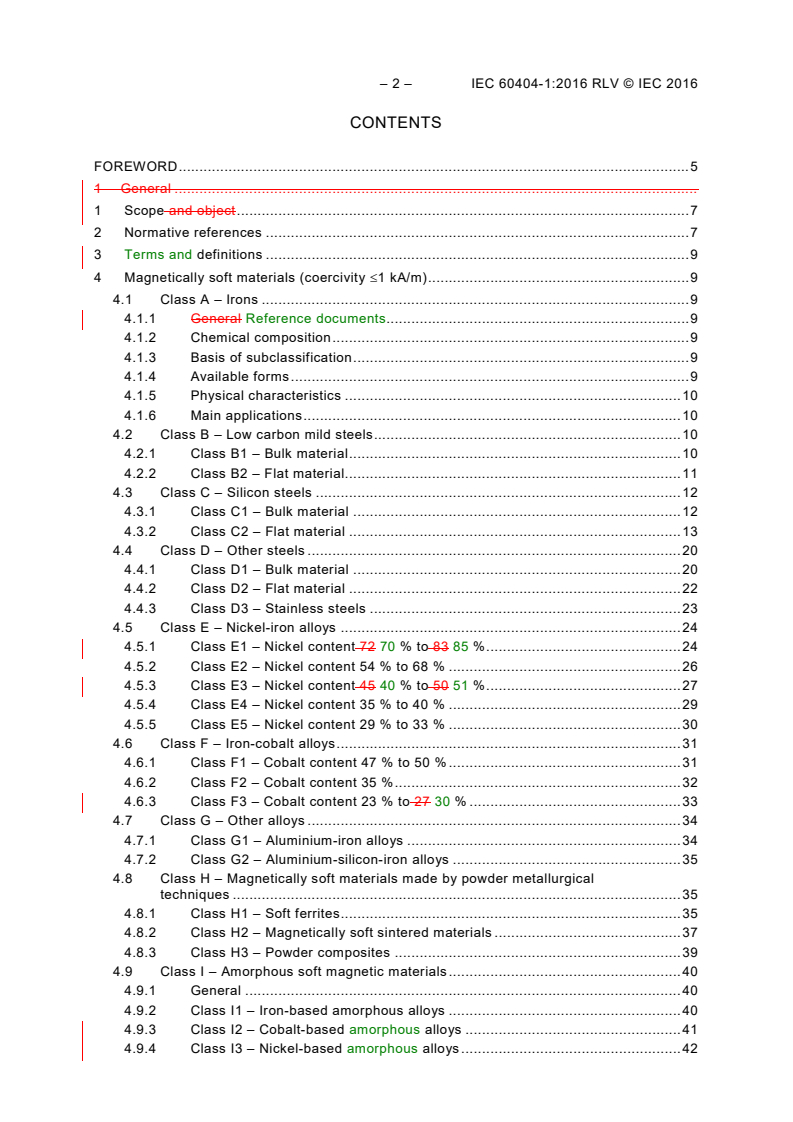
IEC 60404-1:2016 RLV - Magnetic materials - Part 1: Classification Released:10/24/2016
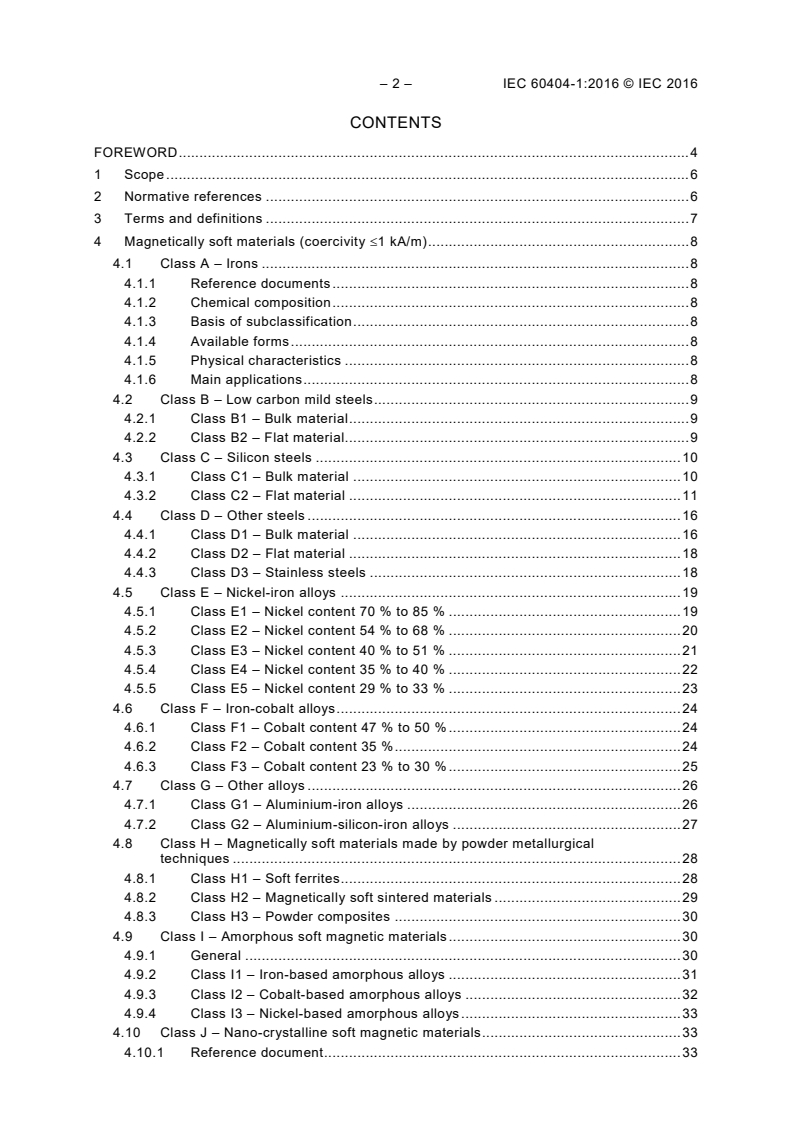
IEC 60404-1:2016 - Magnetic materials - Part 1: Classification Released:10/24/2016
Overview
IEC 60404-1:2016 - "Magnetic materials - Part 1: Classification" is an International Electrotechnical Commission (IEC) standard that defines a harmonized classification system for commercially available magnetic materials. The standard applies to materials used where ferromagnetic or ferrimagnetic properties are required and separates products into two principal groups based on coercivity:
- Soft magnetic materials (coercivity ≤ 1 000 A/m)
- Hard magnetic materials (coercivity > 1 000 A/m)
This 2016 edition emphasizes classification (what a material is) rather than specification (how it performs). Notable changes in this edition include removal of tables/values that described typical material properties to keep the document strictly a classification, adjustments to allowable compositional ranges for certain nickel- and cobalt-based classes, and the addition of a new bonded magnet class (bonded rare earth‑iron‑nitrogen, U5).
Key topics
- Classification scheme: Detailed class structure covering soft magnetic classes (A–J) and hard magnetic classes (Q–U), e.g., irons, low‑carbon steels, silicon steels, nickel‑iron and iron‑cobalt alloys, amorphous and nanocrystalline materials, hard ferrites, RE‑Fe‑B, AlNiCo and bonded magnet families.
- Coercivity threshold: The primary criterion separating soft and hard materials (1 kA/m).
- Chemical classing and subclassification: Materials are grouped by chemistry and processing route (bulk, flat, sintered, bonded).
- Forms and production methods: Identification of available product forms (strip, bulk, sintered, bonded) and relevant manufacturing routes (powder metallurgy, amorphous ribbon, nanocrystalline processing).
- Scope-focused content: The edition is focused on identification and class definitions rather than providing performance tables or specification limits.
Applications and users
IEC 60404-1 is useful to:
- Material manufacturers and suppliers for class labeling and product catalogs
- Design engineers specifying magnetic materials for transformers, inductors, motors, generators, sensors and actuators
- Procurement and standards teams to harmonize material terminology across contracts
- Test laboratories and certification bodies for material identification and reference
- R&D groups comparing material families (e.g., amorphous vs. nanocrystalline vs. ferrite vs. rare-earth magnets)
By using the standard, stakeholders ensure consistent naming and class-based selection of magnetic materials during design, purchasing and regulatory processes.
Related standards
IEC 60404-1 is the classification part of the IEC 60404 family. Other parts of the IEC 60404 series and related IEC documents address measurement methods, specifications, testing and application guidelines for magnetic materials and magnetic components. Use IEC 60404-1 for consistent terminology and class identification before consulting subsequent parts for test methods and performance specifications.
Keywords: IEC 60404-1, magnetic materials, classification, soft magnetic materials, hard magnetic materials, coercivity, bonded magnets, nickel‑iron, iron‑cobalt, rare‑earth magnets.
Relations
- Effective Date
- 05-Sep-2023
- Effective Date
- 05-Sep-2023
Buy Documents
IEC 60404-1:2016+AMD1:2025 CSV - Magnetic materials - Part 1: Classification Released:7/25/2025
IEC 60404-1:2016 - Magnetic materials - Part 1: Classification Released:10/24/2016
IEC 60404-1:2016 RLV - Magnetic materials - Part 1: Classification Released:10/24/2016
IEC 60404-1:2016 - Magnetic materials - Part 1: Classification Released:10/24/2016
Get Certified
Connect with accredited certification bodies for this standard

IMQ S.p.A. (Certification)
Italian electrical product certification.

SLG Prüf- und Zertifizierungs GmbH
German testing and certification body.

UL Solutions
Global safety science company with testing, inspection and certification.
Sponsored listings
Frequently Asked Questions
IEC 60404-1:2016 is a standard published by the International Electrotechnical Commission (IEC). Its full title is "Magnetic materials - Part 1: Classification". This standard covers: IEC 60404-1:2016 is intended to classify commercially available magnetic materials. The term "magnetic materials" denotes substances where the application requires the existence of ferromagnetic or ferrimagnetic properties. The classification of magnetic materials is based upon the generally recognized existence of two main groups of products: - soft magnetic materials (coercivity less than or equal to 1 000 A/m); - hard magnetic materials (coercivity greater than 1 000 A/m). This edition includes the following significant technical changes with respect to the previous edition: a) Removal of all tables and values describing typical properties of the material to be consistent with the aim of the document to be a classification and not a specification. b) Enlargement of the Ni content for the classes E1 and E3. c) Enlargement of the Co content for the classes F3. d) Addition of a new class: U5 bonded rare earth-iron-nitrogen magnets.
IEC 60404-1:2016 is intended to classify commercially available magnetic materials. The term "magnetic materials" denotes substances where the application requires the existence of ferromagnetic or ferrimagnetic properties. The classification of magnetic materials is based upon the generally recognized existence of two main groups of products: - soft magnetic materials (coercivity less than or equal to 1 000 A/m); - hard magnetic materials (coercivity greater than 1 000 A/m). This edition includes the following significant technical changes with respect to the previous edition: a) Removal of all tables and values describing typical properties of the material to be consistent with the aim of the document to be a classification and not a specification. b) Enlargement of the Ni content for the classes E1 and E3. c) Enlargement of the Co content for the classes F3. d) Addition of a new class: U5 bonded rare earth-iron-nitrogen magnets.
IEC 60404-1:2016 is classified under the following ICS (International Classification for Standards) categories: 29.030 - Magnetic materials. The ICS classification helps identify the subject area and facilitates finding related standards.
IEC 60404-1:2016 has the following relationships with other standards: It is inter standard links to IEC 60404-1:2016/AMD1:2025, IEC 60404-1:2000. Understanding these relationships helps ensure you are using the most current and applicable version of the standard.
IEC 60404-1:2016 is available in PDF format for immediate download after purchase. The document can be added to your cart and obtained through the secure checkout process. Digital delivery ensures instant access to the complete standard document.
Standards Content (Sample)
IEC 60404-1 ®
Edition 3.1 2025-07
INTERNATIONAL
STANDARD
CONSOLIDATED VERSION
Magnetic materials -
Part 1: Classification
ICS 29.030 ISBN 978-2-8327-0621-3
All rights reserved. Unless otherwise specified, no part of this publication may be reproduced or utilized in any form
or by any means, electronic or mechanical, including photocopying and microfilm, without permission in writing from
either IEC or IEC's member National Committee in the country of the requester. If you have any questions about IEC
copyright or have an enquiry about obtaining additional rights to this publication, please contact the address below or
your local IEC member National Committee for further information.
IEC Secretariat Tel.: +41 22 919 02 11
3, rue de Varembé info@iec.ch
CH-1211 Geneva 20 www.iec.ch
Switzerland
About the IEC
The International Electrotechnical Commission (IEC) is the leading global organization that prepares and publishes
International Standards for all electrical, electronic and related technologies.
About IEC publications
The technical content of IEC publications is kept under constant review by the IEC. Please make sure that you have the
latest edition, a corrigendum or an amendment might have been published.
IEC publications search - IEC Products & Services Portal - products.iec.ch
webstore.iec.ch/advsearchform Discover our powerful search engine and read freely all the
The advanced search enables to find IEC publications by publications previews, graphical symbols and the glossary.
a variety of criteria (reference number, text, technical With a subscription you will always have access to up to
committee, …). It also gives information on projects, date content tailored to your needs.
replaced and withdrawn publications.
Electropedia - www.electropedia.org
The world's leading online dictionary on electrotechnology,
IEC Just Published - webstore.iec.ch/justpublished
Stay up to date on all new IEC publications. Just containing more than 22 500 terminological entries in
Published details all new publications released. Available English and French, with equivalent terms in 25 additional
online and once a month by email. languages. Also known as the International Electrotechnical
Vocabulary (IEV) online.
IEC Customer Service Centre - webstore.iec.ch/csc
If you wish to give us your feedback on this publication or
need further assistance, please contact the Customer
Service Centre: sales@iec.ch.
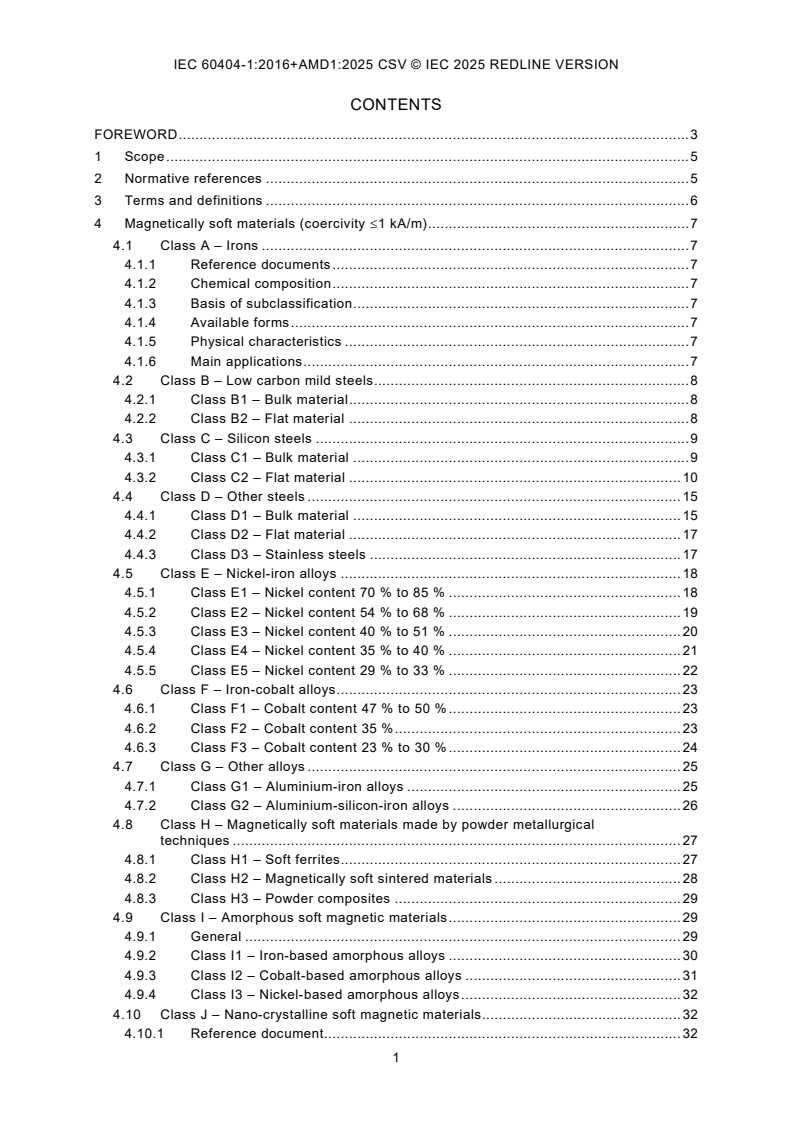
CONTENTS
FOREWORD . 3
1 Scope . 5
2 Normative references . 5
3 Terms and definitions . 6
4 Magnetically soft materials (coercivity ≤1 kA/m) . 7
4.1 Class A – Irons . 7
4.1.1 Reference documents . 7
4.1.2 Chemical composition . 7
4.1.3 Basis of subclassification . 7
4.1.4 Available forms . 7
4.1.5 Physical characteristics . 7
4.1.6 Main applications . 7
4.2 Class B – Low carbon mild steels . 8
4.2.1 Class B1 – Bulk material . 8
4.2.2 Class B2 – Flat material . 8
4.3 Class C – Silicon steels . 9
4.3.1 Class C1 – Bulk material . 9
4.3.2 Class C2 – Flat material . 10
4.4 Class D – Other steels . 15
4.4.1 Class D1 – Bulk material . 15
4.4.2 Class D2 – Flat material . 17
4.4.3 Class D3 – Stainless steels . 17
4.5 Class E – Nickel-iron alloys . 18
4.5.1 Class E1 – Nickel content 70 % to 85 % . 18
4.5.2 Class E2 – Nickel content 54 % to 68 % . 19
4.5.3 Class E3 – Nickel content 40 % to 51 % . 20
4.5.4 Class E4 – Nickel content 35 % to 40 % . 21
4.5.5 Class E5 – Nickel content 29 % to 33 % . 22
4.6 Class F – Iron-cobalt alloys . 23
4.6.1 Class F1 – Cobalt content 47 % to 50 % . 23
4.6.2 Class F2 – Cobalt content 35 % . 23
4.6.3 Class F3 – Cobalt content 23 % to 30 % . 24
4.7 Class G – Other alloys . 25
4.7.1 Class G1 – Aluminium-iron alloys . 25
4.7.2 Class G2 – Aluminium-silicon-iron alloys . 26
4.8 Class H – Magnetically soft materials made by powder metallurgical
techniques . 27
4.8.1 Class H1 – Soft ferrites . 27
4.8.2 Class H2 – Magnetically soft sintered materials . 28
4.8.3 Class H3 – Powder composites . 29
4.9 Class I – Amorphous soft magnetic materials . 29
4.9.1 General . 29
4.9.2 Class I1 – Iron-based amorphous alloys . 30
4.9.3 Class I2 – Cobalt-based amorphous alloys . 31
4.9.4 Class I3 – Nickel-based amorphous alloys . 32
4.10 Class J – Nano-crystalline soft magnetic materials . 32
4.10.1 Reference document. 32
4.10.2 Production process . 32
4.10.3 Chemical composition . 33
4.10.4 Basis of subclassification . 33
4.10.5 Available forms . 33
4.10.6 Physical characteristics . 33
4.10.7 Main applications . 33
5 Magnetically hard materials (coercivity > 1 kA/m) . 34
5.1 Class Q – Magnetostrictive alloys – Rare earth iron alloys (Class Q1) . 34
5.1.1 Reference document. 34
5.1.2 Chemical composition . 34
5.1.3 Basis of subclassification . 34
5.1.4 Available forms . 34
5.1.5 Physical characteristics . 34
5.1.6 Main applications . 34
5.2 Class R – Magnetically hard alloys. 34
5.2.1 Class R1 – Aluminium-nickel-cobalt-iron-titanium (AlNiCo) alloys . 34
5.2.2 Class R3 – Iron-cobalt-vanadium-chromium (FeCoVCr) alloys . 35
5.2.3 Class R5 – Rare earth cobalt (RECo) alloys . 36
5.2.4 Class R6 – Chromium-iron-cobalt (CrFeCo) alloys . 37
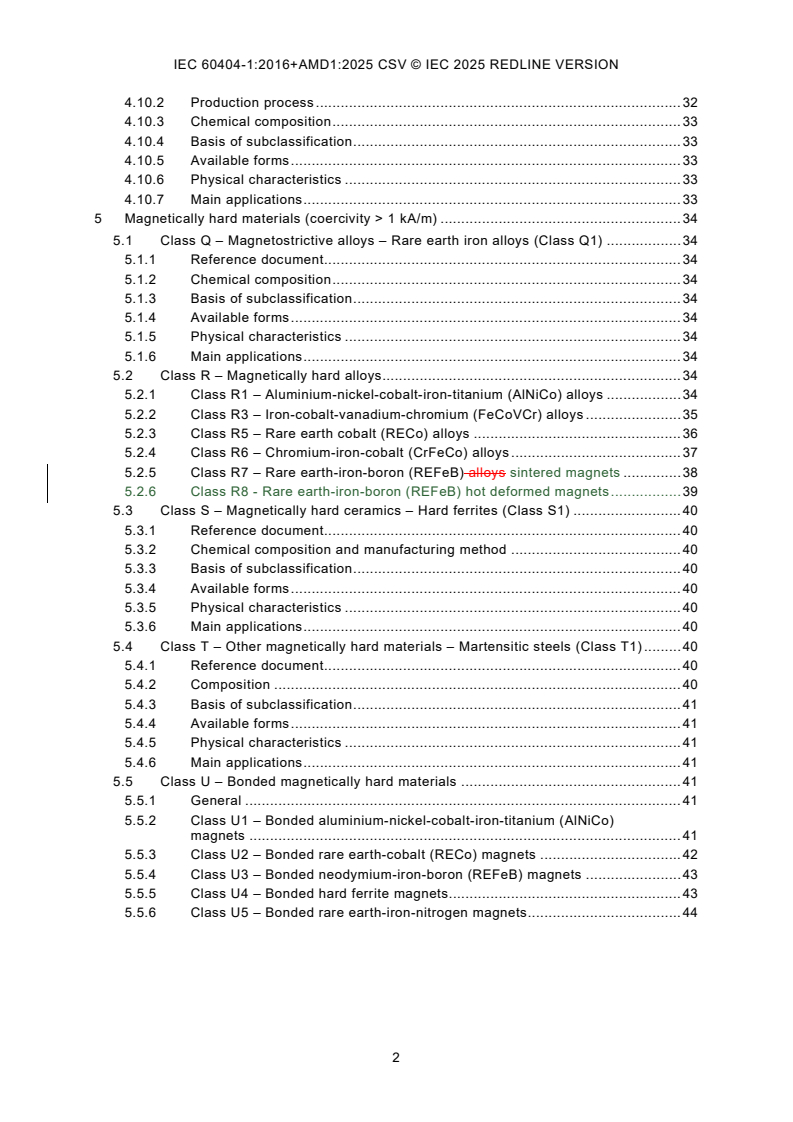
5.2.5 Class R7 – Rare earth-iron-boron (REFeB) alloys sintered magnets . 38
5.2.6 Class R8 - Rare earth-iron-boron (REFeB) hot deformed magnets . 39
5.3 Class S – Magnetically hard ceramics – Hard ferrites (Class S1) . 40
5.3.1 Reference document. 40
5.3.2 Chemical composition and manufacturing method . 40
5.3.3 Basis of subclassification . 40
5.3.4 Available forms . 40
5.3.5 Physical characteristics . 40
5.3.6 Main applications . 40
5.4 Class T – Other magnetically hard materials – Martensitic steels (Class T1) . 40
5.4.1 Reference document. 40
5.4.2 Composition . 40
5.4.3 Basis of subclassification . 41
5.4.4 Available forms . 41
5.4.5 Physical characteristics . 41
5.4.6 Main applications . 41
5.5 Class U – Bonded magnetically hard materials . 41
5.5.1 General . 41
5.5.2 Class U1 – Bonded aluminium-nickel-cobalt-iron-titanium (AlNiCo)
magnets . 41
5.5.3 Class U2 – Bonded rare earth-cobalt (RECo) magnets . 42
5.5.4 Class U3 – Bonded neodymium-iron-boron (REFeB) magnets . 43
5.5.5 Class U4 – Bonded hard ferrite magnets. 43
5.5.6 Class U5 – Bonded rare earth-iron-nitrogen magnets . 44
INTERNATIONAL ELECTROTECHNICAL COMMISSION
____________
Magnetic materials -
Part 1: Classification
FOREWORD
1) The International Electrotechnical Commission (IEC) is a worldwide organization for standardization comprising
all national electrotechnical committees (IEC National Committees). The object of IEC is to promote
international co-operation on all questions concerning standardization in the electrical and electronic fields. To
this end and in addition to other activities, IEC publishes International Standards, Technical Specifications,
Technical Reports, Publicly Available Specifications (PAS) and Guides (hereafter referred to as "IEC
Publication(s)"). Their preparation is entrusted to technical committees; any IEC National Committee interested
in the subject dealt with may participate in this preparatory work. International, governmental and non-
governmental organizations liaising with the IEC also participate in this preparation. IEC collaborates closely
with the International Organization for Standardization (ISO) in accordance with conditions determined by
agreement between the two organizations.
2) The formal decisions or agreements of IEC on technical matters express, as nearly as possible, an international
consensus of opinion on the relevant subjects since each technical committee has representation from all
interested IEC National Committees.
3) IEC Publications have the form of recommendations for international use and are accepted by IEC National
Committees in that sense. While all reasonable efforts are made to ensure that the technical content of IEC
Publications is accurate, IEC cannot be held responsible for the way in which they are used or for any
misinterpretation by any end user.
4) In order to promote international uniformity, IEC National Committees undertake to apply IEC Publications
transparently to the maximum extent possible in their national and regional publications. Any divergence
between any IEC Publication and the corresponding national or regional publication shall be clearly indicated in
the latter.
5) IEC itself does not provide any attestation of conformity. Independent certification bodies provide conformity
assessment services and, in some areas, access to IEC marks of conformity. IEC is not responsible for any
services carried out by independent certification bodies.
6) All users should ensure that they have the latest edition of this publication.
7) No liability shall attach to IEC or its directors, employees, servants or agents including individual experts and
members of its technical committees and IEC National Committees for any personal injury, property damage or
other damage of any nature whatsoever, whether direct or indirect, or for costs (including legal fees) and
expenses arising out of the publication, use of, or reliance upon, this IEC Publication or any other IEC
Publications.
8) Attention is drawn to the Normative references cited in this publication. Use of the referenced publications is
indispensable for the correct application of this publication.
9) IEC draws attention to the possibility that the implementation of this document may involve the use of (a)
patent(s). IEC takes no position concerning the evidence, validity or applicability of any claimed patent rights in
respect thereof. As of the date of publication of this document, IEC had not received notice of (a) patent(s),
which may be required to implement this document. However, implementers are cautioned that this may not
represent the latest information, which may be obtained from the patent database available at
https://patents.iec.ch. IEC shall not be held responsible for identifying any or all such patent rights.
This consolidated version of the official IEC Standard and its amendment has been prepared
for user convenience.
IEC 60404-1 edition 3.1 contains the third edition (2016-10) [documents 68/533/CDV and
68/555/RVC] and its amendment 1 (2025-07) [documents 68/780/CDV and 68/791A/RVC].
In this Redline version, a vertical line in the margin shows where the technical content is
modified by amendment 1. Additions are in green text, deletions are in strikethrough red text.
A separate Final version with all changes accepted is available in this publication.
International Standard IEC 60404-1 has been prepared by IEC technical committee 68:
Magnetic alloys and steels.
This bilingual version (2017-12) corresponds to the monolingual English version, published in
2016-10.
This third edition cancels and replaces the second edition published in 2000 and constitutes a
technical revision.
This edition includes the following significant technical changes with respect to the previous
edition:
a) Removal of all tables and values describing typical properties of the material to be
consistent with the aim of the document to be a classification and not a specification.
b) Enlargement of the Ni content for the classes E1 and E3.
c) Enlargement of the Co content for the classes F3.
d) Addition of a new class: U5 bonded rare earth-iron-nitrogen magnets.
The text of this standard is based on the following documents:
CDV Report on voting
68/533/CDV 68/555/RVC
Full information on the voting for the approval of this International Standard can be found in
the report on voting indicated in the above table.
The French version of this standard has not been voted upon.
This document has been drafted in accordance with the ISO/IEC Directives, Part 2.
A list of all parts in the IEC 60404 series, published under the general title Magnetic
materials, can be found on the IEC website.
The committee has decided that the contents of this document and its amendment will remain
unchanged until the stability date indicated on the IEC website under webstore.iec.ch in the
data related to the specific document. At this date, the document will be
• reconfirmed,
• withdrawn, or
• revised.
1 Scope
This part of IEC 60404 is intended to classify commercially available magnetic materials.
The term "magnetic materials" denotes substances where the application requires the
existence of ferromagnetic or ferrimagnetic properties.
In this document, the classification of magnetic materials is based upon the generally
recognized existence of two main groups of products:
• soft magnetic materials (coercivity ≤1 000 A/m);
• hard magnetic materials (coercivity >1 000 A/m).
Within these main groups, the classification when appropriate recognizes the following
characteristics:
• the main alloying element and the metallurgical state and physical properties of the
material;
• when possible and convenient, the relationship between these characteristics is identified.
A classification by specific areas of application cannot be applied to all materials because
different materials can very often be used for the same application depending on the
characteristics required.
2 Normative references
The following documents are referred to in the text in such a way that some or all of their
content constitutes requirements of this document. For dated references, only the edition
cited applies. For undated references, the latest edition of the referenced document (including
any amendments) applies.
IEC 60050-121, International Electrotechnical Vocabulary – Part 121: Electromagnetism
IEC 60050-151, International Electrotechnical Vocabulary – Part 151: Electrical and magnetic
devices
IEC 60050-221, International Electrotechnical Vocabulary – Chapter 221: Magnetic materials
and components
IEC 60401-3, Terms and nomenclature for cores made of magnetically soft ferrites – Part 3:
Guidelines on the format of data appearing in manufacturers catalogues of transformer and
inductor cores
IEC 60404-2, Magnetic materials – Part 2: Methods of measurement of the magnetic
properties of electrical steel sheet and strip by means of an Epstein frame
IEC 60404-3, Magnetic materials – Part 3: Methods of measurement of the magnetic
properties of magnetic sheet and strip by means of a single sheet tester
IEC 60404-4, Magnetic materials – Part 4: Methods of measurement of d.c. magnetic
properties of iron and steel
IEC 60404-6, Magnetic materials – Part 6: Methods of measurement of the magnetic
properties of magnetically soft metallic and powder materials at frequencies in the range
20 Hz to 200 kHz by the use of ring specimens
IEC 60404-7, Magnetic materials – Part 7: Method of measurement of the coercivity of
magnetic materials in an open magnetic circuit
IEC 60404-8-1, Magnetic materials – Part 8-1: Specifications for individual materials –
Magnetically hard materials
IEC 60404-8-3, Magnetic materials – Part 8-3: Specifications for individual materials – Cold-
rolled electrical non-alloyed and alloyed steel sheet and strip delivered in the semi-processed
state
IEC 60404-8-4, Magnetic materials – Part 8-4: Specifications for individual materials – Cold-
rolled non-oriented electrical steel strip and sheet delivered in the fully-processed state
IEC 60404-8-5, Magnetic materials – Part 8: Specifications for individual materials –
Section Five: Specification for steel sheet and strip with specified mechanical properties and
magnetic permeability
IEC 60404-8-6, Magnetic materials – Part 8-6: Specifications for individual materials – Soft
magnetic metallic materials
IEC 60404-8-7, Magnetic materials – Part 8-7: Specifications for individual materials –Cold-
rolled grain-oriented electrical steel strip and sheet delivered in the fully processed state
IEC 60404-8-8, Magnetic materials – Part 8: Specifications for individual materials –
Section 8: Specification for thin magnetic steel strip for use at medium frequencies
IEC 60404-8-9, Magnetic materials – Part 8: Specifications for individual materials –
Section 9: Standard specification for sintered soft magnetic materials
IEC 60404-8-10, Magnetic materials – Part 8-10: Specifications for individual materials –
Magnetic materials (iron and steel) for use in relays
IEC 60404-8-11, Magnetic materials - Part 8-11: Specifications for individual materials - Fe-
based amorphous strip delivered in the semi-processed state
IEC 60404-10, Magnetic materials – Part 10: Methods of measurement of magnetic properties
of magnetic sheet and strip at medium frequencies
ISO 4948-1, Steels – Classification – Part 1: Classification of steels into unalloyed and alloy
steels based on chemical composition
3 Terms and definitions
For the purposes of this document, the terms and definitions given in IEC 60050-121,
IEC 60050-151, IEC 60050-221 and in the product standards of the IEC 60404-8 series apply.
ISO and IEC maintain terminological databases for use in standardization at the following
addresses:
• IEC Electropedia: available at http://www.electropedia.org/
• ISO Online browsing platform: available at http://www.iso.org/obp
4 Magnetically soft materials (coercivity ≤1 kA/m)
4.1 Class A – Irons
4.1.1 Reference documents
These materials are covered by IEC 60404-8-6 and IEC 60404-8-10.
4.1.2 Chemical composition
The basic constituent of these materials is pure iron, and they are often referred to as
"commercially pure" or "magnetically soft" irons. The material also contains unavoidable
impurities that may affect magnetic properties. The amount of impurities that adversely affect
the remanence, coercivity, saturation, magnetic polarization and stability of the magnetic
properties are limited to produce the required magnetic properties for the proposed
application. For information the most significant impurities when they are present in these
materials are carbon (up to 0,03 %), silicon (up to 0,1 %), manganese (up to 0,2 %),
phosphorus (up to 0,015 %), sulphur (up to 0,03 %), aluminium (up to 0,08 %), titanium (up to
0,1 %) and vanadium (up to 0,1 %).
NOTE For improved free machining capability, the amount of phosphorus and sulphur can be higher than
indicated above.
4.1.3 Basis of subclassification
The recommended subclassification is based on coercivity values.
4.1.4 Available forms
These materials are available in a wide variety of forms. They may be supplied as slabs,
billets, ingots or forgings; as hot-rolled bar in rectangular and square cross-sections; as hot-
rolled wire rod in round, hexagonal and octagonal cross-sections; in cold-rolled and drawn
forms as bar and wire; as hot- or cold-rolled sheet and strip.
4.1.5 Physical characteristics
In addition to the values of coercivity, a more complete definition of these materials can be
based on the following characteristics:
saturation magnetic polarization, magnetic polarization at various
• magnetic:
values of magnetic field strength (from which permeability can be
derived), stability of characteristics with time;
• mechanical: hardness, suitability for punching operations, free machining
capability, deep drawing properties, tensile strength;
• metallurgical state: hot- or cold-worked, forged, deep drawn, fully processed state, i.e.
final annealed.
NOTE For material not delivered in the fully processed state, subclassification is based on the coercivity
measured after heat treatment according to the requirements of the product standard or the recommendations of
the manufacturer.
Ranges of specified values for the above-mentioned magnetic characteristics in the fully
processed state are given in the corresponding product specifications.
4.1.6 Main applications
The main applications are in DC relays, loudspeakers, electromagnets, magnetic clutches,
brakes, parts for magnetic circuits in instruments and control apparatus, as well as for pole
pieces and other DC parts for generators and motors.
4.2 Class B – Low carbon mild steels
4.2.1 Class B1 – Bulk material
4.2.1.1 Reference document
Some of these materials are covered by IEC 60404-8-10.
4.2.1.2 Chemical composition
The basic constituent of these materials is iron containing unavoidable impurities, together
with a low level of other elements which may arise from additions necessitated during the
manufacturing process. The amount of alloying elements is limited to that of a non-alloy steel
as defined in ISO 4948-1, in particular silicon is less than 0,5 %.
4.2.1.3 Basis of subclassification
The recommended subclassification is based on the coercivity.
4.2.1.4 Available forms
These materials are normally supplied in the form of castings or forgings in a final heat-
treated condition or partially machined to drawings supplied by the user or as bar, wire rod or
wire in the hot-rolled, cold-rolled or cold-drawn condition.
4.2.1.5 Physical characteristics
In addition to the coercivity a more complete definition of these materials can be based on the
following properties:
• magnetic: magnetic polarization at various values of magnetic field strength;
yield strength (or 0,2 % proof stress) elongation (L = 5 d ),
• mechanical:
o o
freedom from defects;
hot- or cold-worked, annealed to produce required magnetic
• metallurgical state:
characteristics.
Mechanical and non-destructive tests are made in accordance with the appropriate
ISO standards. Coercivity shall be measured in accordance with IEC 60404-7, other magnetic
properties in accordance with IEC 60404-4.
Ranges of typical values of magnetic and mechanical properties are given in the
corresponding product specification.
4.2.1.6 Main applications
The materials are used for large DC magnets where no mechanical strength is required, for
example, in deflection magnets in elementary particle physics and for relay applications.
4.2.2 Class B2 – Flat material
4.2.2.1 Reference documents
These materials are covered by IEC 60404-8-3, IEC 60404-8-4 and IEC 60404-8-10.
4.2.2.2 Chemical composition
The basic constituent of these materials is iron containing unavoidable impurities, together
with a low level of other elements which may arise from additions necessitated during the
manufacturing process. The amount of alloying elements is limited to that of non-alloy steel as
defined in ISO 4948-1, in particular silicon is less than 0,5 %. These materials can have an
annealing treatment after punching to enhance their magnetic properties.
4.2.2.3 Basis of subclassification
The recommended subclassification is based either on the specific total loss which is a
function of thickness and is normally measured at a magnetic polarization value of 1,5 T and
at normal industrial power frequencies or (for relay application) on the coercivity.
4.2.2.4 Available forms
These materials are supplied in the form of cold-rolled coils or sheets or (for relay application)
in the form of hot-rolled strip, sheet or plate.
4.2.2.5 Physical characteristics
In addition to specific total loss, a more complete definition of these materials can be based
on the following properties:
magnetic polarization at various values of magnetic field strength;
• magnetic:
suitability for punching operations, surface condition, stacking
• mechanical:
factor;
hot-rolled; hard state – i.e. cold-rolled; semi-processed state – i.e.
• metallurgical state:
annealed and finally cold-rolled;
fully processed state – i.e. final annealed.
NOTE For material delivered in the hard or semi-processed state, subclassification is based on the total specific
loss or coercivity measured after heat treatment according to the requirements of the product standard or
recommendations of the manufacturer.
thickness, width and (as required) length.
• dimensions:
Recommended nominal thicknesses for the cold-rolled materials are given in the
corresponding product specifications.
Magnetic measurements are made in accordance with IEC 60404-2, IEC 60404-3 or
IEC 60404-7.
Ranges of specified values of maximum specific total loss, after annealing, for the commonly
used thicknesses are also shown in the corresponding product specifications.
The specified maximum value of coercivity for relay material ranges from 40 A/m to 240 A/m.
4.2.2.6 Main applications
The materials are used in the manufacture of laminated cores for electrical apparatus and
especially small machines and for relay applications.
4.3 Class C – Silicon steels
4.3.1 Class C1 – Bulk material
4.3.1.1 Reference documents
Some of these materials are covered by IEC 60404-8-6 and IEC 60404-8-10.
4.3.1.2 Chemical composition
The basic constituent of these materials is iron in which the main alloying element is silicon
with a content of up to approximately 5 %.
4.3.1.3 Basis of subclassification
The recommended subclassification is based on coercivity values or on electrical resistivity
which is a function of silicon content.
4.3.1.4 Available forms
These materials are available as hot-rolled and cold-drawn bar, wire, ground bar and forging
billets and require heat treatment after mechanical working to achieve the required magnetic
properties.
4.3.1.5 Physical characteristics
In addition to the coercivity and the electrical resistivity, a more complete definition of these
materials can be based on the following characteristics:
• magnetic: saturation magnetic polarization, magnetic polarization at various
values of magnetic field strength, remanent magnetic polarization;
machinability, ductility, hardness;
• mechanical:
hot- or cold-worked, annealed to produce required magnetic
• metallurgical state:
characteristics.
4.3.1.6 Main applications
The main applications are for the magnetic circuits of relays, magnetic clutches, magnetic
pole pieces, stepping motors and gyro housings.
4.3.2 Class C2 – Flat material
4.3.2.1 Class C21 – Isotropic (non-oriented) steels for use at power frequencies
4.3.2.1.1 Reference documents
These materials are covered by IEC 60404-8-3, IEC 60404-8-4, IEC 60404-8-6 and
IEC 60404-8-10.
4.3.2.1.2 Chemical composition
The basic constituent of these materials is iron. The main alloying element is silicon, whose
content may be up to approximately 5 %. Other alloying elements, for example aluminium,
may also be present. The material also contains unavoidable impurities, together with a low
level of other elements which may arise from additions necessitated during the manufacturing
process.
4.3.2.1.3 Basis of subclassification
The recommended subclassification is based on the specific total loss which is a function of
thickness and normally measured at a magnetic polarization value of 1,5 T and at power
frequencies.
When the application demands it (for example relays), it may be more appropriate for the
subclassification to be based on coercivity or permeability.
___________
This describes a material which is substantially isotropic and deliberately processed to be so.
4.3.2.1.4 Available forms
These materials are normally supplied in the form of cold-rolled coils or sheets.
4.3.2.1.5 Physical characteristics
In addition to the values of specific total loss, a more complete definition of these materials
can be based on the following characteristics:
magnetic polarization at various values of magnetic field strength,
• magnetic:
specific apparent power for different values of magnetic polarization
anisotropy of loss;
type of surface insulation and its resistance, resistivity;
• electrical:
suitability for punching operations, ductility, tensile strength,
• mechanical:
hardness, surface condition and finish, stacking factor, flatness,
edge camber;
hard state, i.e. as cold rolled semi-processed state, i.e. annealed or
• metallurgical state:
annealed and temper rolled; fully-processed state, i.e. final
annealed;
NOTE For material delivered in the hard or semi-processed state, the subclassification is based on the specific
total losses measured after heat treatment according to the requirements of the product standard or the
recommendations of the manufacturer.
• dimensions: thickness, width and (as required) length.
The values of nominal thickness are given in the corresponding product specifications.
Magnetic measurements are made in accordance with IEC 60404-2 or IEC 60404-3. The
density values to be used for magnetic measurements should be as defined in the relevant
product standard. In other cases, the density values should be the subject of agreement.
Ranges of specified values of specific total loss, after final annealing, for four commonly used
thicknesses are shown in the corresponding product specifications.
4.3.2.1.6 Main application
These materials are used mainly in the magnetic circuits of electrical apparatus, particularly in
the parts of rotating machines in which the flux is not unidirectional. They may also be used
in electromagnetic relays, small transformers, chokes for fluorescent tubes, electrical meters,
shielding and magnetic poles of electron and proton synchrotrons.
4.3.2.2 Class C22 – Anisotropic (oriented) steels for use at power frequencies
4.3.2.2.1 Reference documents
These materials are covered by IEC 60404-8-6, IEC 60404-8-7 and IEC 60404-8-8.
4.3.2.2.2 Chemical composition
The basic constituent of these materials is iron and the main alloying element is silicon
(approximately 3 %), together with unavoidable impurities and low levels of other elements
which may arise from additions necessitated during the manufacturing process. This type of
magnetic material possesses anisotropic properties (orientation) such that the direction
parallel to the axis of rolling shows the lowest values of specific total losses and the highest
permeability. These properties are sensitive to mechanical treatment, and stress relief
annealing may be used to optimize the inherent properties.
___________
This describes a material which is substantially anisotropic and deliberately processed to be so.
4.3.2.2.3 Basis of subclassification
The recommended subclassification is based on the perfection of crystal orientation
expressed by the magnetic polarization for a magnetic field strength of 800 A/m and on the
specific total loss, which is a function of thickness and of the orientation, and is normally
measured at magnetic polarization values of 1,5 T or 1,7 T and at power frequencies.
With the revision of IEC 60404-8-7 in 2020, an additional subclassification has been
introduced in order to distinguish between high-permeability grades with and without magnetic
domain refinement.
4.3.2.2.4 Available forms
These materials are normally supplied in the form of cold-rolled coils or sheets having an
inorganic insulating coating.
4.3.2.2.5 Physical characteristics
In addition to the perfection of crystal orientation and to the values of specific total loss, a
more complete definition of these materials can be based on the following characteristics:
magnetic polarization at various values of magnetic field strength;
• magnetic:
whether or not the material has been treated with a technology for
• Domain Refined
(DR) state: magnetic domain refinement;
• electrical: type of surface insulation and its resistance, resistivity;
ductility, surface condition and finish, stacking factor, flatness, edge
• mechanical:
camber;
annealed and fully recrystallized;
• metallurgical state:
thickness, width and (if required) length.
• dimensions:
The values of nominal thickness normally used are given in the corresponding product
specifications.
Magnetic measurements are made in accordance with IEC 60404-2 or IEC 60404-3. The
density used for calculations is normally 7,65 kg/dm³ and test pieces are taken parallel to the
axis of rolling and, before measurement, undergo stress relief annealing in accordance with
the recommendations of the manufacturer.
Ranges of specified values of maximum specific total loss, after stress relief annealing, for the
normally used thicknesses are also shown in the corresponding product specifications.
NOTE According to IEC 60404-8-7, the magnetic properties of non-heatproof magnetic domain refined
high-permeability grades are determined according to IEC 60404-3 without applying a supplementary heat
treatment, and in the case of heatproof magnetic domain refinement grades, these properties are determined in
accordance with IEC 60404-2 after the required heat treatment.
In addition, materials which are not yet specified in IEC 60404-8-7 are available.
4.3.2.2.6 Main applications
These materials are used mainly for the manufacture of magnetic cores in which the magnetic
flux paths are substantially parallel to the direction of cold-rolling, as for example in
transformer cores.
4.3.2.3 Class C23 – Thin silicon steels
4.3.2.3.1 Reference document
These materials are covered by IEC 60404-8-8.
4.3.2.3.2 Chemical composition
The basic constituent of these materials is iron. The main alloying element is silicon, whose
content may be between 2 % and 4 %. Other alloying elements, namely aluminium, may also
be present. The material also contains unavoidable impurities, together with a low level of
other elements which may arise from additions necessitated during the manufacturing
process.
4.3.2.3.3 Basis of subclassification
The recommended subclassification is based on the magnetic anisotropy and the specific total
loss which is a function of thickness, magnetic polarization value and test frequency.
4.3.2.3.4 Available forms
These materials are normally supplied in the form of cold-rolled coils or sheets.
4.3.2.3.5 Physical characteristics
In addition to the values of specific total loss, a more complete definition of these materials
can be based on the following characteristics:
magnetic polarization at various values of magnetic field strength;
• magnetic:
type of surface insulation and its resistance, resistivity;
• electrical:
ductility, stacking factor, flatness, edge camber;
• mechanical:
annealed and fully recrystallized;
• metallurgical state:
thickness, width and (if required) length.
• dimensions:
The specified values of maximum specific total loss for the commonly used thicknesses are
shown in the corresponding product specification.
The magnetic properties are determined in accordance with IEC 60404-10 and the test
specimens are prepared as described in the specification.
4.3.2.3.6 Main applications
These materials are mainly used in magnetic circuits of transformers and rotating machines
operating at frequencies above 100 Hz.
4.3.2.4 Class C24 – Steels with specified mechanical properties and specific total
loss
4.3.2.4.1 Reference document
These materials are not covered by an IEC publication.
4.3.2.4.2 Chemical composition
The basic constituent of these materials is iron. The main alloying element is silicon whose
content may be between 2 % and 5 %. Other alloying elements, such as aluminium,
manganese, may be added to increase strength and improve magnetic properties. The
material also contains unavoidable impurities, together with a low level of other elements
which may arise from additions necessitated during the manufacturing process.
4.3.2.4.3 Basis of subclassification
The recommended subclassification is based on the yield strength.
4.3.2.4.4 Available forms
These materials are normally supplied in the form of cold-rolled and final annealed coils or
sheet.
4.3.2.4.5 Physical characteristics
In addition to the yield strength, a more complete definition of these materials can be based
on the following characteristics:
specific total loss, magnetic polarization at various values of
• magnetic:
magnetic field strength;
surface insulation and its resistance, resistivity;
• electrical:
tensile strength, elongation, hardness, stacking factor;
• mechanical:
fully processed, i.e. final annealed;
• metallurgical state:
thickness, width and (if required) length.
• dimensions:
4.3.2.4.6 Main applications
These materials are generally used under conditions of alternating flux for the stressed parts
of magnetic circuits such as rotors of high-speed rotating electric machines.
4.3.2.5 Class C25 – 6,5 % silicon steels
4.3.2.5.1 Reference document
These materials are not covered by an IEC publication.
4.3.2.5.2 Chemical composition
The basic constituent of these materials is iron. The main alloying element is silicon whose
content may be between 6 % and 7 %. Other alloying elements may also be present. The
material also contains unavoidable impu
...
IEC 60404-1 ®
Edition 3.0 2016-10
INTERNATIONAL
STANDARD
Magnetic materials –
Part 1: Classification
All rights reserved. Unless otherwise specified, no part of this publication may be reproduced or utilized in any form
or by any means, electronic or mechanical, including photocopying and microfilm, without permission in writing from
either IEC or IEC's member National Committee in the country of the requester. If you have any questions about IEC
copyright or have an enquiry about obtaining additional rights to this publication, please contact the address below or
your local IEC member National Committee for further information.
IEC Central Office Tel.: +41 22 919 02 11
3, rue de Varembé Fax: +41 22 919 03 00
CH-1211 Geneva 20 info@iec.ch
Switzerland www.iec.ch
About the IEC
The International Electrotechnical Commission (IEC) is the leading global organization that prepares and publishes
International Standards for all electrical, electronic and related technologies.
About IEC publications
The technical content of IEC publications is kept under constant review by the IEC. Please make sure that you have the
latest edition, a corrigenda or an amendment might have been published.
IEC Catalogue - webstore.iec.ch/catalogue Electropedia - www.electropedia.org
The stand-alone application for consulting the entire The world's leading online dictionary of electronic and
bibliographical information on IEC International Standards, electrical terms containing 20 000 terms and definitions in
Technical Specifications, Technical Reports and other English and French, with equivalent terms in 15 additional
documents. Available for PC, Mac OS, Android Tablets and languages. Also known as the International Electrotechnical
iPad. Vocabulary (IEV) online.
IEC publications search - www.iec.ch/searchpub IEC Glossary - std.iec.ch/glossary
The advanced search enables to find IEC publications by a 65 000 electrotechnical terminology entries in English and
variety of criteria (reference number, text, technical French extracted from the Terms and Definitions clause of
committee,…). It also gives information on projects, replaced IEC publications issued since 2002. Some entries have been
and withdrawn publications. collected from earlier publications of IEC TC 37, 77, 86 and
CISPR.
IEC Just Published - webstore.iec.ch/justpublished
Stay up to date on all new IEC publications. Just Published IEC Customer Service Centre - webstore.iec.ch/csc
details all new publications released. Available online and If you wish to give us your feedback on this publication or
also once a month by email. need further assistance, please contact the Customer Service
Centre: csc@iec.ch.
IEC 60404-1 ®
Edition 3.0 2016-10
INTERNATIONAL
STANDARD
Magnetic materials –
Part 1: Classification
INTERNATIONAL
ELECTROTECHNICAL
COMMISSION
ICS 29.030 ISBN 978-2-8322-3671-0
– 2 – IEC 60404-1:2016 © IEC 2016
CONTENTS
FOREWORD . 4
1 Scope . 6
2 Normative references . 6
3 Terms and definitions . 7
4 Magnetically soft materials (coercivity ≤1 kA/m) . 8
4.1 Class A – Irons . 8
4.1.1 Reference documents . 8
4.1.2 Chemical composition . 8
4.1.3 Basis of subclassification . 8
4.1.4 Available forms . 8
4.1.5 Physical characteristics . 8
4.1.6 Main applications . 8
4.2 Class B – Low carbon mild steels . 9
4.2.1 Class B1 – Bulk material . 9
4.2.2 Class B2 – Flat material. 9
4.3 Class C – Silicon steels . 10
4.3.1 Class C1 – Bulk material . 10
4.3.2 Class C2 – Flat material . 11
4.4 Class D – Other steels . 16
4.4.1 Class D1 – Bulk material . 16
4.4.2 Class D2 – Flat material . 18
4.4.3 Class D3 – Stainless steels . 18
4.5 Class E – Nickel-iron alloys . 19
4.5.1 Class E1 – Nickel content 70 % to 85 % . 19
4.5.2 Class E2 – Nickel content 54 % to 68 % . 20
4.5.3 Class E3 – Nickel content 40 % to 51 % . 21
4.5.4 Class E4 – Nickel content 35 % to 40 % . 22
4.5.5 Class E5 – Nickel content 29 % to 33 % . 23
4.6 Class F – Iron-cobalt alloys . 24
4.6.1 Class F1 – Cobalt content 47 % to 50 % . 24
4.6.2 Class F2 – Cobalt content 35 % . 24
4.6.3 Class F3 – Cobalt content 23 % to 30 % . 25
4.7 Class G – Other alloys . 26
4.7.1 Class G1 – Aluminium-iron alloys . 26
4.7.2 Class G2 – Aluminium-silicon-iron alloys . 27
4.8 Class H – Magnetically soft materials made by powder metallurgical
techniques . 27
4.8.1 Class H1 – Soft ferrites . 27
4.8.2 Class H2 – Magnetically soft sintered materials . 29
4.8.3 Class H3 – Powder composites . 29
4.9 Class I – Amorphous soft magnetic materials . 30
4.9.1 General . 30
4.9.2 Class I1 – Iron-based amorphous alloys . 30
4.9.3 Class I2 – Cobalt-based amorphous alloys . 31
4.9.4 Class I3 – Nickel-based amorphous alloys . 32
4.10 Class J – Nano-crystalline soft magnetic materials . 33
4.10.1 Reference document . 33
4.10.2 Production process . 33
4.10.3 Chemical composition . 33
4.10.4 Basis of subclassification . 33
4.10.5 Available forms . 33
4.10.6 Physical characteristics . 33
4.10.7 Main applications . 34
5 Magnetically hard materials (coercivity > 1 kA/m) . 34
5.1 Class Q – Magnetostrictive alloys – Rare earth iron alloys (Class Q1) . 34
5.1.1 Reference document . 34
5.1.2 Chemical composition . 34
5.1.3 Basis of subclassification . 34
5.1.4 Available forms . 34
5.1.5 Physical characteristics . 34
5.1.6 Main applications . 35
5.2 Class R – Magnetically hard alloys . 35
5.2.1 Class R1 – Aluminium-nickel-cobalt-iron-titanium (AlNiCo) alloys . 35
5.2.2 Class R3 – Iron-cobalt-vanadium-chromium (FeCoVCr) alloys . 36
5.2.3 Class R5 – Rare earth cobalt (RECo) alloys . 36
5.2.4 Class R6 – Chromium-iron-cobalt (CrFeCo) alloys . 37
5.2.5 Class R7 – Rare earth-iron-boron (REFeB) alloys . 38
5.3 Class S – Magnetically hard ceramics – Hard ferrites (Class S1) . 39
5.3.1 Reference document . 39
5.3.2 Chemical composition and manufacturing method . 39
5.3.3 Basis of subclassification . 39
5.3.4 Available forms . 39
5.3.5 Physical characteristics . 40
5.3.6 Main applications . 40
5.4 Class T – Other magnetically hard materials – Martensitic steels (Class T1) . 40
5.4.1 Reference document . 40
5.4.2 Composition . 40
5.4.3 Basis of subclassification . 40
5.4.4 Available forms . 40
5.4.5 Physical characteristics . 40
5.4.6 Main applications . 41
5.5 Class U – Bonded magnetically hard materials. 41
5.5.1 General . 41
5.5.2 Class U1 – Bonded aluminium-nickel-cobalt-iron-titanium (AlNiCo)
magnets . 41
5.5.3 Class U2 – Bonded rare earth-cobalt (RECo) magnets . 42
5.5.4 Class U3 – Bonded neodymium-iron-boron (REFeB) magnets . 42
5.5.5 Class U4 – Bonded hard ferrite magnets . 43
5.5.6 Class U5 – Bonded rare earth-iron-nitrogen magnets . 44
– 4 – IEC 60404-1:2016 © IEC 2016
INTERNATIONAL ELECTROTECHNICAL COMMISSION
____________
MAGNETIC MATERIALS –
Part 1: Classification
FOREWORD
1) The International Electrotechnical Commission (IEC) is a worldwide organization for standardization comprising
all national electrotechnical committees (IEC National Committees). The object of IEC is to promote
international co-operation on all questions concerning standardization in the electrical and electronic fields. To
this end and in addition to other activities, IEC publishes International Standards, Technical Specifications,
Technical Reports, Publicly Available Specifications (PAS) and Guides (hereafter referred to as “IEC
Publication(s)”). Their preparation is entrusted to technical committees; any IEC National Committee interested
in the subject dealt with may participate in this preparatory work. International, governmental and non-
governmental organizations liaising with the IEC also participate in this preparation. IEC collaborates closely
with the International Organization for Standardization (ISO) in accordance with conditions determined by
agreement between the two organizations.
2) The formal decisions or agreements of IEC on technical matters express, as nearly as possible, an international
consensus of opinion on the relevant subjects since each technical committee has representation from all
interested IEC National Committees.
3) IEC Publications have the form of recommendations for international use and are accepted by IEC National
Committees in that sense. While all reasonable efforts are made to ensure that the technical content of IEC
Publications is accurate, IEC cannot be held responsible for the way in which they are used or for any
misinterpretation by any end user.
4) In order to promote international uniformity, IEC National Committees undertake to apply IEC Publications
transparently to the maximum extent possible in their national and regional publications. Any divergence
between any IEC Publication and the corresponding national or regional publication shall be clearly indicated in
the latter.
5) IEC itself does not provide any attestation of conformity. Independent certification bodies provide conformity
assessment services and, in some areas, access to IEC marks of conformity. IEC is not responsible for any
services carried out by independent certification bodies.
6) All users should ensure that they have the latest edition of this publication.
7) No liability shall attach to IEC or its directors, employees, servants or agents including individual experts and
members of its technical committees and IEC National Committees for any personal injury, property damage or
other damage of any nature whatsoever, whether direct or indirect, or for costs (including legal fees) and
expenses arising out of the publication, use of, or reliance upon, this IEC Publication or any other IEC
Publications.
8) Attention is drawn to the Normative references cited in this publication. Use of the referenced publications is
indispensable for the correct application of this publication.
9) Attention is drawn to the possibility that some of the elements of this IEC Publication may be the subject of
patent rights. IEC shall not be held responsible for identifying any or all such patent rights.
International Standard IEC 60404-1 has been prepared by IEC technical committee 68:
Magnetic alloys and steels.
This third edition cancels and replaces the second edition published in 2000 and constitutes a
technical revision.
This edition includes the following significant technical changes with respect to the previous
edition:
a) Removal of all tables and values describing typical properties of the material to be
consistent with the aim of the document to be a classification and not a specification.
b) Enlargement of the Ni content for the classes E1 and E3.
c) Enlargement of the Co content for the classes F3.
d) Addition of a new class: U5 bonded rare earth-iron-nitrogen magnets.
The text of this standard is based on the following documents:
CDV Report on voting
68/533/CDV 68/555/RVC
Full information on the voting for the approval of this International Standard can be found in
the report on voting indicated in the above table.
This document has been drafted in accordance with the ISO/IEC Directives, Part 2.
A list of all parts in the IEC 60404 series, published under the general title Magnetic
materials, can be found on the IEC website.
The committee has decided that the contents of this document will remain unchanged until the
stability date indicated on the IEC website under "http://webstore.iec.ch" in the data related to
the specific document. At this date, the document will be
• reconfirmed,
• withdrawn,
• replaced by a revised edition, or
• amended.
A bilingual version of this publication may be issued at a later date.
– 6 – IEC 60404-1:2016 © IEC 2016
MAGNETIC MATERIALS –
Part 1: Classification
1 Scope
This part of IEC 60404 is intended to classify commercially available magnetic materials.
The term "magnetic materials" denotes substances where the application requires the
existence of ferromagnetic or ferrimagnetic properties.
In this document, the classification of magnetic materials is based upon the generally
recognized existence of two main groups of products:
• soft magnetic materials (coercivity ≤1 000 A/m);
• hard magnetic materials (coercivity >1 000 A/m).
Within these main groups, the classification when appropriate recognizes the following
characteristics:
• the main alloying element and the metallurgical state and physical properties of the
material;
• when possible and convenient, the relationship between these characteristics is identified.
A classification by specific areas of application cannot be applied to all materials because
different materials can very often be used for the same application depending on the
characteristics required.
2 Normative references
The following documents are referred to in the text in such a way that some or all of their
content constitutes requirements of this document. For dated references, only the edition
cited applies. For undated references, the latest edition of the referenced document (including
any amendments) applies.
IEC 60050-121, International Electrotechnical Vocabulary – Part 121: Electromagnetism
IEC 60050-151, International Electrotechnical Vocabulary – Part 151: Electrical and magnetic
devices
IEC 60050-221, International Electrotechnical Vocabulary – Chapter 221: Magnetic materials
and components
IEC 60401-3, Terms and nomenclature for cores made of magnetically soft ferrites – Part 3:
Guidelines on the format of data appearing in manufacturers catalogues of transformer and
inductor cores
IEC 60404-2, Magnetic materials – Part 2: Methods of measurement of the magnetic
properties of electrical steel sheet and strip by means of an Epstein frame
IEC 60404-3, Magnetic materials – Part 3: Methods of measurement of the magnetic
properties of magnetic sheet and strip by means of a single sheet tester
IEC 60404-4, Magnetic materials – Part 4: Methods of measurement of d.c. magnetic
properties of iron and steel
IEC 60404-6, Magnetic materials – Part 6: Methods of measurement of the magnetic
properties of magnetically soft metallic and powder materials at frequencies in the range
20 Hz to 200 kHz by the use of ring specimens
IEC 60404-7, Magnetic materials – Part 7: Method of measurement of the coercivity of
magnetic materials in an open magnetic circuit
IEC 60404-8-1, Magnetic materials – Part 8-1: Specifications for individual materials –
Magnetically hard materials
IEC 60404-8-3, Magnetic materials – Part 8-3: Specifications for individual materials – Cold-
rolled electrical non-alloyed and alloyed steel sheet and strip delivered in the semi-processed
state
IEC 60404-8-4, Magnetic materials – Part 8-4: Specifications for individual materials – Cold-
rolled non-oriented electrical steel strip and sheet delivered in the fully-processed state
IEC 60404-8-5, Magnetic materials – Part 8: Specifications for individual materials –
Section Five: Specification for steel sheet and strip with specified mechanical properties and
magnetic permeability
IEC 60404-8-6, Magnetic materials – Part 8-6: Specifications for individual materials – Soft
magnetic metallic materials
IEC 60404-8-7, Magnetic materials – Part 8-7: Specifications for individual materials –Cold-
rolled grain-oriented electrical steel strip and sheet delivered in the fully processed state
IEC 60404-8-8, Magnetic materials – Part 8: Specifications for individual materials –
Section 8: Specification for thin magnetic steel strip for use at medium frequencies
IEC 60404-8-9, Magnetic materials – Part 8: Specifications for individual materials –
Section 9: Standard specification for sintered soft magnetic materials
IEC 60404-8-10, Magnetic materials – Part 8-10: Specifications for individual materials –
Magnetic materials (iron and steel) for use in relays
IEC 60404-10, Magnetic materials. Part 10: Methods of measurement of magnetic properties
of magnetic sheet and strip at medium frequencies
ISO 4948-1, Steels – Classification – Part 1: Classification of steels into unalloyed and alloy
steels based on chemical composition
3 Terms and definitions
For the purposes of this document, the terms and definitions given in IEC 60050-121,
IEC 60050-151, IEC 60050-221 and in the product standards of the IEC 60404-8 series apply.
ISO and IEC maintain terminological databases for use in standardization at the following
addresses:
• IEC Electropedia: available at http://www.electropedia.org/
• ISO Online browsing platform: available at http://www.iso.org/obp
– 8 – IEC 60404-1:2016 © IEC 2016
4 Magnetically soft materials (coercivity ≤1 kA/m)
4.1 Class A – Irons
4.1.1 Reference documents
These materials are covered by IEC 60404-8-6 and IEC 60404-8-10.
4.1.2 Chemical composition
The basic constituent of these materials is pure iron, and they are often referred to as
"commercially pure" or "magnetically soft" irons. The material also contains unavoidable
impurities that may affect magnetic properties. The amount of impurities that adversely affect
the remanence, coercivity, saturation, magnetic polarization and stability of the magnetic
properties are limited to produce the required magnetic properties for the proposed
application. For information the most significant impurities when they are present in these
materials are carbon (up to 0,03 %), silicon (up to 0,1 %), manganese (up to 0,2 %),
phosphorus (up to 0,015 %), sulphur (up to 0,03 %), aluminium (up to 0,08 %), titanium (up to
0,1 %) and vanadium (up to 0,1 %).
NOTE For improved free machining capability, the amount of phosphorus and sulphur can be higher than
indicated above.
4.1.3 Basis of subclassification
The recommended subclassification is based on coercivity values.
4.1.4 Available forms
These materials are available in a wide variety of forms. They may be supplied as slabs,
billets, ingots or forgings; as hot-rolled bar in rectangular and square cross-sections; as hot-
rolled wire rod in round, hexagonal and octagonal cross-sections; in cold-rolled and drawn
forms as bar and wire; as hot- or cold-rolled sheet and strip.
4.1.5 Physical characteristics
In addition to the values of coercivity, a more complete definition of these materials can be
based on the following characteristics:
saturation magnetic polarization, magnetic polarization at various
• magnetic:
values of magnetic field strength (from which permeability can be
derived), stability of characteristics with time;
• mechanical: hardness, suitability for punching operations, free machining
capability, deep drawing properties, tensile strength;
• metallurgical state: hot- or cold-worked, forged, deep drawn, fully processed state, i.e.
final annealed.
NOTE For material not delivered in the fully processed state, subclassification is based on the coercivity
measured after heat treatment according to the requirements of the product standard or the recommendations of
the manufacturer.
Ranges of specified values for the above-mentioned magnetic characteristics in the fully
processed state are given in the corresponding product specifications.
4.1.6 Main applications
The main applications are in DC relays, loudspeakers, electromagnets, magnetic clutches,
brakes, parts for magnetic circuits in instruments and control apparatus, as well as for pole
pieces and other DC parts for generators and motors.
4.2 Class B – Low carbon mild steels
4.2.1 Class B1 – Bulk material
4.2.1.1 Reference document
Some of these materials are covered by IEC 60404-8-10.
4.2.1.2 Chemical composition
The basic constituent of these materials is iron containing unavoidable impurities, together
with a low level of other elements which may arise from additions necessitated during the
manufacturing process. The amount of alloying elements is limited to that of a non-alloy steel
as defined in ISO 4948-1, in particular silicon is less than 0,5 %.
4.2.1.3 Basis of subclassification
The recommended subclassification is based on the coercivity.
4.2.1.4 Available forms
These materials are normally supplied in the form of castings or forgings in a final heat-
treated condition or partially machined to drawings supplied by the user or as bar, wire rod or
wire in the hot-rolled, cold-rolled or cold-drawn condition.
4.2.1.5 Physical characteristics
In addition to the coercivity a more complete definition of these materials can be based on the
following properties:
magnetic polarization at various values of magnetic field strength;
• magnetic:
yield strength (or 0,2 % proof stress) elongation (L = 5 d ),
• mechanical:
o o
freedom from defects;
hot- or cold-worked, annealed to produce required magnetic
• metallurgical state:
characteristics.
Mechanical and non-destructive tests are made in accordance with the appropriate
ISO standards. Coercivity shall be measured in accordance with IEC 60404-7, other magnetic
properties in accordance with IEC 60404-4.
Ranges of typical values of magnetic and mechanical properties are given in the
corresponding product specification.
4.2.1.6 Main applications
The materials are used for large DC magnets where no mechanical strength is required, for
example, in deflection magnets in elementary particle physics and for relay applications.
4.2.2 Class B2 – Flat material
4.2.2.1 Reference documents
These materials are covered by IEC 60404-8-3, IEC 60404-8-4 and IEC 60404-8-10.
4.2.2.2 Chemical composition
The basic constituent of these materials is iron containing unavoidable impurities, together
with a low level of other elements which may arise from additions necessitated during the
manufacturing process. The amount of alloying elements is limited to that of non-alloy steel as
– 10 – IEC 60404-1:2016 © IEC 2016
defined in ISO 4948-1, in particular silicon is less than 0,5 %. These materials can have an
annealing treatment after punching to enhance their magnetic properties.
4.2.2.3 Basis of subclassification
The recommended subclassification is based either on the specific total loss which is a
function of thickness and is normally measured at a magnetic polarization value of 1,5 T and
at normal industrial power frequencies or (for relay application) on the coercivity.
4.2.2.4 Available forms
These materials are supplied in the form of cold-rolled coils or sheets or (for relay application)
in the form of hot-rolled strip, sheet or plate.
4.2.2.5 Physical characteristics
In addition to specific total loss, a more complete definition of these materials can be based
on the following properties:
magnetic polarization at various values of magnetic field strength;
• magnetic:
suitability for punching operations, surface condition, stacking
• mechanical:
factor;
hot-rolled; hard state – i.e. cold-rolled; semi-processed state – i.e.
• metallurgical state:
annealed and finally cold-rolled;
fully processed state – i.e. final annealed.
NOTE For material delivered in the hard or semi-processed state, subclassification is based on the total specific
loss or coercivity measured after heat treatment according to the requirements of the product standard or
recommendations of the manufacturer.
thickness, width and (as required) length.
• dimensions:
Recommended nominal thicknesses for the cold-rolled materials are given in the
corresponding product specifications.
Magnetic measurements are made in accordance with IEC 60404-2, IEC 60404-3 or
IEC 60404-7.
Ranges of specified values of maximum specific total loss, after annealing, for the commonly
used thicknesses are also shown in the corresponding product specifications.
The specified maximum value of coercivity for relay material ranges from 40 A/m to 240 A/m.
4.2.2.6 Main applications
The materials are used in the manufacture of laminated cores for electrical apparatus and
especially small machines and for relay applications.
4.3 Class C – Silicon steels
4.3.1 Class C1 – Bulk material
4.3.1.1 Reference documents
Some of these materials are covered by IEC 60404-8-6 and IEC 60404-8-10.
4.3.1.2 Chemical composition
The basic constituent of these materials is iron in which the main alloying element is silicon
with a content of up to approximately 5 %.
4.3.1.3 Basis of subclassification
The recommended subclassification is based on coercivity values or on electrical resistivity
which is a function of silicon content.
4.3.1.4 Available forms
These materials are available as hot-rolled and cold-drawn bar, wire, ground bar and forging
billets and require heat treatment after mechanical working to achieve the required magnetic
properties.
4.3.1.5 Physical characteristics
In addition to the coercivity and the electrical resistivity, a more complete definition of these
materials can be based on the following characteristics:
saturation magnetic polarization, magnetic polarization at various
• magnetic:
values of magnetic field strength, remanent magnetic polarization;
machinability, ductility, hardness;
• mechanical:
hot- or cold-worked, annealed to produce required magnetic
• metallurgical state:
characteristics.
4.3.1.6 Main applications
The main applications are for the magnetic circuits of relays, magnetic clutches, magnetic
pole pieces, stepping motors and gyro housings.
4.3.2 Class C2 – Flat material
4.3.2.1 Class C21 – Isotropic (non-oriented) steels for use at power frequencies
4.3.2.1.1 Reference documents
These materials are covered by IEC 60404-8-3, IEC 60404-8-4, IEC 60404-8-6 and
IEC 60404-8-10.
4.3.2.1.2 Chemical composition
The basic constituent of these materials is iron. The main alloying element is silicon, whose
content may be up to approximately 5 %. Other alloying elements, for example aluminium,
may also be present. The material also contains unavoidable impurities, together with a low
level of other elements which may arise from additions necessitated during the manufacturing
process.
4.3.2.1.3 Basis of subclassification
The recommended subclassification is based on the specific total loss which is a function of
thickness and normally measured at a magnetic polarization value of 1,5 T and at power
frequencies.
When the application demands it (for example relays), it may be more appropriate for the
subclassification to be based on coercivity or permeability.
____________
This describes a material which is substantially isotropic and deliberately processed to be so.
– 12 – IEC 60404-1:2016 © IEC 2016
4.3.2.1.4 Available forms
These materials are normally supplied in the form of cold-rolled coils or sheets.
4.3.2.1.5 Physical characteristics
In addition to the values of specific total loss, a more complete definition of these materials
can be based on the following characteristics:
magnetic polarization at various values of magnetic field strength,
• magnetic:
specific apparent power for different values of magnetic polarization
anisotropy of loss;
type of surface insulation and its resistance, resistivity;
• electrical:
suitability for punching operations, ductility, tensile strength,
• mechanical:
hardness, surface condition and finish, stacking factor, flatness,
edge camber;
hard state, i.e. as cold rolled semi-processed state, i.e. annealed or
• metallurgical state:
annealed and temper rolled; fully-processed state, i.e. final
annealed;
NOTE For material delivered in the hard or semi-processed state, the subclassification is based on the specific
total losses measured after heat treatment according to the requirements of the product standard or the
recommendations of the manufacturer.
• dimensions: thickness, width and (as required) length.
The values of nominal thickness are given in the corresponding product specifications.
Magnetic measurements are made in accordance with IEC 60404-2 or IEC 60404-3. The
density values to be used for magnetic measurements should be as defined in the relevant
product standard. In other cases, the density values should be the subject of agreement.
Ranges of specified values of specific total loss, after final annealing, for four commonly used
thicknesses are shown in the corresponding product specifications.
4.3.2.1.6 Main application
These materials are used mainly in the magnetic circuits of electrical apparatus, particularly in
the parts of rotating machines in which the flux is not unidirectional. They may also be used
in electromagnetic relays, small transformers, chokes for fluorescent tubes, electrical meters,
shielding and magnetic poles of electron and proton synchrotrons.
4.3.2.2 Class C22 – Anisotropic (oriented) steels for use at power frequencies
4.3.2.2.1 Reference documents
These materials are covered by IEC 60404-8-6, IEC 60404-8-7 and IEC 60404-8-8.
4.3.2.2.2 Chemical composition
The basic constituent of these materials is iron and the main alloying element is silicon
(approximately 3 %), together with unavoidable impurities and low levels of other elements
which may arise from additions necessitated during the manufacturing process. This type of
magnetic material possesses anisotropic properties (orientation) such that the direction
parallel to the axis of rolling shows the lowest values of specific total losses and the highest
permeability. These properties are sensitive to mechanical treatment, and stress relief
annealing may be used to optimize the inherent properties.
____________
This describes a material which is substantially anisotropic and deliberately processed to be so.
4.3.2.2.3 Basis of subclassification
The recommended subclassification is based on the perfection of crystal orientation
expressed by the magnetic polarization for a magnetic field strength of 800 A/m and on the
specific total loss, which is a function of thickness and of the orientation, and is normally
measured at magnetic polarization values of 1,5 T or 1,7 T and at power frequencies.
4.3.2.2.4 Available forms
These materials are normally supplied in the form of cold-rolled coils or sheets having an
inorganic insulating coating.
4.3.2.2.5 Physical characteristics
In addition to the perfection of crystal orientation and to the values of specific total loss, a
more complete definition of these materials can be based on the following characteristics:
magnetic polarization at various values of magnetic field strength;
• magnetic:
type of surface insulation and its resistance, resistivity;
• electrical:
• mechanical: ductility, surface condition and finish, stacking factor, flatness, edge
camber;
• metallurgical state: annealed and fully recrystallized;
thickness, width and (if required) length.
• dimensions:
The values of nominal thickness normally used are given in the corresponding product
specifications.
Magnetic measurements are made in accordance with IEC 60404-2 or IEC 60404-3. The
density used for calculations is normally 7,65 kg/dm³ and test pieces are taken parallel to the
axis of rolling and, before measurement, undergo stress relief annealing in accordance with
the recommendations of the manufacturer.
Ranges of specified values of maximum specific total loss, after stress relief annealing, for the
normally used thicknesses are also shown in the corresponding product specifications.
In addition, materials which are not yet specified in IEC 60404-8-7 are available.
4.3.2.2.6 Main applications
These materials are used mainly for the manufacture of magnetic cores in which the magnetic
flux paths are substantially parallel to the direction of cold-rolling, as for example in
transformer cores.
4.3.2.3 Class C23 – Thin silicon steels
4.3.2.3.1 Reference document
These materials are covered by IEC 60404-8-8.
4.3.2.3.2 Chemical composition
The basic constituent of these materials is iron. The main alloying element is silicon, whose
content may be between 2 % and 4 %. Other alloying elements, namely aluminium, may also
be present. The material also contains unavoidable impurities, together with a low level of
other elements which may arise from additions necessitated during the manufacturing
process.
– 14 – IEC 60404-1:2016 © IEC 2016
4.3.2.3.3 Basis of subclassification
The recommended subclassification is based on the magnetic anisotropy and the specific total
loss which is a function of thickness, magnetic polarization value and test frequency.
4.3.2.3.4 Available forms
These materials are normally supplied in the form of cold-rolled coils or sheets.
4.3.2.3.5 Physical characteristics
In addition to the values of specific total loss, a more complete definition of these materials
can be based on the following characteristics:
magnetic polarization at various values of magnetic field strength;
• magnetic:
type of surface insulation and its resistance, resistivity;
• electrical:
ductility, stacking factor, flatness, edge camber;
• mechanical:
annealed and fully recrystallized;
• metallurgical state:
• dimensions: thickness, width and (if required) length.
The specified values of maximum specific total loss for the commonly used thicknesses are
shown in the corresponding product specification.
The magnetic properties are determined in accordance with IEC 60404-10 and the test
specimens are prepared as described in the specification.
4.3.2.3.6 Main applications
These materials are mainly used in magnetic circuits of transformers and rotating machines
operating at frequencies above 100 Hz.
4.3.2.4 Class C24 – Steels with specified mechanical properties and specific total
loss
4.3.2.4.1 Reference document
These materials are not covered by an IEC publication.
4.3.2.4.2 Chemical composition
The basic constituent of these materials is iron. The main alloying element is silicon whose
content may be between 2 % and 5 %. Other alloying elements, such as aluminium,
manganese, may be added to increase strength and improve magnetic properties. The
material also contains unavoidable impurities, together with a low level of other elements
which may arise from additions necessitated during the manufacturing process.
4.3.2.4.3 Basis of subclassification
The recommended subclassification is based on the yield strength.
4.3.2.4.4 Available forms
These materials are normally supplied in the form of cold-rolled and final annealed coils or
sheet.
4.3.2.4.5 Physical characteristics
In addition to the yield strength, a more complete definition of these materials can be based
on the following characteristics:
specific total loss, magnetic polarization at various values of
• magnetic:
magnetic field strength;
surface insulation and its resistance, resistivity;
• electrical:
tensile strength, elongation, hardness, stacking factor;
• mechanical:
• metallurgical state: fully processed, i.e. final annealed;
thickness, width and (if required) length.
• dimensions:
4.3.2.4.6 Main applications
These materials are generally used under conditions of alternating flux for the stressed parts
of magnetic circuits such as rotors of high-speed rotating electric machines.
4.3.2.5 Class C25 – 6,5 % silicon steels
4.3.2.5.1 Reference document
These materials are not covered by an IEC publication.
4.3.2.5.2 Chemical composition
The basic constituent of these materials is iron. The main alloying element is silicon whose
content may be between 6 % and 7 %. Other alloying elements may also be present. The
material also contains unavoidable impurities, together with a low level of other elements
which may arise from additions necessitated during the manufacturing process.
4.3.2.5.3 Basis of subclassification
The recommended subclassification is based on the specific total loss which is a function of
thickness, magnetic polarization value and test frequency. Specific total loss is determined in
accordance with IEC 60404-10, using sheared specimens consisting of half the strip taken
parallel and half taken perpendicular to the axis of rolling.
4.3.2.5.4 Available forms
These materials are normally supplied in the form of cold-rolled coils or sheets.
4.3.2.5.5 Physical characteristics
In addition to the values of specific total loss, a more complete definition of these materials
can be based on the following characteristics:
magnetic polarization at various values of magnetic field strength;
• magnetic:
• electrical: type of surface insulation and its resistance, resistivity;
stacking factor, flatness, edge camber;
• mechanical:
fully processed, i.e. final annealed;
• metallurgical state:
thickness, width and (if required) length.
• dimensions:
– 16 – IEC 60404-1:2016 © IEC 2016
As an information, particular features of this material are:
-7
• a nearby zero magnetostriction of almost 1 x 10 at 1 T and 400 Hz when measured with
an optical fiber displacement meter.
• the losses measured according to IEC 60404-10 for a material of 0,10 mm thickness at 1 T
and 400 Hz is around 6 W/kg and at 0,05 T and 20 kHz around 7 W/kg.
4.3.2.5.6 Main applications
These
...
IEC 60404-1 ®
Edition 3.0 2016-10
REDLINE VERSION
INTERNATIONAL
STANDARD
colour
inside
Magnetic materials –
Part 1: Classification
All rights reserved. Unless otherwise specified, no part of this publication may be reproduced or utilized in any form
or by any means, electronic or mechanical, including photocopying and microfilm, without permission in writing from
either IEC or IEC's member National Committee in the country of the requester. If you have any questions about IEC
copyright or have an enquiry about obtaining additional rights to this publication, please contact the address below or
your local IEC member National Committee for further information.
IEC Central Office Tel.: +41 22 919 02 11
3, rue de Varembé Fax: +41 22 919 03 00
CH-1211 Geneva 20 info@iec.ch
Switzerland www.iec.ch
About the IEC
The International Electrotechnical Commission (IEC) is the leading global organization that prepares and publishes
International Standards for all electrical, electronic and related technologies.
About IEC publications
The technical content of IEC publications is kept under constant review by the IEC. Please make sure that you have the
latest edition, a corrigenda or an amendment might have been published.
IEC Catalogue - webstore.iec.ch/catalogue Electropedia - www.electropedia.org
The stand-alone application for consulting the entire The world's leading online dictionary of electronic and
bibliographical information on IEC International Standards, electrical terms containing 20 000 terms and definitions in
Technical Specifications, Technical Reports and other English and French, with equivalent terms in 15 additional
documents. Available for PC, Mac OS, Android Tablets and languages. Also known as the International Electrotechnical
iPad. Vocabulary (IEV) online.
IEC publications search - www.iec.ch/searchpub IEC Glossary - std.iec.ch/glossary
The advanced search enables to find IEC publications by a 65 000 electrotechnical terminology entries in English and
variety of criteria (reference number, text, technical French extracted from the Terms and Definitions clause of
committee,…). It also gives information on projects, replaced IEC publications issued since 2002. Some entries have been
and withdrawn publications. collected from earlier publications of IEC TC 37, 77, 86 and
CISPR.
IEC Just Published - webstore.iec.ch/justpublished
Stay up to date on all new IEC publications. Just Published IEC Customer Service Centre - webstore.iec.ch/csc
details all new publications released. Available online and If you wish to give us your feedback on this publication or
also once a month by email. need further assistance, please contact the Customer Service
Centre: csc@iec.ch.
IEC 60404-1 ®
Edition 3.0 2016-10
REDLINE VERSION
INTERNATIONAL
STANDARD
colour
inside
Magnetic materials –
Part 1: Classification
INTERNATIONAL
ELECTROTECHNICAL
COMMISSION
ICS 29.030 ISBN 978-2-8322-3714-4
– 2 – IEC 60404-1:2016 RLV © IEC 2016
CONTENTS
FOREWORD . 5
1 General .
1 Scope and object . 7
2 Normative references . 7
3 Terms and definitions . 9
4 Magnetically soft materials (coercivity ≤1 kA/m) . 9
4.1 Class A – Irons . 9
4.1.1 General Reference documents. 9
4.1.2 Chemical composition . 9
4.1.3 Basis of subclassification . 9
4.1.4 Available forms . 9
4.1.5 Physical characteristics . 10
4.1.6 Main applications . 10
4.2 Class B – Low carbon mild steels . 10
4.2.1 Class B1 – Bulk material . 10
4.2.2 Class B2 – Flat material. 11
4.3 Class C – Silicon steels . 12
4.3.1 Class C1 – Bulk material . 12
4.3.2 Class C2 – Flat material . 13
4.4 Class D – Other steels . 20
4.4.1 Class D1 – Bulk material . 20
4.4.2 Class D2 – Flat material . 22
4.4.3 Class D3 – Stainless steels . 23
4.5 Class E – Nickel-iron alloys . 24
4.5.1 Class E1 – Nickel content 72 70 % to 83 85 % . 24
4.5.2 Class E2 – Nickel content 54 % to 68 % . 26
4.5.3 Class E3 – Nickel content 45 40 % to 50 51 % . 27
4.5.4 Class E4 – Nickel content 35 % to 40 % . 29
4.5.5 Class E5 – Nickel content 29 % to 33 % . 30
4.6 Class F – Iron-cobalt alloys . 31
4.6.1 Class F1 – Cobalt content 47 % to 50 % . 31
4.6.2 Class F2 – Cobalt content 35 % . 32
4.6.3 Class F3 – Cobalt content 23 % to 27 30 % . 33
4.7 Class G – Other alloys . 34
4.7.1 Class G1 – Aluminium-iron alloys . 34
4.7.2 Class G2 – Aluminium-silicon-iron alloys . 35
4.8 Class H – Magnetically soft materials made by powder metallurgical
techniques . 35
4.8.1 Class H1 – Soft ferrites . 35
4.8.2 Class H2 – Magnetically soft sintered materials . 37
4.8.3 Class H3 – Powder composites . 39
4.9 Class I – Amorphous soft magnetic materials . 40
4.9.1 General . 40
4.9.2 Class I1 – Iron-based amorphous alloys . 40
4.9.3 Class I2 – Cobalt-based amorphous alloys . 41
4.9.4 Class I3 – Nickel-based amorphous alloys . 42
4.10 Class J – Nano-crystalline soft magnetic materials . 43
4.10.1 Reference document . 43
4.10.2 Production process . 43
4.10.3 Chemical composition . 43
4.10.4 Basis of subclassification . 43
4.10.5 Available forms . 43
4.10.6 Physical characteristics . 43
4.10.7 Main applications . 44
5 Magnetically hard materials (coercivity > 1 kA/m) . 44
5.1 Class Q – Magnetostrictive alloys – Rare earth iron alloys (Class Q1) . 44
5.1.1 General Reference documents. 44
5.1.2 Chemical composition . 44
5.1.3 Basis of subclassification . 44
5.1.4 Available forms . 44
5.1.5 Physical characteristics . 44
5.1.6 Main applications . 45
5.2 Class R – Magnetically hard alloys . 45
5.2.1 Class R1 – Aluminium-nickel-cobalt-iron-titanium (AlNiCo) alloys . 45
5.2.2 Class R3 – Iron-cobalt-vanadium-chromium (FeCoVCr) alloys . 46
5.2.3 Class R5 – Rare earth cobalt (RECo) alloys . 47
5.2.4 Class R6 – Chromium-iron-cobalt (CrFeCo) alloys . 48
5.2.5 Class R7 – Rare earth-iron-boron (REFeB) alloys . 49
5.3 Class S – Magnetically hard ceramics – Hard ferrites (Class S1) . 50
5.3.1 General Reference document . 50
5.3.2 Chemical composition and manufacturing method . 50
5.3.3 Basis of subclassification . 51
5.3.4 Available forms . 51
5.3.5 Physical characteristics . 51
5.3.6 Main applications . 51
5.4 Class T – Other magnetically hard materials – Martensitic steels (Class T1) . 51
5.4.1 General Reference document . 51
5.4.2 Composition . 51
5.4.3 Basis of subclassification . 51
5.4.4 Available forms . 52
5.4.5 Physical characteristics . 52
5.4.6 Main applications . 52
5.5 Class U – Bonded magnetically hard materials. 52
5.5.1 General . 52
5.5.2 Class U1 – Bonded aluminium-nickel-cobalt-iron-titanium (AlNiCo)
magnets . 53
5.5.3 Class U2 – Bonded rare earth-cobalt (RECo) magnets . 53
5.5.4 Class U3 – Bonded neodymium-iron-boron (REFeB) magnets . 54
5.5.5 Class U4 – Bonded hard ferrites magnets . 55
5.5.6 Class U5 – Bonded rare earth-iron-nitrogen magnets . 56
Table 1 – Ranges of chemical composition .
Table 2 – Ranges of specified values for magnetic properties .
Table 3 – Ranges of typical values of magnetic and mechanical properties .
Table 4 – Ranges of specified values of maximum specific total loss .
– 4 – IEC 60404-1:2016 RLV © IEC 2016
Table 5 – Ranges of specified values for magnetic and electric properties .
Table 6 – Ranges of specified values of maximum specific total loss .
Table 7 – Ranges of specified values of maximum specific total loss .
Table 8 – Ranges of typical values of maximum specific loss .
Table 9 – Specified values of maximum specific total loss .
Table 10 – Typical values of mechanical and magnetic properties
for the thickness of 0,50 mm .
Table 11 – Typical values of magnetic properties .
Table 12 – Typical ranges of magnetic and mechanical properties .
Table 13 – Typical ranges of mechanical properties .
Table 14 – Ranges of specified values of mechanical and magnetic characteristics
of hot-rolled products .
Table 15 – Ranges of specified values of mechanical and magnetic characteristics
of cold-rolled products .
Table 16 – Ranges of chemical composition .
Table 17 – Typical magnetic properties of materials in the fully processed state .
Table 18 – Specified magnetic properties of material with a round hysteresis loop .
Table 19 – Typical magnetic properties of material with a flat hysteresis loop .
Table 20 – Typical magnetic properties of material with a rectangular hysteresis loop .
Table 21 – Typical magnetic properties of material with a round hysteresis loop .
Table 22 – Typical magnetic properties of material with a flat hysteresis loop .
Table 23 – Specified magnetic properties of material with a round hysteresis loop .
Table 24 – Typical magnetic properties of material with a flat hysteresis loop .
Table 25 – Typical magnetic properties of material with a rectangular hysteresis loop .
Table 26 – Specified magnetic properties of materials in the fully processed state .
Table 27 – Typical magnetic properties .
Table 28 – Ranges of specified magnetic properties of material with
a round hysteresis loop .
Table 29 – Typical magnetic properties of material with a rectangular hysteresis loop .
Table 30 – Specified magnetic properties .
Table 31 – Specified magnetic properties .
Table 32 – Typical properties for Mn-Zn ferrites .
Table 33 – Typical properties for Ni-Zn ferrites .
Table 34 – Ranges of specified properties .
Table 35 – Typical physical and magnetic properties .
Table 36 – Typical physical and magnetic properties .
Table 37 – Typical physical and magnetic properties .
Table 38 – Typical physical properties .
Table 39 – Ranges of specified magnetic properties .
Table 40 – Specified values of magnetic properties .
Table 41 – Ranges of specified magnetic properties and density of sintered material.
Table 42 – Ranges of specified magnetic properties .
Table 43 – Ranges of specified magnetic properties and density
for anisotropic RE-FeB alloys .
Table 44 – Ranges of specified values of magnetic properties .
Table 45 – Typical magnetic properties .
Table 46 – Specified values of magnetic properties .
Table 47 – Specified values of magnetic properties .
Table 48 – Ranges of typical physical and magnetic properties .
Table 49 – Ranges of specified magnetic properties .
INTERNATIONAL ELECTROTECHNICAL COMMISSION
____________
MAGNETIC MATERIALS –
Part 1: Classification
FOREWORD
1) The International Electrotechnical Commission (IEC) is a worldwide organization for standardization comprising
all national electrotechnical committees (IEC National Committees). The object of IEC is to promote
international co-operation on all questions concerning standardization in the electrical and electronic fields. To
this end and in addition to other activities, IEC publishes International Standards, Technical Specifications,
Technical Reports, Publicly Available Specifications (PAS) and Guides (hereafter referred to as “IEC
Publication(s)”). Their preparation is entrusted to technical committees; any IEC National Committee interested
in the subject dealt with may participate in this preparatory work. International, governmental and non-
governmental organizations liaising with the IEC also participate in this preparation. IEC collaborates closely
with the International Organization for Standardization (ISO) in accordance with conditions determined by
agreement between the two organizations.
2) The formal decisions or agreements of IEC on technical matters express, as nearly as possible, an international
consensus of opinion on the relevant subjects since each technical committee has representation from all
interested IEC National Committees.
3) IEC Publications have the form of recommendations for international use and are accepted by IEC National
Committees in that sense. While all reasonable efforts are made to ensure that the technical content of IEC
Publications is accurate, IEC cannot be held responsible for the way in which they are used or for any
misinterpretation by any end user.
4) In order to promote international uniformity, IEC National Committees undertake to apply IEC Publications
transparently to the maximum extent possible in their national and regional publications. Any divergence
between any IEC Publication and the corresponding national or regional publication shall be clearly indicated in
the latter.
5) IEC itself does not provide any attestation of conformity. Independent certification bodies provide conformity
assessment services and, in some areas, access to IEC marks of conformity. IEC is not responsible for any
services carried out by independent certification bodies.
6) All users should ensure that they have the latest edition of this publication.
7) No liability shall attach to IEC or its directors, employees, servants or agents including individual experts and
members of its technical committees and IEC National Committees for any personal injury, property damage or
other damage of any nature whatsoever, whether direct or indirect, or for costs (including legal fees) and
expenses arising out of the publication, use of, or reliance upon, this IEC Publication or any other IEC
Publications.
8) Attention is drawn to the Normative references cited in this publication. Use of the referenced publications is
indispensable for the correct application of this publication.
9) Attention is drawn to the possibility that some of the elements of this IEC Publication may be the subject of
patent rights. IEC shall not be held responsible for identifying any or all such patent rights.
This redline version of the official IEC Standard allows the user to identify the changes
made to the previous edition. A vertical bar appears in the margin wherever a change
has been made. Additions are in green text, deletions are in strikethrough red text.
– 6 – IEC 60404-1:2016 RLV © IEC 2016
International Standard IEC 60404-1 has been prepared by IEC technical committee 68:
Magnetic alloys and steels.
This third edition cancels and replaces the second edition published in 2000 and constitutes a
technical revision.
This edition includes the following significant technical changes with respect to the previous
edition:
a) Removal of all tables and values describing typical properties of the material to be
consistent with the aim of the document to be a classification and not a specification.
b) Enlargement of the Ni content for the classes E1 and E3.
c) Enlargement of the Co content for the classes F3.
d) Addition of a new class: U5 bonded rare earth-iron-nitrogen magnets.
The text of this standard is based on the following documents:
CDV Report on voting
68/533/CDV 68/555/RVC
Full information on the voting for the approval of this International Standard can be found in
the report on voting indicated in the above table.
This document has been drafted in accordance with the ISO/IEC Directives, Part 2.
A list of all parts in the IEC 60404 series, published under the general title Magnetic
materials, can be found on the IEC website.
The committee has decided that the contents of this document will remain unchanged until the
stability date indicated on the IEC website under "http://webstore.iec.ch" in the data related to
the specific document. At this date, the document will be
• reconfirmed,
• withdrawn,
• replaced by a revised edition, or
• amended.
A bilingual version of this publication may be issued at a later date.
IMPORTANT – The “colour inside” logo on the cover page of this publication indicates
that it contains colours which are considered to be useful for the correct understanding
of its contents. Users should therefore print this publication using a colour printer.
MAGNETIC MATERIALS –
Part 1: Classification
1 General
1 Scope and object
This part of IEC 60404 is intended to classify commercially available magnetic materials.
The term "magnetic materials" denotes substances where the application requires the
existence of ferromagnetic or ferrimagnetic properties.
In this document, the classification of magnetic materials is based upon the generally
recognized existence of two main groups of products:
• soft magnetic materials (coercivity ≤1 000 A/m);
• hard magnetic materials (coercivity >1 000 A/m).
Within these main groups, the classification when appropriate recognizes the following
characteristics:
• the main alloying element and the metallurgical state and physical properties of the
material;
• when possible and convenient, the relationship between these characteristics is identified.
A classification by specific areas of application cannot be applied to all materials because
different materials can very often be used for the same application depending on the
characteristics required.
2 Normative references
The following documents are referred to in the text in such a way that some or all of their
content constitutes requirements of this document. For dated references, only the edition
cited applies. For undated references, the latest edition of the referenced document (including
any amendments) applies.
IEC 60050-121:1998, International Electrotechnical Vocabulary – Part 121: Electromagnetism
IEC 60050-151:1978, International Electrotechnical Vocabulary – Part 151: Electrical and
magnetic devices
IEC 60050-221:1990, International Electrotechnical Vocabulary – Chapter 221: Magnetic
materials and components
IEC 60401:1993, Ferrite materials – Guide on the format of data appearing in manufacturers
catalogues of transformer and inductor cores
IEC 60401-3, Terms and nomenclature for cores made of magnetically soft ferrites – Part 3:
Guidelines on the format of data appearing in manufacturers catalogues of transformer and
inductor cores
– 8 – IEC 60404-1:2016 RLV © IEC 2016
IEC 60404 (all parts), Magnetic materials
IEC 60404-2:1996, Magnetic materials – Part 2: Methods of measurement of the magnetic
properties of electrical steel sheet and strip by means of an Epstein frame
IEC 60404-3:1992, Magnetic materials – Part 3: Methods of measurement of the magnetic
properties of magnetic sheet and strip by means of a single sheet tester
IEC 60404-4:1995, Magnetic materials – Part 4: Methods of measurement of d.c. magnetic
properties of iron and steel
IEC 60404-6:1986, Magnetic materials – Part 6: Methods of measurement of the magnetic
properties of isotropic nickel-iron soft magnetic alloys, types E1, E3 and E4 magnetically soft
metallic and powder materials at frequencies in the range 20 Hz to 200 kHz by the use of ring
specimens
IEC 60404-7:1982, Magnetic materials – Part 7: Method of measurement of the coercivity of
magnetic materials in an open magnetic circuit
IEC 60404-8-1, Magnetic materials – Part 8-1: Specifications for individual materials –
Standard specifications for Magnetically hard materials
IEC 60404-8-2:1998, Magnetic materials – Part 8-2: Specifications for individual materials –
Cold-rolled electrical alloyed steel sheet and strip delivered in the semi-processed state
IEC 60404-8-3:1998, Magnetic materials – Part 8-3: Specifications for individual materials –
Cold-rolled electrical non-alloyed and alloyed steel sheet and strip delivered in the semi-
processed state
IEC 60404-8-4:1998, Magnetic materials – Part 8-4: Specifications for individual materials –
Cold-rolled non-oriented electrical steel strip and sheet delivered in the fully-processed state
IEC 60404-8-5:1989, Magnetic materials – Part 8: Specifications for individual materials –
Section Five: Specification for steel sheet and strip with specified mechanical properties and
magnetic permeability
IEC 60404-8-6:1999, Magnetic materials – Part 8-6: Specifications for individual materials –
Soft magnetic metallic materials
IEC 60404-8-7:1998, Magnetic materials – Part 8-7: Specifications for individual materials –
Cold-rolled grain-oriented electrical steel strip and sheet delivered in the fully processed state
IEC 60404-8-8:1991, Magnetic materials – Part 8: Specifications for individual materials –
Section 8: Specification for thin magnetic steel strip for use at medium frequencies
IEC 60404-8-9:1994, Magnetic materials – Part 8: Specifications for individual materials –
Section 9: Standard specifications for sintered soft magnetic materials
IEC 60404-8-10:1994, Magnetic materials – Part 8-10: Specifications for individual materials –
Specification for Magnetic materials (iron and steel) for use in relays
IEC 60404-10:1988, Magnetic materials. Part 10: Methods of measurement of magnetic
properties of magnetic steel sheet and strip at medium frequencies
ISO 4948-1:1982, Steels – Classification – Part 1: Classification of steels into unalloyed and
alloy steels based on chemical composition
3 Terms and definitions
For the purposes of this document, the terms and definitions relating to the various terms
used in this part of IEC 60404 are defined given in IEC 60050-121, IEC 60050-151,
IEC 60050-221 and in the product standards of the IEC 60404-8 series apply.
ISO and IEC maintain terminological databases for use in standardization at the following
addresses:
• IEC Electropedia: available at http://www.electropedia.org/
• ISO Online browsing platform: available at http://www.iso.org/obp
4 Magnetically soft materials (coercivity ≤1 kA/m)
4.1 Class A – Irons
4.1.1 General Reference documents
These materials are covered by IEC 60404-8-6 and IEC 60404-8-10.
4.1.2 Chemical composition
The basic constituent of these materials is pure iron, and they are often referred to as
"commercially pure" or "magnetically soft" irons. The material also contains unavoidable
impurities that may affect magnetic properties. Elements The amount of impurities that
adversely affect the remanence, coercivity, saturation, magnetic polarization and stability of
the magnetic properties are controlled limited to produce the required magnetic properties for
the proposed application. The amounts of the most significant elements, other than iron, when
they are present in these materials are characteristically within the ranges of table 1.
Table 1 – Ranges of chemical composition
C Si Mn P S Al Ti V
% % % % % % % %
Up to Up to 0,03 to Up to Up to Up to Up to Up to
0,03 0,1 0,2 0,015* 0,03* 0,08 0,1 0,1
* For improved free machining capability, the upper limits for P and S may be higher than indicated
in the table.
For information the most significant impurities when they are present in these materials are
carbon (up to 0,03 %), silicon (up to 0,1 %), manganese (up to 0,2 %), phosphorus (up to
0,015 %), sulphur (up to 0,03 %), aluminium (up to 0,08 %), titanium (up to 0,1 %) and
vanadium (up to 0,1 %).
NOTE For improved free machining capability, the amount of phosphorus and sulphur can be higher than
indicated above.
4.1.3 Basis of subclassification
The recommended subclassification is based on coercivity values.
4.1.4 Available forms
These materials are available in a wide variety of forms. They may be supplied as slabs,
billets, ingots or forgings; as hot-rolled bar in rectangular and square cross-sections; as hot-
rolled wire rod in round, hexagonal and octagonal cross-sections; in cold-rolled and drawn
forms as bar and wire; as hot- or cold-rolled sheet and strip.
– 10 – IEC 60404-1:2016 RLV © IEC 2016
4.1.5 Physical characteristics
In addition to the values of coercivity, a more complete definition of these materials can be
based on the following characteristics:
saturation magnetic polarization, magnetic polarization for at
• magnetic:
various values of magnetic field strengths (from which permeability
can be derived), stability of characteristics with time;
hardness, suitability for punching operations, free machining
• mechanical:
capability, deep drawing properties, tensile strength;
hot- or cold-worked, forged, deep drawn, fully processed state, i.e.
• metallurgical state:
final annealed.
NOTE For material not delivered in the fully processed state, subclassification is based on the coercivity
measured after heat treatment according to the requirements of the product standard or the recommendations of
the manufacturer.
Ranges of specified values for the above-mentioned magnetic characteristics in the fully
processed state are as shown in table 2 given in the corresponding product specifications.
Table 2 – Ranges of specified values for magnetic properties
Minimum
Minimum magnetic polarization for H =
Maximum saturation
coercivity magnetic
300 A/m 500 A/m 4 000 A/m
polarization*
A/m T T T T
12 to 240 1,30 to 1,15 1,40 to 1,30 1,60 2,10 to 2,16
* Value not specified but typical.
4.1.6 Main applications
The main applications are in DC relays, loudspeakers, electromagnets, magnetic clutches,
brakes, parts for magnetic circuits in instruments and control apparatus, as well as for pole
pieces and other DC parts for generators and motors.
4.2 Class B – Low carbon mild steels
4.2.1 Class B1 – Bulk material
4.2.1.1 General Reference document
Some of these materials are covered by IEC 60404-8-10.
4.2.1.2 Chemical composition
The basic constituent of these materials is iron containing unavoidable impurities, together
with a low level of other elements which may arise from additions necessitated during the
manufacturing process. The amount of alloying elements is limited to that of a non-alloy steel
as defined in ISO 4948-1, in particular silicon is less than 0,5 %.
4.2.1.3 Basis of subclassification
The recommended subclassification is based on the coercivity.
4.2.1.4 Available forms
These materials are normally supplied in the form of castings or forgings in a final heat-
treated condition or partially machined to drawings supplied by the user or as bar, wire rod or
wire in the hot-rolled, cold-rolled or cold-drawn condition.
4.2.1.5 Physical characteristics
In addition to the coercivity a more complete definition of these materials can be based on the
following properties:
magnetic polarization at various values of magnetic field strength;
• magnetic:
• mechanical: yield strength (or 0,2 % proof stress) elongation (L = 5 d ),
o o
freedom from defects;
• metallurgical state: hot- or cold-worked, annealed to produce required magnetic
characteristics.
Mechanical and non-destructive tests are made in accordance with the appropriate ISO
standards. Coercivity shall be measured in accordance with IEC 60404-7, other magnetic
properties in accordance with IEC 60404-4.
Ranges of typical values of magnetic and mechanical properties are given in table 3 the
corresponding product specification.
Table 3 – Ranges of typical values of magnetic and mechanical properties
Magnetic polarization at =
H
Yield Elongation
Coercivity
strength (L = 5 d )
2 500 A/m 5 000 A/m 10 000 A/m
o o
N/mm % A/m T
100 to 180 25 to 45 40 to 400 1,65 to 1,55 1,75 to 1,65 1,85 to 1,75
4.2.1.6 Main applications
The materials are used for large DC magnets where no mechanical strength is required, for
example, in deflection magnets in elementary particle physics and for relay applications.
4.2.2 Class B2 – Flat material
4.2.2.1 General Reference documents
These materials are covered by IEC 60404-8-3, IEC 60404-8-4 and IEC 60404-8-10.
4.2.2.2 Chemical composition
The basic constituent of these materials is iron containing unavoidable impurities, together
with a low level of other elements which may arise from additions necessitated during the
manufacturing process. The amount of alloying elements is limited to that of non-alloy steel as
defined in ISO 4948-1, in particular silicon is less than 0,5 %. These materials can have an
annealing treatment after punching to enhance their magnetic properties.
4.2.2.3 Basis of subclassification
The recommended subclassification is based either on the specific total loss which is a
function of thickness and is normally measured at a magnetic polarization value of 1,5 T and
at normal industrial power frequencies or (for relay application) on the coercivity.
4.2.2.4 Available forms
These materials are supplied in the form of cold-rolled coils or sheets or (for relay application)
in the form of hot-rolled strip, sheet or plate.
– 12 – IEC 60404-1:2016 RLV © IEC 2016
4.2.2.5 Physical characteristics
In addition to specific total loss, a more complete definition of these materials can be based
on the following properties:
magnetic polarization at various values of magnetic field strength;
• magnetic:
• mechanical: suitability for punching operations, surface condition, stacking
factor;
• metallurgical state: hot-rolled; hard state – i.e. cold-rolled; semi-processed state – i.e.
annealed and finally cold-rolled; fully processed state – i.e. final
annealed.
NOTE For material delivered in the hard or semi-processed state, subclassification is based on the total specific
loss or coercivity measured after heat treatment according to the requirements of the product standard or
recommendations of the manufacturer.
• dimensions: thickness, width and (as required) length.
Recommended nominal thicknesses for the cold-rolled materials are 0,47 mm, 0,50 mm,
0,65 mm and 1,0 mm given in the corresponding product specifications.
Magnetic measurements are made in accordance with IEC 60404-2, IEC 60404-3 or
IEC 60404-7.
Ranges of specified values of maximum specific total loss, after annealing, for the commonly
used thicknesses are also shown in table 4 the corresponding product specifications.
Table 4 – Ranges of specified values of maximum specific total loss
Ranges of specific
Nominal
Frequency total loss at
thickness
ˆ
J = 1,5 T
mm Hz W/kg
0,50 50 6,6 to 10,5
0,65 50 8,0 to 12,0
0,50 60 8,4 to 13,4
0,65 60 10,2 to 15,3
The specified maximum value of coercivity for relay material ranges from 40 A/m to 240 A/m.
4.2.2.6 Main applications
The materials are used in the manufacture of laminated cores for electrical apparatus and
especially small machines and for relay applications.
4.3 Class C – Silicon steels
4.3.1 Class C1 – Bulk material
4.3.1.1 General Reference documents
Some of these materials are covered by IEC 60404-8-6 and IEC 60404-8-10.
4.3.1.2 Chemical composition
The basic constituent of these materials is iron in which the main alloying element is silicon in
the range of 0,5 % with a content of up to approximately 5 %.
4.3.1.3 Basis of subclassification
The recommended subclassification is based on coercivity values or on electrical resistivity
which is a function of silicon content.
4.3.1.4 Available forms
These materials are available as hot-rolled and cold-drawn bar, wire, ground bar and forging
billets and require heat treatment after mechanical working to achieve the required magnetic
properties.
4.3.1.5 Physical characteristics
In addition to the coercivity and the electrical resistivity for which ranges are given in table 5,
a more complete definition of these materials can be based on the following characteristics:
saturation magnetic polarization, magnetic polarization for at
• magnetic:
various values of magnetic field strengths, remanent magnetic
polarization;
machinability, ductility, hardness;
• mechanical:
hot- or cold-worked, annealed to produce required magnetic
• metallurgical state:
characteristics.
Table 5 – Ranges of specified values for magnetic and electric properties
Minimum magnetic polarization at H =
Silicon
Resistivity* Coercivity
content*
100 A/m 300 A/m 500 A/m 4 000 A/m
% A/m T
µΩm
2 to 4,5 0,35 to 0,60 48 to 12 0,6 to 1,2 1,1 to 1,3 1,2 to 1,35 1,5
* Value not specified but typical.
4.3.1.6 Main applications
The main applications are for the magnetic circuits of relays, magnetic clutches, magnetic
pole pieces, stepping motors and gyro housings.
4.3.2 Class C2 – Flat material
4.3.2.1 Class C21 – Isotropic (non-oriented) steels for use at power frequencies
4.3.2.1.1 General Reference documents
These materials are covered by IEC 60404-8-2 60404-8-3, IEC 60404-8-4, IEC 60404-8-6 and
IEC 60404-8-10.
4.3.2.1.2 Chemical composition
The basic constituent of these materials is iron. The main alloying element is silicon, whose
content may be between 0,5 % and up to approximately 5 %. Other alloying elements, for
example aluminium, may also be present. The material also contains unavoidable impurities,
together with a low level of other elements which may arise from additions necessitated
during the manufacturing process.
____________
This describes a material which is substantially isotropic and deliberately processed to be so.
– 14 – IEC 60404-1:2016 RLV © IEC 2016
4.3.2.1.3 Basis of subclassification
The recommended subclassification is based on the specific total loss which is a function of
thickness and normally measured at a magnetic polarization value of 1,5 T and at power
frequencies.
When the application demands it (for example relays), it may be more appropriate for the
subclassification to be based on coercivity or permeability.
4.3.2.1.4 Available forms
These materials are normally supplied in the form of cold-rolled coils or sheets.
4.3.2.1.5 Physical characteristics
In addition to the values of specific total loss, a more complete definition of these materials
can be based on the following characteristics:
magnetic polarization at various values of magnetic field strength,
• magnetic:
specific apparent power for different values of magnetic polarization
anisotropy of loss;
type of surface insulation and its resistance, resistivity;
• electrical:
suitability for punching operations, ductility, tensile strength,
• mechanical:
hardness, surface condition and finish, stacking factor, flatness,
edge camber;
• metallurgical state: hard state, i.e. as cold rolled semi-processed state, i.e. annealed or
annealed and temper rolled; fully-processed state, i.e. final
annealed;
NOTE For material delivered in the hard or semi-processed state, the subclassification is based on the specific
total losses measured after heat treatment according to the requirements of the product standard or the
recommendations of the manufacturer.
• dimensions: thickness, width and (as required) length.
The values of nominal thickness normally recommended are 0,35 mm, 0,47 mm, 0,50 mm,
0,65 mm and 1,00 mm are given in the corresponding product specifi
...
IEC 60404-1 ®
Edition 3.0 2016-10
INTERNATIONAL
STANDARD
NORME
INTERNATIONALE
Magnetic materials –
Part 1: Classification
Matériaux magnétiques –
Partie 1: Classification
All rights reserved. Unless otherwise specified, no part of this publication may be reproduced or utilized in any form
or by any means, electronic or mechanical, including photocopying and microfilm, without permission in writing from
either IEC or IEC's member National Committee in the country of the requester. If you have any questions about IEC
copyright or have an enquiry about obtaining additional rights to this publication, please contact the address below or
your local IEC member National Committee for further information.
Droits de reproduction réservés. Sauf indication contraire, aucune partie de cette publication ne peut être reproduite
ni utilisée sous quelque forme que ce soit et par aucun procédé, électronique ou mécanique, y compris la photocopie
et les microfilms, sans l'accord écrit de l'IEC ou du Comité national de l'IEC du pays du demandeur. Si vous avez des
questions sur le copyright de l'IEC ou si vous désirez obtenir des droits supplémentaires sur cette publication, utilisez
les coordonnées ci-après ou contactez le Comité national de l'IEC de votre pays de résidence.
IEC Central Office Tel.: +41 22 919 02 11
3, rue de Varembé Fax: +41 22 919 03 00
CH-1211 Geneva 20 info@iec.ch
Switzerland www.iec.ch
About the IEC
The International Electrotechnical Commission (IEC) is the leading global organization that prepares and publishes
International Standards for all electrical, electronic and related technologies.
About IEC publications
The technical content of IEC publications is kept under constant review by the IEC. Please make sure that you have the
latest edition, a corrigenda or an amendment might have been published.
IEC Catalogue - webstore.iec.ch/catalogue Electropedia - www.electropedia.org
The stand-alone application for consulting the entire The world's leading online dictionary of electronic and
bibliographical information on IEC International Standards, electrical terms containing 20 000 terms and definitions in
Technical Specifications, Technical Reports and other English and French, with equivalent terms in 16 additional
documents. Available for PC, Mac OS, Android Tablets and languages. Also known as the International Electrotechnical
iPad. Vocabulary (IEV) online.
IEC publications search - www.iec.ch/searchpub IEC Glossary - std.iec.ch/glossary
The advanced search enables to find IEC publications by a 65 000 electrotechnical terminology entries in English and
variety of criteria (reference number, text, technical French extracted from the Terms and Definitions clause of
committee,…). It also gives information on projects, replaced IEC publications issued since 2002. Some entries have been
and withdrawn publications. collected from earlier publications of IEC TC 37, 77, 86 and
CISPR.
IEC Just Published - webstore.iec.ch/justpublished
Stay up to date on all new IEC publications. Just Published IEC Customer Service Centre - webstore.iec.ch/csc
details all new publications released. Available online and If you wish to give us your feedback on this publication or
also once a month by email. need further assistance, please contact the Customer Service
Centre: csc@iec.ch.
A propos de l'IEC
La Commission Electrotechnique Internationale (IEC) est la première organisation mondiale qui élabore et publie des
Normes internationales pour tout ce qui a trait à l'électricité, à l'électronique et aux technologies apparentées.
A propos des publications IEC
Le contenu technique des publications IEC est constamment revu. Veuillez vous assurer que vous possédez l’édition la
plus récente, un corrigendum ou amendement peut avoir été publié.
Catalogue IEC - webstore.iec.ch/catalogue Electropedia - www.electropedia.org
Application autonome pour consulter tous les renseignements
Le premier dictionnaire en ligne de termes électroniques et
bibliographiques sur les Normes internationales,
électriques. Il contient 20 000 termes et définitions en anglais
Spécifications techniques, Rapports techniques et autres
et en français, ainsi que les termes équivalents dans 16
documents de l'IEC. Disponible pour PC, Mac OS, tablettes
langues additionnelles. Egalement appelé Vocabulaire
Android et iPad.
Electrotechnique International (IEV) en ligne.
Recherche de publications IEC - www.iec.ch/searchpub
Glossaire IEC - std.iec.ch/glossary
65 000 entrées terminologiques électrotechniques, en anglais
La recherche avancée permet de trouver des publications IEC
en utilisant différents critères (numéro de référence, texte, et en français, extraites des articles Termes et Définitions des
comité d’études,…). Elle donne aussi des informations sur les publications IEC parues depuis 2002. Plus certaines entrées
projets et les publications remplacées ou retirées. antérieures extraites des publications des CE 37, 77, 86 et
CISPR de l'IEC.
IEC Just Published - webstore.iec.ch/justpublished
Service Clients - webstore.iec.ch/csc
Restez informé sur les nouvelles publications IEC. Just
Published détaille les nouvelles publications parues. Si vous désirez nous donner des commentaires sur cette
Disponible en ligne et aussi une fois par mois par email. publication ou si vous avez des questions contactez-nous:
csc@iec.ch.
IEC 60404-1 ®
Edition 3.0 2016-10
INTERNATIONAL
STANDARD
NORME
INTERNATIONALE
Magnetic materials –
Part 1: Classification
Matériaux magnétiques –
Partie 1: Classification
INTERNATIONAL
ELECTROTECHNICAL
COMMISSION
COMMISSION
ELECTROTECHNIQUE
INTERNATIONALE
ICS 29.030 ISBN 978-2-8322-5157-7
– 2 – IEC 60404-1:2016 © IEC 2016
CONTENTS
FOREWORD . 4
1 Scope . 6
2 Normative references . 6
3 Terms and definitions . 7
4 Magnetically soft materials (coercivity ≤1 kA/m) . 8
4.1 Class A – Irons . 8
4.1.1 Reference documents . 8
4.1.2 Chemical composition . 8
4.1.3 Basis of subclassification . 8
4.1.4 Available forms . 8
4.1.5 Physical characteristics . 8
4.1.6 Main applications . 8
4.2 Class B – Low carbon mild steels . 9
4.2.1 Class B1 – Bulk material . 9
4.2.2 Class B2 – Flat material. 9
4.3 Class C – Silicon steels . 10
4.3.1 Class C1 – Bulk material . 10
4.3.2 Class C2 – Flat material . 11
4.4 Class D – Other steels . 16
4.4.1 Class D1 – Bulk material . 16
4.4.2 Class D2 – Flat material . 18
4.4.3 Class D3 – Stainless steels . 18
4.5 Class E – Nickel-iron alloys . 19
4.5.1 Class E1 – Nickel content 70 % to 85 % . 19
4.5.2 Class E2 – Nickel content 54 % to 68 % . 20
4.5.3 Class E3 – Nickel content 40 % to 51 % . 21
4.5.4 Class E4 – Nickel content 35 % to 40 % . 22
4.5.5 Class E5 – Nickel content 29 % to 33 % . 23
4.6 Class F – Iron-cobalt alloys . 24
4.6.1 Class F1 – Cobalt content 47 % to 50 % . 24
4.6.2 Class F2 – Cobalt content 35 % . 24
4.6.3 Class F3 – Cobalt content 23 % to 30 % . 25
4.7 Class G – Other alloys . 26
4.7.1 Class G1 – Aluminium-iron alloys . 26
4.7.2 Class G2 – Aluminium-silicon-iron alloys . 27
4.8 Class H – Magnetically soft materials made by powder metallurgical
techniques . 28
4.8.1 Class H1 – Soft ferrites . 28
4.8.2 Class H2 – Magnetically soft sintered materials . 29
4.8.3 Class H3 – Powder composites . 30
4.9 Class I – Amorphous soft magnetic materials . 30
4.9.1 General . 30
4.9.2 Class I1 – Iron-based amorphous alloys . 31
4.9.3 Class I2 – Cobalt-based amorphous alloys . 32
4.9.4 Class I3 – Nickel-based amorphous alloys . 33
4.10 Class J – Nano-crystalline soft magnetic materials . 33
4.10.1 Reference document . 33
4.10.2 Production process . 33
4.10.3 Chemical composition . 34
4.10.4 Basis of subclassification . 34
4.10.5 Available forms . 34
4.10.6 Physical characteristics . 34
4.10.7 Main applications . 34
5 Magnetically hard materials (coercivity > 1 kA/m) . 35
5.1 Class Q – Magnetostrictive alloys – Rare earth iron alloys (Class Q1) . 35
5.1.1 Reference document . 35
5.1.2 Chemical composition . 35
5.1.3 Basis of subclassification . 35
5.1.4 Available forms . 35
5.1.5 Physical characteristics . 35
5.1.6 Main applications . 35
5.2 Class R – Magnetically hard alloys . 35
5.2.1 Class R1 – Aluminium-nickel-cobalt-iron-titanium (AlNiCo) alloys . 35
5.2.2 Class R3 – Iron-cobalt-vanadium-chromium (FeCoVCr) alloys . 36
5.2.3 Class R5 – Rare earth cobalt (RECo) alloys . 37
5.2.4 Class R6 – Chromium-iron-cobalt (CrFeCo) alloys . 38
5.2.5 Class R7 – Rare earth-iron-boron (REFeB) alloys . 39
5.3 Class S – Magnetically hard ceramics – Hard ferrites (Class S1) . 40
5.3.1 Reference document . 40
5.3.2 Chemical composition and manufacturing method . 40
5.3.3 Basis of subclassification . 40
5.3.4 Available forms . 40
5.3.5 Physical characteristics . 41
5.3.6 Main applications . 41
5.4 Class T – Other magnetically hard materials – Martensitic steels (Class T1) . 41
5.4.1 Reference document . 41
5.4.2 Composition . 41
5.4.3 Basis of subclassification . 41
5.4.4 Available forms . 41
5.4.5 Physical characteristics . 41
5.4.6 Main applications . 42
5.5 Class U – Bonded magnetically hard materials. 42
5.5.1 General . 42
5.5.2 Class U1 – Bonded aluminium-nickel-cobalt-iron-titanium (AlNiCo)
magnets . 42
5.5.3 Class U2 – Bonded rare earth-cobalt (RECo) magnets . 43
5.5.4 Class U3 – Bonded neodymium-iron-boron (REFeB) magnets . 43
5.5.5 Class U4 – Bonded hard ferrite magnets . 44
5.5.6 Class U5 – Bonded rare earth-iron-nitrogen magnets . 45
– 4 – IEC 60404-1:2016 © IEC 2016
INTERNATIONAL ELECTROTECHNICAL COMMISSION
____________
MAGNETIC MATERIALS –
Part 1: Classification
FOREWORD
1) The International Electrotechnical Commission (IEC) is a worldwide organization for standardization comprising
all national electrotechnical committees (IEC National Committees). The object of IEC is to promote
international co-operation on all questions concerning standardization in the electrical and electronic fields. To
this end and in addition to other activities, IEC publishes International Standards, Technical Specifications,
Technical Reports, Publicly Available Specifications (PAS) and Guides (hereafter referred to as “IEC
Publication(s)”). Their preparation is entrusted to technical committees; any IEC National Committee interested
in the subject dealt with may participate in this preparatory work. International, governmental and non-
governmental organizations liaising with the IEC also participate in this preparation. IEC collaborates closely
with the International Organization for Standardization (ISO) in accordance with conditions determined by
agreement between the two organizations.
2) The formal decisions or agreements of IEC on technical matters express, as nearly as possible, an international
consensus of opinion on the relevant subjects since each technical committee has representation from all
interested IEC National Committees.
3) IEC Publications have the form of recommendations for international use and are accepted by IEC National
Committees in that sense. While all reasonable efforts are made to ensure that the technical content of IEC
Publications is accurate, IEC cannot be held responsible for the way in which they are used or for any
misinterpretation by any end user.
4) In order to promote international uniformity, IEC National Committees undertake to apply IEC Publications
transparently to the maximum extent possible in their national and regional publications. Any divergence
between any IEC Publication and the corresponding national or regional publication shall be clearly indicated in
the latter.
5) IEC itself does not provide any attestation of conformity. Independent certification bodies provide conformity
assessment services and, in some areas, access to IEC marks of conformity. IEC is not responsible for any
services carried out by independent certification bodies.
6) All users should ensure that they have the latest edition of this publication.
7) No liability shall attach to IEC or its directors, employees, servants or agents including individual experts and
members of its technical committees and IEC National Committees for any personal injury, property damage or
other damage of any nature whatsoever, whether direct or indirect, or for costs (including legal fees) and
expenses arising out of the publication, use of, or reliance upon, this IEC Publication or any other IEC
Publications.
8) Attention is drawn to the Normative references cited in this publication. Use of the referenced publications is
indispensable for the correct application of this publication.
9) Attention is drawn to the possibility that some of the elements of this IEC Publication may be the subject of
patent rights. IEC shall not be held responsible for identifying any or all such patent rights.
International Standard IEC 60404-1 has been prepared by IEC technical committee 68:
Magnetic alloys and steels.
This bilingual version (2017-12) corresponds to the monolingual English version, published in
2016-10.
This third edition cancels and replaces the second edition published in 2000 and constitutes a
technical revision.
This edition includes the following significant technical changes with respect to the previous
edition:
a) Removal of all tables and values describing typical properties of the material to be
consistent with the aim of the document to be a classification and not a specification.
b) Enlargement of the Ni content for the classes E1 and E3.
c) Enlargement of the Co content for the classes F3.
d) Addition of a new class: U5 bonded rare earth-iron-nitrogen magnets.
The text of this standard is based on the following documents:
CDV Report on voting
68/533/CDV 68/555/RVC
Full information on the voting for the approval of this International Standard can be found in
the report on voting indicated in the above table.
The French version of this standard has not been voted upon.
This document has been drafted in accordance with the ISO/IEC Directives, Part 2.
A list of all parts in the IEC 60404 series, published under the general title Magnetic
materials, can be found on the IEC website.
The committee has decided that the contents of this document will remain unchanged until the
stability date indicated on the IEC website under "http://webstore.iec.ch" in the data related to
the specific document. At this date, the document will be
• reconfirmed,
• withdrawn,
• replaced by a revised edition, or
• amended.
– 6 – IEC 60404-1:2016 © IEC 2016
MAGNETIC MATERIALS –
Part 1: Classification
1 Scope
This part of IEC 60404 is intended to classify commercially available magnetic materials.
The term "magnetic materials" denotes substances where the application requires the
existence of ferromagnetic or ferrimagnetic properties.
In this document, the classification of magnetic materials is based upon the generally
recognized existence of two main groups of products:
• soft magnetic materials (coercivity ≤1 000 A/m);
• hard magnetic materials (coercivity >1 000 A/m).
Within these main groups, the classification when appropriate recognizes the following
characteristics:
• the main alloying element and the metallurgical state and physical properties of the
material;
• when possible and convenient, the relationship between these characteristics is identified.
A classification by specific areas of application cannot be applied to all materials because
different materials can very often be used for the same application depending on the
characteristics required.
2 Normative references
The following documents are referred to in the text in such a way that some or all of their
content constitutes requirements of this document. For dated references, only the edition
cited applies. For undated references, the latest edition of the referenced document (including
any amendments) applies.
IEC 60050-121, International Electrotechnical Vocabulary – Part 121: Electromagnetism
IEC 60050-151, International Electrotechnical Vocabulary – Part 151: Electrical and magnetic
devices
IEC 60050-221, International Electrotechnical Vocabulary – Chapter 221: Magnetic materials
and components
IEC 60401-3, Terms and nomenclature for cores made of magnetically soft ferrites – Part 3:
Guidelines on the format of data appearing in manufacturers catalogues of transformer and
inductor cores
IEC 60404-2, Magnetic materials – Part 2: Methods of measurement of the magnetic
properties of electrical steel sheet and strip by means of an Epstein frame
IEC 60404-3, Magnetic materials – Part 3: Methods of measurement of the magnetic
properties of magnetic sheet and strip by means of a single sheet tester
IEC 60404-4, Magnetic materials – Part 4: Methods of measurement of d.c. magnetic
properties of iron and steel
IEC 60404-6, Magnetic materials – Part 6: Methods of measurement of the magnetic
properties of magnetically soft metallic and powder materials at frequencies in the range
20 Hz to 200 kHz by the use of ring specimens
IEC 60404-7, Magnetic materials – Part 7: Method of measurement of the coercivity of
magnetic materials in an open magnetic circuit
IEC 60404-8-1, Magnetic materials – Part 8-1: Specifications for individual materials –
Magnetically hard materials
IEC 60404-8-3, Magnetic materials – Part 8-3: Specifications for individual materials – Cold-
rolled electrical non-alloyed and alloyed steel sheet and strip delivered in the semi-processed
state
IEC 60404-8-4, Magnetic materials – Part 8-4: Specifications for individual materials – Cold-
rolled non-oriented electrical steel strip and sheet delivered in the fully-processed state
IEC 60404-8-5, Magnetic materials – Part 8: Specifications for individual materials –
Section Five: Specification for steel sheet and strip with specified mechanical properties and
magnetic permeability
IEC 60404-8-6, Magnetic materials – Part 8-6: Specifications for individual materials – Soft
magnetic metallic materials
IEC 60404-8-7, Magnetic materials – Part 8-7: Specifications for individual materials –Cold-
rolled grain-oriented electrical steel strip and sheet delivered in the fully processed state
IEC 60404-8-8, Magnetic materials – Part 8: Specifications for individual materials –
Section 8: Specification for thin magnetic steel strip for use at medium frequencies
IEC 60404-8-9, Magnetic materials – Part 8: Specifications for individual materials –
Section 9: Standard specification for sintered soft magnetic materials
IEC 60404-8-10, Magnetic materials – Part 8-10: Specifications for individual materials –
Magnetic materials (iron and steel) for use in relays
IEC 60404-10, Magnetic materials – Part 10: Methods of measurement of magnetic properties
of magnetic sheet and strip at medium frequencies
ISO 4948-1, Steels – Classification – Part 1: Classification of steels into unalloyed and alloy
steels based on chemical composition
3 Terms and definitions
For the purposes of this document, the terms and definitions given in IEC 60050-121,
IEC 60050-151, IEC 60050-221 and in the product standards of the IEC 60404-8 series apply.
ISO and IEC maintain terminological databases for use in standardization at the following
addresses:
• IEC Electropedia: available at http://www.electropedia.org/
• ISO Online browsing platform: available at http://www.iso.org/obp
– 8 – IEC 60404-1:2016 © IEC 2016
4 Magnetically soft materials (coercivity ≤1 kA/m)
4.1 Class A – Irons
4.1.1 Reference documents
These materials are covered by IEC 60404-8-6 and IEC 60404-8-10.
4.1.2 Chemical composition
The basic constituent of these materials is pure iron, and they are often referred to as
"commercially pure" or "magnetically soft" irons. The material also contains unavoidable
impurities that may affect magnetic properties. The amount of impurities that adversely affect
the remanence, coercivity, saturation, magnetic polarization and stability of the magnetic
properties are limited to produce the required magnetic properties for the proposed
application. For information the most significant impurities when they are present in these
materials are carbon (up to 0,03 %), silicon (up to 0,1 %), manganese (up to 0,2 %),
phosphorus (up to 0,015 %), sulphur (up to 0,03 %), aluminium (up to 0,08 %), titanium (up to
0,1 %) and vanadium (up to 0,1 %).
NOTE For improved free machining capability, the amount of phosphorus and sulphur can be higher than
indicated above.
4.1.3 Basis of subclassification
The recommended subclassification is based on coercivity values.
4.1.4 Available forms
These materials are available in a wide variety of forms. They may be supplied as slabs,
billets, ingots or forgings; as hot-rolled bar in rectangular and square cross-sections; as hot-
rolled wire rod in round, hexagonal and octagonal cross-sections; in cold-rolled and drawn
forms as bar and wire; as hot- or cold-rolled sheet and strip.
4.1.5 Physical characteristics
In addition to the values of coercivity, a more complete definition of these materials can be
based on the following characteristics:
saturation magnetic polarization, magnetic polarization at various
• magnetic:
values of magnetic field strength (from which permeability can be
derived), stability of characteristics with time;
• mechanical: hardness, suitability for punching operations, free machining
capability, deep drawing properties, tensile strength;
• metallurgical state: hot- or cold-worked, forged, deep drawn, fully processed state, i.e.
final annealed.
NOTE For material not delivered in the fully processed state, subclassification is based on the coercivity
measured after heat treatment according to the requirements of the product standard or the recommendations of
the manufacturer.
Ranges of specified values for the above-mentioned magnetic characteristics in the fully
processed state are given in the corresponding product specifications.
4.1.6 Main applications
The main applications are in DC relays, loudspeakers, electromagnets, magnetic clutches,
brakes, parts for magnetic circuits in instruments and control apparatus, as well as for pole
pieces and other DC parts for generators and motors.
4.2 Class B – Low carbon mild steels
4.2.1 Class B1 – Bulk material
4.2.1.1 Reference document
Some of these materials are covered by IEC 60404-8-10.
4.2.1.2 Chemical composition
The basic constituent of these materials is iron containing unavoidable impurities, together
with a low level of other elements which may arise from additions necessitated during the
manufacturing process. The amount of alloying elements is limited to that of a non-alloy steel
as defined in ISO 4948-1, in particular silicon is less than 0,5 %.
4.2.1.3 Basis of subclassification
The recommended subclassification is based on the coercivity.
4.2.1.4 Available forms
These materials are normally supplied in the form of castings or forgings in a final heat-
treated condition or partially machined to drawings supplied by the user or as bar, wire rod or
wire in the hot-rolled, cold-rolled or cold-drawn condition.
4.2.1.5 Physical characteristics
In addition to the coercivity a more complete definition of these materials can be based on the
following properties:
magnetic polarization at various values of magnetic field strength;
• magnetic:
yield strength (or 0,2 % proof stress) elongation (L = 5 d ),
• mechanical:
o o
freedom from defects;
hot- or cold-worked, annealed to produce required magnetic
• metallurgical state:
characteristics.
Mechanical and non-destructive tests are made in accordance with the appropriate
ISO standards. Coercivity shall be measured in accordance with IEC 60404-7, other magnetic
properties in accordance with IEC 60404-4.
Ranges of typical values of magnetic and mechanical properties are given in the
corresponding product specification.
4.2.1.6 Main applications
The materials are used for large DC magnets where no mechanical strength is required, for
example, in deflection magnets in elementary particle physics and for relay applications.
4.2.2 Class B2 – Flat material
4.2.2.1 Reference documents
These materials are covered by IEC 60404-8-3, IEC 60404-8-4 and IEC 60404-8-10.
4.2.2.2 Chemical composition
The basic constituent of these materials is iron containing unavoidable impurities, together
with a low level of other elements which may arise from additions necessitated during the
manufacturing process. The amount of alloying elements is limited to that of non-alloy steel as
– 10 – IEC 60404-1:2016 © IEC 2016
defined in ISO 4948-1, in particular silicon is less than 0,5 %. These materials can have an
annealing treatment after punching to enhance their magnetic properties.
4.2.2.3 Basis of subclassification
The recommended subclassification is based either on the specific total loss which is a
function of thickness and is normally measured at a magnetic polarization value of 1,5 T and
at normal industrial power frequencies or (for relay application) on the coercivity.
4.2.2.4 Available forms
These materials are supplied in the form of cold-rolled coils or sheets or (for relay application)
in the form of hot-rolled strip, sheet or plate.
4.2.2.5 Physical characteristics
In addition to specific total loss, a more complete definition of these materials can be based
on the following properties:
magnetic polarization at various values of magnetic field strength;
• magnetic:
suitability for punching operations, surface condition, stacking
• mechanical:
factor;
hot-rolled; hard state – i.e. cold-rolled; semi-processed state – i.e.
• metallurgical state:
annealed and finally cold-rolled;
fully processed state – i.e. final annealed.
NOTE For material delivered in the hard or semi-processed state, subclassification is based on the total specific
loss or coercivity measured after heat treatment according to the requirements of the product standard or
recommendations of the manufacturer.
thickness, width and (as required) length.
• dimensions:
Recommended nominal thicknesses for the cold-rolled materials are given in the
corresponding product specifications.
Magnetic measurements are made in accordance with IEC 60404-2, IEC 60404-3 or
IEC 60404-7.
Ranges of specified values of maximum specific total loss, after annealing, for the commonly
used thicknesses are also shown in the corresponding product specifications.
The specified maximum value of coercivity for relay material ranges from 40 A/m to 240 A/m.
4.2.2.6 Main applications
The materials are used in the manufacture of laminated cores for electrical apparatus and
especially small machines and for relay applications.
4.3 Class C – Silicon steels
4.3.1 Class C1 – Bulk material
4.3.1.1 Reference documents
Some of these materials are covered by IEC 60404-8-6 and IEC 60404-8-10.
4.3.1.2 Chemical composition
The basic constituent of these materials is iron in which the main alloying element is silicon
with a content of up to approximately 5 %.
4.3.1.3 Basis of subclassification
The recommended subclassification is based on coercivity values or on electrical resistivity
which is a function of silicon content.
4.3.1.4 Available forms
These materials are available as hot-rolled and cold-drawn bar, wire, ground bar and forging
billets and require heat treatment after mechanical working to achieve the required magnetic
properties.
4.3.1.5 Physical characteristics
In addition to the coercivity and the electrical resistivity, a more complete definition of these
materials can be based on the following characteristics:
saturation magnetic polarization, magnetic polarization at various
• magnetic:
values of magnetic field strength, remanent magnetic polarization;
machinability, ductility, hardness;
• mechanical:
hot- or cold-worked, annealed to produce required magnetic
• metallurgical state:
characteristics.
4.3.1.6 Main applications
The main applications are for the magnetic circuits of relays, magnetic clutches, magnetic
pole pieces, stepping motors and gyro housings.
4.3.2 Class C2 – Flat material
4.3.2.1 Class C21 – Isotropic (non-oriented) steels for use at power frequencies
4.3.2.1.1 Reference documents
These materials are covered by IEC 60404-8-3, IEC 60404-8-4, IEC 60404-8-6 and
IEC 60404-8-10.
4.3.2.1.2 Chemical composition
The basic constituent of these materials is iron. The main alloying element is silicon, whose
content may be up to approximately 5 %. Other alloying elements, for example aluminium,
may also be present. The material also contains unavoidable impurities, together with a low
level of other elements which may arise from additions necessitated during the manufacturing
process.
4.3.2.1.3 Basis of subclassification
The recommended subclassification is based on the specific total loss which is a function of
thickness and normally measured at a magnetic polarization value of 1,5 T and at power
frequencies.
When the application demands it (for example relays), it may be more appropriate for the
subclassification to be based on coercivity or permeability.
___________
This describes a material which is substantially isotropic and deliberately processed to be so.
– 12 – IEC 60404-1:2016 © IEC 2016
4.3.2.1.4 Available forms
These materials are normally supplied in the form of cold-rolled coils or sheets.
4.3.2.1.5 Physical characteristics
In addition to the values of specific total loss, a more complete definition of these materials
can be based on the following characteristics:
magnetic polarization at various values of magnetic field strength,
• magnetic:
specific apparent power for different values of magnetic polarization
anisotropy of loss;
type of surface insulation and its resistance, resistivity;
• electrical:
suitability for punching operations, ductility, tensile strength,
• mechanical:
hardness, surface condition and finish, stacking factor, flatness,
edge camber;
hard state, i.e. as cold rolled semi-processed state, i.e. annealed or
• metallurgical state:
annealed and temper rolled; fully-processed state, i.e. final
annealed;
NOTE For material delivered in the hard or semi-processed state, the subclassification is based on the specific
total losses measured after heat treatment according to the requirements of the product standard or the
recommendations of the manufacturer.
• dimensions: thickness, width and (as required) length.
The values of nominal thickness are given in the corresponding product specifications.
Magnetic measurements are made in accordance with IEC 60404-2 or IEC 60404-3. The
density values to be used for magnetic measurements should be as defined in the relevant
product standard. In other cases, the density values should be the subject of agreement.
Ranges of specified values of specific total loss, after final annealing, for four commonly used
thicknesses are shown in the corresponding product specifications.
4.3.2.1.6 Main application
These materials are used mainly in the magnetic circuits of electrical apparatus, particularly in
the parts of rotating machines in which the flux is not unidirectional. They may also be used
in electromagnetic relays, small transformers, chokes for fluorescent tubes, electrical meters,
shielding and magnetic poles of electron and proton synchrotrons.
4.3.2.2 Class C22 – Anisotropic (oriented) steels for use at power frequencies
4.3.2.2.1 Reference documents
These materials are covered by IEC 60404-8-6, IEC 60404-8-7 and IEC 60404-8-8.
4.3.2.2.2 Chemical composition
The basic constituent of these materials is iron and the main alloying element is silicon
(approximately 3 %), together with unavoidable impurities and low levels of other elements
which may arise from additions necessitated during the manufacturing process. This type of
magnetic material possesses anisotropic properties (orientation) such that the direction
parallel to the axis of rolling shows the lowest values of specific total losses and the highest
permeability. These properties are sensitive to mechanical treatment, and stress relief
annealing may be used to optimize the inherent properties.
___________
This describes a material which is substantially anisotropic and deliberately processed to be so.
4.3.2.2.3 Basis of subclassification
The recommended subclassification is based on the perfection of crystal orientation
expressed by the magnetic polarization for a magnetic field strength of 800 A/m and on the
specific total loss, which is a function of thickness and of the orientation, and is normally
measured at magnetic polarization values of 1,5 T or 1,7 T and at power frequencies.
4.3.2.2.4 Available forms
These materials are normally supplied in the form of cold-rolled coils or sheets having an
inorganic insulating coating.
4.3.2.2.5 Physical characteristics
In addition to the perfection of crystal orientation and to the values of specific total loss, a
more complete definition of these materials can be based on the following characteristics:
magnetic polarization at various values of magnetic field strength;
• magnetic:
type of surface insulation and its resistance, resistivity;
• electrical:
• mechanical: ductility, surface condition and finish, stacking factor, flatness, edge
camber;
• metallurgical state: annealed and fully recrystallized;
thickness, width and (if required) length.
• dimensions:
The values of nominal thickness normally used are given in the corresponding product
specifications.
Magnetic measurements are made in accordance with IEC 60404-2 or IEC 60404-3. The
density used for calculations is normally 7,65 kg/dm³ and test pieces are taken parallel to the
axis of rolling and, before measurement, undergo stress relief annealing in accordance with
the recommendations of the manufacturer.
Ranges of specified values of maximum specific total loss, after stress relief annealing, for the
normally used thicknesses are also shown in the corresponding product specifications.
In addition, materials which are not yet specified in IEC 60404-8-7 are available.
4.3.2.2.6 Main applications
These materials are used mainly for the manufacture of magnetic cores in which the magnetic
flux paths are substantially parallel to the direction of cold-rolling, as for example in
transformer cores.
4.3.2.3 Class C23 – Thin silicon steels
4.3.2.3.1 Reference document
These materials are covered by IEC 60404-8-8.
4.3.2.3.2 Chemical composition
The basic constituent of these materials is iron. The main alloying element is silicon, whose
content may be between 2 % and 4 %. Other alloying elements, namely aluminium, may also
be present. The material also contains unavoidable impurities, together with a low level of
other elements which may arise from additions necessitated during the manufacturing
process.
– 14 – IEC 60404-1:2016 © IEC 2016
4.3.2.3.3 Basis of subclassification
The recommended subclassification is based on the magnetic anisotropy and the specific total
loss which is a function of thickness, magnetic polarization value and test frequency.
4.3.2.3.4 Available forms
These materials are normally supplied in the form of cold-rolled coils or sheets.
4.3.2.3.5 Physical characteristics
In addition to the values of specific total loss, a more complete definition of these materials
can be based on the following characteristics:
magnetic polarization at various values of magnetic field strength;
• magnetic:
type of surface insulation and its resistance, resistivity;
• electrical:
ductility, stacking factor, flatness, edge camber;
• mechanical:
annealed and fully recrystallized;
• metallurgical state:
• dimensions: thickness, width and (if required) length.
The specified values of maximum specific total loss for the commonly used thicknesses are
shown in the corresponding product specification.
The magnetic properties are determined in accordance with IEC 60404-10 and the test
specimens are prepared as described in the specification.
4.3.2.3.6 Main applications
These materials are mainly used in magnetic circuits of transformers and rotating machines
operating at frequencies above 100 Hz.
4.3.2.4 Class C24 – Steels with specified mechanical properties and specific total
loss
4.3.2.4.1 Reference document
These materials are not covered by an IEC publication.
4.3.2.4.2 Chemical composition
The basic constituent of these materials is iron. The main alloying element is silicon whose
content may be between 2 % and 5 %. Other alloying elements, such as aluminium,
manganese, may be added to increase strength and improve magnetic properties. The
material also contains unavoidable impurities, together with a low level of other elements
which may arise from additions necessitat
...