


IEC PAS 62382:2004
(Main)Electrical and instrumentation loop check
General Information
- Abstract
describes the recommended steps to complete a loop check which comprises the activities between the completion of loop construction (including installation and point-to-point checks) and the start-up of the cold commissioning. This document is applicable for the construction of new plants and for expansion/retrofits (i.e. revamping) of E&I installations in existing plants (including PLC, BAS, DCS, Panel-mounted and field instrumentation). It does not include a detailed checkout of power distribution systems except as they relate to the loops being checked (i. e. a motor starter or a power supply to a 4-wire transmitter).
- Status
- Replaced
- Publication Date
- 27-Jan-2004
- Technical Committee
- TC 65 - Industrial-process measurement, control and automation
- Current Stage
- DELPUB - Deleted Publication
- Start Date
- 15-Nov-2006
- Completion Date
- 28-Aug-2026
Relations
- Effective Date
- 05-Sep-2023
Get Certified
Connect with accredited certification bodies for this standard

DVS-ZERT GmbH
German welding certification society.
CARES (UK Certification Authority for Reinforcing Steels)
UK certification for reinforcing steels and construction.
EWF/IIW (European/International Welding Federation)
International welding personnel certification.
Sponsored listings
Frequently Asked Questions
IEC PAS 62382:2004 is a technical specification published by the International Electrotechnical Commission (IEC). Its full title is "Electrical and instrumentation loop check". This standard covers: describes the recommended steps to complete a loop check which comprises the activities between the completion of loop construction (including installation and point-to-point checks) and the start-up of the cold commissioning. This document is applicable for the construction of new plants and for expansion/retrofits (i.e. revamping) of E&I installations in existing plants (including PLC, BAS, DCS, Panel-mounted and field instrumentation). It does not include a detailed checkout of power distribution systems except as they relate to the loops being checked (i. e. a motor starter or a power supply to a 4-wire transmitter).
describes the recommended steps to complete a loop check which comprises the activities between the completion of loop construction (including installation and point-to-point checks) and the start-up of the cold commissioning. This document is applicable for the construction of new plants and for expansion/retrofits (i.e. revamping) of E&I installations in existing plants (including PLC, BAS, DCS, Panel-mounted and field instrumentation). It does not include a detailed checkout of power distribution systems except as they relate to the loops being checked (i. e. a motor starter or a power supply to a 4-wire transmitter).
IEC PAS 62382:2004 is classified under the following ICS (International Classification for Standards) categories: 25.040.01 - Industrial automation systems in general. The ICS classification helps identify the subject area and facilitates finding related standards.
IEC PAS 62382:2004 has the following relationships with other standards: It is inter standard links to IEC 62382:2006. Understanding these relationships helps ensure you are using the most current and applicable version of the standard.
IEC PAS 62382:2004 is available in PDF format for immediate download after purchase. The document can be added to your cart and obtained through the secure checkout process. Digital delivery ensures instant access to the complete standard document.
Standards Content (Sample)
PUBLICLY
IEC
AVAILABLE
PAS 62382
SPECIFICATION
First edition
Pre-Standard
2004-01
Electrical and instrumentation
loop check
Reference number
IEC/PAS 62382:2004(E)
Publication numbering
As from 1 January 1997 all IEC publications are issued with a designation in the
60000 series. For example, IEC 34-1 is now referred to as IEC 60034-1.
Consolidated editions
The IEC is now publishing consolidated versions of its publications. For example,
edition numbers 1.0, 1.1 and 1.2 refer, respectively, to the base publication, the
base publication incorporating amendment 1 and the base publication incorporating
amendments 1 and 2.
Further information on IEC publications
The technical content of IEC publications is kept under constant review by the IEC,
thus ensuring that the content reflects current technology. Information relating to
this publication, including its validity, is available in the IEC Catalogue of
publications (see below) in addition to new editions, amendments and corrigenda.
Information on the subjects under consideration and work in progress undertaken
by the technical committee which has prepared this publication, as well as the list
of publications issued, is also available from the following:
• IEC Web Site (www.iec.ch)
• Catalogue of IEC publications
The on-line catalogue on the IEC web site (www.iec.ch/searchpub) enables you to
search by a variety of criteria including text searches, technical committees
and date of publication. On-line information is also available on recently issued
publications, withdrawn and replaced publications, as well as corrigenda.
• IEC Just Published
This summary of recently issued publications (www.iec.ch/online_news/ justpub)
is also available by email. Please contact the Customer Service Centre (see
below) for further information.
• Customer Service Centre
If you have any questions regarding this publication or need further assistance,
please contact the Customer Service Centre:
Email: custserv@iec.ch
Tel: +41 22 919 02 11
Fax: +41 22 919 03 00
PUBLICLY
IEC
AVAILABLE
PAS 62382
SPECIFICATION
First edition
Pre-Standard
2004-01
Electrical and instrumentation
loop check
© IEC 2004 ⎯ Copyright - all rights reserved
No part of this publication may be reproduced or utilized in any form or by any means, electronic or
mechanical, including photocopying and microfilm, without permission in writing from the publisher.
International Electrotechnical Commission, 3, rue de Varembé, PO Box 131, CH-1211 Geneva 20, Switzerland
Telephone: +41 22 919 02 11 Telefax: +41 22 919 03 00 E-mail: inmail@iec.ch Web: www.iec.ch
PRICE CODE
Commission Electrotechnique Internationale Q
International Electrotechnical Commission
МеждународнаяЭлектротехническаяКомиссия
For price, see current catalogue
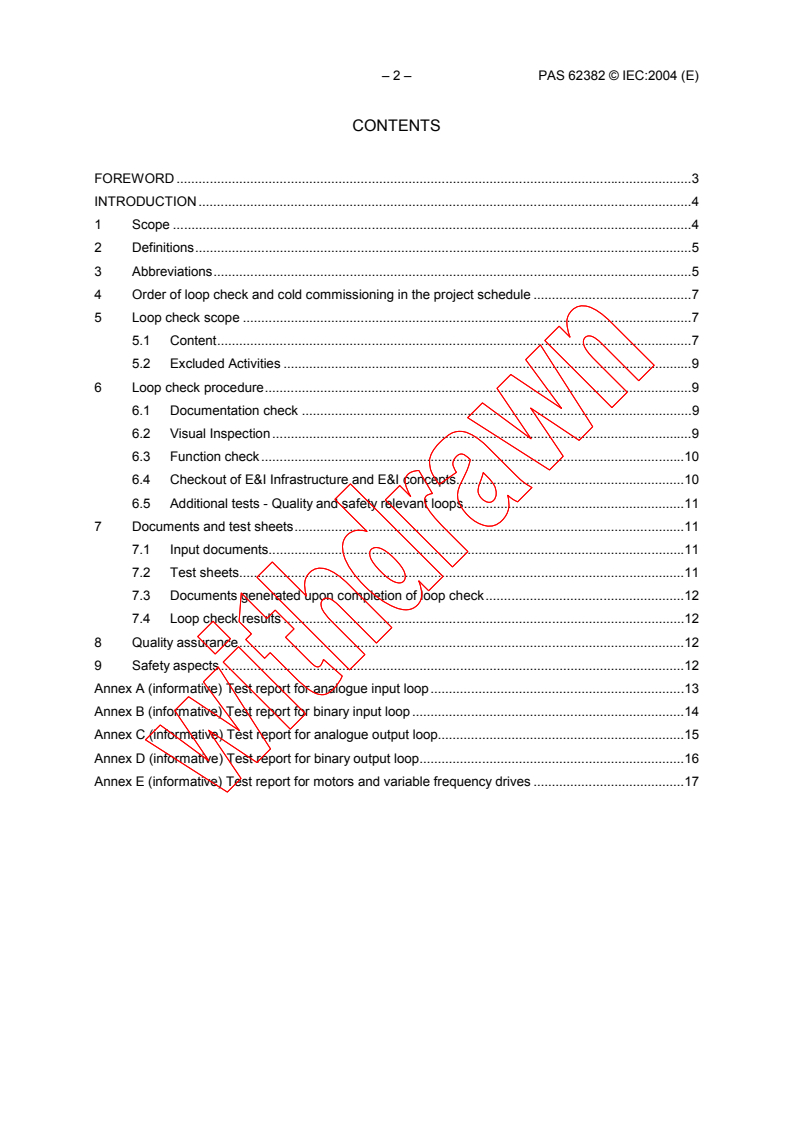
– 2 – PAS 62382 © IEC:2004 (E)
CONTENTS
FOREWORD .3
INTRODUCTION.4
1 Scope .4
2 Definitions.5
3 Abbreviations.5
4 Order of loop check and cold commissioning in the project schedule .7
5 Loop check scope .7
5.1 Content.7
5.2 Excluded Activities .9
6 Loop check procedure.9
6.1 Documentation check .9
6.2 Visual Inspection .9
6.3 Function check.10
6.4 Checkout of E&I Infrastructure and E&I concepts.10
6.5 Additional tests - Quality and safety relevant loops.11
7 Documents and test sheets.11
7.1 Input documents.11
7.2 Test sheets.11
7.3 Documents generated upon completion of loop check.12
7.4 Loop check results .12
8 Quality assurance.12
9 Safety aspects.12
Annex A (informative) Test report for analogue input loop.13
Annex B (informative) Test report for binary input loop .14
Annex C (informative) Test report for analogue output loop.15
Annex D (informative) Test report for binary output loop.16
Annex E (informative) Test report for motors and variable frequency drives .17
PAS 62382 © IEC:2004 (E) – 3 –
INTERNATIONAL ELECTROTECHNICAL COMMISSION
____________
ELECTRICAL AND INSTRUMENTATION LOOP CHECK
FOREWORD
1) The International Electrotechnical Commission (IEC) is a worldwide organization for standardization comprising
all national electrotechnical committees (IEC National Committees). The object of IEC is to promote
international co-operation on all questions concerning standardization in the electrical and electronic fields. To
this end and in addition to other activities, IEC publishes International Standards, Technical Specifications,
Technical Reports, Publicly Available Specifications (PAS) and Guides (hereafter referred to as “IEC
Publication(s)”). Their preparation is entrusted to technical committees; any IEC National Committee interested
in the subject dealt with may participate in this preparatory work. International, governmental and non-
governmental organizations liaising with the IEC also participate in this preparation. IEC collaborates closely
with the International Organization for Standardization (ISO) in accordance with conditions determined by
agreement between the two organizations.
2) The formal decisions or agreements of IEC on technical matters express, as nearly as possible, an international
consensus of opinion on the relevant subjects since each technical committee has representation from all
interested IEC National Committees.
3) IEC Publications have the form of recommendations for international use and are accepted by IEC National
Committees in that sense. While all reasonable efforts are made to ensure that the technical content of IEC
Publications is accurate, IEC cannot be held responsible for the way in which they are used or for any
misinterpretation by any end user.
4) In order to promote international uniformity, IEC National Committees undertake to apply IEC Publications
transparently to the maximum extent possible in their national and regional publications. Any divergence
between any IEC Publication and the corresponding national or regional publication shall be clearly indicated in
the latter.
5) IEC provides no marking procedure to indicate its approval and cannot be rendered responsible for any
equipment declared to be in conformity with an IEC Publication.
6) All users should ensure that they have the latest edition of this publication.
7) No liability shall attach to IEC or its directors, employees, servants or agents including individual experts and
members of its technical committees and IEC National Committees for any personal injury, property damage or
other damage of any nature whatsoever, whether direct or indirect, or for costs (including legal fees) and
expenses arising out of the publication, use of, or reliance upon, this IEC Publication or any other IEC
Publications.
8) Attention is drawn to the Normative references cited in this publication. Use of the referenced publications is
indispensable for the correct application of this publication.
9) Attention is drawn to the possibility that some of the elements of this IEC Publication may be the subject of
patent rights. IEC shall not be held responsible for identifying any or all such patent rights.
A PAS is a technical specification not fulfilling the requirements for a standard but made available to
the public.
IEC-PAS 62382 has been processed by IEC technical committee 65: Industrial-process measurement
and control.
The text of this PAS is based on the This PAS was approved for publication
following document: by the P-members of the committee
concerned as indicated in the following
document
Draft PAS Report on voting
65/310/PAS 65/323/RVD
Following publication of this PAS, which is a pre-standard publication, the technical committee or
subcommittee concerned will transform it into an International Standard.
– 4 – PAS 62382 © IEC:2004 (E)
INTRODUCTION
The inspection and verification of the individual measurements and controls in conjunction with the
control systems used to monitor these devices (DCS, PLC, etc.) is referred to as the loop check. In
industry, numerous methods and philosophies are used to check the instrumentation and controls after
the mechanical installation within projects for modified or new facilities.
This document was created to provide a better understanding of what the loop check consists of and
also to provide a standard methodology for executing the loop check.
The annexes of this document contain forms which may be used in the check procedures. They are
attached to this publication in Excel format. Buyers of this publication may copy these forms for their
own purposes only in the required amount.
The IEC sells read-only PDF files as a general rule. In the present instance, and quite exceptionally, to
enable the user to fill in the forms, a revisable file is included in a pocket affixed to the back cover of
this publication. Please use the zip/unzip function.
This file can also be downloaded from the Web as a PDF file.
PAS 62382 © IEC:2004 (E) – 5 –
ELECTRICAL AND INSTRUMENTATION LOOP CHECK
1 Scope
This document describes the recommended steps to complete a loop check which comprises the
activities between the completion of loop construction (including installation and point-to-point checks)
and the start-up of the cold commissioning. This document is applicable for the construction of new
plants and for expansion/retrofits (i.e. revamping) of E&I installations in existing plants (including PLC,
BAS, DCS, Panel-mounted and field instrumentation). It does not include a detailed checkout of power
distribution systems except as they relate to the loops being checked (i. e. a motor starter or a power
supply to a 4-wire transmitter).
2 Definitions
For the purposes of this document the following definitions apply.
2.1
precommissioning
phase, during which the activities of non-operating adjustments, cold alignment checks, cleaning, and
testing of machinery take place (see annexes)
2.2
mechanical completion
milestone, which is achieved ("mechanically complete’’) when the plant, or any part thereof, has been
erected and tested in accordance with drawings, specifications, instructions, and applicable codes and
regulations to the extent necessary to permit cold commissioning. This includes completion of all
necessary electrical and instrumentation work. This is a milestone marking the end of the
precommissioning activities
2.3
cold commissioning
phase, during which the activities associated with the testing and operation of equipment or facilities
using test media such as water or inert substances prior to introducing any chemical in the system take
place
2.4
Start-up
milestone marking the end of cold commissioning. At this stage the operating range of every
instrument loop is already be adjusted to reflect the actual working condition
2.5
hot commissioning
phase, during which the activities associated with the testing and operation of equipment or facilities
using the actual process chemical prior to making an actual production run, take place
2.6
start of production
milestone marking the end of hot commissioning at which stage the plant is ready for full and
continuous operation
2.7
performance test
– 6 – PAS 62382 © IEC:2004 (E)
milestone at which time the owner’s personnel run the production plant, with the help and supervision
of the contractor, to its design capacity. This test is to demonstrate the contractor’s process
performance as specified in the contract.
2.8
acceptance of plant
milestone in which the formal turnover of the plant from the contractor to the owner is carried out
2.9
basic software
the software which, at a minimum, contains the graphic faceplates, base level alarms and switch
points, basic interlocking and analogue control. In the case of safety loops, any safety switch point
should be included if it is not in the basic database
3 Abbreviations
BAS Building automation systems
C&E Cause and Effect Diagram
DCS Distributed control system
E&I Electrical & instrumentation
ESD Emergency shut down system
FAT Factory acceptance testing
FBD Functional block diagram
FUP Function plan
HMI Human machine interface
HW Hardware
MC Mechanical completion
PDS Project design specifications
PFS Project functional specification
PLC Programmable logic controller
SAT Site acceptance test
SIT Site integration test
SW Software
PAS 62382 © IEC:2004 (E) – 7 –
4 Order of loop check and cold commissioning in the project schedule
The loop checks will ideally occur in the "precommissioning" phase of the schedule depicted below.
However, normal occurrence is that the loop checks begin when any specific loop is completed and
turned over to the checkout crew even when during the "construction" phase. The loop check could
substantially overlap the "construction" phase.
Acceptance
of plant
Construction Precommissioning Commissioning Production
PHASES
Cold Hot
Completion of Mechanical Start-up Start of
MILESTONES
erection completion production Performance
test
NOTE Construction and precommissioning activities could be overlapping.
Figure 1 – Definition of phases and milestones
A loop check
follows the E&I construction phase and FAT of the DCS in a project.;
•
is the last systematic check before mechanical completion to assure that
•
- all E&I documents (loop sheets, etc.) are available and correspond to their latest revision;
- all instrumentation and equipment is delivered according to the design specifications;
- installation has occurred in accordance to engineering documents, applicable codes and local
regulations;
- loop functionality is correct.
This provides
in a project, the quality check for E&I engineering, procurement and installation;
•
the base for the commissioning phase which consists of
•
- cold commissioning:
phase during which functional testing of equipment and facilities, using test media such as water or
inert substances, takes place;
- hot commissioning (chemical start-up):
phase during which activities associated with testing and operation of equipment using the actual
process chemicals (initial start up of process) are performed;
The main activities in the cold and hot commissioning phases are system verification, tuning of loops
and instruments and control schemes.
5 Loop Check Content
5.1 Included activities
A loop check includes the following elements of a "single loop" (sensor and/or actuator).
• Hardware components:
- the installed instruments or components in the field;
- the equipment in E&I rooms;
- hard wired functionality between sensor and actuator loops.
- the input/output cards of process control systems.
– 8 – PAS 62382 © IEC:2004 (E)
• The basic software components (including the graphic faceplates, base level alarms and switch points,
basic interlocking and basic analogue control) to test the field elements. The loop check uses the basic
graphics/faceplates of the control system (see Figure 2)
In the case of safety loops, all safety switch points should be included if they are not in the basic database.
The actual loop check involves three phases:
a) Documentation checkout
Check for the completeness and consistency of loop documents, including any documents from the
installation or FAT.
b) Visual inspection of loop devices for correct installation and labelling.
c)
Function check using a testing device to exercise all components of the loop (including hardware,
wiring and software) to check that all the components function correctly and that the DCS or panel
readouts are accurate.
1)
The check of Operational configuration is completed during cold commissioning or hot commissioning.
Figure 2 – Loop Check
PAS 62382 © IEC:2004 (E) – 9 –
There are three types of deficiencies that can be found during the loop check.
a) Installation failure
Installation failures are discrepancies with the specified hardware or the method of installation (wrong
installation, wrong instruments, etc.). The construction contractor should fix these problems.
b) Configuration failure
Configuration failures are discrepancies with the original software specification. The programming
contractor or E&I Engineering should fix these problems.
c)
E&I engineering failure
Engineering failures are to be suspected when, despite good installation of the right instruments, the
desired functionality cannot be realized (For example, a fault in the wiring diagram; wrong measurement
principle has been chosen, etc.).
These problems shall be corrected by E&I engineering.
Additional deficiencies might be in the process design, but this can only be determined after process
start-up.
5.2 Excluded activities
A "loop check" does not consist of
test activities possible without construction being completed:
•
- software testing using simulation tools;
- other factory acceptance tests performed at the contractor or vendor’s factories;
other software checkout activities (FAT, …);
•
detailed construction and mechanical inspections performed during the construction phase:
•
- cable testing during construction (hipot, meggering, etc.)
- point-to-point wiring checks;
the testing of the internal working of package units (i.e. process subunits, machinery, complex analysers,
•
etc.) is excluded, only the I/O testing of this equipment being included in the loop check;
activities belonging to the "commissioning phase": tuning of loops, instruments and control schemes (for
•
example, calibrating of level-transmitters by filling tanks; verification of complex control schemes; tuning of
continuous control schemes; etc.).
6 Loop check procedure
6.1 Documentation check
– The checkout of the loop should first establish that all documentation pertaining to that loop is available,
consistent and correctly labelled if the loop is a safety, quality or environmental loop.
– The pertinent documentation must, as a minimum, contain a wiring diagram of the loop and a specification
containing all calibration and functional data necessary to verify the correct operation of the loop.
6.2 Visual inspection
– The installation should be visually checked against the documents to ensure that the correct instruments
were installed and that the installation is in accordance with the hardware specifications and circuit
diagrams.
–- Valves and flowmeters are checked for correct installation with the direction of flow.
– Can local instrumentation be easily read?
– Are all the elements of the loop available, accessible, labelled and installed in a clean and neat manner
(including junction boxes, panels, cabinets, racks)?
– Is the tagging clear and unambiguous (No danger of false interpretation)?
Are the field elements adequately protected from mechanical or environmental damage?
– 10 – PAS 62382 © IEC:2004 (E)
6.3 Function check
The function checks are ideally performed in well-defined blocks (related technical blocks like process
units or related racks in E&I rooms). The actual method and order of checkout should be defined by
the project team prior to starting the loop check.
The purpose of the function check is to exercise all components of a loop during one test and measure
their accuracy. Checking out a loop in pieces does not qualify as a function check and shall not
substitute for the function check.
The actual check involves connecting a testing device to the transmitter and increasing the signal, in
increments, to full span to insure that the DCS or panel readout follows the input. Also, if the loop has
an output, the actuator should be observed to verify that it follows the incremental output changes
within a specified tolerance. In the
...