


IEC 60947-5-1:1997/AMD2:1999
(Amendment)Amendment 2 - Low-voltage switchgear and controlgear. Part 5: Control circuit devices and switching elements - Section One: Electromechanical control circuit devices
General Information
- Abstract
- Status
- Published
- Publication Date
- 28-Oct-1999
- Technical Committee
- SC 121A - Low-voltage switchgear and controlgear
- Drafting Committee
- WG 3 - TC 121/SC 121A/WG 3
- Current Stage
- DELPUB - Deleted Publication
- Start Date
- 13-Nov-2003
- Completion Date
- 28-Aug-2026
Buy Documents
IEC 60947-5-1:1997/AMD2:1999 - Amendment 2 - Low-voltage switchgear and controlgear. Part 5: Control circuit devices and switching elements - Section One: Electromechanical control circuit devices Released:10/29/1999
Overview
IEC 60947-5-1:1997/AMD2:1999 is an important amendment to the international standard governing low-voltage switchgear and controlgear, specifically Part 5-1, which addresses control circuit devices and switching elements. This amendment focuses on electromechanical control circuit devices and introduces special technical requirements for mechanically linked contact elements within these devices. These enhancements ensure improved safety, reliability, and performance in industrial and machine control applications involving electrical control circuits.
Key Topics
- Mechanically Linked Contact Elements: The amendment defines mechanically linked contacts as combinations of make (normally open) and break (normally closed) contact elements that are designed to never be closed simultaneously, enhancing circuit safety.
- Design Specifications: Additional design characteristics, marking, construction, and functional requirements are established for devices incorporating mechanically linked contacts.
- Marking and Identification: Devices with mechanically linked contacts must be clearly marked either on the device or in the manufacturer's documentation, facilitating proper recognition and application.
- Special Testing Procedures: Unique test methods are mandated to verify the correct mechanical linkage and electrical isolation of contact elements under operational forces and impulse voltages.
- Safety Applications: The amendment clarifies that devices actuated externally, such as push-buttons or limit switches, cannot contain mechanically linked contacts and should use contacts with positive opening actions for safety.
Applications
- Industrial Machine Control Circuits: Mechanically linked contact elements are critical for self-monitoring control circuits in machinery, ensuring that conflicting contacts are never simultaneously closed, which can prevent equipment damage or hazardous conditions.
- Contactors and Relays: Contactors with auxiliary mechanically linked contacts benefit from the safety and reliability improvements defined in this amendment, enhancing their use in industrial automation.
- Control Circuit Devices: Switching devices that require internal actuating force and high operational reliability in low-voltage applications incorporate these standardized features to meet stringent safety criteria.
Related Standards
- IEC 60947-1: Provides general rules and definitions that support the requirements for low-voltage switchgear and controlgear, referenced in the amendment for testing voltage impulses and minimum contact gap requirements.
- IEC 60947 Series: The broader series of standards for low-voltage switchgear and controlgear, where Part 5-1 specifically aligns with control circuit devices and switching elements.
- Safety Standards on Control Devices: Standards concerning direct opening action contacts and external devices such as push-buttons complement the requirements outlined for mechanically linked contacts in IEC 60947-5-1.
Keywords: IEC 60947-5-1 amendment, electromechanical control circuit devices, mechanically linked contacts, low-voltage switchgear, controlgear standards, industrial control circuits, contactors, auxiliary contacts, electrical safety, control circuit devices testing, low-voltage electrical components.
Relations
- Effective Date
- 05-Sep-2023
- Effective Date
- 05-Sep-2023
Buy Documents
IEC 60947-5-1:1997/AMD2:1999 - Amendment 2 - Low-voltage switchgear and controlgear. Part 5: Control circuit devices and switching elements - Section One: Electromechanical control circuit devices Released:10/29/1999
Get Certified
Connect with accredited certification bodies for this standard

IMQ S.p.A. (Certification)
Italian electrical product certification.

SLG Prüf- und Zertifizierungs GmbH
German testing and certification body.

UL Solutions
Global safety science company with testing, inspection and certification.
Sponsored listings
Frequently Asked Questions
IEC 60947-5-1:1997/AMD2:1999 is a standard published by the International Electrotechnical Commission (IEC). Its full title is "Amendment 2 - Low-voltage switchgear and controlgear. Part 5: Control circuit devices and switching elements - Section One: Electromechanical control circuit devices". This standard covers: Amendment 2 - Low-voltage switchgear and controlgear. Part 5: Control circuit devices and switching elements - Section One: Electromechanical control circuit devices
Amendment 2 - Low-voltage switchgear and controlgear. Part 5: Control circuit devices and switching elements - Section One: Electromechanical control circuit devices
IEC 60947-5-1:1997/AMD2:1999 is classified under the following ICS (International Classification for Standards) categories: 29.130.20 - Low voltage switchgear and controlgear. The ICS classification helps identify the subject area and facilitates finding related standards.
IEC 60947-5-1:1997/AMD2:1999 has the following relationships with other standards: It is inter standard links to IEC 60947-5-1:1997, IEC 60947-5-1:2003. Understanding these relationships helps ensure you are using the most current and applicable version of the standard.
IEC 60947-5-1:1997/AMD2:1999 is available in PDF format for immediate download after purchase. The document can be added to your cart and obtained through the secure checkout process. Digital delivery ensures instant access to the complete standard document.
Standards Content (Sample)
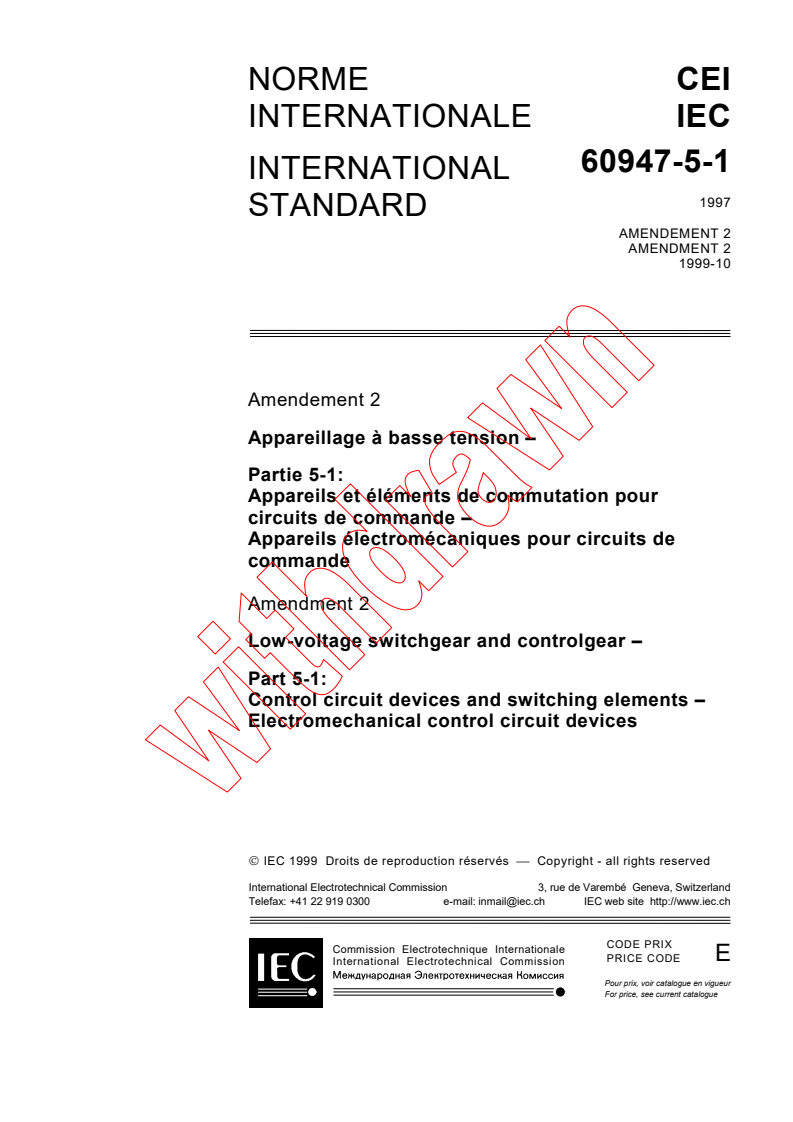
NORME CEI
INTERNATIONALE IEC
60947-5-1
INTERNATIONAL
STANDARD
AMENDEMENT 2
AMENDMENT 2
1999-10
Amendement 2
Appareillage à basse tension –
Partie 5-1:
Appareils et éléments de commutation pour
circuits de commande –
Appareils électromécaniques pour circuits de
commande
Amendment 2
Low-voltage switchgear and controlgear –
Part 5-1:
Control circuit devices and switching elements –
Electromechanical control circuit devices
IEC 1999 Droits de reproduction réservés Copyright - all rights reserved
International Electrotechnical Commission 3, rue de Varembé Geneva, Switzerland
Telefax: +41 22 919 0300 e-mail: inmail@iec.ch IEC web site http://www.iec.ch
CODE PRIX
Commission Electrotechnique Internationale
E
PRICE CODE
International Electrotechnical Commission
Pour prix, voir catalogue en vigueur
For price, see current catalogue
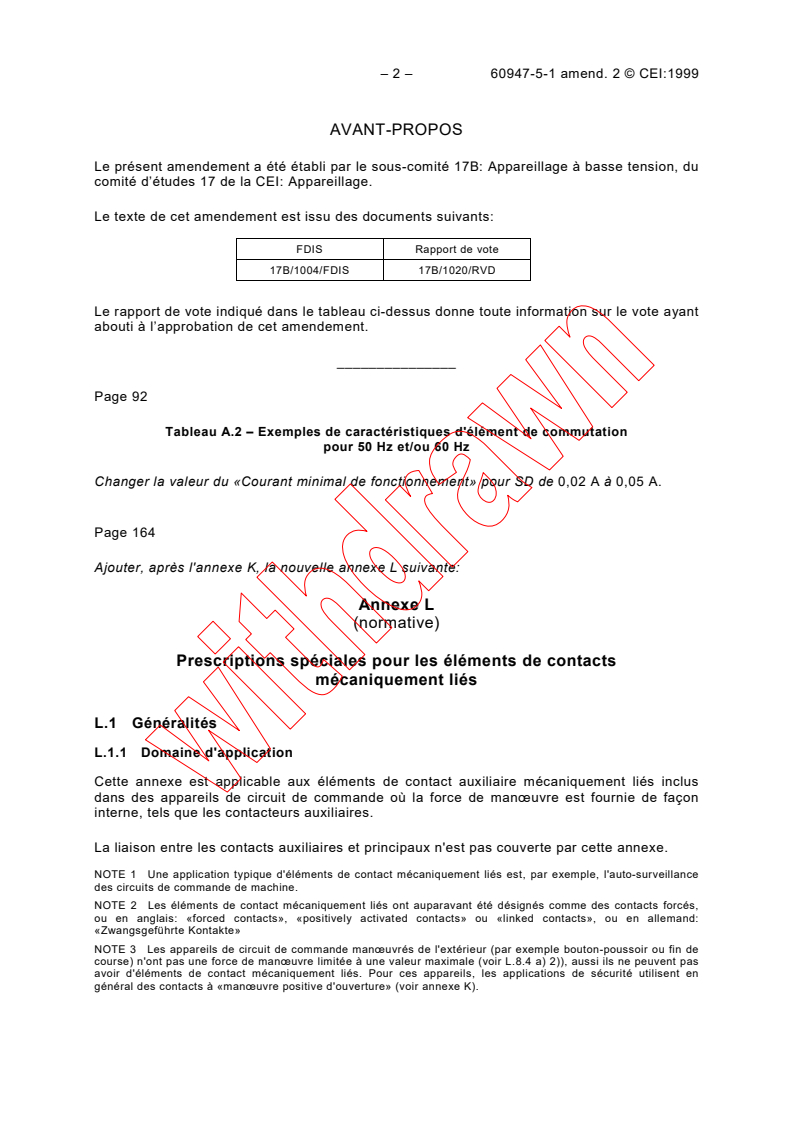
– 2 – 60947-5-1 amend. 2 © CEI:1999
AVANT-PROPOS
Le présent amendement a été établi par le sous-comité 17B: Appareillage à basse tension, du
comité d’études 17 de la CEI: Appareillage.
Le texte de cet amendement est issu des documents suivants:
FDIS Rapport de vote
17B/1004/FDIS 17B/1020/RVD
Le rapport de vote indiqué dans le tableau ci-dessus donne toute information sur le vote ayant
abouti à l’approbation de cet amendement.
_______________
Page 92
Tableau A.2 – Exemples de caractéristiques d'élément de commutation
pour 50 Hz et/ou 60 Hz
Changer la valeur du «Courant minimal de fonctionnement» pour SD de 0,02 A à 0,05 A.
Page 164
Ajouter, après l'annexe K, la nouvelle annexe L suivante:
Annexe L
(normative)
Prescriptions spéciales pour les éléments de contacts
mécaniquement liés
L.1 Généralités
L.1.1 Domaine d'application
Cette annexe est applicable aux éléments de contact auxiliaire mécaniquement liés inclus
dans des appareils de circuit de commande où la force de manœuvre est fournie de façon
interne, tels que les contacteurs auxiliaires.
La liaison entre les contacts auxiliaires et principaux n'est pas couverte par cette annexe.
NOTE 1 Une application typique d'éléments de contact mécaniquement liés est, par exemple, l'auto-surveillance
des circuits de commande de machine.
NOTE 2 Les éléments de contact mécaniquement liés ont auparavant été désignés comme des contacts forcés,
ou en anglais: «forced contacts», «positively activated contacts» ou «linked contacts», ou en allemand:
«Zwangsgeführte Kontakte»
NOTE 3 Les appareils de circuit de commande manœuvrés de l'extérieur (par exemple bouton-poussoir ou fin de
course) n'ont pas une force de manœuvre limitée à une valeur maximale (voir L.8.4 a) 2)), aussi ils ne peuvent pas
avoir d'éléments de contact mécaniquement liés. Pour ces appareils, les applications de sécurité utilisent en
général des contacts à «manœuvre positive d'ouverture» (voir annexe K).
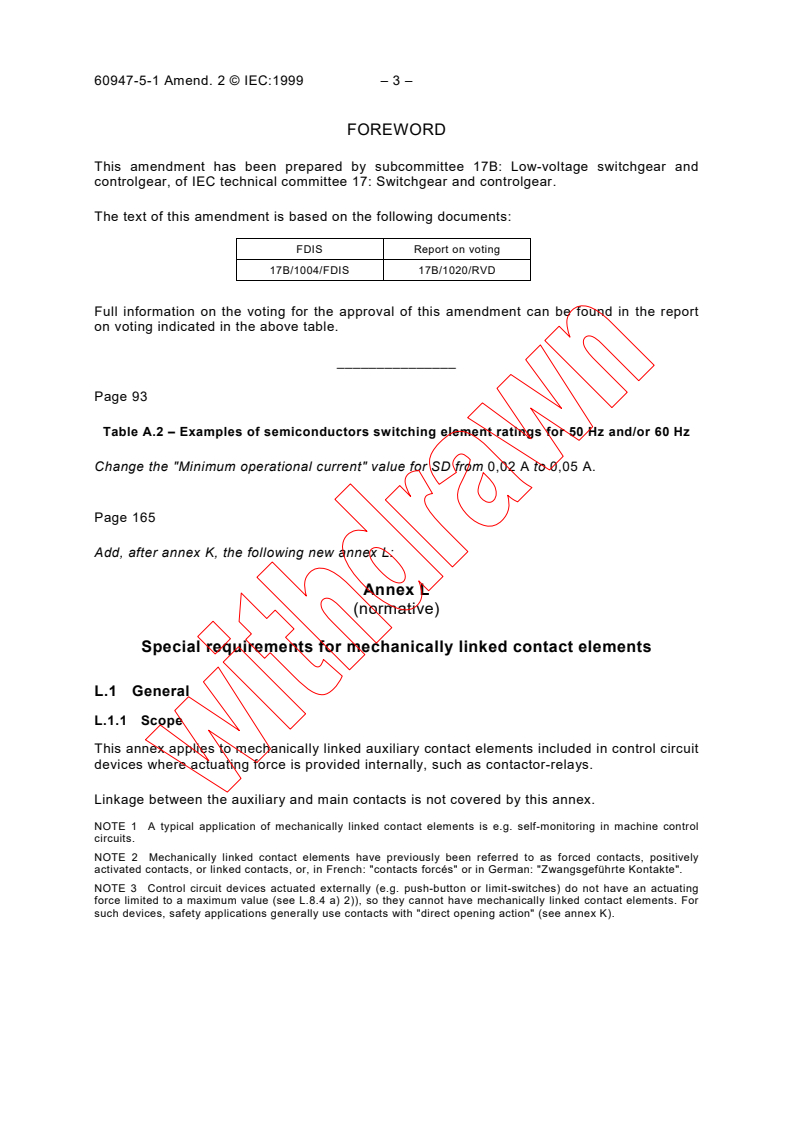
60947-5-1 Amend. 2 © IEC:1999 – 3 –
FOREWORD
This amendment has been prepared by subcommittee 17B: Low-voltage switchgear and
controlgear, of IEC technical committee 17: Switchgear and controlgear.
The text of this amendment is based on the following documents:
FDIS Report on voting
17B/1004/FDIS 17B/1020/RVD
Full information on the voting for the approval of this amendment can be found in the report
on voting indicated in the above table.
_______________
Page 93
Table A.2 – Examples of semiconductors switching element ratings for 50 Hz and/or 60 Hz
Change the "Minimum operational current" value for SD from 0,02 A to 0,05 A.
Page 165
Add, after annex K, the following new annex L:
Annex L
(normative)
Special requirements for mechanically linked contact elements
L.1 General
L.1.1 Scope
This annex applies to mechanically linked auxiliary contact elements included in control circuit
devices where actuating force is provided internally, such as contactor-relays.
Linkage between the auxiliary and main contacts is not covered by this annex.
NOTE 1 A typical application of mechanically linked contact elements is e.g. self-monitoring in machine control
circuits.
NOTE 2 Mechanically linked contact elements have previously been referred to as forced contacts, positively
activated contacts, or linked contacts, or, in French: "contacts forcés" or in German: "Zwangsgeführte Kontakte".
NOTE 3 Control circuit devices actuated externally (e.g. push-button or limit-switches) do not have an actuating
force limited to a maximum value (see L.8.4 a) 2)), so they cannot have mechanically linked contact elements. For
such devices, safety applications generally use contacts with "direct opening action" (see annex K).
– 4 – 60947-5-1 amend. 2 © CEI:1999
L.1.2 Objet
La présente annexe fournit les spécifications complémentaires (définition, prescriptions et
essais) qui doivent être utilisées pour établir les caractéristiques de conception, le marquage
et les performances exigés pour des éléments de contact mécaniquement liés.
L.2 Définitions
La définition complémentaire suivante est applicable:
L.2.1
éléments de contact mécaniquement liés
combinaison de n élément(s) de contact à fermeture et de m élément(s) de contact à
ouverture conçus de telle façon qu'ils ne puissent être simultanément dans la position fermée,
dans les conditions définies en L.8.4
NOTE 1 Un appareil de circuit de commande peut avoir plus d'un groupe d'éléments de contact mécaniquement
liés.
NOTE 2 Voir aussi L.7.1.9.
L.3 Classification
L'article 3 est applicable.
L.4 Caractéristiques
Tous les éléments de contact mécaniquement liés doivent aussi satisfaire aux prescriptions
correspondantes données dans la présente norme.
L.5 Informations sur le matériel
L'article 5 est applicable avec le complément suivant:
L.5.2.7 Identification et marquage des éléments de contact mécaniquement liés
Les éléments de contact mécaniquement liés doivent être clairement identifiés:
– sur l'appareil de circuit de commande lui-même;
– ou sur la documentation du constructeur;
– ou sur les deux.
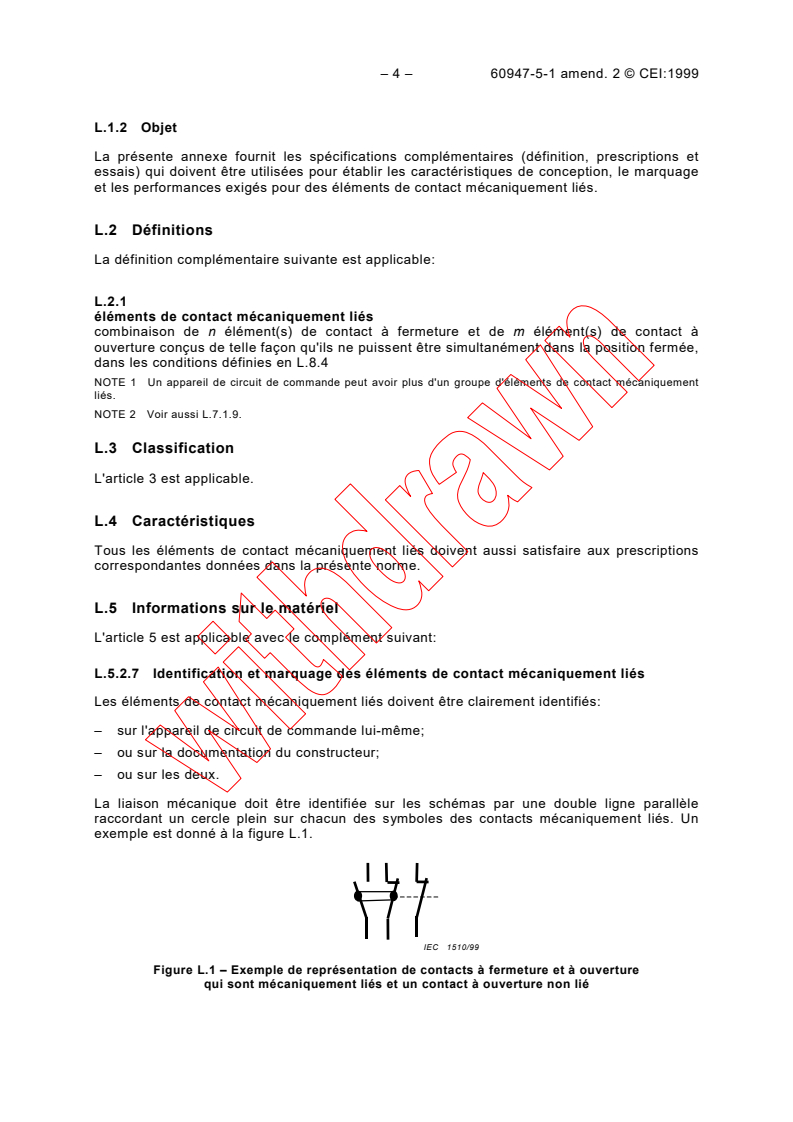
La liaison mécanique doit être identifiée sur les schémas par une double ligne parallèle
raccordant un cercle plein sur chacun des symboles des contacts mécaniquement liés. Un
exemple est donné à la figure L.1.
IEC 1510/99
Figure L.1 – Exemple de représentation de contacts à fermeture et à ouverture
qui sont mécaniquement liés et un contact à ouverture non lié
60947-5-1 Amend. 2 © IEC:1999 – 5 –
L.1.2 Object
This annex provides additional specifications (definition, requirements and tests) which shall
be used for stating the required design characteristics, marking and performance of
mechanically linked contact elements.
L.2 Definition
The following additional definition applies:
L.2.1
mechanically linked contact elements
combination of n Make contact element(s) and m Break contact element(s) designed in such a
way that they cannot be in closed position simultaneously under conditions defined in L.8.4
NOTE 1 One control circuit device may have more than one group of mechanically linked contact elements.
NOTE 2 See also L.7.1.9.
L.3 Classification
Clause 3 applies.
L.4 Characteristics
All mechanically linked contact elements shall
...