


IEC 60947-5-1:2003
(Main)Low-voltage switchgear and controlgear - Part 5-1: Control circuit devices and switching elements - Electromechanical control circuit devices
General Information
- Abstract
Applies to control circuit devices and switching elements intended for control-ling, signalling, interlocking, etc., of switchgear and controlgear. It applies to control circuit devices having a rated voltage not exceeding 1 000 V a.c. (at a frequency not exceeding 1 000 Hz) or 600 V d.c. This standard applies to specific types of control circuit devices such as: - manual control switches, for example pushbuttons, rotary switches, foot switches, etc.; - electromagnetically operated control switches, either time-delayed or instantaneous, for example contactor relays; - pilot switches, for example pressure switches, temperature sensitive switches (thermostats), programmers, etc.; - position switches, for example control switches operated by part of a machine or mechanism; - associated control circuit equipment, for example indicator lights, etc. It also applies to specific types of switching elements associated with other devices (whose main circuits are covered by other standards) such as: - auxiliary contacts of a switching device (e.g. contactor, circuit breaker. etc.) which are not dedicated exclusively for use with the coil of that device; - interlocking contacts of enclosure doors; - control circuit contacts of rotary switches; - control circuit contacts of overload relays. Contactor relays shall also meet the requirements and tests of IEC 60947-4-1 except for the utilization category which shall comply with this standard. This standard does not include the relays covered in IEC 60255 or automatic electrical control devices for household and similar purposes. The colour requirements of indicator lights, pushbuttons, etc., are found in IEC 60073 and also in publication 2 of the International Commission of Illumination (CIE). The object of this standard is to state: a) The characteristics of control circuit devices. b) The electrical and mechanical requirements with respect to: 1) The various duties to be performed. 2) The significance of the rated characteristics and of the markings. 3) The tests to verify the rated characteristics. c) The functional requirements to be satisfied by the control circuit devices with respect to: 1) Environmental conditions, including those of enclosed equipment. 2) Dielectric properties. 3) Terminals. The provisions of the general rules, IEC 60947-1, are applicable to this standard, where specifically called for
- Status
- Published
- Publication Date
- 07-Jul-2009
- Technical Committee
- SC 121A - Low-voltage switchgear and controlgear
- Drafting Committee
- WG 3 - TC 121/SC 121A/WG 3
- Current Stage
- DELPUB - Deleted Publication
- Start Date
- 25-May-2016
- Completion Date
- 28-Aug-2026
Buy Documents
IEC 60947-5-1:2003 - Low-voltage switchgear and controlgear - Part 5-1: Control circuit devices and switching elements - Electromechanical control circuit devices Released:11/12/2003
IEC 60947-5-1:2003+AMD1:2009 CSV - Low-voltage switchgear and controlgear - Part 5-1: Control circuit devices and switching elements - Electromechanical control circuit devices Released:7/8/2009
Overview
IEC 60947-5-1:2003 is an international standard published by the International Electrotechnical Commission (IEC) focusing on low-voltage switchgear and controlgear, specifically Part 5-1 addressing control circuit devices and switching elements - electromechanical types. This standard covers a wide range of control circuit devices operating at rated voltages up to 1,000 V AC (up to 1,000 Hz frequency) or 600 V DC, such as manual and electromagnetically operated control switches, pilot switches, and position switches. It defines the specifications for device properties, electrical and mechanical requirements, performance verification tests, and environmental and safety considerations.
The standard applies broadly to devices used for controlling, signaling, and interlocking switchgear and controlgear, emphasizing electromechanical control circuit devices suitable for industrial and commercial electrical applications.
Key Topics
Scope of Devices: Includes pushbuttons, rotary switches, foot switches, contactor relays (both instantaneous and time-delayed), pressure switches, thermostats, programmable devices, and auxiliary contacts.
Electrical Ratings: Specifies rated voltages and currents, utilization categories for different types of switching elements, and switching overvoltages.
Mechanical and Electrical Requirements: Details construction requirements to ensure durability, reliability under various operating conditions, and safety norms including dielectric properties and terminal designs.
Testing Procedures: Encompasses a variety of tests such as electrical endurance, mechanical reliability, performance under normal and abnormal conditions, and electromagnetic compatibility (EMC).
Marking and Product Information: Provides guidance on clear markings for correct identification, operation instructions, and maintenance guidelines aligned with IEC 60947-1 general rules.
Environmental Conditions: Addresses device robustness against environmental factors, making it suitable for enclosed equipment or exposed installations.
Functional Requirements: Covers actuating forces, electrical separation of contacts, and specific testing for special device features like indicator lights and interlocking contacts.
Applications
IEC 60947-5-1 standard devices are fundamental components in industrial automation systems, control panels, and electrical machinery interfaces where reliable electromechanical control is essential. Typical practical applications include:
Industrial Control Systems: Pushbuttons, selector switches, and pilot lights used on control panels for machine operation, start/stop functions, and status indication.
Safety and Interlocking: Door interlocks on electrical enclosures for safety systems that prevent access while equipment is energized.
Signal and Control Circuit Elements: Thermostats and pressure switches used to automate processes based on condition monitoring.
Motor Control Centers: Electromagnetically operated contactor relays that control motor starters, including timed and instantaneous switching elements.
Building Automation: Control switches for lighting and HVAC systems within commercial and residential buildings.
This comprehensive standard ensures devices' compatibility and interoperability with other low-voltage switchgear defined under IEC 60947 series, enhancing system safety, reliability, and efficiency.
Related Standards
IEC 60947-1: General rules for low-voltage switchgear and controlgear - serves as a foundational reference to IEC 60947-5-1 concerning overall construction and performance principles.
IEC 60947-4-1: Pertains to contactors and motor-starters, including corresponding contactor relays which also must meet requirements specified in this standard.
IEC 60255: Covers electrical relays for power system protection, excluded from this standard’s scope to differentiate relay applications.
IEC 60073: Provides color coding requirements for indicator lights, pushbuttons, and related devices referenced by IEC 60947-5-1 for consistent signaling.
International Commission of Illumination (CIE) Publications: Supplement IEC 60073 by specifying standards for colors used in control devices to ensure universal recognition.
Keywords: IEC 60947-5-1, low-voltage switchgear, control circuit devices, electromechanical switches, controlgear standards, industrial control switches, electromechanical relays, switchgear interlocking, pilot switches, IEC electrical standards.
Relations
- Effective Date
- 25-Aug-2026
- Effective Date
- 05-Sep-2023
- Effective Date
- 05-Sep-2023
- Effective Date
- 05-Sep-2023
- Effective Date
- 05-Sep-2023
- Effective Date
- 05-Sep-2023
Buy Documents
IEC 60947-5-1:2003 - Low-voltage switchgear and controlgear - Part 5-1: Control circuit devices and switching elements - Electromechanical control circuit devices Released:11/12/2003
IEC 60947-5-1:2003+AMD1:2009 CSV - Low-voltage switchgear and controlgear - Part 5-1: Control circuit devices and switching elements - Electromechanical control circuit devices Released:7/8/2009
Get Certified
Connect with accredited certification bodies for this standard

IMQ S.p.A. (Certification)
Italian electrical product certification.

SLG Prüf- und Zertifizierungs GmbH
German testing and certification body.

UL Solutions
Global safety science company with testing, inspection and certification.
Sponsored listings
Frequently Asked Questions
IEC 60947-5-1:2003 is a standard published by the International Electrotechnical Commission (IEC). Its full title is "Low-voltage switchgear and controlgear - Part 5-1: Control circuit devices and switching elements - Electromechanical control circuit devices". This standard covers: Applies to control circuit devices and switching elements intended for control-ling, signalling, interlocking, etc., of switchgear and controlgear. It applies to control circuit devices having a rated voltage not exceeding 1 000 V a.c. (at a frequency not exceeding 1 000 Hz) or 600 V d.c. This standard applies to specific types of control circuit devices such as: - manual control switches, for example pushbuttons, rotary switches, foot switches, etc.; - electromagnetically operated control switches, either time-delayed or instantaneous, for example contactor relays; - pilot switches, for example pressure switches, temperature sensitive switches (thermostats), programmers, etc.; - position switches, for example control switches operated by part of a machine or mechanism; - associated control circuit equipment, for example indicator lights, etc. It also applies to specific types of switching elements associated with other devices (whose main circuits are covered by other standards) such as: - auxiliary contacts of a switching device (e.g. contactor, circuit breaker. etc.) which are not dedicated exclusively for use with the coil of that device; - interlocking contacts of enclosure doors; - control circuit contacts of rotary switches; - control circuit contacts of overload relays. Contactor relays shall also meet the requirements and tests of IEC 60947-4-1 except for the utilization category which shall comply with this standard. This standard does not include the relays covered in IEC 60255 or automatic electrical control devices for household and similar purposes. The colour requirements of indicator lights, pushbuttons, etc., are found in IEC 60073 and also in publication 2 of the International Commission of Illumination (CIE). The object of this standard is to state: a) The characteristics of control circuit devices. b) The electrical and mechanical requirements with respect to: 1) The various duties to be performed. 2) The significance of the rated characteristics and of the markings. 3) The tests to verify the rated characteristics. c) The functional requirements to be satisfied by the control circuit devices with respect to: 1) Environmental conditions, including those of enclosed equipment. 2) Dielectric properties. 3) Terminals. The provisions of the general rules, IEC 60947-1, are applicable to this standard, where specifically called for
Applies to control circuit devices and switching elements intended for control-ling, signalling, interlocking, etc., of switchgear and controlgear. It applies to control circuit devices having a rated voltage not exceeding 1 000 V a.c. (at a frequency not exceeding 1 000 Hz) or 600 V d.c. This standard applies to specific types of control circuit devices such as: - manual control switches, for example pushbuttons, rotary switches, foot switches, etc.; - electromagnetically operated control switches, either time-delayed or instantaneous, for example contactor relays; - pilot switches, for example pressure switches, temperature sensitive switches (thermostats), programmers, etc.; - position switches, for example control switches operated by part of a machine or mechanism; - associated control circuit equipment, for example indicator lights, etc. It also applies to specific types of switching elements associated with other devices (whose main circuits are covered by other standards) such as: - auxiliary contacts of a switching device (e.g. contactor, circuit breaker. etc.) which are not dedicated exclusively for use with the coil of that device; - interlocking contacts of enclosure doors; - control circuit contacts of rotary switches; - control circuit contacts of overload relays. Contactor relays shall also meet the requirements and tests of IEC 60947-4-1 except for the utilization category which shall comply with this standard. This standard does not include the relays covered in IEC 60255 or automatic electrical control devices for household and similar purposes. The colour requirements of indicator lights, pushbuttons, etc., are found in IEC 60073 and also in publication 2 of the International Commission of Illumination (CIE). The object of this standard is to state: a) The characteristics of control circuit devices. b) The electrical and mechanical requirements with respect to: 1) The various duties to be performed. 2) The significance of the rated characteristics and of the markings. 3) The tests to verify the rated characteristics. c) The functional requirements to be satisfied by the control circuit devices with respect to: 1) Environmental conditions, including those of enclosed equipment. 2) Dielectric properties. 3) Terminals. The provisions of the general rules, IEC 60947-1, are applicable to this standard, where specifically called for
IEC 60947-5-1:2003 is classified under the following ICS (International Classification for Standards) categories: 29.120.40 - Switches; 29.130.20 - Low voltage switchgear and controlgear. The ICS classification helps identify the subject area and facilitates finding related standards.
IEC 60947-5-1:2003 has the following relationships with other standards: It is inter standard links to EN ISO 13856-2:2013, IEC 60947-5-1:2003/AMD1:2009, IEC 60947-5-1:1997/AMD1:1999, IEC 60947-5-1:1997, IEC 60947-5-1:2016, IEC 60947-5-1:1997/AMD2:1999. Understanding these relationships helps ensure you are using the most current and applicable version of the standard.
IEC 60947-5-1:2003 is available in PDF format for immediate download after purchase. The document can be added to your cart and obtained through the secure checkout process. Digital delivery ensures instant access to the complete standard document.
Standards Content (Sample)
NORME CEI
INTERNATIONALE
IEC
60947-5-1
INTERNATIONAL
Troisième édition
STANDARD
Third edition
2003-11
Appareillage à basse tension –
Partie 5-1:
Appareils et éléments de commutation
pour circuits de commande –
Appareils électromécaniques pour circuits
de commande
Low-voltage switchgear and controlgear –
Part 5-1:
Control circuit devices and switching elements –
Electromechanical control circuit devices
Numéro de référence
Reference number
CEI/IEC 60947-5-1:2003
Numérotation des publications Publication numbering
Depuis le 1er janvier 1997, les publications de la CEI As from 1 January 1997 all IEC publications are
sont numérotées à partir de 60000. Ainsi, la CEI 34-1 issued with a designation in the 60000 series. For
devient la CEI 60034-1. example, IEC 34-1 is now referred to as IEC 60034-1.
Editions consolidées Consolidated editions
Les versions consolidées de certaines publications de la The IEC is now publishing consolidated versions of its
CEI incorporant les amendements sont disponibles. Par publications. For example, edition numbers 1.0, 1.1
exemple, les numéros d’édition 1.0, 1.1 et 1.2 indiquent and 1.2 refer, respectively, to the base publication,
respectivement la publication de base, la publication de the base publication incorporating amendment 1 and
base incorporant l’amendement 1, et la publication de the base publication incorporating amendments 1
base incorporant les amendements 1 et 2. and 2.
Informations supplémentaires Further information on IEC publications
sur les publications de la CEI
Le contenu technique des publications de la CEI est The technical content of IEC publications is kept
constamment revu par la CEI afin qu'il reflète l'état under constant review by the IEC, thus ensuring that
actuel de la technique. Des renseignements relatifs à the content reflects current technology. Information
cette publication, y compris sa validité, sont dispo- relating to this publication, including its validity, is
nibles dans le Catalogue des publications de la CEI available in the IEC Catalogue of publications
(voir ci-dessous) en plus des nouvelles éditions, (see below) in addition to new editions, amendments
amendements et corrigenda. Des informations sur les and corrigenda. Information on the subjects under
sujets à l’étude et l’avancement des travaux entrepris consideration and work in progress undertaken by the
par le comité d’études qui a élaboré cette publication, technical committee which has prepared this
ainsi que la liste des publications parues, sont publication, as well as the list of publications issued,
également disponibles par l’intermédiaire de: is also available from the following:
x Site web de la CEI (www.iec.ch) x IEC Web Site (www.iec.ch)
x Catalogue des publications de la CEI x Catalogue of IEC publications
Le catalogue en ligne sur le site web de la CEI The on-line catalogue on the IEC web site
(www.iec.ch/searchpub) vous permet de faire des (www.iec.ch/searchpub) enables you to search by a
recherches en utilisant de nombreux critères, variety of criteria including text searches,
comprenant des recherches textuelles, par comité technical committees and date of publication. On-
d’études ou date de publication. Des informations en line information is also available on recently
ligne sont également disponibles sur les nouvelles issued publications, withdrawn and replaced
publications, les publications remplacées ou retirées, publications, as well as corrigenda.
ainsi que sur les corrigenda.
x IEC Just Published x IEC Just Published
Ce résumé des dernières publications parues This summary of recently issued publications
(www.iec.ch/online_news/justpub) est aussi dispo- (www.iec.ch/online_news/justpub) is also available
nible par courrier électronique. Veuillez prendre by email. Please contact the Customer Service
contact avec le Service client (voir ci-dessous) Centre (see below) for further information.
pour plus d’informations.
x Service clients x Customer Service Centre
Si vous avez des questions au sujet de cette If you have any questions regarding this
publication ou avez besoin de renseignements publication or need further assistance, please
supplémentaires, prenez contact avec le Service contact the Customer Service Centre:
clients:
Email: custserv@iec.ch Email: custserv@iec.ch
Tél: +41 22 919 02 11 Tel: +41 22 919 02 11
Fax: +41 22 919 03 00 Fax: +41 22 919 03 00
.
NORME CEI
INTERNATIONALE
IEC
60947-5-1
INTERNATIONAL
Troisième édition
STANDARD
Third edition
2003-11
Appareillage à basse tension –
Partie 5-1:
Appareils et éléments de commutation
pour circuits de commande –
Appareils électromécaniques pour circuits
de commande
Low-voltage switchgear and controlgear –
Part 5-1:
Control circuit devices and switching elements –
Electromechanical control circuit devices
© IEC 2003 Droits de reproduction réservés ⎯ Copyright - all rights reserved
Aucune partie de cette publication ne peut être reproduite ni No part of this publication may be reproduced or utilized in any
utilisée sous quelque forme que ce soit et par aucun procédé, form or by any means, electronic or mechanical, including
électronique ou mécanique, y compris la photocopie et les photocopying and microfilm, without permission in writing from
microfilms, sans l'accord écrit de l'éditeur. the publisher.
International Electrotechnical Commission, 3, rue de Varembé, PO Box 131, CH-1211 Geneva 20, Switzerland
Telephone: +41 22 919 02 11 Telefax: +41 22 919 03 00 E-mail: inmail@iec.ch Web: www.iec.ch
CODE PRIX
XC
Commission Electrotechnique Internationale PRICE CODE
International Electrotechnical Commission
ɆɟɠɞɭɧɚɪɨɞɧɚɹɗɥɟɤɬɪɨɬɟɯɧɢɱɟɫɤɚɹɄɨɦɢɫɫɢɹ
Pour prix, voir catalogue en vigueur
For price, see current catalogue
– 2 – 60947-5-1 © CEI:2003
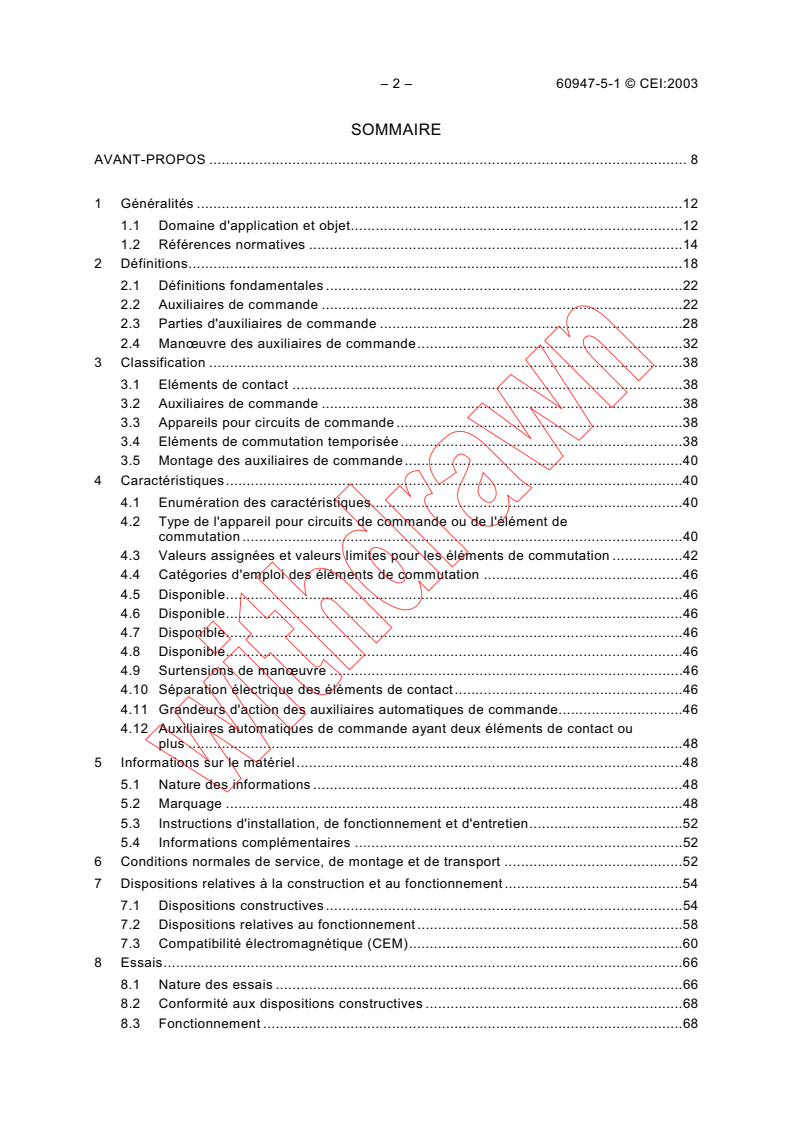
SOMMAIRE
AVANT-PROPOS . 8
1 Généralités.12
1.1 Domaine d'application et objet.12
1.2 Références normatives.14
2 Définitions.18
2.1 Définitions fondamentales.22
2.2 Auxiliaires de commande .22
2.3 Parties d'auxiliaires de commande .28
2.4 Manœuvre des auxiliaires de commande.32
3 Classification.38
3.1 Eléments de contact .38
3.2 Auxiliaires de commande .38
3.3 Appareils pour circuits de commande .38
3.4 Eléments de commutation temporisée .38
3.5 Montage des auxiliaires de commande.40
4 Caractéristiques.40
4.1 Enumération des caractéristiques.40
4.2 Type de l'appareil pour circuits de commande ou de l'élément de
commutation .40
4.3 Valeurs assignées et valeurs limites pour les éléments de commutation .42
4.4 Catégories d'emploi des éléments de commutation .46
4.5 Disponible.46
4.6 Disponible.46
4.7 Disponible.46
4.8 Disponible.46
4.9 Surtensions de manœuvre .46
4.10 Séparation électrique des éléments de contact.46
4.11 Grandeurs d'action des auxiliaires automatiques de commande.46
4.12 Auxiliaires automatiques de commande ayant deux éléments de contact ou
plus .48
5 Informations sur le matériel.48
5.1 Nature des informations .48
5.2 Marquage.48
5.3 Instructions d'installation, de fonctionnement et d'entretien.52
5.4 Informations complémentaires.52
6 Conditions normales de service, de montage et de transport .52
7 Dispositions relatives à la construction et au fonctionnement .54
7.1 Dispositions constructives.54
7.2 Dispositions relatives au fonctionnement.58
7.3 Compatibilité électromagnétique (CEM).60
8 Essais.66
8.1 Nature des essais .66
8.2 Conformité aux dispositions constructives .68
8.3 Fonctionnement.68
60947-5-1 © IEC:2003 – 3 –
CONTENTS
FOREWORD . 9
1 General.13
1.1 Scope and object .13
1.2 Normative references.15
2 Definitions.19
2.1 Basic definitions.23
2.2 Control switches.23
2.3 Parts of control switches .29
2.4 Operation of control switches .33
3 Classification.39
3.1 Contact elements.39
3.2 Control switches.39
3.3 Control circuit devices.39
3.4 Time delay switching elements.39
3.5 Control switch mounting.41
4 Characteristics.41
4.1 Summary of characteristics.41
4.2 Type of control circuit device or switching element.41
4.3 Rated and limiting values for switching elements .43
4.4 Utilization categories for switching elements .47
4.5 Vacant.47
4.6 Vacant.47
4.7 Vacant.47
4.8 Vacant.47
4.9 Switching overvoltages.47
4.10 Electrically separated contact elements .47
4.11 Actuating quantities for pilot switches .47
4.12 Pilot switches having two or more contact elements.49
5 Product information.49
5.1 Nature of information.49
5.2 Marking.49
5.3 Instructions for installation, operation and maintenance .53
5.4 Additional information.53
6 Normal service, mounting and transport conditions .53
7 Constructional and performance requirements .55
7.1 Constructional requirements.55
7.2 Performance requirements.59
7.3 Electromagnetic compatibility (EMC).61
8 Tests.67
8.1 Kinds of test.67
8.2 Compliance with constructional requirements.69
8.3 Performance.69
– 4 – 60947-5-1 © CEI:2003
Annexe A (normative) Caractéristiques électriques assignées suivant les catégories
d'emploi (voir 3.1).94
Annexe B (normative) Exemple de charges d'essai inductives pour contacts en courant
continu .98
Annexe C (normative) Essais spéciaux – Essais de durabilité .102
Annexe D (normative) Distances d'isolement et lignes de fuite des appareils pour
circuits de commande.110
Annexe E (normative) Points faisant l'objet d'un accord entre le constructeur et
l'utilisateur.116
Annexe F (normative) Appareils de classe II pour circuit de commande isolés par
encapsulation Prescriptions et essais .118
Annexe G (normative) Prescriptions supplémentaires pour les appareils pour circuits de
commande avec câble faisant partie intégrante de l'appareil .126
Annexe H (normative) Prescriptions complémentaires concernant les éléments de
commutation à semi-conducteurs pour les appareils pour circuits de commande.132
Annexe J (normative) Prescriptions spéciales pour les voyants lumineux et les
colonnes lumineuses .148
Annexe K (normative) Prescriptions spéciales pour les auxiliaires de commande à
manœuvre positive d'ouverture.160
Annexe L (normative) Prescriptions spéciales pour les éléments de contacts
mécaniquement liés.172
Figure 1 – Exemples de la méthode recommandée pour représenter un diagramme de
fonctionnement d'un commutateur rotatif .41
Figure 2 – Manœuvre des boutons-poussoirs.82
Figure 3 – Différence e entre la course résiduelle de l'organe de commande et celle de
l'élément de contact .84
Figure 4 – Exemples d'éléments de contact (schémas) .86
Figure 5 – Circuits d'essai – Auxiliaires de commande multipolaires – Contacts de
même polarité non électriquement séparés.88
Figure 6 – Circuits d'essai – Auxiliaires de commande multipolaires – Contacts de
polarité opposée et électriquement séparés .88
Figure 7 – Détails de la charge L pour des conditions d'essais demandant des courants
d
d'établissement et de coupure et/ou des facteurs de puissance (ou des constantes de
temps) de valeurs différentes .90
Figure 8 – Circuit d'essai au courant de court-circuit conditionnel (voir 8.3.4.2) .92
Figure 9 – Limites courant/temps pour circuits d'essai en courant continu (voir 8.3.3.5.3).92
Figure B.1 – Construction de la charge pour les contacts à courant continu.100
Figure C.1 – Circuit normal (voir C.3.2.1).108
Figure C.2 – Circuit simplifié (voir C.3.2.1).108
Figure F.1 – Isolation par encapsulation.120
Figure F.2 – Dispositif d'essai.122
Figure H.1 – Relation entre U et U .134
e B
Figure H.2 – Exemple de circuit d'essai pour la vérification de la chute de tension,
courant minimal de fonctionnement et courant à l'état bloquant (voir H.8.2, H.8.3 et
H.8.4).138
Figure H.3 – Essai de court-circuit (voir H.8.6.1) .140
Figure K.1 – Vérification de la robustesse du mécanisme transmetteur .170
60947-5-1 © IEC:2003 – 5 –
Annex A (normative) Electrical ratings based on utilization categories (see 3.1).95
Annex B (normative) Example of inductive test loads for d.c. contacts .99
Annex C (normative) Special tests – Durability tests .103
Annex D (normative) Clearances and creepage distances of control circuit devices .111
Annex E (normative) Items subject to agreement between manufacturer and user .117
Annex F (normative) Class II control circuit devices insulated by encapsulation
Requirements and tests .119
Annex G (normative) Additional requirements for control circuit devices with integrally
connected cables .127
Annex H (normative) Additional requirements for semiconductor switching elements
for control circuit devices .133
Annex J (normative) Special requirements for indicator lights and indicating towers.149
Annex K (normative) Special requirements for control switches with direct opening
action.161
Annex L (normative) Special requirements for mechanically linked contact elements .173
Figure 1 – Examples of the recommended method for drawing an operating diagram of
a rotary switch.41
Figure 2 – Operation of push-buttons .83
Figure 3 – Difference e between the over-travel of the actuator and that of the contact
element.85
Figure 4 – Examples of contact elements (schematic sketches) .87
Figure 5 – Test circuits for multi-pole control switches – Contacts of same polarity, not
electrically separated .89
Figure 6 – Test circuits for multi-pole control switches – Contacts of opposite polarity,
and electrically separated .89
Figure 7 – Load L details for test conditions requiring different values of make and
d
break current and/or power factor (time constant) .91
Figure 8 – Test circuit, conditional short-circuit current (see 8.3.4.2).93
Figure 9 – Current/time limits for d.c. test loads (see 8.3.3.5.3).93
Figure B.1 – Construction of load for d.c. contacts .101
Figure C.1 – Normal circuit (see C.3.2.1) .109
Figure C.2 – Simplified circuit (see C.3.2.1) .109
Figure F.1 – Insulation by encapsulation .121
Figure F.2 – Test apparatus .123
Figure H.1 – Relationship between U and U .135
e B
Figure H.2 – Example of test circuit for the verification of voltage drop, minimum
operational current and OFF-state current (see H.8.2, H.8.3 and H.8.4) .139
Figure H.3 – Short-circuit testing (see H.8.6.1).141
Figure K.1 – Verification of robustness of the actuating system.171
– 6 – 60947-5-1 © CEI:2003
Figure L.1 – Exemple de représentation de contacts à fermeture et à ouverture qui sont
mécaniquement liés et un contact à ouverture non lié .174
Figure L.2 – Symbole pour un appareil comportant des contacts mécaniquement liés.174
Tableau 1 – Catégories d'emploi des éléments de commutation.46
Tableau 2 – Diamètre du trou de fixation et cotes du logement éventuel d'ergot .52
Tableau 3 – Distances minimales préférentielles entre les centres des trous de fixation .54
Tableau 4 – Vérification des pouvoirs de fermeture et de coupure des éléments de
commutation dans les conditions normales correspondant aux catégories d'emploi .62
Tableau 5 – Vérification des pouvoirs de fermeture et de coupure des éléments de
commutation dans les conditions anormales correspondant aux catégories d'emploi .64
Tableau A.1 – Exemples de désignation des caractéristiques assignées des contacts
suivant les catégories d'emploi .94
Tableau A.2 – Exemples de caractéristiques d'élément de commutation pour 50 Hz
et/ou 60 Hz.96
Tableau A.3 – Exemples de caractéristiques d'élément de commutation pour courant continu . 96
Tableau B.1 – Charges en courant continu.100
Tableau C.1 – Pouvoir de fermeture et de coupure pour les essais de durabilité
électrique .106
Tableau D.1 – Distances d'isolement et lignes de fuite.114
Tableau H.1 – Essais d’immunité.142
60947-5-1 © IEC:2003 – 7 –
Figure L.1 – Example of representation of NO and NC contacts which are mechanically
linked and NC non-linked contact .175
Figure L.2 – Symbol for device containing mechanically linked contacts.175
Table 1 – Utilization categories for switching elements.47
Table 2 – Mounting hole diameter and dimensions of the key recess (if any).53
Table 3 – Preferred minimum distances between centres of mounting holes .55
Table 4 – Verification of making and breaking capacities of switching elements under
normal conditions corresponding to the utilization categories .63
Table 5 – Verification of making and breaking capacities of switching elements under
abnormal conditions corresponding to the utilization categories .65
Table A.1 – Examples of contact rating designation based on utilization categories .95
Table A.2 – Examples of semiconductors switching element ratings for 50 Hz and/or 60 Hz 97
Table A.3 – Examples of semiconductors switching element ratings for d.c. .97
Table B.1 – DC loads .101
Table C.1 – Making and breaking conditions for electrical durability .107
Table D.1 – Clearances and creepage distances.115
Table H.1 – Immunity tests.143
– 8 – 60947-5-1 © CEI:2003
COMMISSION ÉLECTROTECHNIQUE INTERNATIONALE
__________
APPAREILLAGE À BASSE TENSION –
Partie 5-1: Appareils et éléments de commutation
pour circuits de commande –
Appareils électromécaniques pour circuits de commande
AVANT-PROPOS
1) La Commission Electrotechnique Internationale (CEI) est une organisation mondiale de normalisation composée
de l'ensemble des comités électrotechniques nationaux (Comités nationaux de la CEI). La CEI a pour objet de
favoriser la coopération internationale pour toutes les questions de normalisation dans les domaines de
l'électricité et de l'électronique. A cet effet, la CEI – entre autres activités – publie des Normes internationales,
des Spécifications techniques, des Rapports techniques, des Spécifications accessibles au public (PAS) et des
Guides (ci-après dénommés "Publication(s) de la CEI"). Leur élaboration est confiée à des comités d'études,
aux travaux desquels tout Comité national intéressé par le sujet traité peut participer. Les organisations
internationales, gouvernementales et non gouvernementales, en liaison avec la CEI, participent également aux
travaux. La CEI collabore étroitement avec l'Organisation Internationale de Normalisation (ISO), selon des
conditions fixées par accord entre les deux organisations.
2) Les décisions ou accords officiels de la CEI concernant les questions techniques représentent, dans la mesure
du possible, un accord international sur les sujets étudiés, étant donné que les Comités nationaux de la CEI
intéressés sont représentés dans chaque comité d’études.
3) Les Publications de la CEI se présentent sous la forme de recommandations internationales et sont agréées
comme telles par les Comités nationaux de la CEI. Tous les efforts raisonnables sont entrepris afin que la CEI
s'assure de l'exactitude du contenu technique de ses publications; la CEI ne peut pas être tenue responsable de
l'éventuelle mauvaise utilisation ou interprétation qui en est faite par un quelconque utilisateur final.
4) Dans le but d'encourager l'uniformité internationale, les Comités nationaux de la CEI s'engagent, dans toute la
mesure possible, à appliquer de façon transparente les Publications de la CEI dans leurs publications
nationales et régionales. Toutes divergences entre toutes Publications de la CEI et toutes publications
nationales ou régionales correspondantes doivent être indiquées en termes clairs dans ces dernières.
5) La CEI n’a prévu aucune procédure de marquage valant indication d’approbation et n'engage pas sa
responsabilité pour les équipements déclarés conformes à une de ses Publications.
6) Tous les utilisateurs doivent s'assurer qu'ils sont en possession de la dernière édition de cette publication.
7) Aucune responsabilité ne doit être imputée à la CEI, à ses administrateurs, employés, auxiliaires ou
mandataires, y compris ses experts particuliers et les membres de ses comités d'études et des Comités
nationaux de la CEI, pour tout préjudice causé en cas de dommages corporels et matériels, ou de tout autre
dommage de quelque nature que ce soit, directe ou indirecte, ou pour supporter les coûts (y compris les frais
de justice) et les dépenses découlant de la publication ou de l'utilisation de cette Publication de la CEI ou de
toute autre Publication de la CEI, ou au crédit qui lui est accordé.
8) L'attention est attirée sur les références normatives citées dans cette publication. L'utilisation de publications
référencées est obligatoire pour une application correcte de la présente publication.
9) L’attention est attirée sur le fait que certains des éléments de la présente Publication de la CEI peuvent faire
l’objet de droits de propriété intellectuelle ou de droits analogues. La CEI ne saurait être tenue pour
responsable de ne pas avoir identifié de tels droits de propriété et de ne pas avoir signalé leur existence.
La Norme internationale CEI 60947-5-1 a été établie par le sous-comité 17B: Appareillage à
basse tension, du comité d'études 17 de la CEI: Appareillage.
Cette troisième édition de la CEI 60947-5-1 annule et remplace la deuxième édition, parue en
1997, l’amendement 1 (1999) et l’amendement 2 (1999).
Le document 17B/1297/FDIS, diffusé comme amendement 3 auprès des Comités nationaux de
la CEI, a conduit à la publication de cette nouvelle édition.
60947-5-1 © IEC:2003 – 9 –
INTERNATIONAL ELECTROTECHNICAL COMMISSION
___________
LOW-VOLTAGE SWITCHGEAR AND CONTROLGEAR –
Part 5-1: Control circuit devices and switching elements
Electromechanical control circuit devices
FOREWORD
1) The International Electrotechnical Commission (IEC) is a worldwide organization for standardization comprising
all national electrotechnical committees (IEC National Committees). The object of IEC is to promote
international co-operation on all questions concerning standardization in the electrical and electronic fields. To
this end and in addition to other activities, IEC publishes International Standards, Technical Specifications,
Technical Reports, Publicly Available Specifications (PAS) and Guides (hereafter referred to as “IEC
Publication(s)”). Their preparation is entrusted to technical committees; any IEC National Committee interested
in the subject dealt with may participate in this preparatory work. International, governmental and non-
governmental organizations liaising with the IEC also participate in this preparation. IEC collaborates closely
with the International Organization for Standardization (ISO) in accordance with conditions determined by
agreement between the two organizations.
2) The formal decisions or agreements of IEC on technical matters express, as nearly as possible, an international
consensus of opinion on the relevant subjects since each technical committee has representation from all
interested IEC National Committees.
3) IEC Publications have the form of recommendations for international use and are accepted by IEC National
Committees in that sense. While all reasonable efforts are made to ensure that the technical content of IEC
Publications is accurate, IEC cannot be held responsible for the way in which they are used or for any
misinterpretation by any end user.
4) In order to promote international uniformity, IEC National Committees undertake to apply IEC Publications
transparently to the maximum extent possible in their national and regional publications. Any divergence
between any IEC Publication and the corresponding national or regional publication shall be clearly indicated in
the latter.
5) IEC provides no marking procedure to indicate its approval and cannot be rendered responsible for any
equipment declared to be in conformity with an IEC Publication.
6) All users should ensure that they have the latest edition of this publication.
7) No liability shall attach to IEC or its directors, employees, servants or agents including individual experts and
members of its technical committees and IEC National Committees for any personal injury, property damage or
other damage of any nature whatsoever, whether direct or indirect, or for costs (including legal fees) and
expenses arising out of the publication, use of, or reliance upon, this IEC Publication or any other IEC
Publications.
8) Attention is drawn to the Normative references cited in this publication. Use of the referenced publications is
indispensable for the correct application of this publication.
9) Attention is drawn to the possibility that some of the elements of this IEC Publication may be the subject of
patent rights. IEC shall not be held responsible for identifying any or all such patent rights.
International Standard IEC 60947-5-1 has been prepared by subcommittee 17B: Low-voltage
switchgear and controlgear, of IEC technical committee 17: Switchgear and controlgear.
This third edition of IEC 60947-5-1 cancels and replaces the second edition, published in
1997, amendment 1 (1999) and amendment 2 (1999).
The document 17B/1297/FDIS, circulated to the National Committees as amendment 3, led to
the publication of this new edition.
– 10 – 60947-5-1 © CEI:2003
Le texte de cette norme est basé sur les documents suivants:
FDIS Rapport de vote
17B/1297/FDIS 17B/1309/RVD
Le rapport de vote indiqué dans le tableau ci-dessus donne toute information sur le vote ayant
abouti à l’approbation de cette norme.
Cette Norme internationale doit être utilisée conjointement avec la CEI 60947-1.
Cette publication a été rédigée selon les Directives ISO/CEI, Partie 2.
Le comité a décidé que le contenu de cette publication ne sera pas modifié avant 2006. A cette
date, la publication sera:
• reconduite;
• supprimée;
• remplacée par une édition révisée, ou
• amendée.
60947-5-1 © IEC:2003 – 11 –
The text of this standard is based on the following documents:
FDIS Report on voting
17B/1297/FDIS 17B/1309/RVD
Full information on the voting for the approval of this standard can be found in the report on
voting indicated in the above table.
This International Standard should be used in conjunction with IEC 60947-1.
This publication has been drafted in accordance with the ISO/IEC Directives, Part 2.
The committee has decided that the contents of this publication will remain unchanged until
2006. At this date, the publication will be:
• reconfirmed;
• withdrawn;
• replaced by a revised edition, or
• amended.
– 12 – 60947-5-1 © CEI:2003
APPAREILLAGE À BASSE TENSION –
Partie 5-1: Appareils et éléments de commutation
pour circuits de commande –
Appareils électromécaniques pour circuits de commande
1 Généralités
Les dispositions des règles générales de la CEI 60947-1 sont applicables à la présente norme
lorsque celle-ci le précise. Les articles, paragraphes, tableaux et figures des règles générales
qui sont ainsi applicables sont identifiés par référence à la CEI 60947-1, par exemple:
paragraphe 1.2.3, Tableau 4 ou Annexe A de la CEI 60947-1.
1.1 Domaine d'application et objet
La présente partie de la CEI 60947 est applicable aux appareils pour circuits de commande et
aux éléments de commutation destinés à la commande, la signalisation, le verrouillage, etc.,
de l'appareillage.
Elle est applicable aux appareils pour circuits de commande dont la tension assignée ne
dépasse pas 1 000 V en courant alternatif (à une fréquence ne dépassant pas 1 000 Hz) ou
600 V en courant continu.
Toutefois, pour des tensions d'emploi, alternatives ou continues, inférieures à 100 V, voir la
note 2 en 4.3.1.1.
La présente norme s'applique à des types déterminés d'appareils pour circuits de commande,
tels que:
– auxiliaires manuels de commande, par exemple boutons-poussoirs, commutateurs rotatifs,
interrupteurs à pédale, etc.;
– auxiliaires électromagnétiques de commande, soit temporisés, soit instantanés, par
exemple contacteurs auxiliaires;
– auxiliaires automatiques de commande, par exemple détecteurs de pression à contacts,
détecteurs de température à contacts (thermostats), programmateurs, etc.;
– interrupteurs de position, par exemple auxiliaires de commande actionnés par une partie
d'une machine ou d'un mécanisme;
– matériel de commande associé, par exemple voyants lumineux, etc.
NOTE 1 Un appareil pour circuits de commande comprend un (des) auxiliaire(s) de commande et des appareils
associés, tels que voyant(s) lumineux.
NOTE 2 Un auxiliaire de commande comprend un (des) élément(s) de commutation et un mécanisme transmetteur.
NOTE 3 Un élément de commutation peut être un élément de contact ou un élément à semi-conducteurs.
Elle s'applique également à des types déterminés d'éléments de commutation associés à
d'autres appareils (dont les circuits principaux font l'objet d'autres normes), tels que:
– contacts auxiliaires d'un appareil de connexion (par exemple contacteur, disjoncteur, etc.)
qui ne sont pas prévus pour être utilisés exclusivement avec la bobine de cet appareil;
– contacts de verrouillage de portes d'enveloppes;
– contacts de circuits de commande d'interrupteurs rotatifs;
– contacts de circuits de commande de relais de surcharge.
60947-5-1 © IEC:2003 – 13 –
LOW-VOLTAGE SWITCHGEAR AND CONTROLGEAR –
Part 5-1: Control circuit devices and switching elements –
Electromechanical control circuit devices
1 General
The provisions of the general rules, IEC 60947-1, are applicable to this standard, where
specifically called for. General rules, clauses and subclauses thus applicable, as well as
tables, figures and annexes are identified by a reference to IEC 60947-1, for example 1.2.3,
Table 4 or Annex A of IEC 60947-1.
1.1 Scope and object
This part of IEC 60947 applies to control circuit devices and switching elements intended for
controlling, signalling, interlocking, etc., of switchgear and controlgear.
It applies to control circuit devices having a rated voltage not exceeding 1 000 V a.c. (at a
frequency not exceeding 1 000 Hz) or 600 V d.c.
However, for operational voltages below 100 V a.c. or d.c., see note 2 of 4.3.1.1.
This standard applies to specific types of control circuit devices such as:
– manual control switches, for example pushbuttons, rotary switches, foot switches, etc.;
– electromagnetically operated control switches, either time-delayed or instantaneous, for
example contactor relays;
– pilot switches, for example pressure switches, temperature sensitive switches (thermostats),
programmers, etc.;
– position switches, for example control switches operated by part of a machine or
mechanism;
– associated control circuit equipment, for example indicator lights, etc.
NOTE 1 A control circuit device includes (a) control switch(es) and associated devices such as (an) indicator
light(s).
NOTE 2 A control switch includes (a) switching element(s) and an actuating system.
NOTE 3 A switching element may be a contact element or a semiconductor element.
It also applies to specific types of switching elements associated with other devices (whose
main circuits are covered by other standards) such as:
– auxiliary contacts of a switching device (e.g. contactor, circuit breaker. etc.) which are not
dedicated exclusively for use with the coil of that device;
– interlocking contacts of enclosure doors;
– control circuit contacts of rotary switches;
– control circuit contacts of overload relays.
– 14 – 60947-5-1 © CEI:2003
Les contacteurs auxiliaires doivent satisfaire aux prescriptions et aux essais de la CEI 60947-4-1
sauf en ce qui concerne la catégorie d'emploi qui doit être conforme à la présente norme.
Cette norme ne comprend pas les relais qui sont traités dans la CEI 60255 ni les dispositifs
électriques de commande automatique pour appar
...
IEC 60947-5-1 ®
Edition 3.1 2009-07
INTERNATIONAL
STANDARD
NORME
INTERNATIONALE
Low-voltage switchgear and controlgear –
Part 5-1: Control circuit devices and switching elements – Electromechanical
control circuit devices
Appareillage à basse tension –
Partie 5-1: Appareils et éléments de commutation pour circuits de commande –
Appareils électromécaniques pour circuits de commande
All rights reserved. Unless otherwise specified, no part of this publication may be reproduced or utilized in any form or by
any means, electronic or mechanical, including photocopying and microfilm, without permission in writing from either IEC or
IEC's member National Committee in the country of the requester.
If you have any questions about IEC copyright or have an enquiry about obtaining additional rights to this publication,
please contact the address below or your local IEC member National Committee for further information.
Droits de reproduction réservés. Sauf indication contraire, aucune partie de cette publication ne peut être reproduite
ni utilisée sous quelque forme que ce soit et par aucun procédé, électronique ou mécanique, y compris la photocopie
et les microfilms, sans l'accord écrit de la CEI ou du Comité national de la CEI du pays du demandeur.
Si vous avez des questions sur le copyright de la CEI ou si vous désirez obtenir des droits supplémentaires sur cette
publication, utilisez les coordonnées ci-après ou contactez le Comité national de la CEI de votre pays de résidence.
IEC Central Office
3, rue de Varembé
CH-1211 Geneva 20
Switzerland
Email: inmail@iec.ch
Web: www.iec.ch
About the IEC
The International Electrotechnical Commission (IEC) is the leading global organization that prepares and publishes
International Standards for all electrical, electronic and related technologies.
About IEC publications
The technical content of IEC publications is kept under constant review by the IEC. Please make sure that you have the
latest edition, a corrigenda or an amendment might have been published.
ƒ Catalogue of IEC publications: www.iec.ch/searchpub
The IEC on-line Catalogue enables you to search by a variety of criteria (reference number, text, technical committee,…).
It also gives information on projects, withdrawn and replaced publications.
ƒ IEC Just Published: www.iec.ch/online_news/justpub
Stay up to date on all new IEC publications. Just Published details twice a month all new publications released. Available
on-line and also by email.
ƒ Electropedia: www.electropedia.org
The world's leading online dictionary of electronic and electrical terms containing more than 20 000 terms and definitions
in English and French, with equivalent terms in additional languages. Also known as the International Electrotechnical
Vocabulary online.
ƒ Customer Service Centre: www.iec.ch/webstore/custserv
If you wish to give us your feedback on this publication or need further assistance, please visit the Customer Service
Centre FAQ or contact us:
Email: csc@iec.ch
Tel.: +41 22 919 02 11
Fax: +41 22 919 03 00
A propos de la CEI
La Commission Electrotechnique Internationale (CEI) est la première organisation mondiale qui élabore et publie des
normes internationales pour tout ce qui a trait à l'électricité, à l'électronique et aux technologies apparentées.
A propos des publications CEI
Le contenu technique des publications de la CEI est constamment revu. Veuillez vous assurer que vous possédez
l’édition la plus récente, un corrigendum ou amendement peut avoir été publié.
ƒ Catalogue des publications de la CEI: www.iec.ch/searchpub/cur_fut-f.htm
Le Catalogue en-ligne de la CEI vous permet d’effectuer des recherches en utilisant différents critères (numéro de référence,
texte, comité d’études,…). Il donne aussi des informations sur les projets et les publications retirées ou remplacées.
ƒ Just Published CEI: www.iec.ch/online_news/justpub
Restez informé sur les nouvelles publications de la CEI. Just Published détaille deux fois par mois les nouvelles
publications parues. Disponible en-ligne et aussi par email.
ƒ Electropedia: www.electropedia.org
Le premier dictionnaire en ligne au monde de termes électroniques et électriques. Il contient plus de 20 000 termes et
définitions en anglais et en français, ainsi que les termes équivalents dans les langues additionnelles. Egalement appelé
Vocabulaire Electrotechnique International en ligne.
ƒ Service Clients: www.iec.ch/webstore/custserv/custserv_entry-f.htm
Si vous désirez nous donner des commentaires sur cette publication ou si vous avez des questions, visitez le FAQ du
Service clients ou contactez-nous:
Email: csc@iec.ch
Tél.: +41 22 919 02 11
Fax: +41 22 919 03 00
IEC 60947-5-1 ®
Edition 3.1 2009-07
INTERNATIONAL
STANDARD
NORME
INTERNATIONALE
Low-voltage switchgear and controlgear –
Part 5-1: Control circuit devices and switching elements – Electromechanical
control circuit devices
Appareillage à basse tension –
Partie 5-1: Appareils et éléments de commutation pour circuits de commande –
Appareils électromécaniques pour circuits de commande
INTERNATIONAL
ELECTROTECHNICAL
COMMISSION
COMMISSION
ELECTROTECHNIQUE
PRICE CODE
INTERNATIONALE
CS
CODE PRIX
ICS 29.120.40; 29.130.20 ISBN 978-2-88910-340-9
– 2 – 60947-5-1 © IEC:2003+A1:2009
CONTENTS
FOREWORD.5
1 General.7
1.1 Scope and object.7
1.2 Normative references.8
2 Definitions.10
2.1 Basic definitions.12
2.2 Control switches.12
2.3 Parts of control switches.15
2.4 Operation of control switches.17
3 Classification.20
3.1 Contact elements.20
3.2 Control switches.20
3.3 Control circuit devices.20
3.4 Time delay switching elements .20
3.5 Control switch mounting .20
4 Characteristics.20
4.1 Summary of characteristics.20
4.2 Type of control circuit device or switching element .21
4.3 Rated and limiting values for switching elements .22
4.4 Utilization categories for switching elements.23
4.5 Vacant.24
4.6 Vacant.24
4.7 Vacant.24
4.8 Vacant.24
4.9 Switching overvoltages.24
4.10 Electrically separated contact elements .24
4.11 Actuating quantities for pilot switches .24
4.12 Pilot switches having two or more contact elements.24
5 Product information .24
5.1 Nature of information.24
5.2 Marking.25
5.3 Instructions for installation, operation and maintenance.26
5.4 Additional information.26
6 Normal service, mounting and transport conditions .26
7 Constructional and performance requirements .28
7.1 Constructional requirements.28
7.2 Performance requirements.29
7.3 Electromagnetic compatibility (EMC) .30
8 Tests.32
8.1 Kinds of test.32
8.2 Compliance with constructional requirements .33
8.3 Performance.34
60947-5-1 © IEC:2003+A1:2009 – 3 –
Annex A (normative) Electrical ratings based on utilization categories (see 3.1) .46
Annex B (normative) Example of inductive test loads for d.c. contacts .48
Annex C (normative) Special tests – Durability tests .50
Annex D Vacant.54
Annex E (normative) Items subject to agreement between manufacturer and user .55
Annex F (normative) Class II control circuit devices insulated by encapsulation
Requirements and tests .56
Annex G (normative) Additional requirements for control circuit devices with integrally
connected cables.60
Annex H (normative) Additional requirements for semiconductor switching elements
for control circuit devices .63
Annex J (normative) Special requirements for indicator lights and indicating towers .72
Annex K (normative) Special requirements for control switches with direct opening
action .78
Annex L (normative) Special requirements for mechanically linked contact elements .84
Annex M (normative) Terminal marking, distinctive number and distinctive letter
for control circuit devices .87
Bibliography.92
Figure 1 – Examples of the recommended method for drawing an operating diagram
of a rotary switch .39
Figure 2 – Operation of push-buttons.40
Figure 3 – Difference e between the over-travel of the actuator and that
of the contact element .41
Figure 4 – Examples of contact elements (schematic sketches) .42
Figure 5 – Test circuits for multi-pole control switches – Contacts of same polarity,
not electrically separated .43
Figure 6 – Test circuits for multi-pole control switches – Contacts of opposite polarity,
and electrically separated .43
Figure 7 – Load L details for test conditions requiring different values of make
d
and break current and/or power factor (time constant) .44
Figure 8 – Test circuit, conditional short-circuit current (see 8.3.4.2) .45
Figure 9 – Current/time limits for d.c. test loads (see 8.3.3.5.3) .45
Figure B.1 – Construction of load for d.c. contacts.49
Figure C.1 – Normal circuit (see C.3.2.1) .53
Figure C.2 – Simplified circuit (see C.3.2.1) .53
Figure F.1 – Insulation by encapsulation.57
Figure F.2 – Test apparatus.58
Figure H.1 – Relationship between U and U .64
e B
Figure H.2 – Example of test circuit for the verification of voltage drop, minimum
operational current and OFF-state current (see H.8.2, H.8.3 and H.8.4).66
Figure H.3 – Short-circuit testing (see H.8.6.1) .67
Figure K.1 – Verification of robustness of the actuating system.83
– 4 – 60947-5-1 © IEC:2003+A1:2009
Figure L.1 – Example of representation of NO and NC contacts which are mechanically
linked and NC non-linked contact.85
Figure L.2 – Symbol for device containing mechanically linked contacts .85
Table 1 – Utilization categories for switching elements .23
Table 2 – Mounting hole diameter and dimensions of the key recess (if any) .27
Table 3 – Preferred minimum distances between centres of mounting holes .27
Table 4 – Verification of making and breaking capacities of switching elements
under normal conditions corresponding to the utilization categories .31
Table 5 – Verification of making and breaking capacities of switching elements
under abnormal conditions corresponding to the utilization categories .32
Table A.1 – Examples of contact rating designation based on utilization categories .46
Table A.2 – Examples of semiconductors switching element ratings for 50 Hz and/or 60 Hz. 47
Table A.3 – Examples of semiconductors switching element ratings for d.c.47
Table B.1 – DC loads.49
Table C.1 – Making and breaking conditions for electrical durability.52
Table H.1 – Immunity tests .69
Table M.1 – Diagrams of control switches.89
Table M.2 – Diagrams of contactor relays designated by the distinctive letter E.90
Table M.3 – Diagrams of contactor relays designated by the distinctive letter Y.91
60947-5-1 © IEC:2003+A1:2009 – 5 –
INTERNATIONAL ELECTROTECHNICAL COMMISSION
___________
LOW-VOLTAGE SWITCHGEAR AND CONTROLGEAR –
Part 5-1: Control circuit devices and switching elements
Electromechanical control circuit devices
FOREWORD
1) The International Electrotechnical Commission (IEC) is a worldwide organization for standardization comprising
all national electrotechnical committees (IEC National Committees). The object of IEC is to promote
international co-operation on all questions concerning standardization in the electrical and electronic fields. To
this end and in addition to other activities, IEC publishes International Standards, Technical Specifications,
Technical Reports, Publicly Available Specifications (PAS) and Guides (hereafter referred to as “IEC
Publication(s)”). Their preparation is entrusted to technical committees; any IEC National Committee interested
in the subject dealt with may participate in this preparatory work. International, governmental and non-
governmental organizations liaising with the IEC also participate in this preparation. IEC collaborates closely
with the International Organization for Standardization (ISO) in accordance with conditions determined by
agreement between the two organizations.
2) The formal decisions or agreements of IEC on technical matters express, as nearly as possible, an international
consensus of opinion on the relevant subjects since each technical committee has representation from all
interested IEC National Committees.
3) IEC Publications have the form of recommendations for international use and are accepted by IEC National
Committees in that sense. While all reasonable efforts are made to ensure that the technical content of IEC
Publications is accurate, IEC cannot be held responsible for the way in which they are used or for any
misinterpretation by any end user.
4) In order to promote international uniformity, IEC National Committees undertake to apply IEC Publications
transparently to the maximum extent possible in their national and regional publications. Any divergence
between any IEC Publication and the corresponding national or regional publication shall be clearly indicated in
the latter.
5) IEC provides no marking procedure to indicate its approval and cannot be rendered responsible for any
equipment declared to be in conformity with an IEC Publication.
6) All users should ensure that they have the latest edition of this publication.
7) No liability shall attach to IEC or its directors, employees, servants or agents including individual experts and
members of its technical committees and IEC National Committees for any personal injury, property damage or
other damage of any nature whatsoever, whether direct or indirect, or for costs (including legal fees) and
expenses arising out of the publication, use of, or reliance upon, this IEC Publication or any other IEC
Publications.
8) Attention is drawn to the Normative references cited in this publication. Use of the referenced publications is
indispensable for the correct application of this publication.
9) Attention is drawn to the possibility that some of the elements of this IEC Publication may be the subject of
patent rights. IEC shall not be held responsible for identifying any or all such patent rights.
International Standard IEC 60947-5-1 has been prepared by subcommittee 17B: Low-voltage
switchgear and controlgear, of IEC technical committee 17: Switchgear and controlgear.
This consolidated version of IEC 60947-5-1 consists of the third edition (2003) [documents
17B/1297/FDIS and 17B/1309/RVD] and its amendment 1 (2009) [documents 17B/1653/FDIS
and 17B/1667/RVD].
The technical content is therefore identical to the base edition and its amendment and has
been prepared for user convenience.
It bears the edition number 3.1.
A vertical line in the margin shows where the base publication has been modified by
amendment 1.
This International Standard should be used in conjunction with IEC 60947-1.
– 6 – 60947-5-1 © IEC:2003+A1:2009
This publication has been drafted in accordance with the ISO/IEC Directives, Part 2.
A list of all the parts in the IEC 60947 series, under the general title Low-voltage switchgear
and controlgear, can be found on the IEC website.
The committee has decided that the contents of the base publication and its amendments will
remain unchanged until the maintenance result date indicated on the IEC web site under
"http://webstore.iec.ch" in the data related to the specific publication. At this date,
the publication will be
• reconfirmed,
• withdrawn,
• replaced by a revised edition, or
• amended.
60947-5-1 © IEC:2003+A1:2009 – 7 –
LOW-VOLTAGE SWITCHGEAR AND CONTROLGEAR –
Part 5-1: Control circuit devices and switching elements –
Electromechanical control circuit devices
1 General
The provisions of the general rules, IEC 60947-1, are applicable to this standard, where
specifically called for. General rules, clauses and subclauses thus applicable, as well as
tables, figures and annexes are identified by a reference to IEC 60947-1, for example 1.2.3,
Table 4 or Annex A of IEC 60947-1.
1.1 Scope and object
This part of IEC 60947 applies to control circuit devices and switching elements intended for
controlling, signalling, interlocking, etc., of switchgear and controlgear.
It applies to control circuit devices having a rated voltage not exceeding 1 000 V a.c. (at a
frequency not exceeding 1 000 Hz) or 600 V d.c.
However, for operational voltages below 100 V a.c. or d.c., see note 2 of 4.3.1.1.
This standard applies to specific types of control circuit devices such as:
– manual control switches, for example pushbuttons, rotary switches, foot switches, etc.;
– electromagnetically operated control switches, either time-delayed or instantaneous, for
example contactor relays;
– pilot switches, for example pressure switches, temperature sensitive switches (thermostats),
programmers, etc.;
– position switches, for example control switches operated by part of a machine or
mechanism;
– associated control circuit equipment, for example indicator lights, etc.
NOTE 1 A control circuit device includes (a) control switch(es) and associated devices such as (an) indicator
light(s).
NOTE 2 A control switch includes (a) switching element(s) and an actuating system.
NOTE 3 A switching element may be a contact element or a semiconductor element.
It also applies to specific types of switching elements associated with other devices (whose
main circuits are covered by other standards) such as:
– auxiliary contacts of a switching device (e.g. contactor, circuit breaker. etc.) which are not
dedicated exclusively for use with the coil of that device;
– interlocking contacts of enclosure doors;
– control circuit contacts of rotary switches;
– control circuit contacts of overload relays.
– 8 – 60947-5-1 © IEC:2003+A1:2009
Contactor relays shall also meet the requirements and tests of IEC 60947-4-1 except for the
utilization category which shall comply with this standard.
This standard does not include the relays covered in IEC 60255 or in the IEC 61810 series,
nor automatic electrical control devices for household and similar purposes.
The colour requirements of indicator lights, pushbuttons, etc., are found in IEC 60073 and
also in publication 2 of the International Commission of Illumination (CIE).
The object of this standard is to state:
a) The characteristics of control circuit devices.
b) The electrical and mechanical requirements with respect to:
1) The various duties to be performed.
2) The significance of the rated characteristics and of the markings.
3) The tests to verify the rated characteristics.
c) The functional requirements to be satisfied by the control circuit devices with respect to:
1) Environmental conditions, including those of enclosed equipment.
2) Dielectric properties.
3) Terminals.
1.2 Normative references
The following referenced documents are indispensable for the application of this document.
For dated references, only the edition cited applies. For undated references, the latest edition
of the referenced document (including any amendments) applies.
IEC 60050(441):1984, International Electrotechnical Vocabulary (IEV) – Chapter 441:
Switchgear, controlgear and fuses
Amendment 1 (2000)
IEC 60050(446):1983, International Electrotechnical Vocabulary (IEV) – Chapter 446:
Electrical relays
IEC 60068-2-6:1995, Environmental testing – Part 2: Tests – Test Fc: Vibration (sinusoidal)
IEC 60068-2-14:1984, Environmental testing – Part 2: Tests – Test N: Change of temperature
Amendment 1 (1986)
IEC 60068-2-27:1987, Environmental testing – Part 2: Tests – Test Ea and guidance: Shock
IEC 60068-2-30:2005, Environmental testing – Part 2-30: Tests – Test Db: Damp heat, cyclic
(12 h + 12 h cycle)
IEC 60073:2002, Basic and safety principles for man-machine interface, marking and
identification – Coding principles for indications and actuators
IEC 60112:2003, Method for the determination of the proof and the comparative tracking
indices of solid insulating materials
IEC 60255 (all parts), Electrical relays
IEC 60417, Graphical symbols for use on equipment
IEC 60617 (all parts), Graphical symbols for diagrams
IEC 60947-1:2007, Low-voltage switchgear and controlgear – Part 1: General rules
60947-5-1 © IEC:2003+A1:2009 – 9 –
IEC 60947-4-1:2000, Low-voltage switchgear and controlgear – Part 4-1: Contactors and
motor-starters – Electromechanical contactors and motor-starters
Amendment 1 (2002)
Amendment 2 (2005)
IEC 60947-5-5:2005, Low-voltage switchgear and controlgear – Part 5-5: Control circuit
devices and switching elements – Electrical emergency stop device with mechanical latching
function
IEC 61000-4-2:1995, Electromagnetic compatibility (EMC) – Part 4-2: Testing and measure-
ment techniques – Electrostatic discharge immunity test
Amendment 1 (1998)
Amendment 2 (2000)
IEC 61000-4-3:2008, Electromagnetic compatibility (EMC) – Part 4-3: Testing and
measurement techniques – Radiated, radio-frequency, electromagnetic field immunity test
IEC 61000-4-4:2004, Electromagnetic compatibility (EMC) – Part 4-4: Testing and
measurement techniques – Electrical fast transient/burst immunity test
IEC 61000-4-5:2005, Electromagnetic compatibility (EMC) – Part 4-5: Testing and
measurement techniques – Surge immunity test
IEC 61000-4-6:2008, Electromagnetic compatibility (EMC) – Part 4-6: Testing and
measurement techniques – Immunity to conducted disturbances, induced by radio-frequency
fields
IEC 61000-4-8:1993, Electromagnetic compatibility (EMC) – Part 4-8: Testing and measure-
ment techniques – Power frequency magnetic field immunity test
Amendment 1 (2000)
IEC 61000-4-11:2004, Electromagnetic compatibility (EMC) – Part 4-11: Testing and
measurement techniques – Voltage dips, short interruptions and voltage variations immunity
tests
IEC 61000-4-13:2002, Electromagnetic compatibility (EMC) – Part 4-13: Testing and measure-
ment techniques – Harmonics and interharmonics including mains signalling at a.c. power
port, low-frequency immunity tests
IEC 61140:2001, Protection against electric shock – Common aspects for installation and
equipment
Amendment 1 (2004)
CISPR 11:2003, Industrial, scientific and medical (ISM) radio-frequency equipment –
Electromagnetic disturbance characteristics – Limits and methods of measurement
Amendment 1 (2004)
Amendment 2 (2006)
– 10 – 60947-5-1 © IEC:2003+A1:2009
2 Definitions
For the purposes of this part of IEC 60947 the definitions of IEC 60947-1 and the following
additions apply:
Alphabetical index of definitions. References
A
Actuating quantity . . 2.4.2.1
Adjustable delay (of a contact element) . . 2.4.1.4
B
Biased position . . 2.4.3.4
Bounce time . . 2.4.4.10
Break-contact element (normally closed) . . 2.3.3.4
Button . .2.3.4
C
Change-over contact elements . . 2.3.3.5
Contact element (of a control switch) . .2.3.3
Contact unit . . 2.3.3.10
Control circuit device . .2.1.1
Control station . .2.1.4
Control switch . .2.1.2
Control switch suitable for isolation . .2.1.3
Covered push-button . . 2.2.2.11
D
d-delay (of a contact element) . . 2.4.1.2
Definite position (abbreviation: position) (of a rotary switch) . . 2.4.3.1
Delayed action push-button . . 2.2.2.9
Dependent action contact element . . 2.3.3.9
Differential value . . 2.4.2.4
Direct drive . . 2.4.4.3
Double gap contact element . . 2.3.3.2
E
e-delay (of a contact element) . . 2.4.1.1
Electrically separated contact elements . . 2.3.3.7
End stop . .2.3.6
Extended button . . 2.3.4.3
F
Fixed delay (of a contact element) . . 2.4.1.3
Flush-button . .2.3.4.1
Foot-switch (pedal) . . 2.2.2.21
Free push-button . . 2.2.2.13
G
Guided push-button . . 2.2.2.14
I
Illuminated push-button . . 2.2.2.10
Independent (snap) action contact element . . 2.3.3.8
Instantaneous contactor relay . . 2.2.1.1
60947-5-1 © IEC:2003+A1:2009 – 11 –
J
Joy stick . . 2.2.2.19
K
Key-operated push-button . . 2.2.2.7
Key-operated rotary switch . . . 2.2.2.16
L
Latched position . . 2.4.3.5
Latched push-button . . 2.2.2.5
Limited drive . . 2.4.4.5
Limited movement rotary switch . . 2.2.2.17
Locating mechanism (of a rotary switch) . .2.3.5
Locked position . . 2.4.3.6
Locked push-button . . 2.2.2.6
M
Make-contact element . . 2.3.3.3
Minimum actuating force (or moment) . . 2.4.4.7
Minimum starting force (or moment) . . 2.4.4.6
Mushroom button . . 2.3.4.4
O
Operating diagram . . 2.4.3.7
Operating value . .2.4.2.2
Over-travel of the actuator . .2.4.4.2
Over-travel of the contact element . . 2.4.4.9
P
Pilot switches . .2.2.1
Position of rest . . 2.4.3.2
Position switch . . 2.2.1.3
Positive drive . . 2.4.4.4
Pre-travel of the actuator . . 2.4.4.1
Pre-travel of the contact element . . 2.4.4.8
Programmer . .2.2.1.4
Pull-button . . 2.2.2.2
Pulse (fleeting) contact element . . 2.3.3.6
Push-button . .2.2.2.1
Push-pull button . . 2.2.2.3
R
Recessed button . . 2.3.4.2
Return value . . 2.4.2.3
Rotary control switch . . 2.2.2.15
Rotary button (selector switch) . . 2.2.2.4
S
Semiconductor element . .2.3.2
Shrouded push-button . . 2.2.2.12
Single gap contact element . . 2.3.3.1
Switching element . .2.3.1
T
Time-delay contactor relay . . 2.2.1.2
Time-delay push-button . . 2.2.2.8
Transit position . . 2.4.3.3
– 12 – 60947-5-1 © IEC:2003+A1:2009
U
Unidirectional movement rotary switch . . 2.2.2.18
W
Wobble stick . . . 2.2.2.20
2.1 Basic definitions
2.1.1
control circuit device
an electrical device intended for the controlling, signalling, interlocking, etc., of switchgear
and controlgear
NOTE Control circuit devices may include associated devices dealt with in other standards, such as instruments,
potentiometers, relays, in so far as associated devices are used for the purposes specified above.
2.1.2
control switch (for control and auxiliary circuits)
a mechanical switching device which serves the purpose of controlling the operation of
switchgear or controlgear, including signalling, electrical interlocking, etc.
NOTE 1 A control switch consists of one or more contact elements with a common actuating system.
NOTE 2 This definition differs from IEV 441-14-46 since a control switch may include semiconductor elements or
contact elements (see 2.3.2 and 2.3.3).
2.1.3
control switch suitable for isolation
a control switch which, in the open position, complies with the requirements specified for the
isolating function (see 2.1.19 and 7.2.3.1 b) of IEC 60947-1)
NOTE Such control switches are intended to provide a higher degree of safety to personnel when working on the
equipment controlled. For this reason, they have to be manually actuated relying on the intelligence of instructed
persons to react in case they would fail to operate, e.g. in case of insufficiently opened contacts.
2.1.4
control station
an assembly of one or more control switches fixed on the same panel or located in the same
enclosure
[IEV 441-12-08]
NOTE A control station panel or enclosure may also contain related equipment, e.g. potentiometers, signal lamps,
instruments, etc.
2.2 Control switches
2.2.1
automatic control switches
NOTE Automatic control switches are operated by automatic control (see 2.4.5 of IEC 60947-1). They are also
designated as pilot switches (see 2.2.18 of IEC 60947-1).
2.2.1.1
instantaneous contactor relay
a contactor relay operating without any intentional time delay
[IEV 441-14-36]
NOTE Unless otherwise stated, a contactor relay is an instantaneous contactor relay.
60947-5-1 © IEC:2003+A1:2009 – 13 –
2.2.1.2
time-delay contactor relay
a contactor relay with specified time-delay characteristics
[IEV 441-14-37]
NOTE 1 The time-delay may be associated with energization (e-delay) or with de-energization (d-delay) or both.
NOTE 2 A time-delay contactor relay may also incorporate instantaneous contact elements.
2.2.1.3
position switch
A pilot switch the actuating system of which is operated by a moving part of the machine,
when this part reaches a predetermined position
[IEV 441-14-49]
2.2.1.4
programmer
a control switch having a multiplicity of switching elements which, after initiation, operates in a
defined sequence
2.2.2
manually operated control switches
NOTE Manually operated control switches are operated by manual control (see 2.4.4 of IEC 60947-1).
2.2.2.1
push-button
a control switch having an actuator intended to be operated by force exerted by a part of the
human body, usually the finger or palm of the hand, and having stored energy (spring) return
[IEV 441-14-53]
2.2.2.2
pull-button
a control switch having an actuator intended to be operated by manual pull, and having stored
energy (spring) return
2.2.2.3
push-pull button
a control switch having an actuator intended to be operated by manual push and returned to
its initial position by manual pull, or vice versa
NOTE There are also «push-push» or «push-turn» or other combinations of buttons.
2.2.2.4
rotary button (e.g.: selector switch)
a combination of push-button type switching elements having an actuator operated by a
manual rotation (see also 2.2.2.15 to 2.2.2.18 inclusive)
NOTE A rotary push-button may have more than two positions; it may or may not have a spring return.
2.2.2.5
latched push-button
a push-button with spring return, but which remains in the actuated position until a latch is
released by a separate action
NOTE The latching may be released by subsequent actuation (such as pushing, turning, etc.) of the same or of an
adjacent push-button or by the action of an electromagnet, etc.
– 14 – 60947-5-1 © IEC:2003+A1:2009
2.2.2.6
locked push-button
a push-button which may be secured in one or more of its positions by a separate action
NOTE The locking may be obtained by turning the button, by turning a key, by operating a lever, etc.
2.2.2.7
key-operated push-button
a push-button which can only be operated as long as a key remains inserted
NOTE Key withdrawal may be provided at any position.
2.2.2.8
time-delay push-button
a push-button the contacts of which return to the initial position only after a pre-determined
interval of time following the release of the actuating force
2.2.2.9
delayed action push-button
a push-button in which the switching operation does not occur until after the for
...