

IEC 62282-8-201:2024
(Main)Fuel cell technologies - Part 8-201: Energy storage systems using fuel cell modules in reverse mode - Test procedures for the performance of power-to-power systems
General Information
- Abstract
IEC 62282-8-201:2024 defines the evaluation methods of typical performances for electric energy storage systems using hydrogen. It is applicable to the systems that use electrochemical reaction devices for both power charge and discharge. This document applies to systems that are designed and used for service and operation in stationary locations (indoor and outdoor). It specifies performance evaluation methods for electric energy storage systems using hydrogen that employ electrochemical reactions both for water and steam electrolysis and electric power generation. This document is intended for power-to-power systems which typically employ a set of electrolyser and fuel cell, or a reversible cell for devices of electric charge and discharge. This second edition cancels and replaces the first edition published in 2020.
This edition includes the following significant technical changes with respect to the previous edition:
a) consideration of systems connected to hydrogen supply infrastructure (hydrogen grids, vessels, caverns or pipelines);
b) hydrogen input and output rate is added in the system parameters (5.10);
c) electric energy storage capacity test is revised (6.2);
d) roundtrip electrical efficiency test is revised (6.5);
e) hydrogen input and output rate test is added (6.6.6).
- Status
- Published
- Publication Date
- 09-Jul-2024
- Technical Committee
- TC 105 - Fuel cell technologies
- Drafting Committee
- MT 208 - TC 105/MT 208
- Current Stage
- PPUB - Publication issued
- Start Date
- 10-Jul-2024
- Completion Date
- 14-Jun-2024
Buy Documents
IEC 62282-8-201:2024 RLV - Fuel cell technologies - Part 8-201: Energy storage systems using fuel cell modules in reverse mode - Test procedures for the performance of power-to-power systems Released:7/10/2024
IEC 62282-8-201:2024 - Fuel cell technologies - Part 8-201: Energy storage systems using fuel cell modules in reverse mode - Test procedures for the performance of power-to-power systems Released:7/10/2024
Overview
IEC 62282-8-201:2024 - Fuel cell technologies, Part 8-201 - defines standardized test procedures for power-to-power systems that use hydrogen-based electrochemical devices for both charging and discharging electrical energy. Applicable to stationary systems (indoor and outdoor), the standard covers systems built from an electrolyser + fuel cell set or reversible cell devices and provides methods to evaluate typical performance metrics for hydrogen energy storage and power-to-power operation.
This second edition (2024) updates the 2020 edition by addressing connection to hydrogen supply infrastructure (grids, vessels, caverns, pipelines), adding hydrogen input/output rate as a system parameter, and revising key tests such as electric energy storage capacity and roundtrip electrical efficiency. A new hydrogen flow-rate test is also included.
Key topics and technical requirements
- Scope and system types: Tests for systems using electrochemical water/steam electrolysis and fuel cell power generation (electrolyser + fuel cell or reversible cell).
- Measurement and uncertainty: Requirements for instruments, measurement plans, environmental conditions and uncertainty evaluation.
- System parameters defined: electric energy storage capacity, rated input/output power, roundtrip electrical efficiency, system response (step response time, ramp rate), minimum switchover time, quiescent standby loss, heat input/recovery, acoustic noise, THD and discharge water quality.
- Core test procedures:
- Electric energy storage capacity test (revised in 2024)
- Rated power input/output tests
- Roundtrip electrical efficiency test (revised)
- Hydrogen input/output rate test (new)
- Response tests: step response time and ramp rate
- Component tests for electrolyser, fuel cell, hydrogen storage, water/battery/oxygen systems
- Reporting: Test report structure and required data, including uncertainty analysis and tested system description.
Practical applications and users
Who uses this standard:
- Manufacturers and system integrators of hydrogen energy storage and reversible fuel cell systems
- Independent test laboratories and certification bodies conducting type and performance testing
- Project developers and utilities evaluating power-to-power solutions for grid balancing, renewable integration, peak shaving, backup power and long-duration storage
- Regulators and procurement teams requiring standardized performance metrics
Practical benefits:
- Enables comparable performance claims (capacity, roundtrip efficiency, response times)
- Facilitates grid interconnection planning and hydrogen-infrastructure coupling
- Supports product development, commissioning and acceptance testing
Related standards
- Other parts of the IEC 62282 series (Fuel cell technologies) for complementary requirements
- Relevant electrical and measurement standards referenced for test instrumentation and uncertainty evaluation
Keywords: IEC 62282-8-201:2024, power-to-power, hydrogen energy storage, electrolyser, fuel cell, roundtrip electrical efficiency, test procedures, energy storage capacity, hydrogen input/output rate.
Relations
- Effective Date
- 05-Sep-2023
Buy Documents
IEC 62282-8-201:2024 RLV - Fuel cell technologies - Part 8-201: Energy storage systems using fuel cell modules in reverse mode - Test procedures for the performance of power-to-power systems Released:7/10/2024
IEC 62282-8-201:2024 - Fuel cell technologies - Part 8-201: Energy storage systems using fuel cell modules in reverse mode - Test procedures for the performance of power-to-power systems Released:7/10/2024
Get Certified
Connect with accredited certification bodies for this standard

DNV
DNV is an independent assurance and risk management provider.

Lloyd's Register
Lloyd's Register is a global professional services organisation specialising in engineering and technology.
DNV Energy Systems
Energy and renewable energy certification.
Sponsored listings
Frequently Asked Questions
IEC 62282-8-201:2024 is a standard published by the International Electrotechnical Commission (IEC). Its full title is "Fuel cell technologies - Part 8-201: Energy storage systems using fuel cell modules in reverse mode - Test procedures for the performance of power-to-power systems". This standard covers: IEC 62282-8-201:2024 defines the evaluation methods of typical performances for electric energy storage systems using hydrogen. It is applicable to the systems that use electrochemical reaction devices for both power charge and discharge. This document applies to systems that are designed and used for service and operation in stationary locations (indoor and outdoor). It specifies performance evaluation methods for electric energy storage systems using hydrogen that employ electrochemical reactions both for water and steam electrolysis and electric power generation. This document is intended for power-to-power systems which typically employ a set of electrolyser and fuel cell, or a reversible cell for devices of electric charge and discharge. This second edition cancels and replaces the first edition published in 2020. This edition includes the following significant technical changes with respect to the previous edition: a) consideration of systems connected to hydrogen supply infrastructure (hydrogen grids, vessels, caverns or pipelines); b) hydrogen input and output rate is added in the system parameters (5.10); c) electric energy storage capacity test is revised (6.2); d) roundtrip electrical efficiency test is revised (6.5); e) hydrogen input and output rate test is added (6.6.6).
IEC 62282-8-201:2024 defines the evaluation methods of typical performances for electric energy storage systems using hydrogen. It is applicable to the systems that use electrochemical reaction devices for both power charge and discharge. This document applies to systems that are designed and used for service and operation in stationary locations (indoor and outdoor). It specifies performance evaluation methods for electric energy storage systems using hydrogen that employ electrochemical reactions both for water and steam electrolysis and electric power generation. This document is intended for power-to-power systems which typically employ a set of electrolyser and fuel cell, or a reversible cell for devices of electric charge and discharge. This second edition cancels and replaces the first edition published in 2020. This edition includes the following significant technical changes with respect to the previous edition: a) consideration of systems connected to hydrogen supply infrastructure (hydrogen grids, vessels, caverns or pipelines); b) hydrogen input and output rate is added in the system parameters (5.10); c) electric energy storage capacity test is revised (6.2); d) roundtrip electrical efficiency test is revised (6.5); e) hydrogen input and output rate test is added (6.6.6).
IEC 62282-8-201:2024 is classified under the following ICS (International Classification for Standards) categories: 27.070 - Fuel cells. The ICS classification helps identify the subject area and facilitates finding related standards.
IEC 62282-8-201:2024 has the following relationships with other standards: It is inter standard links to IEC 62282-8-201:2020. Understanding these relationships helps ensure you are using the most current and applicable version of the standard.
IEC 62282-8-201:2024 is available in PDF format for immediate download after purchase. The document can be added to your cart and obtained through the secure checkout process. Digital delivery ensures instant access to the complete standard document.
Standards Content (Sample)
IEC 62282-8-201 ®
Edition 2.0 2024-07
REDLINE VERSION
INTERNATIONAL
STANDARD
colour
inside
Fuel cell technologies –
Part 8-201: Energy storage systems using fuel cell modules in reverse mode –
Test procedures for the performance of power-to-power systems
All rights reserved. Unless otherwise specified, no part of this publication may be reproduced or utilized in any form
or by any means, electronic or mechanical, including photocopying and microfilm, without permission in writing from
either IEC or IEC's member National Committee in the country of the requester. If you have any questions about IEC
copyright or have an enquiry about obtaining additional rights to this publication, please contact the address below or
your local IEC member National Committee for further information.
IEC Secretariat Tel.: +41 22 919 02 11
3, rue de Varembé info@iec.ch
CH-1211 Geneva 20 www.iec.ch
Switzerland
About the IEC
The International Electrotechnical Commission (IEC) is the leading global organization that prepares and publishes
International Standards for all electrical, electronic and related technologies.
About IEC publications
The technical content of IEC publications is kept under constant review by the IEC. Please make sure that you have the
latest edition, a corrigendum or an amendment might have been published.
IEC publications search - webstore.iec.ch/advsearchform IEC Products & Services Portal - products.iec.ch
The advanced search enables to find IEC publications by a Discover our powerful search engine and read freely all the
variety of criteria (reference number, text, technical publications previews, graphical symbols and the glossary.
committee, …). It also gives information on projects, replaced With a subscription you will always have access to up to date
and withdrawn publications. content tailored to your needs.
IEC Just Published - webstore.iec.ch/justpublished
Electropedia - www.electropedia.org
Stay up to date on all new IEC publications. Just Published
The world's leading online dictionary on electrotechnology,
details all new publications released. Available online and once
containing more than 22 500 terminological entries in English
a month by email.
and French, with equivalent terms in 25 additional languages.
Also known as the International Electrotechnical Vocabulary
IEC Customer Service Centre - webstore.iec.ch/csc
(IEV) online.
If you wish to give us your feedback on this publication or need
further assistance, please contact the Customer Service
Centre: sales@iec.ch.
IEC 62282-8-201 ®
Edition 2.0 2024-07
REDLINE VERSION
INTERNATIONAL
STANDARD
colour
inside
Fuel cell technologies –
Part 8-201: Energy storage systems using fuel cell modules in reverse mode –
Test procedures for the performance of power-to-power systems
INTERNATIONAL
ELECTROTECHNICAL
COMMISSION
ICS 27.070 ISBN 978-2-8322-9383-6
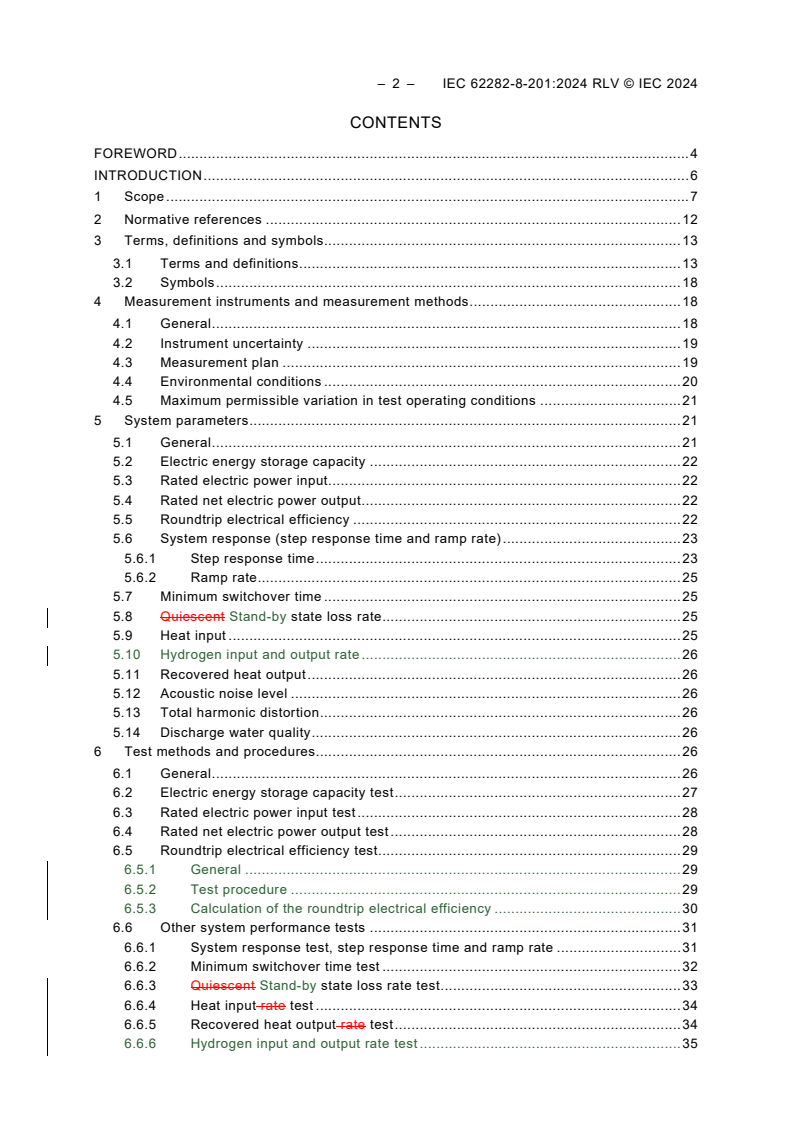
– 2 – IEC 62282-8-201:2024 RLV © IEC 2024
CONTENTS
FOREWORD . 4
INTRODUCTION . 6
1 Scope . 7
2 Normative references . 12
3 Terms, definitions and symbols. 13
3.1 Terms and definitions . 13
3.2 Symbols . 18
4 Measurement instruments and measurement methods . 18
4.1 General . 18
4.2 Instrument uncertainty . 19
4.3 Measurement plan . 19
4.4 Environmental conditions . 20
4.5 Maximum permissible variation in test operating conditions . 21
5 System parameters . 21
5.1 General . 21
5.2 Electric energy storage capacity . 22
5.3 Rated electric power input. 22
5.4 Rated net electric power output . 22
5.5 Roundtrip electrical efficiency . 22
5.6 System response (step response time and ramp rate) . 23
5.6.1 Step response time . 23
5.6.2 Ramp rate. 25
5.7 Minimum switchover time . 25
5.8 Quiescent Stand-by state loss rate . 25
5.9 Heat input . 25
5.10 Hydrogen input and output rate . 26
5.11 Recovered heat output . 26
5.12 Acoustic noise level . 26
5.13 Total harmonic distortion . 26
5.14 Discharge water quality . 26
6 Test methods and procedures. 26
6.1 General . 26
6.2 Electric energy storage capacity test . 27
6.3 Rated electric power input test . 28
6.4 Rated net electric power output test . 28
6.5 Roundtrip electrical efficiency test. 29
6.5.1 General . 29
6.5.2 Test procedure . 29
6.5.3 Calculation of the roundtrip electrical efficiency . 30
6.6 Other system performance tests . 31
6.6.1 System response test, step response time and ramp rate . 31
6.6.2 Minimum switchover time test . 32
6.6.3 Quiescent Stand-by state loss rate test . 33
6.6.4 Heat input rate test . 34
6.6.5 Recovered heat output rate test . 34
6.6.6 Hydrogen input and output rate test . 35
6.6.7 Acoustic noise level test . 35
6.6.8 Total harmonic distortion test . 35
6.6.9 Discharge water quality test . 35
6.7 Component performance test . 35
6.7.1 Electrolyser performance test . 35
6.7.2 Hydrogen storage performance test . 36
6.7.3 Fuel cell performance test . 37
6.7.4 Water management system performance test . 37
6.7.5 Battery performance test . 38
6.7.6 Oxygen storage performance test . 38
7 Test reports . 38
7.1 General . 38
7.2 Report items . 38
7.3 Tested system data description . 39
7.4 Test condition description . 39
7.5 Test data description . 39
7.6 Uncertainty evaluation . 39
Bibliography . 40
Figure 1 – System configuration of electric energy storage system using hydrogen –
Type with electrolyser and fuel cell . 9
Figure 2 – System configuration of electric energy storage system using hydrogen –
Type with reversible cell . 11
Figure 3 – Typical sequence of phases during the system operation . 20
Figure 4 – Step response time and ramp rate of EES system . 24
Figure 5 – Step response test . 32
Figure 6 – Minimum switchover time test . 33
Table 1 – Symbols . 18
Table 2 – Required steps before executing the measurement . 20
Table 3 – Example of document format of roundtrip electrical efficiency . 31
Table 4 – Additional parameters measured on the electrolyser or the reversible cell
module in electrolysis mode . 36
Table 5 – Additional parameters measured on the hydrogen storage component . 36
Table 6 – Additional parameters measured on the fuel cell or the reversible cell module
in fuel cell mode . 37
– 4 – IEC 62282-8-201:2024 RLV © IEC 2024
INTERNATIONAL ELECTROTECHNICAL COMMISSION
____________
FUEL CELL TECHNOLOGIES –
Part 8-201: Energy storage systems using fuel cell modules in reverse
mode – Test procedures for the performance of power-to-power systems
FOREWORD
1) The International Electrotechnical Commission (IEC) is a worldwide organization for standardization comprising
all national electrotechnical committees (IEC National Committees). The object of IEC is to promote international
co-operation on all questions concerning standardization in the electrical and electronic fields. To this end and
in addition to other activities, IEC publishes International Standards, Technical Specifications, Technical Reports,
Publicly Available Specifications (PAS) and Guides (hereafter referred to as “IEC Publication(s)”). Their
preparation is entrusted to technical committees; any IEC National Committee interested in the subject dealt with
may participate in this preparatory work. International, governmental and non-governmental organizations liaising
with the IEC also participate in this preparation. IEC collaborates closely with the International Organization for
Standardization (ISO) in accordance with conditions determined by agreement between the two organizations.
2) The formal decisions or agreements of IEC on technical matters express, as nearly as possible, an international
consensus of opinion on the relevant subjects since each technical committee has representation from all
interested IEC National Committees.
3) IEC Publications have the form of recommendations for international use and are accepted by IEC National
Committees in that sense. While all reasonable efforts are made to ensure that the technical content of IEC
Publications is accurate, IEC cannot be held responsible for the way in which they are used or for any
misinterpretation by any end user.
4) In order to promote international uniformity, IEC National Committees undertake to apply IEC Publications
transparently to the maximum extent possible in their national and regional publications. Any divergence between
any IEC Publication and the corresponding national or regional publication shall be clearly indicated in the latter.
5) IEC itself does not provide any attestation of conformity. Independent certification bodies provide conformity
assessment services and, in some areas, access to IEC marks of conformity. IEC is not responsible for any
services carried out by independent certification bodies.
6) All users should ensure that they have the latest edition of this publication.
7) No liability shall attach to IEC or its directors, employees, servants or agents including individual experts and
members of its technical committees and IEC National Committees for any personal injury, property damage or
other damage of any nature whatsoever, whether direct or indirect, or for costs (including legal fees) and
expenses arising out of the publication, use of, or reliance upon, this IEC Publication or any other IEC
Publications.
8) Attention is drawn to the Normative references cited in this publication. Use of the referenced publications is
indispensable for the correct application of this publication.
9) IEC draws attention to the possibility that the implementation of this document may involve the use of (a)
patent(s). IEC takes no position concerning the evidence, validity or applicability of any claimed patent rights in
respect thereof. As of the date of publication of this document, IEC had not received notice of (a) patent(s), which
may be required to implement this document. However, implementers are cautioned that this may not represent
the latest information, which may be obtained from the patent database available at https://patents.iec.ch. IEC
shall not be held responsible for identifying any or all such patent rights.
This redline version of the official IEC Standard allows the user to identify the changes
made to the previous edition IEC 62282-8-201:2024. A vertical bar appears in the margin
wherever a change has been made. Additions are in green text, deletions are in
strikethrough red text.
IEC 62282-8-201 has been prepared by IEC technical committee 105: Fuel cell technologies.
It is an International Standard.
This second edition cancels and replaces the first edition published in 2020. This edition
constitutes a technical revision.
This edition includes the following significant technical changes with respect to the previous
edition:
a) consideration of systems connected to hydrogen supply infrastructure (hydrogen grids,
vessels, caverns or pipelines);
b) hydrogen input and output rate is added in the system parameters (5.10);
c) electric energy storage capacity test is revised (6.2);
d) roundtrip electrical efficiency test is revised (6.5);
e) hydrogen input and output rate test is added (6.6.6).
The text of this International Standard is based on the following documents:
Draft Report on voting
105/1034/FDIS 105/1050/RVD
Full information on the voting for its approval can be found in the report on voting indicated in
the above table.
The language used for the development of this International Standard is English.
This document was drafted in accordance with ISO/IEC Directives, Part 2, and developed in
accordance with ISO/IEC Directives, Part 1 and ISO/IEC Directives, IEC Supplement, available
at www.iec.ch/members_experts/refdocs. The main document types developed by IEC are
described in greater detail at www.iec.ch/publications.
A list of all parts in the IEC 62282 series, published under the general title Fuel cell technologies,
can be found on the IEC website.
The committee has decided that the contents of this document will remain unchanged until the
stability date indicated on the IEC website under webstore.iec.ch in the data related to the
specific document. At this date, the document will be
• reconfirmed,
• withdrawn, or
• revised.
IMPORTANT – The "colour inside" logo on the cover page of this document indicates
that it contains colours which are considered to be useful for the correct understanding
of its contents. Users should therefore print this document using a colour printer.
– 6 – IEC 62282-8-201:2024 RLV © IEC 2024
INTRODUCTION
This part of IEC 62282 specifies performance evaluation methods for electric energy storage
systems using hydrogen that employ electrochemical reactions both for water/ and steam
electrolysis and electric power generation.
NOTE Heat generation can be a secondary purpose.
This document is intended for power-to-power systems which typically employ a set of
electrolyser and fuel cell, or a reversible cell for devices of electric charge and discharge.
A typical target application of the electric energy storage systems using hydrogen is in the class
of energy intensive electric energy storage. The systems are recognized as critically useful for
the relatively long-term power storage operation, such as efficient storage and supply of the
renewable power derived electric energy and grid stabilization.
The IEC 62282-8 series aims to develop performance test methods for power storage and
buffering systems based on electrochemical modules (combining electrolysis and fuel cells, in
particular reversible cells), taking into consideration both options of re-electrification and
substance (and heat) production for sustainable integration of renewable energy sources.
Under the general title Energy storage systems using fuel cell modules in reverse mode, the
IEC 62282-8 series consists of the following parts:
• IEC 62282-8-101: Test procedures for the performance of solid oxide single cells and
stacks, including reversible operation
• IEC 62282-8-102: Test procedures for the performance of single cells and stacks with proton
exchange membrane, including reversible operation
• IEC 62282-8-103 : Alkaline single cell and stack performance including reversible operation
• IEC 62282-8-201: Test procedures for the performance of power-to-power systems
• IEC 62282-8-202 : Power-to-power systems – Safety
• IEC 62282-8-300 (all parts) : Power -to-substance systems
• IEC 62282-8-301: Power to methane energy systems based on solid oxide cells including
reversible operation – Performance test methods
As a priority dictated by the emerging needs for industry and opportunities for technological
development, IEC 62282-8-101, IEC 62282-8-102 and IEC 62282-8-201 were initiated jointly
and firstly. These parts are presented as a package to highlight the need for an integrated
approach as regards the system's application (i.e. a solution for energy storage) and its
fundamental constituent components (i.e. fuel cells operated in reverse or reversing mode).
IEC 62282-8-103, IEC 62282-8-202 and IEC 62282-8-300 (all parts) are suggested but are left
for initiation at a later stage.
____________
Future project.
Future project.
Under consideration.
FUEL CELL TECHNOLOGIES –
Part 8-201: Energy storage systems using fuel cell modules in reverse
mode – Test procedures for the performance of power-to-power systems
1 Scope
This part of IEC 62282 defines the evaluation methods of typical performances for electric
energy storage systems using hydrogen. It is applicable to the systems that use electrochemical
reaction devices for both power charge and discharge. This document applies to systems that
are designed and used for service and operation in stationary locations (indoor and outdoor).
The conceptual configurations of the electric energy storage systems using hydrogen are shown
in Figure 1 and Figure 2.
Figure 1 shows the system independently equipped with an electrolyser module and a fuel cell
module. Figure 2 shows the system equipped with a reversible cell module.
There are an electrolyser, a hydrogen storage and a fuel cell, or a reversible cell, a hydrogen
storage and an overall management system (which may include a pressure management) as
indispensable components. There may be a battery, an oxygen storage, a heat management
system (which may include a heat storage) and a water management system (which may include
a water storage) as optional components. The performance measurement is executed in the
area surrounded by the outside thick solid line square (system boundary).
Indispensable components are an electrolyser module and a fuel cell module, or a reversible
cell module, an overall management system (which includes a data interface and can include a
pressure management), a thermal management system (which can include a thermal storage),
a water management system (which can include a water storage) and a purge gas supply (inert
gas, practically neither oxidizing nor reducing).
NOTE 1 Indispensable components are indicated by bold lines in Figure 1 and Figure 2.
The system can be equipped with either a hydrogen storage or a connection to an external
hydrogen supply infrastructure or a combination of both. There can be a battery and an oxygen
storage, as optional components.
The electrolyser module can comprise one or more electrolysers whether or not of the same
type. Depending on the operating conditions and considering the operation history, the overall
management system can command the concurrent operation of the electrolysers. The fuel cell
module can comprise one or more fuel cells whether or not of the same type. Depending on the
operating conditions and considering the operation history, the overall management system can
command concurrent operation of the fuel cells. The reversible cell module can comprise one
or more reversible cells whether or not of the same type. The fuel cell module can comprise
one or more fuel cells whether or not of the same type. Depending on the operating conditions
and considering the operation history, the overall management system can command
concurrent operation of the reversible cells.
The performance measurement is executed in the defined area surrounded by the bold outside
solid line (system boundary).
NOTE 2 In the context of this document, the term "reversible" does not refer to the thermodynamic meaning of an
ideal process. It is common practice in the fuel cell community to call the operation mode of a cell that alternates
between fuel cell mode and electrolysis mode "reversible".
– 8 – IEC 62282-8-201:2024 RLV © IEC 2024
This document is intended to be used for data exchanges in commercial transactions between
the system manufacturer and customer. Users of this document can selectively execute test
items suitable for their purposes from thosespecified in this document.
Key
EMD electromagnetic disturbance
EMI electromagnetic interference
NOTE 1 Overall management system, thermal management system, water management system and purge gas
supply can have the relation with electrolyser, fuel cell, battery, hydrogen storage and oxygen storage, and also can
have the relation with one another.
NOTE 2 Other fluid or energy in- or outputs, depending on the used electrolyser and fuel cell types, can be
considered.
NOTE 3 The electricity input and output can be DC or AC or both. Power conditioning sub-systems are usually
used.
– 10 – IEC 62282-8-201:2024 RLV © IEC 2024
NOTE 4 There can be more than one electricity point of connection for input or output or both.
Figure 1 – System configuration of electric energy storage system using hydrogen –
Type with electrolyser and fuel cell
Key
EMD electromagnetic disturbance
EMI electromagnetic interference
NOTE 1 Overall management system, thermal management system, water management system and purge gas
supply can have the relation with reversible cell, battery, hydrogen storage and oxygen storage, and also can have
the relation with one another.
– 12 – IEC 62282-8-201:2024 RLV © IEC 2024
NOTE 2 Other fluid or energy in- or outputs, depending on the used electrolyser and fuel cell types, can be
considered.
NOTE 3 The electricity input and output can be DC or AC or both. Power conditioning sub-systems are usually
used.
NOTE 4 There can be more than one electricity point of connection for input or output or both.
Figure 2 – System configuration of electric energy storage system using hydrogen –
Type with reversible cell
2 Normative references
The following documents are referred to in the text in such a way that some or all of their content
constitutes requirements of this document. For dated references, only the edition cited applies.
For undated references, the latest edition of the referenced document (including any
amendments) applies.
IEC 61427-1, Secondary cells and batteries for renewable energy storage – General
requirements and methods of test – Part 1: Photovoltaic off-grid application
IEC 61427-2, Secondary cells and batteries for renewable energy storage – General
requirements and methods of test – Part 2: On-grid applications
IEC 62282-3-200, Fuel cell technologies – Part 3-200: Stationary fuel cell power systems –
Performance test methods
IEC 62282-3-201, Fuel cell technologies – Part 3-201: Stationary fuel cell power systems –
Performance test methods for small fuel cell power systems
IEC 62282-8-101, Fuel cell technologies – Part 8-101: Energy storage systems using fuel cell
modules in reverse mode – Test procedures for the performance of solid oxide single cells and
stack performance stacks, including reversible operation
IEC 62282-8-102, Fuel cell technologies – Part 8-102: Energy storage systems using fuel cell
modules in reverse mode – Test procedures for PEM the performance of single cells and stack
performance stacks with proton exchange membrane, including reversible operation
IEC 62933-2-1:2017, Electrical energy storage (EES) systems – Part 2-1: Unit parameters and
testing methods – General specification
ISO/IEC Guide 98-3, Uncertainty of measurement – Part 3: Guide to the expression of
uncertainty in measurement (GUM:1995)
ISO 3746, Acoustics – Determination of sound power levels and sound energy levels of noise
sources using sound pressure – Survey method using an enveloping measurement surface over
a reflecting plane
ISO 4064-1, Water meters for cold potable water and hot water – Part 1: Metrological and
technical requirements
ISO 4064-2, Water meters for cold potable water and hot water – Part 2: Test methods
ISO 7888, Water quality – Determination of electrical conductivity
ISO 9614-1, Acoustics – Determination of sound power levels of noise sources using sound
intensity – Part 1: Measurement at discrete points
ISO 11204, Acoustics – Noise emitted by machinery and equipment – Determination of emission
sound pressure levels at a work station and at other specified positions applying accurate
environmental corrections
ISO 16111, Transportable gas storage devices – Hydrogen absorbed in reversible metal hydride
ISO 19880-1, Gaseous hydrogen – Fuelling stations – Part 1: General requirements
ISO 19881, Gaseous hydrogen – Land vehicle fuel containers
ISO 19882, Gaseous hydrogen – Thermally activated pressure relief devices for compressed
hydrogen vehicle fuel containers
ISO 19884, Gaseous hydrogen – Cylinders and tubes for stationary storage
ISO 22734:2019, Hydrogen generators using water electrolysis – Industrial, commercial, and
residential applications
ISO 22734-1, Hydrogen generators using water electrolysis process – Part 1: Industrial and
commercial applications
ISO 22734-2, Hydrogen generators using water electrolysis process – Part 2: residential
applications
3 Terms, definitions and symbols
3.1 Terms and definitions
For the purposes of this document, the following terms and definitions apply.
ISO and IEC maintain terminology databases for use in standardization at the following
addresses:
• IEC Electropedia: available at https://www.electropedia.org/
• ISO Online browsing platform: available at https://www.iso.org/obp
3.1.1
electric energy storage
EES
installation able to store electric energy or which converts electric energy into another form of
energy and vice versa, while storing energy
Note 1 to entry: EES can be used also to indicate the activity of an apparatus described in the definition during
performing its own functionality.
Note 2 to entry: This note applies to the French language only.
[SOURCE: IEC 62933-1:2018, 3.1, modified – Definition revised and example and note 2
deleted.]
3.1.2
electric energy storage system
EES system
installation with defined electrical boundaries, comprising at least one EES, whose purpose is
to extract electric energy from the electric power system, store this energy in some manner and
inject electric energy into the electric power system and which includes civil engineering works,
energy conversion equipment and related ancillary equipment
– 14 – IEC 62282-8-201:2024 RLV © IEC 2024
Note 1 to entry: The EES system is controlled and coordinated to provide services to the electric power system
operators or to the electric power system users.
Note 2 to entry: In some cases, an EES system can require an additional energy source during its discharge,
providing more energy to the electric power system than the energy it stores.
Note 3 to entry: This note applies to the French language only.
[SOURCE: IEC 62933-1:2018, 3.2, modified – In the definition, "grid connected" and "internally"
have been deleted, and "which extracts" has been replaced by "whose purpose is to" added
extract". Note 2 to entry has been shortened and Note 3 to entry deleted.]
3.1.3
EES system using hydrogen
EES system comprising at least one EES using hydrogen, whose purpose is to extract electric
energy from the electric power system, store this energy as hydrogen and inject electric energy
into the electric power system, using hydrogen as a fuel
Note 1 to entry: The conceptual configurations of the EES system using hydrogen are referred to in Clause 1.
3.1.4
battery
EES device for electrochemically storing electricity with electricity charge and discharge
functions
Note 1 to entry: Batteries are typically employed for absorbing short-term fluctuating electricity input combined with
hydrogen storage of an EES system using hydrogen.
3.1.5
electrolyser
electrochemical device that converts water/ or steam to hydrogen and oxygen by electrolysis
reaction
Note 1 to entry: Electrolysers include alkaline water electrolysis device, polymer electrolyte membrane water
electrolysis device, solid oxide electrolysis cell device, and other devices of similar type.
3.1.6
environment
surroundings in which an EES system using hydrogen exists, including air, water, land, natural
resources, flora, fauna, humans, and their interrelation
3.1.7
fuel cell
electrochemical device that converts the chemical energy of a fuel and an oxidant to electric
energy (DC power), heat and reaction products
Note 1 to entry: The fuel and oxidant are typically stored outside of the fuel cell and transferred into the fuel cell as
they are consumed.
[SOURCE: IEC 60050-485:2020, 485-08-01]
3.1.8
heat thermal management system
subsystem of the EES system using hydrogen, for controlling the heat thermal storage and
thermal fluid flows in the system and its POCs (if applicable)
Note 1 to entry: Typically, heat is utilized among the various items of system equipment. An example of the mutual
heat utilization is where the exothermic reaction heat of the fuel cell is conveyed to an electrolysis cell, in particular
a solid oxide electrolysis cell for endothermic consumption.
3.1.9
hydrogen storage
component of the EES system using hydrogen, for storing hydrogen that is produced by water/
or steam electrolysis in or supplied to the system
Note 1 to entry: There are several kinds of hydrogen storage equipment depending on the hydrogen storage
principles. They include low/- and high-pressure gas, liquid, hydrogen-absorbing alloy (hydrogen absorbed in
reversible metal hydride), non-metal hydrides and others.
3.1.10
hydrogen supply infrastructure
assembly of hydrogen carrying and storing devices providing connection points to hydrogen
appliances, which supply hydrogen to the appliance or absorb hydrogen delivered by the
appliance
3.1.11
limit operating conditions
conditions not to be exceeded for operating the EES system normally and safely
Note 1 to entry: They are recommended by the EES system manufacturer considering the system characteristics.
3.1.12
net electric energy output
usable electric energy output from the EES system using hydrogen, which is able to serve for
the user's purpose, excluding internal and external electric energy dissipation of the system
Note 1 to entry: The internal and external electric dissipation of the EES system is typically electric energy loss
from the equipment operations and connections.
Note 2 to entry: The net electric energy output is the difference between the electric energy outputs and inputs at
all POCs.
3.1.13
net electric power
power output of the EES system and available for external use
Note 1 to entry: The net electric power output is the difference between the electric power outputs and inputs at all
POCs.
3.1.14
operating conditions
conditions at which the tested system, more specifically each item of equipment of the tested
EES system, is operated, as well as and including physical conditions such as range of ambient
temperatures, pressure, radiation levels, humidity and atmosphere are included
3.1.15
operating state
state at which the tested system, more specifically each item of equipment of the tested EES
system, is operated at specified conditions
3.1.16
overall management system
subsystem of the EES system using hydrogen, served for monitoring and controlling the EES
system using hydrogen, by fulfilling including all equipment and functions for acquisition,
processing, transmission, and display of the necessary process information
Note 1 to entry: The overall management system also includes a subsystem containing an arrangement of hardware,
software, and propagation media to allow the transfer of messages from one EES system using hydrogen component/
or subsystem to another one, including the data interface with external links.
Note 2 to entry: Generally, the control subsystem may be connected to the primary POC (just for data exchange)
and it can comprise the communication subsystem and the protection subsystem.
– 16 – IEC 62282-8-201:2024 RLV © IEC 2024
Note 3 to entry: The protection subsystem includes one or more items of protection equipment, one or more
instrument transformers, transducers, wiring, one or more tripping circuits, one or more auxiliary supplies. Depending
upon the principle or principles of the protection system, it may include one end or all ends of the protected section
and, possibly, automatic reclosing equipment.
3.1.17
oxygen storage
one component of the EES system using hydrogen, for storing oxygen that is produced by water/
or steam electrolysis in (or supplied to) the EES system
Note 1 to entry: Oxygen storage is equipped, if needed.
3.1.18
point of connection
POC
point where an EES system using hydrogen is connected to a supply/ or extraction exterior to
the system
Note 1 to entry: Generally, POCs are electricity, heat, water, hydrogen and, oxygen/ and air connection points.
They are shown as open circles on the EES system boundary (thick solid-line square) in Figure 1 and Figure 2.
Note 2 to entry: This note applies to the French language only.
3.1.19
quiescent state stand-by state
operating state of the EES system, in which the EES system is partly or fully charged and no
intended charging and discharging of the stored energy, except self-discharging, takes place
3.1.19
quiescent state loss rate
sum of energy loss rate and energy consumption rate of EES system during the quiescent state
3.1.20
rated operating conditions
conditions which are applied for standard operation of equipment and/or systems
Note 1 to entry: Rated operating conditions are recommended by the equipment and/or EES system manufacturers
considering the respective characteristics of the equipment/ or system.
3.1.21
rated input conditions
conditions specified by the manufacturer, at which the tested EES system absorbs electric
power input at the POC
Note 1 to entry: The rated input conditions include the rates of net electric power, heat, water flow, oxygen flow and
air flow.
3.1.22
rated output conditions
conditions specified by the manufacturer, at which the tested EES system delivers electric
power output at the POC
Note 1 to entry: The rated output conditions include the rates of net electric power, heat, water flow, oxygen flow
and air flow.
3.1.23
rated test conditions
specific boundary conditions at which the tested EES system is operated
Note 1 to entry: Rated test conditions are agreed between the EES system manufacturer and customer.
3.1.24
reversible cell
electrochemical device that is able to operate as a fuel cell or as an electrolyser, alternatively
Note 1 to entry: The term "reversible" in this context does not refer to the thermodynamic principle of an ideal
process.
3.1.25
roundtrip electrical efficiency
electric energy discharged measured on the primary POC divided by the electric energy
absorbed, measured on all the POCs (primary and auxiliary), over one EES system standard
charging–discharging cycle under specified operating conditions
Note 1 to entry: Efficiency is generally expressed in percentage.
Note 1 to entry: The auxiliary POC is used for electricity supply of auxiliary components and devices such as
instrumentation, controls, monitoring and safety functions.
3.1.26
operation history
record of the operating conditions of the system
3.1.27
steady state
state of an EES system in which the relevant characteristics remain constant with time
[SOURCE: IEC 60050-485:2020, 485-21-05, modified – In the definition, “physical” has been
replaced with “EES”.]
3.1.28
switchover time
time that is required to switch an EES system using hydrogen from a specified charging phase
to a specified discharging phase or vice versa
Note 1 to entry: This can be of relevance in case grid service shall is required to be performed with the EES system.
It comprises the time that is required to go from one operating point in either charging or discharging operation to
quiescent stand-by state, purging of gas lines if applicable, setting of auxiliary components (valves, heaters,
compressors, etc.) if applicable and to go to an operating point in the opposite operating phase (discharging or
charging).
3.1.29
test state
state of the tested EES system that is consistent with the objective of the evaluation
Note 1 to entry: More specifically, it means the specific operating state for equipment of the tested system.
3.1.30
tested system
EES system defined by its boundary to the environment that is in accordance with the objective
of the evaluation
3.1.31
water management system
subsystem of the EES system using hydrogen, for controlling the water flow, the steam flow
or both in the EES system
Note 1 to entry: Water management system includes the controlling mechanisms of water inlet, transport, purifying
(if applicable), and drain.
– 18 – IEC 62282-8-201:2024 RLV © IEC 2024
3.2 Symbols
The symbols and their meanings used in this document are given in Table 1, with the
appropriate units.
Table 1 lists the symbols and units that are used in this document.
Table 1 – Symbols
Symbol Definition Unit Formula Figure
k Coverage factor
m
Hydrogen mass supplied to the system at the POC g (4)
H2,in
n Number of measurements until discharge completion (3), (4)
P
Active Electric power at the POC W (2)
el
P
Quiescent Stand-by state loss rate W (6)
el,loss
P
Net electric power input W
el,in
P
Net electric power output W (3)
el,out
dP/dt Ramp rate W/s (2) Figure 5
P
Heat input W
th,in
P
Heat output W
th,out
q
Hydrogen mass flow into the system at the POC g/s (4)
m,H2,in
q
Hydrogen mass flow out of the system at the POC g/s
m,H2,out
Time when the system, which is at rest in steady
t
s (1) Figure 4
state, receives the set point value
Time when the active electric power at the POC
t
becomes less than 90 % for negative state or higher s (2) Figure 4
than 10 % for positive state of the set point value
Time when the active electric power at the POC
t
becomes less than 10 % for negative state or higher s (2) Figure 4
than 90 % for positive state o
...
IEC 62282-8-201 ®
Edition 2.0 2024-07
INTERNATIONAL
STANDARD
NORME
INTERNATIONALE
Fuel cell technologies –
Part 8-201: Energy storage systems using fuel cell modules in reverse mode –
Test procedures for the performance of power-to-power systems
Technologies des piles à combustible –
Partie 8-201: Systèmes de stockage de l’énergie à partir de modules de piles à
combustible réversibles – Procédures d’essai pour la performance des
systèmes de conversion électrochimiques électriques à électriques
All rights reserved. Unless otherwise specified, no part of this publication may be reproduced or utilized in any form
or by any means, electronic or mechanical, including photocopying and microfilm, without permission in writing from
either IEC or IEC's member National Committee in the country of the requester. If you have any questions about IEC
copyright or have an enquiry about obtaining additional rights to this publication, please contact the address below or
your local IEC member National Committee for further information.
Droits de reproduction réservés. Sauf indication contraire, aucune partie de cette publication ne peut être reproduite ni
utilisée sous quelque forme que ce soit et par aucun procédé, électronique ou mécanique, y compris la photocopie et
les microfilms, sans l'accord écrit de l'IEC ou du Comité national de l'IEC du pays du demandeur. Si vous avez des
questions sur le copyright de l'IEC ou si vous désirez obtenir des droits supplémentaires sur cette publication, utilisez
les coordonnées ci-après ou contactez le Comité national de l'IEC de votre pays de résidence.
IEC Secretariat Tel.: +41 22 919 02 11
3, rue de Varembé info@iec.ch
CH-1211 Geneva 20 www.iec.ch
Switzerland
About the IEC
The International Electrotechnical Commission (IEC) is the leading global organization that prepares and publishes
International Standards for all electrical, electronic and related technologies.
About IEC publications
The technical content of IEC publications is kept under constant review by the IEC. Please make sure that you have the
latest edition, a corrigendum or an amendment might have been published.
IEC publications search - webstore.iec.ch/advsearchform IEC Products & Services Portal - products.iec.ch
The advanced search enables to find IEC publications by a Discover our powerful search engine and read freely all the
variety of criteria (reference number, text, technical publications previews, graphical symbols and the glossary.
committee, …). It also gives information on projects, replaced With a subscription you will always have access to up to date
and withdrawn publications. content tailored to your needs.
IEC Just Published - webstore.iec.ch/justpublished
Electropedia - www.electropedia.org
Stay up to date on all new IEC publications. Just Published
The world's leading online dictionary on electrotechnology,
details all new publications released. Available online and once
containing more than 22 500 terminological entries in English
a month by email.
and French, with equivalent terms in 25 additional languages.
Also known as the International Electrotechnical Vocabulary
IEC Customer Service Centre - webstore.iec.ch/csc
(IEV) online.
If you wish to give us your feedback on this publication or need
further assistance, please contact the Customer Service
Centre: sales@iec.ch.
A propos de l'IEC
La Commission Electrotechnique Internationale (IEC) est la première organisation mondiale qui élabore et publie des
Normes internationales pour tout ce qui a trait à l'électricité, à l'électronique et aux technologies apparentées.
A propos des publications IEC
Le contenu technique des publications IEC est constamment revu. Veuillez vous assurer que vous possédez l’édition la
plus récente, un corrigendum ou amendement peut avoir été publié.
Recherche de publications IEC - IEC Products & Services Portal - products.iec.ch
webstore.iec.ch/advsearchform Découvrez notre puissant moteur de recherche et consultez
La recherche avancée permet de trouver des publications IEC gratuitement tous les aperçus des publications, symboles
en utilisant différents critères (numéro de référence, texte, graphiques et le glossaire. Avec un abonnement, vous aurez
comité d’études, …). Elle donne aussi des informations sur les toujours accès à un contenu à jour adapté à vos besoins.
projets et les publications remplacées ou retirées.
Electropedia - www.electropedia.org
IEC Just Published - webstore.iec.ch/justpublished
Le premier dictionnaire d'électrotechnologie en ligne au monde,
Restez informé sur les nouvelles publications IEC. Just
avec plus de 22 500 articles terminologiques en anglais et en
Published détaille les nouvelles publications parues.
français, ainsi que les termes équivalents dans 25 langues
Disponible en ligne et une fois par mois par email.
additionnelles. Egalement appelé Vocabulaire
Electrotechnique International (IEV) en ligne.
Service Clients - webstore.iec.ch/csc
Si vous désirez nous donner des commentaires sur cette
publication ou si vous avez des questions contactez-nous:
sales@iec.ch.
IEC 62282-8-201 ®
Edition 2.0 2024-07
INTERNATIONAL
STANDARD
NORME
INTERNATIONALE
Fuel cell technologies –
Part 8-201: Energy storage systems using fuel cell modules in reverse mode –
Test procedures for the performance of power-to-power systems
Technologies des piles à combustible –
Partie 8-201: Systèmes de stockage de l’énergie à partir de modules de piles à
combustible réversibles – Procédures d’essai pour la performance des
systèmes de conversion électrochimiques électriques à électriques
INTERNATIONAL
ELECTROTECHNICAL
COMMISSION
COMMISSION
ELECTROTECHNIQUE
INTERNATIONALE
ICS 27.070 ISBN 978-2-8322-8973-0
– 2 – IEC 62282-8-201:2024 © IEC 2024
CONTENTS
FOREWORD . 4
INTRODUCTION . 6
1 Scope . 7
2 Normative references . 9
3 Terms, definitions and symbols. 10
3.1 Terms and definitions . 10
3.2 Symbols . 15
4 Measurement instruments and measurement methods . 15
4.1 General . 15
4.2 Instrument uncertainty . 16
4.3 Measurement plan . 16
4.4 Environmental conditions . 17
4.5 Maximum permissible variation in test operating conditions . 18
5 System parameters . 18
5.1 General . 18
5.2 Electric energy storage capacity . 19
5.3 Rated electric power input. 19
5.4 Rated net electric power output . 19
5.5 Roundtrip electrical efficiency . 19
5.6 System response (step response time and ramp rate) . 20
5.6.1 Step response time . 20
5.6.2 Ramp rate. 21
5.7 Minimum switchover time . 22
5.8 Stand-by state loss rate . 22
5.9 Heat input . 22
5.10 Hydrogen input and output rate . 22
5.11 Recovered heat output . 22
5.12 Acoustic noise level . 22
5.13 Total harmonic distortion . 23
5.14 Discharge water quality . 23
6 Test methods and procedures. 23
6.1 General . 23
6.2 Electric energy storage capacity test . 23
6.3 Rated electric power input test . 24
6.4 Rated net electric power output test . 25
6.5 Roundtrip electrical efficiency test. 26
6.5.1 General . 26
6.5.2 Test procedure . 26
6.5.3 Calculation of the roundtrip electrical efficiency . 27
6.6 Other system performance tests . 28
6.6.1 System response test, step response time and ramp rate . 28
6.6.2 Minimum switchover time test . 29
6.6.3 Stand-by state loss rate test . 30
6.6.4 Heat input test . 30
6.6.5 Recovered heat output test . 31
6.6.6 Hydrogen input and output rate test . 31
6.6.7 Acoustic noise level test . 31
6.6.8 Total harmonic distortion test . 31
6.6.9 Discharge water quality test . 31
6.7 Component performance test . 32
6.7.1 Electrolyser performance test . 32
6.7.2 Hydrogen storage performance test . 32
6.7.3 Fuel cell performance test . 33
6.7.4 Water management system performance test . 33
6.7.5 Battery performance test . 34
6.7.6 Oxygen storage performance test . 34
7 Test reports . 34
7.1 General . 34
7.2 Report items . 34
7.3 Tested system data description . 35
7.4 Test condition description . 35
7.5 Test data description . 35
7.6 Uncertainty evaluation . 35
Bibliography . 36
Figure 1 – System configuration of electric energy storage system using hydrogen –
Type with electrolyser and fuel cell . 8
Figure 2 – System configuration of electric energy storage system using hydrogen –
Type with reversible cell . 9
Figure 3 – Typical sequence of phases during the system operation . 17
Figure 4 – Step response time and ramp rate of EES system . 21
Figure 5 – Step response test . 29
Figure 6 – Minimum switchover time test . 29
Table 1 – Symbols . 15
Table 2 – Required steps before executing the measurement . 17
Table 3 – Example of document format of roundtrip electrical efficiency . 27
Table 4 – Additional parameters measured on the electrolyser or the reversible cell
module in electrolysis mode . 32
Table 5 – Additional parameters measured on the hydrogen storage component . 33
Table 6 – Additional parameters measured on the fuel cell or the reversible cell module
in fuel cell mode . 33
– 4 – IEC 62282-8-201:2024 © IEC 2024
INTERNATIONAL ELECTROTECHNICAL COMMISSION
____________
FUEL CELL TECHNOLOGIES –
Part 8-201: Energy storage systems using fuel cell modules in reverse
mode – Test procedures for the performance of power-to-power systems
FOREWORD
1) The International Electrotechnical Commission (IEC) is a worldwide organization for standardization comprising
all national electrotechnical committees (IEC National Committees). The object of IEC is to promote international
co-operation on all questions concerning standardization in the electrical and electronic fields. To this end and
in addition to other activities, IEC publishes International Standards, Technical Specifications, Technical Reports,
Publicly Available Specifications (PAS) and Guides (hereafter referred to as “IEC Publication(s)”). Their
preparation is entrusted to technical committees; any IEC National Committee interested in the subject dealt with
may participate in this preparatory work. International, governmental and non-governmental organizations liaising
with the IEC also participate in this preparation. IEC collaborates closely with the International Organization for
Standardization (ISO) in accordance with conditions determined by agreement between the two organizations.
2) The formal decisions or agreements of IEC on technical matters express, as nearly as possible, an international
consensus of opinion on the relevant subjects since each technical committee has representation from all
interested IEC National Committees.
3) IEC Publications have the form of recommendations for international use and are accepted by IEC National
Committees in that sense. While all reasonable efforts are made to ensure that the technical content of IEC
Publications is accurate, IEC cannot be held responsible for the way in which they are used or for any
misinterpretation by any end user.
4) In order to promote international uniformity, IEC National Committees undertake to apply IEC Publications
transparently to the maximum extent possible in their national and regional publications. Any divergence between
any IEC Publication and the corresponding national or regional publication shall be clearly indicated in the latter.
5) IEC itself does not provide any attestation of conformity. Independent certification bodies provide conformity
assessment services and, in some areas, access to IEC marks of conformity. IEC is not responsible for any
services carried out by independent certification bodies.
6) All users should ensure that they have the latest edition of this publication.
7) No liability shall attach to IEC or its directors, employees, servants or agents including individual experts and
members of its technical committees and IEC National Committees for any personal injury, property damage or
other damage of any nature whatsoever, whether direct or indirect, or for costs (including legal fees) and
expenses arising out of the publication, use of, or reliance upon, this IEC Publication or any other IEC
Publications.
8) Attention is drawn to the Normative references cited in this publication. Use of the referenced publications is
indispensable for the correct application of this publication.
9) IEC draws attention to the possibility that the implementation of this document may involve the use of (a)
patent(s). IEC takes no position concerning the evidence, validity or applicability of any claimed patent rights in
respect thereof. As of the date of publication of this document, IEC had not received notice of (a) patent(s), which
may be required to implement this document. However, implementers are cautioned that this may not represent
the latest information, which may be obtained from the patent database available at https://patents.iec.ch. IEC
shall not be held responsible for identifying any or all such patent rights.
IEC 62282-8-201 has been prepared by IEC technical committee 105: Fuel cell technologies.
It is an International Standard.
This second edition cancels and replaces the first edition published in 2020. This edition
constitutes a technical revision.
This edition includes the following significant technical changes with respect to the previous
edition:
a) consideration of systems connected to hydrogen supply infrastructure (hydrogen grids,
vessels, caverns or pipelines);
b) hydrogen input and output rate is added in the system parameters (5.10);
c) electric energy storage capacity test is revised (6.2);
d) roundtrip electrical efficiency test is revised (6.5);
e) hydrogen input and output rate test is added (6.6.6).
The text of this International Standard is based on the following documents:
Draft Report on voting
105/1034/FDIS 105/1050/RVD
Full information on the voting for its approval can be found in the report on voting indicated in
the above table.
The language used for the development of this International Standard is English.
This document was drafted in accordance with ISO/IEC Directives, Part 2, and developed in
accordance with ISO/IEC Directives, Part 1 and ISO/IEC Directives, IEC Supplement, available
at www.iec.ch/members_experts/refdocs. The main document types developed by IEC are
described in greater detail at www.iec.ch/publications.
A list of all parts in the IEC 62282 series, published under the general title Fuel cell technologies,
can be found on the IEC website.
The committee has decided that the contents of this document will remain unchanged until the
stability date indicated on the IEC website under webstore.iec.ch in the data related to the
specific document. At this date, the document will be
• reconfirmed,
• withdrawn, or
• revised.
IMPORTANT – The "colour inside" logo on the cover page of this document indicates
that it contains colours which are considered to be useful for the correct understanding
of its contents. Users should therefore print this document using a colour printer.
– 6 – IEC 62282-8-201:2024 © IEC 2024
INTRODUCTION
This part of IEC 62282 specifies performance evaluation methods for electric energy storage
systems using hydrogen that employ electrochemical reactions both for water and steam
electrolysis and electric power generation.
NOTE Heat generation can be a secondary purpose.
This document is intended for power-to-power systems which typically employ a set of
electrolyser and fuel cell, or a reversible cell for devices of electric charge and discharge.
A typical target application of the electric energy storage systems using hydrogen is in the class
of energy intensive electric energy storage. The systems are recognized as critically useful for
the relatively long-term power storage operation, such as efficient storage and supply of the
renewable power derived electric energy and grid stabilization.
The IEC 62282-8 series aims to develop performance test methods for power storage and
buffering systems based on electrochemical modules (combining electrolysis and fuel cells, in
particular reversible cells), taking into consideration both options of re-electrification and
substance (and heat) production for sustainable integration of renewable energy sources.
Under the general title Energy storage systems using fuel cell modules in reverse mode, the
IEC 62282-8 series consists of the following parts:
• IEC 62282-8-101: Test procedures for the performance of solid oxide single cells and
stacks, including reversible operation
• IEC 62282-8-102: Test procedures for the performance of single cells and stacks with proton
exchange membrane, including reversible operation
• IEC 62282-8-103 : Alkaline single cell and stack performance including reversible operation
• IEC 62282-8-201: Test procedures for the performance of power-to-power systems
• IEC 62282-8-202 : Power-to-power systems – Safety
• IEC 62282-8-301: Power to methane energy systems based on solid oxide cells including
reversible operation – Performance test methods
As a priority dictated by the emerging needs for industry and opportunities for technological
development, IEC 62282-8-101, IEC 62282-8-102 and IEC 62282-8-201 were initiated jointly
and firstly. These parts are presented as a package to highlight the need for an integrated
approach as regards the system's application (i.e. a solution for energy storage) and its
fundamental constituent components (i.e. fuel cells operated in reverse or reversing mode).
____________
Future project.
Future project.
FUEL CELL TECHNOLOGIES –
Part 8-201: Energy storage systems using fuel cell modules in reverse
mode – Test procedures for the performance of power-to-power systems
1 Scope
This part of IEC 62282 defines the evaluation methods of typical performances for electric
energy storage systems using hydrogen. It is applicable to the systems that use electrochemical
reaction devices for both power charge and discharge. This document applies to systems that
are designed and used for service and operation in stationary locations (indoor and outdoor).
The conceptual configurations of the electric energy storage systems using hydrogen are shown
in Figure 1 and Figure 2.
Figure 1 shows the system independently equipped with an electrolyser module and a fuel cell
module. Figure 2 shows the system equipped with a reversible cell module.
Indispensable components are an electrolyser module and a fuel cell module, or a reversible
cell module, an overall management system (which includes a data interface and can include a
pressure management), a thermal management system (which can include a thermal storage),
a water management system (which can include a water storage) and a purge gas supply (inert
gas, practically neither oxidizing nor reducing).
NOTE 1 Indispensable components are indicated by bold lines in Figure 1 and Figure 2.
The system can be equipped with either a hydrogen storage or a connection to an external
hydrogen supply infrastructure or a combination of both. There can be a battery and an oxygen
storage, as optional components.
The electrolyser module can comprise one or more electrolysers whether or not of the same
type. Depending on the operating conditions and considering the operation history, the overall
management system can command the concurrent operation of the electrolysers. The fuel cell
module can comprise one or more fuel cells whether or not of the same type. Depending on the
operating conditions and considering the operation history, the overall management system can
command concurrent operation of the fuel cells. The reversible cell module can comprise one
or more reversible cells whether or not of the same type. The fuel cell module can comprise
one or more fuel cells whether or not of the same type. Depending on the operating conditions
and considering the operation history, the overall management system can command
concurrent operation of the reversible cells.
The performance measurement is executed in the defined area surrounded by the bold outside
solid line (system boundary).
NOTE 2 In the context of this document, the term "reversible" does not refer to the thermodynamic meaning of an
ideal process. It is common practice in the fuel cell community to call the operation mode of a cell that alternates
between fuel cell mode and electrolysis mode "reversible".
This document is intended to be used for data exchanges in commercial transactions between
the system manufacturer and customer. Users of this document can selectively execute test
items suitable for their purposes from those specified in this document.
– 8 – IEC 62282-8-201:2024 © IEC 2024
Key
EMD electromagnetic disturbance
EMI electromagnetic interference
NOTE 1 Overall management system, thermal management system, water management system and purge gas
supply can have the relation with electrolyser, fuel cell, battery, hydrogen storage and oxygen storage, and also can
have the relation with one another.
NOTE 2 Other fluid or energy in- or outputs, depending on the used electrolyser and fuel cell types, can be
considered.
NOTE 3 The electricity input and output can be DC or AC or both. Power conditioning sub-systems are usually
used.
NOTE 4 There can be more than one electricity point of connection for input or output or both.
Figure 1 – System configuration of electric energy storage system using hydrogen –
Type with electrolyser and fuel cell
Key
EMD electromagnetic disturbance
EMI electromagnetic interference
NOTE 1 Overall management system, thermal management system, water management system and purge gas
supply can have the relation with reversible cell, battery, hydrogen storage and oxygen storage, and also can have
the relation with one another.
NOTE 2 Other fluid or energy in- or outputs, depending on the used electrolyser and fuel cell types, can be
considered.
NOTE 3 The electricity input and output can be DC or AC or both. Power conditioning sub-systems are usually
used.
NOTE 4 There can be more than one electricity point of connection for input or output or both.
Figure 2 – System configuration of electric energy storage system using hydrogen –
Type with reversible cell
2 Normative references
The following documents are referred to in the text in such a way that some or all of their content
constitutes requirements of this document. For dated references, only the edition cited applies.
For undated references, the latest edition of the referenced document (including any
amendments) applies.
IEC 61427-1, Secondary cells and batteries for renewable energy storage – General
requirements and methods of test – Part 1: Photovoltaic off-grid application
IEC 61427-2, Secondary cells and batteries for renewable energy storage – General
requirements and methods of test – Part 2: On-grid applications
IEC 62282-3-200, Fuel cell technologies – Part 3-200: Stationary fuel cell power systems –
Performance test methods
– 10 – IEC 62282-8-201:2024 © IEC 2024
IEC 62282-3-201, Fuel cell technologies – Part 3-201: Stationary fuel cell power systems –
Performance test methods for small fuel cell power systems
IEC 62282-8-101, Fuel cell technologies – Part 8-101: Energy storage systems using fuel cell
modules in reverse mode – Test procedures for the performance of solid oxide single cells and
stacks, including reversible operation
IEC 62282-8-102, Fuel cell technologies – Part 8-102: Energy storage systems using fuel cell
modules in reverse mode – Test procedures for the performance of single cells and stacks with
proton exchange membrane, including reversible operation
IEC 62933-2-1:2017, Electrical energy storage (EES) systems – Part 2-1: Unit parameters and
testing methods – General specification
ISO/IEC Guide 98-3, Uncertainty of measurement – Part 3: Guide to the expression of
uncertainty in measurement (GUM:1995)
ISO 3746, Acoustics – Determination of sound power levels and sound energy levels of noise
sources using sound pressure – Survey method using an enveloping measurement surface over
a reflecting plane
ISO 9614-1, Acoustics – Determination of sound power levels of noise sources using sound
intensity – Part 1: Measurement at discrete points
ISO 11204, Acoustics – Noise emitted by machinery and equipment – Determination of emission
sound pressure levels at a work station and at other specified positions applying accurate
environmental corrections
ISO 16111, Transportable gas storage devices – Hydrogen absorbed in reversible metal hydride
ISO 19880-1, Gaseous hydrogen – Fuelling stations – Part 1: General requirements
ISO 19881, Gaseous hydrogen – Land vehicle fuel containers
ISO 19882, Gaseous hydrogen – Thermally activated pressure relief devices for compressed
hydrogen vehicle fuel containers
ISO 22734:2019, Hydrogen generators using water electrolysis – Industrial, commercial, and
residential applications
3 Terms, definitions and symbols
3.1 Terms and definitions
For the purposes of this document, the following terms and definitions apply.
ISO and IEC maintain terminology databases for use in standardization at the following
addresses:
• IEC Electropedia: available at https://www.electropedia.org/
• ISO Online browsing platform: available at https://www.iso.org/obp
3.1.1
electric energy storage
EES
installation able to store electric energy or which converts electric energy into another form of
energy and vice versa, while storing energy
3.1.2
electric energy storage system
EES system
installation with defined electrical boundaries, comprising at least one EES, whose purpose is
to extract electric energy from the electric power system, store this energy in some manner and
inject electric energy into the electric power system and which includes civil engineering works,
energy conversion equipment and related ancillary equipment
Note 1 to entry: The EES system is controlled and coordinated to provide services to the electric power system
operators or to the electric power system users.
Note 2 to entry: In some cases, an EES system can require an additional energy source during its discharge,
providing more energy to the electric power system than the energy it stores.
[SOURCE: IEC 62933-1:2018, 3.2, modified – In the definition, "grid connected" and "internally"
have been deleted, and "which extracts" has been replaced by "whose purpose is to extract".
Note 2 to entry has been shortened and Note 3 to entry deleted.]
3.1.3
EES system using hydrogen
EES system comprising at least one EES using hydrogen, whose purpose is to extract electric
energy from the electric power system, store this energy as hydrogen and inject electric energy
into the electric power system, using hydrogen as a fuel
Note 1 to entry: The conceptual configurations of the EES system using hydrogen are referred to in Clause 1.
3.1.4
battery
EES device for electrochemically storing electricity with electricity charge and discharge
functions
Note 1 to entry: Batteries are typically employed for absorbing short-term fluctuating electricity input combined with
hydrogen storage of an EES system using hydrogen.
3.1.5
electrolyser
electrochemical device that converts water or steam to hydrogen and oxygen by electrolysis
reaction
Note 1 to entry: Electrolysers include alkaline water electrolysis device, polymer electrolyte membrane water
electrolysis device, solid oxide electrolysis cell device, and other devices of similar type.
3.1.6
environment
surroundings in which an EES system using hydrogen exists, including air, water, land, natural
resources, flora, fauna, humans, and their interrelation
3.1.7
fuel cell
electrochemical device that converts the chemical energy of a fuel and an oxidant to electric
energy (DC power), heat and reaction products
Note 1 to entry: The fuel and oxidant are typically stored outside of the fuel cell and transferred into the fuel cell as
they are consumed.
[SOURCE: IEC 60050-485:2020, 485-08-01]
– 12 – IEC 62282-8-201:2024 © IEC 2024
3.1.8
thermal management system
subsystem of the EES system using hydrogen, for controlling the thermal storage and thermal
fluid flows in the system and its POCs (if applicable)
Note 1 to entry: Typically, heat is utilized among the various items of system equipment. An example of the mutual
heat utilization is where the exothermic reaction heat of the fuel cell is conveyed to an electrolysis cell, in particular
a solid oxide electrolysis cell for endothermic consumption.
3.1.9
hydrogen storage
component of the EES system using hydrogen, for storing hydrogen that is produced by water
or steam electrolysis in or supplied to the system
Note 1 to entry: There are several kinds of hydrogen storage equipment depending on the hydrogen storage
principles. They include low- and high-pressure gas, liquid, hydrogen-absorbing alloy (hydrogen absorbed in
reversible metal hydride), non-metal hydrides and others.
3.1.10
hydrogen supply infrastructure
assembly of hydrogen carrying and storing devices providing connection points to hydrogen
appliances, which supply hydrogen to the appliance or absorb hydrogen delivered by the
appliance
3.1.11
limit operating conditions
conditions not to be exceeded for operating the EES system normally and safely
Note 1 to entry: They are recommended by the EES system manufacturer considering the system characteristics.
3.1.12
net electric energy output
usable electric energy output from the EES system using hydrogen, which is able to serve for
the user's purpose, excluding internal and external electric energy dissipation of the system
Note 1 to entry: The internal and external electric dissipation of the EES system is typically electric energy loss
from the equipment operations and connections.
Note 2 to entry: The net electric energy output is the difference between the electric energy outputs and inputs at
all POCs.
3.1.13
net electric power
power output of the EES system and available for external use
Note 1 to entry: The net electric power output is the difference between the electric power outputs and inputs at all
POCs.
3.1.14
operating conditions
conditions at which the tested system, more specifically each item of equipment of the tested
EES system, is operated, and including physical conditions such as range of ambient
temperatures, pressure, radiation levels, humidity and atmosphere
3.1.15
operating state
state at which the tested system, more specifically each item of equipment of the tested EES
system, is operated at specified conditions
3.1.16
overall management system
subsystem of the EES system using hydrogen, served for monitoring and controlling the EES
system using hydrogen, including all equipment and functions for acquisition, processing,
transmission, and display of the necessary process information
Note 1 to entry: The overall management system also includes a subsystem containing an arrangement of hardware,
software, and propagation media to allow the transfer of messages from one EES system using hydrogen component
or subsystem to another one, including the data interface with external links.
Note 2 to entry: Generally, the control subsystem may be connected to the primary POC (just for data exchange)
and it can comprise the communication subsystem and the protection subsystem.
Note 3 to entry: The protection subsystem includes one or more items of protection equipment, one or more
instrument transformers, transducers, wiring, one or more tripping circuits, one or more auxiliary supplies. Depending
upon the principle or principles of the protection system, it may include one end or all ends of the protected section
and, possibly, automatic reclosing equipment.
3.1.17
oxygen storage
component of the EES system using hydrogen, for storing oxygen that is produced by water or
steam electrolysis in or supplied to the EES system
Note 1 to entry: Oxygen storage is equipped, if needed.
3.1.18
point of connection
POC
point where an EES system using hydrogen is connected to a supply or extraction exterior to
the system
Note 1 to entry: Generally, POCs are electricity, heat, water, hydrogen, oxygen and air connection points. They are
shown as open circles on the EES system boundary (thick solid-line square) in Figure 1 and Figure 2.
3.1.19
stand-by state
operating state of the EES system, in which the EES system is partly or fully charged and no
intended charging and discharging of the stored energy, except self-discharging, takes place
3.1.20
rated operating conditions
conditions which are applied for standard operation of equipment or systems
Note 1 to entry: Rated operating conditions are recommended by the equipment or EES system manufacturers
considering the characteristics of the equipment or system.
3.1.21
rated input conditions
conditions specified by the manufacturer, at which the tested EES system absorbs electric
power input at the POC
Note 1 to entry: The rated input conditions include the rates of net electric power, heat, water flow, oxygen flow and
air flow.
3.1.22
rated output conditions
conditions specified by the manufacturer, at which the tested EES system delivers electric
power output at the POC
Note 1 to entry: The rated output conditions include the rates of net electric power, heat, water flow, oxygen flow
and air flow.
– 14 – IEC 62282-8-201:2024 © IEC 2024
3.1.23
rated test conditions
specific boundary conditions at which the tested EES system is operated
Note 1 to entry: Rated test conditions are agreed between the EES system manufacturer and customer.
3.1.24
reversible cell
electrochemical device that is able to operate as a fuel cell or as an electrolyser, alternatively
Note 1 to entry: The term "reversible" in this context does not refer to the thermodynamic principle of an ideal
process.
3.1.25
roundtrip electrical efficiency
electric energy discharged measured on the primary POC divided by the electric energy
absorbed, measured on all the POCs (primary and auxiliary), over one EES system standard
charging–discharging cycle under specified operating conditions
Note 1 to entry: The auxiliary POC is used for electricity supply of auxiliary components and devices such as
instrumentation, controls, monitoring and safety functions.
3.1.26
operation history
record of the operating conditions of the system
3.1.27
steady state
state of an EES system in which the relevant characteristics remain constant with time
[SOURCE: IEC 60050-485:2020, 485-21-05, modified – In the definition, “physical” has been
replaced with “EES”.]
3.1.28
switchover time
time that is required to switch an EES system using hydrogen from a specified charging phase
to a specified discharging phase or vice versa
Note 1 to entry: This can be of relevance in case grid service is required to be performed with the EES system. It
comprises the time that is required to go from one operating point in either charging or discharging operation to
stand-by state, purging of gas lines if applicable, setting of auxiliary components (valves, heaters, compressors, etc.)
if applicable and to go to an operating point in the opposite operating phase (discharging or charging).
3.1.29
test state
state of the tested EES system that is consistent with the objective of the evaluation
3.1.30
tested system
EES system defined by its boundary to the environment that is in accordance with the objective
of the evaluation
3.1.31
water management system
subsystem of the EES system using hydrogen, for controlling the water flow, the steam flow or
both in the EES system
Note 1 to entry: Water management system includes the controlling mechanisms of water inlet, transport, purifying
(if applicable), and drain.
3.2 Symbols
Table 1 lists the symbols and units that are used in this document.
Table 1 – Symbols
Symbol Definition Unit Formula Figure
k Coverage factor
m
Hydrogen mass supplied to the system at the POC g (4)
H2,in
n Number of measurements until discharge completion (3), (4)
P
Electric power at the POC W (2)
el
P
Stand-by state loss rate W (6)
el,loss
P
Net electric power input W
el,in
P
Net electric power output W (3)
el,out
dP/dt Ramp rate W/s (2) Figure 5
P
Heat input W
th,in
P
Heat output W
th,out
q
Hydrogen mass flow into the system at the POC g/s (4)
m,H2,in
q
Hydrogen mass flow out of the system at the POC g/s
m,H2,out
Time when the system, which is in steady state,
t
s (1) Figure 4
receives the set point value
Time when the electric power at the POC becomes
t
less than 90 % for negative state or higher than 10 % s (2) Figure 4
fo
...