


IEC 62282-6-106:2024
(Main)Fuel cell technologies - Part 6-106: Micro fuel cell power systems - Safety - Indirect Class 8 (corrosive) compounds
Fuel cell technologies - Part 6-106: Micro fuel cell power systems - Safety - Indirect Class 8 (corrosive) compounds
IEC 62282-6-106:2024 covers micro fuel cell power systems, micro fuel cell power units and fuel cartridges using hydrogen produced from UN Class 8 (corrosive) borohydride formulations as fuel. These systems and units use proton exchange membrane (PEM) fuel cell technologies. The designs include fuel processing subsystems to derive hydrogen gas from the corrosive fuel formulation.
This first edition, together with the other parts of the IEC 62282-6-1XX series, cancels and replaces IEC 62282-6-100:2010 and IEC 62282-6-100:2010/AMD1:2012.This edition includes the following significant technical changes with respect to IEC 62282‑6‑100:2010 and IEC 62282-6-100:2010/AMD1:2012:
a) A new structure has been set up: IEC 62282-6-101 covers the general safety requirements common to all fuel types whereas IEC 62282-6-102 and subsequent parts of the IEC 62282-6-1XX series cover particular requirements for individual fuel types.
Technologies des piles à combustible - Partie 6-106: Systèmes à micropiles à combustible - Sécurité - Composés (corrosifs) indirects de classe 8
IEC 62282-6-106:2024 raite des systèmes à micropiles à combustible, des blocs d’alimentation électrique des micropiles à combustible et des cartouches de combustible qui utilisent comme combustible l’hydrogène produit à partir de formulations de borohydrure de classe 8 des Nations Unies (corrosifs). Ces systèmes et blocs d’alimentation utilisent des technologies de piles à combustible à membrane à échange de protons (PEM, Proton Exchange Membrane). Les conceptions incluent des sous-systèmes de traitement de combustibles pour obtenir un gaz hydrogène à partir de la formulation corrosive d’un combustible.
Cette première édition, ainsi que les autres parties de la série IEC 62282-6-1XX, annulent et remplacent l'IEC 62282-6-100:2010 et l'IEC 62282-6-100:2010/AMD1:2012. Cette édition inclut les modifications techniques majeures suivantes par rapport à l’IEC 62282‑6‑100:2010 et l’IEC 62282-6-100:2010/AMD1:2012:
a) une nouvelle structure a été établie: l’IEC 62282-6-101 couvre les exigences générales de sécurité communes à tous les types de combustibles, tandis que l’IEC 62282-6-102 et les parties suivantes de la série IEC 62282-6-1XX couvrent les exigences particulières pour les différents types de combustibles.
General Information
- Status
- Published
- Publication Date
- 15-Feb-2024
- Technical Committee
- TC 105 - Fuel cell technologies
- Drafting Committee
- WG 402 - TC 105/WG 402
- Current Stage
- PPUB - Publication issued
- Start Date
- 16-Feb-2024
- Completion Date
- 23-Feb-2024
Relations
- Replaces
IEC 62282-6-100:2010 - Fuel cell technologies - Part 6-100: Micro fuel cell power systems - Safety - Effective Date
- 05-Sep-2023
Overview
IEC 62282-6-106:2024 is an international standard developed by the International Electrotechnical Commission (IEC) focusing on the safety requirements for micro fuel cell power systems, power units, and fuel cartridges using hydrogen procured from UN Class 8 (corrosive) borohydride compounds. These systems primarily utilize proton exchange membrane (PEM) fuel cell technology and incorporate subsystems to derive hydrogen gas from corrosive fuel formulations. As growing industries increasingly rely on portable and micro-scale fuel cell power units for consumer, industrial, and transport applications, this standard sets a framework for safer design, testing, and use.
The 2024 edition aligns with the restructured IEC 62282-6-1XX series. It serves as a specialized addendum to the general micro fuel cell safety requirements described in IEC 62282-6-101, introducing particular requirements for systems using indirect Class 8 borohydride fuels. The document replaces previous editions IEC 62282-6-100:2010 and its amendment.
Key Topics
- Scope and Definitions: Establishes clear terminology for borohydride fuels, cartridges, activators, and by-products pertinent to indirect Class 8 fuel micro fuel cell power systems.
- Chemical Safety: Specifies emission and gas loss limits for hydrogen and other possible hazardous compounds, referencing internationally recommended exposure values and best practices for toxic and flammable gas management.
- Material and Mechanical Integrity: Details requirements for design features that prevent uncontrolled mixing of incompatible materials, with redundancy in safety barriers during storage, transport, and use of corrosive fuels.
- Type Testing: Outlines comprehensive testing protocols-such as leakage, gas loss, pressure differential, temperature cycling, drop, and vibration tests-to ensure device resilience and containment under normal and fault conditions.
- Instructions and Markings: Mandates clear safety warnings such as “MAY CONTAIN FLAMMABLE GAS” on power systems and cartridges to inform users and handlers about potential hazards.
- Hazard Analysis: Emphasizes the importance of hazard analysis, risk assessment, and functional safety as integral aspects of system design and evaluation.
Applications
IEC 62282-6-106:2024 offers practical value for:
- Manufacturers: Guides the development of safe, reliable micro fuel cell cartridges and devices using borohydride-based hydrogen sources, supporting both consumer and industrial product lines.
- Test Laboratories and Inspectors: Provides uniform procedures for type testing and evaluation-critical for market access and regulatory compliance.
- Transport and Storage Providers: Offers clear criteria for safe handling of fuel cell cartridges containing corrosive fuels, ensuring both end-user safety and compliance with international transport regulations (including ICAO and UN Model Regulations).
- Product Certification Bodies: Supplies a harmonized reference for conformity assessment, aiding efficient product approvals and market introductions.
- Design Engineers: Supports innovation in PEM fuel cell technology applied in portable electronics, backup power, and off-grid energy solutions, with a focus on safety and international compatibility.
Related Standards
For holistic safety and compatibility, IEC 62282-6-106:2024 should be used alongside:
- IEC 62282-6-101:2024 – General safety requirements for all micro fuel cell power systems, forming the baseline for additional, fuel-specific stipulations.
- Other IEC 62282-6-1XX Standards – Covering distinct requirements for alternative fuel types and cartridge technologies.
- United Nations Model Regulations on the Transport of Dangerous Goods – For the classification, packaging, and limited quantity exemptions relating to corrosive fuel cartridges.
- ICAO Technical Instructions – Addressing allowances and restrictions for passenger and cargo air transport of fuel cell cartridges containing corrosive materials.
IEC 62282-6-106 is essential for manufacturers, designers, and regulatory stakeholders committed to advancing safe and sustainable fuel cell technologies using borohydride fuels. Consistent adherence to its requirements supports innovation while minimizing chemical, mechanical, and operational risks in micro fuel cell applications.
Get Certified
Connect with accredited certification bodies for this standard

DNV
DNV is an independent assurance and risk management provider.

Lloyd's Register
Lloyd's Register is a global professional services organisation specialising in engineering and technology.
DNV Energy Systems
Energy and renewable energy certification.
Sponsored listings
Frequently Asked Questions
IEC 62282-6-106:2024 is a standard published by the International Electrotechnical Commission (IEC). Its full title is "Fuel cell technologies - Part 6-106: Micro fuel cell power systems - Safety - Indirect Class 8 (corrosive) compounds". This standard covers: IEC 62282-6-106:2024 covers micro fuel cell power systems, micro fuel cell power units and fuel cartridges using hydrogen produced from UN Class 8 (corrosive) borohydride formulations as fuel. These systems and units use proton exchange membrane (PEM) fuel cell technologies. The designs include fuel processing subsystems to derive hydrogen gas from the corrosive fuel formulation. This first edition, together with the other parts of the IEC 62282-6-1XX series, cancels and replaces IEC 62282-6-100:2010 and IEC 62282-6-100:2010/AMD1:2012.This edition includes the following significant technical changes with respect to IEC 62282‑6‑100:2010 and IEC 62282-6-100:2010/AMD1:2012: a) A new structure has been set up: IEC 62282-6-101 covers the general safety requirements common to all fuel types whereas IEC 62282-6-102 and subsequent parts of the IEC 62282-6-1XX series cover particular requirements for individual fuel types.
IEC 62282-6-106:2024 covers micro fuel cell power systems, micro fuel cell power units and fuel cartridges using hydrogen produced from UN Class 8 (corrosive) borohydride formulations as fuel. These systems and units use proton exchange membrane (PEM) fuel cell technologies. The designs include fuel processing subsystems to derive hydrogen gas from the corrosive fuel formulation. This first edition, together with the other parts of the IEC 62282-6-1XX series, cancels and replaces IEC 62282-6-100:2010 and IEC 62282-6-100:2010/AMD1:2012.This edition includes the following significant technical changes with respect to IEC 62282‑6‑100:2010 and IEC 62282-6-100:2010/AMD1:2012: a) A new structure has been set up: IEC 62282-6-101 covers the general safety requirements common to all fuel types whereas IEC 62282-6-102 and subsequent parts of the IEC 62282-6-1XX series cover particular requirements for individual fuel types.
IEC 62282-6-106:2024 is classified under the following ICS (International Classification for Standards) categories: 27.070 - Fuel cells. The ICS classification helps identify the subject area and facilitates finding related standards.
IEC 62282-6-106:2024 has the following relationships with other standards: It is inter standard links to IEC 62282-6-100:2010. Understanding these relationships helps ensure you are using the most current and applicable version of the standard.
IEC 62282-6-106:2024 is available in PDF format for immediate download after purchase. The document can be added to your cart and obtained through the secure checkout process. Digital delivery ensures instant access to the complete standard document.
Standards Content (Sample)
IEC 62282-6-106 ®
Edition 1.0 2024-02
INTERNATIONAL
STANDARD
NORME
INTERNATIONALE
Fuel cell technologies –
Part 6-106: Micro fuel cell power systems – Safety – Indirect Class 8 (corrosive)
compounds
Technologies des piles à combustible –
Partie 6-106: Systèmes à micropiles à combustible – Sécurité – Composés
(corrosifs) indirects de classe 8
All rights reserved. Unless otherwise specified, no part of this publication may be reproduced or utilized in any form
or by any means, electronic or mechanical, including photocopying and microfilm, without permission in writing from
either IEC or IEC's member National Committee in the country of the requester. If you have any questions about IEC
copyright or have an enquiry about obtaining additional rights to this publication, please contact the address below or
your local IEC member National Committee for further information.
Droits de reproduction réservés. Sauf indication contraire, aucune partie de cette publication ne peut être reproduite ni
utilisée sous quelque forme que ce soit et par aucun procédé, électronique ou mécanique, y compris la photocopie et
les microfilms, sans l'accord écrit de l'IEC ou du Comité national de l'IEC du pays du demandeur. Si vous avez des
questions sur le copyright de l'IEC ou si vous désirez obtenir des droits supplémentaires sur cette publication, utilisez
les coordonnées ci-après ou contactez le Comité national de l'IEC de votre pays de résidence.
IEC Secretariat Tel.: +41 22 919 02 11
3, rue de Varembé info@iec.ch
CH-1211 Geneva 20 www.iec.ch
Switzerland
About the IEC
The International Electrotechnical Commission (IEC) is the leading global organization that prepares and publishes
International Standards for all electrical, electronic and related technologies.
About IEC publications
The technical content of IEC publications is kept under constant review by the IEC. Please make sure that you have the
latest edition, a corrigendum or an amendment might have been published.
IEC publications search - webstore.iec.ch/advsearchform IEC Products & Services Portal - products.iec.ch
The advanced search enables to find IEC publications by a Discover our powerful search engine and read freely all the
variety of criteria (reference number, text, technical publications previews, graphical symbols and the glossary.
committee, …). It also gives information on projects, replaced With a subscription you will always have access to up to date
and withdrawn publications. content tailored to your needs.
IEC Just Published - webstore.iec.ch/justpublished
Electropedia - www.electropedia.org
Stay up to date on all new IEC publications. Just Published
The world's leading online dictionary on electrotechnology,
details all new publications released. Available online and once
containing more than 22 500 terminological entries in English
a month by email.
and French, with equivalent terms in 25 additional languages.
Also known as the International Electrotechnical Vocabulary
IEC Customer Service Centre - webstore.iec.ch/csc
(IEV) online.
If you wish to give us your feedback on this publication or need
further assistance, please contact the Customer Service
Centre: sales@iec.ch.
A propos de l'IEC
La Commission Electrotechnique Internationale (IEC) est la première organisation mondiale qui élabore et publie des
Normes internationales pour tout ce qui a trait à l'électricité, à l'électronique et aux technologies apparentées.
A propos des publications IEC
Le contenu technique des publications IEC est constamment revu. Veuillez vous assurer que vous possédez l’édition la
plus récente, un corrigendum ou amendement peut avoir été publié.
Recherche de publications IEC - IEC Products & Services Portal - products.iec.ch
webstore.iec.ch/advsearchform Découvrez notre puissant moteur de recherche et consultez
La recherche avancée permet de trouver des publications IEC gratuitement tous les aperçus des publications, symboles
en utilisant différents critères (numéro de référence, texte, graphiques et le glossaire. Avec un abonnement, vous aurez
comité d’études, …). Elle donne aussi des informations sur les toujours accès à un contenu à jour adapté à vos besoins.
projets et les publications remplacées ou retirées.
Electropedia - www.electropedia.org
IEC Just Published - webstore.iec.ch/justpublished
Le premier dictionnaire d'électrotechnologie en ligne au monde,
Restez informé sur les nouvelles publications IEC. Just
avec plus de 22 500 articles terminologiques en anglais et en
Published détaille les nouvelles publications parues.
français, ainsi que les termes équivalents dans 25 langues
Disponible en ligne et une fois par mois par email.
additionnelles. Egalement appelé Vocabulaire
Electrotechnique International (IEV) en ligne.
Service Clients - webstore.iec.ch/csc
Si vous désirez nous donner des commentaires sur cette
publication ou si vous avez des questions contactez-nous:
sales@iec.ch.
IEC 62282-6-106 ®
Edition 1.0 2024-02
INTERNATIONAL
STANDARD
NORME
INTERNATIONALE
Fuel cell technologies –
Part 6-106: Micro fuel cell power systems – Safety – Indirect Class 8 (corrosive)
compounds
Technologies des piles à combustible –
Partie 6-106: Systèmes à micropiles à combustible – Sécurité – Composés
(corrosifs) indirects de classe 8
INTERNATIONAL
ELECTROTECHNICAL
COMMISSION
COMMISSION
ELECTROTECHNIQUE
INTERNATIONALE
ICS 27.070 ISBN 978-2-8322-8161-1
– 2 – IEC 62282-6-106:2024 © IEC 2024
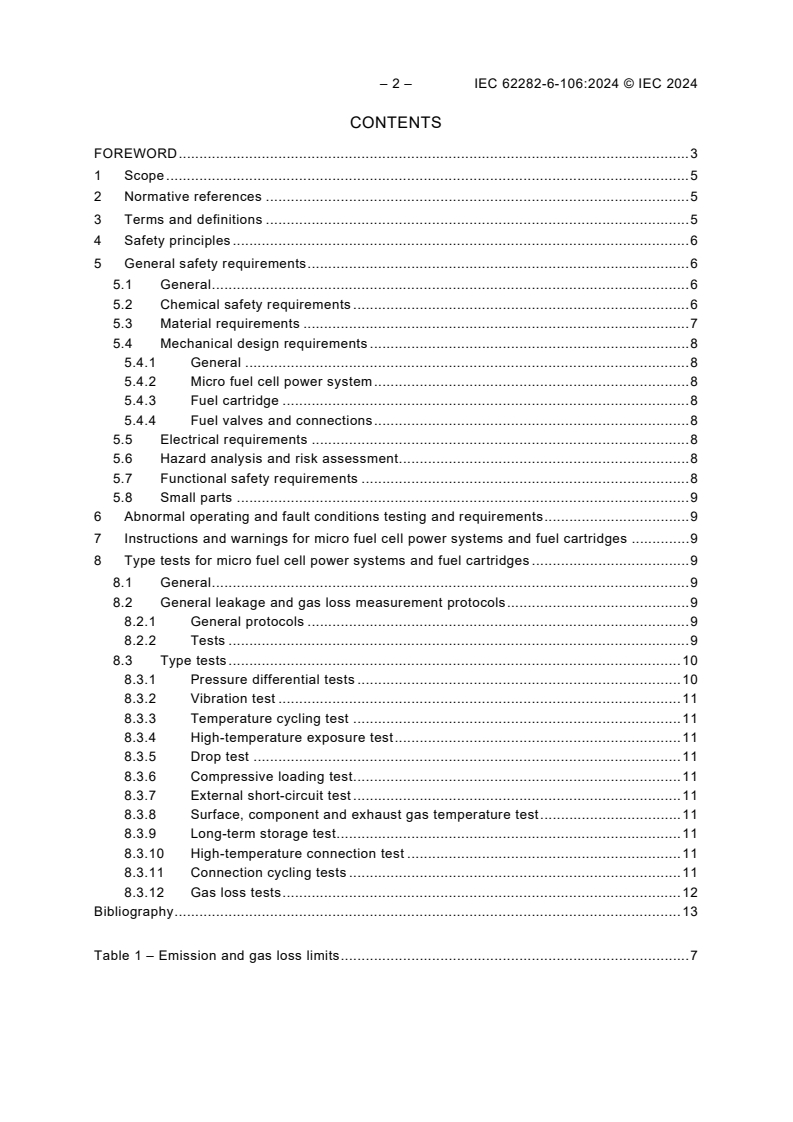
CONTENTS
FOREWORD . 3
1 Scope . 5
2 Normative references . 5
3 Terms and definitions . 5
4 Safety principles . 6
5 General safety requirements . 6
5.1 General . 6
5.2 Chemical safety requirements . 6
5.3 Material requirements . 7
5.4 Mechanical design requirements . 8
5.4.1 General . 8
5.4.2 Micro fuel cell power system . 8
5.4.3 Fuel cartridge . 8
5.4.4 Fuel valves and connections . 8
5.5 Electrical requirements . 8
5.6 Hazard analysis and risk assessment. 8
5.7 Functional safety requirements . 8
5.8 Small parts . 9
6 Abnormal operating and fault conditions testing and requirements . 9
7 Instructions and warnings for micro fuel cell power systems and fuel cartridges . 9
8 Type tests for micro fuel cell power systems and fuel cartridges . 9
8.1 General . 9
8.2 General leakage and gas loss measurement protocols . 9
8.2.1 General protocols . 9
8.2.2 Tests . 9
8.3 Type tests . 10
8.3.1 Pressure differential tests . 10
8.3.2 Vibration test . 11
8.3.3 Temperature cycling test . 11
8.3.4 High-temperature exposure test . 11
8.3.5 Drop test . 11
8.3.6 Compressive loading test . 11
8.3.7 External short-circuit test . 11
8.3.8 Surface, component and exhaust gas temperature test . 11
8.3.9 Long-term storage test . 11
8.3.10 High-temperature connection test . 11
8.3.11 Connection cycling tests . 11
8.3.12 Gas loss tests . 12
Bibliography . 13
Table 1 – Emission and gas loss limits . 7
INTERNATIONAL ELECTROTECHNICAL COMMISSION
____________
FUEL CELL TECHNOLOGIES –
Part 6-106: Micro fuel cell power systems – Safety –
Indirect Class 8 (corrosive) compounds
FOREWORD
1) The International Electrotechnical Commission (IEC) is a worldwide organization for standardization comprising
all national electrotechnical committees (IEC National Committees). The object of IEC is to promote international
co-operation on all questions concerning standardization in the electrical and electronic fields. To this end and
in addition to other activities, IEC publishes International Standards, Technical Specifications, Technical Reports,
Publicly Available Specifications (PAS) and Guides (hereafter referred to as “IEC Publication(s)”). Their
preparation is entrusted to technical committees; any IEC National Committee interested in the subject dealt with
may participate in this preparatory work. International, governmental and non-governmental organizations liaising
with the IEC also participate in this preparation. IEC collaborates closely with the International Organization for
Standardization (ISO) in accordance with conditions determined by agreement between the two organizations.
2) The formal decisions or agreements of IEC on technical matters express, as nearly as possible, an international
consensus of opinion on the relevant subjects since each technical committee has representation from all
interested IEC National Committees.
3) IEC Publications have the form of recommendations for international use and are accepted by IEC National
Committees in that sense. While all reasonable efforts are made to ensure that the technical content of IEC
Publications is accurate, IEC cannot be held responsible for the way in which they are used or for any
misinterpretation by any end user.
4) In order to promote international uniformity, IEC National Committees undertake to apply IEC Publications
transparently to the maximum extent possible in their national and regional publications. Any divergence between
any IEC Publication and the corresponding national or regional publication shall be clearly indicated in the latter.
5) IEC itself does not provide any attestation of conformity. Independent certification bodies provide conformity
assessment services and, in some areas, access to IEC marks of conformity. IEC is not responsible for any
services carried out by independent certification bodies.
6) All users should ensure that they have the latest edition of this publication.
7) No liability shall attach to IEC or its directors, employees, servants or agents including individual experts and
members of its technical committees and IEC National Committees for any personal injury, property damage or
other damage of any nature whatsoever, whether direct or indirect, or for costs (including legal fees) and
expenses arising out of the publication, use of, or reliance upon, this IEC Publication or any other IEC
Publications.
8) Attention is drawn to the Normative references cited in this publication. Use of the referenced publications is
indispensable for the correct application of this publication.
9) IEC draws attention to the possibility that the implementation of this document may involve the use of (a)
patent(s). IEC takes no position concerning the evidence, validity or applicability of any claimed patent rights in
respect thereof. As of the date of publication of this document, IEC had not received notice of (a) patent(s), which
may be required to implement this document. However, implementers are cautioned that this may not represent
the latest information, which may be obtained from the patent database available at https://patents.iec.ch. IEC
shall not be held responsible for identifying any or all such patent rights.
IEC 62282-6-106 has been prepared by IEC technical committee 105: Fuel cell technologies. It
is an International Standard.
This first edition, together with the other parts of the IEC 62282-6-1XX series, cancels and
replaces IEC 62282-6-100:2010 and IEC 62282-6-100:2010/AMD1:2012.
This edition constitutes a technical revision.
This edition includes the following significant technical changes with respect to
IEC 62282-6-100:2010 and IEC 62282-6-100:2010/AMD1:2012:
a) A new structure has been set up: IEC 62282-6-101 covers the general safety requirements
common to all fuel types whereas IEC 62282-6-102 and subsequent parts of the IEC 62282-
6-1XX series cover particular requirements for individual fuel types.
– 4 – IEC 62282-6-106:2024 © IEC 2024
The text of this International Standard is based on the following documents:
Draft Report on voting
105/1017/FDIS 105/1025/RVD
Full information on the voting for its approval can be found in the report on voting indicated in
the above table.
The language used for the development of this International Standard is English.
This document was drafted in accordance with ISO/IEC Directives, Part 2, and developed in
accordance with ISO/IEC Directives, Part 1 and ISO/IEC Directives, IEC Supplement, available
at www.iec.ch/members_experts/refdocs. The main document types developed by IEC are
described in greater detail at www.iec.ch/publications.
A list of all parts in the IEC 62282 series, published under the general title Fuel cell
technologies, can be found on the IEC website.
This document is to be used in conjunction with IEC 62282-6-101:2024 and is not to be used
as a stand-alone document. This document provides additional requirements specific to
corrosive fuel formulations, which apply in addition to the general requirements specified in
IEC 62282-6-101:2024. The (sub)clause numbers in this document are aligned with those of
IEC 62282-6-101:2024 and are intended to provide additional information and refined
requirements, as appropriate.
The committee has decided that the contents of this document will remain unchanged until the
stability date indicated on the IEC website under webstore.iec.ch in the data related to the
specific document. At this date, the document will be
• reconfirmed,
• withdrawn, or
• revised.
NOTE The attention of National Committees is drawn to the fact that equipment manufacturers and testing
organizations may need a transitional period following publication of a new, amended or revised IEC publication in
which to make products in accordance with the new requirements and to equip themselves for conducting new or
revised tests.
It is the recommendation of the committee that the content of this publication be adopted for implementation nationally
not earlier than 12 months from the date of publication.
FUEL CELL TECHNOLOGIES –
Part 6-106: Micro fuel cell power systems – Safety –
Indirect Class 8 (corrosive) compounds
1 Scope
This part of IEC 62282 covers micro fuel cell power systems, micro fuel cell power units and
fuel cartridges using hydrogen produced from UN Class 8 (corrosive) borohydride formulations
as fuel. These systems and units use proton exchange membrane (PEM) fuel cell technologies.
The designs include fuel processing subsystems to derive hydrogen gas from the corrosive fuel
formulation.
IEC 62282-6-101:2024, Figure 1 is applicable.
2 Normative references
The following documents are referred to in the text in such a way that some or all of their content
constitutes requirements of this document. For dated references, only the edition cited applies.
For undated references, the latest edition of the referenced document (including any
amendments) applies.
IEC 62282-6-101:2024, Fuel cell technologies – Part 6-101: Micro fuel cell power systems –
Safety – General requirements
3 Terms and definitions
For the purposes of this document, the terms and definitions given in IEC 62282-6-101 and the
following apply.
ISO and IEC maintain terminology databases for use in standardization at the following
addresses:
• IEC Electropedia: available at https://www.electropedia.org/
• ISO Online browsing platform: available at https://www.iso.org/obp
3.1
fuel
corrosive (UN Class 8) formulation of borohydride compounds used as fuel for an indirect PEM
micro fuel cell power system
Note 1 to entry: The formulation may contain a non-hazardous activator to facilitate the production of hydrogen, or
an inhibitor, such as an alkali metal hydroxide, to modulate or inhibit the production of hydrogen from the corrosive
fuel formulation or both. The formulation may be solid or liquid, or may include both solid and liquid components that
are combined during fuel processing.
Note 2 to entry: This document only applies to corrosive (UN Class 8) compounds which can be processed to evolve
hydrogen gas (e.g. through contact with water, non-hazardous or corrosive aqueous solutions, or an activator, or
both).
Note 3 to entry: Guidance on the classification of materials, including mixtures, can be found in the current edition
of the United Nations Recommendations on the Transport of Dangerous Goods, Model Regulations.
– 6 – IEC 62282-6-106:2024 © IEC 2024
3.2
borohydride compound
sodium or potassium borohydride, or a mixture thereof
3.3
liquid fuel component
Class 8 (corrosive), or non-hazardous, water solutions used to produce hydrogen within the fuel
processing subsystem
3.4
fuel by-product
Class 8 (corrosive), or non-hazardous, compound produced after hydrogen or electricity, or
both, is produced from fuel
3.5
activator
substance that facilitates the production of hydrogen from fuel, such as a catalyst
4 Safety principles
The safety principles included in IEC 62282-6-101:2024, Clause 4 apply in their entirety to
technologies included in this document.
5 General safety requirements
5.1 General
The general safety requirements of IEC 62282-6-101:2024, 5.1 shall apply as written with the
following addition.
NOTE The limited quantity exception for cargo transport of fuel cell cartridges containing corrosive fuel is 1 kg of
solid fuel or 1 l of liquid fuel according to the UN Model Regulations. For passenger carriage in the aircraft cabin or
in checked baggage the maximum quantity of corrosive fuel permitted inside the cartridge is 200 g of solid fuel or
200 g of liquid fuel according to the 2013 edition of the International Civil Aviation Organization (ICAO) Technical
Instructions.
5.2 Chemical safety requirements
Consistent with IEC 62282-6-101:2024, Table 4, the following limits given in Table 1 shall apply
for the emission and gas loss measurements for micro fuel cell power systems and fuel
cartridges tested in accordance with this document.
Table 1 – Emission and gas loss limits
a b c
Constituent
Concentration limit Gas loss rate limit Gas loss rate limit
(Operating devices) (Operating devices) (Non-operating devices)
Non-hazardous aqueous Unlimited for pH between Unlimited for pH between Unlimited for pH between
solutions 3,5 and 10,5 3,5 and 10,5 3,5 and 10,5
0,8 g/h total 0,003 2 g/h total
0,8 g/m
(impermissible H gas loss)
Hydrogen
0,016 g/h from single point
d
leak
e g 3
0,000 6 g/h 0,000 6 g/h
Formaldehyde 0,000 1 g/m
g 3
0,290 g/h 0,290 g/h
CO 0,029 g/m
g 3
f f
CO 9 g/m
60 g/h 60 g/h
g 3
2,45 g/h 0,4 g/h
Methyl formate 0,245 g/m
a
The concentration limit for chemical compounds of interest shall be based on internationally recommended
values. All toxicity based limits listed in this Table 1 are based on long-term, time-averaged limits, for instance
TWA for ICSC’s occupational limit. The gas loss rate limit shall be obtained using similar computation as used
in this Table 1 to ensure that overall gas loss rates do not exceed time-averaged limits for the constituent of
interest. For such constituents, short-term increases in gas loss rate may be permissible, provided that the
transient rate does not exceed the short-term exposure limit (STEL) for that constituent and the overall gas loss
rate does not exceed the time-averaged rate specified in this Table 1.
b 3
The "operating" emission rate limit was based on 10 m ACH, selected as the product of the reference volume
times the air changes per hour (ACH) because it covers the reasonably foreseeable environments where micro
fuel cell power systems will be used. The interior space in a small car and the minimum volume per person on a
commercial aircraft is at 1 m . The minimum ACH used on a passenger aircraft is 10 and the lowest ventilation
setting in cars is 10 ACH. Homes and offices may have ACH levels as low as 0,5 but the per-person volume is
over 20 m , so a product of 10 is conservative.
c
The non-operating limits have been chosen based on a scenario of devices in an enclosed space with no
ventilation. The space chosen has a volume of 0,28 m , or approximately 10 cubic feet. The criterion has been
specified so that a concentration of greater than 25 % of the lower flammability limit (LFL) is not permitted to
develop over a twenty-four hour (24 h) period, if three devices are in the enclosed space. For example, this
criterion is applied for the determination of a maximum gas-loss rate based on the emission of flammable
constituents from non-operating micro fuel cell power systems. Note that the control volume for non-operating
systems should not be applied using toxicity limits, as the core principle of this enclosed space is that of a
storage space, not one that a person can spend time in. For the determination of non-operating limits for
constituents with both flammable and toxic properties, the lower of the flammability based limit for the "non-
operating" control volume and the toxicity based limit for the "operating" control volume shall apply.
d
0,016 g/h reflects an emission rate lower than the limit reported by Swain, et al, (Proceedings of the 2001 DOE
Program Review; NREL/CP-570-30535; M.R. Swain and M.N. Swain, Codes and Standards Analysis, 2001
(USA); available at: http://www1.eere.energy.gov/hydrogenandfuelcells/pdfs/30535bc.pdf) wherein "no hole was
able to support a hydrogen flame at less than 3.5 cc/min." (3.5 cc/min ≈ 0,018 g/h). This value was chosen in
conformance with the guidelines in IEC 62282-6-101:2024, Table 3.
e 3 3
The WHO guideline limit is 0,000 1 g/m . Background levels are 0,000 03 g/m . The emission limit cannot push
the background level above the guideline limit
f
A seated human adult has a CO emission rate of 30 g/h. The fuel cell plus human adult emission rates are
limited such that the CO concentration does not reach the WHO eight-hour concentration limit of 9 g/m . In an
environment with 10 m ACH, this limits the contribution from the fuel cell to 60 g/h.
g
Testing for the presence of these constituents may be omitted for micro fuel cell power systems and fuel
cartridges that do not contain, or have the potential to evolve, carbon-based compounds. In such cases, the
rationale for such omission shall be documented in the hazard analysis and risk assessment.
5.3 Material requirements
The requirements of IEC 62282-6-101:2024, 5.3 shall apply as written.
– 8 – IEC 62282-6-106:2024 © IEC 2024
5.4 Mechanical design requirements
5.4.1 General
The requirements of IEC 62282-6-101:2024, 5.4.1 shall apply as written, with the following
additions.
5.4.1.1 Structural integrity
The general requirements of IEC 62282-6-101:2024, 5.4.1.1 shall apply as written with the
following addition:
In addition, fuel cartridges intended to contain or evolve hydrogen at greater than atmospheric
pressure shall also be capable of withstanding fire testing in accordance with 8.3.1 through
8.3.12.
5.4.2 Micro fuel cell power system
The general requirements of IEC 62282-6-101:2024, 5.4.2.1 and 5.4.2.2 shall apply as written.
5.4.3 Fuel cartridge
The general requirements of IEC 62282-6-101:2024, 5.4.3 shall apply as written with the
following additions.
In addition, the following fuel specific requirements shall apply:
• In cases where materials (either solid or liquid) are present and are incompatible with either
the borohydride fuel or liquid fuel component, the design of the fuel cartridge and micro fuel
cell power system shall provide a means for preventing inadvertent or uncontrolled mixing
of these materials.
• Two independent means for preventing inadvertent or uncontrolled mixing of these materials
shall be provided during transportation and storage prior to use. Illustrative examples of
these means include but are not limited to: positive activation by the control system; physical
removal of an impermeable barrier preventing contact; opening of a normally closed
manually controlled valve preventing contact. For at least one of these means for preventing
uncontrolled mixing, it shall be necessary for the user to take positive action to remove or
deactivate it prior to use.
• At least one means for preventing uncontrolled mixing of these materials shall be provided
during use and storage after use. This means may include active control by system
electronics, subject to the hazard analysis and risk assessment of 5.6.
5.4.4 Fuel valves and connections
The general requirements of IEC 62282-6-101:2024, 5.4.4.1 and 5.4.4.2 shall apply as written.
5.5 Electrical requirements
The general requirements of IEC 62282-6-101:2024, 5.5 shall apply as written.
5.6 Hazard analysis and risk assessment
The general requirements of IEC 62282-6-101:2024, 5.6 shall apply as written.
5.7 Functional safety requirements
The general requirements of IEC 62282-6-101:2024, 5.7 shall apply as written.
5.8 Small parts
The general requirements of IEC 62282-6-101:2024, 5.8 shall apply as written.
6 Abnormal operating and fault conditions testing and requirements
The general requirements of IEC 62282-6-101:2024, Clause 6 shall apply as written.
7 Instructions and warnings for micro fuel cell power systems and fuel
cartridges
The general requirements of IEC 62282-6-101:2024, Clause 7 shall apply as written with the
following addition.
In addition, both fuel cartridges and micro fuel cell power systems shall also include the
following marking:
"MAY CONTAIN FLAMMABLE GAS."
8 Type tests for micro fuel cell power systems and fuel cartridges
8.1 General
The general requirements of IEC 62282-6-101:2024, 8.1 shall apply as written.
8.2 General leakage and gas loss measurement protocols
8.2.1 General protocols
The general requirements and principles of IEC 62282-6-101:2024, 8.2 shall be applied as
appropriate for each of the type tests required in IEC 62282-6-101:2024, 8.3 with the following
additional requirements.
For fuel cartridges and micro fuel cell power systems tested in accordance with this document,
in general, concentration-based measurements are recommended over mass-based
measurements. It is possible that mass-based measurements will not be appropriate for fuel
cartridges containing water-reactive fuel, as leakage can be indicated by an increase in overall
mass (e.g. absorption of water) rather than mass loss. If mass-based measurements are utilized
for any type test, the test method shall be verified and validated prior to use for assessing
compliance.
8.2.2 Tests
8.2.2.1 General
Following each type test, all test samples shall be checked for leakage and gas loss in
accordance with the following procedures.
8.2.2.2 Leakage and gas loss test procedures for fuel cartridges
1) Perform a visual inspection of all possible leak locations as follows:
a) The method for the detection of accessible hazardous liquids given in IEC 62282-6-
101:2024, 8.2.8, or an equivalent method, shall be used to detect any hazardous liquid
leakage.
b) Accessible fuel, fuel by-products, electrolyte or liquid fuel component, or crystals on the
exterior of the fuel cartridge are indications of leakage. If fuel, fuel by-products,
– 10 – IEC 62282-6-106:2024 © IEC 2024
electrolyte or liquid fuel component, or crystals are visible on the exterior, the fuel
cartridge fails the leakage test.
2) Check for hydrogen gas loss using a liquid leak detector on possible leak locations of fuel
cartridges using the protocol described in IEC 62282-6-101:2024, 8.2.5, or an equivalent
method.
If the fuel cartridge is of the type that is refillable by the manufacturer (automated or by
trained technicians), it shall be filled to its rated capacity prior to testing. If the fuel cartridge
is not refillable, it shall be tested in the condition in which it completed the type test in
question. The fuel cartridge shall be tested for leaks at laboratory temperature. There shall
be no leakage or gas loss from any point on the fuel cartridge.
8.2.2.3 Leakage and gas loss test procedures for micro fuel cell power systems
1) Perform a visual inspection of all possible leak locations for leakage as follows:
a) The method for the detection of accessible hazardous liquids given in IEC 62282-6-
101:2024, 8.2.8, or an equivalent method, shall be used to detect any hazardous liquid
leakage.
b) Accessible fuel, fuel by-products, electrolyte or liquid fuel component, or crystals on the
exterior of the fuel cartridge are indications of leakage. If fuel, fuel by-products,
electrolyte or liquid fuel component, or crystals are visible on the exterior, the micro fuel
cell power system fails the leakage test.
2) If the micro fuel cell power system includes a fuel management system or an internal
reservoir that contains hydrogen gas above ambient pressure or both, a check for hydrogen
gas loss shall be done following each type test using a liquid leak detector (bubble forming)
solution as described in IEC 62282-6-101:2024, 8.2.5 or other equivalent means on all
possible leak locations of the fuel management system. The fuel management system and
internal reservoir shall be tested for leaks at laboratory temperature. There shall be no gas
loss from any point on the fuel management system or internal reservoir. If checking for gas
loss from the fuel management system or an internal reservoir or both, requires the
disassembly of the micro fuel cell power system, this check may be performed following all
other gas loss testing.
3) Perform gas loss testing in accordance with the protocol for performing concentration-based
measurements in IEC 62282-6-101:2024, 8.2.3 with the micro fuel cell power system or unit
turned off ("DEVICE – OFF") to check for hydrogen gas loss. Hydrogen gas loss shall be
less than the gas loss rate limit for non-operating devices specified in 5.2 of this document
(< 0,003 2 g/h). If transient gas loss rates greater than 0,016 g/h are observed during
hydrogen gas loss testing, hydrogen point-source gas loss detection testing in accordance
with IEC 62282-6-101:2024, 8.2.4, or an equivalent test for ensuring compliance with the
safety principles expressed in IEC 62282-6-101:2024, 4.2, shall be performed.
4) Turn the micro fuel cell power system "on" and operate for 10 min ± 30 s. Check whether
fire or explosion occurs.
5) Perform gas loss testing in accordance with the protocol for performing concentration-based
measurements in IEC 62282-6-101:2024, 8.2.3 to check for hydrogen gas loss, with the
micro fuel cell power system turned on ("DEVICE – ON"), regardless of whether or not the
micro fuel cell power system is operational. Hydrogen gas loss shall be less than the
applicable gas loss rate limits specified in 5.2 of this document. If the device is not
operational, the gas loss rate limit for non-operating devices shall be met. If transient gas
loss rates greater than 0,016 g/h are observed during hydrogen gas loss testing, hydrogen
point-source gas loss detection testing in accordance with IEC 62282-6-101:2024, 8.2.4, or
an equivalent test for ensuring compliance with the safety principles expressed in
IEC 62282-6-101:2024, 4.2, shall be performed.
8.3 Type tests
8.3.1 Pressure differential tests
The pressure differential tests of IEC 62282-6-101:2024, 8.3.1 shall be performed as written
with the following addition.
Class 8 (corrosive) borohydride fuel will chemically react with water; therefore, water or water-
containing substances shall not be used as the fluid test medium. Class 8 (corrosive)
borohydride fuels have the potential to react with substances other than water, therefore, the
chemical reactivity and stability of the particular Class 8 (corrosive) borohydride fuel being
tested shall be used to guide the selection of a suitable liquid test medium.
8.3.2 Vibration test
The vibration test of IEC 62282-6-101:2024, 8.3.2 shall be performed as written.
8.3.3 Temperature cycling test
The temperature cycling test of IEC 62282-6-101:2024, 8.3.3 shall be performed as written.
8.3.4 High-temperature exposure test
The high temperature exposure test of IEC 62282-6-101:2024, 8.3.4 shall be performed as
written.
8.3.5 Drop test
The drop test of IEC 62282-6-101:2024, 8.3.5 shall be performed as written.
8.3.6 Compressive loading test
The compressive loading test of IEC 62282-6-101:2024, 8.3.6 shall be performed as written.
8.3.7 External short-circuit test
The external short-circuit test of IEC 62282-6-101:2024, 8.3.7 shall be performed as written.
8.3.8 Surface, component and exhaust gas temperature test
The surface, component and exhaust gas temperature test of IEC 62282-6-101:2024, 8.3.8
shall be performed as written.
8.3.9 Long-term storage test
The long-term storage test of IEC 62282-6-101:2024, 8.3.9 shall be performed as written.
8.3.10 High-temperature connection test
The high-temperature connection test of IEC 62282-6-101:2024, 8.3.10 shall be performed as
written.
8.3.11 Connection cycling tests
The connection cycling tests of IEC 62282-6-101:2024, 8.3.11 shall be performed as written.
– 12 – IEC 62282-6-106:2024 © IEC 2024
8.3.12 Gas loss tests
8.3.12.1 General gas loss test
The general gas loss test of IEC 62282-6-101:2024, 8.3.12.1 shall be performed as written to
check for gas loss from operating systems for the constituents listed in 5.2 of this document,
with the following passing criteria:
a) Passing criteria:
During gas loss testing, hydrogen gas loss shall be less than the applicable gas loss rate
limits specified in 5.2 of this document. If the device is not operational, the gas loss rate
limit for non-operating devices shall be met. If transient gas loss rates greater than 0,016 g/h
are observed during hydrogen gas loss testing, hydrogen point-source gas loss detection
testing in accordance with IEC 62282-6-101:2024, 8.2.4, or an equivalent test for ensuring
compliance with the safety principles expressed in IEC 62282-6-101:2024, 4.2, shall be
performed.
Gas loss rates from all other measured constituents shall not exceed the gas loss rate limits
as specified in 5.2 of this document, or shall meet an equivalent level of safety to the
principles expressed in IEC 62282-6-101:2024, 4.2.
8.3.12.2 Gas loss test for devices to be used in close proximity to consumer’s mouth
or nose
The gas loss test of IEC 62282-6-101:2024, 8.3.12.2 shall be performed only if the hazard
analysis and risk assessment indicates that constituents with toxicity hazards can be emitted
from the micro fuel cell power system during operation and the device is intended to be used in
close proximity to a consumer’s mouth or nose. This test is only required for micro fuel cell
power systems that are intended to be used in close proximity (10 cm or less) to a consumer’s
mouth or nose. In such cases, the gas loss test shall be performed as written.
Bibliography
The bibliographical references listed in the Bibliography of IEC 62282-6-101 apply.
___________
– 14 – IEC 62282-6-106:2024 © IEC 2024
SOMMAIRE
AVANT-PROPOS . 15
1 Domaine d’application . 17
2 Références normatives . 17
3 Termes et définitions . 17
4 Principes de sécurité . 18
5 Exigences générales de sécurité . 18
5.1 Généralités . 18
5.2 Exigences de sécurité chimique . 18
5.3 Exigences relatives aux matières et matériaux . 20
5.4 Exigences de conception mécanique . 20
5.4.1 Généralités . 20
5.4.2 Système à micropile à combustible . 20
5.4.3 Cartouche de combustible . 20
5.4.4 Vannes de combustible et connexions . 20
5.5 Exigences électriques . 20
5.6 Analyse des dangers et appréciation du risque . 21
5.7 Exigences de sécurité électrique . 21
5.8 Petites pièces . 21
6 Essais et exigences des conditions anormales de fonctionnement et de défaut . 21
7 Instructions et avertissements pour les systèmes à micropiles à combustible et les
cartouches de combustible . 21
8 Essais de type pour les systèmes à micropiles à combustible et les cartouches de
combustible . 21
8.1 Généralités . 21
8.2 Protocoles généraux de mesurage des fuites et des pertes de gaz . 21
8.2.1 Protocoles généraux . 21
8.2.2 Essais . 22
8.3 Essais de type . 23
8.3.1 Essais de pression différentielle . 23
8.3.2 Essai de vibrations . 23
8.3.3 Essai de cycles de températures . 23
8.3.4 Essai d’exposition à température élevée . 23
8.3.5 Essai de chute . 23
8.3.6 Essai de charge de compression . 24
8.3.7 Essai de court-circuit externe . 24
8.3.8 Essai de température de surface, de composant et de gaz
d’échappement . 24
8.3.9 Essai de stockage de longue durée . 24
8.3.10 Essai de connexion à température élevée . 24
8.3.11 Essais de cycles de connexion . 24
8.3.12 Essais de perte de gaz . 24
Bibliographie . 26
Tableau 1 – Limites d'émission et de pertes de gaz . 19
COMMISSION ÉLECTROTECHNIQUE INTERNATIONALE
____________
...
Questions, Comments and Discussion
Ask us and Technical Secretary will try to provide an answer. You can facilitate discussion about the standard in here.
Loading comments...