

IEC 62586-2:2013
(Main)Power quality measurement in power supply systems - Part 2: Functional tests and uncertainty requirements
General Information
- Abstract
IEC 62586-2:2013 specifies functional tests and uncertainty requirements for instruments whose functions include measuring, recording, and possibly monitoring power quality parameters in power supply systems, and whose measuring methods (class A or class S) are defined in IEC 61000-4-30. This standard applies to power quality instruments complying with IEC 62586-1. This standard may also be referred to by other product standards (e.g. digital fault recorders, revenue meters, MV or HV protection relays) specifying devices embedding class A or class S power quality functions according to IEC 61000-4-30. These requirements are applicable in single, dual- (split phase) and 3-phase a.c. power supply systems at 50 Hz or 60 Hz. The contents of the corrigendum of November 2014 have been included in this copy.
- Status
- Published
- Publication Date
- 11-Dec-2013
- Technical Committee
- TC 85 - Measuring equipment for electrical and electromagnetic quantities
- Drafting Committee
- WG 20 - TC 85/WG 20
- Current Stage
- DELPUB - Deleted Publication
- Start Date
- 07-Mar-2017
- Completion Date
- 28-Aug-2026
Overview
IEC 62586-2:2013 is an international standard developed by the International Electrotechnical Commission (IEC) that specifies functional tests and uncertainty requirements for power quality measurement instruments in power supply systems. This standard focuses on instruments designed to measure, record, and monitor power quality parameters adhering to measurement classes A or S as defined in IEC 61000-4-30.
The standard applies primarily to instruments conforming to IEC 62586-1 and can also be referenced by other product standards such as digital fault recorders, revenue meters, and MV or HV protection relays that incorporate class A or class S power quality measurement functions. It covers measurement applications within single-phase, split-phase, and three-phase AC power supply systems operating at 50 Hz or 60 Hz.
Inclusion of corrigenda from November 2014 ensures that users have access to the most up-to-date functional test and uncertainty criteria for power quality instruments.
Key Topics
Functional Testing of Power Quality Instruments
IEC 62586-2:2013 outlines a comprehensive framework for functional type testing which ensures that power quality measuring devices perform accurately under a variety of operating conditions. Testing includes parameters such as supply voltage magnitude, power frequency, flicker, voltage dips, swells, interruptions, unbalance, harmonics, inter-harmonics, and mains signalling voltages.Uncertainty Requirements
The standard defines measurement uncertainty limits for different parameters to guarantee reliable and precise power quality data. This involves intrinsic uncertainty, operating uncertainty, and overall system uncertainty considerations to help manufacturers and users assess device performance.Class A and Class S Compliance
Specific test procedures and accuracy requirements are differentiated for instruments complying with Class A or Class S under IEC 61000-4-30, providing users the ability to select instruments best suited to their accuracy and monitoring needs.Environmental and External Influence Testing
The functionality and uncertainty measurements take into account external influence factors such as temperature variations and power supply voltage fluctuations, ensuring robust instrument operation in real-world environments.Polyphase Testing Capabilities
Detailed methodologies for verifying performance in polyphase systems include checks on dips, interruptions, swells, and voltage unbalance, ensuring comprehensive coverage for complex power supply setups.
Applications
IEC 62586-2:2013 serves as a critical reference for manufacturers, system integrators, and utilities aiming to ensure the accuracy and reliability of power quality measurement in electrical power systems. Typical applications include:
Power Quality Monitoring and Analysis
Utilities and industrial facilities use compliant instruments for detecting and diagnosing power quality disturbances, enabling enhanced system reliability and energy efficiency.Energy Billing and Revenue Measurement
Accurate power quality data enhances the performance of revenue meters and supports fair billing practices.Protection and Control Systems
Integration of power quality measurement functions into protection relays and digital fault recorders supports advanced fault detection and system stability.Compliance with Regulatory and Industry Standards
Meeting the requirements of IEC 62586-2 supports regulatory compliance and aligns with best practices for power quality management in modern electrical networks.
Related Standards
IEC 62586-1
Specifies the general requirements and architecture for power quality measurement instruments, serving as a foundation to the functional testing aspects detailed in Part 2.IEC 61000-4-30
Defines measurement methods and accuracy classes (Class A and S) for power quality parameters. IEC 62586-2 references this standard extensively for defining test procedures and uncertainty requirements.Digital Fault Recorder and Protection Relay Standards
Various IEC product standards reference IEC 62586-2 for incorporating power quality measurement functions within protective and recording devices.Other IEC Power Quality Standards
IEC standards dealing with power quality phenomena, testing methods, and performance requirements complement the scope of IEC 62586-2, providing a full framework for power quality assessment and instrumentation.
Keywords: IEC 62586-2:2013, power quality measurement, functional tests, uncertainty requirements, IEC 61000-4-30, class A power quality instruments, class S power quality instruments, power supply systems, voltage harmonics, flicker measurement, supply voltage dips, power frequency measurement, polyphase systems, electrical standards, power quality monitoring, power quality instruments testing.
Relations
- Effective Date
- 05-Sep-2023
- Effective Date
- 05-Sep-2023
Get Certified
Connect with accredited certification bodies for this standard

BSMI (Bureau of Standards, Metrology and Inspection)
Taiwan's standards and inspection authority.
Sponsored listings
Frequently Asked Questions
IEC 62586-2:2013 is a standard published by the International Electrotechnical Commission (IEC). Its full title is "Power quality measurement in power supply systems - Part 2: Functional tests and uncertainty requirements". This standard covers: IEC 62586-2:2013 specifies functional tests and uncertainty requirements for instruments whose functions include measuring, recording, and possibly monitoring power quality parameters in power supply systems, and whose measuring methods (class A or class S) are defined in IEC 61000-4-30. This standard applies to power quality instruments complying with IEC 62586-1. This standard may also be referred to by other product standards (e.g. digital fault recorders, revenue meters, MV or HV protection relays) specifying devices embedding class A or class S power quality functions according to IEC 61000-4-30. These requirements are applicable in single, dual- (split phase) and 3-phase a.c. power supply systems at 50 Hz or 60 Hz. The contents of the corrigendum of November 2014 have been included in this copy.
IEC 62586-2:2013 specifies functional tests and uncertainty requirements for instruments whose functions include measuring, recording, and possibly monitoring power quality parameters in power supply systems, and whose measuring methods (class A or class S) are defined in IEC 61000-4-30. This standard applies to power quality instruments complying with IEC 62586-1. This standard may also be referred to by other product standards (e.g. digital fault recorders, revenue meters, MV or HV protection relays) specifying devices embedding class A or class S power quality functions according to IEC 61000-4-30. These requirements are applicable in single, dual- (split phase) and 3-phase a.c. power supply systems at 50 Hz or 60 Hz. The contents of the corrigendum of November 2014 have been included in this copy.
IEC 62586-2:2013 is classified under the following ICS (International Classification for Standards) categories: 17.220.20 - Measurement of electrical and magnetic quantities. The ICS classification helps identify the subject area and facilitates finding related standards.
IEC 62586-2:2013 has the following relationships with other standards: It is inter standard links to IEC 62586-2:2013/COR1:2014, IEC 62586-2:2017. Understanding these relationships helps ensure you are using the most current and applicable version of the standard.
IEC 62586-2:2013 is available in PDF format for immediate download after purchase. The document can be added to your cart and obtained through the secure checkout process. Digital delivery ensures instant access to the complete standard document.
Standards Content (Sample)
IEC 62586-2 ®
Edition 1.0 2013-12
INTERNATIONAL
STANDARD
NORME
INTERNATIONALE
colour
inside
Power quality measurement in power supply systems –
Part 2: Functional tests and uncertainty requirements
Mesure de la qualité de l'alimentation dans les réseaux d'alimentation –
Partie 2: Essais fonctionnels et exigences d'incertitude
All rights reserved. Unless otherwise specified, no part of this publication may be reproduced or utilized in any form
or by any means, electronic or mechanical, including photocopying and microfilm, without permission in writing from
either IEC or IEC's member National Committee in the country of the requester.
If you have any questions about IEC copyright or have an enquiry about obtaining additional rights to this publication,
please contact the address below or your local IEC member National Committee for further information.
Droits de reproduction réservés. Sauf indication contraire, aucune partie de cette publication ne peut être reproduite ni
utilisée sous quelque forme que ce soit et par aucun procédé, électronique ou mécanique, y compris la photocopie et les
microfilms, sans l'accord écrit de la CEI ou du Comité national de la CEI du pays du demandeur.
Si vous avez des questions sur le copyright de la CEI ou si vous désirez obtenir des droits supplémentaires sur cette
publication, utilisez les coordonnées ci-après ou contactez le Comité national de la CEI de votre pays de résidence.
IEC Central Office Tel.: +41 22 919 02 11
3, rue de Varembé Fax: +41 22 919 03 00
CH-1211 Geneva 20 info@iec.ch
Switzerland www.iec.ch
About the IEC
The International Electrotechnical Commission (IEC) is the leading global organization that prepares and publishes
International Standards for all electrical, electronic and related technologies.
About IEC publications
The technical content of IEC publications is kept under constant review by the IEC. Please make sure that you have the
latest edition, a corrigenda or an amendment might have been published.
Useful links:
IEC publications search - www.iec.ch/searchpub Electropedia - www.electropedia.org
The advanced search enables you to find IEC publications The world's leading online dictionary of electronic and
by a variety of criteria (reference number, text, technical electrical terms containing more than 30 000 terms and
committee,…). definitions in English and French, with equivalent terms in
It also gives information on projects, replaced and additional languages. Also known as the International
withdrawn publications. Electrotechnical Vocabulary (IEV) on-line.
IEC Just Published - webstore.iec.ch/justpublished Customer Service Centre - webstore.iec.ch/csc
Stay up to date on all new IEC publications. Just Published If you wish to give us your feedback on this publication
details all new publications released. Available on-line and or need further assistance, please contact the
also once a month by email. Customer Service Centre: csc@iec.ch.
A propos de la CEI
La Commission Electrotechnique Internationale (CEI) est la première organisation mondiale qui élabore et publie des
Normes internationales pour tout ce qui a trait à l'électricité, à l'électronique et aux technologies apparentées.
A propos des publications CEI
Le contenu technique des publications de la CEI est constamment revu. Veuillez vous assurer que vous possédez
l’édition la plus récente, un corrigendum ou amendement peut avoir été publié.
Liens utiles:
Recherche de publications CEI - www.iec.ch/searchpub Electropedia - www.electropedia.org
La recherche avancée vous permet de trouver des Le premier dictionnaire en ligne au monde de termes
publications CEI en utilisant différents critères (numéro de électroniques et électriques. Il contient plus de 30 000
référence, texte, comité d’études,…). termes et définitions en anglais et en français, ainsi que
Elle donne aussi des informations sur les projets et les les termes équivalents dans les langues additionnelles.
publications remplacées ou retirées. Egalement appelé Vocabulaire Electrotechnique
International (VEI) en ligne.
Just Published CEI - webstore.iec.ch/justpublished
Service Clients - webstore.iec.ch/csc
Restez informé sur les nouvelles publications de la CEI.
Just Published détaille les nouvelles publications parues. Si vous désirez nous donner des commentaires sur
Disponible en ligne et aussi une fois par mois par email. cette publication ou si vous avez des questions
contactez-nous: csc@iec.ch.
IEC 62586-2 ®
Edition 1.0 2013-12
INTERNATIONAL
STANDARD
NORME
INTERNATIONALE
colour
inside
Power quality measurement in power supply systems –
Part 2: Functional tests and uncertainty requirements
Mesure de la qualité de l'alimentation dans les réseaux d'alimentation –
Partie 2: Essais fonctionnels et exigences d'incertitude
INTERNATIONAL
ELECTROTECHNICAL
COMMISSION
COMMISSION
ELECTROTECHNIQUE
PRICE CODE
INTERNATIONALE
CODE PRIX XE
ICS 17.220.20 ISBN 978-2-8322-1292-9
– 2 – 62586-2 © IEC:2013
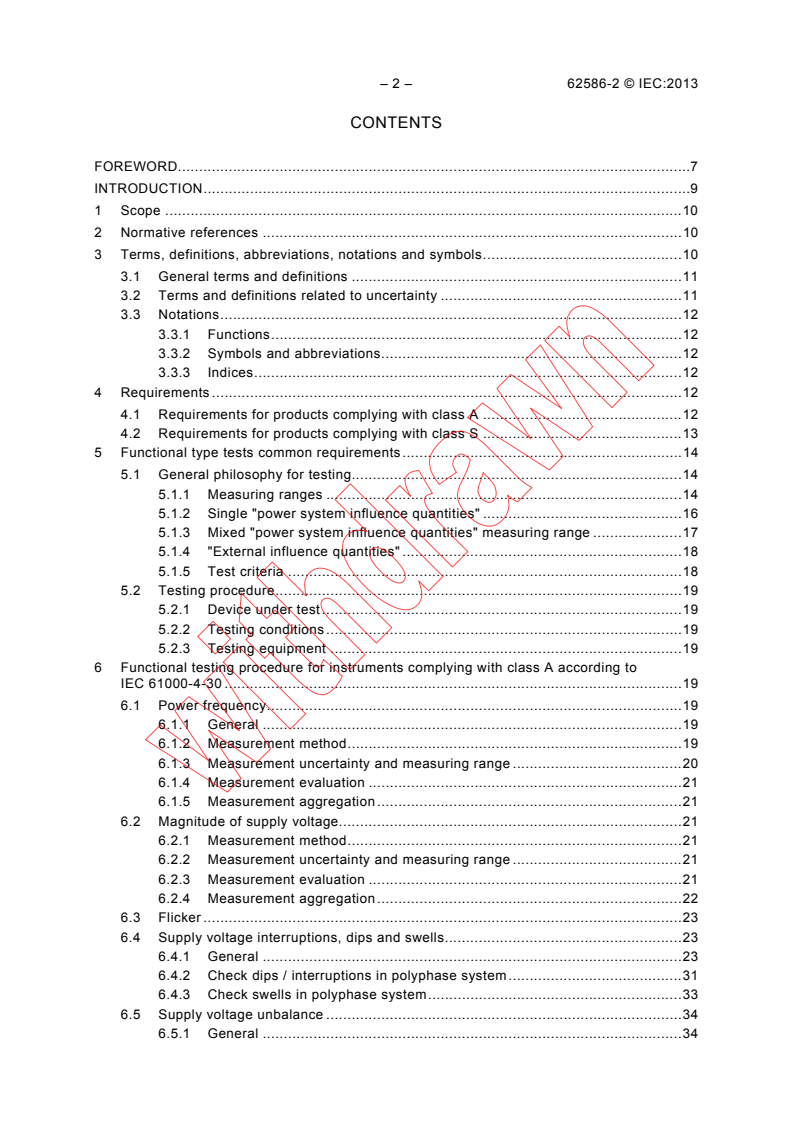
CONTENTS
FOREWORD . 7
INTR ODUCTION . 9
1 Scope . 10
2 Normative references . 10
3 Terms, definitions, abbreviations, notations and symbols . 10
3.1 General terms and definitions . 11
3.2 Terms and definitions related to uncertainty . 11
3.3 Notat i ons . 12
3.3.1 Func tions . 12
3.3.2 Symbols and abbreviations . 12
3.3.3 Indic e s . 12
4 Requirements . 12
4.1 Requirements for products complying with class A . 12
4.2 Requirements for products complying with class S . 13
5 Functional type tests common requirements . 14
5.1 General philosophy for testing. 14
5.1.1 Measuring ranges . 14
5.1.2 Single "power system influence quantities" . 16
5.1.3 Mixed "power system influence quantities" measuring range . 17
5.1.4 "External influence quantities" . 18
5.1.5 Test criteria . 18
5.2 Testing procedure . 19
5.2.1 Device under test . 19
5.2.2 Testing conditions . 19
5.2.3 Testing equipment . 19
6 Functional testing procedure for instruments complying with class A according to
IEC 61000-4-30 . 19
6.1 Power frequency . 19
6.1.1 General . 19
6.1.2 Measurement method . 19
6.1.3 Measurement uncertainty and measuring range . 20
6.1.4 Measurement evaluation . 21
6.1.5 Measurement aggregation . 21
6.2 Magnitude of supply voltage. 21
6.2.1 Measurement method . 21
6.2.2 Measurement uncertainty and measuring range . 21
6.2.3 Measurement evaluation . 21
6.2.4 Measurement aggregation . 22
6.3 Flicker . 23
6.4 Supply voltage interruptions, dips and swells . 23
6.4.1 General . 23
6.4.2 Check dips / interruptions in polyphase system . 31
6.4.3 Check swells in polyphase system . 33
6.5 Supply voltage unbalance . 34
6.5.1 General . 34
62586-2 © IEC:2013 – 3 –
6.5.2 Measurement method, measurement uncertainty and measuring
range . 34
6.5.3 Aggregation . 35
6.6 Voltage harmonics . 35
6.6.1 Measurement method . 35
6.6.2 Measurement uncertainty and measuring range . 36
6.6.3 Measurement evaluation . 37
6.6.4 Measurement aggregation . 37
6.7 Voltage inter-harmonics . 39
6.7.1 Measurement method . 39
6.7.2 Measurement uncertainty and measuring range . 39
6.7.3 Measurement evaluation . 40
6.7.4 Measurement aggregation . 40
6.8 Mains signalling voltages on the supply voltage . 42
6.8.1 Measurement method . 42
6.8.2 Measurement uncertainty and measuring range . 44
6.8.3 Aggregation . 45
6.9 Measurement of underdeviation and overdeviation parameters . 45
6.9.1 Measurement method . 45
6.9.2 Measurement uncertainty and measuring range . 47
6.9.3 Measurement evaluation . 47
6.9.4 Measurement aggregation . 47
6.10 Flagging . 49
6.11 Clock uncertainty testing . 51
6.12 Variations due to external influence quantities . 51
6.12.1 General . 51
6.12.2 Influence of temperature . 52
6.12.3 Influence of power supply voltage . 55
7 Functional testing procedure for instruments complying with class S according to
IEC 61000-4-30 . 56
7.1 Power frequency . 56
7.1.1 General . 56
7.1.2 Measurement method . 56
7.1.3 Measurement uncertainty and measuring range . 57
7.1.4 Measurement evaluation . 58
7.1.5 Measurement aggregation . 58
7.2 Magnitude of the supply voltage . 58
7.2.1 Measurement method . 58
7.2.2 Measurement uncertainty and measuring range . 58
7.2.3 Measurement evaluation . 59
7.2.4 Measurement aggregation . 59
7.3 Flicker . 60
7.4 Supply voltage interruptions, dips and swells . 60
7.4.1 General requirements . 60
7.4.2 Check dips / interruptions in polyphase system . 66
7.4.3 Check swells in polyphase system . 68
7.5 Supply voltage unbalance . 69
7.5.1 General . 69
– 4 – 62586-2 © IEC:2013
7.5.2 Measurement method, measurement uncertainty and measuring
range . 69
7.5.3 Aggregation . 70
7.6 Voltage harmonics . 70
7.6.1 General . 70
7.6.2 Measurement method . 70
7.6.3 Measurement method, measurement uncertainty and measuring
range . 72
7.6.4 Measurement evaluation . 73
7.6.5 Measurement aggregation . 73
7.7 Voltage inter-harmonics . 74
7.8 Mains Signalling Voltages on the supply voltage . 75
7.8.1 General . 75
7.8.2 Measurement method . 75
7.8.3 Measurement uncertainty and measuring range . 75
7.8.4 Aggregation . 75
7.9 Measurement of underdeviation and overdeviation parameters . 75
7.10 Flagging . 75
7.11 Clock uncertainty testing . 77
7.12 Variations due to external influence quantities . 77
7.12.1 General . 77
7.12.2 Frequency measurement . 78
7.12.3 Influence of temperature . 78
7.12.4 Influence of power supply voltage . 79
8 Calculation of measurement uncertainty and operating uncertainty . 80
Annex A (normative) Intrinsic uncertainty, operating uncertainty, and overall system
uncertainty . . 82
Annex B (normative) Calculation of measurement and operating uncertainty for
voltage magnitude and power frequency . 84
Annex C (informative) Further test on dips (amplitude and phase angles changes) . 87
Annex D (informative) Further tests on dips (polyphase): test procedure . 89
Annex E (normative) Gapless measurements of voltage amplitude and harmonics test . 92
Annex F (informative) Gapless measurements of voltage amplitude and harmonics . 95
Annex G (informative) Testing equipment requirements . 103
Annex H (informative) Example of test report . 104
Annex I (informative) Mixed influence quantities . 105
Bibliography . 107
Figure 1 – Overview of test for dips according to test A4.1.1 . 26
Figure 2 – Detail 1 of waveform for test of dips according to test A4.1.1 . 27
Figure 3 – Detail 2 of waveform for tests of dips according to A4.1.1 . 27
Figure 4 – Detail 3 of waveform for tests of dips according to test A4.1.1 . 27
Figure 5 – Detail 1 of waveform for test of dips according to test A4.1.2 . 28
Figure 6 – Detail 2 of waveform for tests of dips according to test A4.1.2 . 28
Figure 7 – Detail 1 of waveform for test of swells according to test A4.1.2 . 29
Figure 8 – Detail 2 of waveform for tests of swells according to test A4.1.2 . 29
Figure 9 – Sliding reference voltage test . 30
62586-2 © IEC:2013 – 5 –
Figure 10 – Sliding reference start up condition . 30
Figure 11 – Detail 1 of waveform for test of polyphase dips/interruptions . 31
Figure 12 – Detail 2 of waveform for test of polyphase dips/interruptions . 32
Figure 13 – Detail 3 of waveform for test of polyphase dips/interruptions . 32
Figure 14 – Detail 1 of waveform for test of polyphase swells . 33
Figure 15 – Detail 2 of waveform for test of polyphase swells . 34
Figure 16 – Flagging test for class A . 50
Figure 17 – Clock uncertainty testing . 51
Figure 18 – Detail 1 of waveform for test of dips according to test S4.1.2 . 63
Figure 19 – Detail 2 of waveform for tests of dips according to test S4.1.2 . 63
Figure 20 – Detail 1 of waveform for test of swells according to test S4.1.2 . 64
Figure 21 – Detail 2 of waveform for tests of swells according to test S4.1.2 . 64
Figure 22 – Sliding reference voltage test . 65
Figure 23 – Sliding reference start up condition . 65
Figure 24 – Detail 1 of waveform for test of polyphase dips/interruptions . 66
Figure 25 – Detail 2 of waveform for test of polyphase dips/interruptions . 67
Figure 26 – Detail 3 of waveform for test of polyphase dips/interruptions . 67
Figure 27 – Detail 1 of waveform for test of polyphase swells . 68
Figure 28 – Detail 2 of waveform for test of polyphase swells . 69
Figure 29 – Flagging test for class S . 76
Figure 30 – Clock uncertainty testing . 77
Figure A.1 – Different kinds of uncertainties . 82
Figure C.1 – Phase-to-neutral testing on three-phase systems . 87
Figure C.2 – Phase-to-phase testing on three-phase systems . 87
Figure D.1 – Example for on phase of a typical N cycle injection . 90
Figure D.2 – Dip/interruption accuracy (amplitude and timing) test . 91
Figure D.3 – Swell accuracy (amplitude and timing) test . 91
Figure F.1 – Simulated signal under noisy conditions . 95
Figure F.2 – Waveform for checking gapless RMS voltage measurement . 96
Figure F.3 – 2,3 Hz Frequency fluctuation . 96
Figure F.4 – Spectral leakage effects for a missing sample . 97
Figure F.5 – Illustration of QRMS for missing samples . 98
Figure F.6 – Detection of a single missing sample . 98
–6
Figure F.7 – Q for an ideal signal, sampling error = 300 x 10 . 99
RMS
–6
Figure F.8 – Q for an ideal signal, sampling error = 400 x 10 . 99
RMS
–6
Figure F.9 – Q for an ideal signal, sampling error = 200 x 10 . 100
RMS
Figure F.10 – Q with ideal test signal and perfect sampling frequency
RMS
synchronization . 101
–6 –6
Figure F.11 – Q with 300 x 10 sampling frequency error and 100 x 10
RMS
modulation frequency error . 101
Figure F.12 – Q with a 20/24 cycles sliding window with a output every 10/12
RMS
c yc les . 102
Figure F.13 – Amplitude test for fluc tu ating component . 102
– 6 – 62586-2 © IEC:2013
Table 1 – Summary of type tests for Class A . 13
Table 2 – Summary of type tests for Class S . 14
Table 3 – Testing points for each measured parameter . 14
Table 4 – List of single "power system influence quantities" . 16
Table 5 – List of mixed "power system influence quantities" . 17
Table 6 – Influence of Temperature . 18
Table 7 – Influence of auxiliary power supply voltage . 18
Table 8 – List of generic test criteria. 18
Table 9 – Uncertainty requirements . 81
Table C.1 – Tests pattern . 88
Table I.1 – Mixed influence quantities test for frequency . 105
Table I.2 – Mixed influence quantities test for magnitude of voltage . 105
Table I.3 – Mixed influence quantities test for dips and swells . 106
62586-2 © IEC:2013 – 7 –
INTERNATIONAL ELECTROTECHNICAL COMMISSION
____________
POWER QUALITY MEASUREMENT IN POWER SUPPLY SYSTEMS –
Part 2: Functional tests and uncertainty requirements
FOREWORD
1) The International Electrotechnical Commission (IEC) is a worldwide organization for standardization comprising
all national electrotechnical committees (IEC National Committees). The object of IEC is to promote
international co-operation on all questions concerning standardization in the electrical and electronic fields. To
this end and in addition to other activities, IEC publishes International Standards, Technical Specifications,
Technical Reports, Publicly Available Specifications (PAS) and Guides (hereafter referred to as “IEC
Publication(s)”). Their preparation is entrusted to technical committees; any IEC National Committee interested
in the subject dealt with may participate in this preparatory work. International, governmental and non-
governmental organizations liaising with the IEC also participate in this preparation. IEC collaborates closely
with the International Organization for Standardization (ISO) in accordance with conditions determined by
agreement between the two organizations.
2) The formal decisions or agreements of IEC on technical matters express, as nearly as possible, an international
consensus of opinion on the relevant subjects since each technical committee has representation from all
interested IEC National Committees.
3) IEC Publications have the form of recommendations for international use and are accepted by IEC National
Committees in that sense. While all reasonable efforts are made to ensure that the technical content of IEC
Publications is accurate, IEC cannot be held responsible for the way in which they are used or for any
misinterpretation by any end user.
4) In order to promote international uniformity, IEC National Committees undertake to apply IEC Publications
transparently to the maximum extent possible in their national and regional publications. Any divergence
between any IEC Publication and the corresponding national or regional publication shall be clearly indicated in
the latter.
5) IEC itself does not provide any attestation of conformity. Independent certification bodies provide conformity
assessment services and, in some areas, access to IEC marks of conformity. IEC is not responsible for any
services carried out by independent certification bodies.
6) All users should ensure that they have the latest edition of this publication.
7) No liability shall attach to IEC or its directors, employees, servants or agents including individual experts and
members of its technical committees and IEC National Committees for any personal injury, property damage or
other damage of any nature whatsoever, whether direct or indirect, or for costs (including legal fees) and
expenses arising out of the publication, use of, or reliance upon, this IEC Publication or any other IEC
Publications.
8) Attention is drawn to the Normative references cited in this publication. Use of the referenced publications is
indispensable for the correct application of this publication.
9) Attention is drawn to the possibility that some of the elements of this IEC Publication may be the subject of
patent rights. IEC shall not be held responsible for identifying any or all such patent rights.
International Standard IEC 62586-2 has been prepared by IEC technical committee 85:
Measuring equipment for electrical and electromagnetic quantities.
The text of this standard is based on the following documents:
FDIS Report on voting
85/461/FDIS 85/467/RVD
Full information on the voting for the approval of this standard can be found in the report on
voting indicated in the above table.
This publication has been drafted in accordance with the ISO/IEC Directives, Part 2.
A list of all parts of the IEC 62586 series, published under the general title Power quality
measurement in power supply systems, can be found on the IEC website.
– 8 – 62586-2 © IEC:2013
The committee has decided that the contents of this publication will remain unchanged until
the stability date indicated on the IEC web site under "http://webstore.iec.ch" in the data
related to the specific publication. At this date, the publication will be
• reconfirmed,
• withdrawn,
• replaced by a revised edition, or
• amended.
The contents of the corrigendum of November 2014 have been included in this copy.
IMPORTANT – The 'colour inside' logo on the cover page of this publication indicates
that it contains colours which are considered to be useful for the correct
understanding of its contents. Users should therefore print this document using a
colour printer.
62586-2 © IEC:2013 – 9 –
INTRODUCTION
Power quality is worldwide more and more important in power supply systems and is generally
assessed by power quality instruments.
IEC 62586-2 is a standard specifying functional and uncertainty tests intended to verify the
compliance of a product to class A and class S measurement methods defined in
IEC 61000-4-30.
IEC 62586-2 therefore complements IEC 61000-4-30.
– 10 – 62586-2 © IEC:2013
POWER QUALITY MEASUREMENT IN POWER SUPPLY SYSTEMS –
Part 2: Functional tests and uncertainty requirements
1 Scope
This part of IEC 62586 specifies functional tests and uncertainty requirements for instruments
whose functions include measuring, recording, and possibly monitoring power quality
parameters in power supply systems, and whose measuring methods (class A or class S) are
defined in IEC 61000-4-30.
This standard applies to power quality instruments complying with IEC 62586-1.
This standard may also be referred to by other product standards (e.g. digital fault recorders,
revenue meters, MV or HV protection relays) specifying devices embedding class A or class
S power quality functions according to IEC 61000-4-30.
These requirements are applicable in single, dual- (split phase) and 3-phase a.c. power
supply systems at 50 Hz or 60 Hz.
NOTE 1 It is not the intent of this standard to address user interface or topics unrelated to device measurement
performance.
NOTE 2 The standard does not cover postprocessing and interpretation of the data, for example with a dedicated
software.
2 Normative references
The following documents, in whole or in part, are normatively referenced in this document and
are indispensable for its application. For dated references, only the edition cited applies. For
undated references, the latest edition of the referenced document (including any
amendments) applies.
IEC 61000-2-4, Electromagnetic compatibility (EMC) – Part 2-4: Environment – Compatibility
levels in industrial plants for low-frequency conducted disturbances
IEC 61000-4-7, Electromagnetic compatibility (EMC) – Part 4-7: Testing and measurement
techniques – General guide on harmonics and interharmonics measurements and
instrumentation, for power supply systems and equipment connected thereto
IEC 61000-4-15, Electromagnetic compatibility (EMC) – Part 4-15: Testing and measurement
techniques – Flickermeter – Functional and design specifications
IEC 61000-4-30:2008, Electromagnetic compatibility (EMC) – Part 4-30: Testing and
measurement techniques – Power quality measurement methods
IEC 62586-1, Power quality measurement in power supply systems – Part 1: Power quality
instruments (PQI)
3 Terms, definitions, abbreviations, notations and symbols
For the purposes of this document, the terms and definitions given in IEC 61000-4-30 as well
as the following terms and definitions apply.
62586-2 © IEC:2013 – 11 –
3.1 General terms and definitions
3.1.1
limit range of operation
extreme conditions that a measuring instrument can withstand without damage and
degradation of its metrological characteristics when it is subsequently operated within its
rated operating conditions
Note 1 to entry: The measuring instrument should be able to function within the limit range of operation
3.1.2
rated range of operation
range of values of a single influence quantity that forms a part of the rated operating
conditions
Note 1 to entry: Uncertainty should be met within the rated range of operation
3.2 Terms and definitions related to uncertainty
3.2.1
intrinsic uncertainty
uncertainty of a measuring instrument when used under reference conditions
Note 1 to entry: In this standard, it is a percentage of the measured value defined in its rated range and with all
influence quantities under reference conditions, unless otherwise stated.
[SOURCE: IEC 60359:2001, 3.2.10, modified – Note 1 to entry has been added.]
3.2.2
influence quantity
quantity which is not the subject of the measurement and whose change affects the
relationship between the indication and the result of the measurement
Note 1 to entry: Influence quantities can originate from the measured system, the measuring equipment or the
environment [IEV].
Note 2 to entry: As the calibration diagram depends on the influence quantities, in order to assign the result of a
measurement it is necessary to know whether the relevant influence quantities lie within the specified range [IEV].
Note 3 to entry: An influence quantity is said to lie within a range C' to C" when the results of its measurement
satisfy the relationship: C' ≤ V – U < V + U ≤ C".
[SOURCE: IEC 60359:2001, 3.1.14]
3.2.3
variation
variation due to a single influence quantity
difference between the value measured under reference conditions and any value measured
within the rated operating range (for this specific influence quantity)
Note 1 to entry: The other performance characteristics and the other influence quantities should stay within the
ranges specified for the reference conditions.
3.2.4
rated operating conditions
set of conditions that must be fulfilled during the measurement in order that a calibration
diagram may be valid
Note 1 to entry: Beside the specified measuring range and rated operating ranges for the influence quantities, the
conditions may include specified ranges for other performance characteristics and other indications that cannot be
expressed as ranges of quantities.
[SOURCE: IEC 60359:2001, 3.3.13]
– 12 – 62586-2 © IEC:2013
3.2.5
operating uncertainty
uncertainty under the rated operating conditions
Note 1 to entry: The operating instrumental uncertainty, like the intrinsic one, is not evaluated by the user of the
instrument, but is stated by its manufacturer or calibrator. The statement may be expressed by means of an
algebraic relation involving the intrinsic instrumental uncertainty and the values of one or several influence
quantities, but such a relation is just a convenient means of expressing a set of operating instrumental
uncertainties under different operating conditions, not a functional relation to be used for evaluating the
propagation of uncertainty inside the instrument.
[SOURCE: IEC 60359:2001, 3.2.11, modified – The word "instrumental" has been removed
from both the term and the definition.]
3.2.6
overall system uncertainty
uncertainty including the instrumental uncertainty of all components related to the
measurement system (sensors, wires, measuring instrument, etc.) under the rated operating
conditions
3.3 Notations
3.3.1 Functions
See functions defined in IEC 61000-4-30:2008.
3.3.2 Symbols and abbreviations
N.R. not requested
N.A. not applicable
3.3.3 Indices
min minimum value
max maximum value
4 Requirements
4.1 Requirements for products complying with class A
Products compliant with class A of IEC 61000-4-30 shall comply with the following
requirements:
– Compliance with class A operational uncertainty, based on testing, as defined in Clause 8.
– Compliance with class A functional tests as defined in Clause 6, based on common
requirements defined in Clause 5. A summary of those tests is provided in Table 1.
62586-2 © IEC:2013 – 13 –
Table 1 – Summary of type tests for Class A
Power system Clause Measurement Measurement uncertainty and Measurement Measurement
influence method measuring range evaluation aggregation
quantities
Uncertainty Variations
under due to
reference influence
conditions quantities
Power 6.1 6.1.2 6.1.3.1 6.1.3.2 6.1.4 N.A.
frequency
Magnitude of 6.2 6.2.1 6.2.2.1 6.2.2.2 N.A. 6.2.4
supply voltage
Flicker 6.3 See See N.A. N.A. N.A.
IEC 61000-4- IEC 61000-4-
15 15
Supply voltage 6.4 6.4 6.4 6.4 N.A. 6.4
interruptions,
dips and swells
Supply voltage 6.5 6.5 6.5 N.A. N.A. N.A.
unbalance
Voltage 6.6 6.6.1 6.6.2.1 6.6.2.2 N.A. 6.6.4
harmonics
Voltage inter- 6.7 6.7.1 6.7.2.1 6.7.2.2 N.A. 6.7.4
harmonics
Mains signalling 6.8 6.8 6.8 6.8.2.2 N.A. 6.8
voltage
Under-over 6.9 6.9 6.9 6.9 N.A. 6.9
deviations
Flagging 6.10 6.10 N.A. N.A. N.A. N.A.
Clock 6.11 N.A. 6.11 N.A. N.A. N.A.
uncertainty
testing
Variations due 6.12 N.A. N.A. 6.12 N.A. N.A.
to external
influence
quantities
4.2 Requirements for products complying with class S
The testing procedure for class S instruments is identical to class A instruments, if class A
measurement methods are implemented (see Clause 6). However, the measurement range
and measuring uncertainty are expected to meet or exceed the performance requirements
defined in IEC 61000-4-30 for class S instruments.
Products compliant with class S of IEC 61000-4-30 shall comply with the following
requirements:
– Compliance with class S operational uncertainty, based on testing, as defined in Clause 8.
– Compliance with class S functional tests as defined in Clause 7, based on common
requirements defined in Clause 5. A summary of those tests is provided in Table 2.
– 14 – 62586-2 © IEC:2013
Table 2 – Summary of type tests for Class S
Clause
Power System Measurement Measurement uncertainty and Measurement Measurement
influence method measuring range evaluation aggregation
quantities
Uncertainty Variations
under due to
reference influence
conditions quantities
Power frequency 7.1 7.1.2 7.1.3.1 7.1.3.2 7.1.4 N.A.
Magnitude of 7.2 7.2.1 7.2.2.1 7.2.2.2 N.A. 7.2.4
supply voltage
Flicker 7.3 N.A. N.A. N.A. N.A. N.A.
Supply voltage 7.4 7.4 7.4 7.4 7.4 N.A.
interruptions, dips
and swells
Supply voltage 7.5 7.5.2 7.5.2 N.A. N.A. 7.5.3
unbalance
Voltage 7.6 7.6.2 7.6.3.1 7.6.3.2 N.A. 7.6.5
harmonics
Voltage inter- 7.7 7.7 7.7 7.7 N.A. 7.7
harmonics
Mains signalling 7.8 7.8.2 7.8.3.1 N.A. N.A. N.A.
voltage
Under-over 7.9 N.A. N.A. N.A. N.A. N.A.
deviations
Flagging 7.10 N.A. N.A. N.A. N.A. N.A.
Clock uncertainty 7.11 N.A. N.A. N.A. N.A. N.A.
testing
Variations due to 7.12 N.A. N.A. N.A. N.A. N.A.
external influence
quantities
5 Functional type tests common requirements
5.1 General philosophy for testing
5.1.1 Measuring ranges
Table 3 below defines the different testing points that shall be applied according to the test
procedures defined in Clause 6, in order to check the uncertainty over the measuring range.
Table 3 – Testing points for each measured parameter
Measured Class Testing point Testing point Testing point Testing point Testing point
a a a a a
parameter P1 P2 P3 P4 P5
b
Frequency 50 Hz A 42,5 Hz 50,05 Hz 57,5 Hz 50 Hz N.A.
(covers 50 Hz)
S 42,5 Hz 50,05 Hz 57,5 Hz 50 Hz N.A.
b
Frequency 60 Hz A 51 Hz 59,95 Hz 69 Hz 60 Hz N.A.
(covers 60 Hz)
S 51 Hz 59,95 Hz 69 Hz 60 Hz N.A.
Voltage magnitude A 10 % U 45 % U 80 % U 115 % U 150 % U
din din din din din
S 20 % U 45 % U 70 % U 95 % U 120 % U
din din din din din
c
Swells A Threshold Threshold 110 % U 120 % U 200 % U
din din din
d
d
swell-
swell+
S Threshold Threshold 110 % U 120 % U 150 % U
din din din
d
d
swell-
swell+
62586-2 © IEC:2013 – 15 –
Measured Class Testing point Testing point Testing point Testing point Testing point
a a a a a
parameter P1 P2 P3 P4 P5
c
Dips, Interruptions A Threshold Threshold 20 % U 60 % U 85 % U
din din din
d d
dip+ dip-
S Threshold Threshold 20 % U 60 % U 85 % U
din din din
d d
dip+ dip-
f
Voltage harmonics A Fundamental Fundamental Fundamental Fundamental Fundamental
as specified as specified as specified as specified as specified
nd
5 % on the 2 10 % on the 1 % on the Distortion on Distortion on
rd th
harmonic 3 harmonic 50 harmonic all harmonics all harmonics
simultaneously simulta
...