

IEC TS 62586-3:2025
(Main)Power quality measurement in power supply systems - Part 3: Maintenance tests, calibration
General Information
- Abstract
IEC TS 62586-3:2025 Describes a procedure used for maintenance tests of individual power quality instruments. Users of these instruments need to ensure the conformity of the individual power quality instrument for stationary use with the requirements of IEC 62586‑1. This is achieved by periodic maintenance tests as defined in this document.
- Status
- Published
- Publication Date
- 07-Aug-2025
- Technical Committee
- TC 85 - Measuring equipment for electrical and electromagnetic quantities
- Drafting Committee
- WG 20 - TC 85/WG 20
- Current Stage
- PPUB - Publication issued
- Start Date
- 08-Aug-2025
- Completion Date
- 01-Aug-2025
Overview
IEC TS 62586-3:2025 - Power quality measurement in power supply systems - Part 3: Maintenance tests, calibration - defines recommended procedures for periodic maintenance tests and the calibration of reference artifacts used when verifying individual power quality instruments. The Technical Specification supports users who must ensure that instruments used for stationary power quality measurement remain conformant with IEC 62586‑1 and with type testing performed under IEC 62586‑2. It also describes a calibration programme that maintains traceability in line with ISO/IEC 17025 and the GUM uncertainty framework.
Key topics
- Scope and intent: Procedures are informative suggestions intended to be sufficient for most practical implementations without restricting expert users.
- Maintenance tests: Rationale, decision rules, and general test approaches to verify ongoing conformance of an instrument’s metrological performance.
- Applicability of type test: Guidance on when type-test results (Classes A and S) can be applied to maintenance testing.
- Clock and timing tests: Verifying timebase performance used in power quality measurements (important for interval timing, flicker and disturbance logging).
- Analogue front-end tests: Specific focus on the voltage and current analogue front-ends (magnitude, unbalance, harmonics and other influence factors).
- Calibration of artifact reference: Requirements for periodic calibration of reference instruments and artefacts, including treatment of measurement uncertainty and a suggested calibration programme.
- Uncertainty and traceability: Use of ISO/IEC Guide 98 (GUM) principles to estimate and apply uncertainty for conformity assessments.
- Annex A (informative): Practical integrity checks for portable power analyzers and influence-factor studies (e.g., anti-aliasing filter effects, PLL error, duty factor, amplitude flatness) that can affect harmonic and waveform measurements.
Applications
This Technical Specification is practical for:
- Utility and industrial power quality teams performing routine verification of installed power quality meters and analyzers.
- Calibration and testing laboratories creating maintenance test procedures and calibration schedules that are traceable to ISO/IEC 17025.
- Manufacturers and service providers defining post‑deployment maintenance and field verification programmes for power quality instrumentation.
- Consultants and integrators validating instrument fitness before harmonic studies, flicker assessments, or compliance audits.
Related standards
- IEC 62586‑1 - Functional and metrological requirements (reference for conformity)
- IEC 62586‑2 - Type tests and uncertainty requirements
- IEC 61000‑4‑30 - Power quality measurement methods
- ISO/IEC 17025 - Competence of testing and calibration laboratories
- ISO/IEC Guide 98 (GUM) - Uncertainty of measurement
Keywords: IEC TS 62586-3:2025, power quality measurement, maintenance tests, calibration, calibration programme, measurement uncertainty, power quality instruments, IEC 62586, IEC 61000-4-30, ISO/IEC 17025.
Get Certified
Connect with accredited certification bodies for this standard

BSMI (Bureau of Standards, Metrology and Inspection)
Taiwan's standards and inspection authority.
Sponsored listings
Frequently Asked Questions
IEC TS 62586-3:2025 is a technical specification published by the International Electrotechnical Commission (IEC). Its full title is "Power quality measurement in power supply systems - Part 3: Maintenance tests, calibration". This standard covers: IEC TS 62586-3:2025 Describes a procedure used for maintenance tests of individual power quality instruments. Users of these instruments need to ensure the conformity of the individual power quality instrument for stationary use with the requirements of IEC 62586‑1. This is achieved by periodic maintenance tests as defined in this document.
IEC TS 62586-3:2025 Describes a procedure used for maintenance tests of individual power quality instruments. Users of these instruments need to ensure the conformity of the individual power quality instrument for stationary use with the requirements of IEC 62586‑1. This is achieved by periodic maintenance tests as defined in this document.
IEC TS 62586-3:2025 is classified under the following ICS (International Classification for Standards) categories: 17.220.20 - Measurement of electrical and magnetic quantities. The ICS classification helps identify the subject area and facilitates finding related standards.
IEC TS 62586-3:2025 is available in PDF format for immediate download after purchase. The document can be added to your cart and obtained through the secure checkout process. Digital delivery ensures instant access to the complete standard document.
Standards Content (Sample)
IEC TS 62586-3 ®
Edition 1.0 2025-08
TECHNICAL
SPECIFICATION
Power quality measurement in power supply systems -
Part 3: Maintenance tests, calibration
ICS 17.220.20 ISBN 978-2-8327-0613-8
All rights reserved. Unless otherwise specified, no part of this publication may be reproduced or utilized in any form or
by any means, electronic or mechanical, including photocopying and microfilm, without permission in writing from either
IEC or IEC's member National Committee in the country of the requester. If you have any questions about IEC copyright
or have an enquiry about obtaining additional rights to this publication, please contact the address below or your local
IEC member National Committee for further information.
IEC Secretariat Tel.: +41 22 919 02 11
3, rue de Varembé info@iec.ch
CH-1211 Geneva 20 www.iec.ch
Switzerland
About the IEC
The International Electrotechnical Commission (IEC) is the leading global organization that prepares and publishes
International Standards for all electrical, electronic and related technologies.
About IEC publications
The technical content of IEC publications is kept under constant review by the IEC. Please make sure that you have the
latest edition, a corrigendum or an amendment might have been published.
IEC publications search - IEC Products & Services Portal - products.iec.ch
webstore.iec.ch/advsearchform Discover our powerful search engine and read freely all the
publications previews, graphical symbols and the glossary.
The advanced search enables to find IEC publications by a
variety of criteria (reference number, text, technical With a subscription you will always have access to up to date
committee, …). It also gives information on projects, content tailored to your needs.
replaced and withdrawn publications.
Electropedia - www.electropedia.org
The world's leading online dictionary on electrotechnology,
IEC Just Published - webstore.iec.ch/justpublished
Stay up to date on all new IEC publications. Just Published containing more than 22 500 terminological entries in English
details all new publications released. Available online and and French, with equivalent terms in 25 additional languages.
once a month by email. Also known as the International Electrotechnical Vocabulary
(IEV) online.
IEC Customer Service Centre - webstore.iec.ch/csc
If you wish to give us your feedback on this publication or
need further assistance, please contact the Customer
Service Centre: sales@iec.ch.
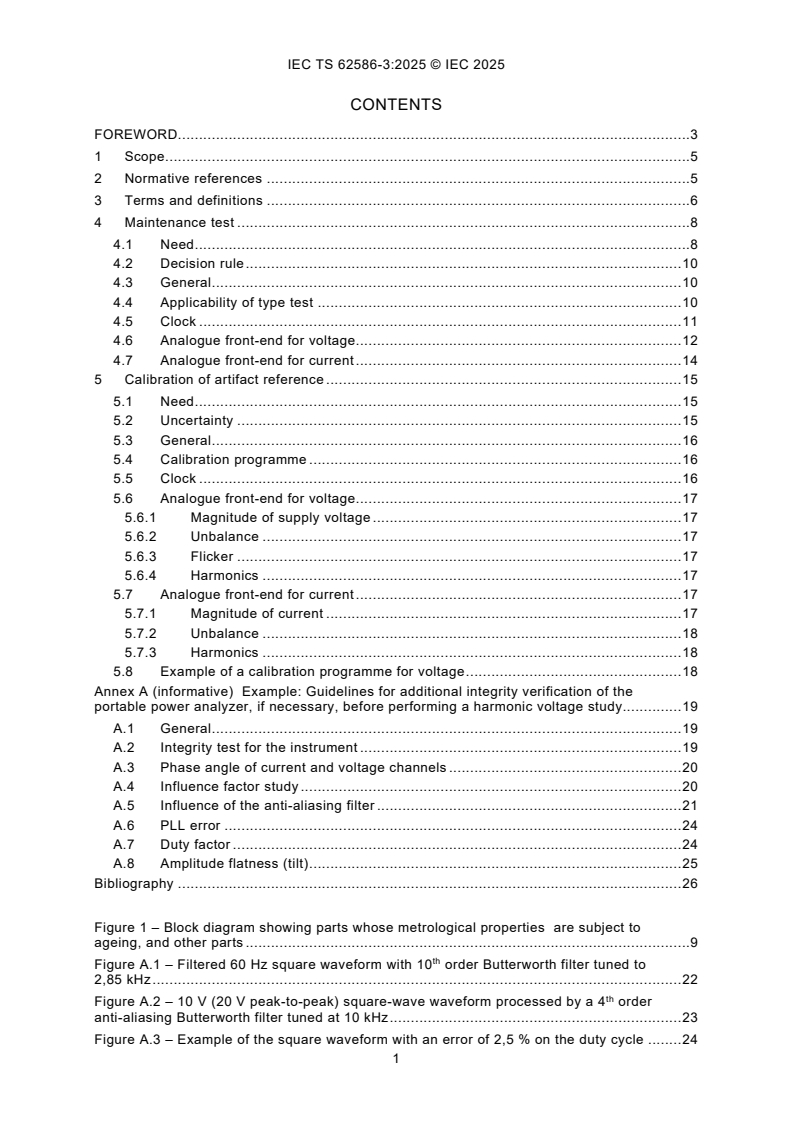
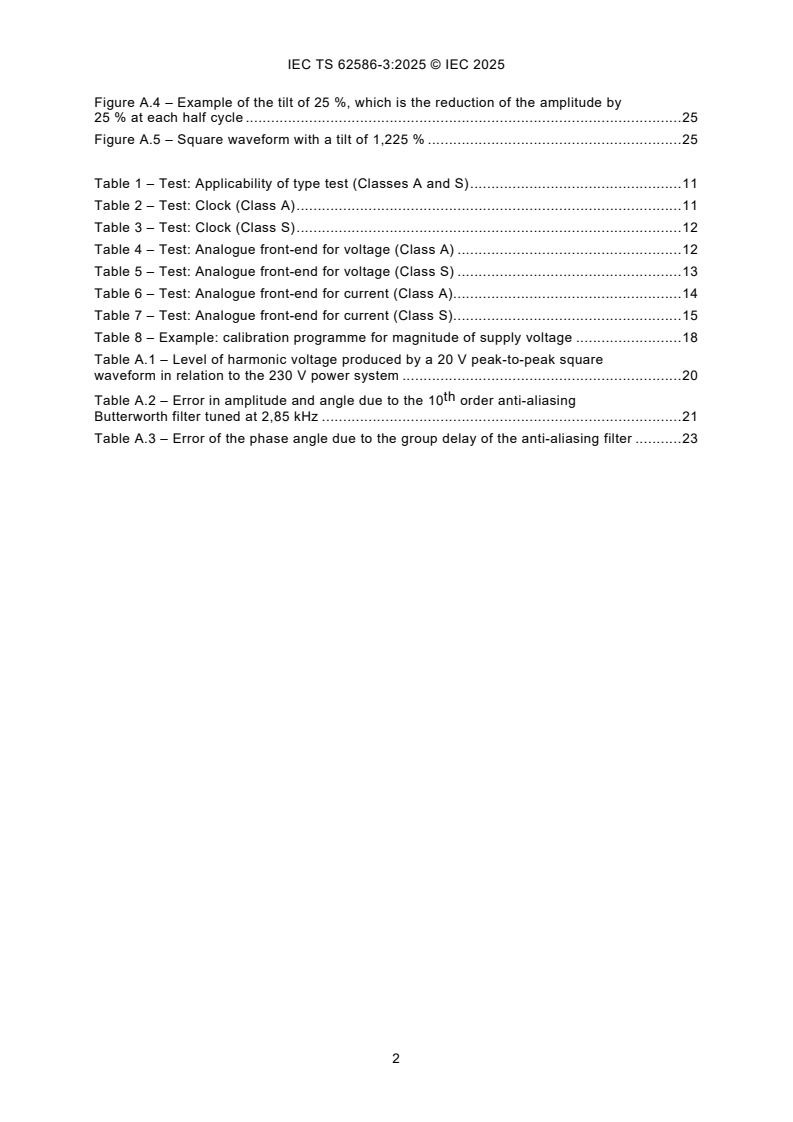
CONTENTS
FOREWORD. 3
1 Scope . 5
2 Normative references . 5
3 Terms and definitions . 6
4 Maintenance test . 8
4.1 Need . 8
4.2 Decision rule . 10
4.3 General . 10
4.4 Applicability of type test . 10
4.5 Clock . 11
4.6 Analogue front-end for voltage . 12
4.7 Analogue front-end for current . 14
5 Calibration of artifact reference . 15
5.1 Need . 15
5.2 Uncertainty . 15
5.3 General . 16
5.4 Calibration programme . 16
5.5 Clock . 16
5.6 Analogue front-end for voltage . 17
5.6.1 Magnitude of supply voltage . 17
5.6.2 Unbalance . 17
5.6.3 Flicker . 17
5.6.4 Harmonics . 17
5.7 Analogue front-end for current . 17
5.7.1 Magnitude of current . 17
5.7.2 Unbalance . 18
5.7.3 Harmonics . 18
5.8 Example of a calibration programme for voltage . 18
Annex A (informative) Example: Guidelines for additional integrity verification of the
portable power analyzer, if necessary, before performing a harmonic voltage study . 19
A.1 General . 19
A.2 Integrity test for the instrument . 19
A.3 Phase angle of current and voltage channels . 20
A.4 Influence factor study . 20
A.5 Influence of the anti-aliasing filter . 21
A.6 PLL error . 24
A.7 Duty factor . 24
A.8 Amplitude flatness (tilt) . 25
Bibliography . 26
Figure 1 – Block diagram showing parts whose metrological properties are subject to
ageing, and other parts . 9
th
Figure A.1 – Filtered 60 Hz square waveform with 10 order Butterworth filter tuned to
2,85 kHz . 22
th
Figure A.2 – 10 V (20 V peak-to-peak) square-wave waveform processed by a 4 order
anti-aliasing Butterworth filter tuned at 10 kHz . 23
Figure A.3 – Example of the square waveform with an error of 2,5 % on the duty cycle . 24
Figure A.4 – Example of the tilt of 25 %, which is the reduction of the amplitude by
25 % at each half cycle . 25
Figure A.5 – Square waveform with a tilt of 1,225 % . 25
Table 1 – Test: Applicability of type test (Classes A and S) . 11
Table 2 – Test: Clock (Class A) . 11
Table 3 – Test: Clock (Class S) . 12
Table 4 – Test: Analogue front-end for voltage (Class A) . 12
Table 5 – Test: Analogue front-end for voltage (Class S) . 13
Table 6 – Test: Analogue front-end for current (Class A) . 14
Table 7 – Test: Analogue front-end for current (Class S) . 15
Table 8 – Example: calibration programme for magnitude of supply voltage . 18
Table A.1 – Level of harmonic voltage produced by a 20 V peak-to-peak square
waveform in relation to the 230 V power system . 20
th
Table A.2 – Error in amplitude and angle due to the 10 order anti-aliasing
Butterworth filter tuned at 2,85 kHz . 21
Table A.3 – Error of the phase angle due to the group delay of the anti-aliasing filter . 23
INTERNATIONAL ELECTROTECHNICAL COMMISSION
____________
Power quality measurement in power supply systems -
Part 3: Maintenance tests, calibration
FOREWORD
1) The International Electrotechnical Commission (IEC) is a worldwide organization for standardization comprising
all national electrotechnical committees (IEC National Committees). The object of IEC is to promote international
co-operation on all questions concerning standardization in the electrical and electronic fields. To this end and
in addition to other activities, IEC publishes International Standards, Technical Specifications, Technical Reports,
Publicly Available Specifications (PAS) and Guides (hereafter referred to as “IEC Publication(s)”). Their
preparation is entrusted to technical committees; any IEC National Committee interested in the subject dealt with
may participate in this preparatory work. International, governmental and non-governmental organizations liaising
with the IEC also participate in this preparation. IEC collaborates closely with the International Organization for
Standardization (ISO) in accordance with conditions determined by agreement between the two organizations.
2) The formal decisions or agreements of IEC on technical matters express, as nearly as possible, an international
consensus of opinion on the relevant subjects since each technical committee has representation from all
interested IEC National Committees.
3) IEC Publications have the form of recommendations for international use and are accepted by IEC National
Committees in that sense. While all reasonable efforts are made to ensure that the technical content of IEC
Publications is accurate, IEC cannot be held responsible for the way in which they are used or for any
misinterpretation by any end user.
4) In order to promote international uniformity, IEC National Committees undertake to apply IEC Publications
transparently to the maximum extent possible in their national and regional publications. Any divergence between
any IEC Publication and the corresponding national or regional publication shall be clearly indicated in the latter.
5) IEC itself does not provide any attestation of conformity. Independent certification bodies provide conformity
assessment services and, in some areas, access to IEC marks of conformity. IEC is not responsible for any
services carried out by independent certification bodies.
6) All users should ensure that they have the latest edition of this publication.
7) No liability shall attach to IEC or its directors, employees, servants or agents including individual experts and
members of its technical committees and IEC National Committees for any personal injury, property damage or
other damage of any nature whatsoever, whether direct or indirect, or for costs (including legal fees) and
expenses arising out of the publication, use of, or reliance upon, this IEC Publication or any other IEC
Publications.
8) Attention is drawn to the Normative references cited in this publication. Use of the referenced publications is
indispensable for the correct application of this publication.
9) IEC draws attention to the possibility that the implementation of this document may involve the use of (a)
patent(s). IEC takes no position concerning the evidence, validity or applicability of any claimed patent rights in
respect thereof. As of the date of publication of this document, IEC had not received notice of (a) patent(s), which
may be required to implement this document. However, implementers are cautioned that this may not represent
the latest information, which may be obtained from the patent database available at https://patents.iec.ch. IEC
shall not be held responsible for identifying any or all such patent rights.
IEC TS 62586-3 has been prepared by IEC technical committee 85: Measuring equipment for
electrical and electromagnetic quantities. It is a Technical Specification.
The text of this Technical Specification is based on the following documents:
Draft Report on voting
85/948/DTS 85/962/RVDTS
Full information on the voting for its approval can be found in the report on voting indicated in
the above table.
The language used for the development of this Technical Specification is English.
This document was drafted in accordance with ISO/IEC Directives, Part 2, and developed in
accordance with ISO/IEC Directives, Part 1 and ISO/IEC Directives, IEC Supplement, available
at www.iec.ch/members_experts/refdocs. The main document types developed by IEC are
described in greater detail at www.iec.ch/publications.
A list of all parts in the IEC 62586 series, published under the general title Power quality
measurement in power supply systems, can be found on the IEC website.
The committee has decided that the contents of this document will remain unchanged until the
stability date indicated on the IEC website under webstore.iec.ch in the data related to the
specific document. At this date, the document will be
• reconfirmed,
• withdrawn, or
• revised.
1 Scope
This part of IEC 62586, which is a Technical Specification, describes a procedure used for
maintenance tests of individual power quality instruments. Users of these instruments need to
ensure the conformity of the individual power quality instrument for stationary use with the
requirements of IEC 62586-1. This is achieved by periodic maintenance tests as defined in this
document.
Reference instruments used for these tests need to be calibrated periodically to maintain
traceability as required by ISO/IEC 17025. This document describes a calibration programme
matching the needs of users carrying out maintenance tests.
The procedure for maintenance tests described here is a suggestion intended to be sufficient
in most practical cases for the common principles of implementation of power quality
instruments. This document is informative and does not limit the freedom of users with
advanced knowledge of their instruments or with special needs to implement specific
programmes in any way.
This document is applicable to power quality instruments complying with IEC 62586-1 and
whose compliance with IEC 61000-4-30 has been certified based on a type test according to
IEC 62586-2.
Adjustment, type test, routine test and field test are out of scope of this document.
2 Normative references
The following documents are referred to in the text in such a way that some or all of their content
constitutes requirements of this document. For dated references, only the edition cited applies.
For undated references, the latest edition of the referenced document (including any
amendments) applies.
IEC 61000-4-7:2002, Electromagnetic compatibility (EMC) - Part 4-7: Testing and measurement
techniques - General guide on harmonics and telharmonic measurements and instrumentation,
for power supply systems and equipment connected thereto
IEC 61000-4-30, Electromagnetic compatibility (EMC) - Part 4-30: Testing and measurement
techniques - Power quality measurement methods
IEC 62586-2, Power quality measurement in power supply systems - Part 2: Functional tests
and uncertainty requirements
ISO/IEC 17025:2017, General requirements for the competence of testing and calibration
laboratories
ISO/IEC Guide 98-3, Uncertainty of measurement - Part 3: Guide to the expression of
uncertainty in measurement (GUM:1995)
ISO/IEC Guide 98-4, Uncertainty of measurement - Part 4: Role of measurement uncertainty in
conformity assessment
3 Terms and definitions
For the purposes of this document, the terms and definitions given in IEC 61000-4-30,
IEC 62586-2 and the following apply.
ISO and IEC maintain terminology databases for use in standardization at the following
addresses:
• IEC Electropedia: available at https://www.electropedia.org/
• ISO Online browsing platform: available at https://www.iso.org/obp
3.1
test
technical operation that consists of the determination of one or more characteristics of a given
product, process or service according to a specified procedure
Note 1 to entry: A test is carried out to measure or classify a characteristic or a property of an item by applying to
the item a set of environmental and operating conditions and/or requirements.
[SOURCE: IEC 60050-151:2001, 151-16-13]
3.2
type test
conformity test made on one or more items representative of the production
[SOURCE: IEC 60050-151:2001, 151-16-16]
3.3
routine test
conformity test made on each individual item during or after manufacture
Note 1 to entry: The routine test demonstrates whether the instrument complies with the requirements and can be
used until the first maintenance test.
Note 2 to entry: Often, routine tests are recommended or required for other properties of the instruments, e.g.
related to safety. This document deals only with the metrological properties of the power quality instruments. It does
not make any statement about other properties.
[SOURCE: IEC 60050-151:2011, 151-16-17, modified – Notes to entry added]
3.4
maintenance test
test carried out periodically on an item to verify that its performance remains within specified
limits
Note 1 to entry: The maintenance test demonstrates whether the instrument complies with the requirements and
can be used without adjustments until the next maintenance test.
[SOURCE: IEC 60050-151:2001, 151-16-25, modified – definition shortened, Note 1 to entry
added]
3.5
calibration
operation that, under specified conditions, in a first step, establishes a relation between the
quantity values with measurement uncertainties provided by measurement standards and
corresponding indications with associated measurement uncertainties and, in a second step,
uses this information to establish a relation for obtaining a measurement result from an
indication
Note 1 to entry: A calibration may be expressed by a statement, calibration function, calibration diagram, calibration
curve, or calibration table. In some cases, it may consist of an additive or multiplicative correction of the indication
with associated measurement uncertainty.
Note 2 to entry: Calibration should not be confused with adjustment of a measuring system, often mistakenly called
“self-calibration”, nor with verification of calibration.
Note 3 to entry: Often, the first step alone in the above definition is perceived as being calibration.
[SOURCE: ISO/IEC Guide 99:2007 [1], 2.39]
3.6
adjustment
adjustment of a measuring system
set of operations carried out on a measuring system so that it provides prescribed indications
corresponding to given values of a quantity to be measured
Note 1 to entry: Types of adjustment of a measuring system include zero adjustment of a measuring system, offset
adjustment, and span adjustment (sometimes called gain adjustment).
Note 2 to entry: Adjustment of a measuring system should not be confused with calibration, which is a prerequisite
for adjustment.
Note 3 to entry: After an adjustment of a measuring system, the measuring system must usually be recalibrated.
[SOURCE: ISO/IEC Guide 99:2007, 3.11]
3.7
measurement uncertainty
uncertainty of measurement
uncertainty
non-negative parameter characterizing the dispersion of the quantity values being attributed to
a measurand, based on the information used
Note 1 to entry: Measurement uncertainty includes components arising from systematic effects, such as
components associated with corrections and the assigned quantity values of measurement standards, as well as the
definitional uncertainty. Sometimes estimated systematic effects are not corrected for but, instead, associated
measurement uncertainty components are incorporated.
Note 2 to entry: The parameter may be, for example, a standard deviation called standard measurement uncertainty
(or a specified multiple of it), or the half-width of an interval, having a stated coverage probability.
Note 3 to entry: Measurement uncertainty comprises, in general, many components. Some of these may be
evaluated by Type A evaluation of measurement uncertainty from the statistical distribution of the quantity values
from series of measurements and can be characterized by standard deviations. The other components, which may
be evaluated by Type B evaluation of measurement uncertainty, can also be characterized by standard deviations,
evaluated from probability density functions based on experience or other information.
Note 4 to entry: In general, for a given set of information, it is understood that the measurement uncertainty is
associated with a stated quantity value attributed to the measurand. A modification of this value results in a
modification of the associated uncertainty.
[SOURCE: ISO/IEC Guide 99:2007, 2.26]
3.8
maximum permissible measurement error
maximum permissible error
limit of error
MPE
extreme value of measurement error, with respect to a known reference quantity value,
permitted by specifications or regulations for a given measurement, measuring instrument, or
measuring system
Note 1 to entry: Usually, the term “maximum permissible errors” or “limits of error” is used where there are two
extreme values.
Note 2 to entry: The term “tolerance” should not be used to designate “maximum permissible error”.
[SOURCE: ISO/IEC Guide 99:2007, 4.26,– modified – abbreviation "MPE" added]
3.9
decision rule
rule that describes how measurement uncertainty is accounted for when stating conformity with
a specified requirement
[SOURCE: ISO/IEC 17025:2017, 3.7]
4 Maintenance test
4.1 Need
A type test as defined in IEC 62586-2 shows compliance with the requirements of
IEC 61000-4-30 based on a small sample of instruments that are deemed representative of the
type. Such a type test demonstrates that a manufacturer can build instruments that comply with
the requirements.
Maintenance tests are required periodically to verify that an instrument has complied with the
requirements since the previous maintenance test and that it is likely to comply with the
requirements until the next maintenance test.
The programme for maintenance tests can be significantly reduced with respect to the
programme for the type test since prior knowledge about the individual instrument is available
(Figure 1).
Figure 1 – Block diagram showing parts whose metrological properties
are subject to ageing, and other parts
The effects of influence quantities, such as ambient temperature, are second order effects. The
impact on the metrological characteristics of the instrument due to ageing of this second order
effect usually does not justify the extensive characterization of these effects during the
maintenance tests.
The effect of ageing on the ADCs and the digital circuitry is usually negligible.
The test report shall state the environment conditions during the test, namely the ambient
temperature and/or the temperature within the DUT’s housing.
If the test is carried out in a temperature-controlled environment where the temperature is
shown not to deviate from the setpoint by more than 2 K, the test report shall state either the
setpoint and the tolerance or the measured temperature.
If the test is carried out outside such a temperature-controlled environment, then the
temperature shall be measured every 30 s or more frequently. The average temperature over
the duration of the tests of 4.5 to 4.7 and its uncertainty shall be stated in the test report.
NOTE The user is responsible to define the maintenance test interval. The definition is a trade-off between the risk
of an instrument failing to meet the requirements, the cost of the necessary correction measures once this failure is
detected and the cost of the maintenance test itself. For guidance on calibration intervals and, by extension, test
intervals, see ILAC G24 and OIML D 10 [2] .
___________
Numbers in square brackets refer to the bibliography.
4.2 Decision rule
The result of a test is a binary decision – compliant or non-compliant – based on measurements,
which are subject to measurement uncertainty. Therefore, the probability of false decisions is
non-zero by principle. To avoid litigation, the decision rule shall be clearly defined and agreed
between the test laboratory and the customer, e.g. by reference to this document
(ISO/IEC 17025:2017, 7.1.3).
The measurement uncertainty shall be evaluated (ISO/IEC 17025:2017, 7.6). The expanded
uncertainty shall be estimated according to ISO/IEC Guide 98-3 (GUM, JCGM 100) with a level
of confidence of approximately 95 %. If this expanded uncertainty is at most one-fifth of the
MPE, the decision shall be taken comparing the measured value with the MPE. This decision
rule is known as simple acceptance or shared risk (ISO/IEC Guide 98-4).
NOTE The probability of a false acceptance or false rejection can reach a maximum of approximately 50 %.
However, the probability of false acceptance of an instrument exceeding the MPE by one-fifth is smaller than 2,5 %.
Equally, the probability of false rejection of an instrument complying the MPE reduced by one-fifth is smaller than
2,5 %.
If the expanded uncertainty is larger than one-fifth of the MPE, a guard band shall be used. In
this case, the MPE used shall be
|ε | = 1,2 |ε | – U
GA SR 95 %
where
ε is the MPE for guarded acceptance;
GA
ε is the MPE for shared risk as shown in Table 2, Table 3, Table 4, Table 5, Table 6 and
SR
Table 7;
U is the expanded uncertainty.
95 %
4.3 General
If testing is requested for instruments used at both 50 Hz and 60 Hz, the tests shall be carried
out at 50 Hz or 60 Hz unless stated otherwise in this clause. If the user specifies either 50 Hz
or 60 Hz as the preferred value, the tests shall be carried out at this value unless stated
otherwise in this clause.
If testing is requested for instruments used with multiple values of U , the tests shall be carried
din
out for one value of U unless stated otherwise in this clause. If the user specifies one value
din
U as the preferred value, the tests shall be carried out at this value unless stated otherwise
din
in this clause. If the user does not specify a preferred value, the test laboratory shall choose a
commonly used value.
If testing is requested for instruments used with multiple values of I , the tests shall be carried
n
out for one value of I unless stated otherwise in this document. If the user specifies one value
n
I as the preferred value, the tests shall be carried out at this value unless stated otherwise in
n
this clause. If the user does not specify a preferred value, the test laboratory shall choose a
commonly used value.
4.4 Applicability of type test
The test programme for maintenance tests is drastically reduced with respect to the test
programme for type tests. This is only valid if the type of the DUT has been type tested. See
Table 1.
Namely, the aggregation is defined by the firmware; the tests defined below are carried out
using the most convenient of the available measurements, e.g. 150/180 cycle measurements
rather than 10 min aggregations.
Table 1 – Test: Applicability of type test (Classes A and S)
Test no. Test procedure Test criterion
4.4.1 Compare hardware version of DUT with hardware version of type test Hardware versions equal
4.4.2 Compare firmware version of DUT with firmware version of type test Firmware versions equal
4.5 Clock
The internal clock is important for time stamping and frequency measurements. This test is
designed to characterise the characteristics of the internal clock source, such as a quartz crystal
oscillator, in the absence of external synchronization.
When an instrument is switched on after having been switched off for some time, it will warm
up. Usually, the most affected part of the circuitry is the clock generation. Therefore, the clock
tests shall only be carried out once the clock frequency is stable. A common duration of the
warm-up time is 2 h, unless specified otherwise by the manufacturer.
NOTE Other tests are usually less sensitive to warm-up and can be carried out during the warm-up time.
Table 2 – Test: Clock (Class A)
Test no. Test procedure MPE
4.5.1 Determine relative error of clock period. ±1/86400
1. Disconnect or disable synchronization and leave disconnected or disabled until end
of test
2. Read time of DUT, e.g. injecting a fixed duration interruption at a known time
3. Wait
4. Read time of DUT, e.g. injecting a fixed duration interruption at a known time
During step 3 of this test, all other tests may be carried out.
EXAMPLE Absolute time uncertainty: 20 ms, required relative uncertainty one-fifth of
MPE (1/432 000), thus minimum duration (step 3): 2,4 h, MPE for absolute duration error:
±0,1 s.
4.5.2 For all tests in 4.6 (analogue front-end for voltage), determine the error of the ±10 mHz
fundamental frequency measurement.
4.5.3 For all tests in 4.7 (analogue front-end for current), determine the error of the ±10 mHz
fundamental frequency measurement.
Table 3 – Test: Clock (Class S)
Test no. Test procedure MPE
4.5.1 Determine relative error of clock period. ±1/17280
1. Disconnect or disable synchronization and leave disconnected or disabled until
end of test
2. Read time of DUT, e.g. injecting a fixed duration interruption at a known time
3. Wait
4. Read time of DUT, e.g. injecting a fixed duration interruption at a known time
During step 3 of this test, all other tests may be carried out.
EXAMPLE Absolute time uncertainty: 20 ms, required relative uncertainty one-
...