


IEC TS 61000-5-10:2017
(Main)Electromagnetic compatibility (EMC) - Part 5-10: Installation and mitigation guidelines - Guidance on the protection of facilities against HEMP and IEMI
Electromagnetic compatibility (EMC) - Part 5-10: Installation and mitigation guidelines - Guidance on the protection of facilities against HEMP and IEMI
IEC TS 61000-5-10:2017(E) provides guidelines to protect commercial facilities from the high-power electromagnetic disturbances of high-altitude electromagnetic pulse (HEMP) and intentional electromagnetic interference (IEMI).
This document is applicable to both existing facilities and new buildings when the customer has decided that protection of critical electronics from HEMP and IEMI is important to the function of the facility.
IEC TS 61000-5-10:2017 has the status of a basic EMC publication in accordance with IEC Guide 107.
General Information
- Status
- Published
- Publication Date
- 17-May-2017
- Technical Committee
- SC 77C - High power transient phenomena
- Drafting Committee
- PT 61000-5-10 - TC 77/SC 77C/PT 61000-5-10
- Current Stage
- PPUB - Publication issued
- Start Date
- 18-May-2017
- Completion Date
- 16-Jun-2017
Overview
IEC TS 61000-5-10:2017 is a key technical specification published by the International Electrotechnical Commission (IEC) addressing electromagnetic compatibility (EMC) with a specific focus on installation and mitigation guidelines. The standard, titled "Electromagnetic compatibility (EMC) – Part 5-10: Installation and mitigation guidelines – Guidance on the protection of facilities against HEMP and IEMI", offers practical guidance for protecting commercial facilities against high-altitude electromagnetic pulse (HEMP) and intentional electromagnetic interference (IEMI).
This document is relevant to both existing facilities and new buildings, enabling organizations to enhance the resilience of their critical electronic systems against disruptive electromagnetic threats. IEC TS 61000-5-10:2017 is recognized as a basic EMC publication in line with IEC Guide 107.
Key Topics
- HEMP and IEMI Threats: Understanding the nature, frequency, and impact of high-altitude electromagnetic pulse (nuclear origin) and intentional electromagnetic interference (malicious origin) on facility electronics.
- Protection Guidelines: Detailed strategies for the protection of facilities, including shielding, filtering, grounding, and the use of surge protective devices.
- Facility Types: Application to both newly designed buildings and upgrades to existing facilities, offering tailored mitigation approaches based on the facility’s operational requirements.
- Testing and Maintenance: Guidance on testing protective measures for effectiveness and ongoing maintenance tasks to ensure continued protection.
- Terminology and Definitions: Comprehensive definitions relating to HEMP, IEMI, shielding effectiveness, conducted and radiated environments, and more, ensuring common understanding.
- Integration with Other Standards: Reference to relevant parts of the IEC 61000 series and other publications that together form a comprehensive EMC protection framework.
Applications
IEC TS 61000-5-10:2017 is widely applicable in sectors where continuity of operations and the protection of sensitive electronic systems are critical. Typical applications include:
- Commercial and Industrial Facilities: Ensuring uninterrupted operation of essential services by defending critical electronics against HEMP and IEMI.
- Data Centers and IT Infrastructure: Preventing catastrophic data loss or hardware damage resulting from electromagnetic disturbances.
- Civil Critical Infrastructure: Protecting public utilities, emergency response centers, and transportation networks from both natural and man-made electromagnetic threats.
- Facility Upgrades: Applying mitigation retrofits and testing protocols to legacy buildings housing important electrical and electronic equipment.
- New Construction Projects: Integrating EMC protection by design, leveraging shielding, proper grounding, and filtered power entry points from the outset.
By implementing the guidelines within IEC TS 61000-5-10:2017, organizations can strengthen operational resilience, safeguard data integrity, and minimize risks from both accidental and deliberate electromagnetic disturbances.
Related Standards
The IEC TS 61000-5-10:2017 forms part of a robust suite of EMC standards. Key related standards include:
- IEC 61000 series (Electromagnetic Compatibility):
- IEC 61000-2-9 and IEC 61000-2-10: Environmental descriptions for HEMP (radiated/conducted)
- IEC 61000-2-13: HPEM environments relevant to IEMI
- IEC 61000-4-23, -4-24, -4-25, -4-36: EMC test and measurement methods for HEMP/IEMI protective devices and immunity assessment
- IEC TR 61000-5-3, -5-6, -5-7, -5-9: Additional installation, mitigation, and assessment guidelines
- IEC 61000-6-6: Generic standard for HEMP immunity of indoor equipment
- IEC Guide 107: Provides guidance on basic EMC publication status and application.
Practical Value
Implementing IEC TS 61000-5-10:2017 helps organizations:
- Identify vulnerabilities to HEMP and IEMI disturbances
- Apply effective installation and retrofitting techniques
- Develop robust EMC maintenance and testing programs
- Align facility design and operation with international EMC best practices
Keywords: IEC TS 61000-5-10:2017, electromagnetic compatibility, HEMP, IEMI, EMC protection, facility shielding, mitigation guidelines, EMC testing, critical infrastructure resilience.
Buy Documents
IEC TS 61000-5-10:2017 - Electromagnetic compatibility (EMC) - Part 5-10: Installation and mitigation guidelines - Guidance on the protection of facilities against HEMP and IEMI Released:5/18/2017
Get Certified
Connect with accredited certification bodies for this standard

ANCE
Mexican certification and testing association.

Intertek Slovenia
Intertek testing, inspection, and certification services in Slovenia.

LNE (Laboratoire National de Métrologie et d'Essais)
French national laboratory for metrology and testing.
Sponsored listings
Frequently Asked Questions
IEC TS 61000-5-10:2017 is a technical specification published by the International Electrotechnical Commission (IEC). Its full title is "Electromagnetic compatibility (EMC) - Part 5-10: Installation and mitigation guidelines - Guidance on the protection of facilities against HEMP and IEMI". This standard covers: IEC TS 61000-5-10:2017(E) provides guidelines to protect commercial facilities from the high-power electromagnetic disturbances of high-altitude electromagnetic pulse (HEMP) and intentional electromagnetic interference (IEMI). This document is applicable to both existing facilities and new buildings when the customer has decided that protection of critical electronics from HEMP and IEMI is important to the function of the facility. IEC TS 61000-5-10:2017 has the status of a basic EMC publication in accordance with IEC Guide 107.
IEC TS 61000-5-10:2017(E) provides guidelines to protect commercial facilities from the high-power electromagnetic disturbances of high-altitude electromagnetic pulse (HEMP) and intentional electromagnetic interference (IEMI). This document is applicable to both existing facilities and new buildings when the customer has decided that protection of critical electronics from HEMP and IEMI is important to the function of the facility. IEC TS 61000-5-10:2017 has the status of a basic EMC publication in accordance with IEC Guide 107.
IEC TS 61000-5-10:2017 is classified under the following ICS (International Classification for Standards) categories: 33.100.20 - Immunity. The ICS classification helps identify the subject area and facilitates finding related standards.
IEC TS 61000-5-10:2017 is available in PDF format for immediate download after purchase. The document can be added to your cart and obtained through the secure checkout process. Digital delivery ensures instant access to the complete standard document.
Standards Content (Sample)
IEC TS 61000-5-10 ®
Edition 1.0 2017-05
TECHNICAL
SPECIFICATION
colour
inside
BASIC EMC PUBLICATION
Electromagnetic compatibility (EMC) –
Part 5-10: Installation and mitigation guidelines – Guidance on the protection of
facilities against HEMP and IEMI
All rights reserved. Unless otherwise specified, no part of this publication may be reproduced or utilized in any form
or by any means, electronic or mechanical, including photocopying and microfilm, without permission in writing from
either IEC or IEC's member National Committee in the country of the requester. If you have any questions about IEC
copyright or have an enquiry about obtaining additional rights to this publication, please contact the address below or
your local IEC member National Committee for further information.
IEC Central Office Tel.: +41 22 919 02 11
3, rue de Varembé Fax: +41 22 919 03 00
CH-1211 Geneva 20 info@iec.ch
Switzerland www.iec.ch
About the IEC
The International Electrotechnical Commission (IEC) is the leading global organization that prepares and publishes
International Standards for all electrical, electronic and related technologies.
About IEC publications
The technical content of IEC publications is kept under constant review by the IEC. Please make sure that you have the
latest edition, a corrigenda or an amendment might have been published.
IEC Catalogue - webstore.iec.ch/catalogue Electropedia - www.electropedia.org
The stand-alone application for consulting the entire The world's leading online dictionary of electronic and
bibliographical information on IEC International Standards, electrical terms containing 20 000 terms and definitions in
Technical Specifications, Technical Reports and other English and French, with equivalent terms in 16 additional
documents. Available for PC, Mac OS, Android Tablets and languages. Also known as the International Electrotechnical
iPad. Vocabulary (IEV) online.
IEC publications search - www.iec.ch/searchpub IEC Glossary - std.iec.ch/glossary
The advanced search enables to find IEC publications by a 65 000 electrotechnical terminology entries in English and
variety of criteria (reference number, text, technical French extracted from the Terms and Definitions clause of
committee,…). It also gives information on projects, replaced IEC publications issued since 2002. Some entries have been
and withdrawn publications. collected from earlier publications of IEC TC 37, 77, 86 and
CISPR.
IEC Just Published - webstore.iec.ch/justpublished
Stay up to date on all new IEC publications. Just Published IEC Customer Service Centre - webstore.iec.ch/csc
details all new publications released. Available online and If you wish to give us your feedback on this publication or
also once a month by email. need further assistance, please contact the Customer Service
Centre: csc@iec.ch.
IEC TS 61000-5-10 ®
Edition 1.0 2017-05
TECHNICAL
SPECIFICATION
colour
inside
BASIC EMC PUBLICATION
Electromagnetic compatibility (EMC) –
Part 5-10: Installation and mitigation guidelines – Guidance on the protection of
facilities against HEMP and IEMI
INTERNATIONAL
ELECTROTECHNICAL
COMMISSION
ICS 33.100.20 ISBN 978-2-8322-4352-7
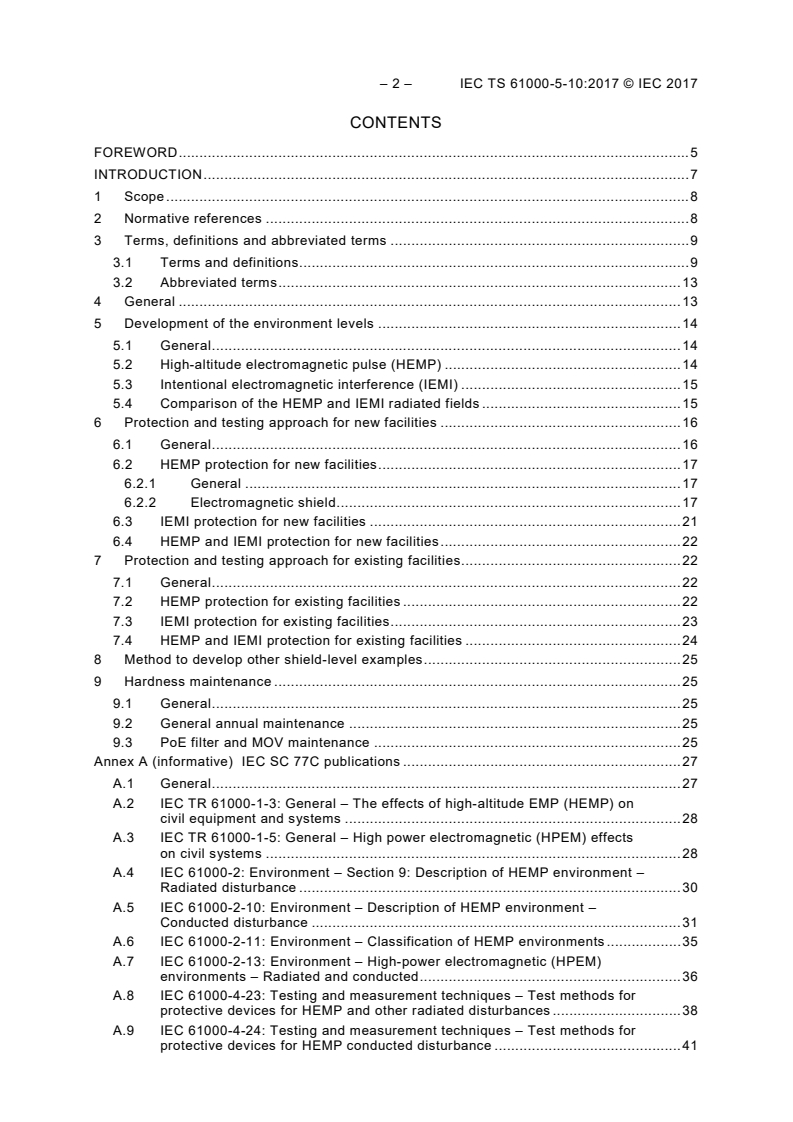
– 2 – IEC TS 61000-5-10:2017 © IEC 2017
CONTENTS
FOREWORD . 5
INTRODUCTION . 7
1 Scope . 8
2 Normative references . 8
3 Terms, definitions and abbreviated terms . 9
3.1 Terms and definitions . 9
3.2 Abbreviated terms . 13
4 General . 13
5 Development of the environment levels . 14
5.1 General . 14
5.2 High-altitude electromagnetic pulse (HEMP) . 14
5.3 Intentional electromagnetic interference (IEMI) . 15
5.4 Comparison of the HEMP and IEMI radiated fields . 15
6 Protection and testing approach for new facilities . 16
6.1 General . 16
6.2 HEMP protection for new facilities . 17
6.2.1 General . 17
6.2.2 Electromagnetic shield . 17
6.3 IEMI protection for new facilities . 21
6.4 HEMP and IEMI protection for new facilities . 22
7 Protection and testing approach for existing facilities . 22
7.1 General . 22
7.2 HEMP protection for existing facilities . 22
7.3 IEMI protection for existing facilities . 23
7.4 HEMP and IEMI protection for existing facilities . 24
8 Method to develop other shield-level examples . 25
9 Hardness maintenance . 25
9.1 General . 25
9.2 General annual maintenance . 25
9.3 PoE filter and MOV maintenance . 25
Annex A (informative) IEC SC 77C publications . 27
A.1 General . 27
A.2 IEC TR 61000-1-3: General – The effects of high-altitude EMP (HEMP) on
civil equipment and systems . 28
A.3 IEC TR 61000-1-5: General – High power electromagnetic (HPEM) effects
on civil systems . 28
A.4 IEC 61000-2: Environment – Section 9: Description of HEMP environment –
Radiated disturbance . 30
A.5 IEC 61000-2-10: Environment – Description of HEMP environment –
Conducted disturbance . 31
A.6 IEC 61000-2-11: Environment – Classification of HEMP environments . 35
A.7 IEC 61000-2-13: Environment – High-power electromagnetic (HPEM)
environments – Radiated and conducted . 36
A.8 IEC 61000-4-23: Testing and measurement techniques – Test methods for
protective devices for HEMP and other radiated disturbances . 38
A.9 IEC 61000-4-24: Testing and measurement techniques – Test methods for
protective devices for HEMP conducted disturbance . 41
A.10 IEC 61000-4-25: Testing and measurement techniques – HEMP immunity
test methods for equipment and systems . 42
A.11 IEC TR 61000-4-32: Testing and measurement techniques – High-altitude
electromagnetic pulse (HEMP) simulator compendium . 43
A.12 IEC 61000-4-33: Testing and measurement techniques – Measurement
methods for high-power transient parameters . 43
A.13 IEC TR 61000-4-35: Testing and measurement techniques – HPEM
simulator compendium . 44
A.14 IEC 61000-4-36: Testing and measurement techniques – IEMI immunity test
methods for equipment and systems . 44
A.15 IEC TR 61000-5-3: Installation and mitigation guidelines – HEMP protection
concepts . 45
A.16 IEC TR 61000-5: Installation and mitigation guidelines – Section 4:
Specifications for protective devices against HEMP radiated disturbance . 46
A.17 IEC 61000-5: Installation and mitigation guidelines – Section 5: Specification
of protective devices for HEMP conducted disturbance . 47
A.18 IEC TR 61000-5-6: Installation and mitigation guidelines – Mitigation of
external EM influences . 47
A.19 IEC 61000-5-7: Installation and mitigation guidelines – Degrees of protection
provided by enclosures against electromagnetic disturbances (EM code) . 49
A.20 IEC TS 61000-5-8: Installation and mitigation guidelines – HEMP protection
methods for the distributed infrastructure . 50
A.21 IEC TS 61000-5-9: Installation and mitigation guidelines – System-level
susceptibility assessments for HEMP and HPEM . 50
A.22 IEC 61000-6-6: Generic standards – HEMP immunity for indoor equipment . 52
Bibliography . 54
Figure 1 – Comparison of IEMI radiated environments with those of E1 HEMP and
lightning . 16
Figure 2 – Basic high frequency shielding approach for a building . 17
Figure A.1 – Organization of the current publications of IEC SC 77C . 27
Figure A.2 – Topological diagram for the simple system. 29
Figure A.3 – Illustration of typical HPEM inadvertent penetration protection methods . 30
Figure A.4 – Complete standard HEMP time waveform with the dashed line indicating
a negative value of the E3 HEMP waveform . 31
Figure A.5 – Amplitude spectrum of each HEMP component . 31
Figure A.6 – Simple equivalent circuit where E is the induced late time HEMP electric
field . 33
Figure A.7 – Several types of HPEM environments compared with the IEC E1 HEMP
waveform . 37
Figure A.8 – Typical configuration of a CW test facility . 39
Figure A.9 – Example scan from 9 kHz to 3 GHz for the ambient electromagnetic field
from communication signals . 39
Figure A.10 – Measurement methods for evaluating shielding effectiveness of high-
level shields . 40
Figure A.11 – Representation of typical IEMI radiation and coupling onto systems . 45
Figure A.12 – Example of penetration from radiated and conducted disturbances
through a two-barrier protection . 46
Figure A.13 – Generalised system topology . 48
Figure A.14 – Assessment methodology flowchart . 51
– 4 – IEC TS 61000-5-10:2017 © IEC 2017
Table 1 – Radiated and conducted environments for early time HEMP and concepts 1
to 6 (IEC 61000-6-6) . 19
Table A.1 – Early time HEMP conducted common-mode short-circuit current including
the time history and peak value I as a function of severity level, length L in m and
pk
ground conductivity in S/m . 32
Table A.2 – Intermediate time HEMP conducted common-mode short-circuit currents
including the time history and peak value I as a function of length L in m and ground
pk
conductivity in S/m . 33
Table A.3 – E1 HEMP response levels for I for the loaded vertical monopole
L
a
antenna (current values are in kA) . 34
Table A.4 – E1 HEMP response levels for I for the loaded horizontal dipole antenna
L
a
(current values are in kA) . 35
Table A.5 – Minimum required attenuation of peak time domain external environments
for the six principal protection concepts for E1 HEMP . 36
Table A.6 – Definitions for IEMI bandwidth classification . 37
Table A.7 – Overview of conducted early time HEMP test requirements defined in
other specifications . 41
Table A.8 – Performance criteria of a filter against early time HEMP at the AC power
port with a nominal load of 2 Ω . 42
Table A.9 – Radiated and conducted environments for early time HEMP and concepts
1 to 6 . 53
INTERNATIONAL ELECTROTECHNICAL COMMISSION
____________
ELECTROMAGNETIC COMPATIBILITY (EMC) –
Part 5-10: Installation and mitigation guidelines –
Guidance on the protection of facilities against HEMP and IEMI
FOREWORD
1) The International Electrotechnical Commission (IEC) is a worldwide organization for standardization comprising
all national electrotechnical committees (IEC National Committees). The object of IEC is to promote
international co-operation on all questions concerning standardization in the electrical and electronic fields. To
this end and in addition to other activities, IEC publishes International Standards, Technical Specifications,
Technical Reports, Publicly Available Specifications (PAS) and Guides (hereafter referred to as “IEC
Publication(s)”). Their preparation is entrusted to technical committees; any IEC National Committee interested
in the subject dealt with may participate in this preparatory work. International, governmental and non-
governmental organizations liaising with the IEC also participate in this preparation. IEC collaborates closely
with the International Organization for Standardization (ISO) in accordance with conditions determined by
agreement between the two organizations.
2) The formal decisions or agreements of IEC on technical matters express, as nearly as possible, an international
consensus of opinion on the relevant subjects since each technical committee has representation from all
interested IEC National Committees.
3) IEC Publications have the form of recommendations for international use and are accepted by IEC National
Committees in that sense. While all reasonable efforts are made to ensure that the technical content of IEC
Publications is accurate, IEC cannot be held responsible for the way in which they are used or for any
misinterpretation by any end user.
4) In order to promote international uniformity, IEC National Committees undertake to apply IEC Publications
transparently to the maximum extent possible in their national and regional publications. Any divergence
between any IEC Publication and the corresponding national or regional publication shall be clearly indicated in
the latter.
5) IEC itself does not provide any attestation of conformity. Independent certification bodies provide conformity
assessment services and, in some areas, access to IEC marks of conformity. IEC is not responsible for any
services carried out by independent certification bodies.
6) All users should ensure that they have the latest edition of this publication.
7) No liability shall attach to IEC or its directors, employees, servants or agents including individual experts and
members of its technical committees and IEC National Committees for any personal injury, property damage or
other damage of any nature whatsoever, whether direct or indirect, or for costs (including legal fees) and
expenses arising out of the publication, use of, or reliance upon, this IEC Publication or any other IEC
Publications.
8) Attention is drawn to the Normative references cited in this publication. Use of the referenced publications is
indispensable for the correct application of this publication.
9) Attention is drawn to the possibility that some of the elements of this IEC Publication may be the subject of
patent rights. IEC shall not be held responsible for identifying any or all such patent rights.
The main task of IEC technical committees is to prepare International Standards. In
exceptional circumstances, a technical committee may propose the publication of a technical
specification when
• the required support cannot be obtained for the publication of an International Standard,
despite repeated efforts, or
• the subject is still under technical development or where, for any other reason, there is the
future but no immediate possibility of an agreement on an International Standard.
Technical Specification IEC 61000-5-10 has been prepared by subcommittee 77C: High-
power transient phenomena, of IEC technical committee 77: Electromagnetic compatibility.
It forms part 5-10 of IEC 61000. It has the status of a basic EMC publication in accordance
with IEC Guide 107.
– 6 – IEC TS 61000-5-10:2017 © IEC 2017
The text of this technical specification is based on the following documents:
Enquiry draft Report on voting
77C/260/DTS 77C/262/RVDTS
Full information on the voting for the approval of this technical specification can be found in
the report on voting indicated in the above table.
This document has been drafted in accordance with the ISO/IEC Directives, Part 2.
A list of all parts in the IEC 61000 series, published under the general title Electromagnetic
compatibility (EMC), can be found on the IEC website.
The committee has decided that the contents of this document will remain unchanged until the
stability date indicated on the IEC website under "http://webstore.iec.ch" in the data related to
the specific document. At this date, the document will be
• reconfirmed,
• withdrawn,
• replaced by a revised edition, or
• amended.
A bilingual version of this publication may be issued at a later date.
IMPORTANT – The 'colour inside' logo on the cover page of this publication indicates
that it contains colours which are considered to be useful for the correct
understanding of its contents. Users should therefore print this document using a
colour printer.
INTRODUCTION
IEC 61000 is published in separate parts according to the following structure:
Part 1: General
General considerations (introduction, fundamental principles)
Definitions, terminology
Part 2: Environment
Description of the environment
Classification of the environment
Compatibility levels
Part 3: Limits
Emission limits
Immunity limits (in so far as they do not fall under the responsibility of the product
committees)
Part 4: Testing and measurement techniques
Measurement techniques
Testing techniques
Part 5: Installation and mitigation guidelines
Installation guidelines
Mitigation methods and devices
Part 6: Generic standards
Part 9: Miscellaneous
Each part is further subdivided into several parts, published either as international standards
or as technical specifications or technical reports, some of which have already been published
as sections. Others will be published with the part number followed by a dash and a second
number identifying the subdivision (example: IEC 61000-6-1).
– 8 – IEC TS 61000-5-10:2017 © IEC 2017
ELECTROMAGNETIC COMPATIBILITY (EMC) –
Part 5-10: Installation and mitigation guidelines –
Guidance on the protection of facilities against HEMP and IEMI
1 Scope
This part of IEC 61000 provides guidelines to protect commercial facilities from the high-
power electromagnetic disturbances of high-altitude electromagnetic pulse (HEMP) and
intentional electromagnetic interference (IEMI). These guidelines are developed from the
entire body of IEC SC 77C publications.
This document is applicable to both existing facilities and new buildings when the customer
has decided that protection of critical electronics from HEMP and IEMI is important to the
function of the facility.
2 Normative references
The following documents are referred to in the text in such a way that some or all of their
content constitutes requirements of this document. For dated references, only the edition
cited applies. For undated references, the latest edition of the referenced document (including
any amendments) applies.
IEC TR 61000-1-3, Electromagnetic compatibility (EMC) – Part 1-3: General – The effects of
high-altitude EMP (HEMP) on civil equipment and systems
IEC TR 61000-1-5, Electromagnetic compatibility (EMC) – Part 1-5: General – High power
electromagnetic (HPEM) effects on civil systems
IEC 61000-2-9, Electromagnetic compatibility (EMC) – Part 2: Environment – Section 9:
Description of HEMP environment – Radiated disturbance
IEC 61000-2-10:1998, Electromagnetic compatibility (EMC) – Part 2-10: Environment –
Description of HEMP environment – Conducted disturbance
IEC 61000-2-11, Electromagnetic compatibility (EMC) – Part 2-11: Environment –
Classification of HEMP environments
IEC 61000-2-13, Electromagnetic compatibility (EMC) – Part 2-13: Environment – High-power
electromagnetic (HPEM) environments – Radiated and conducted
IEC 61000-4-23:2016, Electromagnetic compatibility (EMC) – Part 4-23: Testing and
measurement techniques – Test methods for protective devices for HEMP and other radiated
disturbances
IEC 61000-4-24, Electromagnetic compatibility (EMC) – Part 4-24: Testing and measurement
techniques – Test methods for protective devices for HEMP conducted disturbance
IEC 61000-4-25, Electromagnetic compatibility (EMC) – Part 4-25: Testing and measurement
techniques – HEMP immunity test methods for equipment and systems
IEC TR 61000-4-32, Electromagnetic compatibility (EMC) – Part 4-32: Testing and
measurement techniques – High-altitude electromagnetic pulse (HEMP) simulator
compendium
IEC 61000-4-33, Electromagnetic compatibility (EMC) – Part 4-33: Testing and measurement
techniques – Measurement methods for high-power transient parameters
IEC TR 61000-4-35, Electromagnetic compatibility (EMC) – Part 4-35: Testing and
measurement techniques –HPEM simulator compendium
IEC 61000-4-36:2014, Electromagnetic compatibility (EMC) – Part 4-36: Testing and
measurement techniques – IEMI immunity test methods for equipment and systems
IEC TR 61000-5-3, Electromagnetic compatibility (EMC) – Part 5-3: Installation and mitigation
guidelines – HEMP protection concepts
IEC TR 61000-5-4, Electromagnetic compatibility (EMC) – Part 5: Installation and mitigation
guidelines – Section 4: Immunity to HEMP – Specifications for protective devices against
HEMP radiated disturbance
IEC 61000-5-5:1996, Electromagnetic compatibility (EMC) – Part 5: Installation and mitigation
guidelines – Section 5: Specification of protective devices for HEMP conducted disturbance
IEC TR 61000-5-6, Electromagnetic compatibility (EMC) – Part 5-6: Installation and mitigation
guidelines – Mitigation of external EM influences
IEC 61000-5-7:2001, Electromagnetic compatibility (EMC) – Part 5-7: Installation and
mitigation guidelines – Degrees of protection provided by enclosures against electromagnetic
disturbances (EM code)
IEC TS 61000-5-8, Electromagnetic compatibility (EMC) – Part 5-8: Installation and mitigation
guidelines – HEMP protection methods for the distributed infrastructure
IEC TS 61000-5-9, Electromagnetic compatibility (EMC) – Part 5-9: Installation and mitigation
guidelines – System-level susceptibility assessments for HEMP and HPEM
IEC 61000-6-6, Electromagnetic compatibility (EMC) – Part 6-6: Generic standards – HEMP
immunity for indoor equipment
3 Terms, definitions and abbreviated terms
For the purposes of this document, the following terms, definitions and abbreviated terms
apply.
ISO and IEC maintain terminological databases for use in standardization at the following
addresses:
• IEC Electropedia: available at http://www.electropedia.org/
• ISO Online browsing platform: available at http://www.iso.org/obp
3.1 Terms and definitions
3.1.1
attenuation
reduction in magnitude (e.g., as a result of absorption and/or scattering) of an electric or
magnetic field or a current or voltage
– 10 – IEC TS 61000-5-10:2017 © IEC 2017
Note 1 to entry: It is usually expressed in dB.
3.1.2
bandratio
br
ratio of the high and low frequencies between which there is 90 % of the energy
Note 1 to entry: If the spectrum has a large DC content, the lower limit is nominally defined as 1 Hz.
3.1.3
conducted HPEM environment
totality of high-power electromagnetic currents and voltages that are either coupled to or
directly injected into cables and wires with voltage levels that typically exceed 1 kV
3.1.4
continuous wave
CW
time waveform that has a fixed frequency and is continuous
3.1.5
coupling
interaction of HEMP/IEMI fields with a system or equipment to produce currents and voltages
on system surfaces, cables and wires
3.1.6
E1, E2, E3
terminology for the HEMP electric fields
Note 1 to entry: E1 is early time HEMP electric field, for times less than 1 µs, E2 is intermediate time HEMP
electric field, for times between 1 µs and 1 s, and E3 is late time HEMP electric field, for times greater than 1 s.
3.1.7
electromagnetic compatibility
EMC
ability of an equipment or system to function satisfactorily in its electromagnetic environment
without introducing intolerable electromagnetic disturbances to anything in that environment
[SOURCE: IEC 60050-161:1990, 161-01-07]
3.1.8
electromagnetic disturbance
any electromagnetic phenomenon which may degrade the performance of a device,
equipment or system
[SOURCE: IEC 60050-161:1990, 161-01-05, modified – the last part of the definition has been
deleted.]
3.1.9
electromagnetic interference
EMI
degradation of the performance of a device, transmission channel or system caused by an
electromagnetic disturbance
Note 1 to entry: Disturbance and interference are respectively cause and effect.
[SOURCE: IEC 60050-161:1990, 161-01-06, modified – in the definition "equipment" has been
replaced by "device" and a new note has been added.]
3.1.10
shield
electromagnetic shield
electrically continuous housing for a facility, area, or component used to attenuate incident
electric and magnetic fields by both absorption and reflection
3.1.11
(electromagnetic) susceptibility
inability of a device, equipment or system to perform without degradation in the presence of
an electromagnetic disturbance
Note 1 to entry: Susceptibility is a lack of immunity.
[SOURCE: IEC 60050-161:1990, 161-01-21]
3.1.12
equipment
modules, devices, apparatuses, subsystems, complete systems and installations
3.1.13
equipment under test
EUT
particular equipment being subjected to the test
3.1.14
high-altitude electromagnetic pulse
HEMP
electromagnetic pulse produced by a nuclear explosion outside the earth’s atmosphere
Note 1 to entry: This typically occurs above an altitude of 30 km.
3.1.15
high-power microwaves
HPM
narrowband signals, nominally with peak power in a pulse, in excess of 100 MW at the source
Note 1 to entry: This is a historical definition that depended on the strength of the source. The interest in this
document is mainly on the EM field incident on an electronic system.
3.1.16
hyperband signal
signal or waveform with a pbw (see 3.1.21) value between 163,4 % and 200 % or a
bandratio > 10
3.1.17
hypoband signal
narrowband signal or waveform with a pbw of < 1 % or a bandratio < 1,01
3.1.18
installation
combination of apparatuses, components and systems assembled and/or erected
(individually) in a given area
Note 1 à l'article: For physical reasons (e.g. long distances between individual items) it is in many cases not
possible to test an installation as a unit.
– 12 – IEC TS 61000-5-10:2017 © IEC 2017
3.1.19
intentional electromagnetic interference
IEMI
intentional malicious generation of electromagnetic energy introducing noise or signals into
electric and electronic systems, thus disrupting, confusing or damaging these systems for
terrorist or criminal purposes
3.1.20
mesoband signal
signal or waveform with a pbw value between 1 % and 100 % or a bandratio between 1,01
and 3
3.1.21
percentage bandwidth
pbw
bandwidth of a waveform expressed as a percentage of the centre frequency of that waveform
Note 1 to entry: The pbw has a maximum value of 200 % when the centre frequency is the mean of the high and
low frequencies. The pbw does not apply to signals with a large DC content (e.g., E1 HEMP) for which the
bandratio decades term is used.
3.1.22
port of entry
PoE
physical location (point) on an electromagnetic barrier, where EM energy may enter or exit a
topological volume, unless an adequate PoE protective device is provided
Note 1 to entry: A PoE is not limited to a geometrical point.
Note 2 to entry: PoEs are classified as aperture PoEs or conductive PoEs according to the type of penetration.
They are also classified as architectural, mechanical, structural or electrical PoEs according to the functions they
serve.
3.1.23
pulse
transient waveform that usually rises to a peak value and then decays, or a similar waveform
that is an envelope of an oscillating waveform
3.1.24
pulse width
time interval between the points on the leading and trailing edges of a pulse at which the
instantaneous value is 50 % of the peak pulse amplitude, unless otherwise stated
3.1.25
radiated HPEM environment
totality of high-power electromagnetic fields with peak electric field levels that typically exceed
100 V/m
3.1.26
rise time (of a pulse)
time interval between the instants in which the instantaneous amplitude of a pulse first
reaches specified lower and upper limits, namely 10 % and 90 % of the peak pulse amplitude,
unless otherwise stated
[SOURCE: IEC 60050-161:1990, 161-02-05, modified – the note has been incorporated into
the definition
3.1.27
source impedance
impedance presented by a source of energy to the input terminals of a device or network
3.1.28
sub-hyperband signal
signal or waveform with a pbw value between 100 % and 163,4 % or a bandratio between 3
and 10
3.1.28
system
combination of apparatuses and/or active components constituting a single functional unit and
intended to be installed and operated to perform (a) specific task(s)
3.1.29
transient, adj. and noun
pertaining to or designating a phenomenon or a quantity which varies between two
consecutive steady states during a time interval which is short compared with the time-scale
of interest
Note 1 to entry: A transient can be a unidirectional impulse of either polarity or a damped oscillatory wave with
the first peak occurring in either polarity.
[SOURCE: IEC 60050-161:1990, 161-02-01, modified – a note has been added.]
3.1.30
waveguide below cutoff
WBC
a waveguide which severely attenuates the electromagnetic fields at frequencies below the
cutoff frequency
3.2 Abbreviated terms
CW Continuous wave
DS Damped sinusoid
EMI Electromagnetic interference
ESD Electrostatic discharge
EUT Equipment under test
HEMP High-altitude electromagnetic pulse
HIRF High-intensity radiated fields
HPEM High-power electromagnetic
HPM High-power microwave
LV Low voltage
MOV Metal oxide varistor
MV Medium voltage
PoE Port of entry
SE Shielding effectiveness
SPD Surge protective device
VPD Vertically polarized dipole
WBC Waveguide below cutoff
4 General
IEC SC 77C has developed a wide variety of high-altitude electromagnetic pulse (HEMP) and
intentional electromagnetic interference (IEMI) protection reports and standards, and the
growth of these publications has been organic, responding to the needs of industry. In
addition, some of the standards are being revised to be more specific and useful to industry.
IEC SC 77C publications are currently found in many parts of the IEC 61000 series including:
– 14 – IEC TS 61000-5-10:2017 © IEC 2017
IEC 61000-1: General – two publications
IEC 61000-2: Environment – four publications
IEC 61000-4: Testing and measuring techniques – seven publications
IEC 61000-5: Installation and mitigation guidelines – seven publications
IEC 61000-6: Generic standards – one publication
As the aim of the entire work program in IEC SC 77C is to determine the likely disturbance
levels from HEMP and IEMI and to develop protection and test methods to protect electronics
from these disturbances, it is felt that a comprehensive guide to consolidate this work will be
of great help to industry. In addition all of the IEC SC 77C references used in this document
can be considered normative in nature as this document indicates how they are applied.
This document includes several specific examples of how to apply the publications in the IEC
SC 77C series. The sample problems should include:
a) application of a protection and testing scheme for the design of a new facility,
b) application of a protection and testing scheme for an existing facility.
For both applications, protection and testing schemes need to be identified for three cases:
1) a HEMP protection and testing scheme;
2) an IEMI protection and testing scheme; and
3) a HEMP plus IEMI protection and testing scheme.
This means there are six schemes covered in this document.
As the aim of this work is to provide protection information dealing with the entire group of
IEC SC 77C publications, we recommend that this publication be part of the IEC 61000-5-x
series.
Annex A of this publication provides a summary of the scope (Clause 1) of each of the
documents within the entire body of IEC SC 77C publications at the beginning of this project,
followed with additional discussion concerning the applicability of each of the publications to
this document. In most cases the text in the main body will refer to particular standards, and
the reader is encouraged to look at Annex A to obtain more information.
5 Development of the environment levels
5.1 General
In order to describe the electromagnetic environments of HEMP and those that produce IEMI,
one should refer to IEC 61000-2-9 (radiated) and IEC 61000-2-10 (conducted) for the HEMP,
and IEC 61000-2-13 and IEC 61000-4-36 (both cover radiated and conducted environments)
for the HPEM environments producing IEMI. For HEMP the standard waveforms (for E1, E2,
and E3) are to be used to define the hardening and testing approach. For IEMI the situation is
more complex, as there is a wide variety of pulsed waveforms with different parameters that
can be produced (both narrowband and wideband), and the peak levels of fields potentially
exposing electronics depend both on the technology of the IEMI weapon (discussed in
IEC 61000-2-13) and the distance of deployment. In particular it is necessary to be sure to
clearly establish the radiated and conducted environments for both threats.
5.2 High-altitude electromagnetic pulse (HEMP)
The radiated HEMP environment is fully defined in IEC 61000-2-9, and it provides worst-case
time and frequency waveforms that are to be used for protection design. For facilities, which
possess electronics inside building structures, the emphasis on the protection of facilities will
be mainly for the early time E1 HEMP disturbances. As such the E1 HEMP Fourier transform
is a composite of the expected HEMP waveforms for all scenarios, and therefore it is
appropriate for evaluating the shielding effectiveness required to reduce the external E1
HEMP fields to levels such that the electronics inside building structures can survive and
continue to maintain function. The E2 HEMP radiated environment is not a significant concern
for the electronics inside building structures as the level is low, although the conducted E2
HEMP environment could be important to ensure that E1 HEMP filters can survive. It is also
true that the E3 HEMP could create serious stability issues for the operation of the public
utility electrical grid due to harmonics in the power supply (harmonics of 50 Hz or 60 Hz), and
it is likely that some of these harmonics will propagate from the high voltage grid to the low
voltage grid and through the E1 HEMP filters. In general, however, the shielding for radiated
fields is aimed only at reducing the E1 HEMP fields.
For the conducted HEMP environment it is important to recognize that the conducted E1
HEMP fields couple differently to external power and telecommunications cables as a function
of whether they are elevated or buried cables. As indicated in IEC 61000-2-10 the induced E1
HEMP currents on above ground cables can be more than 10 times higher than for a buried
cable. The E2 and E3 coupling is also defined in IEC 61000-2-10, although E3 is relevant for
the power network itself, and the impact on a building operating at low voltage will be the
nd
harmonics generated in the transmission grid (especially the 2 harmonic) that can
propagate to the low voltage system and into a building. Since these harmonics are close to
the fundamental frequency, they cannot be filtered. There is also an important Annex C in
IEC 61000-2-10:1998 that discusses E1 HEMP coupling to simple antennas. Antennas need
to be evaluated both with respect to the E1 HEMP in-band signal that will reach transmitters
and receivers in the building and the common mode currents on the shields of cables leading
to the facility (this requires proper high frequency grounding).
One should also consider the level of protection that may be needed as a function of the
“importance” of the facility. IEC 61000-2-11 considers that some facilities may not require as
high a level of shielding effectiveness due to their ability to respond to temporary outages with
on site personnel or with regard to their mission. Since IEC 61000-2-11 has six levels (and
some sublevels), these are probably too much for this document to consider. This document
proposes that a shielding effectiveness of ~60 dB is practical and useful as a well-shielded
option for new critical national infrastructure buildings. For existing buildings for retrofit
purposes a lower level of shielding effectiveness of ~30 dB is considered practical, largely
due to cost factors. This is discussed further in 6.2.2.
5.3 Intentional electromagnetic interference (IEMI)
The main information in the IEC SC 77C documents comes from IEC 61000-2-13, which
provides the basic radiated and conducted IEMI disturbances for both narrowband and
wideband sources. Although this document properly describes the types of waveforms that
can be created, a newer publication, IEC 61000-4-36, provides a broader range of wideband
and narrowband test waveforms that may be easier to use. It is suggested that one should
select a set of waveforms that describe the range of disturbances that need to be dealt with
from a protection point of view. As an approximation, this document will focus on the peak
field levels of both wideband and narrowband radiated IEMI fields. With the assumption that
the shielding effectiveness can be designed for frequency content between 1 MHz and
10 GHz (due mainly to reflection), then the focus for protection is shifted to computing the
peak radiated fields inside a facility. In addition, it is possible that conducted IEMI
disturbances can be injected into power and communications lines outside a facility and
should also be considered.
5.4 Comparison of the HEMP and IEMI radiated fields
Figure 1 compares the frequency spectra of the E1 HEMP and the narrowband and wideband
IEMI radiated fields. The E1 HEMP electric field has spectral magnitude up to 1 GHz, while
the IEMI radiated environments extend to frequencies of about 10 GHz. While it is possible
that weapons can produce even higher frequency content (above 10 GHz), it is also clear that
as the frequency content becomes higher, the typical susceptibility levels of the electronics
also rise. This is believed to be related to the fact that wiring inside and outside equipment
– 16 – IEC TS 61000-5-10:2017 © IEC 2017
behaves as receiving antennas, and the power levels of coupled signals decrease as th
...
Questions, Comments and Discussion
Ask us and Technical Secretary will try to provide an answer. You can facilitate discussion about the standard in here.
Loading comments...