


IEC TS 61000-5-8:2009
(Main)Electromagnetic compatibility (EMC) - Part 5-8: Installation and mitigation guidelines - HEMP protection methods for the distributed infrastructure
Electromagnetic compatibility (EMC) - Part 5-8: Installation and mitigation guidelines - HEMP protection methods for the distributed infrastructure
IEC/TS 61000-5-8:2009(E) provides guidance on how to protect the distributed infrastructure (power, telecommunications, transportation and pipeline networks, etc.) from the threat of a high altitude electromagnetic pulse (HEMP). In order to accomplish this goal, it is necessary to describe the special aspects of the HEMP threat to electrical/electronic systems that are connected and distributed in nature. In particular a nuclear burst at a typical altitude of 100 km will illuminate the Earth to a ground radius from the point directly under the burst to a range of 1 100 km. This means that any distributed and connected infrastructure such as power or telecommunications will observe disturbances simultaneously over a wide area. This type of situation is not normally considered in the EMC or HEMP protection of facilities that are part of a distributed network as the impact of a local disturbance is usually evaluated only locally. IEC/TS 61000-5-8:2009 provides general information concerning the disturbance levels and protection methods for all types of distributed infrastructures. Due to its importance to all other parts of the infrastructure, the distributed electric power system (power substations, generation plants and control centres) and its protection are described in more detail. While the telecommunication system is also critical to most of the other distributed infrastructures, the protection of the telecommunication network from HEMP and other electromagnetic threats is covered by the work done by ITU-T. This technical specification forms Part 5-8 of IEC 61000. It has the status of a basic EMC publication in accordance with IEC Guide 107.
General Information
- Status
- Published
- Publication Date
- 30-Aug-2009
- Technical Committee
- SC 77C - High power transient phenomena
- Current Stage
- PPUB - Publication issued
- Start Date
- 31-Aug-2009
- Completion Date
- 15-Dec-2009
Overview
IEC TS 61000-5-8:2009 - Electromagnetic compatibility (EMC) Part 5-8 - gives installation and mitigation guidance for protecting distributed infrastructure (power, telecommunications, transportation, pipelines, etc.) from a high altitude electromagnetic pulse (HEMP). The technical specification explains the special aspects of a HEMP threat for systems that are connected over wide areas (a typical nuclear burst at ~100 km altitude can illuminate Earth out to ~1 100 km). It is a basic EMC publication that complements environment and test documents in the IEC 61000 series.
Key topics
- HEMP environment characterization
- Early-time (E1), intermediate-time (E2) and late-time (E3) HEMP waveforms and their spatial variation across distributed networks.
- Coupling to extended conductors
- How long, connected conductors (overhead lines, buried cables, pipelines) pick up transient currents and voltages from HEMP and the implications for equipment and systems.
- Disturbance levels and vulnerability
- General information on expected disturbance magnitudes and how they differ from other natural EM phenomena (e.g., lightning, geomagnetic storms).
- Protection strategy and mitigation methods
- Planning, immunity requirements for new equipment, retrofit protection measures, grounding and cable routing, and specific considerations for high-voltage power substations, generation plants and control centres.
- Operational resilience
- Emergency planning, operating procedures and restoration strategies for distributed power systems.
- Interface with telecommunications work
- Telecommunication network protection is acknowledged as critical; related work by ITU‑T is referenced.
Practical applications
Who uses this standard and why:
- Power utilities and grid engineers - design and retrofit substations, transmission and control systems to reduce HEMP risk.
- Telecommunications operators and network planners - coordinate mitigation across widely distributed networks (note: detailed telecom methods are covered by ITU‑T).
- Transport, pipeline and critical infrastructure managers - assess cross‑infrastructure dependencies and implement protective measures for SCADA and control links.
- EMC consultants and system integrators - develop protection concepts, specify testing and protective devices, and align installations with IEC 61000 family standards.
- Policy makers and regulators - establish resilience requirements and emergency planning guidance for national infrastructures.
Related standards
Key IEC references related to IEC TS 61000-5-8:
- IEC 61000-2-9, 2-10, 2-11 (HEMP environment and classification)
- IEC 61000-4-4, 4-5 (EFT and surge test methods)
- IEC 61000-4-23, 4-24, 4-25 (HEMP protective device tests and immunity)
- ITU‑T recommendations (telecommunications HEMP protection)
IEC TS 61000-5-8 is practical guidance for resilience against HEMP, forming part of a broader EMC strategy for distributed critical infrastructure.
Get Certified
Connect with accredited certification bodies for this standard

TL 9000 QuEST Forum
Telecommunications quality management system.

ANCE
Mexican certification and testing association.

Intertek Slovenia
Intertek testing, inspection, and certification services in Slovenia.
Sponsored listings
Frequently Asked Questions
IEC TS 61000-5-8:2009 is a technical specification published by the International Electrotechnical Commission (IEC). Its full title is "Electromagnetic compatibility (EMC) - Part 5-8: Installation and mitigation guidelines - HEMP protection methods for the distributed infrastructure". This standard covers: IEC/TS 61000-5-8:2009(E) provides guidance on how to protect the distributed infrastructure (power, telecommunications, transportation and pipeline networks, etc.) from the threat of a high altitude electromagnetic pulse (HEMP). In order to accomplish this goal, it is necessary to describe the special aspects of the HEMP threat to electrical/electronic systems that are connected and distributed in nature. In particular a nuclear burst at a typical altitude of 100 km will illuminate the Earth to a ground radius from the point directly under the burst to a range of 1 100 km. This means that any distributed and connected infrastructure such as power or telecommunications will observe disturbances simultaneously over a wide area. This type of situation is not normally considered in the EMC or HEMP protection of facilities that are part of a distributed network as the impact of a local disturbance is usually evaluated only locally. IEC/TS 61000-5-8:2009 provides general information concerning the disturbance levels and protection methods for all types of distributed infrastructures. Due to its importance to all other parts of the infrastructure, the distributed electric power system (power substations, generation plants and control centres) and its protection are described in more detail. While the telecommunication system is also critical to most of the other distributed infrastructures, the protection of the telecommunication network from HEMP and other electromagnetic threats is covered by the work done by ITU-T. This technical specification forms Part 5-8 of IEC 61000. It has the status of a basic EMC publication in accordance with IEC Guide 107.
IEC/TS 61000-5-8:2009(E) provides guidance on how to protect the distributed infrastructure (power, telecommunications, transportation and pipeline networks, etc.) from the threat of a high altitude electromagnetic pulse (HEMP). In order to accomplish this goal, it is necessary to describe the special aspects of the HEMP threat to electrical/electronic systems that are connected and distributed in nature. In particular a nuclear burst at a typical altitude of 100 km will illuminate the Earth to a ground radius from the point directly under the burst to a range of 1 100 km. This means that any distributed and connected infrastructure such as power or telecommunications will observe disturbances simultaneously over a wide area. This type of situation is not normally considered in the EMC or HEMP protection of facilities that are part of a distributed network as the impact of a local disturbance is usually evaluated only locally. IEC/TS 61000-5-8:2009 provides general information concerning the disturbance levels and protection methods for all types of distributed infrastructures. Due to its importance to all other parts of the infrastructure, the distributed electric power system (power substations, generation plants and control centres) and its protection are described in more detail. While the telecommunication system is also critical to most of the other distributed infrastructures, the protection of the telecommunication network from HEMP and other electromagnetic threats is covered by the work done by ITU-T. This technical specification forms Part 5-8 of IEC 61000. It has the status of a basic EMC publication in accordance with IEC Guide 107.
IEC TS 61000-5-8:2009 is classified under the following ICS (International Classification for Standards) categories: 33.100.20 - Immunity. The ICS classification helps identify the subject area and facilitates finding related standards.
IEC TS 61000-5-8:2009 is available in PDF format for immediate download after purchase. The document can be added to your cart and obtained through the secure checkout process. Digital delivery ensures instant access to the complete standard document.
Standards Content (Sample)
IEC/TS 61000-5-8 ®
Edition 1.0 2009-08
TECHNICAL
SPECIFICATION
colour
inside
BASIC EMC PUBLICATION
Electromagnetic compatibility (EMC) –
Part 5-8: Installation and mitigation guidelines – HEMP protection methods for
the distributed infrastructure
IEC/TS 61000-5-8:2009(E)
All rights reserved. Unless otherwise specified, no part of this publication may be reproduced or utilized in any form or by
any means, electronic or mechanical, including photocopying and microfilm, without permission in writing from either IEC or
IEC's member National Committee in the country of the requester.
If you have any questions about IEC copyright or have an enquiry about obtaining additional rights to this publication,
please contact the address below or your local IEC member National Committee for further information.
Droits de reproduction réservés. Sauf indication contraire, aucune partie de cette publication ne peut être reproduite
ni utilisée sous quelque forme que ce soit et par aucun procédé, électronique ou mécanique, y compris la photocopie
et les microfilms, sans l'accord écrit de la CEI ou du Comité national de la CEI du pays du demandeur.
Si vous avez des questions sur le copyright de la CEI ou si vous désirez obtenir des droits supplémentaires sur cette
publication, utilisez les coordonnées ci-après ou contactez le Comité national de la CEI de votre pays de résidence.
IEC Central Office
3, rue de Varembé
CH-1211 Geneva 20
Switzerland
Email: inmail@iec.ch
Web: www.iec.ch
About IEC publications
The technical content of IEC publications is kept under constant review by the IEC. Please make sure that you have the
latest edition, a corrigenda or an amendment might have been published.
ƒ Catalogue of IEC publications: www.iec.ch/searchpub
The IEC on-line Catalogue enables you to search by a variety of criteria (reference number, text, technical committee,…).
It also gives information on projects, withdrawn and replaced publications.
ƒ IEC Just Published: www.iec.ch/online_news/justpub
Stay up to date on all new IEC publications. Just Published details twice a month all new publications released. Available
on-line and also by email.
ƒ Electropedia: www.electropedia.org
The world's leading online dictionary of electronic and electrical terms containing more than 20 000 terms and definitions
in English and French, with equivalent terms in additional languages. Also known as the International Electrotechnical
Vocabulary online.
ƒ Customer Service Centre: www.iec.ch/webstore/custserv
If you wish to give us your feedback on this publication or need further assistance, please visit the Customer Service
Centre FAQ or contact us:
Email: csc@iec.ch
Tel.: +41 22 919 02 11
Fax: +41 22 919 03 00
IEC/TS 61000-5-8 ®
Edition 1.0 2009-08
TECHNICAL
SPECIFICATION
colour
inside
BASIC EMC PUBLICATION
Electromagnetic compatibility (EMC) –
Part 5-8: Installation and mitigation guidelines – HEMP protection methods for
the distributed infrastructure
INTERNATIONAL
ELECTROTECHNICAL
COMMISSION
PRICE CODE
U
ICS 33.100.20 ISBN 978-2-88910-395-9
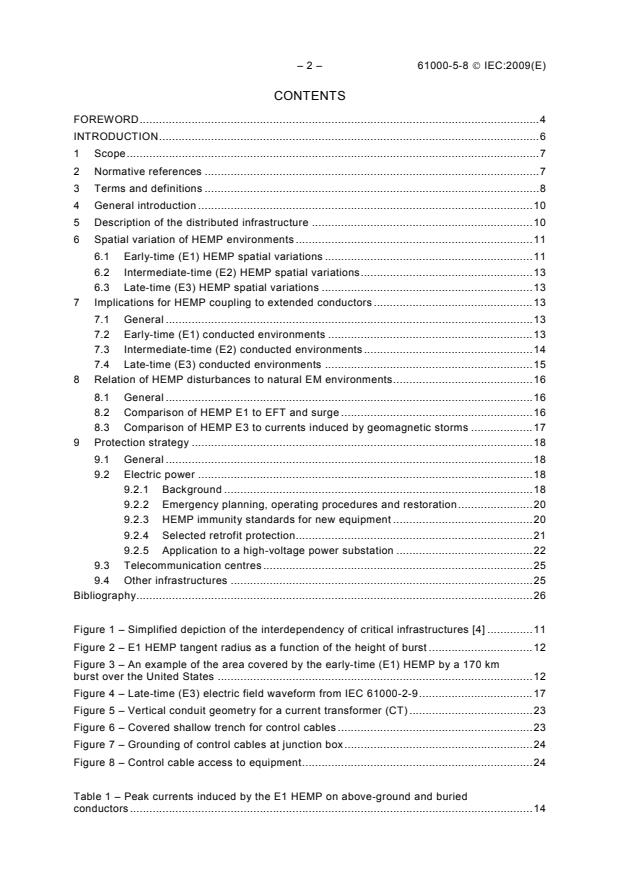
– 2 – 61000-5-8 © IEC:2009(E)
CONTENTS
FOREWORD.4
INTRODUCTION.6
1 Scope.7
2 Normative references .7
3 Terms and definitions .8
4 General introduction .10
5 Description of the distributed infrastructure .10
6 Spatial variation of HEMP environments .11
6.1 Early-time (E1) HEMP spatial variations .11
6.2 Intermediate-time (E2) HEMP spatial variations.13
6.3 Late-time (E3) HEMP spatial variations .13
7 Implications for HEMP coupling to extended conductors .13
7.1 General .13
7.2 Early-time (E1) conducted environments .13
7.3 Intermediate-time (E2) conducted environments .14
7.4 Late-time (E3) conducted environments .15
8 Relation of HEMP disturbances to natural EM environments.16
8.1 General .16
8.2 Comparison of HEMP E1 to EFT and surge .16
8.3 Comparison of HEMP E3 to currents induced by geomagnetic storms .17
9 Protection strategy .18
9.1 General .18
9.2 Electric power .18
9.2.1 Background .18
9.2.2 Emergency planning, operating procedures and restoration.20
9.2.3 HEMP immunity standards for new equipment .20
9.2.4 Selected retrofit protection.21
9.2.5 Application to a high-voltage power substation .22
9.3 Telecommunication centres .25
9.4 Other infrastructures .25
Bibliography.26
Figure 1 – Simplified depiction of the interdependency of critical infrastructures [4] .11
Figure 2 – E1 HEMP tangent radius as a function of the height of burst .12
Figure 3 – An example of the area covered by the early-time (E1) HEMP by a 170 km
burst over the United States .12
Figure 4 – Late-time (E3) electric field waveform from IEC 61000-2-9.17
Figure 5 – Vertical conduit geometry for a current transformer (CT) .23
Figure 6 – Covered shallow trench for control cables .23
Figure 7 – Grounding of control cables at junction box.24
Figure 8 – Control cable access to equipment.24
Table 1 – Peak currents induced by the E1 HEMP on above-ground and buried
conductors.14
61000-5-8 © IEC:2009(E) – 3 –
Table 2 – Peak currents induced by the E2 HEMP on above-ground and buried
conductors.15
Table 3 – Minimum required attenuation of peak time domain external environments for
the six principal protection concepts .21
– 4 – 61000-5-8 © IEC:2009(E)
INTERNATIONAL ELECTROTECHNICAL COMMISSION
____________
ELECTROMAGNETIC COMPATIBILITY (EMC) –
Part 5-8: Installation and mitigation guidelines –
HEMP protection methods for the distributed infrastructure
FOREWORD
1) The International Electrotechnical Commission (IEC) is a worldwide organization for standardization comprising
all national electrotechnical committees (IEC National Committees). The object of IEC is to promote
international co-operation on all questions concerning standardization in the electrical and electronic fields. To
this end and in addition to other activities, IEC publishes International Standards, Technical Specifications,
Technical Reports, Publicly Available Specifications (PAS) and Guides (hereafter referred to as “IEC
Publication(s)”). Their preparation is entrusted to technical committees; any IEC National Committee interested
in the subject dealt with may participate in this preparatory work. International, governmental and non-
governmental organizations liaising with the IEC also participate in this preparation. IEC collaborates closely
with the International Organization for Standardization (ISO) in accordance with conditions determined by
agreement between the two organizations.
2) The formal decisions or agreements of IEC on technical matters express, as nearly as possible, an international
consensus of opinion on the relevant subjects since each technical committee has representation from all
interested IEC National Committees.
3) IEC Publications have the form of recommendations for international use and are accepted by IEC National
Committees in that sense. While all reasonable efforts are made to ensure that the technical content of IEC
Publications is accurate, IEC cannot be held responsible for the way in which they are used or for any
misinterpretation by any end user.
4) In order to promote international uniformity, IEC National Committees undertake to apply IEC Publications
transparently to the maximum extent possible in their national and regional publications. Any divergence
between any IEC Publication and the corresponding national or regional publication shall be clearly indicated in
the latter.
5) IEC provides no marking procedure to indicate its approval and cannot be rendered responsible for any
equipment declared to be in conformity with an IEC Publication.
6) All users should ensure that they have the latest edition of this publication.
7) No liability shall attach to IEC or its directors, employees, servants or agents including individual experts and
members of its technical committees and IEC National Committees for any personal injury, property damage or
other damage of any nature whatsoever, whether direct or indirect, or for costs (including legal fees) and
expenses arising out of the publication, use of, or reliance upon, this IEC Publication or any other IEC
Publications.
8) Attention is drawn to the Normative references cited in this publication. Use of the referenced publications is
indispensable for the correct application of this publication.
9) Attention is drawn to the possibility that some of the elements of this IEC Publication may be the subject of
patent rights. IEC shall not be held responsible for identifying any or all such patent rights.
The main task of IEC technical committees is to prepare International Standards. In
exceptional circumstances, a technical committee may propose the publication of a technical
specification when
• the required support cannot be obtained for the publication of an International Standard,
despite repeated efforts, or
• the subject is still under technical development or where, for any other reason, there is the
future but no immediate possibility of an agreement on an International Standard.
Technical specifications are subject to review within three years of publication to decide
whether they can be transformed into International Standards.
IEC/TS 61000-5-8, which is a technical specification, has been prepared by subcommittee
77C: High power transient phenomena, of IEC technical committee 77: Electromagnetic
compatibility.
61000-5-8 © IEC:2009(E) – 5 –
This Technical Specification forms Part 5-8 of IEC 61000. It has the status of a basic EMC
1)
publication in accordance with IEC Guide 107 [1] .
This document is being issued in the Technical Specification series of publications (according
to the ISO/IEC Directives, Part 1, 3.1.1.1) as a “prospective standard for provisional
application” in the field of protection of the infrastructure against HEMP because there is an
urgent need for guidance on how standards in this field should be used to meet an identified
need.
This document is not to be regarded as an “International Standard”. It is proposed for
provisional application so that information and experience of its use in practice may be
gathered. Comments on the content of this document should be sent to the IEC Central
Office.
A review of this Technical Specification will be carried out not later than 3 years after its
publication with the options of: extension for another 3 years; conversion into an International
Standard; or withdrawal.
The text of this standard is based on the following documents:
Enquiry draft Report on voting
77C/192/DTS 77C/196/RVC
Full information on the voting for the approval of this standard can be found in the report on
voting indicated in the above table.
This publication has been drafted in accordance with the ISO/IEC Directives, Part 2.
The committee has decided that the contents of this publication will remain unchanged until
the maintenance result date indicated on the IEC web site under "http://webstore.iec.ch" in
the data related to the specific publication. At this date, the publication will be
• reconfirmed,
• withdrawn,
• replaced by a revised edition, or
• amended.
A bilingual version of this publication may be issued at a later date.
IMPORTANT – The 'colour inside' logo on the cover page of this publication indicates that it
contains colours which are considered to be useful for the correct understanding of its
contents. Users should therefore print this publication using a colour printer.
—————————
1)
Figures in square brackets refer to the Bibliography.
– 6 – 61000-5-8 © IEC:2009(E)
INTRODUCTION
IEC 61000 is published in separate parts according to the following structure:
Part 1: General
General considerations (introduction, fundamental principles)
Definitions, terminology
Part 2: Environment
Description of the environment
Classification of the environment
Compatibility levels
Part 3: Limits
Emission limits
Immunity limits (in so far as they do not fall under the responsibility of the product
committees)
Part 4: Testing and measurement techniques
Measurement techniques
Testing techniques
Part 5: Installation and mitigation guidelines
Installation guidelines
Mitigation methods and devices
Part 6: Generic standards
Part 9: Miscellaneous
Each part is further subdivided into several parts and published either as International
Standards or as technical specifications or technical reports, some of which have already
been published as sections. Others will be published with the part number followed by a dash
and a second number identifying the subdivision (example: 61000-6-1).
61000-5-8 © IEC:2009(E) – 7 –
ELECTROMAGNETIC COMPATIBILITY (EMC) –
Part 5-8: Installation and mitigation guidelines –
HEMP protection methods for the distributed infrastructure
1 Scope
The aim of this part of IEC 61000 is to provide guidance on how to protect the distributed
infrastructure (power, telecommunications, transportation and pipeline networks, etc.) from
the threat of a high altitude electromagnetic pulse (HEMP). In order to accomplish this goal, it
is necessary to describe the special aspects of the HEMP threat to electrical/electronic
systems that are connected and distributed in nature. In particular a nuclear burst at a typical
altitude of 100 km will illuminate the Earth to a ground radius from the point directly under the
burst to a range of 1 100 km. This means that any distributed and connected infrastructure
such as power or telecommunications will observe disturbances simultaneously over a wide
area. This type of situation is not normally considered in the EMC or HEMP protection of
facilities that are part of a distributed network as the impact of a local disturbance is usually
evaluated only locally.
This publication provides general information concerning the disturbance levels and protection
methods for all types of distributed infrastructures. Due to its importance to all other parts of
the infrastructure, the distributed electric power system (power substations, generation plants
and control centres) and its protection are described in more detail. While the
telecommunication system is also critical to most of the other distributed infrastructures, the
protection of the telecommunication network from HEMP and other electromagnetic threats is
covered by the work done by ITU-T.
2 Normative references
The following referenced documents are indispensable for the application of this document.
For dated references, only the edition cited applies. For undated references, the latest edition
of the referenced document (including any amendments) applies.
IEC 60050(161), International Electrotechnical Vocabulary – Chapter 161: Electromagnetic
compatibility
IEC 61000-2-9, Electromagnetic compatibility (EMC) – Part 2: Environment – Section 9:
Description of HEMP environment – Radiated disturbance
IEC 61000-2-10, Electromagnetic compatibility (EMC) – Part 2-10: Environment – Description
of HEMP environment – Conducted disturbance
IEC 61000-2-11, Electromagnetic compatibility (EMC) – Part 2-11: Environment –
Classification of HEMP environments
IEC 61000-4-4, Electromagnetic compatibility (EMC) – Part 4-4: Testing and measurement
techniques – Electrical fast transient/burst immunity test
IEC 61000-4-5, Electromagnetic compatibility (EMC) – Part 4-5: Testing and measurement
techniques – Surge immunity test
IEC 61000-4-23, Electromagnetic compatibility (EMC) – Part 4-23: Testing and measurement
techniques – Test methods for protective devices for HEMP and other radiated disturbances
– 8 – 61000-5-8 © IEC:2009(E)
IEC 61000-4-24, Electromagnetic compatibility (EMC) – Part 4: Testing and measurement
techniques – Section 24: Test methods for protective devices for HEMP conducted
disturbance
IEC 61000-4-25, Electromagnetic compatibility (EMC) – Part 4-25: Testing and measurement
techniques – HEMP immunity test methods for equipment and systems
IEC/TR 61000-5-3, Electromagnetic compatibility (EMC) – Part 5-3: Installation and mitigation
guidelines – HEMP protection concepts
IEC/TR 61000-5-6, Electromagnetic compatibility (EMC) – Part 5-6: Installation and mitigation
guidelines – Mitigation of external EM influences
IEC/TS 61000-5-9, Electromagnetic compatibility (EMC) – Part 5-9: Installation and mitigation
guidelines – System-level susceptibility assessments for HEMP and HPEM
IEC 61000-6-6, Electromagnetic compatibility (EMC) – Part 6-6: Generic standards – HEMP
immunity for indoor equipment
IEC 61850 (all parts), Communication networks and systems in substations
3 Terms and definitions
For the purposes of this document, the definitions contained in IEC 60050(161) as well as the
following apply.
3.1
distributed infrastructure
the portions of the infrastructure of a society that are connected either physically or through
real-time communications over distances of hundreds of kilometres, and include electrical and
electronic controls to operate that infrastructure
NOTE This normally includes the electric power system, the telecommunications system, pipeline networks, and
the transportation system.
3.2
E1, E2, E3
terminology for the early, intermediate and late-time HEMP electric fields. E1 is for times less
than 1 microsecond, E2 for times between 1 microsecond and 1 second and E3 is for times
greater than 1 second.
NOTE See IEC 61000-2-9 for additional information.
3.3
equipment
this term is not limited and includes modules, devices, apparatuses, subsystems, complete
systems and installations
[IEV 151-11-25, modified]
3.4
HEMP
high-altitude electromagnetic pulse
3.5
HEMP coupling
interaction of the HEMP field with a system to produce currents and voltages on system
surfaces and cables. Voltages result from the induced charges and are only defined at low
frequencies with wavelengths larger than the surface or gap dimensions
61000-5-8 © IEC:2009(E) – 9 –
3.6
installation
combination of apparatuses, components and systems assembled and/or erected
(individually) in a given area; for physical reasons (e.g. long distances between individual
items) it is in many cases not possible to test an installation as a unit
[IEV 151-11-26, modified]
3.7
point-of-entry
PoE
physical location (point) on an electromagnetic barrier, where EM energy may enter or exit a
topological volume, unless an adequate PoE protective device is provided
NOTE A PoE is not limited to a geometrical point. PoEs are classified as aperture PoEs or conductive PoEs
according to the type of penetration. They are also classified as architectural, mechanical, structural or electrical
PoEs according to the functions they serve.
3.8
pulse width
time interval between the points on the leading and trailing edges of a pulse at which the
instantaneous value is 50 % of the peak pulse amplitude, unless otherwise stated
3.9
rectified impulse
RI
integral of the absolute value of a time waveform’s amplitude over a specified time interval
3.10
rise time (of a pulse)
time interval between the instants in which the instantaneous amplitude of a pulse first
reaches specified lower and upper limits, namely 10 % and 90 % of the peak pulse amplitude,
unless otherwise stated
[IEV 161-02-05, modified]
3.11
severity
the probability that a level of HEMP environment will be less than the stated value
NOTE For example a 90 % severity level of current induced on an elevated, randomly oriented conductor is
1,5 kA. This means that only 10 % of currents would exceed this value.
3.12
short-circuit current
the value of current that flows when the output terminals of a circuit are shorted
NOTE This current is normally of interest when checking the performance of surge protection devices.
[IEV 441-11-07, modified and IEV 603-02-26, modified]
3.13
source impedance
impedance presented by a source of energy to the input terminals of a device or network
3.14
system
combination of apparatuses and/or active components constituting a single functional unit and
intended to be installed and operated to perform (a) specific task(s)
– 10 – 61000-5-8 © IEC:2009(E)
4 General
The publications developed to protect civil systems from the threat of high-altitude
electromagnetic pulse (HEMP) in the past have mainly covered the methods to protect
important equipment, systems and installations against the threat of a severe electromagnetic
pulse environment at the location of the system of interest. IEC 61000-2-9 recommends that
an early-time (E1) HEMP with a peak value of 50 kV/m be used to design protection and to
perform radiated tests, if the system of interest is fully exposed to the environment. It is well
known that the HEMP field will vary across the Earth, however, since the location of a burst is
not known in advance, system specifications have usually considered the maximum field level
likely to be found anywhere at the Earth’s surface.
In the same manner IEC 61000-2-10 indicates that the full HEMP field will illuminate and
couple to all conductors, including cables and wires, creating a conducted HEMP
environment, which may flow into connected equipment. For the early-time (E1) HEMP
environment, the levels of currents induced will vary due to the polarization and angle of
incidence of the HEMP field and the orientation of the conductor to the HEMP propagation.
This means that large variations of currents are possible for randomly oriented above-ground
conductors ranging from a 50 % severity value of 500 A to a 99 % severity value of 4 kA
(based on a cumulative probability density function).
While the two examples above refer to the early-time HEMP environment, the intermediate-
time (E2) and late-time (E3) HEMP waveforms are also a concern to very long conductors,
such as exposed power lines and telephone wires. As indicated in IEC 61000-2-10, the peak
currents that are induced may be determined from the peak electric field, the length of the
conductor and the resistance of the conductor over the exposed coupling length.
For high voltage power transmission lines, the late-time (E3) HEMP induces currents on the
order of hundreds of amperes for tens of seconds; these currents are likely to create half-
cycle saturation in high voltage transformers and will also produce severe harmonics that can
disrupt the voltage regulation of the network [2].
For telecommunication lines the late-time (E3) HEMP environment has the ability to induce
currents of up to tens of amperes for tens of seconds that are high enough to trip safety
protection systems and to shut down each exposed line [3]. The currents induced are lower in
telecommunication lines as the resistance per unit length of these lines is much higher than
for power transmission cables.
Given these threats to important infrastructures, this publication provides methods to
determine the appropriate levels of electromagnetic radiated and conducted disturbances for
particular types of distributed infrastructures. In addition, these disturbances are compared to
other natural EM environments that have well defined protection and test methods. This
publication concludes with recommended protection strategies and methods that vary due to
the cost versus effectiveness considerations involved, especially given a low probability event
such as HEMP.
5 Description of the distributed infrastructure
Each critical infrastructure is dependent upon other infrastructures as shown in Figure 1. This
figure is an example that describes in a simplified way the many interdependencies between
them (not all connections are shown). The interdependence of critical infrastructures is likely
to create difficulties in the ability to recover from the widespread disruption and damage that
could be caused by an HEMP attack due to the large area impacted within a short time.
—————————
Figures in square brackets refer to the Bibliography.
61000-5-8 © IEC:2009(E) – 11 –
IEC 1803/09
Figure 1 – Simplified depiction of the interdependency of critical infrastructures [4]
All of the critical functions of infrastructures, such as electric power, telecommunications,
energy, financial, transportation, emergency services, water, food, etc., have electronic
devices embedded in most aspects of their systems. Electric power is clearly the primary
service underlying society and all of its other critical infrastructures. Any large-area blackout
created by a HEMP event will be difficult to alleviate quickly due to the loss of
communications and the difficulties in maintaining transportation networks to repair damage
and to re-energize the grid.
6 Spatial variation of HEMP environments
6.1 Early-time (E1) HEMP spatial variations
The early-time (E1) HEMP field has frequency content mainly above 1 MHz (with most of its
energy in the tens of MHz); for this reason the field travels by line of sight. For typical burst
altitudes above 100 km, the early-time HEMP field is actually generated only when the
atmospheric density is high enough (between 20 km and 50 km altitude) to allow the prompt
gamma rays to produce Compton currents (see IEC 61000-2-9). In spite of this fact, the early-
time HEMP field appears to be radiated from the burst point of the detonation. For that reason
it is straightforward to compute the radius of the Earth exposed to early-time HEMP by a given
burst height (where the line of sight is tangent to the Earth’s surface). Figure 2 indicates the
tangent radius as a function of burst height. In addition, a simple formula may be used when
the burst height is much smaller than the radius of the Earth, which is the usual case: R (km)
T
~ 110 square root [HOB (km)].
– 12 – 61000-5-8 © IEC:2009(E)
IEC 1804/09
Figure 2 – E1 HEMP tangent radius as a function of the height of burst
A more explicit example of the coverage of the early-time (E1) HEMP is shown in Figure 3,
where a portion of the United States is shown covered by a 170 km burst over the state of
Ohio. The early-time HEMP will illuminate the area inside the circle to electric field levels
generally up to a maximum value of 50 kV/m. It is generally true that the maximum E1 HEMP
fields are found near ground zero, and the fields decrease with ground range toward the
tangent point. However, the impact of the Earth’s geomagnetic field does affect this
distribution near ground zero. For more details about the variation of the early-time (E1)
HEMP field levels, see IEC 61000-2-9.
IEC 1805/09
Figure 3 – Example of the area covered by the early-time (E1)
HEMP by a 170 km burst over the United States
61000-5-8 © IEC:2009(E) – 13 –
An important issue concerning the early-time (E1) HEMP is the fact that it propagates at the
speed of light from an apparent focal point at the burst. For the example and as shown in
Figure 3 (burst height of 170 km), the time difference between the first and last arrival of the
E1 HEMP at the Earth’s surface is only 4,3 ms. This means that any disturbances created by
the HEMP on a network, such as the power system, will create potential impacts over
thousands of kilometres, but within one power cycle (20 ms/50 Hz; 16,7 ms/60 Hz). This
provides a unique disturbance situation for a distributed infrastructure.
6.2 Intermediate-time (E2) HEMP spatial variations
For the intermediate-time (E2) HEMP environments, the E2 HEMP radiated field lasts
between 1 μs and 1 s and has a peak field of 100 V/m (IEC 61000-2-9). The peak field of
100 V/m normally occurs within 100 km of surface zero and decreases to levels of a few V/m
at the Earth’s tangent. The frequency content contained in this pulse shape does not allow
efficient coupling to equipment, systems or even small installations. In general the main effect
is through the coupling to long (>100 m) conductors that lead to an installation and the
equipment contained within.
6.3 Late-time (E3) HEMP spatial variations
The E3 HEMP radiated field is expected to be as high as 40 V/km (IEC 61000-2-9), with a rise
time on the order of seconds and a pulse width on the order of 100 s. This level of peak field
is somewhat dependent on the burst height and yield, however, in general the area of
coverage for high levels of fields is within a radius of 250 km from surface zero. As in the
case of E2, the even lower frequency content of this E3 field makes it suited only for coupling
to very long cables (over 1 km in length).
7 Implications for HEMP coupling to extended conductors
7.1 General
Due to the fact that the HEMP conducted environments are only produced by coupling of the
HEMP radiated environments, there are three distinct types of conducted environments: early-
time (E1), intermediate-time (E2) and late-time (E3).
7.2 Early-time (E1) conducted environments
As described in IEC 61000-2-10 the early-time (E1) HEMP field couples efficiently to extended
conductors (such as cables and wires) and can create large currents and voltages with rise
times on the order of 10 ns. Depending on the polarization of the HEMP field, the angle of
incidence to the Earth’s surface and the relative orientation of an above-ground or buried
conductor to the incident field, currents up to 4 kA may be induced. Table 1 from
IEC 61000-2-10 presents several examples of probabilistic E1 HEMP currents that can be
induced for the case of random conductor orientation over the entire area exposed by the
HEMP. The upper portion of Table 1 indicates the results for above-ground conductors and
the lower portion indicates similar results for buried conductors. The currents shown are for
the flow on a conductor and are either shield currents or bulk currents for unshielded cables.
The induced pulse shapes of the currents can be described by a (10/100) ns waveform (rise
time/pulse width) for above-ground conductors and by a (25/500) ns waveform for buried
conductors.
It is noted that the currents carried on above-ground conductors can be much larger than
those from buried conductors. In addition, there is little variation shown due to the effect of
the ground reducing the efficiency of the phasing of the incident field and the propagation of
the induced currents on the conductors. The ground conductivity itself is, however, a factor in
terms of the peak induced currents. As the information provided in Table 1 has been with
regard to shield or bulk currents, the characteristic impedance of the cables must be
considered to determine the appropriate voltage levels. The common-mode characteristic
impedance of the above-ground conductors has a value of 400 Ω versus only 50 Ω for the
– 14 – 61000-5-8 © IEC:2009(E)
buried conductors. This means that the induced peak voltages average 200 kV for above-
ground conductors and range between 10 kV and 20 kV for buried conductors.
Table 1 – Peak currents induced by the E1 HEMP
on above-ground and buried conductors
Table 1a – Above-ground conductor
I
pk
Severity
L > 200 m 100 ≤ L ≤ 200 m L < 100 m
a
%
50 500 500 5,0 L
90 1 500 7,5 L 7,5 L
99 4 000 20 L 20 L
a
Percentage of currents smaller than the indicated value.
Waveform 1: (10/100) ns.
Source impedance, Z = 400 Ω
s
Table 1b – Buried conductor
I
pk
A
Ground conductivity
All lengths > 10 m
S/m
–2
10 200
–3
10 300
–4
10 400
Waveform 2: (25/500) ns.
Source impedance, Z = 50 Ω
s
NOTE Source impedances are used in Table 1 to inject the proper ratio of voltages and currents. They are the
same as the common-mode characteristic impedances.
7.3 Intermediate-time (E2) conducted environments
For the intermediate-time or E2 HEMP field coupling to extended conductors, results from
IEC 61000-2-10 are summarized here. Table 2 describes the currents induced in long
conductors as a function of the ground conductivity, length of the conductors and whether the
conductors are above ground or buried. Table 2 indicates that lower ground conductivities
produce larger currents for both locations of conductors; however, the currents for the above-
ground conductors are higher by factors of 2 to 3 and the characteristic impedance is higher.
Note also that the currents do not increase further for above-ground conductors greater than
10 km long or for buried conductors greater than 1 km. In both cases, the induced current
waveform can be expressed as a (25/1 500) μs waveform.
61000-5-8 © IEC:2009(E) – 15 –
Table 2 – Peak currents induced by the E2 HEMP
on above-ground and buried conductors
Table 2a – Above-ground conductor
I
pk
A
Ground conductivity
L > 10 000 m 1 000 ≤ L ≤ 10 000 m 100 ≤ L < 1 000 m L < 100 m
S/m
–2
10 150 75 0,05L 0
–3
10 350 200 0,15 L 0
–4
10 800 600 0,45 L 0
Waveform 3: (25/1 500) μs.
Source impedance, Z = 400 Ω
s
Table 2b – Buries conductor
I
pk
A
Ground conductivity
L > 1 000 m 100 ≤ L ≤ 1 000 m L < 100 m
S/m
–2
10 50 0,05L 0
–3
10 150 0,15 L 0
–4
10 450 0,45 L 0
Waveform 3: (25/1 500) μs.
Source impedance, Z = 50 Ω
s
NOTE 1 Source impedances are used in Table 2 to inject the proper ratio of voltages and currents. They are the
same as the common-mode characteristic impedances.
NOTE 2 In Table 2a for values of L between 1 000 m and 10 000 m, the values provided are approximate values.
This accounts for the discontinuity for values below 1 000 m. For L < 1 000 m, use the formula provided.
7.4 Late-time (E3) conducted environments
The late-time or E3 HEMP waveform rises in a time of seconds but cannot couple efficiently to
anything other than conductors longer than 1 km. Since the maximum peak field is 40 V/km,
this could induce a voltage over 1 km of 40 V. If the conductor and its grounding system have
10 Ω of resistance, then a current of 4 A will flow. While this is a very low current, it also has
a pulse width of 100 s, thereby providing a threat to fuses and other similar protective
devices. As described here and in IEC 61000-2-10, a simple DC approach may be taken to
evaluating the currents induced by the E3 HEMP, where the field level and the length of a
conductor are first used to determine the induced voltage. The next step is to evaluate the
entire resistance in the ground loop, which is then divided into the voltage to determine the
induced current. This current will have the same time dependence as the incident E3 electric
field.
– 16 – 61000-5-8 © IEC:2009(E)
8 Relation of HEMP disturbances to natural EM environments
8.1 General
In terms of the radiated pulse field that is associated with the E1 HEMP, similar natural pulses
are the EM transient fields produced by arcing events in power substations and the pulsed
fields created by electrostatic discharge (ESD) events. In the case of the substation events,
pulsed fields have been measured with rise times on the order of 10 ns and peak field levels
of 10 kV/m. In the case of ESD, measurements have been made at a distance of 0,1 m from
an arc produced by an ESD test gun and have indicated a peak field up to 10 kV/m with a rise
time of 0,7 ns and a pulse width of 30 ns. The E1 HEMP waveform described in
IEC 61000-2-9 is a (2,5/25) ns waveform with a peak field of 50 kV/m. In the case of ESD,
tests have indicated that electronic equipment can be affected by these types of fields unless
protection is provided. In the case of power substations, it is known that significant high-
frequency currents and voltages can be induced on equipment cables in substations providing
over-voltages that connected equipment must withstand. HEMP fields are often compared to
nearby lightning fields, and measured lightning fields have peak fields of 10 kV/m or higher;
however, the lightning field rise times are longer than 100 ns (often 1 μs) and therefore are
not as similar to E1 HEMP as ESD or substation arcing events (IEC 61000-5-3).
With regard to the E2 HEMP radiated fields, the waveform is very similar to natural lightning,
although the peak field value of 100 V/m is far less than nearby lightning electric fields. It
does appear that because the E2 HEMP field propagates as a plane wave, it is more efficient
in coupling to conductors and therefore creates levels of currents nearly as high as 1 kA. The
E2 HEMP conducted environment, previously discussed, has a waveform that rises in 25 μs
and has a pulse width of 500 μs. This is very similar to the ITU-T immunity test waveform that
has a pulse shape of (10/700) μs (IEC 61000-4-5). A typical level of performance for the
immunity of equipment to this EM pulse is 2 kV. As indicated above in Table 2, the HEMP E2
conducted environment may be as high as 300 kV on above-ground conductors longer than
10 km.
The E3 HEMP electric fields are very similar in their time dependence to the natural electric
fields produced in the Earth due to geomagnetic storms created by enhanced solar activity.
Direct measurements of the geomagnetic fields, the induced electric fields and the currents
induced in high-voltage power networks have been made and published over many years. It is
noted that recent measured electric fields have reached levels of 1 V/km, although it is
possible that the fields may be as high as 5 V/km during severe storms where no direct
electric field measurements were made.
8.2 Comparison of HEMP E1 to EFT and surge
The conducted E1 HEMP environment for an above-ground conductor is defined in
IEC 61000-2-10 as a waveform that rises in 10 ns (10 % to 90 %) and has a pulse width (50 %
– 50 %) of 100 ns (this is typically described as a (10/100) ns waveform). Of course the real
HEMP conducted transients can vary due to the coupling angle of incidence and the
conductivity of the Earth in the vicinity of a conductor. For a buried conductor the waveform is
expected to be (25/500) ns for well-buried conductors. For surface conductors the HEMP
waveforms are expected to have rise times and pulse widths that are between these two
ranges.
The electrical fast transient (EFT) waveform is typically produced from arcing events in power
substations and is a threat to electronic control equipment in the substations and to nearby
factories. It is described in IEC 61000-4-4 as a (5/50) ns waveform. It occurs in bursts of
pulses with a repetition rate between 5 kHz and 100 kHz. It is important to recognize that the
test method defined by the IEC is widely used and most electronic systems are tested to this
disturbance, although at lower peak voltages than those that can be produced by HEMP.
Typically, the test levels for EFT range between 0,5 kV and 4 kV (open circuit voltage). For
HEMP the levels can be 10 kV to 20 kV for equipment inside of buildings and much higher for
fully exposed equipment.
61000-5-8 © IEC:2009(E) – 17 –
It should be noted that the main differences between the E1 HEMP waveform and the EFT
waveform is the fact that the rise time is slower for the HEMP waveform and the pulse width is
longer for the HEMP waveform. This means that the derivative norm (dV/dt) for the HEMP
waveform is one half that of the EFT for the same peak value. It also means that the rectified
impulse of the HEMP waveform is twice as large as the EFT, again for the same peak value.
Since charge transfer and energy are not normally the primary means for causing damage
(damage is usually caused by the triggering of arcs on circuit boards that allow the equipment
power supply to damage low voltage components), the derivative norm is the most important
to consider. This means that for a given peak voltage level, the EFT test produces twice the
derivative norm than does a HEMP. For this reason test level EC9 in IEC 61000-4-25
identifies the largest open circuit voltage test of 16 kV using the IEC 61000-4-4 test method,
which produces the same maximum derivative as a 32 kV HEMP waveform.
The IEC also has defined a surge immunity test for most electronic systems that are likely to
be exposed to lightning transients inside a building due to a nearby lightning stroke. This test
is defined in IEC 61000-4-5 and can be described by an open circuit voltage waveform with a
(1/50) μs pulse shape. This waveform is much slower in its rise (100 times) and longer in its
pulse width (nearly 1000 times) than the E1 HEMP conducted transient waveform. For this
reason there is no relationship between these waveforms, and tests using IEC 61000-4-5
cannot replace tests for the E1 HEMP waveform (in spi
...
Questions, Comments and Discussion
Ask us and Technical Secretary will try to provide an answer. You can facilitate discussion about the standard in here.
Loading comments...