

IEC 60432-1:1999
(Main)Incandescent lamps - Safety specifications - Part 1: Tungsten filament lamps for domestic and similar general lighting purposes
General Information
- Abstract
Specifies the safety and interchangeability requirements of tungsten filament incandescent lamps for general lighting service, having a rated wattage up to and including 200 W or a rated voltage from 50 V to 250 V inclusive. Replaces IEC 60432 (1984).
- Status
- Published
- Publication Date
- 09-Feb-2012
- Technical Committee
- SC 34A - Electric light sources
- Drafting Committee
- WG 6 - TC 34/SC 34A/WG 6
- Current Stage
- PPUB - Publication issued
- Start Date
- 13-Aug-1999
- Completion Date
- 15-Sep-1999
Buy Documents
IEC 60432-1:1999+AMD1:2005 CSV - Incandescent lamps - Safety specifications - Part 1: Tungsten filament lamps for domestic and similar general lighting purposes Released:5/12/2005
IEC 60432-1:1999+AMD1:2005 CSV - Lampes a incandescence - Prescriptions de sécurité - Partie 1: Lampes a filament de tungstene pour usage domestique et éclairage général similaire Released:5/12/2005
IEC 60432-1:1999 - Incandescent lamps - Safety specifications - Part 1: Tungsten filament lamps for domestic and similar general lighting purposes Released:8/13/1999
IEC 60432-1:1999+AMD1:2005+AMD2:2011 CSV - Incandescent lamps - Safety specifications - Part 1: Tungsten filament lamps for domestic and similar general lighting purposes Released:2/10/2012
IEC 60432-1:1999+AMD1:2005 CSV - Incandescent lamps - Safety specifications - Part 1: Tungsten filament lamps for domestic and similar general lighting purposes Released:5/12/2005
Overview
IEC 60432-1:1999 is an international standard published by the International Electrotechnical Commission (IEC), which specifies the safety and interchangeability requirements for tungsten filament incandescent lamps used in domestic and general lighting applications. The standard applies to lamps with a rated wattage of up to and including 200 W and a rated voltage from 50 V to 250 V, covering various bulb shapes and finishes, along with different types of lamp caps. It emphasizes consumer safety and provides manufacturers, testing agencies, and regulators with clear guidelines to ensure that all products entering the market adhere to essential safety principles.
Key Topics
Scope and Applicability
- Covers tungsten filament incandescent lamps for domestic and similar general lighting purposes
- Applies to lamps with wattage up to 200 W and voltage between 50 V and 250 V
- Includes a variety of bulb shapes (e.g., A, B, C, G, M, P, PS, PAR, R) and finishes
Safety Requirements
- Mandates marking with origin, rated voltage, and wattage for traceability
- Specifies requirements for protection against accidental contact in screw-type lampholders
- Specifies limits for lamp cap temperature rise to prevent overheating
- Details the insulation resistance requirements to ensure user safety
- Sets out construction and assembly requirements to safeguard against electrical and mechanical hazards
Product Assessment and Testing
- Outlines manufacturer obligations for production assessment, record-keeping, and batch testing
- Provides methods for evaluating compliance with safety criteria through both whole production review and limited batch assessment
- Includes procedures for induced-failure and operation-to-failure tests to assess safety at end of lamp life
Interchangeability
- Ensures that lamps are compatible with standard lamp caps and holders according to IEC 60061
- Specifies gauge measurements and dimensional controls for compatibility across manufacturers
Applications
IEC 60432-1:1999 is widely applicable in the following areas:
- Manufacturing: Essential for lamp manufacturers designing and producing tungsten filament incandescent lamps, ensuring products meet international safety and compatibility requirements.
- Quality Control & Certification: Used by conformity assessment bodies and internal QA/QC teams to test lamp safety before market release.
- Product Development: Serves as a technical reference for engineers and designers to meet the latest regulatory and interchangeability needs.
- Market Compliance: Helps importers and distributors verify that lamps comply with recognized safety standards, reducing liability and ensuring user safety.
- Consumer Protection: Guarantees that end-users receive safe, reliable lighting products for domestic and general-purpose environments.
Related Standards
- IEC 60064: Performance requirements for tungsten filament lamps, focusing on characteristics such as luminous flux, life, and power consumption.
- IEC 60061-1 and IEC 60061-3: Standards on lamp caps, lampholders, and gauges for safety and interchangeability.
- IEC 60360: Describes the standard method of measuring lamp cap temperature rise.
- IEC 60432-2: Covers safety specifications for tungsten halogen lamps for general lighting.
- IEC 60887: Designation system for glass bulb shapes in lamps.
- IEC 62471: Addresses photobiological safety of lamps and lamp systems.
- IEC/TR 62471-2: Provides guidance on manufacturing requirements for optical radiation safety.
By adhering to IEC 60432-1, stakeholders help ensure the global availability of safe, interchangeable, and high-quality incandescent lighting solutions, thus supporting consumer confidence and regulatory alignment across markets. For those involved in lamp manufacturing, distribution, or conformity assessment, alignment with this standard is fundamental for product acceptance and market access. For the latest updates and amendments, always refer to the IEC webstore.
Relations
- Effective Date
- 05-Sep-2023
- Effective Date
- 05-Sep-2023
- Effective Date
- 05-Sep-2023
Buy Documents
IEC 60432-1:1999+AMD1:2005 CSV - Incandescent lamps - Safety specifications - Part 1: Tungsten filament lamps for domestic and similar general lighting purposes Released:5/12/2005
IEC 60432-1:1999+AMD1:2005 CSV - Lampes a incandescence - Prescriptions de sécurité - Partie 1: Lampes a filament de tungstene pour usage domestique et éclairage général similaire Released:5/12/2005
IEC 60432-1:1999 - Incandescent lamps - Safety specifications - Part 1: Tungsten filament lamps for domestic and similar general lighting purposes Released:8/13/1999
IEC 60432-1:1999+AMD1:2005+AMD2:2011 CSV - Incandescent lamps - Safety specifications - Part 1: Tungsten filament lamps for domestic and similar general lighting purposes Released:2/10/2012
IEC 60432-1:1999+AMD1:2005 CSV - Incandescent lamps - Safety specifications - Part 1: Tungsten filament lamps for domestic and similar general lighting purposes Released:5/12/2005
Get Certified
Connect with accredited certification bodies for this standard

IMQ S.p.A. (Certification)
Italian electrical product certification.

SLG Prüf- und Zertifizierungs GmbH
German testing and certification body.

UL Solutions
Global safety science company with testing, inspection and certification.
Sponsored listings
Frequently Asked Questions
IEC 60432-1:1999 is a standard published by the International Electrotechnical Commission (IEC). Its full title is "Incandescent lamps - Safety specifications - Part 1: Tungsten filament lamps for domestic and similar general lighting purposes". This standard covers: Specifies the safety and interchangeability requirements of tungsten filament incandescent lamps for general lighting service, having a rated wattage up to and including 200 W or a rated voltage from 50 V to 250 V inclusive. Replaces IEC 60432 (1984).
Specifies the safety and interchangeability requirements of tungsten filament incandescent lamps for general lighting service, having a rated wattage up to and including 200 W or a rated voltage from 50 V to 250 V inclusive. Replaces IEC 60432 (1984).
IEC 60432-1:1999 is classified under the following ICS (International Classification for Standards) categories: 29.140.20 - Incandescent lamps. The ICS classification helps identify the subject area and facilitates finding related standards.
IEC 60432-1:1999 has the following relationships with other standards: It is inter standard links to IEC 60432-1:1999/AMD1:2005, IEC 60432-1:1999/AMD2:2011, IEC 60432-1:1993/AMD2:1997. Understanding these relationships helps ensure you are using the most current and applicable version of the standard.
IEC 60432-1:1999 is available in PDF format for immediate download after purchase. The document can be added to your cart and obtained through the secure checkout process. Digital delivery ensures instant access to the complete standard document.
Standards Content (Sample)
INTERNATIONAL IEC
STANDARD 60432-1
Edition 2.1
2005-05
Edition 2:1999 consolidated with amendment 1:2005
Incandescent lamps –
Safety specifications –
Part 1:
Tungsten filament lamps for domestic and
similar general lighting purposes
This English-language version is derived from the original
bilingual publication by leaving out all French-language
pages. Missing page numbers correspond to the French-
language pages.
Reference number
Publication numbering
As from 1 January 1997 all IEC publications are issued with a designation in the
60000 series. For example, IEC 34-1 is now referred to as IEC 60034-1.
Consolidated editions
The IEC is now publishing consolidated versions of its publications. For example,
edition numbers 1.0, 1.1 and 1.2 refer, respectively, to the base publication, the
base publication incorporating amendment 1 and the base publication incorporating
amendments 1 and 2.
Further information on IEC publications
The technical content of IEC publications is kept under constant review by the IEC,
thus ensuring that the content reflects current technology. Information relating to
this publication, including its validity, is available in the IEC Catalogue of
publications (see below) in addition to new editions, amendments and corrigenda.
Information on the subjects under consideration and work in progress undertaken
by the technical committee which has prepared this publication, as well as the list
of publications issued, is also available from the following:
• IEC Web Site (www.iec.ch)
• Catalogue of IEC publications
The on-line catalogue on the IEC web site (www.iec.ch/searchpub) enables you to
search by a variety of criteria including text searches, technical committees
and date of publication. On-line information is also available on recently issued
publications, withdrawn and replaced publications, as well as corrigenda.
• IEC Just Published
This summary of recently issued publications (www.iec.ch/online_news/ justpub)
is also available by email. Please contact the Customer Service Centre (see
below) for further information.
• Customer Service Centre
If you have any questions regarding this publication or need further assistance,
please contact the Customer Service Centre:
Email: custserv@iec.ch
Tel: +41 22 919 02 11
Fax: +41 22 919 03 00
INTERNATIONAL IEC
STANDARD 60432-1
Edition 2.1
2005-05
Edition 2:1999 consolidated with amendment 1:2005
Incandescent lamps –
Safety specifications –
Part 1:
Tungsten filament lamps for domestic and
similar general lighting purposes
IEC 2005 Copyright - all rights reserved
No part of this publication may be reproduced or utilized in any form or by any means, electronic or mechanical,
including photocopying and microfilm, without permission in writing from the publisher.
International Electrotechnical Commission, 3, rue de Varembé, PO Box 131, CH-1211 Geneva 20, Switzerland
Telephone: +41 22 919 02 11 Telefax: +41 22 919 03 00 E-mail: inmail@iec.ch Web: www.iec.ch
PRICE CODE
CN
Commission Electrotechnique Internationale
International Electrotechnical Commission
МеждународнаяЭлектротехническаяКомиссия
For price, see current catalogue
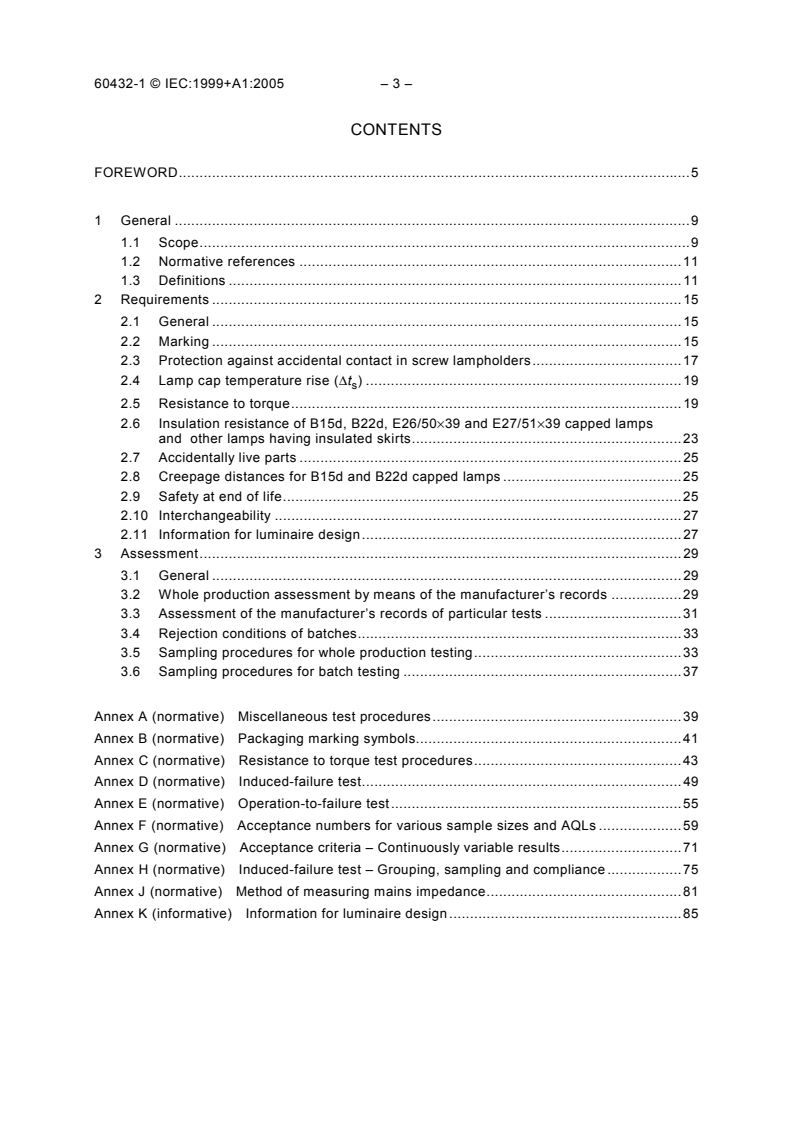
60432-1 © IEC:1999+A1:2005 – 3 –
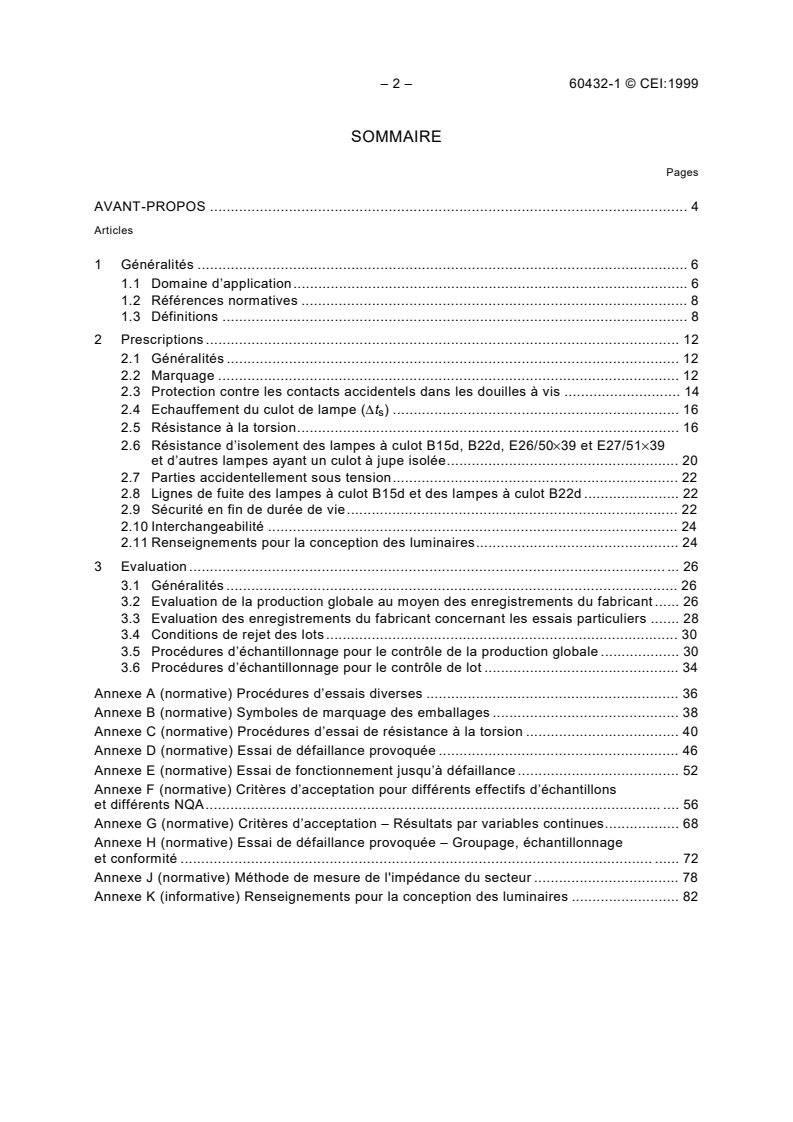
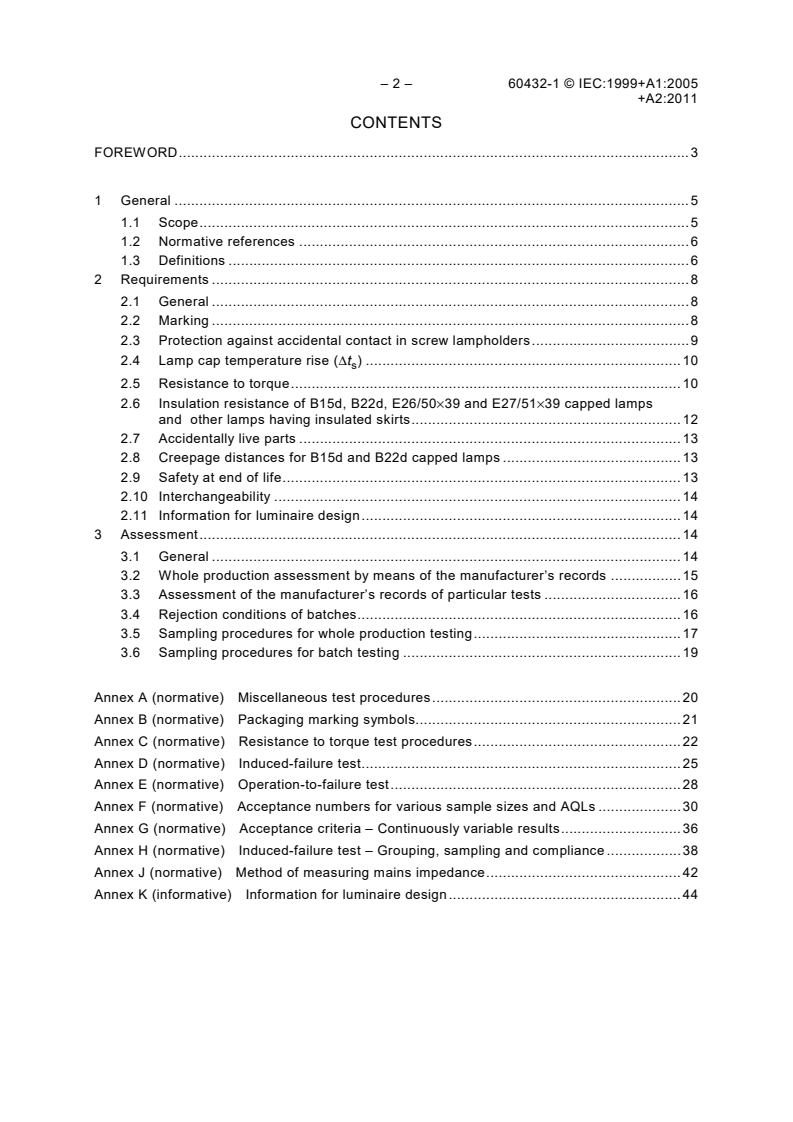
CONTENTS
FOREWORD.5
1 General .9
1.1 Scope.9
1.2 Normative references .11
1.3 Definitions .11
2 Requirements .15
2.1 General .15
2.2 Marking .15
2.3 Protection against accidental contact in screw lampholders.17
2.4 Lamp cap temperature rise (Δt ) .19
s
2.5 Resistance to torque.19
2.6 Insulation resistance of B15d, B22d, E26/50× 39 and E27/51× 39 capped lamps
and other lamps having insulated skirts.23
2.7 Accidentally live parts .25
2.8 Creepage distances for B15d and B22d capped lamps .25
2.9 Safety at end of life.25
2.10 Interchangeability .27
2.11 Information for luminaire design.27
3 Assessment.29
3.1 General .29
3.2 Whole production assessment by means of the manufacturer’s records .29
3.3 Assessment of the manufacturer’s records of particular tests .31
3.4 Rejection conditions of batches.33
3.5 Sampling procedures for whole production testing.33
3.6 Sampling procedures for batch testing .37
Annex A (normative) Miscellaneous test procedures.39
Annex B (normative) Packaging marking symbols.41
Annex C (normative) Resistance to torque test procedures.43
Annex D (normative) Induced-failure test.49
Annex E (normative) Operation-to-failure test.55
Annex F (normative) Acceptance numbers for various sample sizes and AQLs .59
Annex G (normative) Acceptance criteria – Continuously variable results.71
Annex H (normative) Induced-failure test – Grouping, sampling and compliance .75
Annex J (normative) Method of measuring mains impedance.81
Annex K (informative) Information for luminaire design.85
60432-1 © IEC:1999+A1:2005 – 5 –
INTERNATIONAL ELECTROTECHNICAL COMMISSION
____________
INCANDESCENT LAMPS –
SAFETY SPECIFICATIONS –
Part 1: Tungsten filament lamps for domestic and
similar general lighting purposes
FOREWORD
1) The International Electrotechnical Commission (IEC) is a worldwide organization for standardization comprising
all national electrotechnical committees (IEC National Committees). The object of IEC is to promote
international co-operation on all questions concerning standardization in the electrical and electronic fields. To
this end and in addition to other activities, IEC publishes International Standards, Technical Specifications,
Technical Reports, Publicly Available Specifications (PAS) and Guides (hereafter referred to as “IEC
Publication(s)”). Their preparation is entrusted to technical committees; any IEC National Committee interested
in the subject dealt with may participate in this preparatory work. International, governmental and non-
governmental organizations liaising with the IEC also participate in this preparation. IEC collaborates closely
with the International Organization for Standardization (ISO) in accordance with conditions determined by
agreement between the two organizations.
2) The formal decisions or agreements of IEC on technical matters express, as nearly as possible, an international
consensus of opinion on the relevant subjects since each technical committee has representation from all
interested IEC National Committees.
3) IEC Publications have the form of recommendations for international use and are accepted by IEC National
Committees in that sense. While all reasonable efforts are made to ensure that the technical content of IEC
Publications is accurate, IEC cannot be held responsible for the way in which they are used or for any
misinterpretation by any end user.
4) In order to promote international uniformity, IEC National Committees undertake to apply IEC Publications
transparently to the maximum extent possible in their national and regional publications. Any divergence
between any IEC Publication and the corresponding national or regional publication shall be clearly indicated in
the latter.
5) IEC provides no marking procedure to indicate its approval and cannot be rendered responsible for any
equipment declared to be in conformity with an IEC Publication.
6) All users should ensure that they have the latest edition of this publication.
7) No liability shall attach to IEC or its directors, employees, servants or agents including individual experts and
members of its technical committees and IEC National Committees for any personal injury, property damage or
other damage of any nature whatsoever, whether direct or indirect, or for costs (including legal fees) and
expenses arising out of the publication, use of, or reliance upon, this IEC Publication or any other IEC
Publications.
8) Attention is drawn to the Normative references cited in this publication. Use of the referenced publications is
indispensable for the correct application of this publication.
9) Attention is drawn to the possibility that some of the elements of this IEC Publication may be the subject of
patent rights. IEC shall not be held responsible for identifying any or all such patent rights.
International Standard IEC 60432-1 has been prepared by subcommittee 34A: Lamps, of IEC
technical committee 34: Lamps and related equipment.
This consolidated version of IEC 60432-1 consists of the second edition (1999) [documents
34A/873/FDIS and 34A/887/RVD] and its amendment 1 (2005) [documents 34A/1118/FDIS and
34A/1127/RVD].
The technical content is therefore identical to the base edition and its amendment and has
been prepared for user convenience.
It bears the edition number 2.1.
A vertical line in the margin shows where the base publication has been modified by
amendment 1.
60432-1 © IEC:1999+A1:2005 – 7 –
Annexes A through J form an integral part of this standard.
Annex K is for information only.
The committee has decided that the contents of the base publication and its amendments will
remain unchanged until the maintenance result date indicated on the IEC web site under
"http://webstore.iec.ch" in the data related to the specific publication. At this date,
the publication will be
• reconfirmed,
• withdrawn,
• replaced by a revised edition, or
• amended.
60432-1 © IEC:1999+A1:2005 – 9 –
INCANDESCENT LAMPS –
SAFETY SPECIFICATIONS –
Part 1: Tungsten filament lamps for domestic and
similar general lighting purposes
1 General
1.1 Scope
International Standard IEC 60432-1 specifies the safety and interchangeability requirements of
tungsten filament incandescent lamps for general lighting service having:
– rated wattage up to and including 200 W;
– rated voltage of 50 V to 250 V inclusive;
*
– bulbs of the A, B, C, G, M, P, PS, PAR or R shapes , or other bulb shapes where the lamps
are intended to serve the same purpose as lamps with the foregoing bulb shapes;
– bulbs with all kinds of finishes;
**
– caps B15d, B22d, E12, E14, E17, E26 , E26d, E26/50× 39, E27 or E27/51× 39.
As far as is reasonably practicable, this standard is also applicable to lamps with bulbs and
caps other than those mentioned above, but which serve the same purpose.
This standard specifies the method a manufacturer should use to show that his product
conforms to this standard on the basis of whole production appraisal in association with his test
records on finished products. This method can also be applied for certification purposes.
Details of a batch test procedure which can be used to make limited assessment of batches
are also given.
This standard is concerned with safety criteria only and does not take into account the
performance of tungsten filament lamps with respect to luminous flux, life or power
consumption characteristics. Readers should refer to IEC 60064 for such characteristics with
respect to types normally used for general lighting service.
__________
*
See IEC 60887 for description of the letter symbols. Associated traditional names are:
– Pear shape = A, PS
– Mushroom = M
– Candle = B, C (in North America)
– Round bulb = P
– Globular = G
– Reflector = R
– Parabolic reflector = PAR
**
There are two variations of E26 caps which are not fully compatible. In this standard separate references are
made to E26/24 caps used in North America and E26/25 caps used in Japan.
60432-1 © IEC:1999+A1:2005 – 11 –
1.2 Normative references
The following referenced documents are indispensable for the application of this document. For
dated references, only the edition cited applies. For undated references, the latest edition of
the referenced document (including any amendments) applies.
IEC 60061-1: Lamp caps and holders together with gauges for the control of interchangeability
and safety – Part 1: Lamp caps
IEC 60061-3: Lamp caps and holders together with gauges for the control of interchangeability
and safety – Part 3: Gauges
IEC 60064: Tungsten filament lamps for domestic and similar general lighting purposes.
Performance requirements
IEC 60360: Standard method of measurement of lamp cap temperature rise
IEC 60410: Sampling plans and procedures for inspection by attributes
IEC 60432-2: Incandescent lamps – Safety specification – Part 2: Tungsten halogen lamps for
domestic and similar general lighting purposes
IEC 60598-1: Luminaires – Part 1: General requirements and tests
IEC 60887: Glass bulb designation system for lamps
ISO 3951: Sampling procedures and charts for inspection by variables for percent non-
conforming
1.3 Definitions
For the purpose of this International Standard the following definitions apply.
1.3.1
category
all lamps of one manufacturer having the same general construction (bulb shape, external
dimensions, cap type, filament type), rated voltage, rated wattage and finish
For the purposes of this standard:
a) clear, frosted and coatings equivalent to a frosted finish are considered to be the same;
b) various coloured and white finishes are not considered to be the same.
NOTE Lamps differing only by their caps (e.g. E27 and B22d) are of different “categories”, but of the same “type”
as defined in IEC 60064.
1.3.2
type
lamps which, independent of the type of cap, are identical in photometric and electrical
characteristics
60432-1 © IEC:1999+A1:2005 – 13 –
1.3.3
class
all lamps of one manufacturer having the same general construction (bulb shape, external
dimensions, cap type, filament type), rated wattage and finish and differing only by their rated
voltages, when these voltages fall within the same voltage range (e.g. 100 V to 150 V, 200 V
to 250 V)
1.3.4
rated voltage
voltage or voltage range specified in the relevant lamp standard or assigned by the
manufacturer or responsible vendor
(If lamps are marked with a voltage range, it shall be interpreted that they are appropriate for
use on any supply voltage within that range.)
1.3.5
test voltage
rated voltage unless otherwise specified
(If lamps are marked with a voltage range, the test voltage shall be taken as the mean of the
voltage range unless otherwise specified.)
1.3.6
rated wattage
wattage specified in the relevant lamp standard or assigned by the manufacturer or responsible
vendor
1.3.7
end of life
instant when the energized lamp ceases to emit light
1.3.8
cap temperature rise (Δt )
s
surface temperature rise, above ambient temperature, of a standard test lampholder fitted
to the lamp’s cap, when measured in accordance with the standard method described in
IEC 60360
1.3.9
design test
test made on a sample, for the purposes of checking compliance of the design of a category,
class or group of categories with the requirements of the relevant clause
1.3.10
periodic test
test repeated at intervals in order to check that the product does not deviate in certain respects
from the given design
1.3.11
running test
test applied at frequent intervals in order to provide data for assessment
1.3.12
batch
all the lamps of one category, identified as such, and put forward at one time for checking
compliance
60432-1 © IEC:1999+A1:2005 – 15 –
1.3.13
whole production
production of all types of lamps within the scope of this standard manufactured during a period
of 12 months and nominated by the manufacturer in a list for inclusion in the control, this list
being incorporated in the certificate when certification is in operation
1.3.14
bowl mirror lamp
lamp with part of its bulb coated with reflecting material so as to reflect a substantial part of the
light in the general direction of the lamp cap
1.3.15
maximum cap temperature
maximum temperature which the components in the cap area of a lamp are designed to
withstand over the expected life of the lamp
1.3.16
lamp neck reference diameter
that diameter of a lamp which is of influence on the protection against accidental contact and
which is measured at a defined distance from the solder contact plate
For E14 capped lamps, this distance is 30 mm.
2 Requirements
2.1 General
Lamps shall be so designed and constructed that in normal use they present no danger to the
user or surroundings.
Lamps shall satisfy the requirements of this clause.
2.2 Marking
2.2.1 Mandatory markings
The following information shall be marked on the lamps and shall be legible and durable when
subjected to the test procedure in A.1:
a) mark of origin (this may take the form of a trade mark, the manufacturer’s name or the
name of responsible vendor);
b) the rated voltage or the rated voltage range, marked as “V” or “volts”;
c) the rated wattage, marked as “W” or “watts”.
For lamps with 40 mm diameter bulbs or larger and with a realized wattage of 14 W or less, the
wattage need not be marked.
The rated voltage marking for lamps intended for use on United Kingdom supply voltages may
be 240 volts or 240 V.
NOTE The United Kingdom implementation of 230 V European harmonization process allows supply voltages to
remain at 240 V.
60432-1 © IEC:1999+A1:2005 – 17 –
2.2.2 Dichroic reflectorized (cool beam) lamps and bowl mirror lamps
The immediate lamp wrapping or container shall be marked with the relevant symbol as shown
in annex B.
2.2.3 Lamps with operating position limitations
For lamps requiring operating position limitations, such as some 60 W candle and round bulb
lamps capped with B22d or E27 caps which can comply with the requirement of the lamp cap
temperature rise only by excluding the cap-up position, the immediate lamp wrapping or
container shall be marked with the appropriate symbol. An example is shown in annex B.
NOTE The requirements in 2.2.2 and 2.2.3 are intended as information for the end-user of the lamp.
2.3 Protection against accidental contact in screw lampholders
Dimensions of screw capped lamps shall be such that safety against accidental contact is
ensured according to IEC 60061.
The lamps shall satisfy the gauges, defined in IEC 60061-3 in accordance with table 1.
Table 1 – Gauges for checking lamps for protection against
accidental contact
Lamp cap Gauge sheet No. Lamp cap Gauge sheet No.
E12 – E26d 7006-29A
E14 see 2.3.1 E27/25 and E27/27 7006-51A
E17 – 7006-51
E27/51× 39
E26/24 –
E26/25 –
–
E26/50× 39
NOTE The dash marking in the Gauge sheet No. column means that at the moment no such test system has
been developed.
2.3.1 E14 capped lamps
E14 capped lamps shall satisfy the following requirements:
a) candle lamps shall be fitted with caps E14/25× 17 and tested with gauge 7006-55;
b) round bulb, pigmy, tubular and reflector lamps having lamp neck reference diameters of
21 mm and greater shall be fitted with caps E14/25× 17 and tested with gauge 7006-55;
c) round bulb, pigmy, tubular and reflector lamps having lamp neck reference diameters
between 16 mm and 21 mm shall be fitted with caps E14/23× 15 or E14/20;
d) round bulb, pigmy, tubular and reflector lamps having lamp neck reference diameters
between 14 mm and 16 mm shall be fitted with caps E14/20.
In cases c) and d) a gauge is not required, because the choice of caps guarantees the same
degree of safety as in cases a) and b).
60432-1 © IEC:1999+A1:2005 – 19 –
2.4 Lamp cap temperature rise (Δt )
s
2.4.1 Average cap temperature rise
The average cap temperature rise per class of lamp manufactured in a period of 12 months
shall not exceed the following:
a) the appropriate value as specified in table 2; or
b) 45 K lower than the relevant values in table 2 where advantage is taken of the lower
maximum cap temperature of 2.5.4 b).
However, lamps fitted with E12, E17 and E26 caps with higher Δt values intended for special
s
applications are permitted, provided suitable cautionary notices accompany each lamp.
NOTE In North America, lampholder and luminaire designs may be primarily aligned with the cap temperature rise
characteristics of common frosted, clear and white lamps. Therefore, lamps with other bulb finishes or other
characteristics yielding a higher cap temperature rise may require special cautionary notices.
2.4.2 Compliance
Compliance shall be checked by measurements of lamp cap temperature rise on lamps in the
same class in accordance with the test procedure specified in IEC 60360.
If the lamp is marked with a voltage range, the cap temperature rise shall be measured at the
mean voltage provided the limits of the voltage range do not differ by more than 2,5 % from the
mean voltage. For lamps with a wider voltage range, the measurement shall be at the highest
marked voltage.
NOTE Table 2 shows upper limits for average cap temperature rise which apply to all lamps listed by wattage,
bulb and cap. In practice, several design features such as light centre length, mount shape and bulb finish affect
cap temperature rise, but such factors are encompassed in each limit.
2.4.3 Batch testing
For the testing of batches when the 20 lamp sample size is needed, the average shall not
exceed the appropriate value in accordance with 2.4.1, with an allowance of +9 K.
2.5 Resistance to torque
2.5.1 Caps
Caps shall be so constructed and assembled to the bulbs that they remain attached during
normal operation.
2.5.2 Unused lamps
For unused lamps, the lamp cap shall not move relative to the bulb when subjected to the
relevant torque value from table 3 as tested in accordance with C.1. Where the means of
attachment is other than by capping cement or adhesive, relative movement between bulb and
cap is permitted, provided it does not exceed 10°.
2.5.3 Resistance to heat
The lamp cap and capping cement or other means of attachment shall endure exposure to heat
at a level equal to the maximum cap temperature for which that class of lamp is designed.
The lamp cap shall not move relative to the bulb when subjected to the relevant torque values
of table 4 after the heating test specified in C.2 at the appropriate temperature of 2.5.4. In the
case where the means of attachment is other than by capping cement or adhesive, relative
movement between bulb and cap is permitted, provided it does not exceed 10°.
60432-1 © IEC:1999+A1:2005 – 21 –
Table 2 – Maximum allowable cap temperature rise (Δt ) for various lamp wattages
s
and classes over a 12 month period average
Group Δt max.
s
Wattage
number
Bulb shape K
W
B15d B22d E12 E14 E17 E26/24 E26/25 E27
1 25 & 30 A, PS, M and - - - - - 95 65 -
other shapes
40 - - - - - 95 85 -
intended for
60 - use in the 125 - - - 120 95 120
same
100 - 135 - - - 120 110 130
luminaire
150 & 200 - 135 - - - 120 100 130
4,6 4,6
2 40 135 B, G 140 140 130 - 140 - 140
(diameter ≤ 2 4,6 4,6 2
60 145 125 165 140 - 165 - 120
45 mm), P
and other
shapes
intended for
use in the
same
luminaire
3 15 - C, F and - - - 90 - 90 -
other shapes
25 - - 120 - 110 120 110 -
intended for
4,6 9 4,6
40 - use in the - 140 - 130 140 130 -
same
4,6 9 4,6
60 - - 165 - 130 165 130 -
luminaire
4 25 & 40 G (diameter - - - - 110 - 110 -
> 45 mm)
60 & 100 - - - - - - 110 -
5 25 - P & G - - - 110 - 110 -
(diameter ≤
40 135 135 - 135 - - 110 135
45 mm) with
60 bowl mirror 135 - - 135 - - 110 -
6 60 - A & PS with 130 - - - - 110 130
bowl mirror
100 - 135 - - - - 110 135
150 & 200 - 135 - - - - - 135
7 25 R and other - - - - 85 - - -
shapes 6
40 120 120 - 120 95 145 95 120
intended for
60 - use in the 130 - - 105 145 105 130
same
6,7,8
100, 150 - 135 - - - 145 110 135
luminaire
& 200
3 6,8
8 75 PAR shapes - - - - - 145 85 150
6,8
100 - - - - - 145 100 150
6,8
150 - - - - - 145 125 150
9 150 PAR shapes - - - - - 175 150 175
with dichroic
reflector
1 For lamps with intermediate wattage values, the requirement of the next higher value shown applies.
2 This may require a limitation on operating position.
3 Lamps with skirted caps: E26/50x39, E27/51x39, etc.
4 Some lamp classes may be limited to operation in the cap-down or cap-down-through-horizontal
positions by the manufacturer.
5 Some lamp classes may be limited to operation in the cap-down position by the manufacturer.
6 Some lamp classes may be limited by the manufacturer to applications in high-temperature lampholders,
because low-temperature lampholders could deteriorate.
7 Some lamp classes may be limited by the manufacturer to applications at 260 °C maximum cap
temperature in high-temperature lampholders.
8 Some lamps in this category may no longer be sold in the United States and Canada due to updated
energy regulations. Consult local regulations.
9 Under consideration.
60432-1 © IEC:1999+A1:2005 – 23 –
2.5.4 Heating treatment temperatures
The heating treatment shall be conducted at one of the following levels:
a) the maximum cap temperature, in relation to cap type as specified in table K.1; or
b) for certain classes of lamps where 210 °C is specified in table K.1, the manufacturer may
elect to design lamps that can withstand a maximum cap temperature of 165 °C, in which
case the heating test is carried out at 165 °C, provided their rated wattage is 15 W or lower,
and the lamp is not a reflector or bowl mirror type.
NOTE For special applications in North America, maximum cap temperatures lower than those shown in table K.1
may be assigned by the lamp manufacturer. When such a lower temperature lamp class is established, the
manufacturer is encouraged to:
– propose special limits for this standard;
– alert luminaire manufacturers.
Table 3 – Torque test values for unused lamps
Torque value
Cap type
Nm
B15d 1,15
B22d 3,0
E12 0,8
E14 1,15
E17 1,5
3,0
E26, E26d, E27, E26/50× 39 and E27/51× 39
Table 4 – Torque test values after heating
Cap type Torque value
Nm
B15d 0,3
B22d 0,75
E12 0,5
E14 1,0
E17 1,0
E26, E26d, E27, E26/50× 39 and E27/51× 39 2,5
2.6 Insulation resistance of B15d, B22d, E26/50× 39 and E27/51× 39 capped lamps and
other lamps having insulated skirts
Insulation resistance between the shell of the cap and the contacts of bayonet capped lamps,
or between the shell and the insulated skirt of skirted Edison screw capped lamps, shall be not
less than 2 MΩ when measured in accordance with the procedure of A.3.
60432-1 © IEC:1999+A1:2005 – 25 –
2.7 Accidentally live parts
2.7.1 Metal parts intended to be insulated from live parts
Metal parts intended to be insulated from live parts shall not be or become live. Any moveable
conductive material shall be placed without the use of a tool, in the most onerous position
before inspection in accordance with A.4.
2.7.2 Bayonet caps
On bayonet caps, any projection from the contact plate shall not come within 1 mm of metal
parts intended to be insulated.
2.7.3 Edison screw caps
On Edison screw caps any projection from the cap shell shall not project more than 3 mm from
the surface of the cap. See figure 1.
r = 3 mm
IEC 987/99
Figure 1 – Edison screw cap
2.8 Creepage distances for B15d and B22d capped lamps
The minimum creepage distance between the metal shell of the cap and the contacts shall be
in accordance with the distance given in IEC 60061-4, sheet 7007-6.
2.9 Safety at end of life
When tested under the specified conditions, lamp failure shall not be accompanied by
breakage of the outer glass envelope nor its ejection from the cap. For bayonet capped lamps,
it is also required that there shall not be an internal short-circuit to the cap shell after the test.
60432-1 © IEC:1999+A1:2005 – 27 –
The test conditions are:
– an induced-failure test in accordance with annex D or in accordance with the alternative
induced-failure test of annex A of IEC 60432-2, and
– an operation-to-failure test in accordance with annex E.
NOTE 1 In case of disagreement, tests of annexes D and E are the reference methods.
NOTE 2 The induced-failure test is not suitable for lamps with rated voltages below 100 V; however, the
alternative induced-failure test is suitable for lamps with rated voltages below 100 V.
NOTE 3 If lamps fail the induced-failure test, it is not necessary for them to be submitted to the operation-to-
failure test.
NOTE 4 Under circumstances defined in H.3, the operation-to-failure test may be used in place of the
induced-failure test.
2.10 Interchangeability
Interchangeability shall be ensured by the use of caps that are in accordance with IEC 60061-1.
Finished lamps shall satisfy the gauges for checking the dimensions controlling inter-
changeability in accordance with table 5. The gauges are those shown on particular standard
sheets included in IEC 60061-3.
2.11 Information for luminaire design
Refer to annex K.
Table 5 – Interchangeability gauges and lamp cap dimensions
Lamp cap Cap dimensions to be checked by the gauge Gauge sheet
B15d, Amin. 7006-10
B22d Amax., D1max., Nmin. 7006-11
Insertion of the cap in the lampholder 7006-4A
7006-4B
Retention of the cap in the lampholder
E12 Maximum dimensions of screw thread 7006-27H
Additional "Go" gauge for screw thread 7006-27J
Minimum major diameter of screw thread 7006-28C
E14 Maximum dimensions of screw thread 7006-27F
Minimum major diameter of screw thread 7006-28B
Dimension S1 7006-27G
E17 Maximum dimensions of screw thread 7006-27K
Minimum major diameter of screw thread 7006-28F
E26, E26d, Maximum dimensions of screw thread 7006-27D
E26/50x39 Minimum major diameter of screw thread 7006-29L
E27, Maximum dimensions of screw thread 7006-27B
E27/51x39 Minimum major diameter of screw thread 7006-28A
Dimension S1 7006-27C
60432-1 © IEC:1999+A1:2005 – 29 –
3 Assessment
3.1 General
This clause specifies the method a manufacturer should use to show that his product conforms
to this standard on the basis of whole production assessment in association with his test
records on finished products. This method can also be applied for certification purposes.
Clauses 3.2, 3.3 and 3.5 give details of assessment by means of the manufacturer’s records.
Details of a batch test procedure which can be used to make limited assessment of batches
are given in 3.4 and 3.6. Requirements for batch testing are included in order to enable the
assessment of batches presumed to contain unsafe lamps. As some safety requirements
cannot be checked by batch testing and as there may be no previous knowledge of the
manufacturer’s quality, batch testing cannot be used for certification purposes nor in any way
for an approval of the batch. Where a batch is found to be acceptable, a testing agency may
only conclude that there is no reason to reject the batch on safety grounds.
3.2 Whole production assessment by means of the manufacturer’s records
3.2.1 The manufacturer shall show evidence that his products comply with the particular
requirements of 3.3. To this end, the manufacturer shall make available all the results of his
product testing pertinent to the requirements of this standard.
3.2.2 The test results may be drawn from working records and as such may not be
immediately available in collated form.
3.2.3 The assessment shall be based in general on individual factories each meeting the
acceptance criteria of 3.3. However, a number of factories may be grouped together, providing
they are under the same quality management. For certification purposes, one certificate may
be issued to cover a nominated group of factories but the certification authority shall have the
right to visit each plant to examine the relevant local records and quality control procedures.
3.2.4 For certification purposes, the manufacturer shall declare a list of marks of origin and
corresponding lamp categories or classes which are within the scope of this standard and
manufactured in a nominated group of factories. The certificate shall be taken to include all
lamps so listed made by the manufacturer. Notification of additions or deletions may be made
at any time.
3.2.5 In presenting the test results, the manufacturer may combine results of different lamp
classes according to column 4 of table 6.
The whole production assessment requires that the quality control procedures of a
manufacturer shall satisfy recognized quality system requirements for final inspection. Within
the framework of a quality assurance system based also on in-process inspection and testing
the manufacturer may show compliance with some of the requirements of this standard by
means of in-process inspection instead of finished product testing.
3.2.6 The manufacturer shall provide sufficient test records with respect to each clause as
indicated in column 5 of table 6.
3.2.7 The number of non-conformities in the manufacturer’s records shall not exceed the limits
shown in annex F relevant to the Acceptable Quality Level (AQL) values shown in column 6 of
table 6.
60432-1 © IEC:1999+A1:2005 – 31 –
3.2.8 The period of review for assessment purposes need not be limited to a predetermined
year, but may consist of 12 consecutive calendar months immediately preceding the date of
review.
3.2.9 A manufacturer who has met, but no longer meets the specified criteria, shall not be
disqualified from claiming compliance with this standard providing he can show that:
a) action has been taken to remedy the situation as soon as the trend was reasonably
confirmed from his test records;
b) the specified acceptance level was re-established within a period of:
– six months for 2.4.1, 2.5.3 and 2.9;
– one month for other clauses.
When compliance is assessed after corrective action has been taken in accordance with items a)
and b), the test records of these lamp categories which do not comply shall be excluded from
the 12-month summation for their period of non-compliance. The test results relating to the
period of corrective action shall be retained in the records.
3.2.10 A manufacturer who has failed to meet the requirements of a clause where grouping of
the test results is permitted under 3.2.5 shall not be disqualified for the whole of the lamp
classes so grouped if he can show by additional testing that the problem is present only in
certain classes so grouped. In this case, either these classes are dealt with in accordance with
3.2.9 or they are deleted from the list of classes which the manufacturer may claim are in
conformity with the standard.
3.2.11 In the case of a category or class which has been deleted under 3.2.10 from the list
(see 3.2.4), it may be reinstated if satisfactory results are obtained from tests on a number of
lamps equivalent to the minimum annual sample specified in table 6, required by the clause
where non-compliance occurred. This sample may be collected over a short period of time.
3.2.12 In the case of new products, there may be features which are common to existing lamp
classes, and these can be taken as being in compliance if the new product is taken into the
sampling scheme as soon as manufacture is started. Any feature not so covered shall be
tested before production starts.
3.3 Assessment of the manufacturer’s records of particular tests
3.3.1 Table 6 specifies the type of test and other information which applies to the method of
assessing compliance to the requirements of various clauses. For some particular tests, more
detailed information is given below.
A design test need only be repeated when a substantial change is made in the physical or
mechanical construction, materials, or manufacturing process used to manufacture the relevant
product. Tests are required for only those properties affected by the change.
3.3.2 With regard to the resistance to torque after the heating requirements of 2.5.3, the
manufacturer has the option of two test procedures, as set out in annex C.
NOTE Provided that the data from the variables method C.1.4 b), form a near Gaussian distribution, normal
statistical techniques may be used to assess compliance, and an equivalent degree of confidence to that obtained
using method C.1.4 a) may be achieved with the smaller samples. In this case the assessment shall apply the rules
set out in annex G.
60432-1 © IEC:1999+A1:2005 – 33 –
3.3.3 With regard to the cap temperature rise requirements of 2.4, the manufacturer’s records
shall show either:
– a design test, if the cap temperature rise of each lamp in the samples of five is at least 5 K
below the value of table 2; or
– the results of periodic testing, where the average shall not exceed the value of table 2.
Where assessment is made for a lesser period than the full 12 months, a coefficient of
variation of 5 % shall be assumed in making the assessment.
3.3.4 Creepage distance is assessed as a design test. If all five lamps of the sample meet the
requirements of 2.8, the test is passed. A non-conformity is recorded if two or more lamps fail.
If one lamp fails, a further sample of five is to be taken and if no further lamps fail, the test is
passed.
3.4 Rejection conditions of batches
3.4.1 With the exception of the cap temperature rise test, which is covered by 3.4.2, rejection
is established if any rejection number in table 7 is reached. Irrespective of the quantity tested,
a batch shall be rejected as soon as the rejection number for a particular test is reached.
3.4.2 For the batch test of lamp cap temperature rise, five lamps shall be first tested.
Provided that all the lamps have a cap temperature rise at least 5 K lower than the appropriate
values shown in table 2, then no further testing for cap temperature rise is necessary. If at
least one of the five lamps in the test has a cap temperature rise within 5 K of the appropriate
value in table 2, then a total of 20 lamps shall be tested and the average temperature shall not
exceed the requirements of 2.4.3.
3.5 Sampling procedures for whole production testing
3.5.1 The conditions of table 6 apply.
3.5.2 The whole production running tests shall be applied at least once per production day.
They may also be based on in-process inspection and testing.
The frequency of application of the various tests may be different, providing the conditions of
table 6 are met.
3.5.3 Whole production tests shall be made on samples randomly selected at a rate not less
than that indicated in column 5 of table 6. Lamps selected for one test need not be used for
other tests.
3.5.4 For whole production testing of the requirements for accidentally live parts, (see 2.7),
the manufacturer shall demonstrate that there is a continuous 100 % inspection.
3.5.5 In relation to the safety at end of life (see 2.9), the manufacturer shall have a sampling
plan which does not deliberately exclude any of the classes in his nominated list.
60432-1 © IEC:1999+A1:2005 – 35 –
Table 6 – Grouping of test records, sampling and acceptable quality levels (AQL)
1 2 3 4 5 6
Minimum annual
sampling per grouping
For lamps
1)
Clause or Grouping of test
For lamps
AQL
Type
made
subclause Tests records between
made in-
of test
most of
number lamp classes %
frequently
the year
2.2.1 Marking legibility Running All classes with same method 200 – 2,5
of marking
Marking durability Running All classes with same method 200 – 2,5
of marking
2.2.2 Presence of required Running All classes with same method – 32 2,5
symbol of marking
2.3 Accidental contact Running All lamps tested with their 200 32 1,5
appropriate gauge
2.4 Cap temperature rise Design Lamps by class 5 at any design change
5)
or periodic
2.5.2 Resistance to torque
Unused lamps
a) test by attributes Running All lamps with the same 200 80 0,65
according to C.1.4 a) cement and the same cap
3)
b) test by variables Running All lamps with the same 75 25 0,65
according to C.1.4 b) cement and the same cap
2.5.3 After heating
2)
a) test by attributes Periodic All lamps with the same 125 80 0,65
according to C.2.3 a) cement and the same cap
3) 2)
b) test by variables Periodic All lamps with the same 50 20 0,65
according to C.2.3 b) cement and the same cap
2.6 Insulation resistance Running All classes with B15d, B22d, 315 0,4
E26/50× 39 and E27/51× 39
caps
2.7 Accidentally live parts 100 % – – – –
inspection
4)
2.8 Creepage distances Design a) All lamps with B15d caps 5 or 10 at design change
4)
b) All lamps with B22d caps 5 or 10 at design change
2.9 Induced-failure Design See H.1 H.2 H.4
Operation-to-failure Periodic All lamps of all classes 315 0,25
2.10 Interchangeability Periodic All classes with the same cap 32 2,5
1)
Use of this term and table F.1 is as put forth in IEC 60410 where operating characteristics can be found.
2)
For lamps with uncemented caps, this shall be a design test.
3)
Assessed in accordance with annex G.
4)
See 3.3.4.
5)
See 3.3.3.
60432-1 © IEC:1999+A1:2005 – 37 –
Table 7 – Batch sample size and rejection number
Clause or Number
subclause Test of lamps Rejection number
number tested
2.2.1 Marking legibility 200 11
2.2.1 Marking durability 200 11
2.2.2 Presence of required symbol 200 11
2.3 Accidental contact (Edison screw caps) 200 8
2.4 Cap temperature rise See 3.4.2
2.5.2 Resistance to torque (unused lamps) 125 3
2.5.3 Resistance to torque (after heating) 125 3
2.6 Insulation resistance 500 6
2.7 Accidentally live parts 500 1
2.8 Creepage distance
...
NORME CEI
INTERNATIONALE 60432-1
Edition 2.1
2005-05
Edition 2:1999 consolidée par l’amendement 1:2005
Lampes à incandescence –
Prescriptions de sécurité –
Partie 1:
Lampes à filament de tungstène pour usage
domestique et éclairage général similaire
Cette version française découle de la publication d’origine
bilingue dont les pages anglaises ont été supprimées.
Les numéros de page manquants sont ceux des pages
supprimées.
Numéro de référence
CEI 60432-1:1999+A1:2005(F)
Numérotation des publications
Depuis le 1er janvier 1997, les publications de la CEI sont numérotées à partir de
60000. Ainsi, la CEI 34-1 devient la CEI 60034-1.
Editions consolidées
Les versions consolidées de certaines publications de la CEI incorporant les
amendements sont disponibles. Par exemple, les numéros d’édition 1.0, 1.1 et 1.2
indiquent respectivement la publication de base, la publication de base incorporant
l’amendement 1, et la publication de base incorporant les amendements 1 et 2
Informations supplémentaires sur les publications de la CEI
Le contenu technique des publications de la CEI est constamment revu par la CEI
afin qu'il reflète l'état actuel de la technique. Des renseignements relatifs à cette
publication, y compris sa validité, sont disponibles dans le Catalogue des
publications de la CEI (voir ci-dessous) en plus des nouvelles éditions, amende-
ments et corrigenda. Des informations sur les sujets à l’étude et l’avancement des
travaux entrepris par le comité d’études qui a élaboré cette publication, ainsi que la
liste des publications parues, sont également disponibles par l’intermédiaire de:
• Site web de la CEI (www.iec.ch)
• Catalogue des publications de la CEI
Le catalogue en ligne sur le site web de la CEI (www.iec.ch/searchpub) vous permet
de faire des recherches en utilisant de nombreux critères, comprenant des
recherches textuelles, par comité d’études ou date de publication. Des informations
en ligne sont également disponibles sur les nouvelles publications, les publications
remplacées ou retirées, ainsi que sur les corrigenda.
• IEC Just Published
Ce résumé des dernières publications parues (www.iec.ch/online_news/justpub)
est aussi disponible par courrier électronique. Veuillez prendre contact avec le
Service client (voir ci-dessous) pour plus d’informations.
• Service clients
Si vous avez des questions au sujet de cette publication ou avez besoin de
renseignements supplémentaires, prenez contact avec le Service clients:
Email: custserv@iec.ch
Tél: +41 22 919 02 11
Fax: +41 22 919 03 00
NORME CEI
INTERNATIONALE 60432-1
Edition 2.1
2005-05
Edition 2:1999 consolidée par l’amendement 1:2005
Lampes à incandescence –
Prescriptions de sécurité –
Partie 1:
Lampes à filament de tungstène pour usage
domestique et éclairage général similaire
IEC 2005 Droits de reproduction réservés
Aucune partie de cette publication ne peut être reproduite ni utilisée sous quelque forme que ce soit et par aucun
procédé, électronique ou mécanique, y compris la photocopie et les microfilms, sans l'accord écrit de l'éditeur.
International Electrotechnical Commission, 3, rue de Varembé, PO Box 131, CH-1211 Geneva 20, Switzerland
Telephone: +41 22 919 02 11 Telefax: +41 22 919 03 00 E-mail: inmail@iec.ch Web: www.iec.ch
CODE PRIX
CN
Commission Electrotechnique Internationale
International Electrotechnical Commission
МеждународнаяЭлектротехническаяКомиссия
Pour prix, voir catalogue en vigueur
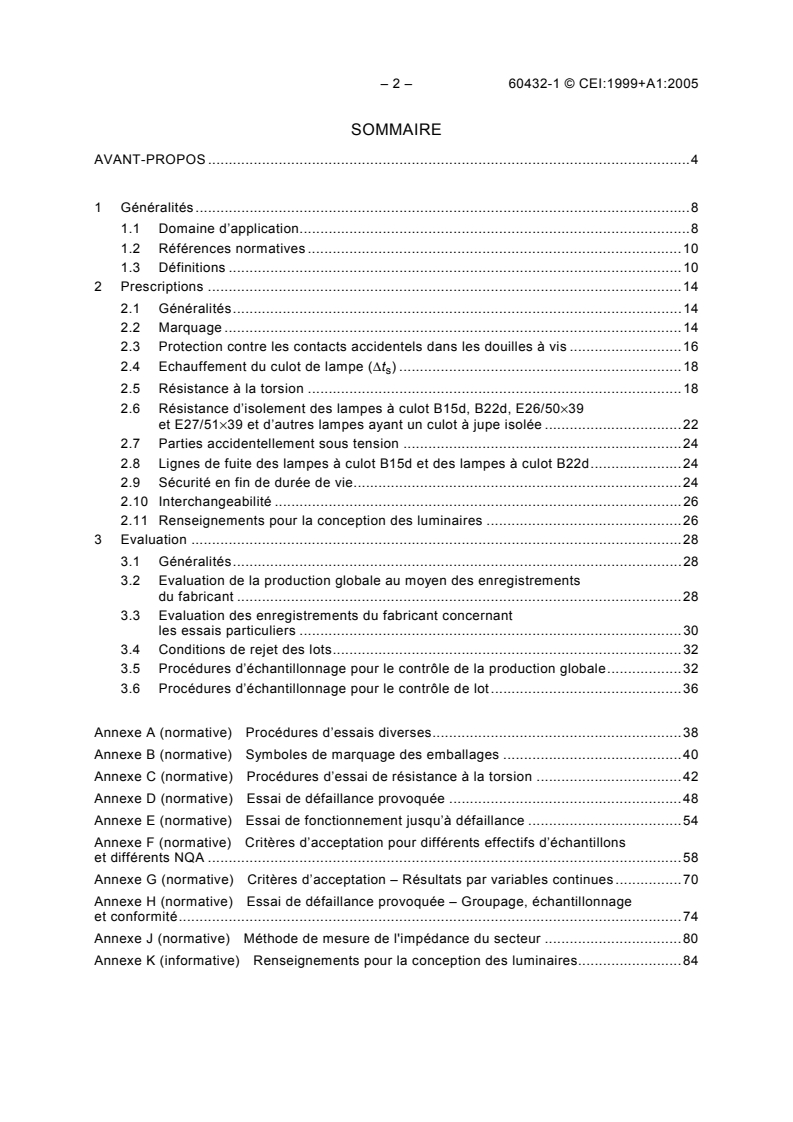
– 2 – 60432-1 © CEI:1999+A1:2005
SOMMAIRE
AVANT-PROPOS .4
1 Généralités.8
1.1 Domaine d’application.8
1.2 Références normatives .10
1.3 Définitions .10
2 Prescriptions .14
2.1 Généralités.14
2.2 Marquage .14
2.3 Protection contre les contacts accidentels dans les douilles à vis .16
2.4 Echauffement du culot de lampe (Δt ) .18
s
2.5 Résistance à la torsion .18
2.6 Résistance d’isolement des lampes à culot B15d, B22d, E26/50× 39
et E27/51× 39 et d’autres lampes ayant un culot à jupe isolée .22
2.7 Parties accidentellement sous tension .24
2.8 Lignes de fuite des lampes à culot B15d et des lampes à culot B22d.24
2.9 Sécurité en fin de durée de vie.24
2.10 Interchangeabilité .26
2.11 Renseignements pour la conception des luminaires .26
3 Evaluation .28
3.1 Généralités.28
3.2 Evaluation de la production globale au moyen des enregistrements
du fabricant .28
3.3 Evaluation des enregistrements du fabricant concernant
les essais particuliers .30
3.4 Conditions de rejet des lots.32
3.5 Procédures d’échantillonnage pour le contrôle de la production globale.32
3.6 Procédures d’échantillonnage pour le contrôle de lot.36
Annexe A (normative) Procédures d’essais diverses.38
Annexe B (normative) Symboles de marquage des emballages .40
Annexe C (normative) Procédures d’essai de résistance à la torsion .42
Annexe D (normative) Essai de défaillance provoquée .48
Annexe E (normative) Essai de fonctionnement jusqu’à défaillance .54
Annexe F (normative) Critères d’acceptation pour différents effectifs d’échantillons
et différents NQA .58
Annexe G (normative) Critères d’acceptation – Résultats par variables continues .70
Annexe H (normative) Essai de défaillance provoquée – Groupage, échantillonnage
et conformité.74
Annexe J (normative) Méthode de mesure de l'impédance du secteur .80
Annexe K (informative) Renseignements pour la conception des luminaires.84
– 4 – 60432-1 © CEI:1999+A1:2005
COMMISSION ÉLECTROTECHNIQUE INTERNATIONALE
____________
LAMPES À INCANDESCENCE –
PRESCRIPTIONS DE SÉCURITÉ –
Partie 1: Lampes à filament de tungstène
pour usage domestique et éclairage général similaire
AVANT-PROPOS
1) La Commission Electrotechnique Internationale (CEI) est une organisation mondiale de normalisation composée
de l'ensemble des comités électrotechniques nationaux (Comités nationaux de la CEI). La CEI a pour objet de
favoriser la coopération internationale pour toutes les questions de normalisation dans les domaines de
l'électricité et de l'électronique. A cet effet, la CEI – entre autres activités – publie des Normes internationales,
des Spécifications techniques, des Rapports techniques, des Spécifications accessibles au public (PAS) et des
Guides (ci-après dénommés "Publication(s) de la CEI"). Leur élaboration est confiée à des comités d'études,
aux travaux desquels tout Comité national intéressé par le sujet traité peut participer. Les organisations
internationales, gouvernementales et non gouvernementales, en liaison avec la CEI, participent également aux
travaux. La CEI collabore étroitement avec l'Organisation Internationale de Normalisation (ISO), selon des
conditions fixées par accord entre les deux organisations.
2) Les décisions ou accords officiels de la CEI concernant les questions techniques représentent, dans la mesure
du possible, un accord international sur les sujets étudiés, étant donné que les Comités nationaux de la CEI
intéressés sont représentés dans chaque comité d’études.
3) Les Publications de la CEI se présentent sous la forme de recommandations internationales et sont agréées
comme telles par les Comités nationaux de la CEI. Tous les efforts raisonnables sont entrepris afin que la CEI
s'assure de l'exactitude du contenu technique de ses publications; la CEI ne peut pas être tenue responsable de
l'éventuelle mauvaise utilisation ou interprétation qui en est faite par un quelconque utilisateur final.
4) Dans le but d'encourager l'uniformité internationale, les Comités nationaux de la CEI s'engagent, dans toute la
mesure possible, à appliquer de façon transparente les Publications de la CEI dans leurs publications
nationales et régionales. Toutes divergences entre toutes Publications de la CEI et toutes publications
nationales ou régionales correspondantes doivent être indiquées en termes clairs dans ces dernières.
5) La CEI n’a prévu aucune procédure de marquage valant indication d’approbation et n'engage pas sa
responsabilité pour les équipements déclarés conformes à une de ses Publications.
6) Tous les utilisateurs doivent s'assurer qu'ils sont en possession de la dernière édition de cette publication.
7) Aucune responsabilité ne doit être imputée à la CEI, à ses administrateurs, employés, auxiliaires ou
mandataires, y compris ses experts particuliers et les membres de ses comités d'études et des Comités
nationaux de la CEI, pour tout préjudice causé en cas de dommages corporels et matériels, ou de tout autre
dommage de quelque nature que ce soit, directe ou indirecte, ou pour supporter les coûts (y compris les frais
de justice) et les dépenses découlant de la publication ou de l'utilisation de cette Publication de la CEI ou de
toute autre Publication de la CEI, ou au crédit qui lui est accordé.
8) L'attention est attirée sur les références normatives citées dans cette publication. L'utilisation de publications
référencées est obligatoire pour une application correcte de la présente publication.
9) L’attention est attirée sur le fait que certains des éléments de la présente Publication de la CEI peuvent faire
l’objet de droits de propriété intellectuelle ou de droits analogues. La CEI ne saurait être tenue pour
responsable de ne pas avoir identifié de tels droits de propriété et de ne pas avoir signalé leur existence.
La Norme internationale CEI 60432-1 a été établie par le sous-comité 34A: Lampes, du comité
d’études 34 de la CEI: Lampes et équipements associés.
La présente version consolidée de la CEI 60432-1 comprend la deuxième édition (1999)
[documents 34A/873/FDIS et 34A/887/RVD] et son amendement 1 (2005) [documents
34A/1118/FDIS et 34A/1127/RVD].
Le contenu technique de cette version consolidée est donc identique à celui de l'édition de
base et à son amendement; cette version a été préparée par commodité pour l'utilisateur.
Elle porte le numéro d'édition 2.1.
Une ligne verticale dans la marge indique où la publication de base a été modifiée par
l'amendement 1.
– 6 – 60432-1 © CEI:1999+A1:2005
Les annexes A à J font partie intégrante de cette norme.
L’annexe K est donnée uniquement à titre d’information.
Le comité a décidé que le contenu de la publication de base et de ses amendements ne sera
pas modifié avant la date de maintenance indiquée sur le site web de la CEI sous
"http://webstore.iec.ch" dans les données relatives à la publication recherchée. A cette date,
la publication sera
• reconduite,
• supprimée,
• remplacée par une édition révisée, ou
• amendée.
– 8 – 60432-1 © CEI:1999+A1:2005
LAMPES À INCANDESCENCE –
PRESCRIPTIONS DE SÉCURITÉ –
Partie 1: Lampes à filament de tungstène
pour usage domestique et éclairage général similaire
1 Généralités
1.1 Domaine d’application
La Norme internationale CEI 60432-1 fournit les prescriptions de sécurité et d’interchangea-
bilité relatives aux lampes à filament de tungstène pour éclairage général ayant:
– une puissance assignée égale ou inférieure à 200 W;
– une tension assignée comprise entre 50 V et 250 V (limites incluses);
*
– des ampoules de l’une des formes A, B, C, G, M, P, PS, PAR ou R, ou d’une autre forme
pourvu que, dans ce cas, les lampes soient prévues pour remplir les mêmes fonctions que
celles équipées d’ampoules correspondant aux symboles littéraux précédents;
– des ampoules avec tous les types de finition;
**
, E26d, E26/50× 39, E27 ou E27/51× 39.
– des culots B15d, B22d, E12, E14, E17, E26
Dans la mesure du possible, la présente norme s'applique également aux lampes ayant des
ampoules et des culots différents de ceux qui sont mentionnés ci-dessus, mais remplissant les
mêmes fonctions.
La présente norme spécifie la méthode que le fabricant doit appliquer pour démontrer la
conformité de ses produits sur la base de l’évaluation de la production globale et en tenant
compte des résultats enregistrés par le fabricant dans le contrôle de ses produits finis. Cette
méthode peut aussi être appliquée à des fins de certification. La norme fournit aussi des
précisions sur une procédure de contrôle par lots qui peut être utilisée pour effectuer une
évaluation limitée de lots.
La présente norme ne concerne que les critères de sécurité et ne prend pas en compte la
performance des lampes à filament de tungstène relative aux caractéristiques de flux
lumineux, de durée ou de puissance consommée. Pour ces caractéristiques, le lecteur devra
se reporter à la CEI 60064, en ce qui concerne les types de lampes utilisés normalement pour
l'éclairage général.
__________
*
Consulter la CEI 60887 pour la définition des symboles littéraux; les noms qui leur sont traditionnellement
associés sont:
– Forme de poire = A, PS
– Oignon = M
– Flamme = B, C (en Amérique du Nord)
– Sphérique = P
– Globe = G
– A réflecteur = R
– A réflecteur parabolique = PAR
**
Il y a deux versions du culot E26 qui ne sont pas tout à fait compatibles. Des références séparées ont été données,
dans la présente norme, au culot E26/24 utilisé en Amérique du Nord et au culot E26/25 utilisé au Japon.
– 10 – 60432-1 © CEI:1999+A1:2005
1.2 Références normatives
Les documents de référence suivants sont indispensables pour l'application du présent
document. Pour les références datées, seule l'édition citée s'applique. Pour les références non
datées, la dernière édition du document de référence s'applique (y compris les éventuels
amendements).
CEI 60061-1: Culots de lampes et douilles ainsi que calibres pour le contrôle de
l’interchangeabilité et de la sécurité – Partie 1: Culots de lampes
CEI 60061-3: Culots de lampes et douilles ainsi que calibres pour le contrôle de
l’interchangeabilité et de la sécurité – Partie 3: Calibres
CEI 60064: Lampes à filament de tungstène pour usage domestique et éclairage général
similaire – Prescriptions de performances
CEI 60360: Méthode normalisée de mesure de l’échauffement d’un culot de lampe
CEI 60410: Plans et règles d’échantillonnage pour les contrôles par attributs
CEI 60432-2: Lampes à incandescence – Prescriptions de sécurité – Partie 2: Lampes
tungstène-halogène pour usage domestique et éclairage général similaire
CEI 60598-1: Luminaires – Partie 1: Prescriptions générales et essais
CEI 60887: Système de désignation des ampoules de verre pour lampes
ISO 3951: Règles et tables d’échantillonnage pour les contrôles par mesures des pourcentages
de non-conformes
1.3 Définitions
Pour les besoins de la présente Norme internationale, les définitions suivantes s’appliquent.
1.3.1
catégorie
toutes les lampes d’un même fabricant présentant la même construction générale (forme
d’ampoule, dimensions extérieures, type de culot, type de filament), les mêmes tension et
puissance assignées et la même finition
Pour les besoins de la présente norme:
a) les finitions claire, dépolie et les recouvrements équivalents à un dépoli, sont considérés
comme identiques;
b) les finitions blanches et celles de différentes couleurs ne sont pas considérées comme identiques.
NOTE Les lampes ne différant que par leurs culots (E27 et B22d par exemple) sont de «catégories» différentes,
mais de même «type», comme défini dans la CEI 60064.
1.3.2
type
lampes qui, indépendamment du type de culot, ont les mêmes caractéristiques photométriques
et électriques
– 12 – 60432-1 © CEI:1999+A1:2005
1.3.3
classe
toutes les lampes d’un même fabricant présentant la même construction générale (forme
d’ampoule, dimensions extérieures, type de culot, type de filament), la même puissance
assignée et la même finition, et ne différant que par leurs tensions assignées lorsque celles-ci
font partie de la même plage (100 V à 150 V, 200 V à 250 V par exemple)
1.3.4
tension assignée
tension ou plage de tension spécifiée dans la norme correspondante de la lampe ou fixée par
le fabricant ou le vendeur responsable
(Si des lampes sont marquées d’une plage de tensions, elles doivent être considérées comme
convenant à l’emploi sous l’une quelconque des tensions de la plage.)
1.3.5
tension d’essai
tension assignée sauf autre spécification
(Si des lampes sont marquées d’une plage de tensions, la tension d’essai, sauf spécification
différente, doit être la moyenne de la plage.)
1.3.6
puissance assignée
puissance spécifiée dans la norme correspondante de la lampe ou spécifiée par le fabricant ou
par le vendeur responsable
1.3.7
fin de la durée de vie
instant où la lampe alimentée cesse d’émettre de la lumière
1.3.8
échauffement du culot (Δt )
s
échauffement, au-dessus de la température ambiante, de la surface d’une douille d’essai
normalisée, montée sur le culot de la lampe, la mesure étant effectuée conformément aux
prescriptions de la CEI 60360
1.3.9
contrôle de conception
vérification, sur un échantillon, de la conformité de la conception d’une catégorie, classe ou
groupe de catégories aux prescriptions de l’article correspondant
1.3.10
contrôle périodique
contrôle renouvelé périodiquement en vue de vérifier que le produit ne s’écarte pas, à certains
égards, du modèle retenu
1.3.11
contrôle courant
contrôle renouvelé à intervalles courts pour fournir des données d’évaluation
1.3.12
lot
toutes les lampes d’une même catégorie, identifiées comme telles, et soumises en une fois
aux essais de réception
– 14 – 60432-1 © CEI:1999+A1:2005
1.3.13
production globale
ensemble de tous les types de lampes relevant du domaine de la présente norme, produits durant
une période de 12 mois et nommément désignés dans une liste par le fabricant pour être soumis
au contrôle. Cette liste est à incorporer au certificat lorsque la certification est mise en jeu
1.3.14
lampe à calotte argentée
lampe dont une partie de l’ampoule est recouverte d’un matériau réflecteur destiné à
transmettre une partie substantielle de la lumière dans la direction du culot de la lampe
1.3.15
température maximale du culot
température maximale que les composants de la lampe situés dans le voisinage du culot sont
conçus pour supporter pendant la durée de vie prévue de la lampe
1.3.16
diamètre de référence du col des lampes
diamètre d’une lampe ayant une influence sur la protection contre les contacts accidentels, et
mesuré à une distance bien définie de la soudure du plot central
Pour les lampes avec culot E14 cette distance est de 30 mm
2 Prescriptions
2.1 Généralités
Les lampes doivent être conçues et construites de manière que leur fonctionnement, en usage
normal, ne présente pas de danger pour l’utilisateur ou l’environnement.
Les lampes doivent satisfaire aux prescriptions du présent article.
2.2 Marquage
2.2.1 Marquage obligatoire
Les renseignements ci-dessous doivent être marqués sur les lampes; le marquage doit être
lisible durablement lorsqu’il est soumis à l’essai décrit en A.1:
a) la marque d’origine (elle peut prendre la forme d’une marque commerciale, du nom du
fabricant ou du vendeur responsable);
b) la tension assignée ou la plage de tensions suivies de «V» ou «volts»;
c) la puissance assignée suivie de «W» ou «watts»;
Pour les lampes dont le diamètre d’ampoule est égal ou supérieur à 40 mm et dont la puis-
sance réelle est égale ou inférieure à 14 W, il n’est pas nécessaire de marquer la puissance.
Pour les lampes destinées à être utilisées aux tensions d’alimentation du Royaume-Uni, il est
admis que le marquage de la tension assignée soit 240 volts ou 240 V.
NOTE Au Royaume-Uni, la mise en application du processus d’harmonisation européenne de la tension 230 V
permet de conserver le 240 V pour les tensions d’alimentation.
– 16 – 60432-1 © CEI:1999+A1:2005
2.2.2 Lampes à réflecteur dichroïque (faisceau froid) et lampes à calotte argentée
La partie de l’emballage enveloppant ou contenant immédiatement la lampe doit être marquée
du symbole correspondant ainsi qu’il est indiqué à l’annexe B.
2.2.3 Lampes avec limitations de position de fonctionnement
Pour les lampes exigeant des limitations de la position de fonctionnement, telles que les
lampes flammes et sphériques de 60 W à culots B22d et E27, qui ne peuvent satisfaire aux
prescriptions d'échauffement du culot que si l’on exclut la position de fonctionnement culot
haut, la partie de l’emballage enveloppant ou contenant immédiatement la lampe doit être
marquée du symbole approprié. Un exemple est indiqué à l’annexe B.
NOTE Les prescriptions de 2.2.2 et 2.2.3 sont destinées à l’information de l’utilisateur final.
2.3 Protection contre les contacts accidentels dans les douilles à vis
Les dimensions des lampes à culot à vis doivent être telles que les prescriptions de sécurité
contre les contacts accidentels de la CEI 60061 soient respectées.
Les lampes doivent satisfaire au calibrage défini dans la CEI 60061-3 et correspondant au
indications du tableau 1.
Tableau 1 – Calibres de contrôle des lampes pour la protection
contre les contacts accidentels
Culot de lampe Feuille de calibre n° Culot de lampe Feuille de calibre n°
E12 – E26d 7006-29A
E14 voir 2.3.1 E27/25 et E27/27 7006-51A
E17 – 7006-51
E27/51× 39
E26/24 –
E26/25 –
–
E26/50× 39
NOTE Le tiret dans la colonne «Feuille de calibre n°» signifie qu’aucun système n’a été établi pour le moment.
2.3.1 Lampes avec culot E14
Les lampes avec culot E14 doivent satisfaire aux exigences suivantes:
a) les lampes flammes doivent être équipées avec des culots E14/25× 17 et essayées avec le
calibre 7006-55;
b) les lampes sphériques, poirettes (pygmy), tubulaires et à réflecteur ayant des diamètres de
référence de col supérieurs ou égaux à 21 mm, doivent être équipées avec des culots
E14/25× 17 et essayées avec le calibre 7006-55;
c) les lampes sphériques, poirettes (pygmy), tubulaires et à réflecteur ayant des diamètres de
référence de col compris entre 16 mm et 21 mm, doivent être équipées avec des culots
E14/23× 15 ou E14/20;
d) les lampes sphériques, poirettes (pygmy), tubulaires et à réflecteur ayant des diamètres de
référence de col compris entre 14 mm et 16 mm doivent être équipées avec des culots E14/20.
Dans les cas c) et d) un calibre n’est pas nécessaire puisque le choix des culots garantit le
même niveau de sécurité que dans les cas a) et b).
– 18 – 60432-1 © CEI:1999+A1:2005
2.4 Echauffement du culot de lampe (Δt )
s
2.4.1 Echauffement moyen du culot
L’échauffement moyen du culot de chacune des classes de lampes fabriquées au cours d’une
période de 12 mois ne doit pas excéder les valeurs suivantes:
a) la valeur appropriée telle qu’elle est spécifiée au tableau 2; ou
b) une valeur inférieure de 45 K à celles spécifiées au tableau 2 qui tient compte de la
température maximale plus faible du culot selon 2.5.4 b).
Les lampes équipées de culots E12, E17 et E26 à Δt plus élevé, et prévues pour des
s
applications spéciales, sont cependant permises pourvu qu’une notice de sécurité appropriée
accompagne chaque lampe.
NOTE En Amérique du Nord, les types de douilles et de luminaires peuvent être conçus pour les échauffements du
culot des lampes dépolies, claires et blanches. Les lampes présentant une autre finition d’ampoule ou d’autres carac-
téristiques entraînant un échauffement du culot plus élevé peuvent donc nécessiter une notice de sécurité spéciale.
2.4.2 Conformité
La conformité est vérifiée en mesurant l’échauffement de lampes d’une même classe, selon la
procédure d’essai spécifiée dans la CEI 60360.
Si la lampe est marquée d’une plage de tensions, l’échauffement du culot doit être mesuré
sous la tension moyenne pourvu que les limites de la plage ne s’écartent pas de plus de 2,5 %
de la tension moyenne. Pour les lampes à plage de tensions plus étendue, la mesure doit être
effectuée à la tension marquée la plus élevée.
NOTE Le tableau 2 donne les limites supérieures de l’échauffement moyen du culot qui s’appliquent à toutes les
lampes classées par puissance, par ampoule et par culot. En pratique plusieurs caractéristiques du modèle de
lampe, telles que la hauteur de centre lumineux, la forme de la monture et la finition de l’ampoule, affectent
l’échauffement du culot, mais les effets de ces facteurs sont englobés dans chacune des limites.
2.4.3 Essais par lots
Pour les essais par lots, lorsqu’une taille d’échantillon de 20 lampes est nécessaire, la moyenne
ne doit pas excéder la valeur appropriée donnée en 2.4.1, avec une tolérance de +9 K.
2.5 Résistance à la torsion
2.5.1 Culots
Les culots doivent être construits et assemblés aux ampoules de telle manière que ces deux
éléments restent fixés l’un à l’autre durant le fonctionnement normal.
2.5.2 Lampes non utilisées
Le culot des lampes non utilisées ne doit pas se déplacer par rapport à l’ampoule lorsqu’il est
soumis, conformément aux prescriptions de C.1, au couple correspondant dont la valeur est donnée
dans le tableau 3. Si l’assemblage n’est pas réalisé au moyen d’un ciment de culotage ou d’un
adhésif, un mouvement relatif entre culot et ampoule est admis pourvu qu’il n’excède pas 10°.
2.5.3 Résistance à la chaleur
Le culot de la lampe et le ciment de culotage, ou tout autre moyen d’assemblage, doivent
supporter l’exposition à une chaleur égale à la température maximale du culot prescrite pour la
classe de la lampe.
Après l’essai d’échauffement spécifié à C.2, à la température appropriée indiquée en 2.5.4, le
culot de la lampe ne doit pas se déplacer par rapport à l’ampoule lorsqu’on le soumet au
couple correspondant dont la valeur est donnée au tableau 4. Dans le cas où la technique
d’assemblage est autre que le ciment de culotage ou un adhésif, le mouvement relatif entre
ampoule et culot est permis pourvu qu’il n’excède pas 10°.
– 20 – 60432-1 © CEI:1999+A1:2005
Tableau 2 – Echauffement maximal du culot (Δt ) des lampes de différentes puissances
s
et classes produites au cours d’une période moyenne de 12 mois
Numéro Δt max.
s
Forme
Puissance
du K
W d’ampoule
groupe
B15d B22d E12 E14 E17 E26/24 E26/25 E27
1 25 & 30 A, PS, M et - - - - - 95 65 -
autres formes
40 - - - - - 95 85 -
prévues pour
60 - emploi dans le 125 - - - 120 95 120
même
100 - 135 - - - 120 110 130
luminaire
150 & 200 - 135 - - - 120 100 130
4,6 4,6
2 40 135 B, G (diamètre 140 140 130 - 140 - 140
≤ 45 mm), P et
2 4,6 4,6 2
60 145 125 165 140 - 165 - 120
autres formes
prévues pour
emploi dans le
même
luminaire
3 15 - C, F et autres - - - 90 - 90 -
formes prévues 9
25 - - 120 - 110 120 110 -
pour emploi
4,6 9 4,6
40 - dans le même - 140 - 130 140 130 -
luminaire
4,6 9 4,6
60 - - 165 - 130 165 130 -
4 25 & 40 G (diamètre - - - - 110 - 110 -
> 45 mm)
60 & 100 - - - - - - 110 -
5 25 - P & G - - - 110 - 110 -
(diamètre
40 135 135 - 135 - - 110 135
≤ 45 mm) à
60 calotte 135 - - 135 - - 110 -
argentée
6 60 - A & PS à 130 - - - - 110 130
calotte
100 - 135 - - - - 110 135
argentée
150 & 200 - 135 - - - - - 135
7 25 R et autres - - - - 85 - - -
formes prévues 6
40 120 120 - 120 95 145 95 120
pour emploi
60 - dans le même 130 - - 105 145 105 130
luminaire
6,7,8
100, 150 - 135 - - - 145 110 135
& 200
3 6,8
8 75 Formes PAR - - - - - 145 85 150
6,8
100 - - - - - 145 100 150
6,8
150 - - - - - 145 125 150
9 150 Formes PAR à - - - - - 175 150 175
réflecteur
dichroïque
1 Pour les lampes de puissance intermédiaire, on applique les exigences relatives à la puissance supérieure la
plus proche.
2 Cela peut exiger une limitation de la position de fonctionnement.
3 Lampes avec culot à collerette : E26/50x39, E27/51x39, etc.
4 Le fabricant peut limiter le fonctionnement de certaines classes de lampes à la position « culot bas » ou « culot
bas jusqu’à l’horizontale ».
5 Le fabricant peut limiter le fonctionnement de certaines classes de lampes à la position « culot bas ».
6 Le fabricant peut limiter certaines classes de lampes à des applications dans des douilles « haute
température », car des douilles « basse température » pourraient se détériorer.
7 Le fabricant peut limiter certaines classes de lampes à des applications avec une température maximale du
culot de 260 °C dans des douilles « haute température ».
8 Certaines lampes de cette catégorie ne peuvent plus être vendues aux Etats Unis et au Canada en raison des
nouveaux règlements relatifs à l’énergie. Consulter les règlements locaux.
9 A l’étude.
– 22 – 60432-1 © CEI:1999+A1:2005
2.5.4 Température du traitement à la chaleur
Le traitement à la chaleur doit être conduit à l’un des niveaux suivants:
a) à la température maximale de culot en relation avec le type de culot, telle qu’elle est
spécifiée au tableau K.1; ou
b) pour certaines classes de lampes pour lesquelles une température de 210 °C est spécifiée
au tableau K.1, le fabricant peut choisir de concevoir des lampes de manière qu’elles
résistent à une température maximale du culot de 165 °C. Dans ce cas, l’essai d’échauf-
fement est effectué à 165 °C pourvu que la puissance nominale des lampes soit égale ou
inférieure à 15 W et que la lampe ne soit pas un modèle à réflecteur ou à calotte argentée.
NOTE Le fabricant de lampes peut, pour des applications spéciales à l’Amérique du Nord, assigner des
températures maximales de culot inférieures à celles du tableau K.1. Lorsque de telles classes de lampes à
température inférieure sont établies, le fabricant est incité:
– à proposer des limites spéciales à introduire dans la présente norme;
– à prévenir les fabricants de luminaires.
Tableau 3 – Valeurs du couple de torsion pour le contrôle
des lampes non utilisées
Valeur du couple
Type de culot
Nm
B15d 1,15
B22d 3,0
E12 0,8
E14 1,15
E17 1,5
E26, E26d, E27, E26/50× 39 et E27/51× 39 3,0
Tableau 4 – Valeurs du couple de torsion après essai d’échauffement
Valeur du couple
Type de culot
Nm
B15d 0,3
B22d 0,75
E12 0,5
E14 1,0
E17 1,0
E26, E26d, E27, E26/50× 39 et E27/51× 39 2,5
2.6 Résistance d’isolement des lampes à culot B15d, B22d, E26/50× 39 et E27/51× 39
et d’autres lampes ayant un culot à jupe isolée
La résistance d’isolement entre la chemise du culot et les contacts des lampes à culot à
baïonnette ou entre la chemise et la jupe isolée des lampes à culot Edison à jupe ne doit
pas être inférieure à 2 MΩ lorsque cette résistance est mesurée selon la procédure décrite
en A.3.
– 24 – 60432-1 © CEI:1999+A1:2005
2.7 Parties accidentellement sous tension
2.7.1 Parties métalliques destinées à être isolées des parties sous tension
Les parties métalliques destinées à être isolées des parties sous tension ne doivent pas être
sous tension ou le devenir. Toute pièce conductrice mobile doit être placée dans la position la
plus défavorable, sans l’aide d’un outil, avant vérification selon A.4.
2.7.2 Culots à baïonnette
Aucune saillie des contacts des culots à baïonnette ne doit se trouver à moins de 1 mm des
parties métalliques destinées à être isolées.
2.7.3 Culots à vis Edison
Aucune protubérance des culots à vis Edison ne doit faire saillie de plus de 3 mm de la surface
du culot. Voir figure 1.
r = 3 mm
IEC 987/99
Figure 1 – Culot à vis Edison
2.8 Lignes de fuite des lampes à culot B15d et des lampes à culot B22d
La ligne de fuite minimale entre la chemise métallique du culot et les contacts doit être en
conformité avec la distance indiquée dans la CEI 60061-4, feuille 7007-6.
2.9 Sécurité en fin de durée de vie
Lorsque l’essai est exécuté dans les conditions spécifiées, la défaillance de la lampe ne doit
pas s'accompagner du bris de l’enveloppe de verre extérieure ou de son éjection hors du culot.
Pour les lampes à culot à baïonnette il est aussi exigé qu’il ne se produise pas de court-circuit
interne de la chemise après l’essai.
– 26 – 60432-1 © CEI:1999+A1:2005
Les conditions d’essai sont:
– un essai de défaillance provoquée, conformément à l’annexe D, ou conformément à l’essai
de défaillance donné en variante dans l’annexe A de la CEI 60432-2, et
– un essai de fonctionnement jusqu’à défaillance, selon l’annexe E.
NOTE 1 En cas de désaccord, les essais des annexes D et E sont les méthodes de référence.
NOTE 2 L’essai de défaillance provoquée ne convient pas aux lampes à tension assignée inférieure à 100 V;
cependant la variante de l’essai de défaillance provoquée est approprié aux lampes à tension assignée inférieure
à 100 V.
NOTE 3 Si les lampes sont rejetées à l’essai de défaillance provoquée, il n’est pas nécessaire de les soumettre à
l’essai de fonctionnement jusqu’à défaillance.
NOTE 4 Dans les conditions définies en H.3, l’essai de fonctionnement jusqu’à défaillance peut être utilisé à la
place de l’essai de défaillance provoquée.
2.10 Interchangeabilité
L’interchangeabilité doit être assurée par l’utilisation de culots conformes à la CEI 60061-1.
Les lampes finies doivent satisfaire au contrôle avec les calibres de vérification des dimensions
commandant l’interchangeabilité, conformément au tableau 5. Les calibres sont ceux indiqués
dans les feuilles de norme particulières de la CEI 60061-3.
2.11 Renseignements pour la conception des luminaires
Se reporter à l’annexe K.
Tableau 5 – Calibres de contrôle de l’interchangeabilité et des cotes de culots de lampes
Culot Dimensions de culot à vérifier au calibre Feuille de calibre
B15d, Amin. 7006-10
B22d 7006-11
Amax., D1max., Nmin.
Insertion du culot dans la douille 7006-4A
Retenue du culot dans la douille 7006-4B
E12 Dimensions maximales du filetage 7006-27H
Calibre additionnel "Entre" pour le filetage 7006-27J
Diamètre extérieur minimal du filetage 7006-28C
E14 Dimensions maximales du filetage 7006-27F
Diamètre extérieur minimal du filetage 7006-28B
Dimension S1 7006-27G
E17 Dimensions maximales du filetage 7006-27K
Diamètre extérieur minimal du filetage 7006-28F
E26, E26d, Dimensions maximales du filetage 7006-27D
E26/50x39 Diamètre extérieur minimal du filetage 7006-29L
E27, Dimensions maximales du filetage 7006-27B
E27/51x39 Diamètre extérieur minimal du filetage 7006-28A
Dimension S1 7006-27C
– 28 – 60432-1 © CEI:1999+A1:2005
3 Evaluation
3.1 Généralités
Le présent article spécifie la méthode qu’il convient qu’un fabricant applique pour démontrer la
conformité de son produit à la présente norme, méthode basée sur l’évaluation de la produc-
tion globale, associée à ses enregistrements d’essais sur les produits finis. Cette méthode
peut aussi être appliquée à des fins de certification. Les articles 3.2, 3.3 et 3.5 fournissent des
précisions concernant l’évaluation au moyen des enregistrements du fabricant.
Des précisions concernant une procédure de contrôle de lot qui peut être utilisée pour une
évaluation limitée sont données en 3.4 et 3.6. Les prescriptions du contrôle de lot ont été
introduites afin de permettre l’évaluation de lots présumés contenir des lampes peu sûres. Etant
donné que certaines prescriptions de sécurité ne peuvent être vérifiées au moyen d’un contrôle
de lot et que l’on peut ne pas avoir de connaissance préalable de la qualité de la production d’un
fabricant, le contrôle de lot ne peut être utilisé à des fins de certification ni, en aucune façon, pour
la réception de lots. Dans le cas où un lot est considéré comme acceptable, un organisme de
contrôle peut seulement conclure qu’il n’y a pas de raison de refuser le lot en invoquant la sécurité.
3.2 Evaluation de la production globale au moyen des enregistrements du fabricant
3.2.1 Le fabricant doit faire la preuve que ses produits sont conformes aux prescriptions
de 3.3. A cette fin, le fabricant doit mettre à disposition tous les résultats du contrôle de ses
produits correspondant aux prescriptions de la présente norme.
3.2.2 Les résultats d’essais peuvent être tirés d’enregistrements de travail et, à ce titre, n’être
pas immédiatement disponibles sous une forme collationnée.
3.2.3 L’évaluation doit, de manière générale, concerner les usines individuellement, chacune
de celles-ci devant respecter les critères d’acceptation de 3.3. Cependant, un certain nombre
d’usines peuvent être regroupées, à condition qu’elles relèvent du même management de la
qualité. Pour les besoins de la certification, un seul certificat couvrant un groupe d’usines
nommément désignées peut être émis, mais l’autorité de certification doit avoir le droit de
visiter chacune des usines concernées pour y examiner les enregistrements et les procédures
de maîtrise de la qualité qui sont applicables.
3.2.4 Le fabricant doit déclarer, en vue de la certification, une liste des marques d’origine et
des catégories ou classes de lampes correspondantes, relevant de la présente norme et
fabriquées dans un groupe d’usines nommément désignées. Le certificat doit être considéré
comme incluant toutes les lampes de la liste produites par le fabricant. La notification
d’additions ou de suppressions peut être faite à tout moment.
3.2.5 Pour la présentation des résultats d’essais, le fabricant peut combiner les résultats de
classes de lampes différentes d’après la colonne 4 du tableau 6.
L’évaluation de la production globale exige que les procédures de maîtrise de la qualité d’un
fabricant satisfassent à des exigences reconnues, pour un système qualité, en matière de
contrôle final. Dans le cadre d’un système d’assurance qualité basé aussi sur des contrôles et
essais en cours de processus, le fabricant peut faire la démonstration de la conformité à
certaines prescriptions de la présente norme au moyen du contrôle en cours de processus au
lieu du contrôle sur le produit fini.
3.2.6 Le fabricant doit fournir, pour chaque article, des enregistrements d’essais en nombre
suffisant selon les indications de la colonne 5 du tableau 6.
3.2.7 Le nombre de non-conformités dans les enregistrements du fabricant ne doit pas
dépasser les limites, indiquées à l’annexe F, correspondant aux valeurs de Niveau de Qualité
Acceptable (NQA) données dans la colonne 6 du tableau 6.
– 30 – 60432-1 © CEI:1999+A1:2005
3.2.8 La période examinée en vue de l’évaluation n’est pas nécessairement limitée à une
année prédéterminée, mais peut consister en 12 mois entiers consécutifs précédant
immédiatement la date de l’examen.
3.2.9 Un fabricant qui a atteint mais n’atteint plus les critères d’acceptation spécifiés pourra
continuer à revendiquer la conformité à la présente norme s’il peut montrer que:
a) des dispositions ont été prises pour remédier à la situation dès que la tendance a été
raisonnablement confirmée par ses enregistrements d’essais;
b) le niveau d’acceptation spécifié a été rétabli dans un délai de:
– six mois pour 2.4.1, 2.5.3 et 2.9;
– un mois pour les autres articles.
Lorsque la conformité est évaluée après qu’une action corrective ait été menée conformément
aux points a) et b), les enregistrements d’essais des catégories de lampes non conformes
doivent être exclus, pour leur période de non-conformité, des résultats cumulés sur 12 mois.
Les résultats d’essais correspondant à la période de l’action corrective doivent être conservés
dans les enregistrements.
3.2.10 Un fabricant qui n’a pas satisfait aux prescriptions d’un article pour lequel le
groupement des résultats d’essais est permis selon 3.2.5, ne doit pas être disqualifié pour la
totalité des classes de lampes ainsi groupées s’il peut démontrer, par un contrôle
complémentaire, que le problème n’apparaît que dans certaines d’entre elles. Ces classes sont
alors traitées conformément à 3.2.9 ou sont éliminées de la liste des classes pour lesquelles la
conformité à la présente norme peut être revendiquée par le fabricant.
3.2.11 Dans le cas où une catégorie ou une classe a été, conformément à 3.2.10, éliminée de
la liste (voir 3.2.4 ), elle peut y être réintroduite si des résultats satisfaisants sont obtenus dans
les essais d’un nombre de lampes équivalent à la taille de l’échantillon annuel minimal prescrit,
au tableau 6, pour l’article où la non-conformité s’est produite. La période au cours de laquelle
cet échantillon est constitué peut être brève.
3.2.12 Dans le cas de nouveaux produits, ceux-ci peuvent présenter des caractéristiques
communes avec des classes de lampes existantes; ils peuvent alors être considérés comme
conformes pour ces caractéristiques si le nouveau produit a été introduit dans le plan
d’échantillonnage aussitôt que sa fabrication a commencé. Toute caractéristique qui n’aurait
pas été couverte de cette manière devra être contrôlée avant le démarrage de la production.
3.3 Evaluation des enregistrements du fabricant concernant les essais particuliers
3.3.1 Le tableau 6 spécifie les types d’essais et donne d’autres renseignements concernant la
méthode d’évaluation de la conformité aux prescriptions de divers articles. Pour certains essais
particuliers, des renseignements plus détaillés sont donnés ci-dessous.
Il n’est nécessaire de renouveler un essai de conception que lorsqu’une modification substan-
tielle est apportée à la construction matérielle ou mécanique, aux matériaux ou au processus
de fabrication utilisé pour réaliser le produit concerné. Des essais ne sont nécessaires que
pour les propriétés affectées par la modification.
3.3.2 En ce qui concerne l’essai de torsion exécuté après le chauffage prescrit en 2.5.3, le
fabricant a le choix entre deux procédures d’essai, conformément à l’annexe C.
NOTE Dans la mesure où les données tirées de l’application de la méthode par variables C.1.4 b) forment une
distribution presque gaussienne, les techniques statistiques de la loi normale peuvent être utilisées pour estimer la
conformit
...
NORME CEI
INTERNATIONALE IEC
60432-1
INTERNATIONAL
Deuxième édition
STANDARD
Second edition
1999-08
Lampes à incandescence –
Prescriptions de sécurité –
Partie 1:
Lampes à filament de tungstène pour usage
domestique et éclairage général similaire
Incandescent lamps –
Safety specifications –
Part 1:
Tungsten filament lamps for domestic and
similar general lighting purposes
Numéro de référence
Reference number
CEI/IEC 60432-1:1999
Numéros des publications Numbering
Depuis le 1er janvier 1997, les publications de la CEI As from 1 January 1997 all IEC publications are
sont numérotées à partir de 60000. issued with a designation in the 60000 series.
Publications consolidées Consolidated publications
Les versions consolidées de certaines publications de Consolidated versions of some IEC publications
la CEI incorporant les amendements sont disponibles. including amendments are available. For example,
Par exemple, les numéros d’édition 1.0, 1.1 et 1.2 edition numbers 1.0, 1.1 and 1.2 refer, respectively, to
indiquent respectivement la publication de base, la the base publication, the base publication incor-
publication de base incorporant l’amendement 1, et la porating amendment 1 and the base publication
publication de base incorporant les amendements 1 incorporating amendments 1 and 2.
et 2.
Validité de la présente publication Validity of this publication
Le contenu technique des publications de la CEI est The technical content of IEC publications is kept
constamment revu par la CEI afin qu'il reflète l'état under constant review by the IEC, thus ensuring that
actuel de la technique. the content reflects current technology.
Des renseignements relatifs à la date de reconfir- Information relating to the date of the reconfirmation
mation de la publication sont disponibles dans le of the publication is available in the IEC catalogue.
Catalogue de la CEI.
Les renseignements relatifs à des questions à l’étude et Information on the subjects under consideration and
des travaux en cours entrepris par le comité technique work in progress undertaken by the technical
qui a établi cette publication, ainsi que la liste des committee which has prepared this publication, as well
publications établies, se trouvent dans les documents ci- as the list of publications issued, is to be found at the
dessous: following IEC sources:
• «Site web» de la CEI* • IEC web site*
• Catalogue des publications de la CEI • Catalogue of IEC publications
Publié annuellement et mis à jour Published yearly with regular updates
régulièrement (On-line catalogue)*
(Catalogue en ligne)*
• Bulletin de la CEI
• IEC Bulletin
Disponible à la fois au «site web» de la CEI* Available both at the IEC web site* and
et comme périodique imprimé as a printed periodical
Terminologie, symboles graphiques Terminology, graphical and letter
et littéraux
symbols
En ce qui concerne la terminologie générale, le lecteur For general terminology, readers are referred to
se reportera à la CEI 60050: Vocabulaire Electro-
IEC 60050: International Electrotechnical Vocabulary
technique International (VEI).
(IEV).
Pour les symboles graphiques, les symboles littéraux For graphical symbols, and letter symbols and signs
et les signes d'usage général approuvés par la CEI, le approved by the IEC for general use, readers are
lecteur consultera la CEI 60027: Symboles littéraux à referred to publications IEC 60027: Letter symbols to
utiliser en électrotechnique, la CEI 60417: Symboles
be used in electrical technology, IEC 60417: Graphical
graphiques utilisables sur le matériel. Index, relevé et
symbols for use on equipment. Index, survey and
compilation des feuilles individuelles, et la CEI 60617: compilation of the single sheets and IEC 60617:
Symboles graphiques pour schémas. Graphical symbols for diagrams.
* Voir adresse «site web» sur la page de titre.
* See web site address on title page.
NORME CEI
INTERNATIONALE IEC
60432-1
INTERNATIONAL
Deuxième édition
STANDARD
Second edition
1999-08
Lampes à incandescence –
Prescriptions de sécurité –
Partie 1:
Lampes à filament de tungstène pour usage
domestique et éclairage général similaire
Incandescent lamps –
Safety specifications –
Part 1:
Tungsten filament lamps for domestic and
similar general lighting purposes
IEC 1999 Droits de reproduction réservés Copyright - all rights reserved
Aucune partie de cette publication ne peut être reproduite ni No part of this publication may be reproduced or utilized in
utilisée sous quelque forme que ce soit et par aucun procédé, any form or by any means, electronic or mechanical,
électronique ou mécanique, y compris la photo-copie et les including photocopying and microfilm, without permission in
microfilms, sans l'accord écrit de l'éditeur. writing from the publisher.
International Electrotechnical Commission 3, rue de Varembé Geneva, Switzerland
Telefax: +41 22 919 0300 e-mail: inmail@iec.ch IEC web site http://www.iec.ch
CODE PRIX
Commission Electrotechnique Internationale
X
PRICE CODE
International Electrotechnical Commission
Pour prix, voir catalogue en vigueur
For price, see current catalogue
– 2 – 60432-1 © CEI:1999
SOMMAIRE
Pages
AVANT-PROPOS . 4
Articles
1 Généralités.6
1.1 Domaine d’application.6
1.2 Références normatives.8
1.3 Définitions. 8
2 Prescriptions.12
2.1 Généralités.12
2.2 Marquage.12
2.3 Protection contre les contacts accidentels dans les douilles à vis . 14
2.4 Echauffement du culot de lampe (Δt ) . 16
s
2.5 Résistance à la torsion. 16
2.6 Résistance d’isolement des lampes à culot B15d, B22d, E26/50×39 et E27/51×39
et d’autres lampes ayant un culot à jupe isolée. 20
2.7 Parties accidentellement sous tension. 22
2.8 Lignes de fuite des lampes à culot B15d et des lampes à culot B22d . 22
2.9 Sécurité en fin de durée de vie. 22
2.10 Interchangeabilité . 24
2.11 Renseignements pour la conception des luminaires. 24
3 Evaluation.26
3.1 Généralités.26
3.2 Evaluation de la production globale au moyen des enregistrements du fabricant . 26
3.3 Evaluation des enregistrements du fabricant concernant les essais particuliers . 28
3.4 Conditions de rejet des lots . 30
3.5 Procédures d’échantillonnage pour le contrôle de la production globale . 30
3.6 Procédures d’échantillonnage pour le contrôle de lot . 34
Annexe A (normative) Procédures d’essais diverses . 36
Annexe B (normative) Symboles de marquage des emballages . 38
Annexe C (normative) Procédures d’essai de résistance à la torsion . 40
Annexe D (normative) Essai de défaillance provoquée . 46
Annexe E (normative) Essai de fonctionnement jusqu’à défaillance . 52
Annexe F (normative) Critères d’acceptation pour différents effectifs d’échantillons
et différents NQA. . 56
Annexe G (normative) Critères d’acceptation – Résultats par variables continues. 68
Annexe H (normative) Essai de défaillance provoquée – Groupage, échantillonnage
et conformité . . 72
Annexe J (normative) Méthode de mesure de l'impédance du secteur . 78
Annexe K (informative) Renseignements pour la conception des luminaires . 82
60432-1 © IEC:1999 – 3 –
CONTENTS
Page
FOREWORD . 5
Clause
1 General.7
1.1 Scope.7
1.2 Normative references.9
1.3 Definitions.9
2 Requirements.13
2.1 General.13
2.2 Marking.13
2.3 Protection against accidental contact in screw lampholders . 15
2.4 Lamp cap temperature rise (Δt ). 17
s
2.5 Resistance to torque . 17
2.6 Insulation resistance of B15d, B22d, E26/50×39 and E27/51×39 capped lamps
and other lamps having insulated skirts . 21
2.7 Accidentally live parts. 23
2.8 Creepage distances for B15d and B22d capped lamps . 23
2.9 Safety at end of life . 23
2.10 Interchangeability.25
2.11 Information for luminaire design . 25
3 Assessment.27
3.1 General.27
3.2 Whole production assessment by means of the manufacturer’s records . 27
3.3 Assessment of the manufacturer’s records of particular tests. 29
3.4 Rejection conditions of batches . 31
3.5 Sampling procedures for whole production testing . 31
3.6 Sampling procedures for batch testing. 35
Annex A (normative) Miscellaneous test procedures . 37
Annex B (normative) Packaging marking symbols . 39
Annex C (normative) Resistance to torque test procedures . 41
Annex D (normative) Induced-failure test . 47
Annex E (normative) Operation-to-failure test . 53
Annex F (normative) Acceptance numbers for various sample sizes and AQLs . 57
Annex G (normative) Acceptance criteria – Continuously variable results . 69
Annex H (normative) Induced-failure test – Grouping, sampling and compliance . 73
Annex J (normative) Method of measuring mains impedance . 79
Annex K (informative) Information for luminaire design. 83
– 4 – 60432-1 © CEI:1999
COMMISSION ÉLECTROTECHNIQUE INTERNATIONALE
____________
LAMPES À INCANDESCENCE –
PRESCRIPTIONS DE SÉCURITÉ –
Partie 1: Lampes à filament de tungstène
pour usage domestique et éclairage général similaire
AVANT-PROPOS
1) La CEI (Commission Electrotechnique Internationale) est une organisation mondiale de normalisation composée
de l'ensemble des comités électrotechniques nationaux (Comités nationaux de la CEI). La CEI a pour objet de
favoriser la coopération internationale pour toutes les questions de normalisation dans les domaines de
l'électricité et de l'électronique. A cet effet, la CEI, entre autres activités, publie des Normes Internationales.
Leur élaboration est confiée à des comités d'études, aux travaux desquels tout Comité national intéressé par le
sujet traité peut participer. Les organisations internationales, gouvernementales et non gouvernementales, en
liaison avec la CEI, participent également aux travaux. La CEI collabore étroitement avec l'Organisation
Internationale de Normalisation (ISO), selon des conditions fixées par accord entre les deux organisations.
2) Les décisions ou accords officiels de la CEI concernant les questions techniques, représentent, dans la mesure
du possible un accord international sur les sujets étudiés, étant donné que les Comités nationaux intéressés
sont représentés dans chaque comité d’études.
3) Les documents produits se présentent sous la forme de recommandations internationales. Ils sont publiés
comme normes, rapports techniques ou guides et agréés comme tels par les Comités nationaux.
4) Dans le but d'encourager l'unification internationale, les Comités nationaux de la CEI s'engagent à appliquer de
façon transparente, dans toute la mesure possible, les Normes internationales de la CEI dans leurs normes
nationales et régionales. Toute divergence entre la norme de la CEI et la norme nationale ou régionale
correspondante doit être indiquée en termes clairs dans cette dernière.
5) La CEI n’a fixé aucune procédure concernant le marquage comme indication d’approbation et sa responsabilité
n’est pas engagée quand un matériel est déclaré conforme à l’une de ses normes.
6) L’attention est attirée sur le fait que certains des éléments de la présente Norme internationale peuvent faire
l’objet de droits de propriété intellectuelle ou de droits analogues. La CEI ne saurait être tenue pour
responsable de ne pas avoir identifié de tels droits de propriété et de ne pas avoir signalé leur existence.
La Norme internationale CEI 60432-1 a été établie par le sous-comité 34A: Lampes, du comité
d’études 34 de la CEI: Lampes et équipements associés.
Le texte de cette norme est issu des documents suivants:
FDIS Rapport de vote
34A/873/FDIS 34A/887/RVD
Le rapport de vote indiqué dans le tableau ci-dessus donne toute information sur le vote ayant
abouti à l'approbation de cette norme.
Cette publication a été rédigée selon les Directives ISO/CEI, Partie 3.
Cette deuxième édition annule et remplace la première édition de la CEI 60432-1, parue en 1993,
son amendement 1 (1995) et son amendement 2 (1997). Elle constitue une révision technique.
Les annexes A à J font partie intégrante de cette norme.
L’annexe K est donnée uniquement à titre d’information.
Le comité a décidé que cette publication reste valable jusqu’en 2003-09.
A cette date, selon décision préalable du comité, la publication sera
• reconduite:
• supprimée;
• remplacée par une édition révisée, ou
• amendée.
60432-1 © IEC:1999 – 5 –
INTERNATIONAL ELECTROTECHNICAL COMMISSION
____________
INCANDESCENT LAMPS –
SAFETY SPECIFICATIONS –
Part 1: Tungsten filament lamps for domestic and
similar general lighting purposes
FOREWORD
1) The IEC (International Electrotechnical Commission) is a worldwide organization for standardization comprising
all national electrotechnical committees (IEC National Committees). The object of the IEC is to promote
international co-operation on all questions concerning standardization in the electrical and electronic fields. To
this end and in addition to other activities, the IEC publishes International Standards. Their preparation is
entrusted to technical committees; any IEC National Committee interested in the subject dealt with may
participate in this preparatory work. International, governmental and non-governmental organizations liaising
with the IEC also participate in this preparation. The IEC collaborates closely with the International Organization
for Standardization (ISO) in accordance with conditions determined by agreement between the two
organizations.
2) The formal decisions or agreements of the IEC on technical matters express, as nearly as possible, an
international consensus of opinion on the relevant subjects since each technical committee has representation
from all interested National Committees.
3) The documents produced have the form of recommendations for international use and are published in the form
of standards, technical reports or guides and they are accepted by the National Committees in that sense.
4) In order to promote international unification, IEC National Committees undertake to apply IEC International
Standards transparently to the maximum extent possible in their national and regional standards. Any
divergence between the IEC Standard and the corresponding national or regional standard shall be clearly
indicated in the latter.
5) The IEC provides no marking procedure to indicate its approval and cannot be rendered responsible for any
equipment declared to be in conformity with one of its standards.
6) Attention is drawn to the possibility that some of the elements of this International Standard may be the subject
of patent rights. The IEC shall not be held responsible for identifying any or all such patent rights.
International Standard IEC 60432-1 has been prepared by subcommittee 34A: Lamps, of IEC
technical committee 34: Lamps and related equipment.
The text of this standard is based on the following documents:
FDIS Report on voting
34A/873/FDIS 34A/887/RVD
Full information on the voting for the approval of this standard can be found in the report on
voting indicated in the above table.
This publication has been drafted in accordance with the ISO/IEC Directives, Part 3.
This second edition cancels and replaces the first edition of IEC 60432-1, published in 1993, its
Amendment 1 (1995) and Amendment 2 (1997). It constitutes a technical revision.
Annexes A through J form an integral part of this standard.
Annex K is for information only.
The committee has decided that this publication remains valid until 2003-09.
At this date, in accordance with the committee’s decision, the publication will be
• reconfirmed:
• withdrawn;
• replaced by a revised edition, or
• amended.
– 6 – 60432-1 © CEI:1999
LAMPES À INCANDESCENCE –
PRESCRIPTIONS DE SÉCURITÉ –
Partie 1: Lampes à filament de tungstène
pour usage domestique et éclairage général similaire
1 Généralités
1.1 Domaine d’application
La Norme internationale CEI 60432-1 fournit les prescriptions de sécurité et d’interchangea-
bilité relatives aux lampes à filament de tungstène pour éclairage général ayant:
– une puissance assignée égale ou inférieure à 200 W;
– une tension assignée comprise entre 50 V et 250 V (limites incluses);
*
– des ampoules de l’une des formes A, B, C, G, M, P, PS, PAR ou R, ou d’une autre forme
pourvu que, dans ce cas, les lampes soient prévues pour remplir les mêmes fonctions que
celles équipées d’ampoules correspondant aux symboles littéraux précédents;
– des ampoules avec tous les types de finition;
**
– des culots B15d, B22d, E12, E14, E17, E26 , E26d, E26/50×39, E27 ou E27/51×39.
Dans la mesure du possible, la présente norme s'applique également aux lampes ayant des
ampoules et des culots différents de ceux qui sont mentionnés ci-dessus, mais remplissant les
mêmes fonctions.
La présente norme spécifie la méthode que le fabricant doit appliquer pour démontrer la
conformité de ses produits sur la base de l’évaluation de la production globale et en tenant
compte des résultats enregistrés par le fabricant dans le contrôle de ses produits finis. Cette
méthode peut aussi être appliquée à des fins de certification. La norme fournit aussi des
précisions sur une procédure de contrôle par lots qui peut être utilisée pour effectuer une
évaluation limitée de lots.
La présente norme ne concerne que les critères de sécurité et ne prend pas en compte la
performance des lampes à filament de tungstène relative aux caractéristiques de flux
lumineux, de durée ou de puissance consommée. Pour ces caractéristiques, le lecteur devra
se reporter à la CEI 60064, en ce qui concerne les types de lampes utilisés normalement pour
l'éclairage général.
__________
*
Consulter la CEI 60887 pour la définition des symboles littéraux; les noms qui leur sont traditionnellement
associés sont:
– Forme de poire = A, PS
– Oignon = M
– Flamme = B, C (en Amérique du Nord)
– Sphérique = P
– Globe = G
– A réflecteur = R
– A réflecteur parabolique = PAR
**
Il y a deux versions du culot E26 qui ne sont pas tout à fait compatibles. Des références séparées ont été données,
dans la présente norme, au culot E26/24 utilisé en Amérique du Nord et au culot E26/25 utilisé au Japon.
60432-1 © IEC:1999 – 7 –
INCANDESCENT LAMPS –
SAFETY SPECIFICATIONS –
Part 1: Tungsten filament lamps for domestic and
similar general lighting purposes
1 General
1.1 Scope
International Standard IEC 60432-1 specifies the safety and interchangeability requirements of
tungsten filament incandescent lamps for general lighting service having:
– rated wattage up to and including 200 W;
– rated voltage of 50 V to 250 V inclusive;
*
– bulbs of the A, B, C, G, M, P, PS, PAR or R shapes , or other bulb shapes where the lamps
are intended to serve the same purpose as lamps with the foregoing bulb shapes;
– bulbs with all kinds of finishes;
**
– caps B15d, B22d, E12, E14, E17, E26 , E26d, E26/50×39, E27 or E27/51×39.
As far as is reasonably practicable, this standard is also applicable to lamps with bulbs and
caps other than those mentioned above, but which serve the same purpose.
This standard specifies the method a manufacturer should use to show that his product
conforms to this standard on the basis of whole production appraisal in association with his test
records on finished products. This method can also be applied for certification purposes.
Details of a batch test procedure which can be used to make limited assessment of batches
are also given.
This standard is concerned with safety criteria only and does not take into account the
performance of tungsten filament lamps with respect to luminous flux, life or power
consumption characteristics. Readers should refer to IEC 60064 for such characteristics with
respect to types normally used for general lighting service.
__________
*
See IEC 60887 for description of the letter symbols. Associated traditional names are:
– Pear shape = A, PS
– Mushroom = M
– Candle = B, C (in North America)
– Round bulb = P
– Globular = G
– Reflector = R
– Parabolic reflector = PAR
**
There are two variations of E26 caps which are not fully compatible. In this standard separate references are
made to E26/24 caps used in North America and E26/25 caps used in Japan.
– 8 – 60432-1 © CEI:1999
1.2 Références normatives
Les documents normatifs suivants contiennent des dispositions qui, par suite de la référence
qui y est faite, constituent des dispositions valables pour la présente Norme internationale.
Pour les références datées, les amendements ultérieurs ou les révisions de ces publications ne
s’appliquent pas. Toutefois, les parties prenantes aux accords fondés sur la présente Norme
internationale sont invitées à rechercher la possibilité d'appliquer les éditions les plus récentes
des documents normatifs indiqués ci-après. Pour les références non datées, la dernière édition
du document normatif en référence s’applique. Les membres de la CEI et de l'ISO possèdent
le registre des Normes internationales en vigueur.
CEI 60061-1: Culots de lampes et douilles ainsi que calibres pour le contrôle de
l’interchangeabilité et de la sécurité – Partie 1: Culots de lampes
CEI 60061-3: Culots de lampes et douilles ainsi que calibres pour le contrôle de
l’interchangeabilité et de la sécurité – Partie 3: Calibres
CEI 60064: Lampes à filament de tungstène pour usage domestique et éclairage général
similaire – Prescriptions de performances
CEI 60360: Méthode normalisée de mesure de l’échauffement d’un culot de lampe
CEI 60410: Plans et règles d’échantillonnage pour les contrôles par attributs
CEI 60432-2: Lampes à incandescence – Prescriptions de sécurité – Partie 2: Lampes
tungstène-halogène pour usage domestique et éclairage général similaire
CEI 60598-1: Luminaires – Partie 1: Prescriptions générales et essais
CEI 60887: Système de désignation des ampoules de verre pour lampes
ISO 3951: Règles et tables d’échantillonnage pour les contrôles par mesures des pourcentages
de non-conformes
1.3 Définitions
Pour les besoins de la présente Norme internationale, les définitions suivantes s’appliquent.
1.3.1
catégorie
toutes les lampes d’un même fabricant présentant la même construction générale (forme
d’ampoule, dimensions extérieures, type de culot, type de filament), les mêmes tension et
puissance assignées et la même finition
Pour les besoins de la présente norme:
a) les finitions claire, dépolie et les recouvrements équivalents à un dépoli, sont considérés
comme identiques;
b) les finitions blanches et celles de différentes couleurs ne sont pas considérées comme identiques.
NOTE – Les lampes ne différant que par leurs culots (E27 et B22d par exemple) sont de «catégories» différentes,
mais de même «type», comme défini dans la CEI 60064.
1.3.2
type
lampes qui, indépendamment du type de culot, ont les mêmes caractéristiques photométriques
et électriques
60432-1 © IEC:1999 – 9 –
1.2 Normative references
The following normative documents contain provisions which, through reference in this text,
constitute provisions of this International Standard. For dated references, subsequent
amendments to, or revisions of, any of these publications do not apply. However, parties to
agreements based on this International Standard are encouraged to investigate the possibility
of applying the most recent editions of the normative documents indicated below. For undated
references, the latest edition of the normative document referred to applies. Members of IEC
and ISO maintain registers of currently valid International Standards.
IEC 60061-1: Lamp caps and holders together with gauges for the control of interchangeability
and safety – Part 1: Lamp caps
IEC 60061-3: Lamp caps and holders together with gauges for the control of interchangeability
and safety – Part 3: Gauges
IEC 60064: Tungsten filament lamps for domestic and similar general lighting purposes.
Performance requirements
IEC 60360: Standard method of measurement of lamp cap temperature rise
IEC 60410: Sampling plans and procedures for inspection by attributes
IEC 60432-2: Incandescent lamps – Safety specification – Part 2: Tungsten halogen lamps for
domestic and similar general lighting purposes
IEC 60598-1: Luminaires – Part 1: General requirements and tests
IEC 60887: Glass bulb designation system for lamps
ISO 3951: Sampling procedures and charts for inspection by variables for percent non-
conforming
1.3 Definitions
For the purpose of this International Standard the following definitions apply.
1.3.1
category
all lamps of one manufacturer having the same general construction (bulb shape, external
dimensions, cap type, filament type), rated voltage, rated wattage and finish
For the purposes of this standard:
a) clear, frosted and coatings equivalent to a frosted finish are considered to be the same;
b) various coloured and white finishes are not considered to be the same.
NOTE – Lamps differing only by their caps (e.g. E27 and B22d) are of different “categories”, but of the same “type”
as defined in IEC 60064.
1.3.2
type
lamps which, independent of the type of cap, are identical in photometric and electrical
characteristics
– 10 – 60432-1 © CEI:1999
1.3.3
classe
toutes les lampes d’un même fabricant présentant la même construction générale (forme
d’ampoule, dimensions extérieures, type de culot, type de filament), la même puissance
assignée et la même finition, et ne différant que par leurs tensions assignées lorsque celles-ci
font partie de la même plage (100 V à 150 V, 200 V à 250 V par exemple)
1.3.4
tension assignée
tension ou plage de tension spécifiée dans la norme correspondante de la lampe ou fixée par
le fabricant ou le vendeur responsable
(Si des lampes sont marquées d’une plage de tensions, elles doivent être considérées comme
convenant à l’emploi sous l’une quelconque des tensions de la plage.)
1.3.5
tension d’essai
tension assignée sauf autre spécification
(Si des lampes sont marquées d’une plage de tensions, la tension d’essai, sauf spécification
différente, doit être la moyenne de la plage.)
1.3.6
puissance assignée
puissance spécifiée dans la norme correspondante de la lampe ou spécifiée par le fabricant ou
par le vendeur responsable
1.3.7
fin de la durée de vie
instant où la lampe alimentée cesse d’émettre de la lumière
1.3.8
)
échauffement du culot (Δt
s
échauffement, au-dessus de la température ambiante, de la surface d’une douille d’essai
normalisée, montée sur le culot de la lampe, la mesure étant effectuée conformément aux
prescriptions de la CEI 60360
1.3.9
contrôle de conception
vérification, sur un échantillon, de la conformité de la conception d’une catégorie, classe ou
groupe de catégories aux prescriptions de l’article correspondant
1.3.10
contrôle périodique
contrôle renouvelé périodiquement en vue de vérifier que le produit ne s’écarte pas, à certains
égards, du modèle retenu
1.3.11
contrôle courant
contrôle renouvelé à intervalles courts pour fournir des données d’évaluation
1.3.12
lot
toutes les lampes d’une même catégorie, identifiées comme telles, et soumises en une fois
aux essais de réception
60432-1 © IEC:1999 – 11 –
1.3.3
class
all lamps of one manufacturer having the same general construction (bulb shape, external
dimensions, cap type, filament type), rated wattage and finish and differing only by their rated
voltages, when these voltages fall within the same voltage range (e.g. 100 V to 150 V, 200 V
to 250 V)
1.3.4
rated voltage
voltage or voltage range specified in the relevant lamp standard or assigned by the
manufacturer or responsible vendor
(If lamps are marked with a voltage range, it shall be interpreted that they are appropriate for
use on any supply voltage within that range.)
1.3.5
test voltage
rated voltage unless otherwise specified
(If lamps are marked with a voltage range, the test voltage shall be taken as the mean of the
voltage range unless otherwise specified.)
1.3.6
rated wattage
wattage specified in the relevant lamp standard or assigned by the manufacturer or responsible
vendor
1.3.7
end of life
instant when the energized lamp ceases to emit light
1.3.8
cap temperature rise (Δt )
s
surface temperature rise, above ambient temperature, of a standard test lampholder fitted
to the lamp’s cap, when measured in accordance with the standard method described in
IEC 60360
1.3.9
design test
test made on a sample, for the purposes of checking compliance of the design of a category,
class or group of categories with the requirements of the relevant clause
1.3.10
periodic test
test repeated at intervals in order to check that the product does not deviate in certain respects
from the given design
1.3.11
running test
test applied at frequent intervals in order to provide data for assessment
1.3.12
batch
all the lamps of one category, identified as such, and put forward at one time for checking
compliance
– 12 – 60432-1 © CEI:1999
1.3.13
production globale
ensemble de tous les types de lampes relevant du domaine de la présente norme, produits durant
une période de 12 mois et nommément désignés dans une liste par le fabricant pour être soumis
au contrôle. Cette liste est à incorporer au certificat lorsque la certification est mise en jeu
1.3.14
lampe à calotte argentée
lampe dont une partie de l’ampoule est recouverte d’un matériau réflecteur destiné à
transmettre une partie substantielle de la lumière dans la direction du culot de la lampe
1.3.15
température maximale du culot
température maximale que les composants de la lampe situés dans le voisinage du culot sont
conçus pour supporter pendant la durée de vie prévue de la lampe
1.3.16
diamètre de référence du col des lampes
diamètre d’une lampe ayant une influence sur la protection contre les contacts accidentels, et
mesuré à une distance bien définie de la soudure du plot central
Pour les lampes avec culot E14 cette distance est de 30 mm
2 Prescriptions
2.1 Généralités
Les lampes doivent être conçues et construites de manière que leur fonctionnement, en usage
normal, ne présente pas de danger pour l’utilisateur ou l’environnement.
Les lampes doivent satisfaire aux prescriptions du présent article.
2.2 Marquage
2.2.1 Marquage obligatoire
Les renseignements ci-dessous doivent être marqués sur les lampes; le marquage doit être
lisible durablement lorsqu’il est soumis à l’essai décrit en A.1:
a) la marque d’origine (elle peut prendre la forme d’une marque commerciale, du nom du
fabricant ou du vendeur responsable);
b) la tension assignée ou la plage de tensions suivies de «V» ou «volts»;
c) la puissance assignée suivie de «W» ou «watts»;
Pour les lampes dont le diamètre d’ampoule est égal ou supérieur à 40 mm et dont la puis-
sance réelle est égale ou inférieure à 14 W, il n’est pas nécessaire de marquer la puissance.
Pour les lampes destinées à être utilisées aux tensions d’alimentation du Royaume-Uni, il est
admis que le marquage de la tension assignée soit 240 volts ou 240 V.
NOTE – Au Royaume-Uni, la mise en application du processus d’harmonisation européenne de la tension 230 V
permet de conserver le 240 V pour les tensions d’alimentation.
60432-1 © IEC:1999 – 13 –
1.3.13
whole production
production of all types of lamps within the scope of this standard manufactured during a period
of 12 months and nominated by the manufacturer in a list for inclusion in the control, this list
being incorporated in the certificate when certification is in operation
1.3.14
bowl mirror lamp
lamp with part of its bulb coated with reflecting material so as to reflect a substantial part of the
light in the general direction of the lamp cap
1.3.15
maximum cap temperature
maximum temperature which the components in the cap area of a lamp are designed to
withstand over the expected life of the lamp
1.3.16
lamp neck reference diameter
that diameter of a lamp which is of influence on the protection against accidental contact and
which is measured at a defined distance from the solder contact plate
For E14 capped lamps, this distance is 30 mm.
2 Requirements
2.1 General
Lamps shall be so designed and constructed that in normal use they present no danger to the
user or surroundings.
Lamps shall satisfy the requirements of this clause.
2.2 Marking
2.2.1 Mandatory markings
The following information shall be marked on the lamps and shall be legible and durable when
subjected to the test procedure in A.1:
a) mark of origin (this may take the form of a trade mark, the manufacturer’s name or the
name of responsible vendor);
b) the rated voltage or the rated voltage range, marked as “V” or “volts”;
c) the rated wattage, marked as “W” or “watts”.
For lamps with 40 mm diameter bulbs or larger and with a realized wattage of 14 W or less, the
wattage need not be marked.
The rated voltage marking for lamps intended for use on United Kingdom supply voltages may
be 240 volts or 240 V.
NOTE – The United Kingdom implementation of 230 V European harmonization process allows supply voltages to
remain at 240 V.
– 14 – 60432-1 © CEI:1999
2.2.2 Lampes à réflecteur dichroïque (faisceau froid) et lampes à calotte argentée
La partie de l’emballage enveloppant ou contenant immédiatement la lampe doit être marquée
du symbole correspondant ainsi qu’il est indiqué à l’annexe B.
2.2.3 Lampes avec limitations de position de fonctionnement
Pour les lampes exigeant des limitations de la position de fonctionnement, telles que les
lampes flammes et sphériques de 60 W à culots B22d et E27, qui ne peuvent satisfaire aux
prescriptions d'échauffement du culot que si l’on exclut la position de fonctionnement culot
haut, la partie de l’emballage enveloppant ou contenant immédiatement la lampe doit être
marquée du symbole approprié. Un exemple est indiqué à l’annexe B.
NOTE – Les prescriptions de 2.2.2 et 2.2.3 sont destinées à l’information de l’utilisateur final.
2.3 Protection contre les contacts accidentels dans les douilles à vis
Les dimensions des lampes à culot à vis doivent être telles que les prescriptions de sécurité
contre les contacts accidentels de la CEI 60061 soient respectées.
Les lampes doivent satisfaire au calibrage défini dans la CEI 60061-3 et correspondant au
indications du tableau 1.
Tableau 1 – Calibres de contrôle des lampes pour la protection
contre les contacts accidentels
Culot de lampe Feuille de calibre n° Culot de lampe Feuille de calibre n°
E12 – E26d 7006-29A
E14 voir 2.3.1 E27/25 et E27/27 7006-51A
E17 – E27/51×39 7006-51
E26/24 –
E26/25 –
–
E26/50×39
NOTE – Le tiret dans la colonne «Feuille de calibre n°» signifie qu’aucun système n’a été établi pour le moment.
2.3.1 Lampes avec culot E14
Les lampes avec culot E14 doivent satisfaire aux exigences suivantes:
a) les lampes flammes doivent être équipées avec des culots E14/25×17 et essayées avec le
calibre 7006-55;
b) les lampes sphériques, poirettes (pygmy), tubulaires et à réflecteur ayant des diamètres de
référence de col supérieurs ou égaux à 21 mm, doivent être équipées avec des culots
E14/25×17 et essayées avec le calibre 7006-55;
c) les lampes sphériques, poirettes (pygmy), tubulaires et à réflecteur ayant des diamètres de
référence de col compris entre 16 mm et 21 mm, doivent être équipées avec des culots
E14/23×15 ou E14/20;
d) les lampes sphériques, poirettes (pygmy), tubulaires et à réflecteur ayant des diamètres de
référence de col compris entre 14 mm et 16 mm doivent être équipées avec des culots E14/20.
Dans les cas c) et d) un calibre n’est pas nécessaire puisque le choix des culots garantit le
même niveau de sécurité que dans les cas a) et b).
60432-1 © IEC:1999 – 15 –
2.2.2 Dichroic reflectorized (cool beam) lamps and bowl mirror lamps
The immediate lamp wrapping or container shall be marked with the relevant symbol as shown
in annex B.
2.2.3 Lamps with operating position limitations
For lamps requiring operating position limitations, such as some 60 W candle and round bulb
lamps capped with B22d or E27 caps which can comply with the requirement of the lamp cap
temperature rise only by excluding the cap-up position, the immediate lamp wrapping or
container shall be marked with the appropriate symbol. An example is shown in annex B.
NOTE – The requirements in 2.2.2 and 2.2.3 are intended as information for the end-user of the lamp.
2.3 Protection against accidental contact in screw lampholders
Dimensions of screw capped lamps shall be such that safety against accidental contact is
ensured according to IEC 60061.
The lamps shall satisfy the gauges, defined in IEC 60061-3 in accordance with table 1.
Table 1 – Gauges for checking lamps for protection against
accidental contact
Lamp cap Gauge sheet No. Lamp cap Gauge sheet No.
E12 – E26d 7006-29A
E14 see 2.3.1 E27/25 and E27/27 7006-51A
E17 – E27/51×39 7006-51
E26/24 –
E26/25 –
–
E26/50×39
NOTE – The dash marking in the Gauge sheet No. column means that at the moment no such test system has been developed.
2.3.1 E14 capped lamps
E14 capped lamps shall satisfy the following requirements:
a) candle lamps shall be fitted with caps E14/25×17 and tested with gauge 7006-55;
b) round bulb, pigmy, tubular and reflector lamps having lamp neck reference diameters of
21 mm and greater shall be fitted with caps E14/25×17 and tested with gauge 7006-55;
c) round bulb, pigmy, tubular and reflector lamps having lamp neck reference diameters
between 16 mm and 21 mm shall be fitted with caps E14/23×15 or E14/20;
d) round bulb, pigmy, tubular and reflector lamps having lamp neck reference diameters
between 14 mm and 16 mm shall be fitted with caps E14/20.
In cases c) and d) a gauge is not required, because the choice of caps guarantees the same
degree of safety as in cases a) and b).
– 16 – 60432-1 © CEI:1999
2.4 Echauffement du culot de lampe (Δt )
s
2.4.1 Echauffement moyen du culot
L’échauffement moyen du culot de chacune des classes de lampes fabriquées au cours d’une
période de 12 mois ne doit pas excéder les valeurs suivantes:
a) la valeur appropriée telle qu’elle est spécifiée au tableau 2; ou
b) une valeur inférieure de 45 K à celles spécifiées au tableau 2 qui tient compte de la
température maximale plus faible du culot selon 2.5.4 b).
Les lampes équipées de culots E12, E17 et E26 à Δt plus élevé, et prévues pour des
s
applications spéciales, sont cependant permises pourvu qu’une notice de sécurité appropriée
accompagne chaque lampe.
NOTE – En Amérique du Nord, les types de douilles et de luminaires peuvent être conçus pour les échauffements du
culot des lampes dépolies, claires et blanches. Les lampes présentant une autre finition d’ampoule ou d’autres carac-
téristiques entraînant un échauffement du culot plus élevé peuvent donc nécessiter une notice de sécurité spéciale.
2.4.2 Conformité
La conformité est vérifiée en mesurant l’échauffement de lampes d’une même classe, selon la
procédure d’essai spécifiée dans la CEI 60360.
Si la lampe est marquée d’une plage de tensions, l’échauffement du culot doit être mesuré
sous la tension moyenne pourvu que les limites de la plage ne s’écartent pas de plus de 2,5 %
de la tension moyenne. Pour les lampes à plage de tensions plus étendue, la mesure doit être
effectuée à la tension marquée la plus élevée.
NOTE – Le tableau 2 donne les limites supérieures de l’échauffement moyen du culot qui s’appliquent à toutes les
lampes classées par puissance, par ampoule et par culot. En pratique plusieurs caractéristiques du modèle de
lampe, telles que la hauteur de centre lumineux, la forme de la monture et la finition de l’ampoule, affectent
l’échauffement du culot, mais les effets de ces facteurs sont englobés dans chacune des limites.
2.4.3 Essais par lots
Pour les essais par lots,
...
IEC 60432-1 ®
Edition 2.2 2012-01
CONSOLIDATED VERSION
INTERNATIONAL
STANDARD
NORME
INTERNATIONALE
Incandescent lamps – Safety specifications –
Part 1: Tungsten filament lamps for domestic and similar general lighting
purposes
Lampes à incandescence – Prescriptions de sécurité –
Partie 1: Lampes à filament de tungstène pour usage domestique et éclairage
général similaire
All rights reserved. Unless otherwise specified, no part of this publication may be reproduced or utilized in any form
or by any means, electronic or mechanical, including photocopying and microfilm, without permission in writing from
either IEC or IEC's member National Committee in the country of the requester.
If you have any questions about IEC copyright or have an enquiry about obtaining additional rights to this publication,
please contact the address below or your local IEC member National Committee for further information.
Droits de reproduction réservés. Sauf indication contraire, aucune partie de cette publication ne peut être reproduite ni
utilisée sous quelque forme que ce soit et par aucun procédé, électronique ou mécanique, y compris la photocopie et les
microfilms, sans l'accord écrit de la CEI ou du Comité national de la CEI du pays du demandeur.
Si vous avez des questions sur le copyright de la CEI ou si vous désirez obtenir des droits supplémentaires sur cette
publication, utilisez les coordonnées ci-après ou contactez le Comité national de la CEI de votre pays de résidence.
IEC Central Office Tel.: +41 22 919 02 11
3, rue de Varembé Fax: +41 22 919 03 00
CH-1211 Geneva 20 info@iec.ch
Switzerland www.iec.ch
About the IEC
The International Electrotechnical Commission (IEC) is the leading global organization that prepares and publishes
International Standards for all electrical, electronic and related technologies.
About IEC publications
The technical content of IEC publications is kept under constant review by the IEC. Please make sure that you have the
latest edition, a corrigenda or an amendment might have been published.
Useful links:
IEC publications search - www.iec.ch/searchpub Electropedia - www.electropedia.org
The advanced search enables you to find IEC publications The world's leading online dictionary of electronic and
by a variety of criteria (reference number, text, technical electrical terms containing more than 30 000 terms and
committee,…). definitions in English and French, with equivalent terms in
It also gives information on projects, replaced and additional languages. Also known as the International
withdrawn publications. Electrotechnical Vocabulary (IEV) on-line.
IEC Just Published - webstore.iec.ch/justpublished Customer Service Centre - webstore.iec.ch/csc
Stay up to date on all new IEC publications. Just Published If you wish to give us your feedback on this publication
details all new publications released. Available on-line and or need further assistance, please contact the
also once a month by email. Customer Service Centre: csc@iec.ch.
A propos de la CEI
La Commission Electrotechnique Internationale (CEI) est la première organisation mondiale qui élabore et publie des
Normes internationales pour tout ce qui a trait à l'électricité, à l'électronique et aux technologies apparentées.
A propos des publications CEI
Le contenu technique des publications de la CEI est constamment revu. Veuillez vous assurer que vous possédez
l’édition la plus récente, un corrigendum ou amendement peut avoir été publié.
Liens utiles:
Recherche de publications CEI - www.iec.ch/searchpub Electropedia - www.electropedia.org
La recherche avancée vous permet de trouver des Le premier dictionnaire en ligne au monde de termes
publications CEI en utilisant différents critères (numéro de électroniques et électriques. Il contient plus de 30 000
référence, texte, comité d’études,…). termes et définitions en anglais et en français, ainsi que
Elle donne aussi des informations sur les projets et les les termes équivalents dans les langues additionnelles.
publications remplacées ou retirées. Egalement appelé Vocabulaire Electrotechnique
International (VEI) en ligne.
Just Published CEI - webstore.iec.ch/justpublished
Service Clients - webstore.iec.ch/csc
Restez informé sur les nouvelles publications de la CEI.
Just Published détaille les nouvelles publications parues. Si vous désirez nous donner des commentaires sur
Disponible en ligne et aussi une fois par mois par email. cette publication ou si vous avez des questions
contactez-nous: csc@iec.ch.
IEC 60432-1 ®
Edition 2.2 2012-01
CONSOLIDATED VERSION
INTERNATIONAL
STANDARD
NORME
INTERNATIONALE
Incandescent lamps – Safety specifications –
Part 1: Tungsten filament lamps for domestic and similar general lighting
purposes
Lampes à incandescence – Prescriptions de sécurité –
Partie 1: Lampes à filament de tungstène pour usage domestique et éclairage
général similaire
INTERNATIONAL
ELECTROTECHNICAL
COMMISSION
COMMISSION
ELECTROTECHNIQUE
INTERNATIONALE
ICS 29.140.20 ISBN 978-2-8891-2878-5
– 2 – 60432-1 © IEC:1999+A1:2005
+A2:2011
CONTENTS
FOREWORD . 3
1 General . 5
1.1 Scope . 5
1.2 Normative references . 6
1.3 Definitions . 6
2 Requirements . 8
2.1 General . 8
2.2 Marking . 8
2.3 Protection against accidental contact in screw lampholders . 9
2.4 Lamp cap temperature rise (Dt ) . 10
s
2.5 Resistance to torque . 10
2.6 Insulation resistance of B15d, B22d, E26/50´39 and E27/51´39 capped lamps
and other lamps having insulated skirts . 12
2.7 Accidentally live parts . 13
2.8 Creepage distances for B15d and B22d capped lamps . 13
2.9 Safety at end of life . 13
2.10 Interchangeability . 14
2.11 Information for luminaire design . 14
3 Assessment . 14
3.1 General . 14
3.2 Whole production assessment by means of the manufacturer’s records . 15
3.3 Assessment of the manufacturer’s records of particular tests . 16
3.4 Rejection conditions of batches . 16
3.5 Sampling procedures for whole production testing . 17
3.6 Sampling procedures for batch testing . 19
Annex A (normative) Miscellaneous test procedures . 20
Annex B (normative) Packaging marking symbols. 21
Annex C (normative) Resistance to torque test procedures . 22
Annex D (normative) Induced-failure test . 25
Annex E (normative) Operation-to-failure test . 28
Annex F (normative) Acceptance numbers for various sample sizes and AQLs . 30
Annex G (normative) Acceptance criteria – Continuously variable results . 36
Annex H (normative) Induced-failure test – Grouping, sampling and compliance . 38
Annex J (normative) Method of measuring mains impedance . 42
Annex K (informative) Information for luminaire design . 44
60432-1 © IEC:1999+A1:2005 – 3 –
+A2:2011
INTERNATIONAL ELECTROTECHNICAL COMMISSION
____________
INCANDESCENT LAMPS –
SAFETY SPECIFICATIONS –
Part 1: Tungsten filament lamps for domestic and
similar general lighting purposes
FOREWORD
1) The International Electrotechnical Commission (IEC) is a worldwide organization for standardization comprising
all national electrotechnical committees (IEC National Committees). The object of IEC is to promote
international co-operation on all questions concerning standardization in the electrical and electronic fields. To
this end and in addition to other activities, IEC publishes International Standards, Technical Specifications,
Technical Reports, Publicly Available Specifications (PAS) and Guides (hereafter referred to as “IEC
Publication(s)”). Their preparation is entrusted to technical committees; any IEC National Committee interested
in the subject dealt with may participate in this preparatory work. International, governmental and non-
governmental organizations liaising with the IEC also participate in this preparation. IEC collaborates closely
with the International Organization for Standardization (ISO) in accordance with conditions determined by
agreement between the two organizations.
2) The formal decisions or agreements of IEC on technical matters express, as nearly as possible, an international
consensus of opinion on the relevant subjects since each technical committee has representation from all
interested IEC National Committees.
3) IEC Publications have the form of recommendations for international use and are accepted by IEC National
Committees in that sense. While all reasonable efforts are made to ensure that the technical content of IEC
Publications is accurate, IEC cannot be held responsible for the way in which they are used or for any
misinterpretation by any end user.
4) In order to promote international uniformity, IEC National Committees undertake to apply IEC Publications
transparently to the maximum extent possible in their national and regional publications. Any divergence
between any IEC Publication and the corresponding national or regional publication shall be clearly indicated in
the latter.
5) IEC itself does not provide any attestation of conformity. Independent certification bodies provide conformity
assessment services and, in some areas, access to IEC marks of conformity. IEC is not responsible for any
services carried out by independent certification bodies.
6) All users should ensure that they have the latest edition of this publication.
7) No liability shall attach to IEC or its directors, employees, servants or agents including individual experts and
members of its technical committees and IEC National Committees for any personal injury, property damage or
other damage of any nature whatsoever, whether direct or indirect, or for costs (including legal fees) and
expenses arising out of the publication, use of, or reliance upon, this IEC Publication or any other IEC
Publications.
8) Attention is drawn to the Normative references cited in this publication. Use of the referenced publications is
indispensable for the correct application of this publication.
9) Attention is drawn to the possibility that some of the elements of this IEC Publication may be the subject of
patent rights. IEC shall not be held responsible for identifying any or all such patent rights.
This consolidated version of the official IEC Standard and its amendments has been
prepared for user convenience.
IEC 60432-1 edition 2.2 contains the second edition (1999) [documents 34A/873/FDIS and
34A/887/RVD], its amendment 1 (2005) [documents 34A/1118/FDIS and 34A/1127/RVD] and its
amendment 2 (2011) [documents 34A/1475/CDV and 34A/1519/RVC].
A vertical line in the margin shows where the base publication has been modified by
amendments 1 and 2.
International Standard IEC 60432-1 has been prepared by subcommittee 34A: Lamps, of IEC
technical committee 34: Lamps and related equipment.
– 4 – 60432-1 © IEC:1999+A1:2005
+A2:2011
Annexes A through J form an integral part of this standard.
Annex K is for information only.
The committee has decided that the contents of the base publication and its amendments will
remain unchanged until the stability date indicated on the IEC web site under
"http://webstore.iec.ch" in the data related to the specific publication. At this date, the
publication will be
• reconfirmed,
• withdrawn,
• replaced by a revised edition, or
• amended.
60432-1 © IEC:1999+A1:2005 – 5 –
+A2:2011
INCANDESCENT LAMPS –
SAFETY SPECIFICATIONS –
Part 1: Tungsten filament lamps for domestic and
similar general lighting purposes
1 General
1.1 Scope
International Standard IEC 60432-1 specifies the safety and interchangeability requirements of
tungsten filament incandescent lamps for general lighting service having:
– rated wattage up to and including 200 W;
– rated voltage of 50 V to 250 V inclusive;
*
– bulbs of the A, B, C, G, M, P, PS, PAR or R shapes , or other bulb shapes where the
lamps are intended to serve the same purpose as lamps with the foregoing bulb shapes;
– bulbs with all kinds of finishes;
**
– caps B15d, B22d, E12, E14, E17, E26 , E26d, E26/50´39, E27 or E27/51´39.
As far as is reasonably practicable, this standard is also applicable to lamps with bulbs and
caps other than those mentioned above, but which serve the same purpose.
This standard specifies the method a manufacturer should use to show that his product
conforms to this standard on the basis of whole production appraisal in association with his test
records on finished products. This method can also be applied for certification purposes.
Details of a batch test procedure which can be used to make limited assessment of batches
are also given.
This part of IEC 60432 covers photobiological safety according to IEC 62471 and
IEC/TR 62471-2. Lamps covered by this part of IEC 60432 do not reach risk levels that require
risk group marking.
This standard is concerned with safety criteria only and does not take into account the
performance of tungsten filament lamps with respect to luminous flux, life or power
consumption characteristics. Readers should refer to IEC 60064 for such characteristics with
respect to types normally used for general lighting service.
__________
*
See IEC 60887 for description of the letter symbols. Associated traditional names are:
– Pear shape = A, PS
– Mushroom = M
– Candle = B, C (in North America)
– Round bulb = P
– Globular = G
– Reflector = R
– Parabolic reflector = PAR
**
There are two variations of E26 caps which are not fully compatible. In this standard separate references are
made to E26/24 caps used in North America and E26/25 caps used in Japan.
– 6 – 60432-1 © IEC:1999+A1:2005
+A2:2011
1.2 Normative references
The following referenced documents are indispensable for the application of this document. For
dated references, only the edition cited applies. For undated references, the latest edition of
the referenced document (including any amendments) applies.
IEC 60061-1: Lamp caps and holders together with gauges for the control of interchangeability
and safety – Part 1: Lamp caps
IEC 60061-3: Lamp caps and holders together with gauges for the control of interchangeability
and safety – Part 3: Gauges
IEC 60064: Tungsten filament lamps for domestic and similar general lighting purposes.
Performance requirements
IEC 60360: Standard method of measurement of lamp cap temperature rise
IEC 60410: Sampling plans and procedures for inspection by attributes
IEC 60432-2: Incandescent lamps – Safety specification – Part 2: Tungsten halogen lamps for
domestic and similar general lighting purposes
IEC 60598-1: Luminaires – Part 1: General requirements and tests
IEC 60887: Glass bulb designation system for lamps
IEC 62471, Photobiological safety of lamps and lamp systems
IEC/TR 62471-2, Photobiological safety of lamps and lamp systems – Part 2: Guidance on
manufacturing requirements relating to non-laser optical radiation safety
ISO 3951: Sampling procedures and charts for inspection by variables for percent non-
conforming
1.3 Definitions
For the purpose of this International Standard the following definitions apply.
1.3.1
category
all lamps of one manufacturer having the same general construction (bulb shape, external
dimensions, cap type, filament type), rated voltage, rated wattage and finish
For the purposes of this standard:
a) clear, frosted and coatings equivalent to a frosted finish are considered to be the same;
b) various coloured and white finishes are not considered to be the same.
NOTE Lamps differing only by their caps (e.g. E27 and B22d) are of different “categories”, but of the same “type”
as defined in IEC 60064.
1.3.2
type
lamps which, independent of the type of cap, are identical in photometric and electrical
characteristics
60432-1 © IEC:1999+A1:2005 – 7 –
+A2:2011
1.3.3
class
all lamps of one manufacturer having the same general construction (bulb shape, external
dimensions, cap type, filament type), rated wattage and finish and differing only by their rated
voltages, when these voltages fall within the same voltage range (e.g. 100 V to 150 V, 200 V
to 250 V)
1.3.4
rated voltage
voltage or voltage range specified in the relevant lamp standard or assigned by the
manufacturer or responsible vendor
(If lamps are marked with a voltage range, it shall be interpreted that they are appropriate for
use on any supply voltage within that range.)
1.3.5
test voltage
rated voltage unless otherwise specified
(If lamps are marked with a voltage range, the test voltage shall be taken as the mean of the
voltage range unless otherwise specified.)
1.3.6
rated wattage
wattage specified in the relevant lamp standard or assigned by the manufacturer or responsible
vendor
1.3.7
end of life
instant when the energized lamp ceases to emit light
1.3.8
cap temperature rise (Dt )
s
surface temperature rise, above ambient temperature, of a standard test lampholder fitted
to the lamp’s cap, when measured in accordance with the standard method described in
IEC 60360
1.3.9
design test
test made on a sample, for the purposes of checking compliance of the design of a category,
class or group of categories with the requirements of the relevant clause
1.3.10
periodic test
test repeated at intervals in order to check that the product does not deviate in certain respects
from the given design
1.3.11
running test
test applied at frequent intervals in order to provide data for assessment
1.3.12
batch
all the lamps of one category, identified as such, and put forward at one time for checking
compliance
– 8 – 60432-1 © IEC:1999+A1:2005
+A2:2011
1.3.13
whole production
production of all types of lamps within the scope of this standard manufactured during a period
of 12 months and nominated by the manufacturer in a list for inclusion in the control, this list
being incorporated in the certificate when certification is in operation
1.3.14
bowl mirror lamp
lamp with part of its bulb coated with reflecting material so as to reflect a substantial part of the
light in the general direction of the lamp cap
1.3.15
maximum cap temperature
maximum temperature which the components in the cap area of a lamp are designed to
withstand over the expected life of the lamp
1.3.16
lamp neck reference diameter
that diameter of a lamp which is of influence on the protection against accidental contact and
which is measured at a defined distance from the solder contact plate
For E14 capped lamps, this distance is 30 mm.
2 Requirements
2.1 General
Lamps shall be so designed and constructed that in normal use they present no danger to the
user or surroundings.
Lamps shall satisfy the requirements of this clause.
2.2 Marking
2.2.1 Mandatory markings
The following information shall be marked on the lamps and shall be legible and durable when
subjected to the test procedure in A.1:
a) mark of origin (this may take the form of a trade mark, the manufacturer’s name or the
name of responsible vendor);
b) the rated voltage or the rated voltage range, marked as “V” or “volts”;
c) the rated wattage, marked as “W” or “watts”.
For lamps with 40 mm diameter bulbs or larger and with a realized wattage of 14 W or less, the
wattage need not be marked.
The rated voltage marking for lamps intended for use on United Kingdom supply voltages may
be 240 volts or 240 V.
NOTE The United Kingdom implementation of 230 V European harmonization process allows supply voltages to
remain at 240 V.
60432-1 © IEC:1999+A1:2005 – 9 –
+A2:2011
2.2.2 Dichroic reflectorized (cool beam) lamps and bowl mirror lamps
The immediate lamp wrapping or container shall be marked with the relevant symbol as shown
in annex B.
2.2.3 Lamps with operating position limitations
For lamps requiring operating position limitations, such as some 60 W candle and round bulb
lamps capped with B22d or E27 caps which can comply with the requirement of the lamp cap
temperature rise only by excluding the cap-up position, the immediate lamp wrapping or
container shall be marked with the appropriate symbol. An example is shown in annex B.
NOTE The requirements in 2.2.2 and 2.2.3 are intended as information for the end-user of the lamp.
2.3 Protection against accidental contact in screw lampholders
Dimensions of screw capped lamps shall be such that safety against accidental contact is
ensured according to IEC 60061.
The lamps shall satisfy the gauges, defined in IEC 60061-3 in accordance with table 1.
Table 1 – Gauges for checking lamps for protection against
accidental contact
Lamp cap Gauge sheet No. Lamp cap Gauge sheet No.
E12 – E26d 7006-29A
E14 see 2.3.1 E27/25 and E27/27 7006-51A
E17 – 7006-51
E27/51´39
E26/24 –
E26/25 –
–
E26/50´39
NOTE The dash marking in the Gauge sheet No. column means that at the moment no such test system has
been developed.
2.3.1 E14 capped lamps
E14 capped lamps shall satisfy the following requirements:
a) candle lamps shall be fitted with caps E14/25´17 and tested with gauge 7006-55;
b) round bulb, pigmy, tubular and reflector lamps having lamp neck reference diameters of
21 mm and greater shall be fitted with caps E14/25´17 and tested with gauge 7006-55;
c) round bulb, pigmy, tubular and reflector lamps having lamp neck reference diameters
between 16 mm and 21 mm shall be fitted with caps E14/23´15 or E14/20;
d) round bulb, pigmy, tubular and reflector lamps having lamp neck reference diameters
between 14 mm and 16 mm shall be fitted with caps E14/20.
In cases c) and d) a gauge is not required, because the choice of caps guarantees the same
degree of safety as in cases a) and b).
– 10 – 60432-1 © IEC:1999+A1:2005
+A2:2011
2.4 Lamp cap temperature rise (Dt )
s
2.4.1 Average cap temperature rise
The average cap temperature rise per class of lamp manufactured in a period of 12 months
shall not exceed the following:
a) the appropriate value as specified in table 2; or
b) 45 K lower than the relevant values in table 2 where advantage is taken of the lower
maximum cap temperature of 2.5.4 b).
However, lamps fitted with E12, E17 and E26 caps with higher Dt values intended for special
s
applications are permitted, provided suitable cautionary notices accompany each lamp.
NOTE In North America, lampholder and luminaire designs may be primarily aligned with the cap temperature rise
characteristics of common frosted, clear and white lamps. Therefore, lamps with other bulb finishes or other
characteristics yielding a higher cap temperature rise may require special cautionary notices.
2.4.2 Compliance
Compliance shall be checked by measurements of lamp cap temperature rise on lamps in the
same class in accordance with the test procedure specified in IEC 60360.
If the lamp is marked with a voltage range, the cap temperature rise shall be measured at the
mean voltage provided the limits of the voltage range do not differ by more than 2,5 % from the
mean voltage. For lamps with a wider voltage range, the measurement shall be at the highest
marked voltage.
NOTE Table 2 shows upper limits for average cap temperature rise which apply to all lamps listed by wattage,
bulb and cap. In practice, several design features such as light centre length, mount shape and bulb finish affect
cap temperature rise, but such factors are encompassed in each limit.
2.4.3 Batch testing
For the testing of batches when the 20 lamp sample size is needed, the average shall not
exceed the appropriate value in accordance with 2.4.1, with an allowance of +9 K.
2.5 Resistance to torque
2.5.1 Caps
Caps shall be so constructed and assembled to the bulbs that they remain attached during
normal operation.
2.5.2 Unused lamps
For unused lamps, the lamp cap shall not move relative to the bulb when subjected to the
relevant torque value from table 3 as tested in accordance with C.1. Where the means of
attachment is other than by capping cement or adhesive, relative movement between bulb and
cap is permitted, provided it does not exceed 10°.
2.5.3 Resistance to heat
The lamp cap and capping cement or other means of attachment shall endure exposure to heat
at a level equal to the maximum cap temperature for which that class of lamp is designed.
The lamp cap shall not move relative to the bulb when subjected to the relevant torque values
of table 4 after the heating test specified in C.2 at the appropriate temperature of 2.5.4. In the
case where the means of attachment is other than by capping cement or adhesive, relative
movement between bulb and cap is permitted, provided it does not exceed 10°.
60432-1 © IEC:1999+A1:2005 – 11 –
+A2:2011
Table 2 – Maximum allowable cap temperature rise (Dt ) for various lamp wattages
s
and classes over a 12 month period average
Group Dt max.
s
Wattage
number
Bulb shape K
W
B15d B22d E12 E14 E17 E26/24 E26/25 E27
1 25 & 30 A, PS, M and - - - - - 95 65 -
other shapes
40 - - - - - 95 85 -
intended for
60 use in the - 125 - - - 120 95 120
same
100 - 135 - - - 120 110 130
luminaire
150 & 200 - 135 - - - 120 100 130
4,6 4,6
2 40 B, G 135 140 140 130 - 140 - 140
(diameter ≤
2 4,6 4,6 2
60 145 125 165 140 - 165 - 120
45 mm), P
and other
shapes
intended for
use in the
same
luminaire
3 15 C, F and - - - - 90 - 90 -
other shapes 9
25 - - 120 - 110 120 110 -
intended for
4,6 9 4,6
40 use in the - - 140 - 130 140 130 -
same
4,6 9 4,6
60 - - 165 - 130 165 130 -
luminaire
4 25 & 40 G (diameter - - - - 110 - 110 -
> 45 mm)
60 & 100 - - - - - - 110 -
5 25 P & G - - - - 110 - 110 -
(diameter ≤
40 135 135 - 135 - - 110 135
45 mm) with
60 bowl mirror 135 - - 135 - - 110 -
6 60 A & PS with - 130 - - - - 110 130
bowl mirror
100 - 135 - - - - 110 135
150 & 200 - 135 - - - - - 135
7 25 R and other - - - - 85 - - -
shapes
40 120 120 - 120 95 145 95 120
intended for
60 use in the - 130 - - 105 145 105 130
same 6,7,8
100, 150 - 135 - - - 145 110 135
luminaire
& 200
3 6,8
8 75 PAR shapes - - - - - 145 85 150
6,8
100 - - - - - 145 100 150
6,8
150 - - - - - 145 125 150
9 150 PAR shapes - - - - - 175 150 175
with dichroic
reflector
1 For lamps with intermediate wattage values, the requirement of the next higher value shown applies.
2 This may require a limitation on operating position.
3 Lamps with skirted caps: E26/50x39, E27/51x39, etc.
4 Some lamp classes may be limited to operation in the cap-down or cap-down-through-horizontal
positions by the manufacturer.
5 Some lamp classes may be limited to operation in the cap-down position by the manufacturer.
6 Some lamp classes may be limited by the manufacturer to applications in high-temperature lampholders,
because low-temperature lampholders could deteriorate.
7 Some lamp classes may be limited by the manufacturer to applications at 260 °C maximum cap
temperature in high-temperature lampholders.
8 Some lamps in this category may no longer be sold in the United States and Canada due to updated
energy regulations. Consult local regulations.
9 Under consideration.
– 12 – 60432-1 © IEC:1999+A1:2005
+A2:2011
2.5.4 Heating treatment temperatures
The heating treatment shall be conducted at one of the following levels:
a) the maximum cap temperature, in relation to cap type as specified in table K.1; or
b) for certain classes of lamps where 210 °C is specified in table K.1, the manufacturer may
elect to design lamps that can withstand a maximum cap temperature of 165 °C, in which
case the heating test is carried out at 165 °C, provided their rated wattage is 15 W or lower,
and the lamp is not a reflector or bowl mirror type.
NOTE For special applications in North America, maximum cap temperatures lower than those shown in table K.1
may be assigned by the lamp manufacturer. When such a lower temperature lamp class is established, the
manufacturer is encouraged to:
– propose special limits for this standard;
– alert luminaire manufacturers.
Table 3 – Torque test values for unused lamps
Torque value
Cap type
Nm
B15d 1,15
B22d 3,0
E12 0,8
E14 1,15
E17 1,5
3,0
E26, E26d, E27, E26/50´39 and E27/51´39
Table 4 – Torque test values after heating
Cap type Torque value
Nm
B15d 0,3
B22d 0,75
E12 0,5
E14 1,0
E17 1,0
2,5
E26, E26d, E27, E26/50´39 and E27/51´39
2.6 Insulation resistance of B15d, B22d, E26/50´39 and E27/51´39 capped lamps and
other lamps having insulated skirts
Insulation resistance between the shell of the cap and the contacts of bayonet capped lamps,
or between the shell and the insulated skirt of skirted Edison screw capped lamps, shall be not
less than 2 MW when measured in accordance with the procedure of A.3.
60432-1 © IEC:1999+A1:2005 – 13 –
+A2:2011
2.7 Accidentally live parts
2.7.1 Metal parts intended to be insulated from live parts
Metal parts intended to be insulated from live parts shall not be or become live. Any moveable
conductive material shall be placed without the use of a tool, in the most onerous position
before inspection in accordance with A.4.
2.7.2 Bayonet caps
On bayonet caps, any projection from the contact plate shall not come within 1 mm of metal
parts intended to be insulated.
2.7.3 Edison screw caps
On Edison screw caps any projection from the cap shell shall not project more than 3 mm from
the surface of the cap. See figure 1.
r = 3 mm
IEC 987/99
Figure 1 – Edison screw cap
2.8 Creepage distances for B15d and B22d capped lamps
The minimum creepage distance between the metal shell of the cap and the contacts shall be
in accordance with the distance given in IEC 60061-4, sheet 7007-6.
2.9 Safety at end of life
When tested under the specified conditions, lamp failure shall not be accompanied by
breakage of the outer glass envelope nor its ejection from the cap. For bayonet capped lamps,
it is also required that there shall not be an internal short-circuit to the cap shell after the test.
The test conditions are:
– an induced-failure test in accordance with annex D or in accordance with the alternative
induced-failure test of annex A of IEC 60432-2, and
– an operation-to-failure test in accordance with annex E.
NOTE 1 In case of disagreement, tests of annexes D and E are the reference methods.
NOTE 2 The induced-failure test is not suitable for lamps with rated voltages below 100 V; however, the
alternative induced-failure test is suitable for lamps with rated voltages below 100 V.
NOTE 3 If lamps fail the induced-failure test, it is not necessary for them to be submitted to the operation-to-
failure test.
NOTE 4 Under circumstances defined in H.3, the operation-to-failure test may be used in place of the
induced-failure test.
– 14 – 60432-1 © IEC:1999+A1:2005
+A2:2011
2.10 Interchangeability
Interchangeability shall be ensured by the use of caps that are in accordance with IEC 60061-1.
Finished lamps shall satisfy the gauges for checking the dimensions controlling inter-
changeability in accordance with table 5. The gauges are those shown on particular standard
sheets included in IEC 60061-3.
2.11 Information for luminaire design
Refer to annex K.
Table 5 – Interchangeability gauges and lamp cap dimensions
Lamp cap Cap dimensions to be checked by the gauge Gauge sheet
B15d, Amin. 7006-10
B22d Amax., D1max., Nmin. 7006-11
Insertion of the cap in the lampholder 7006-4A
Retention of the cap in the lampholder 7006-4B
E12 Maximum dimensions of screw thread 7006-27H
Additional "Go" gauge for screw thread 7006-27J
Minimum major diameter of screw thread 7006-28C
E14 Maximum dimensions of screw thread 7006-27F
Minimum major diameter of screw thread 7006-28B
Dimension S1 7006-27G
E17 Maximum dimensions of screw thread 7006-27K
Minimum major diameter of screw thread 7006-28F
E26, E26d, Maximum dimensions of screw thread 7006-27D
E26/50x39 Minimum major diameter of screw thread 7006-29L
E27, Maximum dimensions of screw thread 7006-27B
E27/51x39 Minimum major diameter of screw thread 7006-28A
Dimension S1 7006-27C
3 Assessment
3.1 General
This clause specifies the method a manufacturer should use to show that his product conforms
to this standard on the basis of whole production assessment in association with his test
records on finished products. This method can also be applied for certification purposes.
Clauses 3.2, 3.3 and 3.5 give details of assessment by means of the manufacturer’s records.
Details of a batch test procedure which can be used to make limited assessment of batches
are given in 3.4 and 3.6. Requirements for batch testing are included in order to enable the
assessment of batches presumed to contain unsafe lamps. As some safety requirements
cannot be checked by batch testing and as there may be no previous knowledge of the
manufacturer’s quality, batch testing cannot be used for certification purposes nor in any way
for an approval of the batch. Where a batch is found to be acceptable, a testing agency may
only conclude that there is no reason to reject the batch on safety grounds.
60432-1 © IEC:1999+A1:2005 – 15 –
+A2:2011
3.2 Whole production assessment by means of the manufacturer’s records
3.2.1 The manufacturer shall show evidence that his products comply with the particular
requirements of 3.3. To this end, the manufacturer shall make available all the results of his
product testing pertinent to the requirements of this standard.
3.2.2 The test results may be drawn from working records and as such may not be
immediately available in collated form.
3.2.3 The assessment shall be based in general on individual factories each meeting the
acceptance criteria of 3.3. However, a number of factories may be grouped together, providing
they are under the same quality management. For certification purposes, one certificate may
be issued to cover a nominated group of factories but the certification authority shall have the
right to visit each plant to examine the relevant local records and quality control procedures.
3.2.4 For certification purposes, the manufacturer shall declare a list of marks of origin and
corresponding lamp categories or classes which are within the scope of this standard and
manufactured in a nominated group of factories. The certificate shall be taken to include all
lamps so listed made by the manufacturer. Notification of additions or deletions may be made
at any time.
3.2.5 In presenting the test results, the manufacturer may combine results of different lamp
classes according to column 4 of table 6.
The whole production assessment requires that the quality control procedures of a
manufacturer shall satisfy recognized quality system requirements for final inspection. Within
the framework of a quality assurance system based also on in-process inspection and testing
the manufacturer may show compliance with some of the requirements of this standard by
means of in-process inspection instead of finished product testing.
3.2.6 The manufacturer shall provide sufficient test records with respect to each clause as
indicated in column 5 of table 6.
3.2.7 The number of non-conformities in the manufacturer’s records shall not exceed the limits
shown in annex F relevant to the Acceptable Quality Level (AQL) values shown in column 6 of
table 6.
3.2.8 The period of review for assessment purposes need not be limited to a predetermined
year, but may consist of 12 consecutive calendar months immediately preceding the date of
review.
3.2.9 A manufacturer who has met, but no longer meets the specified criteria, shall not be
disqualified from claiming compliance with this standard providing he can show that:
a) action has been taken to remedy the situation as soon as the trend was reasonably
confirmed from his test records;
b) the specified acceptance level was re-established within a period of:
– six months for 2.4.1, 2.5.3 and 2.9;
– one month for other clauses.
When compliance is assessed after corrective action has been taken in accordance with items a)
and b), the test records of these lamp categories which do not comply shall be excluded from
the 12-month summation for their period of non-compliance. The test results relating to the
period of corrective action shall be retained in the records.
– 16 – 60432-1 © IEC:1999+A1:2005
+A2:2011
3.2.10 A manufacturer who has failed to meet the requirements of a clause where grouping of
the test results is permitted under 3.2.5 shall not be disqualified for the whole of the lamp
classes so grouped if he can show by additional testing that the problem is present only in
certain classes so grouped. In this case, either these classes are dealt with in accordance with
3.2.9 or they are deleted from the list of classes which the manufacturer may claim are in
conformity with the standard.
3.2.11 In the case of a category or class which has been deleted under 3.2.10 from the list
(see 3.2.4), it may be reinstated if satisfactory results are obtained from tests on a number of
lamps equivalent to the minimum annual sample specified in table 6, required by the clause
where non-compliance occurred. This sample may be collected over a short period of time.
3.2.12 In the case of new products, there may be features which are common to existing lamp
classes, and these can be taken as being in compliance if the new product is taken into the
sampling scheme as soon as manufacture is started. Any feature not so covered shall be
tested before production starts.
3.3 Assessment of the manufacturer’s records of particular tests
3.3.1 Table 6 specifies the type of test and other information which applies to the method of
assessing compliance to the requirements of various clauses. For some particular tests, more
detailed information is given below.
A design test need only be repeated when a substantial change is made in the physical or
mechanical construction, materials, or manufacturing process used to manufacture the relevant
product. Tests are required for only those properties affected by the change.
3.3.2 With regard to the resistance to torque after the heating requirements of 2.5.3, the
manufacturer has the option of two test procedures, as set out in annex C.
NOTE Provided that the data from the variables method C.1.4 b), form a near Gaussian distribution, normal
statistical techniques may be used to assess compliance, and an equivalent degree of confidence to that obtained
using method C.1.4 a) may be achieved with the smaller samples. In this case the assessment shall apply the rules
set out in annex G.
3.3.3 With regard to the cap temperature rise requirements of 2.4, the manufacturer’s records
shall show either:
– a design test, if the cap temperature rise of each lamp in the samples of five is at least 5 K
below the value of table 2; or
– the results of periodic testing, where the average shall not exceed the value of table 2.
Where assessment is made for a lesser period than the full 12 months, a coefficient of
variation of 5 % shall be assumed in making the assessment.
3.3.4 Creepage distance is assessed as a design test. If all five lamps of the sample meet the
requirements of 2.8, the test is passed. A non-conformity is recorded if two or more lamps fail.
If one lamp fails, a further sample of five is to be taken and if no further lamps fail, the test is
passed.
3.4 Rejection conditions of batches
3.4.1 With the exception of the cap temperature rise test, which is covered by 3.4.2, rejection
is established if any rejection number in table 7 is reached. Irrespective of the quantity tested,
a batch shall be rejected as soon as the rejection number for a particular test is reached.
60432-1 © IEC:1999+A1:2005 – 17 –
+A2:2011
3.4.2 For the batch test of lamp cap temperature rise, five lamps shall be first tested.
Provided that all the lamps have a cap temperature rise at least 5 K lower than the appropriate
values shown in table 2, then no further testing for cap temperature rise is necessary. If at
least one of the five lamps in the test has a cap temperature rise within 5 K of the appropriate
value in table 2, then a total of 20 lamps shall be tested and the average temperature shall not
exceed the requirements of 2.4.3.
3.5 Sampling procedures for whole production testing
3.5.1 The conditions of table 6 apply.
3.5.2 The whole production running tests shall be applied at least once per production day.
They may also be based on in-process inspection and testing.
The frequency of application of the various tests may be different, providing the conditions of
table 6 are met.
3.5.3 Whole production tests shall be made on samples randomly selected at a rate not less
than that indicated in column 5 of table 6. Lamps selected for one test need not be used fo
...
IEC 60432-1
Edition 2.1 2005-05
INTERNATIONAL
STANDARD
NORME
INTERNATIONALE
Incandescent lamps – Safety specifications –
Part 1: Tungsten filament lamps for domestic and similar general lighting
purposes
Lampes à incandescence – Prescriptions de sécurité –
Partie 1: Lampes à filament de tungstène pour usage domestique et éclairage
général similaire
All rights reserved. Unless otherwise specified, no part of this publication may be reproduced or utilized in any form or by
any means, electronic or mechanical, including photocopying and microfilm, without permission in writing from either IEC or
IEC's member National Committee in the country of the requester.
If you have any questions about IEC copyright or have an enquiry about obtaining additional rights to this publication,
please contact the address below or your local IEC member National Committee for further information.
Droits de reproduction réservés. Sauf indication contraire, aucune partie de cette publication ne peut être reproduite
ni utilisée sous quelque forme que ce soit et par aucun procédé, électronique ou mécanique, y compris la photocopie
et les microfilms, sans l'accord écrit de la CEI ou du Comité national de la CEI du pays du demandeur.
Si vous avez des questions sur le copyright de la CEI ou si vous désirez obtenir des droits supplémentaires sur cette
publication, utilisez les coordonnées ci-après ou contactez le Comité national de la CEI de votre pays de résidence.
IEC Central Office
3, rue de Varembé
CH-1211 Geneva 20
Switzerland
Email: inmail@iec.ch
Web: www.iec.ch
About the IEC
The International Electrotechnical Commission (IEC) is the leading global organization that prepares and publishes
International Standards for all electrical, electronic and related technologies.
About IEC publications
The technical content of IEC publications is kept under constant review by the IEC. Please make sure that you have the
latest edition, a corrigenda or an amendment might have been published.
ƒ Catalogue of IEC publications: www.iec.ch/searchpub
The IEC on-line Catalogue enables you to search by a variety of criteria (reference number, text, technical committee,…).
It also gives information on projects, withdrawn and replaced publications.
ƒ IEC Just Published: www.iec.ch/online_news/justpub
Stay up to date on all new IEC publications. Just Published details twice a month all new publications released. Available
on-line and also by email.
ƒ Electropedia: www.electropedia.org
The world's leading online dictionary of electronic and electrical terms containing more than 20 000 terms and definitions
in English and French, with equivalent terms in additional languages. Also known as the International Electrotechnical
Vocabulary online.
ƒ Customer Service Centre: www.iec.ch/webstore/custserv
If you wish to give us your feedback on this publication or need further assistance, please visit the Customer Service
Centre FAQ or contact us:
Email: csc@iec.ch
Tel.: +41 22 919 02 11
Fax: +41 22 919 03 00
A propos de la CEI
La Commission Electrotechnique Internationale (CEI) est la première organisation mondiale qui élabore et publie des
normes internationales pour tout ce qui a trait à l'électricité, à l'électronique et aux technologies apparentées.
A propos des publications CEI
Le contenu technique des publications de la CEI est constamment revu. Veuillez vous assurer que vous possédez
l’édition la plus récente, un corrigendum ou amendement peut avoir été publié.
ƒ Catalogue des publications de la CEI: www.iec.ch/searchpub/cur_fut-f.htm
Le Catalogue en-ligne de la CEI vous permet d’effectuer des recherches en utilisant différents critères (numéro de référence,
texte, comité d’études,…). Il donne aussi des informations sur les projets et les publications retirées ou remplacées.
ƒ Just Published CEI: www.iec.ch/online_news/justpub
Restez informé sur les nouvelles publications de la CEI. Just Published détaille deux fois par mois les nouvelles
publications parues. Disponible en-ligne et aussi par email.
ƒ Electropedia: www.electropedia.org
Le premier dictionnaire en ligne au monde de termes électroniques et électriques. Il contient plus de 20 000 termes et
définitions en anglais et en français, ainsi que les termes équivalents dans les langues additionnelles. Egalement appelé
Vocabulaire Electrotechnique International en ligne.
ƒ Service Clients: www.iec.ch/webstore/custserv/custserv_entry-f.htm
Si vous désirez nous donner des commentaires sur cette publication ou si vous avez des questions, visitez le FAQ du
Service clients ou contactez-nous:
Email: csc@iec.ch
Tél.: +41 22 919 02 11
Fax: +41 22 919 03 00
IEC 60432-1
Edition 2.1 2005-05
INTERNATIONAL
STANDARD
NORME
INTERNATIONALE
Incandescent lamps – Safety specifications –
Part 1: Tungsten filament lamps for domestic and similar general lighting
purposes
Lampes à incandescence – Prescriptions de sécurité –
Partie 1: Lampes à filament de tungstène pour usage domestique et éclairage
général similaire
INTERNATIONAL
ELECTROTECHNICAL
COMMISSION
COMMISSION
ELECTROTECHNIQUE
PRICE CODE
INTERNATIONALE
CN
CODE PRIX
ICS 29.140.20 ISBN 2-8318-7946-9
– 2 – 60432-1 © CEI:1999+A1:2005
SOMMAIRE
AVANT-PROPOS .4
1 Généralités.8
1.1 Domaine d’application.8
1.2 Références normatives .10
1.3 Définitions .10
2 Prescriptions .14
2.1 Généralités.14
2.2 Marquage .14
2.3 Protection contre les contacts accidentels dans les douilles à vis .16
2.4 Echauffement du culot de lampe (Δt ) .18
s
2.5 Résistance à la torsion .18
2.6 Résistance d’isolement des lampes à culot B15d, B22d, E26/50× 39
et E27/51× 39 et d’autres lampes ayant un culot à jupe isolée .22
2.7 Parties accidentellement sous tension .24
2.8 Lignes de fuite des lampes à culot B15d et des lampes à culot B22d.24
2.9 Sécurité en fin de durée de vie.24
2.10 Interchangeabilité .26
2.11 Renseignements pour la conception des luminaires .26
3 Evaluation .28
3.1 Généralités.28
3.2 Evaluation de la production globale au moyen des enregistrements
du fabricant .28
3.3 Evaluation des enregistrements du fabricant concernant
les essais particuliers .30
3.4 Conditions de rejet des lots.32
3.5 Procédures d’échantillonnage pour le contrôle de la production globale.32
3.6 Procédures d’échantillonnage pour le contrôle de lot.36
Annexe A (normative) Procédures d’essais diverses.38
Annexe B (normative) Symboles de marquage des emballages .40
Annexe C (normative) Procédures d’essai de résistance à la torsion .42
Annexe D (normative) Essai de défaillance provoquée .48
Annexe E (normative) Essai de fonctionnement jusqu’à défaillance .54
Annexe F (normative) Critères d’acceptation pour différents effectifs d’échantillons
et différents NQA .58
Annexe G (normative) Critères d’acceptation – Résultats par variables continues .70
Annexe H (normative) Essai de défaillance provoquée – Groupage, échantillonnage
et conformité.74
Annexe J (normative) Méthode de mesure de l'impédance du secteur .80
Annexe K (informative) Renseignements pour la conception des luminaires.84
60432-1 © IEC:1999+A1:2005 – 3 –
CONTENTS
FOREWORD.5
1 General .9
1.1 Scope.9
1.2 Normative references .11
1.3 Definitions .11
2 Requirements .15
2.1 General .15
2.2 Marking .15
2.3 Protection against accidental contact in screw lampholders.17
2.4 Lamp cap temperature rise (Δt ) .19
s
2.5 Resistance to torque.19
2.6 Insulation resistance of B15d, B22d, E26/50× 39 and E27/51× 39 capped lamps
and other lamps having insulated skirts.23
2.7 Accidentally live parts .25
2.8 Creepage distances for B15d and B22d capped lamps .25
2.9 Safety at end of life.25
2.10 Interchangeability .27
2.11 Information for luminaire design.27
3 Assessment.29
3.1 General .29
3.2 Whole production assessment by means of the manufacturer’s records .29
3.3 Assessment of the manufacturer’s records of particular tests .31
3.4 Rejection conditions of batches.33
3.5 Sampling procedures for whole production testing.33
3.6 Sampling procedures for batch testing .37
Annex A (normative) Miscellaneous test procedures.39
Annex B (normative) Packaging marking symbols.41
Annex C (normative) Resistance to torque test procedures.43
Annex D (normative) Induced-failure test.49
Annex E (normative) Operation-to-failure test.55
Annex F (normative) Acceptance numbers for various sample sizes and AQLs .59
Annex G (normative) Acceptance criteria – Continuously variable results.71
Annex H (normative) Induced-failure test – Grouping, sampling and compliance .75
Annex J (normative) Method of measuring mains impedance.81
Annex K (informative) Information for luminaire design.85
– 4 – 60432-1 © CEI:1999+A1:2005
COMMISSION ÉLECTROTECHNIQUE INTERNATIONALE
____________
LAMPES À INCANDESCENCE –
PRESCRIPTIONS DE SÉCURITÉ –
Partie 1: Lampes à filament de tungstène
pour usage domestique et éclairage général similaire
AVANT-PROPOS
1) La Commission Electrotechnique Internationale (CEI) est une organisation mondiale de normalisation composée
de l'ensemble des comités électrotechniques nationaux (Comités nationaux de la CEI). La CEI a pour objet de
favoriser la coopération internationale pour toutes les questions de normalisation dans les domaines de
l'électricité et de l'électronique. A cet effet, la CEI – entre autres activités – publie des Normes internationales,
des Spécifications techniques, des Rapports techniques, des Spécifications accessibles au public (PAS) et des
Guides (ci-après dénommés "Publication(s) de la CEI"). Leur élaboration est confiée à des comités d'études,
aux travaux desquels tout Comité national intéressé par le sujet traité peut participer. Les organisations
internationales, gouvernementales et non gouvernementales, en liaison avec la CEI, participent également aux
travaux. La CEI collabore étroitement avec l'Organisation Internationale de Normalisation (ISO), selon des
conditions fixées par accord entre les deux organisations.
2) Les décisions ou accords officiels de la CEI concernant les questions techniques représentent, dans la mesure
du possible, un accord international sur les sujets étudiés, étant donné que les Comités nationaux de la CEI
intéressés sont représentés dans chaque comité d’études.
3) Les Publications de la CEI se présentent sous la forme de recommandations internationales et sont agréées
comme telles par les Comités nationaux de la CEI. Tous les efforts raisonnables sont entrepris afin que la CEI
s'assure de l'exactitude du contenu technique de ses publications; la CEI ne peut pas être tenue responsable de
l'éventuelle mauvaise utilisation ou interprétation qui en est faite par un quelconque utilisateur final.
4) Dans le but d'encourager l'uniformité internationale, les Comités nationaux de la CEI s'engagent, dans toute la
mesure possible, à appliquer de façon transparente les Publications de la CEI dans leurs publications
nationales et régionales. Toutes divergences entre toutes Publications de la CEI et toutes publications
nationales ou régionales correspondantes doivent être indiquées en termes clairs dans ces dernières.
5) La CEI n’a prévu aucune procédure de marquage valant indication d’approbation et n'engage pas sa
responsabilité pour les équipements déclarés conformes à une de ses Publications.
6) Tous les utilisateurs doivent s'assurer qu'ils sont en possession de la dernière édition de cette publication.
7) Aucune responsabilité ne doit être imputée à la CEI, à ses administrateurs, employés, auxiliaires ou
mandataires, y compris ses experts particuliers et les membres de ses comités d'études et des Comités
nationaux de la CEI, pour tout préjudice causé en cas de dommages corporels et matériels, ou de tout autre
dommage de quelque nature que ce soit, directe ou indirecte, ou pour supporter les coûts (y compris les frais
de justice) et les dépenses découlant de la publication ou de l'utilisation de cette Publication de la CEI ou de
toute autre Publication de la CEI, ou au crédit qui lui est accordé.
8) L'attention est attirée sur les références normatives citées dans cette publication. L'utilisation de publications
référencées est obligatoire pour une application correcte de la présente publication.
9) L’attention est attirée sur le fait que certains des éléments de la présente Publication de la CEI peuvent faire
l’objet de droits de propriété intellectuelle ou de droits analogues. La CEI ne saurait être tenue pour
responsable de ne pas avoir identifié de tels droits de propriété et de ne pas avoir signalé leur existence.
La Norme internationale CEI 60432-1 a été établie par le sous-comité 34A: Lampes, du comité
d’études 34 de la CEI: Lampes et équipements associés.
La présente version consolidée de la CEI 60432-1 comprend la deuxième édition (1999)
[documents 34A/873/FDIS et 34A/887/RVD] et son amendement 1 (2005) [documents
34A/1118/FDIS et 34A/1127/RVD].
Le contenu technique de cette version consolidée est donc identique à celui de l'édition de
base et à son amendement; cette version a été préparée par commodité pour l'utilisateur.
Elle porte le numéro d'édition 2.1.
Une ligne verticale dans la marge indique où la publication de base a été modifiée par
l'amendement 1.
60432-1 © IEC:1999+A1:2005 – 5 –
INTERNATIONAL ELECTROTECHNICAL COMMISSION
____________
INCANDESCENT LAMPS –
SAFETY SPECIFICATIONS –
Part 1: Tungsten filament lamps for domestic and
similar general lighting purposes
FOREWORD
1) The International Electrotechnical Commission (IEC) is a worldwide organization for standardization comprising
all national electrotechnical committees (IEC National Committees). The object of IEC is to promote
international co-operation on all questions concerning standardization in the electrical and electronic fields. To
this end and in addition to other activities, IEC publishes International Standards, Technical Specifications,
Technical Reports, Publicly Available Specifications (PAS) and Guides (hereafter referred to as “IEC
Publication(s)”). Their preparation is entrusted to technical committees; any IEC National Committee interested
in the subject dealt with may participate in this preparatory work. International, governmental and non-
governmental organizations liaising with the IEC also participate in this preparation. IEC collaborates closely
with the International Organization for Standardization (ISO) in accordance with conditions determined by
agreement between the two organizations.
2) The formal decisions or agreements of IEC on technical matters express, as nearly as possible, an international
consensus of opinion on the relevant subjects since each technical committee has representation from all
interested IEC National Committees.
3) IEC Publications have the form of recommendations for international use and are accepted by IEC National
Committees in that sense. While all reasonable efforts are made to ensure that the technical content of IEC
Publications is accurate, IEC cannot be held responsible for the way in which they are used or for any
misinterpretation by any end user.
4) In order to promote international uniformity, IEC National Committees undertake to apply IEC Publications
transparently to the maximum extent possible in their national and regional publications. Any divergence
between any IEC Publication and the corresponding national or regional publication shall be clearly indicated in
the latter.
5) IEC provides no marking procedure to indicate its approval and cannot be rendered responsible for any
equipment declared to be in conformity with an IEC Publication.
6) All users should ensure that they have the latest edition of this publication.
7) No liability shall attach to IEC or its directors, employees, servants or agents including individual experts and
members of its technical committees and IEC National Committees for any personal injury, property damage or
other damage of any nature whatsoever, whether direct or indirect, or for costs (including legal fees) and
expenses arising out of the publication, use of, or reliance upon, this IEC Publication or any other IEC
Publications.
8) Attention is drawn to the Normative references cited in this publication. Use of the referenced publications is
indispensable for the correct application of this publication.
9) Attention is drawn to the possibility that some of the elements of this IEC Publication may be the subject of
patent rights. IEC shall not be held responsible for identifying any or all such patent rights.
International Standard IEC 60432-1 has been prepared by subcommittee 34A: Lamps, of IEC
technical committee 34: Lamps and related equipment.
This consolidated version of IEC 60432-1 consists of the second edition (1999) [documents
34A/873/FDIS and 34A/887/RVD] and its amendment 1 (2005) [documents 34A/1118/FDIS and
34A/1127/RVD].
The technical content is therefore identical to the base edition and its amendment and has
been prepared for user convenience.
It bears the edition number 2.1.
A vertical line in the margin shows where the base publication has been modified by
amendment 1.
– 6 – 60432-1 © CEI:1999+A1:2005
Les annexes A à J font partie intégrante de cette norme.
L’annexe K est donnée uniquement à titre d’information.
Le comité a décidé que le contenu de la publication de base et de ses amendements ne sera
pas modifié avant la date de maintenance indiquée sur le site web de la CEI sous
"http://webstore.iec.ch" dans les données relatives à la publication recherchée. A cette date,
la publication sera
• reconduite,
• supprimée,
• remplacée par une édition révisée, ou
• amendée.
60432-1 © IEC:1999+A1:2005 – 7 –
Annexes A through J form an integral part of this standard.
Annex K is for information only.
The committee has decided that the contents of the base publication and its amendments will
remain unchanged until the maintenance result date indicated on the IEC web site under
"http://webstore.iec.ch" in the data related to the specific publication. At this date,
the publication will be
• reconfirmed,
• withdrawn,
• replaced by a revised edition, or
• amended.
– 8 – 60432-1 © CEI:1999+A1:2005
LAMPES À INCANDESCENCE –
PRESCRIPTIONS DE SÉCURITÉ –
Partie 1: Lampes à filament de tungstène
pour usage domestique et éclairage général similaire
1 Généralités
1.1 Domaine d’application
La Norme internationale CEI 60432-1 fournit les prescriptions de sécurité et d’interchangea-
bilité relatives aux lampes à filament de tungstène pour éclairage général ayant:
– une puissance assignée égale ou inférieure à 200 W;
– une tension assignée comprise entre 50 V et 250 V (limites incluses);
*
– des ampoules de l’une des formes A, B, C, G, M, P, PS, PAR ou R, ou d’une autre forme
pourvu que, dans ce cas, les lampes soient prévues pour remplir les mêmes fonctions que
celles équipées d’ampoules correspondant aux symboles littéraux précédents;
– des ampoules avec tous les types de finition;
**
, E26d, E26/50× 39, E27 ou E27/51× 39.
– des culots B15d, B22d, E12, E14, E17, E26
Dans la mesure du possible, la présente norme s'applique également aux lampes ayant des
ampoules et des culots différents de ceux qui sont mentionnés ci-dessus, mais remplissant les
mêmes fonctions.
La présente norme spécifie la méthode que le fabricant doit appliquer pour démontrer la
conformité de ses produits sur la base de l’évaluation de la production globale et en tenant
compte des résultats enregistrés par le fabricant dans le contrôle de ses produits finis. Cette
méthode peut aussi être appliquée à des fins de certification. La norme fournit aussi des
précisions sur une procédure de contrôle par lots qui peut être utilisée pour effectuer une
évaluation limitée de lots.
La présente norme ne concerne que les critères de sécurité et ne prend pas en compte la
performance des lampes à filament de tungstène relative aux caractéristiques de flux
lumineux, de durée ou de puissance consommée. Pour ces caractéristiques, le lecteur devra
se reporter à la CEI 60064, en ce qui concerne les types de lampes utilisés normalement pour
l'éclairage général.
__________
*
Consulter la CEI 60887 pour la définition des symboles littéraux; les noms qui leur sont traditionnellement
associés sont:
– Forme de poire = A, PS
– Oignon = M
– Flamme = B, C (en Amérique du Nord)
– Sphérique = P
– Globe = G
– A réflecteur = R
– A réflecteur parabolique = PAR
**
Il y a deux versions du culot E26 qui ne sont pas tout à fait compatibles. Des références séparées ont été données,
dans la présente norme, au culot E26/24 utilisé en Amérique du Nord et au culot E26/25 utilisé au Japon.
60432-1 © IEC:1999+A1:2005 – 9 –
INCANDESCENT LAMPS –
SAFETY SPECIFICATIONS –
Part 1: Tungsten filament lamps for domestic and
similar general lighting purposes
1 General
1.1 Scope
International Standard IEC 60432-1 specifies the safety and interchangeability requirements of
tungsten filament incandescent lamps for general lighting service having:
– rated wattage up to and including 200 W;
– rated voltage of 50 V to 250 V inclusive;
*
– bulbs of the A, B, C, G, M, P, PS, PAR or R shapes , or other bulb shapes where the lamps
are intended to serve the same purpose as lamps with the foregoing bulb shapes;
– bulbs with all kinds of finishes;
**
– caps B15d, B22d, E12, E14, E17, E26 , E26d, E26/50× 39, E27 or E27/51× 39.
As far as is reasonably practicable, this standard is also applicable to lamps with bulbs and
caps other than those mentioned above, but which serve the same purpose.
This standard specifies the method a manufacturer should use to show that his product
conforms to this standard on the basis of whole production appraisal in association with his test
records on finished products. This method can also be applied for certification purposes.
Details of a batch test procedure which can be used to make limited assessment of batches
are also given.
This standard is concerned with safety criteria only and does not take into account the
performance of tungsten filament lamps with respect to luminous flux, life or power
consumption characteristics. Readers should refer to IEC 60064 for such characteristics with
respect to types normally used for general lighting service.
__________
*
See IEC 60887 for description of the letter symbols. Associated traditional names are:
– Pear shape = A, PS
– Mushroom = M
– Candle = B, C (in North America)
– Round bulb = P
– Globular = G
– Reflector = R
– Parabolic reflector = PAR
**
There are two variations of E26 caps which are not fully compatible. In this standard separate references are
made to E26/24 caps used in North America and E26/25 caps used in Japan.
– 10 – 60432-1 © CEI:1999+A1:2005
1.2 Références normatives
Les documents de référence suivants sont indispensables pour l'application du présent
document. Pour les références datées, seule l'édition citée s'applique. Pour les références non
datées, la dernière édition du document de référence s'applique (y compris les éventuels
amendements).
CEI 60061-1: Culots de lampes et douilles ainsi que calibres pour le contrôle de
l’interchangeabilité et de la sécurité – Partie 1: Culots de lampes
CEI 60061-3: Culots de lampes et douilles ainsi que calibres pour le contrôle de
l’interchangeabilité et de la sécurité – Partie 3: Calibres
CEI 60064: Lampes à filament de tungstène pour usage domestique et éclairage général
similaire – Prescriptions de performances
CEI 60360: Méthode normalisée de mesure de l’échauffement d’un culot de lampe
CEI 60410: Plans et règles d’échantillonnage pour les contrôles par attributs
CEI 60432-2: Lampes à incandescence – Prescriptions de sécurité – Partie 2: Lampes
tungstène-halogène pour usage domestique et éclairage général similaire
CEI 60598-1: Luminaires – Partie 1: Prescriptions générales et essais
CEI 60887: Système de désignation des ampoules de verre pour lampes
ISO 3951: Règles et tables d’échantillonnage pour les contrôles par mesures des pourcentages
de non-conformes
1.3 Définitions
Pour les besoins de la présente Norme internationale, les définitions suivantes s’appliquent.
1.3.1
catégorie
toutes les lampes d’un même fabricant présentant la même construction générale (forme
d’ampoule, dimensions extérieures, type de culot, type de filament), les mêmes tension et
puissance assignées et la même finition
Pour les besoins de la présente norme:
a) les finitions claire, dépolie et les recouvrements équivalents à un dépoli, sont considérés
comme identiques;
b) les finitions blanches et celles de différentes couleurs ne sont pas considérées comme identiques.
NOTE Les lampes ne différant que par leurs culots (E27 et B22d par exemple) sont de «catégories» différentes,
mais de même «type», comme défini dans la CEI 60064.
1.3.2
type
lampes qui, indépendamment du type de culot, ont les mêmes caractéristiques photométriques
et électriques
60432-1 © IEC:1999+A1:2005 – 11 –
1.2 Normative references
The following referenced documents are indispensable for the application of this document. For
dated references, only the edition cited applies. For undated references, the latest edition of
the referenced document (including any amendments) applies.
IEC 60061-1: Lamp caps and holders together with gauges for the control of interchangeability
and safety – Part 1: Lamp caps
IEC 60061-3: Lamp caps and holders together with gauges for the control of interchangeability
and safety – Part 3: Gauges
IEC 60064: Tungsten filament lamps for domestic and similar general lighting purposes.
Performance requirements
IEC 60360: Standard method of measurement of lamp cap temperature rise
IEC 60410: Sampling plans and procedures for inspection by attributes
IEC 60432-2: Incandescent lamps – Safety specification – Part 2: Tungsten halogen lamps for
domestic and similar general lighting purposes
IEC 60598-1: Luminaires – Part 1: General requirements and tests
IEC 60887: Glass bulb designation system for lamps
ISO 3951: Sampling procedures and charts for inspection by variables for percent non-
conforming
1.3 Definitions
For the purpose of this International Standard the following definitions apply.
1.3.1
category
all lamps of one manufacturer having the same general construction (bulb shape, external
dimensions, cap type, filament type), rated voltage, rated wattage and finish
For the purposes of this standard:
a) clear, frosted and coatings equivalent to a frosted finish are considered to be the same;
b) various coloured and white finishes are not considered to be the same.
NOTE Lamps differing only by their caps (e.g. E27 and B22d) are of different “categories”, but of the same “type”
as defined in IEC 60064.
1.3.2
type
lamps which, independent of the type of cap, are identical in photometric and electrical
characteristics
– 12 – 60432-1 © CEI:1999+A1:2005
1.3.3
classe
toutes les lampes d’un même fabricant présentant la même construction générale (forme
d’ampoule, dimensions extérieures, type de culot, type de filament), la même puissance
assignée et la même finition, et ne différant que par leurs tensions assignées lorsque celles-ci
font partie de la même plage (100 V à 150 V, 200 V à 250 V par exemple)
1.3.4
tension assignée
tension ou plage de tension spécifiée dans la norme correspondante de la lampe ou fixée par
le fabricant ou le vendeur responsable
(Si des lampes sont marquées d’une plage de tensions, elles doivent être considérées comme
convenant à l’emploi sous l’une quelconque des tensions de la plage.)
1.3.5
tension d’essai
tension assignée sauf autre spécification
(Si des lampes sont marquées d’une plage de tensions, la tension d’essai, sauf spécification
différente, doit être la moyenne de la plage.)
1.3.6
puissance assignée
puissance spécifiée dans la norme correspondante de la lampe ou spécifiée par le fabricant ou
par le vendeur responsable
1.3.7
fin de la durée de vie
instant où la lampe alimentée cesse d’émettre de la lumière
1.3.8
échauffement du culot (Δt )
s
échauffement, au-dessus de la température ambiante, de la surface d’une douille d’essai
normalisée, montée sur le culot de la lampe, la mesure étant effectuée conformément aux
prescriptions de la CEI 60360
1.3.9
contrôle de conception
vérification, sur un échantillon, de la conformité de la conception d’une catégorie, classe ou
groupe de catégories aux prescriptions de l’article correspondant
1.3.10
contrôle périodique
contrôle renouvelé périodiquement en vue de vérifier que le produit ne s’écarte pas, à certains
égards, du modèle retenu
1.3.11
contrôle courant
contrôle renouvelé à intervalles courts pour fournir des données d’évaluation
1.3.12
lot
toutes les lampes d’une même catégorie, identifiées comme telles, et soumises en une fois
aux essais de réception
60432-1 © IEC:1999+A1:2005 – 13 –
1.3.3
class
all lamps of one manufacturer having the same general construction (bulb shape, external
dimensions, cap type, filament type), rated wattage and finish and differing only by their rated
voltages, when these voltages fall within the same voltage range (e.g. 100 V to 150 V, 200 V
to 250 V)
1.3.4
rated voltage
voltage or voltage range specified in the relevant lamp standard or assigned by the
manufacturer or responsible vendor
(If lamps are marked with a voltage range, it shall be interpreted that they are appropriate for
use on any supply voltage within that range.)
1.3.5
test voltage
rated voltage unless otherwise specified
(If lamps are marked with a voltage range, the test voltage shall be taken as the mean of the
voltage range unless otherwise specified.)
1.3.6
rated wattage
wattage specified in the relevant lamp standard or assigned by the manufacturer or responsible
vendor
1.3.7
end of life
instant when the energized lamp ceases to emit light
1.3.8
cap temperature rise (Δt )
s
surface temperature rise, above ambient temperature, of a standard test lampholder fitted
to the lamp’s cap, when measured in accordance with the standard method described in
IEC 60360
1.3.9
design test
test made on a sample, for the purposes of checking compliance of the design of a category,
class or group of categories with the requirements of the relevant clause
1.3.10
periodic test
test repeated at intervals in order to check that the product does not deviate in certain respects
from the given design
1.3.11
running test
test applied at frequent intervals in order to provide data for assessment
1.3.12
batch
all the lamps of one category, identified as such, and put forward at one time for checking
compliance
– 14 – 60432-1 © CEI:1999+A1:2005
1.3.13
production globale
ensemble de tous les types de lampes relevant du domaine de la présente norme, produits durant
une période de 12 mois et nommément désignés dans une liste par le fabricant pour être soumis
au contrôle. Cette liste est à incorporer au certificat lorsque la certification est mise en jeu
1.3.14
lampe à calotte argentée
lampe dont une partie de l’ampoule est recouverte d’un matériau réflecteur destiné à
transmettre une partie substantielle de la lumière dans la direction du culot de la lampe
1.3.15
température maximale du culot
température maximale que les composants de la lampe situés dans le voisinage du culot sont
conçus pour supporter pendant la durée de vie prévue de la lampe
1.3.16
diamètre de référence du col des lampes
diamètre d’une lampe ayant une influence sur la protection contre les contacts accidentels, et
mesuré à une distance bien définie de la soudure du plot central
Pour les lampes avec culot E14 cette distance est de 30 mm
2 Prescriptions
2.1 Généralités
Les lampes doivent être conçues et construites de manière que leur fonctionnement, en usage
normal, ne présente pas de danger pour l’utilisateur ou l’environnement.
Les lampes doivent satisfaire aux prescriptions du présent article.
2.2 Marquage
2.2.1 Marquage obligatoire
Les renseignements ci-dessous doivent être marqués sur les lampes; le marquage doit être
lisible durablement lorsqu’il est soumis à l’essai décrit en A.1:
a) la marque d’origine (elle peut prendre la forme d’une marque commerciale, du nom du
fabricant ou du vendeur responsable);
b) la tension assignée ou la plage de tensions suivies de «V» ou «volts»;
c) la puissance assignée suivie de «W» ou «watts»;
Pour les lampes dont le diamètre d’ampoule est égal ou supérieur à 40 mm et dont la puis-
sance réelle est égale ou inférieure à 14 W, il n’est pas nécessaire de marquer la puissance.
Pour les lampes destinées à être utilisées aux tensions d’alimentation du Royaume-Uni, il est
admis que le marquage de la tension assignée soit 240 volts ou 240 V.
NOTE Au Royaume-Uni, la mise en application du processus d’harmonisation européenne de la tension 230 V
permet de conserver le 240 V pour les tensions d’alimentation.
60432-1 © IEC:1999+A1:2005 – 15 –
1.3.13
whole production
production of all types of lamps within the scope of this standard manufactured during a period
of 12 months and nominated by the manufacturer in a list for inclusion in the control, this list
being incorporated in the certificate when certification is in operation
1.3.14
bowl mirror lamp
lamp with part of its bulb coated with reflecting material so as to reflect a substantial part of the
light in the general direction of the lamp cap
1.3.15
maximum cap temperature
maximum temperature which the components in the cap area of a lamp are designed to
withstand over the expected life of the lamp
1.3.16
lamp neck reference diameter
that diameter of a lamp which is of influence on the protection against accidental contact and
which is measured at a defined distance from the solder contact plate
For E14 capped lamps, this distance is 30 mm.
2 Requirements
2.1 General
Lamps shall be so designed and constructed that in normal use they present no danger to the
user or surroundings.
Lamps shall satisfy the requirements of this clause.
2.2 Marking
2.2.1 Mandatory markings
The following information shall be marked on the lamps and shall be legible and durable when
subjected to the test procedure in A.1:
a) mark of origin (this may take the form of a trade mark, the manufacturer’s name or the
name of responsible vendor);
b) the rated voltage or the rated voltage range, marked as “V” or “volts”;
c) the rated wattage, marked as “W” or “watts”.
For lamps with 40 mm diameter bulbs or larger and with a realized wattage of 14 W or less, the
wattage need not be marked.
The rated voltage marking for lamps intended for use on United Kingdom supply voltages may
be 240 volts or 240 V.
NOTE The United Kingdom implementation of 230 V European harmonization process allows supply voltages to
remain at 240 V.
– 16 – 60432-1 © CEI:1999+A1:2005
2.2.2 Lampes à réflecteur dichroïque (faisceau froid) et lampes à calotte argentée
La partie de l’emballage enveloppant ou contenant immédiatement la lampe doit être marquée
du symbole correspondant ainsi qu’il est indiqué à l’annexe B.
2.2.3 Lampes avec limitations de position de fonctionnement
Pour les lampes exigeant des limitations de la position de fonctionnement, telles que les
lampes flammes et sphériques de 60 W à culots B22d et E27, qui ne peuvent satisfaire aux
prescriptions d'échauffement du culot que si l’on exclut la position de fonctionnement culot
haut, la partie de l’emballage enveloppant ou contenant immédiatement la lampe doit être
marquée du symbole approprié. Un exemple est indiqué à l’annexe B.
NOTE Les prescriptions de 2.2.2 et 2.2.3 sont destinées à l’information de l’utilisateur final.
2.3 Protection contre les contacts accidentels dans les douilles à vis
Les dimensions des lampes à culot à vis doivent être telles que les prescriptions de sécurité
contre les contacts accidentels de la CEI 60061 soient respectées.
Les lampes doivent satisfaire au calibrage défini dans la CEI 60061-3 et correspondant au
indications du tableau 1.
Tableau 1 – Calibres de contrôle des lampes pour la protection
contre les contacts accidentels
Culot de lampe Feuille de calibre n° Culot de lampe Feuille de calibre n°
E12 – E26d 7006-29A
E14 voir 2.3.1 E27/25 et E27/27 7006-51A
E17 – 7006-51
E27/51× 39
E26/24 –
E26/25 –
–
E26/50× 39
NOTE Le tiret dans la colonne «Feuille de calibre n°» signifie qu’aucun système n’a été établi pour le moment.
2.3.1 Lampes avec culot E14
Les lampes avec culot E14 doivent satisfaire aux exigences suivantes:
a) les lampes flammes doivent être équipées avec des culots E14/25× 17 et essayées avec le
calibre 7006-55;
b) les lampes sphériques, poirettes (pygmy), tubulaires et à réflecteur ayant des diamètres de
référence de col supérieurs ou égaux à 21 mm, doivent être équipées avec des culots
E14/25× 17 et essayées avec le calibre 7006-55;
c) les lampes sphériques, poirettes (pygmy), tubulaires et à réflecteur ayant des diamètres de
référence de col compris entre 16 mm et 21 mm, doivent être équipées avec des culots
E14/23× 15 ou E14/20;
d) les lampes sphériques, poirettes (pygmy), tubulaires et à réflecteur ayant des diamètres de
référence de col compris entre 14 mm et 16 mm doivent être équipées avec des culots E14/20.
Dans les cas c) et d) un calibre n’est pas nécessaire puisque le choix des culots garantit le
même niveau de sécurité que dans les cas a) et b).
60432-1 © IEC:1999+A1:2005 – 17 –
2.2.2 Dichroic reflectorized (cool beam) lamps and bowl mirror lamps
The immediate lamp wrapping or container shall be marked with the relevant symbol as shown
in annex B.
2.2.3 Lamps with operating position limitations
For lamps requiring operating position limitations, such as some 60 W candle and round bulb
lamps capped with B22d or E27 caps which can comply with the requirement of the lamp cap
temperature rise only by excluding the cap-up position, the immediate lamp wrapping or
container shall be marked with the appropriate symbol. An example is shown in annex B.
NOTE The requirements in 2.2.2 and 2.2.3 are intended as information for the end-user of the lamp.
2.3 Protection against accidental contact in screw lampholders
Dimensions of screw capped lamps shall be such that safety against accidental contact is
ensured according to IEC 60061.
The lamps shall satisfy the gauges, defined in IEC 60061-3 in accordance with table 1.
Table 1 – Gauges for checking lamps for protection against
accidental contact
Lamp cap Gauge sheet No. Lamp cap Gauge sheet No.
E12 – E26d 7006-29A
E14 see 2.3.1 E27/
...