


IEC 60730-2-19:1997
(Main)Automatic electrical controls for household and similar use - Part 2: Particular requirements for electrically operated oil valves, including mechanical requirements
Automatic electrical controls for household and similar use - Part 2: Particular requirements for electrically operated oil valves, including mechanical requirements
Applies to electrically operated oil valves for use in, on or in association with equipment for household and similar use that use electricity, in combination with fuel in the liquid state such as distillates, residual fuels, etc. This part 2 also applies to electrically operated oil valves using NTC or PTC thermistors.
Dispositifs de commande électrique automatiques à usage domestique et analogue - Partie 2: Règles particulières pour électrovannes de combustible liquide, y compris les prescriptions mécaniques
s'applique aux électrovannes de combustible liquide destinées à être utilisées dans, ou en association avec des appareils domestiques et à usage analogue utilisant l'électricité, en combinaison avec des combustibles liquides, tels que des distillats, des combustibles résiduels, etc. La présente partie 2 s'applique également aux électrovannes de combustible liquide utilisant des thermistances NTC ou PTC
General Information
- Status
- Withdrawn
- Publication Date
- 11-Oct-2001
- Withdrawal Date
- 30-Dec-2016
- Technical Committee
- TC 72 - Automatic electrical controls
- Drafting Committee
- WG 9 - TC 72/WG 9
- Current Stage
- WPUB - Publication withdrawn
- Start Date
- 31-Dec-2016
- Completion Date
- 27-Oct-2017
Relations
- Effective Date
- 05-Sep-2023
- Effective Date
- 05-Sep-2023
Buy Documents
IEC 60730-2-19:1997 - Automatic electrical controls for household and similar use - Part 2: Particular requirements for electrically operated oil valves, including mechanical requirements Released:2/18/1997 Isbn:2831837200
IEC 60730-2-19:1997+AMD1:2000 CSV - Automatic electrical controls for household and similar use - Part 2-19: Particular requirements for electrically operated oil valves, including mechanical requirements Released:10/12/2001 Isbn:2831860415
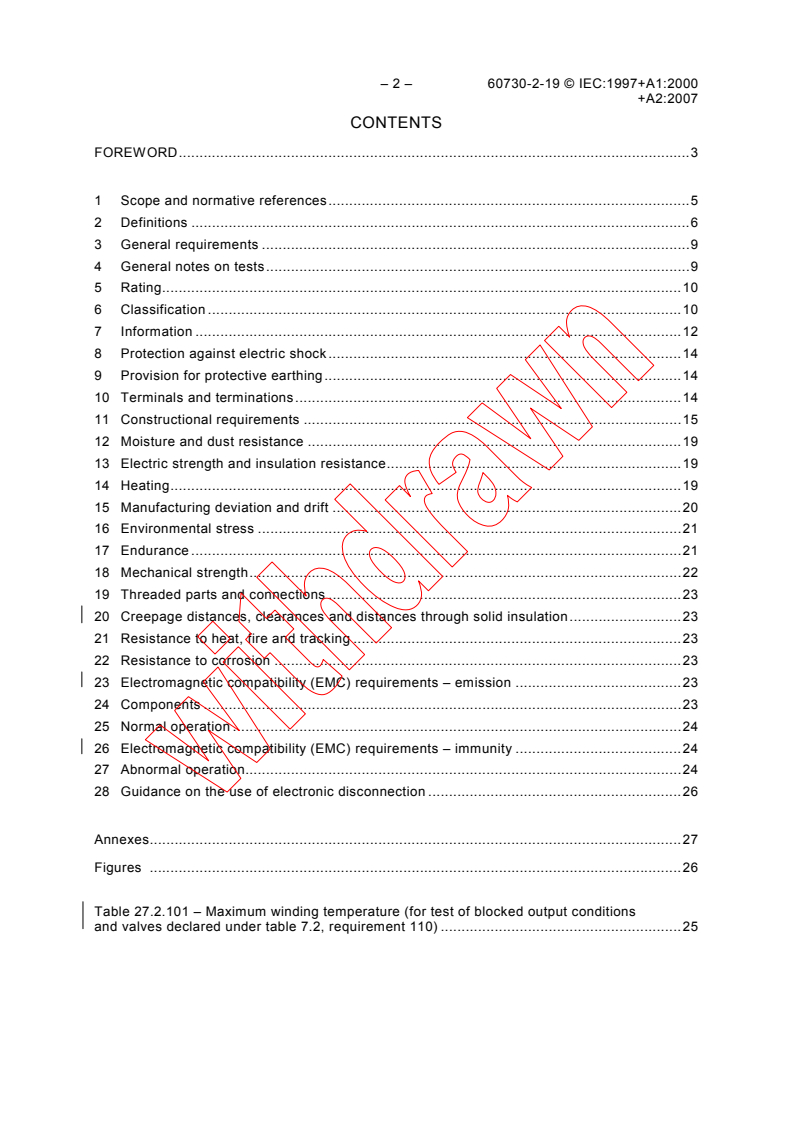
IEC 60730-2-19:1997+AMD1:2000+AMD2:2007 CSV - Automatic electrical controls for household and similar use - Part 2-19: Particular requirements for electrically operated oil valves, including mechanical requirements Released:11/21/2007 Isbn:2831893283
Frequently Asked Questions
IEC 60730-2-19:1997 is a standard published by the International Electrotechnical Commission (IEC). Its full title is "Automatic electrical controls for household and similar use - Part 2: Particular requirements for electrically operated oil valves, including mechanical requirements". This standard covers: Applies to electrically operated oil valves for use in, on or in association with equipment for household and similar use that use electricity, in combination with fuel in the liquid state such as distillates, residual fuels, etc. This part 2 also applies to electrically operated oil valves using NTC or PTC thermistors.
Applies to electrically operated oil valves for use in, on or in association with equipment for household and similar use that use electricity, in combination with fuel in the liquid state such as distillates, residual fuels, etc. This part 2 also applies to electrically operated oil valves using NTC or PTC thermistors.
IEC 60730-2-19:1997 is classified under the following ICS (International Classification for Standards) categories: 97.120 - Automatic controls for household use. The ICS classification helps identify the subject area and facilitates finding related standards.
IEC 60730-2-19:1997 has the following relationships with other standards: It is inter standard links to IEC 60730-2-19:1997/AMD2:2007, IEC 60730-2-19:1997/AMD1:2000. Understanding these relationships helps ensure you are using the most current and applicable version of the standard.
IEC 60730-2-19:1997 is available in PDF format for immediate download after purchase. The document can be added to your cart and obtained through the secure checkout process. Digital delivery ensures instant access to the complete standard document.
Standards Content (Sample)
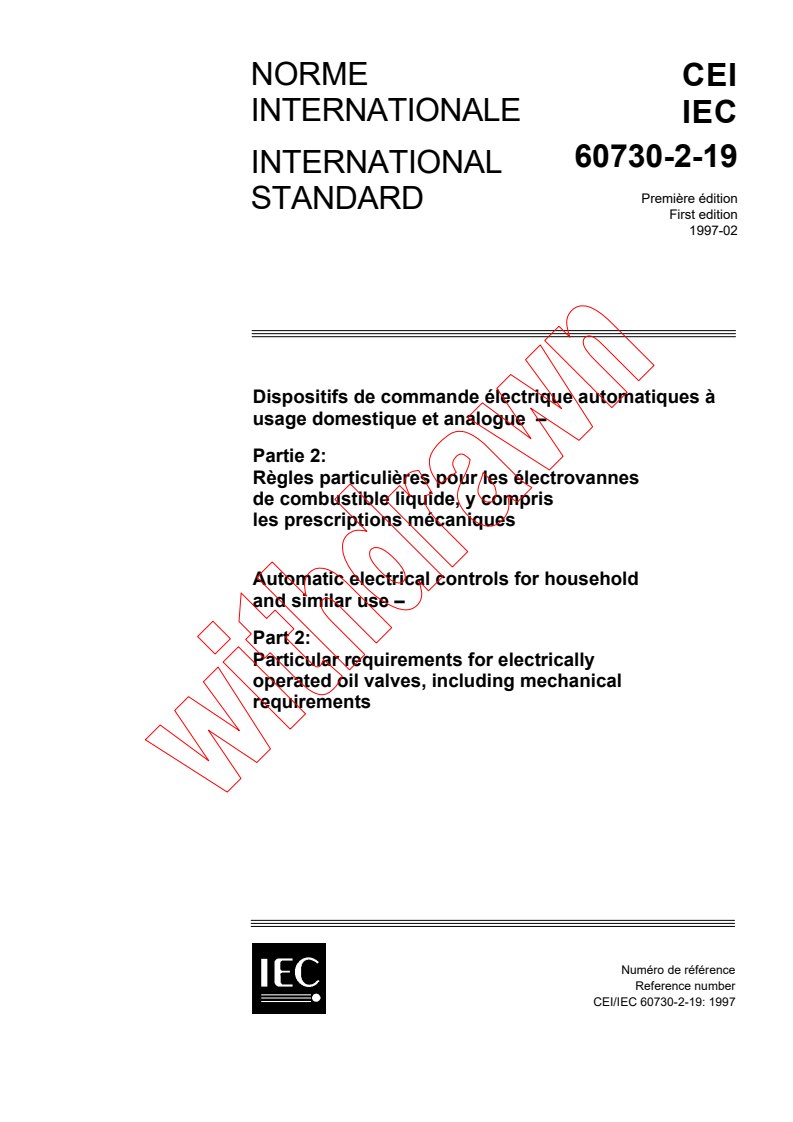
NORME CEI
INTERNATIONALE
IEC
60730-2-19
INTERNATIONAL
Première édition
STANDARD
First edition
1997-02
Dispositifs de commande électrique automatiques à
usage domestique et analogue –
Partie 2:
Règles particulières pour les électrovannes
de combustible liquide, y compris
les prescriptions mécaniques
Automatic electrical controls for household
and similar use –
Part 2:
Particular requirements for electrically
operated oil valves, including mechanical
requirements
Numéro de référence
Reference number
CEI/IEC 60730-2-19: 1997
Validité de la présente publication Validity of this publication
Le contenu technique des publications de la CEI est cons- The technical content of IEC publications is kept under
tamment revu par la CEI afin qu'il reflète l'état actuel de constant review by the IEC, thus ensuring that the content
la technique. reflects current technology.
Des renseignements relatifs à la date de reconfirmation de Information relating to the date of the reconfirmation of the
la publication sont disponibles auprès du Bureau Central de publication is available from the IEC Central Office.
la CEI.
Les renseignements relatifs à ces révisions, à l'établis- Information on the revision work, the issue of revised
sement des éditions révisées et aux amendements peuvent editions and amendments may be obtained from IEC
être obtenus auprès des Comités nationaux de la CEI et National Committees and from the following IEC
dans les documents ci-dessous: sources:
• Bulletin de la CEI • IEC Bulletin
• Annuaire de la CEI • IEC Yearbook
Publié annuellement Published yearly
• Catalogue des publications de la CEI • Catalogue of IEC publications
Publié annuellement et mis à jour régulièrement Published yearly with regular updates
Terminologie Terminology
En ce qui concerne la terminologie générale, le lecteur se For general terminology, readers are referred to IEC 50:
reportera à la CEI 50: Vocabulaire Electrotechnique Inter- International Electrotechnical Vocabulary (IEV), which is
national (VEI), qui se présente sous forme de chapitres issued in the form of separate chapters each dealing
séparés traitant chacun d'un sujet défini. Des détails with a specific field. Full details of the IEV will be
complets sur le VEI peuvent être obtenus sur demande. supplied on request. See also the IEC Multilingual
Voir également le dictionnaire multilingue de la CEI. Dictionary.
Les termes et définitions figurant dans la présente publi- The terms and definitions contained in the present publi-
cation ont été soit tirés du VEI, soit spécifiquement cation have either been taken from the IEV or have been
approuvés aux fins de cette publication. specifically approved for the purpose of this publication.
Symboles graphiques et littéraux Graphical and letter symbols
Pour les symboles graphiques, les symboles littéraux et les For graphical symbols, and letter symbols and signs
signes d'usage général approuvés par la CEI, le lecteur approved by the IEC for general use, readers are referred to
consultera: publications:
– la CEI 27: Symboles littéraux à utiliser en – IEC 27: Letter symbols to be used in electrical
électrotechnique; technology;
– la CEI 417: Symboles graphiques utilisables – IEC 417: Graphical symbols for use on
sur le matériel. Index, relevé et compilation des equipment. Index, survey and compilation of the
feuilles individuelles; single sheets;
– la CEI 617: Symboles graphiques pour schémas; – IEC 617: Graphical symbols for diagrams;
et pour les appareils électromédicaux, and for medical electrical equipment,
– la CEI 878: Symboles graphiques pour – IEC 878: Graphical symbols for electromedical
équipements électriques en pratique médicale. equipment in medical practice.
Les symboles et signes contenus dans la présente publi- The symbols and signs contained in the present publication
cation ont été soit tirés de la CEI 27, de la CEI 417, de la have either been taken from IEC 27, IEC 417, IEC 617
CEI 617 et/ou de la CEI 878, soit spécifiquement approuvés and/or IEC 878, or have been specifically approved for the
aux fins de cette publication. purpose of this publication.
Publications de la CEI établies par le IEC publications prepared by the same
même comité d'études technical committee
L'attention du lecteur est attirée sur les listes figurant à la fin The attention of readers is drawn to the end pages of this
de cette publication, qui énumèrent les publications de la publication which list the IEC publications issued by the
CEI préparées par le comité d'études qui a établi la technical committee which has prepared the present
présente publication. publication.
NORME
CEI
INTERNATIONALE
IEC
60730-2-19
INTERNATIONAL
Première édition
STANDARD
First edition
1997-02
Dispositifs de commande électrique automatiques à
usage domestique et analogue –
Partie 2:
Règles particulières pour les électrovannes
de combustible liquide, y compris
les prescriptions mécaniques
Automatic electrical controls for household
and similar use –
Part 2:
Particular requirements for electrically
operated oil valves, including mechanical
requirements
IEC 1997 Droits de reproduction réservés Copyright - all rights reserved
Aucune partie de cette publication ne peut être reproduite ni utilisée No part of this publication may be reproduced or utilized in
sous quelque forme que ce soit et par aucun procédé, électronique any form or by any means, electronic or mechanical, including
ou mécanique, y compris la photocopie et les microfilms, sans photocopying and microfilm, without permission in writing from
l'accord écrit de l'éditeur. the publisher.
International Electrotechnical Commission 3, rue de Varembé Geneva, Switzerland
Telefax: +41 22 919 0300 e-mail: inmail@iec.ch IEC web site http: //www.iec.ch
CODE PRIX
Commission Electrotechnique Internationale
PRICE CODE U
International Electrotechnical Commission
Pour prix, voir catalogue en vigueur
For price, see current catalogue
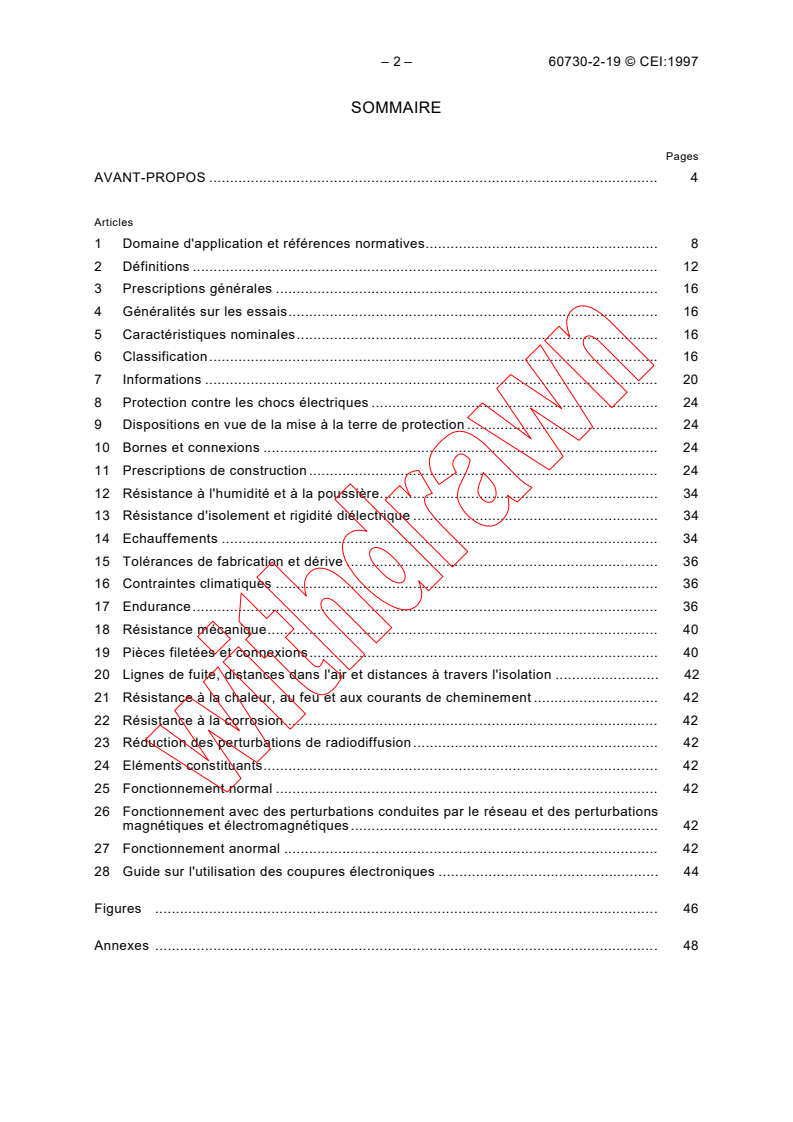
– 2 – 60730-2-19 © CEI:1997
SOMMAIRE
Pages
AVANT-PROPOS . 4
Articles
1 Domaine d'application et références normatives. 8
2 Définitions . 12
3 Prescriptions générales . 16
4 Généralités sur les essais. 16
5 Caractéristiques nominales. 16
6 Classification. 16
7 Informations . 20
8 Protection contre les chocs électriques . 24
9 Dispositions en vue de la mise à la terre de protection . 24
10 Bornes et connexions . 24
11 Prescriptions de construction . 24
12 Résistance à l'humidité et à la poussière. 34
13 Résistance d'isolement et rigidité diélectrique . 34
14 Echauffements . 34
15 Tolérances de fabrication et dérive . 36
16 Contraintes climatiques . 36
17 Endurance. 36
18 Résistance mécanique. 40
19 Pièces filetées et connexions. 40
20 Lignes de fuite, distances dans l'air et distances à travers l'isolation . 42
21 Résistance à la chaleur, au feu et aux courants de cheminement . 42
22 Résistance à la corrosion. 42
23 Réduction des perturbations de radiodiffusion . 42
24 Eléments constituants. 42
25 Fonctionnement normal . 42
26 Fonctionnement avec des perturbations conduites par le réseau et des perturbations
magnétiques et électromagnétiques. 42
27 Fonctionnement anormal . 42
28 Guide sur l'utilisation des coupures électroniques . 44
Figures .46
Annexes .48
60730-2-19 © IEC:1997 – 3 –
CONTENTS
Page
FOREWORD. . 5
Clause
1 Scope and normative references. 9
2 Definitions . 13
3 General requirements . 17
4 General notes on tests. 17
5 Rating . 17
6 Classification. 17
7 Information . 21
8 Protection against electric shock. 25
9 Provision for protective earthing. 25
10 Terminals and terminations. 25
11 Constructional requirements . 25
12 Moisture and dust resistance . 35
13 Electric strength and insulation resistance . 35
14 Heating. 35
15 Manufacturing deviation and drift . 37
16 Environmental stress . 37
17 Endurance. 37
18 Mechanical strength. 41
19 Threaded parts and connections . 41
20 Creepage distances, clearances and distances through insulation. 43
21 Resistance to heat, fire and tracking . 43
22 Resistance to corrosion . 43
23 Radio interference suppression. 43
24 Components . 43
25 Normal operation . 43
26 Operation with mains-borne perturbations, magnetic and electromagnetic
disturbances. 43
27 Abnormal operation . 43
28 Guidance on the use of electronic disconnection . 45
Figures .47
Annexes .49
– 4 – 60730-2-19 © CEI:1997
COMMISSION ÉLECTROTECHNIQUE INTERNATIONALE
______________
DISPOSITIFS DE COMMANDE ÉLECTRIQUE AUTOMATIQUES
À USAGE DOMESTIQUE ET ANALOGUE –
Partie 2: Règles particulières pour les électrovannes
de combustible liquide, y compris les prescriptions mécaniques
AVANT-PROPOS
1) La CEI (Commission Electrotechnique Internationale) est une organisation mondiale de normalisation
composée de l'ensemble des comités électrotechniques nationaux (Comités nationaux de la CEI). La CEI a
pour objet de favoriser la coopération internationale pour toutes les questions de normalisation dans les
domaines de l'électricité et de l'électronique. A cet effet, la CEI, entre autres activités, publie des Normes
Internationales. Leur élaboration est confiée à des comités d'études, aux travaux desquels tout Comité
national intéressé par le sujet traité peut participer. Les organisations internationales, gouvernementales et
non gouvernementales, en liaison avec la CEI, participent également aux travaux. La CEI collabore
étroitement avec l'Organisation Internationale de Normalisation (ISO), selon des conditions fixées par accord
entre les deux organisations.
2) Les décisions ou accords officiels de la CEI concernant les questions techniques, représentent, dans la
mesure du possible un accord international sur les sujets étudiés, étant donné que les Comités nationaux
intéressés sont représentés dans chaque comité d’études.
3) Les documents produits se présentent sous la forme de recommandations internationales. Ils sont publiés
comme normes, rapports techniques ou guides et agréés comme tels par les Comités nationaux.
4) Dans le but d'encourager l'unification internationale, les Comités nationaux de la CEI s'engagent à appliquer
de façon transparente, dans toute la mesure possible, les Normes internationales de la CEI dans leurs normes
nationales et régionales. Toute divergence entre la norme de la CEI et la norme nationale ou régionale
correspondante doit être indiquée en termes clairs dans cette dernière.
5) La CEI n’a fixé aucune procédure concernant le marquage comme indication d’approbation et sa
responsabilité n’est pas engagée quand un matériel est déclaré conforme à l’une de ses normes.
6) L’attention est attirée sur le fait que certains des éléments de la présente Norme internationale peuvent faire
l’objet de droits de propriété intellectuelle ou de droits analogues. La CEI ne saurait être tenue pour
responsable de ne pas avoir identifié de tels droits de propriété et de ne pas avoir signalé leur existence.
La Norme internationale CEI 60730-2-19 a été établie par le comité d'études 72 de la CEI:
Commandes automatiques pour appareils domestiques.
Le texte de cette norme est issu des documents suivants:
FDIS Rapport de vote
72/350/FDIS 72/373/RVD
Le rapport de vote indiqué dans le tableau ci-dessus donne toute information sur le vote ayant
abouti à l'approbation de cette norme.
La présente partie 2 est destinée à être utilisée conjointement avec la CEI 730-1. Elle a été
établie sur la base de la deuxième édition (1993) de cette publication. Les éditions ou
modifications futures de la CEI 730-1 pourront être prises en considération.
La présente partie 2 complète ou modifie les articles correspondants de la CEI 730-1 de façon
à la transformer en norme CEI: Règles particulières pour les électrovannes de combustible
liquide, y compris les prescriptions mécaniques.
60730-2-19 © IEC:1997 – 5 –
INTERNATIONAL ELECTROTECHNICAL COMMISSION
_____________
AUTOMATIC ELECTRICAL CONTROLS FOR HOUSEHOLD
AND SIMILAR USE –
Part 2: Particular requirements for electrically operated oil valves,
including mechanical requirements
FOREWORD
1) The IEC (International Electrotechnical Commission) is a worldwide organization for standardization
comprising all national electrotechnical committees (IEC National Committees). The object of the IEC is to
promote international co-operation on all questions concerning standardization in the electrical and electronic
fields. To this end and in addition to other activities, the IEC publishes International Standards. Their
preparation is entrusted to technical committees; any IEC National Committee interested in the subject dealt
with may participate in this preparatory work. International, governmental and non-governmental organizations
liaising with the IEC also participate in this preparation. The IEC collaborates closely with the International
Organization for Standardization (ISO) in accordance with conditions determined by agreement between the
two organizations.
2) The formal decisions or agreements of the IEC on technical matters express, as nearly as possible, an
international consensus of opinion on the relevant subjects since each technical committee has representation
from all interested National Committees.
3) The documents produced have the form of recommendations for international use and are published in the
form of standards, technical reports or guides and they are accepted by the National Committees in that
sense.
4) In order to promote international unification, IEC National Committees undertake to apply IEC International
Standards transparently to the maximum extent possible in their national and regional standards. Any
divergence between the IEC Standard and the corresponding national or regional standard shall be clearly
indicated in the latter.
5) The IEC provides no marking procedure to indicate its approval and cannot be rendered responsible for any
equipment declared to be in conformity with one of its standards.
6) Attention is drawn to the possibility that some of the elements of this International Standard may be the
subject of patent rights. The IEC shall not be held responsible for identifying any or all such patent rights.
International Standard IEC 60730-2-19 has been prepared by IEC technical committee 72:
Automatic controls for household use.
The text of this standard is based on the following documents:
FDIS Report on voting
72/350/FDIS 72/373/RVD
Full information on the voting for the approval of this standard can be found in the report on
voting indicated in the above table.
This part 2 is intended to be used in conjunction with IEC 730-1. It was established on the
basis of the second edition (1993) of that publication. Consideration may be given to future
editions of, or amendments to, IEC 730-1.
This part 2 supplements or modifies the corresponding clauses in IEC 730-1, so as to convert
that publication into the IEC standard: Particular requirements for electrically operated oil
valves, including mechanical requirements.
– 6 – 60730-2-19 © CEI:1997
Lorsque la présente partie 2 spécifie «addition», «modification» ou «remplacement», la
prescription, la modalité d'essai ou le commentaire correspondant de la partie 1 doit être
adapté en conséquence.
Lorsque aucune modification n'est nécessaire, la partie 2 indique que l'article ou le paragraphe
approprié est applicable.
Afin d'obtenir une norme complètement internationale, il a été nécessaire d'examiner des
prescriptions différentes résultant de l'expérience acquise dans diverses parties du monde, et
de reconnaître les différences nationales dans les réseaux d'alimentation électrique et les
règles d'installations.
Les notes «dans certains pays» concernant des pratiques nationales différentes sont contenues dans les
paragraphes suivants:
– 6.103
– tableau 7.2, prescription 120
– tableau 7.2, note 102
– 11.103
– 11.104.6
– 11.105.1
– 11.105.2
– 11.113
– 18.102
– H.26.10
Dans la présente publication:
1) Les caractères d'imprimerie suivants sont utilisés:
– prescriptions proprement dites: caractères romains;
– modalités d'essais: caractères italiques;
– commentaires: petits caractères romains.
2) Les paragraphes, notes ou articles complémentaires à ceux de la partie 1 sont
numérotés à partir de 101.
60730-2-19 © IEC:1997 – 7 –
Where this part 2 states "addition", "modification" or "replacement", the relevant requirement,
test specification or explanatory matter in part 1 should be adapted accordingly.
Where no change is necessary, part 2 indicates that the relevant clause or subclause applies.
In the development of a fully international standard it has been necessary to take into
consideration the differing requirements resulting from practical experience in various parts of
the world and to recognize the variation in national electrical systems and wiring rules.
The “in some countries” notes regarding differing national practices are contained in the following subclauses:
– 6.103
– Table 7.2, requirement 120
– Table 7.2, note 102
– 11.103
– 11.104.6
– 11.105.1
– 11.105.2
– 11.113
– 18.102
– H26.10
In this publication:
1) The following print types are used:
– requirements proper: in roman type;
– test specifications: in italic type;
– explanatory matter: in smaller roman type.
2) Subclauses, notes or items which are additional to those in part 1 are numbered starting
from 101.
– 8 – 60730-2-19 © CEI:1997
DISPOSITIFS DE COMMANDE ÉLECTRIQUE AUTOMATIQUES
À USAGE DOMESTIQUE ET ANALOGUE –
Partie 2: Règles particulières pour les électrovannes
de combustible liquide, y compris les prescriptions mécaniques
1 Domaine d'application et références normatives
L'article de la partie 1 n'est pas applicable.
Remplacement:
1.1 La présente partie de la CEI 730 s'applique aux électrovannes de combustible liquide
destinées à être utilisées dans, ou en association avec des appareils domestiques et à usage
analogue utilisant l'électricité, en combinaison avec des combustibles liquides, tels que des
distillats, des combustibles résiduels, etc.
La présente partie 2 s'applique également aux électrovannes de combustible liquide utilisant
des thermistances NTC ou PTC, dont les prescriptions sont contenues dans l'annexe J.
1.1.1 La présente partie 2 s'applique à la sécurité intrinsèque, aux valeurs de fonctionnement,
aux temps de fonctionnement et aux séquences de fonctionnement dans la mesure où ils
interviennent dans la protection du matériel, ainsi qu'aux essais des électrovannes de
combustible liquide utilisées dans, ou en association avec des matériels domestiques et
analogues.
La présente partie 2 s'applique aussi aux dispositifs de commande pour appareils dans le
domaine d'application de la CEI 335-1.
Partout où il est utilisé dans la présente partie 2, le terme «matériel» signifie «appareil et matériel».
La présente partie 2 ne s'applique pas aux électrovannes de combustible liquide conçues
exclusivement pour des applications industrielles.
Les électrovannes de combustible liquide des matériels non destinés à l'usage domestique
normal, mais qui peuvent cependant être utilisés par le public, tels que les matériels destinés à
être utilisés par des personnes sans qualification particulière dans des magasins, dans
l'industrie légère et dans les fermes, relèvent du domaine d'application de la présente partie 2.
La présente partie 2 identifie un certain nombre de caractéristiques mécaniques comme «à
l'étude». Jusqu'à ce que ces prescriptions mécaniques soient incorporés dans cette partie 2,
chaque pays utilisant cette partie 2 aura à quantifier ces prescriptions.
La conformité d'une électrovanne de combustible liquide avec cette partie 2 n'implique pas que la vanne soit
acceptable sans essais ultérieurs pour ces prescriptions mécaniques.
1.1.2 La présente partie 2 s'applique aussi aux dispositifs de commande manuels quand ils
sont électriquement et/ou mécaniquement intégrés à des électrovannes de combustible liquide.
Les prescriptions pour les interrupteurs manuels ne faisant pas partie d'une électrovanne de combustible liquide
sont données par la CEI 1058-1.
60730-2-19 © IEC:1997 – 9 –
AUTOMATIC ELECTRICAL CONTROLS FOR HOUSEHOLD
AND SIMILAR USE –
Part 2: Particular requirements for electrically operated oil valves,
including mechanical requirements
1 Scope and normative references
This clause of part 1 is not applicable.
Replacement:
1.1 This part 2 of IEC 730 applies to electrically operated oil valves for use in, on or in
association with equipment for household and similar use that use electricity, in combination
with fuel in the liquid state such as distillates, residual fuels, etc.
This part 2 also applies to electrically operated oil valves using NTC or PTC thermistors,
requirements for which are contained in annex J.
1.1.1 This part 2 applies to the inherent safety, to the operating values, operating times, and
operating sequences where such are associated with equipment safety, and to the testing of
electrically operated oil valves used in, or in association with, household or similar equipment.
This part 2 is also applicable to controls for appliances within the scope of IEC 335-1.
Throughout this part 2 the word "equipment" means "appliance and equipment".
This part 2 does not apply to electrically operated oil valves designed exclusively for industrial
applications.
Electrically operated oil valves for equipment not intended for normal household use, but which
nevertheless may be used by the public, such as equipment intended to be used by laymen in
shops, in light industry and on farms, are within the scope of this part 2.
This part 2 identifies a number of mechanical features as "under consideration". Until these
mechanical requirements are incorporated in this part 2, each country using this part 2 will
have to quantify these requirements.
Compliance of an electrically operated oil valve with this part 2 does not imply that the valve is acceptable without
further tests for these mechanical features.
1.1.2 This part 2 applies to manual controls when such are electrically and/or mechanically
integral with electrically operated oil valves.
Requirements for manual switches not forming part of an electrically operated oil valve are contained in IEC 1058-1.
– 10 – 60730-2-19 © CEI:1997
La présente partie 2 ne s'applique pas aux électrovannes de combustible liquide de taille de
raccords supérieure à DN 150.
Ci-après, le mot «vanne» est utilisé pour désigner une électrovanne de combustible liquide
(y compris le moteur primaire et le corps de vanne).
1.1.3 La présente partie 2 ne s'applique pas aux actionneurs électriques dont les
prescriptions sont contenues dans la CEI 730-2-14.
1.1.4 La présente partie 2 s'applique aussi aux vannes utilisées comme partie d'un système
ou de vannes mécaniquement intégrées à des dispositifs de commande multifonctions.
1.2 La présente partie 2 s'applique aux dispositifs de commande dont la tension nominale ne
dépasse pas 660 V et dont le courant nominal ne dépasse pas 63 A.
1.3 La présente partie 2 ne prend pas en considération la valeur de réponse d'une action
automatique d'une vanne lorsqu'elle est influencée par la méthode de montage du dispositif de
commande dans le matériel. Dans le cas où une telle valeur de réponse est importante du
point de vue de la protection de l'utilisateur ou de l'environnement, la valeur spécifiée dans la
norme particulière du matériel domestique appropriée ou prescrite par le constructeur
s'applique.
1.4 La présente partie 2 s'applique aussi aux vannes incorporant des dispositifs électroniques
dont les prescriptions sont contenues dans l'annexe H.
1.5 Références normatives
L’article de la partie 1 est applicable avec les exceptions suivantes:
Addition:
CEI 335-1: 1991, Sécurité des appareils électrodomestiques et analogues – Partie 1:
Prescriptions générales
CEI 529: 1989, Degrés de protection procurés par les enveloppes (Code IP)
CEI 730-2-14: 1995, Dispositifs de commande électrique automatique à usage domestique et
analogue – Partie 2: Règles particulières pour les actionneurs électriques
CEI 1058-1: 1990, Interrupteurs pour appareils – Partie 1: Règles générales
ISO 7-1: 1994, Filetages de tuyauterie pour raccordement avec étanchéité dans le filet – Partie 1:
Dimensions, tolérances et désignation
ISO 228-1: 1994, Filetages de tuyauterie pour raccordement sans étanchéité dans le filet –
Partie 1: Dimensions, tolérances et désignation
ISO 274: 1975, Tubes en cuivre de section circulaire – Dimensions
ISO 301: 1981, Alliages de zinc en lingots destinés à la fonderie
ISO 4400: 1994, Transmissions hydrauliques et pneumatiques – Connecteurs électriques à
trois broches avec contact de sécurité – Caractéristiques et exigences
60730-2-19 © IEC:1997 – 11 –
This part 2 does not apply to electrically operated oil valves of nominal connection size above
DN 150.
Hereinafter, the term "valve" is used to denote an electrically operated oil valve (including
prime mover and valve body).
1.1.3 This part 2 does not apply to electric actuators which are covered by IEC 730-2-14.
1.1.4 This part 2 also applies to valves utilized as part of a system, or valves mechanically
integral with multifunctional controls.
1.2 This part 2 applies to valves with a rated voltage not exceeding 660 V and with a rated
current not exceeding 63 A.
1.3 This part 2 does not take into account the response value of an automatic action of a
valve, if such a response value is dependent upon the method of mounting the control in the
equipment. Where a response value is of significant purpose for the protection of the user, or
surroundings, the value defined in the appropriate household equipment standard or as
determined by the manufacturer shall apply.
1.4 This part 2 applies also to valves incorporating electronic devices, requirements for which
are contained in annex H.
1.5 Normative references
This clause of part 1 is applicable except as follows:
Addition:
IEC 335-1: 1991, Safety of household and similar electrical appliances – Part 1: General
requirements
IEC 529: 1989, Degrees of protection provided by enclosures (IP Code)
IEC 730-2-14: 1995, Automatic electrical controls for household and similar use – Part 2:
Particular requirements for electric actuators
IEC 1058-1:1990, Switches for appliances – Part 1: General requirements
ISO 7-1: 1994, Pipe threads where pressure-tight joints are made on the threads – Part 1:
Dimensions, tolerances and designation
ISO 228-1: 1994, Pipe threads where pressure-tight joints are not made on the threads –
Part 1: Dimensions, tolerances and designation
ISO 274: 1975, Copper tubes of circular section – Dimensions
ISO 301: 1981, Zinc alloy ingots intended for casting
ISO 4400: 1994, Fluid power systems and components – Three-pin electrical plug connectors
with earth contact – Characteristics and requirements
– 12 – 60730-2-19 © CEI:1997
ISO 6952: 1994, Transmissions hydrauliques et pneumatiques – Connecteurs électriques à
deux broches avec contact de sécurité – Caractéristiques et exigences
ISO 7005-1: 1992, Brides métalliques – Partie 1: Brides en acier
ISO 7005-2: 1988, Brides métalliques – Partie 2: Brides en fonte
2 Définitions
L'article de la partie 1 est applicable avec les exceptions suivantes:
2.2 Définitions des différents types de dispositifs de commande en fonction de l'application
Définitions complémentaires:
2.2.17.101 électrovanne de combustible liquide: Vanne automatique dans laquelle la
transmission est effectuée par un moteur primaire électrique et dont le fonctionnement contrôle
le débit de combustible liquide.
Une vanne semi-automatique qui est ouverte manuellement et se ferme automatiquement ou vice versa est
également couverte par cette définition.
2.2.17.102 corps de vanne: Partie qui est l'enveloppe principale soumise à la pression et
comportant les passages du débit de combustible liquide et les raccordements.
2.2.17.103 raccord: Configuration du corps de la vanne prévue pour constituer un joint
étanche en pression avec le système conducteur de fluide.
2.2.17.104 taille nominale: Désignation numérique de taille commune à tous les composants
d'un système conducteur de fluide autres que les composants désignés par leur diamètre
extérieur ou par les dimensions du filetage.
Cette taille peut être désignée par les lettres «DN» suivies d'un nombre entier convenable mais uniquement à titre
de référence.
Certaines anciennes normes internationales désignent la dimension nominale par le diamètre nominal mais, pour
les besoins de la présente partie 2, les deux expressions sont synonymes.
2.3 Définitions concernant les fonctions des dispositifs de commande
Définitions complémentaires:
2.3.101 vanne tout ou rien: Vanne qui est ouverte ou fermée, sans aucune position
intermédiaire.
2.3.102 vanne normalement fermée: Vanne qui est fermée quand elle n'est pas alimentée
électriquement.
2.3.103 vanne normalement ouverte: Vanne qui est ouverte quand elle n'est pas alimentée
électriquement.
2.3.104 vanne à débit variable: Vanne présentant un débit variable entre des limites de
débits prédéterminées.
60730-2-19 © IEC:1997 – 13 –
ISO 6952: 1994, Fluid power systems and components – Two-pin electrical plug connectors
with earth contact – Characteristics and requirements
ISO 7005-1: 1992, Metallic flanges – Part 1: Steel flanges
ISO 7005-2: 1988, Metallic flanges – Part 2: Cast iron flanges
2 Definitions
This clause of part 1 is applicable except as follows:
2.2 Definitions of types of control according to purpose
Additional definitions:
2.2.17.101 electrically operated oil valve: An automatic valve in which the transmission is
effected by an electrical prime mover and in which the operation controls the flow of oil.
A semi-automatic valve that is opened manually and closes automatically, or vice versa, is also covered by this
definition.
2.2.17.102 valve body: That part which is the main pressure boundary and which provides
the oil flow passageways with end connections.
2.2.17.103 end connection: Valve body configuration provided to make a pressure-tight joint
to the fluid-connecting system.
2.2.17.104 nominal size: A numerical designation of size which is common to all components
in a fluid conducting system other than components designated by outside diameter or by
thread size.
It may be designated by DN followed by a convenient round number, for reference purposes only.
Some older international standards refer to nominal size as nominal diameter but, for the purpose of this part 2, the
two terms are synonymous.
2.3 Definitions relating to the function of controls
Additional definitions:
2.3.101 on-off valve: A valve which is open or closed, without any intermediate positions.
2.3.102 normally closed valve: A valve which is closed when not electrically energized.
2.3.103 normally open valve: A valve which is open when not electrically energized.
2.3.104 modulating valve: A valve which has a variable flow rate between predetermined
flow rates.
– 14 – 60730-2-19 © CEI:1997
2.3.104.1 vanne à points de fonctionnement multiples: Vanne pouvant fonctionner à un
débit assigné ou à différents débits prédéterminés inférieurs au débit assigné.
2.3.105 pièce de fermeture: Partie mobile de la vanne qui est placée dans le flux pour
modifier le débit au travers de la vanne.
2.3.106 position fermée: Position de la pièce de fermeture telle qu'il n'est pas prévu de débit
de combustible liquide du côté sortie de la vanne.
2.3.107 position ouverte: Position de la pièce de fermeture telle qu'un débit de combustible
liquide est prévu du côté sortie de la vanne.
2.3.107.1 position complètement ouverte: Position de la pièce de fermeture telle que la
quantité de combustible liquide traversant la vanne corresponde au débit nominal.
2.3.108 débit: Volume de combustible liquide traversant la vanne par unité de temps.
2.3.109 débit nominal (capacité): Débit pour la course nominale dans les conditions de
référence normalisées de température, de pression et de viscosité déclarées pour une
différence de pression donnée.
2.3.110 pression d'entrée: Pression à l'entrée de la vanne.
2.3.111 pression de sortie: Pression à la sortie de la vanne.
2.3.112 différence de pression: Différence entre les pressions d'entrée et de sortie.
2.3.113 différence de pression maximale de fonctionnement: Différence de pression
maximale déclarée contre laquelle l'actionneur peut effectuer la fermeture de la vanne.
2.3.114 différence de pression minimale de fonctionnement: Différence de pression
minimale déclarée à laquelle la vanne s'ouvre ou se ferme.
2.3.115 pression maximale de fonctionnement: Pression maximale d'entrée déclarée à
laquelle la vanne peut fonctionner.
Elle peut être désignée par les lettres «PN» (encore appelées «nombre de pression») suivies par un nombre entier
convenable, uniquement à titre de référence.
2.3.116 vanne de coupure de sécurité: Vanne normalement fermée qui empêche le
passage du combustible liquide quand elle n'est pas alimentée par action d'un limiteur, d'un
coupe-circuit ou d'un système de commande de brûleur.
Une vanne de coupure de sécurité est considérée comme un dispositif de commande de protection et peut aussi
être utilisée comme dispositif de commande de fonctionnement.
Une vanne de coupure de sécurité peut être du type à ouverture automatique ou semi-automatique.
2.3.117 fuite de combustible liquide, externe: Fuite de combustible liquide du corps de
vanne vers l'atmosphère.
2.3.118 fuite de combustible liquide, interne: Fuite de combustible liquide vers le raccord
de sortie, la pièce de fermeture étant en position fermée.
2.3.119 temps d'ouverture: Intervalle de temps entre le signal électrique d'ouverture de la
vanne et l'obtention du débit maximal ou d'un autre débit défini.
60730-2-19 © IEC:1997 – 15 –
2.3.104.1 multi-stage valve: A valve which permits operation at rated flow rate or at various
predetermined flow rates below rated flow rate.
2.3.105 closure member: A movable part of the valve which is positioned in the flow path to
modify the rate of flow through the valve.
2.3.106 closed position: Position of the closure member when there is no intended oil flow
from the outlet of the valve.
2.3.107 open position: Position of the closure member when there is intended oil flow from
the outlet of the valve.
2.3.107.1 fully open position: Position of the closure member so that the amount of oil
flowing through the valve is in accordance with the rated flow rate.
2.3.108 flow rate: Volume of oil flowing through the valve in unit time.
2.3.109 rated flow rate (capacity): Flow rate under standard reference conditions of
temperature pressure and viscosity declared at a given pressure difference.
2.3.110 inlet pressure: Pressure at the inlet of the valve.
2.3.111 outlet pressure: Pressure at the outlet of the valve.
2.3.112 pressure difference: Difference between the inlet and outlet pressures.
2.3.113 maximum operating pressure difference: The declared maximum pressure
difference against which the actuator can operate the closure member.
2.3.114 minimum operating pressure difference: The declared minimum pressure
difference at which the valve opens or closes.
2.3.115 maximum working pressure: Declared maximum inlet pressure at which the valve
may be operated.
It may be designated by the letters “PN” (also referred to as the pressure number) followed by a convenient round
number, for reference purposes only.
2.3.116 safety shutoff valve: Normally closed valve that prevents delivery of oil when
de-energized by the action of a limiter, a cut-out or a burner control system.
A safety shutoff valve is considered a protective control and may also be used as an operating control.
A safety shutoff valve may be either of the automatic or semi-automatic opening type.
2.3.117 oil leakage, external: Leakage of oil from the valve body to atmosphere.
2.3.118 oil leakage, internal: Leakage of oil from the outlet piping connection with the
closure member in the closed position.
2.3.119 opening time: Time interval between the electrical signal to open the valve and the
achievement of maximum or other defined flow rate.
– 16 – 60730-2-19 © CEI:1997
2.3.120 temps de fermeture: Intervalle de temps entre la perte du signal électrique et la
réalisation de la position fermée.
2.3.121 retard: Intervalle de temps entre le signal électrique d'ouverture de la vanne et le
début du débit de combustible liquide.
2.3.122 interrupteur à fermeture confirmée: Interrupteur électrique qui contrôle la position
fermée de la pièce de fermeture de la vanne et qui est utilisé comme verrou.
3 Prescriptions générales
L'article de la partie 1 est applicable.
4 Généralités sur les essais
L'article de la partie 1 est applicable avec les exceptions suivantes:
4.1 Conditions d'essai
4.1.7 N'est pas applicable.
4.3 Instructions pour les essais
Remplacement:
4.3.2.6 Pour les dispositifs de commande marqués ou déclarés pour plus d'une tension
assignée, les essais de l'article 17 sont effectués à la tension assignée maximale.
Paragraphe additionnel:
4.3.101 Quand un constructeur produit le même corps de vanne avec un nombre de tailles de
raccords déclaré en 6.103, les essais de 18.101 doivent être effectués sur la plus grande taille
de raccord.
5 Caractéristiques nominales
L'article de la partie 1 est applicable.
6 Classification
L'article de la partie 1 est applicable avec les exceptions suivantes:
6.3 Selon les fonctions
6.3.12 Paragraphes additionnels:
6.3.12.101 – vanne tout ou rien;
6.3.12.102 – vanne normalement fermée;
6.3.12.103 – vanne normalement ouverte;
6.3.12.104 – vanne à débit variable;
6.3.12.105 – vanne à points de fonctionnement multiples;
6.3.12.106 – vanne de coupure de sécurité, automatique;
6.3.12.107 – vanne de coupure de sécurité, semi-automatique.
60730-2-19 © IEC:1997 – 17 –
2.3.120 closing time: Time interval between when the electrical signal is removed and the
achievement of the closed position.
2.3.121 delay time: Time interval between the electrical signal to open the valve and start of
flow through the valve.
2.3.122 proof of closure switch: An electric
...
NORME CEI
INTERNATIONALE IEC
60730-2-19
INTERNATIONAL
Edition 1.1
STANDARD
2001-10
Edition 1:1997 consolidée par l'amendement 1:2000
Edition 1:1997 consolidated with amendment 1:2000
Dispositifs de commande électrique automatiques
à usage domestique et analogue –
Partie 2-19:
Règles particulières pour les électrovannes
de combustible liquide, y compris les
prescriptions mécaniques
Automatic electrical controls for household
and similar use –
Part 2-19:
Particular requirements for electrically operated
oil valves, including mechanical requirements
Numéro de référence
Reference number
CEI/IEC 60730-2-19:1997+A1:2000
Numérotation des publications Publication numbering
Depuis le 1er janvier 1997, les publications de la CEI As from 1 January 1997 all IEC publications are
sont numérotées à partir de 60000. Ainsi, la CEI 34-1 issued with a designation in the 60000 series. For
devient la CEI 60034-1. example, IEC 34-1 is now referred to as IEC 60034-1.
Editions consolidées Consolidated editions
Les versions consolidées de certaines publications de la The IEC is now publishing consolidated versions of its
CEI incorporant les amendements sont disponibles. Par publications. For example, edition numbers 1.0, 1.1
exemple, les numéros d’édition 1.0, 1.1 et 1.2 indiquent and 1.2 refer, respectively, to the base publication,
respectivement la publication de base, la publication de the base publication incorporating amendment 1 and
base incorporant l’amendement 1, et la publication de the base publication incorporating amendments 1
base incorporant les amendements 1 et 2. and 2.
Informations supplémentaires Further information on IEC publications
sur les publications de la CEI
Le contenu technique des publications de la CEI est The technical content of IEC publications is kept
constamment revu par la CEI afin qu'il reflète l'état under constant review by the IEC, thus ensuring that
actuel de la technique. Des renseignements relatifs à the content reflects current technology. Information
cette publication, y compris sa validité, sont dispo- relating to this publication, including its validity, is
nibles dans le Catalogue des publications de la CEI available in the IEC Catalogue of publications
(voir ci-dessous) en plus des nouvelles éditions, (see below) in addition to new editions, amendments
amendements et corrigenda. Des informations sur les and corrigenda. Information on the subjects under
sujets à l’étude et l’avancement des travaux entrepris consideration and work in progress undertaken by the
par le comité d’études qui a élaboré cette publication, technical committee which has prepared this
ainsi que la liste des publications parues, sont publication, as well as the list of publications issued,
également disponibles par l’intermédiaire de: is also available from the following:
• Site web de la CEI (www.iec.ch) • IEC Web Site (www.iec.ch)
• Catalogue des publications de la CEI • Catalogue of IEC publications
Le catalogue en ligne sur le site web de la CEI The on-line catalogue on the IEC web site
(www.iec.ch/catlg-f.htm) vous permet de faire des (www.iec.ch/catlg-e.htm) enables you to search
recherches en utilisant de nombreux critères, by a variety of criteria including text searches,
comprenant des recherches textuelles, par comité technical committees and date of publication. On-
d’études ou date de publication. Des informations line information is also available on recently
en ligne sont également disponibles sur les issued publications, withdrawn and replaced
nouvelles publications, les publications rempla- publications, as well as corrigenda.
cées ou retirées, ainsi que sur les corrigenda.
• IEC Just Published
• IEC Just Published
Ce résumé des dernières publications parues
This summary of recently issued publications
(www.iec.ch/JP.htm) est aussi disponible par
(www.iec.ch/JP.htm) is also available by email.
courrier électronique. Veuillez prendre contact
Please contact the Customer Service Centre (see
avec le Service client (voir ci-dessous) pour plus
below) for further information.
d’informations.
• Service clients
• Customer Service Centre
Si vous avez des questions au sujet de cette
If you have any questions regarding this
publication ou avez besoin de renseignements
publication or need further assistance, please
supplémentaires, prenez contact avec le Service
contact the Customer Service Centre:
clients:
Email: custserv@iec.ch
Email: custserv@iec.ch
Tél: +41 22 919 02 11
Tel: +41 22 919 02 11
Fax: +41 22 919 03 00
Fax: +41 22 919 03 00
.
NORME CEI
INTERNATIONALE IEC
60730-2-19
INTERNATIONAL
Edition 1.1
STANDARD
2001-10
Edition 1:1997 consolidée par l'amendement 1:2000
Edition 1:1997 consolidated with amendment 1:2000
Dispositifs de commande électrique automatiques
à usage domestique et analogue –
Partie 2-19:
Règles particulières pour les électrovannes
de combustible liquide, y compris les
prescriptions mécaniques
Automatic electrical controls for household
and similar use –
Part 2-19:
Particular requirements for electrically operated
oil valves, including mechanical requirements
IEC 2001 Droits de reproduction réservés Copyright - all rights reserved
Aucune partie de cette publication ne peut être reproduite ni No part of this publication may be reproduced or utilized in
utilisée sous quelque forme que ce soit et par aucun procédé, any form or by any means, electronic or mechanical,
électronique ou mécanique, y compris la photocopie et les including photocopying and microfilm, without permission in
microfilms, sans l'accord écrit de l'éditeur. writing from the publisher.
International Electrotechnical Commission 3, rue de Varembé Geneva, Switzerland
Telefax: +41 22 919 0300 e-mail: inmail@iec.ch IEC web site http://www.iec.ch
CODE PRIX
Commission Electrotechnique Internationale
CK
PRICE CODE
International Electrotechnical Commission
Pour prix, voir catalogue en vigueur
For price, see current catalogue
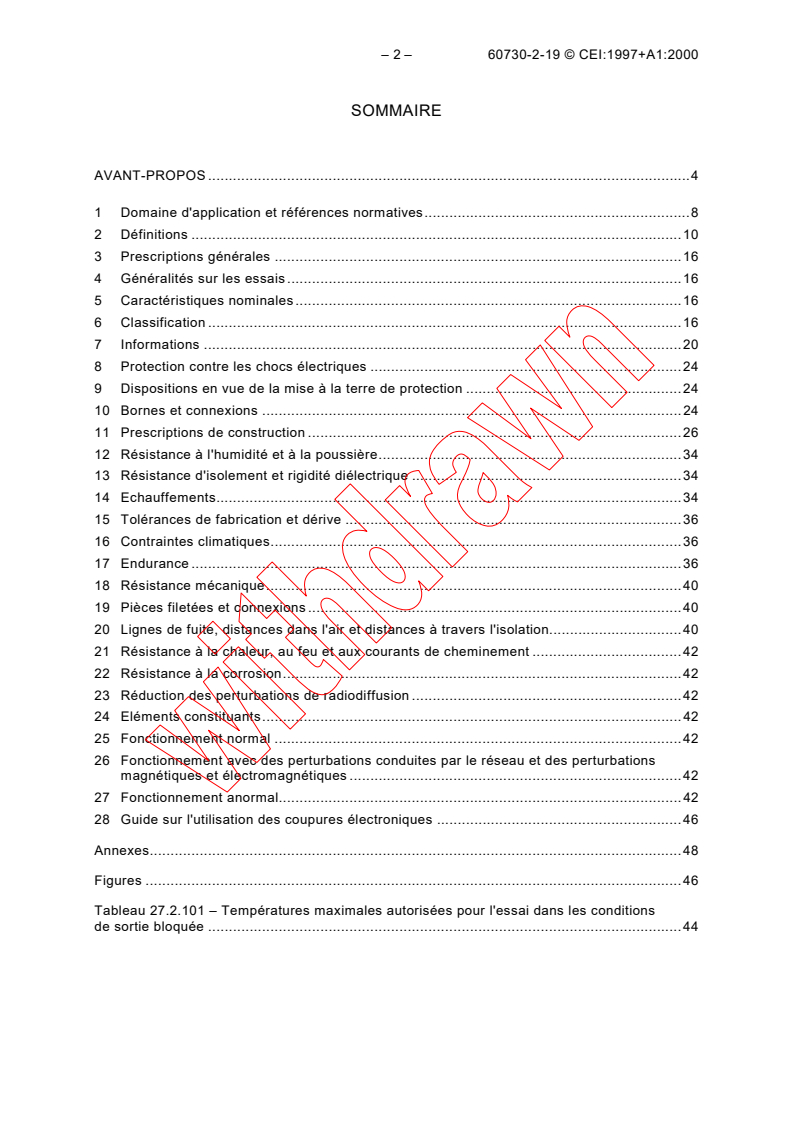
– 2 – 60730-2-19 © CEI:1997+A1:2000
SOMMAIRE
AVANT-PROPOS .4
1 Domaine d'application et références normatives.8
2 Définitions .10
3 Prescriptions générales .16
4 Généralités sur les essais.16
5 Caractéristiques nominales .16
6 Classification .16
7 Informations .20
8 Protection contre les chocs électriques .24
9 Dispositions en vue de la mise à la terre de protection .24
10 Bornes et connexions .24
11 Prescriptions de construction .26
12 Résistance à l'humidité et à la poussière.34
13 Résistance d'isolement et rigidité diélectrique .34
14 Echauffements.34
15 Tolérances de fabrication et dérive .36
16 Contraintes climatiques.36
17 Endurance .36
18 Résistance mécanique.40
19 Pièces filetées et connexions .40
20 Lignes de fuite, distances dans l'air et distances à travers l'isolation.40
21 Résistance à la chaleur, au feu et aux courants de cheminement .42
22 Résistance à la corrosion.42
23 Réduction des perturbations de radiodiffusion .42
24 Eléments constituants.42
25 Fonctionnement normal .42
26 Fonctionnement avec des perturbations conduites par le réseau et des perturbations
magnétiques et électromagnétiques .42
27 Fonctionnement anormal.42
28 Guide sur l'utilisation des coupures électroniques .46
Annexes.48
Figures .46
Tableau 27.2.101 – Températures maximales autorisées pour l'essai dans les conditions
de sortie bloquée .44
60730-2-19 © IEC:1997+A1:2000 – 3 –
CONTENTS
FOREWORD . 5
1 Scope and normative references . 9
2 Definitions.11
3 General requirements.17
4 General notes on tests .17
5 Rating.17
6 Classification .17
7 Information .21
8 Protection against electric shock .25
9 Provision for protective earthing .25
10 Terminals and terminations .25
11 Constructional requirements.27
12 Moisture and dust resistance.35
13 Electric strength and insulation resistance .35
14 Heating .35
15 Manufacturing deviation and drift.37
16 Environmental stress.37
17 Endurance .37
18 Mechanical strength .41
19 Threaded parts and connections .41
20 Creepage distances, clearances and distances through insulation .41
21 Resistance to heat, fire and tracking.43
22 Resistance to corrosion.43
23 Radio interference suppression .43
24 Components .43
25 Normal operation .43
26 Operation with mains-borne perturbations, magnetic and electromagnetic disturbances .43
27 Abnormal operation.43
28 Guidance on the use of electronic disconnection .47
Annexes.49
Figures.47
Table 27.2.101 – Maximum permitted temperatures for test of blocked output conditions .45
– 4 – 60730-2-19 © CEI:1997+A1:2000
COMMISSION ÉLECTROTECHNIQUE INTERNATIONALE
____________
DISPOSITIFS DE COMMANDE ÉLECTRIQUE AUTOMATIQUES
À USAGE DOMESTIQUE ET ANALOGUE –
Partie 2-19: Règles particulières pour les électrovannes
de combustible liquide, y compris les prescriptions mécaniques
AVANT-PROPOS
1) La CEI (Commission Électrotechnique Internationale) est une organisation mondiale de normalisation composée
de l'ensemble des comités électrotechniques nationaux (Comités nationaux de la CEI). La CEI a pour objet de
favoriser la coopération internationale pour toutes les questions de normalisation dans les domaines de
l'électricité et de l'électronique. A cet effet, la CEI, entre autres activités, publie des Normes internationales.
Leur élaboration est confiée à des comités d'études, aux travaux desquels tout Comité national intéressé par le
sujet traité peut participer. Les organisations internationales, gouvernementales et non gouvernementales, en
liaison avec la CEI, participent également aux travaux. La CEI collabore étroitement avec l'Organisation
Internationale de Normalisation (ISO), selon des conditions fixées par accord entre les deux organisations.
2) Les décisions ou accords officiels de la CEI concernant les questions techniques représentent, dans la mesure
du possible, un accord international sur les sujets étudiés, étant donné que les Comités nationaux intéressés
sont représentés dans chaque comité d’études.
3) Les documents produits se présentent sous la forme de recommandations internationales. Ils sont publiés
comme normes, spécifications techniques, rapports techniques ou guides et agréés comme tels par les Comités
nationaux.
4) Dans le but d'encourager l'unification internationale, les Comités nationaux de la CEI s'engagent à appliquer de
façon transparente, dans toute la mesure possible, les Normes internationales de la CEI dans leurs normes
nationales et régionales. Toute divergence entre la norme de la CEI et la norme nationale ou régionale
correspondante doit être indiquée en termes clairs dans cette dernière.
5) La CEI n’a fixé aucune procédure concernant le marquage comme indication d’approbation et sa responsabilité
n’est pas engagée quand un matériel est déclaré conforme à l’une de ses normes.
6) L’attention est attirée sur le fait que certains des éléments de la présente Norme internationale peuvent faire
l’objet de droits de propriété intellectuelle ou de droits analogues. La CEI ne saurait être tenue pour
responsable de ne pas avoir identifié de tels droits de propriété et de ne pas avoir signalé leur existence.
La Norme internationale CEI 60730-2-19 a été établie par le comité d'études 72 de la CEI:
Commandes automatiques pour appareils domestiques.
La présente version consolidée de la CEI 60730-2-19 comprend la première édition (1997)
[documents 72/350/FDIS et 72/373/RVD] et son amendement 1 (2000) [documents
72/467/FDIS et 72/491/RVD].
Le contenu technique de cette version consolidée est donc identique à celui de l'édition de
base et à son amendement; cette version a été préparée par commodité pour l'utilisateur.
Elle porte le numéro d'édition 1.1.
Une ligne verticale dans la marge indique où la publication de base a été modifiée par les
amendement 1.
La présente partie 2 doit être utilisée conjointement avec la CEI 60730-1. Elle a été établie sur
la base de la troisième édition (1999) de cette publication. Les éditions ou amendements futurs
de la CEI 60730-1 pourront être pris en compte.
La présente partie 2 complète ou modifie les articles correspondants de la CEI 60730-1 de
façon à la transformer en norme CEI: Règles particulières pour les électrovannes de
combustible liquide, y compris les prescriptions mécaniques.
Cette publication a été rédigée selon les Directives ISO/CEI, Partie 3.
60730-2-19 © IEC:1997+A1:2000 – 5 –
INTERNATIONAL ELECTROTECHNICAL COMMISSION
____________
AUTOMATIC ELECTRICAL CONTROLS FOR HOUSEHOLD
AND SIMILAR USE –
Part 2-19: Particular requirements for electrically operated oil valves,
including mechanical requirements
FOREWORD
1) The IEC (International Electrotechnical Commission) is a worldwide organization for standardization comprising
all national electrotechnical committees (IEC National Committees). The object of the IEC is to promote
international co-operation on all questions concerning standardization in the electrical and electronic fields. To
this end and in addition to other activities, the IEC publishes International Standards. Their preparation is
entrusted to technical committees; any IEC National Committee interested in the subject dealt with may
participate in this preparatory work. International, governmental and non-governmental organizations liaising
with the IEC also participate in this preparation. The IEC collaborates closely with the International Organization
for Standardization (ISO) in accordance with conditions determined by agreement between the two
organizations.
2) The formal decisions or agreements of the IEC on technical matters express, as nearly as possible, an
international consensus of opinion on the relevant subjects since each technical committee has representation
from all interested National Committees.
3) The documents produced have the form of recommendations for international use and are published in the form
of standards, technical specifications, technical reports or guides and they are accepted by the National
Committees in that sense.
4) In order to promote international unification, IEC National Committees undertake to apply IEC International
Standards transparently to the maximum extent possible in their national and regional standards. Any
divergence between the IEC Standard and the corresponding national or regional standard shall be clearly
indicated in the latter.
5) The IEC provides no marking procedure to indicate its approval and cannot be rendered responsible for any
equipment declared to be in conformity with one of its standards.
6) Attention is drawn to the possibility that some of the elements of this International Standard may be the subject
of patent rights. The IEC shall not be held responsible for identifying any or all such patent rights.
International Standard IEC 60730-2-19 has been prepared by IEC technical committee 72:
Automatic controls for household use.
This consolidated version of IEC 60730-2-19 consists of the first edition (1997) [documents
72/350/FDIS/ and 72/373/RVD] and its amendment 1 (2000) [documents 72/467/FDIS and
72/491/RVD].
The technical content is therefore identical to the base edition and its amendment and has
been prepared for user convenience.
It bears the edition number 1.1.
A vertical line in the margin shows where the base publication has been modified by
amendment 1.
This Part 2 is intended to be used with IEC 60730-1. It was established on the basis of the third
edition (1999) of that publication. Consideration may be given to future editions of, or amend-
ments to IEC 60730-1.
This part 2 supplements or modifies the corresponding clauses in IEC 60730-1, so as to
convert that publication into the IEC standard: Particular requirements for electrically operated
oil valves, including mechanical requirements.
This publication has been drafted in accordance with the ISO/IEC Directives, Part 3.
– 6 – 60730-2-19 © CEI:1997+A1:2000
Lorsque la présente partie 2 spécifie «addition», «modification» ou «remplacement», la
prescription, la modalité d'essai ou le commentaire correspondant de la partie 1 doit être
adapté en conséquence.
Lorsque aucune modification n'est nécessaire, la partie 2 indique que l'article ou le paragraphe
approprié est applicable.
Afin d'obtenir une norme complètement internationale, il a été nécessaire d'examiner des
prescriptions différentes résultant de l'expérience acquise dans diverses parties du monde, et
de reconnaître les différences nationales dans les réseaux d'alimentation électrique et les
règles d'installations.
Les notes «dans certains pays» concernant des pratiques nationales différentes sont contenues dans les
paragraphes suivants:
– 6.103
– tableau 7.2, prescription 120
– tableau 7.2, note 102
– 11.103
– 11.104.6
– 11.105.1
– 11.105.2
– 11.113
– 18.102
– H.26.10
Dans la présente publication:
1) Les caractères d'imprimerie suivants sont utilisés:
– prescriptions proprement dites: caractères romains;
– modalités d'essais: caractères italiques;
– commentaires: petits caractères romains.
2) Les paragraphes, notes ou articles complémentaires à ceux de la partie 1 sont
numérotés à partir de 101.
Le comité a décidé que le contenu de la publication de base et de ses amendements ne sera
pas modifié avant 2002-06. A cette date, la publication sera
• reconduite;
• supprimée;
• remplacée par une édition révisée, ou
• amendée.
60730-2-19 © IEC:1997+A1:2000 – 7 –
Where this part 2 states "addition", "modification" or "replacement", the relevant requirement,
test specification or explanatory matter in part 1 should be adapted accordingly.
Where no change is necessary, part 2 indicates that the relevant clause or subclause applies.
In the development of a fully international standard it has been necessary to take into
consideration the differing requirements resulting from practical experience in various parts of
the world and to recognize the variation in national electrical systems and wiring rules.
The “in some countries” notes regarding differing national practices are contained in the following subclauses:
– 6.103
– table 7.2, requirement 120
– table 7.2, note 102
– 11.103
– 11.104.6
– 11.105.1
– 11.105.2
– 11.113
– 18.102
– H26.10
In this publication:
1) The following print types are used:
– requirements proper: in roman type;
– test specifications: in italic type;
– explanatory matter: in smaller roman type.
2) Subclauses, notes or items which are additional to those in part 1 are numbered starting
from 101.
The committee has decided that the contents of the base publication and its amendments will
remain unchanged until 2002-06. At this date, the publication will be
• reconfirmed;
• withdrawn;
• replaced by a revised edition, or
• amended.
– 8 – 60730-2-19 © CEI:1997+A1:2000
DISPOSITIFS DE COMMANDE ÉLECTRIQUE AUTOMATIQUES
À USAGE DOMESTIQUE ET ANALOGUE –
Partie 2-19: Règles particulières pour les électrovannes
de combustible liquide, y compris les prescriptions mécaniques
1 Domaine d'application et références normatives
L'article de la partie 1 n'est pas applicable.
Remplacement:
1.1 La présente partie de la CEI 60730 s'applique aux électrovannes de combustible liquide
destinées à être utilisées dans, ou en association avec, des appareils domestiques et à usage
analogue utilisant l'électricité, en combinaison avec des combustibles liquides, tels que des
distillats, des combustibles résiduels, etc.
La présente partie 2 s'applique également aux électrovannes de combustible liquide utilisant
des thermistances NTC ou PTC, dont les prescriptions sont contenues dans l'annexe J.
1.1.1 La présente partie 2 s'applique à la sécurité intrinsèque, aux valeurs de fonctionnement,
aux temps de fonctionnement et aux séquences de fonctionnement dans la mesure où ils
interviennent dans la protection du matériel, ainsi qu'aux essais des électrovannes de combus-
tible liquide utilisées dans, ou en association avec des matériels domestiques et analogues.
La présente partie 2 s'applique aussi aux dispositifs de commande pour appareils dans le
domaine d'application de la CEI 60335-1.
Partout où il est utilisé dans la présente partie 2, le terme «matériel» signifie «appareil et matériel».
La présente partie 2 ne s'applique pas aux électrovannes de combustible liquide conçues
exclusivement pour des applications industrielles.
Les électrovannes de combustible liquide des matériels non destinés à l'usage domestique
normal, mais qui peuvent cependant être utilisés par le public, tels que les matériels destinés à
être utilisés par des personnes sans qualification particulière dans des magasins, dans
l'industrie légère et dans les fermes, relèvent du domaine d'application de la présente partie 2.
La présente partie 2 identifie un certain nombre de caractéristiques mécaniques comme
«à l'étude». Jusqu'à ce que ces prescriptions mécaniques soient incorporés dans cette partie 2,
chaque pays utilisant cette partie 2 aura à quantifier ces prescriptions.
La conformité d'une électrovanne de combustible liquide avec cette partie 2 n'implique pas que la vanne soit
acceptable sans essais ultérieurs pour ces prescriptions mécaniques.
1.1.2 La présente partie 2 s'applique aussi aux dispositifs de commande manuels quand ils
sont électriquement et/ou mécaniquement intégrés à des électrovannes de combustible liquide.
Les prescriptions pour les interrupteurs manuels ne faisant pas partie d'une électrovanne de combustible liquide
sont données par la CEI 61058-1.
La présente partie 2 ne s'applique pas aux électrovannes de combustible liquide de taille de
raccords supérieure à DN 150.
Ci-après, le mot «vanne» est utilisé pour désigner une électrovanne de combustible liquide
(y compris le moteur primaire et le corps de vanne).
1.1.3 Un actionneur électrique soumis au laboratoire d'essai en combinaison avec une vanne
de gaz sera évalué selon la présente partie 2. Un actionneur électrique séparé est évalué selon
la CEI 60730-2-14, qui donne les prescriptions particulières pour les actionneurs électriques.
60730-2-19 © IEC:1997+A1:2000 – 9 –
AUTOMATIC ELECTRICAL CONTROLS FOR HOUSEHOLD
AND SIMILAR USE –
Part 2-19: Particular requirements for electrically operated oil valves,
including mechanical requirements
1 Scope and normative references
This clause of part 1 is not applicable.
Replacement:
1.1 This part 2 of IEC 60730 applies to electrically operated oil valves for use in, on or in
association with equipment for household and similar use that use electricity, in combination
with fuel in the liquid state such as distillates, residual fuels, etc.
This part 2 also applies to electrically operated oil valves using NTC or PTC thermistors,
requirements for which are contained in annex J.
1.1.1 This part 2 applies to the inherent safety, to the operating values, operating times, and
operating sequences where such are associated with equipment safety, and to the testing of
electrically operated oil valves used in, or in association with, household or similar equipment.
This part 2 is also applicable to controls for appliances within the scope of IEC 60335-1.
Throughout this part 2 the word "equipment" means "appliance and equipment".
This part 2 does not apply to electrically operated oil valves designed exclusively for industrial
applications.
Electrically operated oil valves for equipment not intended for normal household use, but which
nevertheless may be used by the public, such as equipment intended to be used by laymen in
shops, in light industry and on farms, are within the scope of this part 2.
This part 2 identifies a number of mechanical features as "under consideration". Until these
mechanical requirements are incorporated in this part 2, each country using this part 2 will
have to quantify these requirements.
Compliance of an electrically operated oil valve with this part 2 does not imply that the valve is acceptable without
further tests for these mechanical features.
1.1.2 This part 2 applies to manual controls when such are electrically and/or mechanically
integral with electrically operated oil valves.
Requirements for manual switches not forming part of an electrically operated oil valve are contained in
IEC 61058-1.
This part 2 does not apply to electrically operated oil valves of nominal connection size above
DN 150.
Hereinafter, the term "valve" is used to denote an electrically operated oil valve (including
prime mover and valve body).
1.1.3 An electric actuator that is submitted to the testing laboratory in combination with an oil
valve will be evaluated under this part 2. A separate electric actuator is evaluated under
IEC 60730-2-14, which provides particular requirements for electric actuators.
– 10 – 60730-2-19 © CEI:1997+A1:2000
1.1.4 La présente partie 2 s'applique aussi aux vannes utilisées comme partie d'un système
ou de vannes mécaniquement intégrées à des dispositifs de commande multifonctions.
1.5 Références normatives
L’article de la partie 1 est applicable avec les exceptions suivantes:
Addition:
CEI 60335-1:1991, Sécurité des appareils électrodomestiques et analogues – Partie 1:
Prescriptions générales
CEI 60529:1989, Degrés de protection procurés par les enveloppes (Code IP)
CEI 60730-2-14:1995, Dispositifs de commande électrique automatique à usage domestique et
analogue – Partie 2: Règles particulières pour les actionneurs électriques
CEI 61058-1:1990, Interrupteurs pour appareils – Partie 1: Règles générales
ISO 7-1:1994, Filetages de tuyauterie pour raccordement avec étanchéité dans le filet – Partie 1:
Dimensions, tolérances et désignation
ISO 228-1:1994, Filetages de tuyauterie pour raccordement sans étanchéité dans le filet –
Partie 1: Dimensions, tolérances et désignation
ISO 274:1975, Tubes en cuivre de section circulaire – Dimensions
ISO 301:1981, Alliages de zinc en lingots destinés à la fonderie
ISO 4400:1994, Transmissions hydrauliques et pneumatiques – Connecteurs électriques à trois
broches avec contact de sécurité – Caractéristiques et exigences
ISO 6952:1994, Transmissions hydrauliques et pneumatiques – Connecteurs électriques à
deux broches avec contact de sécurité – Caractéristiques et exigences
ISO 7005-1:1992, Brides métalliques – Partie 1: Brides en acier
ISO 7005-2:1988, Brides métalliques – Partie 2: Brides en fonte
2 Définitions
L'article de la partie 1 est applicable avec les exceptions suivantes:
2.2 Définitions des différents types de dispositifs de commande en fonction de l'application
Définitions complémentaires:
2.2.17.101
électrovanne de combustible liquide
vanne automatique dans laquelle la transmission est effectuée par un moteur primaire élec-
trique et dont le fonctionnement contrôle le débit de combustible liquide
Une vanne semi-automatique qui est ouverte manuellement et se ferme automatiquement ou vice versa est
également couverte par cette définition.
2.2.17.102
corps de vanne
partie qui est l'enveloppe principale soumise à la pression et comportant les passages du débit
de combustible liquide et les raccordements
60730-2-19 © IEC:1997+A1:2000 – 11 –
1.1.4 This part 2 also applies to valves utilized as part of a system, or valves mechanically
integral with multifunctional controls.
1.5 Normative references
This clause of part 1 is applicable except as follows:
Addition:
IEC 60335-1:1991, Safety of household and similar electrical appliances – Part 1: General
requirements
IEC 60529:1989, Degrees of protection provided by enclosures (IP Code)
IEC 60730-2-14:1995, Automatic electrical controls for household and similar use – Part 2:
Particular requirements for electric actuators
IEC 61058-1:1990, Switches for appliances – Part 1: General requirements
ISO 7-1:1994, Pipe threads where pressure-tight joints are made on the threads – Part 1:
Dimensions, tolerances and designation
ISO 228-1:1994, Pipe threads where pressure-tight joints are not made on the threads – Part 1:
Dimensions, tolerances and designation
ISO 274:1975, Copper tubes of circular section – Dimensions
ISO 301:1981, Zinc alloy ingots intended for casting
ISO 4400:1994, Fluid power systems and components – Three-pin electrical plug connectors
with earth contact – Characteristics and requirements
ISO 6952:1994, Fluid power systems and components – Two-pin electrical plug connectors
with earth contact – Characteristics and requirements
ISO 7005-1:1992, Metallic flanges – Part 1: Steel flanges
ISO 7005-2:1988, Metallic flanges – Part 2: Cast iron flanges
2 Definitions
This clause of part 1 is applicable except as follows:
2.2 Definitions of types of control according to purpose
Additional definitions:
2.2.17.101
electrically operated oil valve
an automatic valve in which the transmission is effected by an electrical prime mover and in
which the operation controls the flow of oil
A semi-automatic valve that is opened manually and closes automatically, or vice versa, is also covered by this
definition.
2.2.17.102
valve body
that part which is the main pressure boundary and which provides the oil flow passageways
with end connections
– 12 – 60730-2-19 © CEI:1997+A1:2000
2.2.17.103
raccord
configuration du corps de la vanne prévue pour constituer un joint étanche en pression avec le
système conducteur de fluide
2.2.17.104
taille nominale
désignation numérique de taille commune à tous les composants d'un système conducteur de
fluide autres que les composants désignés par leur diamètre extérieur ou par les dimensions
du filetage
Cette taille peut être désignée par les lettres «DN» suivies d'un nombre entier convenable mais uniquement à titre
de référence.
Certaines anciennes normes internationales désignent la dimension nominale par le diamètre nominal mais, pour
les besoins de la présente partie 2, les deux expressions sont synonymes.
2.3 Définitions concernant les fonctions des dispositifs de commande
Définitions complémentaires:
2.3.101
vanne tout ou rien
vanne qui est ouverte ou fermée, sans aucune position intermédiaire
2.3.102
vanne normalement fermée
vanne qui est fermée quand elle n'est pas alimentée électriquement
2.3.103
vanne normalement ouverte
vanne qui est ouverte quand elle n'est pas alimentée électriquement
2.3.104
vanne à débit variable
vanne présentant un débit variable entre des limites de débits prédéterminées
2.3.104.1
vanne à points de fonctionnement multiples
vanne pouvant fonctionner à un débit assigné ou à différents débits prédéterminés inférieurs
au débit assigné
2.3.105
pièce de fermeture
partie mobile de la vanne qui est placée dans le flux pour modifier le débit au travers de la vanne
2.3.106
position fermée
position de la pièce de fermeture telle qu'il n'est pas prévu de débit de combustible liquide du
côté sortie de la vanne
2.3.107
position ouverte
position de la pièce de fermeture telle qu'un débit de combustible liquide est prévu du côté
sortie de la vanne
2.3.107.1
position complètement ouverte
position de la pièce de fermeture telle que la quantité de combustible liquide traversant la
vanne corresponde au débit nominal
60730-2-19 © IEC:1997+A1:2000 – 13 –
2.2.17.103
end connection
valve body configuration provided to make a pressure-tight joint to the fluid-connecting system
2.2.17.104
nominal size
a numerical designation of size which is common to all components in a fluid conducting
system other than components designated by outside diameter or by thread size
It may be designated by DN followed by a convenient round number, for reference purposes only.
Some older international standards refer to nominal size as nominal diameter but, for the purpose of this part 2, the
two terms are synonymous.
2.3 Definitions relating to the function of controls
Additional definitions:
2.3.101
on-off valve
a valve which is open or closed, without any intermediate positions
2.3.102
normally closed valve
a valve which is closed when not electrically energized
2.3.103
normally open valve
a valve which is open when not electrically energized
2.3.104
modulating valve
a valve which has a variable flow rate between predetermined flow rates
2.3.104.1
multi-stage valve
a valve which permits operation at rated flow rate or at various predetermined flow rates below
rated flow rate
2.3.105
closure member
a movable part of the valve which is positioned in the flow path to modify the rate of flow
through the valve
2.3.106
closed position
position of the closure member when there is no intended oil flow from the outlet of the valve
2.3.107
open position
position of the closure member when there is intended oil flow from the outlet of the valve
2.3.107.1
fully open position
position of the closure member so that the amount of oil flowing through the valve is in
accordance with the rated flow rate
– 14 – 60730-2-19 © CEI:1997+A1:2000
2.3.108
débit
volume de combustible liquide traversant la vanne par unité de temps
2.3.109
débit nominal (capacité)
débit pour la course nominale dans les conditions de référence normalisées de température,
de pression et de viscosité déclarées pour une différence de pression donnée
2.3.110
pression d'entrée
pression à l'entrée de la vanne
2.3.111
pression de sortie
pression à la sortie de la vanne
2.3.112
différence de pression
différence entre les pressions d'entrée et de sortie
2.3.113
différence de pression maximale de fonctionnement
différence de pression maximale déclarée contre laquelle l'actionneur peut effectuer la
fermeture de la vanne
2.3.114
différence de pression minimale de fonctionnement
différence de pression minimale déclarée à laquelle la vanne s'ouvre ou se ferme
2.3.115
pression maximale de fonctionnement
pression maximale d'entrée déclarée à laquelle la vanne peut fonctionner
Elle peut être désignée par les lettres «PN» (encore appelées «nombre de pression») suivies par un nombre entier
convenable, uniquement à titre de référence.
2.3.116
vanne de coupure de sécurité
vanne normalement fermée qui empêche le passage du combustible liquide quand elle n'est pas
alimentée par action d'un limiteur, d'un coupe-circuit ou d'un système de commande de brûleur
Une vanne de coupure de sécurité est considérée comme un dispositif de commande de protection et peut aussi
être utilisée comme dispositif de commande de fonctionnement.
Une vanne de coupure de sécurité peut être du type à ouverture automatique ou semi-automatique.
2.3.117
fuite de combustible liquide, externe
fuite de combustible liquide du corps de vanne vers l'atmosphère
2.3.118
fuite de combustible liquide, interne
fuite de combustible liquide vers le raccord de sortie, la pièce de fermeture étant en position
fermée
2.3.119
temps d'ouverture
intervalle de temps entre le signal électrique d'ouverture de la vanne et l'obtention du débit
maximal ou d'un autre débit défini
2.3.120
temps de fermeture
intervalle de temps entre la perte du signal électrique et la réalisation de la position fermée
60730-2-19 © IEC:1997+A1:2000 – 15 –
2.3.108
flow rate
volume of oil flowing through the valve in unit time
2.3.109
rated flow rate (capacity)
flow rate under standard reference conditions of temperature pressure and viscosity declared
at a given pressure difference
2.3.110
inlet pressure
pressure at the inlet of the valve
2.3.111
outlet pressure
pressure at the outlet of the valve
2.3.112
pressure difference
difference between the inlet and outlet pressures
2.3.113
maximum operating pressure difference
the declared maximum pressure difference against which the actuator can operate the closure
member
2.3.114
minimum operating pressure difference
the declared minimum pressure difference at which the valve opens or closes
2.3.115
maximum working pressure
declared maximum inlet pressure at which the valve may be operated
It may be designated by the letters “PN” (also referred to as the pressure number) followed by a convenient round
number, for reference purposes only.
2.3.116
safety shutoff valve
normally closed valve that prevents delivery of oil when de-energized by the action of a limiter,
a cut-out or a burner control system
A safety shutoff valve is considered a protective control and may also be used as an operating control.
A safety shutoff valve may be either of the automatic or semi-automatic opening type.
2.3.117
oil leakage, external
leakage of oil from the valve body to atmosphere
2.3.118
oil leakage, internal
leakage of oil from the outlet piping connection with the closure member in the closed position
2.3.119
opening time
time interval between the electrical signal to open the valve and the achievement of maximum
or other defined flow rate
2.3.120
closing time
time interval between when the electrical signal is removed and the achievement of the closed
position
– 16 – 60730-2-19 © CEI:1997+A1:2000
2.3.121
retard
intervalle de temps entre le signal électrique d'ouverture de la vanne et le début du débit de
combustible liquide
2.3.122
interrupteur à fermeture confirmée
interrupteur électrique qui contrôle la position fermée de la pièce de fermeture de la vanne et
qui est utilisé comme verrou
2.3.123
dispositif de commutation
interrupteur électrique actionné par l'actionneur de la vanne et utilisé comme une sortie
électrique
2.3.124
actionneur de vanne
mécanisme manoeuvré électriquement ou actionneur primaire, utilisé pour effectuer l'action
d'ouverture ou de fermeture d'une vanne
3 Prescriptions générales
L'article de la partie 1 est applicable.
4 Généralités sur les essais
L'article de la partie 1 est applicable avec les exceptions suivantes:
4.1 Conditions d'essai
4.1.7 N'est pas applicable.
4.3 Instructions pour les essais
Remplacement:
4.3.2.6
...
IEC 60730-2-19
Edition 1.2 2007-11
INTERNATIONAL
STANDARD
NORME
INTERNATIONALE
Automatic electrical controls for household and similar use –
Part 2-19: Particular requirements for electrically operated oil valves, including
mechanical requirements
Dispositifs de commande électrique automatiques à usage domestique et
analogue –
Partie 2-19: Règles particulières pour les électrovannes de combustible liquide,
y compris les prescriptions mécaniques
All rights reserved. Unless otherwise specified, no part of this publication may be reproduced or utilized in any form or by
any means, electronic or mechanical, including photocopying and microfilm, without permission in writing from either IEC or
IEC's member National Committee in the country of the requester.
If you have any questions about IEC copyright or have an enquiry about obtaining additional rights to this publication,
please contact the address below or your local IEC member National Committee for further information.
Droits de reproduction réservés. Sauf indication contraire, aucune partie de cette publication ne peut être reproduite
ni utilisée sous quelque forme que ce soit et par aucun procédé, électronique ou mécanique, y compris la photocopie
et les microfilms, sans l'accord écrit de la CEI ou du Comité national de la CEI du pays du demandeur.
Si vous avez des questions sur le copyright de la CEI ou si vous désirez obtenir des droits supplémentaires sur cette
publication, utilisez les coordonnées ci-après ou contactez le Comité national de la CEI de votre pays de résidence.
IEC Central Office
3, rue de Varembé
CH-1211 Geneva 20
Switzerland
Email: inmail@iec.ch
Web: www.iec.ch
About the IEC
The International Electrotechnical Commission (IEC) is the leading global organization that prepares and publishes
International Standards for all electrical, electronic and related technologies.
About IEC publications
The technical content of IEC publications is kept under constant review by the IEC. Please make sure that you have the
latest edition, a corrigenda or an amendment might have been published.
ƒ Catalogue of IEC publications: www.iec.ch/searchpub
The IEC on-line Catalogue enables you to search by a variety of criteria (reference number, text, technical committee,…).
It also gives information on projects, withdrawn and replaced publications.
ƒ IEC Just Published: www.iec.ch/online_news/justpub
Stay up to date on all new IEC publications. Just Published details twice a month all new publications released. Available
on-line and also by email.
ƒ Electropedia: www.electropedia.org
The world's leading online dictionary of electronic and electrical terms containing more than 20 000 terms and definitions
in English and French, with equivalent terms in additional languages. Also known as the International Electrotechnical
Vocabulary online.
ƒ Customer Service Centre: www.iec.ch/webstore/custserv
If you wish to give us your feedback on this publication or need further assistance, please visit the Customer Service
Centre FAQ or contact us:
Email: csc@iec.ch
Tel.: +41 22 919 02 11
Fax: +41 22 919 03 00
A propos de la CEI
La Commission Electrotechnique Internationale (CEI) est la première organisation mondiale qui élabore et publie des
normes internationales pour tout ce qui a trait à l'électricité, à l'électronique et aux technologies apparentées.
A propos des publications CEI
Le contenu technique des publications de la CEI est constamment revu. Veuillez vous assurer que vous possédez
l’édition la plus récente, un corrigendum ou amendement peut avoir été publié.
ƒ Catalogue des publications de la CEI: www.iec.ch/searchpub/cur_fut-f.htm
Le Catalogue en-ligne de la CEI vous permet d’effectuer des recherches en utilisant différents critères (numéro de référence,
texte, comité d’études,…). Il donne aussi des informations sur les projets et les publications retirées ou remplacées.
ƒ Just Published CEI: www.iec.ch/online_news/justpub
Restez informé sur les nouvelles publications de la CEI. Just Published détaille deux fois par mois les nouvelles
publications parues. Disponible en-ligne et aussi par email.
ƒ Electropedia: www.electropedia.org
Le premier dictionnaire en ligne au monde de termes électroniques et électriques. Il contient plus de 20 000 termes et
définitions en anglais et en français, ainsi que les termes équivalents dans les langues additionnelles. Egalement appelé
Vocabulaire Electrotechnique International en ligne.
ƒ Service Clients: www.iec.ch/webstore/custserv/custserv_entry-f.htm
Si vous désirez nous donner des commentaires sur cette publication ou si vous avez des questions, visitez le FAQ du
Service clients ou contactez-nous:
Email: csc@iec.ch
Tél.: +41 22 919 02 11
Fax: +41 22 919 03 00
IEC 60730-2-19
Edition 1.2 2007-11
INTERNATIONAL
STANDARD
NORME
INTERNATIONALE
Automatic electrical controls for household and similar use –
Part 2-19: Particular requirements for electrically operated oil valves, including
mechanical requirements
Dispositifs de commande électrique automatiques à usage domestique et
analogue –
Partie 2-19: Règles particulières pour les électrovannes de combustible liquide,
y compris les prescriptions mécaniques
INTERNATIONAL
ELECTROTECHNICAL
COMMISSION
COMMISSION
ELECTROTECHNIQUE
PRICE CODE
INTERNATIONALE
CN
CODE PRIX
ICS 97.120 ISBN 2-8318-9328-3
– 2 – 60730-2-19 © IEC:1997+A1:2000
+A2:2007
CONTENTS
FOREWORD.3
1 Scope and normative references.5
2 Definitions .6
3 General requirements .9
4 General notes on tests.9
5 Rating.10
6 Classification .10
7 Information .12
8 Protection against electric shock.14
9 Provision for protective earthing.14
10 Terminals and terminations.14
11 Constructional requirements .15
12 Moisture and dust resistance .19
13 Electric strength and insulation resistance.19
14 Heating.19
15 Manufacturing deviation and drift .20
16 Environmental stress .21
17 Endurance .21
18 Mechanical strength.22
19 Threaded parts and connections .23
20 Creepage distances, clearances and distances through solid insulation.23
21 Resistance to heat, fire and tracking .23
22 Resistance to corrosion .23
23 Electromagnetic compatibility (EMC) requirements – emission .23
24 Components .23
25 Normal operation .24
26 Electromagnetic compatibility (EMC) requirements – immunity .24
27 Abnormal operation.24
28 Guidance on the use of electronic disconnection .26
Annexes.27
Figures .26
Table 27.2.101 – Maximum winding temperature (for test of blocked output conditions
and valves declared under table 7.2, requirement 110) .
60730-2-19 © IEC:1997+A1:2000 – 3 –
+A2:2007
INTERNATIONAL ELECTROTECHNICAL COMMISSION
____________
AUTOMATIC ELECTRICAL CONTROLS FOR HOUSEHOLD
AND SIMILAR USE –
Part 2-19: Particular requirements for electrically operated oil valves,
including mechanical requirements
FOREWORD
1) The International Electrotechnical Commission (IEC) is a worldwide organization for standardization comprising
all national electrotechnical committees (IEC National Committees). The object of IEC is to promote
international co-operation on all questions concerning standardization in the electrical and electronic fields. To
this end and in addition to other activities, IEC publishes International Standards, Technical Specifications,
Technical Reports, Publicly Available Specifications (PAS) and Guides (hereafter referred to as “IEC
Publication(s)”). Their preparation is entrusted to technical committees; any IEC National Committee interested
in the subject dealt with may participate in this preparatory work. International, governmental and non-
governmental organizations liaising with the IEC also participate in this preparation. IEC collaborates closely
with the International Organization for Standardization (ISO) in accordance with conditions determined by
agreement between the two organizations.
2) The formal decisions or agreements of IEC on technical matters express, as nearly as possible, an international
consensus of opinion on the relevant subjects since each technical committee has representation from all
interested IEC National Committees.
3) IEC Publications have the form of recommendations for international use and are accepted by IEC National
Committees in that sense. While all reasonable efforts are made to ensure that the technical content of IEC
Publications is accurate, IEC cannot be held responsible for the way in which they are used or for any
misinterpretation by any end user.
4) In order to promote international uniformity, IEC National Committees undertake to apply IEC Publications
transparently to the maximum extent possible in their national and regional publications. Any divergence
between any IEC Publication and the corresponding national or regional publication shall be clearly indicated in
the latter.
5) IEC provides no marking procedure to indicate its approval and cannot be rendered responsible for any
equipment declared to be in conformity with an IEC Publication.
6) All users should ensure that they have the latest edition of this publication.
7) No liability shall attach to IEC or its directors, employees, servants or agents including individual experts and
members of its technical committees and IEC National Committees for any personal injury, property damage or
other damage of any nature whatsoever, whether direct or indirect, or for costs (including legal fees) and
expenses arising out of the publication, use of, or reliance upon, this IEC Publication or any other IEC
Publications.
8) Attention is drawn to the Normative references cited in this publication. Use of the referenced publications is
indispensable for the correct application of this publication.
9) Attention is drawn to the possibility that some of the elements of this IEC Publication may be the subject of
patent rights. IEC shall not be held responsible for identifying any or all such patent rights.
International Standard IEC 60730-2-19 has been prepared by IEC technical committee 72:
Automatic controls for household use.
This consolidated version of IEC 60730-2-19 consists of the first edition (1997) [documents
72/350/FDIS/ and 72/373/RVD], its amendment 1 (2000) [documents 72/467/FDIS and
72/491/RVD] and its amendment 2 (2007) [documents 72/745/FDIS and 72/750/RVD].
The technical content is therefore identical to the base edition and its amendments and has
been prepared for user convenience.
It bears the edition number 1.2.
A vertical line in the margin shows where the base publication has been modified by
amendments 1 and 2.
– 4 – 60730-2-19 © IEC:1997+A1:2000
+A2:2007
This Part 2-19 is intended to be used in conjunction with IEC 60730-1. It was established on
the basis of the third edition of that standard (1999) and its amendment 1 (2003).
Consideration may be given to future editions of, or amendments to IEC 60730-1.
This part 2 supplements or modifies the corresponding clauses in IEC 60730-1, so as to
convert that publication into the IEC standard: Particular requirements for electrically operated
oil valves, including mechanical requirements.
This publication has been drafted in accordance with the ISO/IEC Directives, Part 3.
Where this part 2 states "addition", "modification" or "replacement", the relevant requirement,
test specification or explanatory matter in part 1 should be adapted accordingly.
Where no change is necessary, part 2 indicates that the relevant clause or subclause applies.
In the development of a fully international standard it has been necessary to take into
consideration the differing requirements resulting from practical experience in various parts of
the world and to recognize the variation in national electrical systems and wiring rules.
The “in some countries” notes regarding differing national practice are contained in the following subclauses:
– Table 7.2, requirement 120
– Table 7.2, note 102
– 11.103
– 11.105.1
– 11.105.2
– 11.113
– 18.102
– 27.2.101.1
– H.26.10
In this publication:
1) The following print types are used:
– requirements proper: in roman type;
– test specifications: in italic type;
– explanatory matter: in smaller roman type.
2) Subclauses, notes or items which are additional to those in part 1 are numbered starting
from 101.
The committee has decided that the contents of the base publication and its amendments will
remain unchanged until the maintenance result date indicated on the IEC web site under
"http://webstore.iec.ch" in the data related to the specific publication. At this date,
the publication will be
• reconfirmed,
• withdrawn,
• replaced by a revised edition, or
• amended.
60730-2-19 © IEC:1997+A1:2000 – 5 –
+A2:2007
AUTOMATIC ELECTRICAL CONTROLS FOR HOUSEHOLD
AND SIMILAR USE –
Part 2-19: Particular requirements for electrically operated oil valves,
including mechanical requirements
1 Scope and normative references
This clause of part 1 is not applicable.
Replacement:
1.1 This part 2 of IEC 60730 applies to electrically operated oil valves for use in, on or in
association with equipment for household and similar use that use electricity, in combination
with fuel in the liquid state such as distillates, residual fuels, etc.
This part 2 also applies to electrically operated oil valves using NTC or PTC thermistors,
requirements for which are contained in annex J.
1.1.1 This standard applies to the inherent safety, to the operating values, operating times,
and operating sequences where such are associated with equipment safety, and to the testing
of electrically operated oil valves used in, or in association with, household or similar
equipment, but also extended to industrial purposes where no dedicated product standard
exists, such as that for central heating, air conditioning, process heating, etc.
This part 2 is also applicable to controls for appliances within the scope of IEC 60335-1.
Throughout this part 2 the word "equipment" means "appliance and equipment".
This part 2 does not apply to electrically operated oil valves designed exclusively for industrial
applications.
Electrically operated oil valves for equipment not intended for normal household use, but which
nevertheless may be used by the public, such as equipment intended to be used by laymen in
shops, in light industry and on farms, are within the scope of this part 2.
This part 2 identifies a number of mechanical features as "under consideration". Until these
mechanical requirements are incorporated in this part 2, each country using this part 2 will
have to quantify these requirements.
Compliance of an electrically operated oil valve with this part 2 does not imply that the valve is acceptable without
further tests for these mechanical features.
1.1.2 This part 2 applies to manual controls when such are electrically and/or mechanically
integral with electrically operated oil valves.
Requirements for manual switches not forming part of an electrically operated oil valve are contained in
IEC 61058-1.
This part 2 does not apply to electrically operated oil valves of nominal connection size above
DN 150.
Hereinafter, the term "valve" is used to denote an electrically operated oil valve (including
prime mover and valve body).
– 6 – 60730-2-19 © IEC:1997+A1:2000
+A2:2007
1.1.3 An electric actuator that is submitted to the testing laboratory in combination with an oil
valve will be evaluated under this part 2. A separate electric actuator is evaluated under
IEC 60730-2-14, which provides particular requirements for electric actuators.
1.1.4 This part 2 also applies to valves utilized as part of a system, or valves mechanically
integral with multifunctional controls.
1.5 Normative references
This clause of part 1 is applicable except as follows:
Addition:
IEC 60730-2-14:2001, Automatic electrical controls for household and similar use – Part 2:
Particular requirements for electric actuators
ISO 7-1:1994, Pipe threads where pressure-tight joints are made on the threads – Part 1:
Dimensions, tolerances and designation
ISO 228-1:2000, Pipe threads where pressure-tight joints are not made on the threads – Part 1:
Dimensions, tolerances and designation
ISO 274:1975, Copper tubes of circular section – Dimensions
ISO 301:1981, Zinc alloy ingots intended for casting
ISO 4400:1994, Fluid power systems and components – Three-pin electrical plug connectors
with earth contact – Characteristics and requirements
ISO 6952:1994, Fluid power systems and components – Two-pin electrical plug connectors
with earth contact – Characteristics and requirements
ISO 7005-1:1992, Metallic flanges – Part 1: Steel flanges
ISO 7005-2:1988, Metallic flanges – Part 2: Cast iron flanges
2 Definitions
This clause of part 1 is applicable except as follows:
2.2 Definitions of types of control according to purpose
Additional definitions:
2.2.17.101
electrically operated oil valve
an automatic valve in which the transmission is effected by an electrical prime mover and in
which the operation controls the flow of oil
A semi-automatic valve that is opened manually and closes automatically, or vice versa, is also covered by this
definition.
2.2.17.102
valve body
that part which is the main pressure boundary and which provides the oil flow passageways
with end connections
60730-2-19 © IEC:1997+A1:2000 – 7 –
+A2:2007
2.2.17.103
end connection
valve body configuration provided to make a pressure-tight joint to the fluid-connecting system
2.2.17.104
nominal size
a numerical designation of size which is common to all components in a fluid conducting
system other than components designated by outside diameter or by thread size
It may be designated by DN followed by a convenient round number, for reference purposes only.
Some older international standards refer to nominal size as nominal diameter but, for the purpose of this part 2, the
two terms are synonymous.
2.3 Definitions relating to the function of controls
Additional definitions:
2.3.101
on-off valve
a valve which is open or closed, without any intermediate positions
2.3.102
normally closed valve
a valve which is closed when not electrically energized
2.3.103
normally open valve
a valve which is open when not electrically energized
2.3.103.1
semi-automatic normally open valve with latch
a valve which is closed when energized. When power is removed the valve will not open
automatically and must be manually reset
2.3.103.2
normally open valve, automatic
a valve which is open when not electrically energized and when power is removed the valve will
open automatically
2.3.104
modulating valve
a valve which has a variable flow rate between predetermined flow rates
2.3.104.1
multi-stage valve
a valve which permits operation at rated flow rate or at various predetermined flow rates below
rated flow rate
2.3.105
closure member
a movable part of the valve which is positioned in the flow path to modify the rate of flow
through the valve
2.3.106
closed position
position of the closure member when there is no intended oil flow from the outlet of the valve
– 8 – 60730-2-19 © IEC:1997+A1:2000
+A2:2007
2.3.107
open position
position of the closure member when there is intended oil flow from the outlet of the valve
2.3.107.1
fully open position
position of the closure member so that the amount of oil flowing through the valve is in
accordance with the rated flow rate
2.3.108
flow rate
volume of oil flowing through the valve in unit time
2.3.109
rated flow rate (capacity)
flow rate under standard reference conditions of temperature pressure and viscosity declared
at a given pressure difference
2.3.110
inlet pressure
pressure at the inlet of the valve
2.3.111
outlet pressure
pressure at the outlet of the valve
2.3.112
pressure difference
difference between the inlet and outlet pressures
2.3.113
maximum operating pressure difference
the declared maximum pressure difference against which the actuator can operate the closure
member
2.3.114
minimum operating pressure difference
the declared minimum pressure difference at which the valve opens or closes
2.3.115
maximum working pressure
declared maximum inlet pressure at which the valve may be operated
It may be designated by the letters “PN” (also referred to as the pressure number) followed by a convenient round
number, for reference purposes only.
2.3.116
safety shutoff valve
normally closed valve that prevents delivery of oil when de-energized by the action of a limiter,
a cut-out or a burner control system
A safety shutoff valve is considered a protective control and may also be used as an operating control.
A safety shutoff valve may be either of the automatic or semi-automatic opening type.
2.3.117
oil leakage, external
leakage of oil from the valve body to atmosphere
60730-2-19 © IEC:1997+A1:2000 – 9 –
+A2:2007
2.3.118
oil leakage, internal
leakage of oil from the outlet piping connection with the closure member in the closed position
2.3.119
opening time
time interval between the electrical signal to open the valve and the achievement of maximum
or other defined flow rate
2.3.120
closing time
time interval between when the electrical signal is removed and the achievement of the closed
position
2.3.121
delay time
time interval between the electrical signal to open the valve and start of flow through the valve
2.3.122
proof of closure switch
an electrical switch which monitors the closed position of the valve closure member and which
is used as an interlock
2.3.123
switching devices
an electrical switch actuated by the valve actuator and used as an electrical output
2.3.124
valve actuator
an electrically operated mechanism or prime mover used to effect the opening or closing action
of a valve
3 General requirements
This clause of part 1 is applicable.
4 General notes on tests
This clause of part 1 is applicable except as follows:
4.1 Conditions of test
4.1.7 Is not applicable.
4.3 Instructions for test
Replacement:
4.3.2.6 For controls marked or declared for more than one rated voltage, the tests of
clause 17 are made at the maximum rated voltage.
– 10 – 60730-2-19 © IEC:1997+A1:2000
+A2:2007
Additional subclause:
4.3.101 Where a manufacturer builds the same valve body with a number of different end
connection sizes declared in 6.103, the tests of 18.101 shall be conducted on the largest end
connection.
5 Rating
This clause of part 1 is applicable.
6 Classification
This clause of part 1 is applicable except as follows:
6.3 According to their purpose
6.3.12 Additional subclauses:
6.3.12.101 – on-off valve;
6.3.12.102 – normally closed valve;
6.3.12.103 – normally open valve;
6.3.12.103.1 – normally open valve, automatic;
6.3.12.103.2 – normally open valve, semi-automatic with latch;
6.3.12.104 – modulating valve;
6.3.12.105 – multi-stage valve;
6.3.12.106 – safety shutoff valve, automatic;
6.3.12.107 – safety shutoff valve, semi-automatic.
6.7 According to ambient temperature limits of the switch head
Modification:
To read "valve" for "control" and to read "prime mover" for "switch head".
6.12 Replacement:
According to the fluid temperature of oil flowing through the valve
6.15 According to construction
Additional subclauses:
6.15.101 According to type of oil
For example:
Number 1, 2, 4, 5, or 6 fuel oil.
60730-2-19 © IEC:1997+A1:2000 – 11 –
+A2:2007
6.15.102 According to viscosity of oil in SSU (Seconds Saybolt Universal)
Additional subclauses:
6.101 According to type of end connections
6.101.1 Valves provided with internally threaded end connections with either:
– ISO 7-1 or NPT thread when pressure tight joints are made on the thread, or
– ISO 228-1 thread when pressure tight joints are not made on the thread, but via an
additional sealing washer.
6.101.2 Valves provided with externally threaded end connections for:
a) compression fittings; or
b) washered union connection; or
c) cone seated union connection; or
d) threaded pipe connections either according to ISO 7-1, ISO 228-1 or NPT thread.
6.101.3 Valves provided with flanged end connections suitable for connection to flanges with
or without adaptors.
6.101.4 Valves provided with end connections suitable for connection by welding or brazing.
6.102 According to features of electrically operated oil valves
6.102.1 According to rated flow rate
Size to be specified in dimensions of inlet and outlet connections and in rated flow rate.
6.102.2 According to function
Description of function regarding number of oil connections and valve position when
de-energized.
6.102.3 According to the type of the prime mover
Examples are:
– electro-magnetic: solenoid;
– electric motor;
– electro thermal: electrically heated wax, bi-metal;
– electro-hydraulic pump;
– pilot operated prime mover.
6.102.4 According to sequence of operation
Multi-stage, etc.
– 12 – 60730-2-19 © IEC:1997+A1:2000
+A2:2007
6.103 According to nominal pipe size of end connections
Designation of thread Nominal size
1/8 DN6
1/4 DN8
3/8 DN10
1/2 DN15
3/4 DN20
1 DN25
1 1/4 DN32
1 1/2 DN40
2 DN50
2 1/2 DN65
3 DN80
4 DN100
5 DN125
6 DN150
Nominal size designation corresponds to the nominal size flanges according to ISO 7005-1 or ISO 7005-2.
7 Information
This clause of part 1 is applicable except as follows:
Modification:
60730-2-19 © IEC:1997+A1:2000 – 13 –
+A2:2007
Table 7.2
Information Clause or subclause Method
7 The type of load controlled by each circuit (for valves with 6.2, 14, 17, D
7)
switching devices)
8)
15 Degree of protection provided by enclosure 6.5.1, 6.5.2, 11.5, 11.102 C
22 Ambient temperature limits of the valve, 6.7, 14.5, 14.7, 17.3 D
if T lower than 0 °C, or T other than 55 °C
min max
23 Not applicable
101)
26 Number of cycles of actuation (M) for each manual action 6.10 X
28 Not applicable
29 Type of disconnection or interruption provided by each circuit (for 6.9 X
valves with switching devices)
5)
31 Mounting positions allowed 11.6 D
36 Not applicable
37 Not applicable
38 Not applicable
102)
39 Type 1 or type 2 action (for valves with switching devices) 6.4 D
40 Additional features of type 1 or type 2 actions (for valves with 6.4.3 D
switching devices)
41 Manufacturing deviation and condition of test appropriate to 11.4.3, 15, 17.14 X
deviation (for valves with switching devices)
42 Drift (for valves with switching devices) 11.4.3, 15, 16.2.4, 17.14 X
43 Not applicable
44 Not applicable
47 Not applicable
48 Operating value(s) (for valves with switching devices) 15 D
101 Input rating in W or in VA or current in amperes C
102 Maximum working pressure in kPa (or in mbar/bar) 2.3.115 C
103 Maximum operating pressure difference 2.3.113 D
104 Minimum operating pressure difference 2.3.114 D
105 Flow direction (on valve body) 2.2.17.102 C
106 Rated flow rate and test method 2.3.109, 6.102.1, 11.111 D
107 Type of valve 2.3.101, 2.3.102, 2.3.103, D
2.3.104, 2.3.110, 2.3.111,
2.3.112, 6.3.12, 11.106.1
108 Type of oil and viscosity value 1.1, 6.15.101, 6.15.102 D
109 Temperature limits of oil (T) 6.12 D
o
110 Valve features 6.102 D
111 Parts intended for field replacement or service 11.3.4.103, 11.104.5 D
112 Valve opening time, characteristics and test method 11.109 X
113 Valve closing time, characteristics and test method 11.110 X
114 Type of end connections 6.101, 6.103, 11.105, D
18.101
115 Maximum external leakage and test method 2.3.119, 11.108.2, 15, 17 X
116 Maximum internal leakage and test method 2.3.120, 11.108.1, 15, 17 X
117 Value and test method for torsion 18.101.1 X
118 Value and test method for bending moment 18.101.2 X
119 Test data for compliance of non-metallic materials 11.107 X
120 In the USA and Canada, means of actuation of safety shutoff 2.3.116 C
valve, lever, handle, etc.
121 Identify normally open and normally closed type valves 2.3.102, 2.3.103, 11.103 C
– 14 – 60730-2-19 © IEC:1997+A1:2000
+A2:2007
Notes to table 7.2
Note 3) Is not applicable.
Note 4) Is not applicable.
Additional notes to table 7.2:
Note 101) The number of manual actuations is a minimum of 6 000.
Note 102) In the USA and Canada, an independently mounted safety shutoff valve with a type 1 switch shall be
marked, “Do not use as a safety switch.”
7.4.5 Is not applicable.
8 Protection against electric shock
This clause of part 1 is applicable.
9 Provision for protective earthing
This clause of part 1 is applicable.
10 Terminals and terminations
This clause of part 1 is applicable except as follows:
Additional subclause:
10.101 Where electrical connectors according to ISO 4400 or ISO 6952 are used, the pins
shall be connected as follows:
Pin 1 – Valve neutral connection
Pin 2 – Valve first stage line connection
Pin 3 – Valve second stage line connection
Pin 4 – (or the marked earth symbol) Earth connection
Except as follows:
a) Pin 3 shall not be used for single stage valves;
b) Pin 4 or the earth symbol shall not be used for class II valves;
c) Pin 4 or the earth symbol shall not be used for those class I valves where the earth
connection is external to the connector;
d) Pins 2 and 3 can be used for line connection of two single stage valves connected in series
or parallel;
e) Combination controls with additional terminals or connections shall be marked other than 1,
2, 3, 4 or the earth symbol.
60730-2-19 © IEC:1997+A1:2000 – 15 –
+A2:2007
11 Constructional requirements
This clause of part 1 is applicable except as follows:
11.3 Actuation and operation
11.3.4 Setting by the manufacturer
Replacement:
Adjustment means shall be secured by means providing protection against access by
uninstructed persons or shall be declared as requiring such protection in the application.
For example, these means may be:
a) sealed with a material suitable for the temperature range of the valve such that tampering is apparent; or
b) accessible only with the use of special purpose tools; or
c) accompanied by instructions requiring the equipment manufacturer to mount the valve such that the adjustment
means is inaccessible.
Compliance is checked by inspection. Where sealing is used, inspection is done before and
after the tests of clause 17.
Additional subclauses:
11.3.4.101 Suitable means for maintaining all adjustments shall be provided.
Lock nuts or adjusting nuts held by springs or compression are acceptable unless their adjustment can be
accidentally disturbed.
11.3.4.102 Means necessary for setting or adjustment during integration, or installation, or
service shall be protected in such a manner as to resist tampering or accidental change.
Compliance is checked by inspection.
11.3.4.103 If a valve can be partially or completely disassembled without the use of special
tools, construction shall be such that either:
a) parts of the valve cannot be readily reassembled improperly in a manner which could result
in an unsafe condition; or
b) threaded fasteners are covered with a sealing means to discourage disassembly. The
sealing means shall be suitable for exposure to the minimum and maximum ambient
temperatures declared for the valve.
This subclause does not apply to parts of a valve intended for replacement or service (as declared in table 7.2,
requirement 111).
Replace this clause as follows:
11.3.9 Pull-cord actuated control
11.3.9.101 Actuation of a manually actuated mechanism of a valve shall not subject parts to
distortion or damage to the extent that their intended function is impaired.
Compliance is checked by operation and inspection.
– 16 – 60730-2-19 © IEC:1997+A1:2000
+A2:2007
11.3.9.102 Moving parts shall be separated from conductors to be connected to the valve by
barriers or by their physical location so that such moving parts are not obstructed by these
conductors.
Compliance is checked by operation and inspection.
Additional subclauses:
11.101
Void.
11.102 For valves intended for exposure to the outdoor environment, the protection of the
electrical parts by the enclosure shall conform to at least IP54 unless that protection is afforded
by the equipment.
Compliance is checked by inspection and the tests of IEC 60529 after pre-conditioning of a
sample as indicated in clause 12.
11.103 Normally closed (normally open) valves shall be constructed to assume the de-
energized position at reduced supply voltage.
Compliance is checked by connecting the normally closed (normally open) valve to the supply
at rated voltage, at room temperature and when mounted in the most unfavourable position
declared in Table 7.2, requirement 31, and with or without oil at the maximum working pressure
connected to the valve inlet, whichever is more unfavourable. The voltage is then slowly
reduced to 15 % of the minimum rated voltage. Before this value is reached, the valve shall
have closed (opened) automatically.
The test is repeated three times.
In the USA and Canada, for d.c. valves, the voltage is slowly reduced to 2 % of the minimum rated voltage.
The value of 15 % is based on the usual normally closed valves where remanence, friction and possible rest
currents due to control and signalling circuits can influence the closing force.
11.104 Miscellaneous construction requirements
11.104.1 For normally closed, normally open and safety shutoff valves of the automatic type,
there shall be no exposed shafts or operating levers where interference could affect the ability
of the valve to close.
11.104.2 Holes for screws, pins, etc., which are used for the assembly of parts or used to
install the valve shall not penetrate oil passageways.
11.104.3 Parts of the valve that directly or indirectly separate an oil-carrying compartment
from the atmosphere shall be manufactured only of metallic materials with a melting point of
not less than 450 °C.
Soldering or other processes where the jointing material has a melting point below 450 °C after
application shall not be used for joining oil-carrying parts.
11.104.4 Holes necessary in manufacture which connect oil passageways to the atmosphere
but which do not affect the function of the valve shall be permanently sealed by metallic means.
Suitable jointing compounds may additionally be used.
60730-2-19 © IEC:1997+A1:2000 – 17 –
+A2:2007
11.104.5 The valve shall be constructed such that leak-tightness in accordance with 11.108
will be achieved by mechanical means (for example, metal to metal joints, o-rings).
If the manufacturer specifies servicing or maintenance which requires access or disassembly,
leak-tightness shall also be maintained after the specified disassembly and reassembly.
11.104.6 Springs shall be protected against abrasion and guided or arranged to minimize
binding, buckling, or other interference with their free movement.
11.104.7 Any part in contact with oil shall be resistant to its action.
11.104.8 For pneumatically or hydraulically actuated valves, where the blockage of an orifice
can adversely affect the closing or opening in case of normally open valves, protection to avoid
any such blockage shall be provided.
11.104.9 Parts of valves coming in contact with a diaphragm shall not have sharp edges
which might chafe or abrade it.
11.104.10 A valve utilizing threaded end connections shall be designed to accept a spanner
for assembly and disassembly to piping or tubing.
11.104.11 Threaded fasteners which attach operating parts to movable members shall be
prevented from loosening.
Examples of acceptable means are lock nuts, adjusting nuts held by springs, upset threads.
11.104.12 Compliance of 11.104.1 to 11.104.11, inclusive is checked by inspection.
11.104.13 A valve which utilizes a flexible diaphragm, bellows, or similar construction as the
only fluid seal, shall have the atmospheric side enclosed in a casing to limit external leakage in
the event of diaphragm or bellows rupture or have provision for connection of pipe or tubing.
Compliance is checked by rupturing the diaphragm or bellows and measuring the leakage
according to 11.108.2.
Leakage through an unthreaded vent opening is included. Leakage through a vent opening which has provision for
connection of pipe or tubing is not included.
11.105 Piping and tubing connections
11.105.1 When threaded for connection to pipe, the inlet and outlet shall have pipe threads
conforming to ISO 7-1 or to ISO 228-1.
When for connection to tubing, the connections together with the fittings used shall be in
accordance with the applicable dimensioning standard for copper tubing of circular section.
In the USA and Canada, pipe threads shall comply with ANSI/ASME Bl.20.1 and tubing connections with ANSI/SAE
J512 or J514 specifications.
Oil valves with connection sizes greater than DN 80 or 3 inches shall utilize flanged
connections.
– 18 – 60730-2-19 © IEC:1997+A1:2000
+A2:2007
11.105.2 Valves over DN 50 connection sizes which use flanges shall be suitable for connec-
tion to flanges which comply with ISO 7005-1 or ISO 7005-2, PN6 or PN16. For valves with
connection sizes up to and including DN 50, flanges shall comply with ISO 7005-1 or ISO 7005-2
or suitable adapters shall be supplied to ensure connection to standard flanges or threads.
Flanges for connection to threaded pipe shall be threaded to comply with 11.105.1.
In the USA and Canada, flanges shall comply with the dimensional requirements of ANSI/ASME B16.1 (cast iron)
or B16.5 (steel).
11.105.3 Compliance with 11.105.1 and 11.105.2 is checked by inspection.
11.106 Safety shutoff valve
11.106.1 A valve declared as a safety shutoff valve (see table 7.2, requirement 107):
a) shall close independently of the energy supplied by oil flow through the valve;
b) shall not incorporate a bypass to prevent it from closing completely;
c) shall close independently of any external operating lever or reset device;
d) if also declared as a semi-automatic valve, permanent blocking of the manual actuating
means shall be discouraged by suitable means; and
Suitable means may be: strong actuating force, button or handle protected by a cover, recessed button with close
tolerance with regard to enclosure.
e) shall not be equipped with a means for holding it in the open position except for the manual
reset mechanism, if applicable.
Compliance is checked by inspection and test.
11.107 Requirements for non-metallic materials
Non-metallic materials shall be suitable for their application.
Compliance is verified by assessment of the data provided by the manufacturer (see table 7.2,
requirement 119).
11.108 Requirements for oil leakage
Requirements for oil leakage and test method are under consideration.
11.108.1 Internal oil leakage
11.108.2 External oil leakage
11.109 Valve opening time and characteristics
Valve opening time, characteristics (including delay time, if applicable) and test method are
declared by the manufacturer in table 7.2, requirement 112.
Compliance is checked by using the test method declared by the manufacturer.
11.110 Valve closing time and characteristics
Valve closing time, characteristics and test method are declared by the manufacturer in
table 7.2, requirement 113.
Compliance is checked by using the test method declared by the manufacturer.
60730-2-19 © IEC:1997+A1:2000 – 19 –
+A2:2007
11.111 Rated flow rate
Rated flow rate (including flow characteristics for modulating and multi-stage valves) and test
method are declared by the manufacturer in table 7.2, requirement 106.
Compliance is checked by using the test method declared by the manufacturer.
11.112 The tests associated with 11.109 to 11.111 inclusive, should be conducted in
conjunction with those of clauses 15 and 17.
11.113 In the USA and Canada, an independently mounted safety shutoff valve utilizing safety extra-low voltage
terminals shall be enclosed if
...
Questions, Comments and Discussion
Ask us and Technical Secretary will try to provide an answer. You can facilitate discussion about the standard in here.
Loading comments...