

IEC 60601-1-8:2006
(Main)Medical electrical equipment - Part 1-8: General requirements for basic safety and essential performance - Collateral Standard: General requirements, tests and guidance for alarm systems in medical electrical equipment and medical electrical systems
General Information
- Abstract
Specifies basic safety and essential performance requirements and tests for alarm systems in medical electrical equipment and medical electrical systems and to provide guidance for their application. This is accomplished by defining alarm categories (priorities) by degree of urgency, consistent alarm signals and consistent control states and their marking for all alarm systems.
- Status
- Published
- Publication Date
- 22-Jul-2020
- Technical Committee
- SC 62A - Common aspects of medical equipment, software, and systems
- Current Stage
- PPUB - Publication issued
- Start Date
- 25-Oct-2006
- Completion Date
- 31-Mar-2007
Buy Documents

IEC 60601-1-8:2006+AMD1:2012+AMD2:2020 CSV - Medical electrical equipment - Part 1-8: General requirements for basic safety and essential performance - Collateral Standard: General requirements, tests and guidance for alarm systems in medical electrical equipment and medical electrical systems Released:7/23/2020
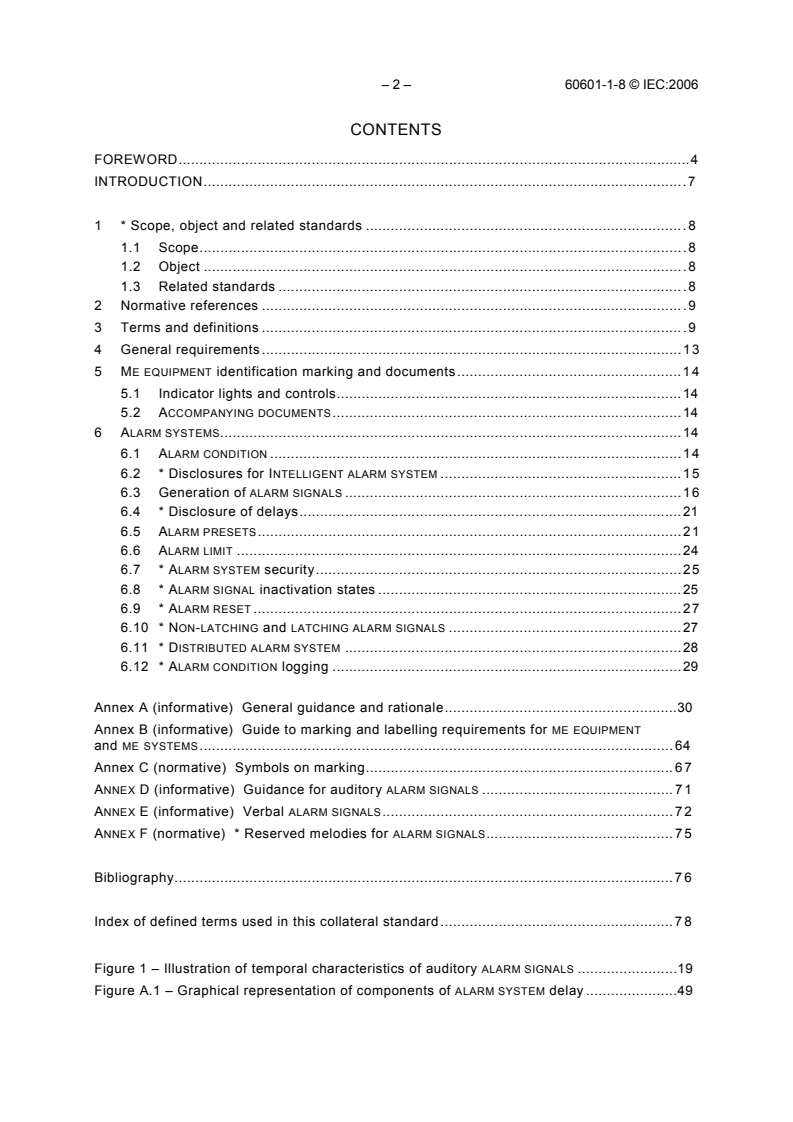
IEC 60601-1-8:2006 - Medical electrical equipment - Part 1-8: General requirements for basic safety and essential performance - Collateral Standard: General requirements, tests and guidance for alarm systems in medical electrical equipment and medical electrical systems Released:10/25/2006
IEC 60601-1-8:2006+AMD1:2012 CSV - Medical electrical equipment - Part 1-8: General requirements forbasic safety and essential performance - Collateral Standard: General requirements, tests and guidance for alarm systems inmedical electrical equipment and medical electrical systems Released:11/28/2012

IEC 60601-1-8:2006+AMD1:2012+AMD2:2020 CSV - Medical electrical equipment - Part 1-8: General requirements for basic safety and essential performance - Collateral Standard: General requirements, tests and guidance for alarm systems in medical electrical equipment and medical electrical systems Released:7/23/2020
Overview
IEC 60601-1-8:2006 (consolidated with Amendments 1 and 2) is the IEC collateral standard that defines general requirements, tests and guidance for alarm systems used in medical electrical equipment and medical electrical systems. It specifies requirements for basic safety and essential performance of alarm functions, and provides guidance on alarm categorization, consistent alarm signals, control states and marking to support safe alarm design and operation in clinical environments.
Key topics and technical requirements
The standard addresses alarm system design and verification across a broad set of technical topics, including:
- Alarm categories and priorities - defining degrees of urgency so alarms are consistent and interpretable across devices.
- Alarm signal generation - requirements for auditory, visual and verbal alarm signals, timing (burst/pulse), and reserved melodies/signal characteristics (normative and informative annexes).
- Indicator marking and controls - labeling, symbols and user-interface states for alarm indicators and controls.
- Alarm system functions - presets, alarm limits, reset, latching vs non-latching behaviors, inactivation states and handling of delays.
- Intelligent and distributed alarm systems - disclosure and behavior expectations for device intelligence, integration with Medical IT Networks and distributed alarm/information systems.
- Alarm logging and security - requirements and guidance for recording alarm conditions and ensuring alarm system security.
- Testing and documentation - tests and required accompanying documents, including guidance in informative annexes (A–H) and normative symbols.
Annexes provide detailed guidance and rationale, marking guides, auditory alarm design guidance and normative signal definitions. The consolidated edition includes amendments up to 2020.
Practical applications - who uses IEC 60601-1-8
IEC 60601-1-8 is essential for:
- Medical device manufacturers designing patient monitors, ventilators, infusion pumps and other devices with alarm functions.
- Clinical engineers and biomedical technicians responsible for alarm configuration, maintenance and integration in hospitals.
- User-interface and human factors teams ensuring alarm signals are consistent, interpretable and support clinical workflows.
- Regulatory and testing laboratories performing conformity assessment and safety testing for alarm systems.
- IT and systems integrators implementing distributed alarm systems and Medical IT Network interfaces.
Use cases include ensuring interoperable alarm behavior across devices, reducing alarm fatigue by consistent prioritization and improving patient safety through validated alarm performance.
Related standards (if applicable)
- IEC 60601-1 - General requirements for basic safety and essential performance (primary general standard).
- ISO/IEC Directives, Part 2 - referenced for structural alignment of collateral standards.
Keywords: IEC 60601-1-8, alarm systems, medical electrical equipment, alarm signals, alarm categories, medical device alarms, essential performance, basic safety, distributed alarm systems.
Relations
- Effective Date
- 25-Aug-2026
- Effective Date
- 25-Aug-2026
- Effective Date
- 25-Aug-2026
- Effective Date
- 25-Aug-2026
- Effective Date
- 25-Aug-2026
- Effective Date
- 25-Aug-2026
- Effective Date
- 25-Aug-2026
- Effective Date
- 25-Aug-2026
- Effective Date
- 25-Aug-2026
- Effective Date
- 25-Aug-2026
- Effective Date
- 25-Aug-2026
- Effective Date
- 25-Aug-2026
- Effective Date
- 25-Aug-2026
- Effective Date
- 25-Aug-2026
- Effective Date
- 25-Aug-2026
Buy Documents
IEC 60601-1-8:2006+AMD1:2012+AMD2:2020 CSV - Medical electrical equipment - Part 1-8: General requirements for basic safety and essential performance - Collateral Standard: General requirements, tests and guidance for alarm systems in medical electrical equipment and medical electrical systems Released:7/23/2020
IEC 60601-1-8:2006 - Medical electrical equipment - Part 1-8: General requirements for basic safety and essential performance - Collateral Standard: General requirements, tests and guidance for alarm systems in medical electrical equipment and medical electrical systems Released:10/25/2006
IEC 60601-1-8:2006+AMD1:2012 CSV - Medical electrical equipment - Part 1-8: General requirements forbasic safety and essential performance - Collateral Standard: General requirements, tests and guidance for alarm systems inmedical electrical equipment and medical electrical systems Released:11/28/2012
IEC 60601-1-8:2006+AMD1:2012+AMD2:2020 CSV - Medical electrical equipment - Part 1-8: General requirements for basic safety and essential performance - Collateral Standard: General requirements, tests and guidance for alarm systems in medical electrical equipment and medical electrical systems Released:7/23/2020
Get Certified
Connect with accredited certification bodies for this standard

BSI Group
BSI (British Standards Institution) is the business standards company that helps organizations make excellence a habit.

TÜV Rheinland
TÜV Rheinland is a leading international provider of technical services.

TÜV SÜD
TÜV SÜD is a trusted partner of choice for safety, security and sustainability solutions.
Sponsored listings
Frequently Asked Questions
IEC 60601-1-8:2006 is a standard published by the International Electrotechnical Commission (IEC). Its full title is "Medical electrical equipment - Part 1-8: General requirements for basic safety and essential performance - Collateral Standard: General requirements, tests and guidance for alarm systems in medical electrical equipment and medical electrical systems". This standard covers: Specifies basic safety and essential performance requirements and tests for alarm systems in medical electrical equipment and medical electrical systems and to provide guidance for their application. This is accomplished by defining alarm categories (priorities) by degree of urgency, consistent alarm signals and consistent control states and their marking for all alarm systems.
Specifies basic safety and essential performance requirements and tests for alarm systems in medical electrical equipment and medical electrical systems and to provide guidance for their application. This is accomplished by defining alarm categories (priorities) by degree of urgency, consistent alarm signals and consistent control states and their marking for all alarm systems.
IEC 60601-1-8:2006 is classified under the following ICS (International Classification for Standards) categories: 11.040.01 - Medical equipment in general. The ICS classification helps identify the subject area and facilitates finding related standards.
IEC 60601-1-8:2006 has the following relationships with other standards: It is inter standard links to EN ISO 80601-2-12:2011, EN ISO 80601-2-55:2011, EN ISO 11197:2016, EN ISO 20342-1:2019, EN ISO 80601-2-56:2012, EN ISO 27427:2019, EN ISO 23371:2022, EN ISO 80601-2-69:2020, EN ISO 26722:2015, EN ISO 80601-2-12:2020, EN ISO 80601-2-61:2011, EN ISO 80601-2-72:2015, EN ISO 20342-1:2022, EN ISO 80601-2-13:2012, EN ISO 80601-2-69:2014. Understanding these relationships helps ensure you are using the most current and applicable version of the standard.
IEC 60601-1-8:2006 is available in PDF format for immediate download after purchase. The document can be added to your cart and obtained through the secure checkout process. Digital delivery ensures instant access to the complete standard document.
Standards Content (Sample)
IEC 60601-1-8
Edition 2.2 2020-07
CONSOLIDATED VERSION
INTERNATIONAL
STANDARD
colour
inside
Medical electrical equipment –
Part 1-8: General requirements for basic safety and essential performance –
Collateral standard: General requirements, tests and guidance for alarm
systems in medical electrical equipment and medical electrical systems
All rights reserved. Unless otherwise specified, no part of this publication may be reproduced or utilized in any form
or by any means, electronic or mechanical, including photocopying and microfilm, without permission in writing from
either IEC or IEC's member National Committee in the country of the requester. If you have any questions about IEC
copyright or have an enquiry about obtaining additional rights to this publication, please contact the address below or
your local IEC member National Committee for further information.
IEC Central Office Tel.: +41 22 919 02 11
3, rue de Varembé info@iec.ch
CH-1211 Geneva 20 www.iec.ch
Switzerland
About the IEC
The International Electrotechnical Commission (IEC) is the leading global organization that prepares and publishes
International Standards for all electrical, electronic and related technologies.
About IEC publications
The technical content of IEC publications is kept under constant review by the IEC. Please make sure that you have the
latest edition, a corrigendum or an amendment might have been published.
IEC publications search - webstore.iec.ch/advsearchform Electropedia - www.electropedia.org
The advanced search enables to find IEC publications by a The world's leading online dictionary on electrotechnology,
variety of criteria (reference number, text, technical containing more than 22 000 terminological entries in English
committee,…). It also gives information on projects, replaced and French, with equivalent terms in 16 additional languages.
and withdrawn publications. Also known as the International Electrotechnical Vocabulary
(IEV) online.
IEC Just Published - webstore.iec.ch/justpublished
Stay up to date on all new IEC publications. Just Published IEC Glossary - std.iec.ch/glossary
details all new publications released. Available online and 67 000 electrotechnical terminology entries in English and
once a month by email. French extracted from the Terms and definitions clause of
IEC publications issued between 2002 and 2015. Some
IEC Customer Service Centre - webstore.iec.ch/csc entries have been collected from earlier publications of IEC
If you wish to give us your feedback on this publication or TC 37, 77, 86 and CISPR.
need further assistance, please contact the Customer Service
Centre: sales@iec.ch.
IEC 60601-1-8
Edition 2.2 2020-07
CONSOLIDATED VERSION
INTERNATIONAL
STANDARD
colour
inside
Medical electrical equipment –
Part 1-8: General requirements for basic safety and essential performance –
Collateral standard: General requirements, tests and guidance for alarm
systems in medical electrical equipment and medical electrical systems
INTERNATIONAL
ELECTROTECHNICAL
COMMISSION
ICS 11.040.01 ISBN 978-2-8322-8720-0
IEC 60601-1-8
Edition 2.2 2020-07
REDLINE VERSION
colour
inside
Medical electrical equipment –
Part 1-8: General requirements for basic safety and essential performance –
Collateral standard: General requirements, tests and guidance for alarm
systems in medical electrical equipment and medical electrical systems
– 2 – IEC 60601-1-8:2006+AMD1:2012
+AMD2:2020 CSV IEC 2020
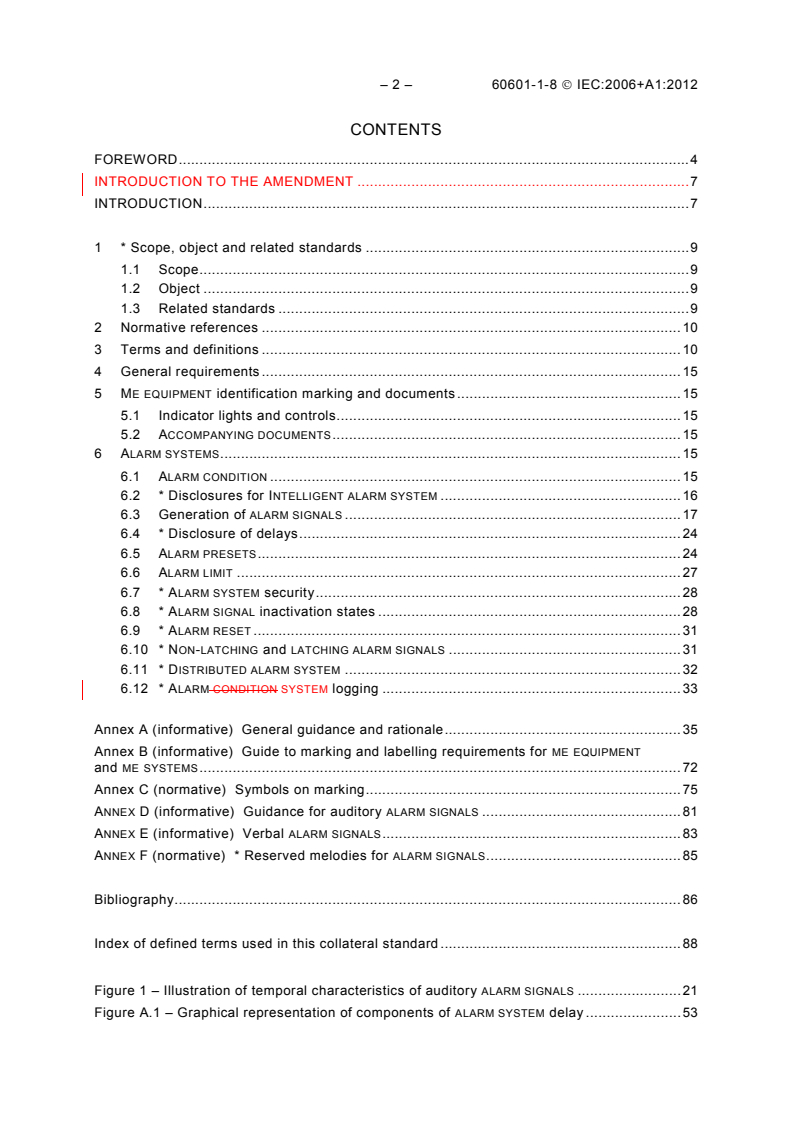
CONTENTS
FOREWORD . 4
INTRODUCTION . 7
INTRODUCTION to Amendment 1 . 7
INTRODUCTION to Amendment 2 . 8
1 * Scope, object and related standards . 9
1.1 Scope . 9
1.2 Object . 9
1.3 Related standards . 9
2 Normative references . 10
3 Terms and definitions . 11
4 General requirements . 18
5 ME EQUIPMENT identification marking and documents . 18
5.1 Indicator lights and controls . 18
5.2 ACCOMPANYING DOCUMENTS . 19
6 ALARM SYSTEMS . 19
6.1 ALARM CONDITION . 19
6.2 * Disclosures for INTELLIGENT ALARM SYSTEM . 21
6.3 Generation of ALARM SIGNALS . 21
6.4 * Disclosure of delays . 29
6.5 ALARM PRESETS . 30
6.6 ALARM LIMIT . 32
6.7 * ALARM SYSTEM security . 33
6.8 * ALARM SIGNAL inactivation states . 33
6.9 * ALARM RESET . 37
6.10 * NON-LATCHING and LATCHING ALARM SIGNALS . 37
6.11 * DISTRIBUTED ALARM SYSTEM AND DISTRIBUTED INFORMATION SYSTEMS ABOUT
ALARM CONDITIONS . 37
6.12 * ALARM CONDITION SYSTEM logging . 42
6.13 ALARM SYSTEM functions . 44
Annex A (informative) General guidance and rationale . 47
Annex B (informative) Guide to marking and labelling requirements for ME EQUIPMENT
and ME SYSTEMS . 97
Annex C (normative) Symbols on marking . 100
Annex D (informative) Guidance for auditory ALARM SIGNALS . 109
Annex E (informative) Verbal ALARM SIGNALS . 111
Annex F (normative) * Reserved melodies for ALARM SIGNALS . 113
Annex G (normative) * Auditory ALARM SIGNALS . 114
Annex H (informative) VALIDATION of AUDITORY ICONS . 119
Bibliography . 125
Index of defined terms used in this collateral standard . 131
Figure 1 – Illustration of temporal characteristics of auditory ALARM SIGNALS . 26
Figure 2 – Functions of a DISTRIBUTED ALARM SYSTEM utilizing a MEDICAL IT NETWORK . 39
+AMD2:2020 CSV IEC 2020
Figure 3 – Functions of an ALARM SYSTEM . 45
Figure A.1 – Graphical representation of components of ALARM SYSTEM delay . 70
Figure G.1 – Illustration of spacing of AUDITORY POINTER . 116
Figure G.2 – Illustration of temporal characteristics of an AUDITORY POINTER . 117
Table 1 – Determination of ALARM CONDITION and assignment of priorities . 20
Table 2 – Characteristics of alarm indicator lights . 22
Table 3 – * Characteristics of the BURST of auditory ALARM SIGNALS . 24
Table 4 – * Characteristics of the PULSE of auditory ALARM SIGNALS. 25
Table 5 – ALARM SIGNAL inactivation states . 36
Table A.1 – Reference interpretation of Table F.1 .
Table A.2 – Reference interpretation of Table F.2 .
Table A.1 – ALARM SYSTEM output to perceived OPERATOR action . 55
Table A.2 – Examples of ME EQUIPMENT for each category of the SOURCE of an ALARM
CONDITION . 96
Table B.1 – Cross-reference of marking . 97
Table B.2 – Cross-reference of ACCOMPANYING DOCUMENTS . 98
Table B.3 – Cross-reference of instructions for use . 98
Table B.4 – Cross-reference of technical description . 99
Table C.1 – Graphical symbols for ALARM SYSTEMS . 100
Table C.1 – Graphical symbols for ALARM SYSTEMS (continued) . 101
Table C.1 – Graphical symbols for ALARM SYSTEMS (continued) . 102
Table C.2 – Alternative ALARM SYSTEM related markings . 108
Table D.1 – Attributes of perceived urgency . 109
Table F.1 – * Equipment encoded auditory ALARM SIGNALS categorized by ALARM
CONDITION and priority complying with Table 3 and Table 4 .
Table F.2 – * Auditory LOW PRIORITY ALARM SIGNAL complying with Table 3 and Table 4 .
Table G.1 – Characteristics of the BURST of the AUDITORY POINTER . 115
Table G.2 – Characteristics of the PULSE of the AUDITORY POINTER . 116
Table G.3 – Characteristics of the AUDITORY POINTER . 117
Table G.4 – * Characteristics of the AUDITORY ICON . 118
Table G.5 – Characteristics of the auditory ALARM SIGNAL . 118
Table H.1 – Performance levels of three AUDITORY POINTERS and seven AUDITORY ICONS
based on available data . 120
– 4 – IEC 60601-1-8:2006+AMD1:2012
+AMD2:2020 CSV IEC 2020
INTERNATIONAL ELECTROTECHNICAL COMMISSION
____________
MEDICAL ELECTRICAL EQUIPMENT –
Part 1-8: General requirements for basic safety
and essential performance –
Collateral Standard: General requirements, tests and guidance for alarm
systems in medical electrical equipment and medical electrical systems
FOREWORD
1) The International Electrotechnical Commission (IEC) is a worldwide organization for standardization comprising
all national electrotechnical committees (IEC National Committees). The object of IEC is to promote
international co-operation on all questions concerning standardization in the electrical and electronic fields. To
this end and in addition to other activities, IEC publishes International Standards, Technical Specifications,
Technical Reports, Publicly Available Specifications (PAS) and Guides (hereafter referred to as “IEC
Publication(s)”). Their preparation is entrusted to technical committees; any IEC National Committee interested
in the subject dealt with may participate in this preparatory work. International, governmental and non-
governmental organizations liaising with the IEC also participate in this preparation. IEC collaborates closely
with the International Organization for Standardization (ISO) in accordance with conditions determined by
agreement between the two organizations.
2) The formal decisions or agreements of IEC on technical matters express, as nearly as possible, an international
consensus of opinion on the relevant subjects since each technical committee has representation from all
interested IEC National Committees.
3) IEC Publications have the form of recommendations for international use and are accepted by IEC National
Committees in that sense. While all reasonable efforts are made to ensure that the technical content of IEC
Publications is accurate, IEC cannot be held responsible for the way in which they are used or for any
misinterpretation by any end user.
4) In order to promote international uniformity, IEC National Committees undertake to apply IEC Publications
transparently to the maximum extent possible in their national and regional publications. Any divergence
between any IEC Publication and the corresponding national or regional publication shall be clearly indicated in
the latter.
5) IEC itself does not provide any attestation of conformity. Independent certification bodies provide conformity
assessment services and, in some areas, access to IEC marks of conformity. IEC is not responsible for any
services carried out by independent certification bodies.
6) All users should ensure that they have the latest edition of this publication.
7) No liability shall attach to IEC or its directors, employees, servants or agents including individual experts and
members of its technical committees and IEC National Committees for any personal injury, property damage or
other damage of any nature whatsoever, whether direct or indirect, or for costs (including legal fees) and
expenses arising out of the publication, use of, or reliance upon, this IEC Publication or any other IEC
Publications.
8) Attention is drawn to the Normative references cited in this publication. Use of the referenced publications is
indispensable for the correct application of this publication.
9) Attention is drawn to the possibility that some of the elements of this IEC Publication may be the subject of
patent rights. IEC shall not be held responsible for identifying any or all such patent rights.
This consolidated version of the official IEC Standard and its amendments has been
prepared for user convenience.
IEC 60601-1-8 edition 2.2 contains the second edition (2006-10) [documents
62A/519/CDV and 62A/537A/RVC], its amendment 1 (2012-11) [documents 62A/824/FDIS
and 62A/837/RVD] and its amendment 2 (2020-07) [documents 62A/1392/FDIS and
62A/1407/RVD].
In this Redline version, a vertical line in the margin shows where the technical content
is modified by amendments 1 and 2. Additions are in green text, deletions are in
strikethrough red text. A separate Final version with all changes accepted is available
in this publication.
+AMD2:2020 CSV IEC 2020
International standard IEC 60601-1-8 has been prepared by IEC subcommittee 62A: Common
aspects of electrical equipment used in medical practice of IEC technical committee 62:
Electrical equipment in medical practice, and ISO subcommittee SC 3: Lung ventilators and
related devices of ISO technical committee 121: Anaesthetic and respiratory equipment.
It is published as double logo standard.
IEC 60601-1-8 constitutes a collateral standard to IEC 60601-1: Medical electrical equipment –
Part 1: General requirements for safety and essential performance hereafter referred to as the
general standard.
This edition of IEC 60601-1-8 was revised to structurally align it with the 2005 edition of IEC
60601-1 and to implement the decision of IEC Subcommittee 62 A that the clause numbering
structure of collateral standards written to IEC 60601-1:2005 would adhere to the form
specified in ISO/IEC Directives, Part 2:2004. The principle technical changes are in Clause 4,
which now recognizes that there is a general requirement for a risk management process in
IEC 60601-1:2005.
This publication has been drafted in accordance with the ISO/IEC Directives, Part 2.
In the 60601 series of publications, collateral standards specify general requirements for
safety applicable to:
– a subgroup of MEDICAL ELECTRICAL EQUIPMENT (e.g. radiological equipment); or
– a specific characteristic of all MEDICAL ELECTRICAL EQUIPMENT, not fully addressed in the
ALARM SYSTEMS).
general standard (e.g.
In this collateral standard, the following print types are used:
– Requirements and definitions: roman type.
– Test specifications: italic type. In addition, in Annex A text in italics indicates guidance that
describes means to achieve the safety objectives of this collateral standard.
– Informative material appearing outside of tables, such as notes, examples and references: in smaller type.
Normative text of tables is also in a smaller type.
– TERMS DEFINED IN CLAUSE 3 OF THE GENERAL STANDARD, IN THIS COLLATERAL STANDARD OR AS
NOTED: SMALL CAPITALS.
In referring to the structure of this standard, the term
– “clause” means one of the seventeen numbered divisions within the table of contents,
inclusive of all subdivisions (e.g. Clause 6 includes Subclauses 6.1, 6.2, etc.);
– “subclause” means a numbered subdivision of a clause (e.g. 6.1, 6.2 and 6.3.1 are all
subclauses of Clause 6).
References to clauses within this standard are preceded by the term “Clause” followed by the
clause number. References to subclauses within this standard are by number only.
In this standard, the conjunctive “or” is used as an “inclusive or” so a statement is true if any
combination of the conditions is true.
The verbal forms used in this standard conform to usage described in Annex H of the ISO/IEC
Directives, Part 2. For the purposes of this standard, the auxiliary verb:
− “shall” means that compliance with a requirement or a test is mandatory for compliance
with this standard;
− “should” means that compliance with a requirement or a test is recommended but is not
mandatory for compliance with this standard;
− “may” is used to describe a permissible way to achieve compliance with a requirement or
test.
– 6 – IEC 60601-1-8:2006+AMD1:2012
+AMD2:2020 CSV IEC 2020
Clauses, subclauses and definitions for which a rationale is provided in informative Annex A
are marked with an asterisk (*).
A list of all parts of the IEC 60601 series, under the general title: Medical electrical
equipment, can be found on the IEC website.
The committee has decided that the contents of the base publication and its amendments will
remain unchanged until the stability date indicated on the IEC web site under
"http://webstore.iec.ch" in the data related to the specific publication. At this date, the
publication will be
• reconfirmed,
• withdrawn,
• replaced by a revised edition, or
• amended.
NOTE The attention of National Committees is drawn to the fact that equipment manufacturers and testing
organizations may need a transitional period following publication of a new, amended or revised IEC or
ISO publication in which to make products in accordance with the new requirements and to equip themselves for
conducting new or revised tests. It is the recommendation of the committee that the content of this publication be
adopted for mandatory implementation nationally not earlier than 3 years from the date of publication.
IMPORTANT – The “colour inside” logo on the cover page of this publication indicates
that it contains colours which are considered to be useful for the correct understanding
of its contents. Users should therefore print this publication using a colour printer.
+AMD2:2020 CSV IEC 2020
INTRODUCTION
MEDICAL ELECTRICAL EQUIPMENT and MEDICAL ELECTRICAL SYSTEMS are increasingly used in
medical practice. ALARM SIGNALS are frequently used to indicate unsatisfactory physiological
PATIENT states, unsatisfactory functional states of the MEDICAL ELECTRICAL EQUIPMENT or
MEDICAL ELECTRICAL SYSTEM or to warn the OPERATOR of HAZARDS to the PATIENT or OPERATOR
due to the MEDICAL ELECTRICAL EQUIPMENT or MEDICAL ELECTRICAL SYSTEM. INFORMATION
SIGNALS convey information that is independent of an ALARM CONDITION.
Surveys of healthcare personnel have indicated significant discontent with ALARM SIGNALS.
Problems include difficulty in identifying the source origin of an ALARM SIGNAL, loud and
distracting ALARM SIGNALS, and the high incidence of FALSE POSITIVE or NEGATIVE ALARM
1)
CONDITIONS [16] . Surveys of MANUFACTURERS of medical monitors demonstrated a wide
variety of DEFAULT ALARM PRESETS. The leading reason for disabling ALARM SIGNALS is the large
number of ALARM SIGNALS associated with FALSE POSITIVE ALARM CONDITIONS. See also
bibliography.
Safety of PATIENTS depends on the ability of the OPERATOR to correctly discern the
characteristics of ALARM SIGNALS. USABILITY is an important element in the design of ALARM
SIGNALS that are readily discernible without being unnecessarily distracting or disturbing. This
approach is intended to rationalize the current situation, to reduce confusion by limiting
proliferation of ALARM SIGNALS and their control states, and to minimize distraction for other
people. This collateral standard was developed with contributions from clinicians, engineers
and applied psychologists.
The terminology, requirements, general recommendations and guidance of this collateral
standard are intended to be useful for MANUFACTURERS of MEDICAL ELECTRICAL EQUIPMENT and
MEDICAL ELECTRICAL SYSTEMS and for technical committees responsible for particular
standards.
The effectiveness of any ALARM SYSTEM depends critically on its implementation by the
RESPONSIBLE ORGANIZATION. It is important that the RESPONSIBLE ORGANIZATION configure the
ALARM SYSTEM so that an OPERATOR is not able to compromise it.
INTRODUCTION to Amendment 1
The second edition of IEC 60601-1-8 was published in 2006. Since its publication, an issue
has been identified with respect to pulse and burst testing. In addition, issues have been
raised by IEC/62D/MT 22, Electromedical diagnostic and patient monitoring equipment, during
implementation of alarm system requirements in particular standards within their scope of
work.
At the Brussels meeting, IEC/SC 62A accepted a proposal, based on ISO/TC 121/SC 3
st
Resolution Orebro 6, to develop the 1 amendment to IEC 60601-1-8:2006 to address the
issues identified above. IEC/SC 62A – ISO/TC 121/SC 3 Joint Working Group 2, Alarms, was
reactivated as a maintenance team to develop this amendment.
—————————
1) Figures in brackets refer to the bibliography.
– 8 – IEC 60601-1-8:2006+AMD1:2012
+AMD2:2020 CSV IEC 2020
INTRODUCTION to Amendment 2
The second edition of IEC 60601-1-8 was published in 2006 and amended in 2012. Since the
publication of IEC 60601-1-8:2006+A1:2012, the IEC Subcommittee (SC) 62A Secretariat has
been collecting issues from a variety of sources including comments from National
Committees. At the November 2015 meeting of IEC/SC 62A in Kobe, Japan, the
subcommittee initiated a process to identify high-priority issues that need to be considered in
an amendment and should not wait until the third edition of IEC 60601-1-8, which is presently
targeted for publication sometime after 2024.
Those issues selected for inclusion on the final "short list" to be addressed in Amendment 2
were those approved by a 2/3 majority of the National Committees present and voting at the
Frankfurt meeting of SC 62A. At the meeting held on 10 October 2016, 20 items were
presented to the National Committees present. All 20 items received the required 2/3 majority
of the National Committees present and voting and have been included in the "short list" for
consideration in preparing Amendment 2. All remaining issues have been placed on a "long
list" for consideration in the third edition of IEC 60601-1-8.
The "short list" of issues was documented in the design specification for Amendment 2. As
IEC 60601-1-8 was jointly developed with ISO/TC 121/SC 3, the work was assigned to
IEC/SC 62A-ISO/TC 121/SC 3 Joint Working Group (JWG) 2. JWG 2 was directed to consider
each issue described in Clause 6 of the design specification and develop an appropriate
solution for the identified problem. That final solution in this amendment can encompass any
technical solution proposed by the author of the issue or it can involve a different solution
developed by the expert group. The expert group can also have recommended that no change
to the standard was justified by the problem statement.
Because this is an amendment to IEC 60601-1-8:2006, the style in force at the time of
publication of IEC 60601-1-8 has been applied to this amendment. The style specified in
ISO/IEC Directives Part 2:2018 has only been applied when implementing the new style
guidance would not result in additional editorial changes. For example, notes to definitions
are designated as "NOTE" rather than "Note to entry" in Clause 3.
Users of this document should note that when constructing the dated references to specific
elements in a standard, such as definitions, amendments are only referenced if they modified
the text being cited. For example, if a reference is made to a definition that has not been
modified by an amendment, then the reference to the amendment is not included in the dated
reference.
+AMD2:2020 CSV IEC 2020
MEDICAL ELECTRICAL EQUIPMENT –
Part 1-8: General requirements for basic safety
and essential performance –
Collateral Standard: General requirements, tests and guidance for alarm
systems in medical electrical equipment and medical electrical systems
1 * Scope, object and related standards
1.1 Scope
This International Standard applies to the BASIC SAFETY and ESSENTIAL PERFORMANCE of
MEDICAL ELECTRICAL EQUIPMENT and MEDICAL ELECTRICAL SYSTEMS, hereafter referred to as
ME EQUIPMENT and ME SYSTEMS.
This collateral standard specifies requirements for ALARM SYSTEMS and ALARM SIGNALS in
ME EQUIPMENT and ME SYSTEMS.
It also provides guidance for the application of ALARM SYSTEMS.
1.2 Object
The object of this collateral standard is to specify BASIC SAFETY and ESSENTIAL PERFORMANCE
requirements and tests for ALARM SYSTEMS in ME EQUIPMENT and ME SYSTEMS and to provide
guidance for their application. This is accomplished by defining alarm categories (priorities) by
degree of urgency, consistent ALARM SIGNALS and consistent control states and their marking
for all ALARM SYSTEMS.
This collateral standard does not specify:
– whether any particular ME EQUIPMENT or ME SYSTEM is required to be provided with ALARM
SYSTEMS;
– the particular circumstances which initiate an ALARM CONDITION;
– the allocation of priorities to a particular ALARM CONDITION; or
– the means of generating ALARM SIGNALS.
1.3 Related standards
1.3.1 IEC 60601-1
For ME EQUIPMENT and ME SYSTEMS, this collateral standard complements IEC 60601-1.
When referring to IEC 60601-1 or to this collateral standard, either individually or in
combination, the following conventions are used:
– "the general standard" designates IEC 60601-1 alone (latest edition including any
amendments);
– "this collateral standard" designates IEC 60601-1-8 alone, including any amendments;
– "this standard" designates the combination of the general standard and this collateral
standard.
– 10 – IEC 60601-1-8:2006+AMD1:2012
+AMD2:2020 CSV IEC 2020
1.3.2 Particular standards
A requirement in a particular standard takes priority over the corresponding requirement in
this collateral standard.
2 Normative references
The following referenced documents, in whole or in part, are normatively referenced in this
document and are indispensable for the its application of this document. For dated
references, only the edition cited applies. For undated references, the latest edition of the
referenced document (including any amendments) applies.
IEC 60417, Graphical symbols for use on equipment. Available from:
symbols.info/equipment>
IEC 60601-1:2005, Medical electrical equipment – Part 1: General requirements for basic
safety and essential performance
Amendment 1:2012
Amendment 2:2020
2)
IEC 60601-1-2:---- , Medical electrical equipment – Part 1-2: General requirements for basic
safety and essential performance – Collateral Standard: Electromagnetic compatibility –
Requirements and tests
3)
IEC 60601-1-6:---- , Medical electrical equipment – Part 1-6: General requirements for basic
safety and essential performance – Collateral standard: Usability
4)
IEC 60651:1979 , Sound level meters
Amendment 1 (1993)
Amendment 2 (2000)
IEC 61672-1:2013, Electroacoustics – Sound level meters – Part 1: Specifications
IEC 62366:2007, Medical devices – Application of usability engineering to medical devices
IEC 62366-1:2015, Medical devices – Part 1: Application of usability engineering to medical
devices
Amendment 1:2020
ISO 3744:19942010, Acoustics – Determination of sound power levels and sound energy
levels of noise sources using sound pressure – Engineering method in for an essentially free
field over a reflecting plane
ISO 7000:1989, Graphical symbols for use on equipment – Index and synopsis. Available
from:
—————————
2)
A second edition of IEC 60601-1-2 exists, published in 2004 under the title Medical electrical equipment – Part
1-2: General requirements for safety – Collateral Standard: Electromagnetic compatibility – Requirements and
tests. A third edition under the title given above is currently to be published. References to IEC 60601-1-2 in
this standard refer to the new edition.
3)
A first edition of IEC 60601-1-6 exists, published in 2004 under the title Medical electrical equipment – Part 1-6:
General requirements for safety – Collateral Standard: Usability. A second edition under the title given above is
currently to be published. References to IEC 60601-1-6 in this standard refer to the new edition.
4)
IEC 60651:1979 has been withdrawn and replaced by IEC 61672-1:2002 and IEC 61672-2:2003. Future editions
of this publication will be amended to take this fact into account.
+AMD2:2020 CSV IEC 2020
3 Terms and definitions
For the purposes of this document, the terms and definitions given in IEC 60601-
5) 6)
1:2005+A1:2012 and IEC 62366:2007, IEC 60601-1-2:---- , IEC 60601-1-6:---- , and the
following definitions apply.
For the purposes of this document, the terms and definitions given in
IEC 60601-1:2005+A1:2012+A2:2020, IEC 62366-1:2015+A1:2020, and the following
definitions apply.
NOTE 1 The term “electrical equipment” is used to mean ME EQUIPMENT or other electrical equipment. This
standard also uses the term “equipment” to mean ME EQUIPMENT or other electrical or non-electrical equipment in
the context of an ME SYSTEM.
NOTE 2 An index of defined terms is found beginning on page 131.
3.1
* ALARM CONDITION
state of the ALARM SYSTEM when it has determined that a potential or actual HAZARD
HAZARDOUS SITUATION exists for which OPERATOR awareness or response is required
NOTE 1 An ALARM CONDITION can be invalid, i.e. a FALSE POSITIVE ALARM CONDITION.
NOTE 2 An ALARM CONDITION can be missed, i.e. a FALSE NEGATIVE ALARM CONDITION.
3.2
* ALARM CONDITION DELAY
time from the occurrence of a triggering event either in the PATIENT, for PHYSIOLOGICAL ALARM
CONDITIONS, or in the equipment, for TECHNICAL ALARM CONDITIONS, to when the ALARM SYSTEM
determines that an ALARM CONDITION exists
3.3
* ALARM LIMIT
threshold used by an ALARM SYSTEM to determine an ALARM CONDITION
3.4
ALARM OFF
state of indefinite duration in which an ALARM SYSTEM or part of an ALARM SYSTEM does not
generate ALARM SIGNALS
3.5
* ALARM PAUSED
state of limited duration in which the ALARM SYSTEM or part of the ALARM SYSTEM does not
generate ALARM SIGNALS
3.6
ALARM PRESET
set of stored configuration parameters, including selection of algorithms and initial values for
use by algorithms, which affect or modify the performance of the ALARM SYSTEM
3.7
ALARM RESET
OPERATOR action that causes the cessation of an ALARM SIGNAL for which no associated ALARM
CONDITION currently exists
3.8
ALARM SETTINGS
ALARM SYSTEM configuration, including but not limited to:
—————————
5)
To be published. See footnote 2.
6)
To be published. See footnote 3.
– 12 – IEC 60601-1-8:2006+AMD1:2012
+AMD2:2020 CSV IEC 2020
– ALARM LIMITS;
– the characteristics of any ALARM SIGNAL inactivation states; and
– the values of variables or parameters that determine the function of the ALARM SYSTEM
NOTE Some algorithmically-determined ALARM SETTINGS can require time to be determined or re-determined.
3.9
ALARM SIGNAL
type of signal generated by the ALARM SYSTEM to indicate the presence (or occurrence) of an
ALARM CONDITION
3.10
* ALARM SIGNAL GENERATION DELAY
time from the onset of an ALARM CONDITION to the generation of its ALARM SIGNAL(S)
3.11
ALARM SYSTEM
parts of ME EQUIPMENT or a ME SYSTEM that detect ALARM CONDITIONS and, as appropriate,
generate ALARM SIGNALS
3.12
AUDIO OFF
state of indefinite duration in which the ALARM SYSTEM or part of the ALARM SYSTEM does not
generate an auditory ALARM SIGNAL
3.13
AUDIO PAUSED
state of limited duration in which the ALARM SYSTEM or part of the ALARM SYSTEM does not
generate an auditory ALARM SIGNAL
3.14
BURST
group of PULSES with a distinctive rhythm or pattern
3.15
DE-ESCALATION
PROCESS by which an ALARM SYSTEM decreases the priority of an ALARM CONDITION or
decreases the sense of urgency of an ALARM SIGNAL
3.16
DEFAULT ALARM PRESET
ALARM PRESET that can be activated by the ALARM SYSTEM without OPERATOR action
NOTE MANUFACTURER- or RESPONSIBLE ORGANIZATION-configured ALARM PRESETS are possible types of DEFAULT
ALARM PRESETS.
3.17
* DISTRIBUTED ALARM SYSTEM
DAS
ALARM SYSTEM that involves more than one item of equipment of a ME SYSTEM intended for
delivery of ALARM CONDITIONS with technical confirmation
NOTE 1 The parts of a DISTRIBUTED ALARM SYSTEM can be widely separated in distance.
NOTE 2 A DISTRIBUTED ALARM SYSTEM is intended to notify OPERATORS of the existence of an ALARM CONDITION.
NOTE 3 For the purposes of this document, technical confirmation means that each element of a DISTRIBUTED
ALARM SYSTEM confirms or guarantees the successful delivery of the ALARM CONDITION to the next element or
appropriate TECHNICAL ALARM CONDITIONS are created as described in 6.11.2.2.1.
+AMD2:2020 CSV IEC 2020
3.18
ESCALATION
PROCESS by which an ALARM SYSTEM increases the priority of an ALARM CONDITION or increases
the sense of urgency of an ALARM SIGNAL
3.19
FALL TIME
t
f
interval over which the PULSE amplitude decreases from 90 % to 10 % of its maximum (see
Figure 1)
3.20
FALSE NEGATIVE ALARM CONDITION
ALARM CONDITION when a valid triggering event has occurred in the PATIENT, the
absence of an
equipment or the ALARM SYSTEM
NOTE An ALARM CONDITION can be rejected or missed because of spurious information produced by the PATIENT,
the PATIENT-equipment interface, other equipment or the equipment ALARM SYSTEM itself.
3.21
FALSE POSITIVE ALARM CONDITION
presence of an ALARM CONDITION when no valid triggering event has occurred in the PATIENT,
the equipment or the ALARM SYSTEM
NOTE A FALSE POSITIVE ALARM CONDITION can be caused by spurious information produced by the PATIENT, the
PATIENT-equipment interface, other equipment or the ALARM SYSTEM itself.
3.22
HIGH PRIORITY
indicating that immediate OPERATOR response is required
NOTE 1 The priority is assigned through RISK ANALYSIS. See 6.1.2 for the assignment of priority.
NOTE 2 Immediate implies the interruption of current workflow is expected [59], [60].
3.23
* INFORMATION SIGNAL
any signal that is not an ALARM SIGNAL or a REMINDER SIGNAL
EXAMPLE 1 ECG waveform
EXAMPLE 2 SpO tone
EXAMPLE 3 Fluoroscopy beam-on indication
NOTE An ADVISORY is a type of INFORMATION SIGNAL.
3.24
* INTELLIGENT ALARM SYSTEM
ALARM SYSTEM that makes logical decisions based on monitored information without OPERATOR
intervention
EXAMPLE 1 An ALARM SYSTEM that changes priority based on the rate of change of a monitored variable.
EXAMPLE 2 An ALARM SYSTEM that suppresses an ALARM CONDITION when a related ALARM CONDITION of higher
priority has recently generated an ALARM SIGNAL.
3.25
INTERBURST INTERVAL
t
b
period of time between the end of the last PULSE of a BURST and the start of the first PULSE of
the next BURST of the same ALARM SIGNAL (see Figure 1 and Figure G.1)
NOTE For the purposes of this document, when an AUDITORY ICON is used, the INTERBURST INTERVAL begins at the
end of the AUDITORY ICON.
– 14 – IEC 60601-1-8:2006+AMD1:2012
+AMD2:2020 CSV IEC 2020
3.26
LATCHING ALARM SIGNAL
ALARM SIGNAL that continues to be generated after its triggering event no longer exists until
stopped by deliberate OPERATOR action
3.27
LOW PRIORITY
indicating that OPERATOR awareness is required and future action might be needed
NOTE 1 The priority is assigned through RISK ANALYSIS. See 6.1.2 for the assignment of priority.
NOTE 2 Awareness implies the planning of future workflow is expected [59], [60].
3.28
MEDIUM PRIORITY
indicating that prompt OPERATOR response is required
NOTE 1 The priority is assigned through RISK ANALYSIS. See 6.1.2 for the assignment of priority.
NOTE 2 Prompt implies the re-planning of current workflow is expected [59], [60].
3.29
NON-LATCHING ALARM SIGNAL
ALARM SIGNAL that automatically stops being generated when its associated triggering event
no longer exists
3.30
OPERATOR'S POSITION
intended position of the OPERATOR with respect to the ALARM SIGNAL generating part of the
ALARM SYSTEM
NOTE A DISTRIBUTED ALARM SYSTEM can have multiple OPERATOR’S POSITIONS.
3.31
PHYSIOLOGICAL ALARM CONDITION
ALARM CONDITION arising from a monitored PATIENT-related variable
EXAMPLE 1 High exhaled anesthetic agent concentration.
EXAMPLE 2 Low exhaled tidal volume.
EXAMPLE 3 Low oxygen saturation measured by pulse oximetry.
EXAMPLE 4 High arterial pressure.
EXAMPLE 5 High heart rate.
3.32
PULSE
brief continuous sound having a specific spectral content
3.33
PULSE FREQUENCY
f
o
PULSE
fundamental frequency (first harmonic) of a
3.34
* REMINDER SIGNAL
periodic signal that reminds the OPERATOR that the ALARM SYSTEM is in an ALARM SIGNAL-
inactivation state
+AMD2:2020 CSV IEC 2020
3.35
RISE TIME
t
r
interval over which the PULSE increases from 10% to 90% of its maximum amplitude (see
Figure 1)
3.36
TECHNICAL ALARM CONDITION
ALARM CONDITION arising from a monitored equipment-related or ALARM SYSTEM-related
variable
EXAMPLE 1 An electrical, mechanical or other failure.
EXAMPLE 2 A failure of a sensor or component (unsafe voltage, high impedance, signal impedance, artifact,
noisy signal, disconnection, calibration error, tubing obstruction, etc.).
EXAMPLE 3 An algorithm that cannot classify or resolve the available data.
3.37
* ACKNOWLEDGED
state of an ALARM SYSTEM initiated by OPERATOR action, where the auditory ALARM SIGNAL
associated with a currently active ALARM CONDITION is inactivated until the ALARM CONDITION no
longer exists or until a predetermined time interval has elapsed
NOTE ACKNOWLEDGED only affects ALARM SIGNALS that are active at the time of the OPERATOR action.
3.38
* ADVISORY
ADVISORY SIGNAL
INFORMATION SIGNAL notifying the OPERATOR of a condition of the PATIENT or ME EQUIPMENT
providing contextual awareness that is intended to improve the clinical workflow or
understanding of the PATIENT condition, the awareness not being intended as a means of RISK
CONTROL
NOTE 1 A notification that a lab result is available, where the lab result requires immediate clinical action is not
an ADVISORY. It is an ALARM CONDITION.
NOTE 2 A signal associated with an ADVISORY, which is an INFORMATION SIGNAL, is required by this document to
be designed so that an OPERATOR does not confuse it with an ALARM SIGNAL. See 6.3.2.2.2 and 6.3.3.2.
EXAMPLE 1 A notification that it is time to draw the next blood sample.
EXAMPLE 2 A battery status notification that replacement will be needed in a day.
EXAMPLE 3 A notification that it is time to bathe the PATIENT.
EXAMPLE 4 A notification that a lab result is available, where the lab results are normal.
3.39
* ALARM FATIGUE
situation wherein the presence of frequent ALARM SIGNALS desensitizes an OPERATOR to an
ALARM SIGNAL
NOTE 1 A desensitized OPERATOR can fail to perceive, recognize or act on an ALARM SIGNAL.
NOTE 2 The response of a desensitized OPERATOR can be inadequate, delayed or non-existent.
NOTE 3 ALARM FLOOD can cause ALARM FATIGUE.
3.40
ALARM FLOOD
situation wherein OPERATORS receive more ALARM SIGNALS in a time period than they can
manage appropriately
NOTE See [56], [57].
– 16 – IEC 60601-1-8:2006+AMD1:2012
+AMD2:2020 CSV IEC 2020
3.41
* ALERT
synonym for the combination of PHYSIOLOGICAL ALARM CONDITIONS, TECHNICAL ALARM
CONDITIONS and ADVISORIES
[SOURCE: ISO/IEEE 11073-10201:2020 [76], 3.3, modified – Replaced "alarms" with "ALARM
", "equipment-user advisory signals" with "ADVISORIES" and deleted "patient
CONDITIONS
related".]
3.42
AUDITORY ICON
sound that creates a strong semantic link to the category it represents
NOTE 1 An AUDI
...
IEC 60601-1-8
Edition 2.0 2006-10
INTERNATIONAL
STANDARD
NORME
INTERNATIONALE
Medical electrical equipment –
Part 1-8: General requirements for basic safety and essential performance –
Collateral standard: General requirements, tests and guidance for alarm systems
in medical electrical equipment and medical electrical systems
Appareils électromédicaux –
Partie 1-8: Exigences générales pour la sécurité de base et les performances
essentielles – Norme collatérale: Exigences générales, essais et guide pour
les systèmes d’alarme des appareils et des systèmes électromédicaux
All rights reserved. Unless otherwise specified, no part of this publication may be reproduced or utilized in any form or by
any means, electronic or mechanical, including photocopying and microfilm, without permission in writing from either IEC or
IEC's member National Committee in the country of the requester.
If you have any questions about IEC copyright or have an enquiry about obtaining additional rights to this publication,
please contact the address below or your local IEC member National Committee for further information.
Droits de reproduction réservés. Sauf indication contraire, aucune partie de cette publication ne peut être reproduite
ni utilisée sous quelque forme que ce soit et par aucun procédé, électronique ou mécanique, y compris la photocopie
et les microfilms, sans l'accord écrit de la CEI ou du Comité national de la CEI du pays du demandeur.
Si vous avez des questions sur le copyright de la CEI ou si vous désirez obtenir des droits supplémentaires sur cette
publication, utilisez les coordonnées ci-après ou contactez le Comité national de la CEI de votre pays de résidence.
IEC Central Office
3, rue de Varembé
CH-1211 Geneva 20
Switzerland
Email: inmail@iec.ch
Web: www.iec.ch
About the IEC
The International Electrotechnical Commission (IEC) is the leading global organization that prepares and publishes
International Standards for all electrical, electronic and related technologies.
About IEC publications
The technical content of IEC publications is kept under constant review by the IEC. Please make sure that you have the
latest edition, a corrigenda or an amendment might have been published.
ƒ Catalogue of IEC publications: www.iec.ch/searchpub
The IEC on-line Catalogue enables you to search by a variety of criteria (reference number, text, technical committee,…).
It also gives information on projects, withdrawn and replaced publications.
ƒ IEC Just Published: www.iec.ch/online_news/justpub
Stay up to date on all new IEC publications. Just Published details twice a month all new publications released. Available
on-line and also by email.
ƒ Electropedia: www.electropedia.org
The world's leading online dictionary of electronic and electrical terms containing more than 20 000 terms and definitions
in English and French, with equivalent terms in additional languages. Also known as the International Electrotechnical
Vocabulary online.
ƒ Customer Service Centre: www.iec.ch/webstore/custserv
If you wish to give us your feedback on this publication or need further assistance, please visit the Customer Service
Centre FAQ or contact us:
Email: csc@iec.ch
Tel.: +41 22 919 02 11
Fax: +41 22 919 03 00
A propos de la CEI
La Commission Electrotechnique Internationale (CEI) est la première organisation mondiale qui élabore et publie des
normes internationales pour tout ce qui a trait à l'électricité, à l'électronique et aux technologies apparentées.
A propos des publications CEI
Le contenu technique des publications de la CEI est constamment revu. Veuillez vous assurer que vous possédez
l’édition la plus récente, un corrigendum ou amendement peut avoir été publié.
ƒ Catalogue des publications de la CEI: www.iec.ch/searchpub/cur_fut-f.htm
Le Catalogue en-ligne de la CEI vous permet d’effectuer des recherches en utilisant différents critères (numéro de référence,
texte, comité d’études,…). Il donne aussi des informations sur les projets et les publications retirées ou remplacées.
ƒ Just Published CEI: www.iec.ch/online_news/justpub
Restez informé sur les nouvelles publications de la CEI. Just Published détaille deux fois par mois les nouvelles
publications parues. Disponible en-ligne et aussi par email.
ƒ Electropedia: www.electropedia.org
Le premier dictionnaire en ligne au monde de termes électroniques et électriques. Il contient plus de 20 000 termes et
définitions en anglais et en français, ainsi que les termes équivalents dans les langues additionnelles. Egalement appelé
Vocabulaire Electrotechnique International en ligne.
ƒ Service Clients: www.iec.ch/webstore/custserv/custserv_entry-f.htm
Si vous désirez nous donner des commentaires sur cette publication ou si vous avez des questions, visitez le FAQ du
Service clients ou contactez-nous:
Email: csc@iec.ch
Tél.: +41 22 919 02 11
Fax: +41 22 919 03 00
IEC 60601-1-8
Edition 2.0 2006-10
INTERNATIONAL
STANDARD
NORME
INTERNATIONALE
Medical electrical equipment –
Part 1-8: General requirements for basic safety and essential performance –
Collateral standard: General requirements, tests and guidance for alarm
systems in medical electrical equipment and medical electrical systems
Appareils électromédicaux –
Partie 1-8: Exigences générales pour la sécurité de base et les performances
essentielles – Norme collatérale: Exigences générales, essais et guide pour
les systèmes d’alarme des appareils et des systèmes électromédicaux
INTERNATIONAL
ELECTROTECHNICAL
COMMISSION
COMMISSION
ELECTROTECHNIQUE
PRICE CODE
INTERNATIONALE
XC
CODE PRIX
ICS 11.040.01 ISBN 2-8318-8826-3
60601-1-8 © IEC:2006 –– 2 – 3 – 60601-1-8 © IEC:2006
CONTENTS
FOREWORD.4
INTRODUCTION.7
1 * Scope, object and related standards .8
1.1 Scope.8
1.2 Object .8
1.3 Related standards .8
2 Normative references .9
3 Terms and definitions .9
4 General requirements .13
5 ME EQUIPMENT identification marking and documents.14
5.1 Indicator lights and controls.14
5.2 ACCOMPANYING DOCUMENTS.14
6 ALARM SYSTEMS.14
6.1 ALARM CONDITION .14
6.2 * Disclosures for INTELLIGENT ALARM SYSTEM .15
6.3 Generation of ALARM SIGNALS .16
6.4 * Disclosure of delays.21
6.5 ALARM PRESETS.21
6.6 ALARM LIMIT .24
6.7 * ALARM SYSTEM security.25
6.8 * ALARM SIGNAL inactivation states .25
6.9 * ALARM RESET .27
6.10 * NON-LATCHING and LATCHING ALARM SIGNALS .27
6.11 * DISTRIBUTED ALARM SYSTEM .28
6.12 * ALARM CONDITION logging .29
Annex A (informative) General guidance and rationale.30
Annex B (informative) Guide to marking and labelling requirements for ME EQUIPMENT
and ME SYSTEMS.64
Annex C (normative) Symbols on marking.67
ANNEX D (informative) Guidance for auditory ALARM SIGNALS .71
ANNEX E (informative) Verbal ALARM SIGNALS.72
ANNEX F (normative) * Reserved melodies for ALARM SIGNALS.75
Bibliography.76
Index of defined terms used in this collateral standard.78
Figure 1 – Illustration of temporal characteristics of auditory ALARM SIGNALS .19
Figure A.1 – Graphical representation of components of ALARM SYSTEM delay .49
60601-1-8 © IEC:200660601-1-8 © IEC:2006 –– 3 – 5 –
Table 1 – ALARM CONDITION priorities.15
Table 2 – Characteristics of alarm indicator lights .16
Table 3 – * Characteristics of the BURST of auditory ALARM SIGNALS .18
Table 4 – * Characteristics of the PULSE of auditory ALARM SIGNALS.18
Table 5 – ALARM SIGNAL inactivation states.27
Table A.1 – Reference interpretation of Table F.1.62
Table A.2 – Reference interpretation of Table F.2.63
Table B.1 – Cross-reference of marking.64
Table B.2 – Cross-reference of ACCOMPANYING DOCUMENTS .65
Table B.3 – Cross-reference of instructions for use.65
Table B.4 – Cross-reference of technical description .66
Table C.1 – Graphical symbols for ALARM SYSTEMS .67
Table C.2 – Alternative ALARM SYSTEM related markings.70
Table D.1 – Attributes of perceived urgency.71
Table F.1 – * Equipment encoded auditory ALARM SIGNALS categorized by ALARM
CONDITION and priority complying with Table 3 and Table 4 .75
Table F.2 – * Auditory LOW PRIORITY ALARM SIGNAL complying with Table 3 and Table 4 .75
60601-1-8 © IEC:2006 –– 4 – 7 – 60601-1-8 © IEC:2006
INTERNATIONAL ELECTROTECHNICAL COMMISSION
____________
MEDICAL ELECTRICAL EQUIPMENT –
Part 1-8: General requirements for basic safety
and essential performance –
Collateral Standard: General requirements, tests and guidance for alarm
systems in medical electrical equipment and medical electrical systems
FOREWORD
1) The International Electrotechnical Commission (IEC) is a worldwide organization for standardization comprising
all national electrotechnical committees (IEC National Committees). The object of IEC is to promote
international co-operation on all questions concerning standardization in the electrical and electronic fields. To
this end and in addition to other activities, IEC publishes International Standards, Technical Specifications,
Technical Reports, Publicly Available Specifications (PAS) and Guides (hereafter referred to as “IEC
Publication(s)”). Their preparation is entrusted to technical committees; any IEC National Committee interested
in the subject dealt with may participate in this preparatory work. International, governmental and non-
governmental organizations liaising with the IEC also participate in this preparation. IEC collaborates closely
with the International Organization for Standardization (ISO) in accordance with conditions determined by
agreement between the two organizations.
2) The formal decisions or agreements of IEC on technical matters express, as nearly as possible, an international
consensus of opinion on the relevant subjects since each technical committee has representation from all
interested IEC National Committees.
3) IEC Publications have the form of recommendations for international use and are accepted by IEC National
Committees in that sense. While all reasonable efforts are made to ensure that the technical content of IEC
Publications is accurate, IEC cannot be held responsible for the way in which they are used or for any
misinterpretation by any end user.
4) In order to promote international uniformity, IEC National Committees undertake to apply IEC Publications
transparently to the maximum extent possible in their national and regional publications. Any divergence
between any IEC Publication and the corresponding national or regional publication shall be clearly indicated in
the latter.
5) IEC provides no marking procedure to indicate its approval and cannot be rendered responsible for any
equipment declared to be in conformity with an IEC Publication.
6) All users should ensure that they have the latest edition of this publication.
7) No liability shall attach to IEC or its directors, employees, servants or agents including individual experts and
members of its technical committees and IEC National Committees for any personal injury, property damage or
other damage of any nature whatsoever, whether direct or indirect, or for costs (including legal fees) and
expenses arising out of the publication, use of, or reliance upon, this IEC Publication or any other IEC
Publications.
8) Attention is drawn to the Normative references cited in this publication. Use of the referenced publications is
indispensable for the correct application of this publication.
9) Attention is drawn to the possibility that some of the elements of this IEC Publication may be the subject of
patent rights. IEC shall not be held responsible for identifying any or all such patent rights.
International standard IEC 60601-1-8 has been prepared by IEC subcommittee 62A: Common
aspects of electrical equipment used in medical practice of IEC technical committee 62:
Electrical equipment in medical practice, and ISO subcommittee SC 3: Lung ventilators and
related devices of ISO technical committee 121: Anaesthetic and respiratory equipment.
It is published as double logo standard.
IEC 60601-1-8 constitutes a collateral standard to IEC 60601-1: Medical electrical equipment
– Part 1: General requirements for safety and essential performance hereafter referred to as
the general standard.
60601-1-8 © IEC:200660601-1-8 © IEC:2006 –– 5 – 9 –
This second edition cancels and replaces the first edition of IEC 60601-1-8, published in
2003, of which it constitutes a technical revision.
This edition of IEC 60601-1-8 was revised to structurally align it with the 2005 edition of IEC
60601-1 and to implement the decision of IEC Subcommittee 62 A that the clause numbering
structure of collateral standards written to IEC 60601-1:2005 would adhere to the form
specified in ISO/IEC Directives, Part 2:2004. The principle technical changes are in Clause 4,
which now recognizes that there is a general requirement for a risk management process in
IEC 60601-1:2005.
The text of this collateral standard is based on the following documents:
CDV Report on voting
62A/519/CDV 62A/537A/RVC
Full information on the voting for the approval of this collateral standard can be found in the
report on voting indicated in the above table. In ISO, the standard has been approved by
18 P-members out of 18 having cast a vote.
This publication has been drafted in accordance with the ISO/IEC Directives, Part 2.
In the 60601 series of publications, collateral standards specify general requirements for
safety applicable to:
– a subgroup of MEDICAL ELECTRICAL EQUIPMENT (e.g. radiological equipment); or
– a specific characteristic of all MEDICAL ELECTRICAL EQUIPMENT, not fully addressed in the
general standard (e.g. ALARM SYSTEMS).
In this collateral standard, the following print types are used:
– Requirements and definitions: roman type.
– Test specifications: italic type. In addition, in Annex A text in italics indicates guidance that
describes means to achieve the safety objectives of this collateral standard.
– Informative material appearing outside of tables, such as notes, examples and references: in smaller type.
Normative text of tables is also in a smaller type.
– TERMS DEFINED IN CLAUSE 3 OF THE GENERAL STANDARD, IN THIS COLLATERAL STANDARD OR AS
NOTED: SMALL CAPITALS.
In referring to the structure of this standard, the term
– “clause” means one of the seventeen numbered divisions within the table of contents,
inclusive of all subdivisions (e.g. Clause 6 includes Subclauses 6.1, 6.2, etc.);
– “subclause” means a numbered subdivision of a clause (e.g. 6.1, 6.2 and 6.3.1 are all
subclauses of Clause 6).
References to clauses within this standard are preceded by the term “Clause” followed by the
clause number. References to subclauses within this standard are by number only.
In this standard, the conjunctive “or” is used as an “inclusive or” so a statement is true if any
combination of the conditions is true.
60601-1-8 © IEC:2006 –– 6 – 11 – 60601-1-8 © IEC:2006
The verbal forms used in this standard conform to usage described in Annex H of the ISO/IEC
Directives, Part 2. For the purposes of this standard, the auxiliary verb:
− “shall” means that compliance with a requirement or a test is mandatory for compliance
with this standard;
− “should” means that compliance with a requirement or a test is recommended but is not
mandatory for compliance with this standard;
− “may” is used to describe a permissible way to achieve compliance with a requirement or
test.
Clauses, subclauses and definitions for which a rationale is provided in informative Annex A
are marked with an asterisk (*).
A list of all parts of the IEC 60601 series, under the general title: Medical electrical
equipment, can be found on the IEC website.
The committee has decided that the contents of this collateral standard will remain unchanged
until the maintenance result date indicated on the IEC web site under "http://webstore.iec.ch"
in the data related to the specific publication. At this date, the publication will be
• reconfirmed;
• withdrawn;
• replaced by a revised edition, or
• amended
60601-1-8 © IEC:200660601-1-8 © IEC:2006 –– 7 – 13 –
INTRODUCTION
MEDICAL ELECTRICAL EQUIPMENT and MEDICAL ELECTRICAL SYSTEMS are increasingly used in
medical practice. ALARM SIGNALS are frequently used to indicate unsatisfactory physiological
PATIENT states, unsatisfactory functional states of the MEDICAL ELECTRICAL EQUIPMENT or
MEDICAL ELECTRICAL SYSTEM or to warn the OPERATOR of HAZARDS to the PATIENT or OPERATOR
due to the MEDICAL ELECTRICAL EQUIPMENT or MEDICAL ELECTRICAL SYSTEM. INFORMATION
SIGNALS convey information that is independent of an ALARM CONDITION.
Surveys of healthcare personnel have indicated significant discontent with ALARM SIGNALS.
Problems include difficulty in identifying the source of an ALARM SIGNAL, loud and distracting
ALARM SIGNALS, and the high incidence of FALSE POSITIVE or NEGATIVE ALARM
1)
CONDITIONS [16] . Surveys of MANUFACTURERS of medical monitors demonstrated a wide
variety of DEFAULT ALARM PRESETS. The leading reason for disabling ALARM SIGNALS is the large
number of ALARM SIGNALS associated with FALSE POSITIVE ALARM CONDITIONS. See also
bibliography.
Safety of PATIENTS depends on the ability of the OPERATOR to correctly discern the
characteristics of ALARM SIGNALS. USABILITY is an important element in the design of ALARM
SIGNALS that are readily discernible without being unnecessarily distracting or disturbing. This
approach is intended to rationalize the current situation, to reduce confusion by limiting
proliferation of ALARM SIGNALS and their control states, and to minimize distraction for other
people. This collateral standard was developed with contributions from clinicians, engineers
and applied psychologists.
The terminology, requirements, general recommendations and guidance of this collateral
standard are intended to be useful for MANUFACTURERS of MEDICAL ELECTRICAL EQUIPMENT and
MEDICAL ELECTRICAL SYSTEMS and for technical committees responsible for particular
standards.
The effectiveness of any ALARM SYSTEM depends critically on its implementation by the
RESPONSIBLE ORGANIZATION. It is important that the RESPONSIBLE ORGANIZATION configure the
ALARM SYSTEM so that an OPERATOR is not able to compromise it.
—————————
1) Figures in brackets refer to the bibliography.
60601-1-8 © IEC:2006 –– 8 – 15 – 60601-1-8 © IEC:2006
MEDICAL ELECTRICAL EQUIPMENT –
Part 1-8: General requirements for basic safety
and essential performance –
Collateral Standard: General requirements, tests and guidance for alarm
systems in medical electrical equipment and medical electrical systems
1 * Scope, object and related standards
1.1 Scope
This International Standard applies to the BASIC SAFETY and ESSENTIAL PERFORMANCE of
MEDICAL ELECTRICAL EQUIPMENT and MEDICAL ELECTRICAL SYSTEMS, hereafter referred to as
ME EQUIPMENT and ME SYSTEMS.
This collateral standard specifies requirements for ALARM SYSTEMS and ALARM SIGNALS in
ME EQUIPMENT and ME SYSTEMS.
It also provides guidance for the application of ALARM SYSTEMS.
1.2 Object
The object of this collateral standard is to specify basic safety and essential performance
requirements and tests for ALARM SYSTEMS in ME EQUIPMENT and ME SYSTEMS and to provide
guidance for their application. This is accomplished by defining alarm categories (priorities) by
degree of urgency, consistent ALARM SIGNALS and consistent control states and their marking
for all ALARM SYSTEMS.
This collateral standard does not specify:
– whether any particular ME EQUIPMENT or ME SYSTEM is required to be provided with ALARM
SYSTEMS;
– the particular circumstances which initiate an ALARM CONDITION;
– the allocation of priorities to a particular ALARM CONDITION; or
– the means of generating ALARM SIGNALS.
1.3 Related standards
1.3.1 IEC 60601-1
For ME EQUIPMENT and ME SYSTEMS, this collateral standard complements IEC 60601-1.
When referring to IEC 60601-1 or to this collateral standard, either individually or in
combination, the following conventions are used:
– "the general standard" designates IEC 60601-1 alone;
– "this collateral standard" designates IEC 60601-1-8 alone;
– "this standard" designates the combination of the general standard and this collateral
standard.
60601-1-8 © IEC:200660601-1-8 © IEC:2006 –– 9 – 17 –
1.3.2 Particular standards
A requirement in a particular standard takes priority over the corresponding requirement in
this collateral standard.
2 Normative references
The following referenced documents are indispensable for the application of this document.
For dated references, only the edition cited applies. For undated references, the latest edition
of the referenced document (including any amendments) applies.
IEC 60417, Graphical symbols for use on equipment
IEC 60601-1:2005, Medical electrical equipment – Part 1: General requirements for basic
safety and essential performance
2)
IEC 60601-1-2:---- , Medical electrical equipment – Part 1-2: General requirements for basic
safety and essential performance – Collateral Standard: Electromagnetic compatibility –
Requirements and tests
3)
IEC 60601-1-6:---- , Medical electrical equipment – Part 1-6: General requirements for basic
safety and essential performance – Collateral standard: Usability
4)
IEC 60651:1979 , Sound level meters
Amendment 1 (1993)
Amendment 2 (2000)
ISO 3744:1994, Acoustics – Determination of sound power levels of noise sources using
sound pressure – Engineering method in an essentially free field over a reflecting plane
ISO 7000:1989, Graphical symbols for use on equipment – Index and synopsis
3 Terms and definitions
For the purposes of this document, the terms and definitions given in IEC 60601-1:2005,
5) 6)
IEC 60601-1-2:---- , IEC 60601-1-6:---- , and the following definitions apply.
NOTE 1 The term “electrical equipment” is used to mean ME EQUIPMENT or other electrical equipment. This
standard also uses the term “equipment” to mean ME EQUIPMENT or other electrical or non-electrical equipment in
the context of an ME SYSTEM.
NOTE 2 An index of defined terms is found beginning on page 155.
—————————
2)
A second edition of IEC 60601-1-2 exists, published in 2004 under the title Medical electrical equipment – Part
1-2: General requirements for safety – Collateral Standard: Electromagnetic compatibility – Requirements and
tests. A third edition under the title given above is currently to be published. References to IEC 60601-1-2 in
this standard refer to the new edition.
3)
A first edition of IEC 60601-1-6 exists, published in 2004 under the title Medical electrical equipment – Part 1-6:
General requirements for safety – Collateral Standard: Usability. A second edition under the title given above is
currently to be published. References to IEC 60601-1-6 in this standard refer to the new edition.
4)
IEC 60651:1979 has been withdrawn and replaced by IEC 61672-1:2002 and IEC 61672-2:2003. Future editions
of this publication will be amended to take this fact into account.
5)
To be published. See footnote 2.
6)
To be published. See footnote 3.
60601-1-8 © IEC:2006 –– 10 – 19 – 60601-1-8 © IEC:2006
3.1
* ALARM CONDITION
state of the ALARM SYSTEM when it has determined that a potential or actual HAZARD exists
NOTE 1 An ALARM CONDITION can be invalid, i.e. a FALSE POSTIVE ALARM CONDITION.
NOTE 2 An ALARM CONDITION can be missed, i.e. a FALSE NEGATIVE ALARM CONDITION.
3.2
* ALARM CONDITION DELAY
time from the occurrence of a triggering event either in the PATIENT, for PHYSIOLOGICAL ALARM
CONDITIONS, or in the equipment, for TECHNICAL ALARM CONDITIONS, to when the ALARM SYSTEM
determines that an ALARM CONDITION exists
3.3
ALARM LIMIT
*
threshold used by an ALARM SYSTEM to determine an ALARM CONDITION
3.4
ALARM OFF
state of indefinite duration in which an ALARM SYSTEM or part of an ALARM SYSTEM does not
generate ALARM SIGNALS
3.5
* ALARM PAUSED
state of limited duration in which the ALARM SYSTEM or part of the ALARM SYSTEM does not
generate ALARM SIGNALS
3.6
ALARM PRESET
set of stored configuration parameters, including selection of algorithms and initial values for
use by algorithms, which affect or modify the performance of the ALARM SYSTEM
3.7
ALARM RESET
OPERATOR action that causes the cessation of an ALARM SIGNAL for which no associated ALARM
CONDITION currently exists
3.8
ALARM SETTINGS
ALARM SYSTEM configuration, including but not limited to:
– ALARM LIMITS;
– the characteristics of any ALARM SIGNAL inactivation states; and
– the values of variables or parameters that determine the function of the ALARM SYSTEM
NOTE Some algorithmically-determined ALARM SETTINGS can require time to be determined or re-determined.
3.9
ALARM SIGNAL
type of signal generated by the ALARM SYSTEM to indicate the presence (or occurrence) of an
ALARM CONDITION
60601-1-8 © IEC:200660601-1-8 © IEC:2006 –– 11 – 21 –
3.10
* ALARM SIGNAL GENERATION DELAY
time from the onset of an ALARM CONDITION to the generation of its ALARM SIGNAL(S)
3.11
ALARM SYSTEM
parts of ME EQUIPMENT or a ME SYSTEM that detect ALARM CONDITIONS and, as appropriate,
generate ALARM SIGNALS
3.12
AUDIO OFF
state of indefinite duration in which the ALARM SYSTEM or part of the ALARM SYSTEM does not
generate an auditory ALARM SIGNAL
3.13
AUDIO PAUSED
state of limited duration in which the ALARM SYSTEM or part of the ALARM SYSTEM does not
generate an auditory ALARM SIGNAL
3.14
BURST
group of PULSES with a distinctive rhythm or pattern
3.15
DE-ESCALATION
PROCESS by which an ALARM SYSTEM decreases the priority of an ALARM CONDITION or
decreases the sense of urgency of an ALARM SIGNAL
3.16
DEFAULT ALARM PRESET
ALARM PRESET that can be activated by the ALARM SYSTEM without OPERATOR action
NOTE MANUFACTURER- or RESPONSIBLE ORGANIZATION-configured ALARM PRESETS are possible types of DEFAULT
ALARM PRESETS.
3.17
* DISTRIBUTED ALARM SYSTEM
ALARM SYSTEM that involves more than one item of equipment of a ME SYSTEM
NOTE The parts of a DISTRIBUTED ALARM SYSTEM can be widely separated in distance.
3.18
ESCALATION
PROCESS by which an ALARM SYSTEM increases the priority of an ALARM CONDITION or increases
the sense of urgency of an ALARM SIGNAL
3.19
FALL TIME
t
f
interval over which the PULSE amplitude decreases from 90 % to 10 % of its maximum (see
Figure 1)
3.20
FALSE NEGATIVE ALARM CONDITION
absence of an ALARM CONDITION when a valid triggering event has occurred in the PATIENT, the
equipment or the ALARM SYSTEM
60601-1-8 © IEC:2006 –– 12 – 23 – 60601-1-8 © IEC:2006
NOTE An ALARM CONDITION can be rejected or missed because of spurious information produced by the PATIENT,
the PATIENT-equipment interface, other equipment or the equipment itself.
3.21
FALSE POSITIVE ALARM CONDITION
presence of an ALARM CONDITION when no valid triggering event has occurred in the PATIENT,
the equipment or the ALARM SYSTEM
NOTE A FALSE POSITIVE ALARM CONDITION can be caused by spurious information produced by the PATIENT, the
PATIENT-equipment interface, other equipment or the ALARM SYSTEM itself.
3.22
HIGH PRIORITY
indicating that immediate OPERATOR response is required
NOTE The priority is assigned through RISK ANALYSIS.
3.23
* INFORMATION SIGNAL
any signal that is not an ALARM SIGNAL or a REMINDER SIGNAL
EXAMPLE 1 ECG waveform
EXAMPLE 2 SpO tone
EXAMPLE 3 Fluoroscopy beam-on indication
3.24
* INTELLIGENT ALARM SYSTEM
ALARM SYSTEM that makes logical decisions based on monitored information without OPERATOR
intervention
EXAMPLE 1 An ALARM SYSTEM that changes priority based on the rate of change of a monitored variable.
EXAMPLE 2 An ALARM SYSTEM that suppresses an ALARM CONDITION when a related ALARM CONDITION of higher
priority has recently generated an ALARM SIGNAL.
3.25
INTERBURST INTERVAL
t
b
period of time between the end of the last PULSE of a BURST and the start of the first PULSE of
the next BURST of the same ALARM SIGNAL (see Figure 1)
3.26
LATCHING ALARM SIGNAL
ALARM SIGNAL that continues to be generated after its triggering event no longer exists until
stopped by deliberate OPERATOR action
3.27
LOW PRIORITY
indicating that OPERATOR awareness is required
NOTE The priority is assigned through RISK ANALYSIS.
3.28
MEDIUM PRIORITY
indicating that prompt OPERATOR response is required
NOTE The priority is assigned through RISK ANALYSIS.
3.29
NON-LATCHING ALARM SIGNAL
ALARM SIGNAL that automatically stops being generated when its associated triggering event
no longer exists
60601-1-8 © IEC:200660601-1-8 © IEC:2006 –– 13 – 25 –
3.30
OPERATOR'S POSITION
intended position of the OPERATOR with respect to the ALARM SIGNAL generating part of the
ALARM SYSTEM
NOTE A DISTRIBUTED ALARM SYSTEM can have multiple OPERATOR’S POSITIONS.
3.31
PHYSIOLOGICAL ALARM CONDITION
ALARM CONDITION arising from a monitored PATIENT-related variable
EXAMPLE 1 High exhaled anesthetic agent concentration.
EXAMPLE 2 Low exhaled tidal volume.
EXAMPLE 3 Low oxygen saturation measured by pulse oximetry.
EXAMPLE 4 High arterial pressure.
EXAMPLE 5 High heart rate.
3.32
PULSE
brief continuous sound having a specific spectral content
3.33
PULSE FREQUENCY
f
o
fundamental frequency (first harmonic) of a PULSE
3.34
* REMINDER SIGNAL
periodic signal that reminds the OPERATOR that the ALARM SYSTEM is in an ALARM SIGNAL-
inactivation state
3.35
RISE TIME
t
r
PULSE increases from 10% to 90% of its maximum amplitude (see
interval over which the
Figure 1)
3.36
TECHNICAL ALARM CONDITION
ALARM CONDITION arising from a monitored equipment-related or ALARM SYSTEM-related
variable
EXAMPLE 1 An electrical, mechanical or other failure.
EXAMPLE 2 A failure of a sensor or component (unsafe voltage, high impedance, signal impedance, artifact,
noisy signal, disconnection, calibration error, tubing obstruction, etc.).
EXAMPLE 3 An algorithm that cannot classify or resolve the available data.
4 General requirements
If the MANUFACTURER chooses as a means of RISK CONTROL to have the ME EQUIPMENT or
ME SYSTEM notify the OPERATOR that a HAZARDOUS SITUATION can exist, then the ME EQUIPMENT
or ME SYSTEM shall include an ALARM SYSTEM complying with this collateral standard for that
purpose. See also 12.3 of the general standard.
The RISK ASSESSMENT shall also consider HAZARDS to PATIENTS, OPERATORS, and other persons
arising from the ALARM SYSTEM (see 6.8.3).
60601-1-8 © IEC:2006 –– 14 – 27 – 60601-1-8 © IEC:2006
5 ME EQUIPMENT identification marking and documents
NOTE Additional requirements for the marking on controls and instruments are specified in this collateral
standard, together with the technical requirements, giving rise to requirements on markings. These requirements
are also listed in Annex B.
5.1 Indicator lights and controls
In addition to the requirements for colours of indicator lights and their meanings in 7.8.1 of the
general standard, the requirements of 6.3.2.2 apply.
NOTE Dot matrix or other alphanumeric displays are not considered to be an alarm indicator light unless those
displays are used to simulate an alarm indicator lights (see 6.3.2.2).
5.2 ACCOMPANYING DOCUMENTS
NOTE Additional requirements on ACCOMPANYING DOCUMENTS are specified in this collateral standard, together
with the technical requirements, giving rise to requirements on ACCOMPANYING DOCUMENTS. These requirements are
also listed in Table B.2.
5.2.1 Instructions for use
The instructions for use shall:
• * provide an overview of the ALARM SYSTEM, including a listing and description of every
possible ALARM CONDITION and, as appropriate for the intended OPERATOR, a summary of
how it is determined;
• indicate any delay inherent in the determination of an ALARM CONDITION;
• disclose the OPERATOR'S POSITION; and
• * include how and when to verify the functionality of the ALARM SYSTEM.
As applicable, the instructions for use shall caution against setting ALARM LIMITS to extreme
values that can render the ALARM SYSTEM useless.
NOTE Additional requirements on instructions for use are specified in this collateral standard, together with the
technical requirements, giving rise to requirements on instructions for use. These requirements are also listed in
Table B.3.
Compliance is checked by inspection of the instructions for use.
5.2.2 Technical description
NOTE Additional requirements on technical description are specified in this collateral standard, together with the
technical requirements, giving rise to requirements on technical description. These requirements are also listed in
Table B.4.
6 ALARM SYSTEMS
6.1 ALARM CONDITION
6.1.1 * General
If ALARM CONDITIONS are grouped into PHYSIOLOGICAL ALARM CONDITIONS, TECHNICAL ALARM
CONDITIONS or other ALARM CONDITION groups by the MANUFACTURER, this shall be disclosed in
the instructions for use.
Compliance is checked by inspection of the instructions for use.
60601-1-8 © IEC:200660601-1-8 © IEC:2006 –– 15 – 29 –
6.1.2 * ALARM CONDITION priority
ALARM CONDITIONS shall be assigned to one or more of the following priorities: HIGH PRIORITY,
MEDIUM PRIORITY, or LOW PRIORITY. Unless a particular ALARM CONDITION priority is specified in
a relevant particular standard, the assignment of priorities is part of the RISK MANAGEMENT
PROCESS and shall be based on Table 1. The priority of each ALARM CONDITION shall be
disclosed in the instructions for use. Priorities may be identified in groups.
Compliance is checked by inspection of the instructions for use and RISK MANAGEMENT FILE.
Table 1 – ALARM CONDITION priorities
a
Potential result of failure Onset of potential HARM
to respond to the cause
b c d
Immediate Prompt Delayed
of ALARM CONDITION
e
Death or irreversible injury HIGH PRIORITY HIGH PRIORITY MEDIUM PRIORITY
Reversible injury HIGH PRIORITY MEDIUM PRIORITY LOW PRIORITY
Minor injury or discomfort MEDIUM PRIORITY LOW PRIORITY LOW PRIORITY
or no ALARM SIGNAL
An INFORMATION SIGNAL may also be used to indicate the potential for delayed minor injury or discomfort.
a
Onset of potential HARM refers to when an injury occurs and not to when it is manifested.
b
Having the potential for the event to develop within a period of time not usually sufficient for manual corrective
action.
c
Having the potential for the event to develop within a period of time usually sufficient for manual corrective
action.
d
Having the potential for the event to develop within an unspecified time greater than that given under “prompt”.
e
Where practicable, ME EQUIPMENT with a therapeutic function incorporates automatic safety mechanisms to
prevent immediate death or irreversible injury caused by the ME EQUIPMENT. See also appropriate particular
standards.
6.2 * Disclosures for INTELLIGENT ALARM SYSTEM
If an INTELLIGENT ALARM SYSTEM is provided, the instructions for use shall include, as
applicable, an overview of how the ALARM SYSTEM:
a) determines an ALARM CONDITION on the basis of time, weightings, multiple variables, or
other advanced processing (including, but not limited to, algorithms, neural networks,
fuzzy logic, etc.);
b) generates ALARM SIGNALS for two or more ALARM CONDITIONS of equal priority (including,
but not limited to, internal ranking, effect on generation of ALARM SIGNALS);
c) changes the previously-assigned priority or relative prioritization of a particular ALARM
CONDITION (e.g., ESCALATION or DE-ESCALATION);
d) changes the ALARM SIGNAL GENERATION DELAY or ALARM CONDITION DELAY; and
e) changes the characteristics of the generated ALARM SIGNALS (for example, volume, pitch,
tempo, urgency).
Compliance is checked by inspection of the instructions for use.
60601-1-8 © IEC:2006 –– 16 – 31 – 60601-1-8 © IEC:2006
6.3 Generation of ALARM SIGNALS
6.3.1 General
Each ALARM CONDITION shall cause the generation of visual ALARM SIGNALS as specified in this
collateral standard. If deemed necessary by RISK ASSESSMENT regarding the environment in
which the ALARM SYSTEM is intended to be used, additional ALARM SIGNALS shall be generated.
These additional ALARM SIGNALS may be auditory, verbal, vibratory or produced by other
means.
EXAMPLE ALARM SYSTEMS with HIGH or MEDIUM PRIORITY ALARM CONDITIONS that are intended not to be
continuously attended by an OPERATOR in NORMAL USE should generate additional auditory ALARM SIGNALS.
Compliance is checked by inspection of the ALARM SYSTEM.
6.3.2 * Visual alarm signals
6.3.2.1 General
ALARM SYSTEMS shall generate visual ALARM SIGNALS to indicate the presence of ALARM
CONDITIONS, their priority and each specific ALARM CONDITION.
6.3.2.2 * Characteristics of visual ALARM SIGNALS
If a visual indicator is necessary for the OPERATOR to identify the equipment or part of the
equipment that requires OPERATOR response or awareness, at least one visual ALARM SIGNAL
shall be provided that:
a) indicates the priority of the highest priority ALARM CONDITION; and
b) can be perceived correctly at a distance of 4 m from the ALARM SYSTEM.
If an alarm indicator light or graphical simulation of an indicator light is used for these
purposes, it shall comply with the colour and flashing requirements given in Table 2.
Alternatively, this indication may be generated by some other type of visual display or device.
ALARM SYSTEMS that do not contain HIGH PRIORITY or MEDIUM PRIORITY ALARM CONDITIONS are
exempt from this requirement if their visual indication cannot be confused with a HIGH PRIORITY
or MEDIUM PRIORITY alarm indicator light complying with Table 2.
NOTE 1 This visual indicator is necessary for ALARM SYSTEMS that are intended to be located in the proximity of
other ALARM SYSTEMS.
NOTE 2 This visual indicator is not necessary for ALARM SYSTEMS that are worn, e.g., a paging receiver.
NOTE 3 An indicator light can be simulated, e.g. by a graphical display.
Table 2 – Characteristics of alarm indicator lights
Alarm category Indicator colour Flashing frequency Duty cycle
HIGH PRIORITY Red 1,4 Hz to 2,8 Hz 20 % to 60 % on
MEDIUM PRIORITY Yellow 0,4 Hz to 0,8 Hz 20 % to 60 % on
LOW PRIORITY Cyan or yellow Constant (on) 100 % on
60601-1-8 © IEC:200660601-1-8 © IEC:2006 –– 17 – 33 –
At least one visual ALARM SIGNAL that identifies the specific ALARM CONDITION and its priority
shall be provided. This signal shall be perceived correctly (be legible) at a distance of 1 m
from the equipment or part of the equipment or from the OPERATOR’S POSITION. This visual
indication may be text placed beside an indicator light or text on a display. The presence ofan
ALARM CONDITION may be visually indicated (marked) with symbol IEC 60417-5307 (2002-10)
(see Symbol 1 of Table C.1). The priority may be indicated by adding one, two or three
optional elements, (e.g., ! for LOW PRIORITY, !! for MEDIUM PRIORITY, and !!! for HIGH PRIORITY).
NOTE 4 Factors affecting the legibility of a visual indication include the nature and characteristics of the visual
indication itself, ambient lighting in the intended environment of use, and viewing angle and distance.
NOTE 5 The use of text that flashes on and off is discouraged because it is often difficult to read. Flashing text
that alternates between normal and reverse video or another colour is acceptable.
NOTE 6 Multiple-purpose computer-generated graphic displays should be designed in accordance with modern
human interface design principles. Attention is drawn to IEC 60601-1-6.
NOTE 7 The identification of the ALARM CONDITION is intended to convey information necessary for PATIENT safety
and safe use of the equipment.
If multiple ALARM CONDITIONS occur at the same time, each individual ALARM CONDITION shall
be visually i
...
IEC 60601-1-8
Edition 2.1 2012-11
CONSOLIDATED VERSION
INTERNATIONAL
STANDARD
NORME
INTERNATIONALE
colour
inside
Medical electrical equipment –
Part 1-8: General requirements for basic safety and essential performance –
Collateral standard: General requirements, tests and guidance for alarm systems
in medical electrical equipment and medical electrical systems
Appareils électromédicaux –
Partie 1-8: Exigences générales pour la sécurité de base et les performances
essentielles – Norme collatérale: Exigences générales, essais et guide pour
les systèmes d’alarme des appareils et des systèmes électromédicaux
All rights reserved. Unless otherwise specified, no part of this publication may be reproduced or utilized in any form
or by any means, electronic or mechanical, including photocopying and microfilm, without permission in writing from
either IEC or IEC's member National Committee in the country of the requester. If you have any questions about IEC
copyright or have an enquiry about obtaining additional rights to this publication, please contact the address below or
your local IEC member National Committee for further information.
Droits de reproduction réservés. Sauf indication contraire, aucune partie de cette publication ne peut être reproduite
ni utilisée sous quelque forme que ce soit et par aucun procédé, électronique ou mécanique, y compris la photocopie
et les microfilms, sans l'accord écrit de l'IEC ou du Comité national de l'IEC du pays du demandeur. Si vous avez des
questions sur le copyright de l'IEC ou si vous désirez obtenir des droits supplémentaires sur cette publication, utilisez
les coordonnées ci-après ou contactez le Comité national de l'IEC de votre pays de résidence.
IEC Secretariat Tel.: +41 22 919 02 11
3, rue de Varembé info@iec.ch
CH-1211 Geneva 20 www.iec.ch
Switzerland
About the IEC
The International Electrotechnical Commission (IEC) is the leading global organization that prepares and publishes
International Standards for all electrical, electronic and related technologies.
About IEC publications
The technical content of IEC publications is kept under constant review by the IEC. Please make sure that you have the
latest edition, a corrigendum or an amendment might have been published.
IEC publications search - webstore.iec.ch/advsearchform IEC Products & Services Portal - products.iec.ch
The advanced search enables to find IEC publications by a Discover our powerful search engine and read freely all the
variety of criteria (reference number, text, technical publications previews. With a subscription you will always
committee, …). It also gives information on projects, replaced have access to up to date content tailored to your needs.
and withdrawn publications.
Electropedia - www.electropedia.org
IEC Just Published - webstore.iec.ch/justpublished
The world's leading online dictionary on electrotechnology,
Stay up to date on all new IEC publications. Just Published
containing more than 22 300 terminological entries in English
details all new publications released. Available online and
and French, with equivalent terms in 19 additional languages.
once a month by email.
Also known as the International Electrotechnical Vocabulary
(IEV) online.
IEC Customer Service Centre - webstore.iec.ch/csc
If you wish to give us your feedback on this publication or
need further assistance, please contact the Customer Service
Centre: sales@iec.ch.
A propos de l'IEC
La Commission Electrotechnique Internationale (IEC) est la première organisation mondiale qui élabore et publie des
Normes internationales pour tout ce qui a trait à l'électricité, à l'électronique et aux technologies apparentées.
A propos des publications IEC
Le contenu technique des publications IEC est constamment revu. Veuillez vous assurer que vous possédez l’édition la
plus récente, un corrigendum ou amendement peut avoir été publié.
Recherche de publications IEC - IEC Products & Services Portal - products.iec.ch
webstore.iec.ch/advsearchform Découvrez notre puissant moteur de recherche et consultez
La recherche avancée permet de trouver des publications IEC gratuitement tous les aperçus des publications. Avec un
en utilisant différents critères (numéro de référence, texte, abonnement, vous aurez toujours accès à un contenu à jour
comité d’études, …). Elle donne aussi des informations sur adapté à vos besoins.
les projets et les publications remplacées ou retirées.
Electropedia - www.electropedia.org
IEC Just Published - webstore.iec.ch/justpublished
Le premier dictionnaire d'électrotechnologie en ligne au
Restez informé sur les nouvelles publications IEC. Just
monde, avec plus de 22 300 articles terminologiques en
Published détaille les nouvelles publications parues.
anglais et en français, ainsi que les termes équivalents dans
Disponible en ligne et une fois par mois par email.
19 langues additionnelles. Egalement appelé Vocabulaire
Electrotechnique International (IEV) en ligne.
Service Clients - webstore.iec.ch/csc
Si vous désirez nous donner des commentaires sur cette
publication ou si vous avez des questions contactez-nous:
sales@iec.ch.
IEC 60601-1-8
Edition 2.1 2012-11
CONSOLIDATED VERSION
INTERNATIONAL
STANDARD
NORME
INTERNATIONALE
colour
inside
Medical electrical equipment –
Part 1-8: General requirements for basic safety and essential performance –
Collateral standard: General requirements, tests and guidance for alarm
systems in medical electrical equipment and medical electrical systems
Appareils électromédicaux –
Partie 1-8: Exigences générales pour la sécurité de base et les performances
essentielles – Norme collatérale: Exigences générales, essais et guide pour
les systèmes d’alarme des appareils et des systèmes électromédicaux
INTERNATIONAL
ELECTROTECHNICAL
COMMISSION
COMMISSION
ELECTROTECHNIQUE
INTERNATIONALE
ICS 11.040.01 ISBN 978-2-8322-0492-4
– 2 – 60601-1-8 IEC:2006+A1:2012
CONTENTS
FOREWORD . 4
INTRODUCTION TO THE AMENDMENT . 7
INTRODUCTION . 7
1 * Scope, object and related standards . 9
1.1 Scope . 9
1.2 Object . 9
1.3 Related standards . 9
2 Normative references . 10
3 Terms and definitions . 10
4 General requirements . 15
5 ME EQUIPMENT identification marking and documents . 15
5.1 Indicator lights and controls . 15
5.2 ACCOMPANYING DOCUMENTS . 15
6 ALARM SYSTEMS . 15
6.1 ALARM CONDITION . 15
6.2 * Disclosures for INTELLIGENT ALARM SYSTEM . 16
6.3 Generation of ALARM SIGNALS . 17
6.4 * Disclosure of delays . 24
6.5 ALARM PRESETS . 24
6.6 ALARM LIMIT . 27
6.7 * ALARM SYSTEM security . 28
6.8 * ALARM SIGNAL inactivation states . 28
6.9 * ALARM RESET . 31
6.10 * NON-LATCHING and LATCHING ALARM SIGNALS . 31
6.11 * DISTRIBUTED ALARM SYSTEM . 32
6.12 * ALARM CONDITION SYSTEM logging . 33
Annex A (informative) General guidance and rationale . 35
Annex B (informative) Guide to marking and labelling requirements for ME EQUIPMENT
and ME SYSTEMS . 72
Annex C (normative) Symbols on marking . 75
ANNEX D (informative) Guidance for auditory ALARM SIGNALS . 81
ANNEX E (informative) Verbal ALARM SIGNALS . 83
ANNEX F (normative) * Reserved melodies for ALARM SIGNALS . 85
Bibliography . 86
Index of defined terms used in this collateral standard . 88
Figure 1 – Illustration of temporal characteristics of auditory ALARM SIGNALS . 21
Figure A.1 – Graphical representation of components of ALARM SYSTEM delay . 53
60601-1-8 IEC:2006+A1:2012 – 3 –
Table 1 – ALARM CONDITION priorities Determination of ALARM CONDITIONS and
assignment of priorities . 16
Table 2 – Characteristics of alarm indicator lights . 18
Table 3 – * Characteristics of the BURST of auditory ALARM SIGNALS . 20
Table 4 – * Characteristics of the PULSE of auditory ALARM SIGNALS. 20
Table 5 – ALARM SIGNAL inactivation states . 30
Table A.1 – Reference interpretation of Table F.1 . 71
Table A.2 – Reference interpretation of Table F.2 . 71
Table B.1 – Cross-reference of marking . 72
Table B.2 – Cross-reference of ACCOMPANYING DOCUMENTS . 73
Table B.3 – Cross-reference of instructions for use . 73
Table B.4 – Cross-reference of technical description . 74
Table C.1 – Graphical symbols for ALARM SYSTEMS . 75
Table C.2 – Alternative ALARM SYSTEM related markings . 80
Table D.1 – Attributes of perceived urgency . 81
Table F.1 – * Equipment encoded auditory ALARM SIGNALS categorized by ALARM
CONDITION and priority complying with Table 3 and Table 4 . 85
Table F.2 – * Auditory LOW PRIORITY ALARM SIGNAL complying with Table 3 and Table 4 . 85
– 4 – 60601-1-8 IEC:2006+A1:2012
INTERNATIONAL ELECTROTECHNICAL COMMISSION
____________
MEDICAL ELECTRICAL EQUIPMENT –
Part 1-8: General requirements for basic safety
and essential performance –
Collateral Standard: General requirements, tests and guidance for alarm
systems in medical electrical equipment and medical electrical systems
FOREWORD
1) The International Electrotechnical Commission (IEC) is a worldwide organization for standardization comprising
all national electrotechnical committees (IEC National Committees). The object of IEC is to promote
international co-operation on all questions concerning standardization in the electrical and electronic fields. To
this end and in addition to other activities, IEC publishes International Standards, Technical Specifications,
Technical Reports, Publicly Available Specifications (PAS) and Guides (hereafter referred to as “IEC
Publication(s)”). Their preparation is entrusted to technical committees; any IEC National Committee interested
in the subject dealt with may participate in this preparatory work. International, governmental and non-
governmental organizations liaising with the IEC also participate in this preparation. IEC collaborates closely
with the International Organization for Standardization (ISO) in accordance with conditions determined by
agreement between the two organizations.
2) The formal decisions or agreements of IEC on technical matters express, as nearly as possible, an international
consensus of opinion on the relevant subjects since each technical committee has representation from all
interested IEC National Committees.
3) IEC Publications have the form of recommendations for international use and are accepted by IEC National
Committees in that sense. While all reasonable efforts are made to ensure that the technical content of IEC
Publications is accurate, IEC cannot be held responsible for the way in which they are used or for any
misinterpretation by any end user.
4) In order to promote international uniformity, IEC National Committees undertake to apply IEC Publications
transparently to the maximum extent possible in their national and regional publications. Any divergence
between any IEC Publication and the corresponding national or regional publication shall be clearly indicated in
the latter.
5) IEC itself does not provide any attestation of conformity. Independent certification bodies provide conformity
assessment services and, in some areas, access to IEC marks of conformity. IEC is not responsible for any
services carried out by independent certification bodies.
6) All users should ensure that they have the latest edition of this publication.
7) No liability shall attach to IEC or its directors, employees, servants or agents including individual experts and
members of its technical committees and IEC National Committees for any personal injury, property damage or
other damage of any nature whatsoever, whether direct or indirect, or for costs (including legal fees) and
expenses arising out of the publication, use of, or reliance upon, this IEC Publication or any other IEC
Publications.
8) Attention is drawn to the Normative references cited in this publication. Use of the referenced publications is
indispensable for the correct application of this publication.
9) Attention is drawn to the possibility that some of the elements of this IEC Publication may be the subject of
patent rights. IEC shall not be held responsible for identifying any or all such patent rights.
This consolidated version of the official IEC Standard and its amendment has been prepared
for user convenience.
IEC 60601-1-8 edition 2.1 contains the second edition (2006) [documents 62A/519/CDV and
62A/537A/RVC] and its amendment 1 (2012) [documents 62A/824/FDIS and 62A/837/RVD].
The technical content is therefore identical to the base edition and its amendment and has
been prepared for user convenience. A vertical line in the margin shows where the base
publication has been modified by amendment 1. Additions and deletions are displayed in red,
with deletions being struck through.
60601-1-8 IEC:2006+A1:2012 – 5 –
International standard IEC 60601-1-8 has been prepared by IEC subcommittee 62A: Common
aspects of electrical equipment used in medical practice of IEC technical committee 62:
Electrical equipment in medical practice, and ISO subcommittee SC 3: Lung ventilators and
related devices of ISO technical committee 121: Anaesthetic and respiratory equipment.
It is published as double logo standard.
IEC 60601-1-8 constitutes a collateral standard to IEC 60601-1: Medical electrical equipment –
Part 1: General requirements for safety and essential performance hereafter referred to as the
general standard.
This edition of IEC 60601-1-8 was revised to structurally align it with the 2005 edition of IEC
60601-1 and to implement the decision of IEC Subcommittee 62 A that the clause numbering
structure of collateral standards written to IEC 60601-1:2005 would adhere to the form
specified in ISO/IEC Directives, Part 2:2004. The principle technical changes are in Clause 4,
which now recognizes that there is a general requirement for a risk management process in
IEC 60601-1:2005.
This publication has been drafted in accordance with the ISO/IEC Directives, Part 2.
In the 60601 series of publications, collateral standards specify general requirements for
safety applicable to:
– a subgroup of MEDICAL ELECTRICAL EQUIPMENT (e.g. radiological equipment); or
– a specific characteristic of all MEDICAL ELECTRICAL EQUIPMENT, not fully addressed in the
general standard (e.g. ALARM SYSTEMS).
In this collateral standard, the following print types are used:
– Requirements and definitions: roman type.
– Test specifications: italic type. In addition, in Annex A text in italics indicates guidance that
describes means to achieve the safety objectives of this collateral standard.
– Informative material appearing outside of tables, such as notes, examples and references: in smaller type.
Normative text of tables is also in a smaller type.
– TERMS DEFINED IN CLAUSE 3 OF THE GENERAL STANDARD, IN THIS COLLATERAL STANDARD OR AS
NOTED: SMALL CAPITALS.
In referring to the structure of this standard, the term
– “clause” means one of the seventeen numbered divisions within the table of contents,
inclusive of all subdivisions (e.g. Clause 6 includes Subclauses 6.1, 6.2, etc.);
– “subclause” means a numbered subdivision of a clause (e.g. 6.1, 6.2 and 6.3.1 are all
subclauses of Clause 6).
References to clauses within this standard are preceded by the term “Clause” followed by the
clause number. References to subclauses within this standard are by number only.
In this standard, the conjunctive “or” is used as an “inclusive or” so a statement is true if any
combination of the conditions is true.
The verbal forms used in this standard conform to usage described in Annex H of the ISO/IEC
Directives, Part 2. For the purposes of this standard, the auxiliary verb:
− “shall” means that compliance with a requirement or a test is mandatory for compliance
with this standard;
− “should” means that compliance with a requirement or a test is recommended but is not
mandatory for compliance with this standard;
− “may” is used to describe a permissible way to achieve compliance with a requirement or
test.
– 6 – 60601-1-8 IEC:2006+A1:2012
Clauses, subclauses and definitions for which a rationale is provided in informative Annex A
are marked with an asterisk (*).
A list of all parts of the IEC 60601 series, under the general title: Medical electrical
equipment, can be found on the IEC website.
The committee has decided that the contents of the base publication and its amendments will
remain unchanged until the stability date indicated on the IEC web site under
"http://webstore.iec.ch" in the data related to the specific publication. At this date, the
publication will be
• reconfirmed,
• withdrawn,
• replaced by a revised edition, or
• amended.
NOTE The attention of National Committees is drawn to the fact that equipment manufacturers and testing
organizations may need a transitional period following publication of a new, amended or revised IEC or
ISO publication in which to make products in accordance with the new requirements and to equip themselves for
conducting new or revised tests. It is the recommendation of the committee that the content of this publication be
adopted for mandatory implementation nationally not earlier than 3 years from the date of publication.
IMPORTANT – The “colour inside” logo on the cover page of this publication indicates
that it contains colours which are considered to be useful for the correct understanding
of its contents. Users should therefore print this publication using a colour printer.
60601-1-8 IEC:2006+A1:2012 – 7 –
INTRODUCTION TO THE AMENDMENT
The second edition of IEC 60601-1-8 was published in 2006. Since its publication, an issue
has been identified with respect to pulse and burst testing. In addition, issues have been
raised by IEC/62D/MT 22, Electromedical diagnostic and patient monitoring equipment, during
implementation of alarm system requirements in particular standards within their scope of
work.
At the Brussels meeting, IEC/SC 62A accepted a proposal, based on ISO/TC 121/SC 3
st
Resolution Orebro 6, to develop the 1 amendment to IEC 60601-1-8:2006 to address the
issues identified above. IEC/SC 62A – ISO/TC 121/SC 3 Joint Working Group 2, Alarms, was
reactivated as a maintenance team to develop this amendment.
– 8 – 60601-1-8 IEC:2006+A1:2012
INTRODUCTION
MEDICAL ELECTRICAL EQUIPMENT and MEDICAL ELECTRICAL SYSTEMS are increasingly used in
medical practice. ALARM SIGNALS are frequently used to indicate unsatisfactory physiological
PATIENT states, unsatisfactory functional states of the MEDICAL ELECTRICAL EQUIPMENT or
MEDICAL ELECTRICAL SYSTEM or to warn the OPERATOR of HAZARDS to the PATIENT or OPERATOR
due to the MEDICAL ELECTRICAL EQUIPMENT or MEDICAL ELECTRICAL SYSTEM. INFORMATION
SIGNALS convey information that is independent of an ALARM CONDITION.
Surveys of healthcare personnel have indicated significant discontent with ALARM SIGNALS.
Problems include difficulty in identifying the source of an ALARM SIGNAL, loud and distracting
ALARM SIGNALS, and the high incidence of FALSE POSITIVE or NEGATIVE ALARM
1)
CONDITIONS [16] . Surveys of MANUFACTURERS of medical monitors demonstrated a wide
variety of DEFAULT ALARM PRESETS. The leading reason for disabling ALARM SIGNALS is the large
number of ALARM SIGNALS associated with FALSE POSITIVE ALARM CONDITIONS. See also
bibliography.
Safety of PATIENTS depends on the ability of the OPERATOR to correctly discern the
characteristics of ALARM SIGNALS. USABILITY is an important element in the design of ALARM
SIGNALS that are readily discernible without being unnecessarily distracting or disturbing. This
approach is intended to rationalize the current situation, to reduce confusion by limiting
proliferation of ALARM SIGNALS and their control states, and to minimize distraction for other
people. This collateral standard was developed with contributions from clinicians, engineers
and applied psychologists.
The terminology, requirements, general recommendations and guidance of this collateral
standard are intended to be useful for MANUFACTURERS of MEDICAL ELECTRICAL EQUIPMENT and
MEDICAL ELECTRICAL SYSTEMS and for technical committees responsible for particular
standards.
The effectiveness of any ALARM SYSTEM depends critically on its implementation by the
RESPONSIBLE ORGANIZATION. It is important that the RESPONSIBLE ORGANIZATION configure the
ALARM SYSTEM so that an OPERATOR is not able to compromise it.
—————————
1) Figures in brackets refer to the bibliography.
60601-1-8 IEC:2006+A1:2012 – 9 –
MEDICAL ELECTRICAL EQUIPMENT –
Part 1-8: General requirements for basic safety
and essential performance –
Collateral Standard: General requirements, tests and guidance for alarm
systems in medical electrical equipment and medical electrical systems
1 * Scope, object and related standards
1.1 Scope
This International Standard applies to the BASIC SAFETY and ESSENTIAL PERFORMANCE of
MEDICAL ELECTRICAL EQUIPMENT and MEDICAL ELECTRICAL SYSTEMS, hereafter referred to as
ME EQUIPMENT and ME SYSTEMS.
This collateral standard specifies requirements for ALARM SYSTEMS and ALARM SIGNALS in
ME EQUIPMENT and ME SYSTEMS.
It also provides guidance for the application of ALARM SYSTEMS.
1.2 Object
The object of this collateral standard is to specify BASIC SAFETY and ESSENTIAL PERFORMANCE
requirements and tests for ALARM SYSTEMS in ME EQUIPMENT and ME SYSTEMS and to provide
guidance for their application. This is accomplished by defining alarm categories (priorities) by
degree of urgency, consistent ALARM SIGNALS and consistent control states and their marking
for all ALARM SYSTEMS.
This collateral standard does not specify:
– whether any particular ME EQUIPMENT or ME SYSTEM is required to be provided with ALARM
SYSTEMS;
– the particular circumstances which initiate an ALARM CONDITION;
– the allocation of priorities to a particular ALARM CONDITION; or
– the means of generating ALARM SIGNALS.
1.3 Related standards
1.3.1 IEC 60601-1
For ME EQUIPMENT and ME SYSTEMS, this collateral standard complements IEC 60601-1.
When referring to IEC 60601-1 or to this collateral standard, either individually or in
combination, the following conventions are used:
– "the general standard" designates IEC 60601-1 alone (latest edition including any
amendments);
– "this collateral standard" designates IEC 60601-1-8 alone;
– "this standard" designates the combination of the general standard and this collateral
standard.
– 10 – 60601-1-8 IEC:2006+A1:2012
1.3.2 Particular standards
A requirement in a particular standard takes priority over the corresponding requirement in
this collateral standard.
2 Normative references
The following referenced documents, in whole or in part, are normatively referenced in this
document and are indispensable for the its application of this document. For dated
references, only the edition cited applies. For undated references, the latest edition of the
referenced document (including any amendments) applies.
IEC 60417, Graphical symbols for use on equipment. Available from:
symbols.info/equipment>
IEC 60601-1:2005, Medical electrical equipment – Part 1: General requirements for basic
safety and essential performance
Amendment 1:2012
2)
IEC 60601-1-2:---- , Medical electrical equipment – Part 1-2: General requirements for basic
safety and essential performance – Collateral Standard: Electromagnetic compatibility –
Requirements and tests
3)
IEC 60601-1-6:---- , Medical electrical equipment – Part 1-6: General requirements for basic
safety and essential performance – Collateral standard: Usability
4)
IEC 60651:1979 , Sound level meters
Amendment 1 (1993)
Amendment 2 (2000)
IEC 61672-1:2002, Electroacoustics – Sound level meters – Part 1: Specifications
IEC 62366:2007, Medical devices – Application of usability engineering to medical devices
ISO 3744:1994 2010, Acoustics – Determination of sound power levels and sound energy
levels of noise sources using sound pressure – Engineering method in for an essentially free
field over a reflecting plane
ISO 7000:1989, Graphical symbols for use on equipment – Index and synopsis. Available
from:
3 Terms and definitions
For the purposes of this document, the terms and definitions given in IEC 60601-
5) 6)
1:2005+A1:2012 and IEC 62366:2007, IEC 60601-1-2:---- , IEC 60601-1-6:---- , and the
following definitions apply.
—————————
2)
A second edition of IEC 60601-1-2 exists, published in 2004 under the title Medical electrical equipment – Part
1-2: General requirements for safety – Collateral Standard: Electromagnetic compatibility – Requirements and
tests. A third edition under the title given above is currently to be published. References to IEC 60601-1-2 in
this standard refer to the new edition.
3)
A first edition of IEC 60601-1-6 exists, published in 2004 under the title Medical electrical equipment – Part 1-6:
General requirements for safety – Collateral Standard: Usability. A second edition under the title given above is
currently to be published. References to IEC 60601-1-6 in this standard refer to the new edition.
4)
IEC 60651:1979 has been withdrawn and replaced by IEC 61672-1:2002 and IEC 61672-2:2003. Future editions
of this publication will be amended to take this fact into account.
5)
To be published. See footnote 2.
60601-1-8 IEC:2006+A1:2012 – 11 –
NOTE 1 The term “electrical equipment” is used to mean ME EQUIPMENT or other electrical equipment. This
standard also uses the term “equipment” to mean ME EQUIPMENT or other electrical or non-electrical equipment in
the context of an ME SYSTEM.
NOTE 2 An index of defined terms is found beginning on page 88.
3.1
* ALARM CONDITION
state of the ALARM SYSTEM when it has determined that a potential or actual HAZARD
HAZARDOUS SITUATION exists for which OPERATOR awareness or response is required
NOTE 1 An ALARM CONDITION can be invalid, i.e. a FALSE POSITIVE ALARM CONDITION.
NOTE 2 An ALARM CONDITION can be missed, i.e. a FALSE NEGATIVE ALARM CONDITION.
3.2
* ALARM CONDITION DELAY
time from the occurrence of a triggering event either in the PATIENT, for PHYSIOLOGICAL ALARM
CONDITIONS, or in the equipment, for TECHNICAL ALARM CONDITIONS, to when the ALARM SYSTEM
determines that an ALARM CONDITION exists
3.3
* ALARM LIMIT
threshold used by an ALARM SYSTEM to determine an ALARM CONDITION
3.4
ALARM OFF
state of indefinite duration in which an ALARM SYSTEM or part of an ALARM SYSTEM does not
generate ALARM SIGNALS
3.5
* ALARM PAUSED
state of limited duration in which the ALARM SYSTEM or part of the ALARM SYSTEM does not
generate ALARM SIGNALS
3.6
ALARM PRESET
set of stored configuration parameters, including selection of algorithms and initial values for
use by algorithms, which affect or modify the performance of the ALARM SYSTEM
3.7
ALARM RESET
OPERATOR action that causes the cessation of an ALARM SIGNAL for which no associated ALARM
CONDITION currently exists
3.8
ALARM SETTINGS
ALARM SYSTEM configuration, including but not limited to:
– ALARM LIMITS;
– the characteristics of any ALARM SIGNAL inactivation states; and
– the values of variables or parameters that determine the function of the ALARM SYSTEM
NOTE Some algorithmically-determined ALARM SETTINGS can require time to be determined or re-determined.
3.9
ALARM SIGNAL
type of signal generated by the ALARM SYSTEM to indicate the presence (or occurrence) of an
ALARM CONDITION
6)
To be published. See footnote 3.
– 12 – 60601-1-8 IEC:2006+A1:2012
3.10
* ALARM SIGNAL GENERATION DELAY
time from the onset of an ALARM CONDITION to the generation of its ALARM SIGNAL(S)
3.11
ALARM SYSTEM
parts of ME EQUIPMENT or a ME SYSTEM that detect ALARM CONDITIONS and, as appropriate,
generate ALARM SIGNALS
3.12
AUDIO OFF
state of indefinite duration in which the ALARM SYSTEM or part of the ALARM SYSTEM does not
generate an auditory ALARM SIGNAL
3.13
AUDIO PAUSED
state of limited duration in which the ALARM SYSTEM or part of the ALARM SYSTEM does not
generate an auditory ALARM SIGNAL
3.14
BURST
group of PULSES with a distinctive rhythm or pattern
3.15
DE-ESCALATION
PROCESS by which an ALARM SYSTEM decreases the priority of an ALARM CONDITION or
ALARM SIGNAL
decreases the sense of urgency of an
3.16
DEFAULT ALARM PRESET
ALARM PRESET that can be activated by the ALARM SYSTEM without OPERATOR action
NOTE MANUFACTURER- or RESPONSIBLE ORGANIZATION-configured ALARM PRESETS are possible types of DEFAULT
ALARM PRESETS.
3.17
* DISTRIBUTED ALARM SYSTEM
ALARM SYSTEM that involves more than one item of equipment of a ME SYSTEM
NOTE The parts of a DISTRIBUTED ALARM SYSTEM can be widely separated in distance.
3.18
ESCALATION
PROCESS by which an ALARM SYSTEM increases the priority of an ALARM CONDITION or increases
the sense of urgency of an ALARM SIGNAL
3.19
FALL TIME
t
f
interval over which the PULSE amplitude decreases from 90 % to 10 % of its maximum (see
Figure 1)
3.20
FALSE NEGATIVE ALARM CONDITION
absence of an ALARM CONDITION when a valid triggering event has occurred in the PATIENT, the
equipment or the ALARM SYSTEM
NOTE An ALARM CONDITION can be rejected or missed because of spurious information produced by the PATIENT,
the PATIENT-equipment interface, other equipment or the equipment itself.
60601-1-8 IEC:2006+A1:2012 – 13 –
3.21
FALSE POSITIVE ALARM CONDITION
presence of an ALARM CONDITION when no valid triggering event has occurred in the PATIENT,
the equipment or the ALARM SYSTEM
NOTE A FALSE POSITIVE ALARM CONDITION can be caused by spurious information produced by the PATIENT, the
PATIENT-equipment interface, other equipment or the ALARM SYSTEM itself.
3.22
HIGH PRIORITY
indicating that immediate OPERATOR response is required
NOTE The priority is assigned through RISK ANALYSIS.
3.23
* INFORMATION SIGNAL
any signal that is not an ALARM SIGNAL or a REMINDER SIGNAL
EXAMPLE 1 ECG waveform
EXAMPLE 2 SpO tone
EXAMPLE 3 Fluoroscopy beam-on indication
3.24
* INTELLIGENT ALARM SYSTEM
ALARM SYSTEM that makes logical decisions based on monitored information without OPERATOR
intervention
EXAMPLE 1 An ALARM SYSTEM that changes priority based on the rate of change of a monitored variable.
EXAMPLE 2 An ALARM SYSTEM that suppresses an ALARM CONDITION when a related ALARM CONDITION of higher
priority has recently generated an ALARM SIGNAL.
3.25
INTERBURST INTERVAL
t
b
period of time between the end of the last PULSE of a BURST and the start of the first PULSE of
the next BURST of the same ALARM SIGNAL (see Figure 1)
3.26
LATCHING ALARM SIGNAL
ALARM SIGNAL that continues to be generated after its triggering event no longer exists until
stopped by deliberate OPERATOR action
3.27
LOW PRIORITY
indicating that OPERATOR awareness is required
NOTE The priority is assigned through RISK ANALYSIS.
3.28
MEDIUM PRIORITY
indicating that prompt OPERATOR response is required
NOTE The priority is assigned through RISK ANALYSIS.
3.29
NON-LATCHING ALARM SIGNAL
ALARM SIGNAL that automatically stops being generated when its associated triggering event
no longer exists
– 14 – 60601-1-8 IEC:2006+A1:2012
3.30
OPERATOR'S POSITION
intended position of the OPERATOR with respect to the ALARM SIGNAL generating part of the
ALARM SYSTEM
NOTE A DISTRIBUTED ALARM SYSTEM can have multiple OPERATOR’S POSITIONS.
3.31
PHYSIOLOGICAL ALARM CONDITION
ALARM CONDITION arising from a monitored PATIENT-related variable
EXAMPLE 1 High exhaled anesthetic agent concentration.
EXAMPLE 2 Low exhaled tidal volume.
EXAMPLE 3 Low oxygen saturation measured by pulse oximetry.
EXAMPLE 4 High arterial pressure.
EXAMPLE 5 High heart rate.
3.32
PULSE
brief continuous sound having a specific spectral content
3.33
PULSE FREQUENCY
f
o
fundamental frequency (first harmonic) of a PULSE
3.34
* REMINDER SIGNAL
periodic signal that reminds the OPERATOR that the ALARM SYSTEM is in an ALARM SIGNAL-
inactivation state
3.35
RISE TIME
t
r
interval over which the PULSE increases from 10% to 90% of its maximum amplitude (see
Figure 1)
3.36
TECHNICAL ALARM CONDITION
ALARM CONDITION arising from a monitored equipment-related or ALARM SYSTEM-related
variable
EXAMPLE 1 An electrical, mechanical or other failure.
EXAMPLE 2 A failure of a sensor or component (unsafe voltage, high impedance, signal impedance, artifact,
noisy signal, disconnection, calibration error, tubing obstruction, etc.).
EXAMPLE 3 An algorithm that cannot classify or resolve the available data.
3.37
* ACKNOWLEDGED
state of an ALARM SYSTEM initiated by OPERATOR action, where the auditory ALARM SIGNAL
associated with a currently active ALARM CONDITION is inactivated until the ALARM CONDITION no
longer exists
NOTE 1 ACKNOWLEDGED only affects ALARM SIGNALS that are active at the time of the OPERATOR action.
NOTE 2 ACKNOWLEDGED can terminate after a predetermined time interval has elapsed.
60601-1-8 IEC:2006+A1:2012 – 15 –
4 General requirements
If the MANUFACTURER chooses as a means of RISK CONTROL to have the ME EQUIPMENT or
ME SYSTEM notify the OPERATOR that a HAZARDOUS SITUATION can exist, then the ME EQUIPMENT
ME SYSTEM shall include an ALARM SYSTEM complying with this collateral standard for that
or
purpose. See also 12.3 of the general standard.
RISK ASSESSMENT shall also consider HAZARDS to PATIENTS, OPERATORS, and other persons
The
arising from the ALARM SYSTEM (see 6.8.3).
5 ME EQUIPMENT identification marking and documents
NOTE Additional requirements for the marking on controls and instruments are specified in this collateral
standard, together with the technical requirements, giving rise to requirements on markings. These requirements
are also listed in Annex B.
5.1 Indicator lights and controls
In addition to the requirements for colours of indicator lights and their meanings in 7.8.1 of the
general standard, the requirements of 6.3.2.2 apply.
NOTE Dot matrix or other alphanumeric displays are not considered to be an alarm indicator light unless those
displays are used to simulate an alarm indicator lights (see 6.3.2.2).
5.2 ACCOMPANYING DOCUMENTS
NOTE Additional requirements on ACCOMPANYING DOCUMENTS are specified in this collateral standard, together
with the technical requirements, giving rise to requirements on ACCOMPANYING DOCUMENTS. These requirements are
also listed in Table B.2.
5.2.1 Instructions for use
The instructions for use shall:
• * provide an overview of the ALARM SYSTEM, including a listing and description of every
possible ALARM CONDITION and, as appropriate for the intended OPERATOR, a summary of
how it is determined;
• indicate any delay inherent in the determination of an ALARM CONDITION;
• disclose the OPERATOR'S POSITION; and
• * include how and when to verify the functionality of the ALARM SYSTEM.
As applicable, the instructions for use shall caution against setting ALARM LIMITS to extreme
values that can render the ALARM SYSTEM useless.
NOTE Additional requirements on instructions for use are specified in this collateral standard, together with the
technical requirements, giving rise to requirements on instructions for use. These requirements are also listed in
Table B.3.
Compliance is checked by inspection of the instructions for use.
5.2.2 Technical description
NOTE Additional requirements on technical description are specified in this collateral standard, together with the
technical requirements, giving rise to requirements on technical description. These requirements are also listed in
Table B.4.
6 ALARM SYSTEMS
6.1 ALARM CONDITION
6.1.1 * General
If ALARM CONDITIONS are grouped into PHYSIOLOGICAL ALARM CONDITIONS, TECHNICAL ALARM
CONDITIONS or other ALARM CONDITION groups by the MANUFACTURER, this shall be disclosed in
the instructions for use.
– 16 – 60601-1-8 IEC:2006+A1:2012
Compliance is checked by inspection of the instructions for use.
6.1.2 * ALARM CONDITION priority
ALARM CONDITIONS shall be assigned to one or more of the following priorities: HIGH PRIORITY,
MEDIUM PRIORITY, or LOW PRIORITY. Unless a particular ALARM CONDITION priority is specified in
a relevant particular standard, the assignment of priorities is part of the RISK MANAGEMENT
PROCESS and shall be based on Table 1. The priority of each ALARM CONDITION shall be
disclosed in the instructions for use. Priorities may be identified in groups.
Compliance is checked by inspection of the instructions for use and RISK MANAGEMENT FILE.
Table 1 – ALARM CONDITION priorities
a
Potential result of failure Onset of potential HARM
to respond to the cause
b c d
Immediate Prompt Delayed
of ALARM CONDITION
e
Death or irreversible injury HIGH PRIORITY HIGH PRIORITY MEDIUM PRIORITY
Reversible injury HIGH PRIORITY MEDIUM PRIORITY LOW PRIORITY
Minor injury or discomfort MEDIUM PRIORITY LOW PRIORITY LOW PRIORITY
or no ALARM SIGNAL
An INFORMATION SIGNAL may also be used to indicate the potential for delayed minor injury or discomfort.
a
Onset of potential HARM refers to when an injury occurs and not to when it is manifested.
b
Having the potential for the event to develop within a period of time not usually sufficient for manual corrective
action.
c
Having the potential for the event to develop within a period of time usually sufficient for manual corrective
action.
d
Having the potential for the event to develop within an unspecified time greater than that given under “prompt”.
e
Where practicable, ME EQUIPMENT with a therapeutic function incorporates automatic safety mechanisms to
prevent immediate death or irreversible injury caused by the ME EQUIPMENT. See also appropriate particular
standards.
* Determination of ALARM CONDITIONS and assignment of priority
For each HAZARDOUS SITUATION where the MANUFACTURER has chosen to use an ALARM SYSTEM
as a means of RISK CONTROL, the MANUFACTURER shall assign an ALARM CONDITION and its
priority using Table 1.
For HAZARDOUS SITUATIONS where the onset of potential HARM is delayed and the potential
result of a failure to respond is discomfort or minor reversible injury, the MANUFACTURER may
determine that no ALARM CONDITION is required. In such cases, the MANUFACTURER may
implement an INFORMATION SIGNAL.
NOTE Not all LOW PRIORITY ALARM CONDITIONS require prompt notification of the OPERATOR. On this basis an
auditory ALARM SIGNAL or repeating auditory ALARM SIGNAL can be omitted, when appropriate, since the OPERATOR
is expected to check the ME EQUIPMENT at intervals. In the event that the OPERATOR does not check the
ME EQUIPMENT in a timely fashion, the ALARM CONDITION should escalate from LOW PRIORITY to MEDIUM PRIORITY or
HIGH PRIORITY, and can additionally increase the sound pressure level of the related auditory ALARM SIGNALS, as
appropriate.
The priority of each ALARM CONDITION shall be disclosed in the instructions for use. Priorities
may be identified in groups.
Compliance is checked by inspection of the instructions for use and RISK MANAGEMENT FILE.
60601-1-8 IEC:2006+A1:2012 – 17 –
Table 1 – Determinatio
...
IEC 60601-1-8
Edition 2.2 2020-07
CONSOLIDATED VERSION
INTERNATIONAL
STANDARD
NORME
INTERNATIONALE
colour
inside
Medical electrical equipment –
Part 1-8: General requirements for basic safety and essential performance –
Collateral standard: General requirements, tests and guidance for alarm
systems in medical electrical equipment and medical electrical systems
Appareils électromédicaux –
Partie 1-8: Exigences générales pour la sécurité de base et les performances
essentielles – Norme collatérale: exigences générales, essais et guide pour les
systèmes d'alarme des appareils et des systèmes électromédicaux
All rights reserved. Unless otherwise specified, no part of this publication may be reproduced or utilized in any form
or by any means, electronic or mechanical, including photocopying and microfilm, without permission in writing from
either IEC or IEC's member National Committee in the country of the requester. If you have any questions about IEC
copyright or have an enquiry about obtaining additional rights to this publication, please contact the address below or
your local IEC member National Committee for further information.
Droits de reproduction réservés. Sauf indication contraire, aucune partie de cette publication ne peut être reproduite
ni utilisée sous quelque forme que ce soit et par aucun procédé, électronique ou mécanique, y compris la photocopie
et les microfilms, sans l'accord écrit de l'IEC ou du Comité national de l'IEC du pays du demandeur. Si vous avez des
questions sur le copyright de l'IEC ou si vous désirez obtenir des droits supplémentaires sur cette publication, utilisez
les coordonnées ci-après ou contactez le Comité national de l'IEC de votre pays de résidence.
IEC Central Office Tel.: +41 22 919 02 11
3, rue de Varembé info@iec.ch
CH-1211 Geneva 20 www.iec.ch
Switzerland
About the IEC
The International Electrotechnical Commission (IEC) is the leading global organization that prepares and publishes
International Standards for all electrical, electronic and related technologies.
About IEC publications
The technical content of IEC publications is kept under constant review by the IEC. Please make sure that you have the
latest edition, a corrigendum or an amendment might have been published.
IEC publications search - webstore.iec.ch/advsearchform IEC online collection - oc.iec.ch
The advanced search enables to find IEC publications by a Discover our powerful search engine and read freely all the
variety of criteria (reference number, text, technical publications previews. With a subscription you will always
committee, …). It also gives information on projects, replaced have access to up to date content tailored to your needs.
and withdrawn publications.
Electropedia - www.electropedia.org
IEC Just Published - webstore.iec.ch/justpublished
The world's leading online dictionary on electrotechnology,
Stay up to date on all new IEC publications. Just Published
containing more than 22 000 terminological entries in English
details all new publications released. Available online and
and French, with equivalent terms in 18 additional languages.
once a month by email.
Also known as the International Electrotechnical Vocabulary
(IEV) online.
IEC Customer Service Centre - webstore.iec.ch/csc
If you wish to give us your feedback on this publication or
need further assistance, please contact the Customer Service
Centre: sales@iec.ch.
A propos de l'IEC
La Commission Electrotechnique Internationale (IEC) est la première organisation mondiale qui élabore et publie des
Normes internationales pour tout ce qui a trait à l'électricité, à l'électronique et aux technologies apparentées.
A propos des publications IEC
Le contenu technique des publications IEC est constamment revu. Veuillez vous assurer que vous possédez l’édition la
plus récente, un corrigendum ou amendement peut avoir été publié.
Recherche de publications IEC - IEC online collection - oc.iec.ch
webstore.iec.ch/advsearchform Découvrez notre puissant moteur de recherche et consultez
La recherche avancée permet de trouver des publications IEC gratuitement tous les aperçus des publications. Avec un
en utilisant différents critères (numéro de référence, texte, abonnement, vous aurez toujours accès à un contenu à jour
comité d’études, …). Elle donne aussi des informations sur adapté à vos besoins.
les projets et les publications remplacées ou retirées.
Electropedia - www.electropedia.org
IEC Just Published - webstore.iec.ch/justpublished
Le premier dictionnaire d'électrotechnologie en ligne au
Restez informé sur les nouvelles publications IEC. Just
monde, avec plus de 22 000 articles terminologiques en
Published détaille les nouvelles publications parues.
anglais et en français, ainsi que les termes équivalents dans
Disponible en ligne et une fois par mois par email.
16 langues additionnelles. Egalement appelé Vocabulaire
Electrotechnique International (IEV) en ligne.
Service Clients - webstore.iec.ch/csc
Si vous désirez nous donner des commentaires sur cette
publication ou si vous avez des questions contactez-nous:
sales@iec.ch.
IEC 60601-1-8
Edition 2.2 2020-07
CONSOLIDATED VERSION
INTERNATIONAL
STANDARD
NORME
INTERNATIONALE
colour
inside
Medical electrical equipment –
Part 1-8: General requirements for basic safety and essential performance –
Collateral standard: General requirements, tests and guidance for alarm
systems in medical electrical equipment and medical electrical systems
Appareils électromédicaux –
Partie 1-8: Exigences générales pour la sécurité de base et les performances
essentielles – Norme collatérale: exigences générales, essais et guide pour les
systèmes d'alarme des appareils et des systèmes électromédicaux
INTERNATIONAL
ELECTROTECHNICAL
COMMISSION
COMMISSION
ELECTROTECHNIQUE
INTERNATIONALE
ICS 11.040.01 ISBN 978-2-8322-4272-8
IEC 60601-1-8
Edition 2.2 2020-07
CONSOLIDATED VERSION
REDLINE VERSION
VERSION REDLINE
colour
inside
Medical electrical equipment –
Part 1-8: General requirements for basic safety and essential performance –
Collateral standard: General requirements, tests and guidance for alarm
systems in medical electrical equipment and medical electrical systems
Appareils électromédicaux –
Partie 1-8: Exigences générales pour la sécurité de base et les performances
essentielles – Norme collatérale: exigences générales, essais et guide pour les
systèmes d'alarme des appareils et des systèmes électromédicaux
– 2 – IEC 60601-1-8:2006+AMD1:2012
+AMD2:2020 CSV IEC 2020
CONTENTS
FOREWORD . 4
INTRODUCTION . 7
INTRODUCTION to Amendment 1 . 7
INTRODUCTION to Amendment 2 . 8
1 * Scope, object and related standards . 9
1.1 Scope . 9
1.2 Object . 9
1.3 Related standards . 9
2 Normative references . 10
3 Terms and definitions . 11
4 General requirements . 18
5 ME EQUIPMENT identification marking and documents . 18
5.1 Indicator lights and controls . 18
5.2 ACCOMPANYING DOCUMENTS . 19
6 ALARM SYSTEMS . 19
6.1 ALARM CONDITION . 19
6.2 * Disclosures for INTELLIGENT ALARM SYSTEM . 21
6.3 Generation of ALARM SIGNALS . 21
6.4 * Disclosure of delays . 29
6.5 ALARM PRESETS . 30
6.6 ALARM LIMIT . 32
6.7 * ALARM SYSTEM security . 33
6.8 * ALARM SIGNAL inactivation states . 33
6.9 * ALARM RESET . 37
6.10 * NON-LATCHING and LATCHING ALARM SIGNALS . 37
6.11 * DISTRIBUTED ALARM SYSTEM AND DISTRIBUTED INFORMATION SYSTEMS ABOUT
ALARM CONDITIONS . 37
6.12 * ALARM CONDITION SYSTEM logging . 42
6.13 ALARM SYSTEM functions . 44
Annex A (informative) General guidance and rationale . 47
Annex B (informative) Guide to marking and labelling requirements for ME EQUIPMENT
and ME SYSTEMS . 96
Annex C (normative) Symbols on marking . 99
Annex D (informative) Guidance for auditory ALARM SIGNALS . 108
Annex E (informative) Verbal ALARM SIGNALS . 110
Annex F (normative) * Reserved melodies for ALARM SIGNALS . 112
Annex G (normative) * Auditory ALARM SIGNALS . 113
Annex H (informative) VALIDATION of AUDITORY ICONS . 118
Bibliography . 124
Index of defined terms used in this collateral standard . 130
Figure 1 – Illustration of temporal characteristics of auditory ALARM SIGNALS . 26
Figure 2 – Functions of a DISTRIBUTED ALARM SYSTEM utilizing a MEDICAL IT NETWORK . 39
Figure 3 – Functions of an ALARM SYSTEM . 45
+AMD2:2020 CSV IEC 2020
Figure A.1 – Graphical representation of components of ALARM SYSTEM delay . 70
Figure G.1 – Illustration of spacing of AUDITORY POINTER . 115
Figure G.2 – Illustration of temporal characteristics of an AUDITORY POINTER . 116
Table 1 – Determination of ALARM CONDITION and assignment of priorities . 20
Table 2 – Characteristics of alarm indicator lights . 22
Table 3 – * Characteristics of the BURST of auditory ALARM SIGNALS . 24
Table 4 – * Characteristics of the PULSE of auditory ALARM SIGNALS. 25
Table 5 – ALARM SIGNAL inactivation states . 36
Table A.1 – Reference interpretation of Table F.1 .
Table A.2 – Reference interpretation of Table F.2 .
Table A.1 – ALARM SYSTEM output to perceived OPERATOR action . 55
Table A.2 – Examples of ME EQUIPMENT for each category of the SOURCE of an ALARM
CONDITION . 95
Table B.1 – Cross-reference of marking . 96
Table B.2 – Cross-reference of ACCOMPANYING DOCUMENTS . 97
Table B.3 – Cross-reference of instructions for use . 97
Table B.4 – Cross-reference of technical description . 98
Table C.1 – Graphical symbols for ALARM SYSTEMS . 99
Table C.1 – Graphical symbols for ALARM SYSTEMS (continued) . 100
Table C.1 – Graphical symbols for ALARM SYSTEMS (continued) . 101
Table C.2 – Alternative ALARM SYSTEM related markings . 107
Table D.1 – Attributes of perceived urgency . 108
Table F.1 – * Equipment encoded auditory ALARM SIGNALS categorized by ALARM
CONDITION and priority complying with Table 3 and Table 4 .
Table F.2 – * Auditory LOW PRIORITY ALARM SIGNAL complying with Table 3 and Table 4 .
Table G.1 – Characteristics of the BURST of the AUDITORY POINTER . 114
Table G.2 – Characteristics of the PULSE of the AUDITORY POINTER . 115
Table G.3 – Characteristics of the AUDITORY POINTER . 116
Table G.4 – * Characteristics of the AUDITORY ICON . 117
Table G.5 – Characteristics of the auditory ALARM SIGNAL . 117
Table H.1 – Performance levels of three AUDITORY POINTERS and seven AUDITORY ICONS
based on available data . 119
– 4 – IEC 60601-1-8:2006+AMD1:2012
+AMD2:2020 CSV IEC 2020
INTERNATIONAL ELECTROTECHNICAL COMMISSION
____________
MEDICAL ELECTRICAL EQUIPMENT –
Part 1-8: General requirements for basic safety
and essential performance –
Collateral Standard: General requirements, tests and guidance for alarm
systems in medical electrical equipment and medical electrical systems
FOREWORD
1) The International Electrotechnical Commission (IEC) is a worldwide organization for standardization comprising
all national electrotechnical committees (IEC National Committees). The object of IEC is to promote
international co-operation on all questions concerning standardization in the electrical and electronic fields. To
this end and in addition to other activities, IEC publishes International Standards, Technical Specifications,
Technical Reports, Publicly Available Specifications (PAS) and Guides (hereafter referred to as “IEC
Publication(s)”). Their preparation is entrusted to technical committees; any IEC National Committee interested
in the subject dealt with may participate in this preparatory work. International, governmental and non-
governmental organizations liaising with the IEC also participate in this preparation. IEC collaborates closely
with the International Organization for Standardization (ISO) in accordance with conditions determined by
agreement between the two organizations.
2) The formal decisions or agreements of IEC on technical matters express, as nearly as possible, an international
consensus of opinion on the relevant subjects since each technical committee has representation from all
interested IEC National Committees.
3) IEC Publications have the form of recommendations for international use and are accepted by IEC National
Committees in that sense. While all reasonable efforts are made to ensure that the technical content of IEC
Publications is accurate, IEC cannot be held responsible for the way in which they are used or for any
misinterpretation by any end user.
4) In order to promote international uniformity, IEC National Committees undertake to apply IEC Publications
transparently to the maximum extent possible in their national and regional publications. Any divergence
between any IEC Publication and the corresponding national or regional publication shall be clearly indicated in
the latter.
5) IEC itself does not provide any attestation of conformity. Independent certification bodies provide conformity
assessment services and, in some areas, access to IEC marks of conformity. IEC is not responsible for any
services carried out by independent certification bodies.
6) All users should ensure that they have the latest edition of this publication.
7) No liability shall attach to IEC or its directors, employees, servants or agents including individual experts and
members of its technical committees and IEC National Committees for any personal injury, property damage or
other damage of any nature whatsoever, whether direct or indirect, or for costs (including legal fees) and
expenses arising out of the publication, use of, or reliance upon, this IEC Publication or any other IEC
Publications.
8) Attention is drawn to the Normative references cited in this publication. Use of the referenced publications is
indispensable for the correct application of this publication.
9) Attention is drawn to the possibility that some of the elements of this IEC Publication may be the subject of
patent rights. IEC shall not be held responsible for identifying any or all such patent rights.
This consolidated version of the official IEC Standard and its amendments has been
prepared for user convenience.
IEC 60601-1-8 edition 2.2 contains the second edition (2006-10) [documents
62A/519/CDV and 62A/537A/RVC], its amendment 1 (2012-11) [documents 62A/824/FDIS
and 62A/837/RVD] and its amendment 2 (2020-07) [documents 62A/1392/FDIS and
62A/1407/RVD].
In this Redline version, a vertical line in the margin shows where the technical content
is modified by amendments 1 and 2. Additions are in green text, deletions are in
strikethrough red text. A separate Final version with all changes accepted is available
in this publication.
+AMD2:2020 CSV IEC 2020
International standard IEC 60601-1-8 has been prepared by IEC subcommittee 62A: Common
aspects of electrical equipment used in medical practice of IEC technical committee 62:
Electrical equipment in medical practice, and ISO subcommittee SC 3: Lung ventilators and
related devices of ISO technical committee 121: Anaesthetic and respiratory equipment.
It is published as double logo standard.
IEC 60601-1-8 constitutes a collateral standard to IEC 60601-1: Medical electrical equipment –
Part 1: General requirements for safety and essential performance hereafter referred to as the
general standard.
This edition of IEC 60601-1-8 was revised to structurally align it with the 2005 edition of IEC
60601-1 and to implement the decision of IEC Subcommittee 62 A that the clause numbering
structure of collateral standards written to IEC 60601-1:2005 would adhere to the form
specified in ISO/IEC Directives, Part 2:2004. The principle technical changes are in Clause 4,
which now recognizes that there is a general requirement for a risk management process in
IEC 60601-1:2005.
This publication has been drafted in accordance with the ISO/IEC Directives, Part 2.
In the 60601 series of publications, collateral standards specify general requirements for
safety applicable to:
– a subgroup of MEDICAL ELECTRICAL EQUIPMENT (e.g. radiological equipment); or
– a specific characteristic of all MEDICAL ELECTRICAL EQUIPMENT, not fully addressed in the
ALARM SYSTEMS).
general standard (e.g.
In this collateral standard, the following print types are used:
– Requirements and definitions: roman type.
– Test specifications: italic type. In addition, in Annex A text in italics indicates guidance that
describes means to achieve the safety objectives of this collateral standard.
– Informative material appearing outside of tables, such as notes, examples and references: in smaller type.
Normative text of tables is also in a smaller type.
– TERMS DEFINED IN CLAUSE 3 OF THE GENERAL STANDARD, IN THIS COLLATERAL STANDARD OR AS
NOTED: SMALL CAPITALS.
In referring to the structure of this standard, the term
– “clause” means one of the seventeen numbered divisions within the table of contents,
inclusive of all subdivisions (e.g. Clause 6 includes Subclauses 6.1, 6.2, etc.);
– “subclause” means a numbered subdivision of a clause (e.g. 6.1, 6.2 and 6.3.1 are all
subclauses of Clause 6).
References to clauses within this standard are preceded by the term “Clause” followed by the
clause number. References to subclauses within this standard are by number only.
In this standard, the conjunctive “or” is used as an “inclusive or” so a statement is true if any
combination of the conditions is true.
The verbal forms used in this standard conform to usage described in Annex H of the ISO/IEC
Directives, Part 2. For the purposes of this standard, the auxiliary verb:
− “shall” means that compliance with a requirement or a test is mandatory for compliance
with this standard;
− “should” means that compliance with a requirement or a test is recommended but is not
mandatory for compliance with this standard;
− “may” is used to describe a permissible way to achieve compliance with a requirement or
test.
– 6 – IEC 60601-1-8:2006+AMD1:2012
+AMD2:2020 CSV IEC 2020
Clauses, subclauses and definitions for which a rationale is provided in informative Annex A
are marked with an asterisk (*).
A list of all parts of the IEC 60601 series, under the general title: Medical electrical
equipment, can be found on the IEC website.
The committee has decided that the contents of the base publication and its amendments will
remain unchanged until the stability date indicated on the IEC web site under
"http://webstore.iec.ch" in the data related to the specific publication. At this date, the
publication will be
• reconfirmed,
• withdrawn,
• replaced by a revised edition, or
• amended.
NOTE The attention of National Committees is drawn to the fact that equipment manufacturers and testing
organizations may need a transitional period following publication of a new, amended or revised IEC or
ISO publication in which to make products in accordance with the new requirements and to equip themselves for
conducting new or revised tests. It is the recommendation of the committee that the content of this publication be
adopted for mandatory implementation nationally not earlier than 3 years from the date of publication.
IMPORTANT – The “colour inside” logo on the cover page of this publication indicates
that it contains colours which are considered to be useful for the correct understanding
of its contents. Users should therefore print this publication using a colour printer.
+AMD2:2020 CSV IEC 2020
INTRODUCTION
MEDICAL ELECTRICAL EQUIPMENT and MEDICAL ELECTRICAL SYSTEMS are increasingly used in
medical practice. ALARM SIGNALS are frequently used to indicate unsatisfactory physiological
PATIENT states, unsatisfactory functional states of the MEDICAL ELECTRICAL EQUIPMENT or
MEDICAL ELECTRICAL SYSTEM or to warn the OPERATOR of HAZARDS to the PATIENT or OPERATOR
due to the MEDICAL ELECTRICAL EQUIPMENT or MEDICAL ELECTRICAL SYSTEM. INFORMATION
SIGNALS convey information that is independent of an ALARM CONDITION.
Surveys of healthcare personnel have indicated significant discontent with ALARM SIGNALS.
Problems include difficulty in identifying the source origin of an ALARM SIGNAL, loud and
distracting ALARM SIGNALS, and the high incidence of FALSE POSITIVE or NEGATIVE ALARM
1)
CONDITIONS [16] . Surveys of MANUFACTURERS of medical monitors demonstrated a wide
variety of DEFAULT ALARM PRESETS. The leading reason for disabling ALARM SIGNALS is the large
number of ALARM SIGNALS associated with FALSE POSITIVE ALARM CONDITIONS. See also
bibliography.
Safety of PATIENTS depends on the ability of the OPERATOR to correctly discern the
characteristics of ALARM SIGNALS. USABILITY is an important element in the design of ALARM
SIGNALS that are readily discernible without being unnecessarily distracting or disturbing. This
approach is intended to rationalize the current situation, to reduce confusion by limiting
proliferation of ALARM SIGNALS and their control states, and to minimize distraction for other
people. This collateral standard was developed with contributions from clinicians, engineers
and applied psychologists.
The terminology, requirements, general recommendations and guidance of this collateral
standard are intended to be useful for MANUFACTURERS of MEDICAL ELECTRICAL EQUIPMENT and
MEDICAL ELECTRICAL SYSTEMS and for technical committees responsible for particular
standards.
The effectiveness of any ALARM SYSTEM depends critically on its implementation by the
RESPONSIBLE ORGANIZATION. It is important that the RESPONSIBLE ORGANIZATION configure the
ALARM SYSTEM so that an OPERATOR is not able to compromise it.
INTRODUCTION to Amendment 1
The second edition of IEC 60601-1-8 was published in 2006. Since its publication, an issue
has been identified with respect to pulse and burst testing. In addition, issues have been
raised by IEC/62D/MT 22, Electromedical diagnostic and patient monitoring equipment, during
implementation of alarm system requirements in particular standards within their scope of
work.
At the Brussels meeting, IEC/SC 62A accepted a proposal, based on ISO/TC 121/SC 3
st
Resolution Orebro 6, to develop the 1 amendment to IEC 60601-1-8:2006 to address the
issues identified above. IEC/SC 62A – ISO/TC 121/SC 3 Joint Working Group 2, Alarms, was
reactivated as a maintenance team to develop this amendment.
—————————
1) Figures in brackets refer to the bibliography.
– 8 – IEC 60601-1-8:2006+AMD1:2012
+AMD2:2020 CSV IEC 2020
INTRODUCTION to Amendment 2
The second edition of IEC 60601-1-8 was published in 2006 and amended in 2012. Since the
publication of IEC 60601-1-8:2006+A1:2012, the IEC Subcommittee (SC) 62A Secretariat has
been collecting issues from a variety of sources including comments from National
Committees. At the November 2015 meeting of IEC/SC 62A in Kobe, Japan, the
subcommittee initiated a process to identify high-priority issues that need to be considered in
an amendment and should not wait until the third edition of IEC 60601-1-8, which is presently
targeted for publication sometime after 2024.
Those issues selected for inclusion on the final "short list" to be addressed in Amendment 2
were those approved by a 2/3 majority of the National Committees present and voting at the
Frankfurt meeting of SC 62A. At the meeting held on 10 October 2016, 20 items were
presented to the National Committees present. All 20 items received the required 2/3 majority
of the National Committees present and voting and have been included in the "short list" for
consideration in preparing Amendment 2. All remaining issues have been placed on a "long
list" for consideration in the third edition of IEC 60601-1-8.
The "short list" of issues was documented in the design specification for Amendment 2. As
IEC 60601-1-8 was jointly developed with ISO/TC 121/SC 3, the work was assigned to
IEC/SC 62A-ISO/TC 121/SC 3 Joint Working Group (JWG) 2. JWG 2 was directed to consider
each issue described in Clause 6 of the design specification and develop an appropriate
solution for the identified problem. That final solution in this amendment can encompass any
technical solution proposed by the author of the issue or it can involve a different solution
developed by the expert group. The expert group can also have recommended that no change
to the standard was justified by the problem statement.
Because this is an amendment to IEC 60601-1-8:2006, the style in force at the time of
publication of IEC 60601-1-8 has been applied to this amendment. The style specified in
ISO/IEC Directives Part 2:2018 has only been applied when implementing the new style
guidance would not result in additional editorial changes. For example, notes to definitions
are designated as "NOTE" rather than "Note to entry" in Clause 3.
Users of this document should note that when constructing the dated references to specific
elements in a standard, such as definitions, amendments are only referenced if they modified
the text being cited. For example, if a reference is made to a definition that has not been
modified by an amendment, then the reference to the amendment is not included in the dated
reference.
+AMD2:2020 CSV IEC 2020
MEDICAL ELECTRICAL EQUIPMENT –
Part 1-8: General requirements for basic safety
and essential performance –
Collateral Standard: General requirements, tests and guidance for alarm
systems in medical electrical equipment and medical electrical systems
1 * Scope, object and related standards
1.1 Scope
This International Standard applies to the BASIC SAFETY and ESSENTIAL PERFORMANCE of
MEDICAL ELECTRICAL EQUIPMENT and MEDICAL ELECTRICAL SYSTEMS, hereafter referred to as
ME EQUIPMENT and ME SYSTEMS.
This collateral standard specifies requirements for ALARM SYSTEMS and ALARM SIGNALS in
ME EQUIPMENT and ME SYSTEMS.
It also provides guidance for the application of ALARM SYSTEMS.
1.2 Object
The object of this collateral standard is to specify BASIC SAFETY and ESSENTIAL PERFORMANCE
requirements and tests for ALARM SYSTEMS in ME EQUIPMENT and ME SYSTEMS and to provide
guidance for their application. This is accomplished by defining alarm categories (priorities) by
degree of urgency, consistent ALARM SIGNALS and consistent control states and their marking
for all ALARM SYSTEMS.
This collateral standard does not specify:
– whether any particular ME EQUIPMENT or ME SYSTEM is required to be provided with ALARM
SYSTEMS;
– the particular circumstances which initiate an ALARM CONDITION;
– the allocation of priorities to a particular ALARM CONDITION; or
– the means of generating ALARM SIGNALS.
1.3 Related standards
1.3.1 IEC 60601-1
For ME EQUIPMENT and ME SYSTEMS, this collateral standard complements IEC 60601-1.
When referring to IEC 60601-1 or to this collateral standard, either individually or in
combination, the following conventions are used:
– "the general standard" designates IEC 60601-1 alone (latest edition including any
amendments);
– "this collateral standard" designates IEC 60601-1-8 alone, including any amendments;
– "this standard" designates the combination of the general standard and this collateral
standard.
– 10 – IEC 60601-1-8:2006+AMD1:2012
+AMD2:2020 CSV IEC 2020
1.3.2 Particular standards
A requirement in a particular standard takes priority over the corresponding requirement in
this collateral standard.
2 Normative references
The following referenced documents, in whole or in part, are normatively referenced in this
document and are indispensable for the its application of this document. For dated
references, only the edition cited applies. For undated references, the latest edition of the
referenced document (including any amendments) applies.
IEC 60417, Graphical symbols for use on equipment. Available from:
symbols.info/equipment>
IEC 60601-1:2005, Medical electrical equipment – Part 1: General requirements for basic
safety and essential performance
Amendment 1:2012
Amendment 2:2020
2)
IEC 60601-1-2:---- , Medical electrical equipment – Part 1-2: General requirements for basic
safety and essential performance – Collateral Standard: Electromagnetic compatibility –
Requirements and tests
3)
IEC 60601-1-6:---- , Medical electrical equipment – Part 1-6: General requirements for basic
safety and essential performance – Collateral standard: Usability
4)
IEC 60651:1979 , Sound level meters
Amendment 1 (1993)
Amendment 2 (2000)
IEC 61672-1:2013, Electroacoustics – Sound level meters – Part 1: Specifications
IEC 62366:2007, Medical devices – Application of usability engineering to medical devices
IEC 62366-1:2015, Medical devices – Part 1: Application of usability engineering to medical
devices
Amendment 1:2020
ISO 3744:19942010, Acoustics – Determination of sound power levels and sound energy
levels of noise sources using sound pressure – Engineering method in for an essentially free
field over a reflecting plane
ISO 7000:1989, Graphical symbols for use on equipment – Index and synopsis. Available
from:
—————————
2)
A second edition of IEC 60601-1-2 exists, published in 2004 under the title Medical electrical equipment – Part
1-2: General requirements for safety – Collateral Standard: Electromagnetic compatibility – Requirements and
tests. A third edition under the title given above is currently to be published. References to IEC 60601-1-2 in
this standard refer to the new edition.
3)
A first edition of IEC 60601-1-6 exists, published in 2004 under the title Medical electrical equipment – Part 1-6:
General requirements for safety – Collateral Standard: Usability. A second edition under the title given above is
currently to be published. References to IEC 60601-1-6 in this standard refer to the new edition.
4)
IEC 60651:1979 has been withdrawn and replaced by IEC 61672-1:2002 and IEC 61672-2:2003. Future editions
of this publication will be amended to take this fact into account.
+AMD2:2020 CSV IEC 2020
3 Terms and definitions
For the purposes of this document, the terms and definitions given in IEC 60601-
5) 6)
1:2005+A1:2012 and IEC 62366:2007, IEC 60601-1-2:---- , IEC 60601-1-6:---- , and the
following definitions apply.
For the purposes of this document, the terms and definitions given in
IEC 60601-1:2005+A1:2012+A2:2020, IEC 62366-1:2015+A1:2020, and the following
definitions apply.
NOTE 1 The term “electrical equipment” is used to mean ME EQUIPMENT or other electrical equipment. This
standard also uses the term “equipment” to mean ME EQUIPMENT or other electrical or non-electrical equipment in
the context of an ME SYSTEM.
NOTE 2 An index of defined terms is found beginning on page 130.
3.1
* ALARM CONDITION
state of the ALARM SYSTEM when it has determined that a potential or actual HAZARD
HAZARDOUS SITUATION exists for which OPERATOR awareness or response is required
NOTE 1 An ALARM CONDITION can be invalid, i.e. a FALSE POSITIVE ALARM CONDITION.
NOTE 2 An ALARM CONDITION can be missed, i.e. a FALSE NEGATIVE ALARM CONDITION.
3.2
* ALARM CONDITION DELAY
time from the occurrence of a triggering event either in the PATIENT, for PHYSIOLOGICAL ALARM
CONDITIONS, or in the equipment, for TECHNICAL ALARM CONDITIONS, to when the ALARM SYSTEM
determines that an ALARM CONDITION exists
3.3
* ALARM LIMIT
threshold used by an ALARM SYSTEM to determine an ALARM CONDITION
3.4
ALARM OFF
state of indefinite duration in which an ALARM SYSTEM or part of an ALARM SYSTEM does not
generate ALARM SIGNALS
3.5
* ALARM PAUSED
state of limited duration in which the ALARM SYSTEM or part of the ALARM SYSTEM does not
generate ALARM SIGNALS
3.6
ALARM PRESET
set of stored configuration parameters, including selection of algorithms and initial values for
use by algorithms, which affect or modify the performance of the ALARM SYSTEM
3.7
ALARM RESET
OPERATOR action that causes the cessation of an ALARM SIGNAL for which no associated ALARM
CONDITION currently exists
3.8
ALARM SETTINGS
ALARM SYSTEM configuration, including but not limited to:
—————————
5)
To be published. See footnote 2.
6)
To be published. See footnote 3.
– 12 – IEC 60601-1-8:2006+AMD1:2012
+AMD2:2020 CSV IEC 2020
– ALARM LIMITS;
– the characteristics of any ALARM SIGNAL inactivation states; and
– the values of variables or parameters that determine the function of the ALARM SYSTEM
NOTE Some algorithmically-determined ALARM SETTINGS can require time to be determined or re-determined.
3.9
ALARM SIGNAL
type of signal generated by the ALARM SYSTEM to indicate the presence (or occurrence) of an
ALARM CONDITION
3.10
* ALARM SIGNAL GENERATION DELAY
time from the onset of an ALARM CONDITION to the generation of its ALARM SIGNAL(S)
3.11
ALARM SYSTEM
parts of ME EQUIPMENT or a ME SYSTEM that detect ALARM CONDITIONS and, as appropriate,
generate ALARM SIGNALS
3.12
AUDIO OFF
state of indefinite duration in which the ALARM SYSTEM or part of the ALARM SYSTEM does not
generate an auditory ALARM SIGNAL
3.13
AUDIO PAUSED
state of limited duration in which the ALARM SYSTEM or part of the ALARM SYSTEM does not
generate an auditory ALARM SIGNAL
3.14
BURST
group of PULSES with a distinctive rhythm or pattern
3.15
DE-ESCALATION
PROCESS by which an ALARM SYSTEM decreases the priority of an ALARM CONDITION or
decreases the sense of urgency of an ALARM SIGNAL
3.16
DEFAULT ALARM PRESET
ALARM PRESET that can be activated by the ALARM SYSTEM without OPERATOR action
NOTE MANUFACTURER- or RESPONSIBLE ORGANIZATION-configured ALARM PRESETS are possible types of DEFAULT
ALARM PRESETS.
3.17
* DISTRIBUTED ALARM SYSTEM
DAS
ALARM SYSTEM that involves more than one item of equipment of a ME SYSTEM intended for
delivery of ALARM CONDITIONS with technical confirmation
NOTE 1 The parts of a DISTRIBUTED ALARM SYSTEM can be widely separated in distance.
NOTE 2 A DISTRIBUTED ALARM SYSTEM is intended to notify OPERATORS of the existence of an ALARM CONDITION.
NOTE 3 For the purposes of this document, technical confirmation means that each element of a DISTRIBUTED
ALARM SYSTEM confirms or guarantees the successful delivery of the ALARM CONDITION to the next element or
appropriate TECHNICAL ALARM CONDITIONS are created as described in 6.11.2.2.1.
+AMD2:2020 CSV IEC 2020
3.18
ESCALATION
PROCESS by which an ALARM SYSTEM increases the priority of an ALARM CONDITION or increases
the sense of urgency of an ALARM SIGNAL
3.19
FALL TIME
t
f
interval over which the PULSE amplitude decreases from 90 % to 10 % of its maximum (see
Figure 1)
3.20
FALSE NEGATIVE ALARM CONDITION
ALARM CONDITION when a valid triggering event has occurred in the PATIENT, the
absence of an
equipment or the ALARM SYSTEM
NOTE An ALARM CONDITION can be rejected or missed because of spurious information produced by the PATIENT,
the PATIENT-equipment interface, other equipment or the equipment ALARM SYSTEM itself.
3.21
FALSE POSITIVE ALARM CONDITION
presence of an ALARM CONDITION when no valid triggering event has occurred in the PATIENT,
the equipment or the ALARM SYSTEM
NOTE A FALSE POSITIVE ALARM CONDITION can be caused by spurious information produced by the PATIENT, the
PATIENT-equipment interface, other equipment or the ALARM SYSTEM itself.
3.22
HIGH PRIORITY
indicating that immediate OPERATOR response is required
NOTE 1 The priority is assigned through RISK ANALYSIS. See 6.1.2 for the assignment of priority.
NOTE 2 Immediate implies the interruption of current workflow is expected [59], [60].
3.23
* INFORMATION SIGNAL
any signal that is not an ALARM SIGNAL or a REMINDER SIGNAL
EXAMPLE 1 ECG waveform
EXAMPLE 2 SpO tone
EXAMPLE 3 Fluoroscopy beam-on indication
NOTE An ADVISORY is a type of INFORMATION SIGNAL.
3.24
* INTELLIGENT ALARM SYSTEM
ALARM SYSTEM that makes logical decisions based on monitored information without OPERATOR
intervention
EXAMPLE 1 An ALARM SYSTEM that changes priority based on the rate of change of a monitored variable.
EXAMPLE 2 An ALARM SYSTEM that suppresses an ALARM CONDITION when a related ALARM CONDITION of higher
priority has recently generated an ALARM SIGNAL.
3.25
INTERBURST INTERVAL
t
b
period of time between the end of the last PULSE of a BURST and the start of the first PULSE of
the next BURST of the same ALARM SIGNAL (see Figure 1 and Figure G.1)
NOTE For the purposes of this document, when an AUDITORY ICON is used, the INTERBURST INTERVAL begins at the
end of the AUDITORY ICON.
– 14 – IEC 60601-1-8:2006+AMD1:2012
+AMD2:2020 CSV IEC 2020
3.26
LATCHING ALARM SIGNAL
ALARM SIGNAL that continues to be generated after its triggering event no longer exists until
stopped by deliberate OPERATOR action
3.27
LOW PRIORITY
indicating that OPERATOR awareness is required and future action might be needed
NOTE 1 The priority is assigned through RISK ANALYSIS. See 6.1.2 for the assignment of priority.
NOTE 2 Awareness implies the planning of future workflow is expected [59], [60].
3.28
MEDIUM PRIORITY
indicating that prompt OPERATOR response is required
NOTE 1 The priority is assigned through RISK ANALYSIS. See 6.1.2 for the assignment of priority.
NOTE 2 Prompt implies the re-planning of current workflow is expected [59], [60].
3.29
NON-LATCHING ALARM SIGNAL
ALARM SIGNAL that automatically stops being generated when its associated triggering event
no longer exists
3.30
OPERATOR'S POSITION
intended position of the OPERATOR with respect to the ALARM SIGNAL generating part of the
ALARM SYSTEM
NOTE A DISTRIBUTED ALARM SYSTEM can have multiple OPERATOR’S POSITIONS.
3.31
PHYSIOLOGICAL ALARM CONDITION
ALARM CONDITION arising from a monitored PATIENT-related variable
EXAMPLE 1 High exhaled anesthetic agent concentration.
EXAMPLE 2 Low exhaled tidal volume.
EXAMPLE 3 Low oxygen saturation measured by pulse oximetry.
EXAMPLE 4 High arterial pressure.
EXAMPLE 5 High heart rate.
3.32
PULSE
brief continuous sound having a specific spectral content
3.33
PULSE FREQUENCY
f
o
PULSE
fundamental frequency (first harmonic) of a
3.34
* REMINDER SIGNAL
periodic signal that reminds the OPERATOR that the ALARM SYSTEM is in an ALARM SIGNAL-
inactivation state
-------------------
...