

IEC TR 60601-4-5:2021
(Main)Medical electrical equipment - Part 4-5: Guidance and interpretation - Safety-related technical security specifications
General Information
- Abstract
IEC TR 60601-4-5:2021 provides detailed technical specifications for SECURITY features of MEDICAL DEVICES used in MEDICAL IT-NETWORKS. MEDICAL DEVICES dealt with in this document include MEDICAL ELECTRICAL EQUIPMENT, MEDICAL ELECTRICAL SYSTEMS and MEDICAL DEVICE SOFTWARE. MEDICAL DEVICE SOFTWARE, although not in the scope of IEC 60601 (all parts), can also make use of this document. Based on the seven foundational requirements described in the state-of-the-art document IEC TS 62443 1 1:2009, this document provides specifications for different MEDICAL DEVICE capability SECURITY LEVELS (SL C). The specified SECURITY capabilities of a MEDICAL DEVICE can be used by various members of the medical community to integrate the device correctly into defined SECURITY ZONES and CONDUITS of a MEDICAL IT-NETWORK with an appropriate MEDICAL IT NETWORK's target SECURITY LEVEL (SL T).
This document is applicable to MEDICAL DEVICES with external data interface(s), for example when connected to a MEDICAL IT-NETWORK or when a human interface is used for processing – e.g. entering, capturing or viewing – CONFIDENTIAL DATA.
This document does not apply to other software used on a MEDICAL IT-NETWORK which does not meet the definition of MEDICAL DEVICE SOFTWARE.
This document does not apply to in-vitro diagnostic devices (IVD).
- Status
- Published
- Publication Date
- 17-Jan-2021
- Technical Committee
- SC 62A - Common aspects of medical equipment, software, and systems
- Drafting Committee
- MT 35 - TC 62/SC 62A/MT 35
- Current Stage
- PPUB - Publication issued
- Start Date
- 18-Jan-2021
- Completion Date
- 21-Jan-2021
Overview
IEC TR 60601-4-5:2021 - "Medical electrical equipment - Part 4-5: Guidance and interpretation - Safety-related technical security specifications" - is a Technical Report from IEC that defines safety-related technical security specifications for medical devices used in MEDICAL IT‑NETWORKS. It applies to MEDICAL ELECTRICAL EQUIPMENT, MEDICAL ELECTRICAL SYSTEMS and MEDICAL DEVICE SOFTWARE (when that software meets the MEDICAL DEVICE SOFTWARE definition) that have external data interfaces or process CONFIDENTIAL DATA. The report gives a framework for expressing a device's capability security level (SL‑C) so devices can be integrated into defined SECURITY ZONES and CONDUITS with an appropriate network target security level (SL‑T). Note: in‑vitro diagnostic devices (IVD) and non‑medical software on networks are excluded.
Key topics and technical requirements
- Capability security levels (SL‑C): Defines device-level security capability classifications to align with network target levels (SL‑T).
- Seven foundational requirements (from IEC TS 62443‑1‑1):
- Identification and authentication control (IAC)
- Use control (UC)
- System integrity (SI)
- Data confidentiality (DC)
- Restricted data flow (RDF)
- Timely response to events (TRE)
- Resource availability (RA)
- Common security constraints: Least privilege, data minimization, hardware security considerations and compensating countermeasures to preserve essential functions and safety.
- Mapping and testing: The report maps single technical requirements to SL‑C vectors and supports type‑testable descriptions of device IT security properties.
- Documentation & integration guidance: Guidance for manufacturers on documenting SL‑C and for integrators on placing devices into ZONES and CONDUITS of MEDICAL IT‑NETWORKS.
- Safety-first approach: Security measures are specified with the explicit requirement that they must not negatively impact device safety or performance.
Applications and who should use it
- Medical device manufacturers - use IEC TR 60601‑4‑5 to design and document device security capabilities (SL‑C) and to allocate which security functions are native to the device versus provided by the network.
- Healthcare IT and network integrators - map device SL‑C to network SL‑T, place devices into appropriate SECURITY ZONES/CONDUITS, and specify compensating countermeasures.
- Regulators and compliance authorities - use the document as guidance for evaluating safety-related cybersecurity in MEDICAL ELECTRICAL EQUIPMENT and MEDICAL ELECTRICAL SYSTEMS.
- Clinical engineers and procurement teams - assess device suitability for intended MEDICAL IT‑NETWORK environments and required mitigations for safe integration.
Related standards
- IEC 62443 series (industrial/network security foundations) - referenced for SL concepts and technical requirements.
- IEC 62443‑4‑2:2019 - component security requirements referenced and adapted for medical devices.
- IEC 60601 series - broader medical electrical equipment safety standards.
- IEC TR 80001‑2‑2 - related guidance on risk and networked medical devices.
Keywords: IEC TR 60601‑4‑5:2021, medical device security, medical IT‑network security, capability security level SL‑C, healthcare cybersecurity, IEC 62443, medical electrical equipment.
Get Certified
Connect with accredited certification bodies for this standard

BSI Group
BSI (British Standards Institution) is the business standards company that helps organizations make excellence a habit.

TÜV Rheinland
TÜV Rheinland is a leading international provider of technical services.

TÜV SÜD
TÜV SÜD is a trusted partner of choice for safety, security and sustainability solutions.
Sponsored listings
Frequently Asked Questions
IEC TR 60601-4-5:2021 is a technical report published by the International Electrotechnical Commission (IEC). Its full title is "Medical electrical equipment - Part 4-5: Guidance and interpretation - Safety-related technical security specifications". This standard covers: IEC TR 60601-4-5:2021 provides detailed technical specifications for SECURITY features of MEDICAL DEVICES used in MEDICAL IT-NETWORKS. MEDICAL DEVICES dealt with in this document include MEDICAL ELECTRICAL EQUIPMENT, MEDICAL ELECTRICAL SYSTEMS and MEDICAL DEVICE SOFTWARE. MEDICAL DEVICE SOFTWARE, although not in the scope of IEC 60601 (all parts), can also make use of this document. Based on the seven foundational requirements described in the state-of-the-art document IEC TS 62443 1 1:2009, this document provides specifications for different MEDICAL DEVICE capability SECURITY LEVELS (SL C). The specified SECURITY capabilities of a MEDICAL DEVICE can be used by various members of the medical community to integrate the device correctly into defined SECURITY ZONES and CONDUITS of a MEDICAL IT-NETWORK with an appropriate MEDICAL IT NETWORK's target SECURITY LEVEL (SL T). This document is applicable to MEDICAL DEVICES with external data interface(s), for example when connected to a MEDICAL IT-NETWORK or when a human interface is used for processing – e.g. entering, capturing or viewing – CONFIDENTIAL DATA. This document does not apply to other software used on a MEDICAL IT-NETWORK which does not meet the definition of MEDICAL DEVICE SOFTWARE. This document does not apply to in-vitro diagnostic devices (IVD).
IEC TR 60601-4-5:2021 provides detailed technical specifications for SECURITY features of MEDICAL DEVICES used in MEDICAL IT-NETWORKS. MEDICAL DEVICES dealt with in this document include MEDICAL ELECTRICAL EQUIPMENT, MEDICAL ELECTRICAL SYSTEMS and MEDICAL DEVICE SOFTWARE. MEDICAL DEVICE SOFTWARE, although not in the scope of IEC 60601 (all parts), can also make use of this document. Based on the seven foundational requirements described in the state-of-the-art document IEC TS 62443 1 1:2009, this document provides specifications for different MEDICAL DEVICE capability SECURITY LEVELS (SL C). The specified SECURITY capabilities of a MEDICAL DEVICE can be used by various members of the medical community to integrate the device correctly into defined SECURITY ZONES and CONDUITS of a MEDICAL IT-NETWORK with an appropriate MEDICAL IT NETWORK's target SECURITY LEVEL (SL T). This document is applicable to MEDICAL DEVICES with external data interface(s), for example when connected to a MEDICAL IT-NETWORK or when a human interface is used for processing – e.g. entering, capturing or viewing – CONFIDENTIAL DATA. This document does not apply to other software used on a MEDICAL IT-NETWORK which does not meet the definition of MEDICAL DEVICE SOFTWARE. This document does not apply to in-vitro diagnostic devices (IVD).
IEC TR 60601-4-5:2021 is classified under the following ICS (International Classification for Standards) categories: 11.040.01 - Medical equipment in general. The ICS classification helps identify the subject area and facilitates finding related standards.
IEC TR 60601-4-5:2021 is available in PDF format for immediate download after purchase. The document can be added to your cart and obtained through the secure checkout process. Digital delivery ensures instant access to the complete standard document.
Standards Content (Sample)
IEC TR 60601-4-5 ®
Edition 1.0 2021-01
TECHNICAL
REPORT
colour
inside
Medical electrical equipment –
Part 4-5: Guidance and interpretation – Safety-related technical security
specifications
All rights reserved. Unless otherwise specified, no part of this publication may be reproduced or utilized in any form
or by any means, electronic or mechanical, including photocopying and microfilm, without permission in writing from
either IEC or IEC's member National Committee in the country of the requester. If you have any questions about IEC
copyright or have an enquiry about obtaining additional rights to this publication, please contact the address below or
your local IEC member National Committee for further information.
IEC Central Office Tel.: +41 22 919 02 11
3, rue de Varembé info@iec.ch
CH-1211 Geneva 20 www.iec.ch
Switzerland
About the IEC
The International Electrotechnical Commission (IEC) is the leading global organization that prepares and publishes
International Standards for all electrical, electronic and related technologies.
About IEC publications
The technical content of IEC publications is kept under constant review by the IEC. Please make sure that you have the
latest edition, a corrigendum or an amendment might have been published.
IEC publications search - webstore.iec.ch/advsearchform IEC online collection - oc.iec.ch
The advanced search enables to find IEC publications by a Discover our powerful search engine and read freely all the
variety of criteria (reference number, text, technical publications previews. With a subscription you will always
committee, …). It also gives information on projects, replaced have access to up to date content tailored to your needs.
and withdrawn publications.
Electropedia - www.electropedia.org
IEC Just Published - webstore.iec.ch/justpublished
The world's leading online dictionary on electrotechnology,
Stay up to date on all new IEC publications. Just Published
containing more than 22 000 terminological entries in English
details all new publications released. Available online and
and French, with equivalent terms in 18 additional languages.
once a month by email.
Also known as the International Electrotechnical Vocabulary
(IEV) online.
IEC Customer Service Centre - webstore.iec.ch/csc
If you wish to give us your feedback on this publication or
need further assistance, please contact the Customer Service
Centre: sales@iec.ch.
IEC TR 60601-4-5 ®
Edition 1.0 2021-01
TECHNICAL
REPORT
colour
inside
Medical electrical equipment –
Part 4-5: Guidance and interpretation – Safety-related technical security
specifications
INTERNATIONAL
ELECTROTECHNICAL
COMMISSION
ICS 11.040.01 ISBN 978-2-8322-9227-3
– 2 – IEC TR 60601-4-5:2021 © IEC 2021
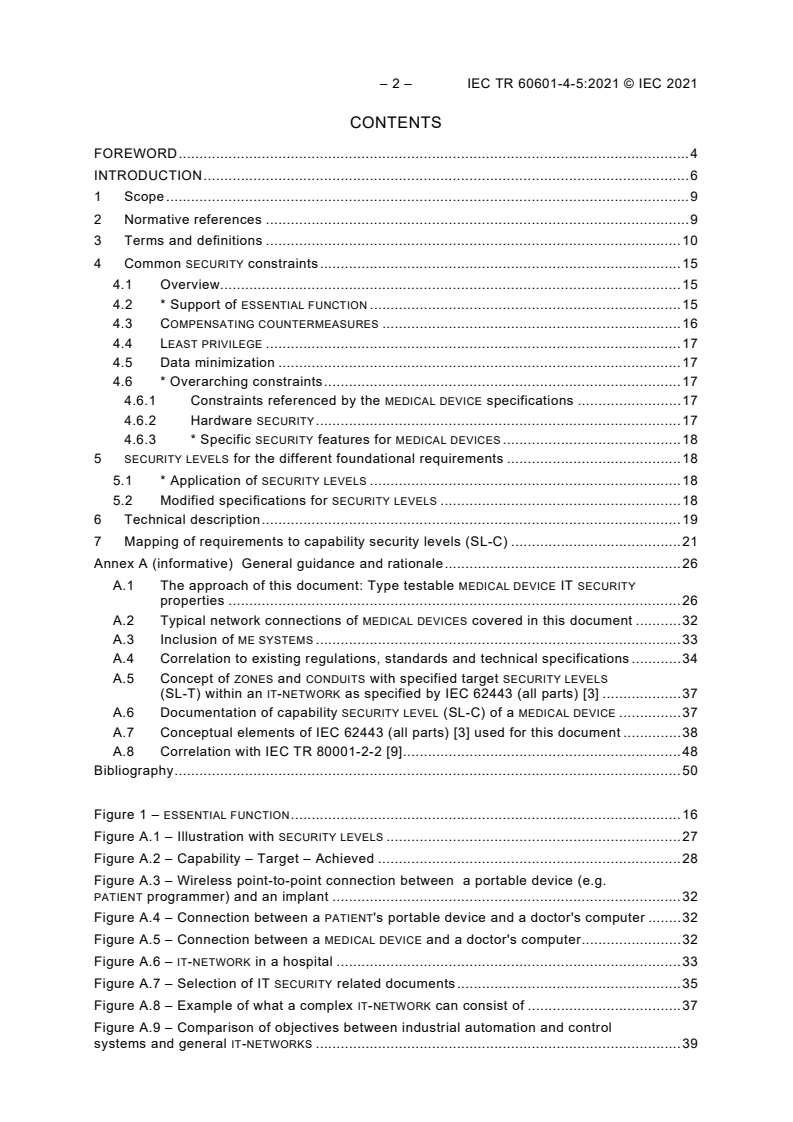
CONTENTS
FOREWORD . 4
INTRODUCTION . 6
1 Scope . 9
2 Normative references . 9
3 Terms and definitions . 10
4 Common SECURITY constraints . 15
4.1 Overview. 15
4.2 * Support of ESSENTIAL FUNCTION . 15
4.3 COMPENSATING COUNTERMEASURES . 16
4.4 LEAST PRIVILEGE . 17
4.5 Data minimization . 17
4.6 * Overarching constraints . 17
4.6.1 Constraints referenced by the MEDICAL DEVICE specifications . 17
4.6.2 Hardware SECURITY . 17
4.6.3 * Specific SECURITY features for MEDICAL DEVICES . 18
5 SECURITY LEVELS for the different foundational requirements . 18
5.1 * Application of SECURITY LEVELS . 18
5.2 Modified specifications for SECURITY LEVELS . 18
6 Technical description . 19
7 Mapping of requirements to capability security levels (SL-C) . 21
Annex A (informative) General guidance and rationale . 26
A.1 The approach of this document: Type testable MEDICAL DEVICE IT SECURITY
properties . 26
A.2 Typical network connections of MEDICAL DEVICES covered in this document . 32
A.3 Inclusion of ME SYSTEMS . 33
A.4 Correlation to existing regulations, standards and technical specifications . 34
A.5 Concept of ZONES and CONDUITS with specified target SECURITY LEVELS
(SL-T) within an IT-NETWORK as specified by IEC 62443 (all parts) [3] . 37
A.6 Documentation of capability SECURITY LEVEL (SL-C) of a MEDICAL DEVICE . 37
A.7 Conceptual elements of IEC 62443 (all parts) [3] used for this document . 38
A.8 Correlation with IEC TR 80001-2-2 [9] . 48
Bibliography . 50
Figure 1 – ESSENTIAL FUNCTION . 16
Figure A.1 – Illustration with SECURITY LEVELS . 27
Figure A.2 – Capability – Target – Achieved . 28
Figure A.3 – Wireless point-to-point connection between a portable device (e.g.
PATIENT programmer) and an implant . 32
Figure A.4 – Connection between a PATIENT's portable device and a doctor's computer . 32
Figure A.5 – Connection between a MEDICAL DEVICE and a doctor's computer . 32
Figure A.6 – IT-NETWORK in a hospital . 33
Figure A.7 – Selection of IT SECURITY related documents . 35
Figure A.8 – Example of what a complex IT-NETWORK can consist of . 37
Figure A.9 – Comparison of objectives between industrial automation and control
systems and general IT-NETWORKS . 39
Table 1 – Mapping of single requirements to capability security levels (SL-C) . 22
Table A.1 – Exemplary criteria for the selection of appropriate target SECURITY LEVEL
SL-T in typical INTENDED USE environments . 31
Table A.2 – Exemplary vector of capability SECURITY LEVEL SL-C . 38
– 4 – IEC TR 60601-4-5:2021 © IEC 2021
INTERNATIONAL ELECTROTECHNICAL COMMISSION
____________
MEDICAL ELECTRICAL EQUIPMENT –
Part 4-5: Guidance and interpretation –
Safety-related technical security specifications
FOREWORD
1) The International Electrotechnical Commission (IEC) is a worldwide organization for standardization comprising
all national electrotechnical committees (IEC National Committees). The object of IEC is to promote international
co-operation on all questions concerning standardization in the electrical and electronic fields. To this end and
in addition to other activities, IEC publishes International Standards, Technical Specifications, Technical Reports,
Publicly Available Specifications (PAS) and Guides (hereafter referred to as "IEC Publication(s)"). Their
preparation is entrusted to technical committees; any IEC National Committee interested in the subject dealt with
may participate in this preparatory work. International, governmental and non-governmental organizations liaising
with the IEC also participate in this preparation. IEC collaborates closely with the International Organization for
Standardization (ISO) in accordance with conditions determined by agreement between the two organizations.
2) The formal decisions or agreements of IEC on technical matters express, as nearly as possible, an international
consensus of opinion on the relevant subjects since each technical committee has representation from all
interested IEC National Committees.
3) IEC Publications have the form of recommendations for international use and are accepted by IEC National
Committees in that sense. While all reasonable efforts are made to ensure that the technical content of IEC
Publications is accurate, IEC cannot be held responsible for the way in which they are used or for any
misinterpretation by any end user.
4) In order to promote international uniformity, IEC National Committees undertake to apply IEC Publications
transparently to the maximum extent possible in their national and regional publications. Any divergence between
any IEC Publication and the corresponding national or regional publication shall be clearly indicated in the latter.
5) IEC itself does not provide any attestation of conformity. Independent certification bodies provide conformity
assessment services and, in some areas, access to IEC marks of conformity. IEC is not responsible for any
services carried out by independent certification bodies.
6) All users should ensure that they have the latest edition of this publication.
7) No liability shall attach to IEC or its directors, employees, servants or agents including individual experts and
members of its technical committees and IEC National Committees for any personal injury, property damage or
other damage of any nature whatsoever, whether direct or indirect, or for costs (including legal fees) and
expenses arising out of the publication, use of, or reliance upon, this IEC Publication or any other IEC Publications.
8) Attention is drawn to the Normative references cited in this publication. Use of the referenced publications is
indispensable for the correct application of this publication.
9) Attention is drawn to the possibility that some of the elements of this IEC Publication may be the subject of patent
rights. IEC shall not be held responsible for identifying any or all such patent rights.
IEC TR 60601-4-5 has been prepared by subcommittee 62A: Common aspects of electrical
equipment used in medical practice, of IEC technical committee 62: Electrical equipment in
medical practice. It is a Technical Report.
The text of this Technical Report is based on the following documents:
Draft TR Report on voting
62A/1402/DTR 62A/1417A/RVDTR
Full information on the voting for its approval can be found in the report on voting indicated in
the above table.
The language used for the development of this Technical Report is English.
This document has been drafted in accordance with the ISO/IEC Directives, Part 2, and
developed in accordance with ISO/IEC Directives, Part 1 and ISO/IEC Directives, IEC
Supplement, available at www.iec.ch/members_experts/refdocs. The main document types
developed by IEC are described in greater detail at www.iec.ch/standardsdev/publications.
In this document, the following print types are used:
– TERMS DEFINED IN CLAUSE 3: SMALL CAPITALS;
– COMPLIANCE STATEMENTS IN CLAUSE 4 AND CLAUSE 5: ITALICS.
An asterisk (*) as the first character of a title or at the beginning of a paragraph or table title
indicates that there is guidance or rationale related to that item in Annex A.
A list of all parts in the IEC 60601 series, published under the general title Medical electrical
equipment, can be found on the IEC website.
The committee has decided that the contents of this document will remain unchanged until the
stability date indicated on the IEC website under "http://webstore.iec.ch" in the data related to
the specific document. At this date, the document will be
• reconfirmed,
• withdrawn,
• replaced by a revised edition, or
• amended.
IMPORTANT – The 'colour inside' logo on the cover page of this publication indicates
that it contains colours which are considered to be useful for the correct understanding
of its contents. Users should therefore print this document using a colour printer.
– 6 – IEC TR 60601-4-5:2021 © IEC 2021
INTRODUCTION
This document provides IT SECURITY specifications for MEDICAL ELECTRICAL EQUIPMENT (ME
EQUIPMENT) AND MEDICAL ELECTRICAL SYSTEMS (ME SYSTEMS) connectable to MEDICAL
IT-NETWORKS as network components. MEDICAL DEVICE SOFTWARE, although not in the scope of
IEC 60601 (all parts), can also make use of this document. The intent of this document is to
specify SECURITY capabilities that enable a MEDICAL DEVICE to be more easily integrated into a
MEDICAL IT-NETWORK environment at a given SECURITY LEVEL (SL).
ME SYSTEMS placed onto the market as a whole by one legal MANUFACTURER should follow this
document as a whole network component of an IT-NETWORK, in the same way as ME EQUIPMENT.
ME SYSTEMS configured by the owner of a MEDICAL IT-NETWORK can be treated in the same way
as other combinations of medical and nonmedical devices within a MEDICAL IT-NETWORK and are
out of the scope of this document but within the scope of standards for MEDICAL IT-NETWORKS
(e.g. IEC 80001 (all parts) [7] ).
This document references already existing SECURITY LEVEL (SL) requirements for components
of an IT-NETWORK as listed in IEC 62443-4-2:2019. This document is restricted to the network
components which are MEDICAL DEVICES in order to allow the use of additional nonmedical
components within the MEDICAL IT-NETWORK complying with IEC 62443 (all parts) [3] or with
further appropriate SECURITY standards. This document modifies IEC 62443-4-2:2019 only for
specific aspects of MEDICAL DEVICES in MEDICAL IT-NETWORKS. The primary goal of this document
is to provide a flexible framework that facilitates addressing current and future vulnerabilities
and applying necessary mitigations in a systematic, defendable manner. Each of the proposed
COUNTERMEASURES should take into account that requirements regarding the safety and
performance of a MEDICAL DEVICE should not be negatively impacted.
The main audience for this document is MEDICAL DEVICE MANUFACTURERS and, where appropriate,
compliance authorities. Compliance authorities include government agencies and regulators
with the legal authority to perform audits to verify compliance with governing laws and
regulations.
MEDICAL IT-NETWORK integrators, as a further audience, may make use of the SECURITY LEVEL
classification for MEDICAL DEVICES, to assist them in the secure integration of MEDICAL DEVICES
into their networks. This assistance will be to help MEDICAL IT-NETWORK integrators to identify
the realized capability SECURITY LEVEL SL-C of MEDICAL DEVICES and thus to specify appropriate
additional SECURITY COUNTERMEASURES in the individual MEDICAL IT-NETWORK they are procuring.
MEDICAL DEVICE MANUFACTURERS should use this document to understand and apply the
specifications for specific capability SECURITY LEVEL SL-C of their MEDICAL DEVICES. A MEDICAL
DEVICE may not provide the capability itself but may be designed to integrate with a higher-level
entity – e.g. a hospital IT-NETWORK or department IT-NETWORK – and thus benefit from that
entity's capability. This document should guide MEDICAL DEVICE MANUFACTURERS as to what
specifications can be allocated and which specifications need to be native in the MEDICAL DEVICE.
MEDICAL DEVICE MANUFACTURERS should provide documentation on how to properly integrate the
MEDICAL DEVICE into a MEDICAL IT-NETWORK (see Clause A.2 for typical network connections of
MEDICAL DEVICES).
This document should be used to apply and verify appropriate technical SECURITY specifications
for MEDICAL DEVICES which thus can easily be integrated into existing or growing MEDICAL
IT-NETWORKS and which in some cases are connected to the Internet. This document does not
include SECURITY specifications for any additional services installed in a MEDICAL IT-NETWORK.
___________
Numbers in square brackets refer to the Bibliography.
As defined in IEC TS 62443-1-1:2009 [4], there are a total of seven foundational requirements
to be addressed:
– identification and authentication control (IAC);
– use control (UC);
– system integrity (SI);
– data CONFIDENTIALITY (DC);
– restricted data flow (RDF);
– timely response to events (TRE);
– resource availability (RA).
NOTE 1 Data CONFIDENTIALITY includes the unauthorized access to MEDICAL DEVICE data which could be leveraged
to cause all many types of HARM. The focus of this document is SAFETY-related SECURITY specifications for MEDICAL
DEVICES regarding data CONFIDENTIALITY. However, the listed provisions for SAFETY-related data CONFIDENTIALITY are
a good base also for non-SAFETY-related SECURITY aspects.
These seven requirements are used for meeting the capability SECURITY LEVEL SL-C of a
MEDICAL DEVICE which may be placed on a MEDICAL IT-NETWORK. Defining SL-C for MEDICAL
DEVICES is the goal and objective of this document. The target SECURITY LEVEL SL-T and
achieved SECURITY LEVELS (SL-A) for a complete MEDICAL IT-NETWORK or a subset of that network
(e.g. a specific ZONE of it) are out of the scope of this document.
A capability SECURITY LEVEL SL-C is defined for COUNTERMEASURES and for inherent SECURITY
properties of a MEDICAL DEVICE. It is a measure of the effectiveness strength of the
COUNTERMEASURES, which are either separate or integral to a MEDICAL DEVICE, for the addressed
SECURITY property and contributes to the achieved SECURITY LEVEL SL-A in the corresponding
part of the MEDICAL IT-NETWORK.
COUNTERMEASURES can be:
– technical COUNTERMEASURES (e.g. firewalls, anti-virus software, etc.), or
– administrative COUNTERMEASURES (e.g. policies, and procedures), or
– physical COUNTERMEASURES (e.g. locked doors, encapsulated printed circuit board, etc.).
The specified "component requirements" (CRs) for MEDICAL DEVICES provided in this document
are mainly derived from the IT-NETWORK "system requirements" (SRs) in IEC 62443‑3‑3 [5]
which are in turn derived from the overall foundational requirements defined in
IEC TS 62443-1-1:2009 [4]. MEDICAL DEVICE specifications also include a set of "requirement
enhancements" (REs). The combination of CRs and REs implemented into a MEDICAL DEVICE
will determine the capability SECURITY LEVEL SL-C of the MEDICAL DEVICE.
As this document provides specifications for MEDICAL DEVICES with external data interfaces or
with a human interface for processing – e.g. entering, capturing or viewing – CONFIDENTIAL
PATIENT DATA, the specifications will be designated as follows:
– MEDICAL DEVICE specifications for ME EQUIPMENT and manufacturer provided by ME SYSTEMS;
– MEDICAL DEVICE SOFTWARE specifications.
The majority of the specifications in this document are the same for these two types and are
thus designated simply as a MEDICAL DEVICE specification. When a specification is only
applicable to one of the above two types, it is specified as such.
– 8 – IEC TR 60601-4-5:2021 © IEC 2021
This document refers to both ESSENTIAL PERFORMANCE and ESSENTIAL FUNCTION, which are very
distinct. ESSENTIAL FUNCTION is a well-established term for SECURITY aspects and is different
from ESSENTIAL PERFORMANCE which is related to safety of one ME EQUIPMENT or ME SYSTEM in
NORMAL CONDITION and SINGLE FAULT CONDITION. An ESSENTIAL FUNCTION CONSIDERS, for instance,
a successful attack on the MEDICAL IT-NETWORK and its connected MEDICAL DEVICES and
MEDICAL IT-NETWORK supporting function and
supporting systems. This may lead to loss of the
of some functions of the MEDICAL DEVICE itself. In that case, the MEDICAL DEVICE is still
responsible for providing a condition sustaining the required minimum functions, including but
not limited to BASIC SAFETY and ESSENTIAL PERFORMANCE.
MEDICAL ELECTRICAL EQUIPMENT –
Part 4-5: Guidance and interpretation –
Safety-related technical security specifications
1 Scope
This document, which is a Technical Report, provides detailed technical specifications for
SECURITY features of MEDICAL DEVICES used in MEDICAL IT-NETWORKS. MEDICAL DEVICES dealt with
in this document include MEDICAL ELECTRICAL EQUIPMENT, MEDICAL ELECTRICAL SYSTEMS and
MEDICAL DEVICE SOFTWARE. MEDICAL DEVICE SOFTWARE, although not in the scope of
IEC 60601 (all parts), can also make use of this document. Based on the seven foundational
requirements described in the state-of-the-art document IEC TS 62443-1-1:2009 [4], this
document provides specifications for different MEDICAL DEVICE capability SECURITY LEVELS
(SL-C). The specified SECURITY capabilities of a MEDICAL DEVICE can be used by various
members of the medical community to integrate the device correctly into defined SECURITY
ZONES and CONDUITS of a MEDICAL IT-NETWORK with an appropriate MEDICAL IT-NETWORK's target
SECURITY LEVEL (SL-T).
This document is applicable to MEDICAL DEVICES with external data interface(s), for example
when connected to a MEDICAL IT-NETWORK or when a human interface is used for processing –
e.g. entering, capturing or viewing – CONFIDENTIAL DATA.
This document does not apply to other software used on a MEDICAL IT-NETWORK which does not
meet the definition of MEDICAL DEVICE SOFTWARE.
NOTE 1 An example of this exclusion is software not incorporated into the MEDICAL DEVICE.
NOTE 2 This document does also not apply to industry protocols such as DICOM and HL7.
This document does not apply to in-vitro diagnostic devices (IVD).
2 Normative references
The following documents are referred to in the text in such a way that some or all of their content
constitutes requirements of this document. For dated references, only the edition cited applies.
For undated references, the latest edition of the referenced document (including any
amendments) applies.
IEC 60601-1:2005, Medical electrical equipment – Part 1: General requirements for basic safety
and essential performance
IEC 60601-1:2005/AMD1:2012
IEC 60601-1:2005/AMD2:2020
IEC 62443-4-2:2019, Security for industrial automation and control systems – Part 4-2:
Technical security requirements for IACS components
– 10 – IEC TR 60601-4-5:2021 © IEC 2021
3 Terms and definitions
For the purposes of this document, the terms and definitions given in IEC 60601-1:2005,
IEC 60601-1/AMD1:2012 and IEC 60601-1/AMD2:2020 and the following apply.
ISO and IEC maintain terminological databases for use in standardization at the following
addresses:
• IEC Electropedia: available at http://www.electropedia.org/
• ISO Online browsing platform: available at https://www.iso.org/obp
3.1
ASSET
physical or logical object having either a perceived or actual value to the MEDICAL DEVICE or
MEDICAL IT-NETWORK
Note 1 to entry: In this specific case, an ASSET is any item that should be protected as part of the MEDICAL DEVICE
SECURITY management system.
Note 2 to entry: An ASSET is not limited to the MEDICAL DEVICE alone but can also include the physical ASSETS under
its control.
Note 3 to entry: Typically, the RESPONSIBLE ORGANIZATION is an ASSET owner.
[SOURCE: IEC 62443-4-2:2019, 3.1.1, modified – Replacement of "IACS" with "MEDICAL DEVICE
or MEDICAL IT-NETWORK" in the definition, replacement of "IACS" with "MEDICAL DEVICE" in Note
2 to entry, and addition of a new Note 3 to entry.]
3.2
AUTHENTICATION
verification of the claimed identity of an entity
Note 1 to entry: AUTHENTICATION is usually a prerequisite to allowing access to resources in a MEDICAL DEVICE.
[SOURCE: IEC 62443-4-2:2019, 3.1.4, modified – Replacement of "control system" with
"MEDICAL DEVICE" in Note 1 to entry.]
3.3
AUTHENTICITY
property that an entity is what it claims to be through AUTHENTICATION of origin and verification
of INTEGRITY
Note 1 to entry: AUTHENTICITY is typically used in the context of confidence in the identity of an entity, or the validity
of a transmission, a message or message originator.
[SOURCE: IEC 62443-4-2:2019, 3.1.6]
3.4
AVAILABILITY
property of ensuring timely and reliable access to and use of MEDICAL DEVICE information and
functionality
[SOURCE: IEC 62443-4-2:2019, 3.1.7, modified – Replacement of "control system" with
"MEDICAL DEVICE".]
3.5
COMPENSATING COUNTERMEASURE
COUNTERMEASURE employed in lieu of or in addition to inherent SECURITY capabilities to satisfy
one or more SECURITY requirements
Note 1 to entry: Examples include:
– (MEDICAL DEVICE): locked cabinet around a controller that otherwise might be exposed to unauthorized access
via its physical data interfaces, or an encapsulated printed circuit board;
– (ZONE level): physical access control (guards, gates and guns) to protect a control room to restrict access to a
group of known personnel to compensate for the technical requirement for personnel to be uniquely identified by
the MEDICAL IT-NETWORK; and
– (MEDICAL DEVICE): a product supplier's magnetic resonance imaging (MRI) machine cannot meet the access
control capabilities from an ASSET owner (i.e. typically the RESPONSIBLE ORGANIZATION), so the product supplier
puts a firewall in front of the MRI machine and sells it as a system.
[SOURCE: IEC 62443-4-2:2019, 3.1.9, modified – The example has been formatted as a note
to entry. Note 1 to entry has been modified by replacing "component-level" with "MEDICAL
DEVICE", "IACS" with "MEDICAL IT-NETWORK", "PLC" with "MRI", by removing "control system" and
by adding a second example for the first dash.]
3.6
CONDUIT
logical grouping of communication channels, connecting two or more ZONES that share common
SECURITY requirements
Note 1 to entry: A CONDUIT is allowed to traverse a ZONE as long as the SECURITY of the channels contained within
the CONDUIT is not impacted by the ZONE.
[SOURCE: IEC 62443-4-2:2019, 3.1.11]
3.7
CONFIDENTIALITY
assurance that information is not disclosed to unauthorized individuals, PROCESSES, or devices
Note 1 to entry: When used in the context of a MEDICAL DEVICE, CONFIDENTIALITY refers to protecting MEDICAL DEVICE
data and information from unauthorized access.
[SOURCE: IEC 62443-4-2:2019, 3.1.12, modified – Replacement of "an IACS" with "a MEDICAL
DEVICE".]
3.8
CONFIDENTIAL DATA
data to which only a limited number of persons have access and which are meant for restricted
use
[SOURCE: ISO 5127:2017, 3.1.10.18, modified – Deletion of Note 1 to entry.]
3.9
COUNTERMEASURE
action, device, procedure or technique that reduces a THREAT, a vulnerability or the
consequences of an attack by minimizing the HARM the attack can cause or by discovering and
reporting it so that corrective action can be taken
Note 1 to entry: The term "control" is also used to describe this concept in some contexts. The term
"COUNTERMEASURE" has been chosen for this document to avoid confusion with the term "control" in the context of
"PROCESS control" and "control system".
[SOURCE: IEC 62443-4-2:2019, 3.1.15]
– 12 – IEC TR 60601-4-5:2021 © IEC 2021
3.10
* ESSENTIAL FUNCTION
CORE FUNCTION
function or capability that is required to maintain BASIC SAFETY, ESSENTIAL PERFORMANCE, a
minimum of clinical functionality as specified by the manufacturer, and operational AVAILABILITY
MEDICAL DEVICE
for the
Note 1 to entry: ESSENTIAL FUNCTIONS include, but are not limited to, the SAFETY instrumented function (BASIC
SAFETY and ESSENTIAL PERFORMANCE), the control function and the AVAILABILITY of urgently needed functions and
such allowing the OPERATOR to view and manipulate the MEDICAL DEVICE safely with the most urgently needed
performance (operational AVAILABILITY). The loss of ESSENTIAL FUNCTION is commonly termed loss of protection, loss
of control and loss of view respectively.
Note 2 to entry: The term is derived from IEC 62443-4-2:2019, 3.1.20, and has been refined for the purpose and
scope of this document.
3.11
FIRECALL
method established to provide emergency access to a secure MEDICAL DEVICE
Note 1 to entry: In an emergency situation, unprivileged users can gain access to key systems to correct the
problem. When a FIRECALL is used, there is usually a review PROCESS to ensure that the access was used properly
to correct a problem. These methods generally either provide a one-time use user identifier (ID) or one-time password
or other suitable measures.
Note 2 to entry: Also referred to as "break glass" feature.
[SOURCE: IEC 62443-4-2:2019, 3.1.22, modified – Replacement of "control system" with
"MEDICAL DEVICE"; addition of the words "or other suitable measures" in Note 1 to entry; addition
of Note 2 to entry.]
3.12
INCIDENT
single or a series of unwanted or unexpected information SECURITY events that have a significant
probability of compromising business operations and threatening information SECURITY
Note 1 to entry: This definition is based on the term: information SECURITY INCIDENT
[SOURCE: ISO/IEC 27000:2018, 3.31, modified – Deletion of "information security" in the term.]
3.13
INTEGRITY
property of protecting the accuracy and completeness of ASSETS
[SOURCE: IEC 62443-4-2:2019, 3.1.27]
3.14
IT-NETWORK
INFORMATION TECHNOLOGY NETWORK
system or systems composed of communicating nodes and transmission links to provide
physically linked or wireless transmission between two or more specified communication nodes
Note 1 to entry: Adapted from IEC 61907:2009, 3.1.1.
Note 2 to entry: The scope of the MEDICAL IT-NETWORK in this document is defined by the RESPONSIBLE ORGANIZATION
based on where the MEDICAL DEVICES in the MEDICAL IT-NETWORK are located and the defined use of the network. It
can contain IT infrastructure, home health and non-clinical contexts.
[SOURCE: IEC 80001-1:2010, 2.12, modified – Deletion of the reference to 4.3.3 in Note 2 to
entry.]
3.15
LEAST PRIVILEGE
basic principle that holds that users (humans, software PROCESSES or devices) should be
assigned the fewest privileges consistent with their assigned duties and functions
Note 1 to entry: LEAST PRIVILEGE is commonly implemented as a set of roles in a MEDICAL DEVICE.
[SOURCE: IEC 62443-4-2:2019, 3.1.28, modified – Replacement of "an IACS" with "a MEDICAL
DEVICE" in Note 1 to entry.]
3.16
MEDICAL DEVICE
instrument, apparatus, implement, machine, appliance, implant, reagent for in vitro use,
software, material or other similar or related article, intended by the MANUFACTURER to be used,
alone or in combination, for human beings, for one of more of the specific medical purpose(s)
of
– diagnosis, prevention, monitoring, treatment or alleviation of disease,
– diagnosis, monitoring, treatment, alleviation of or compensation for an injury,
– investigation, replacement, modification, or support of the anatomy or of a physiological
PROCESS,
– supporting or sustaining life,
– control of conception,
– cleaning, disinfection or sterilization of MEDICAL DEVICES,
– providing information by means of in vitro examination of specimens derived from the human
body,
and does not achieve its primary intended action by pharmacological, immunological or
metabolic means, in or on the human body, but which may be assisted in its function by such
means
Note 1 to entry: Products which may be considered to be MEDICAL DEVICES in some jurisdictions but not in others
include:
– disinfection substances,
– aids for persons with disabilities,
– devices incorporating animal and/or human tissues, and
– devices for in-vitro fertilization or assisted reproductive technologies.
Note 2 to entry: For clarification purposes, in certain regulatory jurisdictions, devices for cosmetic/aesthetic
purposes are also considered MEDICAL DEVICES.
Note 3 to entry: For clarification purposes, in certain regulatory jurisdictions, the commerce of devices incorporating
human tissues is not allowed.
[SOURCE: IMDRF/GRRP WG/N47:2018, 3.26]
3.17
MEDICAL DEVICE SOFTWARE
software system that has been developed for the purpose of being incorporated into the MEDICAL
DEVICE being developed or that is intended for use as a MEDICAL DEVICE
Note 1 to entry: This includes a MEDICAL DEVICE software product, which then is a MEDICAL DEVICE in its own right.
[SOURCE: IEC 62304:2006 and IEC 62304:2006/AMD1:2015, 3.12]
– 14 – IEC TR 60601-4-5:2021 © IEC 2021
3.18
MEDICAL IT-NETWORK
IT-NETWORK that incorporates at least one MEDICAL DEVICE
Note 1 to entry: The MEDICAL IT-NETWORK in its INTENDED USE mainly provides connectivity for MEDICAL DEVICES that
are intended to be connected to such an IT-NETWORK. Also non-medical equipment may be connected to the MEDICAL
IT-NETWORK, mostly intended to support the MEDICAL DEVICES.
[SOURCE: IEC 80001-1:2010, 2.16, modified – Addition of Note 1 to entry.]
3.19
NON-REPUDIATION
ability to prove the occurrence of a claimed event or action and its originating entities
Note 1 to entry: The purpose of NON-REPUDIATION is to resolve disputes about the occurrence or non-occurrence of
the event or action and involvement of entities in the event.
[SOURCE: IEC 62443-4-2:2019, 3.1.32]
3.20
RISK
combination of the probability of occurrence of HARM and the severity of that HARM
Note 1 to entry: The probability of occurrence includes the exposure to a HAZARDOUS SITUATION and the possibility
to avoid or limit the HARM.
[SOURCE: ISO/IEC Guide 63:2019, 3.10]
3.21
SAFETY
freedom from unacceptable RISK
[SOURCE: ISO/IEC Guide 63:2019, 3.16]
3.22
SECURITY
CYBERSECURITY
state where information and systems are protected from unauthorized activities, such as
access, use, disclosure, disruption, modification, or destruction, to a degree that the related
risks to AUTHENTICATION, use control, INTEGRITY, data CONFIDENTIALITY, data flow, timely
response and AVAILABILITY are maintained at an acceptable level throughout the life cycle
Note 1 to entry: A similar definition of the term is in preparation for ISO 81001-1:— and IEC 81001-5-1:—. In this
document, all seven foundational requirements are included (not only three of them).
3.23
SECURITY LEVEL
level corresponding to the required set of COUNTERMEASURES and inherent SECURITY properties
of devices and systems for a ZONE or CONDUIT based on assessment of RISK for the ZONE or
CONDUIT
[SOURCE: IEC 62443-4-2:2019, 3.1.37]
3.24
THREAT
set of circumstances and associated sequence of events with the potential to adversely affect
operations (including mission, functions, image or reputation), ASSETS, MEDICAL DEVICES or
individuals via unauthorized access, destruction, disclosure, modification of data and/or denial
of service
[SOURCE: IEC 62443-4-2:2019, 3.1.43, modified – Replacement of "control systems" with
"MEDICAL DEVICES".]
3.25
ZONE
collection of entities that represents partitioning of a system under consideration on the basis
of their functional, logical and physical (including location) relationship
Note 1 to entry: A ZONE has a clear border. The SECURITY policy of a ZONE is typically enforced by a combination of
mechanisms both at the ZONE edge and within the ZONE.
[SOURCE: IEC 62443-4-2:2019, 3.1.49]
4 Common SECURITY constraints
4.1 Overview
The SECURITY related RISKS addressed in this document should be controlled by:
– MEDICAL DEVICE SECURITY measures, and/or
– MEDICAL IT-NETWORK SECURITY measures.
COUNTERMEASURES are addressed which refer to
Within the scope of this document, only those
a MEDICAL DEVICE (i.e. ME EQUIPMENT, MANUFACTURER provided ME SYSTEM, MEDICAL DEVICE
SOFTWARE). COUNTERMEASURES which a RESPONSIBLE ORGANIZATION might apply to a MEDICAL
IT-NETWORK (including ME SYSTEMS specifically combined by the RESPONSIBLE ORGANISATION) are
not within the scope of this document. However, if a MEDICAL DEVICE with external data interfaces
requires additional (external) COMPENSATING COUNTERMEASURES, those measures should be
ACCOMPANYING DOCUMENTS of the MEDICAL DEVICE. Risk assessments
addressed in the
according to ISO 14971:2019 [13] are not part of this document; however, they should take into
account the technical solutions offered in this document when assessing SECURITY related risks.
Compliance with the specification should be checked by tests and inspections as specified in
4.2 to 4.6, and Clause 5 to Clause 7.
4.2 * Support of ESSENTIAL FUNCTION
BASIC SAFETY and especially ESSENTIAL PERFORMANCE can be affected by THREATS, resulting in
hazardous situations or lack of appropriate AVAILABILITY of the MEDICAL DEVICE. BASIC SAFETY,
ESSENTIAL PERFORMANCE, a minimum of clinical functionality and operational availability should
be maintained during and after an exploitation of a vulnerability (see Figure 1). In this context,
the word "maintained" means that the MEDICAL DEVICE goes over to a safe condition either
without operating any longer or, for particular MEDICAL DEVICES, operating safely with
appropriate, limited functionalities or without clinical function but providing an alarm, if the
MEDICAL DEVICE is used under medical supervision.
SECURITY COUNTERMEASURES should not adversely affect the ability to maintain the ESSENTIAL
FUNCTION of the MEDICAL DEVICE.
– 16 – IEC TR 60601-4-5:2021 © IEC 2021
In particular, the following should be applied.
– Access controls (i.e. foundational requirements 1 and 2) should not prevent the operation
of ESSENTIAL FUNCTION of MEDICAL DEVICES (see also 4.6.3).
– MEDICAL DEVICES with access controls should implement specific appropriate FIRECALL
functions for emergency access to relevant clinical functions or data. If a FIRECALL function
is used, this should be made traceable.
– SECURITY COUNTERMEASURES of MEDICAL DEVICES or the connected MEDICAL IT-NETWORK
infrastructure that provide boundary protection should not impact the ESSENTIAL FUNCTION of
the MEDICAL DEVICE.
– A denial of service (DoS) attack on the MEDICAL DEVICE or on the connected MEDICAL
IT-NETWORK should not prevent the MEDICAL DEVICE that implements the SAFETY-related
function from performing as indicated in Figure 1.
Figure 1 – ESSENTIAL FUNCTION
To determine the required ESSENTIAL FUNCTION, a benefit-risk analysis (between safety and
security) should be conducted to determine which functionality can be sacrificed, and which
cannot.
NOTE For examples and more guidance, see Annex A.
Compliance with the specification should be checked by inspection of the ESSENTIAL FUNCTION
concept in the SECURITY design documents and the correlated test documentation.
4.3 COMPENSATING COUNTERMEASURES
If the target SECURITY LEVEL SL-T for a specific IT-NETWORK or a part of it (e.g. zone) exceeds
the capability SECURITY LEVEL SL-C of a MEDICAL DEVICE, COMPENSATING COUNTERMEASURES
external to the MEDICAL DEVICE are required unless the responsible organization adjusts their
SL-T. In some cases, COMPENSATING COUNTERMEASURES external to the MEDICAL DEVICE are also
required as last option to fulfil the intended capability SECURITY LEVEL SL-C. When this is the
case, the ACCOMPANYING DOCUMENTS for that MEDICAL DEVICE should describe the appropriate
COMPENSATING COUNTERMEASURES to be applied to the connected MEDICAL IT-NETWORK to allow
the specification to be met when the MEDICAL DEVICE is integrated into a MEDICAL IT-NETWORK.
Compliance with the specification should be checked by inspection of the ACCOMPANYING
DOCUMENTS, focused on the description of appropriate COMPENSATING COUNTERMEASURES, and
of the SECURITY design documents.
4.4 LEAST PRIVILEGE
When required and appropriate, MEDICAL DEVICES should provide the capability for the
connected MEDICAL IT-NETWORK to enforce the concept of LEAST PRIVILEGE. Individual MEDICAL
DEVICES should provide the granularity of permissions and the flexibility of mapping those
permissions to roles sufficient to support this. Individual accountability should be available when
required.
NOTE The granularity of permissions and assignment is dependent on the type of the MEDICAL DEVICE and is defined
in its ACCOMPANYING DOCUMENTS.
Compliance with the specification should be checked by inspection of the role concept and the
concept of LEAST PRIVILEGE in the SECURITY design documents and inspection of the
ACCOMPANYING DOCUMENTS, focused on the description of granular permissions, and by
inspection of test results according to the corresponding parts of Table 1.
4.5 Data minimization
MEDICAL DEVICES should only store and transmit sensitive and person identifiable information
(CONFIDENTIAL DATA) that are required, relevant and limited to what is necessary for the purposes
for which they are processed. Such data in the MEDICAL DEVICE context should not be held or
further used unless this is essential for reasons that are clearly stated by the MANUFACTURER in
the ACCOMPANYING DOCUMENTS (e.g. a "flight recorder" or logging function or data needed for
standards or regulatory requirements).
Compliance with the specification should be checked by inspection of the CONFIDENTIAL DATA
handling concept in the SECURITY design documents, inspection of the ACCOMPANYING
DOCUMENTS and by inspection of test results according to the corresponding parts of Table 1.
4.6 * Overarching constraints
4.6.1 Constraints referenced by the MEDICAL DEVICE specifications
The overarching constraints of 4.6.2 and 4.6.3 should be applied.
4.6.2 Hardware SECURITY
Based on a RISK and THREAT analysis, the MEDICAL DEVICE should provide the capability to
protect critical ASSETS via hardware mechanisms according to commonly accepted and proven
SECURITY practices and specifications (e.g. locks, tokens, SECURITY chips). This protection
...