

IEC 60695-9-1:2013
(Main)Fire hazard testing - Part 9-1: Surface spread of flame - General guidance
General Information
- Abstract
IEC 60695-9-1:2013 provides guidance for the assessment of surface spread of flame for electrotechnical products and the materials from which they are formed. It provides an explanation of the principles of flame spread for both liquids and solids, guidance for the selection of test methods, guidance on the use and interpretation of test results, and informative references. This third edition cancels and replaces the second edition of IEC 60695-9-1 published in 2005, and constitutes a technical revision. This edition includes the following significant technical changes with respect to the previous edition:
- an expanded scope;
- updated references and
- updated terms and definitions.
Keywords: Surface spread, Flame
This publication is to be read in conjunction with IEC 60695-9-2:2005.
- Status
- Published
- Publication Date
- 28-Apr-2013
- Technical Committee
- TC 89 - Fire hazard testing
- Drafting Committee
- WG 11 - TC 89/WG 11
- Current Stage
- PPUB - Publication issued
- Start Date
- 29-Apr-2013
- Completion Date
- 15-Mar-2013
Overview
IEC 60695-9-1:2013 is an international standard published by the International Electrotechnical Commission (IEC) that provides general guidance on the surface spread of flame for electrotechnical products and materials. This third edition updates and expands the scope of the previous 2005 edition, offering a comprehensive framework for assessing flame spread characteristics on both solids and liquids.
The standard focuses on understanding the fundamental principles of flame spread, guiding the selection and application of appropriate test methods, and offering best practices for interpreting test results. It serves as a basic safety publication aimed at technical committees involved in developing standards relating to the fire hazard of electrotechnical products.
Key Topics
Principles of Flame Spread:
- Explanation of surface flame spread mechanisms for liquids and solids, including pyrolysis, combustion process, and flame front dynamics.
- Discussion on factors influencing flame spread such as material properties (thickness, density, thermal conductivity) and external conditions (heat exposure, airflow).
Classification of Flame Spread Behavior:
- Non-propagation: No flame advancement beyond ignition area.
- Decelerating propagation: Flame spreads partially and then extinguishes.
- Propagation: Flame spreads continuously, potentially engulfing the entire material surface.
Fire Scenario Considerations:
- Assessment based on surface orientation, ventilation, and ignition source characteristics to simulate realistic fire hazards.
Test Methods Guidance:
- Criteria for selecting test methods tailored to different types of materials and fire scenarios.
- Overview of test specimen types, ignition sources, apparatus, and measurement techniques (both direct and indirect flame spread measurement).
Result Interpretation:
- Guidelines on analyzing flame spread test outcomes to ensure meaningful safety evaluations and standard compliance.
Updated Terminology and References:
- Incorporates revised terms and definitions consistent with IEC 60695-4, ISO 13943, and other related standards ensuring international terminology uniformity.
Applications
IEC 60695-9-1:2013 is essential for a broad range of stakeholders involved in electrotechnical product safety, including manufacturers, testing laboratories, standardization bodies, and regulatory authorities. Its practical applications include:
Product Development & Safety Assessment:
Designing safer electrical and electronic devices by evaluating the surface flame spread characteristics of component materials and assemblies.Material Selection and Treatment:
Assisting engineers in choosing materials or flame retardant treatments that minimize the risk of flame propagation on product surfaces.Standardization & Compliance:
Providing technical committees with foundational guidance to formulate coherent fire hazard testing requirements within product standards.Fire Risk Management:
Supporting fire prevention strategies in manufacturing plants, buildings, and transport sectors by understanding how flame spreads on product surfaces under various conditions.Research & Innovation:
Facilitating the development of new flame retardant technologies and testing methodologies by offering a clear framework of surface flame spread principles.
Related Standards
To ensure comprehensive fire hazard evaluation, IEC 60695-9-1:2013 is intended to be used in conjunction with other standards, including:
- IEC 60695-9-2:2005 – Surface Spread of Flame: Summary of Test Methods
- IEC 60695-4 – Terminology Concerning Fire Tests for Electrotechnical Products
- ISO 13943:2008 – Fire Safety Vocabulary
- IEC Guide 104 – Preparation of Safety Publications and Use of Basic Safety Publications
- ISO/IEC Guide 51 – Safety Aspects and Guidelines for Their Inclusion in Standards
Together, these standards establish a harmonized approach for fire hazard testing, terminology, and safety requirements, enhancing consistency and reliability in international electrotechnical safety regulation.
Keywords: surface spread, flame spread, fire hazard testing, electrotechnical products, flame propagation, pyrolysis, fire safety standards, flame retardants, fire scenario, test methods, material ignition, IEC 60695-9-1.
Relations
- Revises
IEC 60695-9-1:2005 - Fire hazard testing - Part 9-1: Surface spread of flame - General guidance - Effective Date
- 05-Sep-2023
Get Certified
Connect with accredited certification bodies for this standard

IMQ S.p.A. (Certification)
Italian electrical product certification.

SLG Prüf- und Zertifizierungs GmbH
German testing and certification body.

UL Solutions
Global safety science company with testing, inspection and certification.
Sponsored listings
Frequently Asked Questions
IEC 60695-9-1:2013 is a standard published by the International Electrotechnical Commission (IEC). Its full title is "Fire hazard testing - Part 9-1: Surface spread of flame - General guidance". This standard covers: IEC 60695-9-1:2013 provides guidance for the assessment of surface spread of flame for electrotechnical products and the materials from which they are formed. It provides an explanation of the principles of flame spread for both liquids and solids, guidance for the selection of test methods, guidance on the use and interpretation of test results, and informative references. This third edition cancels and replaces the second edition of IEC 60695-9-1 published in 2005, and constitutes a technical revision. This edition includes the following significant technical changes with respect to the previous edition: - an expanded scope; - updated references and - updated terms and definitions. Keywords: Surface spread, Flame This publication is to be read in conjunction with IEC 60695-9-2:2005.
IEC 60695-9-1:2013 provides guidance for the assessment of surface spread of flame for electrotechnical products and the materials from which they are formed. It provides an explanation of the principles of flame spread for both liquids and solids, guidance for the selection of test methods, guidance on the use and interpretation of test results, and informative references. This third edition cancels and replaces the second edition of IEC 60695-9-1 published in 2005, and constitutes a technical revision. This edition includes the following significant technical changes with respect to the previous edition: - an expanded scope; - updated references and - updated terms and definitions. Keywords: Surface spread, Flame This publication is to be read in conjunction with IEC 60695-9-2:2005.
IEC 60695-9-1:2013 is classified under the following ICS (International Classification for Standards) categories: 13.220.40 - Ignitability and burning behaviour of materials and products; 29.020 - Electrical engineering in general. The ICS classification helps identify the subject area and facilitates finding related standards.
IEC 60695-9-1:2013 has the following relationships with other standards: It is inter standard links to IEC 60695-9-1:2005. Understanding these relationships helps ensure you are using the most current and applicable version of the standard.
IEC 60695-9-1:2013 is available in PDF format for immediate download after purchase. The document can be added to your cart and obtained through the secure checkout process. Digital delivery ensures instant access to the complete standard document.
Standards Content (Sample)
IEC 60695-9-1 ®
Edition 3.0 2013-04
INTERNATIONAL
STANDARD
NORME
INTERNATIONALE
BASIC SAFETY PUBLICATION
PUBLICATION FONDAMENTALE DE SÉCURITÉ
Fire hazard testing –
Part 9-1: Surface spread of flame – General guidance
Essais relatifs aux risques du feu –
Partie 9-1: Propagation des flammes en surface – Lignes directrices générales
All rights reserved. Unless otherwise specified, no part of this publication may be reproduced or utilized in any form
or by any means, electronic or mechanical, including photocopying and microfilm, without permission in writing from
either IEC or IEC's member National Committee in the country of the requester.
If you have any questions about IEC copyright or have an enquiry about obtaining additional rights to this publication,
please contact the address below or your local IEC member National Committee for further information.
Droits de reproduction réservés. Sauf indication contraire, aucune partie de cette publication ne peut être reproduite ni
utilisée sous quelque forme que ce soit et par aucun procédé, électronique ou mécanique, y compris la photocopie et les
microfilms, sans l'accord écrit de la CEI ou du Comité national de la CEI du pays du demandeur.
Si vous avez des questions sur le copyright de la CEI ou si vous désirez obtenir des droits supplémentaires sur cette
publication, utilisez les coordonnées ci-après ou contactez le Comité national de la CEI de votre pays de résidence.
IEC Central Office Tel.: +41 22 919 02 11
3, rue de Varembé Fax: +41 22 919 03 00
CH-1211 Geneva 20 info@iec.ch
Switzerland www.iec.ch
About the IEC
The International Electrotechnical Commission (IEC) is the leading global organization that prepares and publishes
International Standards for all electrical, electronic and related technologies.
About IEC publications
The technical content of IEC publications is kept under constant review by the IEC. Please make sure that you have the
latest edition, a corrigenda or an amendment might have been published.
Useful links:
IEC publications search - www.iec.ch/searchpub Electropedia - www.electropedia.org
The advanced search enables you to find IEC publications The world's leading online dictionary of electronic and
by a variety of criteria (reference number, text, technical electrical terms containing more than 30 000 terms and
committee,…). definitions in English and French, with equivalent terms in
It also gives information on projects, replaced and additional languages. Also known as the International
withdrawn publications. Electrotechnical Vocabulary (IEV) on-line.
IEC Just Published - webstore.iec.ch/justpublished Customer Service Centre - webstore.iec.ch/csc
Stay up to date on all new IEC publications. Just Published If you wish to give us your feedback on this publication
details all new publications released. Available on-line and or need further assistance, please contact the
also once a month by email. Customer Service Centre: csc@iec.ch.
A propos de la CEI
La Commission Electrotechnique Internationale (CEI) est la première organisation mondiale qui élabore et publie des
Normes internationales pour tout ce qui a trait à l'électricité, à l'électronique et aux technologies apparentées.
A propos des publications CEI
Le contenu technique des publications de la CEI est constamment revu. Veuillez vous assurer que vous possédez
l’édition la plus récente, un corrigendum ou amendement peut avoir été publié.
Liens utiles:
Recherche de publications CEI - www.iec.ch/searchpub Electropedia - www.electropedia.org
La recherche avancée vous permet de trouver des Le premier dictionnaire en ligne au monde de termes
publications CEI en utilisant différents critères (numéro de électroniques et électriques. Il contient plus de 30 000
référence, texte, comité d’études,…). termes et définitions en anglais et en français, ainsi que
Elle donne aussi des informations sur les projets et les les termes équivalents dans les langues additionnelles.
publications remplacées ou retirées. Egalement appelé Vocabulaire Electrotechnique
International (VEI) en ligne.
Just Published CEI - webstore.iec.ch/justpublished
Service Clients - webstore.iec.ch/csc
Restez informé sur les nouvelles publications de la CEI.
Just Published détaille les nouvelles publications parues. Si vous désirez nous donner des commentaires sur
Disponible en ligne et aussi une fois par mois par email. cette publication ou si vous avez des questions
contactez-nous: csc@iec.ch.
IEC 60695-9-1 ®
Edition 3.0 2013-04
INTERNATIONAL
STANDARD
NORME
INTERNATIONALE
BASIC SAFETY PUBLICATION
PUBLICATION FONDAMENTALE DE SÉCURITÉ
Fire hazard testing –
Part 9-1: Surface spread of flame – General guidance
Essais relatifs aux risques du feu –
Partie 9-1: Propagation des flammes en surface – Lignes directrices générales
INTERNATIONAL
ELECTROTECHNICAL
COMMISSION
COMMISSION
ELECTROTECHNIQUE
PRICE CODE
INTERNATIONALE
CODE PRIX P
ICS 13.220.40; 29.020 ISBN 978-2-83220-753-6
– 2 – 60695-9-1 © IEC:2013
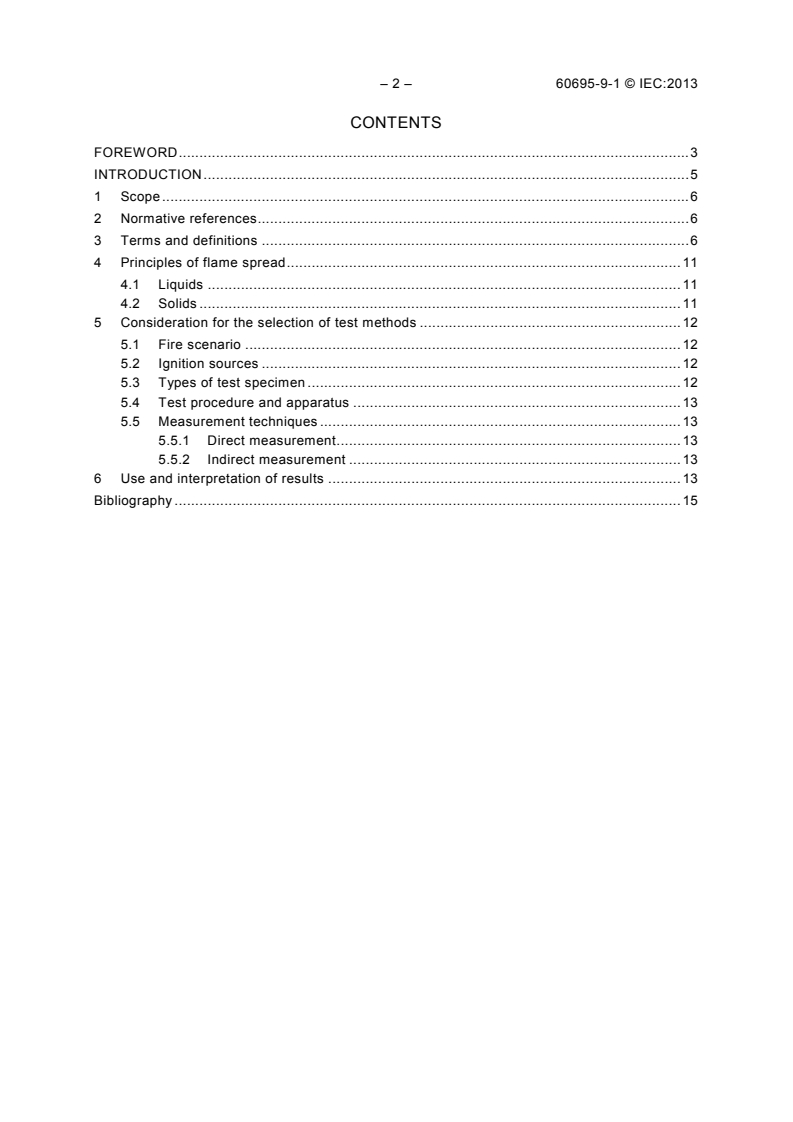
CONTENTS
FOREWORD . 3
INTRODUCTION . 5
1 Scope . 6
2 Normative references . 6
3 Terms and definitions . 6
4 Principles of flame spread . 11
4.1 Liquids . 11
4.2 Solids . 11
5 Consideration for the selection of test methods . 12
5.1 Fire scenario . 12
5.2 Ignition sources . 12
5.3 Types of test specimen . 12
5.4 Test procedure and apparatus . 13
5.5 Measurement techniques . 13
5.5.1 Direct measurement . 13
5.5.2 Indirect measurement . 13
6 Use and interpretation of results . 13
Bibliography . 15
60695-9-1 © IEC:2013 – 3 –
INTERNATIONAL ELECTROTECHNICAL COMMISSION
____________
FIRE HAZARD TESTING –
Part 9-1: Surface spread of flame –
General guidance
FOREWORD
1) The International Electrotechnical Commission (IEC) is a worldwide organization for standardization comprising
all national electrotechnical committees (IEC National Committees). The object of IEC is to promote
international co-operation on all questions concerning standardization in the electrical and electronic fields. To
this end and in addition to other activities, IEC publishes International Standards, Technical Specifications,
Technical Reports, Publicly Available Specifications (PAS) and Guides (hereafter referred to as “IEC
Publication(s)”). Their preparation is entrusted to technical committees; any IEC National Committee interested
in the subject dealt with may participate in this preparatory work. International, governmental and non-
governmental organizations liaising with the IEC also participate in this preparation. IEC collaborates closely
with the International Organization for Standardization (ISO) in accordance with conditions determined by
agreement between the two organizations.
2) The formal decisions or agreements of IEC on technical matters express, as nearly as possible, an international
consensus of opinion on the relevant subjects since each technical committee has representation from all
interested IEC National Committees.
3) IEC Publications have the form of recommendations for international use and are accepted by IEC National
Committees in that sense. While all reasonable efforts are made to ensure that the technical content of IEC
Publications is accurate, IEC cannot be held responsible for the way in which they are used or for any
misinterpretation by any end user.
4) In order to promote international uniformity, IEC National Committees undertake to apply IEC Publications
transparently to the maximum extent possible in their national and regional publications. Any divergence
between any IEC Publication and the corresponding national or regional publication shall be clearly indicated in
the latter.
5) IEC itself does not provide any attestation of conformity. Independent certification bodies provide conformity
assessment services and, in some areas, access to IEC marks of conformity. IEC is not responsible for any
services carried out by independent certification bodies.
6) All users should ensure that they have the latest edition of this publication.
7) No liability shall attach to IEC or its directors, employees, servants or agents including individual experts and
members of its technical committees and IEC National Committees for any personal injury, property damage or
other damage of any nature whatsoever, whether direct or indirect, or for costs (including legal fees) and
expenses arising out of the publication, use of, or reliance upon, this IEC Publication or any other IEC
Publications.
8) Attention is drawn to the Normative references cited in this publication. Use of the referenced publications is
indispensable for the correct application of this publication.
9) Attention is drawn to the possibility that some of the elements of this IEC Publication may be the subject of
patent rights. IEC shall not be held responsible for identifying any or all such patent rights.
International Standard IEC 60695-9-1 has been prepared by IEC technical committee 89: Fire
hazard testing.
The text of this standard is based on the following documents:
FDIS Report on voting
89/1159/FDIS 89/1164/RVD
Full information on the voting for the approval of this standard can be found in the report on
voting indicated in the above table.
This publication has been drafted in accordance with the ISO/IEC Directives, Part 2.
This third edition cancels and replaces the second edition of IEC 60695-9-1 published in 2005,
and constitutes a technical revision.
– 4 – 60695-9-1 © IEC:2013
This edition includes the following significant technical changes with respect to the previous
edition:
a) an expanded scope;
b) updated references;
c) updated terms and definitions.
It has the status of a basic safety publication in accordance with IEC Guide 104 and
ISO/IEC Guide 51.
This international standard is to be used in conjunction with IEC 60695-9-2.
A list of all the parts in the 60695 series, under the general title Fire hazard testing, can be
found on the IEC web site.
IEC 60695-9 consists of the following parts:
– Part 9-1:Surface spread of flame – General guidance
– Part 9-2: Surface spread of flame – Summary of test methods
The committee has decided that the contents of this publication will remain unchanged until the
stability date indicated on the IEC web site under "http://webstore.iec.ch" in the data related to
the specific publication. At this date, the publication will be
• reconfirmed,
• withdrawn,
• replaced by a revised edition, or
• amended.
60695-9-1 © IEC:2013 – 5 –
INTRODUCTION
Fires are responsible for creating hazards to life and property as a result of the generation of
heat (thermal hazard), and also toxic effluent, corrosive effluent and smoke (non-thermal
hazard). Fire hazard increases with the burning area leading in some cases to flashover and a
fully developed fire. This is a typical fire scenario in buildings.
The surface spread of flame beyond the area of ignition occurs as a result of the creation of a
pyrolysis front on the surface of the material, ahead of the flame front, arising from the heating
by the flame and external heat sources. The pyrolysis front is the boundary between pyrolysed
material and unpyrolysed material on the surface of the material. Combustible vapours are
generated within the region of pyrolysed material, which mix with air and ignite, creating the
flame front.
The surface spread of flame rate is the distance travelled by the flame front divided by the time
required to travel that distance. The surface spread of flame rate depends on the heat supplied
externally and/or by the flame of the burning material ahead of the burning zone and on the
ease of ignition. The ease of ignition is a function of the minimum ignition temperature,
thickness, density, specific heat, and thermal conductivity of the material. The heat supplied by
the flame depends on the heat release rate, specimen orientation, air flow rate and air flow
direction relative to the surface spread of flame direction. In general, materials show one of the
following types of surface spread of flame behaviour:
a) non-propagation: there is no flame propagation beyond the area of ignition;
b) decelerating propagation: flame propagation stops before reaching the end of the surface of
the material; and
c) propagation: flame propagates beyond the area of ignition and eventually affects the entire
surface of the material.
Properties of the materials that are used to describe the surface spread of flame behaviour are
associated with surface preheating and pyrolysis, generation of vapours, mixing of the vapours
with air, ignition, combustion of the mixture and generation of heat and combustion products.
Flame retardants and surface treatments are used to modify the surface spread of flame
behaviour. Factors that need to be considered for the assessment of the surface spread of
flame behaviour of materials are:
1) the fire scenario (including such parameters as surface orientation, ventilation and the
nature of the ignition source);
2) measurement techniques (see 5.5); and
3) the use and interpretation of results obtained (see 6).
– 6 – 60695-9-1 © IEC:2013
FIRE HAZARD TESTING –
Part 9-1: Surface spread of flame –
General guidance
1 Scope
This part of IEC 60695provides guidance for the assessment of surface spread of flame for
electrotechnical products and the materials from which they are formed. It provides:
• an explanation of the principles of flame spread for both liquids and solids,
• guidance for the selection of test methods,
• guidance on the use and interpretation of test results, and
• informative references
This basic safety publication is intended for use by technical committees in the preparation of
standards in accordance with the principles laid down in IEC Guide 104 and ISO/IEC Guide 51.
One of the responsibilities of a technical committee is, wherever applicable, to make use of
basic safety publications in the preparation of its publications. The requirements, test methods
or test conditions of this basic safety publication will not apply unless specifically referred to or
included in the relevant publications.
2 Normative references
The following documents, in whole or in part, are normatively referenced in this document and
are indispensable for its application. For dated references, only the edition cited applies. For
undated references, the latest edition of the referenced document (including any amendments)
applies.
IEC 60695-4, Fire hazard testing – Part 4: Terminology concerning fire tests for
electrotechnical products
IEC Guide 104, The preparation of safety publications and the use of basic safety publications
and group safety publications
ISO/IEC Guide 51, Safety aspects – Guidelines for their inclusion in standards
ISO 13943:2008, Fire safety – Vocabulary
ISO 2592, Determination of flash and fire points – Cleveland open cup method
3 Terms and definitions
For the purposes of this document, terms and definitions given in IEC 60695-4 and in
ISO 13943:2008, some of which are reproduced below for the user’s convenience, apply.
3.1
combustion
exothermic reaction of a substance with an oxidizing agent
60695-9-1 © IEC:2013 – 7 –
Note 1 to entry: Combustion generally emits fire effluent accompanied by flames (3.11) and/or glowing.
[SOURCE: ISO 13943:2008, 4.46]
3.2
damaged area
total of those surface areas that have been affected permanently by fire (3.6) under specified
conditions
Note 1 to entry: Users of this term should specify the types of damage to be considered. This can include, for
example, loss of material, deformation, softening, melting behaviour, char formation, combustion (3.1), pyrolysis
(3.25) or chemical attack.
Note 2 to entry: The typical units are square metres (m ).
[SOURCE: ISO 13943:2008, 4.59]
3.3
damaged length
maximum extent in a specified direction of the damaged area (3.2)
[SOURCE: ISO 13943:2008, 4.60]
3.4
extent of combustion
〈electrotechnical〉 maximum length of a test specimen that has been destroyed by combustion
(3.1) or pyrolysis (3.25), under specified test conditions, excluding any region damaged only
by deformation
[SOURCE: ISO 13943:2008, 4.91]
3.5
fire
〈general〉 process of combustion (3.1) characterized by the emission of heat and fire effluent
and usually accompanied by smoke, flame (3.11), glowing or a combination thereof
Note 1 to entry: In the English language the term “fire” is used to designate three concepts, two of which, fire (3.6)
and fire (3.7), relate to specific types of self-supporting combustion with different meanings and two of them are
designated using two different terms in both French and German.
[SOURCE: ISO 13943:2008, 4.96]
3.6
fire
〈controlled〉 self-supporting combustion (3.1) that has been deliberately arranged to provide
useful effects and is limited in its extent in time and space
[SOURCE: ISO 13943:2008, 4.97]
3.7
fire
〈uncontrolled〉 self-supporting combustion (3.1) that has not been deliberately arranged to
provide useful effects and is not limited in its extent in time and space
[SOURCE: ISO 13943:2008, 4.98]
– 8 – 60695-9-1 © IEC:2013
3.8
fire hazard
physical object or condition with a potential for an undesirable consequence from fire (3.7)
[SOURCE: ISO 13943:2008, 4.112]
3.9
fire point
minimum temperature at which a material ignites and continues to burn for a specified time
after a standardized small flame (3.11) has been applied to its surface under specified
conditions
Note 1 to entry: In some countries, the term “fire point” has an additional meaning: a location where fire-fighting
equipment is sited, which may also comprise a fire-alarm call point and fire instruction notices.
Note 2 to entry: The typical units are degrees Celsius (°C).
[SOURCE: ISO 13943:2008, 4.119]
3.10
fire scenario
qualitative description of the course of a fire (3.7) with respect to time, identifying key events
that characterise the studied fire and differentiate it from other possible fires
Note 1 to entry: It typically defines the ignition (3.21) and fire growth processes, the fully developed fire (3.18)
stage, the fire decay stage, and the environment and systems that impact on the course of the fire.
[SOURCE: ISO 13943:2008, 4.129]
3.11
flame, noun
zone in which there is rapid, self-sustaining, sub-sonic propagation of combustion (3.1) in a
gaseous medium, usually with emission of light
[SOURCE: ISO 13943:2008, 4.133, modified – added "zone in which there is".]
3.12
flame front
boundary of flaming combustion (3.1) at the surface of a material or propagating through a
gaseous mixture
[SOURCE: ISO 13943:2008, 4.136]
3.13
flame retardant, noun
substance added, or a treatment applied, to a material in order to suppress or delay the
appearance of a flame (3.11) and/or reduce the flame-spread rate (3.15)
Note 1 to entry: The use of (a) flame retardant(s) does not necessarily suppress fire (3.5) or terminate
combustion (3.1).
[SOURCE: ISO 13943:2008, 4.139]
3.14
flame spread
propagation of a flame front (3.12)
[SOURCE: ISO 13943:2008, 4.142]
60695-9-1 © IEC:2013 – 9 –
3.15
flame-spread rate
surface spread of flame rate
DEPRECATED: burning rate
DEPRECATED: rate of burning
distance travelled by a flame front (3.12) during its propagation, divided by the time of travel,
under specified conditions
[SOURCE: ISO 13943:2008, 4.143]
3.16
flashover
〈stage of fire〉 transition to a state of total surface involvement in a fire (3.7) of combustible
materials within an enclosure
[SOURCE: ISO 13943:2008, 4.156]
3.17
flash point
minimum temperature to which it is necessary to heat a material or a product for the vapours
emitted to ignite momentarily in the presence of flame (3.11) under specified conditions
[SOURCE: ISO 13943:2008, 4.154]
3.18
fully developed fire
state of total involvement of combustible materials in a fire (3.5)
[SOURCE: ISO 13943:2008, 4.164]
3.19
heat flux
amount of thermal energy emitted, transmitted or received per unit area and per unit time
-2
Note 1 to entry: The typical units are watts per square metre (W⋅m ).
[SOURCE: ISO 13943:2008, 4.173]
3.20
heat release rate
DEPRECATED: burning rate
DEPRECATED: rate of burning
rate of thermal energy production generated by combustion (3.1)
Note 1 to entry: The typical units are watts (W).
[SOURCE: ISO 13943:2008, 4.177]
3.21
ignition
DEPRECATED: sustained ignition
〈general〉 initiation of combustion (3.1)
[SOURCE: ISO 13943:2008, 4.187]
– 10 – 60695-9-1 © IEC:2013
3.22
ignition
DEPRECATED: sustained ignition
〈flaming combustion〉 initiation of sustained flame (3.11)
[SOURCE: ISO 13943:2008, 4.188]
3.23
ignition source
source of energy that initiates combustion (3.1)
[SOURCE: ISO 13943:2008, 4.189]
3.24
minimum ignition temperature
ignition point
minimum temperature at which sustained combustion (3.1) can be initiated under specified
test conditions
Note 1 to entry: The minimum ignition temperature implies the application of a thermal stress for an infinite length
of time.
Note 2 to entry: The typical units are degrees Celsius (°C).
[SOURCE: ISO 13943:2008, 4.231]
3.25
pyrolysis
chemical decomposition of a substance by the action of heat
Note 1 to entry: Pyrolysis is often used to refer to a stage of fire (3.5) before flaming combustion (3.1) has
begun.
Note 2 to entry: In fire science, no assumption is made about the presence or absence of oxygen.
[SOURCE: ISO 13943:2008, 4.266]
3.26
pyrolysis front
boundary between the region of pyrolysis (3.25) and the region of unaffected material at the
surface of the material
[SOURCE: ISO 13943:2008, 4.267]
3.27
surface spread of flame
flame spread (3.14) away from the source of ignition (3.22) across the surface of a liquid or a
solid
[SOURCE: ISO 13943:2008, 4.317]
3.28
thermal inertia
product of thermal conductivity, density and specific heat capacity
8 2 -1 -4 -2
EXAMPLES The thermal inertia of steel is 2,3 × 10 J ⋅s ⋅m ⋅K . The thermal inertia of polystyrene foam is
3 2 -1 -4 -2
1,4 × 10 J ⋅s ⋅m ⋅K .
60695-9-1 © IEC:2013 – 11 –
Note 1 to entry: When a material is exposed to a heat flux (3.19), the rate of increase of surface temperature
depends strongly on the value of the thermal inertia of the material. The surface temperature of a material with a
low thermal inertia rises relatively quickly when it is heated, and vice versa.
Note 2 to entry: The typical units are joules squared per second per metre to the fourth power per kelvin squared
2 -1 -4 -2
(J ⋅s ⋅m ⋅K ).
[SOURCE: ISO 13943:2008, 4.326]
4 Principles of flame spread
4.1 Liquids
The surface spread of flame over a liquid surface is governed by the flash and fire points of the
liquid. The flash point is the minimum temperature to which the liquid must be heated for the
vapours emitted to ignite momentarily in the presence of a flame under specified test
conditions. In this case, the flash point is measured according to ISO 2592 (Cleveland open
cup).
NOTE Defining the test method is important because the flame spread is described over an open liquid surface,
for which ISO 2592 is applicable. The alternative method of measuring the flash point, described in ISO 2719
(Pensky – Martens closed cup) which is cited in IEC standards for insulating liquids, measures the flash point in a
confined space and is intended to detect minor amounts of volatile material. The flash point measured in this way is
significantly lower than that measured by ISO 2592.
The fire point is the temperature at which the liquid will not only ignite but will continue to burn.
The surface spread of flame rate is determined by gas phase parameters, when the
temperature of the liquid is greater than that of its flash point, and by liquid phase parameters,
when the liquid is at a temperature lower than that of its flash point. Gas phase parameters
include air flow, flame and thermal radiation effects. Liquid phase parameters include
convective fluid motion, surface tension, and liquid viscosity.
4.2 Solids
The surface spread of flame over a solid surface is always associated with air flow, caused by
external factors (wind and ventilation) and by air flows induced by the flame itself. Air flowing in
the opposite direction to that of the surface spread of flame (opposed flow) reduces the surface
spread of flame rate and air flow in the same direction as the surface spread of flame
(wind-aided) enhances the surface spread of flame rate.
For vertical test specimens with ignition at the bottom, the flame moves towards the top and is
defined as the upward surface spread of flame. For vertical test specimens with ignition at the
top, the flame moves towards the bottom, and this behaviour is defined as the downward
surface spread of flame. For horizontal test specimens, the flame moves sideways away from
the area of ignition, and this behaviour is defined as the lateral surface spread of flame.
After ignition of the test specimen, flame propagation will occur if the flame transfers sufficient
heat flux, mostly as thermal radiation, ahead of the pyrolysis front so as to continue pyrolysis
and ignition at a sufficient rate.
The magnitude of the heat flux transferred ahead of the pyrolysis front depends on the heat
release rate of the test specimen, whereas the resistance to ignition is a function of the
minimum ignition temperature of the test specimen and the rate of heating of the surface.
The rate of heating of the surface is, in turn, a function of a number of properties of the test
specimen:
a) thickness;
b) thermal conductivity, (k);
– 12 – 60695-9-1 © IEC:2013
ρ);
c) density, (
d) specific heat capacity, (c).
In a thick test specimen, material below the surface is able to conduct heat away thus reducing
the rate of surface heating and increasing the resistance to ignition. In a thin test specimen this
effect is much reduced and so ignition resistance is lower.
The product, kpc, is known as 'thermal inertia'. If the thermal inertia is high, for example as in
the case of a solid metal, the rate of surface heating will be relatively low and it will therefore
take a relatively long time for the ignition temperature to be reached. If the thermal inertia is
low, for example as in the case of some foamed plastics or low density combustible materials,
the rate of surface heating will be relatively high and it will therefore take a relatively short time
for the ignition temperature to be reached.
Further detailed guidance concerning flame spread on solids is given in ISO/TS 5658-1.
5 Consideration for the selection of test methods
5.1 Fire scenario
The test method(s) selected should be relevant to the fire scenario of concern. Important
parameters to be considered include:
a) the geometry of the test specimen, including the presence of edges, corners or joints;
b) the surface orientation;
c) the direction of flame propagation;
d) the rate and direction of air flow;
e) the nature and position of the ignition source;
f) the magnitude and position of any external heat flux;
g) whether the flammable material is a solid or a liquid.
5.2 Ignition sources
The ignition source used in a laboratory test should be relevant to the fire scenario of concern.
In the case of the fire hazard of electrotechnical equipment, two types of ignition source are of
concern:
a) from unusual localized, internal sources of excessive heat within electrotechnical
equipment and systems;
b) from sources of flame or excessive heat which are external to electrotechnical equipment
and systems.
5.3 Types of test specimen
The test specimen may be a manufactured product, a component of a product, a simulated
product (representative of a portion of a manufactured product), a basic material (solid or
liquid), or a composite of materials.
Variations in the shape, size and arrangement of the test specimen should be limited.
Some test specimens may exhibit anisotropy, for example extruded or moulded thermoplastic
materials. Where the intended usage and installation practice is such that bi-directional spread
of fire presents a fire safety hazard, for instance computer housings, such test specimens
should be tested in both ‘x’ and ‘y’ directions.
60695-9-1 © IEC:2013 – 13 –
NOTE This recommendation does not apply to products typically installed in long, thin configurations, e.g. cables
and conduits.
5.4 Test procedure and apparatus
The test procedure should preferably be designed so that the results can be used for hazard
analysis. However, this may not be necessary in the case of simple tests intended only for
quality control or regulatory purposes.
The test apparatus should be able to test the actual electrotechnical product, a simulated
product, a material or a composite, as described in 5.3.
The test apparatus should be able to impose a heat flux from an external heat source or from a
flame, in an approximately uniform fashion to the test specimen in the region where ignition is
intended to occur.
The test apparatus with imposed heat flux should be able to ignite the vapour-air mixture
emanating from the test specimen. An electrical spark ignitor or a premixed gas-air flame has
been found to be suitable.
Tests for surface spread of flame under well-ventilated conditions should be performed using
an air flow rate which is relevant to the fire scenario of concern.
5.5 Measurement techniques
5.5.1 Direct measurement
The position of the flame front is observed visually. It may be recorded as a function of time or
simply to check some pass/fail distance criterion.
5.5.2 Indirect measurement
Two methods are employed to indirectly assess the rate or amount of flame spread.
One method is to note whether an indicator material has been burned or damaged. Examples
are a paper flag, cotton waste or cotton thread. These indicator materials are positioned at
defined points on or near the test specimen.
The other method is to note the position and/or amount of charred or damaged surface.
Measurements may be made as a function of time or simply to record some pass/fail distance
or area criterion.
It should be noted that direct and indirect methods will not normally give equivalent results.
Limited correlations have been established between results for the rate and extent of surface
spread of flame using these two techniques.
6 Use and interpretation of results
Surface spread of flame depends on the pyrolysis, ignition, and combustion behaviour of a
material. As the heat release rate from a material increases, the surface flame spread over the
surface of a material increases and so does the generation of combustion products. Thus, for a
specific fire, the following all increase together: the surface spread of flame, the heat release
rate, the evolution of combustion products, the fire hazard, and the difficulty in fighting the fire.
By determining the surface spread of flame rate (and associated heat release rate and
generation rates of combustion products), the relative hazard expected in fires of
electrotechnical products is assessed. The assessment is based on the principle that the
– 14 – 60695-9-1 © IEC:2013
slower the surface spread of flame, the lower the expected hazard. It is always desirable that
the surface spread of flame be non-propagating or decelerating.
60695-9-1 © IEC:2013 – 15 –
Bibliography
IEC 60332 (all parts), Tests on electric and optical fibre cables under fire conditions
IEC 61197, Insulating liquids – Linear flame propagation – Test method using a glass- fibre
tape
ISO 2719, Determination of flash point – Pensky-Martens closed cup method
ISO/TS 5658-1, Reaction to fire tests – Spread of flame – Part 1: Guidance on flame spread
BHATNAGAR, S.K., VARSHNEY, B.S., and MOHANTY, B. An appraisal of standard methods
for determination of surface spread of flame behaviour of materials. Fire and Materials.
July/September 1992, vol. 16(3), 141-151. Available from: doi: 10.1002/fam.810160306
CLARKE, F., HOOVER, J.R., CAUDILL, L.M., FINE, A., PARNELL, A. and BUTCHER, G.,
Characterizing fire hazard of unprotected cables in over-ceiling voids used for ventilation,
Interflam ’93. Sixth International Fire Conference, Oxford. 1993.
DRYSDALE, D., An introduction to fire dynamics. New York: John Wiley and Sons, 1985,
pp. 186-252.
FERNANDEZ-PELLO, A.C. and HIRANO, T. Controlling mechanisms of flame spread.
Published jointly in Fire Science and Technology (Japan) 1982, vol. 2(1), 17-54, and
Combustion Science and Technology 1983, vol. 32(1-4), 1-31. Available from: doi:
10.1080/00102208308923650
FRIEDMAN, R., Principles of fire protection chemistry, 2nd ed. Quincy, Mass.: National Fire
Protection Association, 1989.
GLASSMAN, I., and HANSEL, J.G. Some thoughts and experiments on liquid fuel spreading,
steady burning, and ignitability in quiescent atmospheres. Fire Research Abstracts and
Reviews. 1968 10, 217-234. ISSN 0015-265X
HILADO, C.J., Flammability test methods handbook. Westport: Technomic, 1973.
HIRSCHLER, M.M., Comparison of large- and small-scale heat release tests with electrical
cables, Fire and Materials. March/April 1994, vol. 18(2), 61-76. Available from: doi:
10.1002/fam.810180202
HASEMI, Y., Surface flame spread. In: SFPE Handbook of Fire Protection Engineering, Quincy,
Mass.: National Fire Protection Association, 2008, pp. 2.278-2.290.
Specification Standard for Cable Fire Propagation, Class Number 3972. Norwood, Mass.:
Factory Mutual Research Corporation, 1989.
TEWARSON, A., and KHAN, M.M. A new standard test method for the quantification of fire
propagation behavior of electrical cables using Factory Mutual Research Corporation's small-
scale flammability apparatus. Fire Technology. 1992, vol. 28(3), 215-227. Available from: doi:
10.1007/BF01857691
TEWARSON, A. Surface Spread of Flame in Standard Tests for Electrical Cables. Technical
Report J.I. 8 OM2E1. RC-2. Norwood, Mass.: Factory Mutual Research Corporation,
September 1993.
___________
– 16 – 60695-9-1 © CEI:2013
SOMMAIRE
AVANT-PROPOS . 17
INTRODUCTION . 19
1 Domaine d’application . 20
2 Références normatives . 20
3 Termes et définitions . 21
4 Principes de la propagation des flammes . 25
4.1 Liquides . 25
4.2 Solides . 25
5 Considérations pour la sélection des méthodes d’essai . 26
5.1 Scénario de feu . 26
5.2 Sources d’allumage . 27
5.3 Types d'éprouvettes . 27
5.4 Procédure et appareillage d'essai . 27
5.5 Techniques de mesure . 27
5.5.1 Mesure directe . 27
5.5.2 Mesure indirecte . 28
6 Utilisation et interprétation des résultats . 28
Bibliographie . 29
60695-9-1 © CEI:2013 – 17 –
COMMISSION ÉLECTROTECHNIQUE INTERNATIONALE
____________
ESSAIS RELATIFS AUX RISQUES DU FEU –
Partie 9-1: Propagation des flammes en surface –
Lignes directrices générales
AVANT-PROPOS
1) La Commission Electrotechnique Internationale (CEI) est une organisation mondiale de normalisation composée
de l'ensemble des comités électrotechniques nationaux (Comités nationaux de la CEI). La CEI a pour objet de
favoriser la coopération internationale pour toutes les questions de normalisation dans les domaines de
l'électricité et de l'électronique. A cet effet, la CEI – entre autres activités – publie des Normes internationales,
des Spécifications techniques, des Rapports techniques, des Spécifications accessibles au public (PAS) et des
Guides (ci-après dénommés "Publication(s) de la CEI"). Leur élaboration est confiée à des comités d'études,
aux travaux desquels tout Comité national intéressé par le sujet traité peut participer. Les organisations
internationales, gouvernementales et non gouvernementales, en liaison avec la CEI, participent également aux
travaux. La CEI collabore étroitement avec l'Organisation Internationale de Normalisation (ISO), selon des
conditions fixées par accord entre les deux organisations.
2) Les décisions ou accords officiels de la CEI concernant les questions techniques représentent, dans la mesure
du possible, un accord international sur les sujets étudiés, étant donné que les Comités nationaux de la CEI
intéressés sont représentés dans chaque comité d’études.
3) Les Publications de la CEI se présentent sous la forme de recommandations internationales et sont agréées
comme telles par les Comités nationaux de la CEI. Tous les efforts raisonnables sont entrepris afin que la CEI
s'assure de l'exactitude du contenu technique de ses publications; la CEI ne peut pas être tenue responsable de
l'éventuelle mauvaise utilisation ou interprétation qui en est faite par un quelconque utilisateur final.
4) Dans le but d'encourager l'uniformité internationale, les Comités nationaux de la CEI s'engagent, dans toute la
mesure possible, à appliquer de façon transparente les Publications de la CEI dans leurs publications
nationales et régionales. Toutes divergences entre toutes Publications de la CEI et toutes publications
nationales ou régionales correspondantes doivent être indiquées en termes clairs dans ces dernières.
5) La CEI elle-même ne fournit aucune attestation de conformité. Des organismes de certification indépendants
fournissent des services d'évaluation de conformité et, dans certains secteurs, accèdent aux marques de
conformité de la CEI. La CEI n'est responsable d'aucun des services effectués par les organismes de
certification indépendants.
6) Tous les utilisateurs doivent s'assurer qu'ils sont en possession de la dernière édition de cette publication.
7) Aucune responsabilité ne doit être imputée à la CEI, à ses administrateurs, employés, auxiliaires ou
mandataires, y compris ses experts particuliers et les membres de ses comités d'études et des Comités
nationaux de la CEI, pour tout préjudice causé en cas de dommages corporels et matériels, ou de tout autre
dommage de quelque nature que ce soit, directe ou indirecte, ou pour supporter les coûts (y compris les frais
de justice) et les dépenses découlant de la publication ou de l'utilisation de cette Publication de la CEI ou de
toute autre Publication de la CEI, ou au crédit qui lui est accordé.
8) L'attention est attirée sur les références normatives citées dans cette publication. L'utilisation de publications
référencées est obligatoire pour une application correcte de la présente publication.
9) L’attention est attirée sur le fait que certains des éléments de la présente Publication de la CEI peuvent faire
l’objet de droits de brevet. La CEI ne saurait être tenue pour responsable de ne pas avoir identifié de tels droits
de brevets et de ne pas avoir signalé leur existence.
La Norme internationale CEI 60695-9-1 a été établie par le comité d’études 89 de la CEI:
Essais relatifs aux risques du feu.
Le texte de cette norme est issu des documents suivants:
FDIS Rapport de vote
89/1159/FDIS 89/1164/RVD
Le rapport de vote indiqué dans le tableau ci-dessus donne toute information sur le vote ayant
abouti à l'approbation de cette norme.
Cette publication a été rédigée selon les Directives ISO/CEI, Partie 2.
– 18 – 60695-9-1 © CEI:2013
Cette troisième édition de la CEI 60695-9-1 annule et remplace la deuxième édition publiée en
2005 dont elle constitue une révision technique.
Les principales modifications par rapport à l'édition antérieure sont indiquées ci-dessous:
– un domaine d’application étoffé;
– mise à jour des références;
– mise à jour des termes et définitions
Elle a le statut d’une publication fondamentale de sécurité, conformément au Guide CEI 104 et
au Guide ISO/CEI 51.
La
...